

Sample Category Title
Summary 3/13 – 3/17
Monday, Mar 13, 2023
| GMT | Ccy | Events | Consensus | Previous |
|---|---|---|---|---|
| 21:30 | NZD | Business NZ PSI Feb | 54.5 | |
| 23:50 | JPY | BSI Large Manufacturing Index Q1 | -4.2 | -3.6 |
| 15:30 | USD | 3-Month Bill Auction | ||
| 15:30 | USD | 6-Month Bill Auction | ||
| 23:30 | AUD | Westpac Consumer Confidence Mar | -6.90% |
| GMT | Ccy | Events | |
|---|---|---|---|
| 21:30 | NZD | Business NZ PSI Feb | |
| Forecast: | Previous: 54.5 | ||
| 23:50 | JPY | BSI Large Manufacturing Index Q1 | |
| Forecast: -4.2 | Previous: -3.6 | ||
| 15:30 | USD | 3-Month Bill Auction | |
| Forecast: | Previous: | ||
| 15:30 | USD | 6-Month Bill Auction | |
| Forecast: | Previous: | ||
| 23:30 | AUD | Westpac Consumer Confidence Mar | |
| Forecast: | Previous: -6.90% | ||
Tuesday, Mar 14, 2023
| GMT | Ccy | Events | Consensus | Previous |
|---|---|---|---|---|
| 00:30 | AUD | NAB Business Conditions Feb | 18 | |
| 00:30 | AUD | NAB Business Confidence Feb | 6 | |
| 07:00 | GBP | Claimant Count Change Feb | -12.4K | -12.9K |
| 07:00 | GBP | ILO Unemployment Rate (3M) Jan | 3.80% | 3.70% |
| 07:00 | GBP | Average Earnings Excluding Bonus 3M/Y Jan | 6.60% | 6.70% |
| 07:00 | GBP | Average Earnings Including Bonus 3M/Y Jan | 5.70% | 5.90% |
| 07:30 | CHF | Producer and Import Prices M/M Feb | 0.50% | 0.70% |
| 07:30 | CHF | Producer and Import Prices Y/Y Feb | 3.40% | 3.30% |
| 09:00 | EUR | Italy Industrial Output M/M Jan | -0.40% | 1.60% |
| 11:00 | USD | NFIB Business Optimism Index Feb | 91.2 | 90.3 |
| 12:30 | CAD | Manufacturing Sales M/M Jan | -0.40% | -1.50% |
| 12:30 | USD | CPI M/M Feb | 0.40% | 0.50% |
| 12:30 | USD | CPI Y/Y Feb | 6.00% | 6.40% |
| 12:30 | USD | CPI Core M/M Feb | 0.40% | 0.40% |
| 12:30 | USD | CPI Core Y/Y Feb | 5.50% | 5.60% |
| 21:45 | NZD | Current Account (NZD) Q4 | -7.65B | -10.21B |
| 23:50 | JPY | BoJ Minutes |
| GMT | Ccy | Events | |
|---|---|---|---|
| 00:30 | AUD | NAB Business Conditions Feb | |
| Forecast: | Previous: 18 | ||
| 00:30 | AUD | NAB Business Confidence Feb | |
| Forecast: | Previous: 6 | ||
| 07:00 | GBP | Claimant Count Change Feb | |
| Forecast: -12.4K | Previous: -12.9K | ||
| 07:00 | GBP | ILO Unemployment Rate (3M) Jan | |
| Forecast: 3.80% | Previous: 3.70% | ||
| 07:00 | GBP | Average Earnings Excluding Bonus 3M/Y Jan | |
| Forecast: 6.60% | Previous: 6.70% | ||
| 07:00 | GBP | Average Earnings Including Bonus 3M/Y Jan | |
| Forecast: 5.70% | Previous: 5.90% | ||
| 07:30 | CHF | Producer and Import Prices M/M Feb | |
| Forecast: 0.50% | Previous: 0.70% | ||
| 07:30 | CHF | Producer and Import Prices Y/Y Feb | |
| Forecast: 3.40% | Previous: 3.30% | ||
| 09:00 | EUR | Italy Industrial Output M/M Jan | |
| Forecast: -0.40% | Previous: 1.60% | ||
| 11:00 | USD | NFIB Business Optimism Index Feb | |
| Forecast: 91.2 | Previous: 90.3 | ||
| 12:30 | CAD | Manufacturing Sales M/M Jan | |
| Forecast: -0.40% | Previous: -1.50% | ||
| 12:30 | USD | CPI M/M Feb | |
| Forecast: 0.40% | Previous: 0.50% | ||
| 12:30 | USD | CPI Y/Y Feb | |
| Forecast: 6.00% | Previous: 6.40% | ||
| 12:30 | USD | CPI Core M/M Feb | |
| Forecast: 0.40% | Previous: 0.40% | ||
| 12:30 | USD | CPI Core Y/Y Feb | |
| Forecast: 5.50% | Previous: 5.60% | ||
| 21:45 | NZD | Current Account (NZD) Q4 | |
| Forecast: -7.65B | Previous: -10.21B | ||
| 23:50 | JPY | BoJ Minutes | |
| Forecast: | Previous: | ||
Wednesday, Mar 15, 2023
| GMT | Ccy | Events | Consensus | Previous |
|---|---|---|---|---|
| 02:00 | CNY | Retail Sales Y/Y Feb | 3.40% | -1.80% |
| 02:00 | CNY | Industrial Production Y/Y Feb | 2.60% | 1.30% |
| 02:00 | CNY | Fixed Asset Investment YTD Y/Y Feb | 4.50% | 5.10% |
| 10:00 | EUR | Eurozone Industrial Production M/M Jan | 0.50% | -1.10% |
| 12:15 | CAD | Housing Starts Feb | 225K | 215K |
| 12:30 | USD | Empire State Manufacturing Index Mar | -7.5 | -5.8 |
| 12:30 | USD | Retail Sales M/M Feb | 0.20% | 3.00% |
| 12:30 | USD | Retail Sales ex Autos M/M Feb | -0.10% | 2.30% |
| 12:30 | USD | PPI M/M Feb | 0.30% | 0.70% |
| 12:30 | USD | PPI Y/Y Feb | 5.10% | 6.00% |
| 12:30 | USD | PPI Core M/M Feb | 0.40% | 0.50% |
| 12:30 | USD | PPI Core Y/Y Feb | 5.00% | 5.40% |
| 14:00 | USD | Business Inventories Jan | 0.00% | 0.30% |
| 14:00 | USD | NAHB Housing Market Index Mar | 42 | 42 |
| 14:30 | USD | Crude Oil Inventories | -1.7M | |
| 21:45 | NZD | GDP Q/Q Q4 | -0.20% | 2.00% |
| 23:50 | JPY | Trade Balance (JPY) Feb | -1.46T | -1.82T |
| 23:50 | JPY | Machinery Orders M/M Jan | 1.80% | 1.60% |
| GMT | Ccy | Events | |
|---|---|---|---|
| 02:00 | CNY | Retail Sales Y/Y Feb | |
| Forecast: 3.40% | Previous: -1.80% | ||
| 02:00 | CNY | Industrial Production Y/Y Feb | |
| Forecast: 2.60% | Previous: 1.30% | ||
| 02:00 | CNY | Fixed Asset Investment YTD Y/Y Feb | |
| Forecast: 4.50% | Previous: 5.10% | ||
| 10:00 | EUR | Eurozone Industrial Production M/M Jan | |
| Forecast: 0.50% | Previous: -1.10% | ||
| 12:15 | CAD | Housing Starts Feb | |
| Forecast: 225K | Previous: 215K | ||
| 12:30 | USD | Empire State Manufacturing Index Mar | |
| Forecast: -7.5 | Previous: -5.8 | ||
| 12:30 | USD | Retail Sales M/M Feb | |
| Forecast: 0.20% | Previous: 3.00% | ||
| 12:30 | USD | Retail Sales ex Autos M/M Feb | |
| Forecast: -0.10% | Previous: 2.30% | ||
| 12:30 | USD | PPI M/M Feb | |
| Forecast: 0.30% | Previous: 0.70% | ||
| 12:30 | USD | PPI Y/Y Feb | |
| Forecast: 5.10% | Previous: 6.00% | ||
| 12:30 | USD | PPI Core M/M Feb | |
| Forecast: 0.40% | Previous: 0.50% | ||
| 12:30 | USD | PPI Core Y/Y Feb | |
| Forecast: 5.00% | Previous: 5.40% | ||
| 14:00 | USD | Business Inventories Jan | |
| Forecast: 0.00% | Previous: 0.30% | ||
| 14:00 | USD | NAHB Housing Market Index Mar | |
| Forecast: 42 | Previous: 42 | ||
| 14:30 | USD | Crude Oil Inventories | |
| Forecast: | Previous: -1.7M | ||
| 21:45 | NZD | GDP Q/Q Q4 | |
| Forecast: -0.20% | Previous: 2.00% | ||
| 23:50 | JPY | Trade Balance (JPY) Feb | |
| Forecast: -1.46T | Previous: -1.82T | ||
| 23:50 | JPY | Machinery Orders M/M Jan | |
| Forecast: 1.80% | Previous: 1.60% | ||
Thursday, Mar 16, 2023
| GMT | Ccy | Events | Consensus | Previous |
|---|---|---|---|---|
| 00:00 | AUD | Consumer Inflation Expectations Mar | 5.10% | |
| 00:30 | AUD | Employment Change Feb | 48.5K | -11.5K |
| 00:30 | AUD | Unemployment Rate Feb | 3.60% | 3.70% |
| 04:30 | JPY | Industrial Production M/M Jan F | -4.60% | -4.60% |
| 08:00 | CHF | SECO Economic Forecasts | ||
| 12:30 | CAD | Wholesale Sales M/M Jan | 0.10% | -0.80% |
| 12:30 | USD | Initial Jobless Claims (Mar 10) | 205K | 211K |
| 12:30 | USD | Housing Starts Feb | 1.32M | 1.31M |
| 12:30 | USD | Building Permits Feb | 1.35M | 1.34M |
| 12:30 | USD | Import Price Index M/M Feb | -0.20% | -0.20% |
| 12:30 | USD | Philadelphia Fed Manufacturing Survey Mar | -16 | -24.3 |
| 13:15 | EUR | ECB Main Refinancing Rate | 3.50% | 3.00% |
| 13:45 | EUR | ECB Press Conference | ||
| 14:30 | USD | Natural Gas Storage | -84B | |
| 15:30 | USD | 4-Week Bill Auction | 4.64% |
| GMT | Ccy | Events | |
|---|---|---|---|
| 00:00 | AUD | Consumer Inflation Expectations Mar | |
| Forecast: | Previous: 5.10% | ||
| 00:30 | AUD | Employment Change Feb | |
| Forecast: 48.5K | Previous: -11.5K | ||
| 00:30 | AUD | Unemployment Rate Feb | |
| Forecast: 3.60% | Previous: 3.70% | ||
| 04:30 | JPY | Industrial Production M/M Jan F | |
| Forecast: -4.60% | Previous: -4.60% | ||
| 08:00 | CHF | SECO Economic Forecasts | |
| Forecast: | Previous: | ||
| 12:30 | CAD | Wholesale Sales M/M Jan | |
| Forecast: 0.10% | Previous: -0.80% | ||
| 12:30 | USD | Initial Jobless Claims (Mar 10) | |
| Forecast: 205K | Previous: 211K | ||
| 12:30 | USD | Housing Starts Feb | |
| Forecast: 1.32M | Previous: 1.31M | ||
| 12:30 | USD | Building Permits Feb | |
| Forecast: 1.35M | Previous: 1.34M | ||
| 12:30 | USD | Import Price Index M/M Feb | |
| Forecast: -0.20% | Previous: -0.20% | ||
| 12:30 | USD | Philadelphia Fed Manufacturing Survey Mar | |
| Forecast: -16 | Previous: -24.3 | ||
| 13:15 | EUR | ECB Main Refinancing Rate | |
| Forecast: 3.50% | Previous: 3.00% | ||
| 13:45 | EUR | ECB Press Conference | |
| Forecast: | Previous: | ||
| 14:30 | USD | Natural Gas Storage | |
| Forecast: | Previous: -84B | ||
| 15:30 | USD | 4-Week Bill Auction | |
| Forecast: | Previous: 4.64% | ||
Friday, Mar 17, 2023
| GMT | Ccy | Events | Consensus | Previous |
|---|---|---|---|---|
| 04:30 | JPY | Tertiary Industry Index M/M Jan | 0.30% | -0.40% |
| 09:00 | EUR | Italy Trade Balance (EUR) Jan | 1.50B | 1.07B |
| 09:30 | GBP | Consumer Inflation Expectations | 4.80% | |
| 10:00 | EUR | Eurozone CPI Y/Y Feb F | 8.60% | 8.60% |
| 10:00 | EUR | Eurozone CPI Core Y/Y Feb F | 5.60% | 5.60% |
| 12:30 | CAD | Industrial Product Price M/M Feb | 0.40% | |
| 12:30 | CAD | Raw Material Price Index Feb | -0.10% | |
| 13:15 | USD | Industrial Production M/M Feb | 0.60% | 0.00% |
| 13:15 | USD | Capacity Utilization Feb | 78.50% | 78.30% |
| 15:00 | USD | Michigan Consumer Sentiment Index Mar P | 67 | 67 |
| GMT | Ccy | Events | |
|---|---|---|---|
| 04:30 | JPY | Tertiary Industry Index M/M Jan | |
| Forecast: 0.30% | Previous: -0.40% | ||
| 09:00 | EUR | Italy Trade Balance (EUR) Jan | |
| Forecast: 1.50B | Previous: 1.07B | ||
| 09:30 | GBP | Consumer Inflation Expectations | |
| Forecast: | Previous: 4.80% | ||
| 10:00 | EUR | Eurozone CPI Y/Y Feb F | |
| Forecast: 8.60% | Previous: 8.60% | ||
| 10:00 | EUR | Eurozone CPI Core Y/Y Feb F | |
| Forecast: 5.60% | Previous: 5.60% | ||
| 12:30 | CAD | Industrial Product Price M/M Feb | |
| Forecast: | Previous: 0.40% | ||
| 12:30 | CAD | Raw Material Price Index Feb | |
| Forecast: | Previous: -0.10% | ||
| 13:15 | USD | Industrial Production M/M Feb | |
| Forecast: 0.60% | Previous: 0.00% | ||
| 13:15 | USD | Capacity Utilization Feb | |
| Forecast: 78.50% | Previous: 78.30% | ||
| 15:00 | USD | Michigan Consumer Sentiment Index Mar P | |
| Forecast: 67 | Previous: 67 | ||
What Do Higher US Interest Rates Mean for the Risk-Linked Currencies?
With expectations about the Fed’s future course of action changing radically lately, the commodity-linked or risk-sensitive currencies aussie, kiwi, and loonie have been under strong pressure. But why are those currencies suffering and how could they perform in the near future?
What does commodity-linked currencies mean?
Commodity currencies are the currencies of economies that are sensitive to changes in commodity prices and usually rely on commodity exports for growth. Among the major ones, the three that fit that description are the Australian dollar, the New Zealand dollar, and the Canadian dollar. Their link to commodities makes them sensitive to changes in the global risk sentiment and that’s why they usually have positive correlation with stock indices, like the S&P 500.
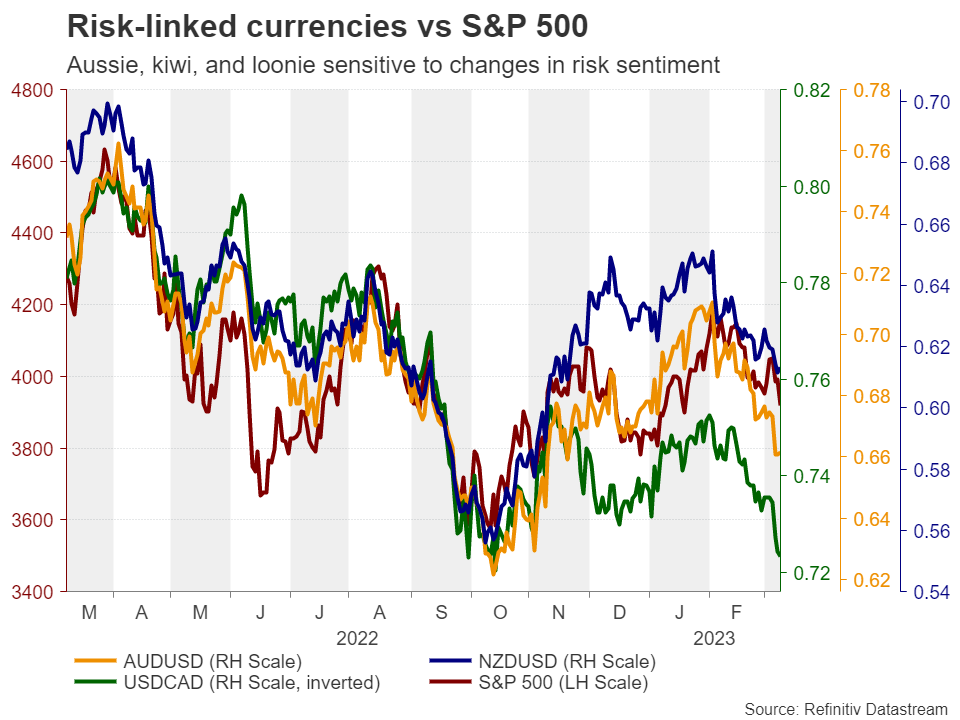
For example, iron ore is the leading commodity exported from Australia, with the nation holding the eighth place in terms of copper exports. Due to manufacturing and industrial sectors around the globe using those metals, the demand for them is affected by the performance of the global economy and that’s why the aussie (and for similar reasons the other commodity-linked currencies) is usually moving in tandem with equity indices. For that reason, those currencies are also called risk-sensitive or risk-linked currencies.
Risk-linked currencies suffer as Fed and ECB hike bets rise
Since the beginning of February all the major currencies have been underperforming against the US dollar, which has staged a stellar comeback as a streak of upbeat US economic releases and hotter-than-expected inflation data prompted market participants to radically increase their Fed hike bets. With Fed Chair Jerome Powell appearing in a hawkish suit on Tuesday and saying that interest rates may rise higher and probably faster than previously anticipated, investors are now assigning a nearly 70% probability for a bigger 50bps hike by the Fed in two weeks, while they see a terminal rate of nearly 5.5%.
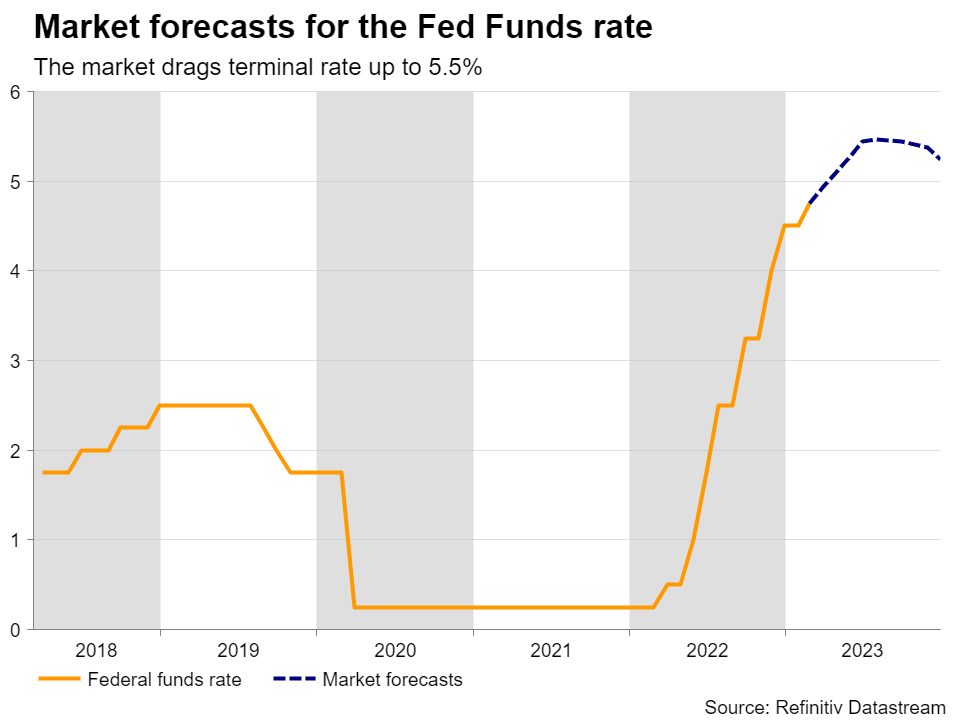
This change of heart on US interest rates has also weighed on equities and the broader risk sentiment as higher interest rates mean higher borrowing costs and lower corporate valuations, but also tighter financial conditions that could result in an economic slowdown. But hike bets are not rising only regarding the Fed. The ECB is also expected to raise rates higher than previously anticipated, with money markets now expecting a total of 160 basis points worth of additional rate increases by the end of the year.
Therefore, regardless of what their national central banks are planning to do, the aussie, the kiwi and the loonie have been under pressure, and they could continue feeling the heat of rising hike bets should incoming Eurozone and US data releases continue to corroborate that narrative.
How are they affected by policies of their own central banks?
Having said all that, an interesting question might be: Which currency could be hurt the most? There is no crystal-clear answer, but one major dynamic that could help in arriving at some sort of conclusion may be any divergences between the monetary policy strategies of their respective central banks.
So, kicking off with the BoC, this Wednesday, it refrained from pushing the hike button, becoming the first major central bank to hit the pause button in the current fight against inflation, with the meeting statement providing hints that they could stay on the sidelines until data warrants otherwise. Market participants are pricing nearly another 25bps hike by the end of the year, which leaves ample room for further declines in the loonie should Canadian data continue to disappoint.
Passing the ball to the RBA, policymakers of this Bank did press the hike button when they last met, delivering a 25bps hike and noting that further tightening of monetary policy will probably be needed. However, they added that how much further interest rates need to increase will depend on upcoming data and developments, with Governor Lowe saying a few days after the meeting that they are now closer to also pausing. In terms of market pricing, there is only a 40% probability for another 25bps hike at the upcoming gathering, with the remaining 60% pointing to a pause, but investors see nearly another 50bps worth of increments until December.
Last but not least, the RBNZ hiked by 50bps in February, with the market expecting 80 more basis points worth of hikes this year.
Loonie could be hurt the most
Putting everything together, it seems that there is a decent divergence between the RBNZ and the other two Banks, and thus the kiwi may be the first to be dismissed as a potential answer. Now, between the other two, the aussie took the most beating since the dollar’s rebound on February 3. However, following Powell’s hawkish remarks before Congress and the BoC’s dovish decision this Wednesday, the loonie accelerated its slide, although it has been holding better compared to the other two.
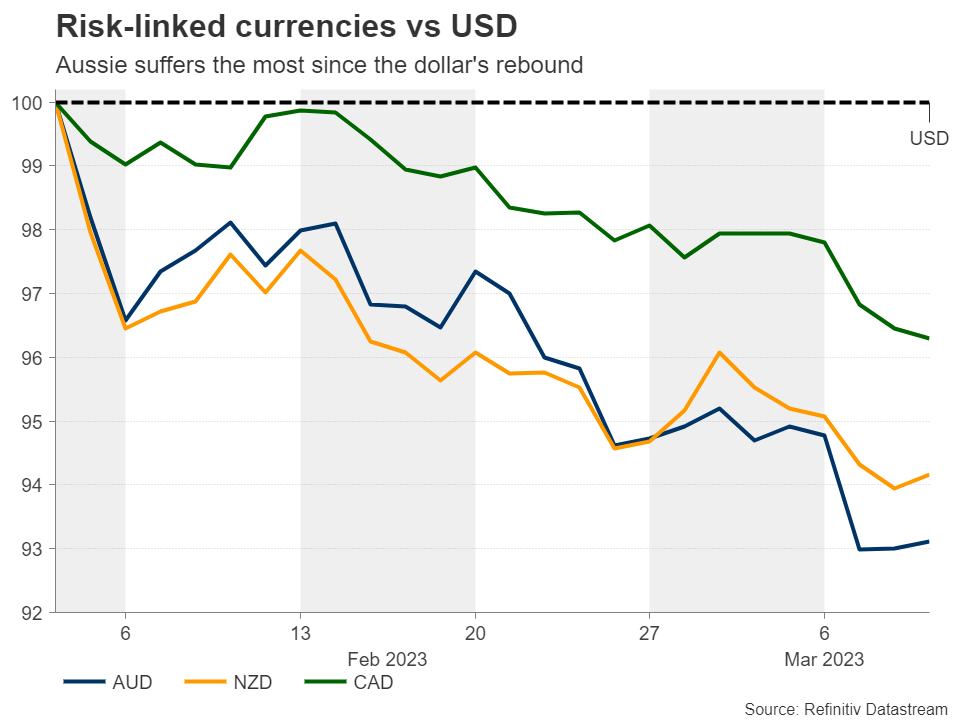
With the BoC appearing more dovish than the RBA, this suggests that from a risk-to-reward perspective, the loonie may be a better choice for exploiting further declines. In other words, there may be more room for the loonie to extend its slide. On top of that, Australia has closer trading ties with China and thus, it is more sensitive to developments surrounding the world’s second largest economy. Therefore, with the Chinese PMIs pointing to a notable improvement after the nation’s reopening from the strict COVID-related curbs, the environment may be slightly more favorable for the aussie hereafter.
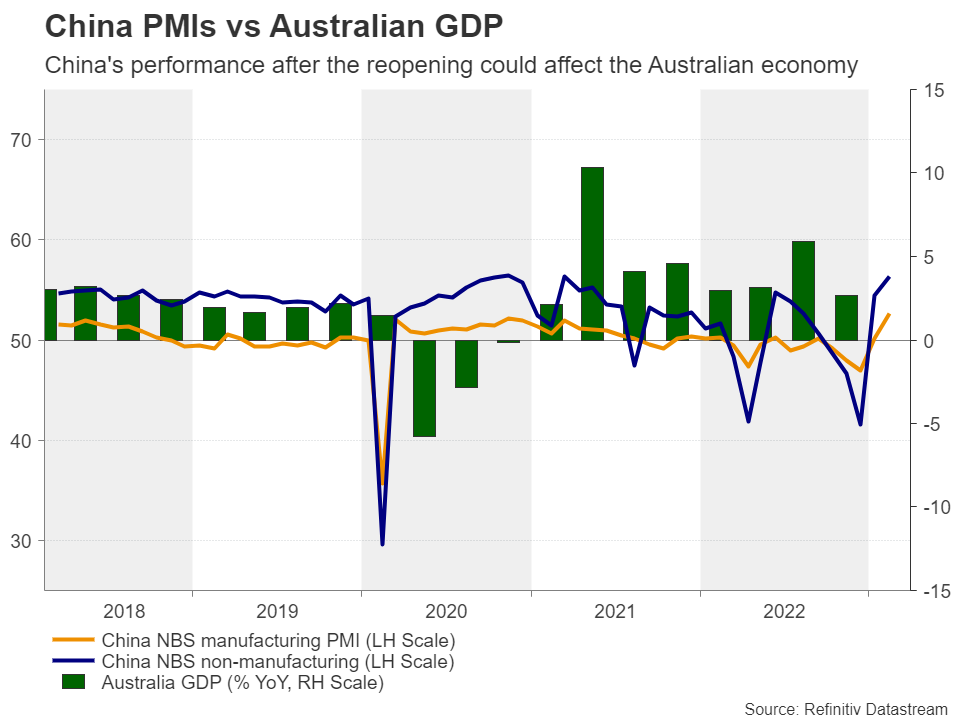
Ergo, should market participants keep their Fed hike bets elevated, all three of the major risk-liked currencies could continue to slide against the dollar, but the one to suffer the most may be the loonie.
Dollar/loonie gets closer to its October high
Dollar loonie has been in a rally mode since Tuesday, breaking two important resistance areas since then; the 1.3700 zone, which acted as a ceiling between December 7 and January 3, and the 1.3810 barrier, marked by the high of November 3. Overall, the pair is trading well above the uptrend line drawn from the low of June and well above the 50- and 200-day exponential moving averages.
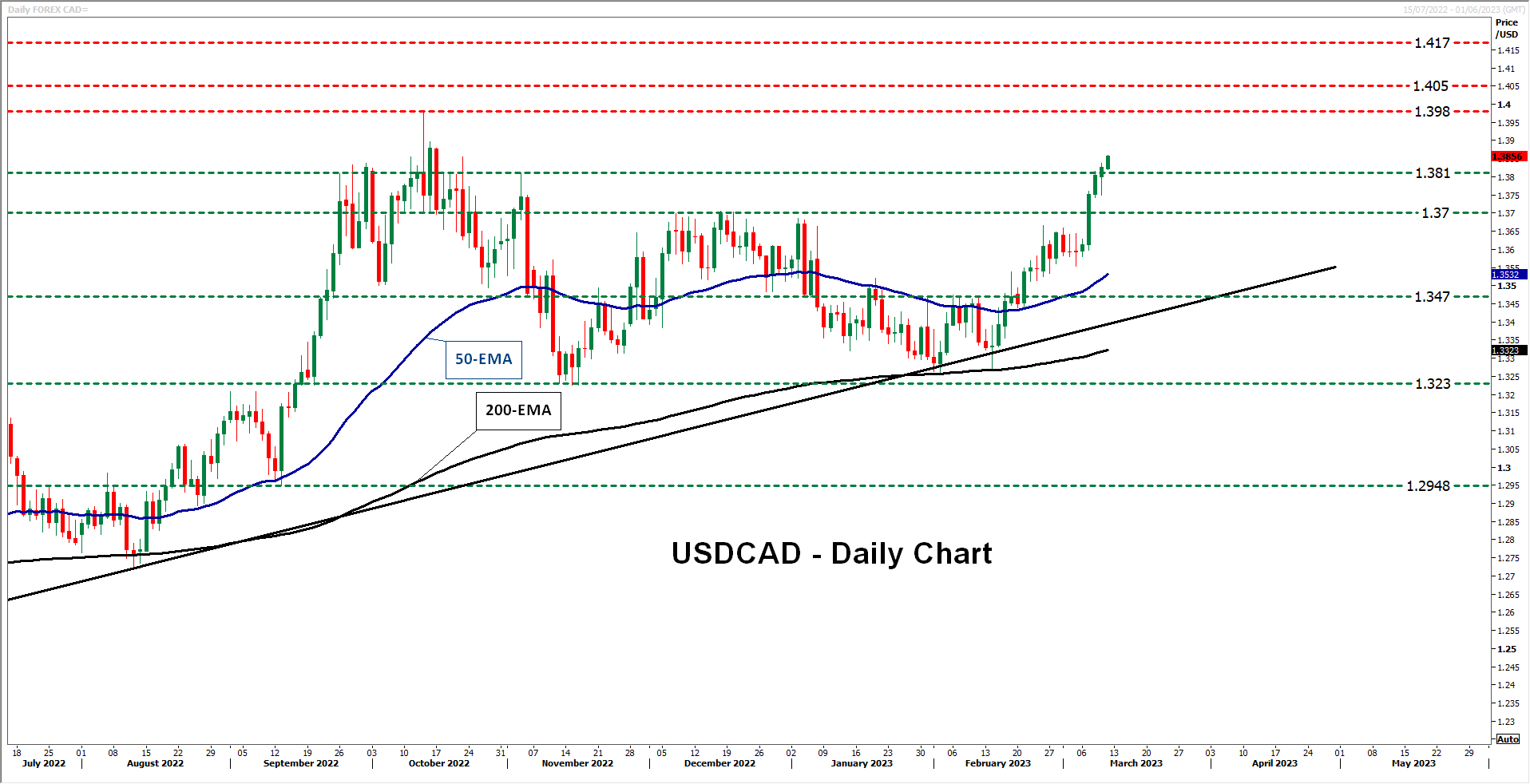
Dollar/loonie now seems to be heading towards the peak of October 3 at 1.3980, which is also the highest point since May 2020. If the bulls are strong enough to overcome it, they could aim for the high of May 22, 2020, at 1.4050, the break of which could see scope for extensions towards the peak of May 7, 2020, at 1.4170.
On the downside, the positive outlook could be dismissed upon a dip below 1.3470. Such a dip could also signal the break of the aforementioned uptrend line and allow declines towards the key territory of 1.3230, which offered support in November and February, and acted as resistance back in July. If that important area fails to stop the bears this time around, its break could set the stage for declines towards the low of September 13 at 1.2955.
The Weekly Bottom Line: BoC on Hold Amid Defiant Labour Market
U.S. Highlights
- Chair Powell’s testimony threw the market in to risk-off mode with both the Treasury and equity market falling on the week.
- The economy added 311k jobs in February, well ahead of the consensus forecast of 225k, reinforcing the resilience of the job market.
- There’s still plenty of data to come in before the Fed’s rate decision, with next week’s inflation report the most important.
Canadian Highlights
- As widely expected, the Bank left the overnight rate unchanged at 4.5% this week. So far, the economy has evolved largely in-line with the central bank’s expectations, meeting the conditions set to pause on rate hikes.
- Today’s employment report showed that the labour market remained tight in February, adding 22k new positions on top of the blockbuster 150k gain in January. Labour market resilience suggests that the BoC may have to wait longer to see a meaningful slowdown in hiring.
- A significant increase in government payouts and subsidies combined with still-elevated household wealth and savings may be blunting the impact of higher interest rates on consumers, making the usual monetary policy lags even longer.
U.S. - Jobs Market Stays Strong
Chair Powell’s bi-annual testimony to Congress pushed the market into risk-off mode as his explicit remarks put the half-point rate hike back on the table. In his statement, Powell highlighted the strength of the latest economic data, “which suggests that the ultimate level of interest rates is likely to be higher than previously anticipated”.
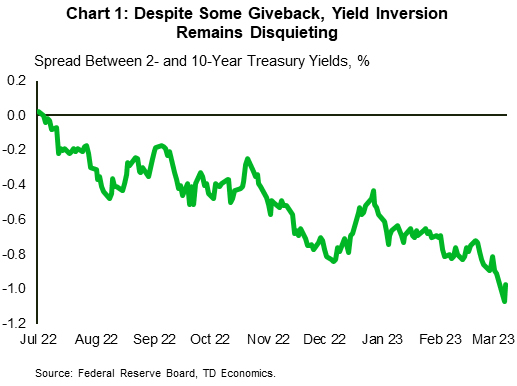
Treasuries plunged to fresh lows, with the two-year yield moving briefly above 5% for the first time since July 2007, while keeping the ten-year yield hovering just below 4%. As a result, the spread between the two (one of the strongest market-based recession indicators) widened to the 100-basis point mark before narrowing back to 90 bps by the end of the week (Chart 1). This is the deepest inversion since 1981. The equity market was as volatile, with the trouble at SVB Financial Group adding to shock. The S&P 500 Index moved below the 4,000-level finishing the week with a 3.4% loss (at the time of writing).
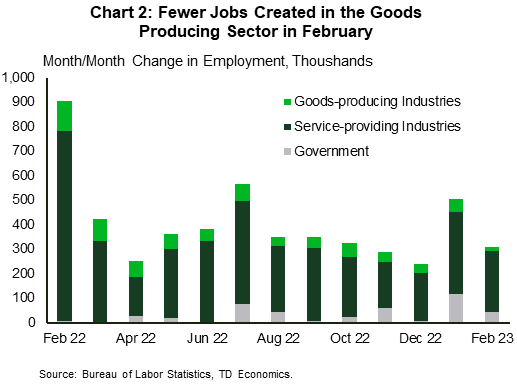
Today’s payrolls report didn’t help settle the markets. The employment number came in stronger than anticipated (at 311k v. 225k expected), suggesting that there is considerable strength in the jobs market. The unemployment rate returned to 3.6% as the labor force expanded, lifting the participation rate to 62.5%. Notably, the monthly increase in the goods producing sector was the smallest since May 2021, with job gains tilted towards the services sector (Chart 2). The trend pace of average hourly earnings growth over the past three months slipped to the slowest pace of growth in nearly two-years. However, hourly earnings don’t adjust for compositional effects across sectors, and have been running well below other metrics in recent months. February’s softness is likely in part due to job gains concentrated in lower-wage sectors and jobs losses in some higher-wage ones.
The tight labor market was also evidenced in January’s Job Openings and Labor Turnover Survey (JOLTS). While job vacancies declined to 10.8 from an upwardly revised 11.2 million in December, they remain high, suggesting that demand for workers exceeds supply – a condition that will continue to support wage growth.
There’s still plenty of data to come before the Fed’s March 21-22 meeting, when the Fed decides on the rate hike and releases updated economic projections. Next week, we’ll have more details on CPI and retail sales for February. The former has more bearing on the rate decision, as it makes up the second half of the Fed’s dual mandate (besides maximum employment), while the latter may contribute to the Fed’s understanding of consumer spending momentum. To convince FOMC members to keep the same pace of rate hikes as in December, price changes would need to provide evidence of a decelerating trend. Today, the probability of a 50-basis points hike settled around 40% - higher than 28% last week but lower than more than 70% earlier this week.
Canada – BoC on Hold Amid Defiant Labour Market
It was on eventful week, with both the Bank of Canada interest rate announcement and jobs data on the docket. As expected, the Bank left the overnight rate unchanged at 4.5%. So far, the economy has evolved largely in-line with the central bank's expectations, meeting the conditions set out for the Bank to pause on rate hikes. Economic growth continued to slow, coming to a halt in the final quarter of last year. The Bank noted that the labour market remained very tight, however it is not yet worried about it, expecting demand for workers to ease in the coming quarters. Ditto for inflation, which it expects to slow from 5.9% in January to around 3% by the middle of this year.
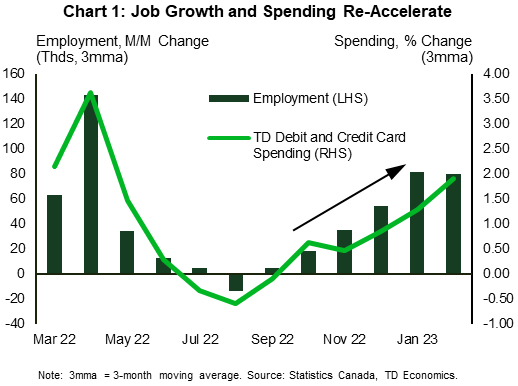
It is likely a matter of time before a slowdown shows up in the employment numbers. However, the latest resilience in job growth suggests that the Bank may need to wait a little longer for this to materialize. Hiring has re-accelerated in recent months, and consumer spending – as captured by debit and credit card transactions – followed suit (Chart 1). Today's employment report showed that the labour market continued to roll in February, adding 22k new positions on top of the blockbuster 150k gain in January. The unemployment rate held steady at 5%, total hours worked increased and wage growth has accelerated.
The Bank of Canada's pause contrasted with hawkish comments from Fed Chair Jerome Powell, who noted this week that the incoming economic data has been stronger than expected and the Fed will need to raise rates higher than previously anticipated. This will widen the gap between the two policy rates.
On that note, the BoC Deputy Governor Carolyn Rogers stated every country has different circumstances and needs "to chart its own course to return to price stability." She noted that Canada's highly indebted households make them more vulnerable to higher rates than their American counterparts. Indeed, the Bank might be wise to wait and let the economy absorb the 425 basis points of monetary tightening. So far there are no signs of broad-based financial stress among the Canadian households, but many have not yet been exposed to higher debt servicing costs.
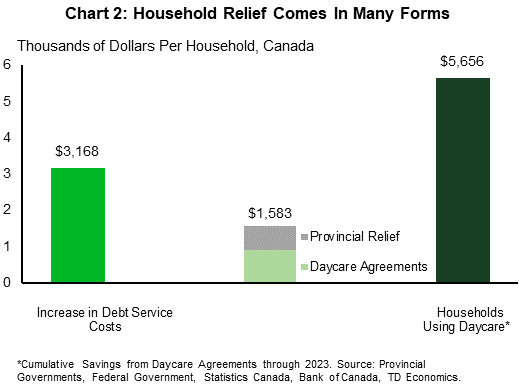
It is also important to be mindful that this economic cycle is not like the others. Households are facing higher rates from a from a relatively strong financial position, with still elevated levels of wealth and savings. This could blunt their sensitivity to rate hikes, making the usual policy lags even longer. In addition, as we note in this week's perspective, income is getting a boost from a significant increase in government payouts and subsidies, mitigating some of the hit from higher debt servicing costs (Chart 2). This is juicing the economy, running counter to what the BoC is trying to accomplish, and something the Bank needs to keep an eye on as we head into a busy government budget season.
Weekly Economic & Financial Commentary: Central Banks Front and Center This Week
Summary
United States: Labor Market Continues to Exude Resilience
- Coming into the week, financial markets were looking for validation that January's unexpected strength was not a fluke and that the downward slide in economic momentum experienced late last year had stabilized. On balance, this week's indicators supported that notion.
- Next week: CPI (Tue), Retail Sales (Wed), Industrial Production (Fri)
International: Central Banks Front and Center This Week
- Obviously, Fed Chair Powell's two-day testimony caught market participants' attention the most; however, the Bank of Canada (BoC) and Bank of Japan (BoJ) also met this week as well. While neither institution caught markets off guard with any surprise decisions or communications, a Fed shifting slightly more hawkish combined with stress in the U.S. banking system could complicate future monetary policy decisions going forward.
- Next week: India CPI (Mon), Argentina CPI (Tue), European Central Bank (Thu)
Credit Market Insights: 2023 Started Off with Some Signs of Life, Beige Book Reports
- Overall economic activity modestly expanded in six districts, while little or no growth was reported in the other six districts. The labor market remains tight, while inflation is still a concern. Regional variation in prices as well as labor supply and demand contribute to a mixed but generally positive picture.
Topic of the Week: Party of One
- There has been a gradual shift in household structure taking place in the United States. Now, more than half of women are single. The change is rippling across the economy and leaving a mark on the labor market, wealth and spending.
U.S. Inflation Easing, But Still Sticky
U.S. headline inflation will be anxiously awaited next week as Fed officials debate how much to raise interest rates. We expect Tuesday’s report to show the year-over-year measure falling to 5.9% in February compared to 6.4% January (which was the lowest reading since October 2021). Much of that easing has come from lower energy prices and signs that food price growth is past its peak. Growth in those categories should continue to slow on lower commodity prices and easing global supply chain disruptions. One closely-watched measure from the New York Fed reports that global supply chain pressures have now essentially returned to normal.
Inflation pressures across other goods and services—the kind of inflation more directly influenced by U.S. Federal Reserve interest rate decisions—has also been edging lower, though its proven stickier than expected in recent months. We expect the February numbers to look better with ‘core’ inflation (which excludes food and energy products) dipping to 5.4% from 5.6% in January. A rising share of that increase is still coming from the lagged impact of earlier increases in home rents flowing through to leases—a pressure that won’t last given the slowdown in current market rent prices. Core services ex-rents, the Fed’s preferred measure of domestically-driven inflation, rebounded slightly in January and will be closely scrutinized for any signs of easing.
Robust U.S. labour market data indicates strong economic momentum at the start of 2023, and stickier inflation suggests it may take longer to get back to the 2% target. This is bolstering the case for further interest rate hikes from the Fed.
Week ahead data watch
StatCan’s advance estimate indicates January manufacturing sales rose 3.9%, boosted by petroleum and coal products, motor vehicles, primary metals and railroad stock industries.
We expect Canadian housing starts to rebound to 245,000 units in February following a decline to 215,000 units in January.
The Canadian Q4 household debt service ratio (the share of household disposable income eaten up by debt payments) likely ticked up to 14.3% in Q4—below pre-pandemic levels but up from a low of 13.3% in Q1 2021. We expect the ratio to rise to record levels this year as aggressive BoC interest rate hikes continue to flow through to household debt payments.
We expect U.S. retail sales edged 0.1% lower in February, with sales in the motor vehicle sector shrinking by 3.3% during that month. U.S. industrial production likely tick down 0.1%, given hours worked in both manufacturing (-0.5%) and mining (-1.1%) sectors fell in February.downturn.
Week Ahead – ECB Playing Catch-Up
The labor market is still strong but is showing signs it is ready to soften as wages cool. Wall Street will pay close attention to the February inflation report. Disinflation trends are struggling here and a hot report could not only lock the Fed into boosting their hiking pace but possibly lead markets into expecting a higher peak rate. Headline inflation is expected to slow from 6.4% to 6.0%. The monthly inflation rate is expected to edge lower from 0.5% to 0.4%, while the core reading is expected to hold steady at the 0.4% pace.
While the inflation report will get the majority of the attention, traders should also pay close attention to the February retail sales data which should show consumer spending is weakening. Housing data is expected to remain weak, while a couple of Fed regional surveys (Empire/Philly) should show manufacturing data remains deeply in contraction territory. Friday’s release of consumer sentiment is expected to hold steady, while many traders will pay close attention to see if inflation expectations continue to retreat.
With the Fed’s blackout period quickly approaching, only Bowman will make an appearance on Tuesday at the Community Bankers Event in Hawaii.
The ECB is widely expected to raise interest rates by 50 basis points on Thursday but it’s what comes next that investors will be most interested in. This makes the new economic projections that are released alongside the decision, and the press conference, arguably the most important things to watch out for.
Labor market figures on Tuesday are the standout release next week but it’s the spring budget a day later that people may be most interested in. The fact that the UK is not already in recession will come as a big surprise to many and one of the benefits of that may be a little extra fiscal headroom for the Chancellor. Unfortunately, giveaways may be few and far between for a number of reasons that may make holding off more appealing to the government.
Russia
The CBR is expected to leave interest rates unchanged at 7.5% on Friday. Inflation has been declining but remains far above target which may encourage the central bank to stay on hold for now.
South Africa
It’s a little light on economic data next week with manufacturing production and retail sales the only notable indicators on Tuesday and Wednesday, respectively.
Turkey
No major data or events next week.
Switzerland
It’s a little quiet next week but the focus will remain on what the SNB will do on 23 March, especially after the inflation overshoot in February. Markets are still pricing in 50 basis points with a small chance of 75.
China
The National People’s Congress (NPC) has made a more conservative forecast of 5.0% GDP growth in 2023. Recent economic data has shown a strong recovery in the economy, confirming expectations for an early recovery but softening expectations for fiscal and monetary stimulus. The lifting of the zero-Covid policy has led to a surge in business activity, reduced operational interruptions, and robust data on commercial activities.
Powell’s testimony this past week lifted the US dollar against the Chinese yuan pushing the pair close to the psychological level of 7.0000 which may attract attention once more.
Focus next week will remain on the data including retail sales, industrial production, fixed asset investment, and unemployment.
Markets are pricing in one more rate hike in the tightening cycle at the next meeting on 6 April but next week’s inflation data could change that. Recent trends around the world have seen more rate hikes being priced in and India is no exception after the inflation jump in January. If it doesn’t prove to be an anomaly, further hikes could be priced in.
Australia & New Zealand
Next week offers the Australian unemployment rate, employment change, and change in full-time employment on Thursday. From New Zealand, we’ll get fourth-quarter GDP data on Wednesday and we’ll also hear from Assistant Governor, Karen Silk on Sunday
Japan
There isn’t much on the agenda next week, with the minutes of the Bank of Japan’s January monetary policy meeting on Wednesday arguably the highlight. Minutes are often viewed as being outdated but nowhere is this more true than in Japan, where those of the January meeting are released after the March meeting has taken place. For that reason, it would take something extraordinary for them to have a big impact on the markets.
Kazuo Ueda, the new governor of the BoJ who will take office in April, recently stated that it is not a good time to abandon the current policy considering the current economic environment. He supports its continued commitment to massive quantitative easing and is not expected to significantly adjust the yield curve control, which has limited the attractiveness of the yen.
Singapore
Unemployment data on Monday is the only economic release this upcoming week.
Economic Calendar
Sunday, March 12
Economic Events
- New Zealand Food Prices
- Japan BSI Manufacturing Index
Monday, March 13
Economic Data/Events
- India CPI
- Mexico Industrial Production
- New Zealand REINZ House Sales
- Australia Westpac Consumer Conf, NAB Business Confidence
- BOE’s Dhingra speaks
Tuesday, March 14
Economic Data/Events
- Fed’s Bowman Speaks at Community Bankers Event in Hawaii
- UK Claimant Count Rate, Jobless Claim Change, ILO Unemployment Rate
- Swiss Producer and Import Prices
- Italy Industrial Production
- India Wholesale Prices
- South Africa Mining Data
- BoJ Minutes of January Meeting
- BoJ Outright Bond Purchases
- Riksbank in hearing on the annual report, monetary policy
Wednesday, March 15
Economic Data/Events
- US Empire Manufacturing, Retail Sales, PPI, NAHB Housing Market Index, MBA Mortgage Applications, Business Inventories, Net Long-term TIC flows
- China PBOC 1-year MLF Rate, Industrial Production, Retail Sales, Fixed assets, Nw Home Prices
- UK Chancellor Hunt delivers annual budget
- EIA Crude Oil Inventories
- Sweden CPI
- France CPI
- Poland CPI
- Italy Unemployment Rate, General Government Debt
- South Africa Retail Sales
- India Trade Data
- New Zealand GDP
- Australia Employment Change
Thursday, March 16
Economic Data/Events
- US Initial Jobless Claims, Philly Fed Business Outlook, Import and Export Prices, Housing Starts, Building Permits
- Canada Wholesale Trade Sales
- ECB Rate Decision: Expected to raise Main Refinancing Rate by 50bps to 3.50%
- ECB President Lagarde holds a post-rate decision press conference
- BOE releases Ipsos inflation survey
- Japan Industrial Production
- Sweden Prospera’s Inflation Expectations Survey
- Czech Current Account
- Poland Current Account
- Swiss SECO March Forecasts
- New Zealand Q4 GDP
- Riksbank Business Survey, Floden speaks
- UK OBR briefs on budget
- Japan Trade Balance
- Australia Employment Change
- Singapore Non-Oil Domestic Exports
Friday, March 17
Economic Data/Events
- US Industrial Production, Leading Index, University of Michigan Sentiment,
- Canada Industrial Product Price
- Eurozone CPI, OECD Publishes Interim Economic Outlook
- Sweden Unemployment Rate
- Baker Hughes Rig Count
- Russia central bank (CBR) rate decision: Expected to keep rates steady at 7.50%
Sovereign Rating Updates
- Turkey(Fitch)
- Belgium (S&P)
- Spain (S&P)
Week Ahead – US Inflation, ECB Decision to Test Markets’ Nerve
The US inflation report and the European Central Bank’s policy meeting will share the limelight next week amid another round of ratcheting up of rate hike expectations by investors. Other critical data such as Chinese industrial output, Australian employment and New Zealand GDP estimates might thus get overshadowed. Meanwhile in the UK, it’s budget time again, although the event is not expected to generate as much volatility as last time.
CPI report could make the case for 50-bps hike
There’s been no let-up in the ‘higher for longer’ bets for the Fed after a string of hot labour market and price data, pushing expectations for the terminal rate to a new cycle high of 5.65%. Fed Chair Powell gave the thumbs up to the markets’ shifting expectations for higher rates and opened the door to a re-acceleration of the tightening pace as early as the March meeting.
Tuesday’s CPI numbers will therefore be vital as they could determine whether FOMC members vote for a 25- or 50-basis-point increase. In January, the slowdown in the CPI rate was less than expected, sparking fears that high inflation will persist for longer than anticipated. The February forecasts point to a similarly slow process as the month-on-month increases are projected at a somewhat elevated pace of 0.4% for both the headline and core CPIs.
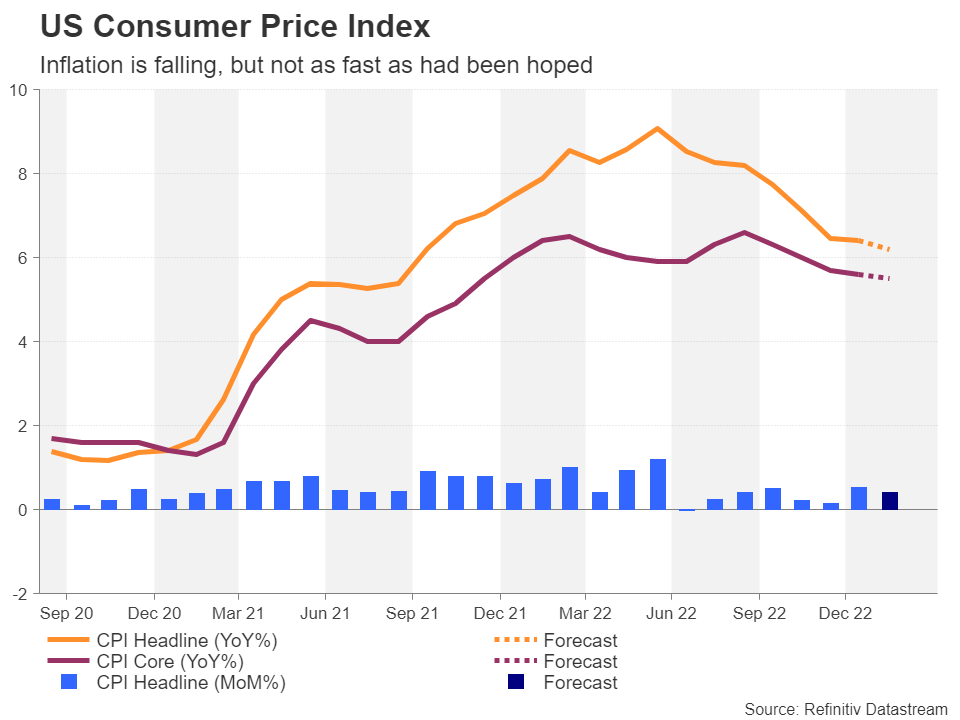
The producer price index will follow on Wednesday, along with retail sales figures for February. After a surprisingly robust rebound in consumption in January, investors will be watching to see if this was a blip or whether consumers continued to spend in the face of rising interest rates.
In other data, the New York and Philadelphia Feds’ manufacturing gauges on Wednesday and Thursday, respectively, will shed some light on how the sector fared in the early days of March. Building permits and housing starts are due on Thursday as well. Wrapping things up on Friday are industrial production numbers and the University of Michigan’s preliminary survey readings on consumer sentiment in March.
The US dollar is likely to receive another leg up on the back of a hotter-than-expected CPI report, though the gains might be muted ahead of the Fed meeting on March 21-22.
ECB to hike again, all eyes on future pace
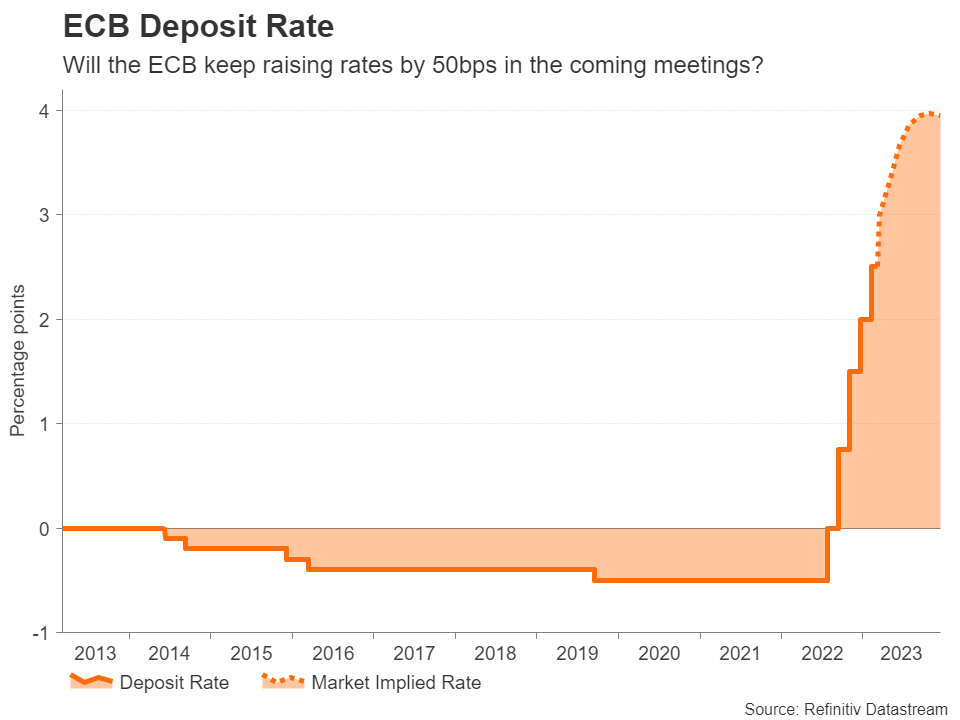
The ECB is almost certain to deliver its third straight hike of 50 bps on Thursday, raising the deposit rate to 3.0% - the highest since 2008. However, the path forward may get more complicated as there is a growing split between the hawks and the doves within the Governing Council.
The final readings of Eurozone inflation out on Friday are expected to confirm that the core CPI rate that excludes food and energy prices jumped to 7.4% - an astronomical figure in the eyes of ECB hawks. However, dovish members are worried about the impact that surging borrowing costs might have on weaker members such as Greece and Italy.
As in other countries, there is an intensifying debate about the appropriate speed of rate increases now that most of the major central banks are one year into their tightening cycle. Going too fast risks a hard landing but going too slow could be even more dangerous if it makes way for second-round effects.
The ECB will publish its latest quarterly staff projections after the meeting and it will be interesting to see how quickly inflation is forecast to drop to its 2% target. But the bigger question is whether President Christine Lagarde will signal another 50-bps hike in May as the failure to do so would suggest that doves may be winning the argument.
Such an outcome could be slightly negative for the euro, though not much, as rates could still peak as high as 4.0% by year-end.
Will the Spring Budget rattle the pound?
Over in the UK, it will be somewhat of a quieter week, with the January employment report due Tuesday being the only major release. However, the Spring Budget Statement on Wednesday will likely attract more attention for the pound.
After the turmoil that followed the previous budget in September, investors are feeling a lot calmer under the safer pair of hands of Jeremy Hunt heading into the event. Hunt has not pivoted away from his belief in fiscal discipline since taking on the role to clean up the mess left by Truss and her chancellor, so the likelihood of significant tax cuts is very low.
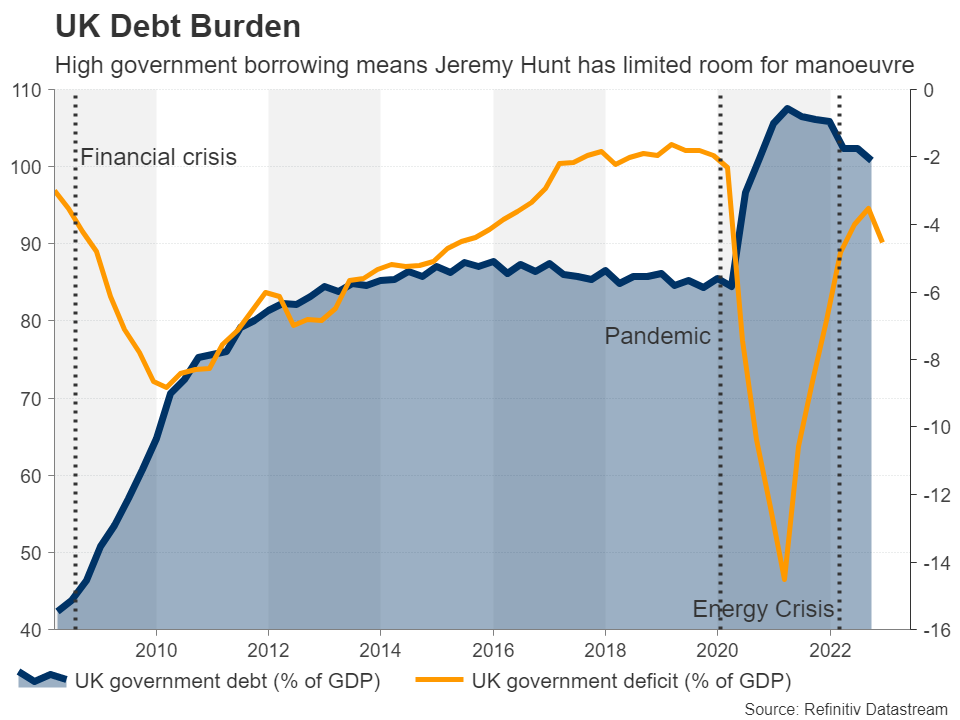
However, there is speculation that Hunt may announce tax breaks for businesses, specifically to encourage more investment, amid growing political frustration about the UK’s lacklustre growth prospects. Hunt is also under pressure to extend the energy price guarantee beyond April, and while there have been some indications that he is set to maintain this support, there’s also a chance it might be scaled back from the current generous levels.
For the pound, a budget that is pro-growth but with spending kept in check would be broadly positive.
Aussie and kiwi on data alert
China signalled that the days of ambitious GDP goals are over when it set itself a ‘modest’ growth target of 5% for 2023. This suggests that growth will mainly be driven by the reopening effect and the government has no plans to unleash new substantial stimulus measures. Data out on Wednesday is expected to show there was a further bounce back in the economy in February.
Industrial production growth is forecast to have picked up to 2.6%, while retail sales probably rebounded by 3.4% after contracting the previous month.
If the February numbers disappoint, the China-sensitive Australian dollar could slip on fears of a faltering recovery. But aussie traders will also be keeping an eye on domestic employment stats due Thursday. Australia’s economy shed 11.5k jobs in January so another weak report for February would dampen expectations about the RBA hiking rates at its next meeting.
Across the Tasman Sea, Q4 GDP figures for New Zealand are released on Thursday. But the data may not necessarily have a sizeable impact on RBNZ rate hike expectations unless there is a very big beat or miss.
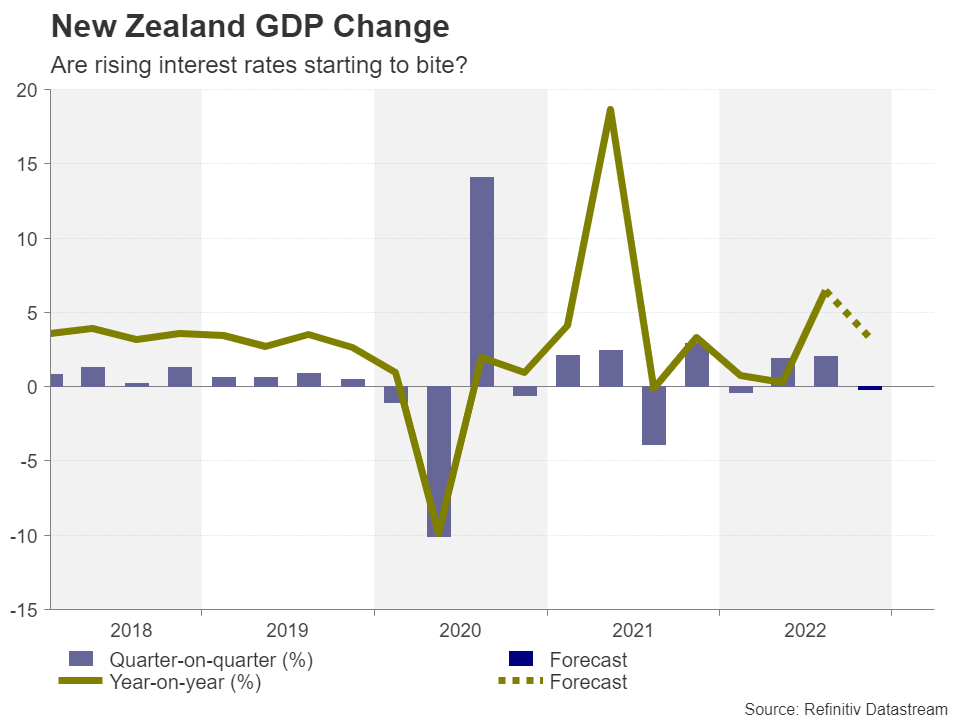 Although the RBNZ has not followed some of its peers in toning down its hawkish rhetoric, it has already been one of the most aggressive central banks over the past year and so there is limited scope for its terminal rate to go much higher. Neither is the RBNZ likely to abruptly turn dovish, thus, there’s not a lot to price into money markets in either direction, meaning the New Zealand dollar will mainly stay attuned to the global risk tone.
Weekly Focus – Hawkish Powell Opens for Possibility of a 50bp Hike
The biggest market mover this week was Fed Governor Jerome Powell's hawkish testimony in the Senate. Powell pointed to an "extremely tight labour market" and stated that the Fed was prepared to speed up rate rises if warranted by data, thus opening the door for a possible 50bp hike at the upcoming meeting on 22 March. No doubt next week's CPI report for February and the non-farm payrolls released today (after deadline) are key for the Fed's decision on the size of the hike. US job openings released this week were again stronger than expected, although declining slightly from the January level. When Powell described the labour market he referred specifically to the ratio of job openings to unemployed, which stood at 1.9 in January, a very high number historically. The market prices more than 100bp of further rate increases by the Fed over the next 2-3 quarters.
ECB members increasingly disagree on what to signal to the market, which led to an open spat when Bank of Italy governor Ignazio Visco took a swipe at colleagues saying that "Uncertainty is so high that the Governing Council of the ECB has agreed to decide 'meeting by meeting', without 'forward guidance...I therefore don't appreciate statements by my colleagues about future and prolonged interest rate hikes." It followed comments by Austrian central bank Governor Holzmann that he expected the ECB to hike 50bp at the next four meetings. Holzmann is probably the most hawkish member of the ECB. The market currently prices a further 160bp of hikes broadly in line with our own forecast.
Updated fiscal policy guidance from the European Commission urged EU countries to start phasing out government support programmes after the pandemic and energy crisis, as Brussels prepares to reinstate Stability and Growth Pact rules in 2024. However, the planned reinstatement coincides with ongoing discussions to overhaul the Stability and Growth Pact (SGP) rules, where consensus remains yet elusive.
In China the National People's Congress opened on Sunday and revealed a growth target for 2023 of 'around 5%', which was at the low end of expectations. It is a signal that China will hold back from major stimulus and prioritizes long-term stability goals. We expect China to beat the target and growth 5.5% this year as data so far points to a strong rebound of the economy after the 'reopening' and we see scope for pent-up demand in consumption and housing to be unleashed this year. This weekend China will present new people on key positions in the government and Li Qiang will officially become China's new number two as Premier, taking over from Li Keqiang.
In financial markets long bond yields have moved sideways despite higher short-end yields following the hawkish signals from Powell. The USD gained on more rate hikes being priced while equities and commodity prices are broadly flat on the week.
The key data release the coming week will be the US CPI for February. We broadly agree with consensus of another print on the high side of 0.4% m/m for core CPI. It is also time for the ECB meeting on Thursday which will be the highlight. A 50bp hike is a done deal, but markets will pay attention to the communication for the May meeting, given the continued strong underlying inflation pressure. See also our ECB preview: Higher for longer - now seen at 4%, 2 March.
Sunset Market Commentary
Markets
The developing Silicon Valley Bank story kept markets hostage and determined today’s reaction to the latest US payrolls release. Yesterday’s surprise announcement by SVB that it wanted to raise $2.25bn by issuing shares to strengthen its capital position triggered a strong risk-off move. SVB is considered a (one of the first) victim(s) of central bank’s aggressive tightening campaigns following decades of ultra-easy monetary policy. Lack of deposits triggered forced asset sales of eg US Treasuries at steep losses. The story triggered a bank run on SVB and raises questions on broader financial stability as Fed policy becomes restrictive with a deeply inverse yield curve. Global core bonds stuck to yesterday’s gains (US Treasuries) or made a catch-up move (German Bunds). European stock markets follow WS and Asia south with losses of up to 2%. The specific (US) nature of the current problems hampers the greenback’s normal outperformance in such risk-off market setting.
The above-mentioned story helps explain the market reaction the US payrolls. The US economy added another 311k jobs in February, significantly beating 225k consensus, even when taking into account a 34k downward revision to the previous two months’ numbers. The second consecutive blowout numbers (504k in January) would have already cemented a 50 bps Fed rate hike in March if it weren’t for the developing SVB story. Now, markets focused on parts of the report which fell shy of expectations. The unemployment rate for example ticked up from 3.4% to 3.6% though we add a rise in the participation rate from 62.4% to 62.5%. Average weekly hours declined from 34.6 to 34.5. Average hourly earnings decelerated from 0.3% M/M to 0.2% M/M (vs 0.3% expected) while rising from 4.4% Y/Y to 4.6% Y/Y (vs 4.7% expected). Markets picked up on those elements, together with the financial stability concerns scaling back rate hike bets for March to 25 bps. US yields lose another 11.3 bps (30-yr) to 22.5 bps (2-yr). German yields fall by 15.9 bps (30-yr) to 24.5 bps (2-yr). US stock markets open up to 1.5% weaker. EUR/USD spikes from 1.06 to 1.0650.
News Headlines
Czech inflation slowed in February to 0.6% M/M and 16.7%Y/Y, compared to 6.0% M/M and 17.5% Y/Y in January. The outcome was marginally higher than market expectations and the forecast of the Czech national bank (16.5% Y/Y). Prices of goods in total went up by 0.5% and services prices by 0.6%. Core inflation (CNB reporting) printed at 12.1%. There were significant price hikes in food led by vegetables and fruit (+12.7%). Prices of households goods, appliances and household equipment (+1.4%) also rose substantially. As expected, fuel prices rose slightly in February, while inflation in the key housing section started to recede slowly. Imputed rents continued to fall (-0.7% M/M). Gas prices fell slightly (-1.6%). The data was no big surprise. KBC expects inflation to subside in coming months, mainly due to lower energy prices. Food price will decline more slowly. Core inflation (excluding imputed rent) will be more persistent. KBC expects inflation to stay in double digits in H1 of 2023 an may average about 11.0% for the whole year. The Czech koruna today lost modest ground (EUR/CZK 23.63) but this was mainly due to the broader risk-off sentiment rather than to country-specific topics.
The Canadian economy added 21 800 jobs in February. This compares with an outsized employment gain of 150 k in January. Still the figure was stronger than expected. The unemployment rate held near a record low at 5%. The participation rate stabilized at 65.7%. The hourly wage of permanent employees rose to a stronger than expected 5.4% Y/Y from 4.5% in January. The report comes as the Bank of Canada this week shifted to a pause in its rate hike cycle, leaving the policy rate unchanged at 4.50%. However, the BoC indicated that it remains prepared to increase the policy rate further if needed to return inflation to the 2% target. A tight labour market in this respect is an important factor. The Canadian dollar strengthened substantially from USD/CAD 1.383 to currently 1.378 after the release of the labour report. However, this was probably mainly inspired by the market reaction to the US payrolls released at the same time, rather than to the Canada data.
How Worried Should Forex Traders Be Over the SVB Crisis?
US stock indices dropped substantially yesterday, led by the Nasdaq and prompting a general sell-off across the world. A ~2% drop in the stock market isn't all that unusual, but this time it was caused by a massive drop in the banking sector. And when banks are in trouble, forex traders would do well to sit up and pay attention, since banks are the ones that handle all the money processing.
What happened?
The issue stems from some bad news out of a bank that is relatively unknown outside of the tech start-up sphere, Silicon Valley Bank, which is owned by SVB Financial (and most commonly known simply as SVB). It sparked a wave of panic in the tech sector, but also raised concerns among US retail banks that spread through all the major financial institutions. The cause of the crisis at SVB wasn't immediately apparent, and many investors are worried about the general situation of the banks as the Fed tries to drain liquidity from the market.
The issue came to light when SVB's parent announced that it had sold $21B in securities from its portfolio, followed by a filing to sell $2.25B in shares to shore up its capital position. The price of the stock subsequently crashed 60%, dragging on all the other banks. The reason was an unexpectedly high outflow in deposits from the bank. At the same time, SVB cut its net profit guidance.
What does it mean
What was already a problem of too many depositors withdrawing from the bank was accelerated when many venture capitalists started to pull their cash from the bank. Prominently that included Peter Theil's Founders Fund, which instructed its portfolio managers to limit exposure to SVB. The move caused what in effect was the first sign of a run on the bank. The CEO held a conference call with its main customers, trying to reassure them and avoid a full-blown run. A number of VCs have said they will stick with the bank.
The crisis at SVB coincided with the sudden closing of Silvergate Capital, which was highly exposed to the crypto industry. SVB is the only publicly-traded bank that focuses on Silicon Valley and its tech start ups. With interest rates rising, but inflation pushing real rates lower, tech startups in particular have been struggling to attract VC interest. That made SVB particularly vulnerable to a downturn in the tech space, as startups had to withdraw funds to keep operating in an increasingly costly environment.
What happens now?
The best case scenario is that the sale of assets covers the withdrawals, and investors are reassured. Some have proposed that it's necessary for the federal government to bail out SVB to maintain market confidence.
What dragged the banking index to its lowest level in three years, and prompted a shift to safe havens, is the worry that this is just the tip of the iceberg. The sudden rise in interest rates causes a vulnerability for banks that have low interest paying bonds which they can't sell without incurring substantial losses. That means if a bunch of customers need to withdraw their funds, the bank will have to sell assets at a loss.
SVB is nowhere close to the scale that would make it a "Lehman moment", but the surprise to the market could lead to a revaluation of the stability of the banking sector. How the Silvergate and SVB situation plays out over the coming days could be crucial for whether the market turns more risk averse or not.