Sample Category Title
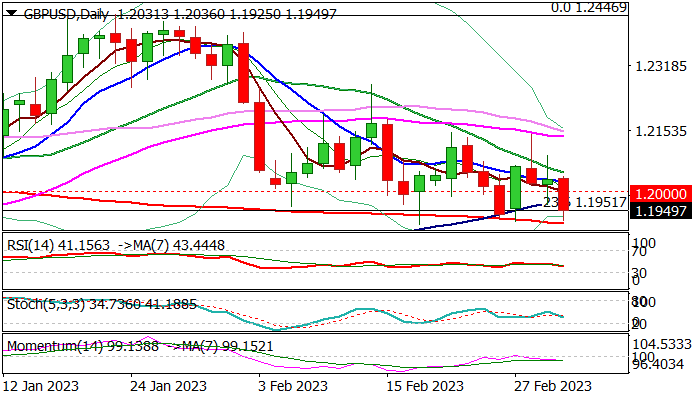
GBP/USD: Renewed Bears Probe Again Through Key Support Zone
Cable lost ground after recovery was strongly rejected at the base of falling weekly Ichimoku cloud on Tuesday and fresh bearish acceleration on Thursday broke psychological 1.20 level, to test key support zone at 1.1950/14 (Fibo 38.2% of 1.1146/1.2446 / 200DMA / Feb 17 spike low), which contained several attacks in past three weeks.
Weakening structure of daily studies (negative momentum is rising / RSI is heading south / moving averages almost in full bearish setup) is maintaining downside pressure, while descending weekly cloud continues to weigh on near-term action after larger recovery was capped by the cloud base on Jan 23.
Also, a double-top pattern has been formed (1.2447, tops of Dec 14 and Jan 23) and adds to bearish pressure, although the pattern still requires a confirmation on firm break of pivotal support at 1.1841 (2023 low, posted on Jan 6).
In addition, long upper shadows of weekly candlesticks of past three weeks, indicate persisting bearish pressure.
Fresh bears look for eventual break of 1.1950/14 support zone to spark acceleration lower, with violation of 1.1841 pivot to unmask next key support at 1.1645 (Fibo 38.2% retracement of entire recovery from 1.0348 (2022 low, posted on Sep 26) to 1.2447 peak.
Broken 1.20 support reverted to initial resistance, followed by key barriers at 1.2147/43 (Feb 21/28 tops, reinforced by 55DMA).
Res: 1.2000; 1.2046; 1.2089; 1.2147.
Sup: 1.1918; 1.1900; 1.1841; 1.1769.
Sunset Market Commentary
Markets
German bonds initially sold off further going into the publication of February European CPI. But ECB’s Lagarde held a speech first. She sounded determined to keep rates at a restrictive enough level (without specifying how high this would be) to tame inflation. Easing less than expected, from 8.6% y/y to 8.5%, headline price pressures indeed remain way above target in February. Core inflation accelerated to a new record of 5.6%, materially more than the 5.3% (which would have matched the January number) anticipated. Underscoring the stickiness of price pressures is services inflation, which hit a new record high as well at 4.8% (up a solid 0.4 ppts). ECB meeting minutes of the February policy meeting later showed a general tendency towards more (and much needed) rate hikes with concerns of overtightening dismissed as being premature. But there were some dovish elements to the minutes as well, with some officials warning of focusing too much on core inflation. Some also pointed out that “recent dynamics of core inflation showed that there had been a leveling-off of momentum”. The data today of course comes back to haunt them. From a risk management perspective, the minutes concluded, there was still value in frontloading rate hikes. Read: 50 bps in March and most likely (desk interpretation) in May. But despite the significant upside inflation surprise and overall hawkish tone to the minutes, Bund losses did not deepen. The opposite even materialized in some kind of a buy the rumour, sell the fact. German yields are currently down 2 bps at the front while the long end still adds 3 bps. The whole curve before the release was up more than 4 bps across the curve. US yields on the other hand surged 4.6-7.3 bps. American rates found new vigor, especially at the long end of the curve. After the US 10y yield broke above the symbolic 4% barrier in Asian dealings this morning a technical acceleration kicked in. A further decline in initial jobless claims to a low 190k and an upward revision to Q4 unit labor costs strengthened the yield upleg. Although outdated, the revision was this big (from 1.1% to 3.2% q/q) that it didn’t go unnoticed.
European stocks fainted at the open. Losses deepened to about 1% before recovering in lockstep with Bunds. The Euro Stoxx 50 currently trades about flat. The sentiment turnaround (dollar negative, euro positive) this time however does not compensate enough for widening yield differentials (vice versa). EUR/USD drops from 1.0668 to 1.0598 currently. USD/JPY rises to 136.81. It serves as important resistance with both the 100 and 200 dMA wandering around in the area. Sterling’s sharp move yesterday was met with follow-through losses. EUR/GBP is again testing 0.8897 resistance as we speak. A successful push higher, quickly brings back 0.90 on the radar. Worth mentioning is the retreat in CE currencies today. The strong, protracted strengthening move by the CZK, HUF and PLN goes in reverse with the former two underperforming.
News & Views
According to the Decision Maker Panel survey of the Bank of England, CFO’s of UK businesses in February expected their own-price inflation to ease the next year by 0.4% to an average of 5.4%. Expectations for CPI inflation one and three years ahead also eases respectively to 5.9% (from 6.4%) and 3.4% (from 3.7%). Actual unit costs in the year to February eased only marginally to 9.8%, but cost for next year also were expected to slow from 8.0% to 7.0%. Still, expected wage growth stayed at 5.7%. Supply side prices even were perceived have deteriorated. 45% of firms reported recruitment difficulties (35% in January) and even slightly higher non-labour input disruptions. Realised employment growth remained strong at 4.3% in the three months to February with expectations for year ahead employment growth also reaccelerating (3-month average 1.9% from 1.5%). Businesses also assessed the overall level of uncertainty to decline (53% down from 57%).
GDP in Brazil contracted 0.2% in the final quarter of 2022, statistics agency IBGE reported. Y/Y growth slowed from 3.6% to 1.9%. Cumulative growth over 2022 was reported at 2.9%. The release was close to expectations. Tighter financial conditions likely resulted in a substantial slowdown of private consumption (0.3% from 1.0% in Q3). Government consumption also slowed (0.3% Q/Q). Investment even contracted 1.1%. Net exports contributed positively due to a 3.5% rise in exports combined with a 1.9% decline of imports. The slowdown in activity might reinforce calls from the government for the central bank to ease the policy rate which is currently 13.75%. The real today declines from USD/BRL 5.18 to 5.22.
Yen Edges Lower, Eyes on Tokyo Core CPI
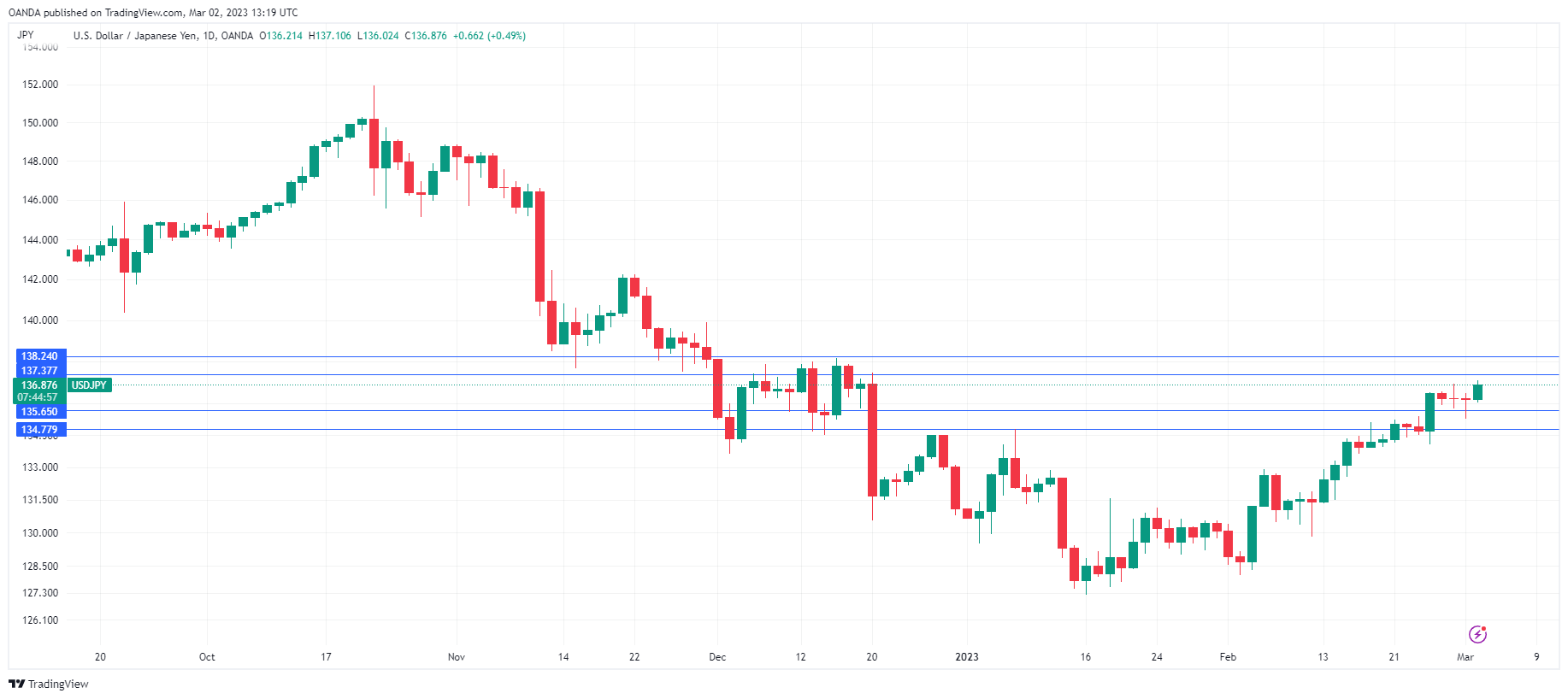
It has been a quiet week for the Japanese yen, but USD/JPY is showing some strength on Thursday and has pushed above the 137 line for the first time this year.
Will Tokyo Core CPI continue to rise?
Japan’s inflation indicators have continued to point upwards. We’ll get a look at Tokyo Core CPI for February later today. This key indicator has accelerated for eight straight months and hit 4.3% in December, its highest level since May 1981. The upward trend is expected to continue, with an estimate of 4.5%. A reading below expectations would not be a total surprise, as the government fuel subsidies took effect in February and could be reflected in the inflation release.
These inflation levels may be the envy of other developed countries, but they are causing serious distress in Japan, which had a deflation problem for decades. The Bank of Japan has insisted that inflation is transient, an echo of what the Fed and ECB were preaching before they threw in the towel and hiked rates in a massive fashion. As inflation continues to rise, there is growing pressure on the BoJ to ease up on its ultra-loose policy.
The BoJ, which has its hands full with rising inflation, is in the midst of a sensitive leadership transition. Kazuo Ueda will take over from Haruhiko Kuroda next month. Ueda has stressed continuity at his confirmation hearings, saying that the central bank’s current policy is appropriate. Nevertheless, the markets aren’t convinced that Ueda will take his time before making any changes in policy. The Bank’s yield curve control policy has damaged the bond markets and there is concern that if Ueda stands on the sidelines at the April meeting, the result could be a massive selling of bonds. Just to add to the drama, there is speculation that Kuroda could tweak policy at his final policy meeting on March 10 in order to relieve the pressure on Ueda.
USD/JPY Technical
- There is resistance at 137.37 and 138.24
- 135.65 and 134.78 are providing support
USD/JPY Mid-Day Outlook
Daily Pivots: (S1) 135.48; (P) 135.98; (R1) 136.69; More...
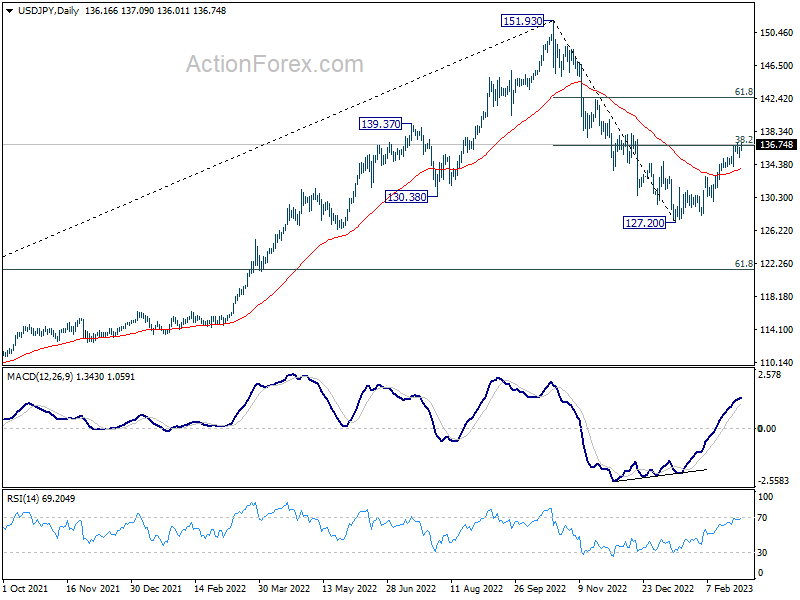
Intraday bias in USD/JPY is back on the upside with break of 136.91 temporary top. Sustained trading above 38.2% retracement of 151.93 to 127.20 at 136.64 will indicate that fall from 151.93 has completed, and bring further rally to 61.8% retracement at 142.48. Nevertheless, rejection by this fibonacci level, followed by break of 135.24 support, will argue that rebound from 127.20 has completed, and turn bias back to the downside.
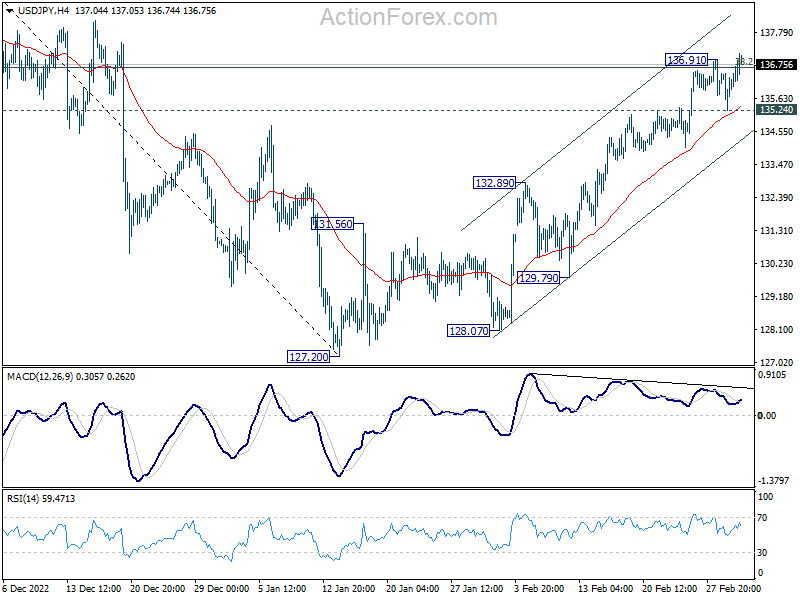
In the bigger picture, focus is now on 38.2% retracement of 151.93 to 127.20 at 136.64. Sustained break there will indicate that price actions from 151.93 medium term are merely a corrective pattern. Such development will maintain long term bullishness. Rejection by 136.64 will, on the other hand, extend the fall from 151.93 to 61.8% retracement of 102.58 to 151.93 at 121.43 at a later stage.
USD/CHF Mid-Day Outlook
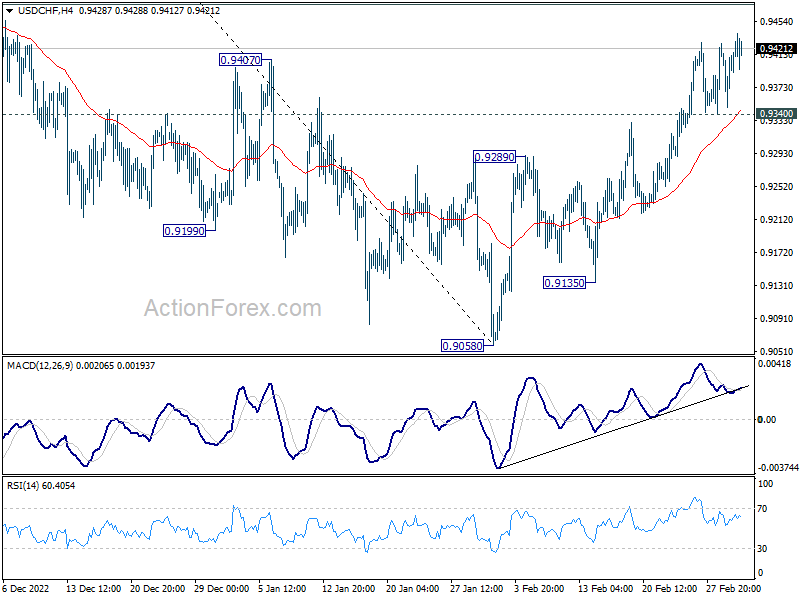
Daily Pivots: (S1) 0.9356; (P) 0.9392; (R1) 0.9434; More...
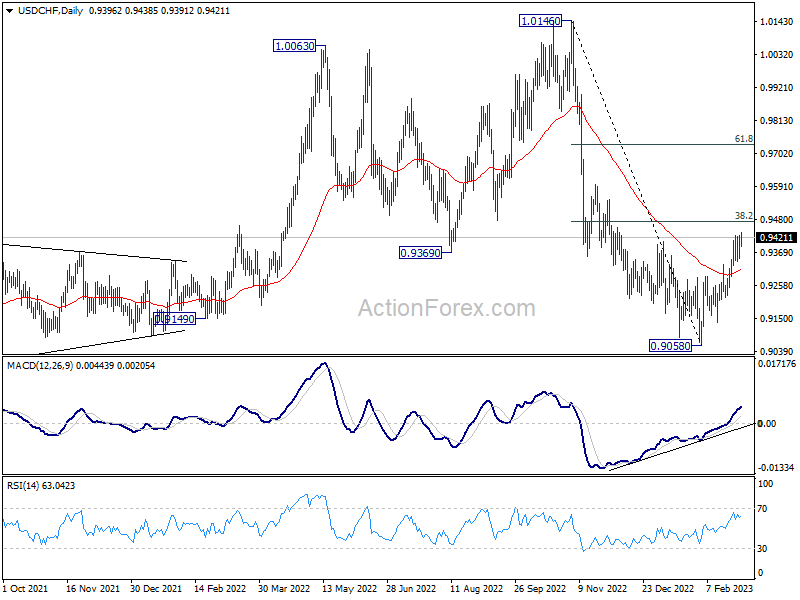
Intraday bias in USD/CHF remains on the upside. Further rally would be seen to 38.2% retracement of 1.0146 to 0.9058 at 0.9474. Strong resistance could be seen there to complete the rebound from 0.9058. Break of 0.9340 minor support will now turn bias back to the downside. However, decisive break of 0.9474 will carry larger bullish implications and target 61.8% retracement at 0.9730.
In the bigger picture, decline from 1.0146 is seen as part of a long term sideway pattern. As long as 38.2% retracement of 1.0146 to 0.9058 at 0.9474 holds, another fall is in favor through 0.9058. However, sustained trading above 0.9474 will indicate that the medium term trend has reversed, and open up further rally to 61.8% retracement at 0.9730 and above.
GBP/USD Mid-Day Outlook
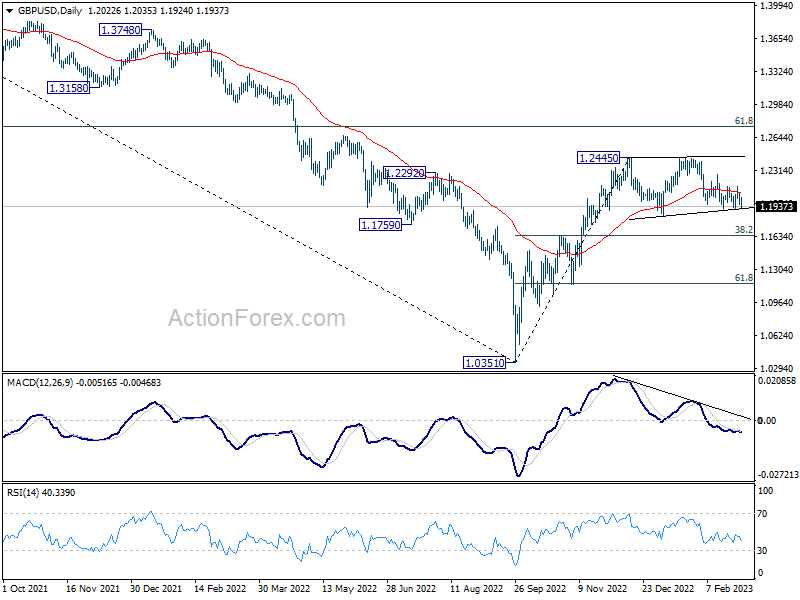
Daily Pivots: (S1) 1.1965; (P) 1.2027; (R1) 1.2089; More...
Intraday bias sin GBP/USD remains neutral for the moment. On the downside, break of 1.1914 will resume the decline from 1.2446 for 1.1840 support and possibly below. On the upside, break of 1.2146 resistance will turn bias back to the upside for further rebound to 1.2269 and above.
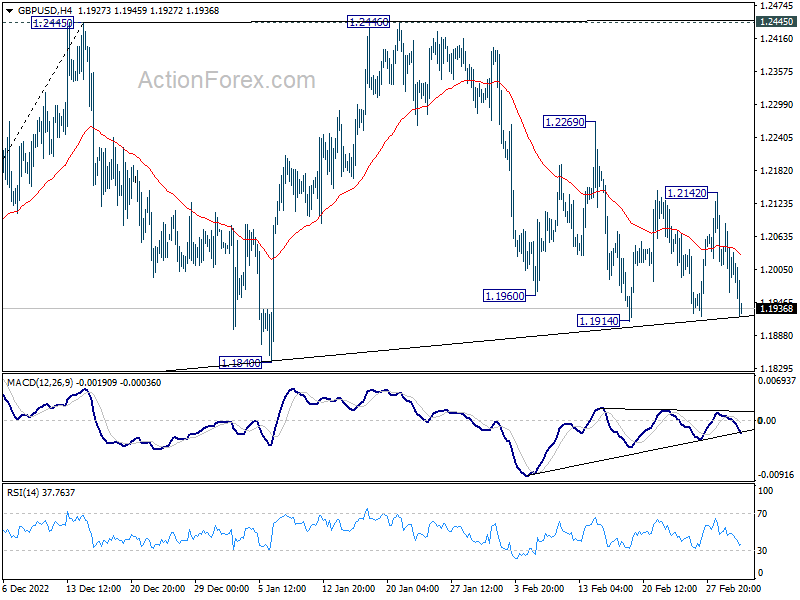
In the bigger picture,as long as 1.1840 support holds, rise from 1.0351 medium term bottom (2022 low) should still continue to 61.8% retracement of 1.4248 (2021 high) to 1.0351 at 1.2759. However, decisive break of 1.1840 will complete a double top pattern (1.2445, 1.2446) after rejection by 55 week EMA (now at 1.2251). Deeper decline should be seen back to 38.2% retracement of 1.0351 to 1.2445 at 1.1645.
EUR/USD Mid-Day Outlook
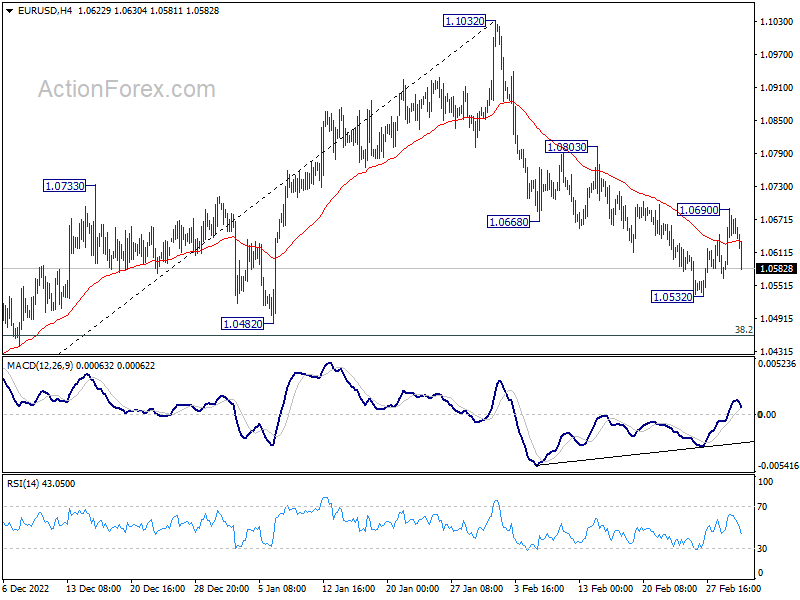
Daily Pivots: (S1) 1.0593; (P) 1.0642; (R1) 1.0719; More...
Intraday bias in EUR/USD is turned neutral again as it retreated sharply after hitting 1.0690, and failed to sustain above 4 hour 55 EMA. Fall from 1.1032 could still extend lower. But strong support is expected from 38.2% retracement of 0.9534 to 1.1032 at 1.0463 to bring rebound. Break of 1.0690 will turn bias back to the upside for 1.0803 resistance first. However, sustained break of 1.0463 will carry larger bearish implication and bring deeper decline.
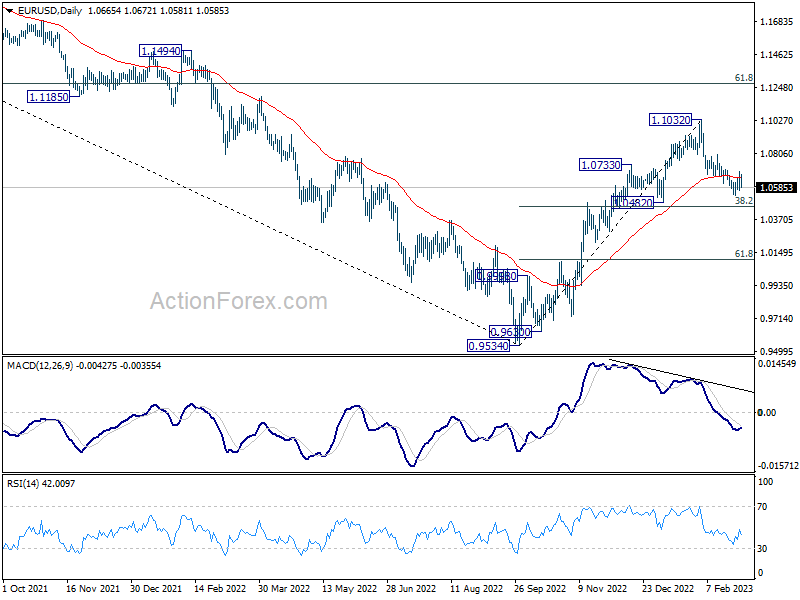
In the bigger picture, as long as 1.0482 support holds, rise from 0.9534 (2022 low) should continue to 61.8% retracement of 1.2348 (2021 high) to 0.9534 at 1.1273. However, sustained break of 1.0482 will bring deeper fall to 61.8% retracement of 0.9534 to 1.1032 at 1.0106, even as a corrective pull back.
Euro Disappoints Despite Strong Inflation Data, Dollar Strengthens on Tight Labor Market
Dollar is fighting back today as jobless claims data continue to show tightness in the labor market. Following the greenback, Canadian dollar is the second strongest currency, surging in crosses. Meanwhile, Euro has failed to show a bullish reaction to stronger-than-expected consumer inflation data, disappointing traders. The common currency is even retreating notably against Swiss Franc. Sterling is also soft, along with the Australian and New Zealand dollars.
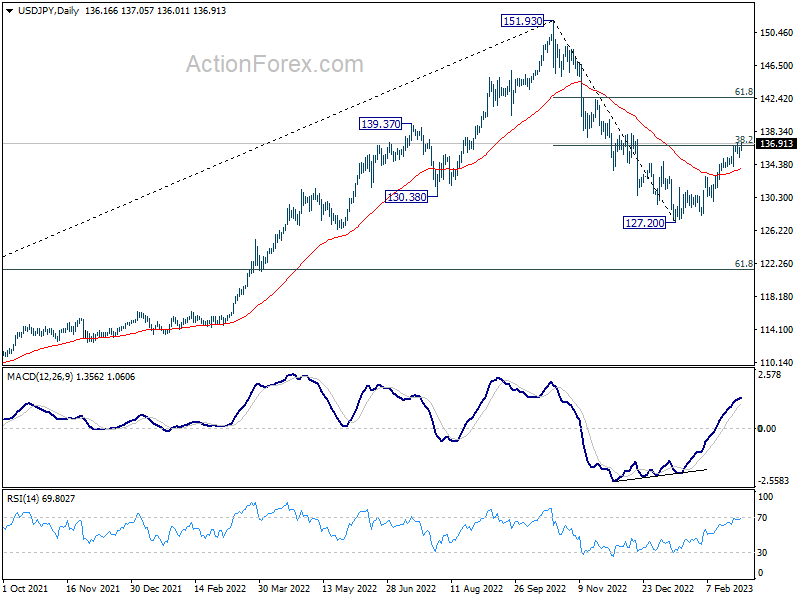
From a technical perspective, USD/JPY is attempting to resume the rise from 127.20, but it has yet to overcome the 38.2% retracement of 151.93 to 127.20 at 136.64 cleanly. A sustained break above this level would be a strong sign of a bullish reversal, with the next target at 61.8% retracement at 142.48. If this were to happen, it could lead to a rise in Dollar and a Selloff in Yen elsewhere at the same time, considering near-term bullishness in US treasury yields.
In Europe, at the time of writing, FTSE is down -0.15%. DAX is down -0.52%. CAC is down -0.13%. Germany 10-year yield is up 0.018 at 2.731. Earlier in Asia, Nikkei dropped -0.06%. Hong Kong HSI dropped -0.92%. China Shanghai SSE dropped -0.05%. Singapore Strait Times dropped -0.62%. Japan 10-year JGB yield dropped -0.0109 to 0.497.
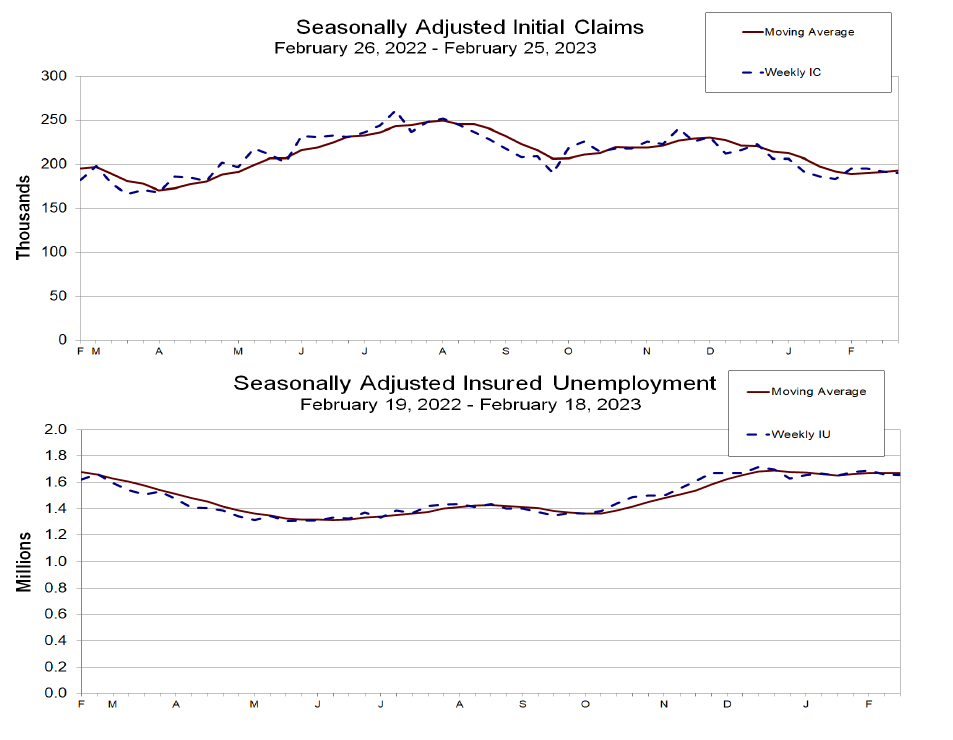
US initial claims dropped to 190k vs exp. 196k
US initial jobless claims dropped -2k to 190k in the week ending February 25, below expectation of 196k. The reading was also below 200k handle for the seventh straight months. Four-week moving average of initial claims rose 1750 to 193k.
Continuing claims dropped -5k to 1655k in the week ending February 18. Four-week moving average of continuing claims rose 1250 to 1672k.
ECB accounts: Concerns of overtightening premature
The accounts of ECB's February 1-2 meeting noted, "it was generally felt that concerns of 'overtightening' were premature at the present high levels of inflation and in view of the likely persistence of underlying price pressures".
The view was expressed that, "given the still substantial distance to the prospective terminal rate, there continued to be value – from a risk management perspective – in frontloading rate hikes at the present stage."
The communication regarding March meeting, "conveyed the view that, in the absence of abrupt changes in circumstances, a further 50 basis point interest rate hike at the March meeting was consistent with a very wide range of possible scenarios for the way inflation would develop."
Eurozone CPI ticked down to 8.5% yoy in Feb, core CPI rose to 5.6% yoy
Eurozone CPI slowed from 8.6% yoy to 8.5% yoy in February, above expectation of 8.2% yoy. CPI core all items ex energy, food, alcohol and tobacco) rose from 5.3% yoy to 5.6% yoy, above expectation of 5.3% yoy.
Looking at the main components, food, alcohol & tobacco is expected to have the highest annual rate in February (15.0%, compared with 14.1% in January), followed by energy (13.7%, compared with 18.9% in January), non-energy industrial goods (6.8%, compared with 6.7% in January) and services (4.8%, compared with 4.4% in January).
ECB Lagarde: It's possible to continue on tightening path after march
ECB President Christine Lagarde told Spain TV channel Antena 3, "at this point in time, it's possible that we continue on that path (of tightening after March)... By which amount in each and every meeting is impossible to say at this point."
Regarding the terminal rate, Lagarde said, "the real honest answer is that it will determined by data."
"What's very certain is that we'll do whatever's needed in order to bring inflation back to 2%," Lagarde said.
BoJ Takata: We need to patiently maintain monetary easing
BoJ board member Hajime Takata said said in a speech today, "now is the time where the BOJ must scrutinise whether the economy and prices can achieve a sustained, positive cycle."
"While we need to be mindful of the impact of our massive stimulus program on market function, we're at a stage where we need to patiently maintain monetary easing," he said.
EUR/USD Mid-Day Outlook
Daily Pivots: (S1) 1.0593; (P) 1.0642; (R1) 1.0719; More...
Intraday bias in EUR/USD is turned neutral again as it retreated sharply after hitting 1.0690, and failed to sustain above 4 hour 55 EMA. Fall from 1.1032 could still extend lower. But strong support is expected from 38.2% retracement of 0.9534 to 1.1032 at 1.0463 to bring rebound. Break of 1.0690 will turn bias back to the upside for 1.0803 resistance first. However, sustained break of 1.0463 will carry larger bearish implication and bring deeper decline.
In the bigger picture, as long as 1.0482 support holds, rise from 0.9534 (2022 low) should continue to 61.8% retracement of 1.2348 (2021 high) to 0.9534 at 1.1273. However, sustained break of 1.0482 will bring deeper fall to 61.8% retracement of 0.9534 to 1.1032 at 1.0106, even as a corrective pull back.
Economic Indicators Update
| GMT | Ccy | Events | Actual | Forecast | Previous | Revised |
|---|---|---|---|---|---|---|
| 21:45 | NZD | Terms of Trade Index Q4 | 1.80% | -1.70% | -3.40% | -3.90% |
| 23:50 | JPY | Capital Spending Q4 | 7.70% | 6.90% | 9.80% | |
| 23:50 | JPY | Monetary Base Y/Y Feb | -1.60% | -3.20% | -3.80% | |
| 00:30 | AUD | Building Permits M/M Jan | -27.60% | -7.60% | 18.50% | |
| 05:00 | JPY | Consumer Confidence Feb | 31.1 | 32 | 31 | |
| 09:00 | EUR | Italy Unemployment Jan | 7.90% | 7.80% | 7.80% | |
| 10:00 | EUR | Eurozone Unemployment Rate Jan | 6.70% | 6.60% | 6.60% | 6.70% |
| 10:00 | EUR | Eurozone CPI Y/Y Feb P | 8.50% | 8.20% | 8.60% | |
| 10:00 | EUR | Eurozone CPI Core Y/Y Feb P | 5.60% | 5.30% | 5.30% | |
| 12:30 | EUR | ECB Monetary Policy Meeting Accounts | ||||
| 13:30 | USD | Initial Jobless Claims (Feb 24) | 190K | 196K | 192K | |
| 13:30 | USD | Nonfarm Productivity Q4 | 1.70% | 2.50% | 3.00% | |
| 13:30 | USD | Unit Labor Costs Q4 | 3.20% | 1.40% | 1.10% | |
| 15:30 | USD | Natural Gas Storage | -72B | -71B |
US initial claims dropped to 190k vs exp. 196k
US initial jobless claims dropped -2k to 190k in the week ending February 25, below expectation of 196k. The reading was also below 200k handle for the seventh straight months. Four-week moving average of initial claims rose 1750 to 193k.
Continuing claims dropped -5k to 1655k in the week ending February 18. Four-week moving average of continuing claims rose 1250 to 1672k.
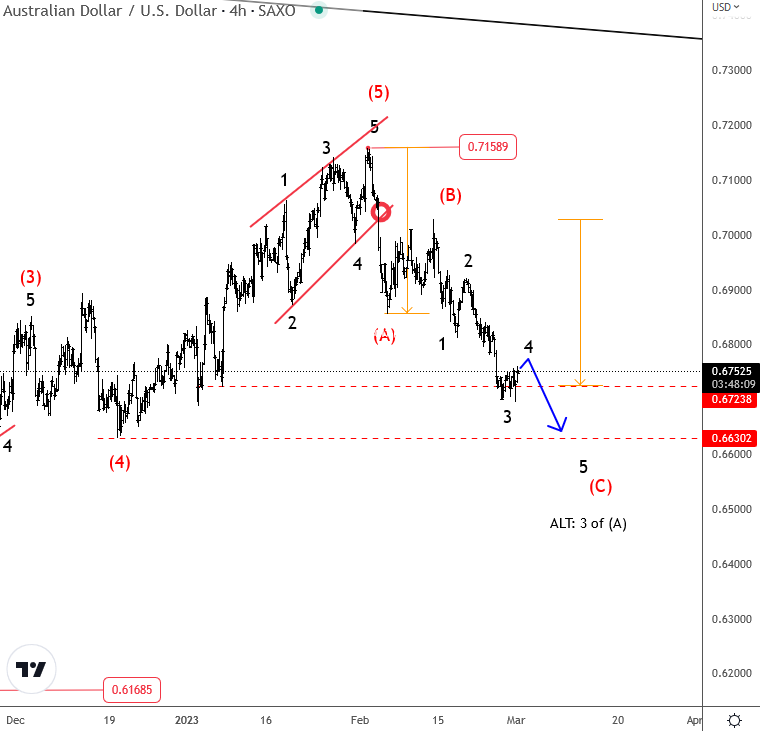
Aussie Approaching Support
Aussie broke to new highs at the end of January, but it came out of a corrective wave 4 so we knew that this was the fifth wave, the final leg of a higher-degree impulse that is already causing a corrective setback after sharp drop out of an ending diagonal. So far, we can already count A-B-C down, but subwave C has to be made by five subwaves, so more weakness is possibly, down to 0.6630 former wave (4) support. Keep in mind that we are tracking only a temporary weakness and that the higher degree trend is up.