Sample Category Title
USD/CHF Mid-Day Outlook
Daily Pivots: (S1) 0.9325; (P) 0.9377; (R1) 0.9410; More...
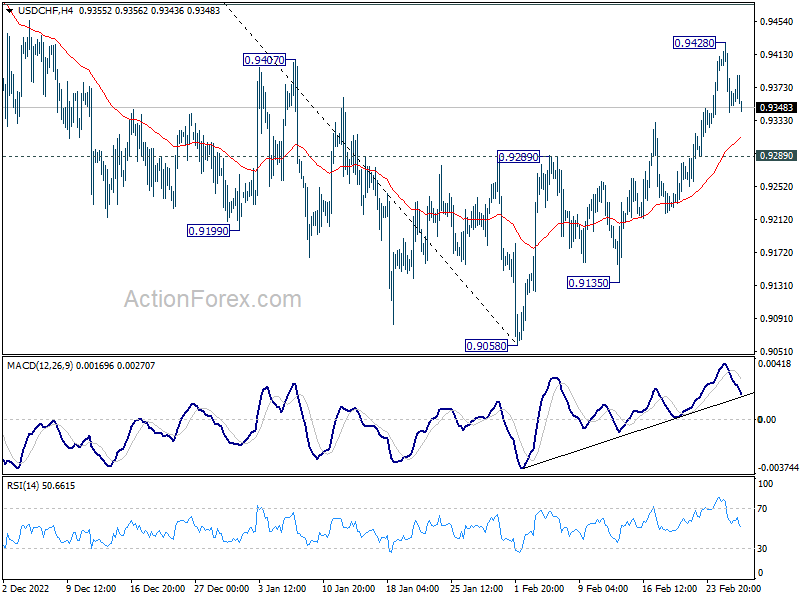
USD/CHF is staying in consolidation below 0.9428 and intraday bias remains neutral. Break of 0.9428 will resume the rebound form 0.9058. But strong resistance could be seen at 38.2% retracement of 1.0146 to 0.9058 at 0.9474 to limit upside. Break of 0.9289 resistance turned support will indicate completion of the rebound and turn bias back to the downside. However, decisive break of 0.9474 will carry larger bullish implications and target 61.8% retracement at 0.9730.
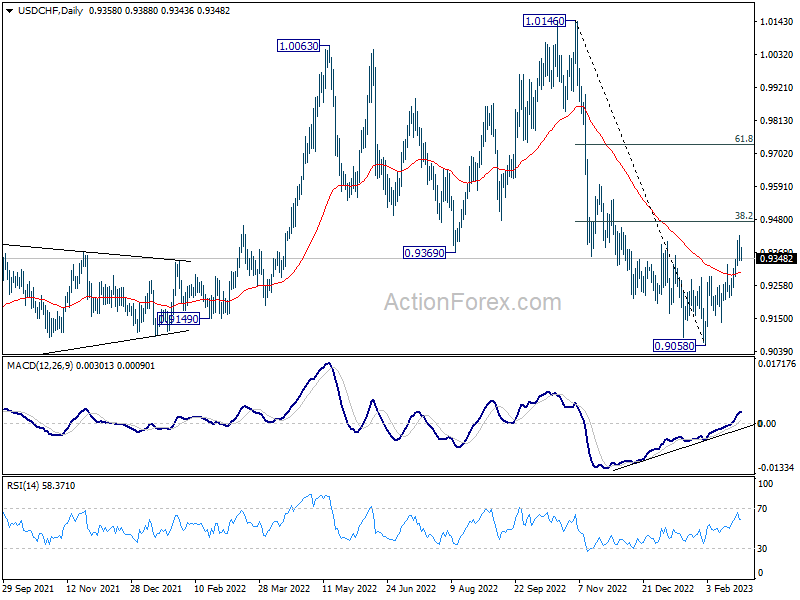
In the bigger picture, decline from 1.0146 is seen as part of a long term sideway pattern. As long as 38.2% retracement of 1.0146 to 0.9058 at 0.9474 holds, another fall is in favor through 0.9058. However, sustained trading above 0.9474 will indicate that the medium term trend has reversed, and open up further rally to 61.8% retracement at 0.9730 and above.
EUR/USD Mid-Day Outlook
Daily Pivots: (S1) 1.0555; (P) 1.0587; (R1) 1.0642; More...
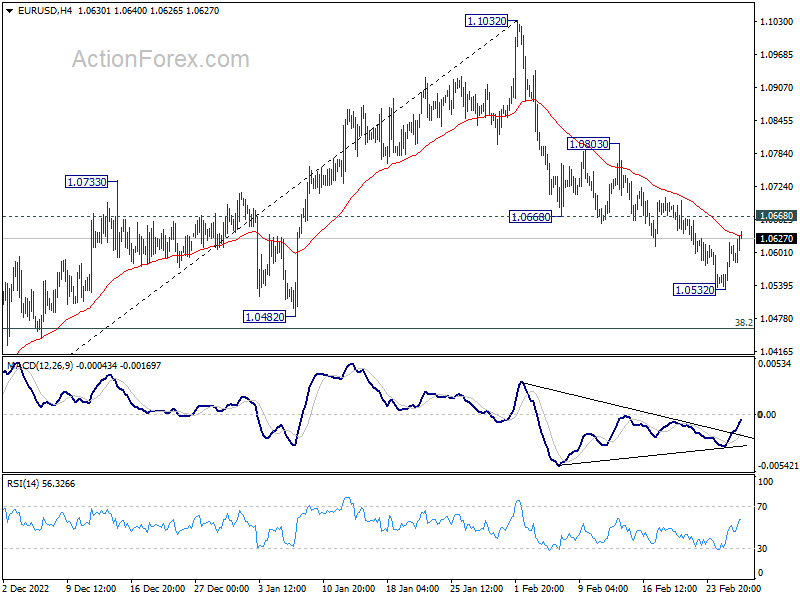
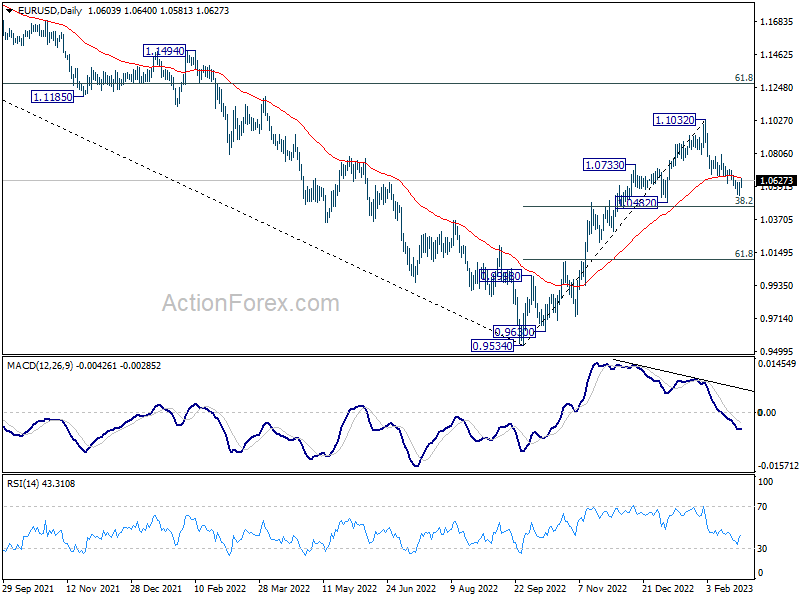
Intraday bias in EUR/USD stays neutral for the moment. The decline from 1.1032 might still extend lower, but strong support could be seen around 38.2% retracement of 0.9534 to 1.1032 at 1.0463 to bring rebound, at least on first attempt. Break of 1.0668 support turned resistance will turn bias back to the upside for 1.0803 resistance and above. However, sustained break of 1.0463 will carry larger bearish implications.
In the bigger picture, as long as 1.0482 support holds, rise from 0.9534 (2022 low) should continue to 61.8% retracement of 1.2348 (2021 high) to 0.9534 at 1.1273. However, sustained break of 1.0482 will bring deeper fall to 61.8% retracement of 0.9534 to 1.1032 at 1.0106, even as a corrective pull back.
Gold and Silver Have Room to Fall
Gold continues to test the bottom and today fell back below $1810. Since the beginning of February, the dynamics suggest an almost perfect reversal of the uptrend, where the initial sharp pullback on the 2nd and 3rd was followed by a downtrend with nearly daily updates of intraday lows.
Until the middle of last week, gold’s decline fit into a typical technical correction, but it is now trading below the 61.8% level of the rally from $1617 in early November to a high of $1960 on the 2nd.
Gold’s reversal began after touching the overbought region on the weekly RSI, and the latest pullback has brought the index back into the mid-range.
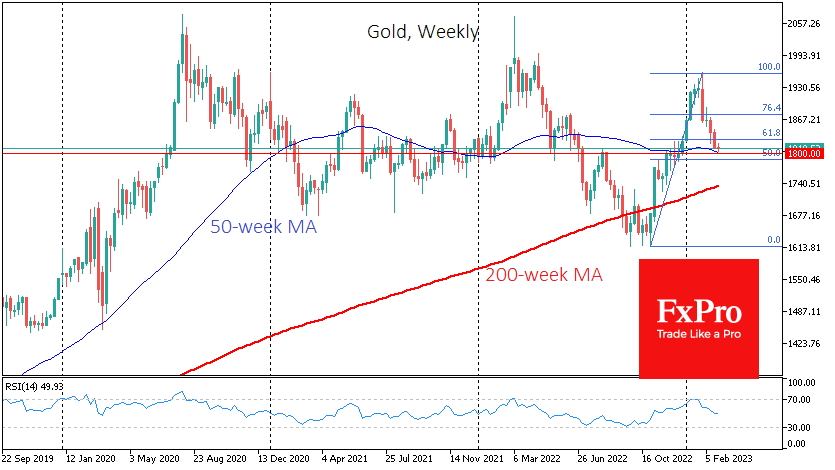
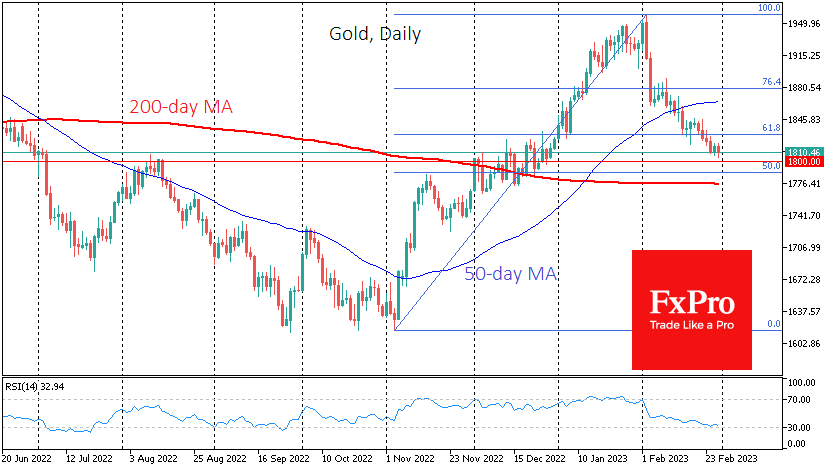
Technically, gold’s sustained decline could continue to the $1775-1787 area for some time. The lower boundary is the 200-day moving average, while the upper boundary is the 50% retracement of the last few months’ gains. The RSI on the daily timeframe has yet to enter the oversold territory, suggesting that there is room for further declines.
Although the $1800 level looks like a nice round level, there were no meaningful stops and reversals near it in December, increasing the chances that there will not be this time around.
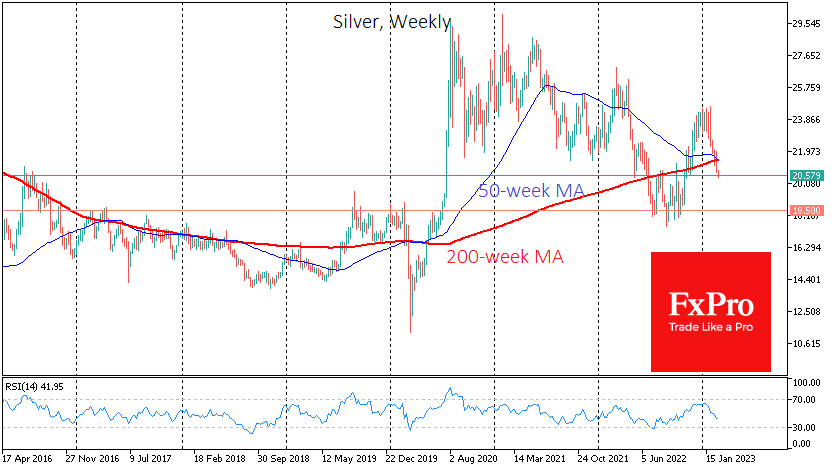
A key indicator for the gold market is silver. The pullback towards $20.60 has brought the price back below the 200 SMA, which could put additional pressure on the market. A death cross has formed on the weekly timeframe as the 50-week moving average is below the 200-week moving average.
This technical picture suggests the possibility of a decline to $18.50. This is where silver could find support from buyers, as it did last August. It is also the former multi-year resistance that turned into support last year.
GBP/USD Mid-Day Outlook
Daily Pivots: (S1) 1.1969; (P) 1.2017; (R1) 1.2112; More...
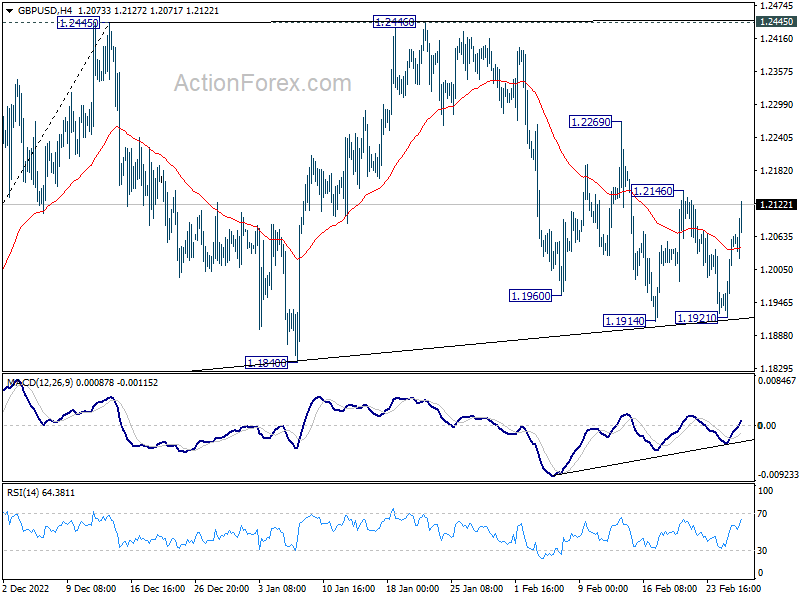
Focus in GBP/USD is now back on 1.2146 resistance as rebound form 1.1921 extends. Firm break there will turn bias back to the upside for 1.2269 resistance. In such case, whole corrective pattern from 1.2445 might have completed at 1.1914. Break of 1.2269 will bring retest of 1.2445/6 high.
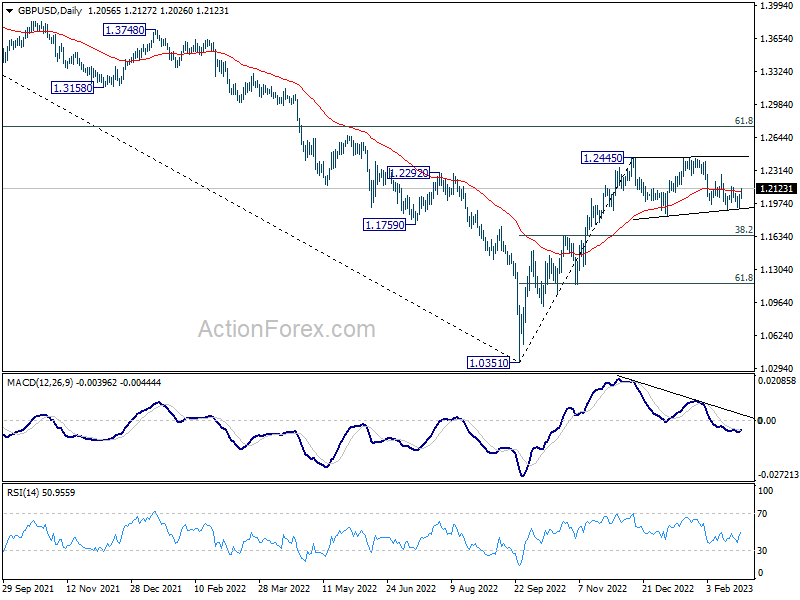
In the bigger picture,as long as 1.1840 support holds, rise from 1.0351 medium term bottom (2022 low) should still continue to 61.8% retracement of 1.4248 (2021 high) to 1.0351 at 1.2759. However, decisive break of 1.1840 will complete a double top pattern (1.2445, 1.2446) after rejection by 55 week EMA (now at 1.2251). Deeper decline should be seen back to 38.2% retracement of 1.0351 to 1.2445 at 1.1645.
Sterling Extends Broad-Based Rally, Yen Stays Pressured
Sterling's broad-based rally continues today and shows sign of upside acceleration. The Pound is additionally added by selloff in Swiss Franc, which is also seen against Euro. Dollar is currently the third strongest for the day as supported by resilience in benchmark treasury yields. Meanwhile, Yen and Swiss Franc are the worst performers, while commodity currencies are mixed.
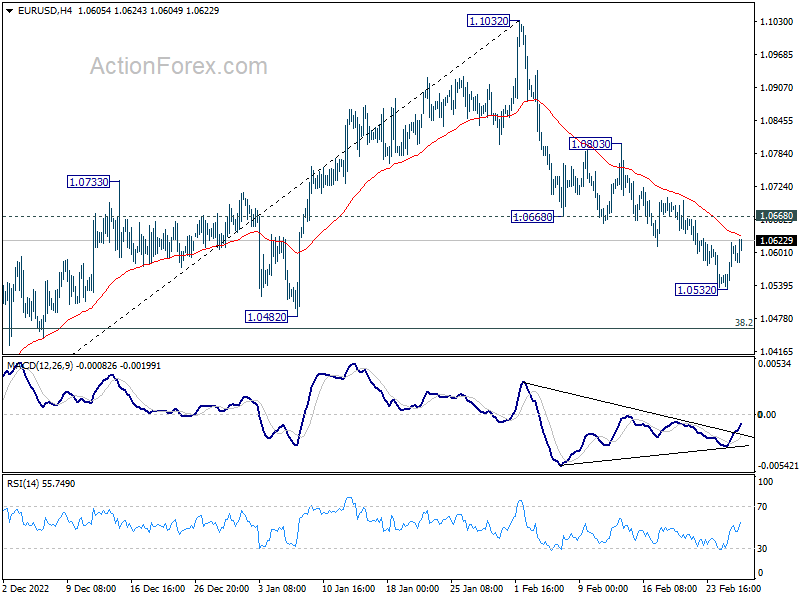
Technically, EUR/USD will be a focus in the next few sessions. Recovery from 1.0532 is picking up some momentum in 4 hour MACD. Firm break of 1.0668 support turned resistance will argue that whole corrective fall from 1.1032 has completed with three waves down to 1.0532, ahead of 1.0482 key structural support. In the case, stronger rise should be seen through 1.0803 towards 1.1032 high. If happens, that should be accompanied by GBP/USD's rally through 1.2269 resistance towards 1.2446 high.
In Europe, at the time of writing, FTSE is down -0.52%. DAX is up 0.26%. CAC is up 0.20%. Germany 10-year yield is up 0.090 at 2.670. Earlier in Asia, Nikkei rose 0.08%. Hong Kong HSI dropped -0.79%. China Shanghai SSE rose 0.66%. Singapore Strait Times dropped -0.02%. Japan 10-year JGB yield dropped -0.0017 to 0.503.
Canada GDP down -0.1% mom in Dec, but expected to rebound in Jan
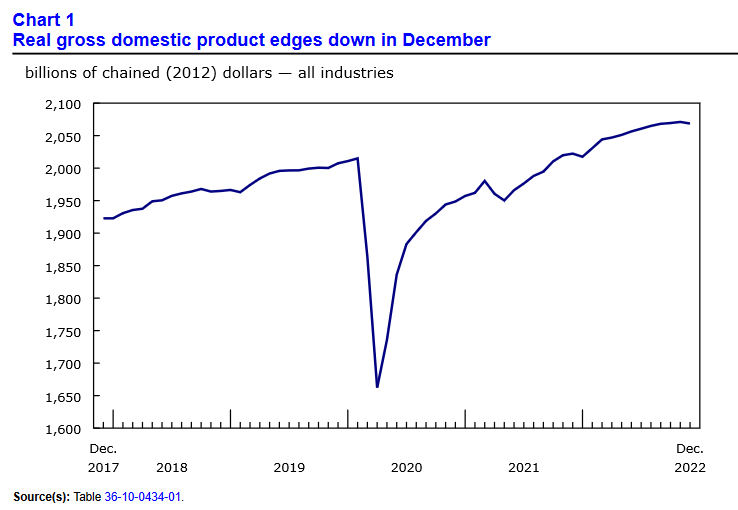
Canada GDP contracted -0.1% mom in December, worse than expectation of 0.2% mom expansion. Goods-producing industries declined -0.6% while service-producing industries were essentially unchanged.
For Q4, GDP grew 0.2% qoq, slowest pace since Q2, 2021. Services producing industries rose 0.5% qoq while goods-producing industries contracted -0.6% qoq.
Advance information indicates that real GDP grew 0.3% mom in January. Increases in the mining, quarrying, and oil and gas extraction, wholesale trade, professional, scientific and technical services, and transportation and warehousing sectors were slightly offset by decreases in construction and retail trade.
ECB Lane: We need another 50 basis points in March
ECB Chief Economist Philip Lane said in an interview, "our assessment of December remains solid, that we needed a sequence of 50 basis point hikes to bring us inside a zone where we would need to think harder about whether rates are sufficiently restrictive to deliver the return of inflation to 2%.
"The data flow since then suggests that the assessment is solid, that we need another 50 basis points in March," he said.
Beyond March, "the overall philosophy is that we will bring rates to a level that is sufficiently restrictive, which depends on where the inflation forecast is, where we are with underlying inflation and where we are with the monetary transmission mechanism."
"There is a zone of interest rate paths that the Governing Council will have to assess in March, in May and thereafter, and determine where in that zone we want to be," he added.
Without commenting on whether rate will stay at a significantly long plateau, Lane said "I absolutely sign up to the monetary policy philosophy that wherever we get to, we should be slow to come down until we have very strong evidence – not just in the forecast but also in our ongoing assessment of underlying inflation – that we are returning inflation to target."
Swiss KOF rose to 100, an encouraging upward trend
Swiss KOF Economic Barometer rose for the third month in a row, from 97.4 to 100 in February, hitting the long-term average. It's also above expectation of 98.0.
KOF said, "Since the last low in November 2022 (89.3), we are now observing an encouraging upward trend lasting for already three months."
"The indicators from the manufacturing sector are primarily responsible for the increase, but the indicators for the consumer-related sectors and the export economy as well as, albeit somewhat less clearly, the financial sector are also sending positive signals.
"The other indicators included in the barometer show hardly any change, with the exception of the hotel and restaurant industry, where sentiment has deteriorated slightly."
Swiss GDP stagnated in Q4, challenging international environment curbed manufacturing and exports
Swiss GDP stagnated in Q4, worse than expectation of 0.3% qoq. Looking at some details by production approach, manufacturing contracted -0.3% qoq. Construction was down -0.2% qoq. Trade rose 0.4% qoq. By expenditure approach, private consumption rose 0.3% qoq, government consumption rose 0.3% qoq, construction investment dropped -0.5% qoq, exports of goods dropped -1.7% qoq.
SECO said, "The challenging international environment curbed manufacturing output and also exports. Domestic demand showed robust growth."
BoJ Wakatabe: Dangers of secular stagnation and Japanification not yet passed
Deputy Governor Masazumi Wakatabe said, "the mild-inflation regime has not come to an end, and we should say that the potential dangers of secular stagnation and Japanification have not yet passed."
"When an exogenous shock occurs, there is an adjustment from the old to a new price system. After adjustment, the rising inflation rate is likely to return to the steady-state inflation rate," he said.
"So the important point is how this rate is affected. Of course, it is possible that cost-push factors will remain, but whether they will push up the steady-state inflation rate is uncertain," Wakatabe said, adding that it was "well known that cost-push inflation does not last long.".
BoJ Uchida: Shouldn't modify easy policy just because there are side-effects
Incoming BoJ Deputy Governor Shinichi Uchida told an upper house confirmation hearing, "BOJ must maintain monetary easing. It shouldn't modify easy policy just because there are side-effects. Rather, it must come up with ideas" to mitigate the costs and help sustain stimulus.
He also noted it's premature to discuss an exit from the ultra-loose monetary policy. Any exit would involve adjustments in the interest targets and the balance sheet. "In what order and at what timing the BOJ will make these adjustments will depend on economic and financial developments at the time," Uchida said.
Japan industrial production down -4.6% mom in Jan, expected to rebound in Feb
Japan industrial production declined -4.6% mom in January, much worse than expectation of -2.6% mom.
Upon the release of the data, the METI downgraded its assessment of industrial production, saying that it has weakened. Never the less, the ministry forecast industrial production to bounce back by 8.0% in February, and then a further 0.7% in March.
Retail sales rose 6.3% yoy, above expectation of 4.0% yoy.
Australia retail sales rose 1.9% mom in Jan, flat on average over the past few months
Australia retail sales turnover rose 1.9% mom to AUD 35.09B in January, above expectation of 1.6% mom. Compared with January 2022, sales turnover was up 7.5% yoy.
Ben Dorber, ABS head of retail statistics, said: "The rebound in retail turnover in January followed a substantial fall of 4.0 per cent in December and a large rise of 1.7 per cent in November.
"Looking through this volatility shows that turnover is at a similar level to September 2022, and on average, growth has been flat over the past few months."
NZ ANZ business confidence rose to -43.3, firms wary but getting on with the job
New Zealand ANZ Business Confidence improved form -52.0 to -43.3 in February. Own Activity Outlook rose from -15.8 to -9.2.
Looking at some details, export intentions ticked up from -5.4 to -5.2. Investment intentions rose from -13.7 to -4.9. Employment intentions jumped from -11.1 to -3.4. Pricing intentions dropped from 62.4 to 58.8. Cost expectations dropped from 91.3 to 88.3. Inflation expectations ticked down from 5.99 to 5.94.
ANZ said: "The shock value of the November Monetary Policy Statement appears to have faded into the rear-vision mirror as firms focus on the risks and opportunities that are front and centre.... Opportunity is clearly still knocking. That said, the level of most indicators remain subdued – firms are still very wary, and understandably so. But they are getting on with the job."
GBP/USD Mid-Day Outlook
Daily Pivots: (S1) 1.1969; (P) 1.2017; (R1) 1.2112; More...
Focus in GBP/USD is now back on 1.2146 resistance as rebound form 1.1921 extends. Firm break there will turn bias back to the upside for 1.2269 resistance. In such case, whole corrective pattern from 1.2445 might have completed at 1.1914. Break of 1.2269 will bring retest of 1.2445/6 high.
In the bigger picture,as long as 1.1840 support holds, rise from 1.0351 medium term bottom (2022 low) should still continue to 61.8% retracement of 1.4248 (2021 high) to 1.0351 at 1.2759. However, decisive break of 1.1840 will complete a double top pattern (1.2445, 1.2446) after rejection by 55 week EMA (now at 1.2251). Deeper decline should be seen back to 38.2% retracement of 1.0351 to 1.2445 at 1.1645.
Economic Indicators Update
| GMT | Ccy | Events | Actual | Forecast | Previous | Revised |
|---|---|---|---|---|---|---|
| 23:50 | JPY | Industrial Production M/M Jan P | -4.60% | -2.60% | 0.30% | |
| 23:50 | JPY | Retail Trade Y/Y Jan | 6.30% | 4.00% | 3.80% | |
| 00:00 | NZD | ANZ Business Confidence Feb | -43.3 | -52 | ||
| 00:30 | AUD | Current Account Balance (AUD) Q4 | 14.1B | 6.8B | -2.3B | 0.8B |
| 00:30 | AUD | Private Sector Credit M/M Jan | 0.40% | 0.40% | 0.30% | |
| 00:30 | AUD | Retail Sales M/M Jan | 1.90% | 1.60% | -3.90% | -4.00% |
| 05:00 | JPY | Housing Starts Y/Y Jan | 6.60% | -1.20% | -1.70% | |
| 07:00 | EUR | Germany Import Price Index M/M Jan | -1.20% | 0.40% | -1.60% | |
| 07:45 | EUR | France GDP Q/Q Q4 F | 0.10% | 0.10% | 0.10% | |
| 08:00 | CHF | KOF Economic Barometer Feb | 100 | 98 | 97.2 | 97.4 |
| 08:00 | CHF | GDP Q/Q Q4 | 0.00% | 0.30% | 0.20% | |
| 13:30 | CAD | GDP M/M Dec | -0.10% | 0.20% | 0.10% | |
| 13:30 | USD | Goods Trade Balance (USD) Jan P | -91.5B | -91.0B | -90.3B | |
| 13:30 | USD | Wholesale Inventories Jan P | -0.40% | 0.10% | 0.10% | |
| 14:00 | USD | Housing Price Index M/M Dec | -0.20% | -0.10% | ||
| 14:00 | USD | S&P/CS Composite-20 HPI Y/Y Dec | 6.80% | 6.80% | ||
| 14:45 | USD | Chicago PMI Feb | 45 | 44.3 | ||
| 15:00 | USD | Consumer Confidence Feb | 108.5 | 107.1 |
Canada GDP down -0.1% mom in Dec, but expected to rebound in Jan
Canada GDP contracted -0.1% mom in December, worse than expectation of 0.2% mom expansion. Goods-producing industries declined -0.6% while service-producing industries were essentially unchanged.
For Q4, GDP grew 0.2% qoq, slowest pace since Q2, 2021. Services producing industries rose 0.5% qoq while goods-producing industries contracted -0.6% qoq.
Advance information indicates that real GDP grew 0.3% mom in January. Increases in the mining, quarrying, and oil and gas extraction, wholesale trade, professional, scientific and technical services, and transportation and warehousing sectors were slightly offset by decreases in construction and retail trade.
Canadian Dollar Drifting as GDP Looms
Canadian GDP expected to slow in Q4
It’s a very light data calendar for Canadian releases this week, with today’s GDP report the sole tier-1 event. Canada’s economy is expected to slow to 1.5% y/y in the fourth quarter, following a solid 2.9% gain in Q3.
A slowdown in economic activity is what the Bank of Canada is looking for, as inflation remains public enemy number one. CPI is moving in the right direction as it fell to 5.9% in January, down from 6.3% in December. The BoC is optimistic that the downturn will continue, with a forecast that inflation will fall to 3% by mid-2023 and hit the 2% target by the end of the year.
The BoC will have to tread carefully in this tricky economic landscape. The economy is cooling and while inflation is easing, it remains much higher than the 2% target and will require additional rate hikes which will make a soft landing a difficult endeavour. If growth continues to weaken in 2023, there is a strong chance of the economy tipping into a recession by mid-2023. The Bank meets next on March 8 and the markets are expecting a 0.25% hike for the second straight time. The Bank would like to take a pause in its tightening cycle but this will require a substantial drop in inflation.
In the US, strong employment and consumer data and stubborn inflation have supported the Fed’s hawkish stance and there is talk of the Fed raising rates as high as 6%. It was only a few weeks ago that the markets were talking about a ‘one and done’ rate hike in March, followed by a long pause and perhaps some cuts by year’s end. This has all changed as the US economy has proven to be surprisingly resilient, despite rising rates and high inflation. The markets are currently pricing in three more rate hikes this year, but that could change in a hurry if key releases in February show that the economy is slowing down.
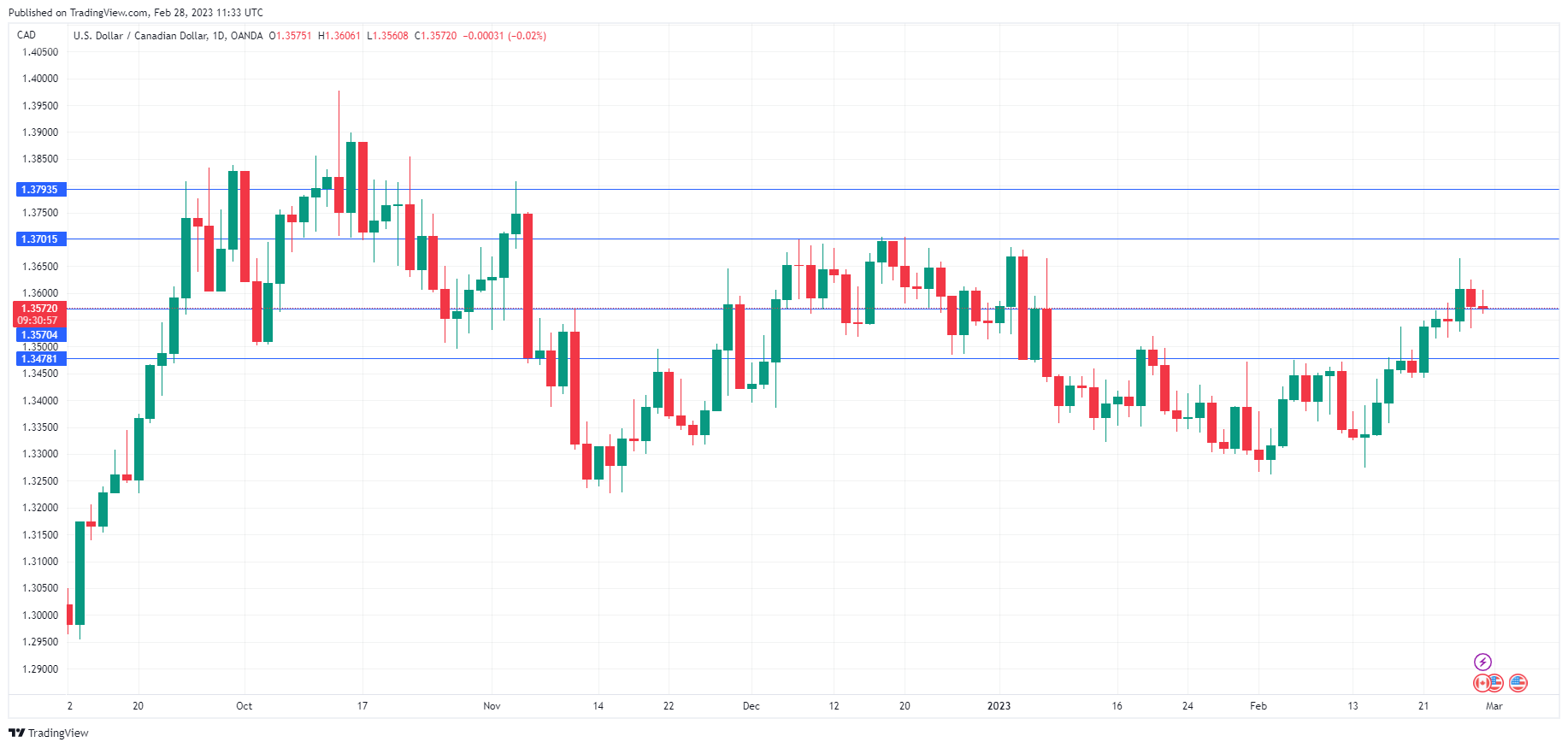
USD/CAD Technical
- There is resistance at 1.3701 and 1.3794
- 1.3570 is under strong pressure in support. 1.3478 is the next support line
EUR/GBP Mid-Day Outlook
Daily Pivots: (S1) 0.8778; (P) 0.8807; (R1) 0.8824; More...
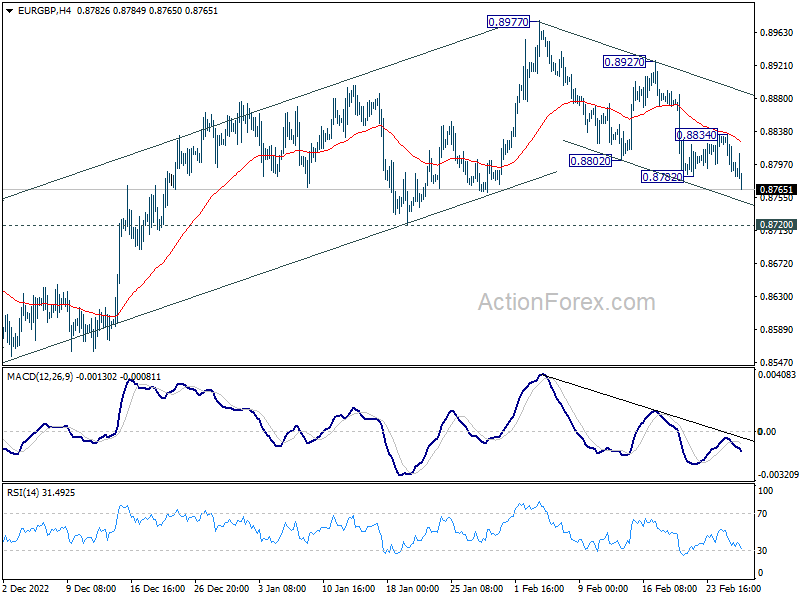
EUR/GBP's fall from 0.8977 resumed today by breaking through 0.8782. Intraday bias is back on the downside for 0.8270 support. Firm break there should confirm completion of whole rebound from 0.8545, and turn near term outlook bearish for this support. For now, outlook will stay cautiously bearish as long as 0.8834 resistance holds, in case of recovery.
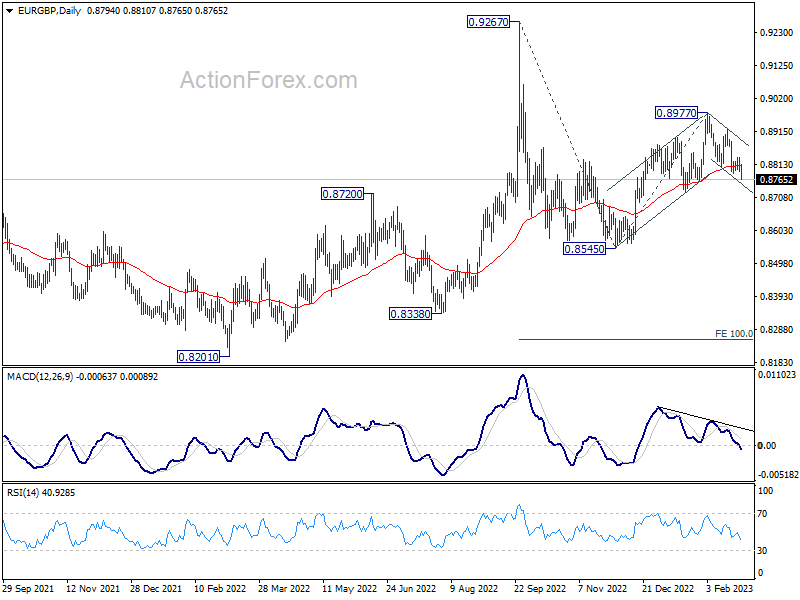
In the bigger picture, current development suggests that fall from 0.9267 (2022 high) is still in progress. Such decline is seen as a leg inside long term range pattern from 0.9499 (2020 high). Break of 0.8545 will target 100% projection of 0.9267 to 0.8545 from 0.8977 at 0.8255. On the other hand, strong rebound from current level will extend the rise from 0.8545 through 0.8977 at a later stage.
EUR/JPY Mid-Day Outlook
Daily Pivots: (S1) 143.88; (P) 144.22; (R1) 144.86; More....
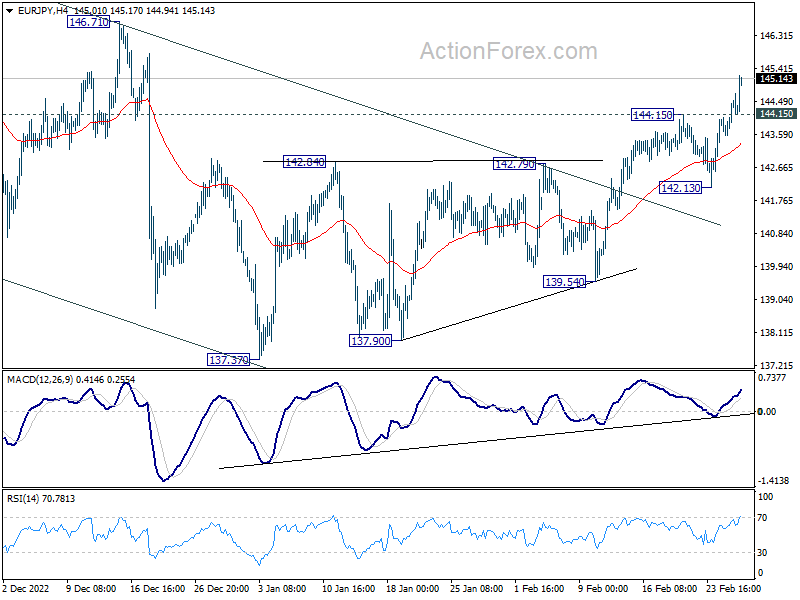
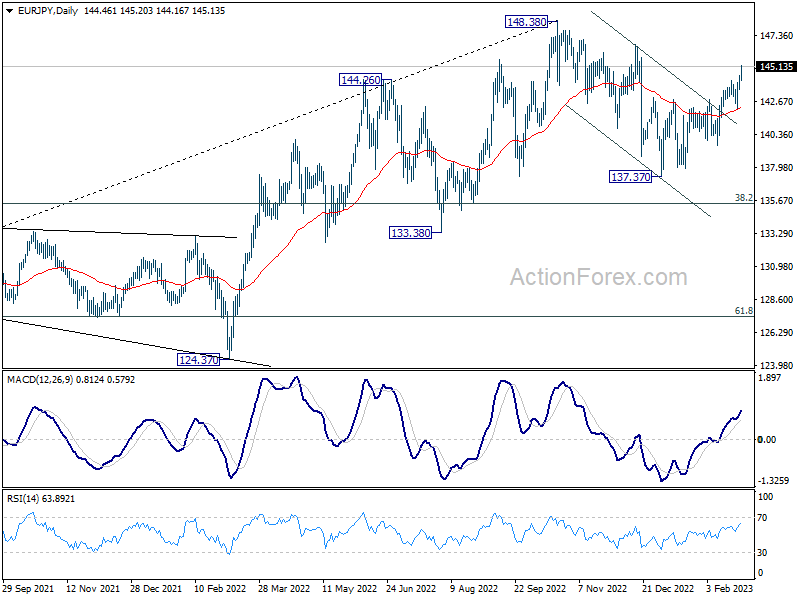
EUR/JPY's rally continues to as high as 145.20 so far and intraday bias remains on the upside. Corrective fall from 148.38 has completed at 137.37 already. Rise from 137.37 should target 146.71 resistance and then 148.38 high. On the downside, below 144.15 minor support will turn intraday bias neutral and bring consolidations. But outlook will stay cautiously bullish as long as 142.13 support holds.
In the bigger picture, as long as 55 week EMA (now at 139.42) holds, larger up trend from 114.42 (2020 low) is still in progress for 149.76 long term resistance. However, firm break of 55 week EMA will bring deeper fall to 38.2% retracement of 114.42 to 148.38 at 135.40. Sustained break there will raise the chance of trend reversal, and target 61.8% retracement at 127.39.
GBP/JPY Mid-Day Outlook
Daily Pivots: (S1) 163.18; (P) 163.76; (R1) 164.92; More...
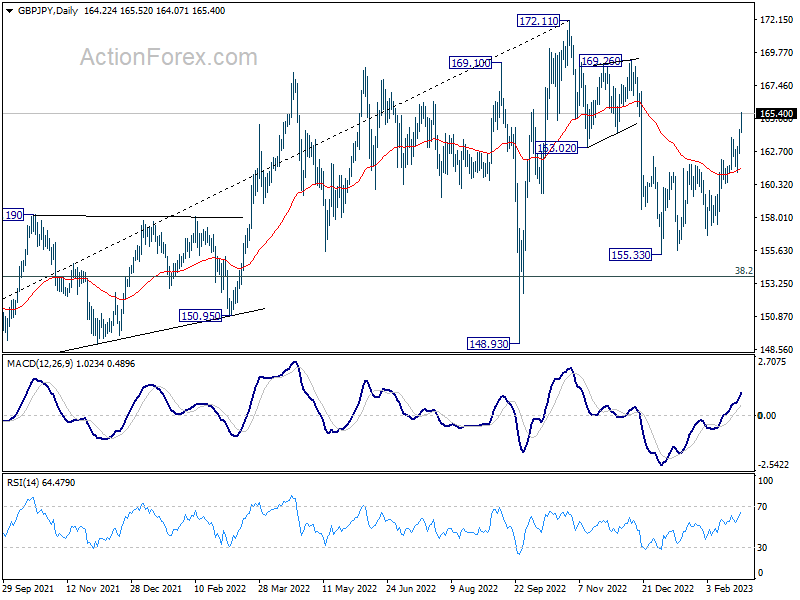
GBP/JPY rises to as high as 165.52 so far and intraday bias remains on the upside. As noted before, corrective fall from 172.11 should have completed at 155.33 already. Rise from 155.33 should target 169.26 resistance first, and then 172.11 high. On the downside, below 163.73 minor support will turn intraday bias neutral and bring consolidations. But outlook will stay cautiously bullish as long as 161.18 support holds.
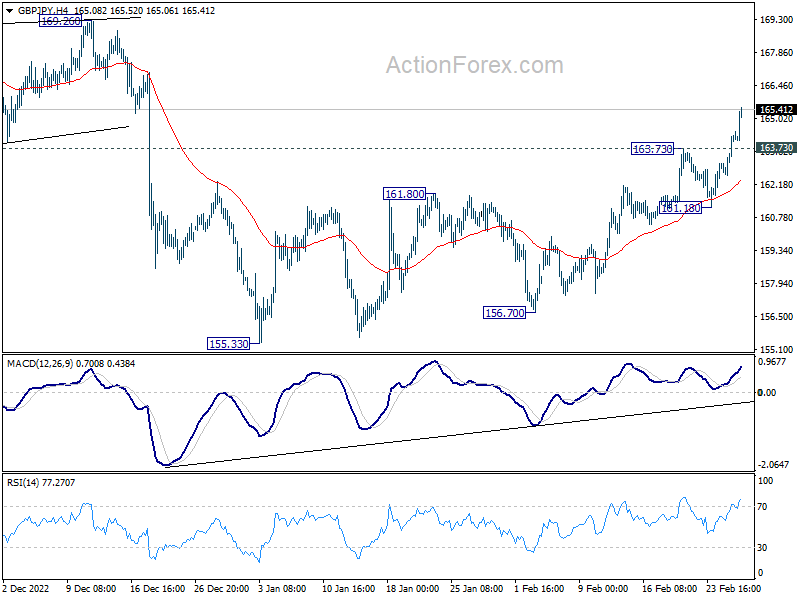
In the bigger picture, corrective decline from 172.11 medium term should have completed at 155.33. With 38.2% retracement of 123.94 (2020 low) to 172.11 (2022 high) at 153.70 intact, medium term bullishness is retained. That is, larger up trend from 123.94 (2020 low) is still in progress. Break of 172.11 high to resume such up trend is expected at a later stage.