

Sample Category Title
Fed Harker: Hikes of 25 appropriate going forward
Philadelphia Fed President Patrick Harker said yesterday, "I expect that we will raise rates a few more times this year, though, to my mind, the days of us raising them 75 basis points at a time have surely passed." "Hikes of 25 basis points will be appropriate going forward," he said. And, "let's get above 5% and sit there for a while".
While risks to inflation remain on the upside, he noted, "we are starting to see inflation come down across a spectrum of goods." He expects core inflation to decline to 3.5% this year, and 2.5% next, then get back to target in 2025. He also said the economy should grow 1% this year, without falling into recession.
Bitcoin Price Could Correct Before Fresh Increase
Key Highlights
- Bitcoin price started a fresh increase above the $20,000 resistance.
- It traded below a rising channel with support near $21,000 on the 4-hours chart.
- Gold price is consolidating gains above the $1,880 resistance.
- Crude oil price is correcting gains from the $82.40 resistance.
Bitcoin Price Technical Analysis
Bitcoin price formed a base and started a fresh increase above $18,500 resistance. BTC/USD surpassed key hurdles near $19,000 to move into a short-term positive zone.
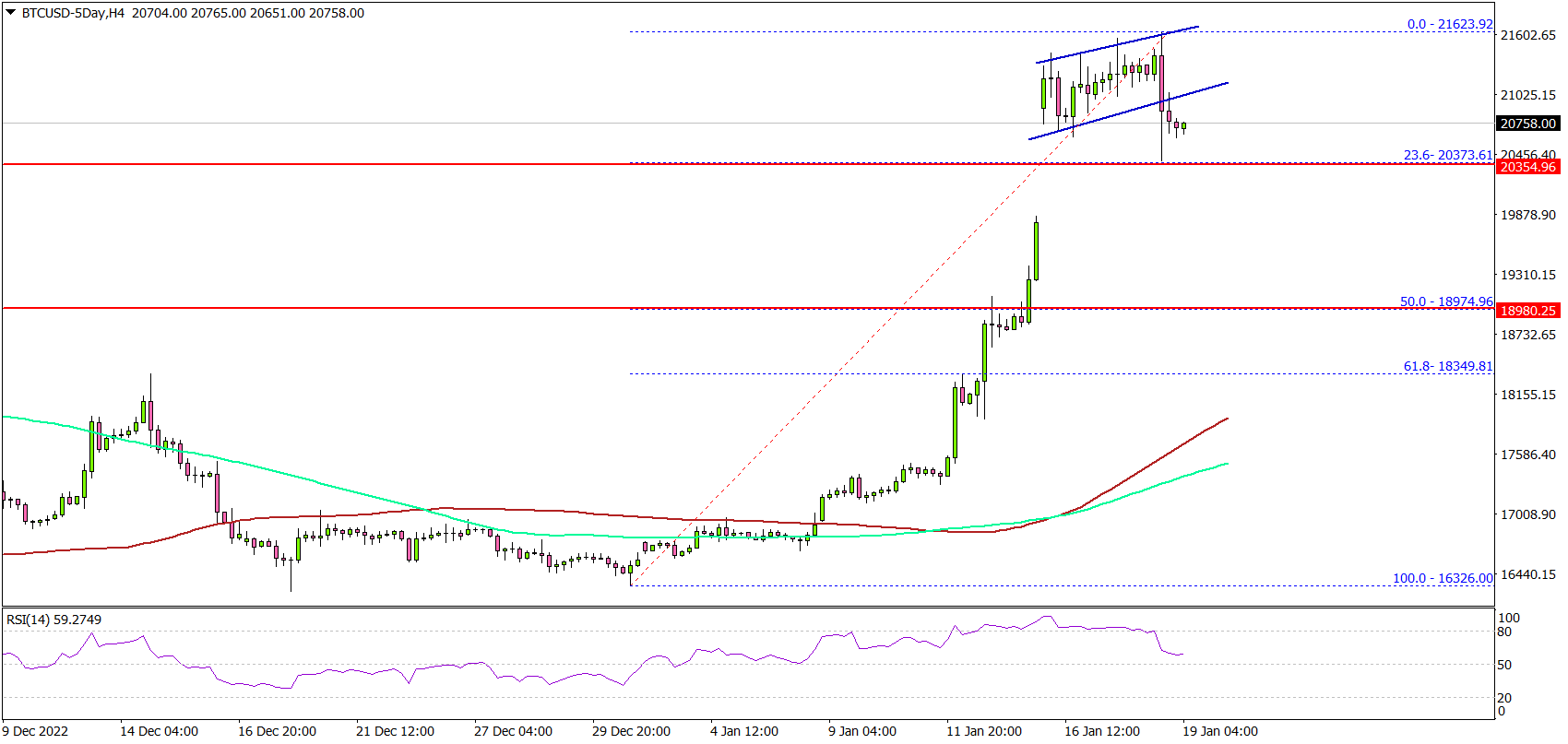
Looking at the 4-hours chart, the price traded above the $20,000 resistance, the 200 simple moving average (green, 4-hours), and the 100 simple moving average (red, 4-hours).
The price even spiked above the $21,000 level. A new multi-week high was formed near $21,623 and the price is now correcting gains. It traded below a rising channel with support near $21,000 on the same chart.
There was a test of the 23.6% Fib retracement level of the upward move from the $16,326 swing low to $21,623 high. On the downside, an initial support sits near the $20,400 level.
The main breakdown support sits near the $19,000 zone. If there is a downside break and close below $19,000, bitcoin might start another major decline in the coming days. In the stated case, it could revisit the $17,500 support or even test $17,000.
Conversely, the price might climb higher again above $21,000. The next resistance sits near the $21,500 zone. A close above the $21,500 level may perhaps start another steady increase in the coming days.
In the stated case, the price could rise towards the $22,500 level. Any more gains could set the pace for a move towards the $24,000 level.
Economic Releases
- US Initial Jobless Claims - Forecast 215K, versus 205K previous.
WTI Wave Analysis
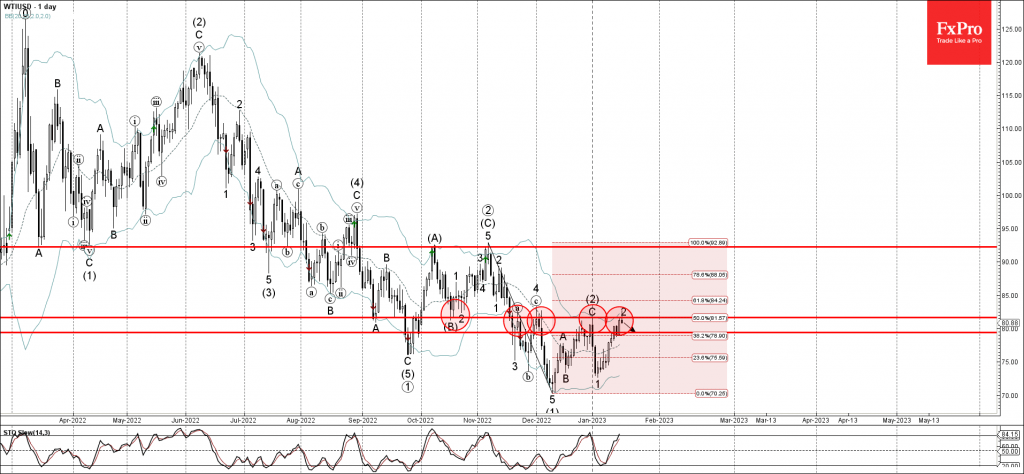
- WTI reversed from key resistance level 81.6
- Likely to fall to support level 80.00
WTI crude oil recently reversed down from the key resistance level 81.6 (former low of wave (B) from October, which has been reversing the price from November).
The resistance level 81.60 was further strengthened by the upper daily Bollinger Band and by the 50% Fibonacci correction of the downward impulse from (1) from November.
Given the overbought daily Stochastic and the strong daily downtrend, WTI crude oil can be expected to fall further toward the next support level 80.00.
GBPAUD Wave Analysis
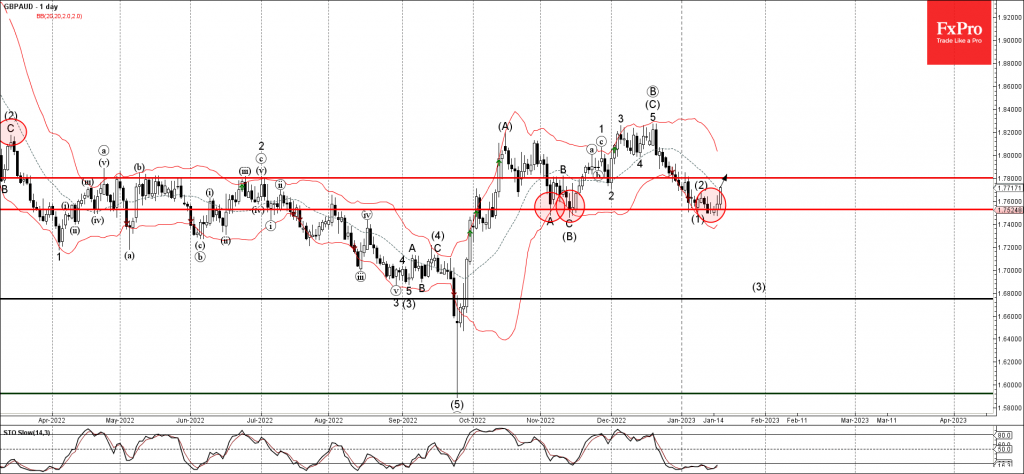
- GBPAUD reversed from support level 1.7525
- Likely to rise to resistance level 1.7800
GBPAUD recently reversed up from the pivotal support level 1.7525 (which stopped the previous waves A, (B) and (1)).
The upward reversal from the support level 1.7525 stopped the previous intermediate impulse wave (3) from the start of January.
Given the strongly bullish sterling sentiment and the oversold daily Stochastic, GBPAUD can be expected to rise further toward the next resistance level 1.7800.
Fed Mester: We’re not at 5% yet, we need to keep going
Cleveland Fed President Loretta Mester, said in an AP interview, "We're beginning to see the kind of actions that we need to see... Good signs that things are moving in the right direction ... That's important input into how we're thinking about where policy needs to go."
"We're starting to see our policy actions do what they're intended to do," she said. "But I do believe we have to continue raising ... and then hold for a while so that we get back to price stability in a timely way."
"We're not at 5% yet, we're not above 5%, which I think is going to be needed given where my projections are for the economy," she said. "I just think we need to keep going, and we'll discuss at the meeting how much to do."
GBP/AUD Moving into Support
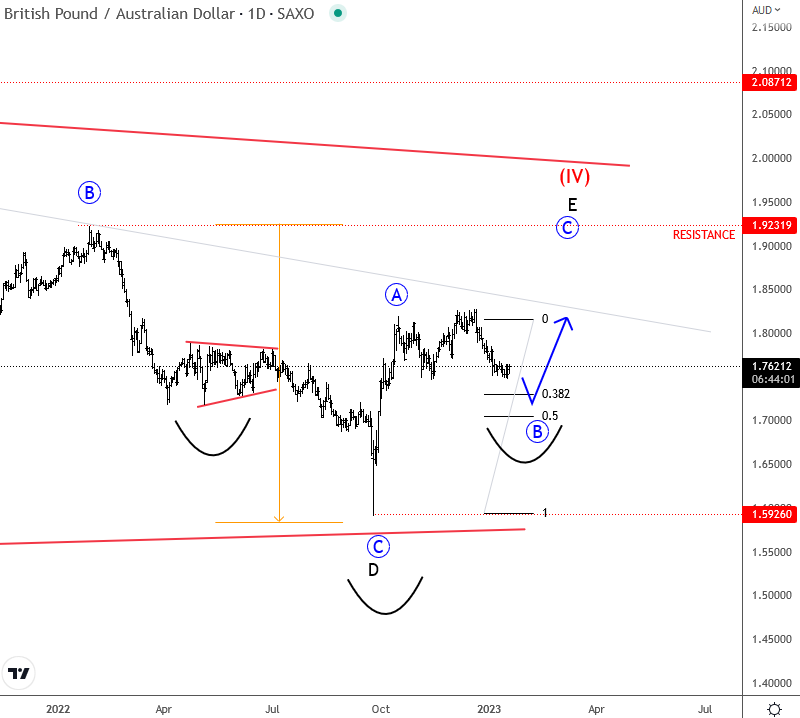
GBPAUD may have a completed three-wave A-B-C decline for a higher degree wave D on a daily chart because of a strong rebound in September, so new recovery can be now in pla, possibly even back to 1.90 resistance area. Notice that rebound from latest low was sharp; its seen as wave A, followed by a wave B pullback that can be making a flat formation, now at the support so be aware of a new turn into the upside. Wave C projections are near 1.85 than 1.9. H&S pattern can also be completing the right shoulder.
Fed Bullard: Rates almost restrictive, but not quite there yet
St. Louis Fed President James Bullard said in an online WSJ interview, "we're almost into a zone that we could call restrictive - we're not quite there yet."
Fed will wants to make sure that inflation will fall back to 2% target. "We don't want to waiver on that," he said.
"Policy has to stay on the tighter side during 2023" as the disinflationary process unfolds, he added.
He still sees rates at 5.25-5.50% range at the end of the year.
Is the ECB Done With the Hikes?
The Euro was underperforming yesterday after press reports that the ECB was planning to hike by 25bps in March. That's quite a long time away, and it's just a rumor. But it could have an outsized impact on the shared currency for a couple of reasons. We could see a shift in tone ahead of the next ECB meeting, as well.
The first thing is that press reports like this are fairly common, and typically the ECB doesn't make a point of denying them. Without a formal dismissal by the Governing Council - which takes quite a bit of logistics - then the rumor will stay in the back of the mind of most traders. That could, by itself, incline the psychology towards a weaker Euro as well.
It's good news
The other aspect is the reasoning given: The recent improvements in the inflation have lowered the inflation outlook. That's a logical analysis, and is in line with previous comments by most members of the ECB. After all, the central bank is trying to get inflation down by raising rates, so a significant drop in inflation would imply the ECB won't have to hike as much.
The problem is that the ECB was much slower to join the rate hiking club. The BOE was the first and has pushed rates up to 3.5%. The Fed has been even harsher, pushing rates up to 4.5%. Meanwhile, the ECB is less than half of that at 2.0%. And some officials are even calling that the "ballpark" of neutral rate.
The drivers of the currency pair
The gap in interest rates between the Eurozone and the US is what pushed the Euro below parity last year. It has subsequently climbed back up as traders figure the ECB will hike longer, catching up with the Fed through the course of this year. Inflation in the shared economy is higher than in the US, so it stands to reason that rates would continue to rise.
As inflation came down in the US, the Fed has slowed the pace of its hiking. Current expectations are for a 50bps hike in February, followed by a 25bps in March. Which could be the last hike for the Fed this cycle. The latest press reports suggest that the ECB will do the same. In other words, the interest rate gap between the two economies would remain consistent through at least the first quarter. That doesn't allow much upside for the EURUSD.
What about the downside?
ECB policy matching the Fed's has a significant problem though. US core inflation has been declining for a few months now, while the same measure in the share economy has continued to rise. Energy prices have been the largest contributor to the lowering of headline inflation - but that's not thanks to ECB policy.
The ECB cares much more about the core rate, and that is still, apparently, not under control. Which makes planning to halt hiking at this juncture a little premature. Of course there is one additional element, which is that the ECB plans to reduce its balance sheet in March, which counts as additional tightening. But it's a relatively small amount; just €15B/month, while the ECB averages maturities of about €30B a month. And the Fed is running off $95B a month.
The press report for the moment remains a rumor, but if it turns out that's what the ECB will announce in due course, it could keep the Euro under pressure.
Sunset Market Commentary
Markets
The Bank of Japan stuck to its ultra-easy monetary policy this morning, pushing back against heavy market speculation that the central bank would take or at least announce further steps towards policy normalization. Japanese yields fell off a cliff, particularly in the BoJ-capped 10y maturity. This immediately spilled over into core bond markets. Yesterday’s Bloomberg report citing sources that ECB policymakers are contemplating slowing down the tightening pace from March - contrasting with official December guidance - lingered still as well. Markets brushed aside ECB governor Villeroy’s early morning intervention. He said that the December narrative (50 bps on the next couple of meetings) is still valid. European swap yields decline 3.5-12.2 bps with losses deepening after US numbers were released. Hard economic data in the US now seem to follow the roll-over in sentiment indicators (eg. yesterday’s Empire manufacturing). Retail sales in December undershot expectations across the board (headline: -1.1%, a private consumption proxy: -0.7%) and came on top of a downward revision to the November figures. Ten out of the 13 categories printed declines last month with sales value at gasoline stations slumping 4.6%. PPI inflation eased further to 6.2% (headline) and 4.6% (ex food, energy and trade) in December, fueling the UST rally. US yields shed 9.9-14.9 bps with the belly of the curve outperforming. Markets aren’t so much lowering the expected (yet still-too low) terminal rate (4.75-5%) but they do increasingly discount rate cuts further out. US equities eke out a small advance with the prospect of a recession offset against lower core bond/US yields. The EuroStoxx50 rose to the highest level since February last year. The index is now just 5% below its post-pandemic high seen in November 2021.
EUR/USD on the foreign exchange market revisited the Villeroy-driven intraday highs after the US data release caused renewed dollar weakness. The pair is testing recent highs around 1.0867. A breach looks ever more plausible. The trade-weighted DXY approaches next support at 101.297 (May 2022 correction low). The USD is barely a match for the Japanese yen. USD/JPY stabilizes near 128.11. This compares to an intraday high of 131.58 seen immediately after the BoJ announced the status quo. The British pound holds up well. After a solid labour report, December CPI this morning showed that price pressures are still extremely strong (10.5%) with the underlying gauge even topping estimates (6.3%). The numbers keep the Bank of England on a tightening path, despite some in the MPC having second thoughts because of slowing growth. EUR/GBP dips to 0.875 and is closing in on first support at 0.8721. GBP/USD (1.243) is nearing the 6-month high seen last December around critical resistance of 1.2451.
News Headlines
December headline inflation in South Africa printed at 0.4% M/M and 7.2% Y/Y, compared to 7.4% in November. Core CPI was reported at 5.1%, unchanged from November. Higher food prices (12.4%) still were an important factor of higher global prices. This put average inflation for 2022 at 6.9%, the highest level since 2009. The Reserve Bank of South Africa has a target range of 3-6%. The SARB raised its policy rate from 3.50% end 2021 to 7.0% (last step of 75 bps in November). The first policy meeting for this year is January 26, with new economic forecasts available. A limited further hike might be on the cards. A separate report today showed stronger than expected November retail sales at 0.4% M/M and 1.1% Y/Y. The rand is already on gradual appreciation trend against the dollar since end October but this mostly mirrors USD weakness. The rand gains slightly with USD/ZAR trading just below 17.
According the January oil market report released by the International Energy Agency global oil markets might see a bigger than expected surplus in the first half of 2023. According to the agency, ‘a slow demand recovery expected in 1H23 suggests continued inventory builds like those that started to emerge in 3Q22’ According to IEA, supply outpaced demand by over 1 mb/d in Q4 of last year. However, the agency indicates that the well-supplied balance at the start of 2023 could quickly tighten as sanctions will impact Russian exports and China consumption might accelerate. Bent oil today rebounds further rising to $87.3 p/b.