Sample Category Title
CADJPY Wave Analysis
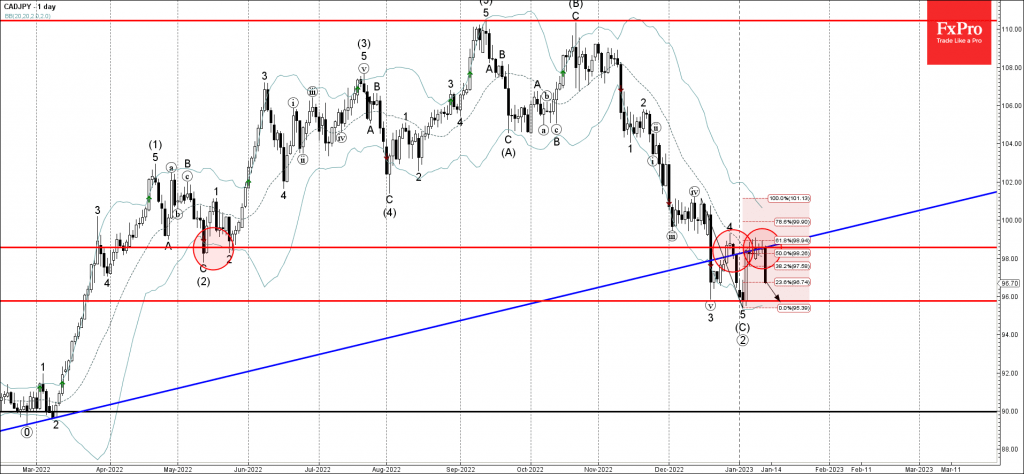
- CADJPY reversed from resistance level 98.50
- Likely to fall support level 96.00
CADJPY earlier reversed down from the resistance level 98.50 (former strong support from May, acting as the resistance after it was broken In December).
The resistance level 98.50 was strengthened by uptrend trend line from last year and by the 61.8% Fibonacci correction of the previous downward impulse from December.
Given the strong yen inflows, CADJPY can be expected to fall further toward the next support level 96.00 (which stopped the previous waves 3 and (C)).
EURUSD Wave Analysis
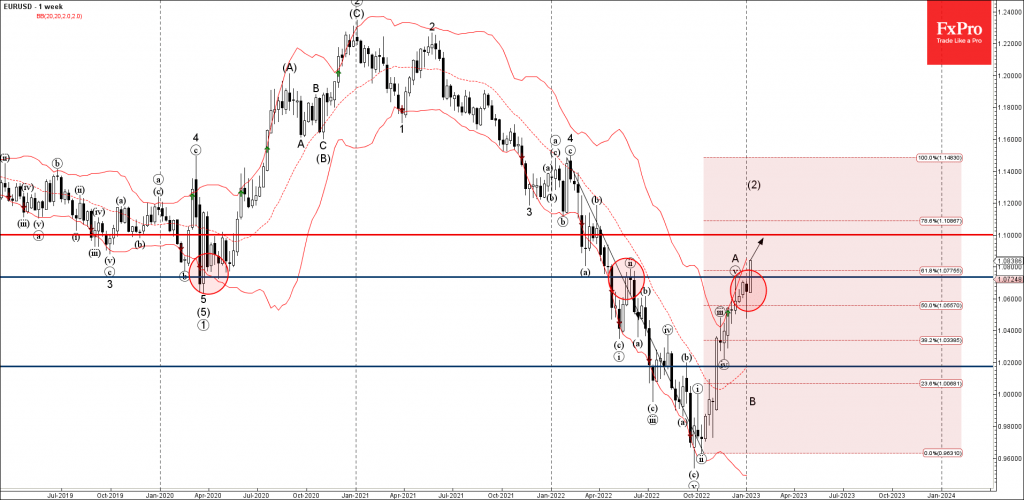
- EURUSD broke resistance level 1.0735
- Likely to rise resistance level 1.1000
EURUSD recently broke above the key resistance level 1.0735 (which have been reversing the price from the middle of 2021) intersecting with the 61.8% Fibonacci correction of the previous weekly downward impulse from January.
The breakout of the resistance level 1.0735 continues the active weekly upward ABC correction (2).
Given the strongly bearish USD sentiment, EURUSD can be expected to rise further toward the next resistance level 1.1000.
Nasdaq100 Tests Crucial Levels
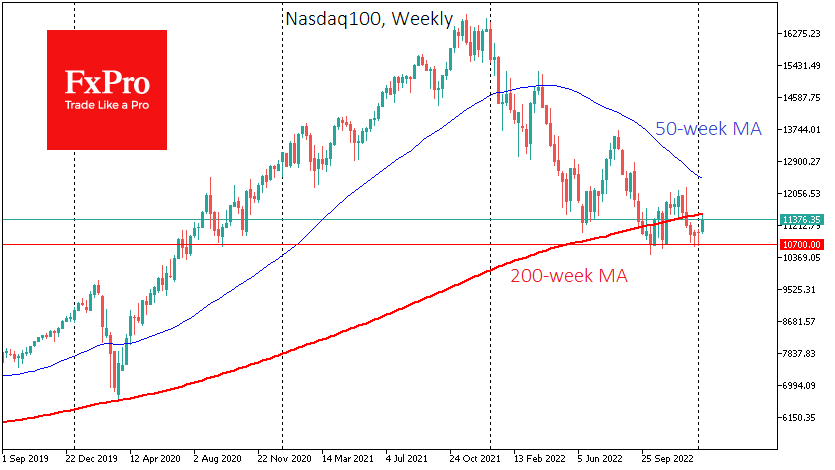
US inflation data promises to directly impact Fed policy, to which the Nasdaq100 is the most sensitive among key indices. The heavy reliance of the index on inflation and a set of significant key levels makes us watch the Nasdaq100 closely today and in the week with double attention.
After managing to turn to the upside at the end of last week, the Nasdaq100 index has added an impressive 3.3% since the beginning of the week, rising to 11,400. The latest increase brought the market to another attempt to reverse the downtrend. The inflation data coming out on Thursday, which has become the primary economic market mover in recent months, is set up so that we may see the outcome of this battle in the coming hours.
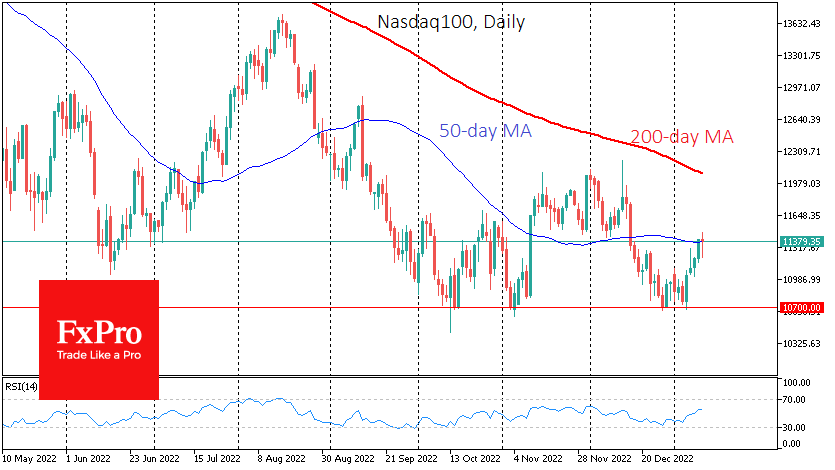
The Nasdaq100 received clear support on dips to the 10,700-area last October and December. From about the same levels, the rally in September 2020 started. Thus, the bulls defended basic levels, which is not enough to start a new rally.
Despite the “double bottom”, the Nasdaq100 maintained a sequence of declining highs, and the sellers brutally crushed the attempt of the market to rewrite the local highs in December.
The moving averages are also pointing to the importance of momentum. On the daily timeframes, the Nasdaq100 is trying to return above the 50-day moving average. By the way, the same moving average has been supporting the Dow Jones for a month. Successful consolidation of the Nasdaq100 above its 50 SMA would probably take the next target of the 200 SMA, which is now close to 12000, coinciding with the reversal area of December and generally represents a more critical trendline.
On the weekly charts, the 11500 area, where the 200-week average passes, looks like an important trend signal level. In 2018 and 2020, approaching this area attracted long-term buyers. From October through December 2022, declines below that curve were also quickly redeemed, but buyers ran out of steam in the year’s final weeks. This week looks more encouraging, but this may change in a matter of hours.
German GDP, Spanish CPI and Can Europe Avoid a Recession?
Goldman Sachs has been one of the recent major banks to upgrade its expectations for the Euro Zone for the coming year. It had previously expected the shared economy to fall into a recession in the first half of the year. Now, the forecast shows an expectation that the Euro Area will just barely avoid a recession, growing at 0.1% for each of the first two quarters.
The revision of expectations is based on the dramatic drop in natural gas prices through the fall, and China reopening sooner than expected. The bout of warm weather over the last couple of weeks has provided further optimism that Europe will avoid an energy crisis during the winter, as Germany was able to restock its natural gas supplies. Additionally, France brought back on line some of its nuclear power plants, allowing the country to become a net exporter once again.
More room for the ECB?
With inflation only just off double-digits, there is quite a bit of pressure on the ECB to get prices back in line. The ECB expects inflation to remain above target for the next three years. However, high inflation isn't a tenable situation, as seen in the UK. Inflation in Britain started to rise sooner than in the Euro Area, and has prompted a series of strikes across the country that threaten to either push the country further into recession or increase inflationary pressures.
There has been some industrial action in Europe, with some firms offering concessions in wages. But as people see their purchasing power diminish for a protracted period of time, the labor upheaval seen in the UK (like the energy crisis before it), could be a preview of what could happen in Europe over the winter and into the spring.
It's not just Europe
Meanwhile, the World Bank almost halved its projections for growth this year. It had previously forecasted that the global economy would grow by 3.0%, but now expects only 1.7%. An important part of the pessimism for the outlook is around China, which is expected to have a difficult start to the year. Europe is one of the major exporters to China, as well as relying on it for materials. The continued disruption as covid rampages through the world's second largest economy could be expected to have an effect on Europe as well.
The US is also expected to have meager growth in the first half of the year. All of this combines to put the ECB in a difficult spot, not wanting to be responsible for Europe slipping into a recession, even if just technically. But something has to be done about inflation.
The core that matters
A large portion of the headline inflation can be attributed to the increased cost of energy. Now that natural gas prices are coming down, so should the headline CPI figure. But core inflation, the one that matters to the ECB, has actually continued to rise. That might pose additional headwinds for the economy, if the ECB has to raise rates even more to get it under control.
German annual GDP growth is expected to come in at 1.8%, down from the 2.6% registered in 2021. Meanwhile, core Spanish annualized CPI for December is expected to be confirmed as growing to 6.9% from 6.3% reported in November.
Sunset Market Commentary
Markets
The much-anticipated US December CPI reading literally couldn’t be more spot on. Monthly headline dynamics eased as expected from 0.1% to -0.1% m/m, resulting in a deceleration of the yearly figure from 7.1% to 6.5% y/y. Energy was a main contributor to easing prices, dropping more than 9% on a monthly basis. Core inflation rose by 0.3% to be up 5.7% compared to the same month a year earlier vs 6% in October. Ongoing price drops in the market of used cars and trucks (-2.5% m/m) and airlines (-3.1% m/m) and milder price pressures in recreation and education & communication help explain the modestly lower core gauge. That said, housing continued to rise at a fast 0.7% m/m pace (8.1% y/y). The broader (wage-sensitive) services inflation advanced by 0.6% m/m (7.5% y/y). Today’s numbers follow softer-than-expected wage growth and a sharp setback in the non-manufacturing ISM last Friday. The combo all but cements market expectations for a further slowdown of the Fed tightening pace from 50 bps to the regular 25 bps. Philly Fed Harker, a voting member this year, already shortly after the release said that such a pace “will be appropriate going forward”. He sees core inflation going down to 3.5% this year. At first, markets were even disappointed that the numbers didn’t surprise to the downside, the way they did in previous months. US yields and the dollar shot up but that didn’t last two seconds. The yield curve currently turns less inverse with declines at the front of more than 10 bps before paring a few bps as US investors joined. The 2y yield is flirting with the recent (December) lows around 4.13%. Next support is located at 4%. Longer maturities decline 1.8-3.7 bps with the 10y yield temporarily dropping below the June interim high of 3.5%. German bond yields got caught in the slipstream, losing 3.9-6.6 bps with the wings slightly underperforming the belly of the curve. Gold likes the interest rate drop and went for the $1900 barrier for the first time since May last year. US equities, however, fail to profit. The US dollar gets a serious beating. The trade-weighted DXY loses critical support at 103 (2020 panic surge) and is already testing next support at 102.34 (62% retracement of the 2022 rally). EUR/USD bounced off 1.0735 support to test 1.0806 (March 2022 interim low). USD/JPY extends a JPY-driven drop seen in the Asian session. The pair is at risk of losing key support around 130 (down from 132.45 at yesterday’s close). Sterling interestingly enough is unable to really profit from the weak greenback. GBP/USD ekes out a small gain to 1.218. EUR/GBP is going nowhere just below the 0.8867/77 resistance level despite news reports that the EU and UK are preparing to enter the negotiating tunnel next week. This intense phase of talks aims to settle the remaining issues over the Northern Irish protocol (role of the European Court of Justice in case of disputes, governance of the protocol …). In other UK news, the Bank of England said it has already unwound its emergency bond portfolio, consisting of a little less than £20bn UK gilts bought end last year to stem the Truss-Kwarteng driven turmoil.
News Headlines
The ECB published the results of its consumer expectations survey of November. Inflation expectations for the next 12 months declined from 5.4% to 5.0%. Expectations for inflation 3-years ahead eased slightly to 2.9% from 3.0%. Aside from inflation, consumers expected nominal income to grow by 0.9% over the next 12 months (0.7% in October). For the first time since mid-2021, expectations for nominal spending growth decreased from 4.7% to 4.3%. Economic growth expectations for the next 12 months rose from -2.6% in October to -2.0%. Consistent with the higher expectations for economic growth, expectations for the unemployment rate edged down to 12.4%.
Headline inflation in India cooled further in December, from 5.88% in November to 5.72%, keeping it within the 2.0%-6.0% target range of the Reserve bank of India. Food price inflation, which accounts for 47% of the basket decelerated to 4.19% from 4.67%. The Reserve Bank of India last year raised its policy rate 225 bps to 6.25%. The next policy meeting is scheduled for Feb 8. As the RBI keeps a close eye at core inflation, a 25 bps final rate hike at the February meeting is still very well possible. The rupee over the previous days gained modest ground against the dollar (currently USD/INR 81.55) after holding near all-time weakest levels just below USD/INR 83 in December.
December CPI: Three’s a Trend
Summary
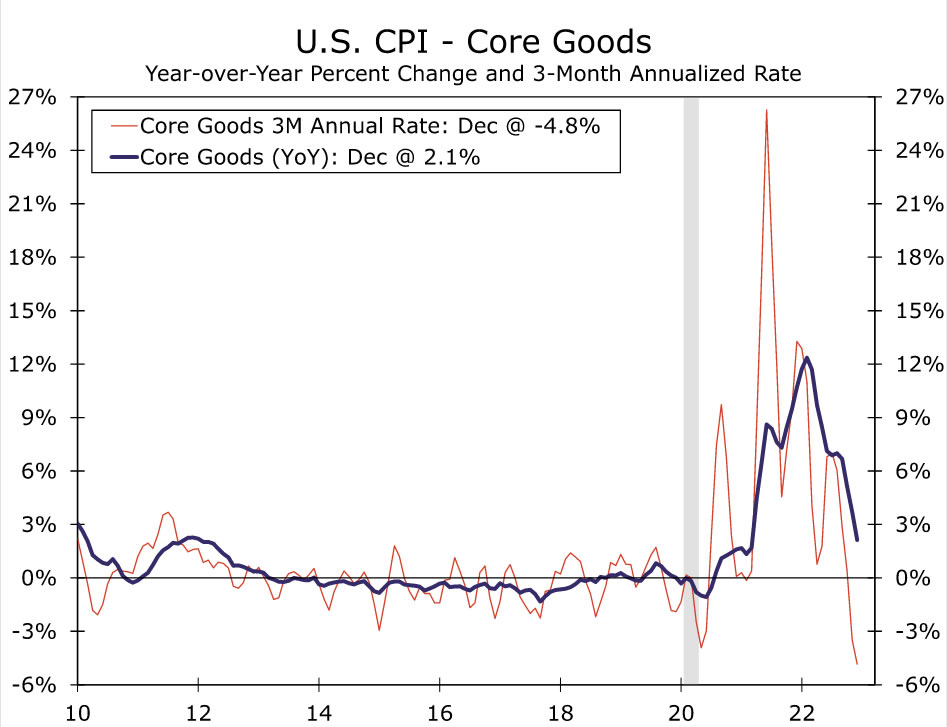
Inflation continued to ease in December. The headline CPI fell 0.1% in the month, and December marked the third consecutive increase in the core index of 0.3% or less. A major decline in gasoline prices helped keep headline inflation in check, but the signs of slower inflation extended beyond prices at the pump. Grocery store prices grew at the slowest pace since March 2021, and core goods prices declined for the third consecutive month, led lower by another decline in prices for used autos. Services remained the hottest inflation category. Prices of core services rose 0.5% in December, led higher by a sizable 0.8% increase in shelter costs.
Inflation clearly has slowed from its breakneck pace in mid-2022. Headline inflation has fallen by 2.6 percentage points since June, and the annualized run rate over the past three months is just 1.8%, demonstrating further slowing is still to come in the year-ago change. Additional progress should be made in the coming months as goods inflation remains soft and the lagged effect of slower housing cost growth eventually flows through to the CPI data. As a result, the days of 75 bps rate hikes from the FOMC appear to be well in the rearview mirror.
That said, we doubt the FOMC is ready to declare mission accomplished. There have been head fakes on inflation before, to no avail, and there is a wide range of inflation outcomes between the peaks seen last summer and the central bank's 2% inflation target. Eventually the goods price deflation will cease, and labor cost growth continues to run in excess of what Fed officials believe is consistent with 2% inflation. The increasingly compelling evidence of slowing inflation brought by today's report ups the chance that the FOMC will hike the fed funds rate by just 25 bps at its next meeting, but with the trend in inflation still above target, we expect that even if the FOMC delivers a downshift in pace, it will continue tightening past its next meeting.
Energy, Food, Goods Prices Keep Normalizing
The Consumer Price Index (CPI) fell by 0.1% in December, matching the Bloomberg consensus forecast and marking an albeit modest month of deflation to finish 2022. It was a narrowly-driven decline with major deflationary contributions from gasoline and used autos. Gasoline prices declined 9.4% in December and were down 1.5% compared to a year-ago. Energy services inflation surprised to the upside, led higher by monthly price increases of 1.0% and 3.0% for electricity and utility gas, respectively. Food inflation continued to cool. Prices at the grocery store increased 0.2% in December, the smallest monthly increase since March 2021. Prices for food-away-from-home rose a faster 0.4% in the month but also decelerated from the previous few months.
The normalization of prices in sectors that were distorted by the pandemic mostly continued. Core goods prices fell by 0.3% in December, the third consecutive month of deflation for this category. Prices for used cars and trucks fell another 2.5% and are now down 8.8% on a year-over-year basis. New vehicle prices declined a much more modest 0.1%, while a few categories such as apparel (+0.5%) posted upside surprises. Several travel-related categories also experienced another bout of deflation in December including airfares (-3.1%) and car rentals (-1.6%). Lodging away from home was the outlier in travel, posting a 1.5% increase.
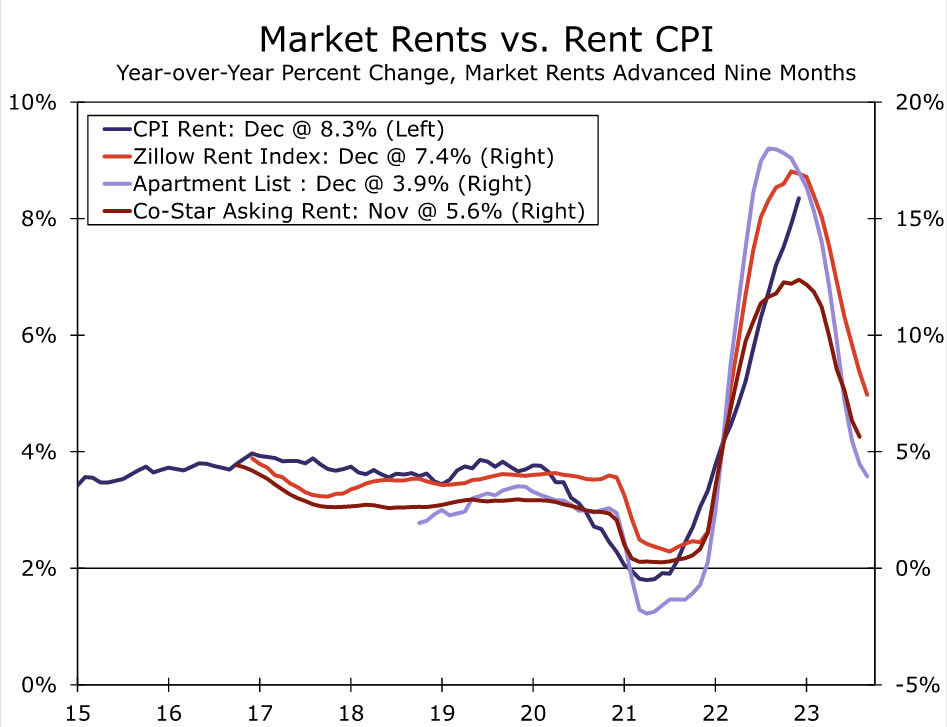
Prices of core services, on the other hand, continued to advance at a strong clip, rising 0.5% in December. A rebound in hospital services and smaller drop in health insurance drove a pickup in medical care services. Surprising in our view were stronger gains in primary rent and owners' equivalent rent, both up 0.8% on the month. Given the sharp slowdown in private sector rent measures and more recent declines in home prices, we do not expect the strength to last, however, and we look for sequential gains to trend lower imminently.
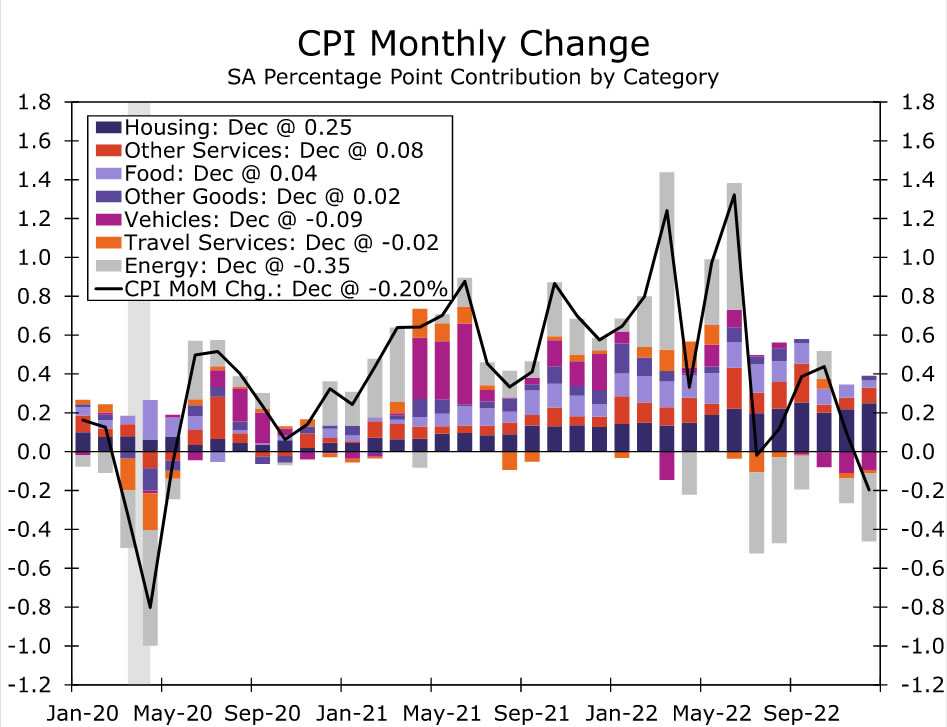
Elsewhere, details continued to suggest core services inflation is at least not getting worse. While the various ways to slice and dice the traditional core may at times be going a bit overboard, core services ex-shelter rose a tame 0.2% in December. In addition to the declines in airfare and car rental costs, price growth for recreation services, education/communication services and vehicle insurance all slowed.
Progress Made, but the War Is Yet to Be Won
Stepping back, the inflation picture is vastly improved from where it was in the middle of last year. Headline inflation has fallen by 2.6 percentage points since June, and the annualized run rate over the past three months is just 1.8%, demonstrating further slowing is still to come in the year-ago change.
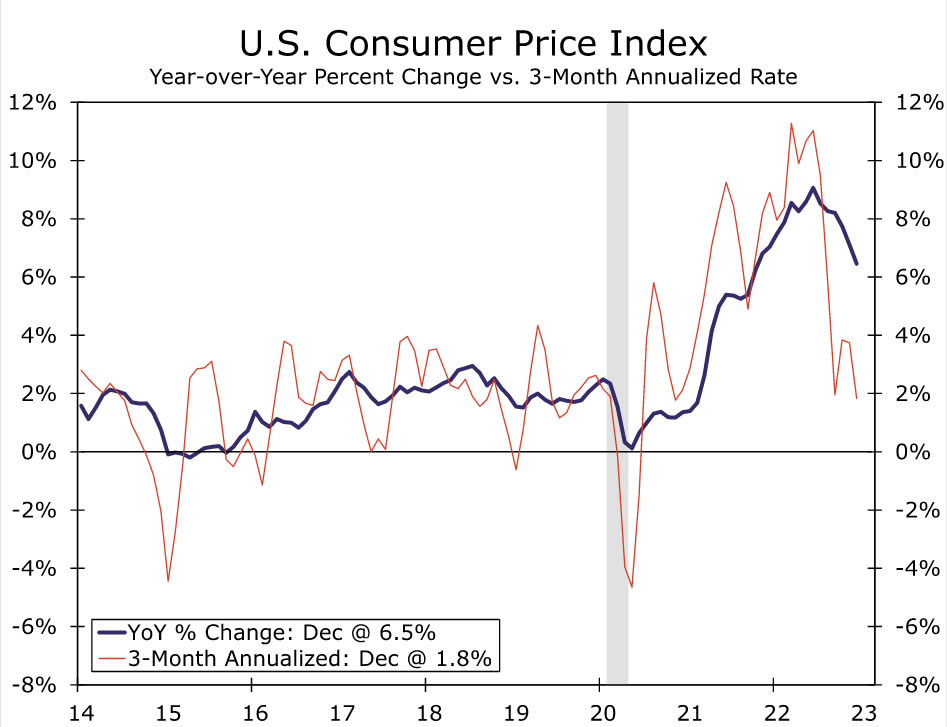
We see scope for both headline and core inflation to quickly cover additional ground in its march back to 2% over the coming months. Some giveback in goods prices seemed inevitable after the stratospheric rise of the past two years, and that time seems to have finally come. Retail inventories have piled up as demand for goods has flat-lined and supply chain kinks have unwound. Even the hard-hit auto sector appears to have reached an inflection point, with inventories rising and transaction prices squeezed by higher financing costs (one sign the Fed's policy tightening is helping to reduce inflation). Similarly, the pace of shelter inflation seemed destined to ease after the housing market frenzy finally fizzled, and the turn is drawing increasingly near.
But, the weakening in goods prices and even shelter costs needs to be viewed in conjunction with more labor-intensive services. We suspect core services excluding shelter, which accounts for nearly one-third of the core index, will prove more stubborn to improve given the longer lag with which input cost changes are incorporated. Labor costs are still rising at a 4-5% clip which is one to two percentage points faster than the pre-pandemic pace. While Fed officials have acknowledged the recent progress and should welcome this report, like us, they remain skeptical that inflation will easily settle back down to 2% past the correction in goods and housing. The increasingly compelling evidence of slowing inflation brought by today's report ups the chance that the FOMC will hike the fed funds rate by just 25 bps at its next meeting, but with the trend in inflation still above target, we expect that even if the FOMC delivers a downshift in pace, it will continue tightening past its next meeting.
USD/JPY Mid-Day Outlook
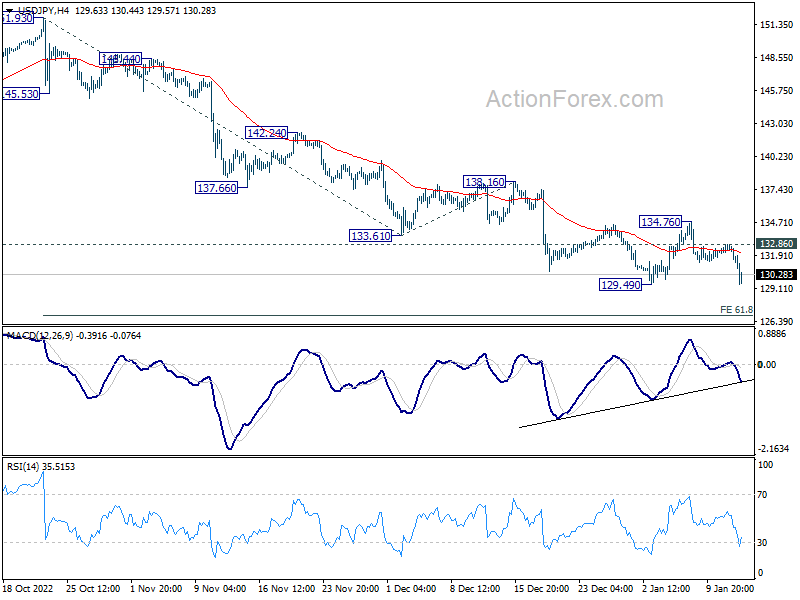
Daily Pivots: (S1) 132.09; (P) 132.48; (R1) 132.89; More...
Immediate focus is now on 129.49 support in USD/JPY. Firm break there will resume whole decline from 151.93. Intraday bias will be back on the downside for 61.8% projection of 151.93 to 133.61 from 138.16 at 126.83. On the upside, however, break of 132.86 resistance will indicate short term bottoming, and bring rebound to 134.76 resistance and above.
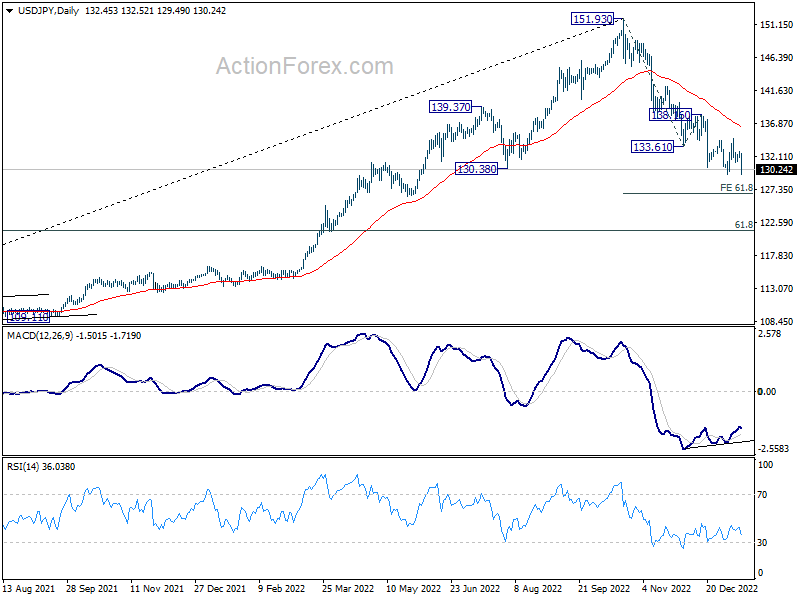
In the bigger picture, a medium term top was in place at 151.93. Sustained trading below 55 week EMA (now at 131.73) would raise the chance of bearish trend reversal. Deeper fall would be seen to 61.8% retracement of 102.58 to 151.93 at 121.43. This will now remain the favored case as long as 55 day EMA (now at 136.34) holds.
USD/CHF Mid-Day Outlook
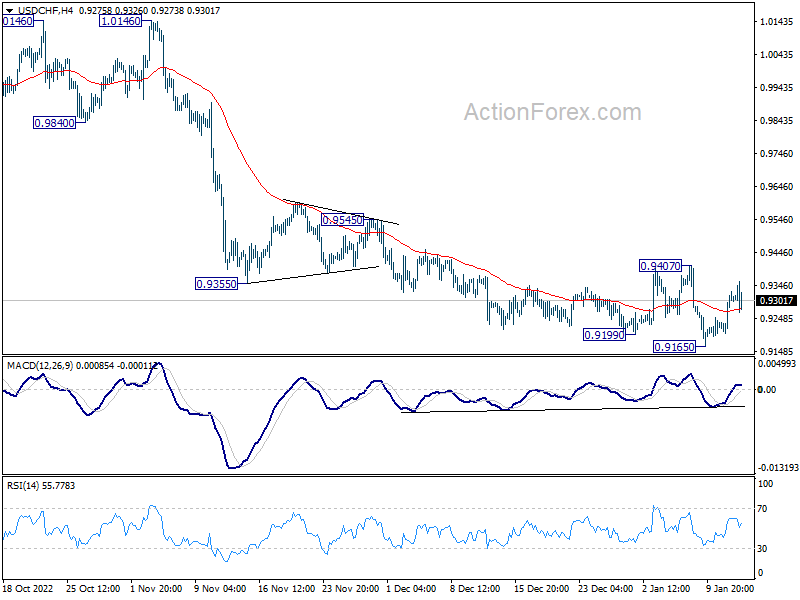
Daily Pivots: (S1) 0.9236; (P) 0.9283; (R1) 0.9362; More...
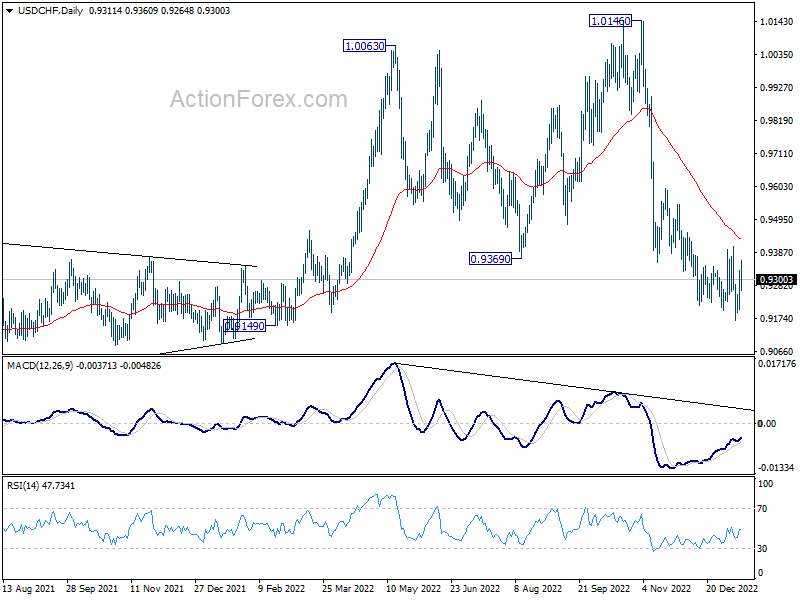
No change in USD/CHF's outlook as range trading continues. Intraday bias stays neutral at this point. Further decline is still in favor as long as 0.9407 resistance holds. Break of 0.9165 will resume whole fall from 1.0146. However, firm break of 0.9407 will turn bias back to the upside for strong rebound.
In the bigger picture, rise from 0.8756 (2021 low) has completed at 1.0146, well ahead of 1.0342 long term resistance (2016 high). Based on current downside momentum, fall from 1.0146 should be a medium term down trend itself. Next target is a test on 0.8756 low. Strong support should be seen there to bring rebound. Still, further decline will now be expected as long as 0.9407 resistance holds, in any case.
GBP/USD Mid-Day Outlook
Daily Pivots: (S1) 1.2107; (P) 1.2143; (R1) 1.2184; More...
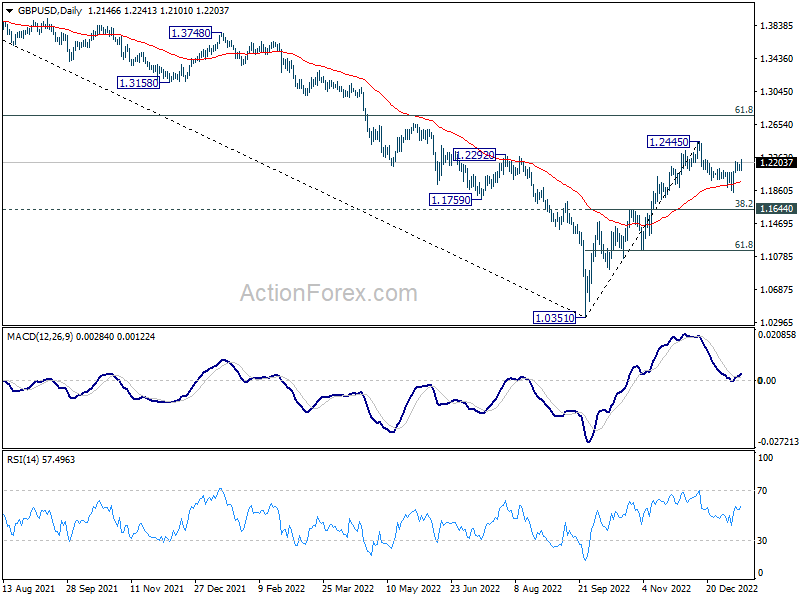
GBP/USD's rally from 1.1840 resumed after brief consolidation and intraday bias back on the upside. Further rise should be seen to retest 1.2445 high. Decisive break there will resume whole rally from 1.0351 to 1.2759 fibonacci level. On the downside, break of 1.2099 minor support will turn intraday bias neutral first. Break of 1.1840 will resume the correction from 1.2445 to 38.2% retracement of 1.0351 to 1.2445 at 1.1645.
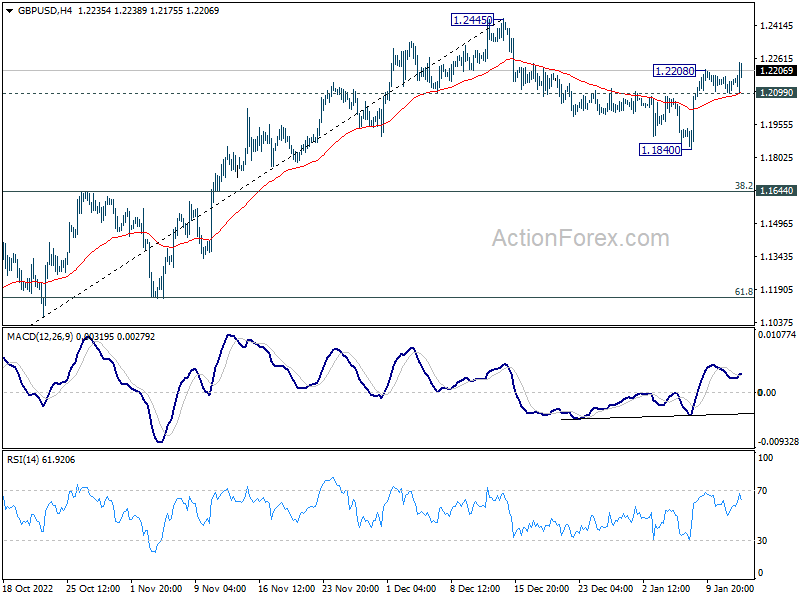
In the bigger picture, rise from 1.0351 medium term bottom is at least correcting whole down trend from 1.4248 (2021 high). Further rise is expected as long as 1.1644 resistance turned support holds. Next target is 61.8% retracement of 1.4248 to 1.0351 at 1.2759. Sustained break there will pave the way back to 1.4248.