Sample Category Title
Fed Daly: Case can be made for either 25 or 50 next
San Francisco Fed President Mary Daly said in a WSJ interview that she expects interest rate to rise from the current 4.25-4.50% to 5.00-5.25%. But she added that "doing it in more gradual steps does give you the ability to respond to incoming information."
Daly said the "case can be made for either" a 25bps or 50bps hike in February. But at the same time, "I want to be data dependent, not wall off a 50 basis point increase."
She expects unemployment to rise from current 3.5% to 4.5-4.6% as tightening continues. Inflation, now running at 5.5%, will fall to low 3% range by the end of 2023, and closer to 2% in 2024.
GBP/USD Could Rally Above This Resistance
Key Highlights
- GBP/USD could gain pace if it clears the 1.2215 resistance.
- It broke a major bearish trend line with resistance near 1.2050 on the 4-hours chart.
- EUR/USD broke the 1.0700 resistance and might rise further.
- Gold price rallied further above the $1,875 resistance.
GBP/USD Technical Analysis
The British Pound found support near 1.1845 against the US Dollar. GBP/USD started a fresh increase and cleared a major hurdle near 1.2000.
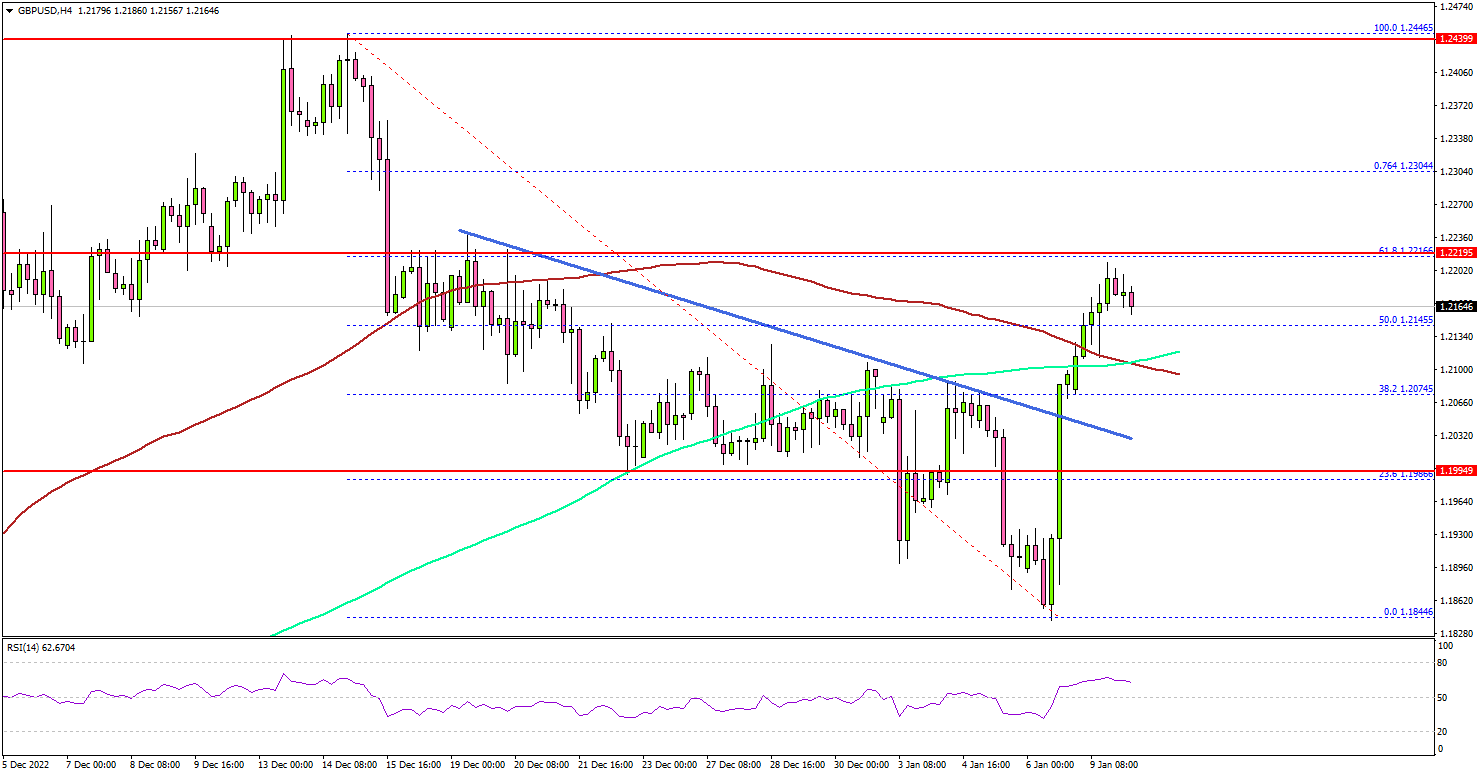
Looking at the 4-hours chart, the pair was able to settle above the 1.2000 resistance. There was a clear move above a major bearish trend line with resistance near 1.2050.
The pair surpassed the 50% Fib retracement level of the downward move from the 1.2446 swing high to 1.1844 low. It settled above the 100 simple moving average (red, 4-hours) and the 200 simple moving average (green, 4-hours).
On the upside, an initial resistance is near the 1.2200 level. The next major resistance may perhaps be near 1.2215. It is near the 61.8% Fib retracement level of the downward move from the 1.2446 swing high to 1.1844 low.
A clear move above the 1.2215 resistance might start a steady increase. In the stated case, GBP/USD could even surpass the 1.2250 level. In the stated case, the pair could rise towards the 1.2400 level.
On the downside, there is a major support at 1.2100 and the 100 simple moving average (red, 4-hours). The main support is now forming near the 1.2035 level. A downside break below the 1.2035 zone might push the pair lower.
The next major support sits near the 1.1955 level. Any more losses might open the doors for a move towards the 1.1850 support zone.
Looking at EUR/USD, the pair is showing positive signs and might soon attempt a move above the 1.1800 resistance zone in the coming sessions.
Economic Releases
- Federal Reserve Chair Jerome Powell Speech.
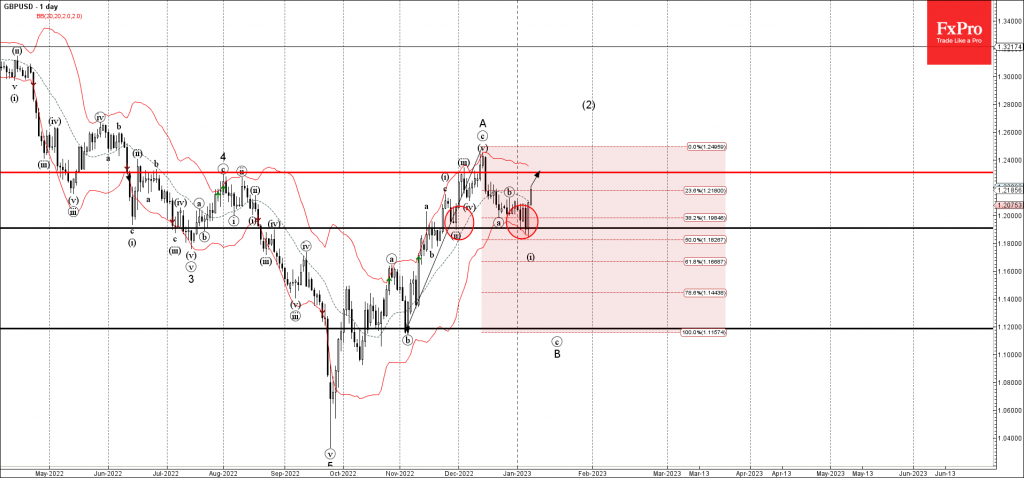
GBPUSD Wave Analysis
- GBPUSD reversed from support level 1.1900
- Likely to rise to resistance 1.2300
GBPUSD currency pair recently reversed up from the support level 1.1900 (which also stopped the previous correction (iv) at the end of last month), intersecting with the daily lower Bollinger Band and the 50% Fibonacci correction of the upward impulse from November.
The level 1.1900 created the second consecutive daily Japanese candlesticks reversal pattern Bullish Engulfing.
GBPUSD currency pair can be expected to rise further toward the next resistance level 1.2300 (which has been reversing the price from June).
Nasdaq 100 Wave Analysis
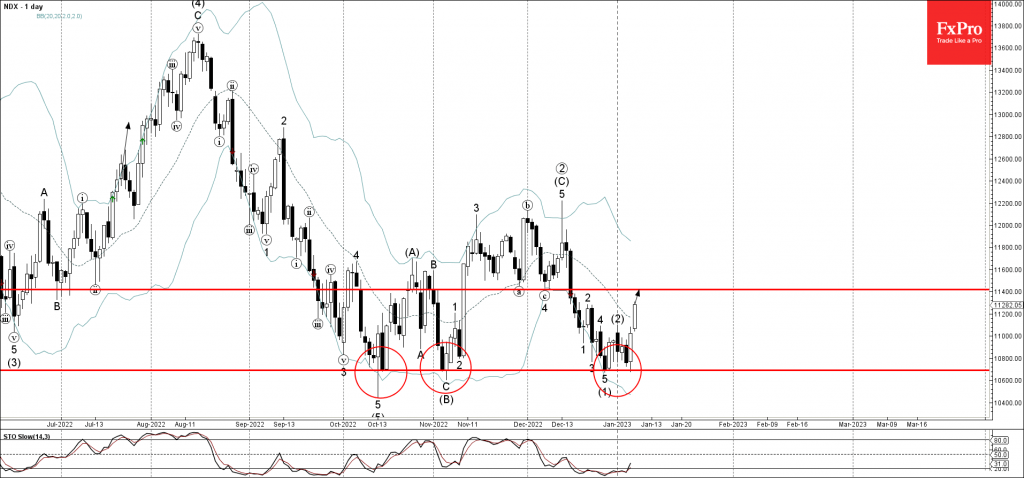
- Nasdaq 100 reversed from key support level 10700.00
- Likely to rise to resistance level 11400.00
Nasdaq 100 index recently reversed up from the key support level 10700.00 (which has been repeatedly reversing the price from the middle of October).
The upward reversal from the support level 10700.00 created the daily Japanese candlesticks reversal pattern Bullish Engulfing.
Given the strength of the support level 10700.00, Nasdaq 100 can be expected to rise further toward the next resistance level 11400.00 (former strong support from the November and December).
BoE Pill: Distinctive context prevails in UK creates the potential for more persistent inflation
BoE Chief Economist Huw Pill said in a speech that the central bank's communication "rightly places the persistence of inflation at centre-stage".
"Given the famous 'long and variable lags' in monetary policy transmission, it is the persistent component of inflation – that component of inflation that will still be there once the lags in monetary policy transmission unwind – that is the relevant object for the MPC's attention," he said.
He also noted, "the distinctive context that prevails in the UK – of higher natural gas prices with a tight labour market, adverse labour supply developments and goods market bottlenecks – creates the potential for inflation to prove more persistent."
"It is therefore in this nexus that I focus in coming to my own assessment of the risks surrounding inflation persistence, which – consistent with the MPC's collective communication – will strongly influence my monetary policy position in the coming months."
The Greenback Slides Against All G10 Peers
Markets
US yields enforced a slight comeback after tanking on Friday following slower-than-expected wage growth and a sharp retreat in the non-manufacturing December ISM. Advances in early European trading amounted to 5-6 bps across the curve but lacked strong-enough legs in a session without any news to retain all gains. The upcoming December CPI release (due Thursday) probably also caps the potential of market moves in the run-up. Net daily changes currently vary between flat at the short end and about 2 bps for maturities from 10y on. European yields were caught in the US slipstream end of last week. German yields lost about 10 bps but recoup more than half today, adding 4.5-6.4 bps across all maturities and underperforming US Treasuries. Peripheral spread changes vs Germany’s 10y are limited to +1 bp, with the exception of Greece (+5 bps). In terms of supply, the Kingdom of Belgium intends to issue a new syndicated benchmark bond (see headline below). Oil catches the eye in commodity markets. By adding about 3%, Brent settles back above $80/b. Some refer to ongoing China-related optimism. The country has issued a huge quota for crude imports today, which is taken as a hopeful demand signal. It has also unveiled some other supportive measures, including temporary VAT cuts for SMEs. That other closely watched energy commodity, gas, is stabilizing around levels seen just before the Russian invasion (€71.4/MWh) as a persistently mild winter keeps demand in check still. Equity markets join the risk-on. The EuroStoxx50 extends gains by 0.75%. The European gauge is creeping further north of the 4k barrier and has surpassed the previous recovery high (4035.15 in mid-December). US stocks add less than a percent.
The weekend hasn’t brought any relief for the dollar. The greenback slides against all G10 peers, including the yen – which is in bad shape too. DXY (trade-weighted index) is closing in on the 102.98 support level (post-pandemic panic surge higher in March 2020). USD/JPY loses a few ticks to 131.94. EUR/USD is testing the mid-December recovery high at around 1.072. To put things in perspective: the couple traded below 1.05 on Friday afternoon just before the payrolls release. Central-European currencies remain in a sweet spot, especially the Czech koruna. EUR/CZK hit a 15-y low after temporarily dipping below the 2011 support level at 23.93. A hawkish turn by the CNB (“rates may rise if demand pressures grow”) also helps. EUR/HUF stabilizes sub 400 and EUR/PLN holds ground below 4.70. Sterling’s attempt for a return back below EUR/GBP 0.88 ended almost as soon as it started. The pair (0.8806) is currently trading close to unchanged.
News Headlines
The Kingdom of Belgium (rated Aa3/AA/AA-; outlook all stable) announced that it intends to issue a new 10-yr syndicated OLO benchmark (OLO 97 Jun 2033) in the near future, subject to market conditions. It’s the first of three new expected benchmark deals in 2023 which serve to help complete a €45bn OLO funding need. In 2022, the Belgian debt agency raised €44.1bn in long term funding. OLO issuance is the lion share to cover this year’s €51.07bn gross borrowing requirement of the federal government, mainly consisting of a €27.54bn net financing requirement and €21.13bn worth of OLO redemptions.
The ECB published its economic bulletin. In one box they zoom in on wage developments and their determinants since the start of the pandemic. Looking ahead, wage growth over the next few quarters is expected to be very strong compared with historical patterns. This reflects robust labour markets that so far have not been substantially affected by the slowing of the economy, increases in national minimum wages and some catch-up between wages and high rates of inflation. Beyond the near term, the expected economic slowdown in the euro area and uncertainty about the economic outlook are likely to put downward pressure on wage growth.
Euro Extends Rally
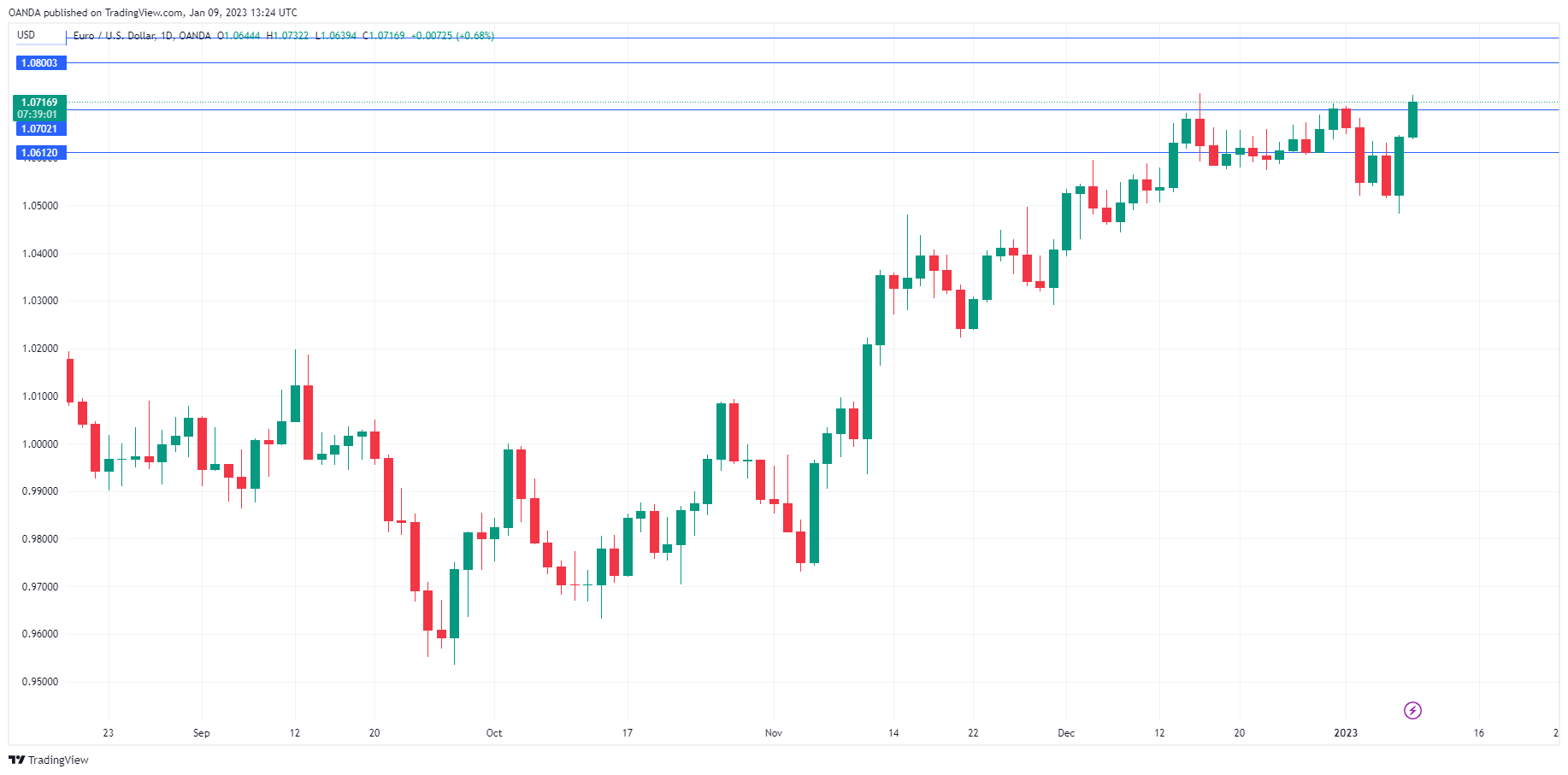
The euro is on a tear, climbing almost 2% since Thursday. Earlier today, EUR/USD rose to 1.0731, its highest level in a month.
Eurozone inflation falls sharply
Germany and other eurozone members recorded lower inflation in December, and eurozone inflation was expected to also soften. What was surprising was the extent of the drop, with headline CPI falling to 9.2%, down from 10.1% and below the estimate of 9.7%. This sent the euro sharply higher on Friday.
The main driver of the decline in inflation was a drop in oil and natural gas prices, as well as energy subsidies. It’s looking increasingly likely that inflation has already peaked, but of course, the road back to the 2% target will be a long one. The ECB’s latest projection shows inflation won’t hit this target until 2025. Another caveat is that core inflation actually rose in December to 5.2%, up from 5.0%, which was also the forecast. With core inflation remaining persistent, it’s likely that the ECB will remain hawkish in the first quarter and rate hikes of 50 basis points are likely in February and March.
The eurozone Sentix Investor Confidence index climbed for a third straight month, rising by 3.5 points in January. Investor expectations improved, with hopes that the reopening in China will boost the eurozone economy. Still, the index is mired in negative territory, at -17.5 points.
In the US, the data was mixed on a busy Friday. Nonfarm payrolls came in at 223,000, down from 256,000 but above the estimate of 203,000. This was a decent release, but investors chose to focus on the soft releases. Average hourly earnings rose 4.6%, well off the 5.0% estimate and shy of the prior reading of 4.8%. As well, the ISM Services PMI fell into contraction territory for the first time since May 2020. The index slipped to 49.6, down sharply from 56.5 and the forecast of 55.5. The drop in wage growth and weaker services activity could force the Fed to rethink its aggressive rate policy and even cut rates late in the year. This has raised risk appetite and sent the US dollar lower across the board.
EUR/USD Technical
- EUR/USD has support at 1.0702 and 1.0612
- There is resistance at 1.0800 and 1.0953
WTI Oil: Oil Price Rises on Renewed Demand Optimism But Key Barriers Still Hold
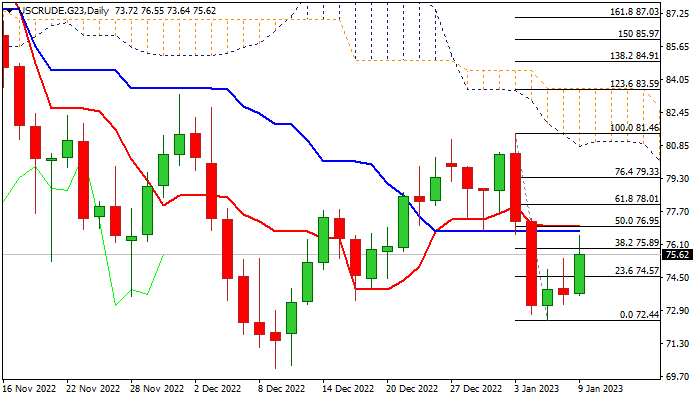
Strong bullish acceleration on Monday (WTI contract was up around 3% in Asia/Europe) retraced close to 50% of last week’s 8.5% drop, as sentiment improved on China’s opening its borders that brightened the outlook for oil demand, while weaker dollar also contributed to higher oil prices.
Technical studies on daily chart are improving as 14-d momentum is breaking into positive territory and stochastic emerged from oversold zone, though moving averages are still in bearish configuration.
Pivotal barrier lays at $76.70/95 zone (converged daily Tenkan-sen / Kijun-sen) and sustained break here is needed to generate reversal signal and open way for stronger recovery, while holding below these resistances would keep the downside vulnerable.
Res: 75.89; 76.70; 76.95; 78.01.
Sup: 74.57; 73.64; 73.22; 72.44.
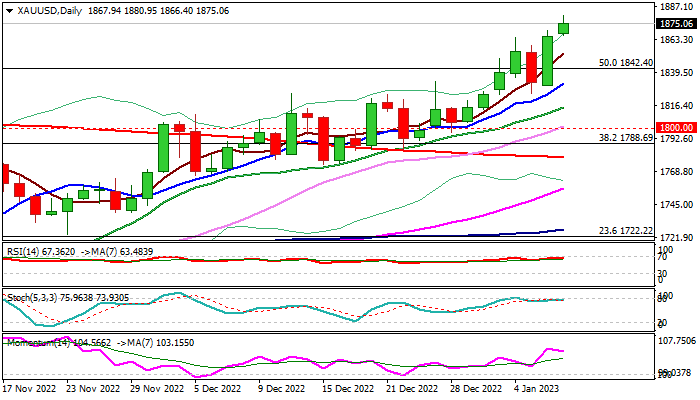
XAU/USD: Weaker Dollar and Improved Sentiment Lift Gold to 8-Month High
Gold rises to 8-month high on Monday, lifted by weaker dollar on growing expectations that the Fed would further decelerate its policy tightening, as well as improving sentiment on top gold consumer – China, opening its borders.
The yellow metal advanced around 0.5% on Monday until the start of the US session, extending Friday’s 1.9% rally (the biggest one-day gain since Nov 10.
Bulls probe through the top of thickening weekly cloud ($1877), where headwinds are expected, as bullish momentum is fading on daily chart and stochastic indicator is showing bearish divergence.
Overall picture remains bullish and additionally underpinned by Friday’s bullish engulfing, with corrective dips likely to be shallow and offer better opportunities to re-join bullish action.
Bulls look for a break through weekly cloud top to attack targets at $1896/$1900 (Fibo 61.8% of $2070/$1614 / psychological).
Broken Fibo 50% of $2070/$1614 reverted to solid support which should ideally contain and guard pivotal support at $1832 (rising 10DMA).
Res: 1880; 1886; 1896; 1900.
Sup: 1866; 1853; 1842; 1832.