Sample Category Title
BoJ Kuroda: Central banks cannot unconditionally respond to climate change
At an event in Stockholm, BoJ Governor Haruhiko Kuroda said, "central banks, which are independent from governments cannot unconditionally respond to climate change," and must "autonomously decide their actions within their mandate" from a long-term perspective.
He added that central banks must try to affect the overall economy, but not specific industries.
While BoJ doesn't have specific mandata on climate change, it's "generally accepted by the public" that the central bank's measures are in line with the government. Back in 2021, BoJ launched a scheme to offer zero-interest loans to boost green and sustainable loans.
Fed Pushing Back
European stock markets are softer in early trade on Tuesday following a similar session in much of Asia as investors turn more cautious ahead of Thursday's US inflation data.
The commentary from Fed officials at the start of the week was more hawkish than what investors wanted to hear following a knockout jobs report. Considering the rhetoric in the weeks leading up to Friday, it shouldn't have come as a great surprise that policymakers are sticking to the "higher for longer" narrative.
There has been a determination to not allow financial conditions to loosen on the expectation of lower rates down the road as it undermines tightening efforts now. While the central bank's assessment of future rates may be more hawkish than the markets, it's also possible that they're being intentionally overly hawkish now in an attempt to stop investors from getting carried away.
The jobs report may not have been enough to warrant a shift in the language, but that doesn't mean we aren't close and any change could be quite stark. The inflation report on Thursday could further justify such a move although investors will be very wary that a bad one could ensure policymakers dig their heels in for a while longer yet.
Demand to pick up later this year
It's been a choppy session in the oil market, where Brent is hovering around $80 and WTI $75. We've now seen three sessions on the bounce in which oil prices have rallied before ending the day well off the highs. Not a particularly bullish signal.
There's a lot to consider in oil markets at the moment and the near-term risks probably are more tilted to the downside. The start of the year could see countries fall into recession as the cost-of-living crisis bites, interest rates are hitting a level that could significantly hurt economic activity and China is likely to experience the worst of the Covid surge after relaxing its approach.
Beyond that, things could start to look up for a number of reasons. China could bounce back strongly, especially if backed by monetary and fiscal stimulus, central banks may discover they have room to cut rates if inflation falls substantially and economies are in recession and Russian output could be squeezed as sanctions take their toll. A lot of if's and but's, of course, but that is the uncertain world we now live in.
Holding on
Gold is holding onto gains well considering the Fed's efforts to address market interest rate expectations. Yields remain near their recent lows and gold near the highs around $1,880, indicating that policymakers have a lot more convincing to do. That may be made harder on Thursday if core inflation is lower than expected, undermining the central bank's hawkish stance. Of course, there will come a time when that will have to change and it may be fairly abrupt.
For now, the yellow metal faces strong resistance around $1,880-$1,920, a region that we've seen a lot of activity around in recent years. Momentum remains favourable for the bulls but that may change now that price is testing that $40 range.
Tentatively higher
Bitcoin is marginally higher after breaking back above $17,000 yesterday, buoyed by an improvement in risk appetite. That remains fragile though and a nasty surprise this Thursday from the US inflation report could send risk assets into reverse. The broader crypto environment remains the dominant driver though and it's gone a little quiet on that front which will be welcome.
GBPUSD Holds Bullish Bias But Momentum Weak
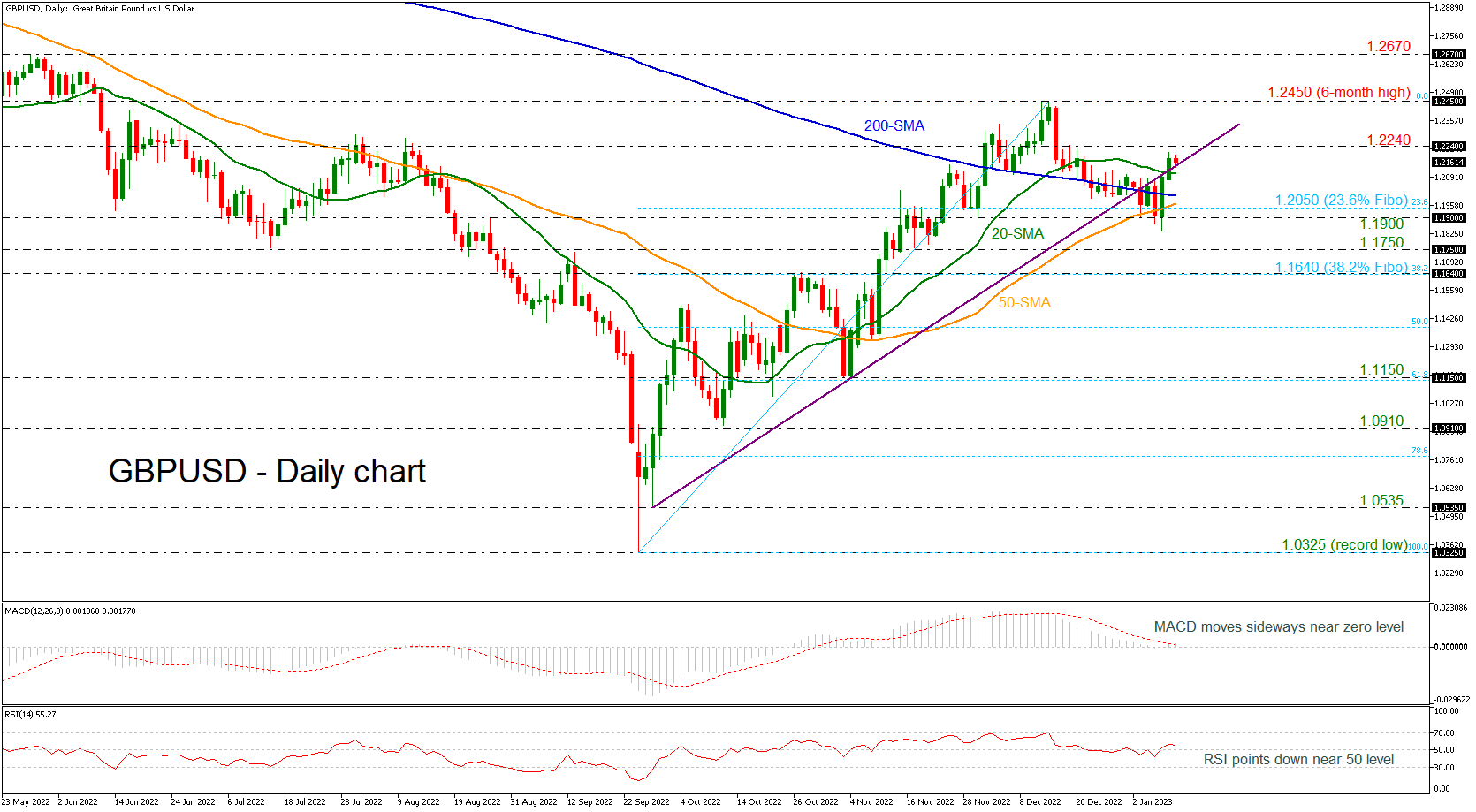
GBPUSD returned back above the medium-term uptrend line after the fall below the 23.6% Fibonacci retracement level of the upward wave from 1.0325 to 1.2450 at 1.2050. Currently, the price is losing some momentum, confirmed by the technical oscillators. The MACD is moving sideways near the zero level, while the RSI is sloping down near the 50 neutral threshold of 50.
Failure to remain above the ascending line could send the price down to the 200-day simple moving average (SMA) at 1.2000, which has been a challenging point over the last two weeks. Lower, support could next be found around the 50-day SMA, which is moving near the 23.6% Fibonacci at 1.2050, while a decisive close below the 1.1900 round number could stage a steeper sell-off.
Alternatively, if 1.2240 proves easy to get through, the spotlight will turn to the six-month high of 1.2450. On top of that, the bulls would need to clear the 1.2670 barrier, achieved in May 2022.
In the medium-term picture, GBPUSD turned neutral after violating the uptrend started from the 1.0535 bottom. Should the market continue the upward pattern, the outlook may turn brighter. A run above 1.2450 would turn the outlook strongly bullish.
EURJPY Bounces Back Within Bearish Channel
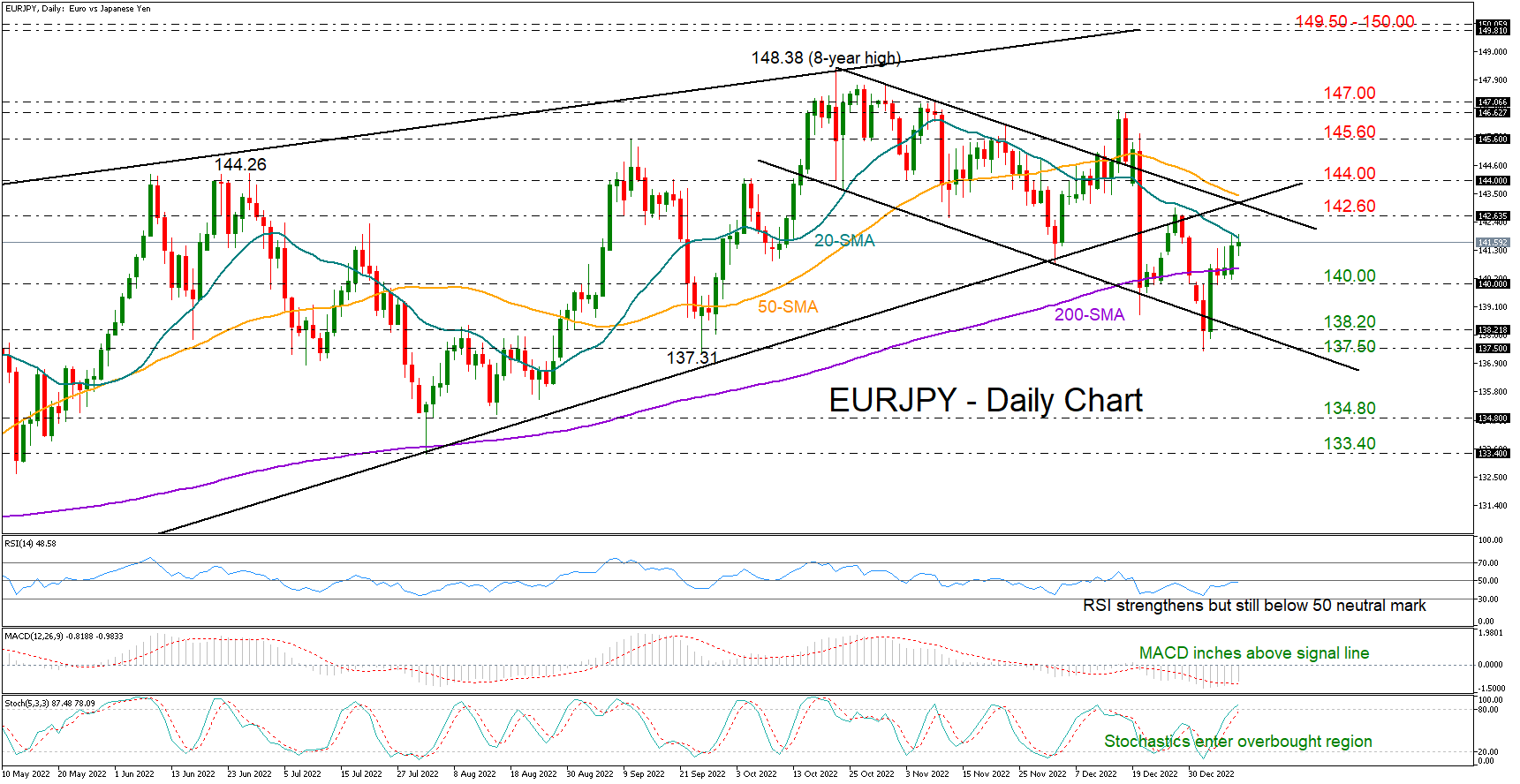
EURJPY rose as high as 141.91 after charting a three-month low of 137.37 at the lower boundary of a bearish channel.
The pair switched into gains in January after two negative months, and although the positive slope in the momentum indicators raises hopes for more upside ahead, room for improvement could be limited as the channel’s upper trendline is within a breathing distance at 142.60. Prior to that, the 20-day simple moving average (SMA), which is capping bullish actions for the second consecutive day at 141.75, could immediately ruin the recovery phase. Note that the RSI has yet to climb above its 50 neutral mark despite moving higher, while the stochastics are entering the overbought region.
Should the price exit the channel on the upside, all eyes will shift to the support-turned-resistance trendline from March 2022 at 143.30. This is where the 50-day SMA is heading. Hence, a clear extension higher and beyond the 144.00 hurdle could confirm additional gains up to 145.60.
If buying interest fades immediately, the price may reverse south to retest the 200-day SMA and the 140.00 number. A step lower could spark an aggressive decline towards the channel’s support line seen at 138.20, while a steeper bearish correction could reach the 137.50 floor as well.
Summing up, the latest rebound in EURJPY may have more room to run, though whether the bulls will escape the bearish structure remains to be seen.
Japanese Yen Yawns as Inflation Hits 4%
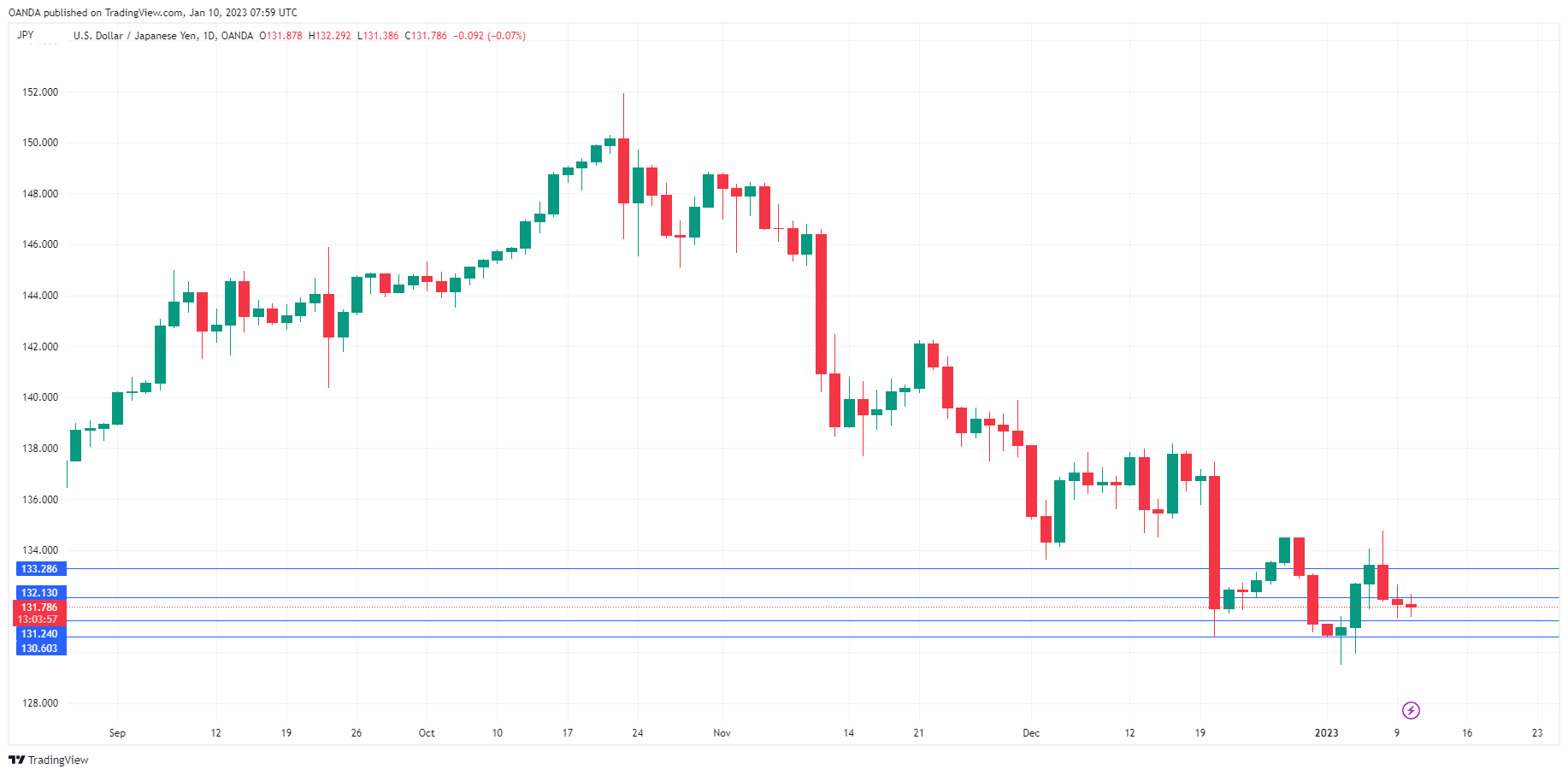
The Japanese yen continues to have a quiet week. USD/JPY is showing little movement on Tuesday, trading at 131.84.
Tokyo Core CPI hits 4.0%
Tokyo Core CPI, a key inflation indicator, was higher than expected and in December hit 4.0% for the first time since 1982. This was up from 3.6% in November and above the forecast of 3.8%. Food and energy costs were the drivers behind the uptick, but higher prices were broad-based, casting doubt on the Bank of Japan’s argument that inflation is mainly due to import costs. The BoJ says that inflation is close to a peak, but inflation indicators such as Tokyo Core CPI don’t corroborate that view.
The markets were caught flat-footed by the BoJ in December when it suddenly widened the yield curve control band, and wary investors are on the lookout for further policy changes, such as another widening of the band or eliminating its yield curve control target for long-term bonds. Higher inflation is putting pressure on the BoJ to respond, and the monthly policy meetings are no longer sleepy affairs that have no bearing on the markets. The BoJ meets again on January 18th and in addition to announcing policy will update its inflation forecasts.
High inflation has taken its toll on consumers, and Household Spending declined in November for the first time since June, with a reading of -1.2%. This was down from 1.2% in October and missed the consensus of 0.6%. The government has introduced an economic stimulus package that includes subsidies for electric bills and is counting on the measures to push inflation lower. Still, the package isn’t expected to make an impact until February, which means inflation could continue to accelerate in January.
USD/JPY Technical
- There is weak resistance at 132.13, followed by 133.30
- 131.25 and 130.60 are the next support lines
USD Weakness ahead of Powell – Further Downside after Rally
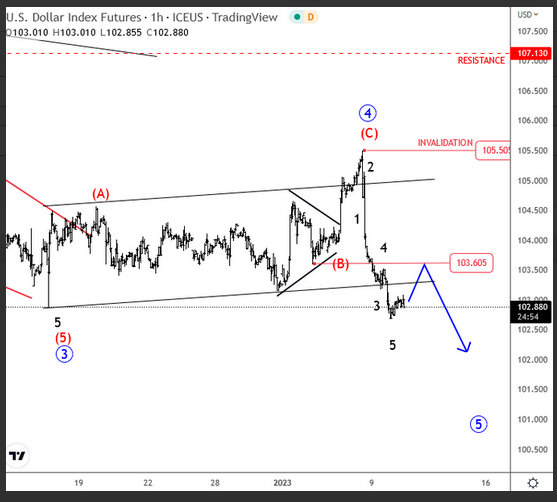
Markets are not moving much. They slowed down after some dollar weakness over the last two trading days. We see US stocks coming down from resistance ahead of Powell today, so it appears that investors are waiting on more details before they may position themselves for a direction of a breakout. Will Powell be hawkish or more neutural with comments is a real question. I think he may not give us any real bias yet, ahead of US CPI data this Thursday. From an Elliott wave perspective we see USD in bearish mode, with room for more weakness, but possibly after a rally on DXY. Resistance is at 103.60.
Markets Slip On Hawkish Fed Remarks
It’s a new year but the same old story with markets sensitive to Fed rate hike bets and hawkish chatter by policymakers.
Asian shares were knocked lower during early trading as investors evaluated comments from two Federal Reserve officials overnight. A sense of caution ahead of the key US inflation report on Thursday dampened the overall mood, encouraging investors to adopt a guarded approach towards riskier assets.
European futures are pointing to a lower open this morning amid the shaky risk sentiment. In the currency markets, the dollar was little changed but remains pressured by market expectations of a less hawkish Fed, despite the recent comments from Raphael Bostic and Mary Daly. Gold continues to shine, kissing levels not seen since May 2022 above $1880 while oil remains a fierce battleground for bulls and bears.
In other news, the World Bank is expected to unveil its global economic prospects report today. The international financial institution has already expressed concerns about the global economic outlook, warning of recession risk in 2023. Should the forecasts point to a global economic slowdown, another wave of risk aversion could sweep across markets as investors rush to safety.
More pain ahead for the Dollar?
Over the past few weeks, it has been the same old story for the tired dollar.
Expectations around a less hawkish Fed and subdued Treasury yields have clipped the greenback’s wings. Things are looking rough for the buck which has depreciated against almost every single G10 currency since the start of 2023. Bears remain in the vicinity despite the recent hawkish comments from Fed officials overnight with further downside on the cards if Thursday’s US inflation cools again.
According to Bloomberg, annual headline inflation for December is expected to cool to 6.5% from the prior print of 7.1%. Should expectations become reality, this will mark the sixth straight monthly decline and the lowest since October 2021. More signs of falling inflation may fuel talk around the Federal Reserve steering to a smaller rate hike at the start of next month. Alternatively, a hotter-than-expected CPI report could revive aggressive rate hike bets as investors question how slowly inflation will fall. Such a development could see the dollar rebound.
Before the key US inflation data later in the week, all eyes will be on Fed Chair Jerome Powell as he speaks during an international symposium at the Riksbank in Stockholm later today. Should the Fed Chair provide any guidance on rate hikes, this could influence the dollar.
Looking at the technicals, the DXY could be in store for more pain as the death cross technical pattern strikes. With the 50-period simple moving average (SMA) crossing down below the 200-day SMA, this signals a major trend reversal to the downside. Sustained weakness below 103.00 could encourage a decline towards 101.30.
Currency spotlight – GBPUSD
It has been a choppy affair for GBPUSD recently as prices have traded within a 200-pip range with support at 1.1900 and resistance at 1.2100. However, the recent breakout has shifted the scales of power in favour of the bulls, with further upside on the cards. Bank of England Governor Andrew Bailey will be under the spotlight this morning as he speaks at the event at the Riksbank. This could translate to pound volatility depending on his remarks. Nevertheless, pound bulls remain in some control above 1.2100 with the next key levels of interest found at 1.2230 and 1.2300.
Commodity spotlight - Gold
Gold has kicked off 2023 on a solid note, gaining 2.7% since the start of the New Year.
The precious metal continues to draw strength from a softer dollar, falling Treasury yields, and growing expectations of a less hawkish Federal Reserve. Given how last Friday’s mixed jobs report has fanned speculation around the Fed slowing its rate hikes, further upside could be on the cards. In the meantime, gold’s outlook is likely to be influenced by the upcoming US inflation report. A further cooling in prices in December and lower bond yields would be a welcome development for zero-yielding gold. Looking at the technical picture, bulls remain in a position of power with the next key level of interest found at $1900.
US, China Inflation and Reopening Impact
The two largest economies in the world are expected to report inflation figures later this week. But, by far, the US figure is expected to be the most important. The yuan trades within a bound set by the PBOC, which limits the impact that data can have. However, the broader implication of prices and China, as well as their causes, can have global implications.
China formally lifted all restrictions related to covid over the weekend, which initially supported risk-on sentiment in the markets. But comments from Fed officials later in the day completely reversed that situation. It's just an example of where the balance of influence is, when it comes to the key data coming up this week.
China inflation is more important than it appears
Effectively, China is the world's manufacturing center. If production costs increase for Chinese firms, they will end up pushing through the supply chain to the rest of the world. With China under restrictions for the last several months, productivity has been constrained. Meanwhile, the government has been spending in order to prop up the economy. This puts China in a similar situation as the rest of the world that is experiencing high inflation.
China's lifting of restrictions, on the other hand, could help stop inflation from getting off the ground. But that depends on whether global demand remains sufficiently resilient. Inflation is the product of an imbalance between the money supply and the amount of productivity. If the money supply is expanded, and productivity increases to match, then inflation could be stopped. But, if the world slips into an expected recession this year, then Chinese productivity could falter, creating inflationary pressures. Since firms buy products months in advance, the evolution of Chinese CPI over the coming months could give some insight into a pending recession, and how bad it could be.
What to look out for
China's inflation rate is expected to accelerate to 1.8% from 1.6% prior. This is still below the PBOC's 2% target, which means the government could continue to provide stimulus for the domestic economy.
Meanwhile, across the Pacific, US CPI is expected to continue its rapid deceleration, forecast at 6.5%, down from 7.1% prior. After being caught by surprise for two months in a row, it seems economists are being more aggressive in their forecasts for slowing inflation. Core inflation is also expected to come down, but not as fast: It is forecast at 5.7%, down from 6.0%, still almost triple the Fed's target.
What it all means
What matters more to the markets is the core figure because that's what matters more to the Fed. Initial optimism that the Fed might not raise rates as much because inflation has come down is now facing a dose of reality as core inflation remains 'sticky'.
That was reflected in comments from Fed officials yesterday, who both insisted that the terminal rate will be higher than what the market expects. Even if headline inflation comes down substantially, unless core inflation surprises to the downside, investors could start to bet on further rate hikes from the Fed.
GBP/JPY Daily Outlook
Daily Pivots: (S1) 159.59; (P) 160.41; (R1) 161.50; More...
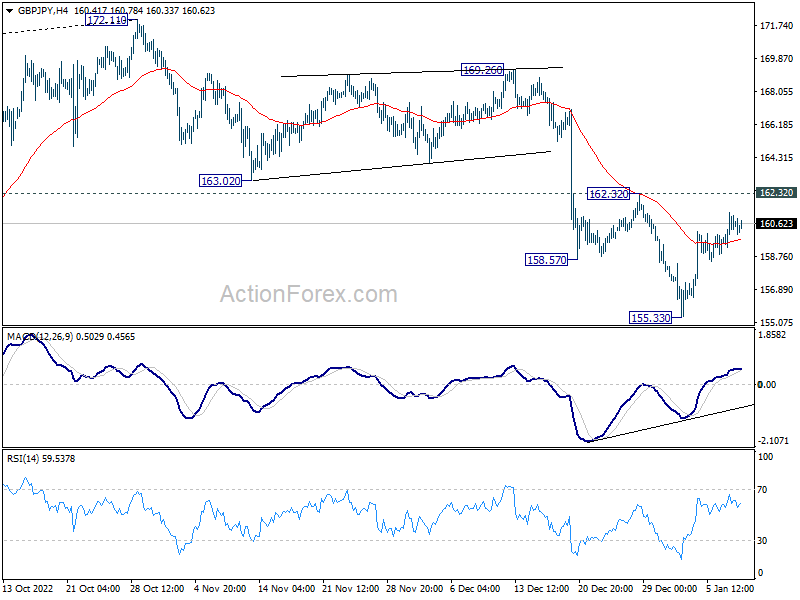
Outlook in GBP/JPY remains unchanged and intraday bias stays neutral. On the downside, break of 155.33 will resume the fall from 172.11 to 153.70 fibonacci level. Nevertheless, considering bullish convergence condition in 4 hour MACD, firm break of 162.32 will argue that such decline has completed, and turn bias back to the upside for 55 day EMA (now at 163.35) and above.
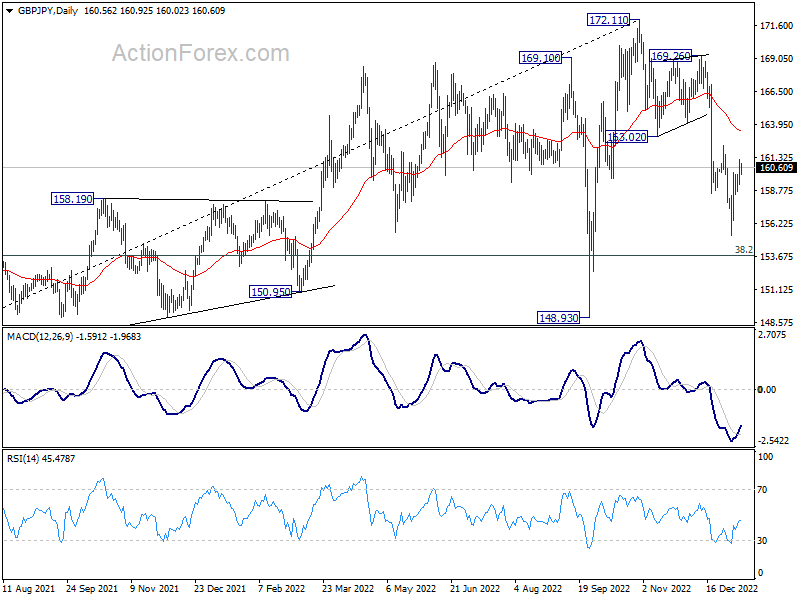
In the bigger picture, as long as 153.02 support turned resistance holds, decline from 172.11 medium term top is expected to continue to 38.2% retracement of 123.94 to 172.11 at 153.70. Sustained break there will raise the change of trend reversal and target 61.8% retracement at 142.34. Nevertheless, break of 153.02 support turned resistance will argue that the decline has completed, and retain medium term bullishness.
EUR/JPY Daily Outlook
Daily Pivots: (S1) 140.51; (P) 141.21; (R1) 142.25; More....
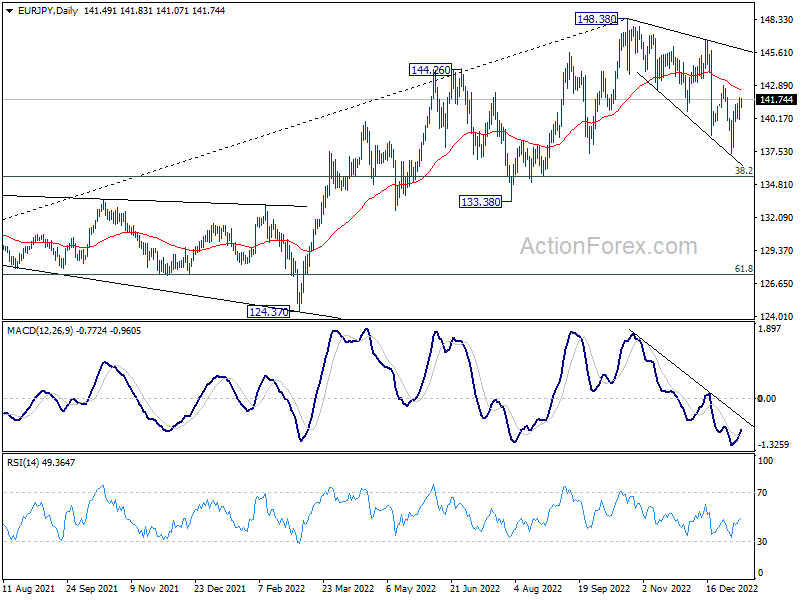
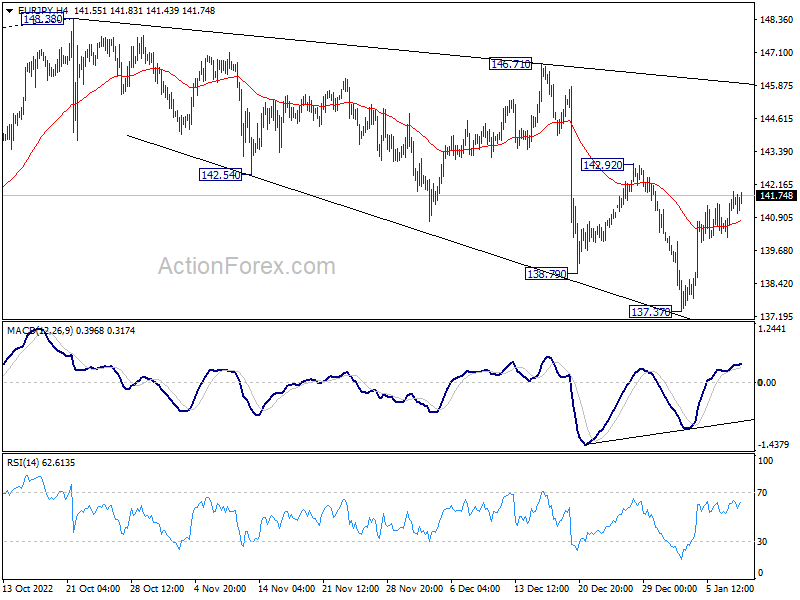
No change in EUR/JPY's outlook and intraday bias stays neutral. On the downside, break of 137.37 will resume the decline from 148.38 to 135.40 fibonacci level. However, considering bullish convergence condition in 4 hour MACD, break of 142.92 will argue that the correction from 148.38 might have completed. Intraday bias will be turned back to the upside for 146.71 resistance.
In the bigger picture, as long as 55 week EMA (now at 138.64) holds, larger up trend from 114.42 (2020 low) is still in progress for 149.76 long term resistance. However, firm break of 55 week EMA will bring deeper fall to 38.2% retracement of 114.42 to 148.38 at 135.40. Sustained break there will raise the chance of trend reversal, and target 61.8% retracement at 127.39.