

Sample Category Title
US: Small Business Optimism Index Deteriorates, Reversing Four Months’ Gains
The NFIB's Small Business Optimism Index lost 2.1 points, dipping to 89.8 in December - the lowest level since July. The reading is below the consensus forecast, which expected it to ease only by four points to 91.5. The index has been below the historical average since the beginning of 2022.
Most of the subcomponents fell on the month. The biggest drivers were economic expectations and earnings, both of which declined by eight points (the latter gave back November's gain). Among owners reporting lower profits, 30 percent blamed the rise in the cost of materials, 24 percent blamed weaker sales.
Fewer small business owners reported that now is a good time to expand or have plans to make capital outlays in the next few months, as both components deteriorated by 1 point each, reversing November gains.
The only positive change was in the sentiment for inventories reported as "too low" (+3 points), while plans to add more inventories remained flat on the month after a six point deterioration in November.
Fewer firms reported open positions that they were unable to fill, but at 41% (three points lower than in November), the labor market remained tight. As a result, small business owners continue to boost compensation, with 44% (+4 points) reporting higher compensation in the past three months and 28% (-1 ppts) of firms planning to raise it in the next three months. Meanwhile, firms' hiring intentions dropped to 17% (-1 ppts) - to the lowest level since January 2021.
The net percent of owners raising average selling prices decreased 8 points from November to a net 43% - the lowest since May 2021. This suggests that prices are easing.
Key Implications
The Small Business Optimism Index ended the year on a somber note. Despite the recent trend of easing gas prices, which typically boost business sentiment, owners became more pessimistic about their prospects. While rising input costs continue to be owners top business problem, deteriorating demand makes it harder for them to continue to raise sales prices. This makes small business owners worry about their ability to keep profits and explains the deterioration.
Despite the marginal improvement in the number of firms finding it hard to fill positions, demand for labor remains strong and is the second biggest concern of small business owners. Most of them continue to report that jobs are hard to fill and they plan to attract workers by increasing labor compensation. This too may affect profits in the coming year.
Trade Ideas: CAD Might Weaken Ahead of the Macklem’s Speech
Later today, Tiff Macklem, the governor of the BoC (Bank of Canada), is expected to speak at the Riksbank's International Symposium as part of a discussion panel on 'Central Bank Independence.' This speech, however, is speculated to deliver helpful insights into the governor's perception of the Canadian economy through the BoC policies on the interest rate.On the technical side of things, we will take a cross-sectional look at CAD pairs to see how they are looking ahead of the news release.
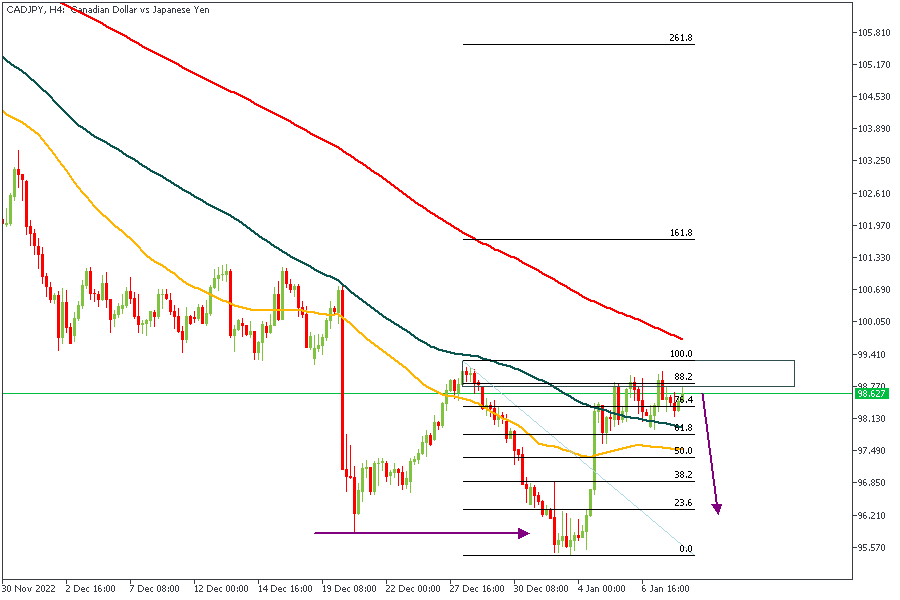
CADJPY
After the bearish break of the structure marked by the horizontal arrow, the price retests the supply order block heading into the 200-SMA. The 88.2% Fibonacci level is also crucial to consider alongside the current accumulation around that area.
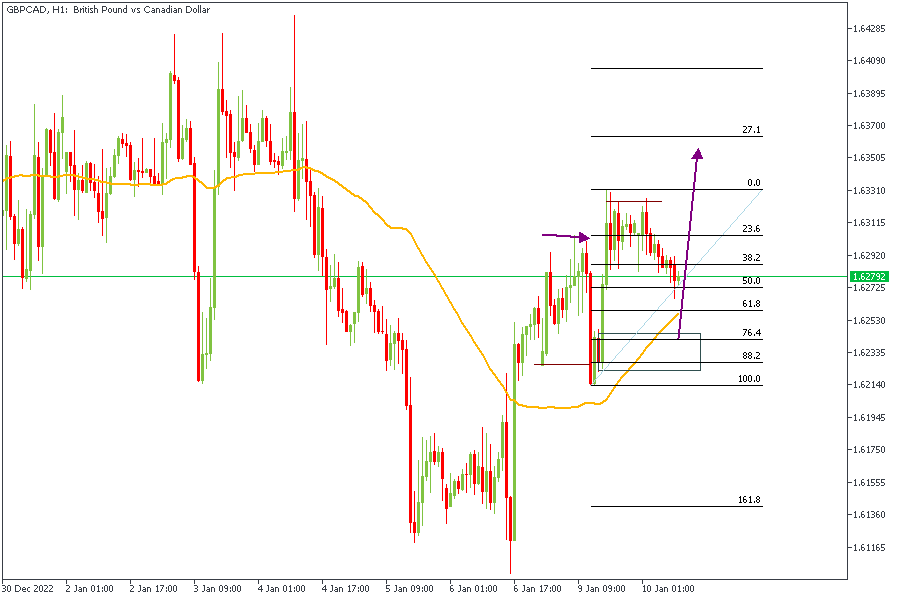
GBPCAD
GBPCAD's downward trend may be temporarily interrupted as the price heads into the 100-SMA. The marked rectangle highlights a demand zone coupled with the Fibonacci level, the Moving Average, and the QML (Quasimodo) pattern, presenting a bullish argument for price action.
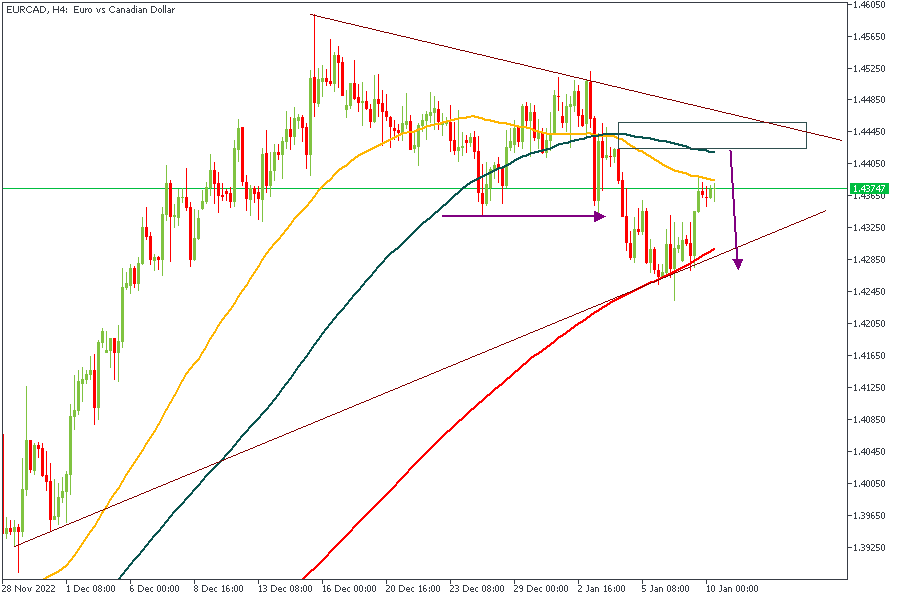
EURCAD
EURCAD is currently trading inside a wedge pattern. Notable, however, is the crossing of the 100 and 50 Moving Averages, which could serve as an early signal for bearish movement. The marked box is also a rally-base-drop supply zone situated at the 88.2% Fibonacci level, further strengthening our bearish bias.
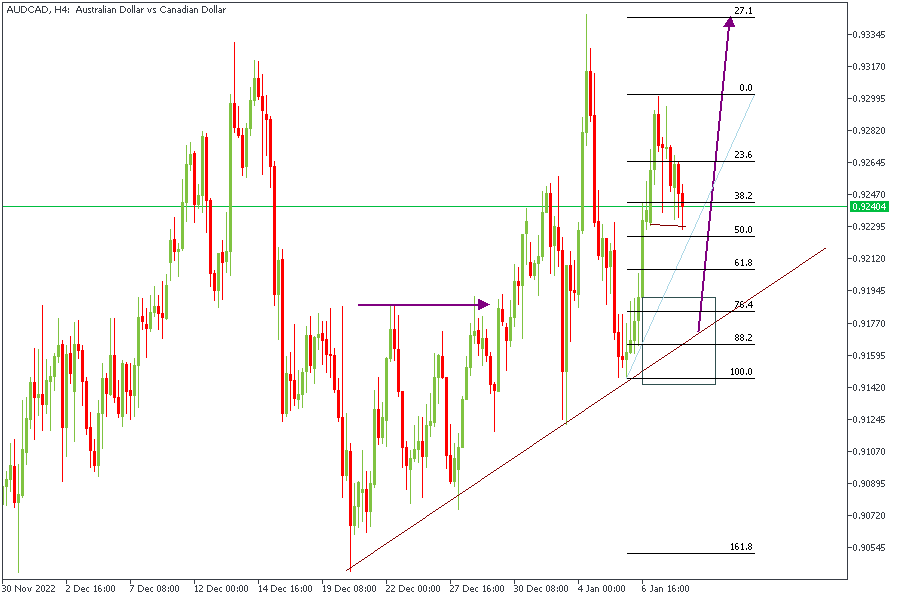
AUDCAD
There's been a recent bullish break of structure on AUDCAD's H4 timeframe, which has not yet responded to the demand zone to give a higher high. On this note, the Fibonacci level and the rally-base-rally demand zone marked by the rectangle seem good enough to anticipate some bullish price action in the hours to come.
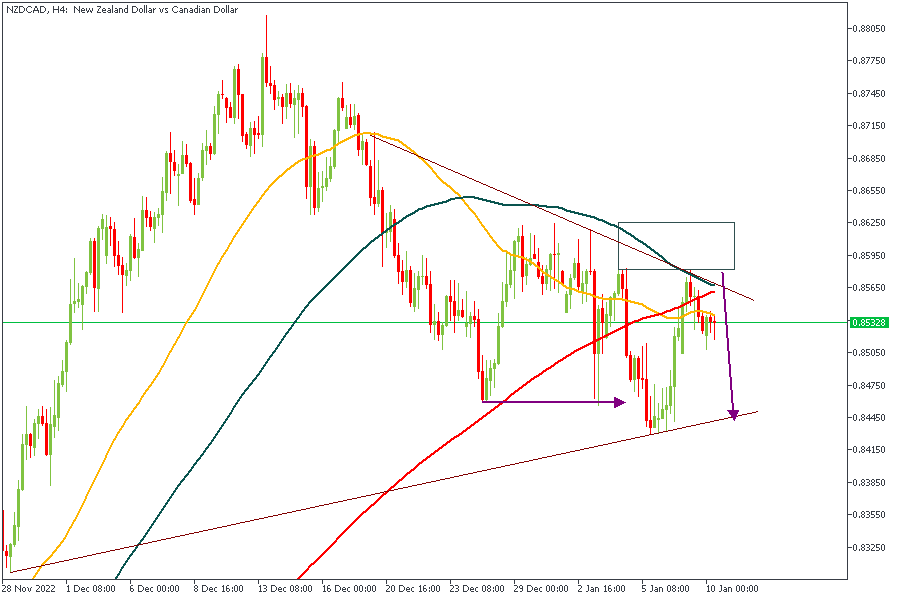
NZDCAD
With the 50-SMA below the 100-SMA and the 200-SMA, we can expect a continuation of the bearish structure that the break of structure at the horizontal arrow has confirmed. However, before that, we may see some initial bullish pulse as the price might try to retest the trendline resistance + 100-SMA + supply zone area once more before heading downwards.
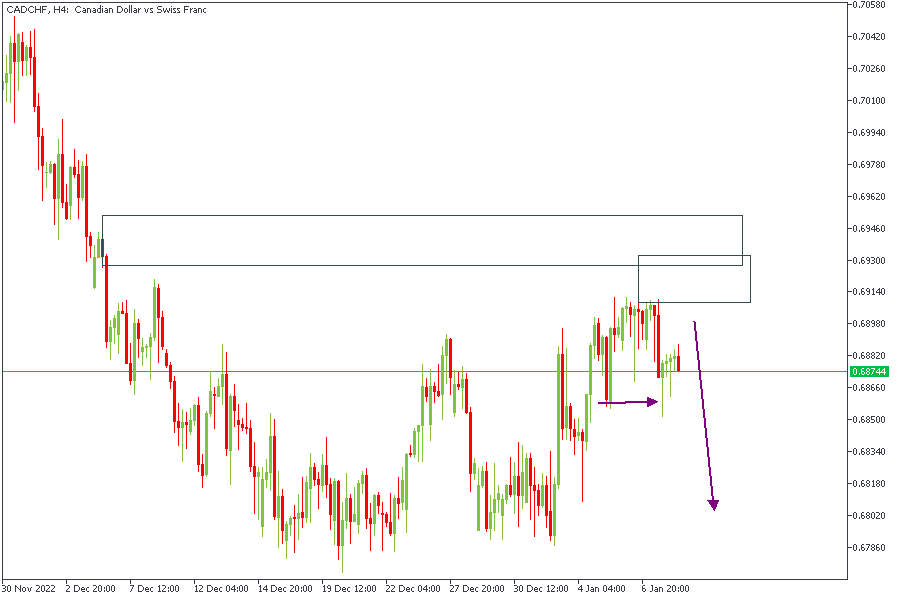
CADCHF
The structure is bearish on this H4 chart. It means we can expect some initial bearish movement from the rally-base-drop supply zone to the 0.68 price area as the price searches for a reliable area of demand to recover its bullish impulse. The release will be expected to bring more clarity to this directional bias.
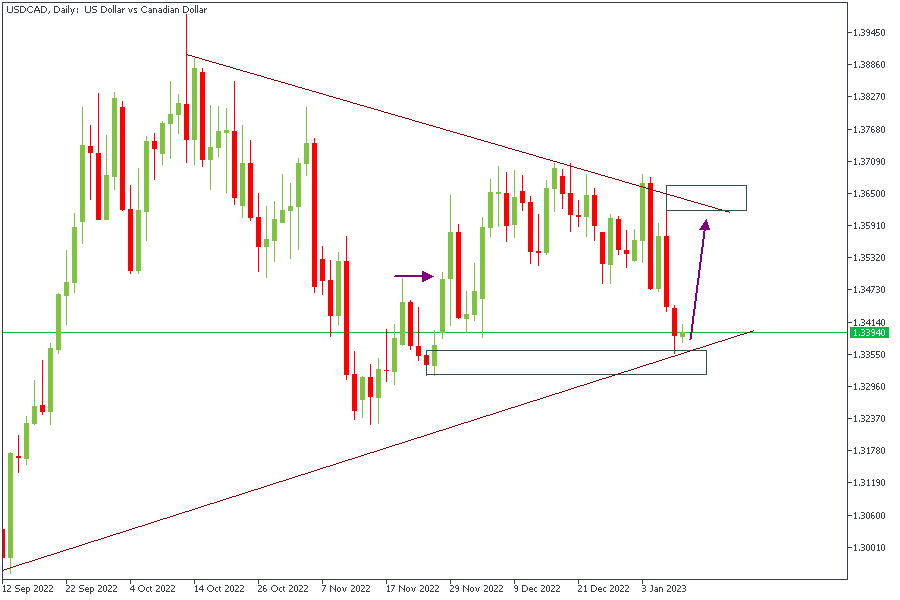
USDCAD
The daily timeframe of USDCAD shows price trading within a wide range, with demand and supply zones marked out. Based on the visible price data, I expect the price to bounce off the demand zone since the trendline support and the 88.2% Fibonacci level agree with me.
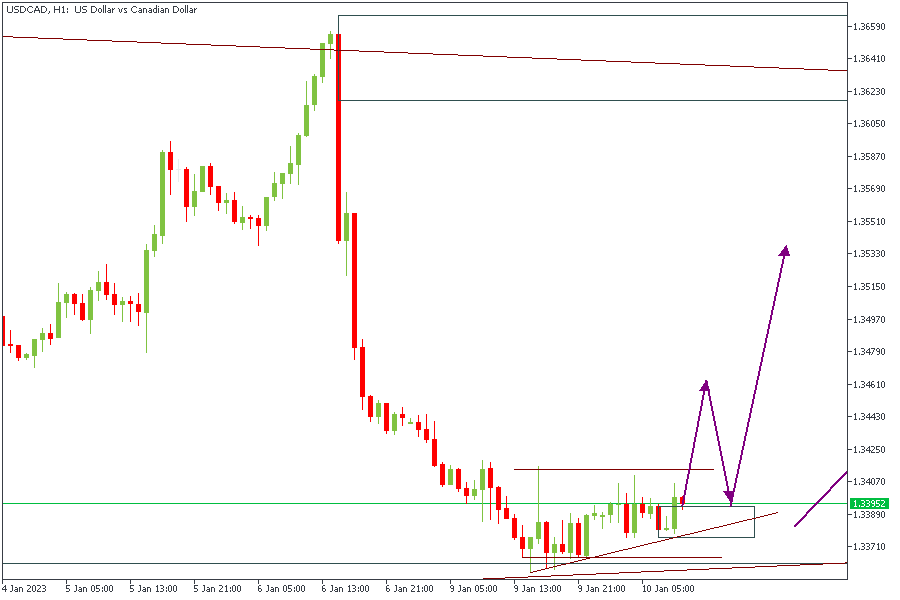
The 1-hour timeframe's price action should look like the path of the arrows marked above.
CONCLUSION
The views above are solely based on Technical Analysis techniques using my personal Smart Money approach. Hence, it is important to understand that the trading of CFDs comes at a risk; if not properly managed, you may lose all of your trading capital. To avoid costly mistakes while you look to trade these opportunities, be sure to do your own due diligence and manage your risk appropriately. You can access more of such trade ideas as well as prompt market updates on the telegram channel.
EUR/USD Mid-Day Outlook
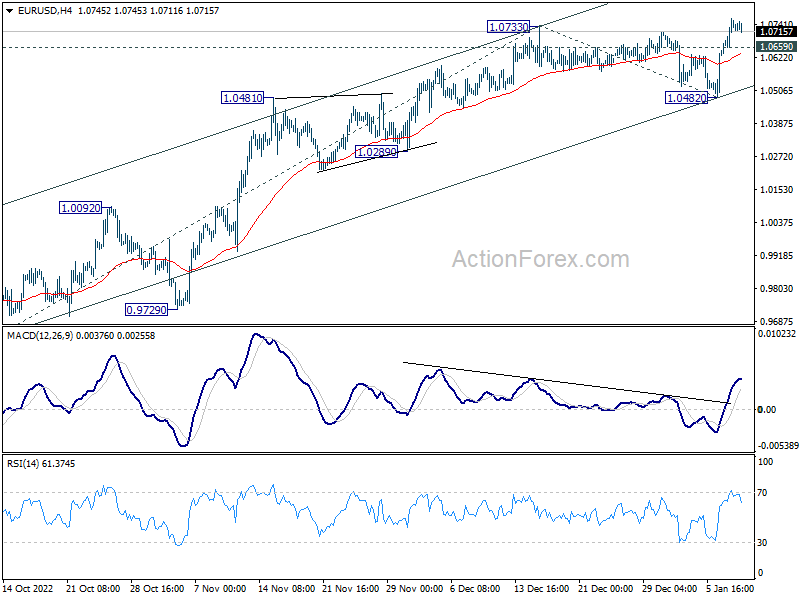
Daily Pivots: (S1) 1.0662; (P) 1.0711; (R1) 1.0785; More...
Intraday bias in EUR/USD stays mildly on the upside for the moment. Current rally from 0.9534 would target 61.8% projection of 0.9630 to 1.0733 from 1.0482 at 1.1164. On the downside, below 1.0659 minor support will turn intraday bias neutral again fist. But near term outlook will stay bullish as long as 1.0482 support holds, in case of retreat.
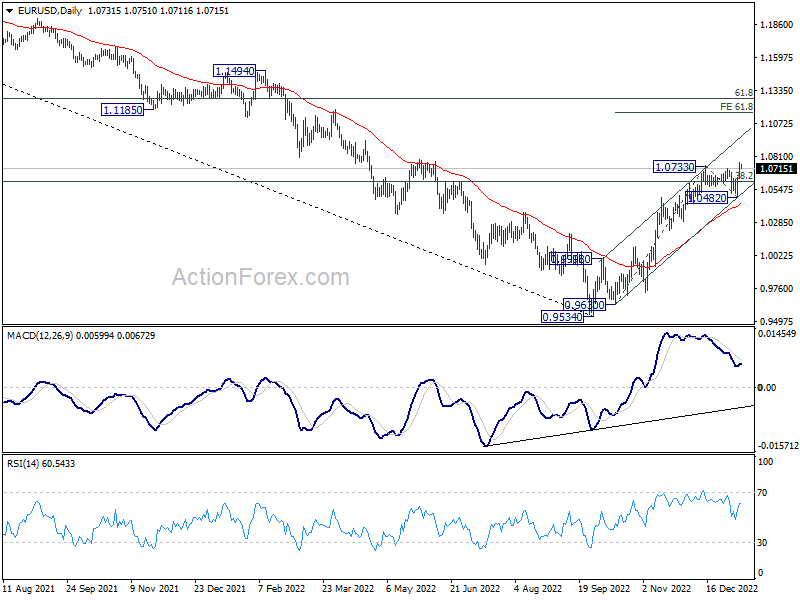
In the bigger picture, focus stays on 38.2% retracement of 1.2348 (2021 high) to 0.9534 at 1.0609. Rejection by 1.0609 will suggest that price actions from 0.9534 medium term bottom are developing into a corrective pattern. Thus, medium bearishness is retained for another fall through 0.9534 at a later stage. However, sustained break of 1.0609 will raise the chance of trend reversal and target 61.8% retracement at 1.1273.
GBP/USD Mid-Day Outlook
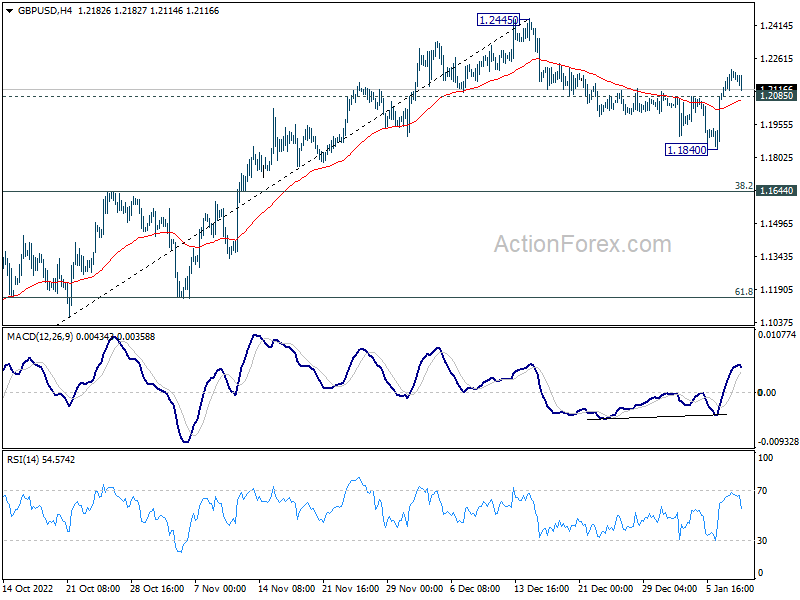
Daily Pivots: (S1) 1.2111; (P) 1.2160; (R1) 1.2236; More...
Intraday bias in GBP/USD stays mildly on the upside at this point, for retesting 1.2445 high. Decisive break there will resume whole rally from 1.0351 to 1.2759 fibonacci level. On the downside, below 1.2085 minor support will turn intraday bias neutral first. Further break of 1.1840 will resume the correction from 1.2445 to 38.2% retracement of 1.0351 to 1.2445 at 1.1645.
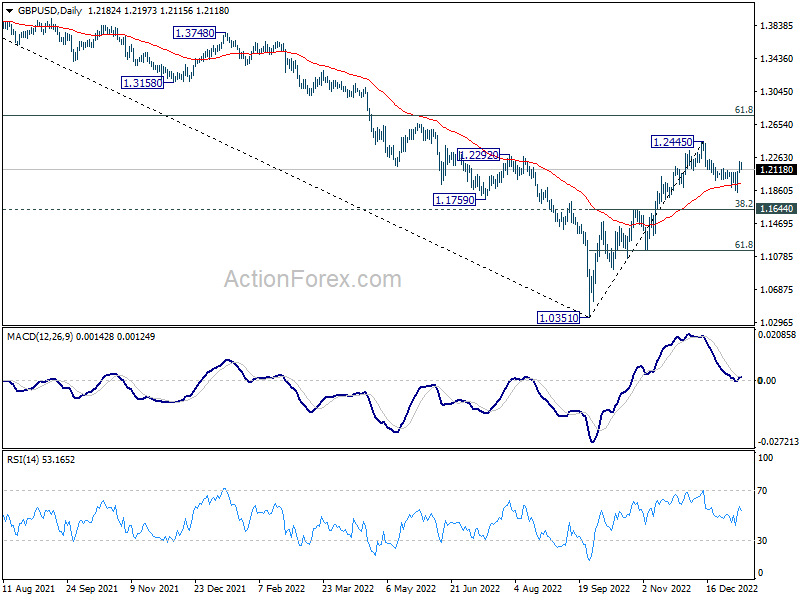
In the bigger picture, rise from 1.0351 medium term bottom is at least correcting whole down trend from 1.4248 (2021 high). Further rise is expected as long as 1.1644 resistance turned support holds. Next target is 61.8% retracement of 1.4248 to 1.0351 at 1.2759. Sustained break there will pave the way back to 1.4248.
USD/CHF Mid-Day Outlook
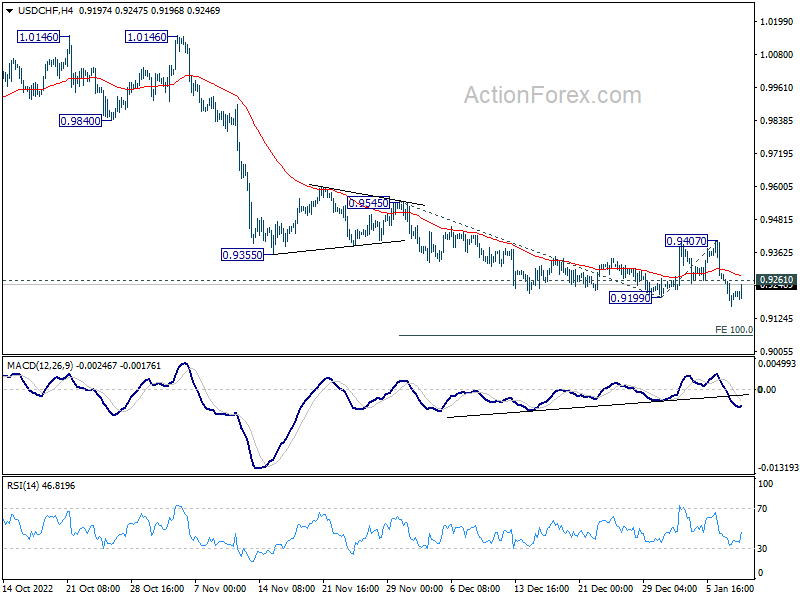
Daily Pivots: (S1) 0.9159; (P) 0.9221; (R1) 0.9276; More...
With 0.9261 minor resistance intact, intraday bias in USD/CHF stays mildly on the downside. Current decline from 1.0146 should target 100% projection of 0.9545 to 0.9199 from 0.9407 at 0.9061 next. On the upside, above 0.9261 minor resistance will turn intraday bias neutral first. But outlook will remain bearish as long as 0.9407 resistance holds, in case of recovery.
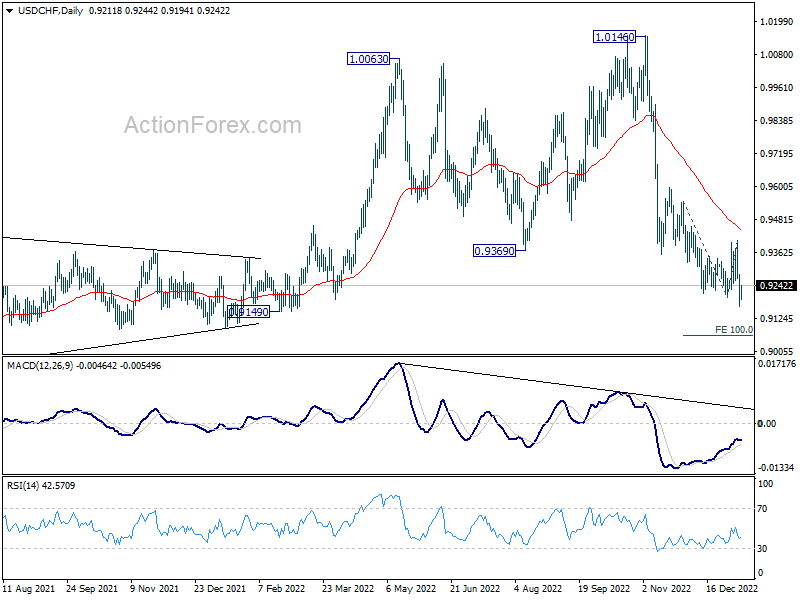
In the bigger picture, rise from 0.8756 (2021 low) has completed at 1.0146, well ahead of 1.0342 long term resistance (2016 high). Based on current downside momentum, fall from 1.0146 should be a medium term down trend itself. Next target is a test on 0.8756 low. Strong support should be seen there to bring rebound. Still, further decline will now be expected as long as 0.9407 resistance holds, in any case.
USD/JPY Mid-Day Outlook
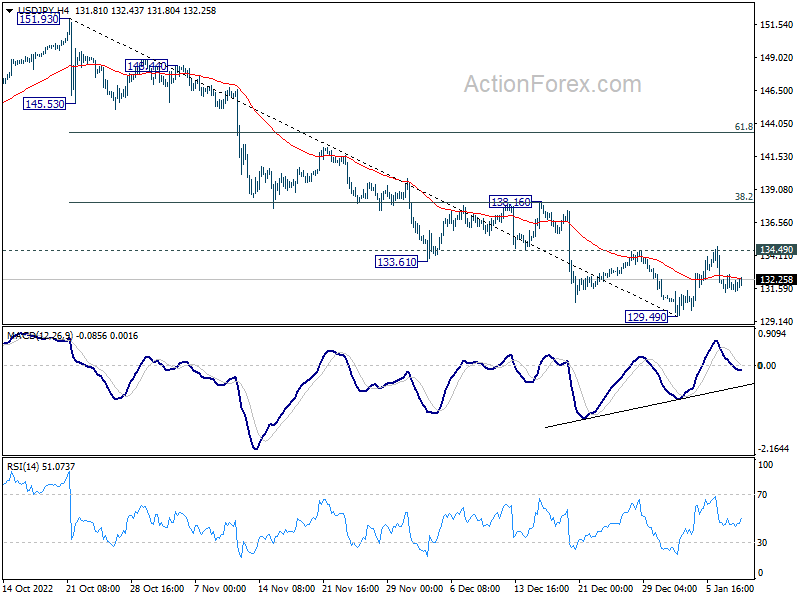
Daily Pivots: (S1) 131.25; (P) 131.95; (R1) 132.60; More...
USD/JPY is still bounded in range above 129.49 and intraday bias stays neutral. On the upside, firm break of 134.49 should confirm short term bottoming, and bring stronger rise to 138.16 cluster resistance (38.2% retracement of 151.93 to 129.49 at 138.06). However, break of 129.49 will resume the whole decline from 151.93 instead.
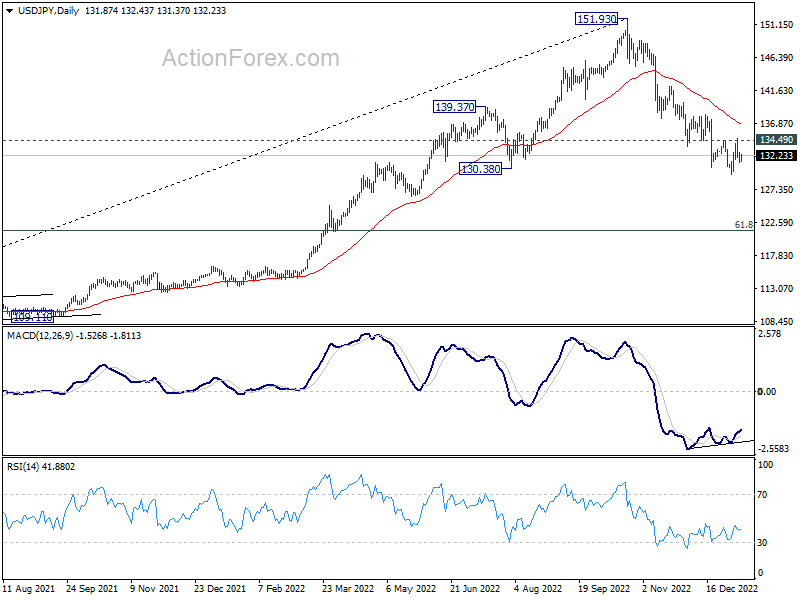
In the bigger picture, a medium term top was in place at 151.93. Sustained trading below 55 week EMA (now at 131.73) would raise the chance of bearish trend reversal. Deeper fall would be seen to 61.8% retracement of 102.58 to 151.93 at 121.43. This will now remain the favored case as long as 55 day EMA (now at 137.08) holds.
AUD/USD Mid-Day Report
Daily Pivots: (S1) 0.6875; (P) 0.6913; (R1) 0.6950; More...
A temporary top is formed at 0.6949 in AUD/USD and intraday bias is turned neutral for some consolidations first. But outlook will stay bullish as long as 0.6721 support holds. Break of 0.6949 will resume larger rise from 0.6169 to 61.8% projection of 0.6169 to 0.6892 from 0.6721 at 0.7444 next. However, firm break of 0.6721 will indicate near term reversal and turn bias back to the downside.
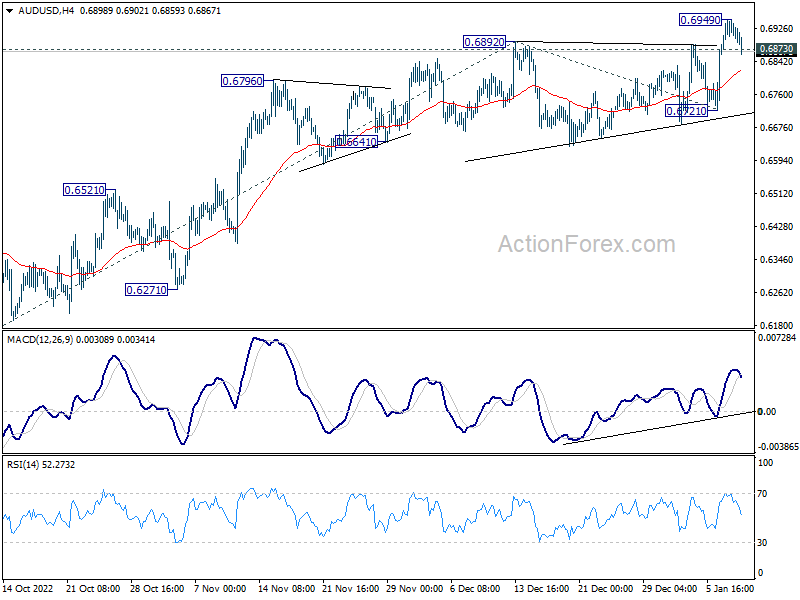
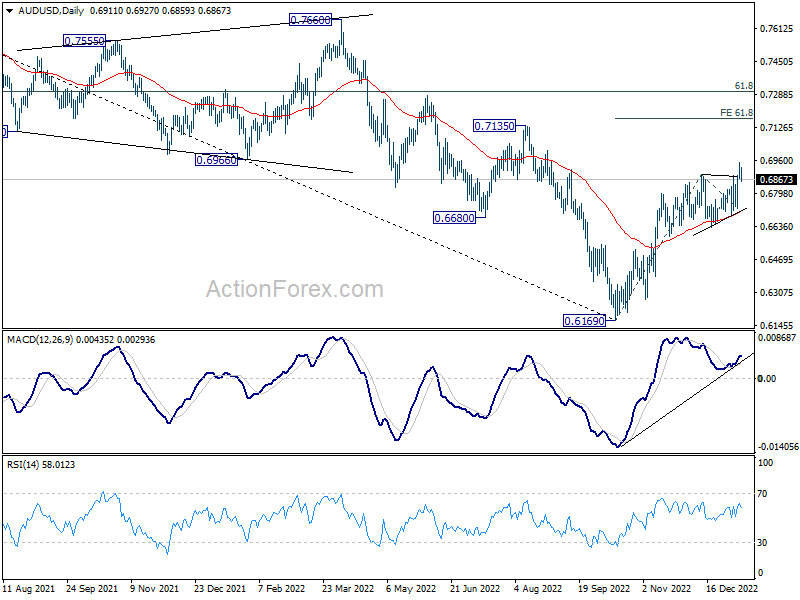
In the bigger picture, corrective decline from 0.8006 (2021 high) should have completed with three waves down to 0.6169 (2022 low). Further rally should be seen to 61.8% retracement of 0.8006 to 0.6169 at 0.6871. Sustained break there will pave the way to retest 0.8006. This will now remain the favored case as long as 0.6721 support holds.
Dollar Recovers as Risk Sentiment Turns on Hawkish Fed Comments
Dollar recovers broadly today as risk sentiment turns negative again. Hawkish comments from Fed officials this week reminded people that even though a smaller hike is possible for February, interest rates are going to stay high for "a long time". Euro is currently the second strongest for the day, followed by Canadian. On the other hand, Aussie's rally is losing momentum quickly and trade as the worst for the day, followed by Sterling and Yen. Now, let's see what reactions Fed Chair Jerome Powell would trigger.
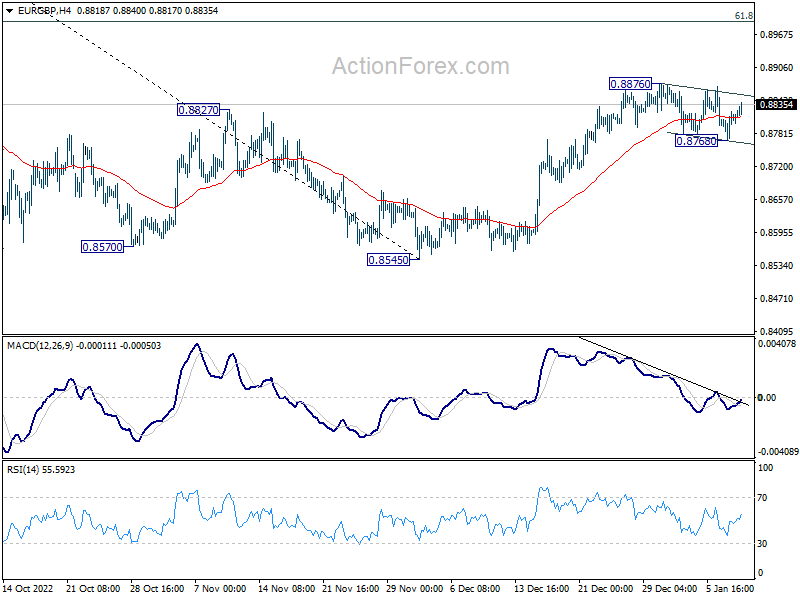
Technically, EUR/GBP's corrective pattern from 0.8876 might be close to completion. Retest of 0.8876 could be seen soon. Firm break there will resume whole rise from 0.8545 to 61.8% retracement of 0.9276 to 0.8545 at 0.8997. If that happens, it's a bit uncertain whether stronger rally would be seen in EUR/USD together, or in other Euro crosses.
In Europe, at the time of writing, FTSE is down -0.28%. DAX is down -0.46%. CAC is down -0.66%. Germany 10-year yield is up 0.047 at 2.276. Earlier in Asia, Nikkei rose 0.78%. Hong Kong HSI dropped -0.27%. China Shanghai SSE rose 0.38%. Singapore Strait Times dropped -1.29%. Japan 10-year JGB yield rose 0.0062 to 0.512, above expectation's 0.5% cap.
US NFIB Small Business Optimism Index declined to 89.8 in Dec
US NFIB Small Business Optimism Index declined -2.1 pts to 89.8 in December, below expectation of 91.6. That's also the 12th consecutive month the index was below 49-year average of 98.
"Overall, small business owners are not optimistic about 2023 as sales and business conditions are expected to deteriorate," said NFIB Chief Economist Bill Dunkelberg. "Owners are managing several economic uncertainties and persistent inflation and they continue to make business and operational changes to compensate."
ECB Schnabel: Inflation will not subside by itself
ECB Executive Board member Isabel Schnabel said in a speech "inflation will not subside by itself". She added that preliminary data for December "point to a persistent build-up of underlying price pressures even as energy price inflation has started to subside from uncomfortably high levels."
"To resolve today's inflation problem, financing conditions will need to become restrictive," she said. "Tighter financing conditions will slow growth in aggregate demand, which is needed to reduce the upward pressure on prices that has resulted from the long-lasting damage to the euro area's production capacity inflicted by the energy crisis."
"Monetary policy would need to raise interest rates even more forcefully to restore trust in the economy's nominal anchor. In the 1970s, financing conditions tightened to an extent that made capital accumulation prohibitively expensive."
BoJ Kuroda: Central banks cannot unconditionally respond to climate change
At an event in Stockholm, BoJ Governor Haruhiko Kuroda said, "central banks, which are independent from governments cannot unconditionally respond to climate change," and must "autonomously decide their actions within their mandate" from a long-term perspective.
He added that central banks must try to affect the overall economy, but not specific industries.
While BoJ doesn't have specific mandata on climate change, it's "generally accepted by the public" that the central bank's measures are in line with the government. Back in 2021, BoJ launched a scheme to offer zero-interest loans to boost green and sustainable loans.
AUD/USD Mid-Day Report
Daily Pivots: (S1) 0.6875; (P) 0.6913; (R1) 0.6950; More...
A temporary top is formed at 0.6949 in AUD/USD and intraday bias is turned neutral for some consolidations first. But outlook will stay bullish as long as 0.6721 support holds. Break of 0.6949 will resume larger rise from 0.6169 to 61.8% projection of 0.6169 to 0.6892 from 0.6721 at 0.7444 next. However, firm break of 0.6721 will indicate near term reversal and turn bias back to the downside.
In the bigger picture, corrective decline from 0.8006 (2021 high) should have completed with three waves down to 0.6169 (2022 low). Further rally should be seen to 61.8% retracement of 0.8006 to 0.6169 at 0.6871. Sustained break there will pave the way to retest 0.8006. This will now remain the favored case as long as 0.6721 support holds.
Economic Indicators Update
| GMT | Ccy | Events | Actual | Forecast | Previous | Revised |
|---|---|---|---|---|---|---|
| 23:30 | JPY | Tokyo CPI Core Y/Y Dec | 4.00% | 3.80% | 3.60% | |
| 23:30 | JPY | Household Spending Y/Y Nov | -1.20% | 0.60% | 1.20% | |
| 00:01 | GBP | BRC Like-For-Like Retail Sales Y/Y Dec | 6.50% | 4.10% | ||
| 07:45 | EUR | France Industrial Output M/M Nov | 2.00% | 0.90% | -2.60% | -2.50% |
| 11:00 | USD | NFIB Business Optimism Index Dec | 89.8 | 91.6 | 91.9 | |
| 15:00 | USD | Wholesale Inventories Nov F | 1.00% | 1.00% |
US NFIB Small Business Optimism Index declined to 89.8 in Dec
US NFIB Small Business Optimism Index declined -2.1 pts to 89.8 in December, below expectation of 91.6. That's also the 12th consecutive month the index was below 49-year average of 98.
"Overall, small business owners are not optimistic about 2023 as sales and business conditions are expected to deteriorate," said NFIB Chief Economist Bill Dunkelberg. "Owners are managing several economic uncertainties and persistent inflation and they continue to make business and operational changes to compensate."
ECB Schnabel: Inflation will not subside by itself
ECB Executive Board member Isabel Schnabel said in a speech "inflation will not subside by itself". She added that preliminary data for December "point to a persistent build-up of underlying price pressures even as energy price inflation has started to subside from uncomfortably high levels."
"To resolve today's inflation problem, financing conditions will need to become restrictive," she said. "Tighter financing conditions will slow growth in aggregate demand, which is needed to reduce the upward pressure on prices that has resulted from the long-lasting damage to the euro area's production capacity inflicted by the energy crisis."
"Monetary policy would need to raise interest rates even more forcefully to restore trust in the economy's nominal anchor. In the 1970s, financing conditions tightened to an extent that made capital accumulation prohibitively expensive."