

Sample Category Title
DAX 40 Remains Under Pressure
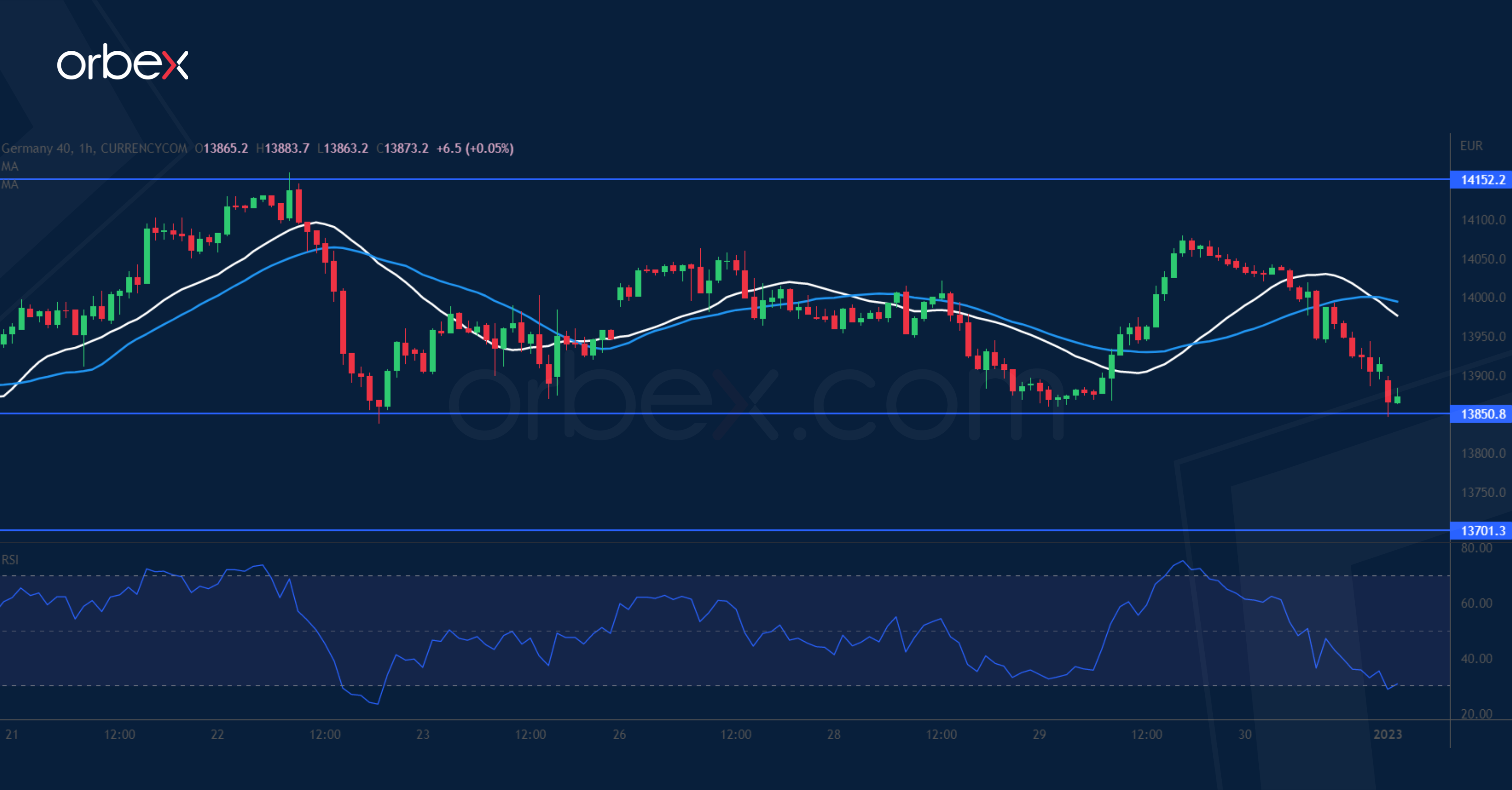
The Dax 40 drifts lower as investors dread more aggressive moves from central banks. On the daily chart, after hitting last June’s peak of 14700, a bearish MA cross could foreshadow a deeper correction. Zooming into the hourly chart, the horizontal consolidation is a sign of momentary hesitation. 14150 at the top of the latest bounce coincides with the 20-day moving average and a failure to break higher by the bulls would mean that the path of least resistance would be down. 13850 is the immediate support.
EUR/GBP Breaks Higher
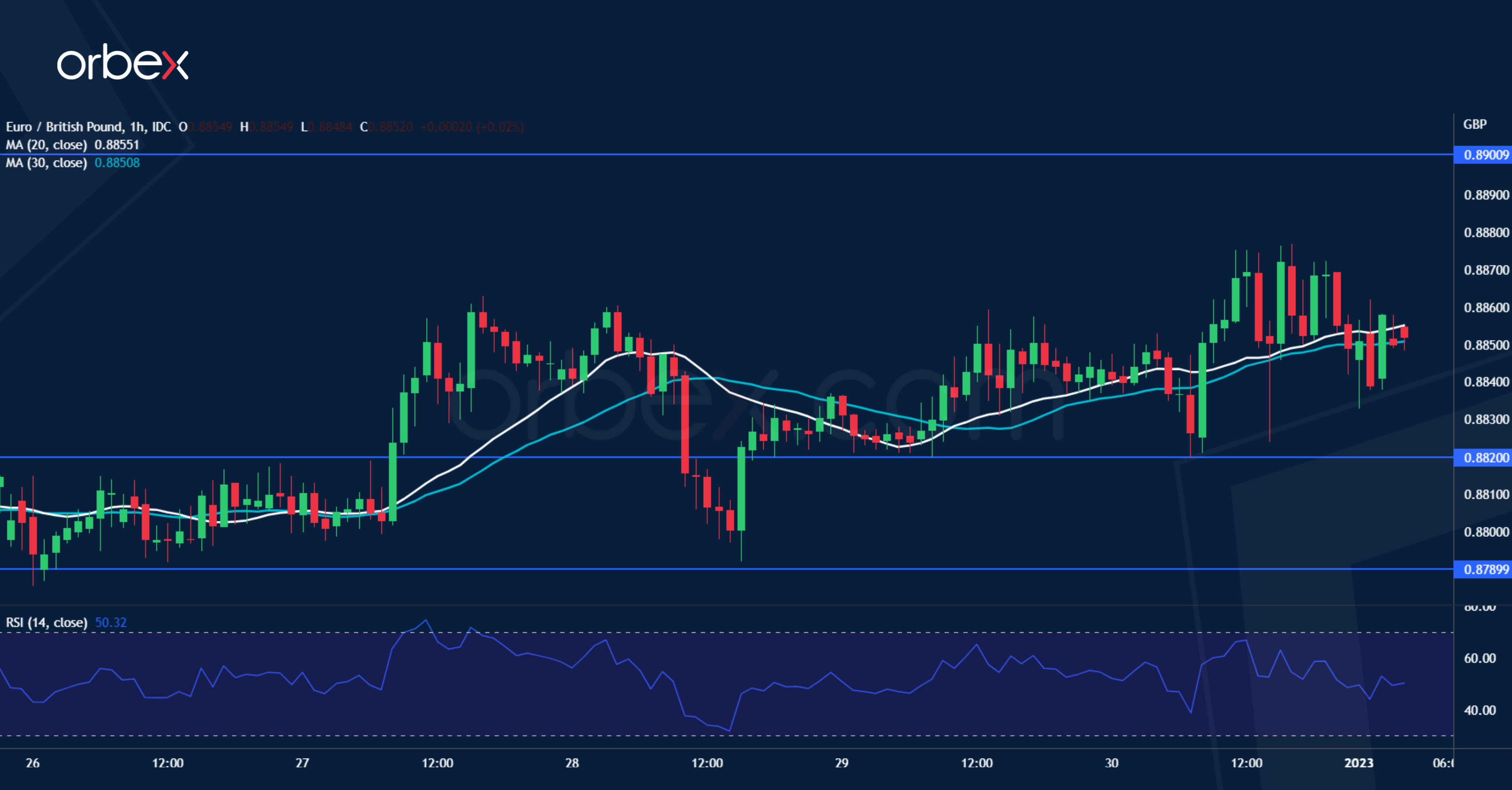
The euro strengthened after ECB President Lagarde hinted at more tightening to cap wage growth. A bullish MA cross on the daily chart confirms the pair's recovery. A break above October’s high of 0.8860 might have put the euro on a fast track towards this year’s high above 0.9100. 0.8900 is the next resistance and 0.8970 at the start of a sell-off in September the last obstacle. An overbought RSI may trigger a limited pullback which could attract bids from trend-followers. Between 0.8820 and 0.8790 lies an important demand zone.
USD/JPY Tests Critical Floor
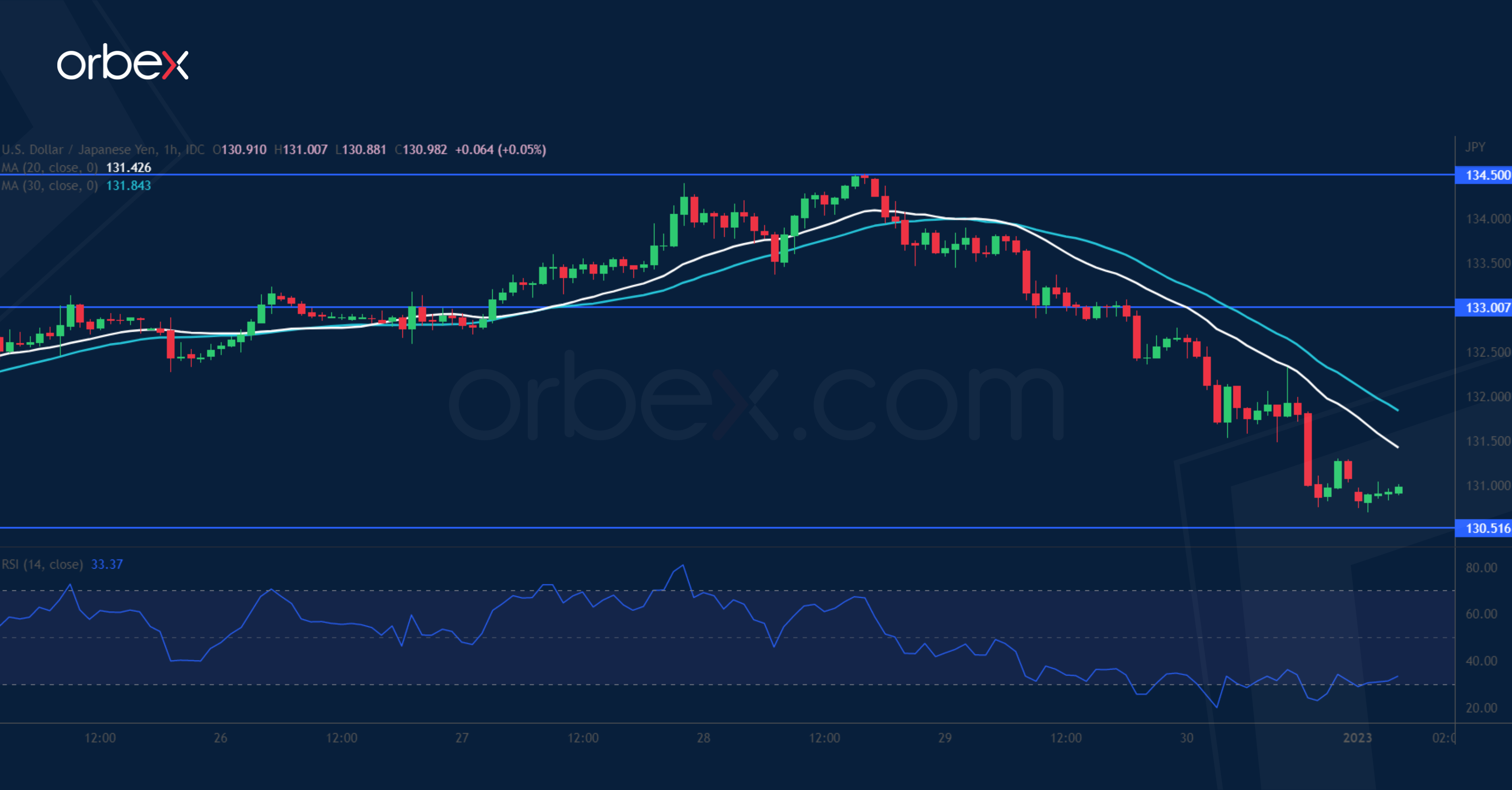
The Japanese yen rallies as the BOJ considers raising its inflation forecast. The dollar’s rebound came to a halt at a previous low (134.50) from early December, which has turned into resistance. Sentiment remains downbeat after the greenback gave up all the gains. 130.50 is a major level to see whether the buy side will be strong enough to contain the fall. A bearish breakout would pave the way for a slide to 127.00. The RSI’s oversold condition may attract some bargain hunters and 133.00 would be the first hurdle to test.
A New Year, But Still Inflation and Central Banks in Focus
Market movers today
A new year kicks off with continued focus on central banks and inflation, as well as on signals of how long and deep a recession are we heading into. For inflation pressures to cool off, further tightening of financial conditions and weaker economic activity is still needed.
The week starts with December manufacturing PMIs being released from the euro area and from Scandinavia. Indices are widely expected to remain below the 50 threshold implying a recessionary environment albeit it seems that activity has continued to recover from October lows. Overnight, we will also get manufacturing PMI data from China.
Later in the week, on Tuesday, December flash inflation print from Germany is due, while on Wednesday the focus will be in the US manufacturing data and FOMC minutes.
Friday will be even more interesting as we will get the December flash inflation print from euro area ahead of US nonfarm payrolls in the afternoon.
UK and US is out on public holiday today.
The 60 second overview
Spanish inflation: Spanish inflation was released on Friday and was the first of many to come with headline inflation lower than the core inflation on an annual basis. Headline came in slightly lower than consensus at 5.6% yoy. This is 1.1pp drop from the November print. That said, underlying inflation continued to rise as core inflation came in at 6.9% yoy vs. 6.3% previous. That is a rise in underlying inflation of 0.8% mom.
China COVID: President Xi said in his new year's address that China is now entering a new phase in the fight against covid although that there are still tough challenges ahead, thereby also acknowledging that the zero-covid policy will not be applied again. Between Christmas and new years eve, Italian media reported that 50% of passengers from China had COVID, although reports suggest no new variants.
Croatia joined the euro on 1 January. There are now 20 euro area member states.
FI: European rates have generally trading higher in the final trading sessions of the year. Hawkish comments from Knot, Chinese reopening and Spanish underlying inflation continuing higher all supported the rates up trading environment. Bunds are now trading at the 2.57% level. Looking at the ECB pricing, markets sees the ECB deposit rate peaking at the 3.58% in Summer next year. UK and US is out on public holiday today.
FX: EUR/USD starts off the new year around 1.07, the highest levels seen since early June. EUR/SEK is also trading elevated, as the recent spike to 11.15 and above is most likely somewhat overdone and premature in our eyes. EUR/NOK remains in consolidation within the same range as was seen during most of Q4, currently sitting just above 10.50.
EUR/USD Could Resume Increase In The New Year
Key Highlights
- EUR/USD could gain bullish momentum above the 1.0750 resistance.
- A key bullish trend line is forming with support near 1.0650 on the 4-hours chart.
- GBP/USD is facing resistance near the 1.2200 and 1.2220 levels.
- The Euro Zone Manufacturing PMI could remain at 47.8 in Dec 2022.
EUR/USD Technical Analysis
The Euro started a minor downside correction from 1.0736 against the US Dollar. EUR/USD tested the 1.0575 before it started a fresh upward move.
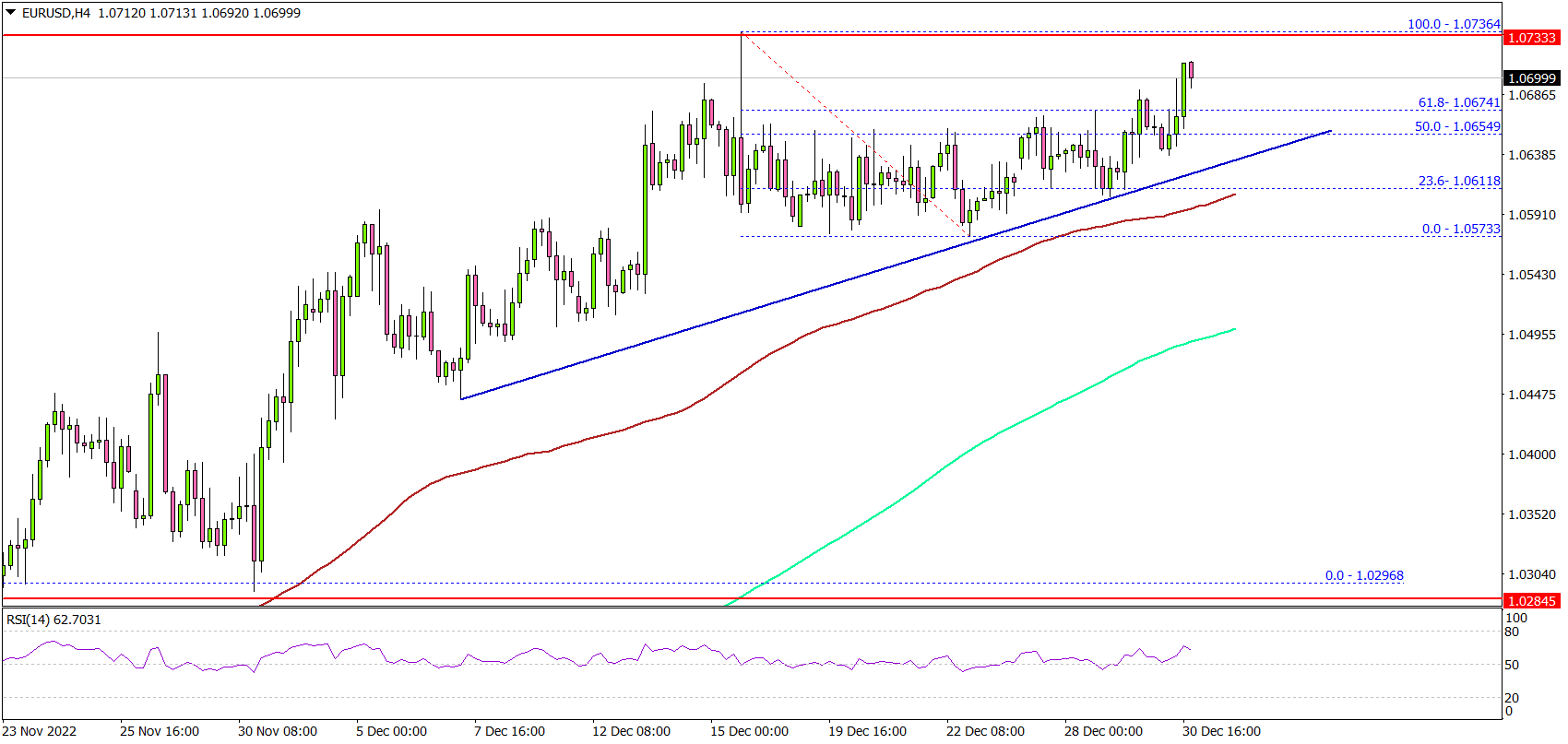
Looking at the 4-hours chart, the pair was able to climb above the 1.0620 resistance zone. The pair remained well above the 1.0600 level, the 100 simple moving average (red, 4-hours), and the 200 simple moving average (green, 4-hours).
There was also a move above the 50% Fib retracement level of the downward correction from the 1.0736 swing high to 1.0573 low.
On the upside, an initial resistance is near the 1.0735 level. The next major resistance may perhaps be near 1.0750. A clear move above the 1.0750 resistance might start a steady increase. In the stated case, EUR/USD may perhaps rise towards the 1.0800 level or even 1.0850.
On the downside, there is a key support at 1.0650. There is also a key bullish trend line forming with support near 1.0650 on the same chart.
A downside break below the 1.0650 zone might spark a major decline. The next major support sits near the 1.0575 level. Any more losses might open the doors for a move towards the 1.0500 support zone.
Looking at GBP/USD, the pair is stable above 1.2000 and might attempt a fresh increase above the 1.2220 resistance zone in the coming sessions.
Economic Releases
- Germany’s Manufacturing PMI for Dec 2022 - Forecast 47.4, versus 47.4 previous.
- Euro Zone Manufacturing PMI for Dec 2022 – Forecast 47.8, versus 47.8 previous.
What to Expect from the Dollar and the Euro in 2023
We analyzed last week what happened to the two most popular currencies in 2020-2022, what forecasts were given then by the strategists of leading financial institutions for EUR/USD, and how accurate they turned out to be. Now it's time to tell what experts expect from 2023.
It should be noted right away that these forecasts differ greatly: life has brought too many "surprises" in recent years and has left too many unresolved problems for the future.
What will be the geopolitical situation, in what direction and at what pace will the monetary policy of the Fed and the ECB go, what will happen to the recession and labor markets, will it be possible to defeat inflation and curb energy prices? We have yet to find out the answers to these and many other questions. There are a lot of uncertainties, which do not allow experts to come to a common opinion.
Some believe that EUR/USD will approach the 2000-2002 lows around 0.8500, while others believe that it will rush to 1.6000, as it was in 2008. Of course, these are extreme values. It is highly likely that the pair will not reach either the first or the second of these extremes, and the range of oscillations will be much narrower. At least, this is what most reputable experts point out, and we will introduce you to their forecasts.
What the Bulls Say for EUR/USD
Deutsche Bank strategists assume that the pair may return to the February-March 2022 figures in 2023 (a two-month fluctuation range of 1.0800-1.1500). In their opinion, this may happen even if the geopolitical situation does not improve and remains at the level of the second half of 2022. However, in their opinion, such a weakening of the dollar is possible only if the Federal Reserve begins to ease its monetary policy in the second half of 2023.
And that is what might not happen. Recall that Fed Chairman Jerome Powell said at the press conference following the December FOMC (Federal Open Market Committee) meeting that the regulator will keep interest rates at their peak until it is sure that the decline in inflation has become a stable trend. The base rate can be raised to 5.1% in 2023 and remain so high until 2024. (Recall that 4.6% was mentioned as the peak rate in the September statement). According to Jerome Powell, the Fed understands that this will trigger a recession, but is willing to pay that price to control inflation.
It should be noted that the position of the US Central Bank runs counter to the position of the United Nations, which called for a suspension of rate hikes. The UN believes that further tightening of monetary policy could cause serious damage to developing countries, which have already suffered greatly from the increase in the cost of goods in the United States.
In addition to putting pressure on the Fed, there is another way to balance and even weaken the dollar's position. This is what the ECB and several other Central Banks have demonstrated in recent months by raising their own interest rates. As we wrote in the previous review, the common European currency managed to seriously push the dollar over the last three months of 2022 and lift EUR/USD by about 1,200 points.
ECB President Christine Lagarde, as well as her overseas counterpart, showed a hawkish attitude at the press conference on December 15 and made it clear that quantitative tightening (QT) in the Eurozone will not end there: the euro interest rate will face several more increases in 2023. The ECB also plans to start reducing its balance sheet from March.
At the beginning of 2023, the gap between the dollar and euro rates is 200 basis points (4.5% and 2.5%, respectively). The swap market expects that the European regulator may raise its rate by another 100 bp in the coming year, which will provide some support for EUR/USD.
Economists at Bank of America Global Research agree with this development. "According to our baseline scenario," they write, "the US dollar will remain strong in early 2023 and will switch to a more stable downward trajectory after the Fed's pause." Starting from Q2, according to BofA, the dollar will gradually weaken, and EUR/USD will rise to 1.1000.
German Commerzbank supports this scenario. "Given the expected change in the interest rate of the Fed and provided that the ECB refrains from cutting interest rates […], our target price for EUR/USD for 2023 is 1.1000," economists of this banking group predict.
The French financial conglomerate Societe Generale also votes for the weakening of the dollar and the growth of the pair. "We expect," says Kit Juckes, Chief Global FX Strategist at SocGen, "that the yield difference between 10-year US and German bonds will fall from 180 basis points to 115 basis points by the end of Q1, and the difference between 2-year interest rates will fall from 190 bps to less than 1%. The last time we saw such a difference between rate and return, EUR/USD was above 1.1500 and this is where it will be by the end of Q1 if it continues to rise at the same rate as it reached 0.9500 at the end of September ".
What the Bears Say For EUR/USD
Analysts at the Economic Forecasting Agency expect the pair to grow to 1.1160 in the coming year, but then, in their opinion, it will fall smoothly but steadily and reach 1.0430 at the end of Q2, 1.0050 at the end of Q3, and end the year at 0.9790.
Economists at Internationale Nederlanden Groep have taken a much more radical stance. ING is confident that all the pressures of 2022 will continue into 2023. High energy prices will continue to put pressure on the European economy. Additional pressure will be exerted if the US Federal Reserve suspends the printing press before the ECB does. Analysts of this largest banking group in the Netherlands believe that the exchange rate of 0.9500 euros per dollar will be adequate in Q1 2023, which, however, may grow to parity of 1.0000 in Q4.
Many other authoritative experts also support the US currency. Thus, Dave Schabes at the University of Chicago's Harris School of Public Policy believes that Russia's war with Ukraine threatens to slow economic growth across Europe and prolong the continent's energy crisis until 2023 and possibly 2024. According to the scientist, this is a specific factor contributing to the strength of the dollar. "The US has always been considered the world's number one safe haven in times of political or military uncertainty," he says.
Eric Donovan, head of Institutional FX at StoneX, a financial services company, shares the same point of view. "The main reason the dollar has become so strong is because it is still considered a safe-haven currency and it will strengthen during periods when the markets are in a state of fear," he explains. Therefore, the dollar will remain strong against European currencies as long as this war continues.
***
The past year, 2022, was not an easy one: the problems created by the coronavirus pandemic were superimposed by the tragic events in Ukraine, which have hit the entire global economy. However, as the legendary King Solomon said to the king of Ethiopia: "This too shall pass." We really want to believe this.
Summary 1/2 – 1/6
Monday, Jan 2, 2023
| GMT | Ccy | Events | Consensus | Previous |
|---|---|---|---|---|
| 08:45 | EUR | Italy Manufacturing PMI Dec | 48.5 | 48.4 |
| 08:50 | EUR | France Manufacturing PMI Dec F | 48.9 | 48.9 |
| 08:55 | EUR | Germany Manufacturing PMI Dec F | 47.4 | 47.4 |
| 09:00 | EUR | Eurozone Manufacturing PMI Dec F | 47.8 | 47.8 |
| GMT | Ccy | Events | |
|---|---|---|---|
| 08:45 | EUR | Italy Manufacturing PMI Dec | |
| Forecast: 48.5 | Previous: 48.4 | ||
| 08:50 | EUR | France Manufacturing PMI Dec F | |
| Forecast: 48.9 | Previous: 48.9 | ||
| 08:55 | EUR | Germany Manufacturing PMI Dec F | |
| Forecast: 47.4 | Previous: 47.4 | ||
| 09:00 | EUR | Eurozone Manufacturing PMI Dec F | |
| Forecast: 47.8 | Previous: 47.8 | ||
Tuesday, Jan 3, 2023
| GMT | Ccy | Events | Consensus | Previous |
|---|---|---|---|---|
| 01:45 | CNY | Caixin Manufacturing PMI Dec | 49.3 | 49.4 |
| 08:30 | CHF | SVME PMI Dec | 53 | 53.9 |
| 08:55 | EUR | Germany Unemployment Change Dec | 15K | 17K |
| 08:55 | EUR | Germany Unemployment Rate Dec | 5.50% | 5.60% |
| 09:30 | GBP | Manufacturing PMI Dec F | 44.7 | 44.7 |
| 13:00 | EUR | Germany CPI M/M Dec P | -0.70% | -0.50% |
| 13:00 | EUR | Germany CPI Y/Y Dec P | 10.00% | |
| 14:30 | CAD | Manufacturing PMI Dec | 49.9 | 49.6 |
| 14:45 | USD | Manufacturing PMI Dec F | 46.2 | 46.2 |
| 15:00 | USD | Construction Spending M/M Nov | -0.40% | -0.30% |
| GMT | Ccy | Events | |
|---|---|---|---|
| 01:45 | CNY | Caixin Manufacturing PMI Dec | |
| Forecast: 49.3 | Previous: 49.4 | ||
| 08:30 | CHF | SVME PMI Dec | |
| Forecast: 53 | Previous: 53.9 | ||
| 08:55 | EUR | Germany Unemployment Change Dec | |
| Forecast: 15K | Previous: 17K | ||
| 08:55 | EUR | Germany Unemployment Rate Dec | |
| Forecast: 5.50% | Previous: 5.60% | ||
| 09:30 | GBP | Manufacturing PMI Dec F | |
| Forecast: 44.7 | Previous: 44.7 | ||
| 13:00 | EUR | Germany CPI M/M Dec P | |
| Forecast: -0.70% | Previous: -0.50% | ||
| 13:00 | EUR | Germany CPI Y/Y Dec P | |
| Forecast: | Previous: 10.00% | ||
| 14:30 | CAD | Manufacturing PMI Dec | |
| Forecast: 49.9 | Previous: 49.6 | ||
| 14:45 | USD | Manufacturing PMI Dec F | |
| Forecast: 46.2 | Previous: 46.2 | ||
| 15:00 | USD | Construction Spending M/M Nov | |
| Forecast: -0.40% | Previous: -0.30% | ||
Wednesday, Jan 4, 2023
| GMT | Ccy | Events | Consensus | Previous |
|---|---|---|---|---|
| 00:01 | GBP | BRC Shop Price Index Y/Y Nov | 7.40% | |
| 00:30 | JPY | Manufacturing PMI Dec F | 48.8 | 48.8 |
| 07:00 | EUR | Germany Import Price Index M/M Nov | -1.70% | -1.20% |
| 07:30 | CHF | CPI M/M Dec | 0.00% | 0.00% |
| 07:30 | CHF | CPI Y/Y Dec | 3.40% | 3.00% |
| 08:45 | EUR | Italy Services PMI Dec | 47.6 | 49.5 |
| 08:50 | EUR | France Services PMI Dec F | 48.1 | 48.1 |
| 08:55 | EUR | Germany Services PMI Dec F | 49 | 49 |
| 09:00 | EUR | Eurozone Services PMI Dec F | 49.1 | 49.1 |
| 09:30 | GBP | Mortgage Approvals Nov | 54K | 59K |
| 09:30 | GBP | M4 Money Supply M/M Nov | 0.20% | 0.00% |
| 15:00 | USD | ISM Manufacturing PMI Dec | 48.6 | 49 |
| 15:00 | USD | ISM Manufacturing Prices Paid Dec | 42.3 | 43 |
| 15:00 | USD | ISM Manufacturing Employment Index Dec | 48.4 | |
| 19:00 | USD | FOMC Minutes | ||
| 23:50 | JPY | Monetary Base Y/Y Dec | -3.20% | -6.40% |
| GMT | Ccy | Events | |
|---|---|---|---|
| 00:01 | GBP | BRC Shop Price Index Y/Y Nov | |
| Forecast: | Previous: 7.40% | ||
| 00:30 | JPY | Manufacturing PMI Dec F | |
| Forecast: 48.8 | Previous: 48.8 | ||
| 07:00 | EUR | Germany Import Price Index M/M Nov | |
| Forecast: -1.70% | Previous: -1.20% | ||
| 07:30 | CHF | CPI M/M Dec | |
| Forecast: 0.00% | Previous: 0.00% | ||
| 07:30 | CHF | CPI Y/Y Dec | |
| Forecast: 3.40% | Previous: 3.00% | ||
| 08:45 | EUR | Italy Services PMI Dec | |
| Forecast: 47.6 | Previous: 49.5 | ||
| 08:50 | EUR | France Services PMI Dec F | |
| Forecast: 48.1 | Previous: 48.1 | ||
| 08:55 | EUR | Germany Services PMI Dec F | |
| Forecast: 49 | Previous: 49 | ||
| 09:00 | EUR | Eurozone Services PMI Dec F | |
| Forecast: 49.1 | Previous: 49.1 | ||
| 09:30 | GBP | Mortgage Approvals Nov | |
| Forecast: 54K | Previous: 59K | ||
| 09:30 | GBP | M4 Money Supply M/M Nov | |
| Forecast: 0.20% | Previous: 0.00% | ||
| 15:00 | USD | ISM Manufacturing PMI Dec | |
| Forecast: 48.6 | Previous: 49 | ||
| 15:00 | USD | ISM Manufacturing Prices Paid Dec | |
| Forecast: 42.3 | Previous: 43 | ||
| 15:00 | USD | ISM Manufacturing Employment Index Dec | |
| Forecast: | Previous: 48.4 | ||
| 19:00 | USD | FOMC Minutes | |
| Forecast: | Previous: | ||
| 23:50 | JPY | Monetary Base Y/Y Dec | |
| Forecast: -3.20% | Previous: -6.40% | ||
Thursday, Jan 5, 2023
| GMT | Ccy | Events | Consensus | Previous |
|---|---|---|---|---|
| 01:45 | CNY | Caixin Services PMI Dec | 47.5 | 46.7 |
| 05:00 | JPY | Consumer Confidence Index Dec | 29.1 | 28.6 |
| 07:00 | EUR | Germany Trade Balance (EUR) Nov | 7.5B | 6.9B |
| 09:30 | GBP | Services PMI Dec F | 50 | 50 |
| 10:00 | EUR | Eurozone PPI M/M Nov | -0.80% | -2.90% |
| 10:00 | EUR | Eurozone PPI Y/Y Nov | 28.20% | 30.80% |
| 12:30 | USD | Challenger Job Cuts Y/Y Dec | 416.50% | |
| 13:15 | USD | ADP Employment Change Dec | 145K | 127K |
| 13:30 | USD | Initial Jobless Claims (Dec 30) | 230K | 225K |
| 13:30 | USD | Trade Balance (USD) Nov | -74.6B | -78.2B |
| 13:30 | CAD | Trade Balance (CAD) Nov | 1.2B | 1.2B |
| 14:45 | USD | Services PMI Dec F | 44.4 | 44.4 |
| 15:30 | USD | Natural Gas Storage | -213B | |
| 16:00 | USD | Crude Oil Inventories | 0.7M | |
| 23:30 | JPY | Labor Cash Earnings Y/Y Nov | 1.50% | 1.80% |
| GMT | Ccy | Events | |
|---|---|---|---|
| 01:45 | CNY | Caixin Services PMI Dec | |
| Forecast: 47.5 | Previous: 46.7 | ||
| 05:00 | JPY | Consumer Confidence Index Dec | |
| Forecast: 29.1 | Previous: 28.6 | ||
| 07:00 | EUR | Germany Trade Balance (EUR) Nov | |
| Forecast: 7.5B | Previous: 6.9B | ||
| 09:30 | GBP | Services PMI Dec F | |
| Forecast: 50 | Previous: 50 | ||
| 10:00 | EUR | Eurozone PPI M/M Nov | |
| Forecast: -0.80% | Previous: -2.90% | ||
| 10:00 | EUR | Eurozone PPI Y/Y Nov | |
| Forecast: 28.20% | Previous: 30.80% | ||
| 12:30 | USD | Challenger Job Cuts Y/Y Dec | |
| Forecast: | Previous: 416.50% | ||
| 13:15 | USD | ADP Employment Change Dec | |
| Forecast: 145K | Previous: 127K | ||
| 13:30 | USD | Initial Jobless Claims (Dec 30) | |
| Forecast: 230K | Previous: 225K | ||
| 13:30 | USD | Trade Balance (USD) Nov | |
| Forecast: -74.6B | Previous: -78.2B | ||
| 13:30 | CAD | Trade Balance (CAD) Nov | |
| Forecast: 1.2B | Previous: 1.2B | ||
| 14:45 | USD | Services PMI Dec F | |
| Forecast: 44.4 | Previous: 44.4 | ||
| 15:30 | USD | Natural Gas Storage | |
| Forecast: | Previous: -213B | ||
| 16:00 | USD | Crude Oil Inventories | |
| Forecast: | Previous: 0.7M | ||
| 23:30 | JPY | Labor Cash Earnings Y/Y Nov | |
| Forecast: 1.50% | Previous: 1.80% | ||
Friday, Jan 6, 2023
| GMT | Ccy | Events | Consensus | Previous |
|---|---|---|---|---|
| 07:00 | EUR | Germany Retail Sales M/M Nov | 1.50% | -2.80% |
| 07:00 | EUR | Germany Factory Orders M/M Nov | -0.50% | 0.80% |
| 07:30 | CHF | Real Retail Sales Y/Y Nov | 3.00% | -2.50% |
| 07:45 | EUR | France Consumer Spending M/M Nov | -1.00% | -2.80% |
| 08:00 | CHF | Foreign Currency Reserves (CHF) Dec | 790B | |
| 09:30 | GBP | Construction PMI Dec | 50.6 | 50.4 |
| 10:00 | EUR | Eurozone CPI Y/Y Dec P | 10.00% | 10.10% |
| 10:00 | EUR | Eurozone CPI Core Y/Y Dec P | 5.00% | 5.00% |
| 10:00 | EUR | Eurozone Economic Sentiment Indicator Dec | 93 | 93.7 |
| 10:00 | EUR | Eurozone Industrial Confidence Dec | -1.6 | -2 |
| 10:00 | EUR | Eurozone Services Sentiment Dec | 2.1 | 2.3 |
| 10:00 | EUR | Eurozone Consumer Confidence Dec F | -22.2 | -22.2 |
| 10:00 | EUR | Eurozone Retail Sales M/M Dec | 0.10% | -1.80% |
| 13:30 | USD | Nonfarm Payrolls Dec | 200K | 263K |
| 13:30 | USD | Unemployment Rate Dec | 3.70% | 3.70% |
| 13:30 | USD | Average Hourly Earnings M/M Dec | 0.40% | 0.60% |
| 13:30 | CAD | Net Change in Employment Dec | 10.1K | |
| 13:30 | CAD | Unemployment Rate Dec | 5.10% | |
| 15:00 | USD | ISM Services PMI Dec | 55.5 | 56.5 |
| 15:00 | USD | Factory Orders M/M Nov | 1.00% |
| GMT | Ccy | Events | |
|---|---|---|---|
| 07:00 | EUR | Germany Retail Sales M/M Nov | |
| Forecast: 1.50% | Previous: -2.80% | ||
| 07:00 | EUR | Germany Factory Orders M/M Nov | |
| Forecast: -0.50% | Previous: 0.80% | ||
| 07:30 | CHF | Real Retail Sales Y/Y Nov | |
| Forecast: 3.00% | Previous: -2.50% | ||
| 07:45 | EUR | France Consumer Spending M/M Nov | |
| Forecast: -1.00% | Previous: -2.80% | ||
| 08:00 | CHF | Foreign Currency Reserves (CHF) Dec | |
| Forecast: | Previous: 790B | ||
| 09:30 | GBP | Construction PMI Dec | |
| Forecast: 50.6 | Previous: 50.4 | ||
| 10:00 | EUR | Eurozone CPI Y/Y Dec P | |
| Forecast: 10.00% | Previous: 10.10% | ||
| 10:00 | EUR | Eurozone CPI Core Y/Y Dec P | |
| Forecast: 5.00% | Previous: 5.00% | ||
| 10:00 | EUR | Eurozone Economic Sentiment Indicator Dec | |
| Forecast: 93 | Previous: 93.7 | ||
| 10:00 | EUR | Eurozone Industrial Confidence Dec | |
| Forecast: -1.6 | Previous: -2 | ||
| 10:00 | EUR | Eurozone Services Sentiment Dec | |
| Forecast: 2.1 | Previous: 2.3 | ||
| 10:00 | EUR | Eurozone Consumer Confidence Dec F | |
| Forecast: -22.2 | Previous: -22.2 | ||
| 10:00 | EUR | Eurozone Retail Sales M/M Dec | |
| Forecast: 0.10% | Previous: -1.80% | ||
| 13:30 | USD | Nonfarm Payrolls Dec | |
| Forecast: 200K | Previous: 263K | ||
| 13:30 | USD | Unemployment Rate Dec | |
| Forecast: 3.70% | Previous: 3.70% | ||
| 13:30 | USD | Average Hourly Earnings M/M Dec | |
| Forecast: 0.40% | Previous: 0.60% | ||
| 13:30 | CAD | Net Change in Employment Dec | |
| Forecast: | Previous: 10.1K | ||
| 13:30 | CAD | Unemployment Rate Dec | |
| Forecast: | Previous: 5.10% | ||
| 15:00 | USD | ISM Services PMI Dec | |
| Forecast: 55.5 | Previous: 56.5 | ||
| 15:00 | USD | Factory Orders M/M Nov | |
| Forecast: | Previous: 1.00% | ||
New Year, Old Theme – US Jobs Data to Kick Off Volatility
EUR/USD awaits new catalyst
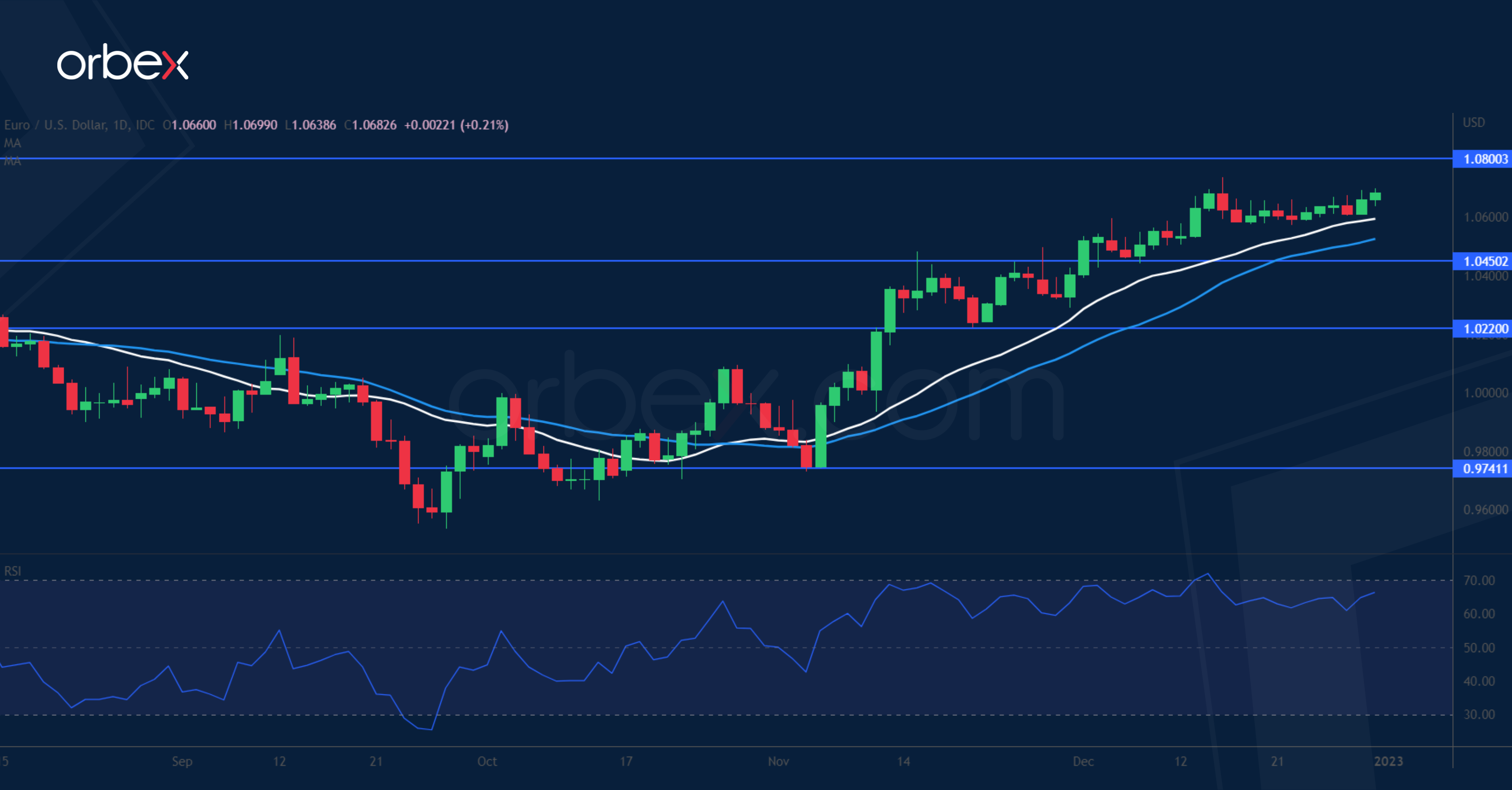
The euro finds support from an assertive ECB. For the most traded currency pair, the new year’s theme would be how fast the ECB will close the monetary policy gap. Traders have shrugged off concerns about soaring energy prices and borrowing costs. European policymakers’ shift to a tough line on inflation and raising rates quickly has led to a broad recovery of the single currency, compounding tempered expectations of the Fed’s hike intensity. The market is in need of a catalyst after the holiday lethargy, and the FOMC minutes and nonfarm payroll could cause a breakout. 1.0800 is a key resistance and 1.0450 a support.
USD/CAD steadies as market stays risk-off
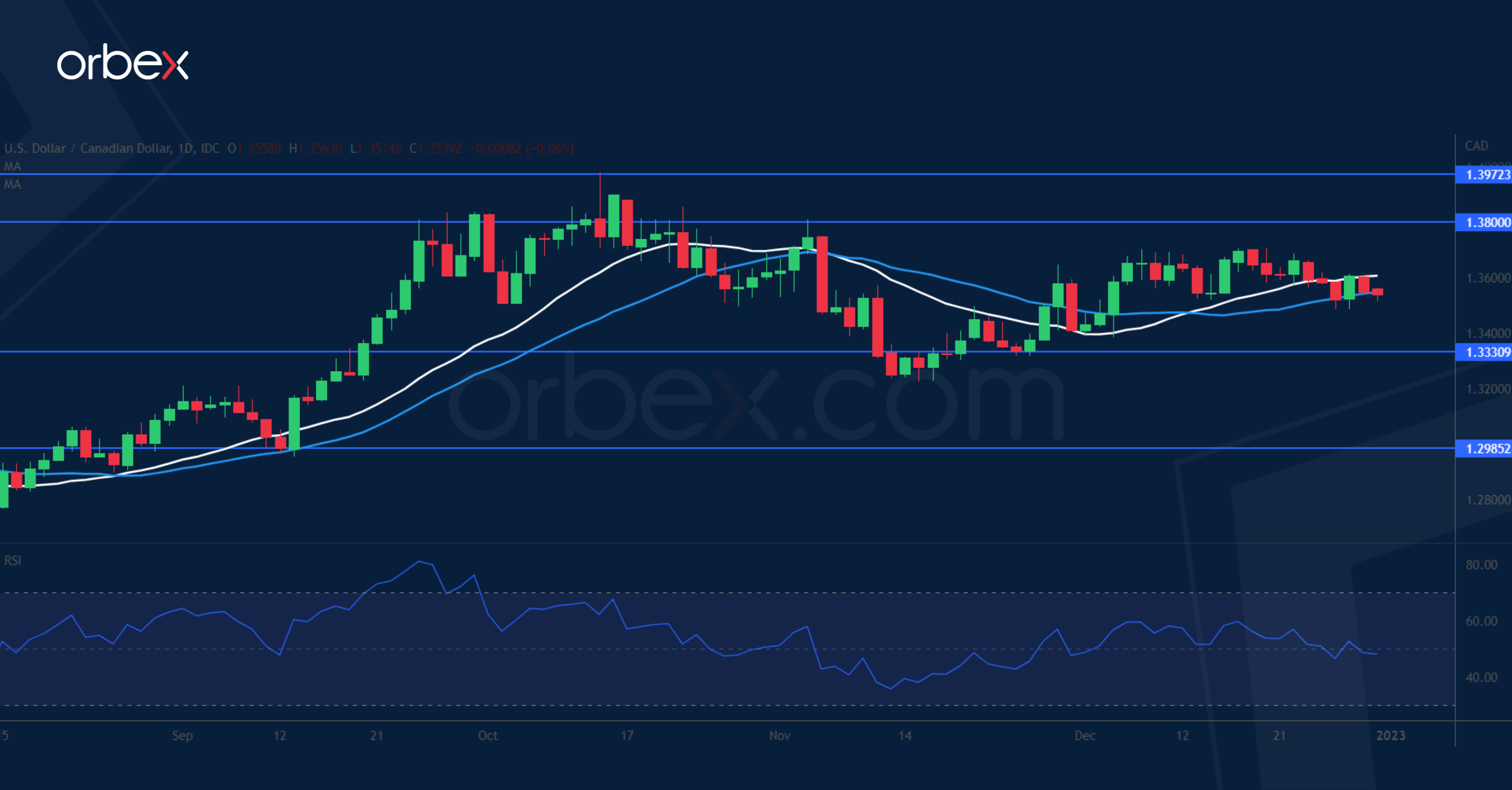
The Canadian dollar softens over a fragile market mood. The beleaguered loonie is not out of the woods yet as it continues to face several headwinds. Cautious sentiment keeps risk assets under pressure and sluggish oil prices fail to provide an effective floor. As investors brace for macroeconomic uncertainties in 2023, they may choose to stick with the greenback’s safer appeal at the expense of the risk-sensitive Canadian dollar, while the Fed’s relative hawkish stance could help the former prevail. The dual job data this week may stir up volatility and a break above 1.3800 could resume the uptrend. 1.3330 is the closest support.
XAU/USD recovers with little conviction
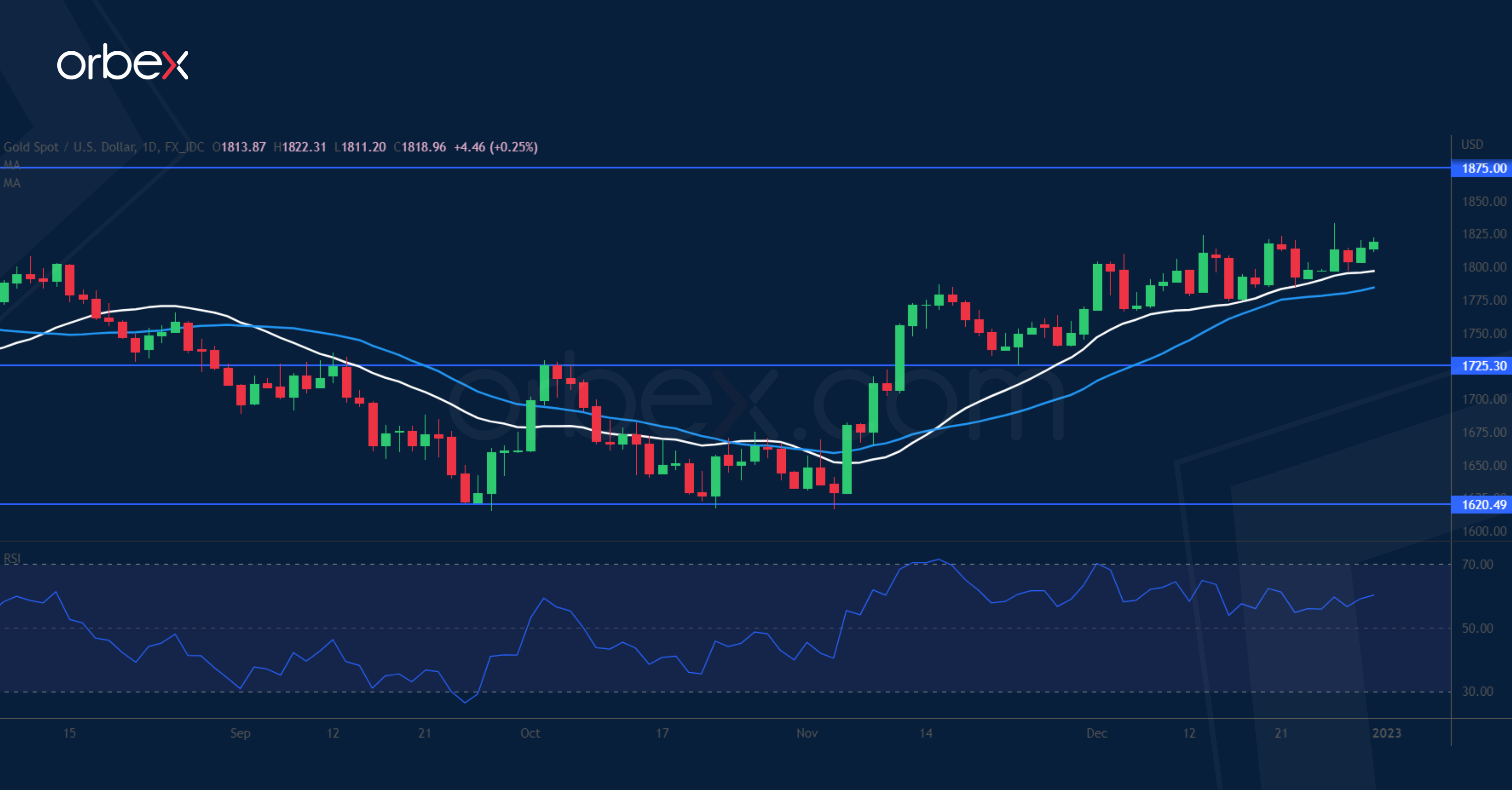
Gold rallies as the US dollar snaps back due to a lack of catalyst. The dollar’s softness amid expectations about slower interest rate hikes from the Fed has fuelled demand for the yellow metal. Meanwhile, China's decision to reopen its borders in January raises hopes that the top gold consumer would regain appetite in the physical market. Volatility may shoot up as liquidity flows back into the market in a data-intensive first week of the year. The downside risk would be an ever resilient US labour market lifting the greenback and trapping complacent gold bulls. 1875 is the next resistance and 1725 a fresh support.
S&P 500 struggles as Fed may not blink
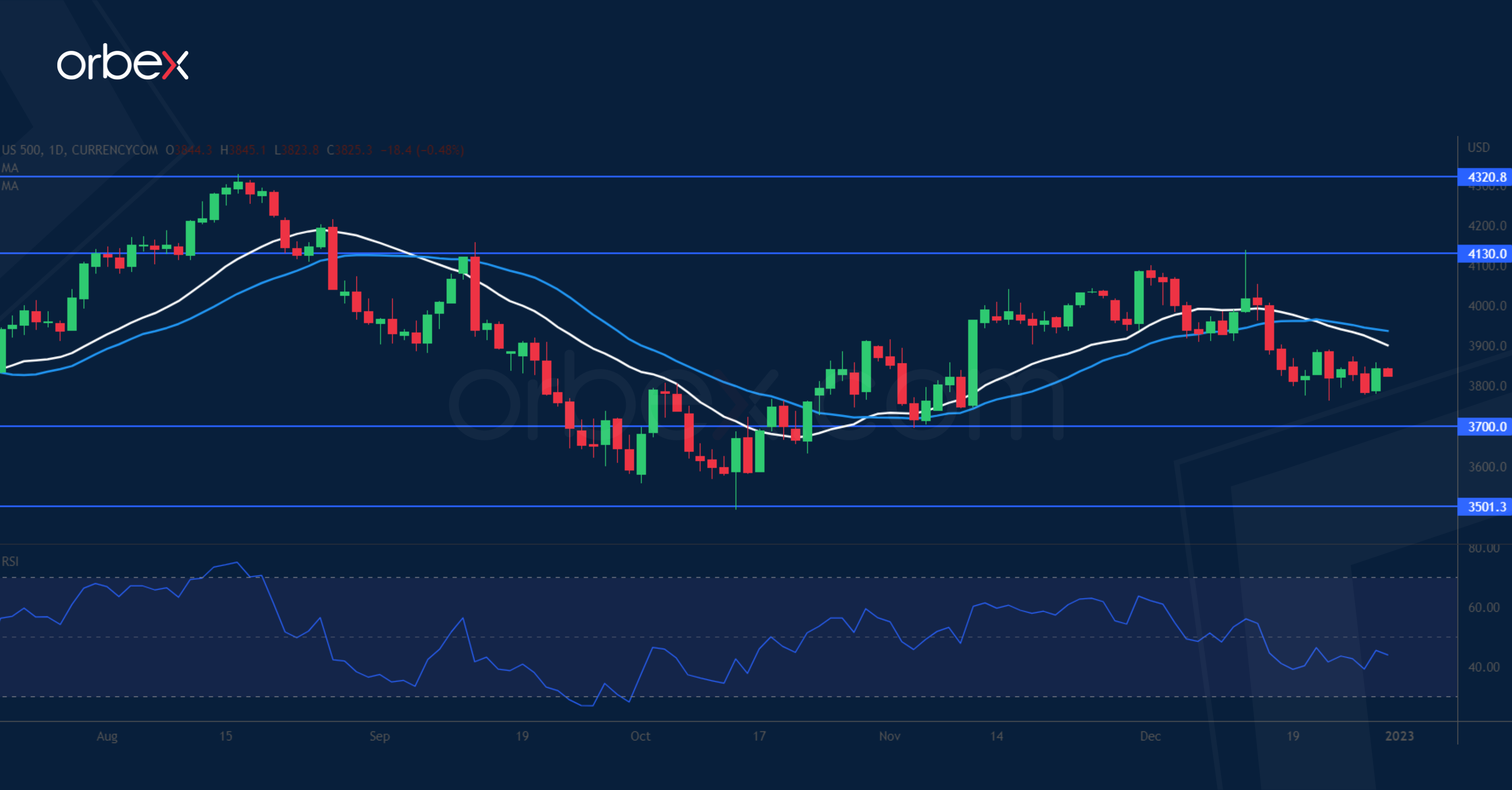
The S&P 500 slides as investors worry about tightening for an extended period of time. The holiday offered market participants a little solace but the new year could come with challenges. As the Fed is determined to cool the labour market and ease the wage pressure, the nonfarm payrolls would be the main catalyst of the next direction. A solid reading may fan fears that it would take the central bank more to break a tight job market, which would prolong the bear market. Meanwhile, China’s struggle with reopening sows doubt about the recovery of the global supply chain. The index hit resistance at 4130 and may test 3700.
Outlook 2023: Gold
As a hedge against uncertainty, gold is expected to have quite an active year in 2023. There are many risk events already on the calendar for the next 12 months, and then we have to consider the unforeseeable events that could shake up markets. There are also a series of expected changes in both monetary and fiscal policy that could change the direction of the price in gold.
For the moment, gold is getting support from two main sources: The weaker dollar as the Fed slows down the pace of its interest rate hikes. And central banks around the world are buying up gold going into the end of the year. The reasons for the latter are harder to parse, because central banks are notoriously tight-lipped about why they are investing in safe-havens. One of the more common explanations is the assessment that gold is undervalued in the current market, and would likely appreciate at least in the coming months.
Further support from the Fed?
One of the main selling points of gold is that it doesn't suffer from inflation. So, given the skyrocketing CPI last year, how come gold didn't spike? That is mostly due to the rise in interest rates that made the dollar more attractive, and the expectation that inflation would be reduced substantially in the short term.
But now that the Fed is expected to at most level off in rates, if not cut them some time next year, the dollar has been getting weaker the last couple of months. Unless there is a major change in outlook from the Fed over the next couple of meetings, that trend is expected to continue. Which could further support gold.
What about China?
The largest buyer of gold is another important factor. Lockdowns in China have hurt economic development. But now lifting the lockdowns is causing economic issues as many workers are absent due to illness. The theory is that Chinese people have low immunity to covid because of the low rate of vaccinations and lack of exposure to the disease. But the wave of cases is expected to subside at some point through the winter, and then the Chinese economy might rebound, bringing with it renewed demand for gold.
But there is another problem: The majority of economists are forecasting a global recession in the first half of next year. This could imply a slower rebound for the Chinese economy, and less disposable income to buy gold. Additionally, the traditional view among financial managers is to hold cash through an economic downturn to be ready to snap up bargains. If the Fed shows little sign of reducing rates, the dollar could get a second wind during the early part of next year.
Getting through March
Several issues are expected to be resolved by the end of March: Europe will be through the worst of the winter weather, the geostrategic situation in Ukraine will enter a new phase, the ECB will update on further bond sales, and the US economy will show signs of whether it fell into a recession in the first quarter. Therefore, March could be an inflection point for risk perception.
Gold could see substantial volatility depending on expectations of if or when there is a recession, how deep it gets, and whether central banks will ease up on policy sooner than anticipated.