Sample Category Title
Nasdaq 100 Wave Analysis
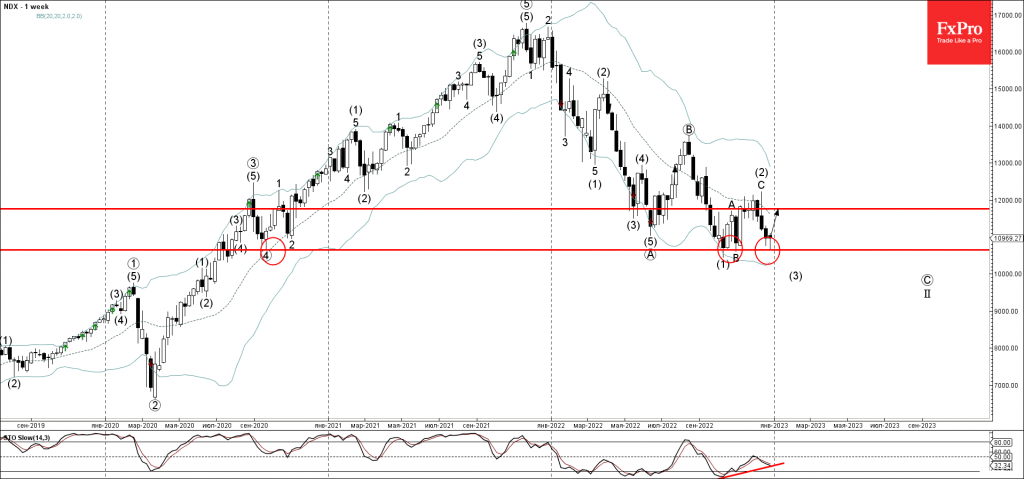
- Nasdaq 100 reversed from support level 10650.00
- Likely to rise to resistance level 12000
Nasdaq 100 index recently reversed up from the major support level 10650.00 (which has been repeatedly reversing the price from the middle of 2020).
The upward reversal from the support level 10650.00 stopped the previous intermediate impulse wave (3).
Given the clear bullish divergence on the weekly Stochastic indicator, Nasdaq 100 can be expected to rise further toward the next resistance level 12000.00.
Week Ahead – NFP and Fed Minutes to Kickstart the New Year as Dollar Languishes
Markets will slowly begin to return to normal in the first trading week of 2023, with a number of top-tier releases on the way to liven things up after the holiday lull. The latest US jobs report will be headlining the economic agenda, while the minutes of the December FOMC meeting is expected to attract more attention than usual given the absence of Fed speakers since the event. Flash inflation readings out of the Eurozone and Canadian employment figures will be the other highlights.
Chinese PMIs to greet the new year
Most markets will be closed on Monday for the New Year holiday so it will be a slow start to the week. But there will be some Chinese PMI numbers out of China on Saturday greeting the few traders that will be at their desks on Monday. China has been gradually moving away from zero-Covid policy and this week ditched its last remaining major restriction by ending the need for inbound travellers to quarantine. But the country is currently battling a surge in infections, hence, it may be a while for the impact of looser Covid curbs to be felt.
The government’s official manufacturing gauge is forecast to have stayed unchanged in December at 48.0, while the Caixin/S&P Global equivalent PMI is expected to have dropped from 49.4 to 48.8.
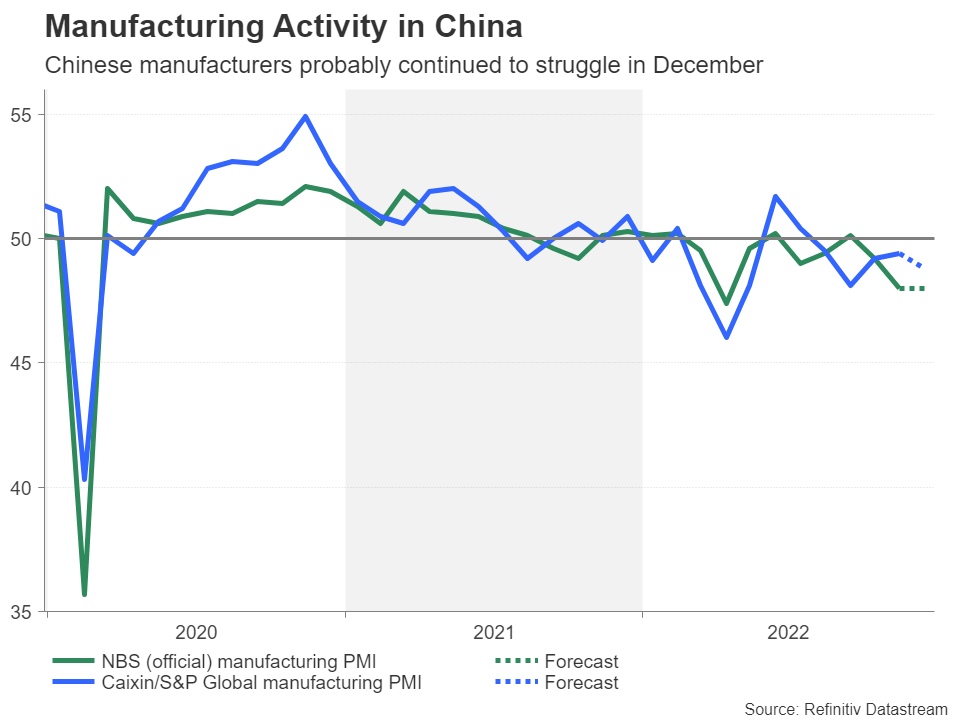
Equity markets could slide should the PMIs point to anything too worrying and the China-sensitive Australian dollar could begin the new year on the backfoot. Though, any setback is likely to be temporary as investors remain optimistic that the world’s second largest economy will bounce back at some point in 2023.
Waiting for the elusive jobs slowdown
Despite the Fed hiking rates by a cumulative 425 basis points (bps) in 2022, America’s labour market has breezed through this tightening cycle, much to the frustration of policymakers. Other parts of the economy, such as housing, are clearly cracking, and even consumer spending hit a soft patch in November. So how much longer can the tight labour market hold out?
After several high profile announcements of big layoffs in recent months, the unemployment rate has ticked up only marginally to 3.7%, while nonfarm payrolls have been rising at a pace of between 250k and 300k since September. Forecasts for the payrolls change have been stuck at 200k and it’s no different for the December report.
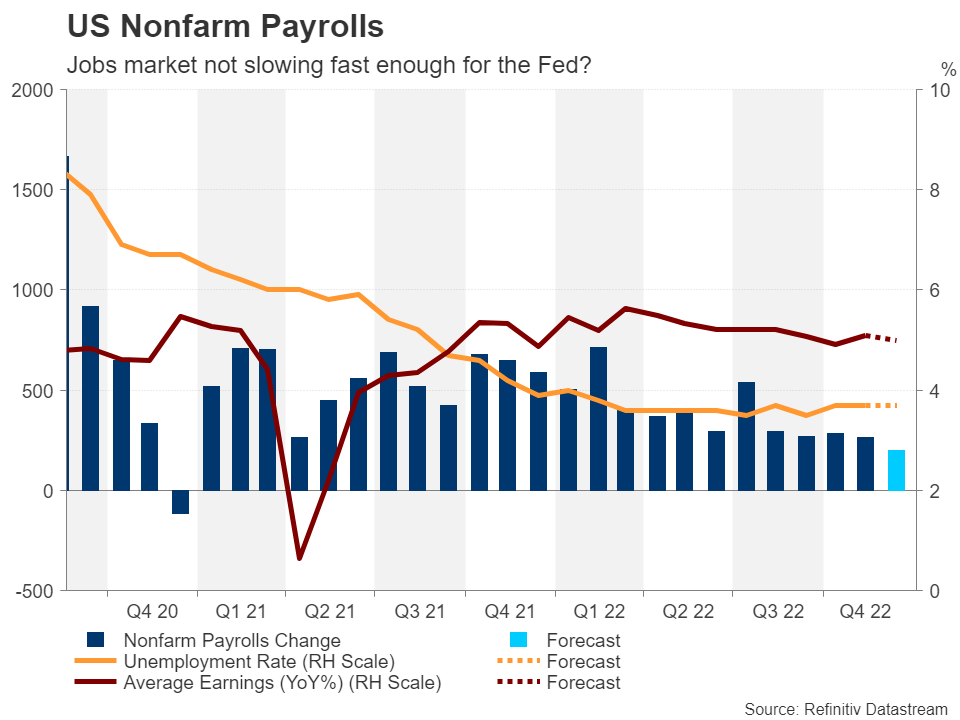
Following Fed Chair Powell’s hawkish pushback in December, investors are likely to be sensitive to continued strength in the jobs data and they will also be paying attention to average hourly earnings, which accelerated to 5.1% year-on-year in November.
Should Friday’s NFP report beat expectations again, there could be some ‘relief’ for the markets from the ISM manufacturing and non-manufacturing PMIs due on Wednesday and Friday, respectively. Both are expected to print lower in December, with the former sinking deeper below 50. Other data will include the JOLTS job openings (Wednesday), the ADP employment report (Thursday) and factory orders (Friday).
Can hawkish minutes boost the dollar?
With the US dollar unable to gain much lately from upbeat indicators as they only heighten fears that the Fed will respond by overtightening, pushing the economy into a steeper recession, it may be a lose-lose situation for the currency next week and it’s best hope could be the December FOMC minutes due Wednesday.
Fed speakers have been mostly silent since the last meeting so the minutes might offer some new insight into how confident policymakers are about inflation coming down substantially over the next year as well as how worried they are about triggering a painful recession. If the minutes shrug off growth concerns, the dollar might be able to better withstand any data-driven selloff.
Canadian jobs report also on the radar
North of the border, Canada will also be reporting employment numbers on Friday. Canada’s labour market likely lost a bit of steam in December and is expected to have added just 7.5k jobs versus 10.1k in the prior month. The jobless rate is projected to tick up slightly to 5.2%, but on the whole, it’s a tight market and wage growth has been running above 5% since June.
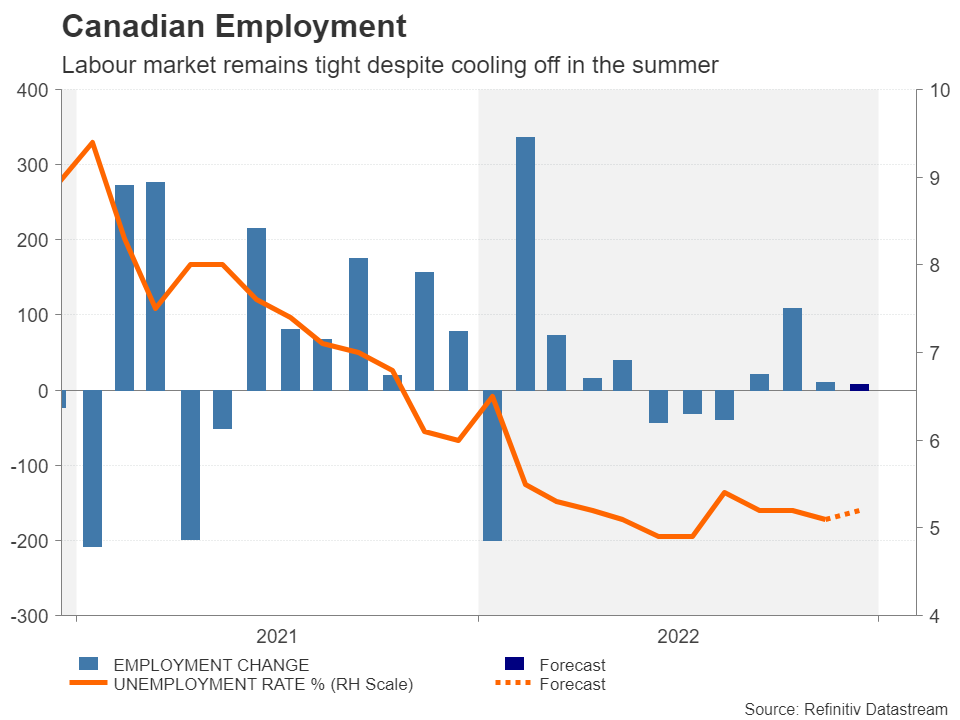
Nevertheless, policymakers at the Bank of Canada are increasingly of the opinion that they’ve already done enough in terms of policy tightening and the decision in January whether to hike or keep rates unchanged will probably be a coin toss. Expectations that the BoC will be the first to pause its rate hiking campaign has been quite damaging for the local dollar. Having outperformed in the earlier part of 2022, the loonie is faring worst than its aussie and kiwi counterparts as the year wraps up.
However, the currency could be in line for a small boost should the job figures impress and they don’t get outshined by the US ones.
Eurozone inflation: has it peaked?
European markets will be getting into full swing straight after the New Year celebrations, with a fairly busy calendar for the week. The flash inflation estimates for December at the end of the week will be the focal point, but investors might be drawn to some of the other releases as well.
The final PMI readings for manufacturing are out on Monday and the services PMIs will follow on Tuesday. Euro area producer prices are due on Thursday and on Friday, November retail sales and the December economic sentiment indicator should help shed additional light on the health of the Eurozone economy. German data will be important too, comprising November trade figures on Thursday and industrial orders on Friday.
After the recent comments from the ECB’s Klaas Knot, who suggested that the Bank is only at the halfway point with its rate increases, Friday’s inflation numbers might not stir up a huge reaction for the euro, but they are likely to provide some relief, nonetheless.
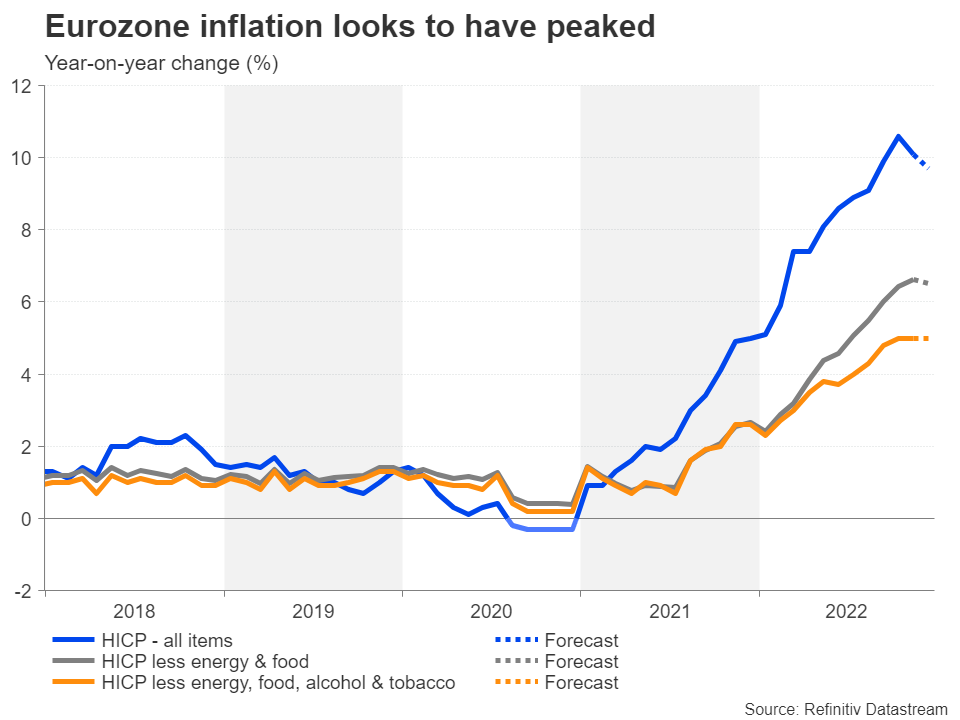
The harmonized index of consumer prices (HICP) is expected to moderate on an annual basis, easing from 10.1% to 9.7% in December. If confirmed, this would raise hopes that inflation in the euro area has peaked, although the underlying measures are not anticipated to be as encouraging. HICP excluding food and energy is forecast to drop by just 0.1 percentage point to 6.5% and to stay unchanged at 5.0% when excluding alcohol and tobacco prices too.
The single currency has been trading within a very narrow range over the last two weeks, so a breakout seems imminent. The question is, will the euro finally be able to conquer the $1.07 handle after hovering beneath the level for so long, or will the dollar make a comeback, pushing the pair below $1.05?
Gold: Bulls Gaining Traction for Eventual Break Higher After a Three-Week Pause
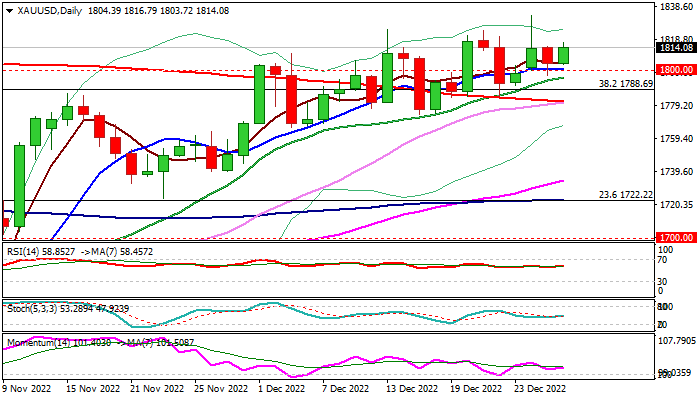
Gold regained traction after a bearish close on Wednesday, with fresh strength being driven by weaker dollar on Thursday.
The metal is on track to eventually register a weekly close above $1800, following a multiple failures in past four weeks and to break from three-week congestion, defined by a triple weekly Doji.
Weekly close above $1800 would generate an initial positive signal which will require a confirmation on break above $1842 (50% retracement of $2070/$1614) and signal bullish continuation of an uptrend from Sep-Nov $1614 base.
Technical studies on daily chart are in full bullish setup and supportive, though bulls may face headwinds, as traders remain cautious and await for further signals and markets operate in holiday mode with lower volumes.
Res: 1824; 1833; 1842; 1855
Sup: 1800; 1788; 1773; 1765
EUR/GBP: Bulls Expected to Resume After Extended Consolidation
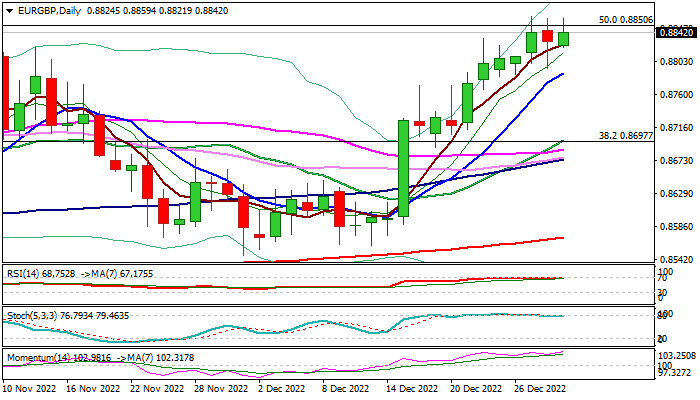
The cross firmed on Thursday after Wednesday’s close in red but continues to face headwinds at 0.8850 barrier (50% retracement of 0.9498/0.8202), as the action failed to break clearly higher in three consecutive attempts.
Technical studies on daily chart show rising positive momentum and MA’s in full bullish setup, underpinning the action, though overbought conditions may reduce the pace and keep the pair in extended consolidation.
Immediate bullish stance is expected to remain intact while the price holds above rising 10DMA (0.8787) that will keep the upside in focus.
Sustained break of pivotal barriers at 0.8850/66 (Fibo / Oct 12 lower top) is needed to generate signal of bullish continuation and expose targets at 0.9000 zone (psychological / Fibo 61.8% of 0.9498/0.8202).
Large bullish monthly candle of December (the pair was up 2.5%) completes reversal signal on monthly chart and helps bulls to tighten grip, as monthly studies are firmly bullish and bode well for further gains.
The ECB is expected to continue raising interest rates by 50 basis points in February and March that would add to positive outlook for Euro.
Res: 0.8850; 0.8866; 0.8895; 0.9000
Sup: 0.8826; 0.8787; 0.8713; 0.8697
US ISM Manufacturing Survey and Fed Minutes Kick Off the Trading Year in High Fashion
The new trading year starts on a high note as the crucial non-farm payrolls print is set for release on the Friday, January 6. Before this “main course”, the market will be served the appetizers in the form of the ISM Manufacturing survey and the Fed minutes from the December meeting. Could these releases brighten the somewhat gloomy outlook?
Manufacturing weakness spreading
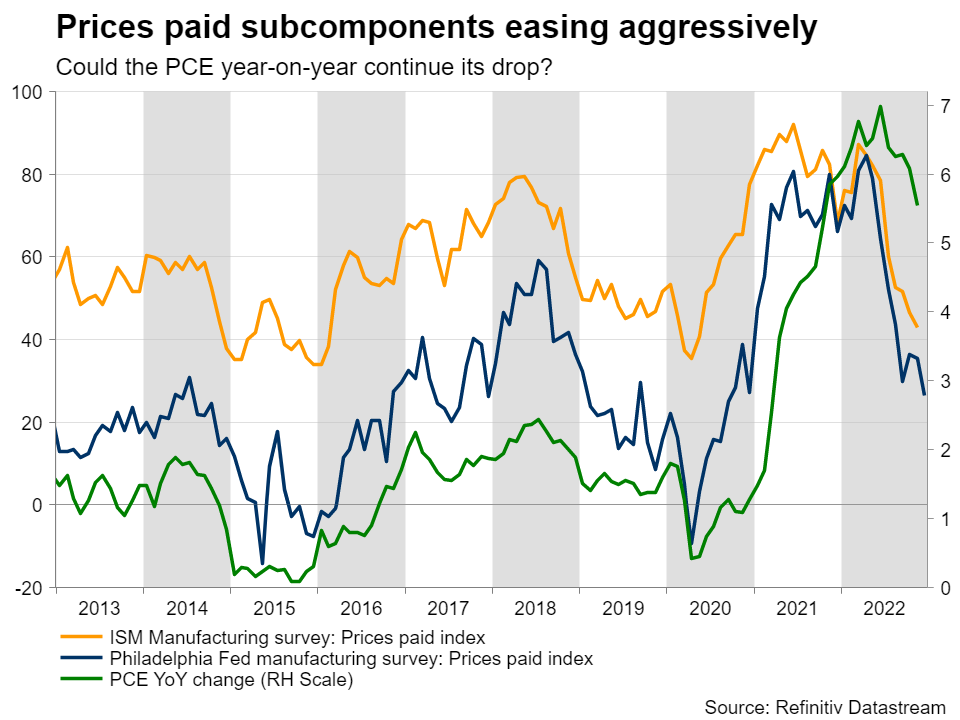
The ISM manufacturing kicks off a very busy week for the US economic calendar. Since March 2021 the headline index has been on an acute downtrend, finally dipping below 50 in November, signaling a contraction in the manufacturing sector. It is closely matching other manufacturing surveys from regional federal reserve banks. The December print released on Wednesday, January 4 is expected to show another drop to 48.5 for the headline indicator. This homogenous message of ongoing weakness is one the main factors contributing to the extensive recession talk for 2023.
Looking under the hood, the prices paid and the new orders sub-components are of particular interest. The former has been in freefall lately, easing concerns about runaway inflation. Most market participants and Fed members assume that the PCE index is past its peak. However, a jump in the prices paid sub-index, for example above 50 for December, could raise some eyebrows in the market about the future path of Fed funds rate. Similarly, the “new orders” component holds significant market impact potential. It comes amidst an overall clouded business outlook as seen in durable goods orders lately and other non-manufacturing business surveys.
Fed meeting minutes unlikely to hold surprises?
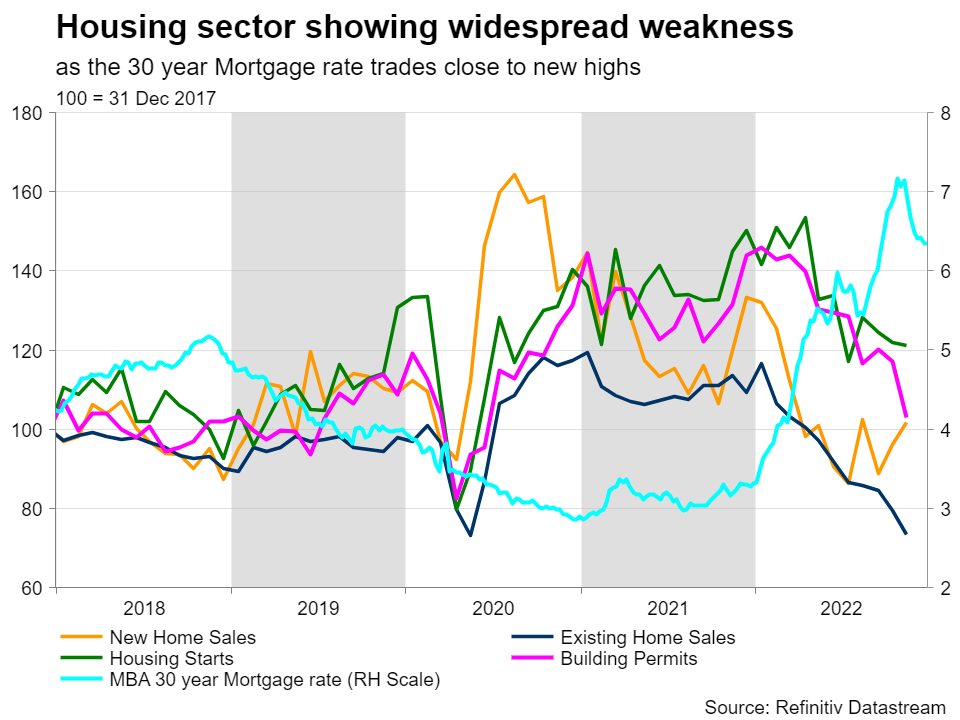
On Wednesday we also get the minutes of the December 14 Fed meeting. As it was expected, another rate hike, in the tune of 50bps, was announced at that meeting. However, the heightened terminal rate, seen at 5.1% against 4.6% at the October meeting, took the market by surprise. Powell’s rhetoric at the ensuing press conference was less hawkish than in previous meetings as the Fed feels more comfortable following a total of 425 bps of rate hikes. The full extent of the minutes would be closely scrutinized but the market focus would fall on any recession talk, especially as consumer spending is slowing and the housing sector is showing cracks. There is increasing evidence of a widespread slowdown in this crucial sector, especially as the reported prices have fallen for four straight months, according to the S&P Case-Shiller home price index.
But the icing on the cake would be the discussion on the Fed’s next steps. Powell commented that the Fed “still has some way to go on rate hikes” and it would be interesting to see the number of FOMC members agreeing wholeheartedly with this approach. As the Fed is approaching a decade-high in Fed funds rates, there could be louder voices in the Fed meeting asking for a more passive strategy ahead, for example pausing at the current rate and allowing the economy to digest the more expensive price of money. Such a strategy could potentially manage to ease the 2023 recession concerns and somewhat cheer up the troubled stock markets, especially the underperforming US technology sector.
EURUSD in waiting mode
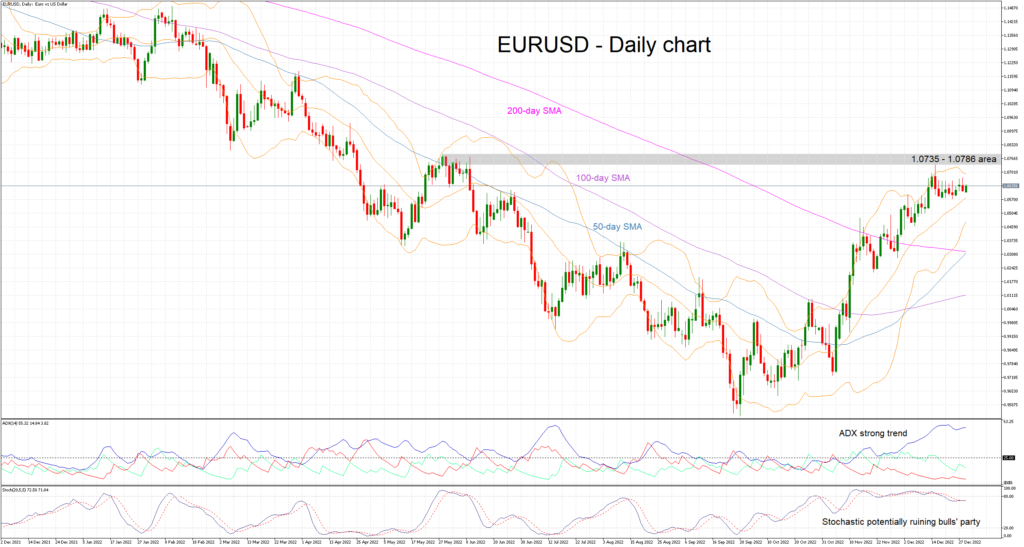
USD is recording an abysmal fourth quarter following almost two years of continued outperformance against most currencies. EUR has been one of the main beneficiaries of the USD’s retreat. The pair has climbed aggressively above parity, evaporating the market forecasts for a move towards the 0.8 level. It currently appears to consolidate at the 1.06 area as market participants weigh their options ahead of the new trading year. The overall technical picture appears to be tilting towards the bullish side, particularly as the golden cross between the 50-day and 200-day SMAs could occur soon, and despite the stochastic oscillator prepping to potentially signal a bearish bias.
USD/CHF Mid-Day Outlook
Daily Pivots: (S1) 0.9254; (P) 0.9281; (R1) 0.9315; More...
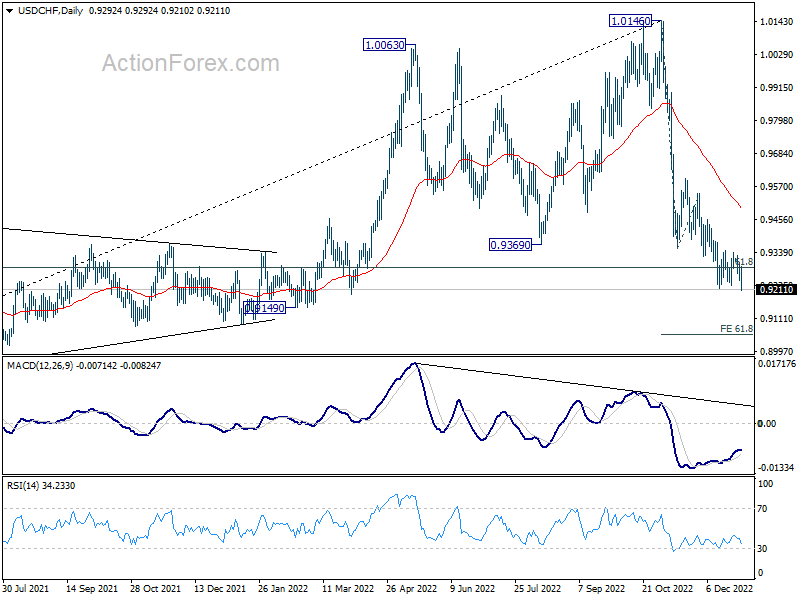
USD/CHF's break of 0.9214 support indicates that recent decline from 1.0146 is finally resuming. Intraday bias is back on the downside for 61.8% projection of 1.0146 to 0.9355 from 0.9545 at 0.9056. For now, outlook will remain bearish as long as 0.9341 resistance holds, in case of recovery.
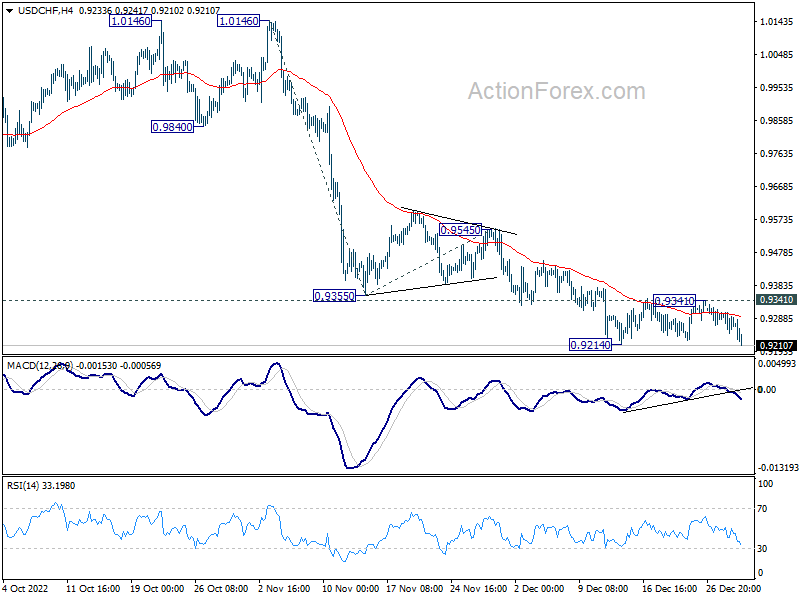
In the bigger picture, rise from 0.8756 (2021 low) has completed at 1.0146, well ahead of 1.0342 long term resistance (2016 high). Based on current downside momentum, fall from 1.0146 might be a medium term down trend itself. Sustained break of 61.8% retracement of 0.8756 to 1.0146 at 0.9287 will pave the way to 0.8756. In any case, risk will stay on the downside as long as 0.9545 resistance holds.
EUR/USD Mid-Day Outlook
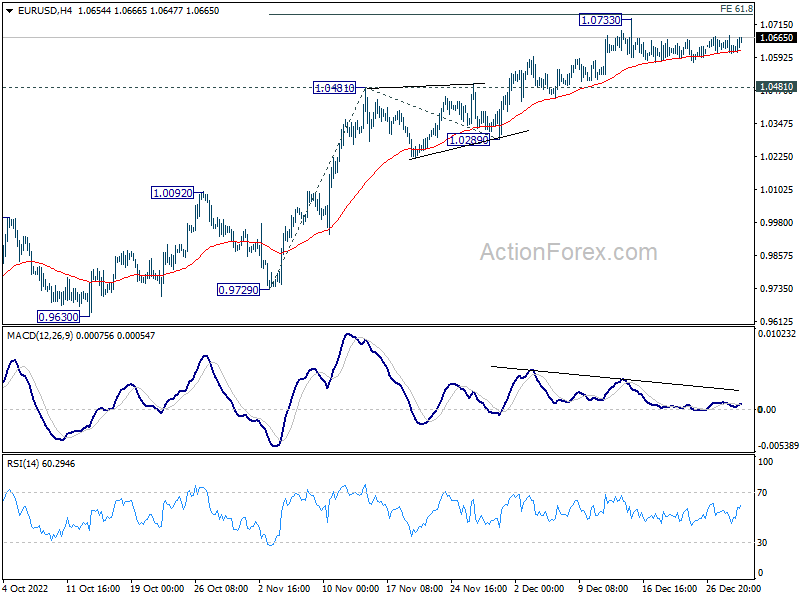
Daily Pivots: (S1) 1.0588; (P) 1.0632; (R1) 1.0656; More...
EUR/USD is still bounded in tight range and intraday bias remains neutral. Further rally is expected as long as 1.0481 resistance turned support holds. Firm break of 61.8% projection of 0.9729 to 1.0481 from 1.0289 at 1.0754 will pave the way to 100% projection at 1.1041. However, firm break of 1.0481 will confirm short term topping and bring deeper fall to 1.0289 support.
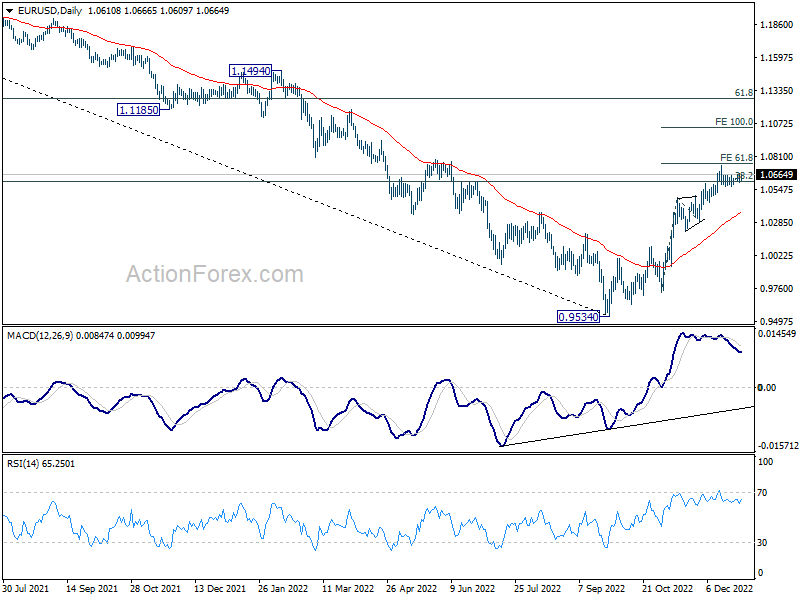
In the bigger picture, focus stays on 38.2% retracement of 1.2348 (2021 high) to 0.9534 at 1.0609. Rejection by 1.0609 will suggest that price actions from 0.9534 medium term bottom are developing into a corrective pattern. Thus, medium bearishness is retained for another fall through 0.9534 at a later stage. However, sustained break of 1.0609 will raise the chance of trend reversal and target 61.8% retracement at 1.1273.
GBP/USD Mid-Day Outlook
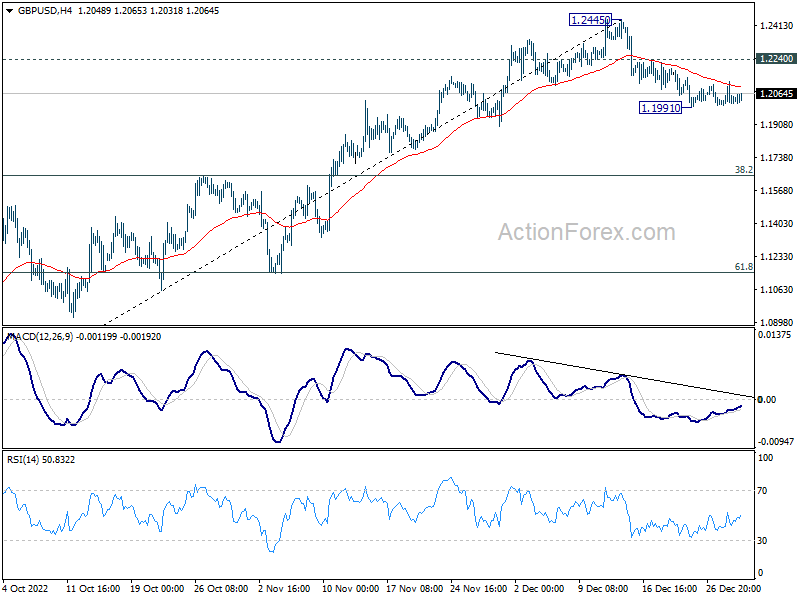
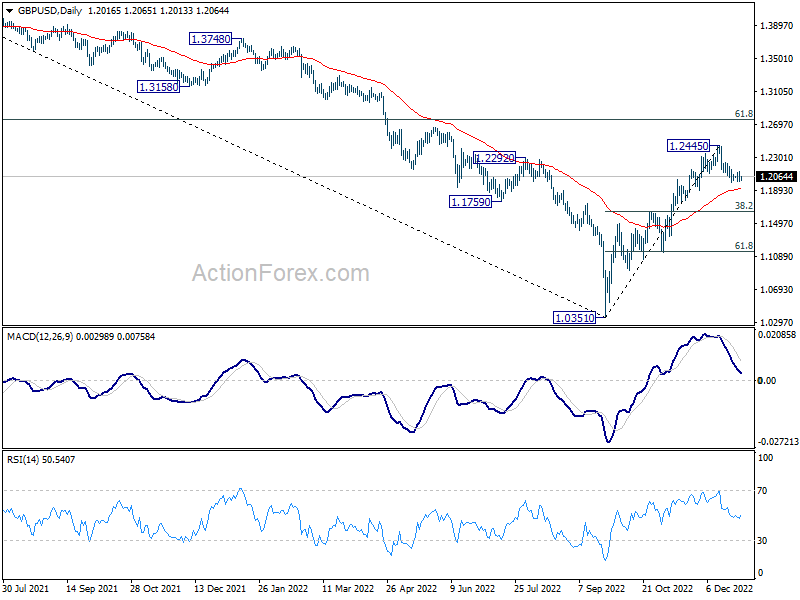
Daily Pivots: (S1) 1.1973; (P) 1.2049; (R1) 1.2096; More...
GBP/USD is still bounded in very tight range and intraday bias stays neutral. On the downside, break of 1.1991 will resume the fall from 1.2445 to 55 day EMA (now at 1.1916). Firm break there will target 38.2% retracement of 1.0351 to 1.2445 at 1.1645. On the upside, break of 1.2240 minor resistance will turn bias back to the upside for retesting 1.2445 instead.
In the bigger picture, rise from 1.0351 medium term bottom is at least correcting whole down trend from 1.4248 (2021 high). Further rise is expected as long as 1.1644 resistance turned support holds. Next target is 61.8% retracement of 1.4248 to 1.0351 at 1.2759. Sustained break there will pave the way back to 1.4248. This will remain the favored case as long as 55 day EMA (now at 1.1916) holds.
USD/JPY Mid-Day Outlook
Daily Pivots: (S1) 132.90; (P) 133.25; (R1) 133.86; More...
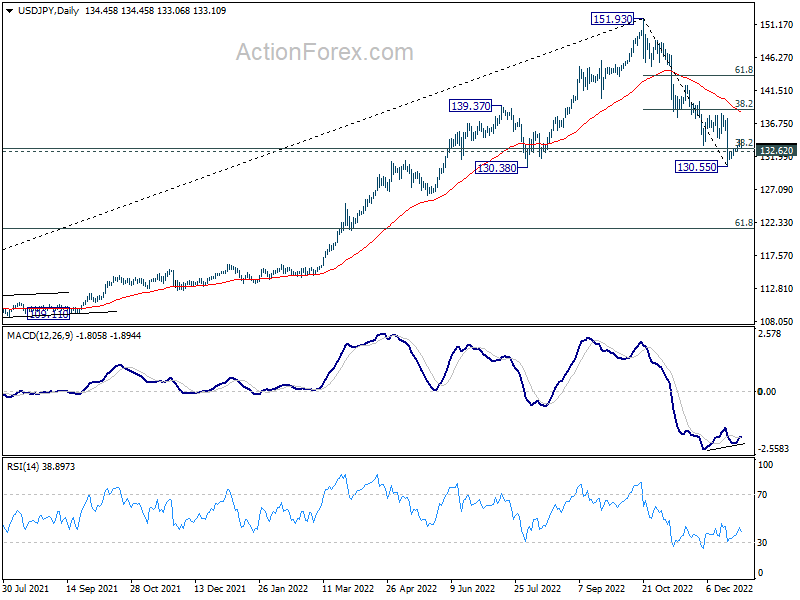
USD/JPY's recovery lost momentum after hitting 134.49 and intraday bias is turned neutral first. On the upside, above 134.49 should resume the rebound through near term channel resistance, towards 38.2% retracement of 151.93 to 130.55 at 138.71 first. On the downside, however, break of 132.62 minor support will bring retest of 130.55 instead.
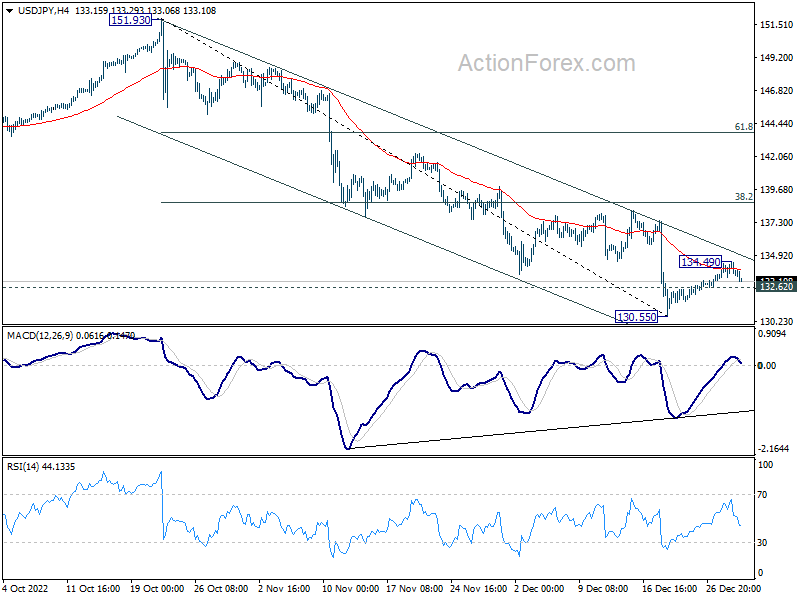
In the bigger picture, price actions from 151.93 medium term could be just a corrective pattern to up trend from 102.58 (2021 low). Strong support from 38.2% retracement of 102.58 to 151.93 at 133.07 and 55 week EMA (now at 131.76) will set the range for such corrective pattern. However, sustained break of 55 week EMA will pave the way to 61.8% retracement at 121.43.