

Sample Category Title
GBP/JPY Daily Outlook
Daily Pivots: (S1) 166.60; (P) 166.98; (R1) 167.66; More...
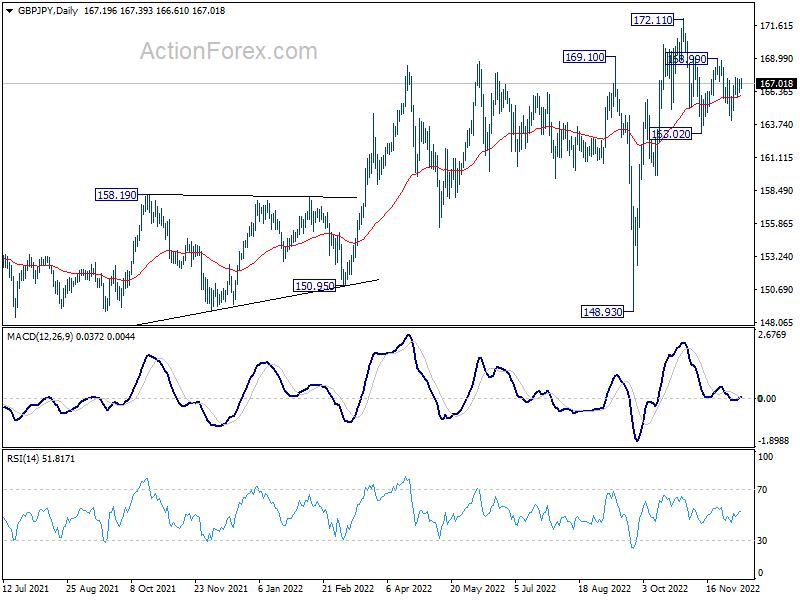
Intraday bias in GBP/JPY stays neutral and sideway trading continues. On the downside, break of 164.02 should resume the whole fall from 172.11 through 163.02 support. Nevertheless, on the upside, break of 168.99 resistance will bring stronger rebound to retest 172.11 high instead.
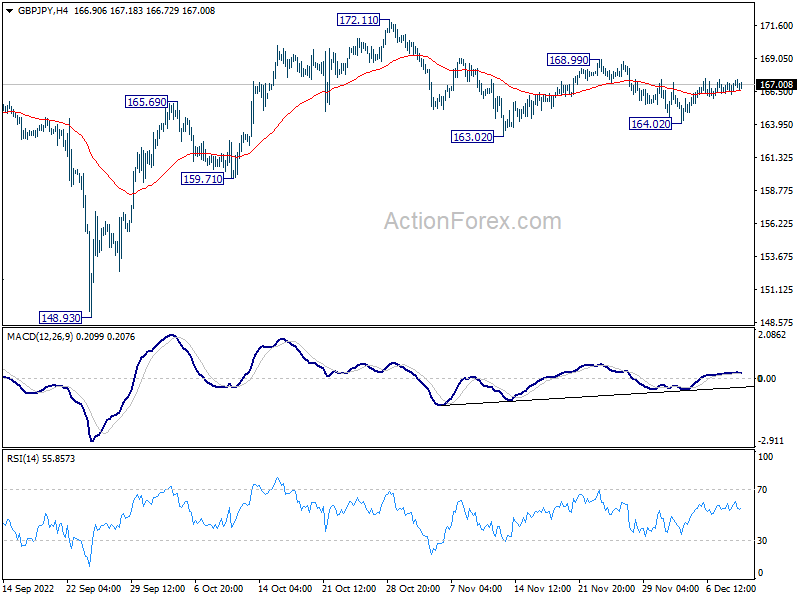
In the bigger picture, medium term upside momentum has been diminishing as seen in bearish divergence condition in weekly MACD. Sustained break of 55 week EMA (now at 160.66) will argue that it's already correcting whole up trend from 123.94 (2020 low). Nevertheless, before that, such up trend could still extend through 172.11 high.
EUR/JPY Daily Outlook
Daily Pivots: (S1) 143.57; (P) 143.97; (R1) 144.68; More....
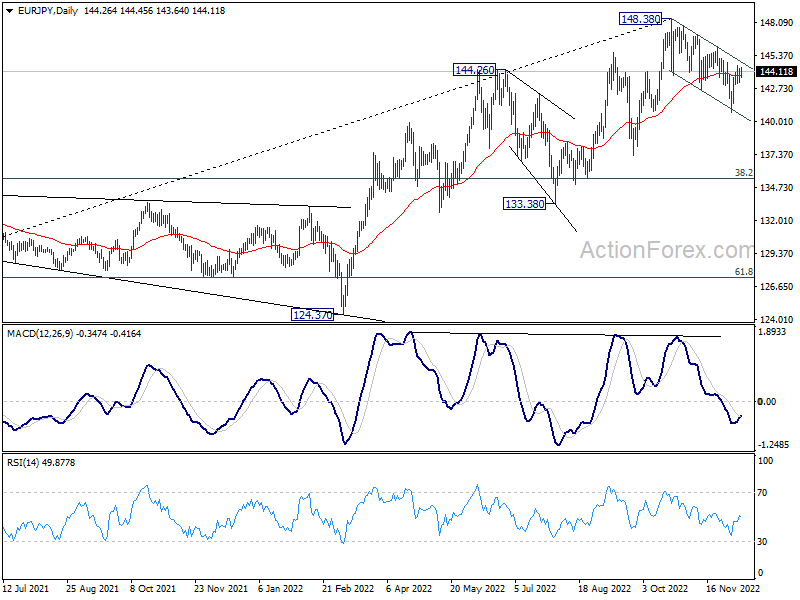
Intraday bias in EUR/JPY remains neutral and outlook is unchanged. Further decline could be seen as long as 146.12 resistance holds. Break of 140.75 will resume the fall from 148.38. However, break of 146.12 resistance will indicate that correction from 148.38 has completed. Bias will be back on the upside for retesting 148.38.
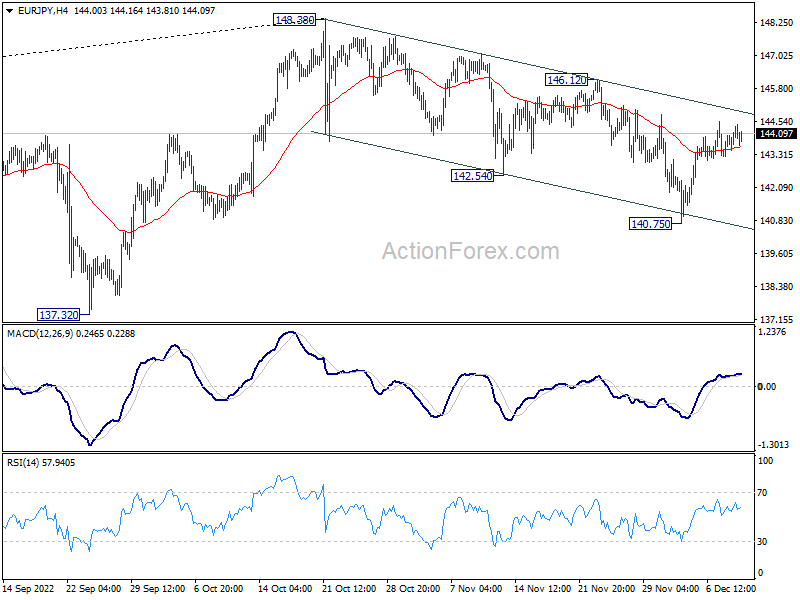
In the bigger picture, considering bearish divergence condition in weekly MACD, 148.38 could be a medium term top already. Fall from there is probably correcting whole up trend from 114.42 (2020 low). Deeper decline would be seen to 55 week EMA (now at 137.37), or further to 38.2% retracement of 114.42 to 148.38 at 135.40 before completion.
EUR/GBP Daily Outlook
Daily Pivots: (S1) 0.8605; (P) 0.8626; (R1) 0.8647; More...
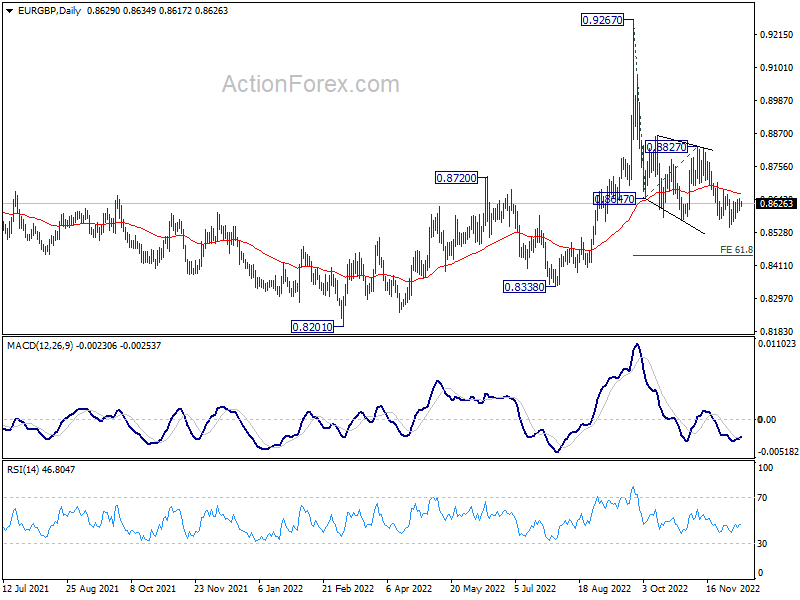
EUR/GBP is staying in consolidation from 0.8545 and intraday bias remains neutral. Further decline is in favor with 0.8674 resistance intact. Break of 0.8545 will resume the fall from 0.9267 and target 61.8% projection of 0.9267 to 0.8647 from 0.8827 at 0.8444 next. On the upside, above 0.8674 minor resistance will indicate short term bottoming, and bring stronger rebound back to 0.8827 instead.
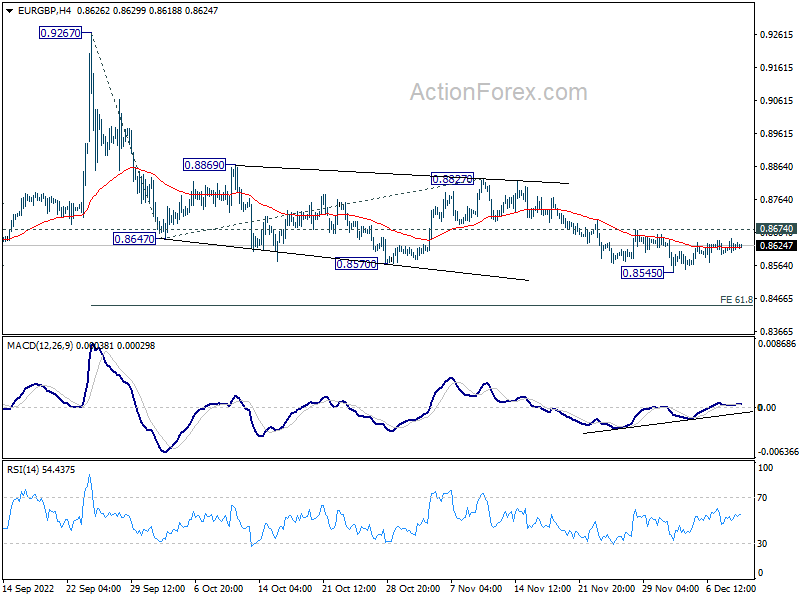
In the bigger picture, current development suggests that fall from 0.9267 is a down leg inside long term range pattern. Deeper fall could be seen towards 0.8201/8338 support zone. But strong support should be seen there to bring reversal. Nevertheless, firm break of 0.8827 resistance will turn favor to the case that such decline is merely a correction in the up trend from 0.8201. That is, further rally would be seen at a later stage through 0.9267.
EUR/AUD Daily Outlook
Daily Pivots: (S1) 1.5534; (P) 1.5606; (R1) 1.5662; More...
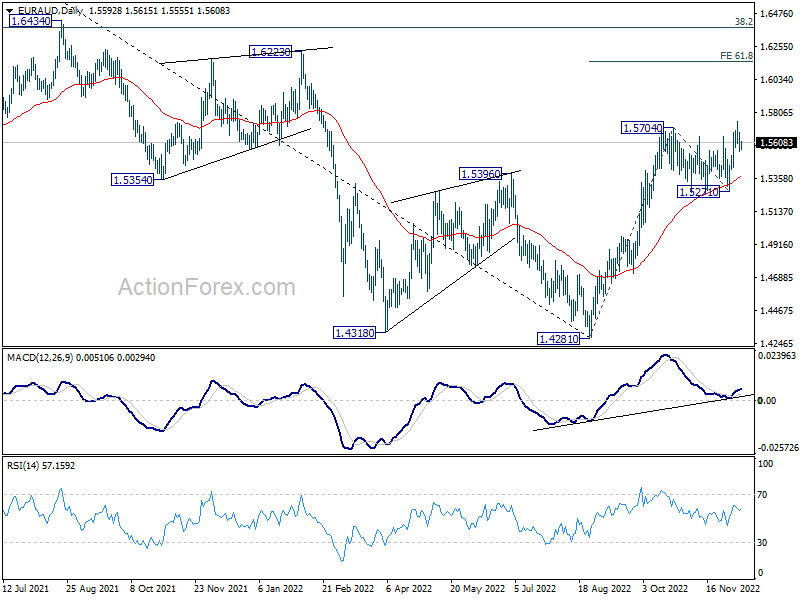
Intraday bias in EUR/AUD remains neutral for the moment. But further rally is expected as long as 1.5271 support holds. On the upside, firm break of 1.5474 will resume larger rally from 1.4281. Next target is 61.8% projection of 1.4281 to 1.5704 from 1.5271 at 1.6150.
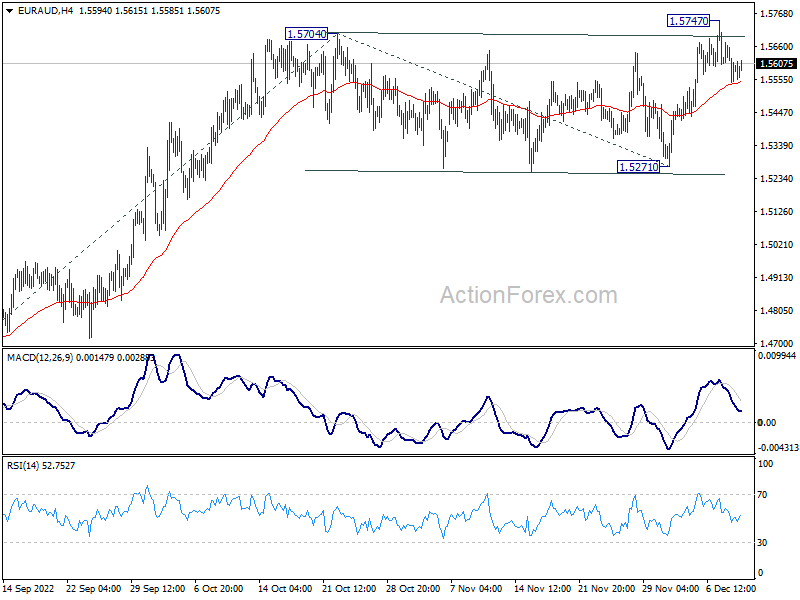
In the bigger picture, a medium term bottom should be in place at 1.4281, on bullish convergence condition in daily MACD. Further rise would be seen back to 1.6434 key resistance next. Break of 1.5271 support is needed to indicate reversal. Otherwise, further rally will remain in favor.
EUR/CHF Daily Outlook
Daily Pivots: (S1) 0.9865; (P) 0.9883; (R1) 0.9902; More....
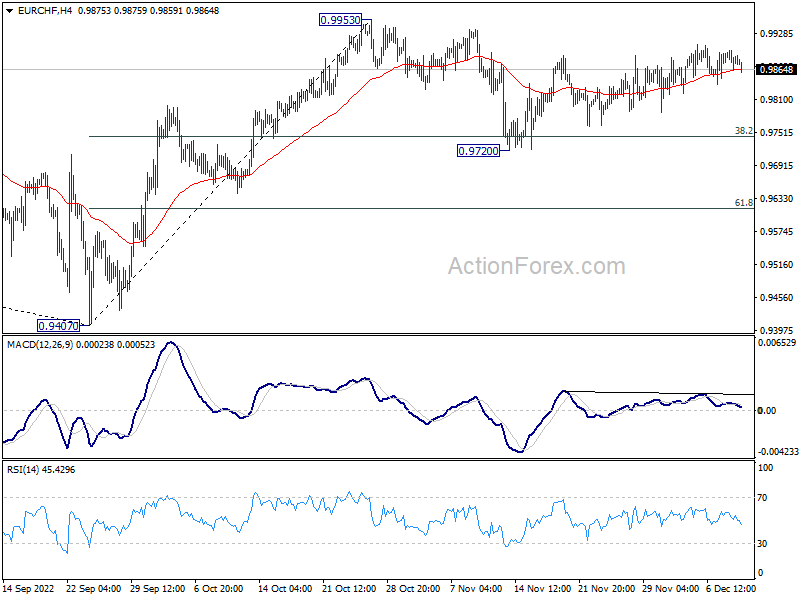
No change in EUR/CHF's outlook as sideway trading from 0.9953 is still extending. Intraday bias remains neutral for the moment. On the upside, firm break of 0.9953 resistance will resume larger rally from 0.9407 to 1.0072 fibonacci level. However, break of 0.9720 will extend the decline from 0.9953 to 61.8% retracement of 0.8407 to 0.9953 at 0.9616.
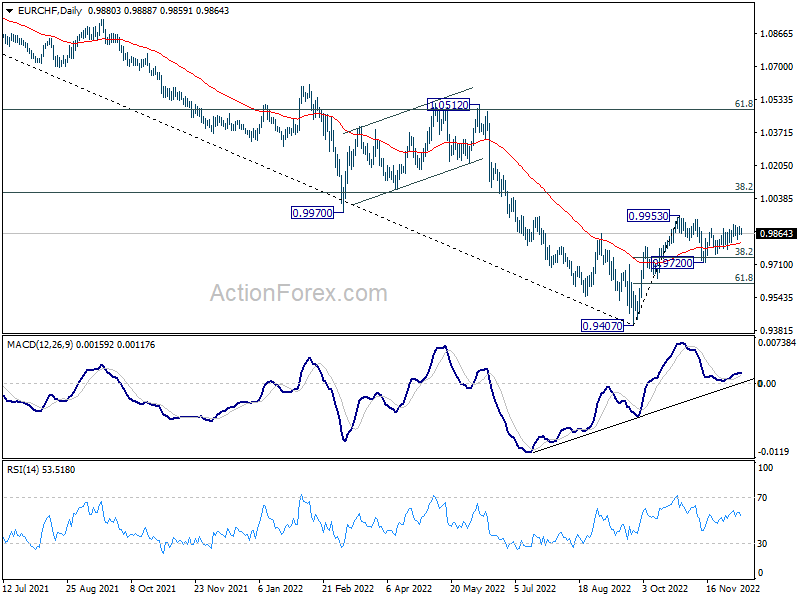
In the bigger picture, prior rejection by 0.9970 support turned resistance retains medium term bearishness. That is, while 0.9407 is a medium term bottom, price actions from there would develope into a corrective pattern rather than a reversal. Down trend resumption through 0.9407 is mildly favored at a later stage. This will remain the favored case now, as long 38.2% retracement of 1.1149 to 0.9407 at 1.0072 holds.
S&P 500 Breaks Support
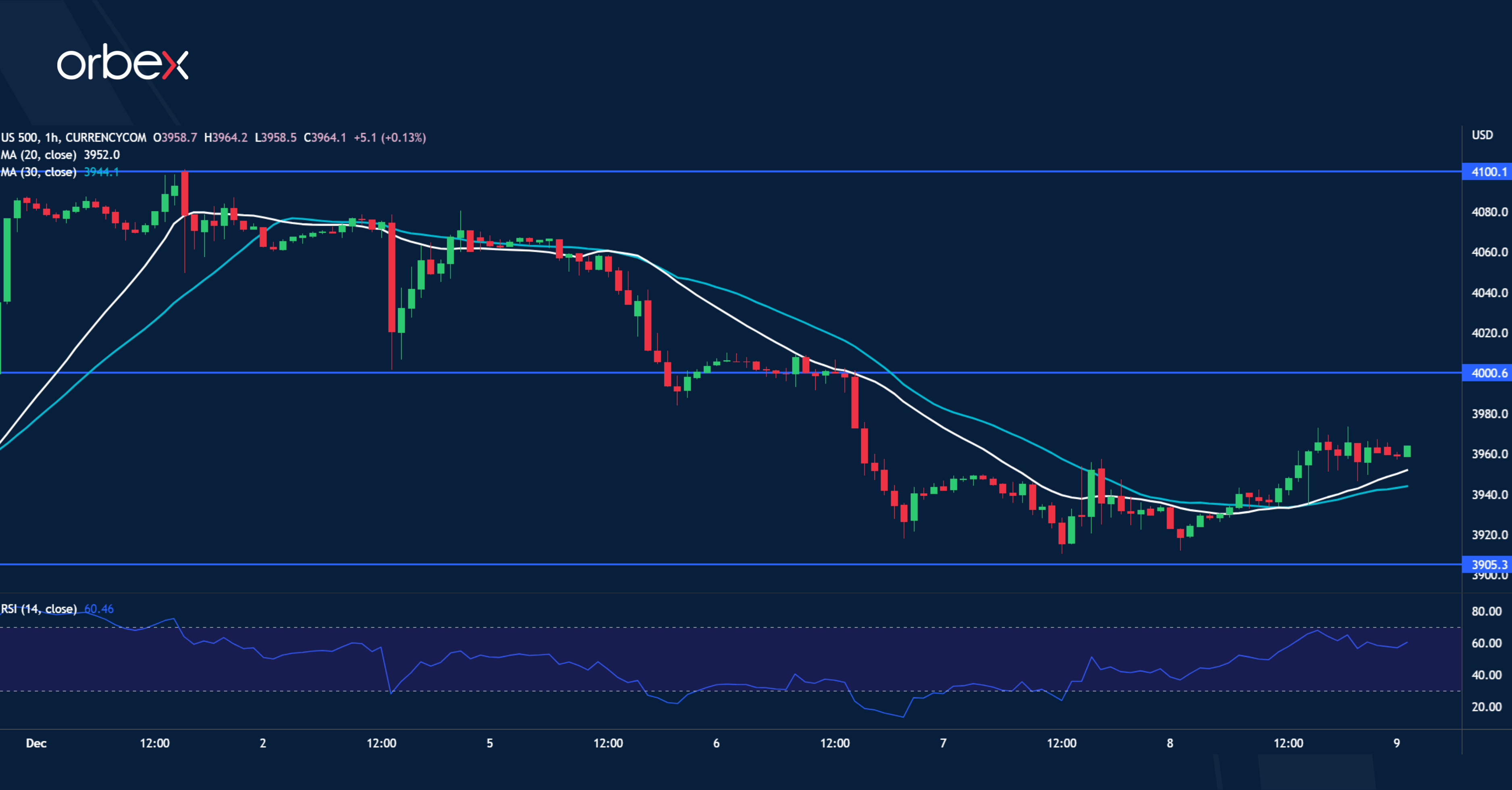
The S&P 500 edged higher after US jobless claims rose moderately last week . The index has struggled in the supply zone (4130) from last September. The tumble below the base of the previous bullish momentum at 3950 has thrown the bulls into disarray. This lack of follow-through might lead to a bearish reversal as the buy side may choose to bail out. Only a climb back above the psychological level of 4000 would attract more interest and signal a recovery. Below 3905, the bears would take over and press towards 3840.
EUR/JPY Tests Resistance
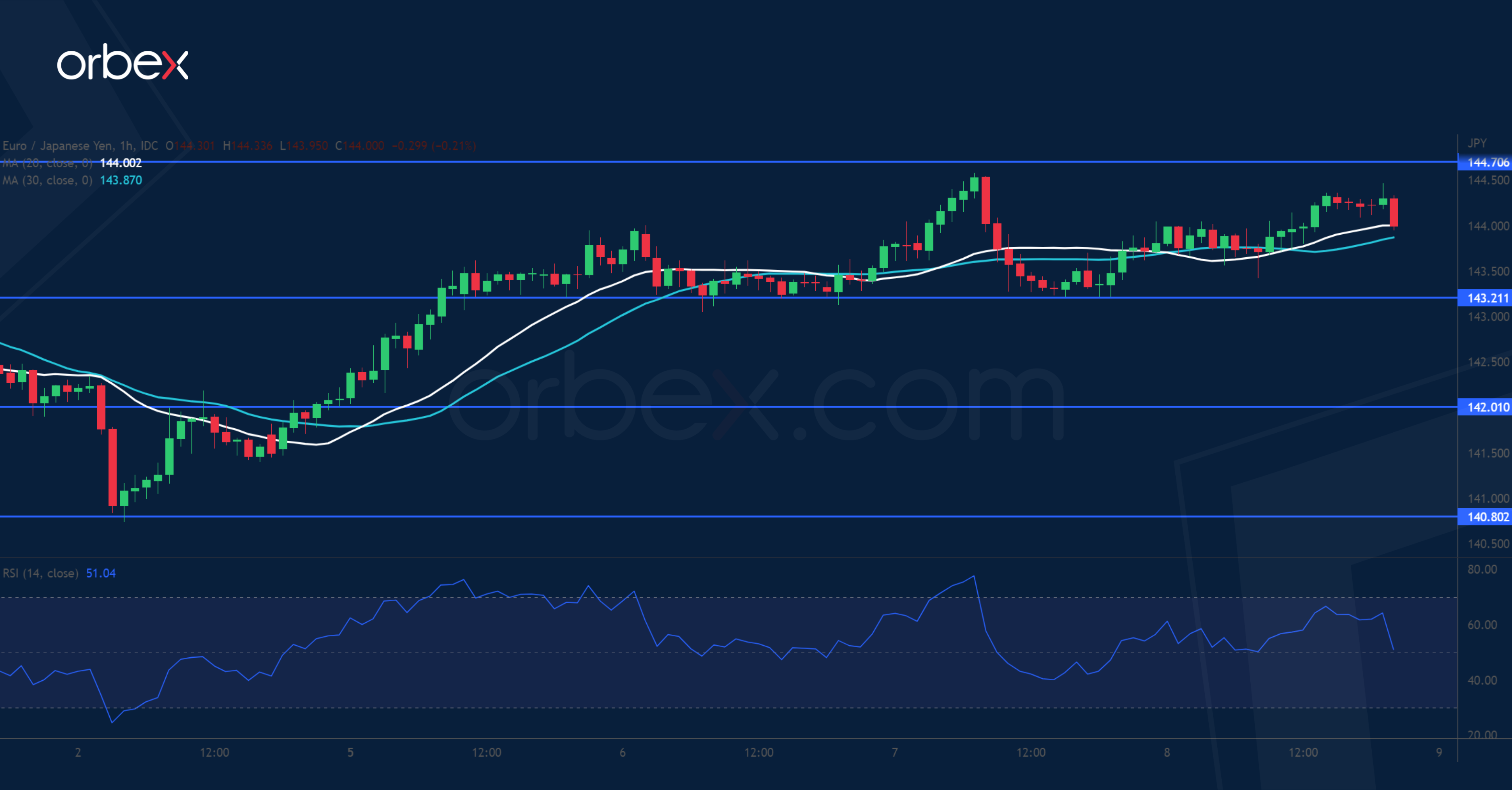
The Japanese yen weakens as the BoJ remains resolutely dovish. The pair has seen increasing pressure after it broke below October’s low of 141.00. 144.70 at the start of the previous bearish push is a major obstacle. A bullish breakout may propel the pair above 146.00, putting the uptrend back on track for the weeks to come. However, if buyers fail to clear it the single currency could head back south. A drop below 143.20 would trigger renewed selling towards 142.00 which is a critical level to keep the current rebound valid.
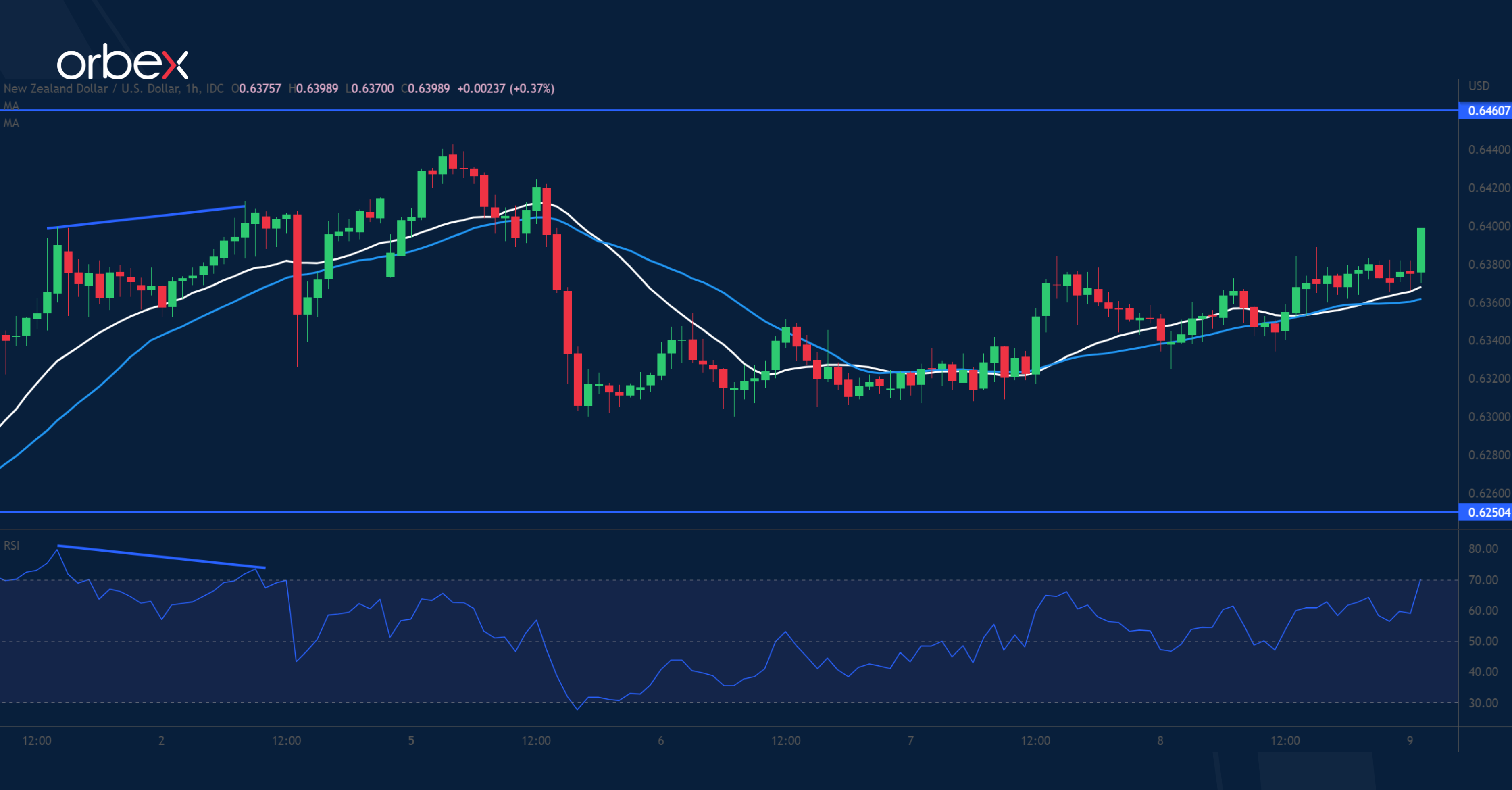
NZD/USD Seeks Support
The New Zealand dollar treads water ahead of the Fed's policy meeting. The pair hit resistance right under August’s high of 0.6460. Profit-taking from short-term buyers compounds selling from those who believe in a bear market in the medium-term in this area of confluence. The bearish RSI divergence was already a giveaway of a slowdown in the rally. 0.6250 near the previous highs is the first level to assess buying interest. 0.6160 is the bulls’ second layer of defence in case of a deeper correction.
US November PPI Will Grab Some Headlines
Markets
To say it hasn’t been the most exciting week is an understatement. Volumes are typically low this time of the year and are being further depressed by looming event risk in the form of a central bank bonanza next week. Economic data is mostly of secondary importance. Trading in such circumstances is merely technically driven. US yields recouped between 2.3 bps and 8.3 bps yesterday after slumping the day before with the longest maturity being the exception (-0.2 bps). The 10y yield hit support from the 50% retracement level of the Aug-Oct rally which coincides with the incoming downward trendline connecting the lower lows in the current corrective move (around 3.42%). German yields rose in similar fashion (3.8-6.5 bps), slightly underperforming vs swaps. Equity sentiment was fragile in European dealings but improved throughout the US session (Nasdaq +1.13%), helping explain the dollar’s defensive mode. EUR/USD closed at 1.055, up half a big figure. USD/JPY (136.37) went nowhere. EUR/GBP simply held above 0.86. The US oil reference, WTI, surged >4% intraday after the US/Canada Keystone pipeline was shut after detecting a leak in Nebraska. It closed the day lower still, as did the European Brent reference. The latter finished at $76.15/b, the lowest since December last year.
After this morning’s Chinese CPI numbers (see below), the remaining data releases take place in US dealings. December University of Michigan consumer confidence (expected to stabilize around 57) is a harbinger for data points ahead. Especially consumer inflation expectations caught attention this year. They are expected unchanged at 4.9% and 3% for 1y and 5-10y respectively.  as well with markets looking for more evidence of easing pipeline price pressures that may translate into further declines in next week Tuesday’s CPI number. European attention turns to the second early TLTRO redemption figure. Banks repaid €296bn on the first occasion (Nov 23) with over €1.8tn still outstanding. Recent changes to TLTRO modalities make them less attractive to hold to maturity. A faster wind down of TLTRO’s, together with the end to APP reinvestments from early next year onwards, will help shrink the central bank’s balance sheet and reduce excess liquidity in the system. From a policy normalization point of view, this is the elephant in the room next year rather than the pace of ECB rate hike and their peak levels. Turning to markets today, we expect more of what we’ve seen all week … which is not much. We do pay close attention whether crucial technical support level holds in Germany’s and the US 10y yield at 1.77% (September correction low) and 3.42% respectively. Closing the week above these targets is important going into the ECB and Fed meetings next week. EUR/USD extends gains this morning and is creeping towards 1.0611, the 38.2% Fibonacci recovery of the 2021-2022 decline. We still believe the USD correction is way overdone.
News Headlines
Price pressures in China remain very modest. CPI inflation eased from 2.1% in October to 1.6% in November, in line with expectations. Especially food price inflation eased from 7.0% Y/Y in October to 3.7% Y/Y. Core inflation, excluding volatile food and energy prices was unchanged from previous month at 0.6% Y/Y. Price for consumer goods rose 2.3% Y/Y, services inflation stays very modest at 0.5% Y/Y. Soft inflation data at least partially mirror subdued consumer demand. Chinese firms even still face some of a deflationary environment. Producer prices were 1.3% lower compared to the same month last year. Analysists expected a slightly bigger price decline. The price data give Chinese authorities room for a policy of selective monetary and fiscal support. Despite low inflationary pressures, the yean this morning gains slightly with USD/CNY trading near 6.955.
Inflation data in Mexico in November showed a mixed picture. Headline inflation rose 0.58% M/M and 7.8% Y/Y (was 8.41% in November). Core inflation however rose 0.45% M/M and is slightly higher Y/Y (to 8.51% from 8.42%). As such inflation remains well above the central bank’s target of 3.0% (+/- 1.0%). The Bank of Mexico currently has its policy rate at 10%. The Bank meets next week. Analysts expect the bank to raise the policy rate by an additional 50 bps to 10.5%. After a trend of appreciation against the USD this year, the peso recently fell prey to profit taking. The peso yesterday regained slightly to currently trade in thee USD/MXN 19.63 area.
US PPI Will Say the Last Word of the Week
The US initial jobless claims for employment benefits rose last week, and continuing claims advanced to their highest levels since February, meaning that people who are out of work take more time to find a job.
It sounds terrible to a normal ear, but it’s music to the Federal Reserve’s (Fed) ears, as it is a sign that the jobs market in the US could be weakening – and that could help weaken inflation.
So, yesterday’s trading session was a bit better than the previous five sessions. The US indices eked out small gains after taking over a mixed session from European traders.
The Eurostoxx index was flat yesterday, while FTSE 100 fell despite a good session for the mining stocks, which rallied on a jaw-dropping $7 billion profit announced by the commodity trader Trafigura.
Activity on FTSE and European index futures hint at a slightly positive start on Friday. The US PPI data will, however, say the last word.
The data of the week
The US will release its November PPI figure today and expectations are low.
Released earlier, the Chinese inflation fell to 1.6%, the lowest since March in line with expectations; the factory gate prices fell 1.3%. Prices of production materials shrank as the cost of extractions and processing cost continued to decline. A sharp slowdown in the cost of raw materials also helped cooling the Chinese PPI.
The consensus of analyst estimates on Bloomberg survey shows that the US PPI is expected to have slowed to 7.2% in November from 8% printed a month earlier. The core PPI is also seen down from 6.7% to 5.9%.
If this is the case, if the factory gate inflation in the US slowed last month – which would also hint at a potentially slower CPI data next Tuesday before the FOMC decision – we could see the risk assets shrug off some of this week’s weakness. The S&P500 could rebound back to its 200-DMA and close the week above the 4000 mark.
But if the US PPI figure is higher than expected – which is well possible given that the low expectations are harder to beat, then we will probably see the US stocks sink back in the red.
The key bearish targets for the S&P500 stands at 3900, which has acted as a pivot a couple of times this year, and the 3870 mark, the major 38.2% Fibonacci retracement on the latest bear market rally, if broken, would hint at a medium term bearish reversal.
More potential for hawkish price action
The US dollar index remains under a decent selling pressure against many majors. The US dollar index hasn’t extended losses below last week’s lows but remained clearly offered into its 200-DMA this week, meaning that the conviction that the US dollar should fall sustainably strengthens among traders.
A US PPI figure in line, or ideally softer-than-expected, could boost the US dollar bears, and help the dollar close the week at fresh lows since summer. Whereas disappointment on the PPI front will likely give a boost to the dollar, as it would boost the hawkish Fed expectations and the rate bets.
It’s important to note that the Fed is given around 80% probability to hike the interest rates by 50bp next week. But the inflation data will hardly change that expectation. It will change the bets on the Fed’s terminal rate, instead. The market pricing still points at a terminal Fed rate below 5%, which means that, in case of PPI disappointment, there is more potential for a hawkish price action, than a dovish one.
In commodities, gold is also pushing higher thanks to a broadly softer US dollar. The precious metal is above its 200-DMA this morning and is flirting with the $1800 mark. Soft PPI data could help extend the yellow metal’s rally above $1800, whereas a stronger-than-expected figure will likely lead to some profit taking before the weekly closing bell.
Crude to $65pb?
The barrel of American crude extended losses to $71 per barrel. Trend and momentum indicators remain comfortably bearish, inviting traders to sell the tops for a further fall in oil prices in the short run. A fall below the $70 psychological level could pave the way for a further decline to $65, in continuation of an ABCD pattern building since end of September.
But the price should rebound back above $82 sometime in the first quarter of next year.