

Sample Category Title
Technical Outlook and Review
USD/JPY:
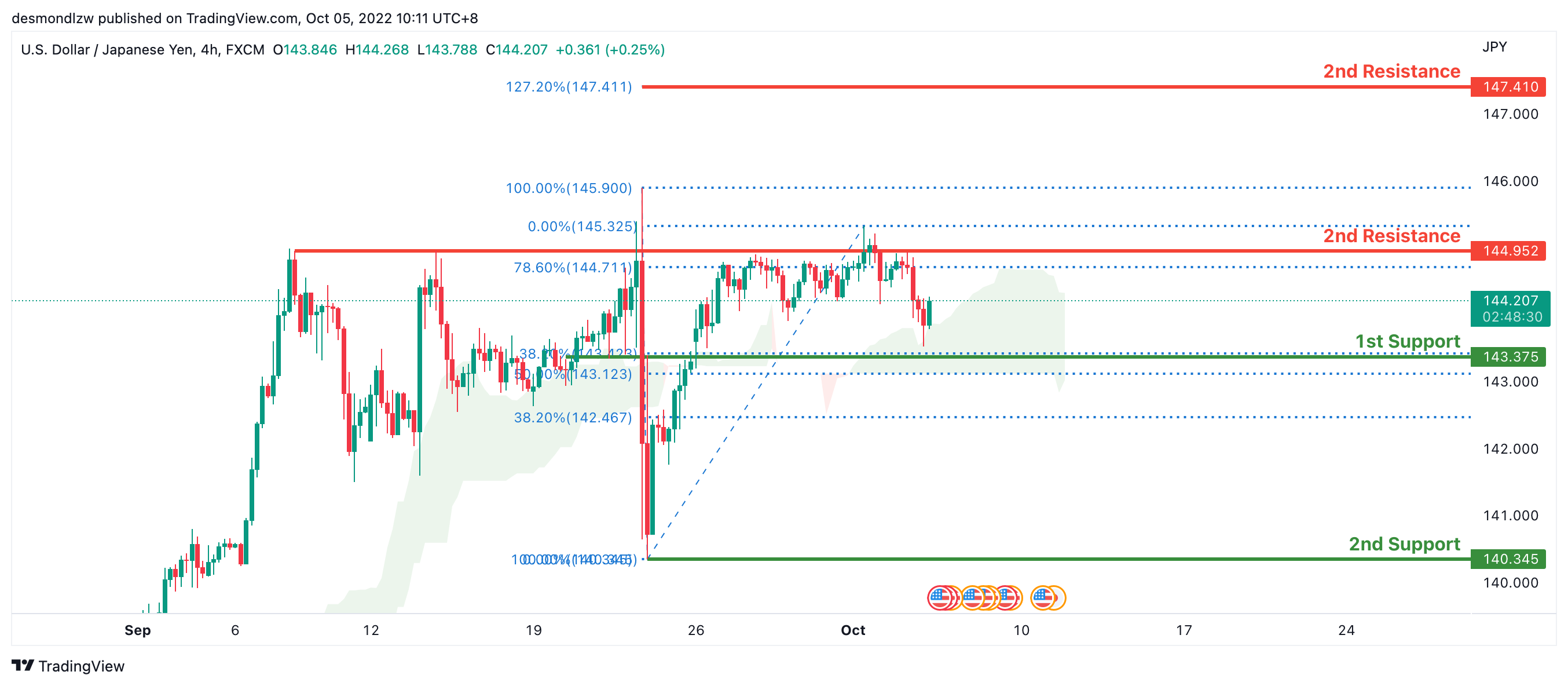
The price is moving in a clear bullish trend on the H4 chart. In addition, the price is above the ichimoku cloud, a bullish market indicator. Overnight, the price responded lower off of the 145 level with a frail bearish momentum. Price is anticipated to move towards the first support level at 143.375, which contains the 38.2% and 50% Fibonacci lines.
Areas of consideration:
- H4 time frame, 1st resistance at 144.952
- H4 time frame, 1st support at 143.474
DXY:
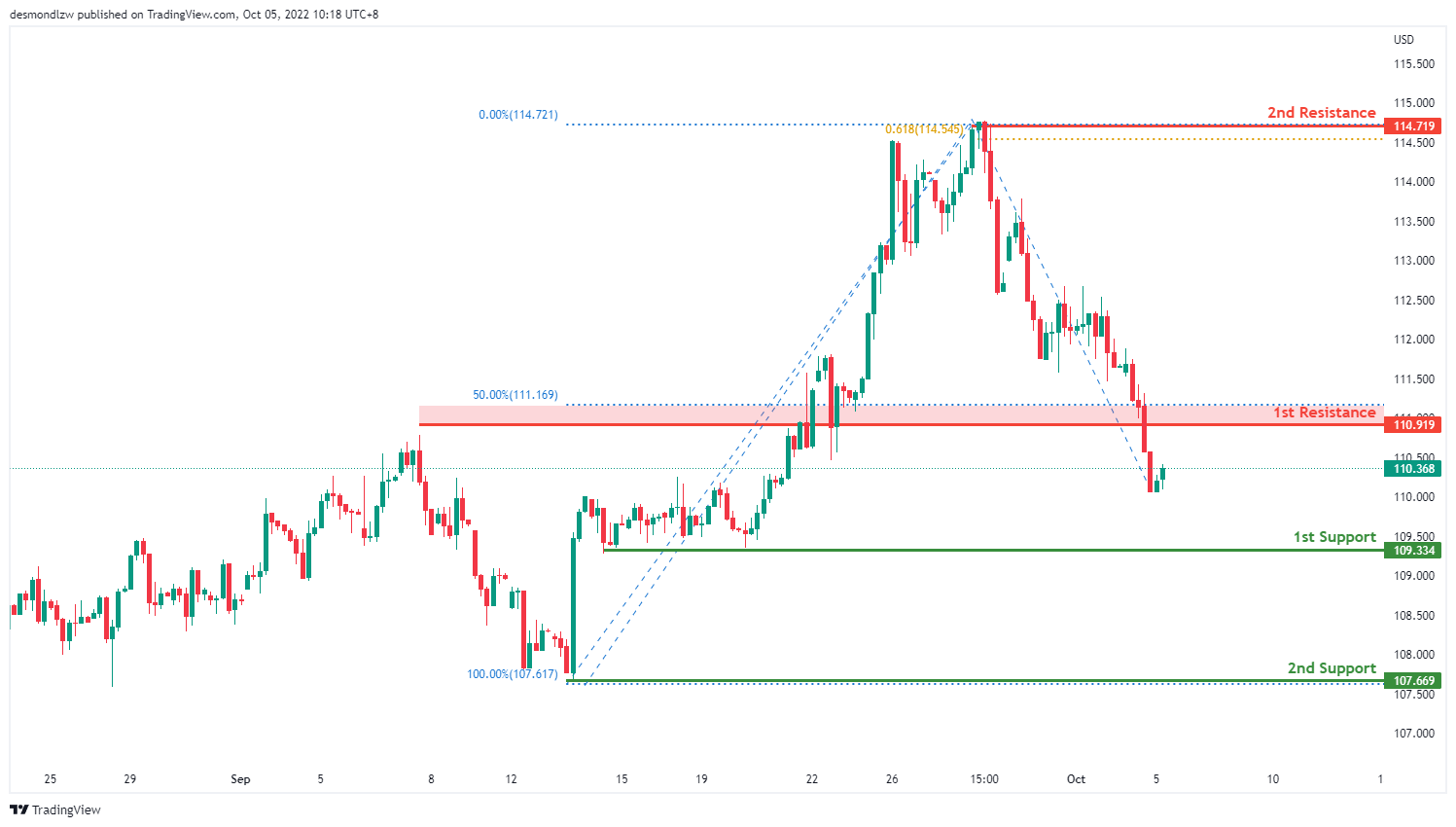
On the H4, price has broken lower from the ichimoku cloud and is moving in a descending manner hence we are bearish bias. It has broken the resistance and is moving toward the first support at 109.334 where my swing low sits. If bearish momentum continues, it will bring price to my second support at 107.669 where my second support and previous swing low sits. Alternatively price could bounce back to test the first resistance at 110.919 where my 50% retracement sits then the second resistance at 114.719 where the 61.8% projection and previous swing high sits
Areas of consideration:
- H4 time frame, 1st resistance at 110.919
- H4 time frame, 1st support at 109.334
EUR/USD:
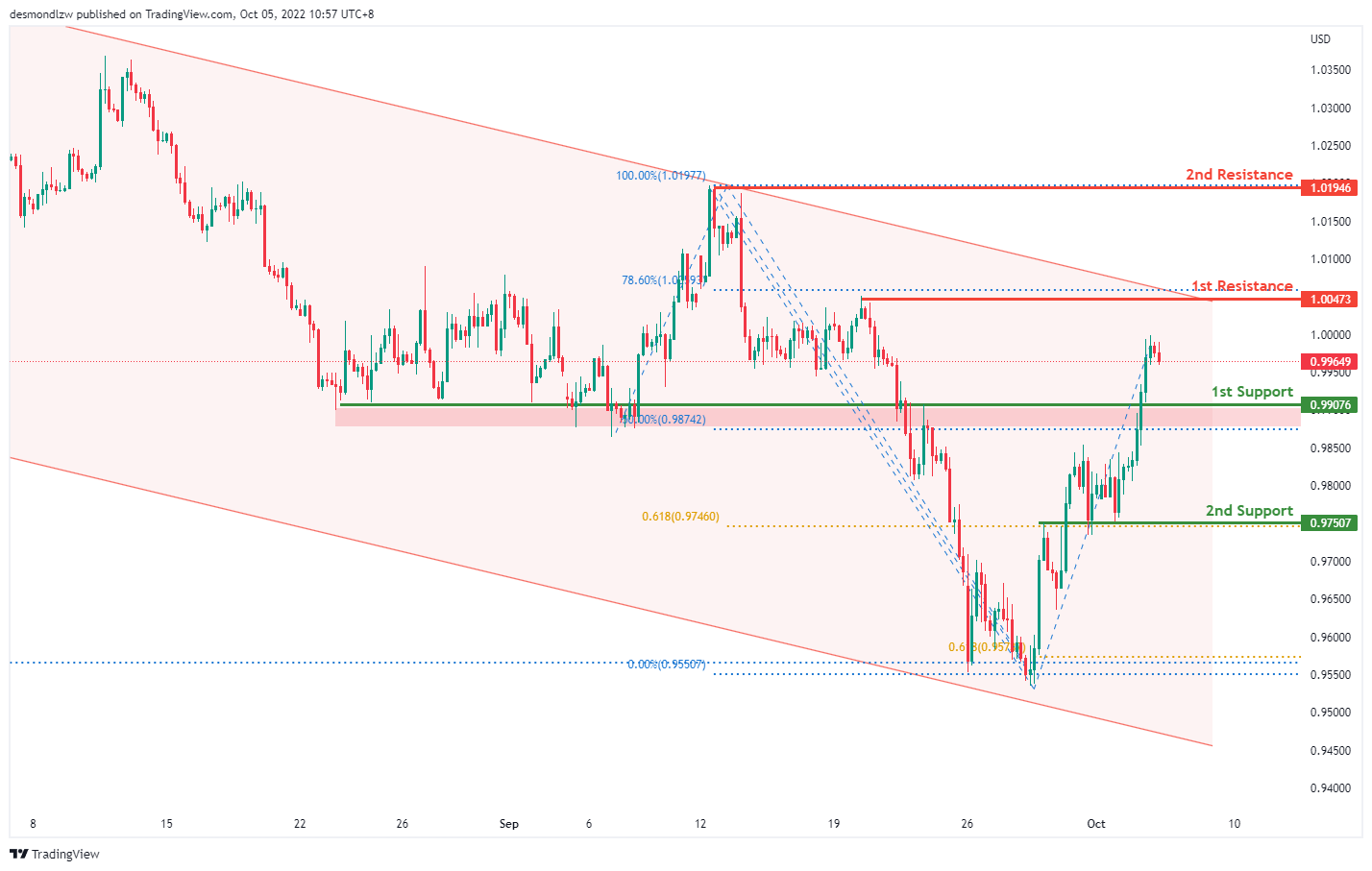
On the H4, price is moving within the descending trendline but in an ascending manner, with the price above ichimoku cloud- we are slightly bullish biased. Price has bounced off the first support and is moving toward the first resistance at 1.00473 where the 78.6% projection sits. If price breaks this level, it will test the second resistance at 1.0194, where the previous swing high sits. Alternatively, the overall bearish momentum could bring price back to test the first support at 0.9907 where the previous swing low and 50% retracement sits. If it breaks this level, we have a strong bearish confirmation to bring price down to 0.9750 where the swing low and 61.8% projection sits
Areas of consideration :
- H4 1st resistance at 1.0047
- H4 1st support at 0.9907
GBP/USD:
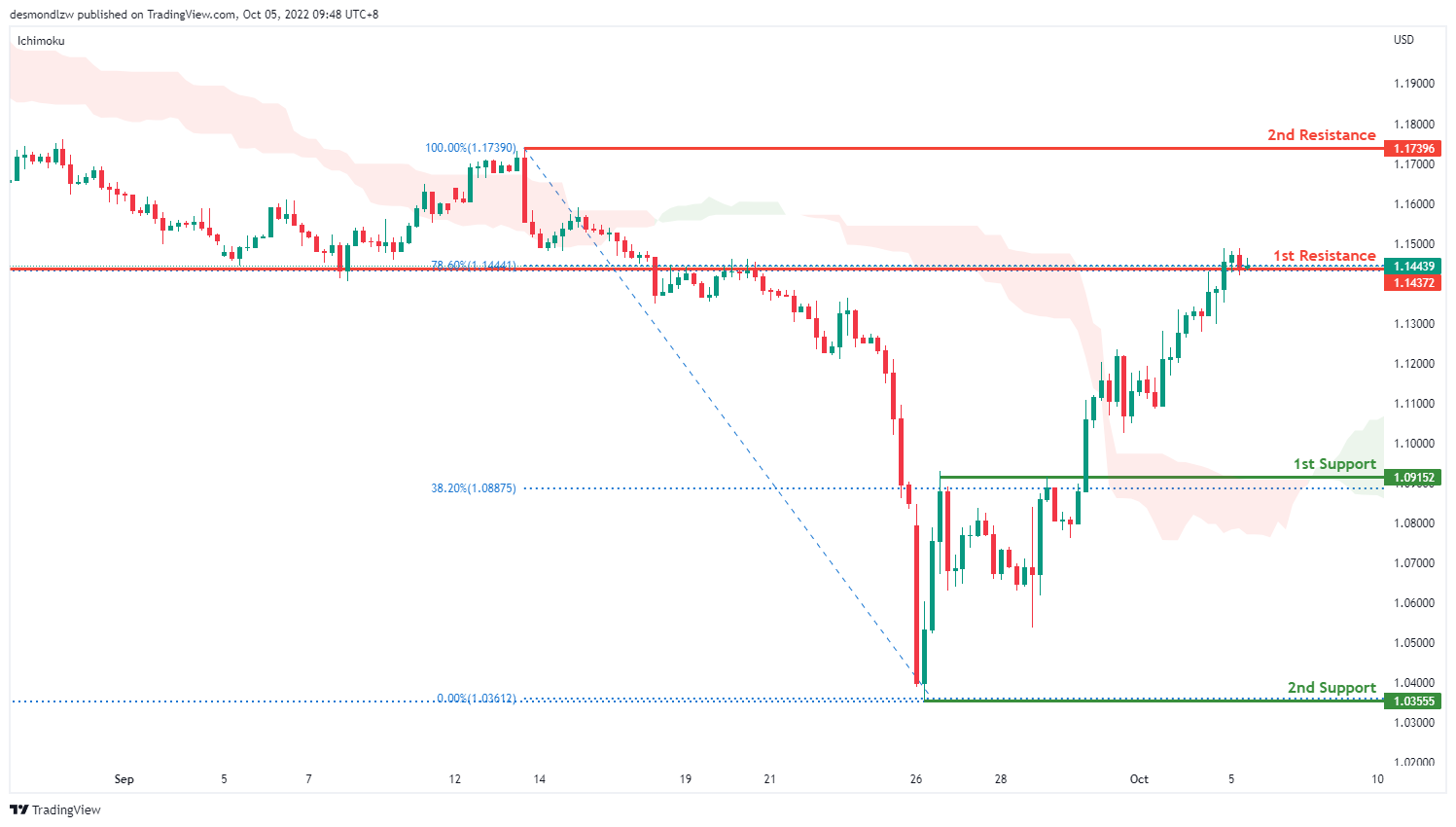
On the H4 time frame, prices have bounced off the support level and are moving in an ascending manner, we are slightly bullish. Price is moving toward the first resistance at 1.1443, where the 78.6% retracement and overlap resistance sits. If it breaks this level, its bullish momentum will bring price to second resistance at 1.1739 where the previous swing high sits. Alternatively, price could pull back to test the first support at 1.0915, where the 38.2% retracement sits then the second support at 1.0355 where the 138.2% extension sits
Areas of consideration:
- H4 1st resistance at 1.1443
- H4 1st support at 1.10915
USD/CHF:
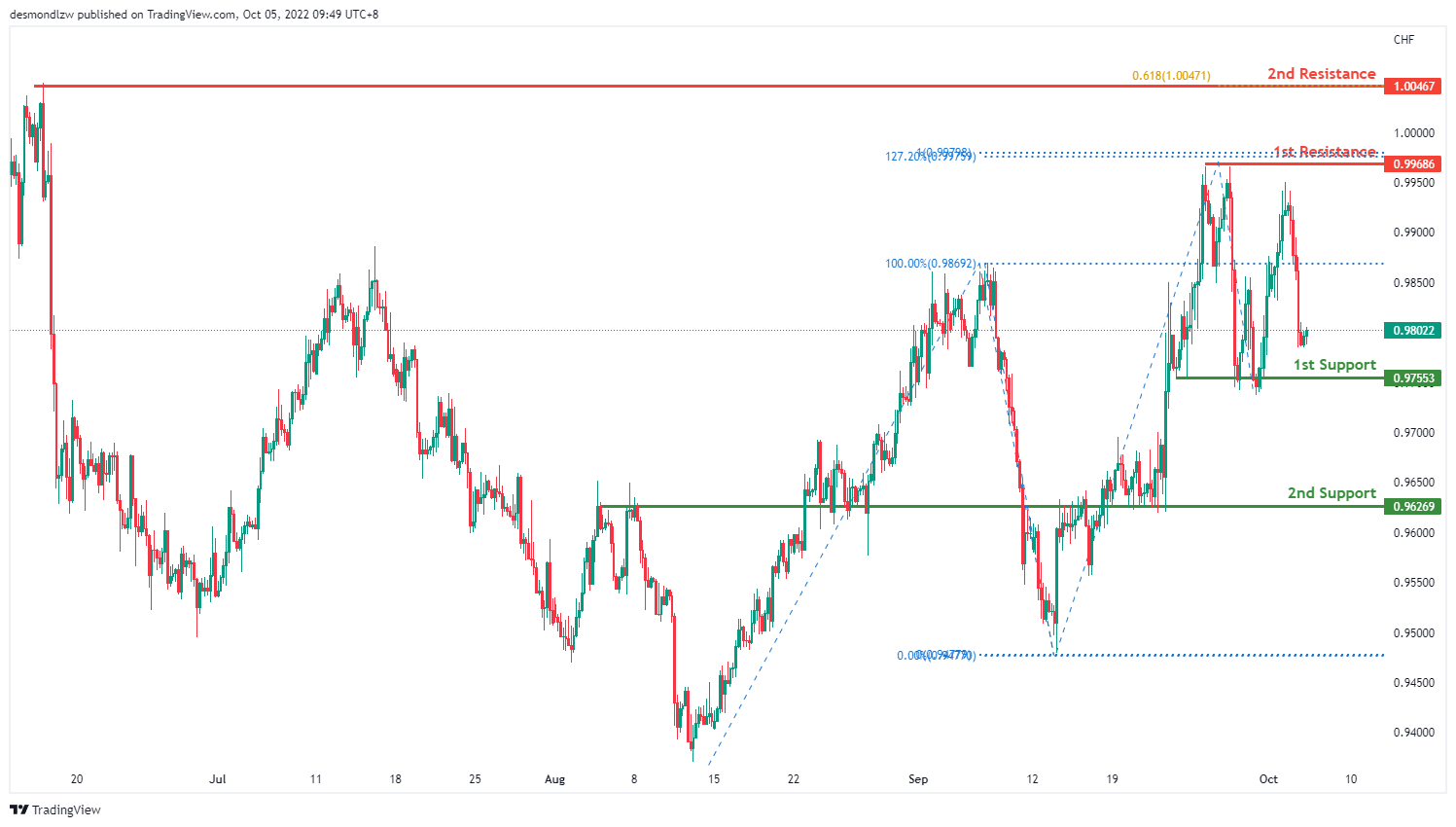
On the H4 chart, price has rejected the resistance level and is moving in a descending manner hence we are bearish bias- prices are moving toward the first support at 0.9755 where the previous swing low sits. If bearish momentum continues, it will bring price down to the second support at 0.9626 where the overlap support sits. Alternatively, price could bounce back to test the first resistance at 0.9968 where the 127.2% extension and 100% projection sits then to test the second resistance at 1.0046
Areas of consideration
- H4 1st support at 0.9755
- H4 1st resistance at 0.9968
XAU/USD (GOLD):
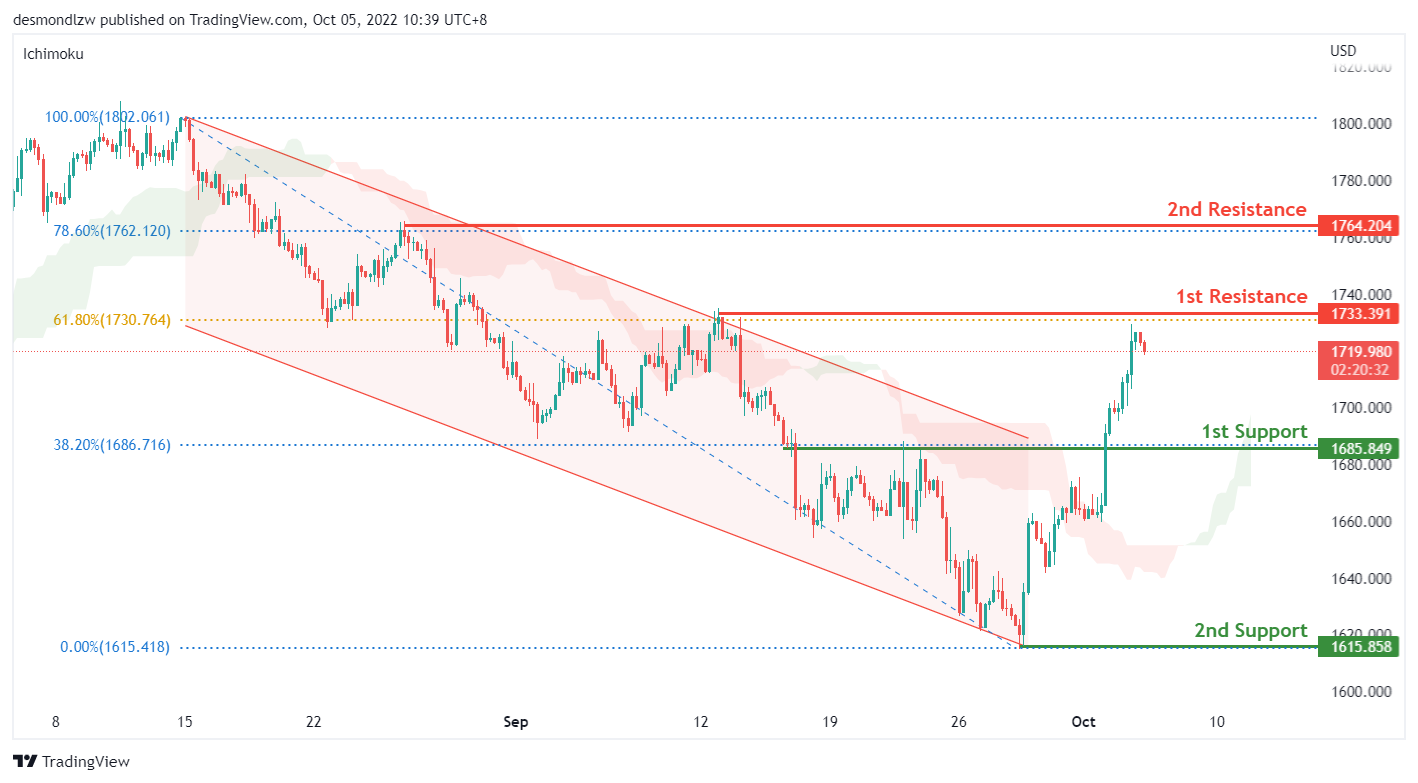
On the H4, price trades strongly higher above the ichimoku cloud as it approaches the 1st resistance of 1733 which is the previous swing high from 12 September 2022 and the 61.80% fibonacci retracement level. We continue to have a bullish bias that price could trade higher to the 2nd resistance of 1764 which is in line with the 78.60% fibonacci retracement level and previous swing high from end August 2022. However, before the move higher, the price could first retrace towards the risk level of 1708 which is the 50% fibonacci retracement level.
Areas of consideration:
- H4 time frame, 1st resistance at 1733.39
- H4 time frame, 1st support at 1685
- H4 time frame, 2nd resistance at 1764
AUD/USD:
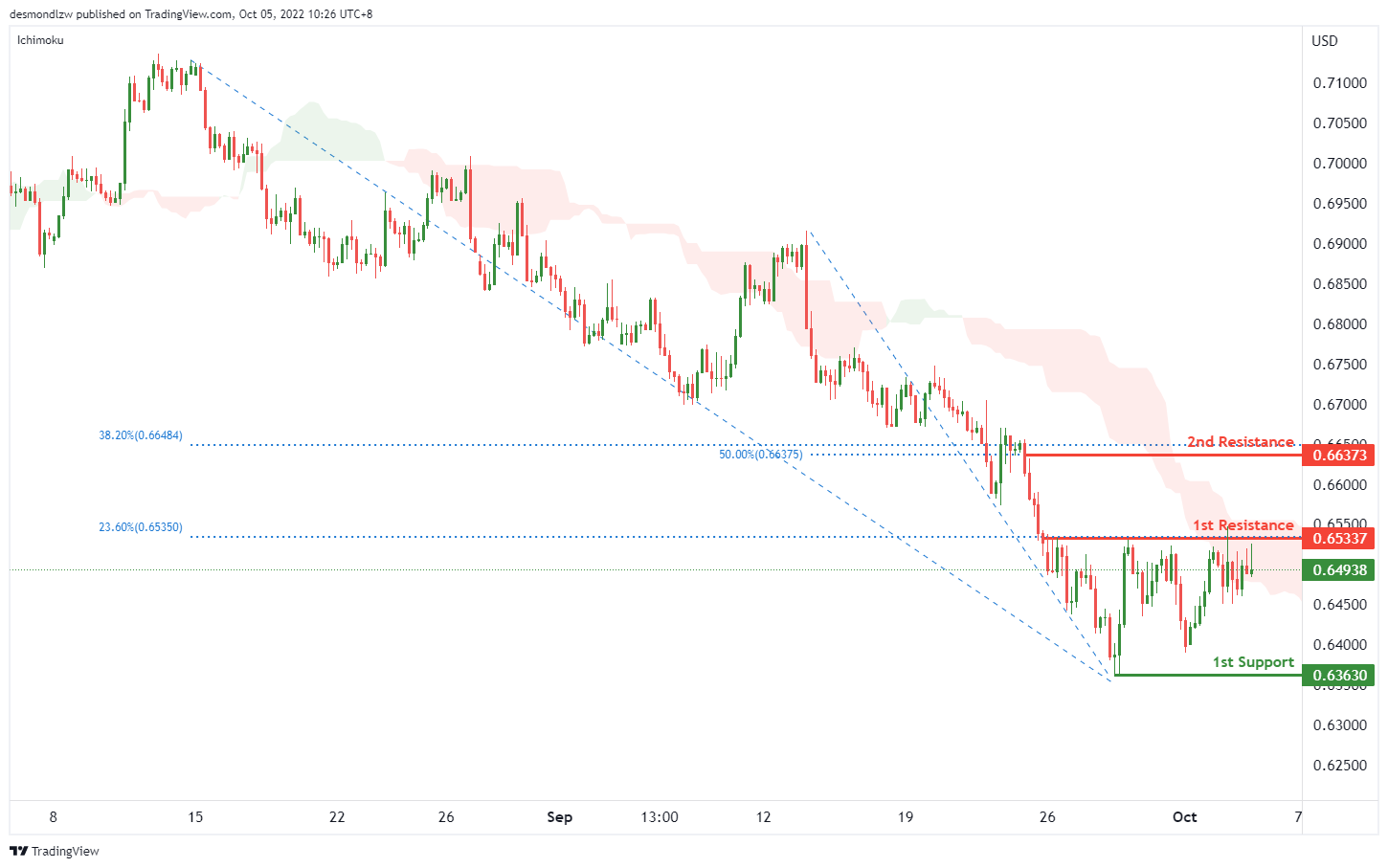
On the H4, with the price testing the 1st resistance at 0.65337, where the 23.6% fibonacci retracement sits, and crossing ichimoku cloud, if the price can break the 1st resistance successfully, we can expect the price rise to the 2nd resistance at 0.66373, which is in line with the 50% and 38.2% fibonacci retracement. Alternatively, the price may drop back to the 1st support at 0.63630, where the swing low is.
Areas of consideration
- H4, 1st resistance at 0.65337
- H4, 2nd resistance at 0.66373
NZD/USD:
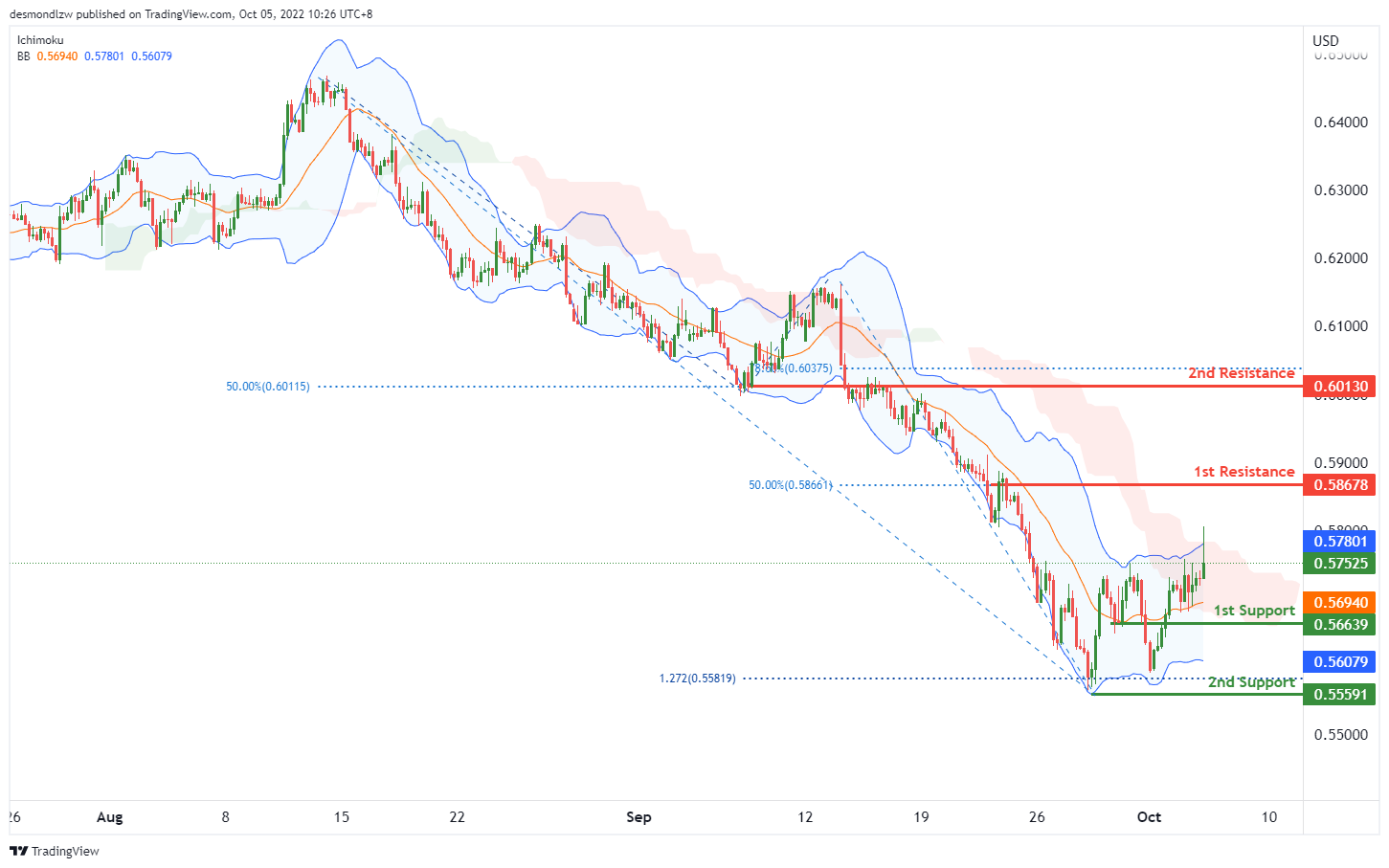
On the H4, with the price crossing the ichimoku cloud and still within the bollinger bands, we have a bullish bias that the price may rise to the 1st resistance at 0.58678, which is in line with the 50% fibonacci retracement. If the 1st resistance is broken, we can expect the price to rise to the 2nd resistance at 0.60130, where the 78.6% fibonacci retracement and 50% fibonacci retracement are. Alternatively, the price may drop to the 1st support at 0.56639, where the previous swing low is. If the 1st support is broken, the next support level could be at 0.55591, which is in line with the significant swing low.
Areas of consideration:
- H4 time frame, 1st resistance at 0.58678
- H4 time frame, 1st support at 0.56639
USD/CAD:
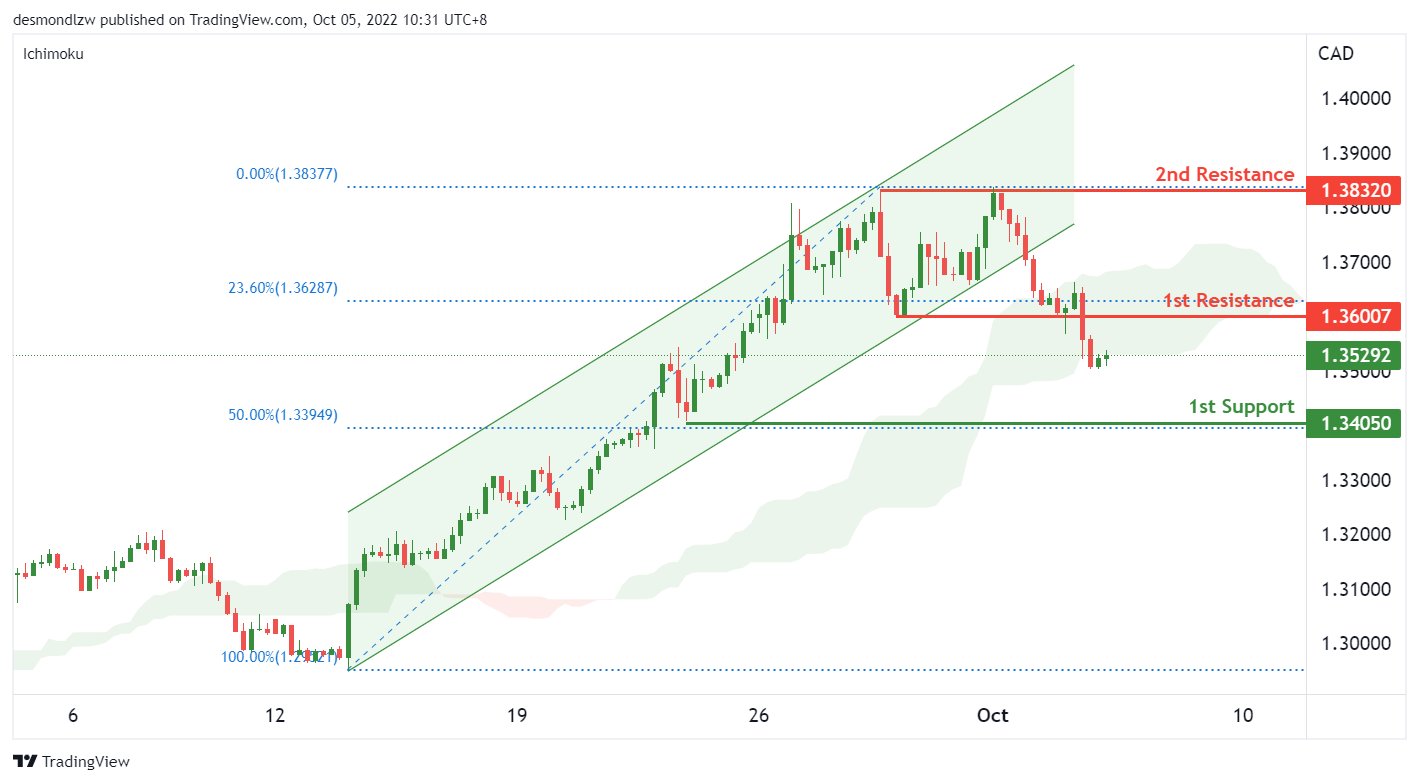
On the H4, the price broke lower from the support turned 1st resistance level of 1.36 which is in line with the 23.60% fibonacci retracement level. With the price trading below the ascending channel and the ichimoky cloud, we have a short term bearish bias. Price could fall to the 1st support of 1.34 which is in line with the 50% retracement level and the previous swing low. However, the price could retest the 1st resistance before trading lower. Alternatively, if price breaks above the 1st resistance level, the USDCAD could trade higher towards the 2nd resistance of 1.3832 which is the previous swing high.
Areas of consideration:
- H4 time frame, 1st resistance at 1.36
- H4 time frame, 1st support at 1.34
- H4 time frame, 2nd resistance at 1.3832
OIL:
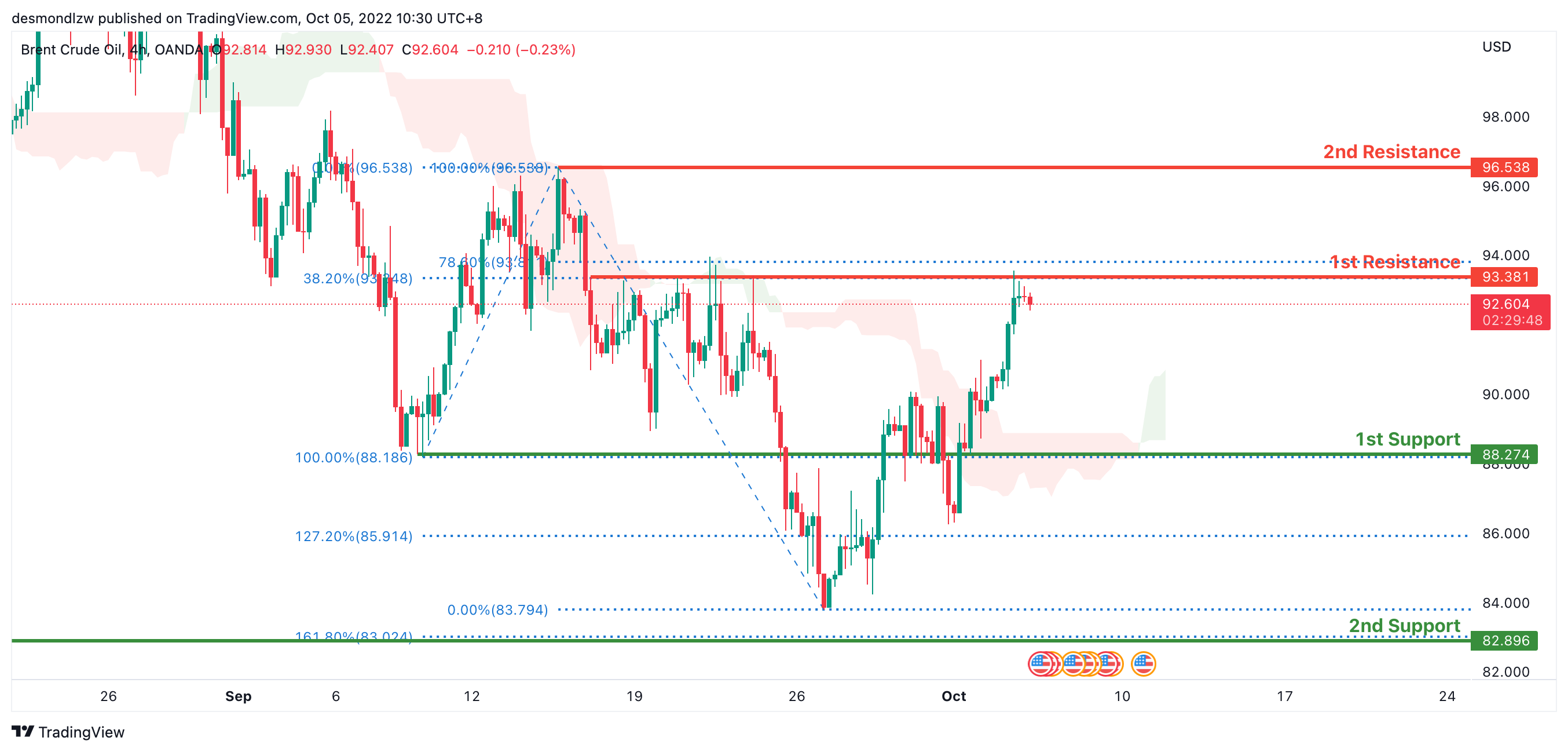
Oil is in a bearish trend on the 4-hour chart. However, price is now above the Ichimoku cloud, indicating that the market is bullish at the moment. Price has broken through the first support level, which has a 100% Fibonacci extension and served as the previous swing low, at 88.788. Overnight, price has tapped onto the first resistance level, where the 38.2% Fibonacci extension line is at 93.381. Expecting price to consolidate around this area.
Areas of consideration:
- H4 time frame, 1st resistance at 93.381
- H4 time frame, 1st support at 88.366
Dow Jones Industrial Average:
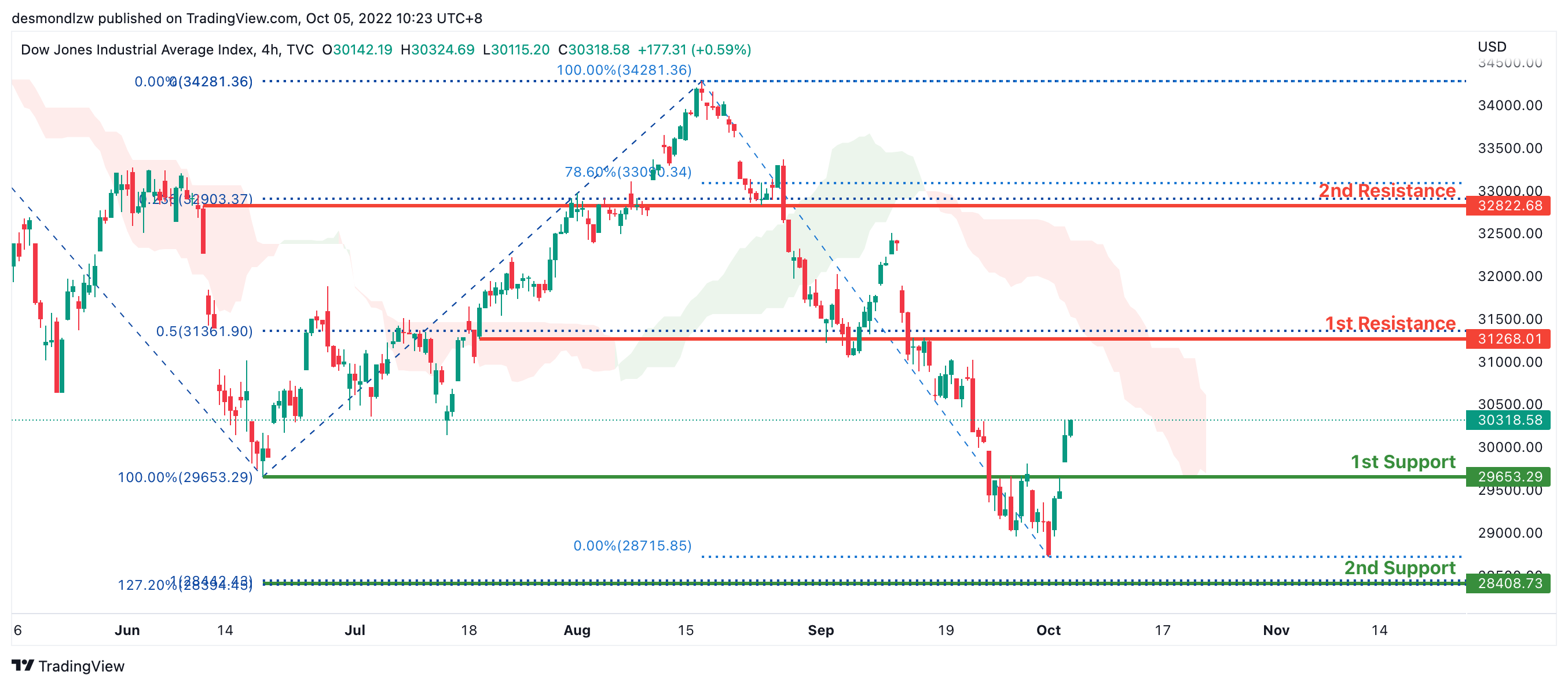
The price is moving downward on the H4 chart. The first support level at 29653.29 has also been breached by the price. Price moved away from the first support level overnight, continuing its upward bullish momentum. The initial resistance level around 28422.42, which is where the 50% Fibonacci line is situated, is where price is anticipated to move.
Areas of consideration:
- H4 time frame, 1st support at 29653.29
- H4 time frame, 1st resistance at 31268.01
DAX:
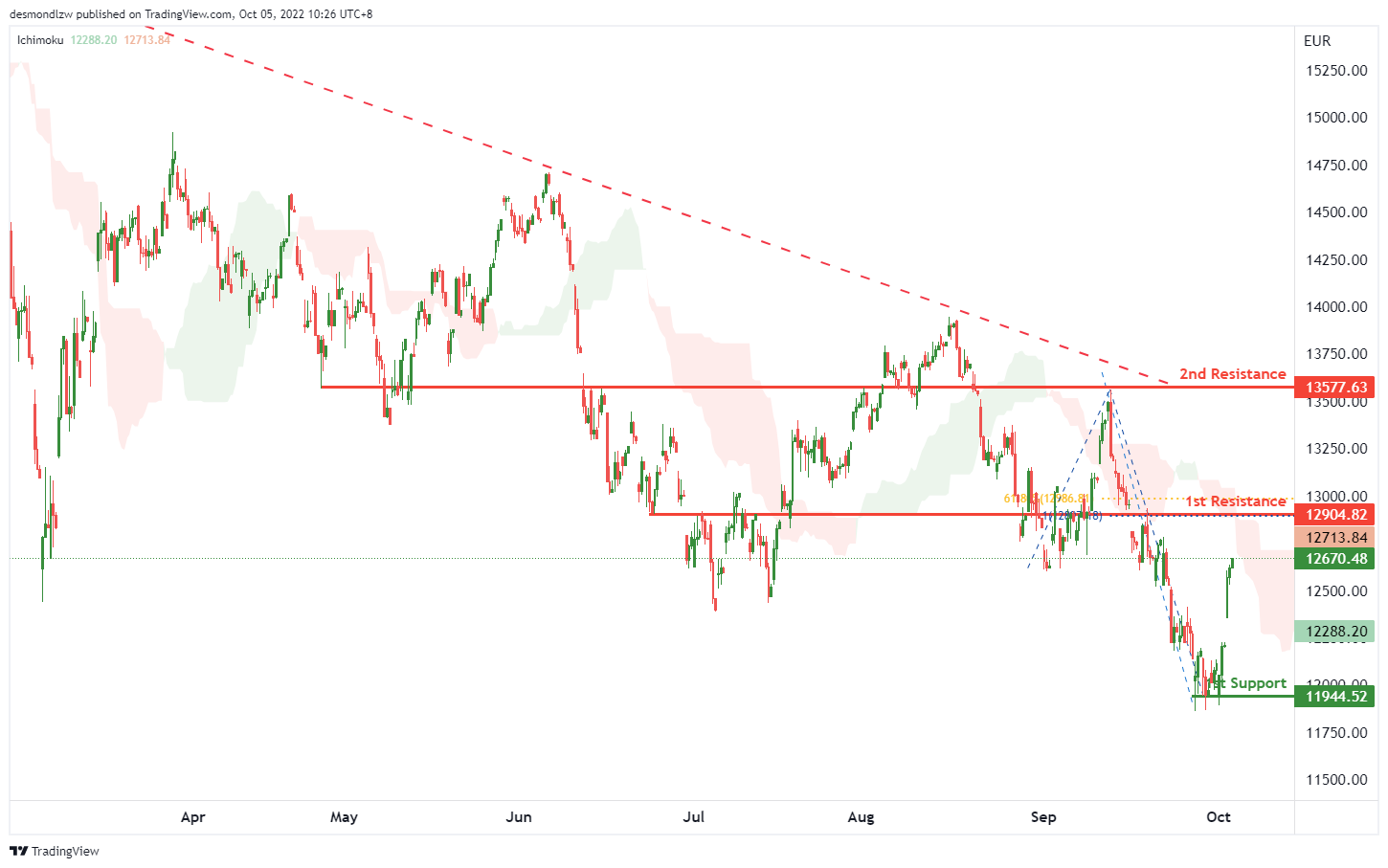
On the H4, with the price bouncing from the 1st support at 11944.52, the price may test the 1st resistance at 12904.82, which is in line with the 100% fibonacci projection and 61.8% fibonacci retracement. If the 1st resistance is broken, the price may rise to the 2nd resistance at 13577.63, where the overlap resistance is. Alternatively, the price may drop back to the 1st support at 11944.52, which is in line with the swing low.
Areas of consideration:
- H4 time frame, 1st resistance at 12904.82
- H4 time frame, 2nd resistance at 13577.63
ETHUSD:
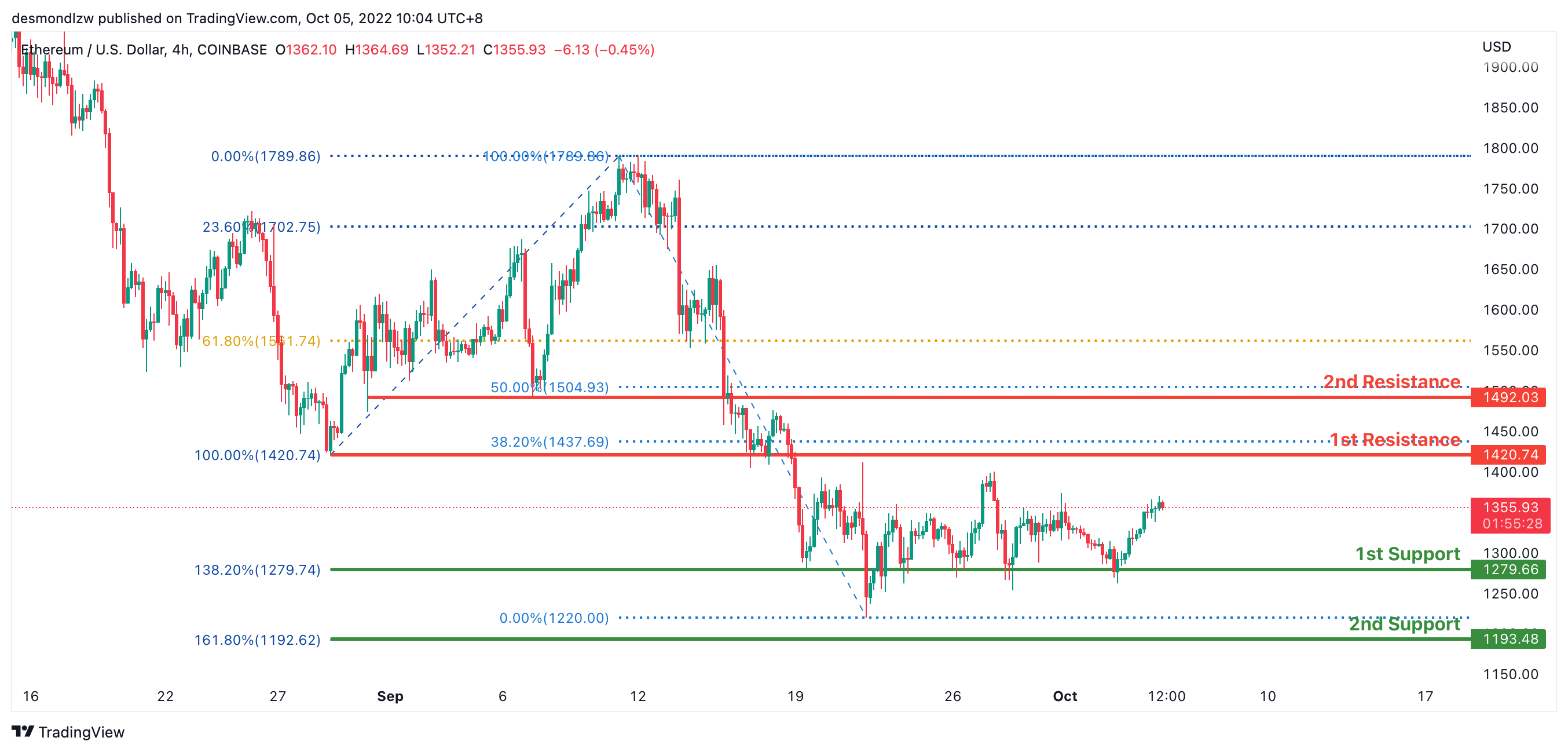
The overall price of ETHUSD is quite bearish on the H4. Price has now closed above the Ichimoku cloud, suggesting a potential short-term trend change. Overnight, ETHUSD kept moving upward from the first support level at 1279.74, which is the 138.2% Fibonacci extension line. We anticipate a price reversal to the 100% Fibonacci and 38.2% Fibonacci lines at 1420.74, which is the first resistance line.
Areas of consideration:
- H4 time frame, 1st resistance of 1420.74
- H4 time frame, 1st support at 1279.00
BTCUSD:
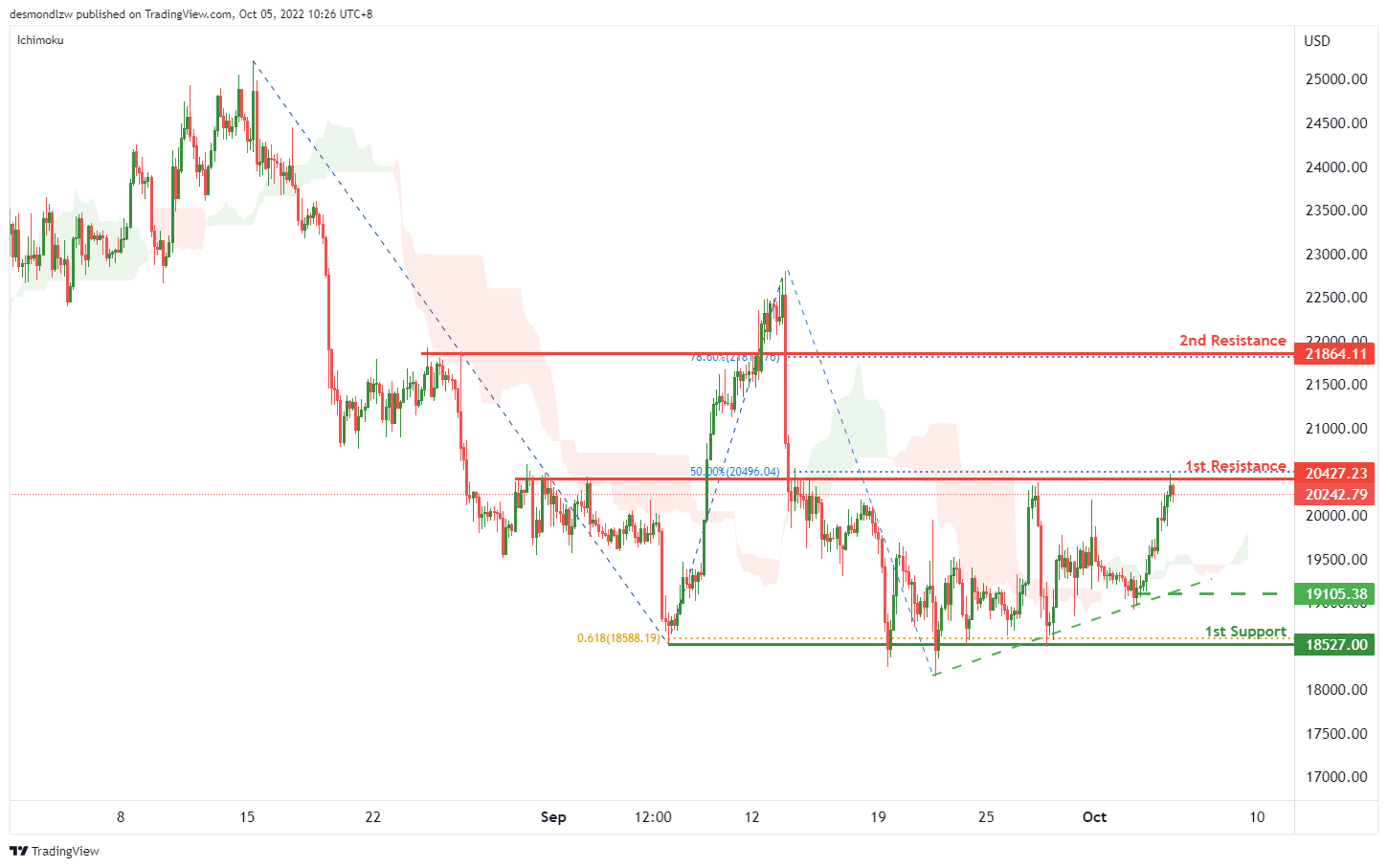
On the H4, price is showing a short term ascending trendline and testing the 1st resistance at 20427.23, where the overlap resistance and 50% fibonacci retracement are. If the 1st resistance is broken, the next resistance could be at 21864.11, which is in line with the 78.6% fibonacci retracement. Alternatively, the price may pull back from the 1st resistance and drop to the 1st support at 18527, which is in line with the swing lows and 61.8% fibonacci projection. Take note the 19105.38 could be the intermediate support.
Areas of consideration:
- H4 time frame, 1st resistance at 20427.23
- H4 time frame, 2nd resistance at 21864.11
S&P 500:
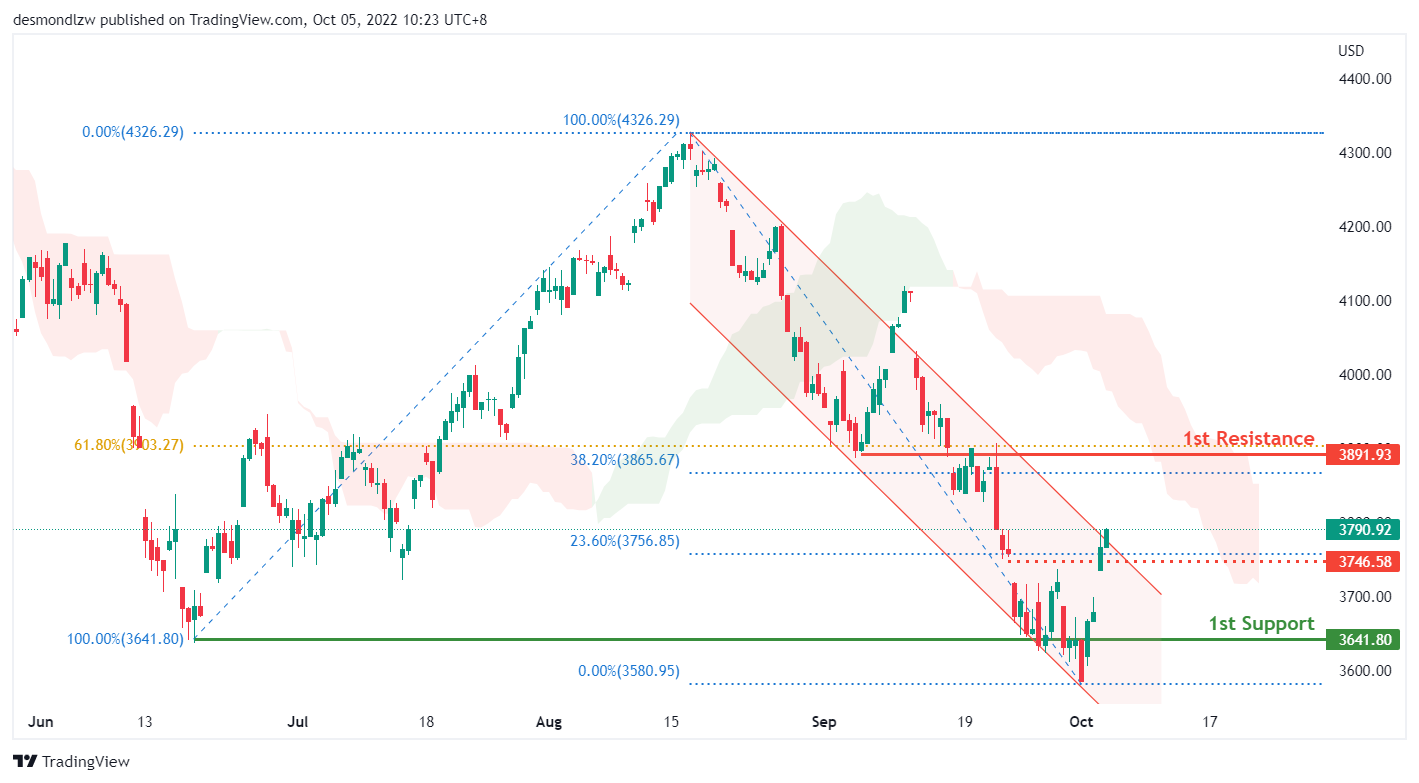
On the H4, with the price trading higher from 1st support of 3642, previous swing low of June 2022 and the interim risk level of 3746.58 which is in line with the 23.60% fibonacci retracement level, we continue to have a bearish bias. With the price breaking out of the descending channel but below the ichimoku cloud, the price could continue trading higher to the 1st resistance of 3892.
Areas of consideration:
- H4 time frame, 1st resistance at 3892
- H4 time frame, 1st support at 3642
EUR/USD Daily Outlook
Daily Pivots: (S1) 0.9862; (P) 0.9930; (R1) 1.0055; More...
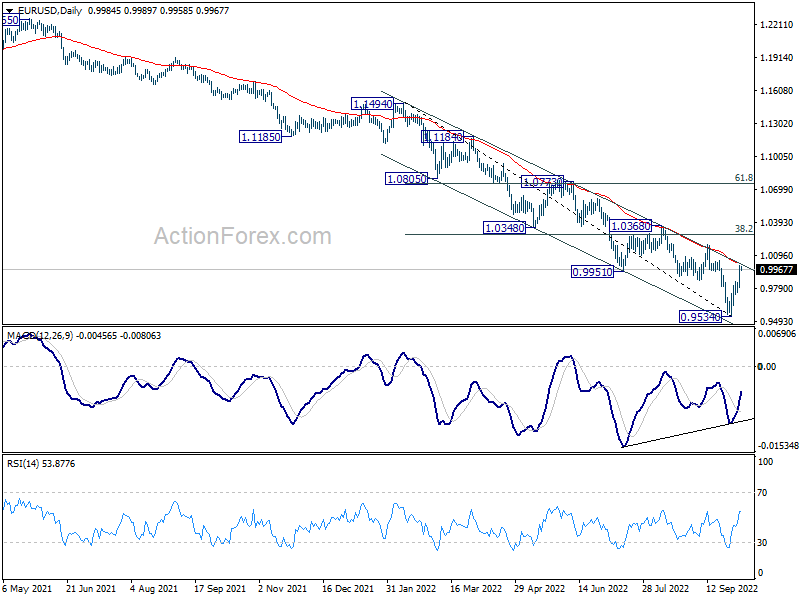
EUR/USD's rebound from 0.9534 is still in progress and intraday bias stays on the upside. Considering bullish convergence condition in daily MACD, sustained break of 55 day EMA (now at 1.0022) will raise the chance of medium term bottoming at 0.9534. Further rally should then be seen to 38.2% retracement of 1.1494 to 0.9534 at 1.0283. On the downside, though, break of 0.9734 minor support will bring retest of 0.9534 low instead.
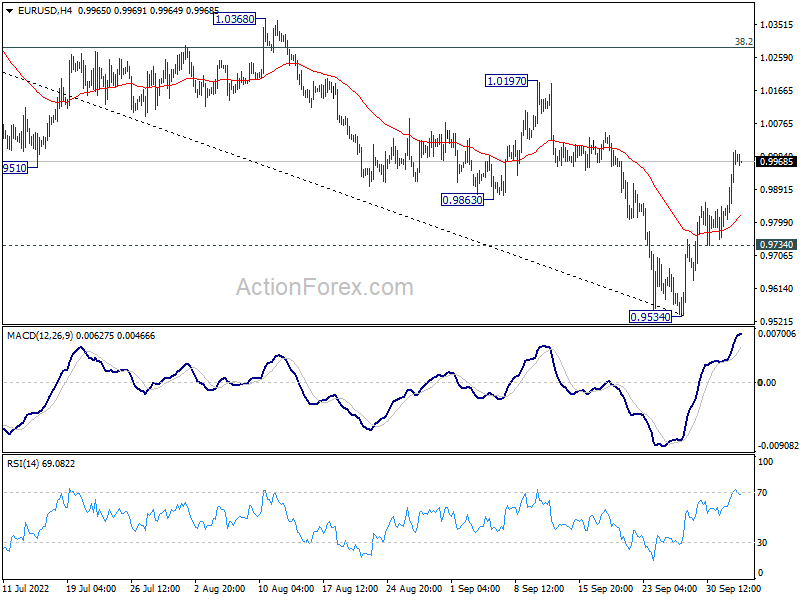
In the bigger picture, down trend from 1.6039 (2008 high) is still in progress. Next target is 100% projection of 1.3993 to 1.0339 from 1.2348 at 0.8694. In any case, break of 1.0197 resistance is needed to be the first sign of medium term bottoming. Otherwise, outlook will stay bearish even with strong rebound.
NZD Rises after RBNZ Hike, Dollar Stays as Worst Performer
New Zealand Dollar rises broadly in quiet markets today, after RBNZ delivered the 50bps rate hike as widely expected, clearing the doubt that it will follow RBA and opt for a smaller hike. Dollar remains the worst performer of the week, following strong risk rebound in stock markets, while yields weakened. Yen is the second weakest, only slightly better than Dollar. Sterling is so far the winner, continuing to reverse prior deep losses while Euro and Swiss France are also firm.
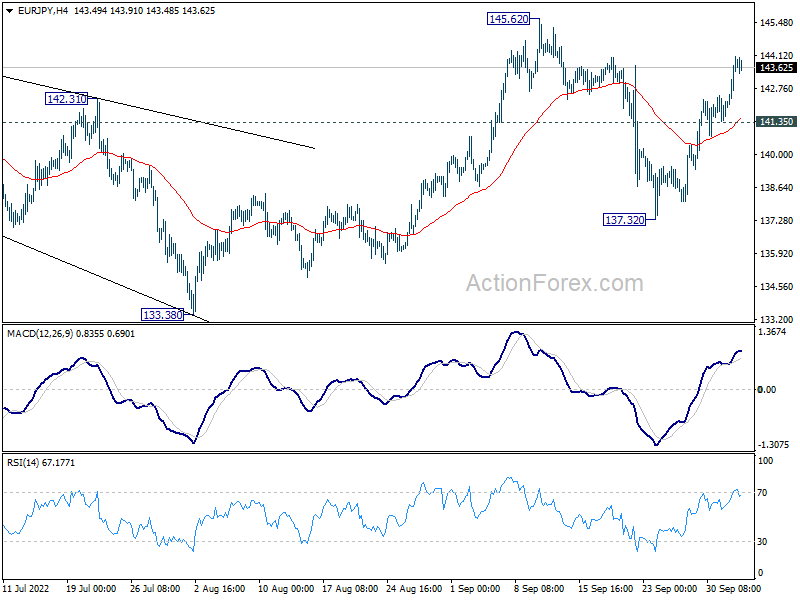
Technically, a focus for now is whether Euro and Sterling could maintain upside momentum to solidify it as a trend. 4 hour RSI in EUR/JPY is dipping back from overbought region, suggesting that there may loss of upside momentum. Break of 140.35 minor support will suggest rejection by 145.62 high, to start the third leg of the consolidation pattern from there.
In Asia, at the time of writing, Nikkei is up 0.36%. Hong Kong HSI is up 5.47%. Singapore Strait Times is up 0.35%. Japan 10-year JGB yield is up 0.0312 at 0.263. Overnight, DOW rose 2.80%. S&P 500 rose 3.06%. NASDAQ rose 3.34%. 10-year yield dropped -0.034 to 3.617.
RBNZ hikes by 50bps, considered 75bps
RBNZ raises Official Cash Rate by 50bps 3.50% as widely expected. In the summary of record it's noted that the Committee considered whether to hike by 50bps or 75bps, but decided that 50bps was appropriate at this meeting.
In the statement, RBNZ noted that domestic spending has remained "resilient". Employment levels are "high" while productivity capacity is "constrained" by labor shortages. wage pressures are "heightened". Also, "spending continues to outstrip the capacity to supply goods and services, with a range of indicators continuing to highlight broad-based pricing pressures."
AUD/NZD topped but not reversing yet
AUD/NZD spikes lower after RBNZ's 50bps rate hike. The development also came with the background that RBA disappointed the markets with a 25bps hike yesterday.
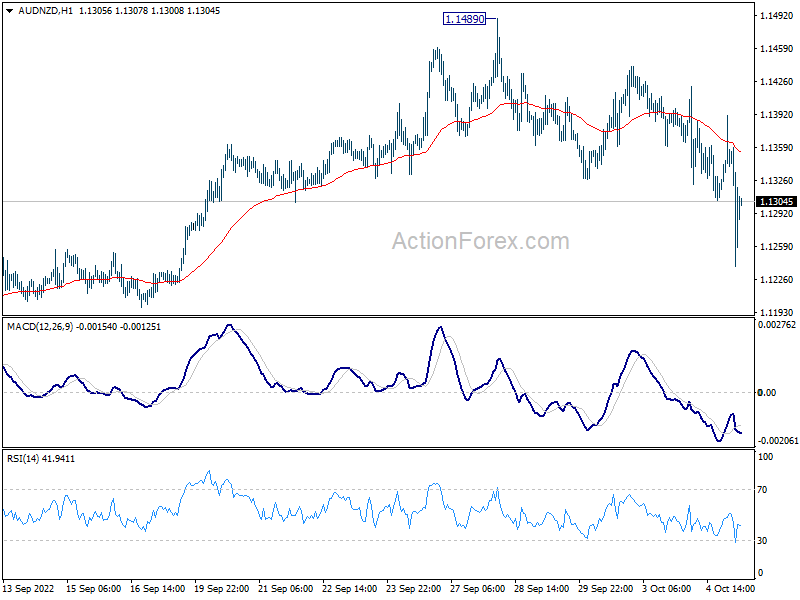
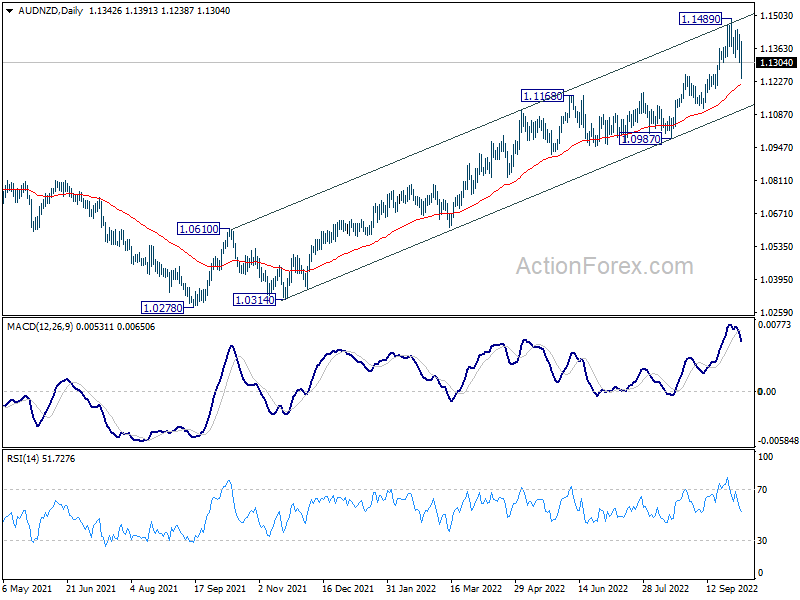
Technically, a short term top was in place at 1.1489 after AUD/NZD hit medium term channel resistance. But it's still early to call for a medium term correction. As long as 55 day EMA (now at 1.1211) holds, the consolidation from 1.1489 should be relatively brief, and larger up trend should resume sooner rather than later.
However, firm break of the 55 day EMA will open up deeper correction through channel support to 1.0987, before having some support for a bounce.
Looking ahead
Germany trade balance, France industrial production, Eurozone PMI services final, and UK PMI services final will be featured in European session.
Later in the day, US will release ADP employment, trade balance and ISM services. Canada will release building permits and trade balance.
EUR/USD Daily Outlook
Daily Pivots: (S1) 0.9862; (P) 0.9930; (R1) 1.0055; More...
EUR/USD's rebound from 0.9534 is still in progress and intraday bias stays on the upside. Considering bullish convergence condition in daily MACD, sustained break of 55 day EMA (now at 1.0022) will raise the chance of medium term bottoming at 0.9534. Further rally should then be seen to 38.2% retracement of 1.1494 to 0.9534 at 1.0283. On the downside, though, break of 0.9734 minor support will bring retest of 0.9534 low instead.
In the bigger picture, down trend from 1.6039 (2008 high) is still in progress. Next target is 100% projection of 1.3993 to 1.0339 from 1.2348 at 0.8694. In any case, break of 1.0197 resistance is needed to be the first sign of medium term bottoming. Otherwise, outlook will stay bearish even with strong rebound.
Economic Indicators Update
| GMT | Ccy | Events | Actual | Forecast | Previous | Revised |
|---|---|---|---|---|---|---|
| 01:00 | NZD | RBNZ Interest Rate Decision | 3.50% | 3.50% | 3.00% | |
| 06:00 | EUR | Germany Trade Balance (EUR) Aug | 4.0B | 5.4B | ||
| 06:45 | EUR | France Industrial Output M/M Aug | -0.30% | -1.60% | ||
| 07:45 | Italy | Italy Services PMI Sep | 49.2 | 50.5 | ||
| 07:50 | EUR | France Services PMI Sep F | 53 | 53 | ||
| 07:55 | EUR | Germany Services PMI Sep F | 45.4 | 45.4 | ||
| 08:00 | EUR | Eurozone Services PMI Sep F | 50.2 | 48.9 | ||
| 08:30 | GBP | Services PMI Sep F | 49.2 | 49.2 | ||
| 12:15 | USD | ADP Employment Change Sep | 200K | 132K | ||
| 12:30 | USD | Trade Balance (USD) Aug | -67.8B | -70.6B | ||
| 12:30 | CAD | Building Permits M/M Aug | -0.80% | -6.60% | ||
| 12:30 | CAD | International Merchandise Trade (CAD) Aug | 3.5B | 4.1B | ||
| 13:45 | USD | Services PMI Sep F | 49.2 | 49.2 | ||
| 14:00 | USD | ISM Services PMI Sep | 56 | 56.9 | ||
| 14:30 | USD | Crude Oil Inventories | -0.2M |
AUD/NZD topped but not reversing yet
AUD/NZD spikes lower after RBNZ's 50bps rate hike. The development also came with the background that RBA disappointed the markets with a 25bps hike yesterday.
Technically, a short term top was in place at 1.1489 after AUD/NZD hit medium term channel resistance. But it's still early to call for a medium term correction. As long as 55 day EMA (now at 1.1211) holds, the consolidation from 1.1489 should be relatively brief, and larger up trend should resume sooner rather than later.
However, firm break of the 55 day EMA will open up deeper correction through channel support to 1.0987, before having some support for a bounce.
RBNZ hikes by 50bps, considered 75bps
RBNZ raises Official Cash Rate by 50bps 3.50% as widely expected. In the summary of record it's noted that the Committee considered whether to hike by 50bps or 75bps, but decided that 50bps was appropriate at this meeting.
In the statement, RBNZ noted that domestic spending has remained "resilient". Employment levels are "high" while productivity capacity is "constrained" by labor shortages. wage pressures are "heightened". Also, "spending continues to outstrip the capacity to supply goods and services, with a range of indicators continuing to highlight broad-based pricing pressures."
(RBNZ) Continued monetary tightening
The Monetary Policy Committee today increased the Official Cash Rate (OCR) to 3.5% from 3.0%.
The Committee agreed it remains appropriate to continue to tighten monetary conditions at pace to maintain price stability and contribute to maximum sustainable employment. Core consumer price inflation is too high and labour resources are scarce.
Global consumer price pressures remain heightened. The global demand for goods and services is exceeding supply capacity, putting upward pressure on prices. Food and energy prices are being particularly exacerbated by the war in Ukraine.
A recent decline in oil prices and an easing in some supply-chain constraints have seen headline inflation measures fall in some countries. However, core measures of inflation have risen and persist. Central banks are tightening monetary conditions, implying a weaker growth outlook for New Zealand's trading partners.
In New Zealand, the level of domestic spending has remained resilient to date, in the face of slowing global growth and higher domestic interest rates. Employment levels are high, and household balance sheets remain resilient despite the fall in house prices.
New Zealand's productive capacity is still being constrained by labour shortages and wage pressures are heightened. Overall, spending continues to outstrip the capacity to supply goods and services, with a range of indicators continuing to highlight broad-based pricing pressures.
Committee members agreed that monetary conditions needed to continue to tighten until they are confident there is sufficient restraint on spending to bring inflation back within its 1 to 3% per annum target range. The Committee remains resolute in achieving the Monetary Policy Remit.
Media contact
James Weir
Senior Adviser External Stakeholders
DDI: +64 4 471 3962 | MOB: 021 103 1622
Email: James.Weir@rbnz.govt.nz
Summary Record of Meeting – October 2022
The Monetary Policy Committee discussed developments affecting the outlook for inflation and employment in New Zealand. Inflation is currently too high and employment is beyond its maximum sustainable level. The Committee agreed to continue increasing the Official Cash Rate (OCR) at pace to maintain price stability and support maximum sustainable employment.
The Committee discussed recent international economic developments. Inflation remains high globally. Headline inflation has declined slightly in some countries, but core measures of inflation have proved more persistent. Recent indicators suggest the global growth outlook has weakened, in part due to tighter global financial conditions. In Europe, the war in Ukraine continues to pose downside risks to growth and upside risks to inflation. In China, containment of COVID-19 continues to adversely impact activity and there are financial stresses emanating from the property sector.
The Committee observed that global sovereign bond yields have increased significantly, consistent with a repricing of expectations for central bank policy rates. Some members believed that simultaneous and fast-paced monetary tightening in multiple countries was increasing downside risks to global growth. Members noted that large movements in wholesale interest rates and exchange rates were causing a deterioration in financial market liquidity, which can exacerbate market volatility.
Higher global interest rates and increased risk aversion in global markets have placed downward pressure on the New Zealand dollar. Members believed that this would contribute toward a rebalancing of New Zealand's current account over the long-term. However, a lower New Zealand dollar, if sustained, poses further upside risk to inflation over the forecast horizon.
The Committee discussed recent developments in the domestic economy. New Zealand GDP in the June quarter rebounded broadly as expected. This was supported by a resumption in international tourism following the reopening of New Zealand's borders, and an increase in domestic activity following the relaxation of pandemic restrictions. Other more recent indicators suggest that domestic activity in the September quarter may have been slightly stronger than previously assumed. Consumption remains resilient overall, but spending on durable goods, which may be more sensitive to interest rates, has continued to decline.
Household balance sheets are resilient despite recent declines in house prices. Members agreed that falling house prices and declines in other asset prices will negatively impact household consumption. Members noted that household debt servicing costs were rising and had further to increase on average as more fixed-rate mortgages are reset at higher interest rates. The impact of higher debt servicing requirements are an important channel of monetary policy transmission.
The Committee noted recent survey data showed that for businesses, cost pressures and labour scarcity remain the primary concerns. The construction industry faces ongoing capacity constraints. Building consents remain near historic highs, driven by growth in multi-unit dwellings, although there is uncertainty about the construction pipeline going forward.
The Committee agreed that the labour market remains very tight. Net migration remains negative and is yet to provide any sustained recovery in external labour supply. Members discussed the likelihood of further upside wage pressure given lags in the wage setting process. Some members noted that there may be changes in wage setting behaviour in an environment of higher headline inflation.
The Committee discussed domestic financial conditions. Members noted the strong funding position of banks and that as a result, recent increases in wholesale interest rates have yet to be fully reflected in retail interest rates. However, wholesale funding costs are rising and bank funding conditions are expected to become less accommodative. The Committee expects that higher wholesale interest rates will be reflected in higher retail interest rates, particularly deposit rates, as banks compete for funding.
The Committee discussed the pace and extent of monetary tightening required. Members agreed that the OCR needed to reach a level where the Committee could be confident it was sufficient to maintain expectations of low inflation in the longer term and bring consumer price inflation to within the target range.
The Committee considered whether to increase the OCR by 50 or 75 basis points at this meeting. Some members highlighted that a larger increase in the OCR now would reduce the likelihood of a higher peak in the OCR being required. Other members emphasised the degree of policy tightening delivered to date. Members also noted the lags in monetary policy transmission and a slow pass-through to retail interest rates. On balance, the Committee agreed that a 50 basis point increase was appropriate at this meeting.
On Wednesday 5 October, the Committee reached a consensus to increase the OCR to 3.5% from 3%.
Attendees:
Reserve Bank staff: Adrian Orr, Karen Silk, Christian Hawkesby, Paul Conway
External: Bob Buckle, Peter Harris, Caroline Saunders
Treasury Observer: Tim Ng
Secretary: David Craigie
First Impressions: RBNZ Monetary Policy Review, October 2022
The RBNZ delivered another 50 basis point OCR hike to 3.5%, and hinted that the urgency to deal with inflation pressures has increased.
RBNZ Monetary Policy Review, October 2022
- The Reserve Bank increased the Official Cash Rate by another 50 basis points to 3.5% and signalled more increases to come.
- The accompanying statement repeated much of the language from the August review. The RBNZ continues to tighten monetary policy “at pace”, and remains “resolute” in achieving its inflation target over the medium term.
- The RBNZ continues to emphasise the extent of inflation pressures in the New Zealand, with overheated demand and a very tight labour market.
- The main statement did not discuss the likely extent of future interest rate rises.
- However, the record of the meeting was unusually explicit in noting that the Committee debated between a 50 or a 75 basis point hike.
- The latter was argued on a ‘stitch in time’ basis: a larger increase now could reduce the risk of a higher peak in the overall OCR cycle. This suggests that the RBNZ is now eyeing a considerably higher peak than the 4.1% from its August projections.
- Today’s 50bp increase was widely expected, and the implicit signal of a higher OCR peak was broadly in line with what we expected. We recently revised up our OCR forecast to a peak of 4.5% by next February.
AUD/USD Aims Steady Recovery, Gold Surges
Key Highlights
- AUD/USD started an upside correction above the 0.6450 level.
- It broke a key bearish trend line at 0.6480 on the 4-hours chart.
- Gold price gained bullish momentum and climbed above the $1,710 resistance.
- The US ADP Employment could change 200K in Sep 2022, up from 132K.
AUD/USD Technical Analysis
The Aussie Dollar traded as low as 0.6363 before it found support against the US Dollar. AUD/USD is slowly forming a base above the 0.6400 level.
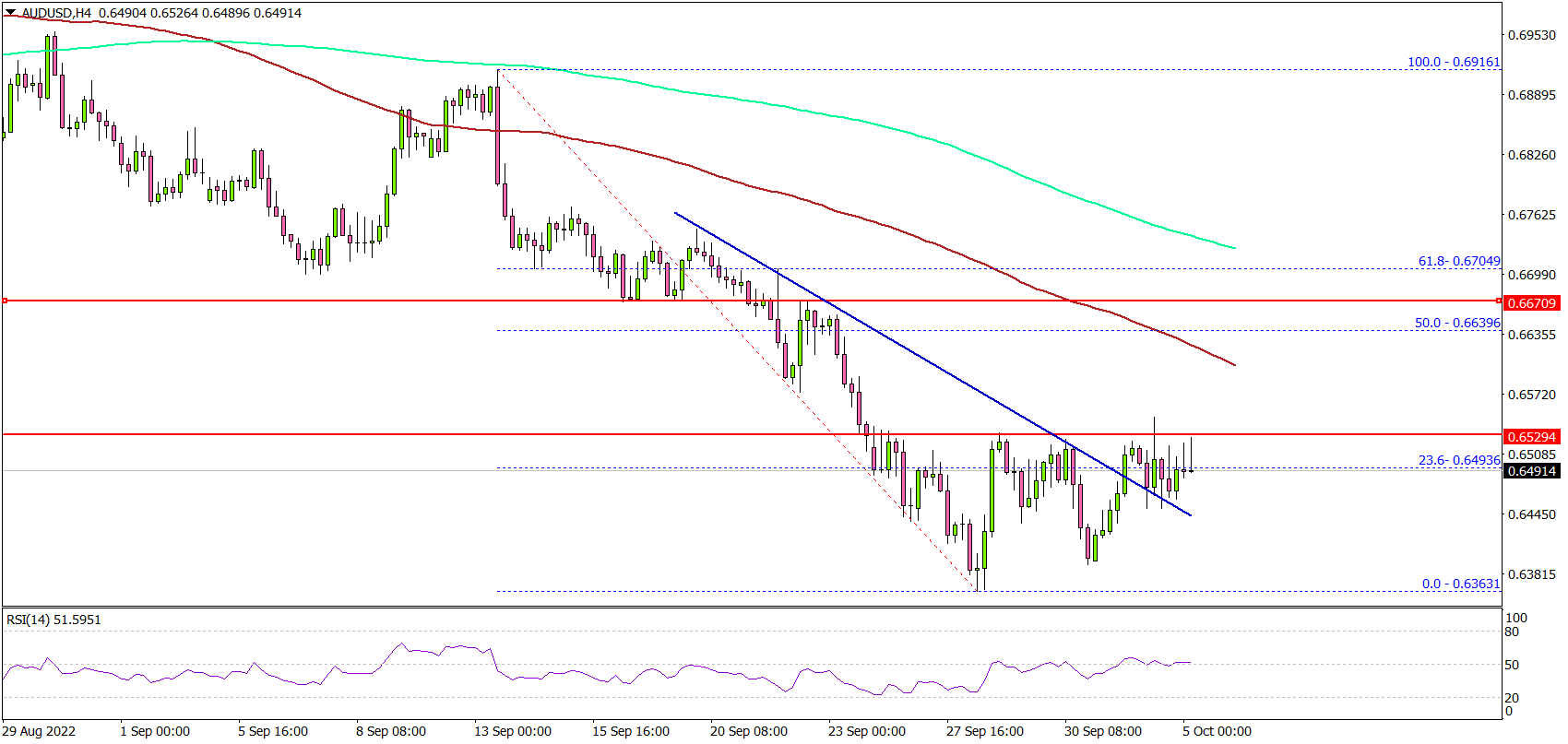
Looking at the 4-hours chart, the pair was able to recover above the 0.6420 and 0.6440 resistance levels. There was a move above a key bearish trend line with resistance at 0.6480.
The pair is now consolidating near the 23.6% Fib retracement level of the downward move from the 0.6916 swing high to 0.6363 low. An immediate resistance is near the 0.6520 level, above which the pair could test the 100 simple moving average (red, 4-hours).
The next major resistance is near the 0.6640 level. It is near the 50% Fib retracement level of the downward move from the 0.6916 swing high to 0.6363 low.
A clear move above the 0.6640 level might send the pair towards the 0.6700 level or at least the 200 simple moving average (green, 4-hours). On the downside, an initial support is near the 0.6440 level. The main support sits at the 0.6400 level.
A downside break below the 0.6440 zone might send the pair towards the 0.6320 level. The next major support is near the 0.6300 level, below which the pair could even test the 0.6250 support zone.
Looking at gold price, there was a decent increase above the $1,700 level and it seems like the bulls are aiming more upsides.
Economic Releases
- Germany’s Services PMI for Sep 2022 - Forecast 45.4, versus 45.4 previous.
- Euro Zone Services PMI for Sep 2022 – Forecast 50.2, versus 48.9 previous.
- UK Services PMI for Sep e 2022 – Forecast 49.2, versus 49.2 previous.
- US Services PMI for Sep 2022 – Forecast 49.2, versus 49.2 previous.
- US ISM Services PMI for Sep 2022 – Forecast 56.0, versus 56.9 previous.
- US ADP Employment Change for Sep 2022 - Forecast 200K, versus 132K previous.
Eco Data 10/5/22
[php_everywhere instance="1"]
Fed Daly: Needs to hold restrictive policies until truly done on inflation
San Francisco Fed President Mary Daly said Fed needs to raise interest further and hold restrictive policies in place until it's "truly done" on bring back inflation to 2% target.
"Those interest rate increases slow the economy and they do have spillover effects on currencies in other countries," Daly said, of the Fed's interest-rate rises. "But central banks, no matter where you are, are meant to create policy for the nation that they serve, and then we have to be aware of how this affects the global economy because that's part of the puzzle."