Sample Category Title
Fed Daly: Need to keep committed until actually seeing inflation down in data
San Francisco Fed President Mary Daly said Fed is "nowhere near almost done", with inflation. "We have made a good start and I feel really pleased with where we've gotten to at this point."
"It really would be premature to unwind all of that and say the job is done," she said. "I also think that we've been with this high inflation for a while, and really getting too confident that we've already solved the problem," Daly said, adding that the Fed needs to "keep committed until we actually see it in the data."
Fed Evans: 50bps hike next is reasonable, 75bps also ok
Chicago Fed President Charles Evan said that is things "weren't improving", the 50bps rate hike in September is a "reasonable assessment", but 75 bps "could also be ok". He added "I doubt that more would be called for."
"We wanted to get to neutral expeditiously. We want to get a little restrictive expeditiously," Evans added. "We want to see if the real side effects are going to start coming back in line ... or if we have a lot more ahead of us."
Dollar Awaits Nonfarm Payrolls as Recession Worries Mount
With the US economy teetering on the edge of recession, all eyes will be on the latest employment data at 12:30 GMT Friday. Another solid jobs report is expected, yet various indicators suggest the labor market has started to lose steam. While a disappointment could extend the latest retreat in the dollar as markets price out some Fed tightening, it’s still too early for a trend reversal.
Is it a recession?
The US economy has now contracted for two consecutive quarters, a situation we used to call a technical recession. In fact, business surveys suggest the picture has deteriorated further in the third quarter, as the cost of living crisis keeps squeezing consumers and soaring interest rates have kneecapped the housing market.
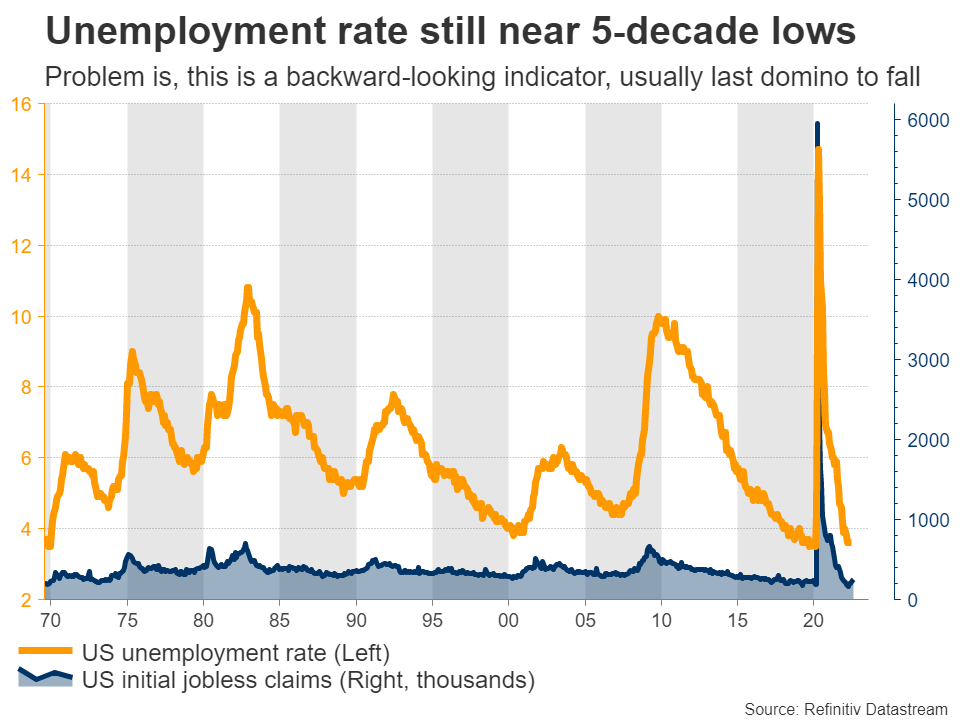
Yet both the Federal Reserve and the White House insist this is not a ‘real’ recession, since we haven’t really seen companies shutting down or any widespread job losses. They argue that the economy cannot be in recession with the unemployment rate near a five-decade low.
The problem with that logic is that they are looking into the past to justify how strong the economy is. Labor market indicators are typically the last domino to fall - the jobs market always looks great just before a slump. It’s a backward-looking measure.
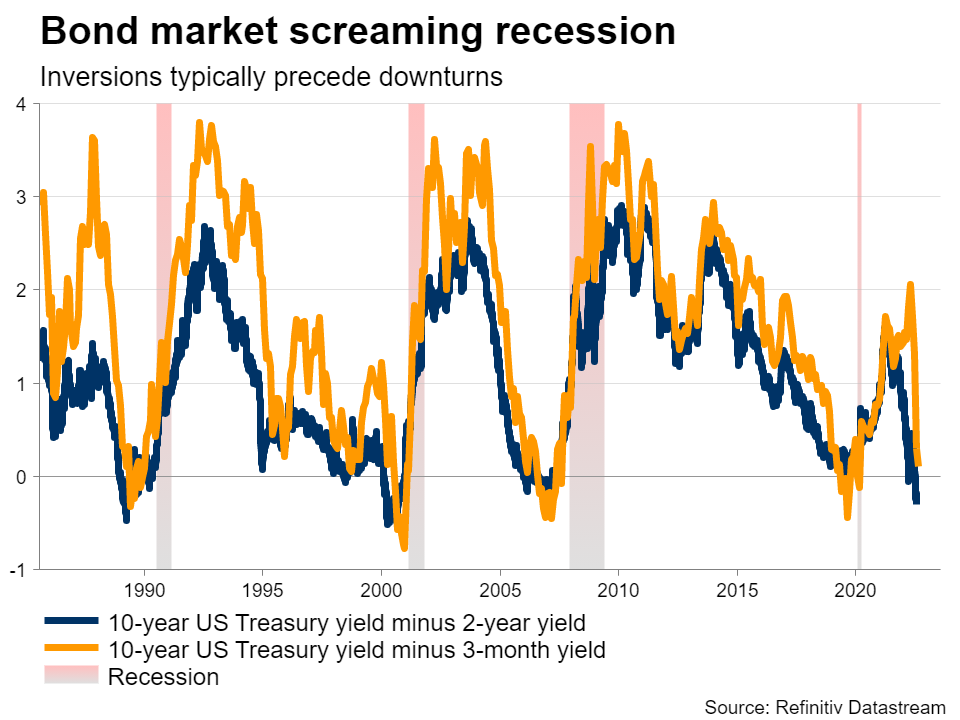
In contrast, all the forward-looking indicators are screaming recession. New business orders have softened sharply, inventories are high, and consumer confidence is in the gutter. Even the Fed’s favorite recession predictor, the difference between 3-month and 10-year Treasury yields, suggests a downturn is imminent.
Great expectations
Nonfarm payrolls are expected to come in at 250k in July, less than the 372k previously but still a solid number all around. The unemployment rate is projected to have held steady at 3.6%, while average hourly earnings are seen cooling down on a yearly basis.
As for the risks surrounding these forecasts, most indicators that have been released so far suggest a disappointment is more likely than a positive surprise. The S&P Global composite PMI showed job creation slowing to the weakest pace since February, while the employment sub-index of the ISM manufacturing survey remained in contraction for a third month.
Meanwhile, jobless claims continued to climb during the week the employment data was collected. This suggests more people are filing for unemployment benefits, although the absolute level is still low from a historical perspective.
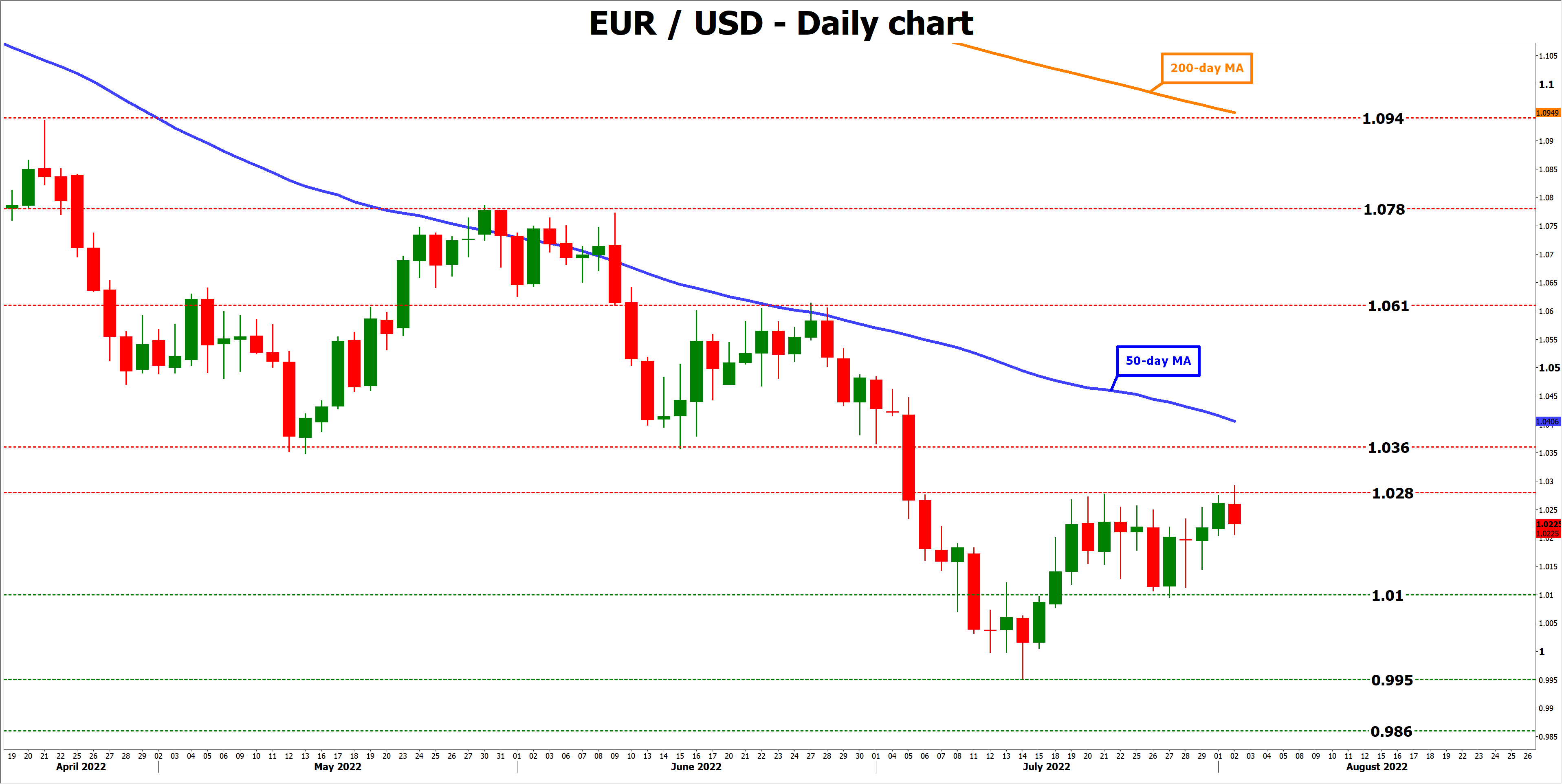
Therefore, the jobs market is not crashing but the forecasts do seem a little too rosy. If nonfarm payrolls come in closer to zero instead, that could deal a blow to the mighty US dollar, likely sending euro/dollar above the 1.0280 zone and towards the 1.0360 barrier.
No reversals yet
In the bigger picture, even a disappointment in US employment is unlikely to derail the overall uptrend in the dollar. Yes, the markets might price out some tightening, but that wouldn’t be a game-changer for the reserve currency.
Let’s put it this way - if the Fed slows down because of recession fears and the situation in the rest of the world is even worse, safe-haven flows could keep the dollar supported nonetheless. And the situation in Europe is definitely worse, with the economy headed for an even deeper recession according to business surveys, as the energy crisis bites.
Instead, what is needed to truly curtail dollar strength is an improvement in the growth outlook for Europe and Asia. This will require lower energy prices, or at least stable prices for some time. OPEC meets this week but there is mounting speculation it cannot produce much more even if it wanted to.
As such, any trend reversal in the dollar might have to wait until there’s a ceasefire in Ukraine, which doesn’t seem imminent. Until then, it’s difficult to argue with the trend in euro/dollar and if sellers reclaim control, their first battle could be around the 1.01 region.
Finally, note that the ISM services PMI will also be released on Wednesday and might be crucial in setting market expectations ahead of the employment report.
Bank of England Ponders a More ‘Forceful’ Rate Hike
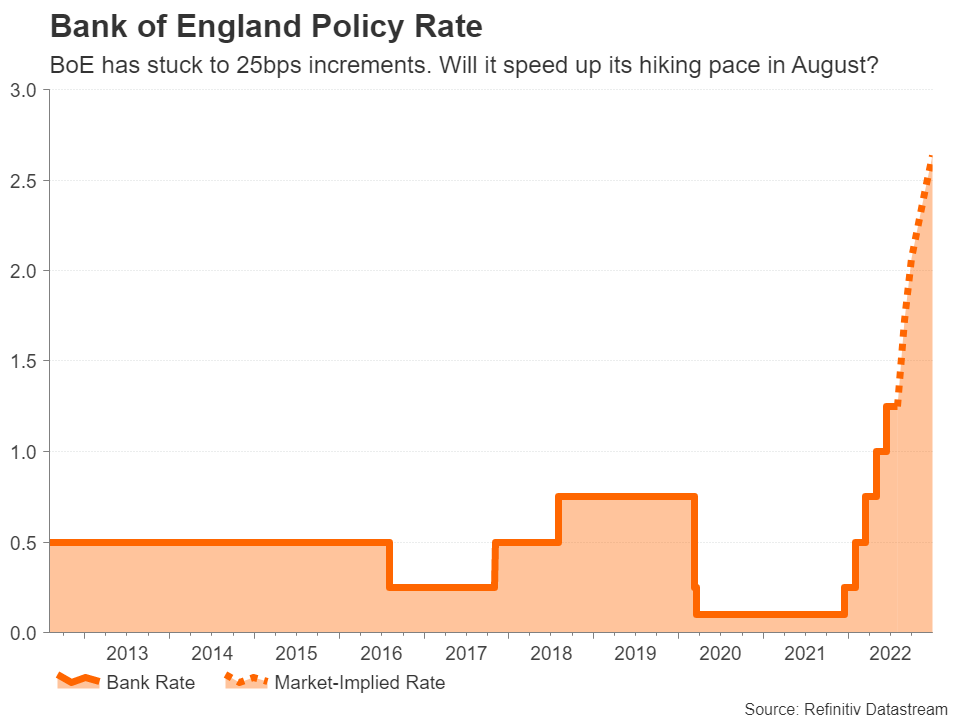
The Bank of England is widely tipped to raise interest rates for the sixth straight meeting on Thursday (11:00 GMT). But there is a bit of uncertainty about the size of the hike as policymakers are considering stepping up the pace of rate increases to 50-basis-point increments as inflation continues to run wild in the UK. Market pundits have assigned about an 85% probability of a double hike, leaving the pound with little scope to extend its two-week rebound versus the US dollar if the BoE does not disappoint. This means that any signals about the future rate path as well as a likely decision on reducing the balance sheet will be just as important.
Still eking out growth
There can be no doubt that UK growth hit a stumbling block in early Spring in the aftermath of Russia’s invasion of Ukraine. But despite all the doom-mongering, economic output has kept growing, just about. More importantly for the Bank of England, employment jumped by a staggering 296k in the three months to May, while there’s yet to be a collapse in consumer spending from the worsening cost of living crisis.
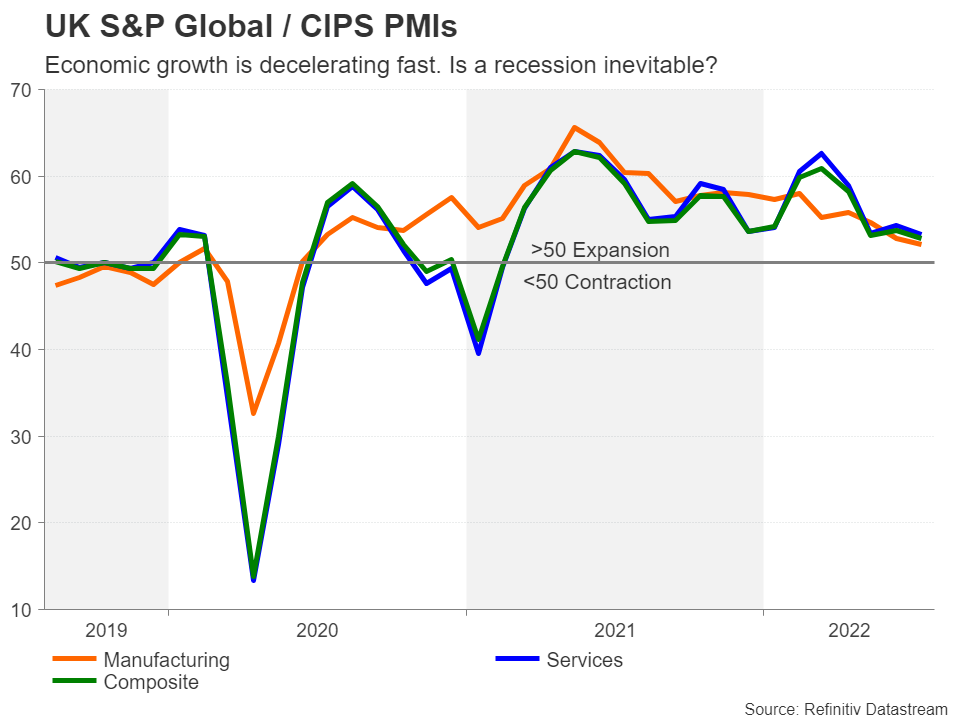
It's also undeniable, however, that the recession warning signs are clearly there and that the worst has yet to come. Manufacturing output declined in July for the first time since May 2020 according to S&P Global’s PMI survey and new orders fell too, even though the headline index held above the 50 level that separates contraction from expansion. Growth in the dominant services sector is also slowing and is mostly being propped up by the travel and leisure industries, whose boost will likely fade after the summer.
Is inflation peaking?
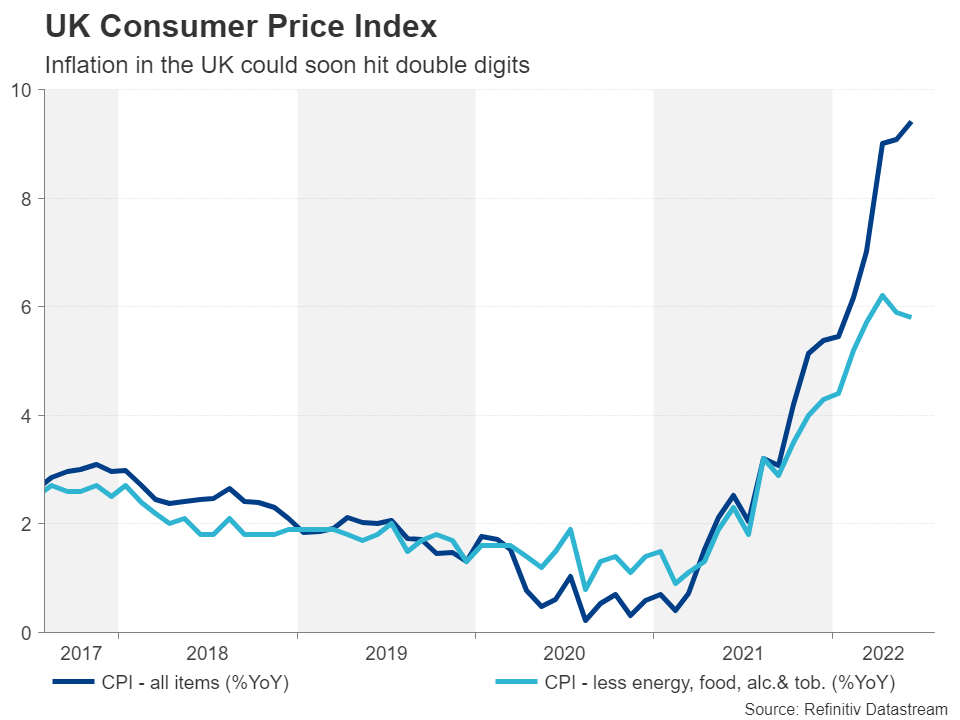
All this as inflation has continued to climb – the consumer price index hit a fresh 40-year high of 9.4% y/y in June. There are some indications that the build-up of price pressures is easing off and input costs may have peaked too, in line with the recent move lower in commodity prices. Although this hasn’t translated to a significant reduction in petrol prices across the UK, price cuts will probably gather pace soon.
So why is the Bank of England thinking about going faster now, especially when inflation expectations have also started to cool off? Policymakers might still be worried about second-round effects, particularly as the tight labour market is getting even tighter and neither has there been a notable slowdown in the red-hot property market. They might also be having second thoughts about their overly cautious approach, as excluding the Bank of Japan, the BoE is now the only major central bank that has not raised rates by more than 25 basis points.
Catching up
With the economy seemingly withstanding the fallout from the Ukraine war and the labour market coming out of it unscathed, the Bank may now be feeling compelled to hike more aggressively so it doesn’t fall further behind its global peers in the race to tighten monetary policy. There are other considerations too such as the possibility of further energy price shocks in the autumn or winter if Russia cuts off natural gas supplies to Europe completely, even if both oil and gas prices have steadied for now.
As the Bank tries to carefully balance its primary objective of containing inflation with sustaining economic growth, its updated quarterly projections in the Monetary Policy Report due the same day should reveal which way the risks are tilted.
Pound is eyeing a hawkish shift
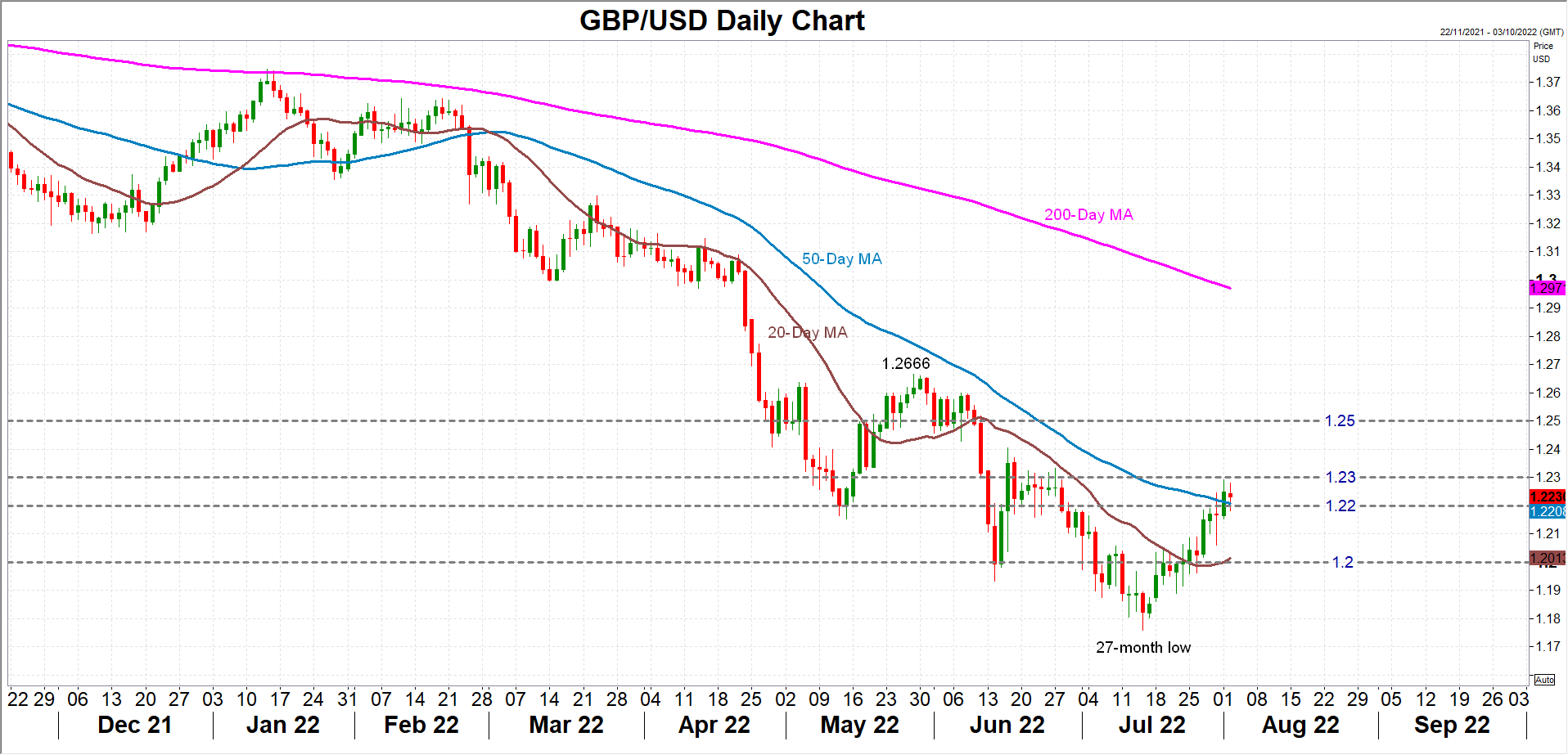
Should the BoE meet expectations and raise the Bank Rate by 50 basis points, as well as revise up its CPI forecasts for the next 2-3 years, the pound could soon be testing the $1.25 level. If Governor Andrew Bailey ratchets up his hawkish rhetoric a notch further and goes as far as hinting that more 50-bps hikes are on the cards, sterling could revisit the top of $1.2666 scaled in May.
However, the interest rate setting is not the only decision the Bank will be making at its August meeting as policymakers will likely announce the active sale of UK government bonds, or gilts. Back in February, the Bank said it will cease reinvesting in maturing gilts but that it will not consider actively selling them until the Bank Rate has reached 1%, which it now has, although it did begin unwinding all its corporate bond holdings.
Downside risks from balance sheet reduction
If the BoE does decide it’s time to start shrinking its bloated balance sheet more rapidly, this could cast doubt about the need for further action on interest rates. In such a scenario and in the absence of explicit signals about steeper rate rises, the pound would be at risk of breaching $1.20 again, a level underscored by the 20-day moving average.
In the bigger picture, however, BoE policy will likely play second fiddle to moves in the US dollar, which itself is being driven by expectations around Fed policy, as well as by broader risk appetite in the markets. Hence, a hawkish pivot by the BoE can only provide a meaningful boost to sterling if the dollar remains on the backfoot.
Gold Outlook: Gold Capitalizing on USD’s Weakening
Gold’s price was on the rise for the past few days as the greenback tended to weaken. The negative corelation of the two trading instruments came once again on display, as the precious metal is denominated in USD. It should be noted that the weakening of the USD initiated again after the Fed’s interest rate decision last week.
As was widely expected on Wednesday the 26th of July, the Fed delivered a 75 basis points rate hike unanimously and in its accompanying statement the FOMC kept a rather confident, hawkish tone citing a tight US employment market as well as inflationary pressures in the US economy. Fed Chairman Powell, in his press conference, which may have been the market moving element of the event, stated that inflation is much too high and wage growth is elevated, while there is still upward pressure on inflation. Yet Powell also stated that the size of the next rate hike is going to be dependent on the data to be released, which may imply that the next rate hike may not be as wide as 75 basis points, yet the bank will not hesitate to repeat it if necessary. At the same time the Fed’s Chairman stated that he does not believe that the US economy is currently in a recession as the economy is doing well in a number of areas especially the employment market. Despite Powell’s sayings the GDP advance growth rate for Q2 was telling a different story on Thursday the 27th, as it failed to exit the negative territory and signalled that the US economy is in a recession, at least technically, given that it remained in the negatives for a second consecutive quarter. We highlight that the US yields have been dropping since our last report and characteristically the US 10 year yield retreated from 2.787% on the 26th of July to the current level of 2.557%. The drop of the US yields polished the shiny metal even further for investors which may have opted it in contrast to bonds.
Also on a fundamental level, we cannot miss out on commenting on the escalation of tensions in the US-Sino relationships. It should be noted that US House speaker Nancy Pelosi is set to land in Taiwan today, the first of a high–ranking US politician in the past 25 years and the visit could be considered as a provocation for China. We note that China had warned of the possible tensions implying that it will not remain idle. Yet given that the two sides would want to avoid military confrontation, we may see other actions being opted from the Chinese side to respond. Should the tensions escalate further we may see the market turbulence intensifying with safe havens like gold being in demand, while riskier assets being sold. Yet there are chances that the escalation is to be only temporary if China chooses not to respond or respond mildly, in which case the crisis could fade away. Nevertheless, the average trader would have to consider in the case of further escalation which trading instrument would take precedence as a safe haven. Should that be the USD we may see Gold’s price dropping initially, and vice versa.
The next big test for gold’s price is expected to be the US employment report for July, which is due out on Friday. The NFP figure is expected to drop if compared to June, while the unemployment rate is expected to remain unchanged at rather low levels. Overall the US employment market seems to remain tight should the actual rates and figures meet their respective forecasts, albeit the tightening seems to be losing some steam. Please that at the time of the release there may be increased volatility for Gold’s price, so some caution is advisable.
Technical Analysis
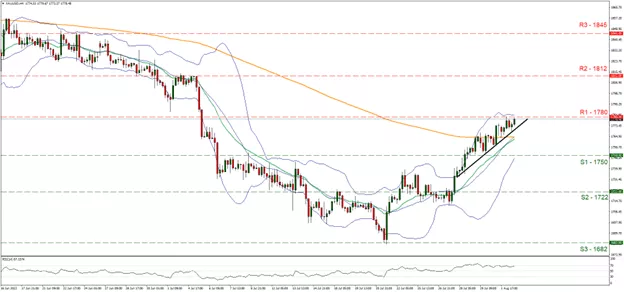
XAUUSD H4
Support: 1750 (S1), 1722 (S2), 1682 (S3)
Resistance: 1780 (R1), 1812 (R2), 1845 (R3)
Gold’s price has been on the rise for the past few days testing the 1780 (R1) resistance line. We tend to maintain our bullish outlook for the precious metal as long as its price action remains above the upward trendline incepted since the 28th of July. Please also note that the RSI indicator below our 4-hour chart is running along the reading of 70, also implying a bullish sentiment for the bullion. Also the price action is flirting with the upper Bollinger band yet has not surpassed it and there still seems to be little room for the bulls to advance. Should the bulls actually maintain control over the pair, we may see the precious metal breaking the 1780 (R1) resistance line and aim for the 1812 (R2) resistance level that capped the gold’s upward movement also on the 4-5th of July. As the next possible stop for the bulls we note the 1845 (R3) resistance hurdle which reversed the precious metals’ bullish tendencies on the 22nd and the 23rd of June. For a bearish scenario we would require the precious metal’s price to reverse direction, break the prementioned upward trendline, which would constitute a signal for a trend reversal, yet we would also require gold’s price to break the 1750 (S1) support line. Lower than that we also note the 1722 (S2) support level and even lower we note the 1682 (S3) support barrier, that also is the lowest level of gold’s price action in our chart.
Gold and USD Prices Benefit from Geopolitical Tensions
Released and Expected Data
The RBA hiked rates by 50 points taking current interest rates up to 1.85%. investors await the RBA governor’s speech on Friday to find out more about the reason behind raising interest rates and if there is any forward guidance from the central bank over the coming period. On the other hand, the final data of the Swiss Manufacturing PMI decreased from 59.1 in June to 58 in July.
Today investors await the final data of the Canadian Manufacturing PMI (July) at 5:30 pm UAE time, and then the speech of the Fed Member Mr Evans at 6:00 pm. Markets pay a close attention to Fed members’ speeches to get any hint about the next step the US central bank’s committee may take, especially after shifting to a meeting-by-meeting approach .
Indices and Bonds Yield
Geopolitical tensions between the US and China on the back of the US House Speaker Nancy Pelosi’s visit to Taiwan have weighed today on the
market’s sentiment.
China’s vows of taking “strong and resolute” measures led European indices and futures contracts of the US major indices to decline today by nearly 1% while safe havens like treasury bonds, USD and Gold have traded higher. It’s worth noting that any military action China might take may trigger sanctions from the US like those imposed on Russia after invading Ukraine.
The US 10-year bond yields fell today by about 1% and rebounded from the 2.50% level, and while the price trades below 2.80% it is highly likely to decline towards 2.38%. On the other hand, the spread between 10-year bond yields and two-year yields hit 30 basis points highlighting fears of a longer-term recession in the US economy.
Major FX Currencies
Today the US Dollar index slowed down its downside move started last week as investors reduced some of their long positions considering a possible pivot from the Fed. Nonetheless,the US dollar decline may stop due to the geopolitical instability (Russia – Ukraine, Chine- Taiwan)
As for the Euro, it is unlikely to rise above 1.0400 levels due to the energy crises in Europe, especially in Germany. Any escalation between the US and China could put more pressure on EUR/USD as it could put the market in risk-off mode ie, increasing USD long positions and bringing the pair to the parity level or maybe falling further.
The EUR/USD moves in between 1.0000 - 1.0414. A daily close below the lower end of the above-mentioned trading zone may encourage traders to focus selling pressures toward 0.9701. On the other hand, a break above the July 21 high at 1.0277 may send the price towards the higher end of the trading zone.
Commodities
Gold hit today a four-week high at $1784 /oz. The price has been rising since last week as markets believed that the Federal Reserve may slow down its monetary tightening.
The daily candle closed yesterday above 1765, hinting that it may continue towards 1807 although the resistance area located between 1789 and the 50-day moving average should be monitored. In return, a daily close below 1765 may encourage traders to press towards 1747.
Oil prices have stabilized today as investors wait for the OPEC + meeting tomorrow to decide on the production policy for the month of September. It is worth noting that the spread between Brent and West Texas oil has fallen to about $6, indicating the possibility of OPEC maintaining or raising production levels.
From a technical point of view, the daily close below 93.83 opens the door for more decline towards 89.02. On the other hand, of a daily close above 93.57 may send the price towards $98.65pb.
US Dollar Index - Daily Price chart
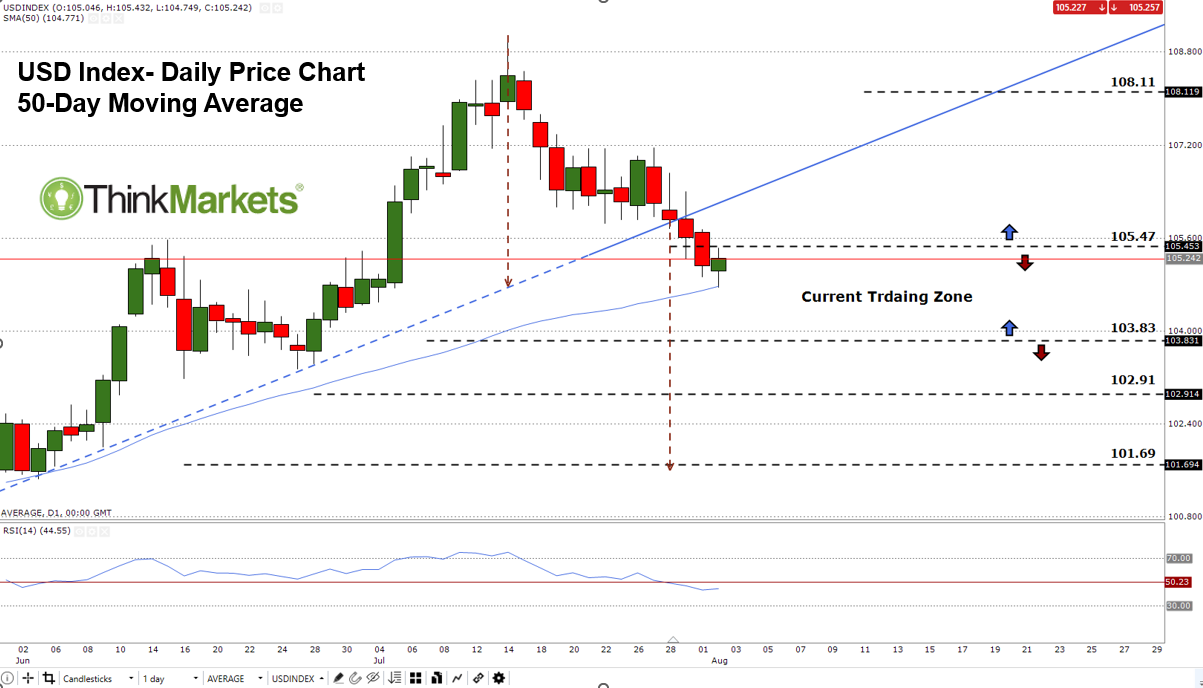
On July 27, the US dollar index corrected higher and formed a lower high at 107.16. At the end of last week, prices broke the ascending up trend line originating from the bottom of May 30 at 101.09. Additionally, the RSI fell below the 50-level, indicating the possibility of starting a bearish momentum that might bring prices towards 101.69.
Today, the price has rebounded from the 50-day moving average at 104.75, nonetheless, still within the current trading zone of 105.47 - 103.83 and may be on its way for a test of the lower end of this zone. On the other hand, a daily close above the higher end of this zone at 105.47 might push it towards 107.14 and then 108.11 respectively.
Pelosi Rocks the Boat
Markets
Pelosi rocks the boat. The Speaker of the House is about to set foot on Taiwanese soil to meet the president (tomorrow) and it’s very much against the will of China. Taiwan is a self-governing island but China considers it part of its territory. High-level meetings like these are viewed as supportive of Taiwan’s independence and meddling with internal matters. China repeatedly warned the US not to make the same mistake it did 25 years ago by sending then-Speaker Newt Gingrich on a similar visit. China threatened with “disastrous consequences” without detailing what those measures could be. It did ratchet up military activity around Taiwan in the meantime while the Taiwan president website underwent cyber-attacks this afternoon. The geopolitical saga got another angle after Russia sided with its southern neighbour, calling Pelosi’s trip provocative. It’s keeping markets on edge. European and US stocks drop 0.5 to 1%. Both US Treasuries and German Bunds attracted safe haven flows but the tide turned for the better as US dealers started joining. US yields cut their losses that went as high as 5 bps and now trade 1.8 to 7.9 bps higher in a flattener. The turnaround also helps support at 2.55% in the 10y yield survive. German yields were down almost 8 bps but bottomed out in lockstep with the US. Current moves vary between +2 bps (5y) to flat (30y). Here too an important reference that was tested earlier (0.73% for the 10y yield) survives the day. EMU swap rates in quite a sharp countermove reverse 5.1 bps losses to 1.7-5.2 bps gains. Despite the sudden intraday U-turn, short-term money markets continue to have ever more doubts on the ECB’s tightening intentions. The expected terminal rate today is less than half (<1.25% early 2023) of what was expected at the top in market pricing mid-June. It’s unclear to us how this can ever dovetail with the ECB’s own expectations of inflation next year averaging at an above-target 3.5% but it’s happening anyway.
Two discernable developments on FX markets today. The Aussie dollar lags G10 peers following a third, consecutive 50 bps rate hike by the RBA. It’s the central bank’s slight tweak towards more focus on growth that prompted a sharp repricing in yields and thus the Australian currency. AUD/USD drops from 0.703 to 0.693. The Japanese yen marks the other side of the spectrum, profiting from the core bond yield declines. Support in USD/JPY at 131.25 was tested but narrowly survives at the time of writing. EUR/JPY extends its freefall to 134. The dollar was a bit hesitant at first, unable even to profit from risk-off just like yesterday, but then gained momentum. EUR/USD slips back to the low and very familiar 1.02 area. The trade-weighted index bounced off the 105 support zone (105.6). EUR/GBP is on track for the weakest close since April as sterling holds remarkably resilient.
News Headlines
UK house prices in July rose at the slowest monthly pace in a year. The Nationwide Building Society price indicator advanced 0.1% m/m (est. 0.2%) to be up 11% y/y (est. 11.4%). The housing market boomed during the pandemic and values continue to be supported by supply shortages and very low unemployment, resulting in their longest run of gains for 8 years NBS explained. However, soaring inflation and rising mortgage interest costs are starting to ripple through. NBS chief economist Gardner expects the slowdown to continue as inflation could reach double digits towards the end of the year. In addition, the Bank of England is set to deliver the biggest rate hike in 27 years on Thursday. Both elements dampening price growth in the housing market are also affecting the UK corporate life. The number of companies filing for insolvency last quarter jumped by 81% compared to the same period last year as many of the government support measures over the course of last year ended. It was the highest number since 2009, UK’s Insolvency Service said. The majority of them were creditor’s voluntary liquidations (CVLs), ie. when company directors themselves decide to wind-up an insolvent company. But CVLs are often considered the first wave of insolvencies to arise, so things may get worse before they get better.
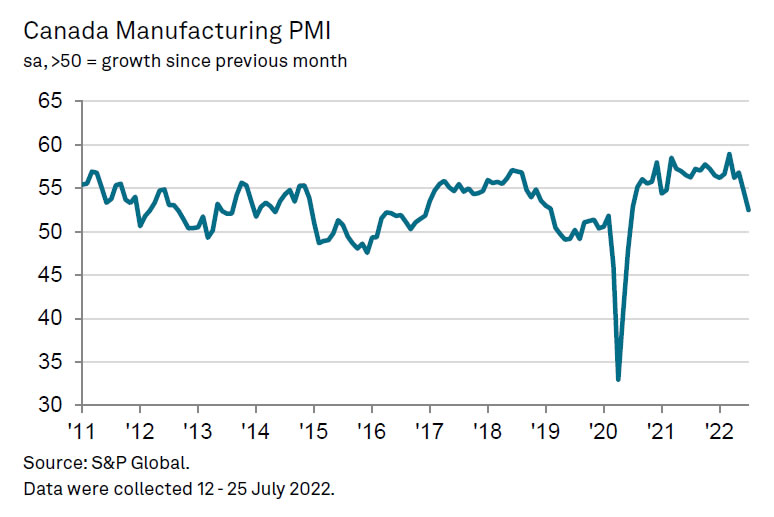
Canada PMI manufacturing dropped to 52.5, another slowdown in operating conditions
Canada PMI Manufacturing dropped from 54.6 to 52.5 in July, hitting the lowest level in more than two years.
Shreeya Patel, Economist at S&P Global Market Intelligence said:
"Latest PMI data revealed another slowdown in operating conditions in Canada's manufacturing sector with the PMI at its lowest point for just over two years. Behind the latest moderation were contractions in both output and new orders which fell for the first time since the pandemic began in the first half of 2020.
"Firms continue to face sharply rising costs, which have been exacerbated by the war in Ukraine and lockdowns in China. Policymakers have reaffirmed their stance on tackling inflation by raising interest rates by a full percentage point last month.
"Companies in Canada will hope price pressures continue to ease and demand from both international and domestic markets improves. In the meantime, firms remain cautiously optimistic about their 12-month outlook for output."
Euro Eyes Services PMIs
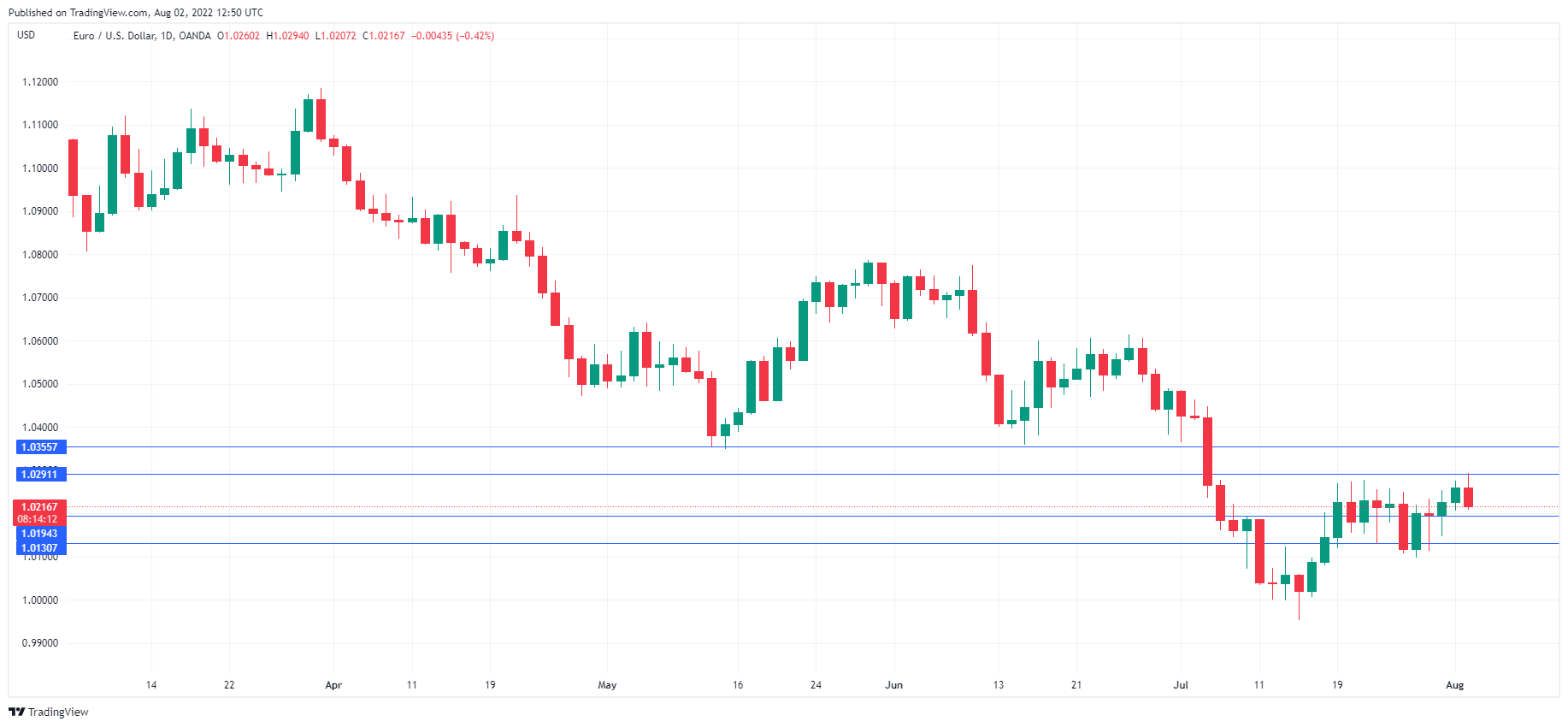
The euro is in negative territory today. EUR/USD is trading at 1.0207, down 0.51% on the day.
Will weak German data weigh on euro?
Germany, the largest economy in the eurozone, is showing signs of weakness, which bodes badly for the rest of the eurozone as well as the euro. The week started off with soft manufacturing PMI and retail sales numbers out of Germany.
Retail sales for June posted a sharp decline of 1.6% MoM, down from the 1.2% gain in May and shy of the 0.2% estimate. On an annualized basis, retail sales fell a massive 8.8%, after a 1.1% gain in May, and worse than the forecast of -8.0%. The German consumer is in a surly mood due to the cost of living crisis and is holding tight onto her purse strings. If consumer weakness remains weak, the danger of a recession will only grow. As well, Germany’s Manufacturing PMI for July fell to 49.3, down from 52.0 in June. This is the first time in over two years that Germany’s manufacturing sector has recorded a decline, which is bound to worry the markets.
Manufacturing across Europe is struggling, as demand has fallen after the post-Covid surge. High inflation and the uncertain economic outlook, are additional headwinds for manufacturing, which could continue to post declines in the coming months if the eurozone economy doesn’t improve. The war in Ukraine remains a stalemate and has caused a huge rise in wheat and oil prices, resulting in spiralling inflation worldwide, including the eurozone. Russia has cut back on energy imports in response to Western sanctions and this could result in an energy crisis in Europe this winter. The Nord Stream 1 pipeline, a major conduit of natural gas from Russia to Europe, is operating at just 20% of capacity and there are fears that Moscow will not hesitate to weaponise its energy exports against Western Europe.
EUR/USD Technical
- There is resistance at 1.0291 and 1.0355
- 1.0194 is under pressure in support. Below, there is support at 1.0130
EUR/USD Mid-Day Outlook
Daily Pivots: (S1) 1.0220; (P) 1.0247; (R1) 1.0289; More...
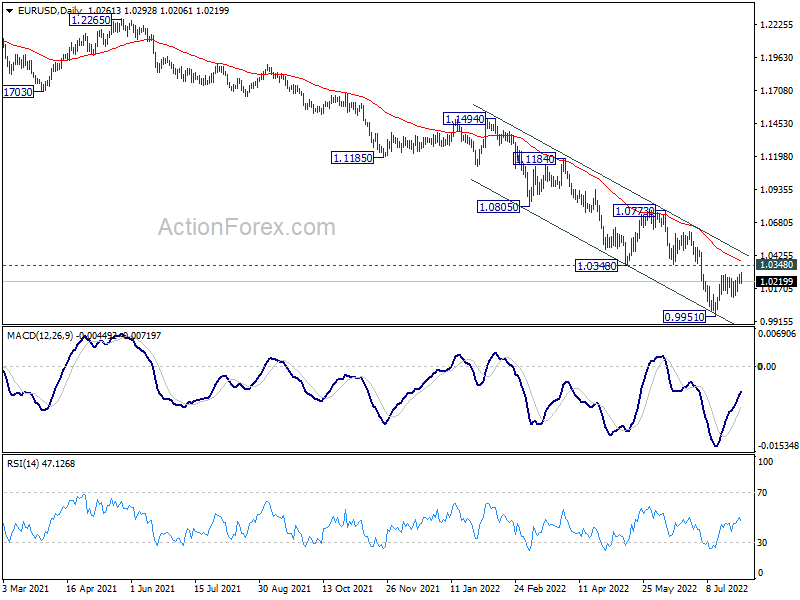
EUR/USD lost momentum after very brief breach of 1.0227 resistance. But further rise will remain in favor as long as 1.0095 support holds. Rebound from 0.9951 will target 1.0348 support turned resistance. Break there will target channel resistance at 1.0452. On the downside, break of 1.0095 minor support will turn bias back to the downside, and bring retest of 0.9951 low instead.
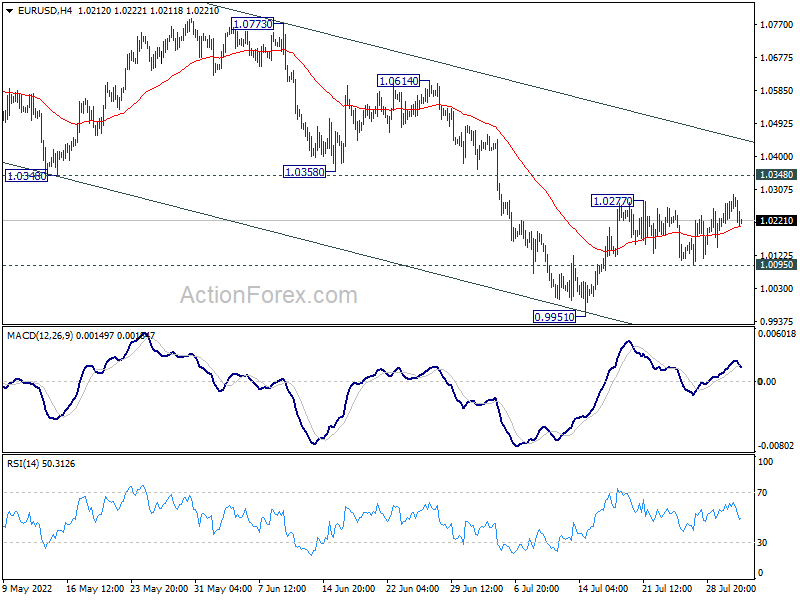
In the bigger picture, down trend from 1.6039 (2008 high) is still in progress. Next target is 100% projection of 1.3993 to 1.0339 from 1.2348 at 0.8694. In any case, outlook will stay bearish as long as 1.0773 resistance holds, in case of strong rebound.