Sample Category Title
GBPUSD Under Bullish Control But Confirmation Required
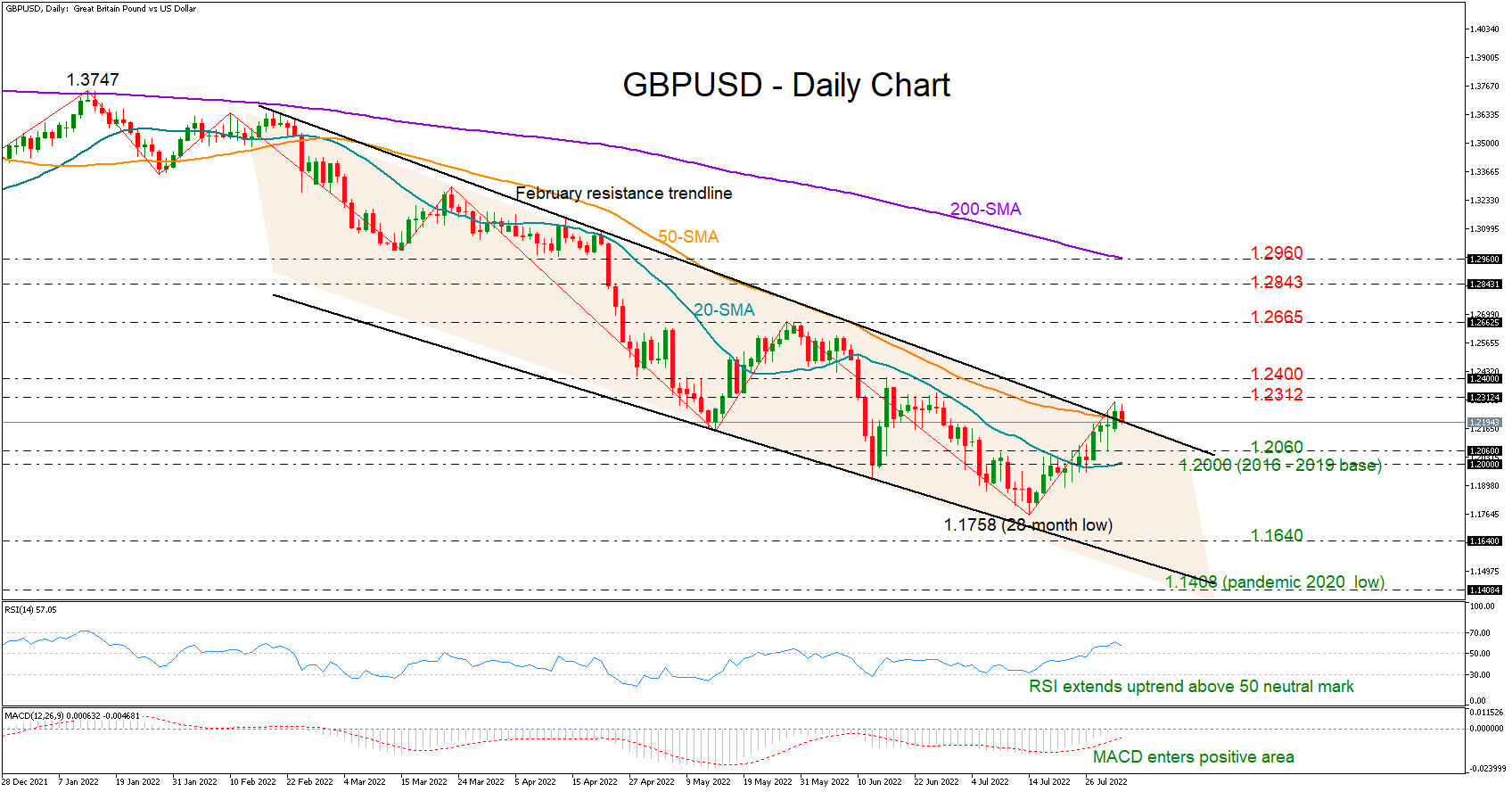
GBPUSD closed marginally above its 50-day simple moving average (SMA) on Monday at 1.2244 for the first time since February, violating at the same time the upper surface of a bearish channel.
Despite today’s stabilization, there are still hopes for further progress given the upward trend in the RSI, which is currently hovering clearly above its 50 neutral mark, as well as the strength in the MACD, which has climbed into the positive region.
That said, traders may wait for additional winning sessions, and particularly a durable move above the nearby resistance area of 1.2312 – 1.2400, before they target May’s top of 1.2665. If the bulls successfully claim the latter, officially signaling a trend reversal, the price could pick up steam towards the 1.2843 minor barrier, which was more active during the 2019 – 2020 period. Higher, the pair will seek another advance above the key 200-day SMA at 1.2960.
In the case the price pulls back into the bearish channel, the 1.2060 – 1.2000 region may attempt to prevent a freefall towards the 28-month low of 1.1758. Failure to change direction here could press the price towards the channel’s bottom line currently seen at 1.1640, while even lower, all attention will turn to the pandemic trough of 1.1408.
In summary, GBPUSD is still surrounded by positive vibes following its latest bullish breakout. Buyers will next look for a close above the 1.2312 – 1.2400 zone before they raise exposure in the market.
RBA Board Raises Cash Rate by 50 Basis Points – Expect Another 50 in September
The Reserve Bank Board today lifted the cash rate by a further 50 basis points. The Bank has increased its inflation forecasts and lowered its growth forecasts. A significant theme is around the current momentum in the economy. That clearly points to another 50 basis points in September after which the Board can slow the pace while and still have reasonable prospects inflation returns to the target band.
The Reserve Bank Board decided to increase the cash rate by 50 basis points to 1.85% at its August Board meeting.
In his Statement, the Governor noted that the Bank has made some significant changes to their forecasts.
The headline inflation rate is now forecast to reach 7.75% by end 2022 (up from 5.9% in the May Statement on Monetary Policy); thereafter it is forecast to slow to 4% (up from 3.1%) by end 2023; and 3% by end 2024 (up slightly from 2.9% by mid 2024).
The growth forecasts have also been revised with 2022 being lowered from 4.25% in the May statement on Monetary Policy to 3.25%; with the 2023 and 2024 forecasts being lowered from 2% to 1.75%.
Note that the forecasts have been extended from June 2024 to December 2024.
The Statement continues to note that “the Board expects to take further steps in the process of normalising monetary conditions over months ahead but is not on a preset path.” That compares with the Statement in July “The Board expects to take further steps in the process of normalising monetary conditions in Australia over the months ahead.” The “not on a pre set path” comment has been used in extensive communications by the Governor on other occasions and it does not seem to be significant that it has been added to the Statement ¬– certainly not that another 50 basis points in September has been ruled out.
The most important aspect of interpreting the Statement is whether there is anything to dissuade us from our view that there will be another 50 basis point increase in September.
In earlier communications that Governor has been clear that he expects that the neutral policy setting is around 2.5%. After this decision the cash rate at 1.85% is still well short of that neutral level.
The language in the Statement could have implied that there was some uncertainty about “neutral” by downgrading the momentum of the economy.
But the Governor remains upbeat about current economic conditions; “widespread upward pressures from strong demand“ compared to “strong demand contributing to the upward pressure on prices” (in July); “the Australian economy is expected to grow strongly this year”; “national income is being boosted by a rise in the terms of trade , which are at a record high”; “consumer spending has been resilient and an upswing in business investment is underway.”
Even the downward revision to GDP growth in 2022 can be partly attributed to the likely 0.5% “ miss” on the GDP growth forecast in the March quarter which was not known when the May SOMP predicted growth of 4.25% in 2022.However, like the Treasury, there seems to be a very cautious assessment of the growth rate in the June quarter (possibly 1.3% compared to Treasury of 0.9% (our estimate) and our own forecast of at least 2%).
But that 1.3% is still comfortably more than double trend.
The Bank is also predicting a very modest weakening in the labour market in 2023/24 with the unemployment rate only lifting to 4% by end 2024 compared to our forecast of 5%.
So, there does not appear to be grounds for assessing that the Board will slow the pace at the September meeting - a further 0.5% is very likely.
But the cash rate will then reach 2.35% – within the “neutral zone” from the RBA’s perspective.
It is then that some of the cautious aspects of today’s Statement can be used as a signal that the Board’s preference will be to slow the pace of tightening. We expect that the Board can then move back to a “25 basis point” pace. Just as the Chairman of the Federal Reserve signalled a likely reassessment of the 75 basis point pace, at the Press Conference, at the next FOMC then the Governor’s Statement in September can do the same, although the slowdown evidence for the US economy is much clearer than for Australia – for now.
The two most cautious aspects of the August Statement are referring to the challenge of achieving the inflation target while “keeping the economy on an even keel” (a new addition) and lifting the inflation forecast for 2022 from 3.1% to 4%. That implies that the Board feels that it has more time to reach the target given the higher starting point. It may also be with an eye to the Bank’s previous poor record on forecasting inflation, believing that increasing the starting point from 5.9% to 7.75%, would require a solid lift in the 2023 forecast as well.
A test will be whether medium term inflationary expectations take a lift in the face of a less committed forecast from the RBA.
Recall that complacency around containing inflationary expectations is a trap that the Board should avoid at all costs.
Because its only measure on medium term inflationary expectations appears to be break even yields in the financial markets the Board is running a risk by signalling such patience in the face of the widespread pressures on inflation that it has described.
It is our view that the Board will have to slow the economy in 2023 (to 1% growth rate) in order to maintain a grip on inflationary expectations.
Conclusion
The 50 basis point move today was widely expected, although some analysts had been flirting with 75 basis points.
The most important aspect of the Statement was whether there was any indication that the Board might ease back to a 25 basis point pace in September. But there does not appear to be any evidence to suggest such a policy and we confirm our view that there will be another lift of 50 basis points in September.
However, there were references that might imply a more cautious approach after September and we see them as consistent with our view.
As indicated in the final sentence” the Board confirms its commitment to doing what is necessary to ensure inflation in Australia returns to target over time.”
We expect that objective will require a series of four 25 basis point moves following the 50 basis points in September.
Australian Dollar Sinks after RBA Hike
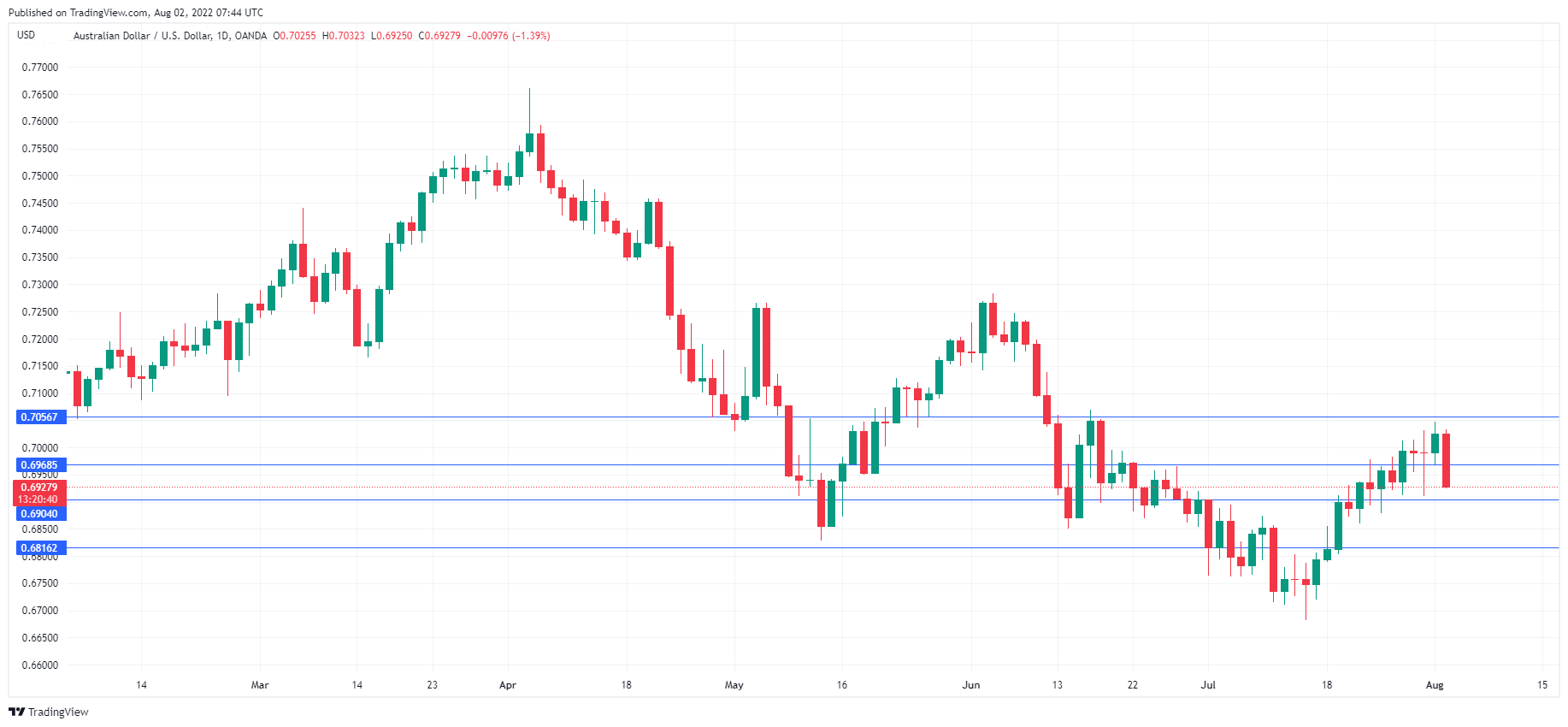
The Australian dollar has declined sharply and is back below the symbolic 0.7000 level. AUD/USD is trading at 0.6931, down 1.35% on the day.
RBA raises rates by 50bp
The Reserve Bank of Australia raised interest rates by 50bp today. This is becoming somewhat of a routine, as today’s move was the third consecutive hike of 50 bp, bringing the cash rate to 1.85%. The markets had circled a 50bp move as the most likely, although ahead of the decision, there was a possibility that the RBA might go soft with a 25bp move or full throttle with a 75bp hike.
The uncertainty in the markets ahead of the meeting reflects the delicate position that the RBA (and other central banks) find themselves, with inflation running red-hot at 6.1% and expected to accelerate. The central bank has labeled inflation as public enemy number one and has embarked on a rate-tightening cycle to curb inflation. Higher rates will slow the economy, which will lower inflation but could tip the economy into a recession. The RBA is aiming for a ‘soft landing’ as the economy slows but this will be a tricky task.
In the RBA statement, Governor Lowe hinted at further rate hikes to come, but said that the RBA was not on a “pre-set path”. Lowe added that the RBA would do whatever is necessary to reduce inflation back to target “over time”. With the RBA projection inflation will be around 7.75% over 2022 and the Bank’s inflation target between 2% and 3%, there’s no question that more rate hikes are coming in the coming months, with the size of the hikes the key question. In defence of today’s rate hike, Lowe said that the labour market and consumer spending were strong. However, household spending remained “a key source of uncertainty” due to the cost of living crisis and higher mortgage payments due to rising interest rates.
The Australian dollar, which dropped sharply after the rate announcement, is also under pressure from heavy selling of USD/JPY, which is down for a fifth straight day and has dropped below the 131 line for the first time in two months.
AUD/USD Technical
- AUD/USD is putting pressure on support at 0.6904. The next support level is at 0.6816
- There is resistance at 0.6968 and 7056
Daily Technical Analysis
EUR/USD
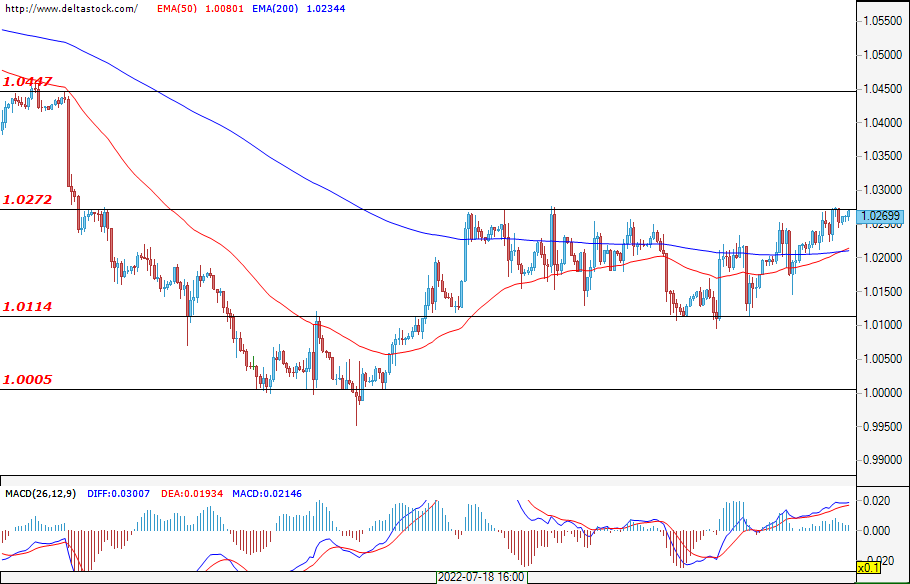
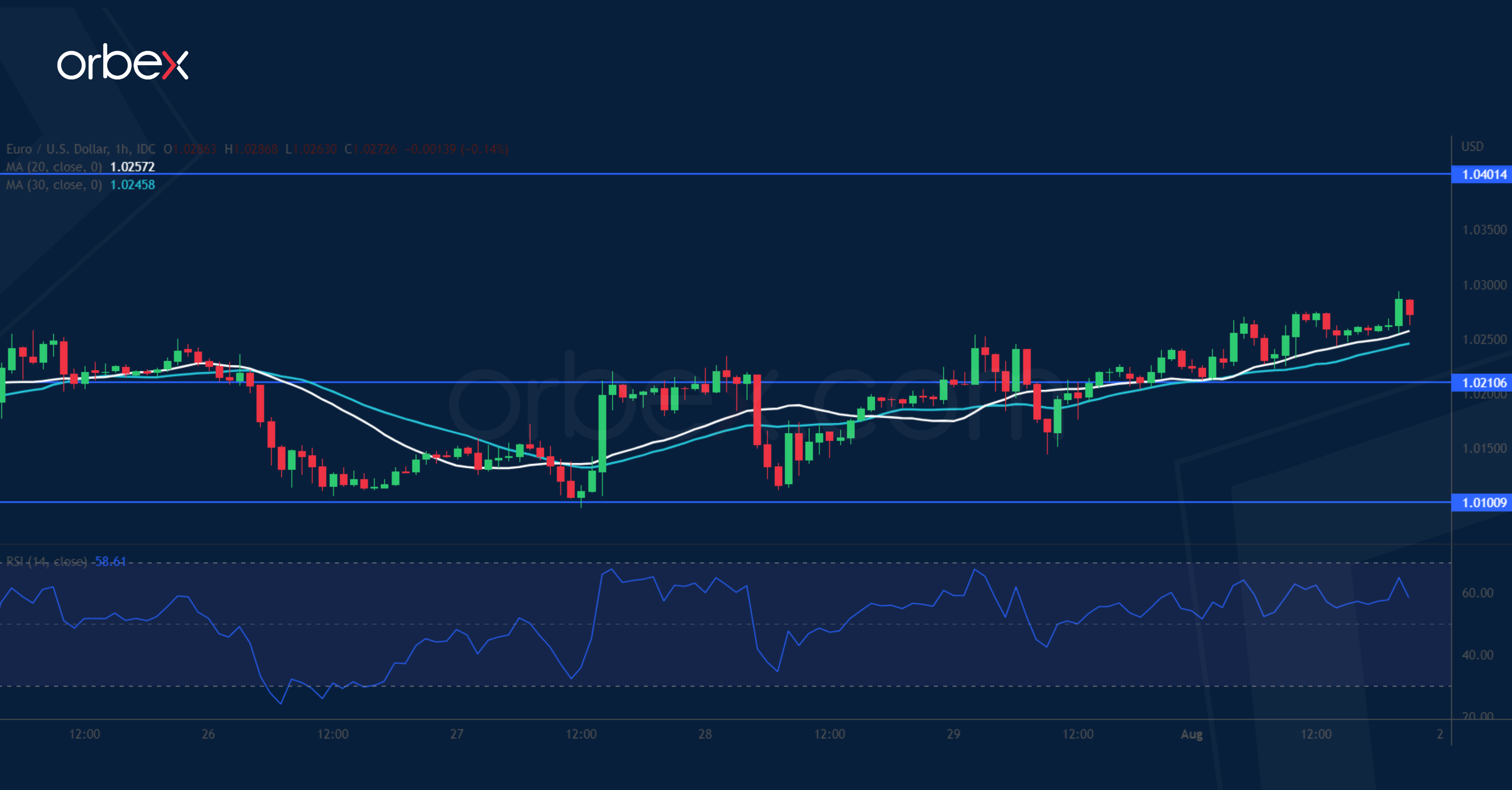
The single European currency continued its twenty-day consolidation in the range between 1.0110 and 1.0270. During yesterday's trading session, we saw a failed attempt to breach the upper border of the mentioned range by the bulls, but the bears again managed to put a stop to the buyers’ efforts to start a more sustained rally. At the time of writing the analysis, the bulls are still trying to breach the resistance, and if they manage to do so, then the next one before them would be found at 1.044. If the bears manage to overcome the lower border of the range, then they would find themselves "eye to eye" with the psychological support at 1.000 and we will witness parity between the euro and the U.S. dollar once again.
USD/JPY
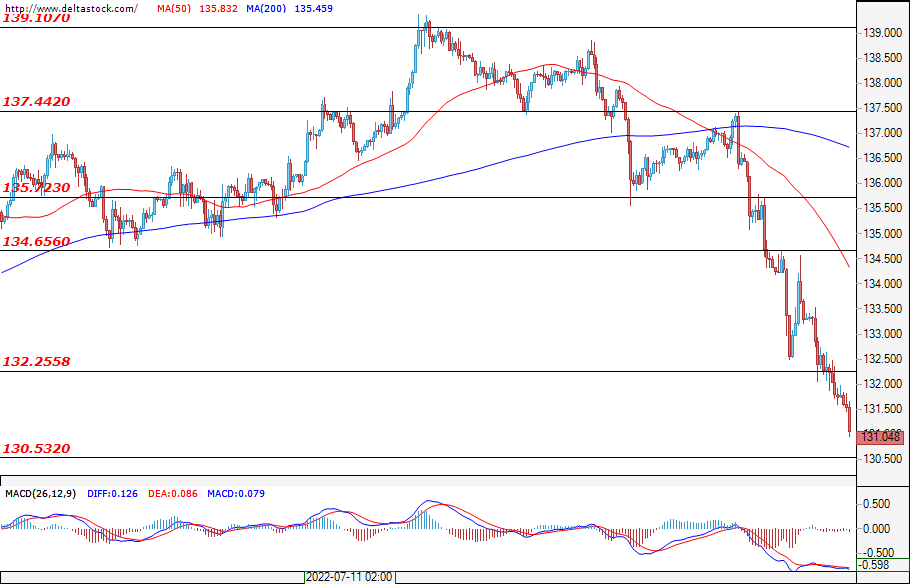
Yesterday's trading session for the Ninja was marked by a successful bearish breach of the support at 132.25. Today, the bears start the trading session with the same momentum as the previous day. By all accounts, they seem headed for the 130.53 support. If, on the other hand, the bulls manage to limit the sell-offs and restore yesterday's positions, then they would face the resistance at 134.65.
GBP/USD
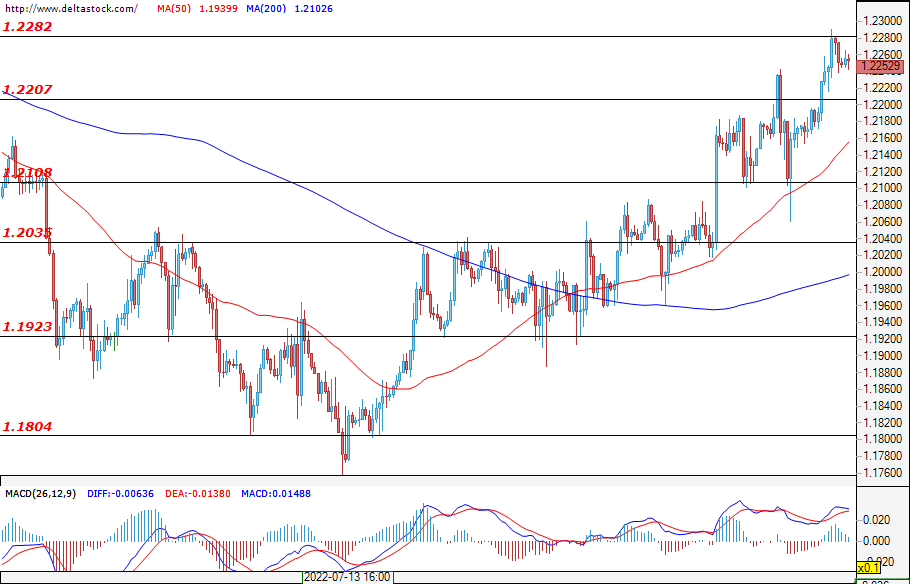
During yesterday's trading session involving the sterling, the bulls managed to breach the resistance at 1.2282 as a result of the greenback’s weak performance across the board. However, their breakthrough was not confirmed and they lost their momentum. The bears took advantage of this weakness and were able to recover some of their positions. The next supports for them to overcome are those at 1.2207 and at 1.2108.
EUGERMANY40
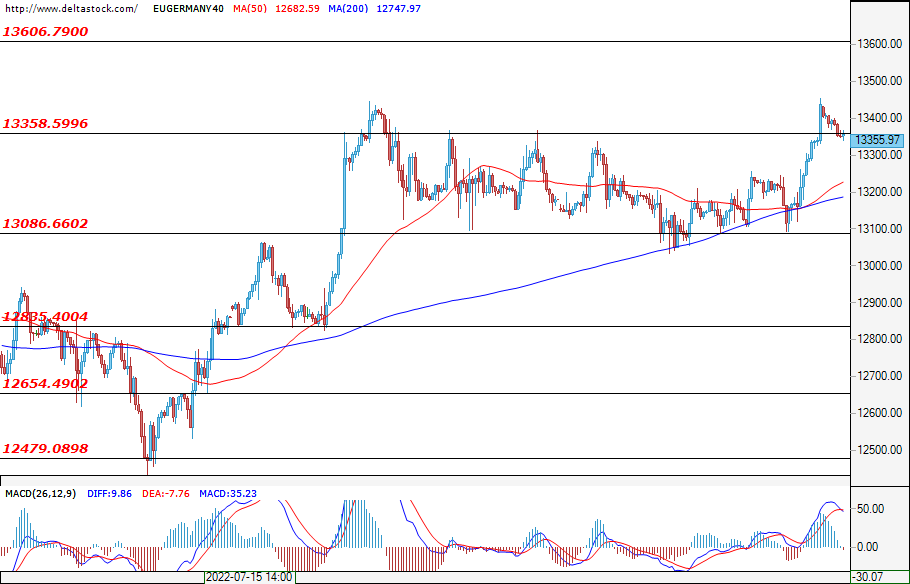
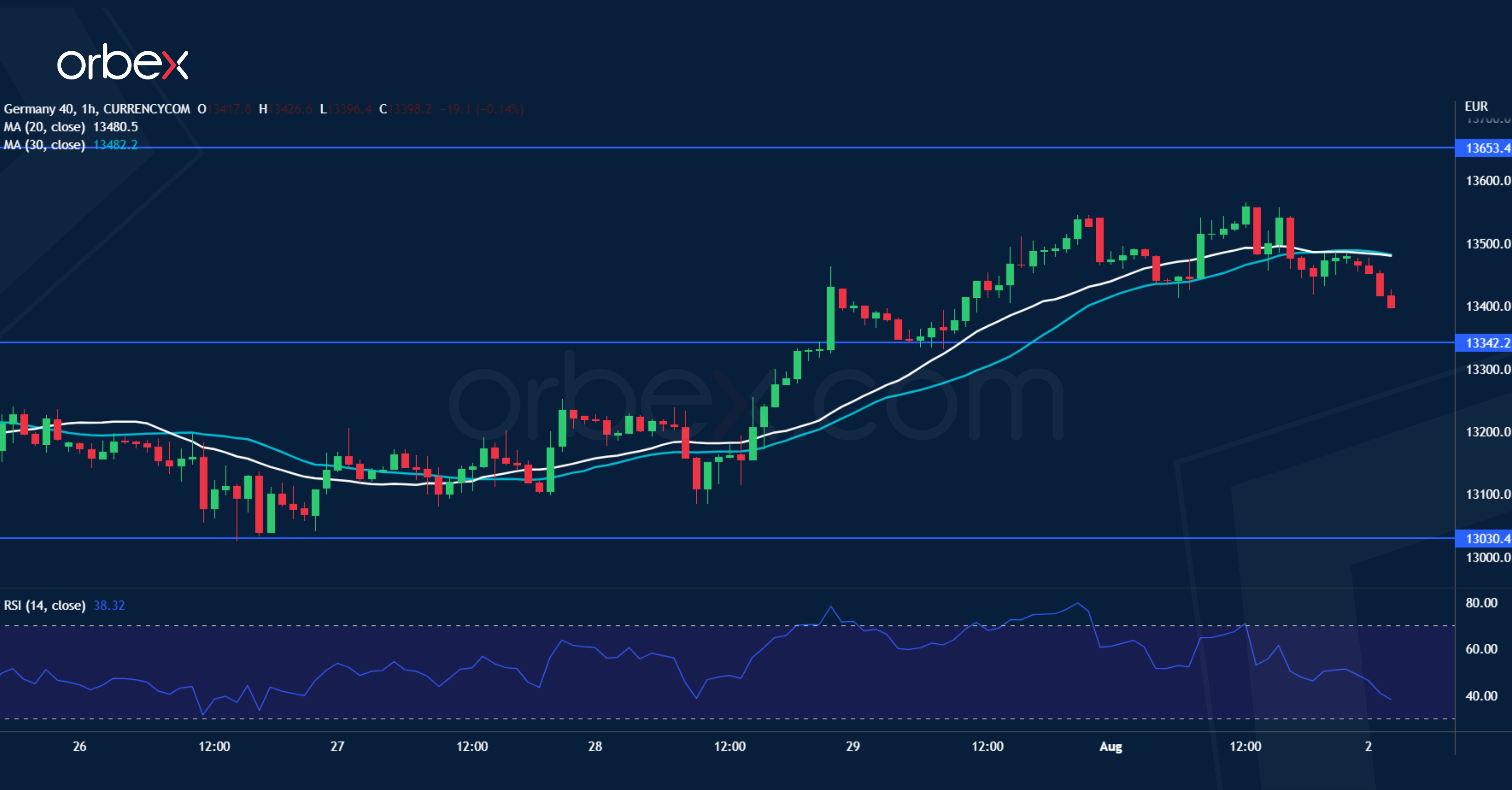
Today's trading session for the German index started hesitantly after the level at 13560 withheld the bullish attack once again, proving itself as a big hurdle for investors. At the time of writing the analysis, the most probable scenario is for a corrective move towards 13360 as a result of the upward impulse one from yesterday. If the sell-off gains steam, then the next level of support after the aforementioned level will be the one at 13086.. In case the bulls gain the upper hand, then their first resistance would be the level at 13358.
US30
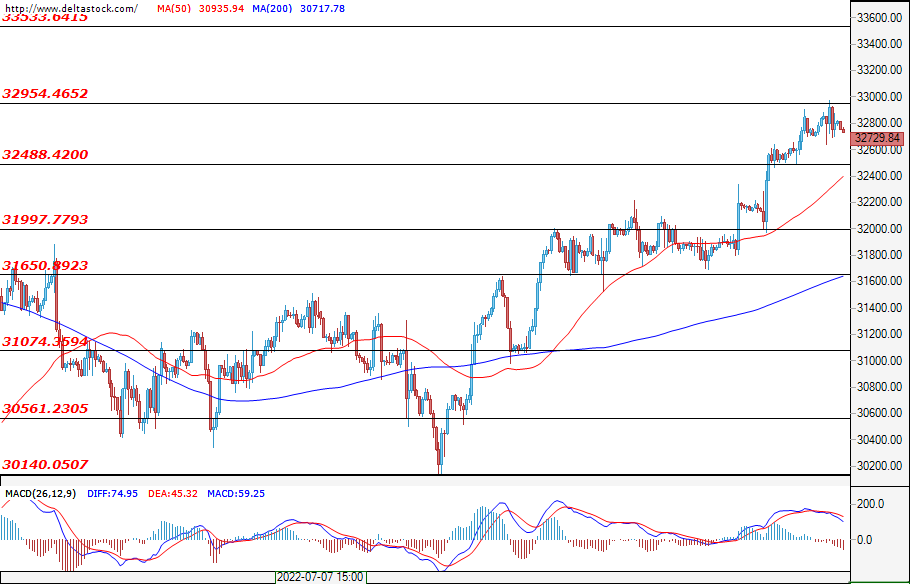
Over the past few days, we saw a reduction in volatility, increasing the odds of the index entering a consolidation phase for a couple of days. If the bulls continue to hold the upper hand, then they will have to tackle the resistance at 33533 in order to continue their run. However, Nancy Pelosi's visit to Taiwan prompted the Chinese to escalate their rhetoric, which resembled what we were hearing from Russia prior to the start of the war. This sank Asian markets, with the HONGKONG50 losing more than 3%. If tensions continue to rise, then the Asian sell-off could spread to the U.S. markets as well. A strong bearish attack, on the other hand, would lead the market towards the support at 32500.
GER 40 Tests Key Resistance
The Dax 40 finds support from strong earnings in Q2. A bullish MA cross on the daily chart indicates improvement in the market mood after the bulls cleared resistance around 13350. 13650 at the origin of a faded rebound in mid-June is a key hurdle. Selling interest could be expected as the index is still in recovery mode. However, a bullish breakout could trigger a runaway rally and send the index towards June’s high at 14700. The RSI’s overbought condition has caused a pullback and 13340 is the first support.
XAG/USD Consolidates Gains
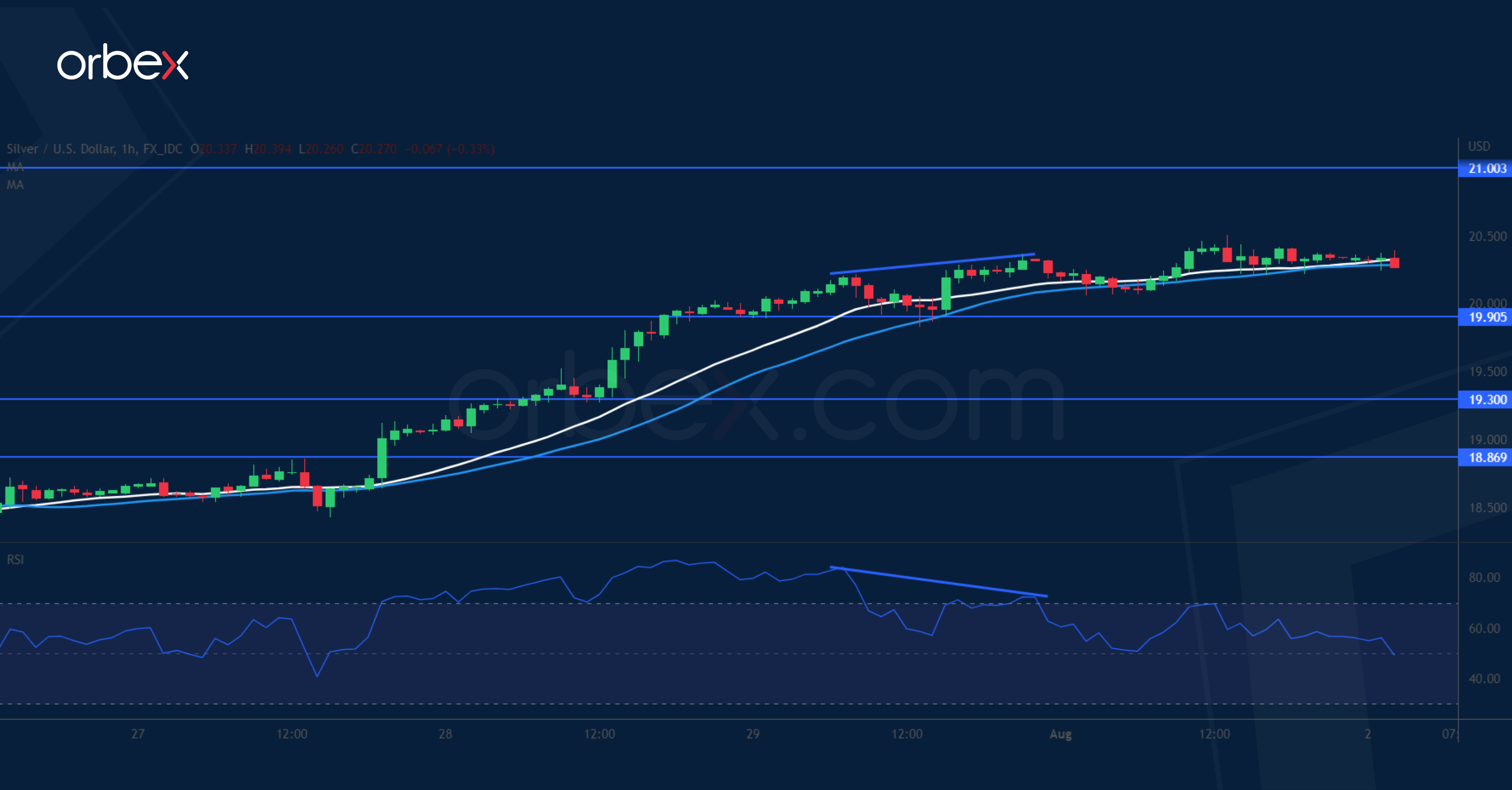
Silver rallies as risk appetite favours commodity markets. A break above the last leg of sell-off at 19.40 triggered momentum buying. This is a sign of a massive exodus from heavy selling. A close above 20.20 further put the short side under pressure. The RSI exhibits a bearish divergence, suggesting a slowdown in the impetus. Resistance could be expected in the supply zone (21.00) from a combination of profit-taking and fresh selling. 19.90 is the immediate support and 19.30 a second layer in case of a deeper pullback.
EUR/USD Finds Support
The US dollar continues to retreat as profit-taking goes on ahead of nonfarm payrolls. The latest rally found support over 1.0100 after it cleared 1.0200. A series of higher lows indicates mounting buying pressure and short-term sentiment could be turning around. The recent high at 1.0270 coincides with the 30-day moving average and might be sellers’ last stronghold. Its breach may pave the way for an extended recovery. 1.0210 is a fresh support and the support-turned-resistance at 1.0400 from the daily chart could be the target.
Taiwan Story Will Only Be a Temporary Market Determinant
Markets
The initial core bond yield jump quickly faded once again. Intraday advances of as much as 7 bps (in Germany) evaporated as the day evolved on a combination of factors. News of the first overseas grain shipment from a Ukraine port since the Russian invasion weighed on price of a range of (soft) commodities. Second, the Liberty Times reported that House Speaker Pelosi is to visit Taiwan during her Asian visit after all. China repeatedly warned not to. Geopolitical tensions flared, supporting the safe haven bid for core bonds. Finally, two elements strike us from the July US manufacturing ISM yesterday. While the headline series came in at a better-than-expected 52.8 (down from 53), new orders eased to 48 (49 expected). Furthermore, prices paid, considered an early inflation gauge, stumbled more than 18 points to the lowest in almost two years. Both fueled ongoing market speculation that the Fed may not need to be as aggressive as it(s dot plot) suggests. The damage check reads -1.4 bps (2y) to -10.9 bps (20y) for US Treasuries. Bund yields lost 1.5 bps (2y) to 4.1 bps (30y). Stock markets whipsawed to close slightly lower in Europe and the US. The yen scores a hattrick on currency markets, being the outperformer for a third day straight while the dollar continues to trade on the back foot. USD/JPY dropped to 131.6, down from 133.3. EUR/JPY closed at the 135 support level. EUR/USD tested the 1.028 intermediate resistance but closed at 1.026 eventually. Sterling remains in a sweet spot ahead of the (more aggressive?) BoE. EUR/GBP edged south to 0.8375 though finished off intraday lows.
Geopolitical tensions between the US and China with Taiwan in the middle holds markets in a grip in Asian dealings. Stocks drop with China underperforming strongly (losses of more than 3.5%). The yuan drops to USD/CNY 6.77. Safe havens benefit, including US Treasuries (yields down >2 bps across the curve) and, you guessed it, the Japanese yen. USD/JPY loses important support at 131.25 and EUR/JPY the 135 level. We think the Taiwan story will only be a temporary market determinant, but the cautious risk mood is apparent nonetheless and may last until Pelosi’s planned meet with the president of Taiwan on Wednesday, especially given the thin eco calendar. Interestingly, the dollar isn’t really able to bank on its safe haven status. Let’s see if the 105 level in the trade-weighted (DXY) index holds today. EUR/USD briefly pushed trough 1.028 this morning only to pare gains afterwards. Momentum in the pair over the past three days was not bad. But in case of a break beyond 1.028, 1.035 already pops up as the first, actual resistance. That may be a tough nut to crack with the upper bound of the downward trend channel also looming. Additionally, it remains unnatural for the euro to rise in risk-off. We keep a close eye on rates. Both in the US and EU they are at or near yet another technical crossroad (eg. 10y swap 1.63%, German 10y 0.73%, US 10y 2.55%).
News Headlines
Inflation in South Korea quickened in line with expectations. Headline price pressures in July advanced by 0.5% m/m to be up 6.3% y/y vs. 6% the month before. Core inflation (ex. agriculturals and oils) rose from 4.4% to 4.5%. The OECD measure (ex food and energy) stabilized at 3.9%. Accelerating price developments keep up the pressure on the BoK to continue its tightening cycle. It said after the publication that inflation may continue to stay above 6% for some time to come. BoK governor Rhee Chang-yong the day before said another hike by 25 bps is likely on August 25. He didn’t rule out a bigger-sized move. In July, the BoK raised rates by 50 bps to 2.25%.
The Reserve Bank of Australia hiked policy rates to 1.85% from 1.35%. It’s the third consecutive 50 bps hike and it follows stubbornly high inflation that’s the result of both global and domestic factors. Inflation is seen peaking later this year and should average around 7.75% in 2022, a little above 4% next year and around 3% in 2024. Growth will still expand strongly this year at 3.25%, aided by record high terms of trade, before moderating to 1.75% in the two following years. The RBA expects more tightening in coming months, but added in the August statement that it is not on a pre-set path. Markets saw this as a hint that jumbo rate hikes may no longer be appropriate. Australian swap markets trimmed expectations for the next policy meeting in September from 50 bps to 25 bps. The terminal rate was adjusted lower only marginally (between 3.25 and 3.50% still). The Aussie dollar is disappointed. AUD/USD loses the 0.70 barrier again.
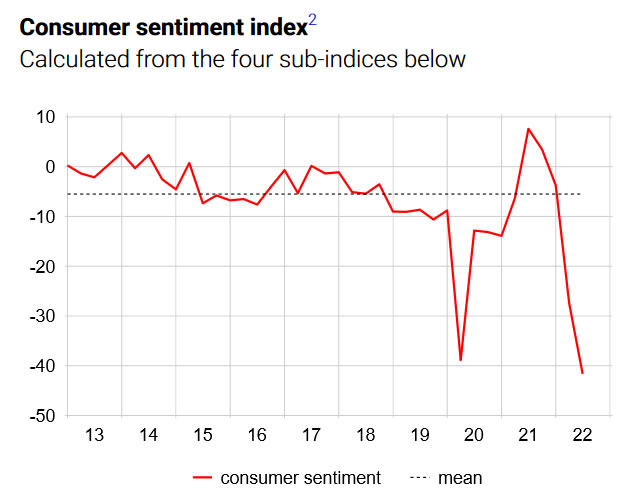
Swiss SECO consumer sentiment dropped to -42, worse than pandemic low
Swiss SECO Consumer Sentiment dropped sharply from -27 to -42 in Q3, worse than expectation of -34. It's even below the -39 reading after the onset of the pandemic in April 2020. Expected economic development dropped further from -31.4 to -53.5, far below its long-term average at -9. Expected financial situation dropped from -24.9 to -34.8, undershooting previous low of -26 in January 1995.
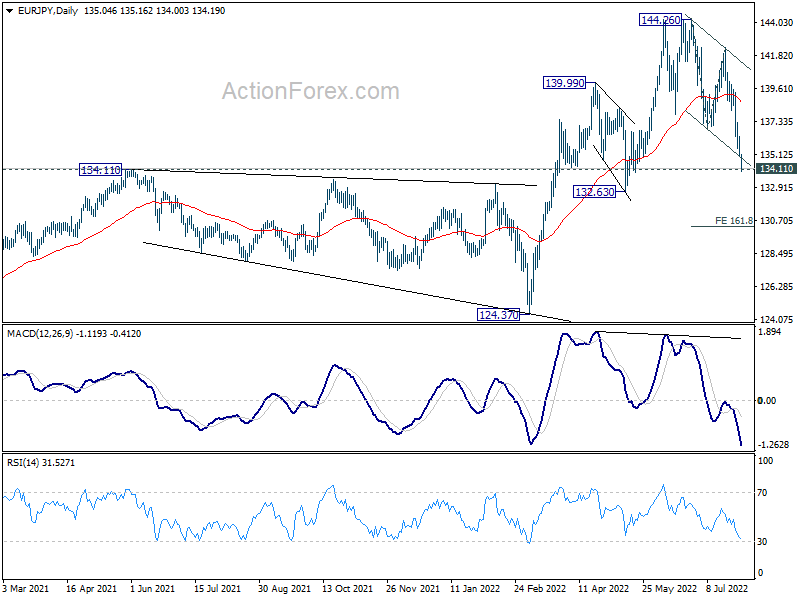
EUR/JPY Daily Outlook
Daily Pivots: (S1) 134.56; (P) 135.46; (R1) 135.91; More....
EUR/JPY's decline continues today and it's now pressing 134.11 key support turned resistance. Strong support could be seen from current level to complete the pattern from 144.26 high. Break of 135.85 minor resistance will turn bias back to the upside for stronger rebound. However, sustained break of 134.11 will carry larger bearish implications and target 161.8% projection of 144.26 to 136.85 from 142.31 at 130.32.
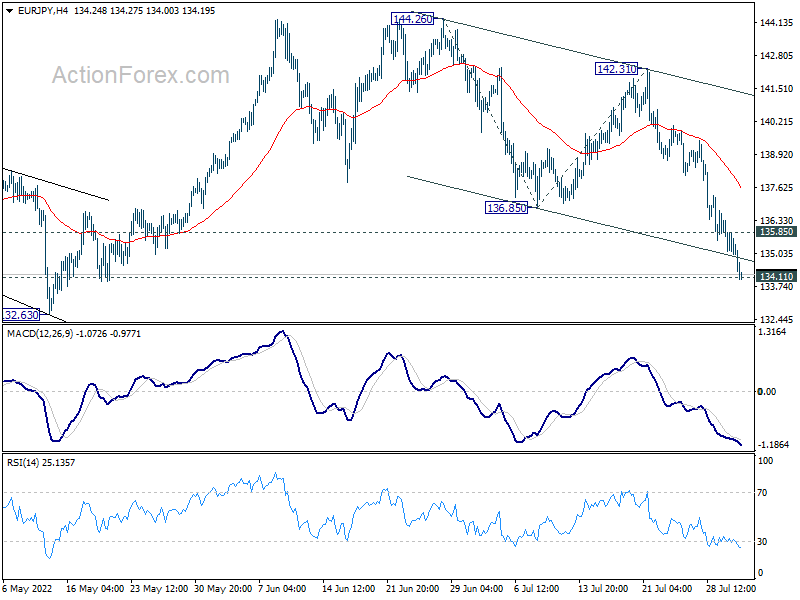
In the bigger picture, up trend from 114.42 (2020 low) is seen as the third leg of the pattern from 109.30 (2016 low). Further rally is in favor as long as 134.11 resistance turned support holds, even in case of deep pull back. Next target is 149.76 (2015 high). However, sustained break of 134.11 will be a sign of medium term bearish reversal and turn focus to 124.37 support for confirmation.