

Sample Category Title
RBA to Raise Rates, But Aussie Cares about Global Forces
The Reserve Bank of Australia (RBA) is widely expected to roll out another 50bps rate increase when it concludes its meeting at 04:30 GMT Tuesday. Inflation is high and unemployment is at record lows, so the RBA could signal another move of equal size for September, providing some relief to the Australian dollar. Overall though, what the central bank does is secondary to how global forces evolve.
Going strong
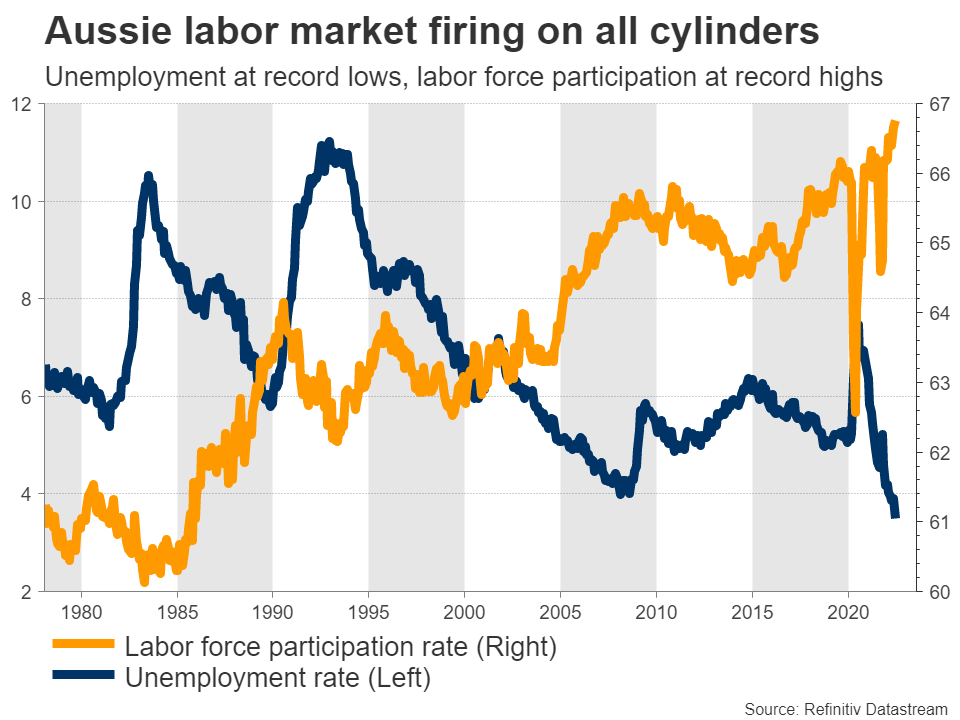
The Australian labor market is on fire. It’s not every day you see an economy with the unemployment rate at fresh record lows and labor force participation at record highs. More people are employed than ever before and the scarcity is attracting new workers into the jobs market.
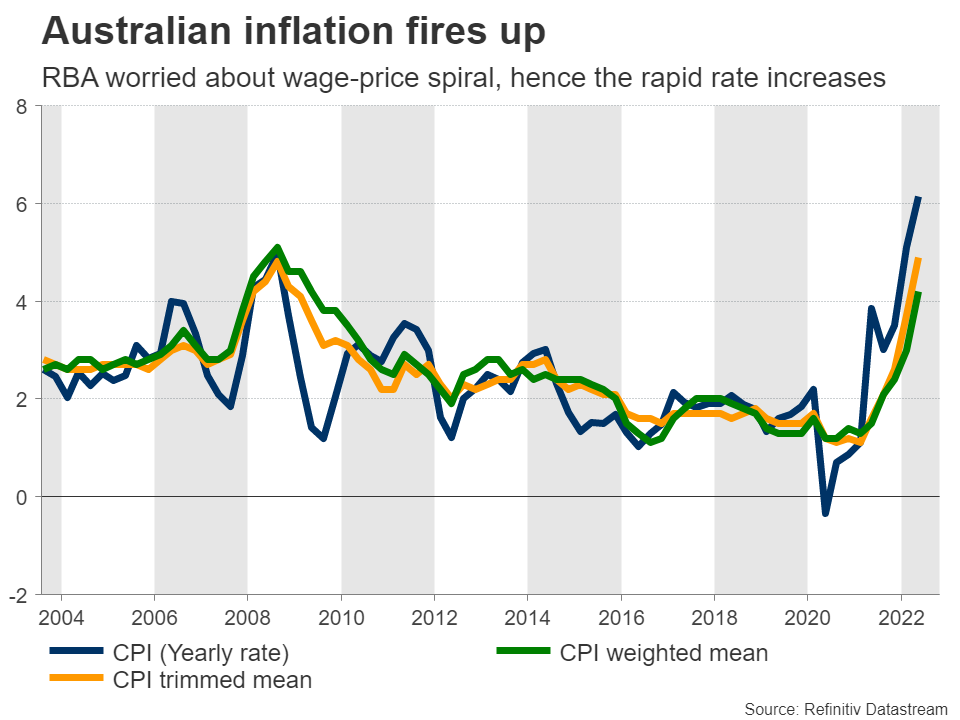
With the domestic economy running on all cylinders and elevated energy prices, inflation has started to fire up. The Reserve Bank is worried that wage growth might follow suit as people demand higher wages, so it is raising interest rates in a forceful manner to prevent a wage-price spiral that keeps feeding inflationary pressures.
In a recent speech, Governor Lowe pointed out that the ‘neutral’ level for interest rates - the one that is neither stimulative nor restrictive for the economy - is “at least” 2.25%. It is reasonable to assume the RBA will mimic the Fed and telegraph a slowdown once this rate is reached, but with rates currently at only 1.35%, it is probably too early for such signals.
Market expectations
Heading into this meeting, a 50bps rate increase that brings rates to 1.85% is essentially fully priced in. If there is any surprise, the risks seem tilted towards an even larger move. The labor market is so strong that policymakers would likely prefer to front-load the rate increases, instead of playing it slow.
Business surveys suggest companies raised their selling prices at the fastest pace on record in July, proving the RBA a good excuse to expedite the tightening process. The catch is that those same surveys pointed to slowing economic growth, therefore, a more measured 50 bps hike seems prudent.
Another factor that might keep the Reserve Bank cautious is the housing market. With mortgage rates rising at light speed, recent data show house prices falling at the fastest pace since the global financial crisis. Of course, this follows a huge rally after the pandemic, but nonetheless, a sharp decline would be problematic for households that are already feeling the heat of inflation.
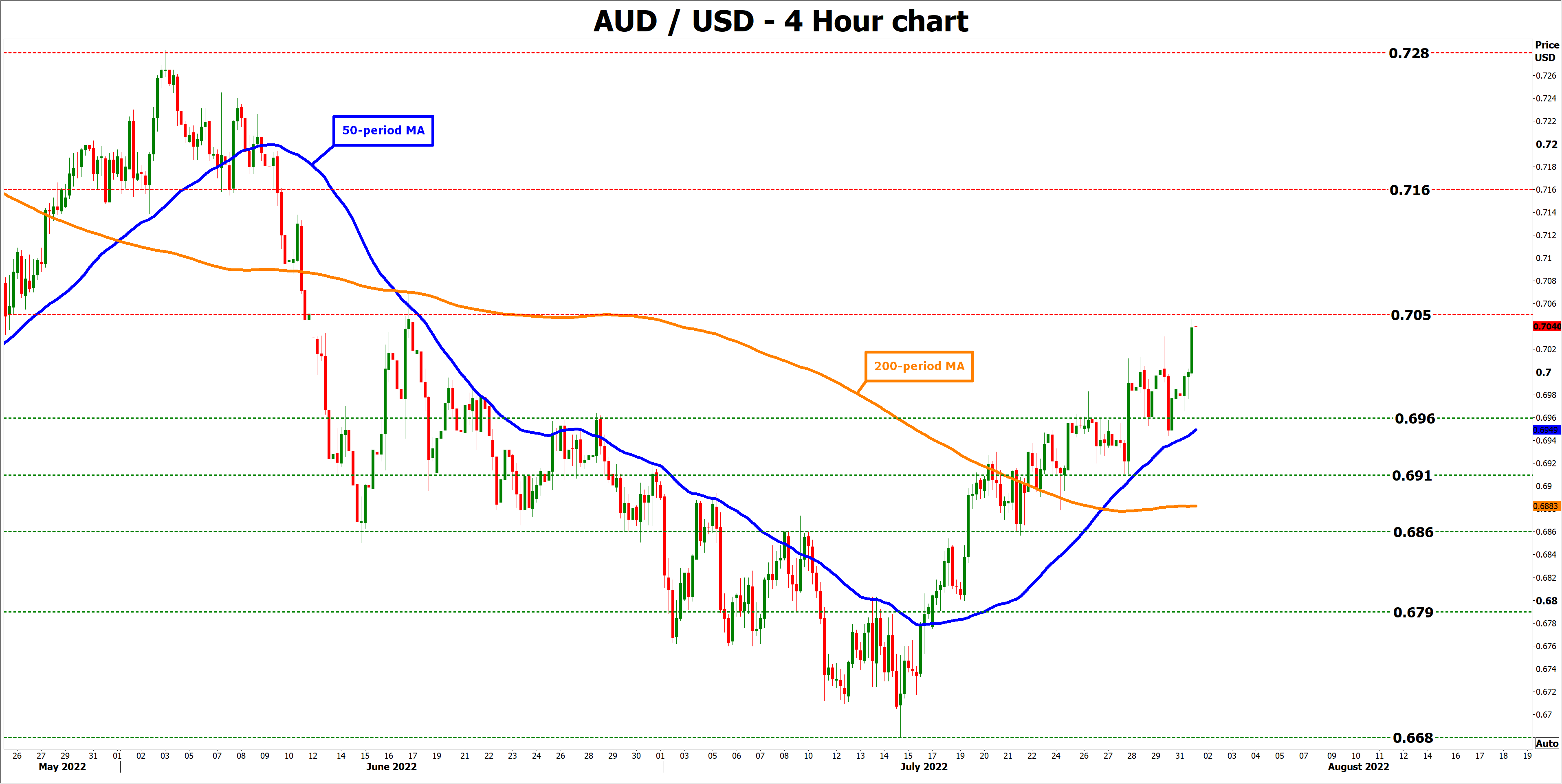
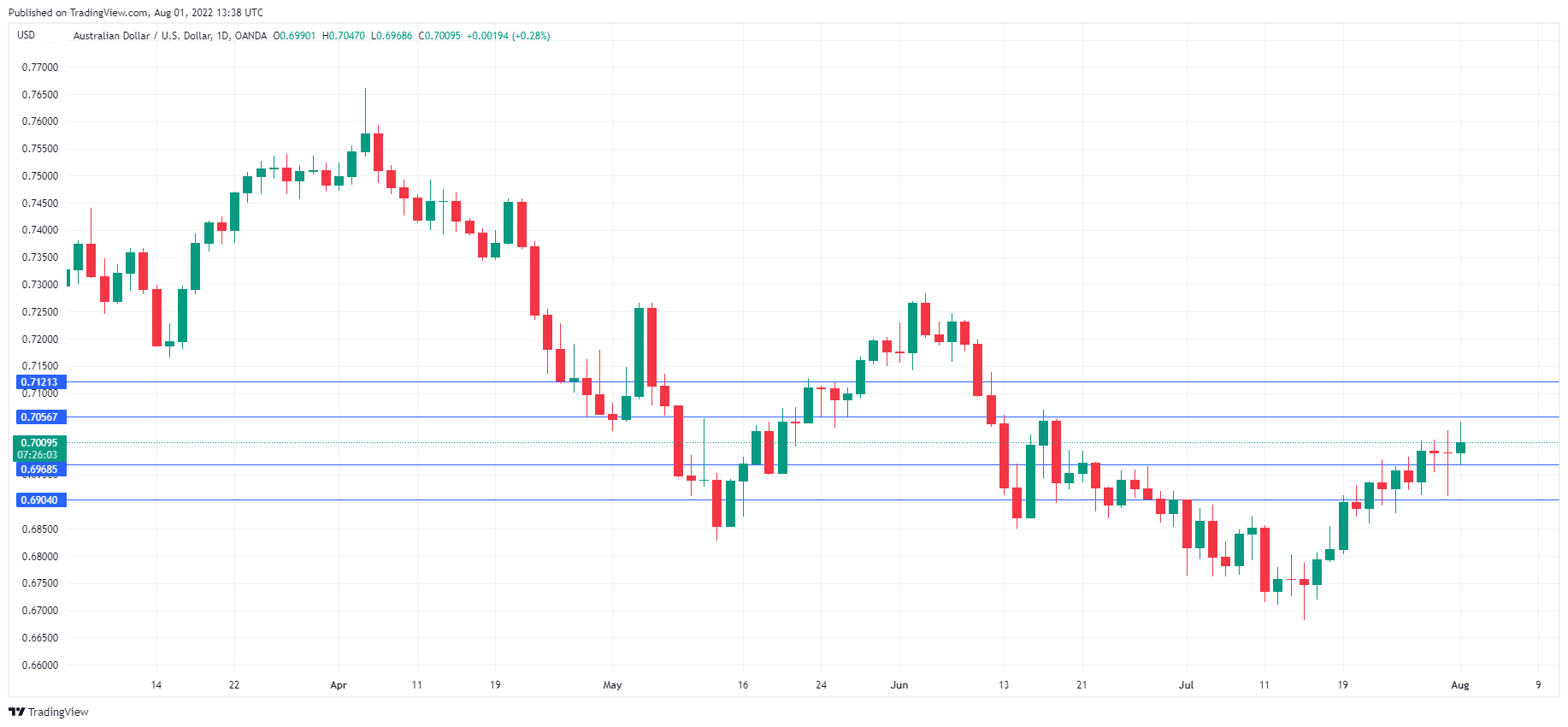
Assuming the rate increase is indeed 50bps, the focus will shift to any signals about the next meeting in September. If the RBA indicates a similar move, that might still be enough to lift the aussie. Taking a technical look at aussie/dollar, a spike above the 0.7050 zone could open the door towards the 0.7160 region.
Aussie has bigger fish to fry
Zooming out, the most crucial variable for the Australian dollar won’t be what the RBA does, but rather how the global economy evolves. The currency is driven mostly by the performance of commodity prices and risk sentiment in global markets, so it is unlikely to thrive in a regime characterized by recession concerns.
The aussie is also sensitive to developments in China, the nation’s largest trading partner by far. While the Chinese economy seems to have stabilized after its lockdown-fueled slump, growth has stalled and the stress in the troubled property sector keeps building up.
As such, it is difficult to trust the latest recovery in the Australian dollar, even if the RBA strikes a hawkish tone this week. Instead, what’s needed is an improvement in the global outlook that dispels recession fears, such as a ceasefire in Ukraine or China abandoning its strict lockdown strategy, before a trend reversal becomes realistic.
In case of a retreat, aussie/dollar could encounter initial support around the 0.6960 barrier.
Finally, note that the RBA’s quarterly economic projections will be released on Friday and might also matter for markets.
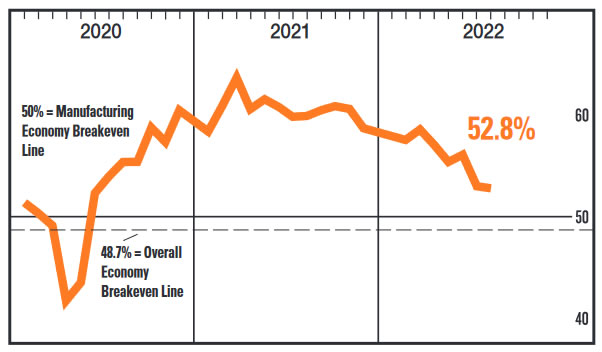
US ISM manufacturing ticked down to 52.8, prices fell to acceptable level at 60.0
US ISM Manufacturing PMI dropped from 53.0 to 52.8 in July, above expectation of 52.0. Looking at some details, new orders dropped -1.2 to 48.0. Production dropped -1.4 to 53.5. Employment rose 2.6 to 49.9. Prices dropped sharply by -18.5 to 60.0.
ISM said: ""The U.S. manufacturing sector continues expanding — though slightly less so in July — as new order rates continue to contract, supplier deliveries improve and prices soften to acceptable levels."
"The past relationship between the Manufacturing PMI and the overall economy indicates that the Manufacturing PMI® for July (52.8 percent) corresponds to a 1.4-percent increase in real gross domestic product (GDP) on an annualized basis."
USD Breaking Down Towards 103/104
I hope you had a nice weekend and that you are ready on more volatile markets with plenty of important data on this week's schedule. However, August is known as one of the slowest months of the year, but this time can be different due to CBs hiking policy decisions. We have RBA and BoE decisions and then important employment from Cadena and New Zealand and US. Technically speaking, we see USD in bearish mode, with room for more weakness as finally stocks recovers and even finished the week at the highs. It looks like risk-on mode is back after the US economy is officially in a technical recession after GDP shrank in both the first and second quarters. However, Fed does not see a recession as jobs are still strong. From an Elliott wave perspective, we see DXY coming down from a consolidation (yellow box), so USD can get weaker across the board.
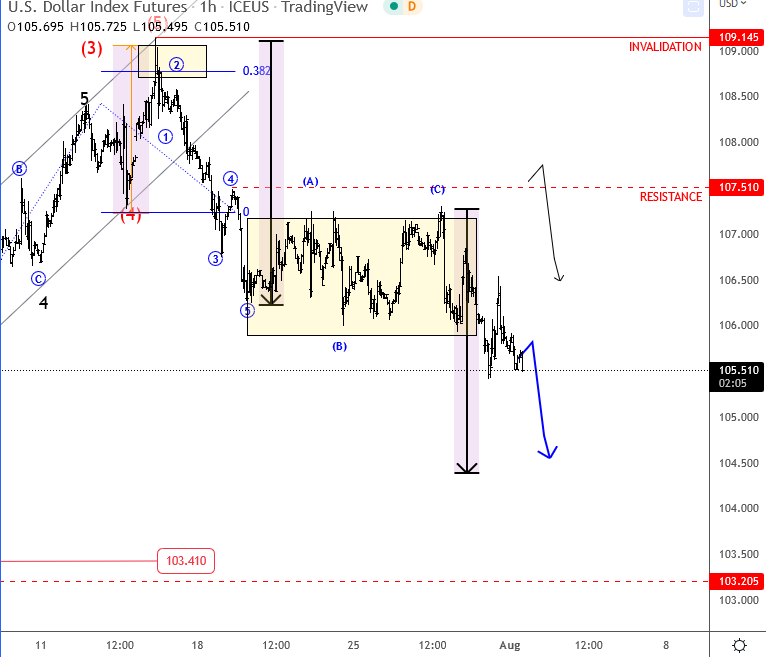
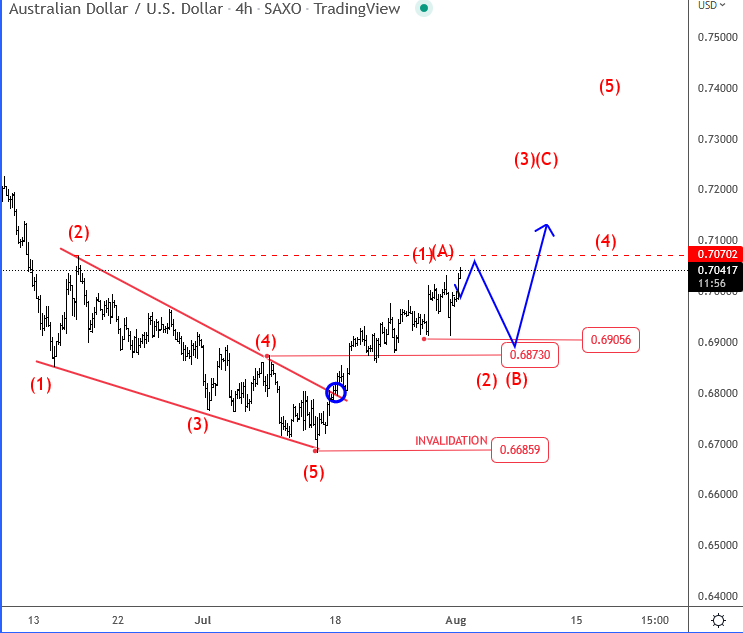
Now when USD is breaking down, keep an eye on AUDUSD for more upside after pullback. Temporary resistance is at 0.7070, and support at 0.6900.
Sunset Market Commentary
Markets
Core bond yields on Monday kicked off the new month in good spirits. German yields rose as much as 7 bps and a little less in the US. That happened even against the backdrop of disappointing retail sales in Germany which declined unexpectedly by 1.6% m/m in June on cuts in non-essentials as inflation bites. In absence of a fundamental driver, we’d label the move an attempt to bottom out after sliding in a dramatic fashion over the course of July. An ”attempt", because it didn’t last very long. First gains evaporated gradually though not fully amid easing inflation expectations. This was in turn related to news of the first (of potentially many) ships carrying tons of agricultural products leaving one of Ukraine’s ports (see headline). It puts soft commodities under pressure. The likes of oil lose out in a daily perspective too. Brent trades at $101/barrel after hitting resistance around 106.55 last Friday (50dMa) ahead of the OPEC+ meeting this Wednesday. But then word got out that House Speaker Pelosi will indeed visit Taiwan during her Asian tour that started today. China repeatedly warned not to do so and didn’t leave out threats. It fuels geopolitical tensions beyond Russia and the western world and triggered safe haven flows. European swap yields trade mixed between +1 and -1 bp. The 10y risks tests support around 1.63%. German yields drop between 2 and 3.1 bps across the curve. Peripheral spreads narrow slightly nevertheless. Italy (-8 bps) outperforms peers as the 10y yield dropped below 3% for the first time since end May. Bloomberg reported last week that the poll-leading Giorgia Meloni (Brothers of Italy) plans to stick to the (budget) commitments needed to get access to the 200bn euros of EU funds. US yields erase advances of as much as 6 bps to just 0.3 bps at the front and shed up to 4 bps further out as markets go into the release of the US manufacturing ISM (expected to ease from 53 to 52). Stocks held up well until the Pelosi news. Both European and US stocks dip with the latter underperforming (-0.6%).
The dollar remained in the defensive. The euro was able to profit initially, partially helped by the faster rise in yields. EUR/USD hit an intraday high of 1.027, an inch away from intermediate resistance at 1.028. However, as bond yields faded, so did the couple (1.024 currently). Dollar on a trade-weighted basis (DXY) drifts further south (105.55) on the back of a stronger and outperforming (for a third time straight) yen. USD/JPY, now at 132.3 is approaching strong support at 131.25. Sterling shows no signs of nervousness going into the Bank of England meeting on Thursday. The Queen’s money strengthens both against euro and dollar. EUR/GBP drops to 0.836 with technical potential to 0.83 as it is headed for the BoE. GBP/USD jumps to 1.224, extending the bottoming out process in place since mid-July. News Headlines
Hong Kong’s economy rebounded from a -2.9% q/q contraction in Q1 with 0.9% growth in Q2 this year. That was, however, much less than the expected 3%. Compared to the same period last year, growth is now still 1.4% lower. A government spokesperson blamed ongoing cargo flow disruptions between HK and mainland China as well as the recent increase in Covid-19 infections and tighter financial conditions. Details showed that private consumption merely flatlined after contracting 5.8% in Q1 with strict quarantine restrictions for inbound travelers holding back tourism. Goods export also suffered, suffering from falling flows to the mainland as well as the US and EU amid slowing foreign demand. The Hong Kong dollar barely budged given that it is already flirting with the upper bound of the 7.75/7.85 tolerance range. For weeks, the HKMA is intervening heavily in the FX market.
A cargo ship, loaded with more than 26k tons of corn, has left Ukraine’s Odesa port for Lebanon. It’s the first overseas shipment since Russia invaded the country in February and marks an important step towards unlocking millions of tons of stored crops. This is crucial to fend off the threat of a global food crisis. The shipment follows the July 22 agreement to create safe shipping corridors through three of Ukraine’s ports. Prices of soft commodities, led by corn (-2.4%), all declined today.
Aussie Higher ahead of RBA Decision
The Australian dollar has posted strong gains today. In the North American session, AUD/USD is trading at 0.7030, up 0.57% on the day.
RBA expected to hike by 50 bp
The Reserve Bank of Australia meets on Tuesday and is expected to deliver a third straight hike of 0.50%. This would bring the Cash Rate to 1.85%. The markets have priced in a 50bp increase at 0.75%. The central bank continues to grapple with rising inflation, with CPI in the second quarter rising to 6.1%, up sharply from 5.1% in Q1. Australian Treasurer Chalmers told parliament on Thursday that the government expects inflation to peak at 7.75% in Q4, and will gradually ease in 2023 and fall to 2.75% in 2024.
If Chalmers’ number crunching is accurate, then the cost of living crisis will worsen before it improves and the central bank will likely have to keep tightening, with plenty more inflation to come. Chalmers noted that the country’s biggest headwinds are surging inflation and slowing global growth. The government revised lower its GDP forecast for 2021-22 to 3.75%, down from 4.5%, and the 2022-2023 forecast from 3.5% to 3.0%.
The RBA has a delicate task of raising rates to curb inflation but not slowing the economy to the extent that it tips into a recession. The labour market remains robust, and important indication that the economy is strong enough to withstand further rate hikes. Tuesday’s rate hike, if 0.50% as expected, is unlikely to impact on the Australian dollar, except perhaps for some short-lived reaction after the rate announcement, as external factors are the main driver behind the Aussie’s movement.
AUD/USD Technical
- AUD/USD is putting pressure on resistance at 0.7056. Above, there is resistance at 0.7120
- There is support at 0.6968 and 6904
USD/JPY Mid-Day Outlook
Daily Pivots: (S1) 132.27; (P) 133.47; (R1) 134.44; More...
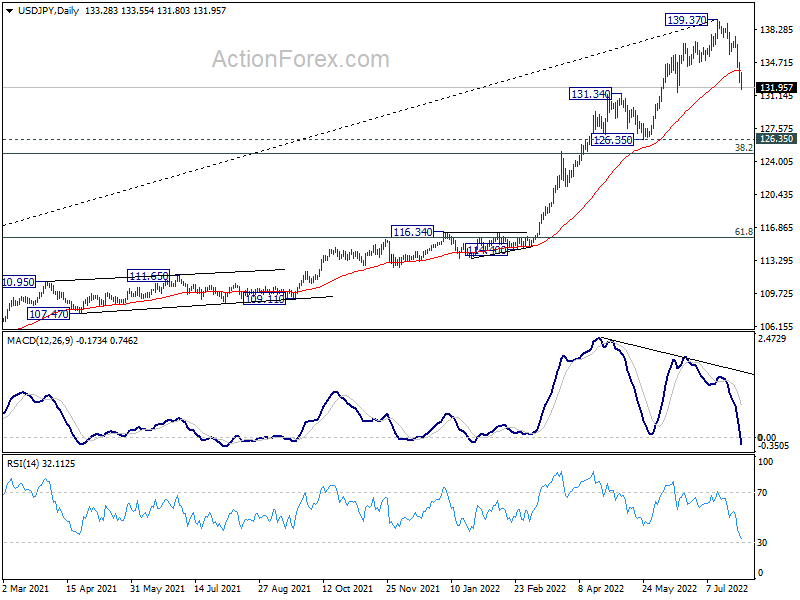
Intraday bias in USD/JPY stays on the downside as fall from 139.37 is still in progress. Deeper decline should be seen to 131.34 resistance turned support and below. But strong support is expected above 126.35 to contain downside, at least on first attempt, to bring rebound. On the upside, above 134.58 minor resistance will turn intraday bias neutral first, and bring some consolidations.
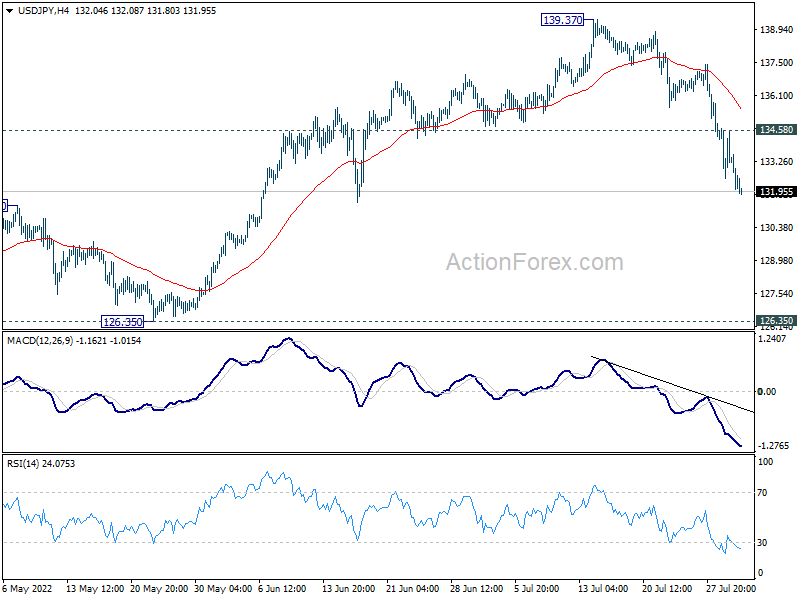
In the bigger picture, a medium term top should be in place at 139.37, on bearish divergence condition in daily MACD. Fall from there could be correcting whole up trend from 101.18 (2020 low). While deeper decline cannot be ruled out, outlook will stays bullish as long as 55 week EMA (now at 121.84) holds. Long term up trend is expected to resume through 139.37 at a later stage, after the correction finishes.
USD/CHF Mid-Day Outlook
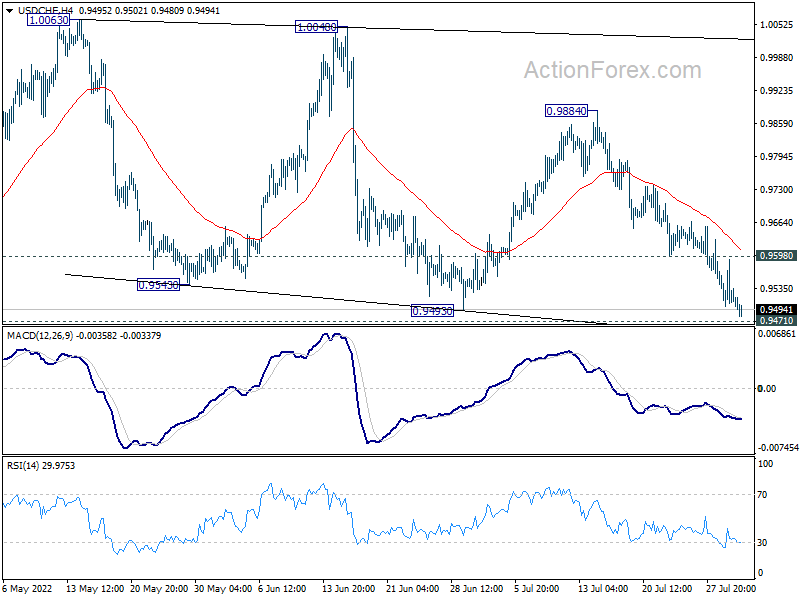
Daily Pivots: (S1) 0.9480; (P) 0.9537; (R1) 0.9572; More...
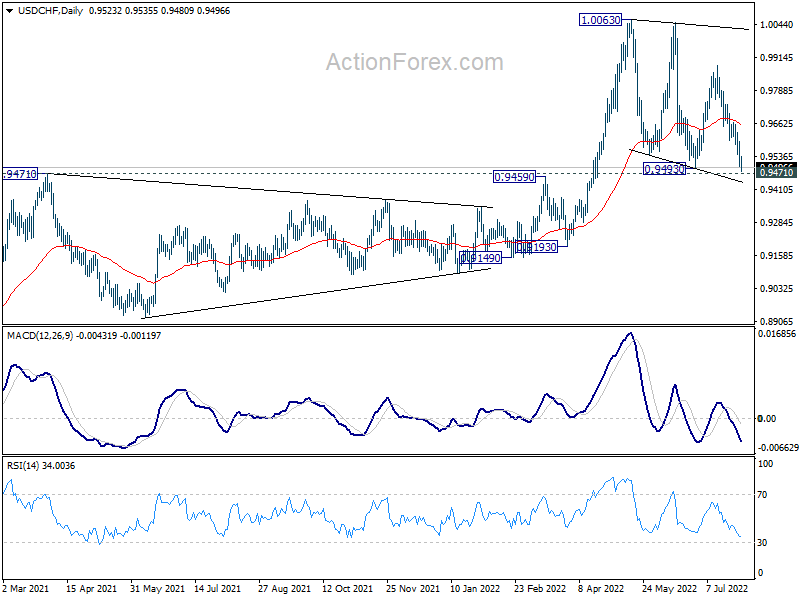
USD/CHF's decline resumes today and focus stays on 0.9471 resistance turned support. Stronger support should be seen from there to bring rebound. On the upside, above 0.9598 minor resistance will turn bias back to the upside for recovery towards 55 day EMA (now at 0.9663) and above. However, sustained break of 0.9471 will carry larger bearish implication and target 0.9193 support next.
In the bigger picture, medium term up trend from 0.8756 (2021 low) is still in progress. On resumption, next target is 1.0342 (2016 high). Sustained break there will resume long term up trend from 0.7065 (2011 low). This will remain the favored case as long as 0.9471 resistance turned support holds. However, firm break of 0.9471 will raise the chance that such up trend is over. Sustained trading below 55 week EMA (now at 0.9424) could bring deeper medium term fall back to 0.9149 support and below.
EUR/USD Mid-Day Outlook
Daily Pivots: (S1) 1.0164; (P) 1.0209; (R1) 1.0272; More...
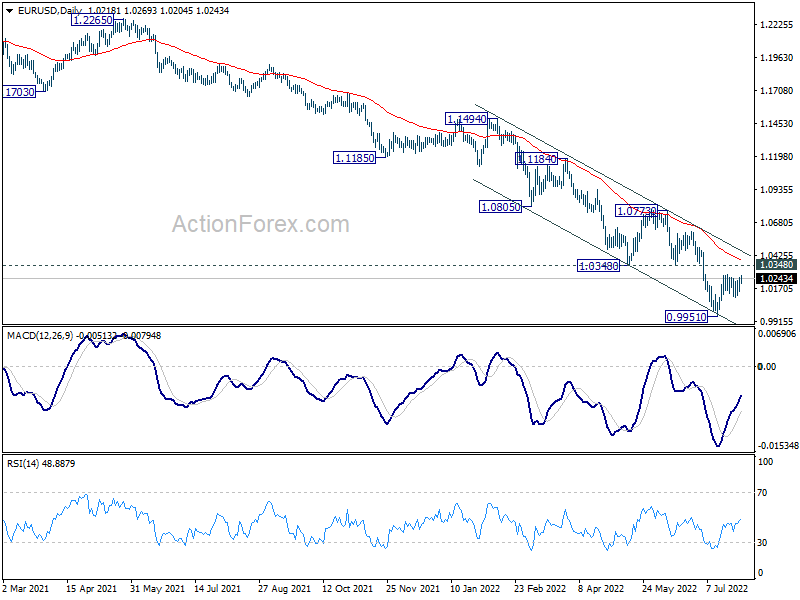
Range trading continues in EUR/USD and intraday bias stays neutral at this point. On the upside, above 1.0277 minor resistance will target 1.0348 resistance first. Break there will target channel resistance at 1.0469. On the downside, break of 1.0095 minor support will bring retest of 0.9951 low instead.
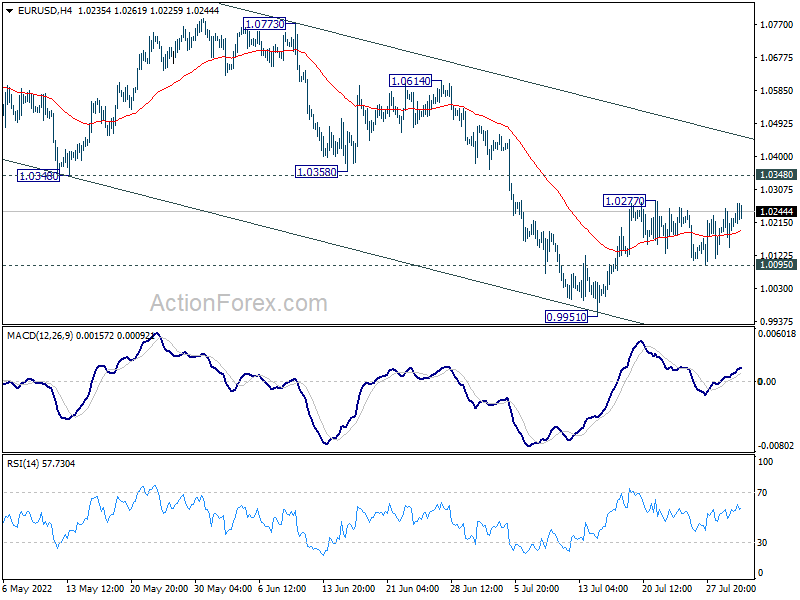
In the bigger picture, down trend from 1.6039 (2008 high) is still in progress. Next target is 100% projection of 1.3993 to 1.0339 from 1.2348 at 0.8694. In any case, outlook will stay bearish as long as 1.0773 resistance holds, in case of strong rebound.
Dollar Selling is Back While Yen Strength Continues
Dollar selling is back today while Yen's strength continues. Euro is also soft as the second worst after the greenback. On other hand hand, Sterling is strengthening with help from buying against Euro. Commodity currencies are mixed for now, with Canadian Dollar turning softer while Kiwi leads Aussie higher. Stock market sentiment is mixed, and will probably need some guidance from this week's important data releases, starting from ISM manufacturing today.
Technically, one interesting development to note is the interplay between Dollar and Euro. EUR/USD is still range bound while both are being pressured elsewhere. GBP/USD and AUD/USD are already resuming near term rebound, after very brief retreat. At the same time, EUR/GBP and EUR/AUD look on the verge of decline resumption. Let's see if the developments in GBP/USD, AUD/USD, EUR/GBP and EUR/AUD would help squeeze EUR/USD out of range, or keep it inside.
In Europe, at the time of writing, FTSE is up 0.20%. DAX is up 0.08%. CAC is up 0.05%. Germany 10-year yield is down -0.009 at 0.805. Earlier in Asia, Nikkei rose 0.69%. Hong Kong HSI rose 0.50%. China Shanghai SSE rose 0.21%. Singapore Strait Times rose 0.85%. Japan 10-year JGB yield rose 0.0026 to 0.186.
UK PMI manufacturing finalized at 52.1, shifted into reverse gear
UK PMI Manufacturing was finalized at 52.1 in July, down from 52.8 in June. That's also the lowest level in 25 months. S&P Global said that output fell in consumer and intermediate goods industries. Job created accelerated as companies addressed staff shortages.
Rob Dobson, Director at S&P Global Market Intelligence, said:
"The UK manufacturing sector shifted into reverse gear at the start of the third quarter. Output contracted for the first time since May 2020, as new order intakes suffered the first back-to-back monthly decreases for two years.
"Rising market uncertainty, the cost of living crisis, war in Ukraine, ongoing supply issues and inflationary pressures are all hitting demand for goods at the same time, while lingering post-Brexit issues and the darkening global economic backdrop are hampering exports.
"With the Bank of England implementing further interest rate hikes to combat inflation, the outlook is beset with downside risks. With this in mind, the continued low degree of optimism among manufacturers is of little surprise."
Eurozone unemployment rate unchanged at 6.6% in Jun, EU at 7.2%
Eurozone unemployment rate was unchanged at 6.6% in June, matched expectations. EU unemployment rate was also stable at 7.2%.
Eurostat estimates that 12.931 million men and women in the EU, of whom 10.925 million in the euro area, were unemployed in June 2022. Compared with June 2021, unemployment decreased by 2.311 million in the EU and by 1.957 million in the euro area.
Eurozone PMI manufacturing finalized at 49.8, sinking into increasingly steep downturn
Eurozone PMI Manufacturing was finalized at 49.8 in July, down from 52.1. That's also a 25-month low. PMI Manufacturing Output Index was finalized at 46.3, down from June's 49.3, a 26-month low.
Looking at some member states, PMI manufacturing in the Netherlands dropped to 20-month low at 54.5. Austria recovered to 2-month high at 51.7. France (49.6, 26-month low), Germany (49.3, 25-month low), Greece (49.1, 19-month low), Spain (48.7, 26-month low), and Italy (48.5, 25-month low) were all in contraction.
Chris Williamson, Chief Business Economist at S&P Global Market Intelligence said: "Eurozone manufacturing is sinking into an increasingly steep downturn, adding to the region's recession risks....
"Production is falling at especially worrying rates in Germany, Italy and France, but is also now in decline in all other surveyed countries except the Netherlands, and even here the rate of growth has slowed sharply...
"The energy crisis adds to the risks that not only will weaker demand and destocking cause manufacturing production to decline at an increased rate in the coming months, but reduced energy supply will act as an additional drag on the sector."
China Caixin PMI manufacturing dropped to 50.4, continued recovery
China Caixin PMI Manufacturing dropped from 51.7 to 50.4 in July, below expectation of 51.5. Caixin said there were softer increases in output and new orders. Employment fell at quicker pace. Input cost inflation slowed notably while prices charged fell again.
Wang Zhe, Senior Economist at Caixin Insight Group said: "In general, the eased Covid situation and restrictions facilitated a continuous recovery in the manufacturing sector in July. Supply and demand continued to improve, with supply stronger than demand. Employment lagged, remaining in contractionary territory. Costs gradually rose, with output prices on the decline, posing challenges for company profits. The market held on to positive sentiment, along with concerns about the economic outlook.
Released yesterday, the official PMI manufacturing dropped from 50.2 to 49.0, back in contraction. PMI non-manufacturing dropped form 54.7 to 53.8.
Japan PMI manufacturing finalized at 52.1, headline masked worrying trends
Japan PMI Manufacturing was finalized at 52.1 in July, down from June's 52.7. That's the lowest level since September 2021. S&P Global said there were renewed reductions in output and new orders. The softest rise in outstanding business 17 months was due to weaker demand. Rising prices and delivery delays led to accelerated stock building.
Usamah Bhatti, Economist at S&P Global Market Intelligence, said: "The headline PMI masked some worrying trends when looking at the underlying sub-indices, which add downside risks for the sector. New order inflows fell for the first time in ten months and at the fastest pace since November 2020, which contributed to a renewed contraction in production levels - the first since February.
"Weaker demand conditions also contributed to reduced pressure on operating capacity. Backlogs of work increased at the softest rate in 17 months... Anecdotal evidence also pointed to an acceleration in stock building activity among Japanese goods producers."
Australia AiG manufacturing dropped to 52.5, manufacturers simply can't meet demand
Australia AiG Performance of Manufacturing Index dropped -1.5 to 52.5 in July. Looking at some details, production dropped sharply by -7.2 to 47.5. Employment dropped -0.9 to 50.1. New orders rose 4.2 to 59.9. Supplier deliveries dropped -4.1 to 47.4. Exports dropped -1.8 to 51.2. Input prices dropped -9.6 to 79.7. Selling prices dropped -3.3 to 64.5.
Innes Willox, Chief Executive of Ai Group said: "The supply and labour constraints afflicting the Australian economy are weighing heavily on the manufacturing sector. Production and employment both fell in July, as manufacturers struggle with chronic labour shortages and supply chain interruptions. New orders rose this month, but our manufacturers simply can't meet this demand without more workers."
GBP/USD Mid-Day Outlook
Daily Pivots: (S1) 1.2078; (P) 1.2162; (R1) 1.2261; More...
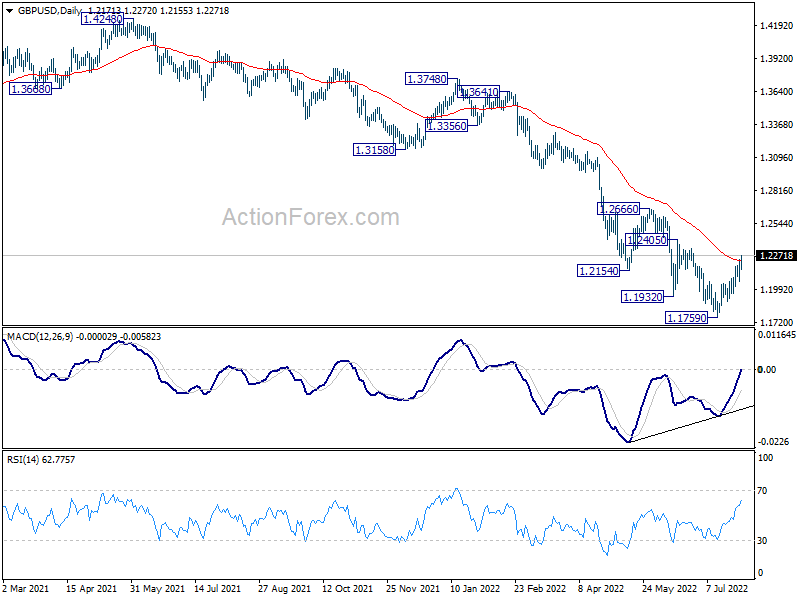
Intraday bias in GBP/USD is back on the upside as rebound form 1.1759 resumed after brief retreat. Further rally should be seen to 1.2405 resistance first. Firm break there will target 1.2666 key resistance next. On the downside, however, break of 1.2062 minor support will argue that the rebound is over, and turn bias back to the downside for retesting 1.1759 low instead.
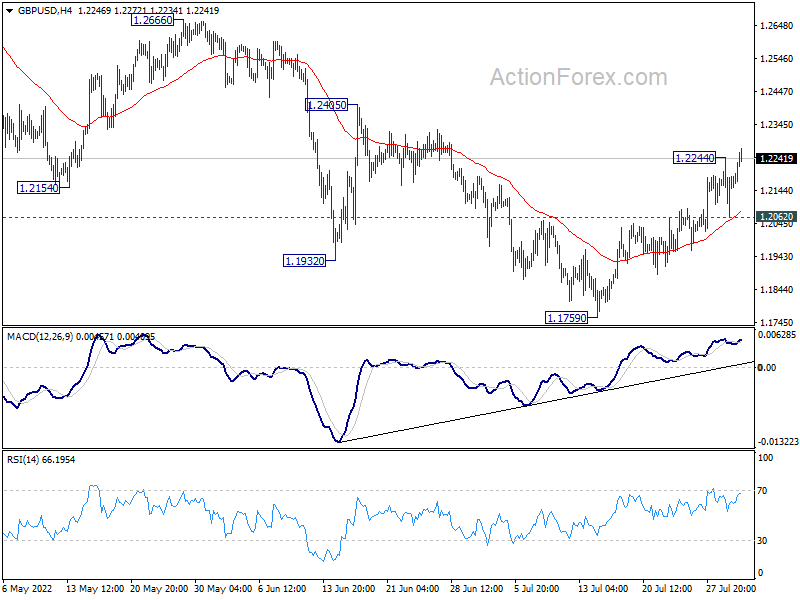
In the bigger picture, fall from 1.4248 (2018 high) could be a leg inside the pattern from 1.1409 (2020 low), or resuming the longer term down trend. Deeper decline is expected as long as 1.2666 resistance holds. Next target is 1.1409 low. However, firm break of 1.2666 will bring stronger rise back to 55 week EMA (now at 1.2957).
Economic Indicators Update
| GMT | Ccy | Events | Actual | Forecast | Previous | Revised |
|---|---|---|---|---|---|---|
| 22:30 | AUD | AiG Performance of Mfg Index Jul | 52.5 | 54 | ||
| 22:45 | NZD | Building Permits M/M Jun | -2.30% | -0.50% | ||
| 00:30 | JPY | Manufacturing PMI Jul F | 52.1 | 52.2 | 52.2 | |
| 01:00 | AUD | TD Securities Inflation M/M Jul | 1.20% | 0.30% | ||
| 01:45 | CNY | Caixin Manufacturing PMI Jul | 50.4 | 51.5 | 51.7 | |
| 06:00 | EUR | Germany Retail Sales M/M Jun | -1.60% | 0.60% | ||
| 07:45 | EUR | Italy Manufacturing PMI Jul | 48.5 | 49.1 | 50.9 | |
| 07:50 | EUR | France Manufacturing PMI Jul F | 49.5 | 49.6 | 49.6 | |
| 07:55 | EUR | Germany Manufacturing PMI Jul F | 49.3 | 49.2 | 49.2 | |
| 08:00 | EUR | Eurozone Manufacturing PMI Jul F | 49.8 | 49.6 | 49.6 | |
| 08:00 | EUR | Italy Unemployment Jun | 8.10% | 8.10% | 8.10% | 8.20% |
| 08:30 | GBP | Manufacturing PMI Jul F | 52.1 | 52.2 | 52.2 | |
| 09:00 | EUR | Eurozone Unemployment Rate Jun | 6.60% | 6.60% | 6.60% | |
| 13:45 | USD | Manufacturing PMI Jul F | 52.3 | 52.3 | ||
| 14:00 | USD | ISM Manufacturing PMI Jul | 52 | 53 | ||
| 14:00 | USD | ISM Manufacturing Prices Paid Jul | 73.5 | 78.5 | ||
| 14:00 | USD | ISM Manufacturing Employment Index Jul | 47.3 | |||
| 14:00 | USD | Construction Spending M/M Jun | 0.20% | -0.10% |
GBP/USD Mid-Day Outlook
Daily Pivots: (S1) 1.2078; (P) 1.2162; (R1) 1.2261; More...
Intraday bias in GBP/USD is back on the upside as rebound form 1.1759 resumed after brief retreat. Further rally should be seen to 1.2405 resistance first. Firm break there will target 1.2666 key resistance next. On the downside, however, break of 1.2062 minor support will argue that the rebound is over, and turn bias back to the downside for retesting 1.1759 low instead.
In the bigger picture, fall from 1.4248 (2018 high) could be a leg inside the pattern from 1.1409 (2020 low), or resuming the longer term down trend. Deeper decline is expected as long as 1.2666 resistance holds. Next target is 1.1409 low. However, firm break of 1.2666 will bring stronger rise back to 55 week EMA (now at 1.2957).