Sample Category Title
Gold pressing 1800 as decline continues
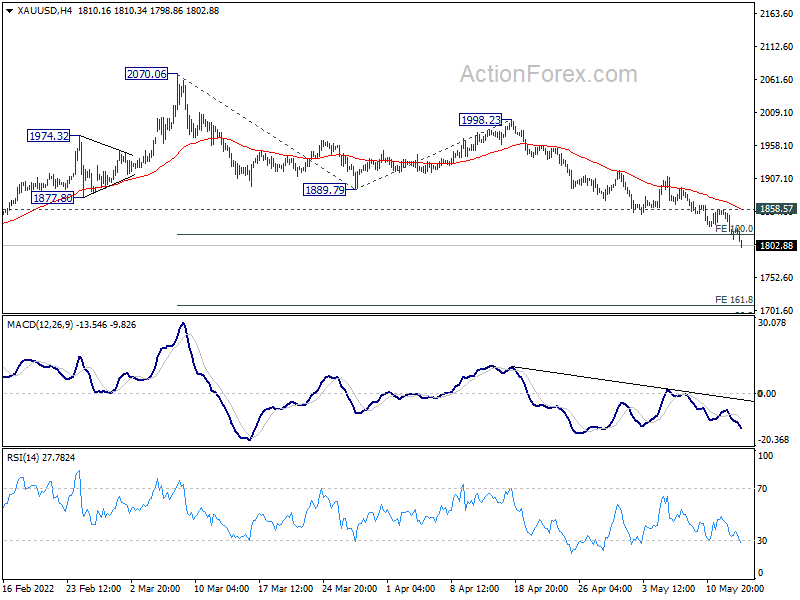
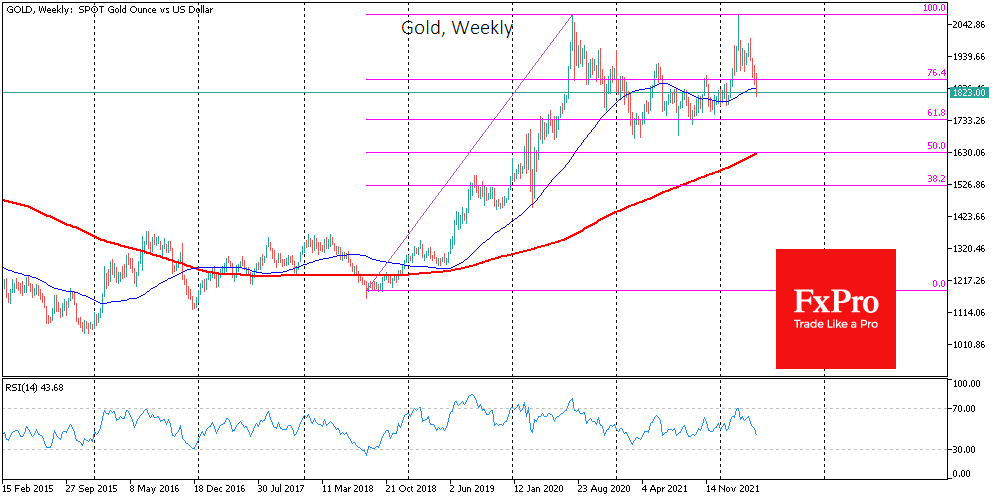
Gold's decline resumes after brief support from 100% projection of 2070.06 to 1889.79 from 1998.23 at 1817.86. It's now taking on 1800 handle and there is no clear sign of bottoming yet. Further fall is expected as long as 1858.57 resistance holds. Next target is 161.8% projection at 1706.55.
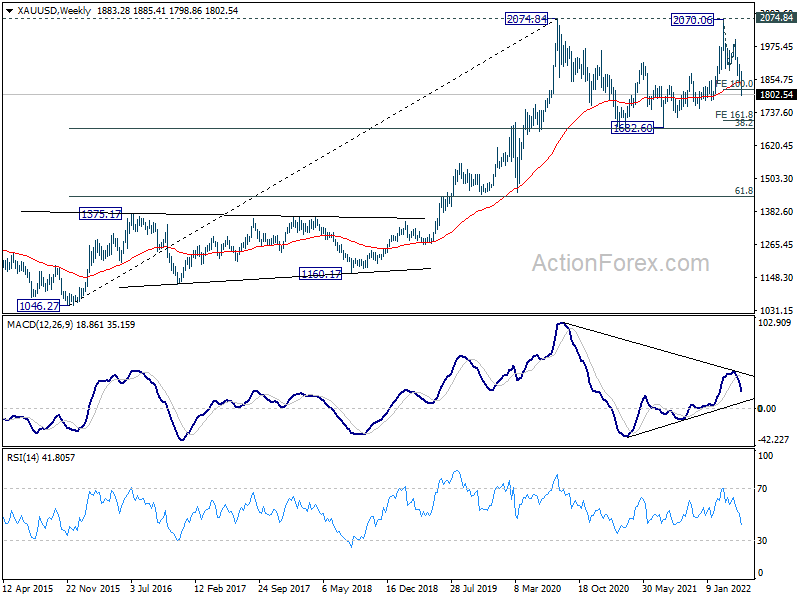
Also, the whole fall from 2070.06 is seen as the third leg of the consolidation pattern from 2074.84 (2020 high). It would eventually target 1682.60 support to complete the pattern.
Euro Under Pressure, Falls Below 1.04
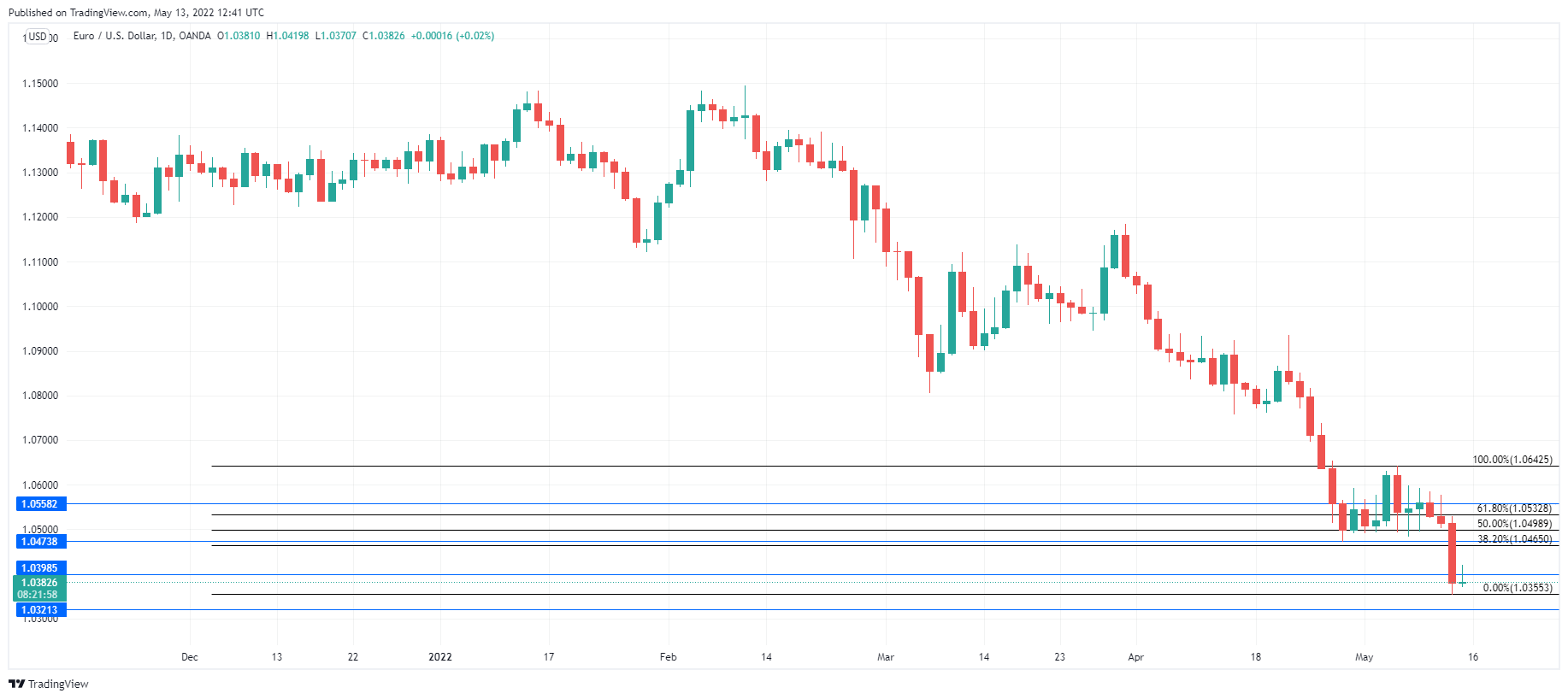
The euro has stabilized on Friday, after a dreadful Thursday in which EUR/USD fell 1.26%.
Russian announces sanctions
The euro continues to struggle and is trading at lows last seen in January 2017. The Ukraine war has taken a bite out of the eurozone economy and sent the euro tumbling. The latest development weighing on the euro was Russia’s announcement of sanctions on some European gas importers, at a time when the EU is trying to garner support for a ban on Russian oil. Germany has said that it could manage without Russian oil, but the main stumbling block to the ban appears to be Hungary, which is very dependent on Russian energy supplies. The euro has broken through major support lines at 1.08 and 1.05, and if it breaches the 1.03 line, we could see move towards parity with the dollar.
The wobbly euro hasn’t received any support from the ECB, which has been slow to shed its dovish policy. After years of monetary easing, ECB members are becoming more vocal about the need for tighter policy, and ECB President Christine Lagarde said earlier this week that QE would end in the third quarter, and a rate hike would follow “some time” after that. We could see a rate increase as early as July, although it’s unclear if the ECB will launch a rate cycle with a hike of 25 or 50 basis points.
The US dollar has shined against the majors, buoyed by an aggressive Federal Reserve. The April US inflation report indicated that expectations of an inflation peak were premature, as CPI fell only slightly, from 8.5% to 8.3%. Fed Chair Powell has signalled that the Fed will deliver 0.50% rate increases in June and July, as the Fed is focused on lowering inflation, which has hit a 40-year high. There has been some talk of a 0.75% hike, but it is far more likely that the Fed will stick with 0.50% moves, hoping that they can do the trick and wrestle down inflation.
EUR/USD Technical
- 1.0398 has switched to resistance. It is a weak line and could see further action during the day. Above, there is resistance at 1.0473
- There is support at 1.0321 and 1.0246
British Pound’s Woes Continue
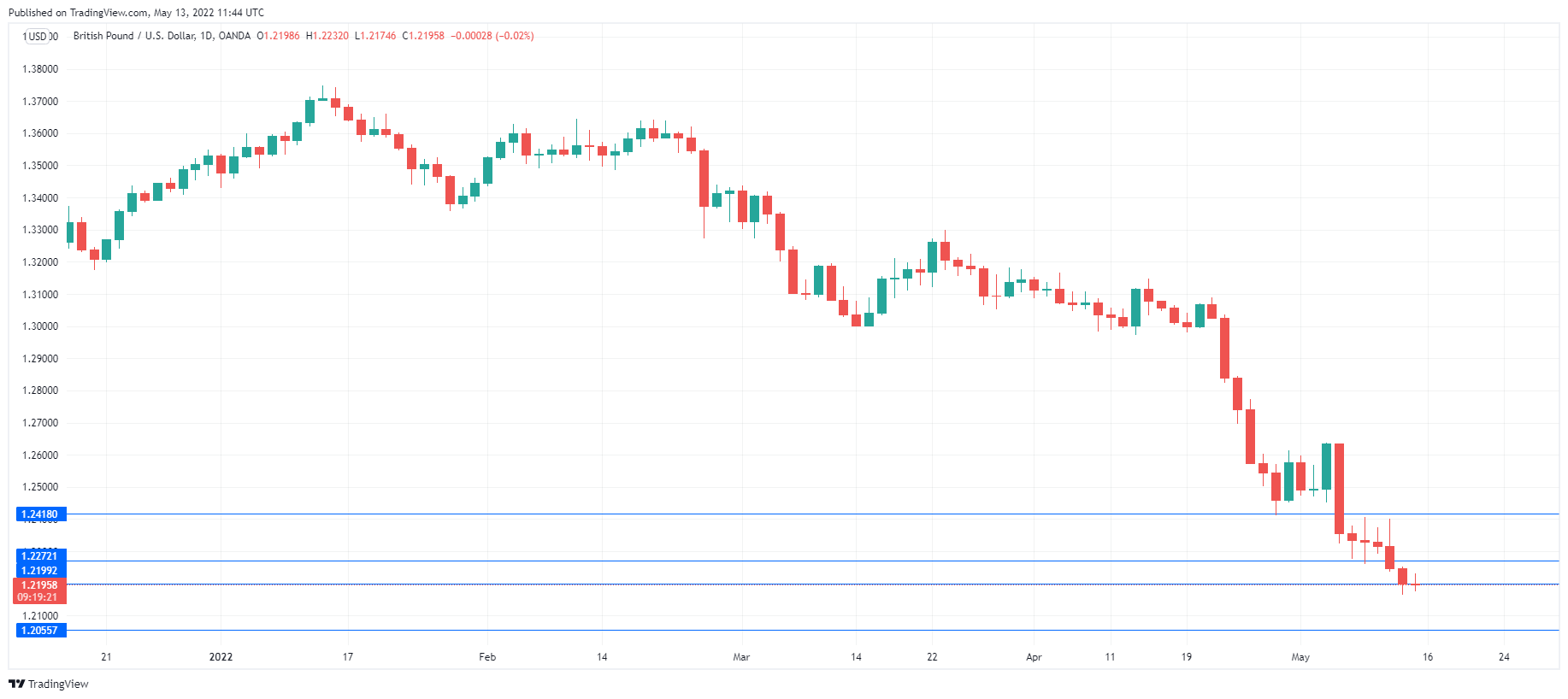
The British pound can’t seem to find its footing. GBP/USD hasn’t had a daily winning session since May 4th and closed on Thursday below the 1.22 line, for the first time since May 2020. In the European session, the pound is trading quietly at the 1.22 line.
Recession fears, negative growth weighing on sterling
The UK treated the markets to a data dump on Thursday, but the news was not positive. UK growth for Q2 showed a 0.8% gain, down sharply from 1.3% in Q4 of 2020 and missing the 1.0% estimate. In March, the economy contracted by 0.1%, compared to a 0.1% gain in February and shy of the estimate of 0.0%. Investors never like to hear the phrase ‘negative growth’ and the March GDP report pushed the pound lower on Thursday. There was more bad news as Industrial Production, Manufacturing Production and Business Investment all slowed down and posted negative readings.
The UK continues to grapple with spiralling inflation, and the BoE has warned that things could get even worse. CPI hit 7% The BoE has raised rates to 1.0%, a 13-year high, but it will take time for higher interest rates to take a bite out of inflation. At last week’s policy meeting, the central bank warned that inflation could top 10% and there was the danger of a recession. The pound tumbled over 2% in response and has fallen another 125 points since then. Risk is tilted to the downside for the pound, which has tumbled about 7% since the beginning of April.
Fed’s Powell confirmed by Senate
Fed Chair Powell was overwhelmingly nominated for a second term on Thursday by the US Senate. Powell appears committed to delivering 0.50% rate hikes at the next two meetings, although there has been talk of a super-size 0.75% hike in order to curb soaring inflation. US inflation finally slowed in April, but the reading of 8.3% (8.5% prior) was hardly what the markets were looking for, and talk of an “inflation peak” proved to be premature.
GBP/USD Technical
- 1.2199 remains under pressure in support. Below, there is support at 1.2056
- GBP/USD faces resistance at 1.2272 and 1.2418
EUR/USD Bears May Accelerate on Break of 2017 Kow
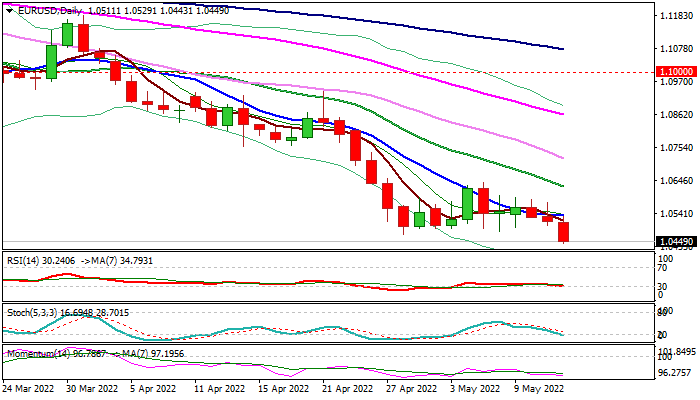
The Euro is consolidating within a tight range on Friday after a 1.3% drop previous day, as oversold daily studies warn of price adjustment, which is likely to be limited as overall bearish bias is intact.
The pair is on track for a weekly loss of approx. 1.5% that will mark the sixth straight week in red.
Thursday’s fall to new five-year low (1.0354) increased pressure on 2017 low at 1.0340, violation of which would spark fresh bearish acceleration below 1.0300 support.
Upticks should be ideally capped under 1.0463 (Fibo 38.2% of 1.0648/1.0354 bear-leg), while only break above daily Tenkan-sen (1.0497) would ease immediate bearish pressure.
Res: 1.0419; 1.0463; 1.0497; 1.0508
Sup: 1.0354; 1.0340; 1.0300; 1.0235
ECB Centeno: Necessary and desirable to normalize monetary policy
ECB Governing Council member Mario Centeno said normalization of monetary policy was "necessary and desirable". But such normalization must be done gradually. He urged not to "over-react" to inflation rising across Europe or risk penalizing economic growth.
"Although inflation remains high in 2022, there are no structural reasons why it should not converge towards the medium-term objective as imbalances are gradually resolved and uncertainty dissipated," Centeno said. "There are currently no structuring signs of de-anchoring inflation," even though the balance of risks around inflation is skewed upward" after Russia's invasion of Ukraine.
Second-order effects of wage pressures was "an additional risk which needs close and continued monitoring", he added.
BoJ Kuroda: Important to underpin economic activity with powerful monetary easing
BoJ Governor Haruhiko Kuroda told the parliament, "it's important for currency rates to move stably reflecting economic and financial fundamentals... The recent sharp, short-term fluctuations in the yen are undesirable, as it heightens uncertainty and makes it harder for companies to set business plans."
"The economy is in the midst of a recovery and now faces headwinds from rising commodity prices," Kuroda said. "It's therefore important to underpin economic activity with powerful monetary easing."
Separately, Kuroda also said in a speech, "the coronavirus pandemic is a major risk that could further hurt Japan's economy." As such, "it's appropriate to maintain ... the dovish bias of our guidance for the time being."
"For inflation to heighten as a trend, Japan must see a shift from inflation caused by energy prices, to one that is driven by increasing corporate profits and wage growth," he said.
Gold Fails Essential Support, But Bulls Still Have a Chance
A sell-off in the equity market and a new wave of flight to the dollar on Thursday provided the perfect combination to knock out gold, which slipped to $1810 in thin trading on Friday morning, falling to its lowest level since early February.
Right now, it’s up to gold to decide whether we see a double top formation or whether the bulls are gaining strength and liquidity ahead of a new multi-month rising momentum.
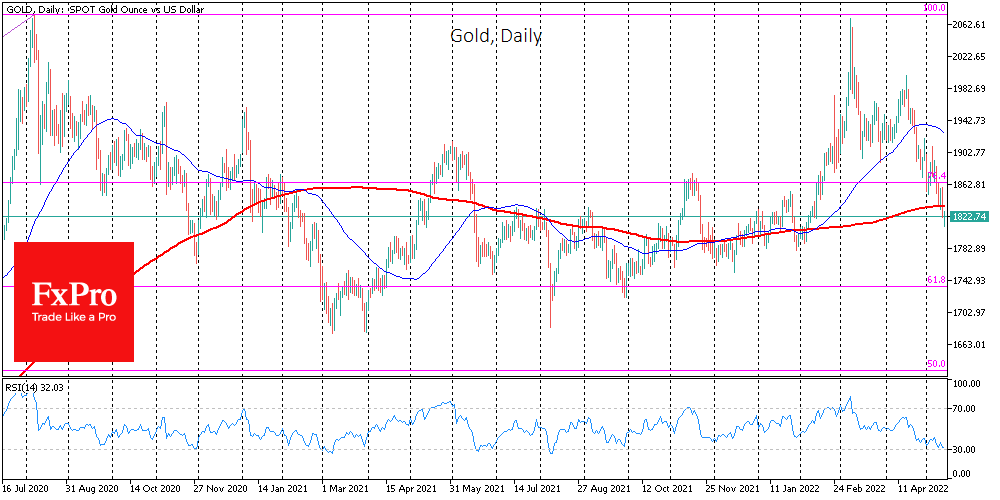
The current decline in the price makes us keep a close eye on further developments. Yesterday, gold took a sharp plunge under the 200 SMA, which is often a bearish factor for the instrument. A consolidation of the week under $1830 would reinforce that signal.
This would open the way for another roughly 25% drop into the $1350 area, the area of the 2015-2018 highs.
If we see an uptick in buyers’ in the hours and days ahead, we could say that gold is in a correction. Potentially, a reversal to the upside from these levels could signal the start of a new wave of long-term growth, the first impulse of which was in 2018-2020, followed by a prolonged wide side trend. A potential bull target, in this case, could be the $2500 area.
Profit-Taking Pauses Bears but Dow Still on Track for Big Weekly Loss
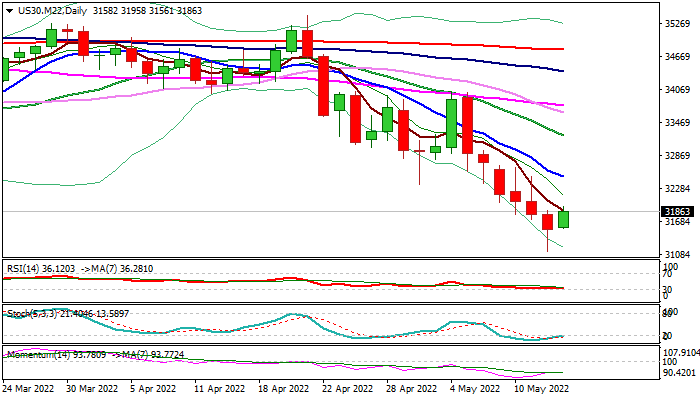
Bears are taking a breather on Friday, as traders collects profits after a sharp fall this week (the index was down over 3% during Mon/Thu period.
Stock markets were slashed by worries of high inflation and aggressive monetary policy tightening, as Fed signaled a series of rate hikes in coming months to contain the raging inflation.
Today’s bounce from new multi-month low (the lowest since Feb 2021) eases immediate downside pressure, but the Dow is still on track for strong weekly loss ( the sixth consecutive weekly close in red).
Corrective action was signaled by Thursday’s long-tailed daily candle and oversold conditions, with fresh bulls trading above initial resistance at 31824 (Fibo 23.6% of 34017/31146 bear-leg), but needs more work at the upside and violation of pivotal Fibo barrier at 32243 (38.2%) to generate initial reversal signal.
Turbulent geopolitical and economic conditions are likely to keep traders away from risky assets, suggesting that current correction is likely to be limited and offer better selling opportunities, with the base of thick weekly cloud (32781) expected to cap and keep larger bears in play.
Res: 31958; 32152; 32243; 32501
Sup: 31678; 31561; 31456; 31338
New Zealand Dollar Stabilizes
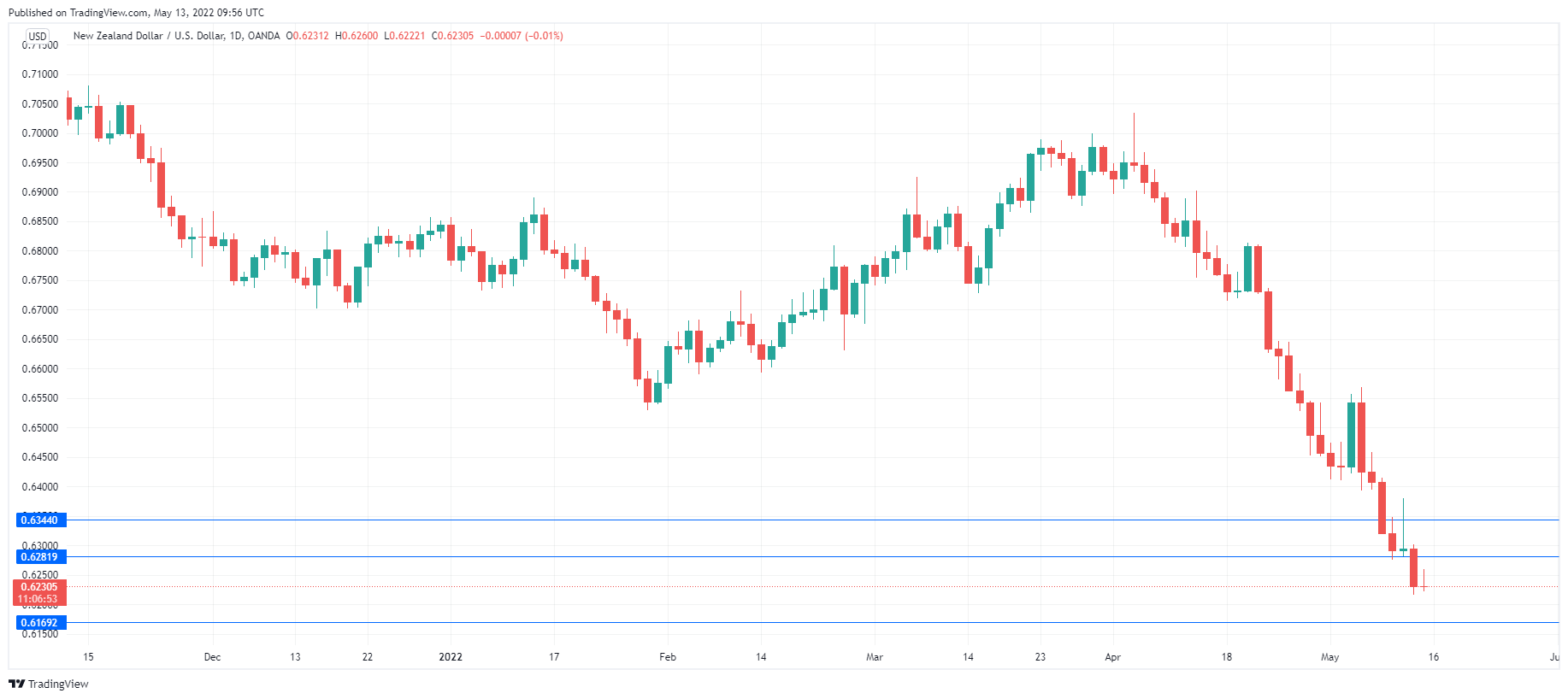
The New Zealand dollar is headed for its seventh consecutive losing week. NZD/USD has declined 2.51% this week and the currency is trading at July 2020 lows. The currency plunged 1.01% on Thursday but has steadied on Friday and is trading at 0.6244.
New Zealand’s Manufacturing Index slowed to 51.2 in April, down from 53.8 in March. The reading didn’t have much impact on the New Zealand dollar, which remains under pressure after a sharp drop on Thursday. This marked the lowest level since August 2021, and the index has fallen close to the 50.0 level, which separates contraction from expansion. Manufacturers continue to point to labour shortages and supply chain disruptions as key problems for the sector, along with Covid-19.
The slowdown in manufacturing follows Inflation Expectations for Q2, which accelerated for an eighth straight month. The gain was admittedly small (3.29%, up from 3.27%), but the RBNZ has stated it would act to ensure that soaring CPI does not become embedded into inflation expectations. I expect the RBNZ to continue to raise rates aggressively until inflation expectations show signs of easing, which could take several months. The RBNZ next meets on May 25th and is widely expected to hike rates by 0.50%, which would bring the Official Cash Rate to 2.0%.
Fed’s Powell sticks to 0.50% stance
The Fed has signalled that it plans to deliver 50-bps increases in June and July, but the markets aren’t dismissing the possibility of a massive 0.75% hike, especially after US inflation remained higher than expected in April, at 8.3%. Hopes of an “inflation peak” were dashed, and the Fed’s aggressive stance appears justified in order to wrestle down red-hot inflation. Fed Chair Powell was overwhelmingly nominated for a second term on Thursday by the US Senate. Powell stuck to the 0.50% script overnight, which has helped soothe market nerves about a 0.75% move.
NZD/USD Technical
- NZD/USD continues to break below support levels as it loses ground. There is support at 0.6169 and 0.6066
- There is resistance at 0.6281 and 0.6344
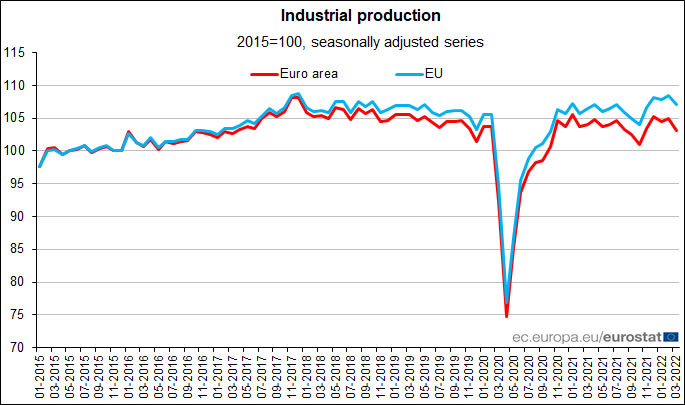
Eurozone industrial production dropped -1.8% mom in Mar, EU down -1.2% mom
Eurozone industrial production dropped -1.8% mom in March, slightly worse than expectation of -1.7% mom. Production of capital goods fell by -2.7%, non-durable consumer goods by -2.3%, intermediate goods by -2.0% and energy by -1.7%, while production of durable consumer goods rose by 0.8%.
EU industrial production dropped -1.2% mom. Among Member States for which data are available, the largest monthly decreases were registered in Slovakia (-5.3%), Germany (-5.0%) and Luxembourg (-3.9%). The highest increases were observed in Lithuania (+11.3%), Estonia (+5.1%), Bulgaria and Greece (both +5.0%).