

Sample Category Title
Forward Guidance: Canada’s Inflation Rate Boiled Again in April
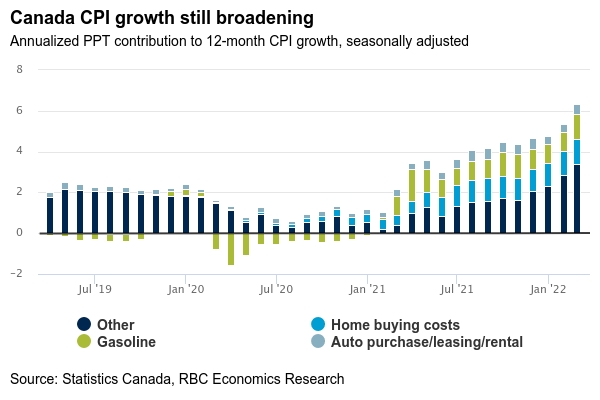
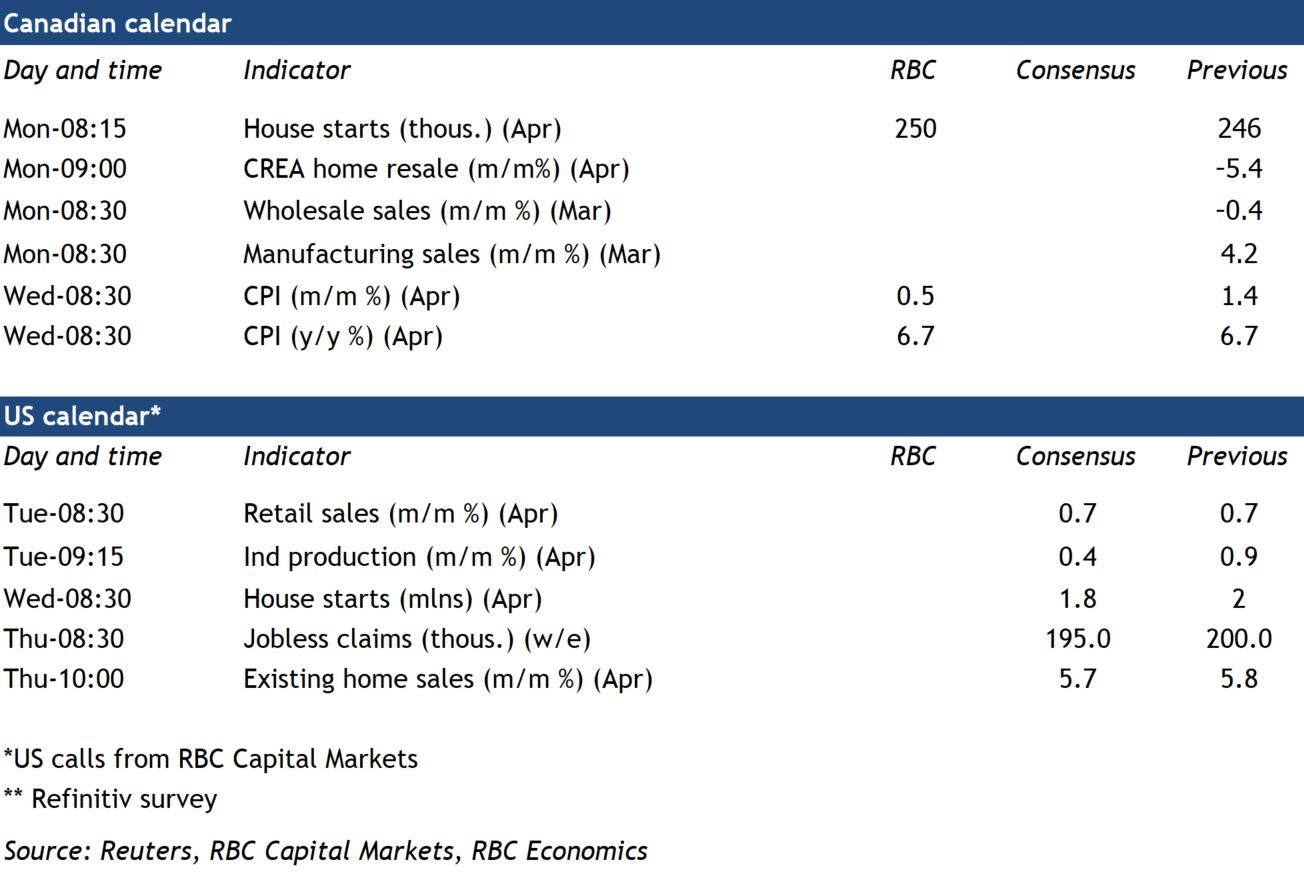
Canada’s CPI report will be the headline event next week as inflation continues to roil the economy. We look for year-over-year price growth to hold steady at 6.7% in April. That would match March’s reading and would still be the highest level since the start of inflation targeting in 1991. Energy price growth likely slowed as oil prices retreated from a dramatic spike at the onset of the Russian invasion of Ukraine. The rapid increase in home prices—which has also been disproportionately impacting the CPI growth rate—is expected to have slowed too based on early data from local real estate boards. But food price growth probably accelerated as rising input and transport costs filtered through supply chains. A spike in wheat prices tied to the war already pushed pasta prices higher in March. And inflation pressures have continued to broaden over a wider array of goods and services.
The reopening of the hard-hit travel and hospitality sector will likely add more fuel to inflation fire. Mobility has increased in recent weeks, and our own card spending data shows travel and tourism activity bouncing back. That’s good news for businesses, but makes some sharper price growth within those sectors more likely. Firm inflation (and strong labour markets) continue to reinforce the need for the Bank of Canada to accelerate its rate hiking cycle. We look for another 50 basis point increase in the overnight rate in June—adding to the 75 basis points of hikes over March and April.
Week ahead data watch:
- Statscan preliminary estimate for Canadian manufacturing sales showed a 1.7% increase in March. Strong auto manufacturing production leaves some upside risk to that call.
- Canada’s real estate resale market will likely show some moderation in home buying activity based on early local market reports. Price growth likely slowed with an outright decline already reported in the Toronto market.
- US Industrial activity is expected to have edged higher in April despite ongoing global supply chain disruptions. We look for retail spending to rise as well, boosted by higher auto sales.
Week Ahead – Data Avalanche to Keep Spotlight on Rate Hike Expectations
It’s going to be a full-on week for economic indicators with a barrage of data due that should keep the guessing game going on how much central banks will tighten this year. Australia and the UK report jobs numbers, the latter will also release CPI readings along with Canada and Japan. Retail sales will be watched in the UK and US, as well as in China, while the Q1 GDP estimate will be important in Japan.
China slowdown fears will likely intensify
The week will kick off with the monthly dump of data out of China, which might attract more attention than usual this time as the lockdown measures introduced in March in the country’s largest city – Shanghai – have yet to be lifted. Moreover, the shutdowns have now spread to Beijing and the government does not seem to be ready to abandon its zero-Covid policy that many see as unsustainable.
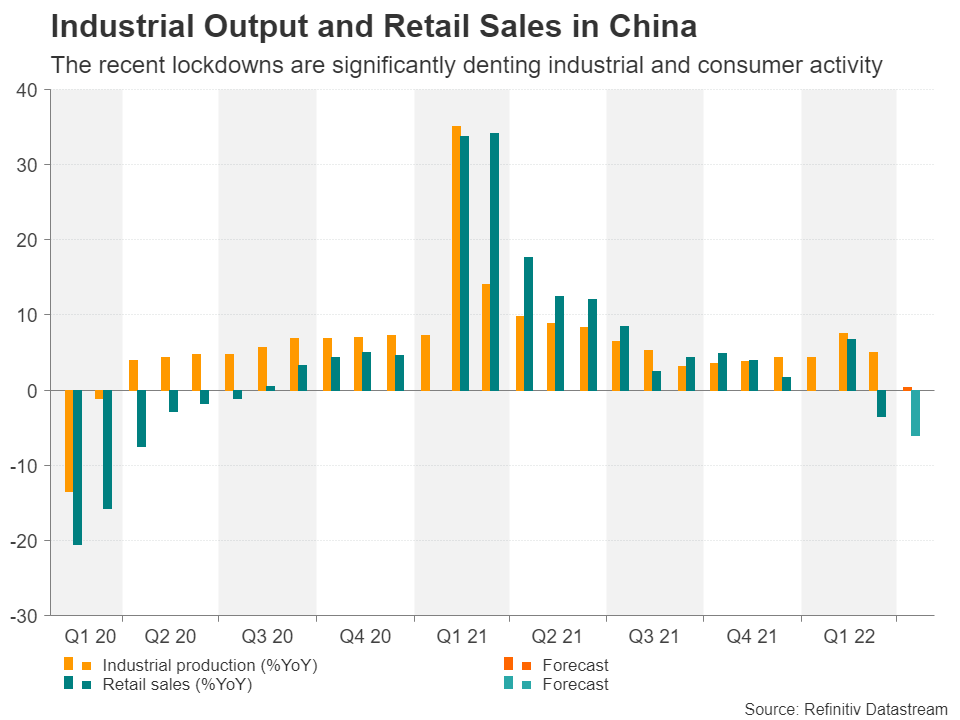
With growth prospects fading fast, investors are increasingly concerned that a sharp slowdown in China will drag on growth in the rest of the world where interest rates are on the rise and consumers are feeling the pinch of higher living costs. According to the forecasts, next week’s releases will only add to the gloom.
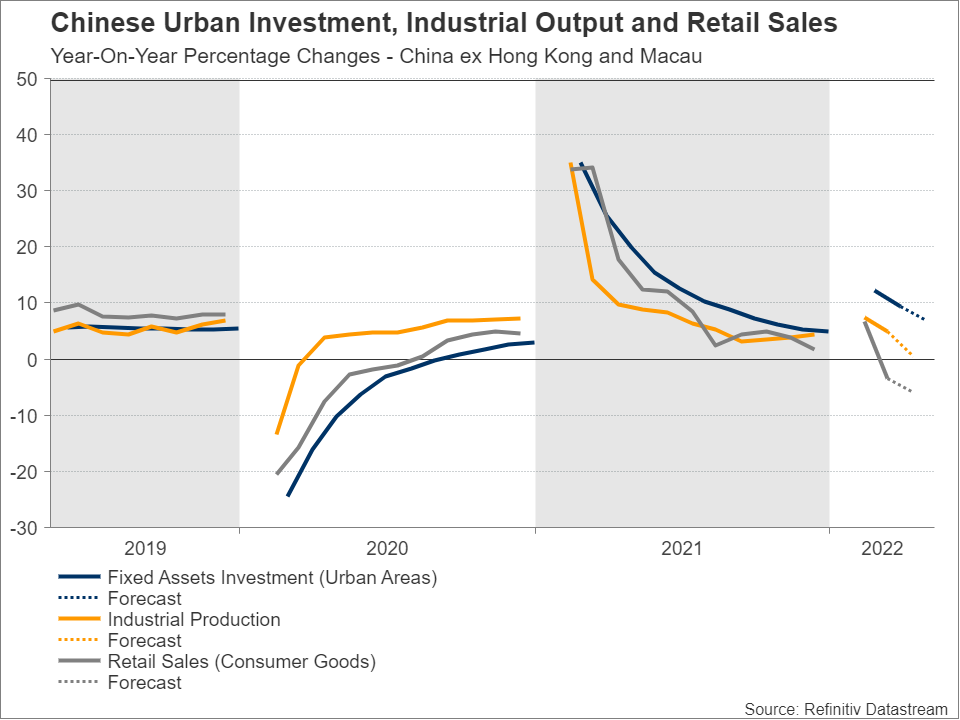
Industrial output growth is expected to have been near stagnant in April, cooling from 5.0% year-on-year in March to just 0.4% y/y. More worryingly, consumer spending likely slumped in April as retail sales are projected to have fallen by 6.1% y/y. The only bright spot is fixed asset investment, which is expected to have held up at a relatively healthier reading of 7.0% y/y between January and April.
On the plus side, however, a poor set of figures could prompt the People’s Bank of China to cut its key loan prime rates (LPR) when it meets on Friday. The Bank had last reduced its one- and five-year LPRs in January and generally prefers to boost lending using a combination of other tools so another cut might not be on the cards so soon.
Elections and jobs on the aussie’s radar
Doubts about China have taken a toll on the Australian dollar as a weaker Chinese economy would be bad news for Australian exporters of resources. However, domestic data might be more supportive of the aussie.
Australia's employment report for April is out on Thursday and a day earlier, the wage price index for the first quarter will be scrutinized for any signs that the tight jobs market is pushing up labour costs.
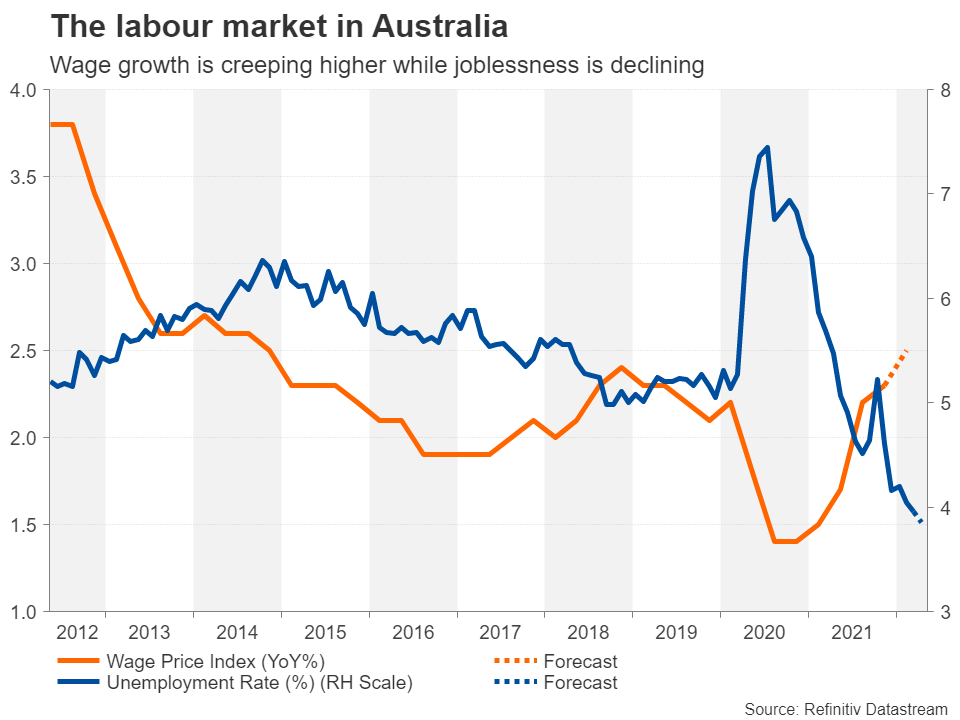
The RBA surprised many last week when it raised its cash rate by 25 basis points instead of 15 bps so strong jobs numbers could fuel speculation of another aggressive hike at the next meeting in June. But before then, there is the tiny detail of the federal election on May 21 that traders will be keeping an eye on.
The opposition Labor party has recently widened its lead with the ruling Liberal-National coalition in the polls. Labor has said it would not repeal the final stage of the coalition government’s tax cuts that are targeted at the wealthy and due to take effect in 2024, while the jump in inflation that is pressuring disposable incomes is likely hurting incumbent Prime Minister Scott Morrison’s popularity.
Yet, with not a lot separating the two parties when it comes to economic policies, the widening gap in polls may not be such a bad thing as it would at least prevent a hung parliament, which is probably the worst outcome for the aussie.
Across the Tasman Sea, the New Zealand dollar will mostly be taking its cues from the global risk tone, though the 2022 budget set to be unveiled on Thursday might also spur some reaction for the kiwi as the government might seek to rein in spending.
Pound may not find much love from UK data
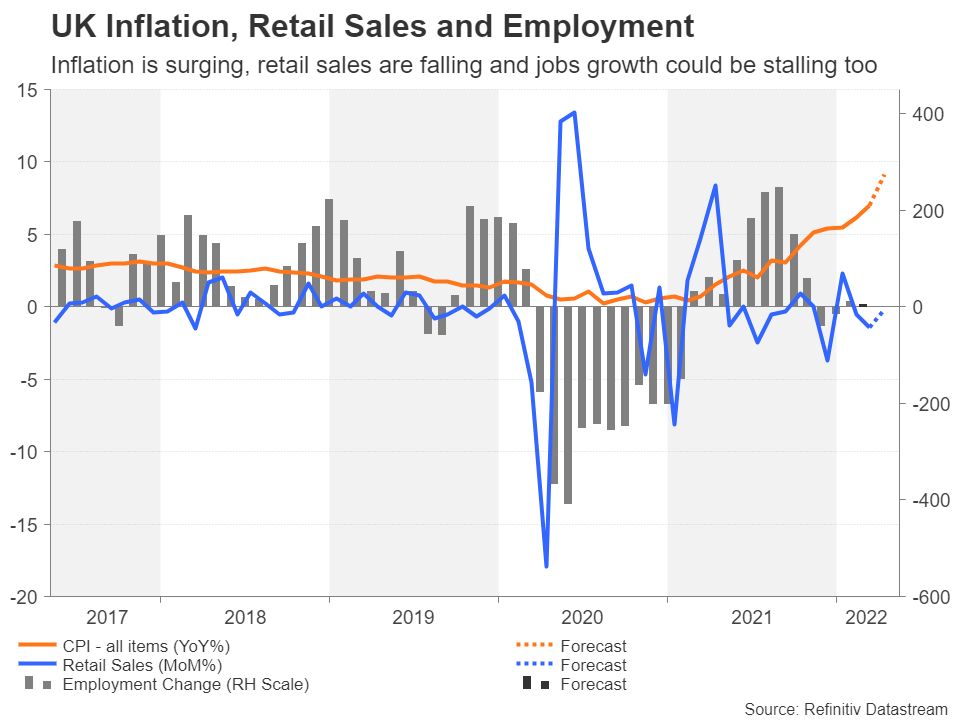
The pound has taken quite a bashing over the last month, with its year-to-date losses versus the US dollar approaching 10%. Its woes deepened after GDP numbers showed that the UK economy contracted in March, in what could be the start of a major downturn. Investors will get another chance to gauge the health of the economy next week when employment, inflation and retail sales figures are due on Tuesday, Wednesday and Friday, respectively.
The consumer price index probably soared to 9.1% y/y in April as higher energy prices took effect for many households, likely adding pressure on the Bank of England to do more to contain the inflationary buildup. The BoE is worried about tightening too fast amidst the weakening economic backdrop. The April retail sales report should reveal how severe the squeeze on consumers was as wage growth has been unable to keep up with the pace of inflation, and now there are signs that hiring could be slowing too.
Another headache for sterling is the escalation in tensions between London and Brussels over Northern Ireland. The UK government is unhappy about the lack of progress in the talks aimed at improving the Northern Ireland protocol and is threatening to ditch border checks over the Irish Sea as required by the Brexit treaty. Unilateral action by the UK risks the EU suspending the Brexit trade deal in retaliation.
Risk sentiment to drive loonie and yen as April CPI eyed
Inflation will be in focus in Canada and Japan too. Canada’s 12-month CPI rate hit 6.7% in March and the Bank of Canada was one of the first to join the 50-bps bandwagon. Another strong print on Wednesday for April would reinforce expectations that the BoC would again hike by 50 bps at its next meeting. Although this may not provide much of a boost to the Canadian dollar, which has fallen victim to the risk-off flows.
The Bank of Japan is one of the few central banks that can claim inflation has yet to overshoot the universally accepted 2% target. However, that could all change on Friday when core CPI is forecast to have jumped from just 0.8% to 2.1% y/y in April.
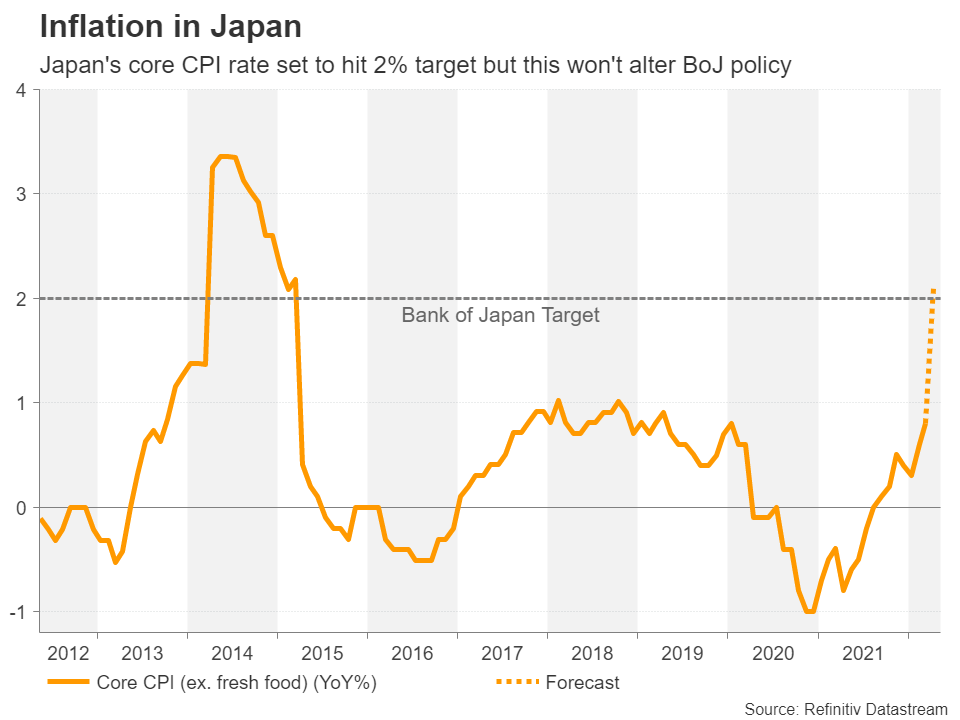
Prior to the CPI report, the GDP estimate for Q1 will be released on Wednesday. Japan’s economy is expected to have shrunk in the first quarter when business activity was curbed by the Omicron outbreak. Other data will include wholesale prices on Monday, as well as trade figures and machinery orders on Thursday.
The yen has benefited from the increased demand for safe havens when markets turned jittery during May on the dimming outlook for growth and fears of high inflation persisting for far longer than what is currently anticipated.
US retail sales to be dollar’s primary focus
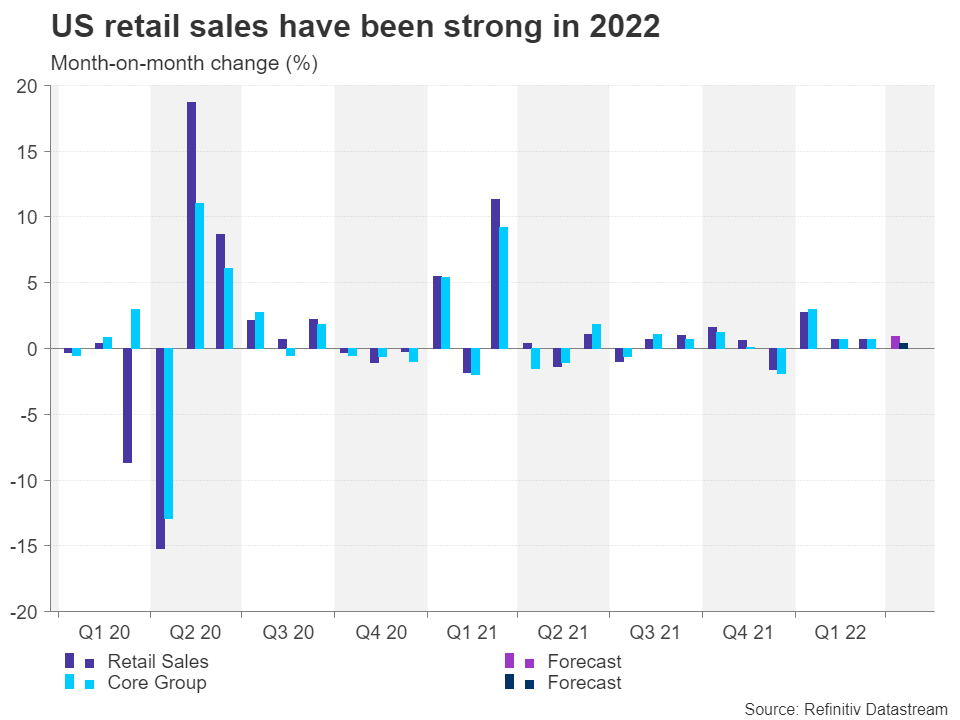
Finally in the United States, the highlight will be the retail sales numbers out on Tuesday. Retail sales growth is forecast to have quickened 0.9% month-on-month in April. Industrial output data are due the same day and a solid print of 0.4% m/m is expected. If confirmed, they would help alleviate concerns about a slowdown in the US economy and keep the Fed on track to hike rates by 50 bps several more times this year.
However, amidst the warnings of a correction in America’s housing market, the latest housing starts and building permits (both out on Wednesday), and existing home sales (Friday) will also be of interest for investors.
Regional Fed manufacturing surveys will be watched too; the New York Fed’s Empire State manufacturing index is up first on Monday and the Philly Fed’s equivalent gauge follows on Thursday.
The dollar is likely to draw further bullish support if there are no troubling trends in the US economic barometers that are scheduled for the next seven days. Although, regardless of any surprises in the upcoming data or any fresh panic episodes in the markets, a small pullback is looking overdue for the greenback after the recent strong gains.
China’s Data May Cause More Drama Next Week
Chinese data may kick off more drama in global markets during the Asian session on Monday at 03:00 GMT as urban investment, industrial output, retail sales, and new yuan loans are expected to falter for the second consecutive month, exacerbating fears of economic stagnation in the second quarter. Such news could further batter stocks and currencies such as the Chinese-sensitive Australian dollar, which are already facing their longest losing streak since 2008.
Growth fears intensify
Growth jitters resurfaced at full swing this month as central bankers started to talk about recession just after beginning on their inflation fighting course. Discouragingly, higher-than-expected US CPI figures telegraphed this week that inflation may not easily go away and will likely keep weighing on consumers’ pockets, with stocks, risk currencies and cryptos all plummeting in response, while the drop in bond yields and the impressive rebound in the safe-haven Japanese yen confirmed the flight to safety as well.
China’s economy is becoming another headache. Its late zero-Covid lockdown measures just popped up at the wrong time, alongside the war in Ukraine and a fragile domestic real-estate sector. That has spread pessimism that the already damaged supply chain links could inevitably lead the global economy to a cliff edge in the second quarter despite the PBOC’s extensively accommodative monetary strategy.
Chinese data could trigger the next sell-off
Monday’s data releases for the month of April could be more evidence to China’s eggshell-like economic landscape. Retail sales, which are a major proxy for consumption, are expected to almost double their March decline to -6.0% y/y from -3.5% previously. Stats on new yuan loans may echo the weakness in demand as the amount is forecast to half to 1.5bln in April. Likewise, the squeeze in industrial output is forecast to pick up steam for the second consecutive month, falling sharply from 6.0% y/y to 0.5% and urban investment may face another pullback to 7.0% y/y from 9.3% in March.
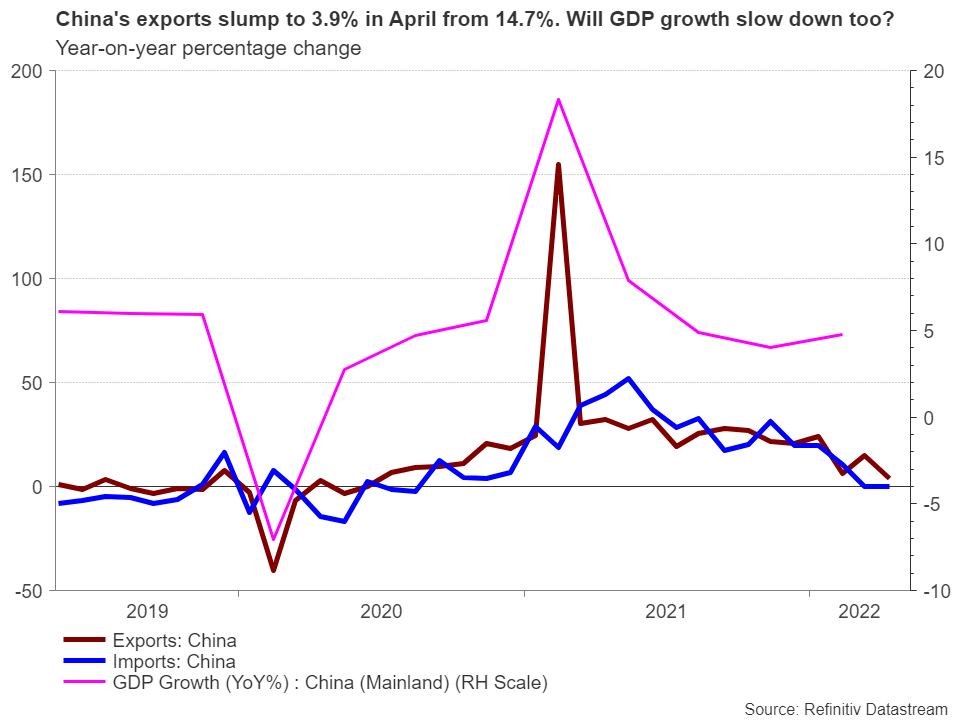
Recent stats have also revealed a slowdown in China’s exports in April that continued to worsen, rising at their weakest pace in two years thanks to the onerous restrictions in the country’s biggest trade hub Shanghai. Moreover, business sectors returned to contraction in the same month according to PMI numbers. Hence, another row of disappointing data releases could reasonably defend growth concerns at the start of next week, potentially activating fresh selling, especially in the Australian dollar, which is heavily dependent on China’s economic outlook.
Where next for aussie?
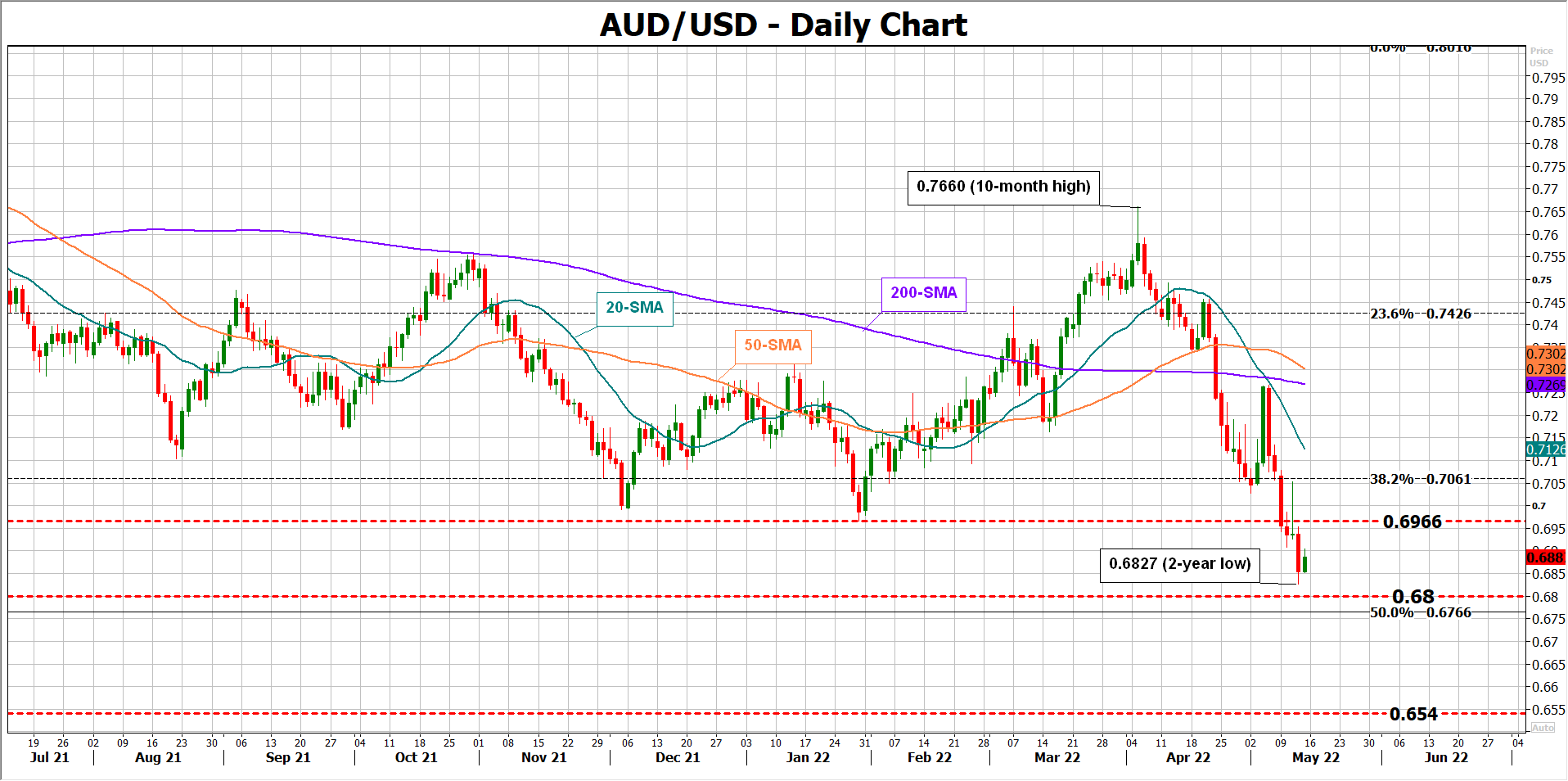
The aussie has fully erased its 2022 gains, re-activating its 2021 broad downtrend this week after slumping to an almost two-year low of 0.6827 against the US dollar. The support area of 0.6800 and the 50% Fibonacci of the 2020 rally at 0.6766 are currently under the spotlight. Should the figures paint a gloomier picture for China’s economy, raising alarms for reduced demand for Australian exports, aussie/dollar may dive below that floor to test the 0.6540 constraining region, while deeper, the next stop could be around the 61.8% Fibonacci of 0.6300.
Alternatively, a better-than-expected outcome may feed optimism that China’s accommodative monetary and fiscal settings may prevent a sharp economic squeeze despite the harsh lockdowns. In this case, aussie/dollar may attempt to crawl up to January’s low of 0.6966 and then speed up to the 38.2% Fibonacci of 0.7050.
Sunset Market Commentary
Markets
Trading on global markets today enters calmer waters to finish a week with quite some wild swings. Early this week, it looked that established trends could simply continue. Long term yields in the US (30-y 3.30%; 10-y 3.20%) and Europe (German 10-y 1.18%, EMU 10-y swap 2.0%+) still touched new cycle peak levels. The EMU 2-y swap also temporarily surpassed 1.0%. In hindsight, maybe there was already an underlying warning signal as both EMU and US inflation expectations/10-y inflation swaps were drifting off recent peak levels. However, initially this was still more than counterbalanced by a higher real yield. This dynamic changed after the publication of higher than expected US (core) inflation on Wednesday. A brief attempt of yields to continue their uptrend was rejected and triggered a sharp reversal in interest rate markets which later was followed by broad sharp risk-off repositioning. Economic analysts concluded that investors grew uncertain whether central bankers would be able to do enough to bring inflation back under control without hurting growth too much. More technically oriented analysts probably will advocate that the almost uninterrupted uptrend in yields since the turn of the year was simply ripe for a correction. Whatever the narrative, both US and EMU/German yields sharply tumbled back the below the above mentioned high profile levels. ECB’s Lagarde opening the door for a July ECB rate hike didn’t help to slow the correction. Today interest rate markets apparently found a first short-term equilibrium. In a session devoid of key economic data (U. of Michigan Consumer confidence will be published after finishing this report), US and German yields rebound. US yields are gaining between 4 bps (2 & 30-y) and 6 bps (10-y). German yields are rising between 4.5 bps (2-y) and 8 bps (10-y). Remarkably, gains in EMU swap rates are limited. The ‘return to normal’ on interest markets also filtered through into equity markets. European equities mostly regain about 1.50%/1.75%. The risk of further mutual economic retaliation between Russian and Europe moved a bit to the background. US indices opened similar gains (Nasdaq +1.90%, S&P +1.25%). Oil rebounds further, with brent trading at $ 110 p/b.
The sharp swings post the US CPI data also triggered a standard risk-off repositioning on FX markets. The dollar fully played its safe have role with the DXY TW index yesterday touching the highest level since 2002, just below the 105 mark. However, the yen also made a somewhat remarkable comeback with USD/JPY easing off the 131+ levels reached earlier this week. A less negative interest rate differential apparently helped the yen. Today, the DXY index (104.90) continues testing the multi-year peak. USD/JPY returns to the 129 area on a risk-on sentiment and higher core yields. The euro remains in dire straits. The risk-off repositioning pushed EUR/USD below the 1.0472/1.05 support. The prospect of an ECB lift-off in July didn’t provide any relief. Even in a more constructive sentiment, EUR/USD today still feels the forces of gravity (EUR/USD 1.036). The 1.0341 2017 low is only a whisker away. Poor Q1 growth data and division within the BoE on the pace of further rate hikes temporarily pushed EUR/GBP above 0.86 yesterday. However, euro weakness ‘restored’ the EUR/GBP balance rate with the pair today trading in a tight range close to/slightly above 0.85(1).
News Headlines
The Hungarian central bank’s vice governor Virag said the central bank is transitioning from an “aggressive” tighten cycle to a more gradual one. His comments came after Hungarian CPI accelerated to a faster-than-expected 9.5% (10.3% even for core inflation) and may have yet to peak at 10%+ by the end of Q3. It thus suggests the MNB stays patient rather than want to shock markets with sudden rate hikes. KBC Economics expect the one-week deposit rate to be raised to 7.5% by 2022Q3 and that the gap with the base rate gets closed by the end of June. Risks are to the upside (ie higher rates). Them materializing is dependent on several factors including fiscal policy, global central bank actions and the exchange rate. Regarding the latter, we think the MNB would like to see EUR/HUF fluctuating between 360-370. Since Virag’s speech, the forint weakened further from EUR/HUF 380 to 384.65 today.
AUDJPY Rebounds Off Cloud’s Floor, Downside Risks Linger
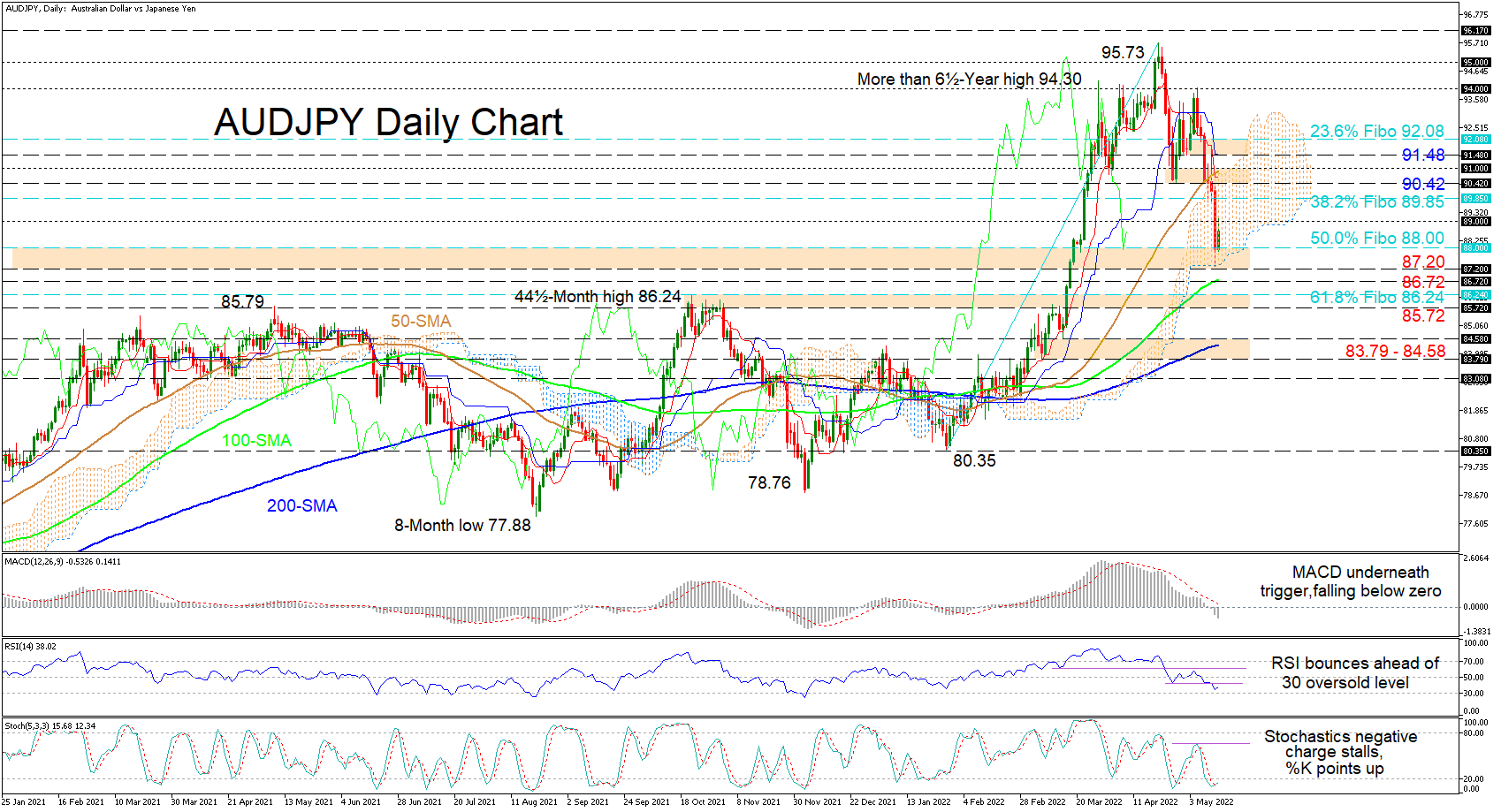
AUDJPY has corrected to the 88.00 handle, which is the 50.0% Fibonacci retracement of the 12-week rally from 80.35 until the 95.73 peak. Despite the price failing to snowball below the support barrier formed by the 50.0% Fibo at 88.00 and the 87.20 January 2018 inside swing low, the bearish tone has yet to be fully offset. On that note, the simple moving averages (SMAs) continue to endorse the bullish picture in the pair.
Contrary to this, the Ichimoku lines are indicating that the recent sturdy negative forces have temporarily stalled. Moreover, the short-term oscillators are reflecting mixed notions of directional momentum. The MACD is suggesting the decline in the pair remains intact despite buyers fighting back. Meanwhile, the uptick in the stochastic %K line, and the bounce in the RSI in the bearish region, both mirror the latest efforts from buyers but have yet to provide convincing evidence that they have gained the upper hand.
Preliminary resistance to positive developments in the pair is emanating from the 0.8900 hurdle. If bullish forces continue to grow, next upside obstruction may come from the 38.2% Fibo of 89.85 before the bulls tackle the fortified 90.42-91.00 resistance zone. Should price buoyancy persist in the pair, the price could then eye the 91.48-92.08 barrier, the latter being the 23.6% Fibo.
On the flipside, if sellers resurface, the 87.20-88.00 support boundary may be retested prior to the ascending 100-day SMA, residing at the 86.72 high, which was logged back in February 2018. Should the pair remain heavy, the region of support between the 61.8% Fibo of 86.24 and the 85.72 mark could come under attack. In the event this section fails to curb the descent in the pair, the price may then return to a broader consolidation that gripped the pair from May 2021 until March 2022. Any further moves lower could snag around the 83.79-84.58 support area.
Summarizing, AUDJPY’s broader bullish mood is likely to remain active if the pair holds north of the 87.20-88.00 boundary and the cloud. Yet, for convincing bullish prospects to evolve, the price would need to climb back above the 94.00 mark. That said, diving beneath the 85.72-86.24 support could reinforce negative tendencies in the pair.
USD/JPY Mid-Day Outlook
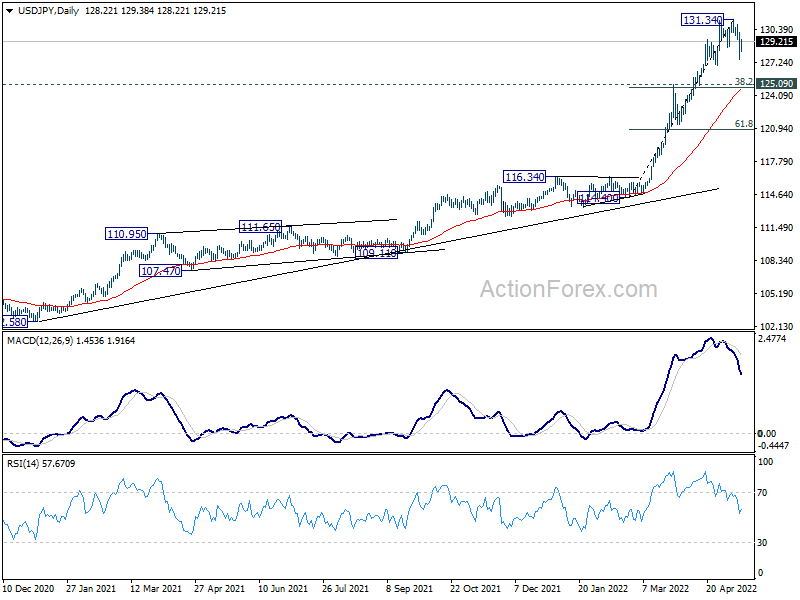
Daily Pivots: (S1) 127.21; (P) 128.64; (R1) 129.75; More...
Intraday bias in USD/JPY is turned neutral with current recovery. But overall, it's staying in correction to rise from 114.40, and risk will stay mildly on the downside as long as 131.34 resistance holds. Another fall should be seen to 125.09 cluster support (38.2% retracement of 114.40 to 131.34 at 124.86).
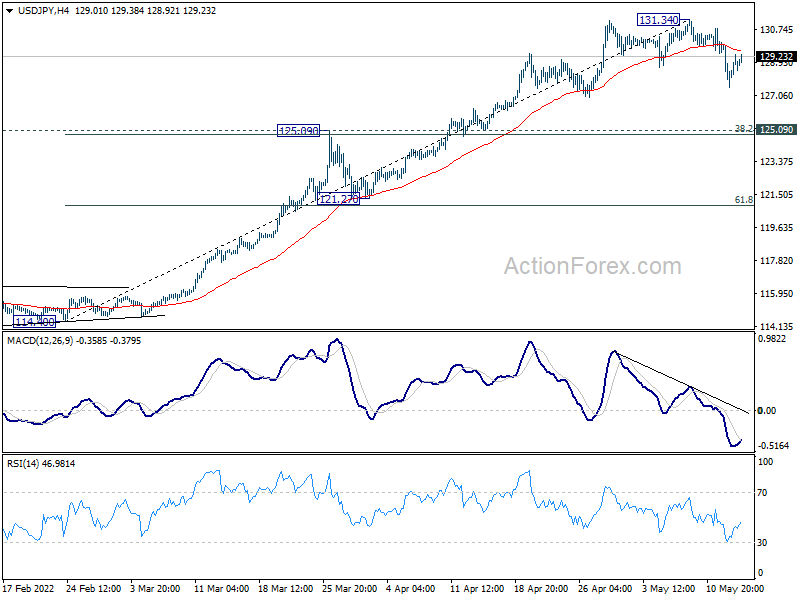
In the bigger picture, current rally is seen as part of the long term up trend form 75.56 (2011 low). Sustained trading above 61.8% projection of 75.56 (2011 low) to 125.85 (2015 high) from 98.97 at 130.04 will pave the way to 100% projection at 149.26, which is close to 147.68 (1998 high). For now, this will remain the favored case as long as 121.27 support holds.
USD/CHF Mid-Day Outlook
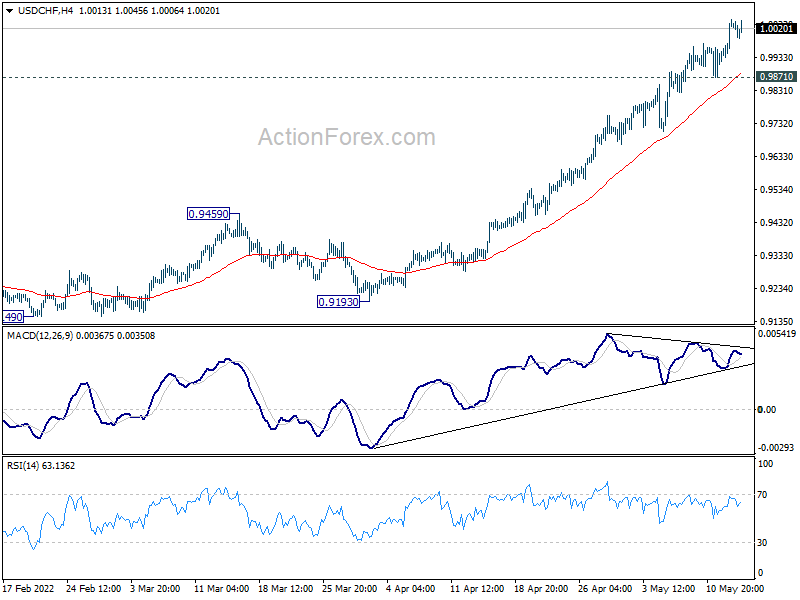
Daily Pivots: (S1) 0.9956; (P) 1.0003; (R1) 1.0076; More....
Intraday bias in USD/CHF remains on the upside at this point. Current rally would extend to next medium term projection level at 1.0306. On the downside, considering bearish divergence condition in 4 hour MACD, break of 0.9871 support will indicate short term topping, and turn bias to the downside for pull back.
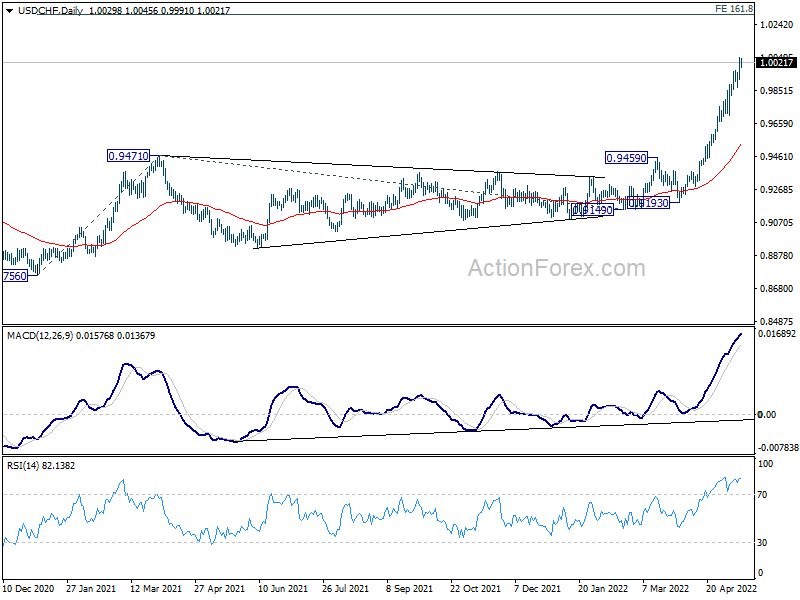
In the bigger picture, down trend from 1.0342 (2016 high) should have completed with three waves down to 0.8756 (2021 low) already. Rise from 0.8756 is likely a medium term up trend of its own. Next target is 161.8% projection of 0.8756 to 0.9471 from 0.9149 at 1.0306, which is close to 1.0342 (2016 high). This will remain the favored case as long as 0.9459 resistance turned support holds.
GBP/USD Mid-Day Outlook
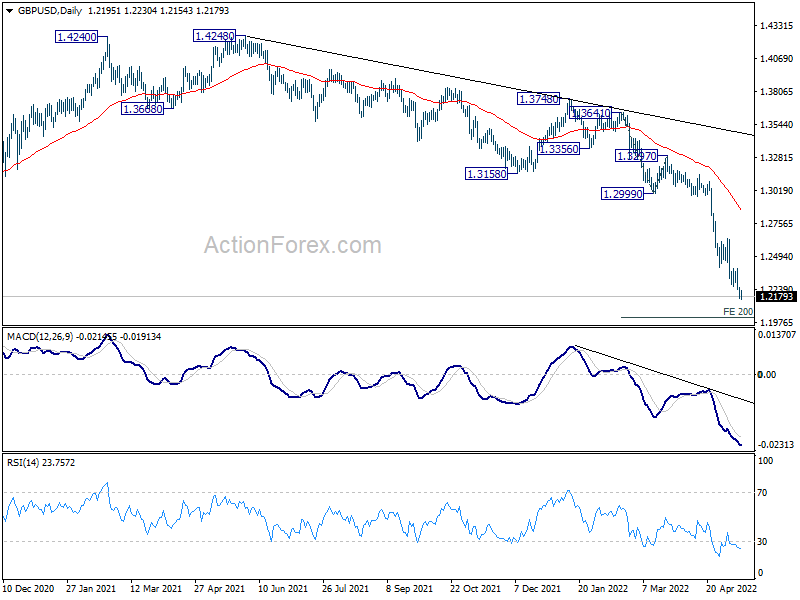
Daily Pivots: (S1) 1.2158; (P) 1.2207; (R1) 1.2248; More..
Intraday bias in GBP/USD remains on the downside at this point. Current down trend should target 200% projection of 1.3641 to 1.2999 from 1.3297 at 1.2013 next. On the upside, above 1.2399 minor resistance will turn intraday bias neutral again. But outlook will stay bearish as long as 1.2637 resistance holds.
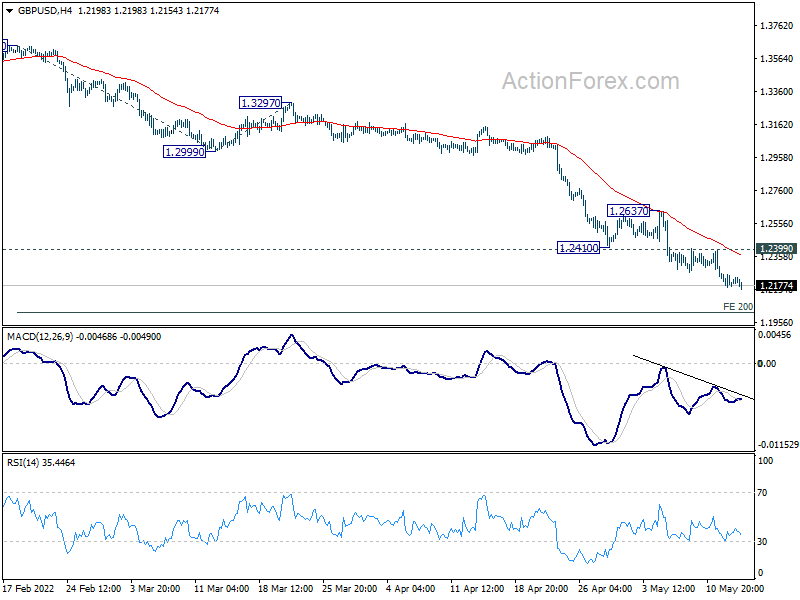
In the bigger picture, based on current momentum, fall from 1.4248 (2018 high) at least at the same degree as the rise from 1.1409 (2020 low). That is, fall from 1.4248 could be a leg inside the pattern from 1.1409, or resuming the longer term down trend. In either case, deeper decline is expected as long as 1.2999 support turned resistance holds. Next target is 1.1409 low.
EUR/USD Mid-Day Outlook
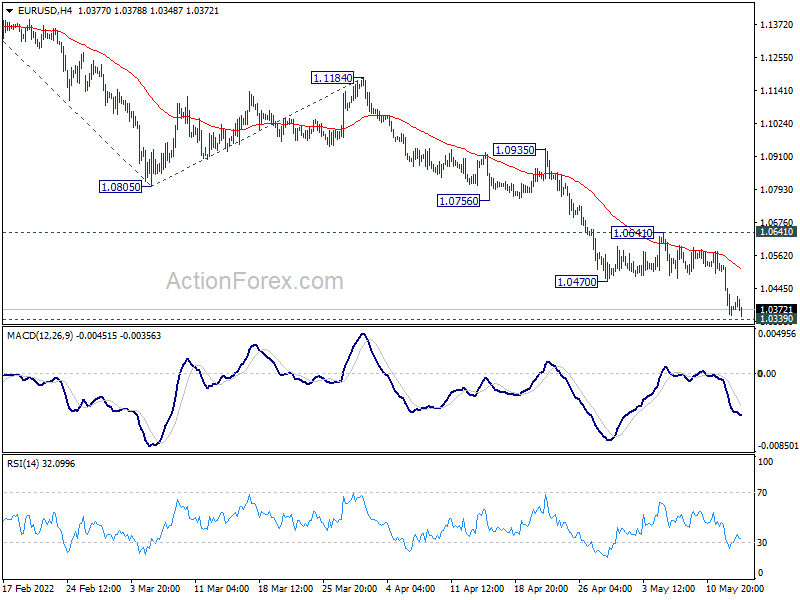
Daily Pivots: (S1) 1.0313; (P) 1.0421 (R1) 1.0488; More...
Intraday bias in EUR/USD stays on the downside at this point. Decisive break of 1.0339 long term support will carry larger bearish implication and target 161.8% projection of 1.1494 to 1.0805 from 1.1184 at 1.0069. On the upside, break of 1.0641 resistance is needed to indicate short term bottoming. Otherwise, outlook will stay bearish in case of recovery.
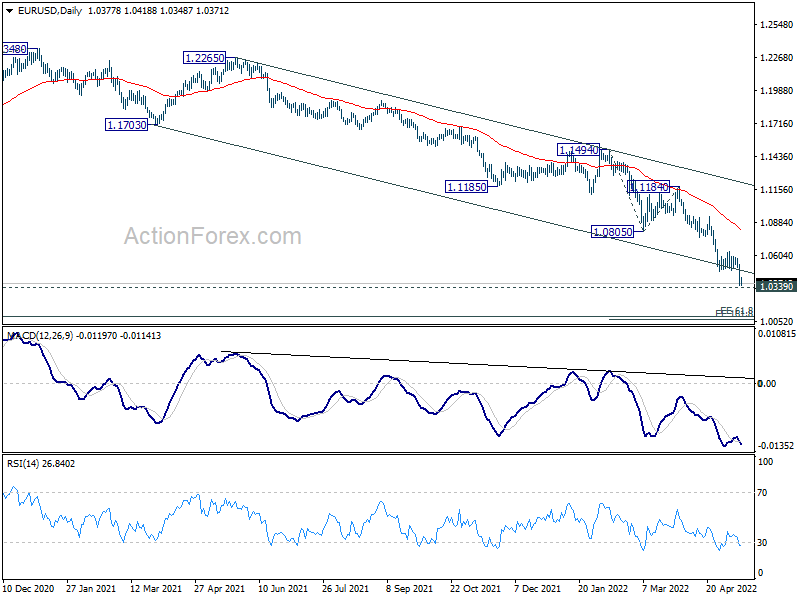
In the bigger picture, break of medium term channel support suggests downside acceleration. Current decline from 1.2348 (2021 high) is probably resuming long term down trend from 1.6039 (2008 high). Retest of 1.0339 (2017 low) low should be seen next. Decisive break there will confirm this bearish case. This will now remain the favored case as long as 1.0805 support turned resistance holds.
Gold Extends Decline While EUR/USD Holding on to 2017 Low
Overall, the forex markets are rather quiet as the week is heading to a close. EUR/USD is still holding above 2017 low but lacks any strength for a recovery. The greenback might still have a last push during the rest of the session. Meanwhile, Gold is a major mover today, and it's now pressing 1800 handle. As for the week, Yen and Dollar remain the strongest while Kiwi and Aussie are the worst, followed by Euro.
In Europe, at the time of writing, FTSE is up 1.74%. DAX is up 1.26%. CAC is up 1.62%. Germany 10-year yield is up 0.875 at 0.933. Earlier in Asia, Nikkei rose 2.64%. Hong Kong HSI rose 2.68%. China Shanghai SSE rose 0.96%. Singapore Strait Times rose 0.82%. Japan 10-year JGB yield dropped -0.0065 to 0.245.
Gold pressing 1800 as decline continues
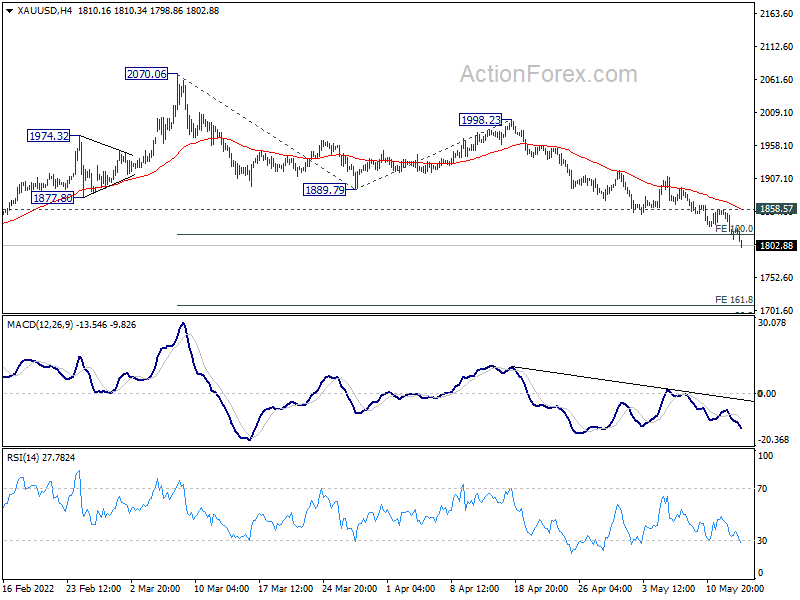
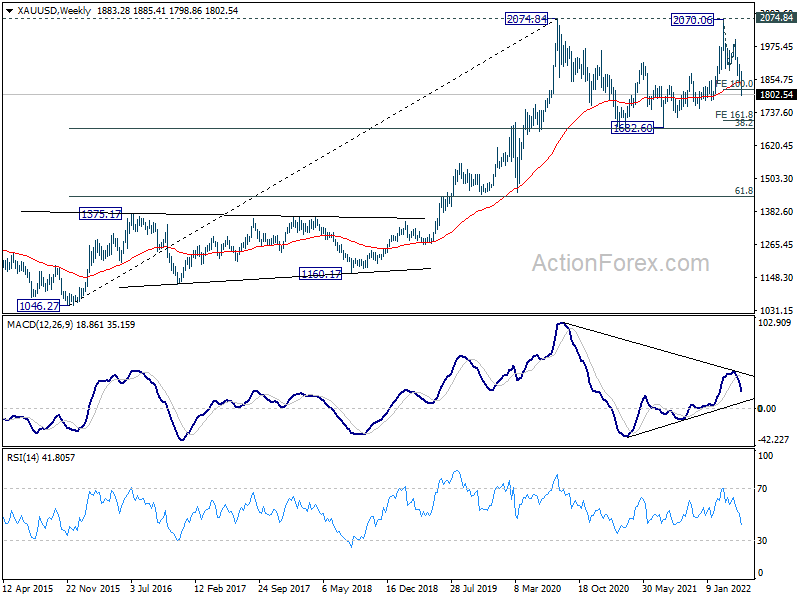
Gold's decline resumes after brief support from 100% projection of 2070.06 to 1889.79 from 1998.23 at 1817.86. It's now taking on 18k handle and there is no clear sign of bottoming yet. Further fall is expected as long as 1858.57 resistance holds. Next target is 161.8% projection at 1706.55.
Also, the whole fall from 2070.06 is seen as the third leg of the consolidation pattern from 2074.84 (2020 high). It would eventually target 1682.60 support to complete the pattern.
ECB Centeno: Necessary and desirable to normalize monetary policy
ECB Governing Council member Mario Centeno said normalization of monetary policy was "necessary and desirable". But such normalization must be done gradually. He urged not to "over-react" to inflation rising across Europe or risk penalizing economic growth.
"Although inflation remains high in 2022, there are no structural reasons why it should not converge towards the medium-term objective as imbalances are gradually resolved and uncertainty dissipated," Centeno said. "There are currently no structuring signs of de-anchoring inflation," even though the balance of risks around inflation is skewed upward" after Russia's invasion of Ukraine.
Second-order effects of wage pressures was "an additional risk which needs close and continued monitoring", he added.
Eurozone industrial production dropped -1.8% mom in Mar, EU down -1.2% mom
Eurozone industrial production dropped -1.8% mom in March, slightly worse than expectation of -1.7% mom. Production of capital goods fell by -2.7%, non-durable consumer goods by -2.3%, intermediate goods by -2.0% and energy by -1.7%, while production of durable consumer goods rose by 0.8%.
EU industrial production dropped -1.2% mom. Among Member States for which data are available, the largest monthly decreases were registered in Slovakia (-5.3%), Germany (-5.0%) and Luxembourg (-3.9%). The highest increases were observed in Lithuania (+11.3%), Estonia (+5.1%), Bulgaria and Greece (both +5.0%).
BoJ Kuroda: Important to underpin economic activity with powerful monetary easing
BoJ Governor Haruhiko Kuroda told the parliament, "it's important for currency rates to move stably reflecting economic and financial fundamentals... The recent sharp, short-term fluctuations in the yen are undesirable, as it heightens uncertainty and makes it harder for companies to set business plans."
"The economy is in the midst of a recovery and now faces headwinds from rising commodity prices," Kuroda said. "It's therefore important to underpin economic activity with powerful monetary easing."
Separately, Kuroda also said in a speech, "the coronavirus pandemic is a major risk that could further hurt Japan's economy." As such, "it's appropriate to maintain ... the dovish bias of our guidance for the time being."
"For inflation to heighten as a trend, Japan must see a shift from inflation caused by energy prices, to one that is driven by increasing corporate profits and wage growth," he said.
EUR/USD Mid-Day Outlook
Daily Pivots: (S1) 1.0313; (P) 1.0421 (R1) 1.0488; More...
Intraday bias in EUR/USD stays on the downside at this point. Decisive break of 1.0339 long term support will carry larger bearish implication and target 161.8% projection of 1.1494 to 1.0805 from 1.1184 at 1.0069. On the upside, break of 1.0641 resistance is needed to indicate short term bottoming. Otherwise, outlook will stay bearish in case of recovery.
In the bigger picture, break of medium term channel support suggests downside acceleration. Current decline from 1.2348 (2021 high) is probably resuming long term down trend from 1.6039 (2008 high). Retest of 1.0339 (2017 low) low should be seen next. Decisive break there will confirm this bearish case. This will now remain the favored case as long as 1.0805 support turned resistance holds.
Economic Indicators Update
| GMT | Ccy | Events | Actual | Forecast | Previous | Revised |
|---|---|---|---|---|---|---|
| 22:30 | NZD | Business NZ PMI Apr | 51.2 | 53.8 | 53.7 | |
| 23:50 | JPY | Money Supply M2+CD Y/Y Apr | 3.60% | 3.60% | 3.50% | |
| 09:00 | EUR | Eurozone Industrial Production M/M Mar | -1.80% | -1.70% | 0.70% | |
| 12:30 | USD | Import Price Index M/M Apr | 0.00% | 0.60% | 2.60% | 2.90% |
| 14:00 | USD | Michigan Consumer Sentiment Index May P | 63.6 | 65.2 |