

Sample Category Title
A Small Recovery
We're seeing a small recovery in stock markets on Tuesday, as investors dust themselves off following the rout at the start of the week.
There's clearly a huge amount of worry about a recession in the markets at the minute as central banks continue to aggressively tighten against the backdrop of a slowing economy and a cost-of-living crisis. There's a lot of pressure on household budgets and it's only going to intensify as the year progresses which will take its toll.
The Bank of England alluded to that last week, with a recession now expected later this year as energy prices surge once more. While the Fed and others may still be more optimistic about their prospects, with a soft landing still the base case in the US, many are sceptical it can be achieved.
Given the record of central banks in correctly anticipating the path of inflation and interest rates over the last 12 months, perhaps investors are right to treat their forecasts with a large dose of scepticism. The inflation data from the US on Wednesday will naturally be heavily scrutinized as a result, with investors looking for signs of pressure easing. We'll need to see a sharp decline in the coming months for concerns to abate.
Comments from policymakers will also naturally be poured over for signs of evolving attitudes within the central banks. Most notably whether there is increased support for 75 basis point hikes from the Fed. We have a plethora of speakers from the Fed today including John Williams, Loretta Mester, Christopher Waller, Neel Kashkari, Raphael Bostic and Thomas Barkin.
Oil slips closer to $100
Oil prices are slightly lower again today and not far from double-digit territory as traders grapple with the prospect of recessions and a tightening of Chinese restrictions. The unwillingness and, more accurately, inability of OPEC+ to turn the taps on more is keeping oil prices very elevated but at a little over $100, it's more comfortable than was looking probable at times over the last couple of months.
The EU struggling to find a coordinated response on Russian oil is possibly helping to alleviate some near-term pressures, although progress with Hungary is reportedly being made. This also comes as some OPEC members warn of dwindling energy capacity as a result of underinvestment, perhaps a sign that we should get used to these higher prices.
Gold struggling as central banks raise their game
Uncertainty and risk aversion in the markets is doing little to support gold at the moment, with the dollar instead being favoured and the yellow metal under heavy pressure. Since coming within a whisker of $2,000 a few weeks ago, gold has fallen more than 7% and looks vulnerable to further losses.
Inflation is still extremely high and economic uncertainty is weighing heavily on risk assets. But central banks are being very aggressive to try and contain price pressures which appears to be getting in the way of gold retaining the gains it made earlier in the year when they were still in denial.
A small recovery
Bitcoin is making small gains after getting hammered on Monday. Much higher interest rates and investors ditching risky assets are creating very uncomfortable conditions for cryptos which haven't had to deal with these circumstances before. How much appetite will there be for instruments like bitcoin if rates keep rising? It's all well and good performing well in a world of seemingly unlimited cheap money but the new reality will be far more challenging. A break of $30,000 could deliver much more pain for bitcoin.
USD/JPY Mid-Day Outlook
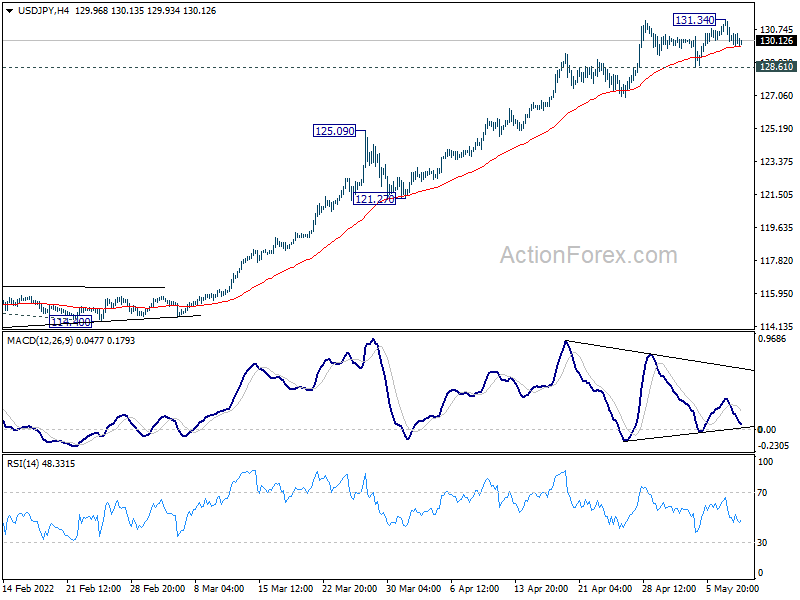
Daily Pivots: (S1) 129.85; (P) 130.60; (R1) 131.08; More...
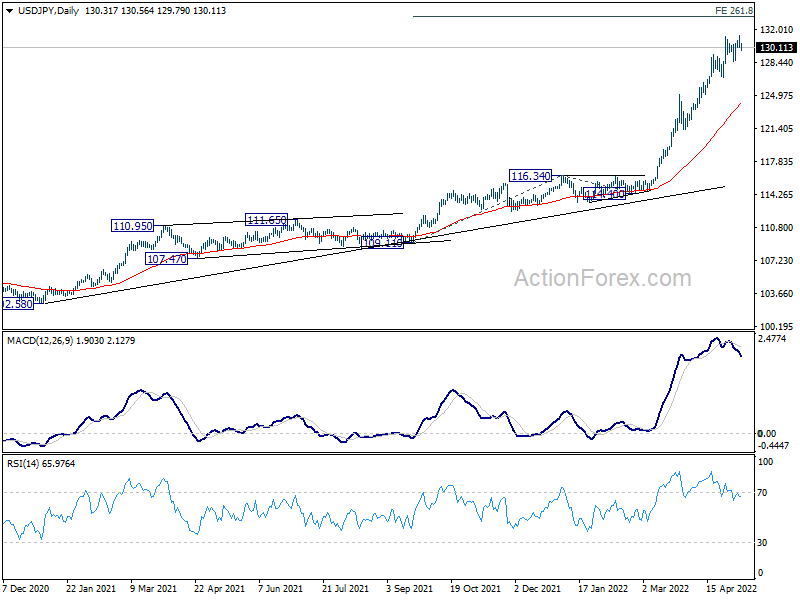
Intraday bias in USD/JPY remains neutral for the moment. Further is expected as long as 128.61 support holds. Above 131.34 will target 261.8% projection of 109.11 to 116.34 from 114.40 at 133.26. However, firm break of 128.61 will indicate short term topping, and turn bias to the downside for deeper pull back.
In the bigger picture, current rally is seen as part of the long term up trend form 75.56 (2011 low). Sustained trading above 61.8% projection of 75.56 (2011 low) to 125.85 (2015 high) from 98.97 at 130.04 will pave the way to 100% projection at 149.26, which is close to 147.68 (1998 high). For now, this will remain the favored case as long as 121.27 support holds.
USD/CHF Mid-Day Outlook
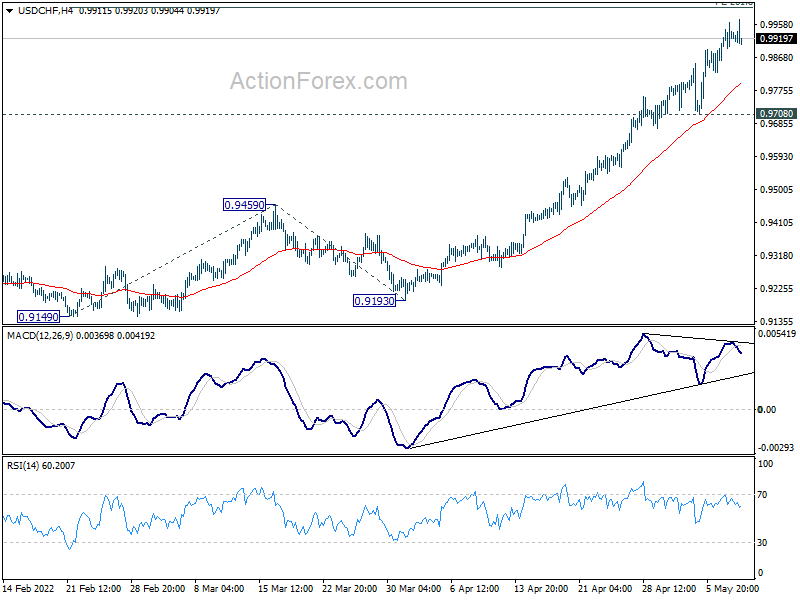
Daily Pivots: (S1) 0.9879; (P) 0.9922; (R1) 0.9983; More....
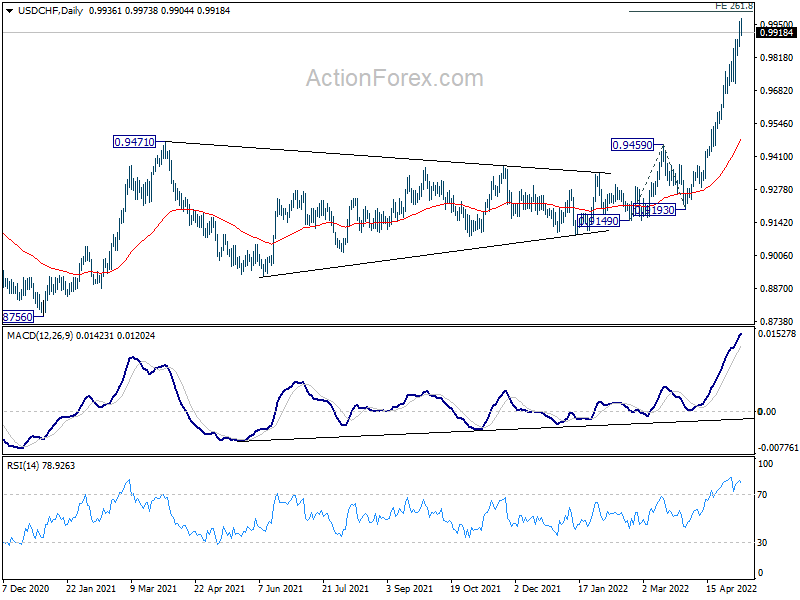
Intraday bias in USD/CHF remains mildly on the upside for 261.8% projection of 0.9149 to 0.9459 from 0.9193 at 1.0005 next. On the downside, break of 0.9708 support is needed to indicate short term topping. Otherwise, outlook will stay bullish in case of retreat.
In the bigger picture, down trend from 1.0342 (2016 high) should have completed with three waves down to 0.8756 (2021 low) already. Rise from 0.8756 is likely a medium term up trend of its own. Sustained trading above 100% projection of 0.8756 to 0.9471 from 0.9149 at 0.9864 will pave the way to 161.8% projection at 1.0306, which is close to 1.0342 (2016 high). This will remain the favored case as long as 0.9459 resistance turned support holds.
GBP/USD Mid-Day Outlook
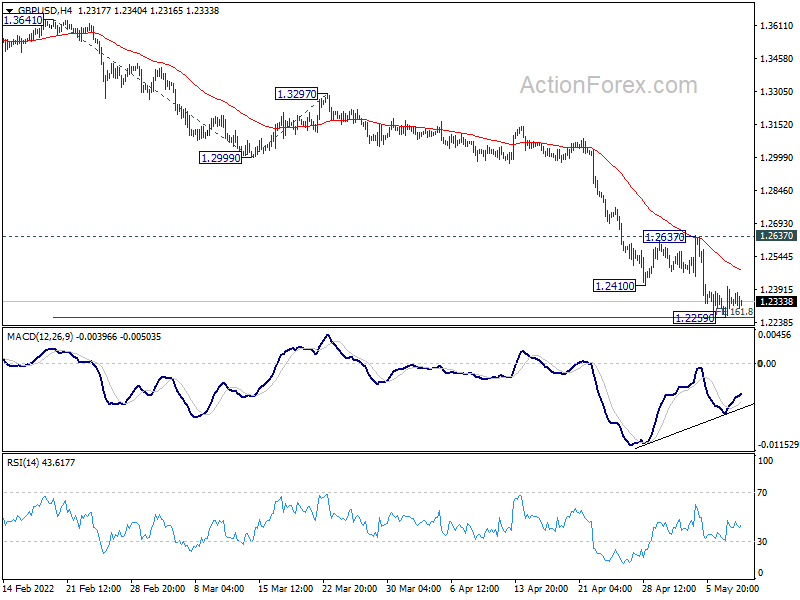
Daily Pivots: (S1) 1.2259; (P) 1.2333; (R1) 1.2403; More...
GBP/USD is staying in consolidation above 1.2259 temporary low and intraday bias remains neutral at this point. Some consolidations could be seen but upside of recovery should be limited by 1.2637 resistance to bring fall resumption. On the downside, firm break of 161.8% projection of 1.3641 to 1.2999 from 1.3297 at 1.2258 will extend recent down trend to 200% projection at 1.2013 next.
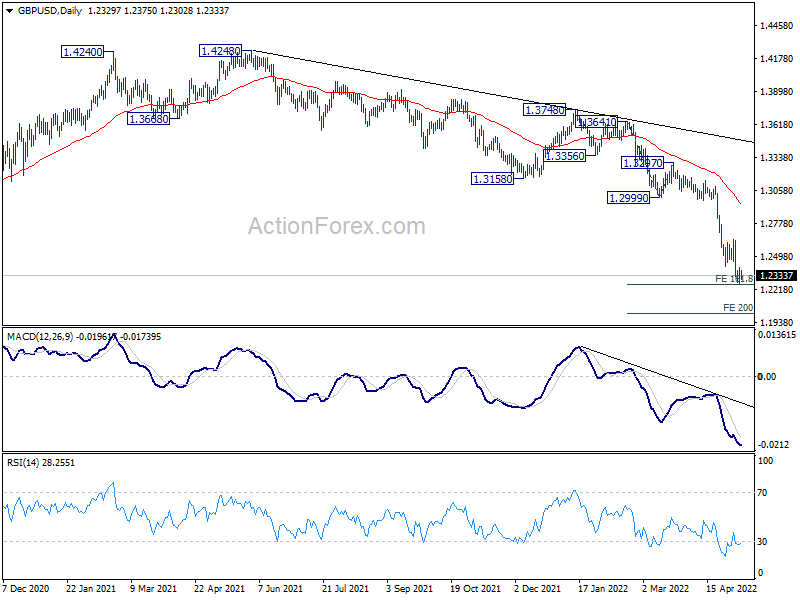
In the bigger picture, based on current momentum, fall from 1.4248 (2018 high) at least at the same degree as the rise form 1.1409 (2020 low). That is, fall from 1.4248 could be a leg inside the pattern from 1.1409, or resuming the longer term down trend. In either case, deeper decline is expected as long as 1.2999 support turned resistance holds. Next target is 1.1409 low.
EUR/USD Mid-Day Outlook
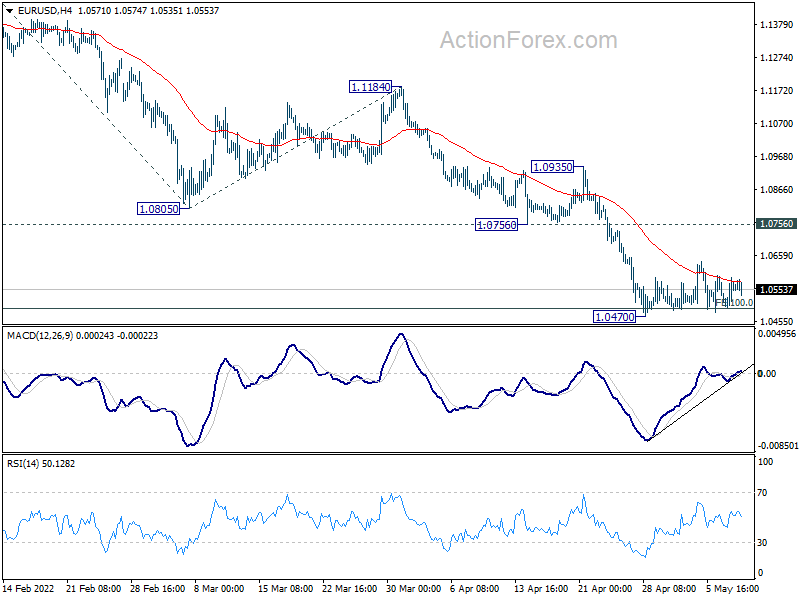
Daily Pivots: (S1) 1.0506; (P) 1.0549 (R1) 1.0604; More...
Range trading continues in EUR/USD and intraday bias remains neutral. In case of another recovery, upside should be limited by 1.0756 support turned resistance to bring fall resumption. On the downside, firm break of 1.0470 will resume larger down trend to 161.8% projection of 1.1494 to 1.0805 from 1.1184 at 1.0069.
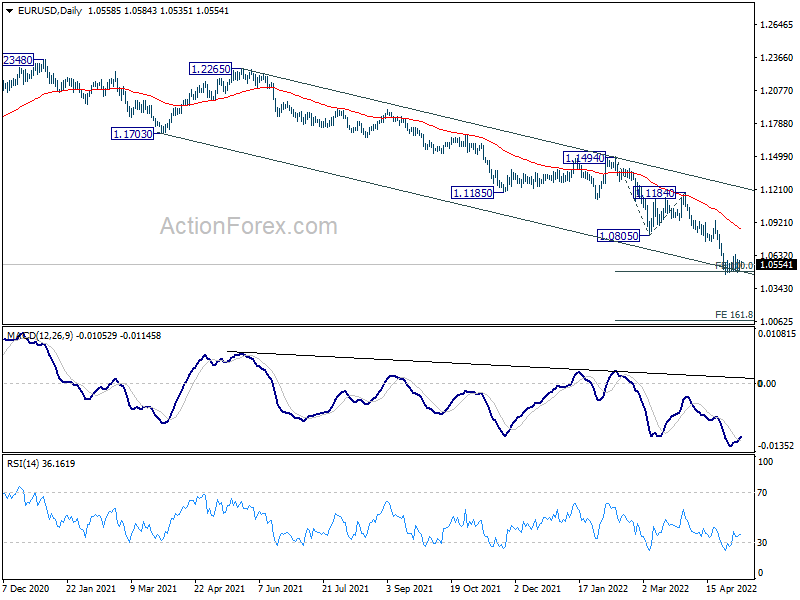
In the bigger picture, the decline from 1.2348 (2021 high) is expected to continue as long as 1.1185 support turned resistance holds. The break of 1.0635 (2020 low) now raises the chance that it's resuming long term down trend from 1.6039 (2008 high). Retest of 1.0339 (2017 low) low should be seen next. Decisive break there will confirm this bearish case.
Dollar Ranging Against Euro and Yen, Markets Turning Cautious With Stabilization
Risk sentiment stabilizes today with rebound in major European stocks while US futures also point to higher open. Selloff in commodity currencies slow a bit but they remain the worst performers, led by Aussie. Yen, Euro and Dollar are the stronger ones, and they're mixed against each other. Sterling and Swiss Franc are also consolidating against Euro for now. Overall, trader might hold their bets first before tomorrow's US CPI release.
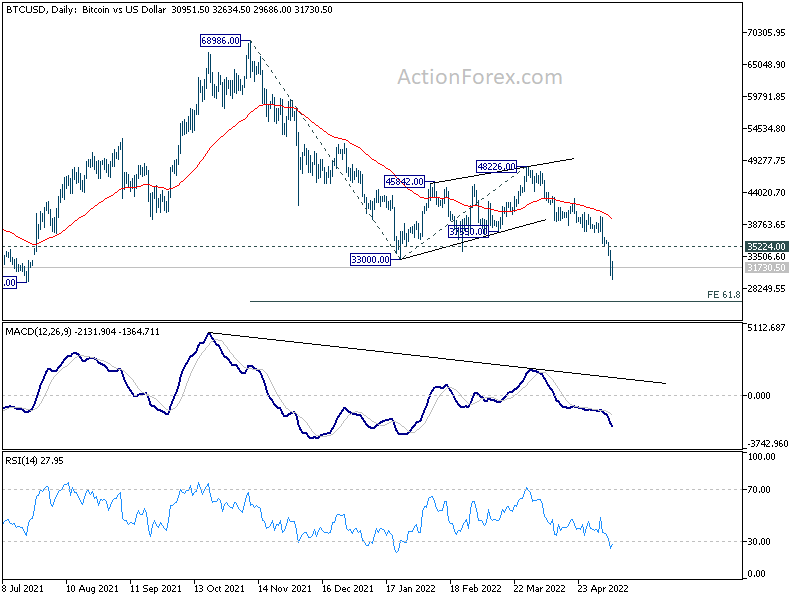
Technically, Bitcoin is stabilizing after breaching 30k handle earlier today. But further decline is still expected with 35224 resistance intact. Current down trend from 68986 is expected to continue to 61.8% projection of 68986 to 33000 from 48226 at 25986. The next fall would likely come with another round of selloff in stocks, which would also be reflected in the FX markets too.
In Europe, at the time of writing, FTSE is up 0.66%. DAX is up 1.49%. CAC is up 0.95%. Germany 10-year yield is down -0.0564 at 1.035. Earlier in Asia, Nikkei dropped -0.58%. Hong Kong HSI dropped -1.84%. China Shanghai SSE rose 1.06%. Singapore Strait Times dropped -1.25%. Japan 10-year JGB yield dropped -0.0032 to 0.251.
Fed Williams: To move expeditiously in bringing rate back to more normal levels this year
In a speech, New York Fed President John Williams said he expects the FOMC to "move expeditiously in bringing the federal funds rate back to more normal levels this year". The ongoing pandemic and Ukraine war "bring a tremendous amount of complexity and uncertainty". Fed will "need to be data dependent and adjust our policy actions as circumstances warrant.".
For 2022, Williams expects core inflation to be nearly 4%, before falling to around 2.50% next year, then further decline to close to 2% long-run goal in 2024. He also expects GDP growth to be around 2% in 2022 while unemployment rate to remain around its current low level.
Germany ZEW rose to -34.3 in May, deterioration still assumed, just slower
Germany ZEW Economic Sentiment improved form -41 to -34.3 in May, above expectation of -42.5. Germany Current Situation index, however, dropped from -30.8 to -36.5, slightly below expectation of -35.0. Eurozone Economic Sentiment rose from -43.0 to -29.5, above expectation of -41.0. Eurozone Current Situation index dropped -6.5 pts to -35.0.
ZEW President Professor Achim Wambach: "The ZEW Indicator of Economic Sentiment increased moderately this month but still remains at a relatively low level. Compared to last month, the outlook for the economic situation in Germany is thus slightly less pessimistic. The experts still assume that it will continue to deteriorate, but at a lower pace than expected before.
"The strong restrictions in China to fight against new Covid-19 infections lead to a strong reduction in the assessment of the current economic situation in China. This is a heavy weight on the future development of the German economy.
With regard to the ECB's monetary policy stance there is a large majority of experts expecting an increase in interest rates during the next six months. Accordingly they expect a decline of inflation rates from their very high current level.
BoJ Kuroda: Retail level CBDC is an option
BoJ Governor Haruhiko Kuroda said in an online seminar that the central bank has not decided on central bank digital currency (CBDC) yet. But he noted it could be an option for securing a seamless and safe infrastructure.
"CBDC is not the only way, so a national discussion is needed as to how to achieve this goal," Kuroda said, adding, "retail level CBDC is an option."
BoJ started the second phase of the CBDC experiments in April. The process will last for around a year.
BoJ Uchida: Important to continue with powerful monetary easing
BoJ Executive Director Shinichi Uchida told the parliament today, "Japan's economy is still in the midst of recovering from the pandemic's impact. It is recently under pressure from rising commodity prices... It's therefore important for the BOJ to continue supporting economic activity with powerful monetary easing." He also said BoJ has no plan to adjust the 50bps band allowed for 10-year JGB yield to fluctuate around 0%.
Separately, Finance Minister Shunichi Suzuki said after a cabinet meeting, "stability is important and rapid moves as seen recently are undesirable," referring to Yen's exchange rate. But he emphasized that any actions would follow the practice agreed with G7 partners.
Also from Japan, overall household spending dropped -2.3% yoy in March, versus expectation of -2.8% yoy.
Australia NAB business confidence dropped to 10 in Apr, conditions rose to 20
Australia NAB business confidence dropped from 16 to 10 in April. Business conditions rose from 15 to 20. Looking at some details, trading conditions rose from 23 to 27. Profitability conditions rose from 12 to 22. Employment conditions were unchanged at 10.
NAB Group Chief Economist Alan Oster said: "Price growth eased somewhat in the April survey after hitting record rates in March, but remained high when looking at the history of the survey, supporting our expectation that inflation will remain elevated in Q2 and likely Q3.
"Still, the strong business conditions including trading conditions and profitability show that the economy is faring quite well and so far, demand is holding up in the face of higher inflation."
EUR/USD Mid-Day Outlook
Daily Pivots: (S1) 1.0506; (P) 1.0549 (R1) 1.0604; More...
Range trading continues in EUR/USD and intraday bias remains neutral. In case of another recovery, upside should be limited by 1.0756 support turned resistance to bring fall resumption. On the downside, firm break of 1.0470 will resume larger down trend to 161.8% projection of 1.1494 to 1.0805 from 1.1184 at 1.0069.
In the bigger picture, the decline from 1.2348 (2021 high) is expected to continue as long as 1.1185 support turned resistance holds. The break of 1.0635 (2020 low) now raises the chance that it's resuming long term down trend from 1.6039 (2008 high). Retest of 1.0339 (2017 low) low should be seen next. Decisive break there will confirm this bearish case.
Economic Indicators Update
| GMT | Ccy | Events | Actual | Forecast | Previous | Revised |
|---|---|---|---|---|---|---|
| 23:01 | GBP | BRC Like-For-Like Retail Sales Y/Y Apr | -1.70% | -0.40% | ||
| 23:30 | JPY | Overall Household Spending Y/Y Mar | -2.30% | -2.80% | 1.10% | |
| 01:30 | AUD | NAB Business Confidence Apr | 10 | 16 | ||
| 01:30 | AUD | NAB Business Conditions Apr | 20 | 18 | ||
| 08:00 | EUR | Italy Industrial Output M/M Mar | 0.00% | -1.40% | 4% | |
| 09:00 | EUR | Germany ZEW Economic Sentiment May | -34.3 | -42.5 | -41 | |
| 09:00 | EUR | Germany ZEW Current Situation May | -36.5 | -35 | -30.8 | |
| 09:00 | EUR | Eurozone ZEW Economic Sentiment May | -29.5 | -41 | -43 | |
| 10:00 | USD | NFIB Business Optimism Index Apr | 93.2 | 92.9 | 93.2 |
Fed Williams: To move expeditiously in bringing rate back to more normal levels this year
In a speech, New York Fed President John Williams said he expects the FOMC to "move expeditiously in bringing the federal funds rate back to more normal levels this year". The ongoing pandemic and Ukraine war "bring a tremendous amount of complexity and uncertainty". Fed will "need to be data dependent and adjust our policy actions as circumstances warrant.".
For 2022, Williams expects core inflation to be nearly 4%, before falling to around 2.50% next year, then further decline to close to 2% long-run goal in 2024. He also expects GDP growth to be around 2% in 2022 while unemployment rate to remain around its current low level.
Australian Dollar Falls Below 70
Aussie tumbles on risk aversion
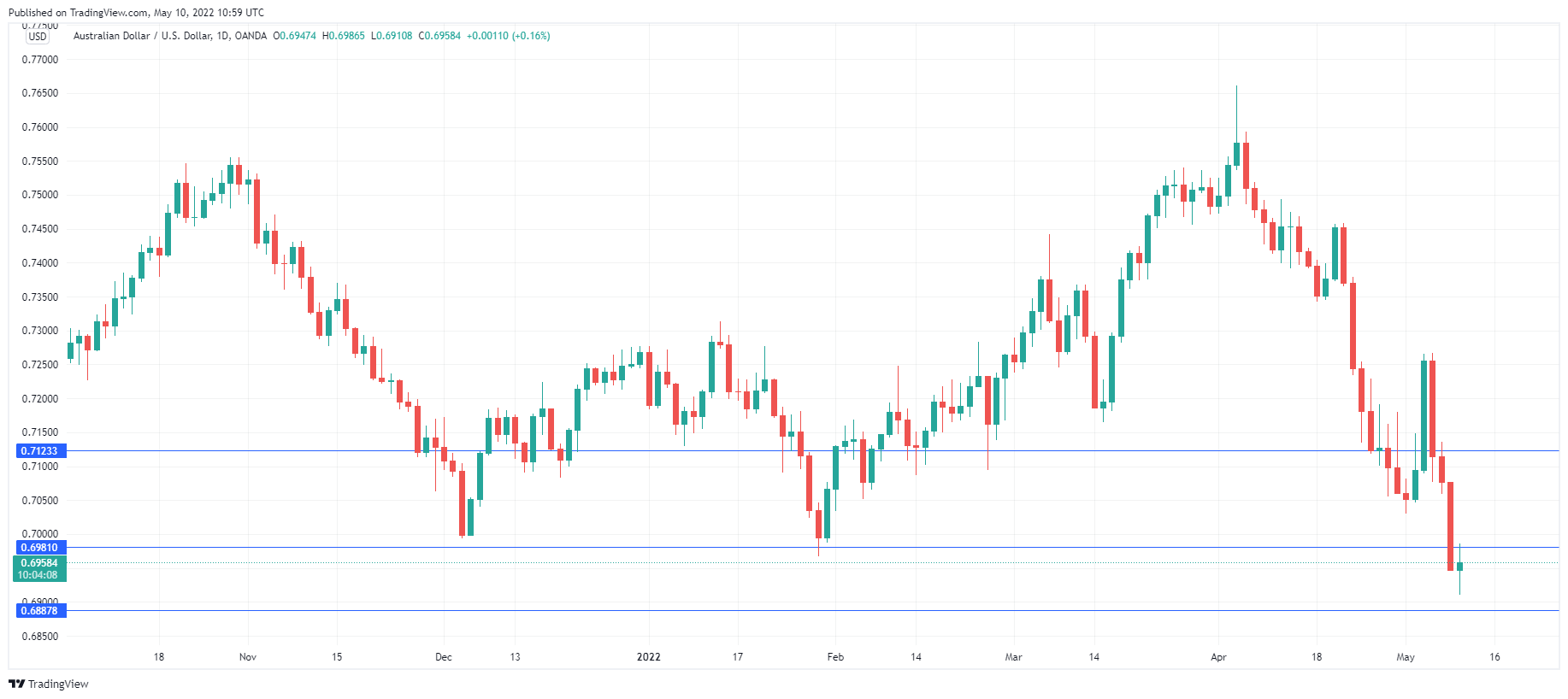
The Australian dollar is stable on Tuesday, after starting the week with a nasty drop of 1.83%. AUD/USD has dropped to its lowest levels since July 2020, as it trades around 0.6970.
Risk aversion remains high, as investors see dark clouds all around. Soaring inflation, supply chain disruptions, a hawkish Fed, the Ukraine war and a slowdown in China have boosted the US dollar and sent risk currencies like the Australian dollar sharply lower.
China, the world’s number two economy, is stubbornly sticking to its zero-Covid policy, putting hundreds of millions of residents under lockdown and disrupting factory production and global supply chains. Perhaps no country is feeling the deterioration in China more than Australia, as the Asian giant is Australia’s largest trading partner. Last month, the IMF recently cut China’s growth forecast to 4.4%, down from 4.8%. The property sector hasn’t been in the headlines lately, but the severe leverage problems which have affected huge developers haven’t gone away and remain a real threat to economic stability. The troubles in China are a serious headwind for the struggling Australian dollar.
On the economic front, NAB Business Confidence slowed to 10 in April, down from 16 in March. Retail Sales for Q1 came in 1.2% QoQ, better than the forecast of 1.0%. The markets will be keeping a close eye on US inflation, which will be released later today. CPI surged to 8.5% YoY in March, the forecast for April stands at 8.1%. If inflation does ease, we’re bound to see plenty of headlines proclaiming that “inflation has peaked” and the US dollar could lose ground. It would be premature to argue that inflation is on its way down based on just one CPI reading. Furthermore, long-term inflation expectations have increased (3.7% to 3.9%), according to a NY Fed survey on Monday. True, one-year inflation expectations decreased (6.6 to 6.3%), but that won’t change the Fed’s aggressive tune.
AUD/USD Technical
- There is support at 0.6887 and 0.6745
- 0.6981 is a weak resistance line, followed by 0.7123
Germany ZEW rose to -34.3 in May, deterioration still assumed, just slower
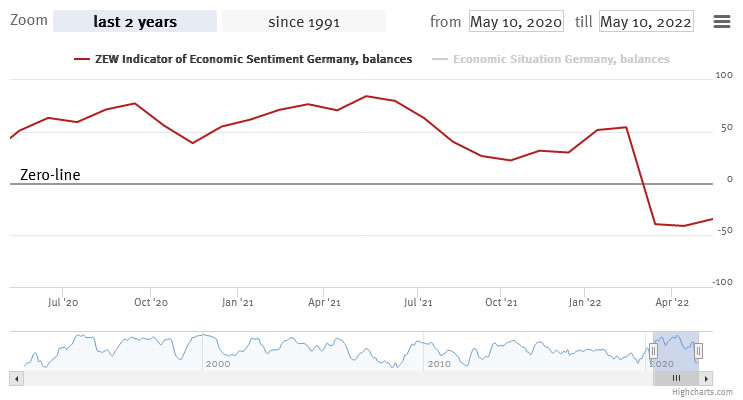
Germany ZEW Economic Sentiment improved from -41 to -34.3 in May, above expectation of -42.5. Germany Current Situation index, however, dropped from -30.8 to -36.5, slightly below expectation of -35.0. Eurozone Economic Sentiment rose from -43.0 to -29.5, above expectation of -41.0. Eurozone Current Situation index dropped -6.5 pts to -35.0.
ZEW President Professor Achim Wambach: "The ZEW Indicator of Economic Sentiment increased moderately this month but still remains at a relatively low level. Compared to last month, the outlook for the economic situation in Germany is thus slightly less pessimistic. The experts still assume that it will continue to deteriorate, but at a lower pace than expected before.
"The strong restrictions in China to fight against new Covid-19 infections lead to a strong reduction in the assessment of the current economic situation in China. This is a heavy weight on the future development of the German economy.
"With regard to the ECB's monetary policy stance there is a large majority of experts expecting an increase in interest rates during the next six months. Accordingly they expect a decline of inflation rates from their very high current level.
BoJ Kuroda: Retail level CBDC is an option
BoJ Governor Haruhiko Kuroda said in an online seminar that the central bank has not decided on central bank digital currency (CBDC) yet. But he noted it could be an option for securing a seamless and safe infrastructure.
"CBDC is not the only way, so a national discussion is needed as to how to achieve this goal," Kuroda said, adding, "retail level CBDC is an option."
BoJ started the second phase of the CBDC experiments in April. The process will last for around a year.