Sample Category Title
Cryptocurrencies Have Gone Downstream
Bitcoin has been losing 2.5% within the last 24 hours, falling back to $43.6K. Ethereum lost 2.3%, with other top 10 leading altcoins varied between -5% (Terra) and +1% (BNB).
According to CoinMarketCap, the total capitalization of the crypto market sank by 2% overnight to $2.01 trillion.
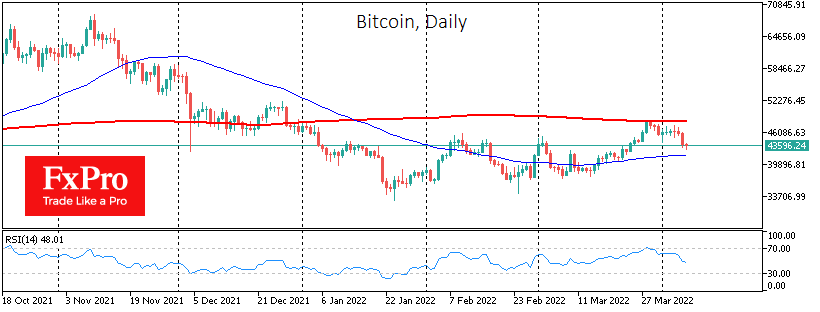
The crypto-currency index of fear and greed grounded at 34 by Thursday morning, having lost 14 points and turning into a state of fear. This is the lowest value in the last two weeks.
After several days of sliding, the fall of bitcoin accelerated amid trading in Europe, reaching two-week lows just above $43,000. The negative dynamic of the cryptocurrency market was facilitated by the fall of global stock indices. The published minutes of the Fed meeting showed tougher rhetoric than expected. That put pressure on all risk-sensitive assets.
News about the arrest of the servers of the darknet resource Hydra with the confiscation of 540 bitcoins, as well as sanctions against the Garantex crypto exchange could have a negative effect on the whole crypto market.
According to Glassnode, the number of bitcoins on exchanges has fallen to the lowest since August 2018. Investors have been withdrawing coins since the beginning of March, which is often taken as a signal to keep Bitcoin out of the market for a long time. This reduction in active supply often pushes the price up. However, now we are also seeing increased sales from institutional.
Reports that Tesla’s CEO Elon Musk had become Twitter’s largest shareholder initially caused Dogecoin to soar more than 20%, as Musk had previously used the coin to pay for small Tesla goods. Potentially, there could be more applications for Doge in Twitter. However, by Thursday morning its price returned to the levels of the beginning of the week, still showing that this “dog” is not yet able to swim against the current, just as Bitcoin cannot become a meaningful fish against a big pond of stock markets.
Eurozone: Slowing Growth, Faster Inflation and More Timely Monetary Tightening
Summary
- The Eurozone economy has had an unsettled start to 2022, as a temporary surge in COVID cases and Ukraine-related uncertainties have weighed on activity. From a longer-term perspective there also appears to be some softening in consumer fundamentals, and we have lowered our Eurozone GDP growth forecast for 2022 slightly to 3.1%.
- In contrast, Eurozone headline CPI inflation has moved sharply higher, and core inflation has also firmed, though to a much lesser extent. Still, even if price gains do not become broad-based, persistently elevated energy prices and headline CPI inflation could still prompt a response from the European Central Bank (ECB).
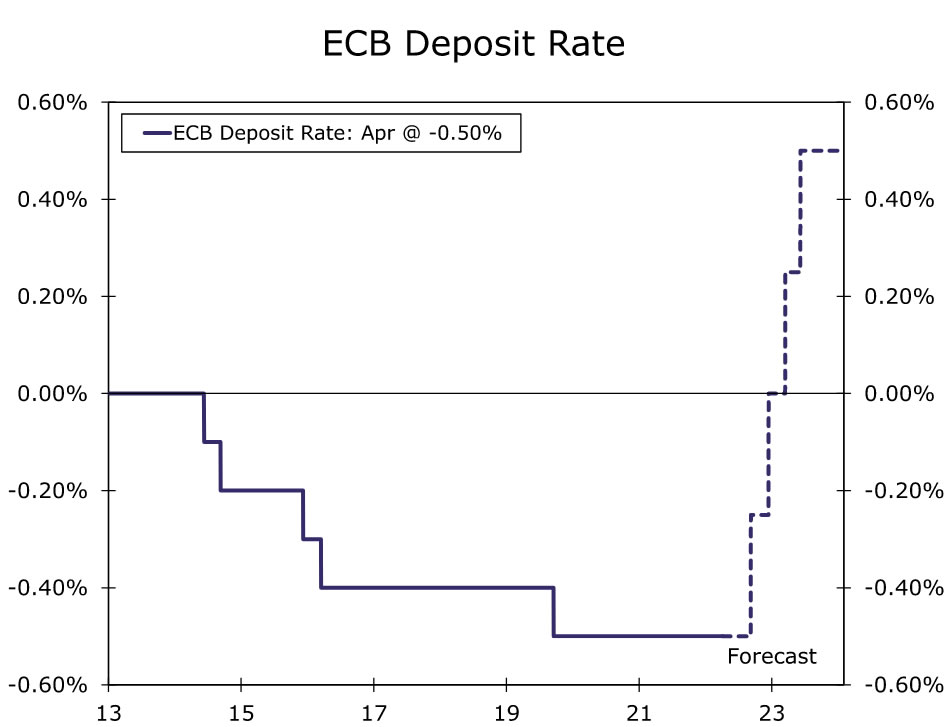
- Indeed, we now expect earlier and more rapid monetary tightening from the ECB than previously. We forecast an initial 25 bps increase in the Deposit Rate at the September 2022 meeting (compared to December previously). Beyond that, we expect a steady series of 25 bps increases at the December 2022, March 2023 and June 2023 meetings, which would lift the Deposit Rate to +0.50% by the middle of next year.
Consumer Fundamentals Suggest Softening Eurozone Economic Outlook
The Eurozone economy has had an unsettled start to 2022. A surge in COVID cases around the turn of the year weighed temporarily on activity across the region, as Eurozone December retail sales slumped 2.1% month-over-month in December before staging a modest rebound early this year with a cumulative 0.4% gain in sales during the January-February period. Meanwhile, the Eurozone services PMI fell to a low of 51.1 in January, but has rebounded somewhat since. After having navigated a COVID-induced slowdown in activity, Europe was then faced with uncertainties stemming from the Russian invasion of Ukraine in late February. In addition to restraining Eurozone consumer confidence, which fell sharply to -18.7 in March, Europe's reliance on Russia as a source for oil and gas imports adds uncertainty to the outlook.
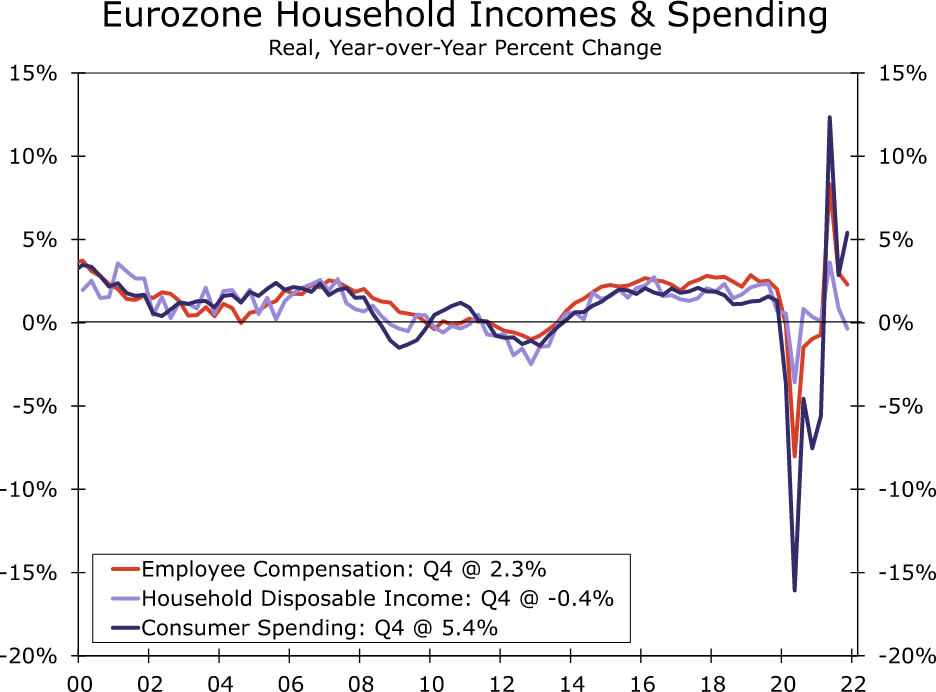
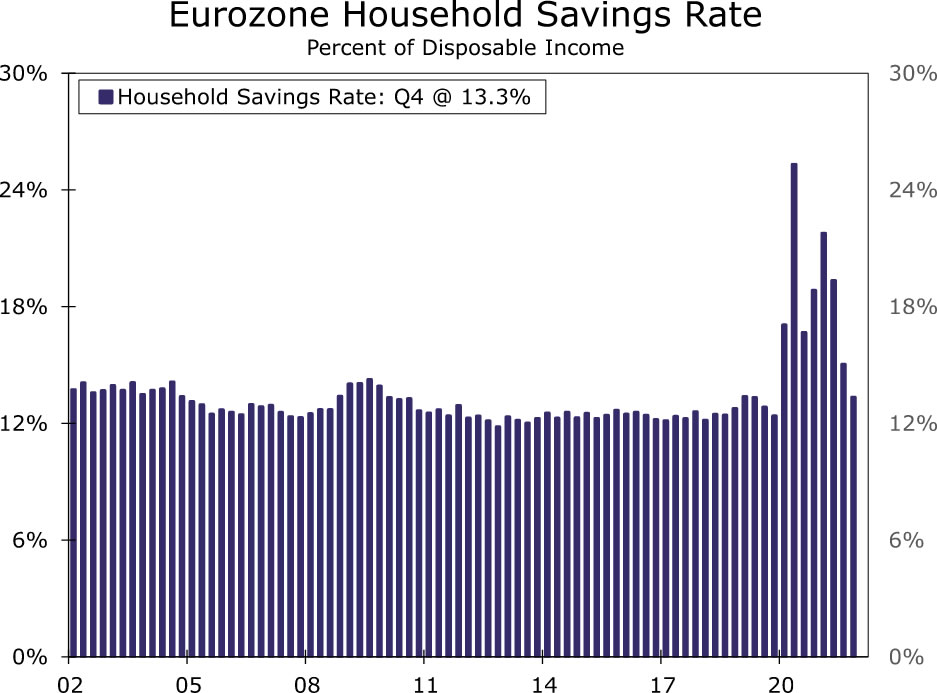
While those Ukraine-related uncertainties are likely to have a negative impact on the Eurozone economy, export exposures for the Eurozone to Russia are very modest, and ultimately we anticipate that any direct negative growth impact from the Ukraine crisis will be limited. That said, the recent COVID and Ukraine uncertainties compound an already softening backdrop for the region's consumer sector and thus could, in our view, contribute to a moderately softer growth outlook than previously. Recently released data from the Eurostat statistical agency and European Central Bank (ECB) indicate that, in nominal terms, Eurozone household disposable income fell 1.4% quarter-over-quarter in Q4-2020, but was still up 3.4% year-over-year. However, after adjusting for inflation, Eurozone real household disposable income was actually down 0.4% year-over-year. And importantly, the household savings rate also declined to 13.3% of household disposable income in Q4-2020, only slightly above levels that prevailed prior to the pandemic. Real consumer spending had already begun to lose some momentum by late last year with a decline of 0.6% quarter-over-quarter in Q4. Looking ahead, even with the accumulation of excess savings during the pandemic which can now potentially be deployed, the slower growth in household incomes and falling savings rate does suggest the Eurozone consumer will provide less of an impulse to the economy moving forward.
Meanwhile, from a business perspective, it's possible the Eurozone corporate sector could provide the economy with a modest cushion against an excessive slowdown. The same Eurostat and ECB data indicate that net entrepreneurial income for Eurozone non-financial corporates grew 17.0% year-over-year in Q4-2020, stronger than the 11.9% increase in Q3, and a faster pace of profit growth than generally prevailed in the several years prior to the pandemic. Should profit growth be sustained at respectable levels—which remains an open question—that could provide some support to investment spending across the region. However, even the investment outlook faces some uncertainties. Supply disruptions and increasing costs have the potential to weigh on Eurozone profit growth going forward. And of course from a mathematical point of view, consumer spending comprises a far larger portion of the Eurozone economy than does investment spending. At best, we expect investment spending would offer only a partial cushion for the Eurozone growth outlook. Accordingly, we have revised our outlook for Eurozone GDP growth outlook modestly lower, and now forecast GDP growth of 3.1% for 2022, slowing to GDP growth of 2.4% for 2023.
Eurozone Inflation Still Quickening
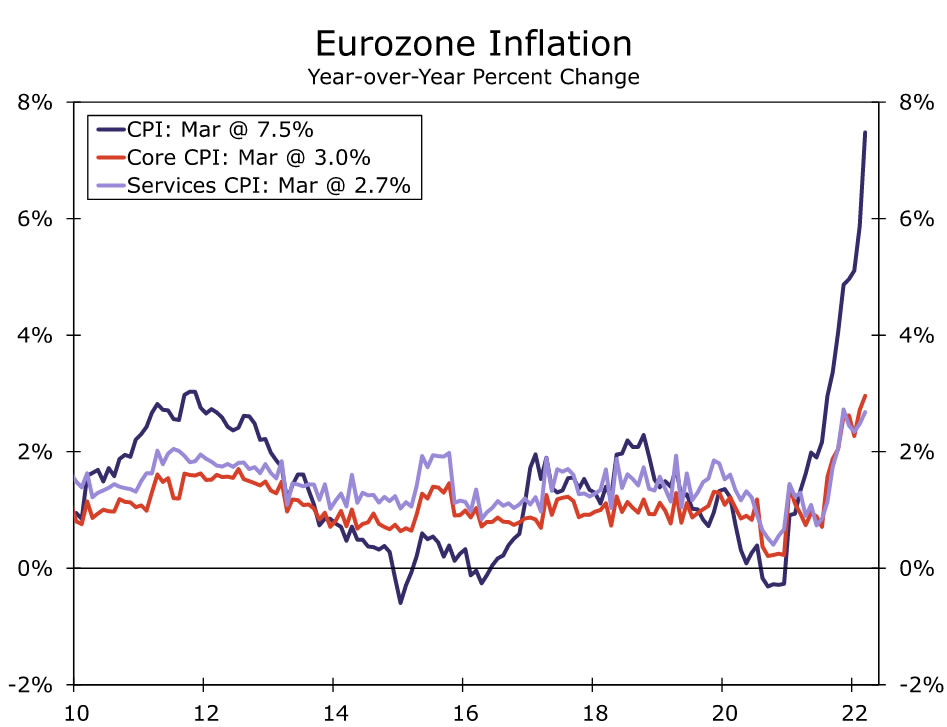
In contrast to the slowing growth trends, incoming data suggest that inflationary pressures continue to intensify. The March CPI firmed more than expected to 7.5% year-over-year, driven by a 44.7% increase in energy prices. So far price pressures across the Eurozone do not appear to be as broad-based as in many other major economies, such as the United States. The core CPI, for example, firmed modestly to 3.0%, while services inflation ticked higher to 2.7%. That said, there still remains some potential for price pressures to spill over to other areas. Unfavorable base effects suggest a further quickening of core inflation is likely, while the elevated input and output price components of the Eurozone purchasing managers indices also hint at potentially more widespread price gains moving forward. Moreover, even absent any acceleration in core inflation trends, energy prices appear likely to remain elevated for some time. As a result, headline inflation is also likely to continue running at a rapid pace. Given the March CPI outcome, and considering these inflationary pressures, we now see a faster average pace of inflation for 2022 of 6.4%.
We believe the accelerated pace of headline inflation will also have implications for the path of European Central Bank monetary policy. While monetary policymakers often tend to focus on core CPI measures as an indication of underlying inflation trends, the fact that energy prices and thus headline inflation could remain elevated for an extended period, even without a broadening of price pressures, could in our view prompt the European Central Bank to respond. Indeed, in the wake of recent developments, we now expect earlier and more rapid monetary tightening (and specifically Deposit Rate increases) from the ECB than previously. Our outlook for the ECB to end its quantitative easing program by July remains unchanged. However, we now expect an initial 25 bps increase in the Deposit Rate at the September 2022 meeting (compared to our previous call for an initial rate increase in December). Beyond September, we expect a steady series of 25 bps Deposit Rate increases at the December 2022, March 2023 and June 2023 meetings, which would lift the Deposit Rate to +0.50% by the middle of next year. At that point, given moderate growth and receding inflation, we believe the ECB may pause its rate hikes through the second half of 2023 to assess the impact of its actions, before likely resuming monetary tightening in 2024. That said, we do see the risks are tilted towards continued tightening, meaning the Deposit Rate could end 2023 at a higher level than we currently forecast.
AUD Falls as Trade Balance Shrinks
The Australian dollar has extended its losses and has fallen below the symbolic 75 line. In the North American session, AUD/USD is trading at 0.7475, down 0.45% on the day.
Central bank announcements have been sending the Australian dollar up and down this week like a yo-yo. On Tuesday, the RBA soared 200 points at one stage, as the rate statement omitted the word “patient”, a hallmark of Governor Lowe’s monetary stance. Lowe appears to have thrown in the towel on requiring wage growth of 3% before raising rates, and the markets are expecting a series of hikes starting in June.
The Fed followed the RBA with the FOMC minutes on Wednesday, and the aggressive tone sent the Aussie tumbling almost 1 per cent. The minutes signalled that the Fed plans to scale back the balance sheet at a faster pace than previously expected, trimming up to USD 95 billion/month starting in September. As well, the minutes hinted that the Fed could implement super-size 1/2 point hikes in the coming months, in order to curb red-hot inflation. The minutes raised the inflation forecast for 2022 to 4.3% (2.6% prior), while downgrading the growth forecast to 2.8% (4% prior), but the overall tone of the minutes was clearly hawkish, sending the US dollar to higher ground.
Australia’s surplus shrinks
Australia’s Trade Balance for February was a major disappointment, as both exports and imports missed expectations. The headline figure dropped to AUD 7.45 billion, its smallest since March 2021. This was down sharply from AUD 11.79 billion in January and short of the estimate of 12.00 billion. Exports were almost flat, but it was imports that surprised, with a jump of 12.0%, vs. 1.0% expected. The finger of blame can be pointed at cost-put inflation, which pushed up the prices of imports, notably industrial supplies, fuels and transport equipment.
AUD/USD Technical
- 0.7582 is a weak resistance line. Above, there is resistance at 0.7682
- There is support at 0.7541 and 0.7458
Sunset Market Commentary
Markets
It’s becoming the week of Minutes. Yesterday’s FOMC Minutes provided the blueprint for the Fed’s balance sheet roll-off. The Fed gives itself three months’ time starting from May to hit a pace of $95/bn month. This consists out of $60bn US Treasuries and $35bn mortgage-backed securities. Months were redemptions don’t reach this number will be complemented with shedding t-bills. Once the roll-off process is up and running, the Fed will contemplate active monthly selling out of its $2.7tn MBS-portfolio, implying that the $95bn figure serves as a floor. The rapid quantitative tightening will be complemented by bigger rate hikes as the Fed slams the breaks to address the inflation problem. Focus turned to ECB March Minutes today. At that meeting, the ECB changed its plans for net asset purchases. In December they suggested to buy a total amount of €120bn in Q2, €90bn in Q3 and €60bn in Q4 while keeping options open for 2023. In March they scaled back the (net) buying plans to €40bn in April, €30bn in May and €20bn in June while adding that they would end, ceteris paribus, in Q3. Minutes now highlighted internal division with some members preferring a firm end date during summer. That would be a stronger signal for a possible rate rise in the light of the deterioration in the inflation outlook. The latter scenario actually developed, making the hawkish call from the March meeting a likely scenario at the April one. Especially as Minutes stress that the economy enters the new crisis (Russian invasion) with better fundamentals than in March 2020. This again hints at additional and earlier room to maneuver on inflation. European bond markets took another scare in a significant bear flattening move. We warned before that a first ECB rate hike could come as early as July. German yields rise by 3.8 bps (30-yr) to 8 bps (3-yr) with the 2-yr yield returning in positive territory. The EU 2y swap set a new cycle high (and high since 2013) at 0.68%. The EU 10y swap rate is testing the 2015 top at 1.37%. The US Treasury yield curve continues its pre- and post-Minutes steepening trend as the Fed’s stealth QT pace leaves the longer end of the curve scrambling to find a new equilibrium. Daily changes vary between -2.5 bps (2-yr) and +4.2 bps (30-yr). The euro switched sides around the 1.09 big figure following ECB Minutes with the pair currently changing hands near 1.0930. EUR/GBP bounces back from an intraday low 0.8314 to currently 0.8360. News HeadlinesThe Hungarian central bank kept the weekly deposit rate stable at 6.15%. Since 2022 it only hiked that rate after raising the base rate at its regular monthly meeting, meaning the status quo was expected. However, some in the market assumed the NBH would act still after the recent slide in the HUF from EUR/HUF 367 to almost 380 in just three days. This was to a large extent the result of the EU triggering the rule of law mechanism against Hungary, potentially blocking billions of funds over the lack of anti-corruption measures and eroding democratic standards. The forint weakened further in the early wake of the NBH’s decision to an intraday low of EUR/HUF 382 before paring losses to trade a tad stronger than yesterday at 378.7. Serbia’s central bank raised the policy rate from 1% to 1.5%. It’s the first hike in a decade and the central bank joins the worldwide trend of lifting borrowing costs to kill off high inflation. Price rose 8.8% in February, the fastest pace since 2013, double the 3% +/- 1.5 ppt target zone. “Inflationary pressures on the global and domestic markets are stronger and of more enduring character than previously expected,” the central bank explained, adding that additional tightening is on the way. With the hikes, it also seeks to protect the Serbian dinar from straying too far away from the narrow EUR/RSD trading range it favours. The currency in recent weeks suffered from geopolitical woes, causing EUR/RSD to drift north to 117.74 currently.
Bullard: Fed is behind the curve
St. Louis Fed president James Bullard said in a presentation, "standard Taylor-type monetary policy rules, even if based on a minimum interpretation of the persistent component of inflation, still recommend substantial increases in the policy rate." Also, "credible forward guidance means market interest rates have increased substantially in advance of tangible Fed action. Both are indications that Fed is "behind the curve".
The recommended policy rate from Bullard's simple Taylor-type policy rule calculation is 3.5%, while the current value of the policy rate is 37.5 basis points. "One concludes that the current policy rate is too low by about 300 basis points, according to this calculation," Bullard said.
GBPUSD Elliott Wave : Forecasting The Short Term Path
Hello fellow traders. In this technical blog we’re going to take a quick look at the Elliott Wave charts of GBPUSD. The pair has given us nice trading opportunity recently. We have been selling the rallies at 1.3298-1.3348 area as explained in previous article on GBPUSD . Reasons for calling further weakness in pair are bearish sequences in the cycle from the June 1st 2021 peak. We recommended members to avoid buying and keep selling rallies in 3,7,11 swings when get a chance. In further text we are going to explain the Elliott Wave Forecast
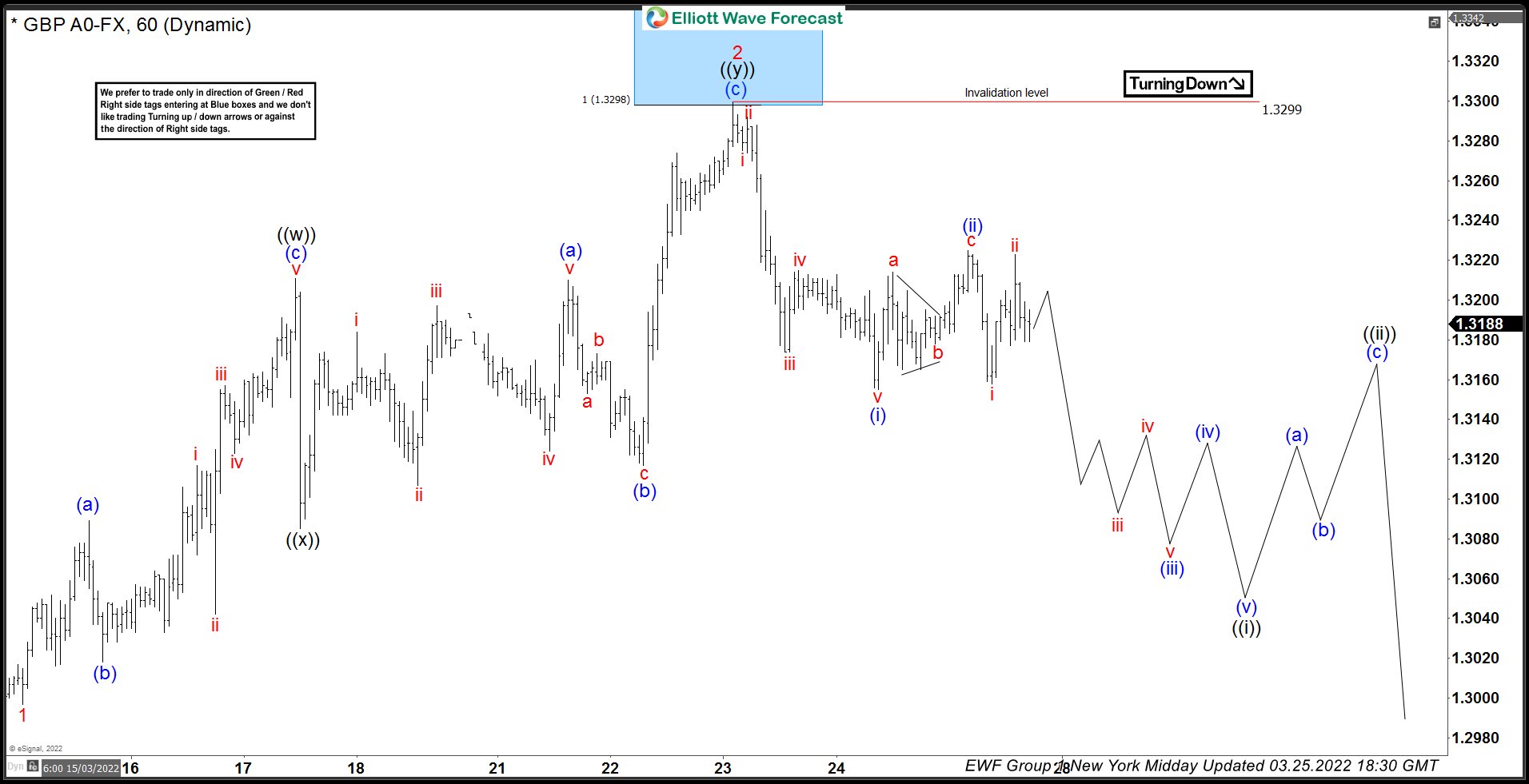
GBPUSD H1 Elliott Wave Analysis 03.25.2022
GBPUSD has given us nice reaction lower from our selling zone. Recovery is counted completed at 1.3299. While below that high, next leg down can be in progress. However we need to see further separation from the peak to confirm. Current view suggests as far as the price holds below 1.3222 peak – (ii) blue, next technical area to the downside ideally comes at 1.3079-.3045 . At that zone we should ideally complete 5 waves down from the 1.3299 peak. Once 5 waves down are completed and we can expect to see 3 waves bounce against the 1.3299 high.
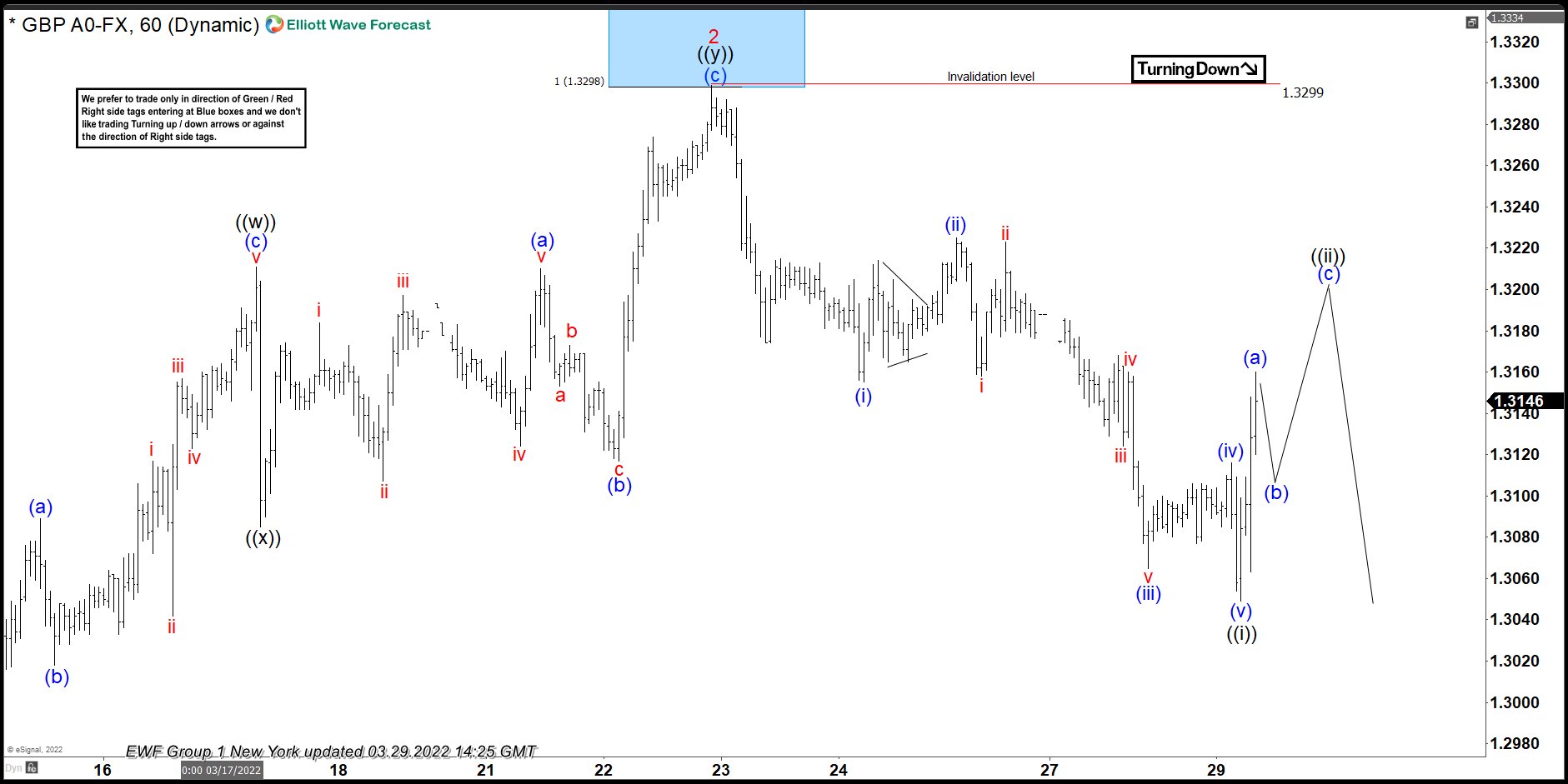
GBPUSD H1 Elliott Wave Analysis 03.29.2022
We got further separation from the peak. The pair reached 1.3079-.3045 area , completed 5 waves – ((i)) black and started turning higher in recovery ((ii)) correcting the cycle from the 1.3299 peak. Short term rally from the last low looks impulsive which suggests we are ending only first leg (a) blue of ((ii)). We expect 3 waves pull back in (b) and then another leg up (c) of ((ii)) before further decline ideally resumes.
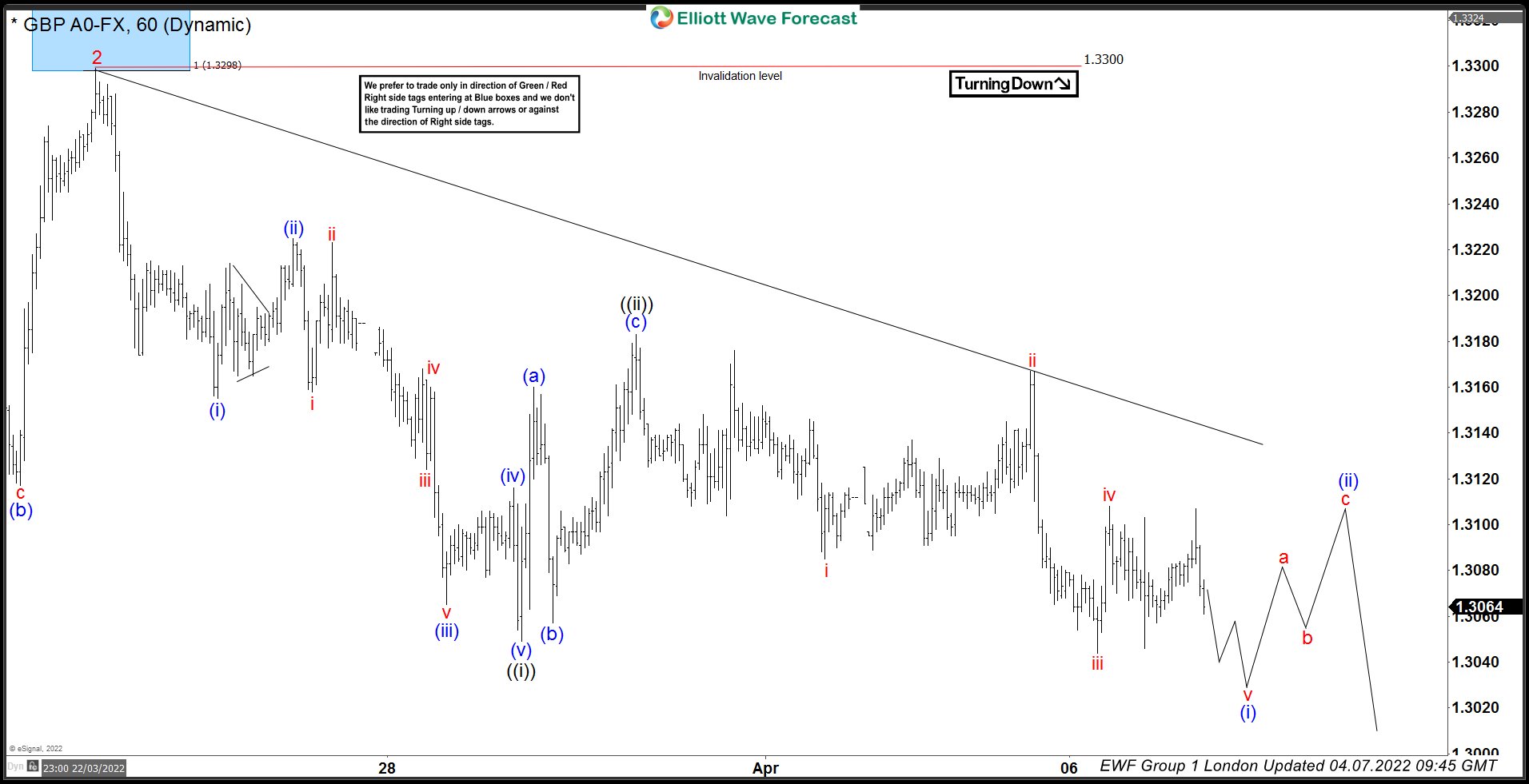
GBPUSD H1 Elliott Wave Analysis 04.07.2022
GBPUSD made (b) blue pull back and another leg up (c) blue of ((ii)). The pair completed 3 waves recovery ((ii)) black at 1.3183 and made decline again as expected. The pair has broken previous low 1.305 , which made lower low sequences from the 1.330 peak. Current price structure suggests as far as the price holds below marked trend line and 1.3183 pivot holds,next tech zone to the downside ideally comes at 1.2943-1.2886 area.
USD/JPY Mid-Day Outlook
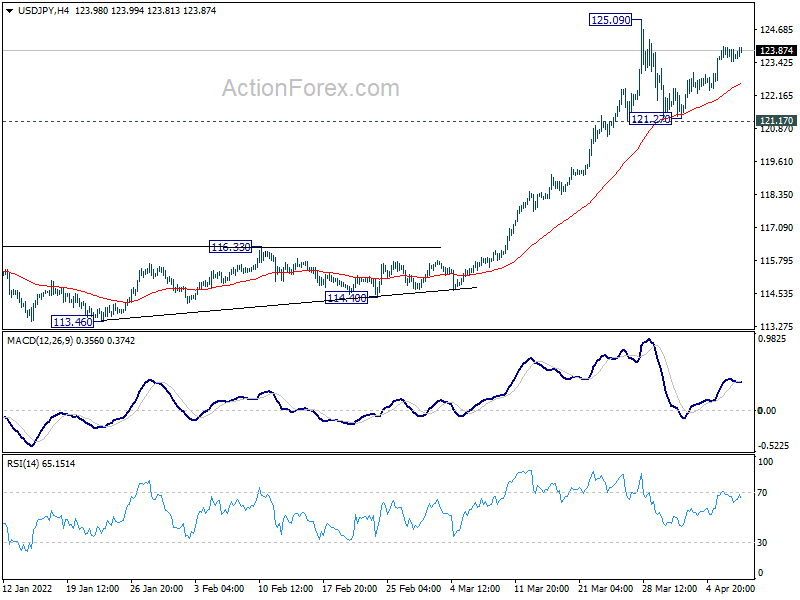
Daily Pivots: (S1) 123.49; (P) 123.77; (R1) 124.07; More...
Intraday bias in USD/JPY remains neutral as consolidation from 125.09 is extending. Outlook stays bullish with 121.17 support intact and further rise is expected. On the upside, break of 125.09 will target 125.85 long term resistance. Firm break pave the way to 130.04 long term projection level. However, break of 121.17 will turn bias back to the downside for deeper pull back.
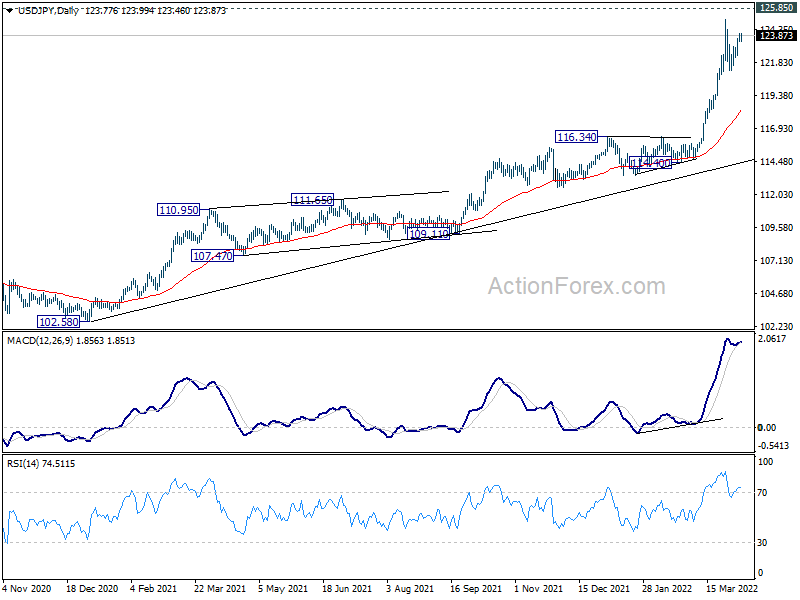
In the bigger picture, up trend from 98.97 (2016 low) in in progress for retesting 125.85 (2015 high). Sustained break there will confirm long term up trend resumption. Next target will be 61.8% projection of 75.56 (2011 low) to 125.85 (2015 high) from 98.97 at 130.04. This will now remain the favored case as long as 116.34 resistance turned support holds.
USD/CHF Mid-Day Outlook
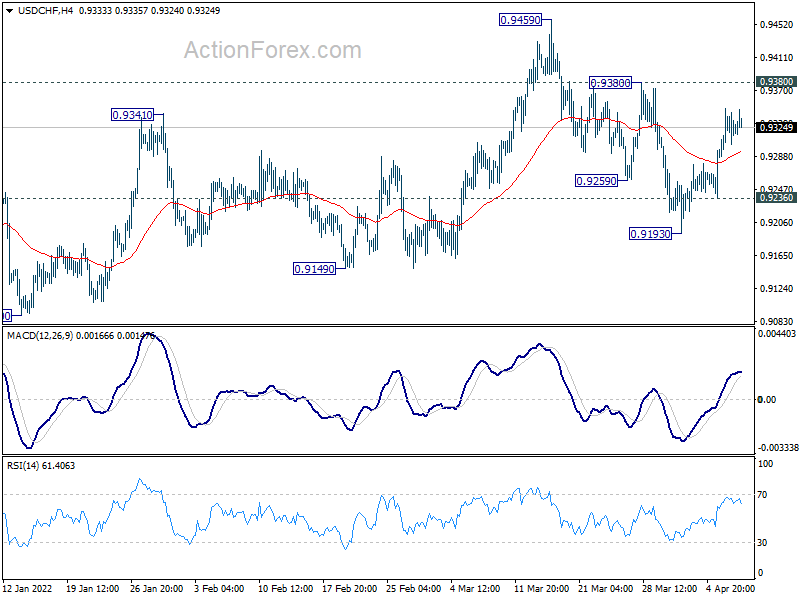
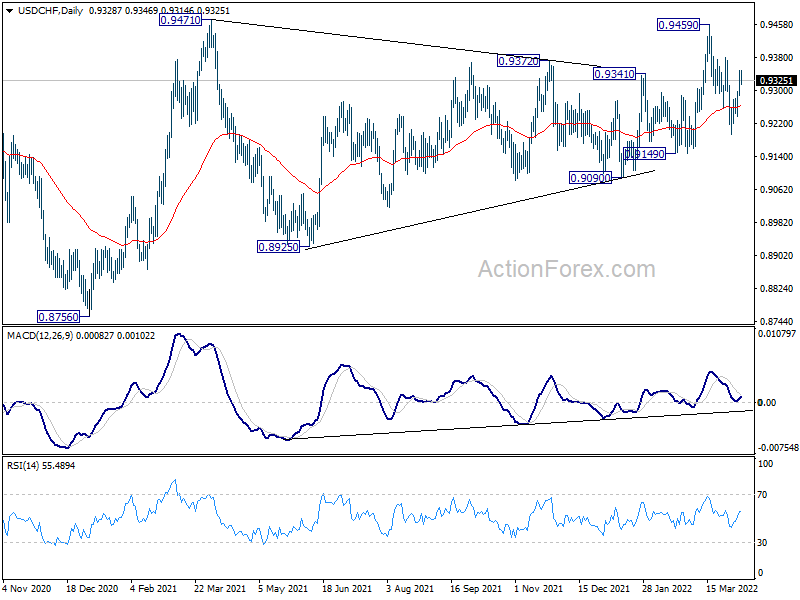
Daily Pivots: (S1) 0.9299; (P) 0.9325; (R1) 0.9358; More....
Intraday bias in USD/CHF stays neutral and focus is still on 0.9380 resistance. Firm break there will indicate that fall from 0.9459 has completed with three wave down to 0.9193. Such development will revive near term bullishness and turn bias back to the upside for 0.9459 and then 0.9471 resistance. On the downside, however, below 0.9236 will turn bias to the downside for 0.9149 structural support next.
In the bigger picture, medium term outlook will be neutral at best as long as 0.9471 resistance holds. Larger down trend could still extend through 0.8756 (2021 low). However, firm break of 0.9471 will argue that whole down trend form 1.0342 (2016 high), has completed with waves down to 0.8756. A medium term up trend should be set up to target 1.0237/0342 resistance zone.
GBP/USD Mid-Day Outlook
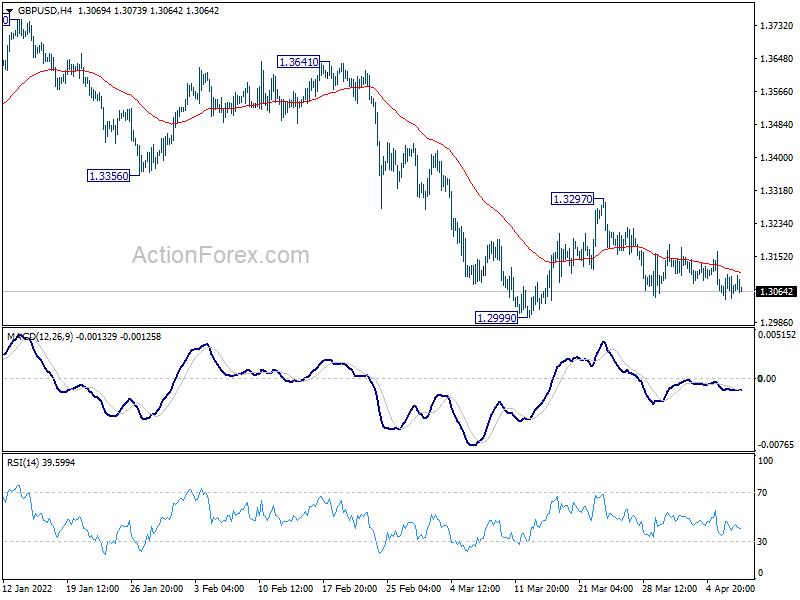
Daily Pivots: (S1) 1.3040; (P) 1.3074; (R1) 1.3102; More...
GBP/USD is staying in consolidation from 1.2999 and intraday bias remains neutral for the moment. Further decline is mildly in favor with 1.3297 resistance intact. On the downside, firm break of 1.2999 will resume larger down trend from 1.4248. However, firm break of 1.3297 will turn bias back to the upside for stronger rebound.
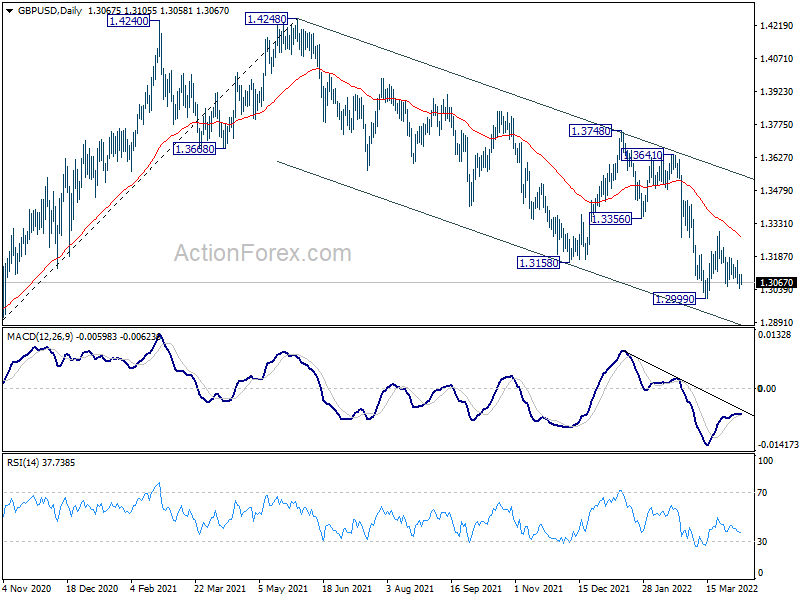
In the bigger picture, current development suggests that the up trend from 1.1409 (2020 low) has completed at 1.4248. Decline from 1.4248 could still be a corrective move, or it could be the start of a long term down trend. In either case, deeper decline would be seen back to 61.8% retracement of 2.1161 to 1.1409 at 1.2493. In any case, break of 1.3748 resistance is needed to indicate medium term bottoming, or outlook will stay bearish.
EUR/USD Mid-Day Outlook
Daily Pivots: (S1) 1.0869; (P) 1.0903 (R1) 1.0932; More...
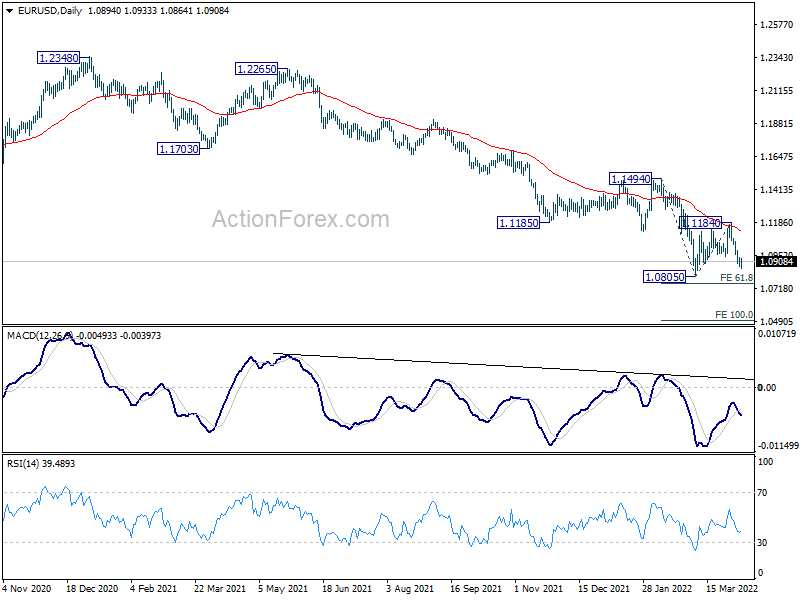
EUR/USD is losing some downside momentum as seen in 4 hour MACD, but further decline is expected with 1.0987 minor resistance intact. Deeper decline would be seen to 1.0805 low. Firm break there will resume larger down trend from 1.2248. Next target is 61.8% projection of 1.1494 to 1.0805 from 1.1184 at 1.0758, and then 100% projection at 1.0495. On the upside, above 1.0987 minor resistance will mix up the outlook and bring recovery.
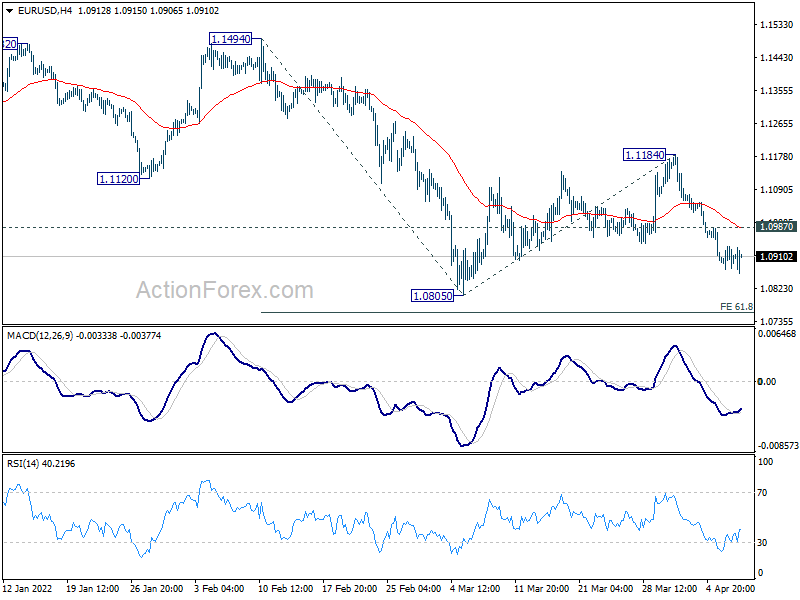
In the bigger picture, the decline from 1.2348 (2021 high) is expected to continue as long as 1.1494 resistance holds. Firm break of 1.0635 (2020 low) will raise the chance of long term down trend resumption and target a retest on 1.0339 (2017 low) next. Nevertheless, break of 1.1494 will maintain medium term neutral outlook, and extending term range trading first.