Sun, Apr 26, 2026 00:54 GMT
More

    Sample Category Title

    XAU/USD: Gold Continues to Hit New Record High in Each Session

    Gold continues to hit new record high on daily basis and rose to $4380 in early Friday trading, after the metal rallied 2.8% on Thursday and closed above $4300, recording new fastest move between two round-figure levels of just one day.

    The yellow metal remains in strong uptrend which accelerates and steepens in growing euphoria over historical rally into safety.

    Gold is also on track for weekly gain of over 8%, which marks the best week since September 2008, as the price was up almost $400 during the past five days and has advanced around 66% from the beginning of the year.

    Growing trade tensions between the US and China, which threaten of uncontrollable escalation, tough rhetorics of Moscow, Washington and NATO over the war in Ukraine, fragile peace in the Middle East, clouded political and economic situation in a number of developed countries and strong demand for physical gold from central banks continue to fuel gold’s rally, with the newest signs of weakness in US regional banks, adding to the cocktail of key factors that continue to lift metal’s price.

    Bulls remained resilient despite strongly overbought daily and weekly studies, but some price adjustment is likely to be seen soon, as 14-d momentum turned south and strongly overbought \RSI turned sideways, generating initial signal.

    However, potential consolidation or correction is likely to be limited and probably mark positioning for fresh push higher, if current strongly supportive environment persists.

    Broken $4300 level, although being cracked, marks initial support, with deeper pullback to ideally hold above $4200 (psychological / Thursday’s low) and not exceed rising daily Tenkan-sen ($4160) to keep bulls in play for probe through $4400 and possible attack at $4500, which now marks key barrier.

    Res: 4380; 4400; 4422; 4500.
    Sup: 4300; 4278; 4200; 4160.

    USD/JPY: US-Japan Yield Spread Breakdown Signals Further Yen Strength Ahead in the Near Term

    Key takeaways

    • USD/JPY reversed from its recent high of 153.28, falling 2.2% as bullish U.S. dollar momentum faded.
    • Political uncertainty in Japan weakened the “Takaichi Trade,” reducing bets on extended monetary easing.
    • The 10-year U.S.-Japan sovereign yield spread broke below key 2.47% support, signalling further downside pressure.
    • Technical indicators point to a short-term bearish setup, with support at 149.05–148.55 and resistance at 151.70.

    Since our prior report, the USD/JPY has witnessed a minor “momentum crush” as bullish sentiment of the US dollar took a backseat, where the USD/JPY did a residual push up to print an intraday high of 153.28 on 10 October 2025, before it tumbled by 2.2% to hit an intraday low of 149.90 at the time of writing.

    In addition, the “Takaichi Trade” of shorting the yen in anticipation of a revival of easy monetary policy in Japan has lost traction as Sanae Takaichi, the newly elected leader of the LDP ruling party, may not receive enough parliamentary votes to become Japan’s next prime minister after the LDP’s long-term coalition partner, Komeito withdrew its 26-year partnership with the LDP.

    Let’s now look at several macro and technical factors that suggest further potential downside in the USD/JPY, at least in the near term.

    10-year US Treasury/JGB yield spread has (finally) broken below a major support level of 2.47%

    Fig. 1: Yield spreads of US Treasury/JGB with major trend of USD/JPY as of 17 Oct 2025 (Source: TradingView)

    The 10-year yield differential between the US Treasury note and JGB has broken below the 2.47% major support with a daily close below it since 8 October 2025 (see Fig. 1)

    A move away further down from 2.47% is likely to cement a further narrowing of the 10-year US-Japan sovereign bond yield differential, and a similar movement occurred during late December 2024 to mid-April 2025 that triggered a medium-term decline of 10% on the USD/JPY.

    Implied volatility from JPY options has started to tick higher

    Fig. 2: JPY implied volatility as of 7 Oct 2025 (Source: MacroMicro)

    The implied volatility of JPY measured via FX options has started to increase from a relatively low level of 8.39 printed on 26 September 2025 (almost a 9-month low) to 9.01 on 7 October 2025 (see Fig. 2)

    Prior similar observations seen from 24 January 2025 to 7 February 2025, where the implied volatility of JPY jumped from 8.69 to 10.59, which thereafter led to a fall of 10% on the USD/JPY.

    Failure bullish breakout on the USD/JPY

    Fig. 3: USD/JPY medium-term trend as of 17 October 2025 (Source: TradingView)

    The recent bullish breakout of the USD/JPY above its “Ascending Wedge” range resistance on 7 October 2025 is considered a “failure bullish breakout” as its latest price actions of the USD/JPY have reintegrated back below the aforementioned range resistance at 150.50.

    These observations suggest that the USD/JPY is likely to revert to its medium-term sideways motion, with the key range support to watch at 146.60 (see Fig. 3).

    We will now examine its latest short-term (1 to 3 days) trajectory and key technical levels to watch on USD/JPY

    Preferred trend bias (1-3 days) – Vulnerable for a bearish break below 20-day MA

    Fig. 4: USD/JPY minor trend as of 17 October 2025 (Source: TradingView)

    Bearish bias in any bounces below 151.70 key short-term pivotal resistance, and a break below 149.75 exposes the next intermediate support zone at 149.05/148.55 in the first step (see Fig. 4).

    Key elements

    • The hourly MACD trend indicator of the USD/JPY has broken below a key ascending trendline support that has occurred below the centreline, which suggests a potential buildup of a bearish momentum condition.
    • These observations indicate that the 20-day moving average, which is acting as a near-term support at 149.75, is likely to be broken down.
    • The intermediate support zone of 149.05/148.55 is defined by the gap support formed on 6 October 2025 and the 50-day moving average.

    Alternative trend bias (1 to 3 days)

    A clearance above 151.70 key short-term resistance invalidates the bearish scenario for a squeeze up towards the next intermediate resistance at 152.45.

    US: Lack of Labor Market Data Due to Government Shutdown – Investors Seek Alternative Indicators

    • Investors rely on private data (ADP, ISM, Conference Board), but correlations with official figures are weak.
    • Alternative indicators suggest slower hiring, not a collapse.
    • The Fed is likely to stay cautious with future rate cuts.

    The third week of the partial shutdown of the U.S. federal government is increasingly disrupting access to official economic data. The suspension of key reports makes it more difficult for the Federal Reserve to assess the economic situation as it prepares for the upcoming FOMC meeting scheduled for October 28–29. In this environment, investors and analysts are attempting to replace government statistics with private-sector indicators — though their reliability remains limited.

    Limited Access to Data and the Fed’s Policy Challenges

    Due to the ongoing stalemate in Congress, many federal agencies, including statistical offices, have been closed since October 1. This has resulted in the suspension of several crucial releases, including employment reports. The Bureau of Labor Statistics (BLS) plans to publish consumer inflation data on October 24, albeit with a one-week delay. For the Federal Reserve, this situation represents a significant obstacle to evaluating the state of the economy — especially the labor market, which currently shows signs of fragility.

    Private Data Sources – Limited Informational Value

    ADP: The ADP report, based on payroll data from 26 million private-sector employees, showed that U.S. private employers cut 32,000 jobs in September, marking the latest sign that the labor market is entering a significant slowdown. By sector, the largest losses were recorded in service-providing industries, including leisure and hospitality as well as business services, where employment fell by 28,000 positions. Moreover, the real-time correlation between ADP data and official BLS figures remains very weak at 0.12, indicating no statistically meaningful relationship. As a result, the ADP report provides limited insight into what the official employment report might have shown had the government not been shut down.

    ISM Indices: The Institute for Supply Management’s manufacturing and services surveys suggest a slowdown in hiring, with both employment components remaining below the neutral 50-point threshold. In September, the employment subindex for the services sector stood at 47.2 points, while the manufacturing employment subindex came in at 45.3 points — both signaling contraction in hiring activity. While the manufacturing employment index shows a moderate correlation (0.6) with employment dynamics, its volatility and discrepancies with actual data limit its predictive reliability.

    Sentiment Indicators and Predictive Models

    Conference Board: The gap between the share of respondents who believe that “jobs are plentiful” and those who say they are “hard to get” (known as the labor market differential) is highly correlated with the unemployment rate. This metric has recently declined, signaling a deterioration in consumer sentiment and suggesting possible softening in the labor market over the coming months.

    Chicago Fed: The Federal Reserve Bank of Chicago continues to publish its own unemployment rate estimates based on models incorporating both public and private data. According to the latest (not yet officially released) estimates, the unemployment rate stood at 4.34 percent in September — only slightly higher than August’s 4.32 percent. However, the historical accuracy of this model has been limited.

    Chicago Fed Real-Time Unemployment Rate (September 2025), source: chicagofed.org

    The Labor Market Is Slowing, Not Collapsing

    While alternative indicators provide some insight into current economic conditions, they cannot fully replace official data, which remain methodologically consistent and historically comparable. The available private data suggest a moderation in hiring momentum rather than a sharp downturn. The U.S. labor market thus appears to be entering a phase of gradual cooling rather than contraction — a scenario that may encourage the Federal Reserve to proceed cautiously with further interest rate cuts in the months ahead.

    Eurozone CPI finalized at 2.2%, driven by services and food prices

    Eurozone inflation edged higher in September, with headline CPI finalized at 2.2% yoy, up from 2.0% in August. The core measure, which excludes energy, food, alcohol & tobacco, also firmed to 2.4% yoy from 2.3%.

    The main driver of the increase came from services, which contributed +1.49 percentage points to the annual rate, followed by food, alcohol, and tobacco (+0.58 pp), and non-energy industrial goods (+0.20 pp). Energy continued to be a drag, subtracting -0.03 pp.

    Across the broader European Union, annual inflation was finalized at 2.6% yoy, up from 2.4% in August, with wide divergence among member states. Cyprus (0.0%), France (1.1%), and Italy and Greece (1.8%) recorded the lowest rates, while Romania (8.6%), Estonia (5.3%), and Croatia and Slovakia (4.6%) posted the highest. Inflation fell in 8 countries, was stable in 4, and rose in 15.

    Full Eurozone CPI final release here.

    BoJ’s Uchida: Further hikes if outlook holds

    BoJ Deputy Governor Shinichi Uchida said in a speech on today that the central bank remains prepared to raise interest rates further if its current projections for growth and inflation are realized. He emphasized that the BoJ will “judge without any pre-conception” while monitoring both domestic and global conditions.

    Uchida highlighted rising uncertainty surrounding overseas economies, particularly due to shifting trade policies that could influence Japan’s external demand and price trends. “It’s necessary to closely monitor how these developments may affect financial and foreign exchange markets, as well as Japan’s economy and prices,” he said.

    Yen Nears End of Corrective Phase

    Market sentiment remains highly sensitive to rhetoric from the Federal Reserve and statements from the White House. This is particularly true given the protracted government shutdown and the resurgence of trade disputes with several Asian partners.

    While heightened geopolitical tensions in the region are bolstering demand for the yen as a safe-haven asset, the broader monetary policy divergence between the Fed and the Bank of Japan continues to favour the US dollar.

    The greenback remains under pressure due to ongoing uncertainty from the shutdown and escalating "Trump trade wars." These factors are amplifying market volatility, prompting traders to lock in positions ahead of key inflation data and scheduled speeches from Fed officials.

    Conversely, the Japanese yen is attracting moderate support from falling US Treasury yields and growing demand for safe-haven assets.

    Technical Analysis: USD/JPY

    H4 Chart:

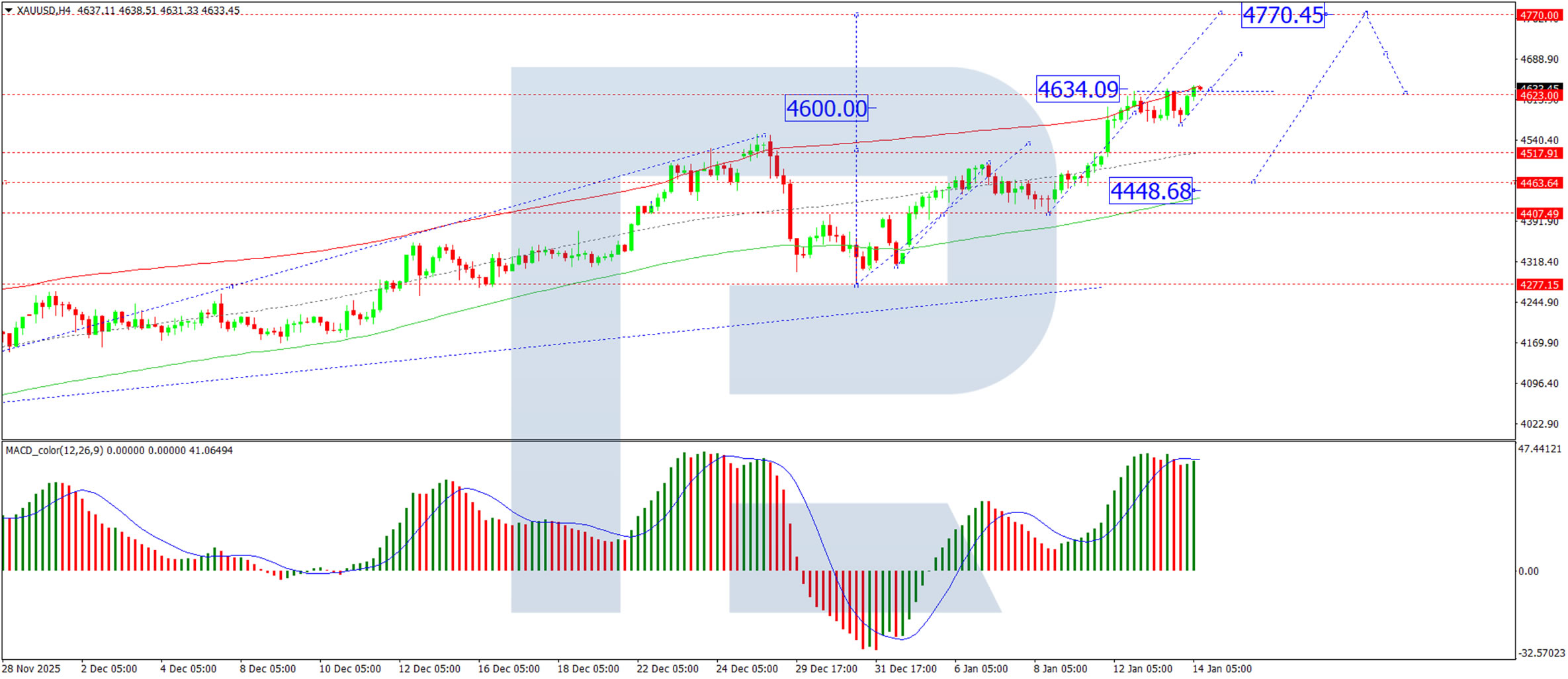
    The USD/JPY pair has completed a corrective decline, finding a base at 149.75. We anticipate this correction is now concluding, paving the way for a growth wave with an initial target of 151.55 (testing it from below). Following this, a pullback towards 150.60 is plausible, potentially forming a local consolidation range. An upward breakout from this range would signal a continuation of the bullish momentum towards 154.10, which serves as the next local target. This outlook is technically confirmed by the MACD indicator, whose signal line is at lows below zero and appears to be reversing upwards, suggesting a new growth impulse is likely forming.

    H1 Chart:

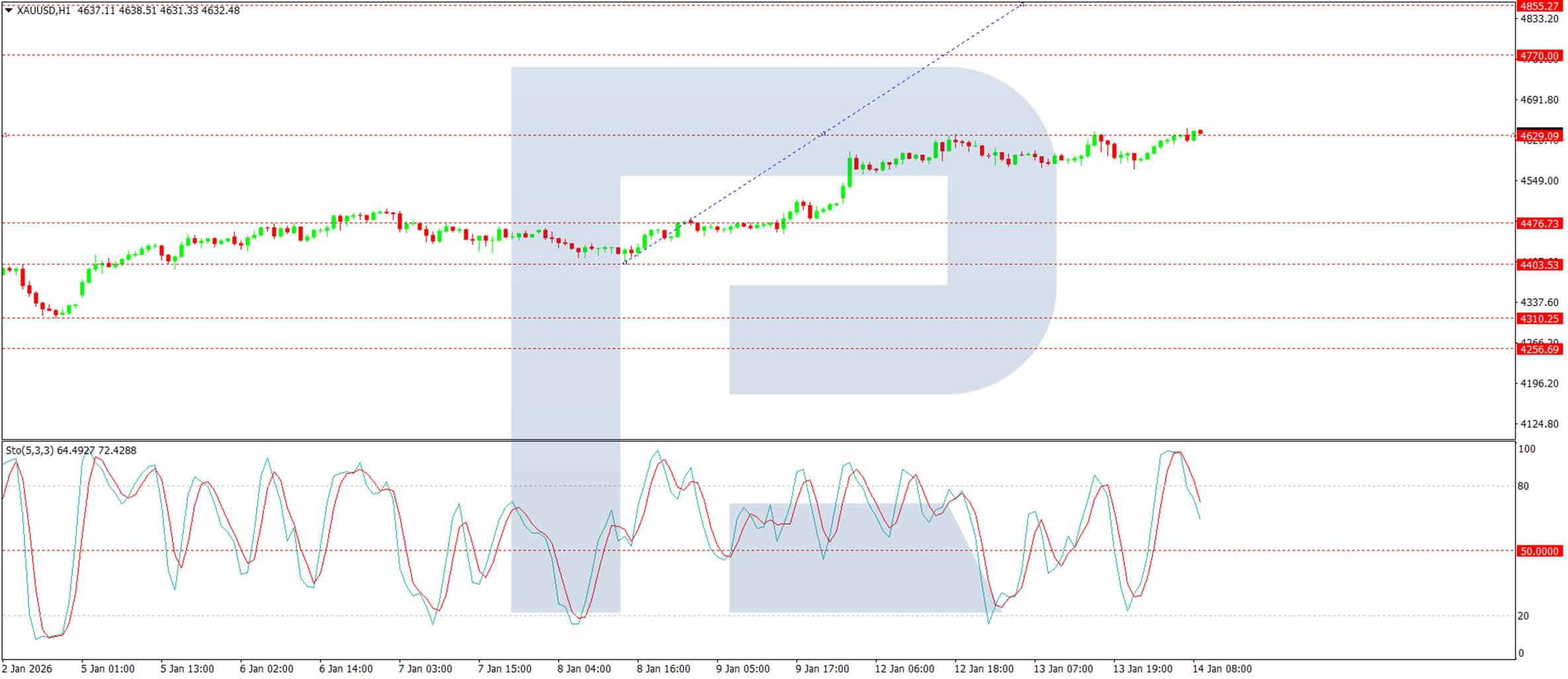
    The market concluded its downward wave at 149.75 and is currently consolidating at the range's lower boundary. We expect an initial growth wave to 151.55, to be followed by a potential correction to 150.60. The bullish scenario is further supported by the Stochastic oscillator; its signal lines are deep in the oversold territory (below 20) and are poised to rise towards 80, indicating significant recovery potential in the coming hours.

    Conclusion

    The technical picture suggests the yen's correction is finalising. While safe-haven flows provide underlying support, the dominant driver remains the significant monetary policy divergence, which is expected to ultimately favour the dollar. The immediate trajectory will be guided by the market's reaction to upcoming US data and Fed commentary.

    EUR/CAD Hits 16-Year High

    Charts show that the euro strengthened against the Canadian dollar on Thursday, with the pair climbing above 1.6460 for the first time since spring 2009, when the world was still reeling from the global financial crisis.

    The current weakness of the Canadian dollar is being influenced by several factors:

    → Trade relations with the United States – according to media reports, some Canadian industries such as steel and automotive manufacturing are facing competitive disadvantages under the current agreement.

    → Oil prices have fallen to a five-month low, partly due to expectations surrounding a potential meeting between the US and Russian presidents. As we noted on 13 October, the XTI/USD exchange rate could drift towards $55 per barrel.

    Meanwhile, the euro has benefited from the softening of the US dollar. Notably, the DXY index has turned lower from a key resistance level — the upper boundary of the channel identified in our 9 October analysis.

    However, an examination of the EUR/CAD chart suggests that the current upward momentum may be losing steam.

    Technical Analysis of the EUR/CAD Chart

    Price movements — with key turning points shown in bold — outline a rising channel that has remained relevant since August.

    The bearish case rests on the following factors:

    → The pair has reached the upper boundary of the channel, which has repeatedly acted as strong resistance and may do so again.

    → The sharp mid-October rally pushed the RSI indicator into extreme overbought territory.

    On the other hand, price action continues to reflect strong demand, as seen in the clean breakout above the previous peak near 1.6400, which occurred on a wide bullish candle with minimal pullback.

    In these conditions, it is reasonable to assume that:

    → After a 1.6% rise in seven days, some long holders may start taking profits, leading to consolidation near the upper boundary of the channel;

    → If a correction from the upper channel line develops, it is likely to be shallow, as bullish activity could re-emerge around the median line, reinforced by the former resistance at 1.6400.

    Trade over 50 forex markets 24 hours a day with FXOpen. Take advantage of low commissions, deep liquidity, and spreads from 0.0 pips. Open your FXOpen account now or learn more about trading forex with FXOpen.

    This article represents the opinion of the Companies operating under the FXOpen brand only. It is not to be construed as an offer, solicitation, or recommendation with respect to products and services provided by the Companies operating under the FXOpen brand, nor is it to be considered financial advice.

    Bullish on Silver: Why Upside Potential Looks Promising

    According to short-term Elliott Wave analysis, Silver (XAGUSD) has been in a strong impulsive rally since July 31. The metal initially surged to $38.73 in wave (1), pulled back to $36.94 ended wave (2), and then resumed its upward momentum in wave (3) higher. Whereas wave 1 of (3) ended at $39.06 high, wave 2 pullback ended at $38.06 low. Then a rally to $53.57 high ended wave 3. A subsequent corrective phase, wave 4, formed a zigzag pattern with a final low at $50.42, completing the wave 4.

    Silver then launched into wave 5, characterized by a five-wave internal structure. From the wave 4 low, the metal advanced in waves ((i)) to $51.93 and ((ii)) to $51.28 low, with minor sub-waves in waves (i) ended at $53.36 high and (ii) ended at $52.42 low. Up from there, wave (iii) ended at $54.42 high and wave (iv) at $53.40 low. Now as long as Silver stays above $50.40, dips are likely to attract buyers, potentially in a 3, 7, or 11-swing sequence, supporting further upside. This outlook suggests the bullish trend remains intact, with potential for additional gains as the impulsive structure unfolds.

    Silver Latest 1-Hour Elliott Wave Chart From 10.17.2025

    Silver Elliott Wave Video:

    https://www.youtube.com/watch?v=Dl23zcBHHB0

    Safe Haven Flows Flocked into US Bonds

    Markets

    Treasuries rallied yesterday, dragging yields 4.1 to 7.3 bps lower with the front end of the curve outperforming. Safe haven flows flocked into US bonds on reports of two regional banks (Zions & Western Alliance) saying they were the victim of collateral-related fraud on loans to funds that invest in distressed commercial mortgages. Both banks fell more than 10%, dragging the broader regional bank index significantly lower too. This index got to the center of attention back in March 2023, when other regional lenders including Silicon Valley Bank failed and caused tremors across other markets. The current matter is different from the underlying issues back then (Treasuries deeply under water due to the Fed’s tightening cycle) and it remains to be seen if this is an isolated, one-off event. Being in a late cycle economy, however, it does trigger investor concerns of wider spread cracks emerging in the credit market. The lack of other news puts a magnifier on the topic, potentially exacerbating the moves. A yet again empty economic calendar just might do the same for today, especially going into the weekend and considering yesterday’s technical break lower. The US 10-yr yield dropped below the 4% barrier and is now eying support at 3.88%, where the 76.4% retracement on the Sep 2024 – Jan 2025 rally coincides with the temporary lows seen in the aftermath of president Trump’s April 2 tariff announcements. The 2-yr yield already surpassed that mark. The 3.4% is currently the lowest level since September 2022. Money markets for the first time since the September meeting are mulling the possibility of a jumbo cut at one of the two remaining meetings this year. The cumulative amount of easing priced in rose to 55 bps. In the ultra-short yield segment we’re looking very closely at the SOFR fixing. Yesterday’s 4.29% was higher than the Fed’s upper bound of the 4.-4.25% target range. Net TBill supply was one of the reasons said to have stretched liquidity but the mere fact that it did is reason enough to follow up on the matter. German bunds underperformed Treasuries yesterday but they missed out on a second risk-off leg happening after European closing hours. Bund futures marched higher yesterday evening and this morning. Wall Street contained losses to around 0.6% but futures suggest a further decline, including for Europe (-0.9%). We expect the US dollar to remain under pressure, just as it did yesterday. US-related risk-off (for now at least) appears to hurt the greenback more than the euro, allowing EUR/USD to rebound to 1.173 currently after its recent correction lower. French PM Lecornu surviving two votes of no confidence eases some of the most acute risk for new elections but we remain skeptical. The hard part, budget talks, has only just begun. Belgium is facing a similar daunting task. It dodged rating agency Moody’s bullet last week but S&P is lining up (review next Friday). S&P has a AA rating with a negative outlook (since April this year). The Japanese yen outperforms in these risk aversion circumstances, pushing USD/JPY back below 150 for the first time since early October.

    News & Views

    Bank of Japan governor Ueda kept the door open for a rate hike when the central bank convenes at the end of the month. He said that there’s no change in the central bank’s stance that they will adjust the degree of monetary easing if confidence in hitting the outlook increases. Japanese money markets currently attach only a 15% probability to a 25 bps rate hike. Speeches by BoJ Takata and BoJ Himino are still scheduled on Monday and on Tuesday with national CPI numbers out on Friday. Takata was one of two BoJ-members who already though that a rate hike was justified at the September meeting. BoJ governor Ueda didn’t touch on domestic politics as a potential source of volatility which could impact monetary policy. The Japanese parliament is scheduled to vote on the next PM on Tuesday. The ruling LDP party is still searching for a new coalition partner after its junior partner Komeito ended the collaboration in the aftermath of LDP leadership election. They have been courting the Japan Innovation Party (Ishin). One of Ishin’s co-leaders called it a 50/50 toss-up this morning whether they’d back LDP’s Takaichi or whether they join forces with main opposition parties in supporting the leader of the Democratic Party for the People, Tamaki. USD/JPY dives back below the 150-handle this morning on a combination of USD-weakness and JPY strength in the risk-off market climate.

    The UK’s Institute for Fiscal Studies (IFS) released its annual “Green Budget” report ahead of the Autumn Budget. The very extensive report, in collaboration with Barclays, provides and in-depth analysis of the UK’s economic and fiscal outlook. One of the chapters looks at risks and challenges for public finances. The IFS warns for example for a lower productivity forecast by the OBR. A 0.1 ppt drop could increase borrowing by £7bn in 2029-2030. Under Barclays’ central scenario, Chancellor Reeves’ Autumn budget would need £12bn in tightening for a current budget surplus, £17bn is she wants to meet her second fiscal rule related to debt (PSNFL falling as a share of national income) and £22bn to restore her current £10bn fiscal buffer (headroom). The IFS adds that the headroom is extremely small, increasing risks of political instability and economic uncertainty. If she restores the £10bn, they attach a 2/3rd probability of meeting borrowing rules next spring and only a 1/5 probability of meeting them over three years without policy changes.

    EUR/USD Daily Outlook

    Daily Pivots: (S1) 1.1655; (P) 1.1675; (R1) 1.1706; More

    Intraday bias in EUR/USD remains neutral for the moment. Further decline is still expected with 1.1778 resistance intact. On the downside, break of 1.1540 will resume the fall from 1.1917 to 1.1390 , or further to 38.2% retracement of 1.0176 to 1.1917 at 1.1252. However, firm break of 1.1778 will suggest that pullback from 1.1917 has completed, and bring retest of this high.

    In the bigger picture, considering bearish divergence condition in D MACD, a medium term top is likely in place at 1.1917, just ahead of 1.2 key psychological level. As long as 55 W EMA (now at 1.1274) holds, the up trend from 0.9534 (2022 low) is still extended to continue. Decisive break of 1.2000 will carry larger bullish implications. However, sustained trading below 55 W EMA will argue that rise from 0.9534 has completed as a three wave corrective bounce, and keep outlook bearish.