Sample Category Title
GBP/USD Mid-Day Outlook
Daily Pivots: (S1) 1.3586; (P) 1.3611; (R1) 1.3661; More...
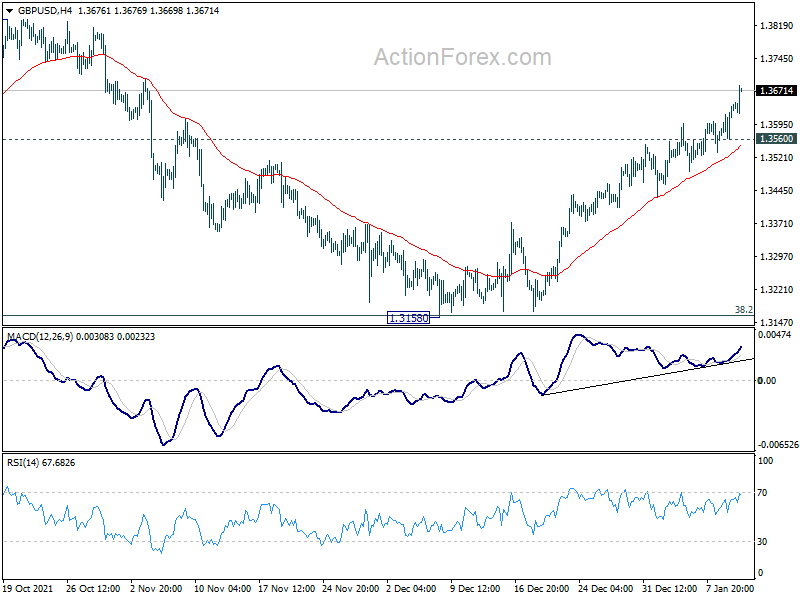
GBP/USD's rally from 1.3158 continues today and intraday bias remains on the upside. As noted before, corrective fall from 1.4282 should have completed with three waves down to 1.3158, after hitting 1.3164 medium term fibonacci level. Further rally should be seen to 1.3833 resistance next. On the downside, below 1.3560 minor support will turn intraday bias neutral first. But further rise will remain in favor as long as 55 day EMA (now at 1.3468) holds.
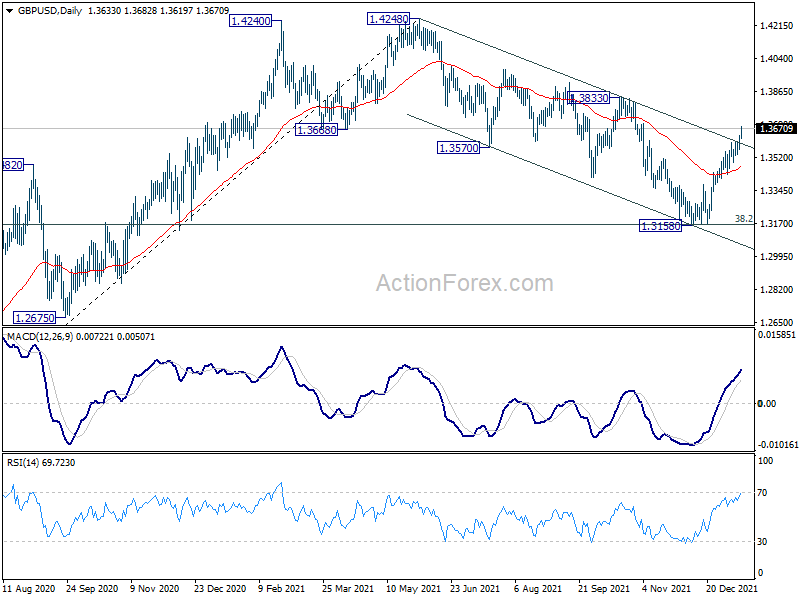
In the bigger picture, strong support was seen from 38.2% retracement of 1.1409 to 1.4248 at 1.3164. The development suggests that up trend from 1.1409 (2020 low) is still in progress. On resumption, next target will be 38.2% retracement of 2.1161 to 1.1409 at 1.5134. Nevertheless sustained break of 1.3164 will argue that whole rise from 1.1409 has completed and bring deeper fall to 61.8% retracement at 1.2493.
EUR/USD Mid-Day Outlook
Daily Pivots: (S1) 1.1330; (P) 1.1352; (R1) 1.1392; More...
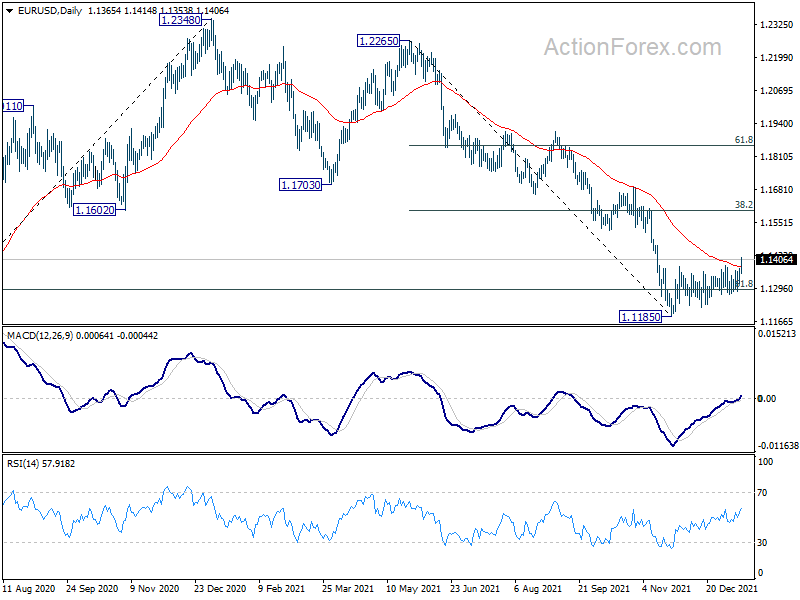
EUR/USD finally breaks out of established range today and hits as high as 1.1414 so far. Intraday bias is now on the upside, and rebound from 1.1185 would target 38.2% retracement of 1.2265 to 1.1185 at 1.1598. As we're tentatively treating is as a corrective move, we'd look for strong resistance from 1.1598 to bring down trend resumption. On the downside, below 1.1284 support will bring retest of 1.1185 low. However, sustained break of 1.1598 will argue that the trend is reversing already.
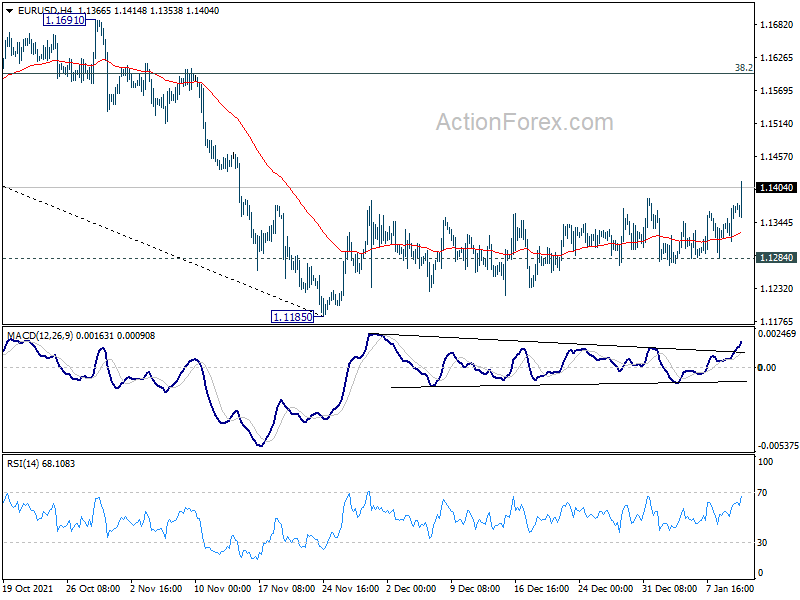
In the bigger picture, there are various ways of interpreting the fall from 1.2348 (2021 high). It could be a correction to rise from 1.0635 (2020 low), the fourth leg of a sideway pattern from 1.0339 (2017 low), or resuming long term down trend. In any case, outlook will now stay bearish as long as 1.1703 support turned resistance holds. Sustained break of 61.8% retracement of 1.0635 to 1.2348 at 1.1289 would pave the way back to 1.0635.
Dollar Tumbles Broadly as CPI Matched Expectations, Risk Cleared
Dollar tumbles broadly in early US session even though consumer inflation data hit multi-decade highs. The move could be seen as a result of clearing the risk of even worse inflation reading that could force Fed's hand. For now, Canadian Dollar is the strongest one as boosted by rally in oil prices. Sterling and Aussie are following closely on broad risk-on sentiment. On the other hand, Yen is under some selling pressure.
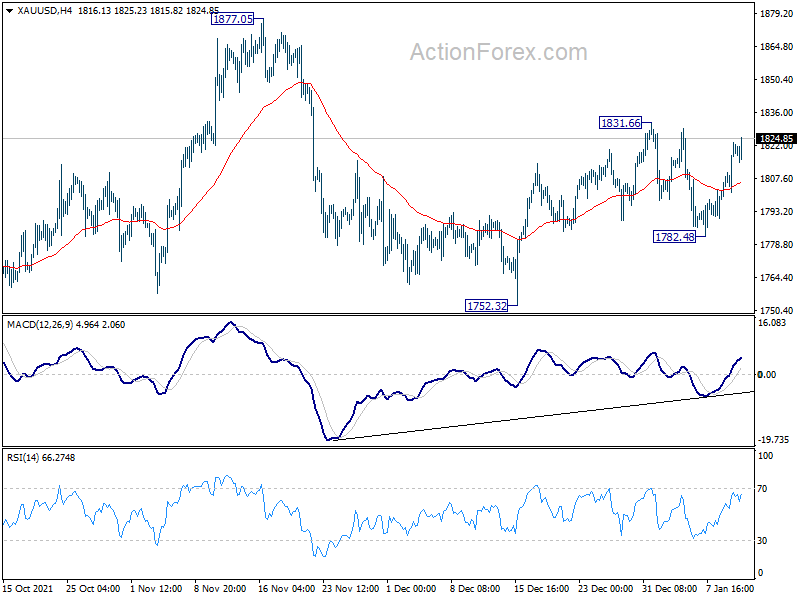
Technically, EUR/USD finally breaks out to the upside today, after staying in range for more than a month. We'll now look at GBP/USD's reaction to 1.3833 resistance and 0.7277 resistance in AUD/USD to further confirm Dollar's weakness. Meanwhile, Gold could also follow by breaking 1831.66 resistance to resume the rebound from 1752.32.
In Europe, at the time of writing, FTSE is up 0.74%. DAX is up 0.37%. CAC is up 0.48%. Germany 10-year yield is down -0.044 at -0.067. Earlier in Asia, Nikkei rose 1.92%. Hong Kong HSI rose 2.79%. China Shanghai SSE rose 0.84%. Singapore Strait Times rose 0.27%. Japan 10-year JGB yield dropped -0.0255 to 0.129.
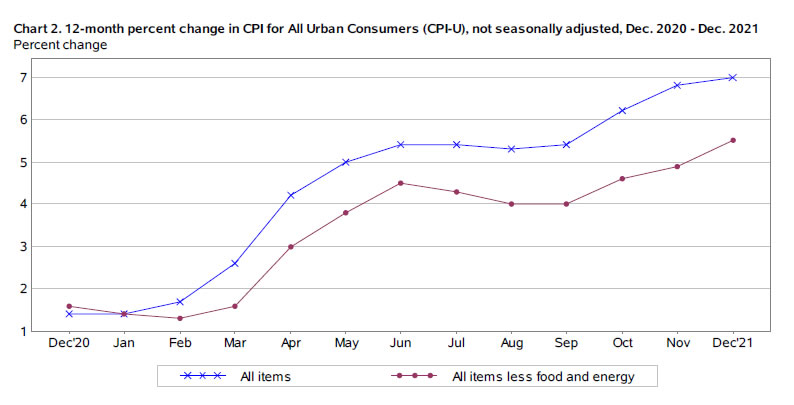
US CPI rose to 7.0% yoy in Dec, core CPI rose to 5.5% yoy
US all-item CPI accelerated from 6.8% yoy to 7.0% yoy in December, matched expectations. The annual rate was the largest increase since June 1982. Core CPI accelerated from 4.9% yoy to 5.5% yoy, above expectation of 5.4% yoy. That's the highest level since February 1991. The energy index rose 29.3% yoy while food index rose 6.3% yoy.
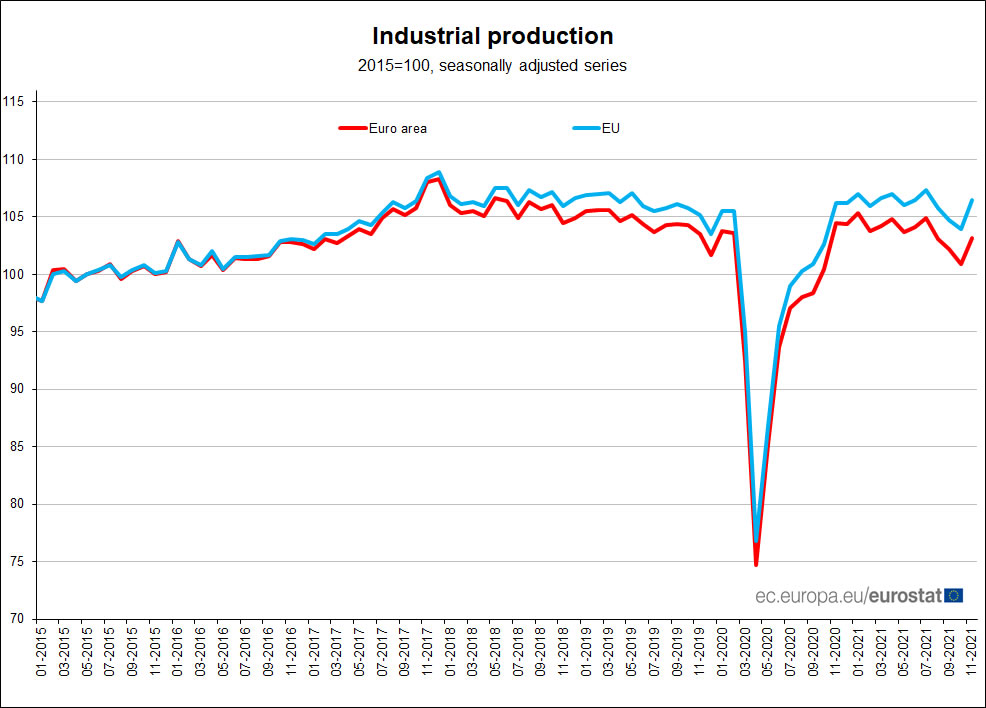
Eurozone industrial production rose 2.3% mom in Nov, EU up 2.5% mom
Eurozone industrial production rose 2.3% mom in November, well above expectation of 0.6% mom. Production of non-durable consumer goods rose by 3.2%, capital goods by 1.5%, energy by 1.2% and intermediate goods by 0.9%, while production of durable consumer goods fell by -0.2%
EU industrial production rose 2.5% mom. Among Member States for which data are available, the largest monthly increases were registered in Ireland (+37.3%), Poland (+5.9%) and Czechia (+4.8%). The highest decreases were observed in Belgium (-4.4%), Malta (-3.7%) and Luxembourg (-2.3%).
BoJ Kuroda: Consumer inflation likely to gradually accelerate
In a speech to regional branch managers, BoJ Governor Haruhiko Kuroda said "Japan's economy is picking up as a trend, although it remains in a severe state due to the impact of the coronavirus pandemic." The economy is expected to recover ahead as coronavirus impact eases.
On prices, Kuroda said consumer inflation is "likely to gradually accelerate reflecting rising energy prices." Also, "consumer inflation likely to gradually accelerate as a trend."
BoJ upgrades economic assessments on all nine regions
In the latest regional Economic Report, BoJ upgraded assessment on all nine regions. All reported that their respective economies "had been picking up or had shown signs of a pick-up, with the impact of the novel coronavirus (COVID-19) waning somewhat, primarily in consumption of services."
EUR/USD Mid-Day Outlook
Daily Pivots: (S1) 1.1330; (P) 1.1352; (R1) 1.1392; More...
EUR/USD finally breaks out of established range today and hits as high as 1.1414 so far. Intraday bias is now on the upside, and rebound from 1.1185 would target 38.2% retracement of 1.2265 to 1.1185 at 1.1598. As we're tentatively treating is as a corrective move, we'd look for strong resistance from 1.1598 to bring down trend resumption. On the downside, below 1.1284 support will bring retest of 1.1185 low. However, sustained break of 1.1598 will argue that the trend is reversing already.
In the bigger picture, there are various ways of interpreting the fall from 1.2348 (2021 high). It could be a correction to rise from 1.0635 (2020 low), the fourth leg of a sideway pattern from 1.0339 (2017 low), or resuming long term down trend. In any case, outlook will now stay bearish as long as 1.1703 support turned resistance holds. Sustained break of 61.8% retracement of 1.0635 to 1.2348 at 1.1289 would pave the way back to 1.0635.
Economic Indicators Update
| GMT | Ccy | Events | Actual | Forecast | Previous | Revised |
|---|---|---|---|---|---|---|
| 23:50 | JPY | Bank Lending Y/Y Dec | 0.60% | 0.60% | 0.60% | |
| 23:50 | JPY | Current Account (JPY) Nov | 1.37T | 1.05T | 1.03T | |
| 01:30 | CNY | CPI Y/Y Dec | 1.50% | 1.80% | 2.30% | |
| 01:30 | CNY | PPI Y/Y Dec | 10.30% | 11.10% | 12.90% | |
| 05:00 | JPY | Eco Watchers Survey: Current Dec | 56.4 | 56.2 | 56.3 | |
| 10:00 | EUR | Eurozone Industrial Production M/M Nov | 2.30% | 0.60% | 1.10% | -1.30% |
| 13:30 | USD | CPI M/M Dec | 0.50% | 0.40% | 0.80% | |
| 13:30 | USD | CPI Y/Y Dec | 7.00% | 7.00% | 6.80% | |
| 13:30 | USD | CPI Core M/M Dec | 0.60% | 0.50% | 0.50% | |
| 13:30 | USD | CPI Core Y/Y Dec | 5.50% | 5.40% | 4.90% | |
| 15:30 | USD | Crude Oil Inventories | -2.1M | -2.1M | ||
| 19:00 | USD | Fed's Beige Book |
US CPI rose to 7.0% yoy in Dec, core CPI rose to 5.5% yoy
US all-item CPI accelerated from 6.8% yoy to 7.0% yoy in December, matched expectations. The annual rate was the largest increase since June 1982. Core CPI accelerated from 4.9% yoy to 5.5% yoy, above expectation of 5.4% yoy. That's the highest level since February 1991. The energy index rose 29.3% yoy while food index rose 6.3% yoy.
Aussie Snoozes as Mini-Rally Fizzles
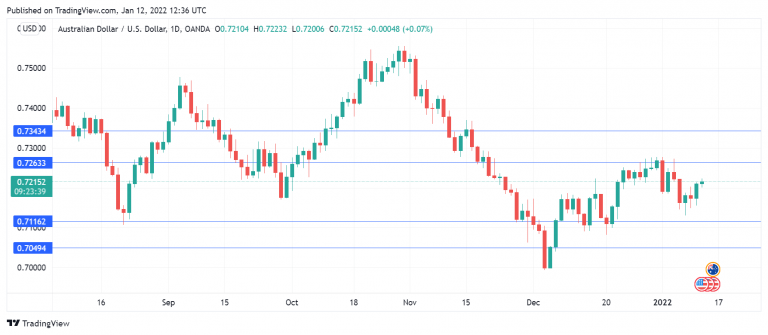
The Australian dollar is almost unchanged on Wednesday as it trades just above the 0.72 level. On Tuesday, the Aussie posted strong gains of 0.51%, its best daily performance in a week. This was courtesy of testimony from Fed Chair Jerome Powell, who reiterated the Fed’s hawkish stance and boosted risk sentiment.
Powell, who spoke at his confirmation hearing, said that he expects the Fed to normalize policy this year by ending asset purchases in March and raising interest rates over the course of 2022. Powell added that the Fed would start decreasing the balance sheet later in year, another sign of normalization.
On the inflation front, Powell said that he expected inflation to peak in mid-year. Importantly, he didn’t back four rate hikes this year and didn’t mention a March lift-off to hikes. This kept Wall Street pleased and the equity markets responded with strong gains while the US dollar retreated, as risk sentiment remained elevated.
Investors have shifted their attention to US CPI and Core CPI, which will be released later today. Inflation has been soaring and the December consensus stands at 7.0% y/y, even higher than the 6.8% gain in November. The inflation report could shake up the US dollar – a reading above 7.0% would raise the likelihood of a March hike and boost the dollar, while a release below 6.50% would support the Fed waiting until mid-year, which would be bearish for the greenback.
In Australia, Omicron infections are skyrocketing, with the country reporting over 1 million infections. Although the number of severe cases has not climbed sharply, businesses are hurting due to worker shortages, as workers have stayed at home due to sickness or quarantine regulations. This could put in a dent in Australia’s GDP, even if the government manages to avoid lockdowns due to the current Omicron wave.
AUD/USD Technical
- There is resistance at 0.7263 and 0.7343
- AUD/USD has support at 0.7116 and 0.7049
EUR/USD Outlook: Bulls Pressure Key Fibo Barrier ahead of US Inflation Data
The Euro trading at the upper side of the near-term range in European trading on Wednesday, after eventually penetrating into thick and falling daily Ichimoku cloud on Tuesday.
The action is still holding below pivotal Fibo barrier at 1.3795 (38.2% of 1.1692/1.1186 bear-leg) which caps since the mid-November.
Break here is needed to signal an end of extended sideways-trading and open way for stronger correction of larger downtrend from 1.2266 (May 25 2021 peak).
Daily studies are mixed as MA’s (10/20/30/55) are in bullish configuration but positive momentum is fading that may obstruct fresh bulls, but the near-term bias is expected to remain positive while the action stays above daily cloud base (1.1347) now reverted to support.
Traders await release of US inflation data, which is expected to provide stronger direction signal.
Economists expect US inflation to rise to 49-year high at 7.00% in December that would add to Fed’s decision to start tightening monetary policy as early as March, with policymakers seeing three hikes this year, while many expect four rate increases on surging inflation.
The single currency may come under pressure on such scenario, as traders would increase their dollar longs on expectations for aggressive actin from the US central bank.
However, many analysts warn of buy the rumor – sell the fact scenario, as high levels of the dollar offer a good selling opportunity.
Also, similar action could be expected if US CPI falls below expectations that would deflate expectations for increased pace in Fed’s tightening this year.
Res: 1.1379; 1.1400; 1.1439; 1.1463.
Sup: 1.1354; 1.1330; 1.1305; 1.1272.

Powell Hawkish, But Not Hawkish Enough to Scare Wall Street
- Powell signals rate hikes and balance sheet runoff but yields hold steady
- Nasdaq extends recovery, global stocks also rally
- Dollar steadier after tumble as focus shifts to US CPI data
Powell gets serious about taming inflation
The Fed took another significant step towards policy normalization this week, as Jerome Powell repeated the message of his colleagues, flagging higher interest rates and a smaller balance sheet in his confirmation hearing on Capitol Hill for a second term as Fed Chair. With a growing number of Fed officials voicing support for not only an earlier rate hike but also for the balance sheet reduction to start sooner rather than later, Powell seemed to be on board with quantitative tightening.
Confident about the recovery even as the Omicron wave continues to cause widespread disruption to businesses and supply chains, Powell said the economy “no longer needs highly accommodative policy”, warning that there is a risk that high inflation becomes entrenched.
With the Fed now firmly focused on getting inflation back under control, the market pricing of at least three rate hikes this year no longer seems so far-fetched. However, this is already what money markets were signalling before Powell’s testimony on Tuesday so the fact that a fourth rate hike is not fully baked in after his remarks suggests that not much has changed as far as the markets are concerned.
Wall Street reassured by Powell
Crucially, investors were reassured by Powell’s prediction that inflation will likely peak in the middle of this year and are therefore betting that the Fed won’t have to hike rates much more aggressively than what’s currently being projected. Powell also avoided giving precise timings for liftoff and the start of the balance sheet runoff and markets may have taken this as a sign that he’s not in as much of a hurry as some of his more hawkish fellow policymakers.
This seems to have set the tone for equity markets as shares on Wall Street extended their remarkable rebound after Monday’s dramatic whipsaw that saw the Nasdaq briefly entering correction territory. The Nasdaq Composite ended Tuesday’s session up by 1.4%, while the S&P 500 finished 0.9% higher.
Asian and European shares were a sea of green on Wednesday, though US e-mini futures were pointing to some weakness. Sentiment is being additionally propped up by optimism about the upcoming earnings season as well as softer-than-expected CPI numbers out of China earlier today, which have boosted expectations of further monetary easing by the PBOC.
Yields steady ahead of all-important US CPI
Ultimately though, it is the calm in bond markets that has equities rejoicing as Treasury yields did not spike after Powell’s hearing and the rally in global yields appears to have paused as well.
Whether that calm holds or not will likely depend on today’s inflation report out of the United States. The headline CPI rate is expected to reach 7.0% y/y in December. An even bigger increase could roil markets once again.
Dollar flat, loonie shines in broader FX calm
Ahead of the inflation data, the dollar was trading flat against a basket of currencies. The greenback took a tumble on Tuesday as most traders were anticipating Powell to be even more hawkish. However, it’s been a much steadier start for FX markets on Wednesday, with most majors more or less unchanged against their US counterpart.
The Canadian dollar is the exception as the recent strong gains in oil prices are bolstering the loonie, which is trading near two-month highs versus the greenback. The euro, meanwhile, is approaching the upper band of its sideways range, seen at $1.1385, and the pound is holding above $1.36, brushing off the brewing political storm for Boris Johnson, who is coming under increasing pressure from his own party following a series of scandals.
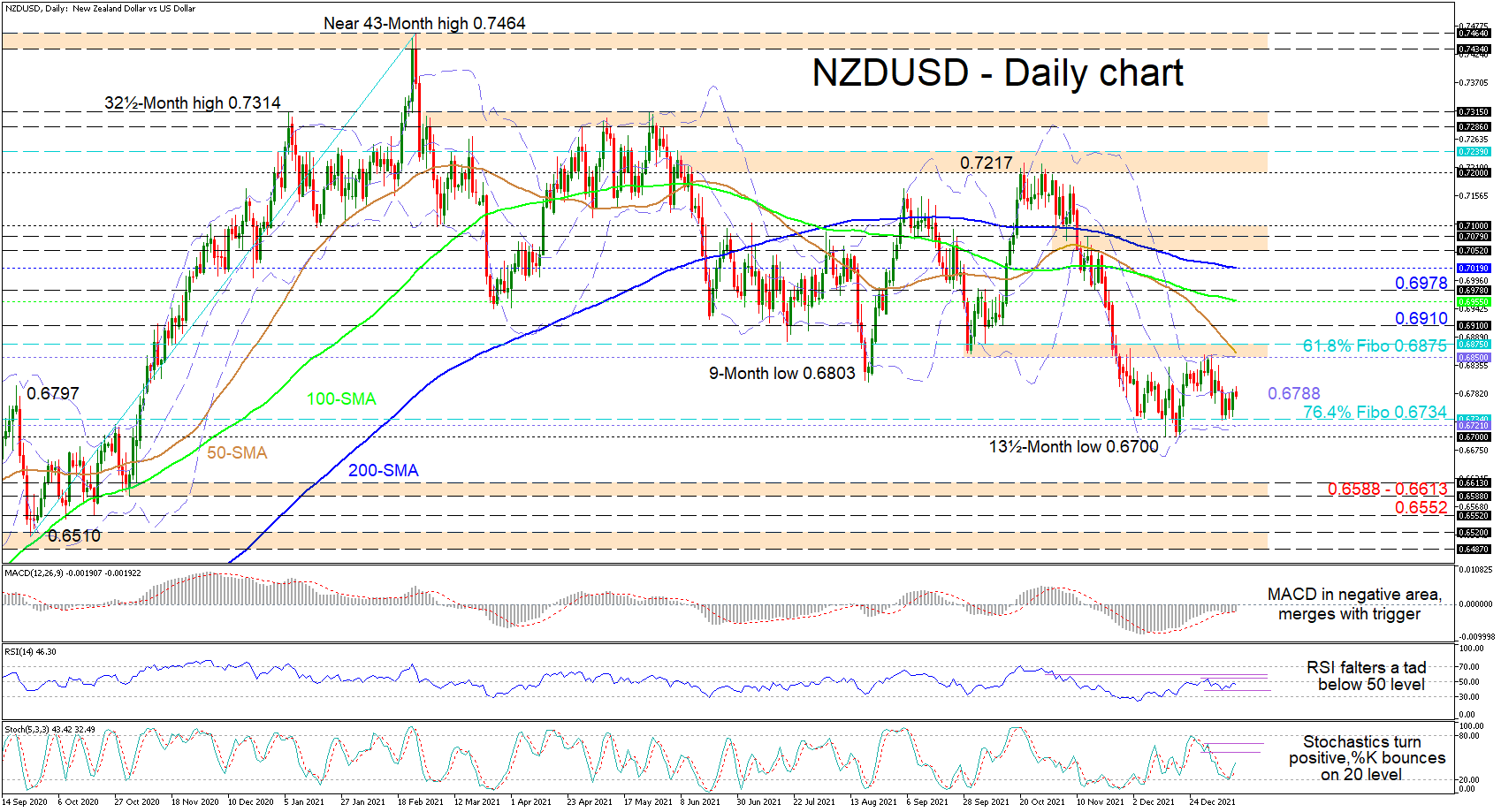
NZDUSD Treads Across 76.4% Fibonacci but Bearish Tone Remains
NZDUSD has been consolidating for around one-month now as downward pressures diminished after recording a 13½-month low of 0.6700. The pair has been finding support lately from the lower Bollinger band and the 0.6734 level, which is the 76.4% Fibonacci retracement of the up leg from 0.6510 until 0.7464, even though the SMAs continue to endorse a bearish trend.
The short-term oscillators are conveying mixed signals in directional impetus. The MACD, slightly beneath the zero mark, has returned lower to its red trigger line showing that sellers are still present. The RSI has dipped in the bearish region, suggesting negative forces have yet to fully subside. However, the positively charged stochastic oscillator is implying that buying interest may pick up.
If the price oversteps the mid-Bollinger band at 0.6788, buyers may face a reinforced ceiling linked to the recent consolidation, moulded between the upper Bollinger band at 0.6850 and the 61.8% Fibo of 0.6875. Clearing this, buyers could tackle the nearby 0.6910 obstacle before eyeing the 100-day SMA at 0.6955. Should the pair continue to recoup lost ground, a push past the neighbouring 0.6978 barrier could encourage the bulls to aim for the 200-day SMA at 0.7019.
Otherwise, if the mid-Bollinger band impedes hikes in the pair, initial support may originate around the 76.4% Fibo of 0.6734 and the lower Bollinger band at 0.6721 before sellers challenge the 13½-month low of 0.6700. Should the decline resume, the 0.6588-0.6613 support band created in November 2020 could come into play ahead of the 0.6552 barrier.
Summarizing, NZDUSD is currently stuck in a sideways market between the lower limit of 0.6700-0.6734 and the upper limit of 0.6850-0.6875. That said, the neutral-to-bearish mood is active and a price climb above 0.7100 would be needed to reinstate optimism in the pair.
Eurozone industrial production rose 2.3% mom in Nov, EU up 2.5% mom
Eurozone industrial production rose 2.3% mom in November, well above expectation of 0.6% mom. Production of non-durable consumer goods rose by 3.2%, capital goods by 1.5%, energy by 1.2% and intermediate goods by 0.9%, while production of durable consumer goods fell by -0.2%
EU industrial production rose 2.5% mom. Among Member States for which data are available, the largest monthly increases were registered in Ireland (+37.3%), Poland (+5.9%) and Czechia (+4.8%). The highest decreases were observed in Belgium (-4.4%), Malta (-3.7%) and Luxembourg (-2.3%).
USDCAD Loses Ground as Bearish Forces Linger
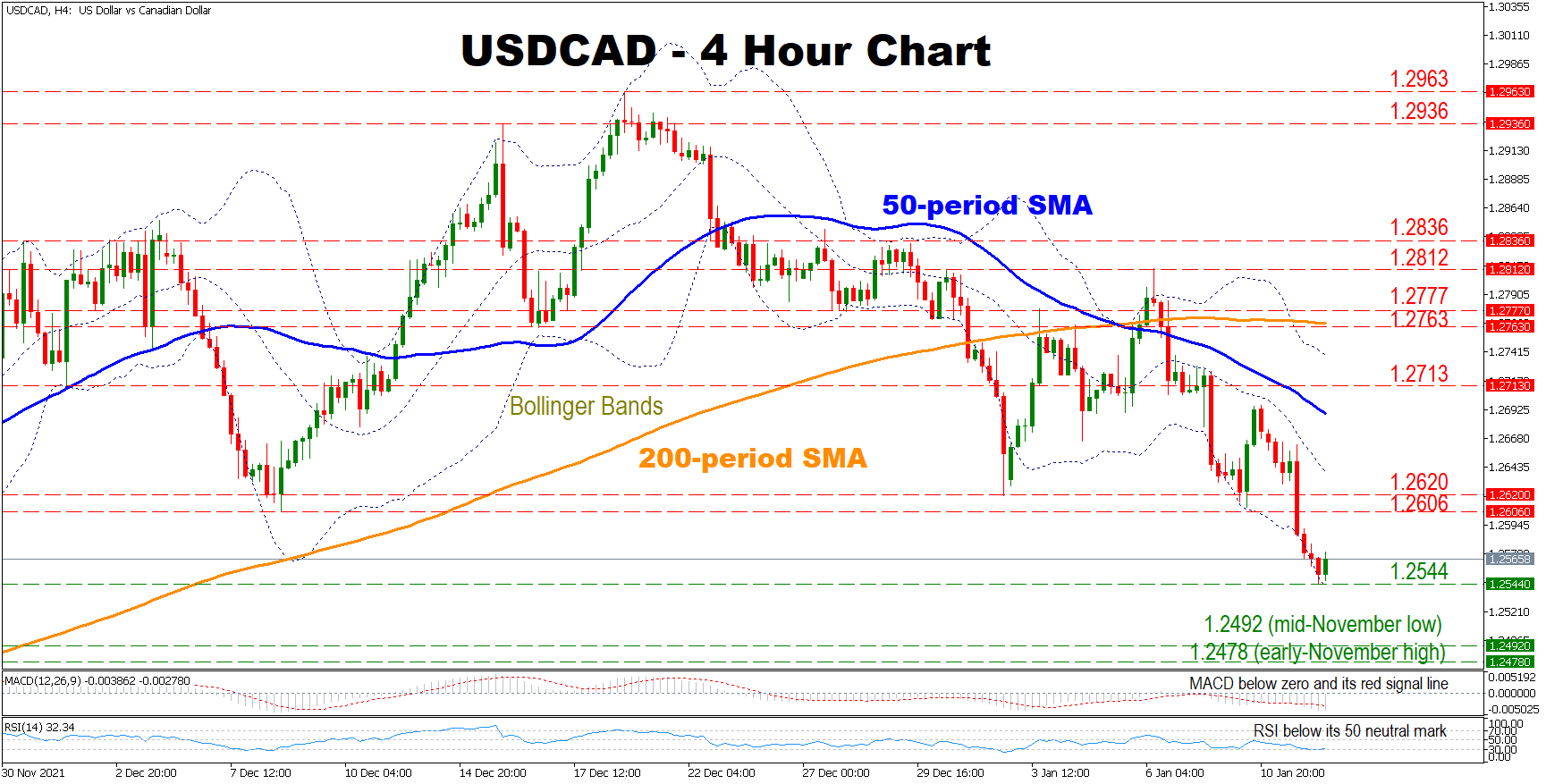
USDCAD has retreated from its January high amid strengthening negative momentum, and is currently found near its lower Bollinger Band indicating that an immediate upside movement should not be ruled out. Moreover, the pair’s 50-period simple moving average (SMA) has recently crossed below its 200-period SMA, increasing fears of a sustained bearish outlook.
Short-term momentum indicators are supporting a negative bias as the RSI is located below its 50 neutral mark. Also, the MACD is found below zero and its red signal line, which could indicate that the negative bias might be gaining more traction.
Should the bears remain in charge, initial support might be found at the 1.2544 hurdle. A decisive move below this point could increase selling pressures further, opening the door towards the mid-November low at 1.2492. A break below the latter could shift sellers attention towards the early-November high at 1.2478.
On the flip side, if the price crosses above the 1.2606 level, resistance might then be found at the 1.2620 hurdle. Crossing above the latter could send the price towards its 50-period SMA currently at 1.2689. A break above that point could turn the fortunes around for the pair, paving the way towards the 1.2713 obstacle, before the bulls eye the 1.2763 barrier.
In brief, the overall outlook for the pair is bearish. For sentiment to change, sellers would need to break above the 50-period SMA.