Sample Category Title
CFTC Commitments of Traders – Bets Trimmed on Gas Price after Sharp Rally
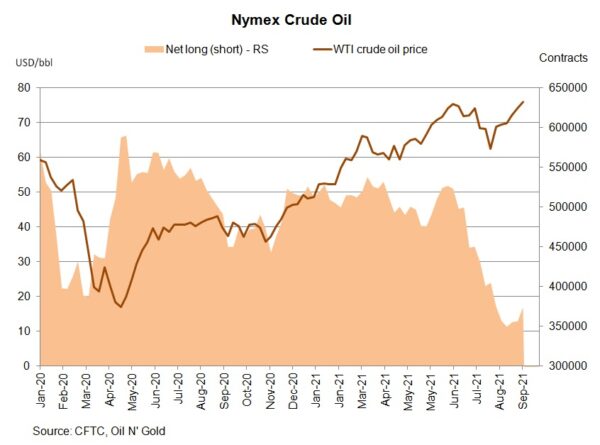
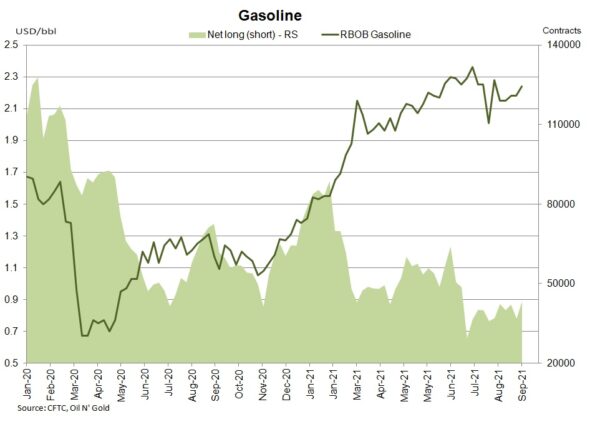
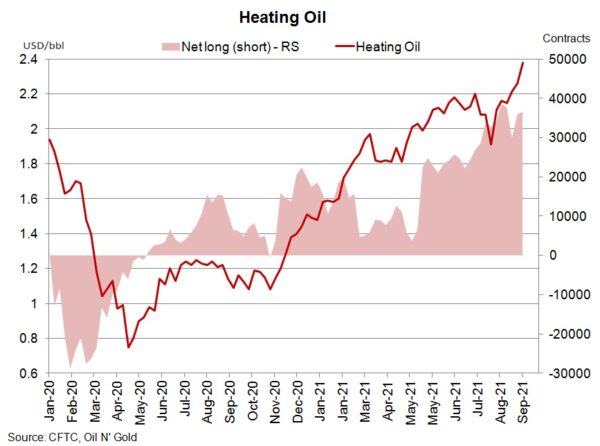
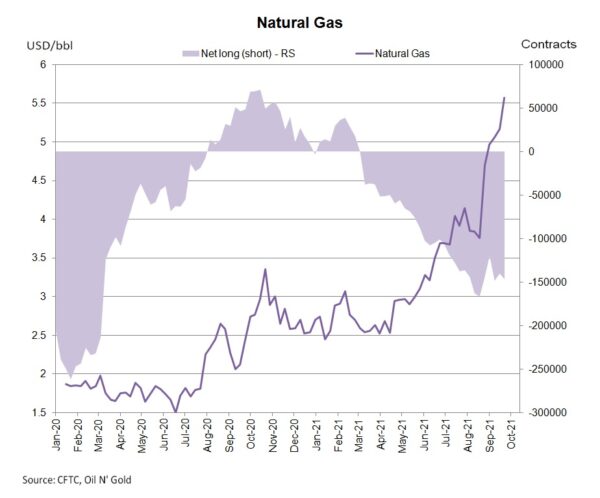
According to the CFTC Commitments of Traders report for the week ended September 28, NET LENGTH of crude oil futures jumped +17 836 contracts to 373 814. Increase in speculative longs clearly outweighed that of shorts. For refined oil products, NET LENGTH for heating oil added +700 contracts to 36 590, while that for gasoline rose +6 504 contracts to 43 177. NET SHORT of natural gas futures soared +6 460 contracts to 146 680 during the week. Traders trimmed bets on both sides. The sharp increase in natural gas price over the past weeks has raised doubt over whether how far the rally could go. 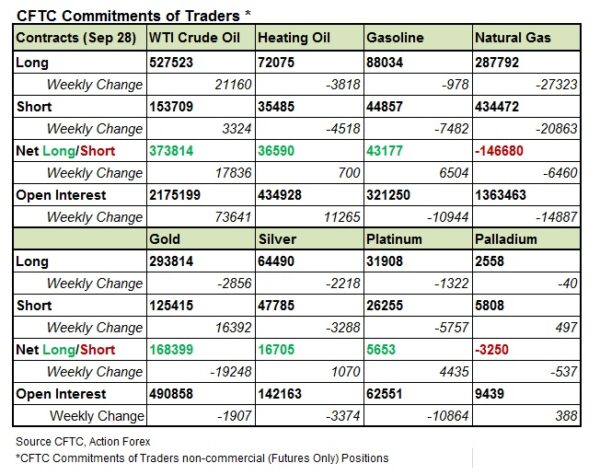
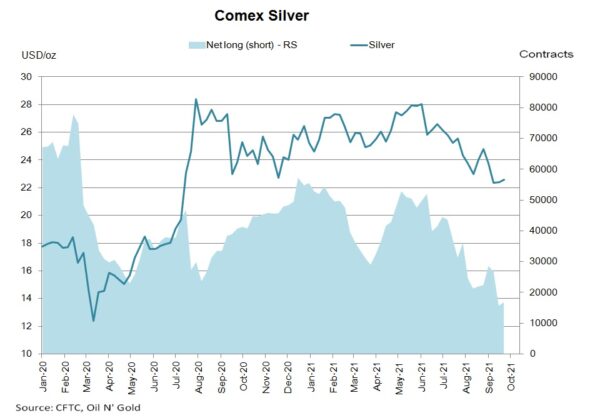
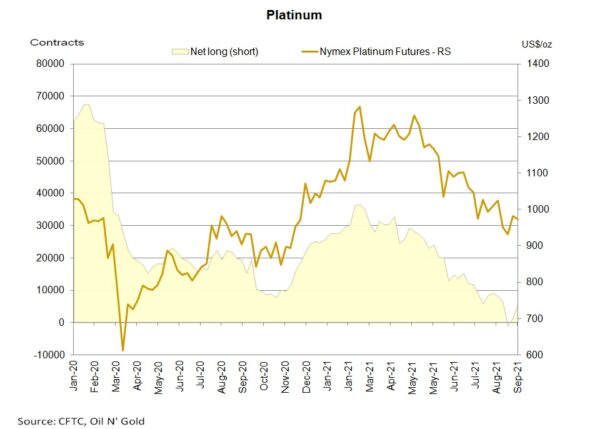
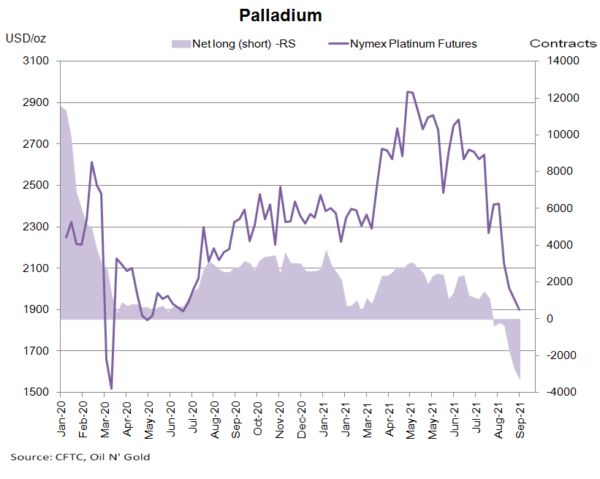
Gold futures’ NET LENGTH slumped -19 248 contracts to 168399. Silver futures’ NET LENGTH gained +1 070 contracts to 16 705. For PGMs, NET LENGTH of Nymex platinum futures rose +4 435 contracts to 5 653, while NET SHORT for palladium futures added +537 contracts to 3 250.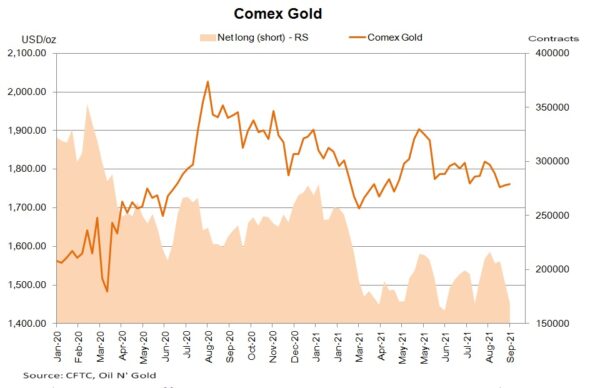
Summary 10/4 – 10/8
Monday, Oct 4, 2021
[php_everywhere instance="1"]
Tuesday, Oct 5, 2021
[php_everywhere instance="2"]
Wednesday, Oct 6, 2021
[php_everywhere instance="3"]
Thursday, Oct 7, 2021
[php_everywhere instance="4"]
Friday, Oct 8, 2021
[php_everywhere instance="5"]
Weekly Economic & Financial Commentary: With Eyes on Washington, the Expansion Continues to Roll Along
Summary
United States: With Eyes on Washington, the Expansion Continues to Roll Along
- Data released this week showed the production and housing sectors continued to hum, despite ongoing supply constraints, while consumers kept spending, despite some trepidation about the economic outlook.
- Next week: Trade Balance (Tuesday), ISM Services (Tuesday), Nonfarm Payrolls (Friday)
International: Rate Hikes Across Latin America; Mixed Signals from China's PMIs
- With elevated inflation still a concern in Latin America, central banks across the region opted to lift interest rates this week in an effort to control price pressures. While we are not exactly calling for a sudden turn in China's economic prospects, the non-manufacturing PMI gives us hope that the end of the recent economic slowdown could be near.
- Next week: Turkey CPI (Monday), RBNZ Rate Decision (Tuesday), Reserve Bank of India Rate Decision (Friday)
Interest Rate Watch: Interest Rates Rise in Wake of FOMC Meeting
- We look for the yield on the two-year note to rise to 0.90% by the end of next year and to 1.60% by the end of 2023. We also see rates at the longer end of the curve moving higher, albeit not to the same extent as the two-year note.
Credit Market Insights: The iBuyer Phenomenon
- The United States' housing market has resiliently rebounded from last year's sharp, COVID-driven contraction. Recently, home flipping has become increasingly popular among companies known as “iBuyers.” These firms finance their activities with bonds backed by homes they have purchased, but have not yet sold, as collateral.
Topic of the Week: Shutdown Avoided, but Debt Limit Looms Large
- On Thursday, Congress passed and President Biden signed a continuing resolution (CR) that funds the federal government until Dec. 3. The CR averted a government shutdown that would have begun today if Congress had not acted in time. However, we are not out of the woods yet when it comes to fiscal deadlines in D.C.
The Weekly Bottom Line: Global Energy Supply Squeeze Taking the Spotlight
U.S. Highlights
- Equity markets fell this week as various concerns weighed on sentiment, including central banks signaling an end to pandemic era stimulus. Fortunately, Congress agreed to a last-minute spending deal to avert a shutdown, but it will still need to raise the debt ceiling.
- August consumer spending data showed underlying resilience in services outlays despite the increase in infections. It also showed core services price pressures cooling slightly, supporting the Fed’s narrative that inflation will cool in the month ahead.
Canadian Highlights
- July’s industry-level real GDP, the key data release this week, revealed a lesser-than-expected 0.1% contraction in activity during the month.
- Flash estimates point to a healthy, 0.7% rebound in economic activity in August. And although we’re not out of the woods yet, health indicators have shown stabilization, or even improvement in some provinces in recent weeks.
Special Feature: Global Energy Supply Squeeze Taking the Spotlight
- A global energy supply squeeze has taken the spotlight this week, amplifying the uptrend in natural gas prices.
- The turn of events has sparked concerns around economic output and inflation in Europe and Asia, with prices at the mercy of weather. North America is experiencing some ripple effects, but faces lesser risks given its ample domestic production.
U.S. - Markets Fall Despite Economic Resilience
Equity markets had a notable decline this week due to various issues, among them worries about a delta-variant driven slowdown and central banks signaling an end to pandemic-era stimulus. Congress is once again locked in brinksmanship on the debt ceiling, although markets are likely less spooked having seen this show numerous times before. Friday’s economic data looked pretty good, but was not enough to boost sentiment on equities.
Congress passed an 11th hour deal to keep government funded through Dec. 3rd, averting a shutdown. That takes one Washington-related risk off the table, but Congress still needs to raise the debt ceiling by Oct. 18th. If it fails to do so, the Treasury will then need to make decisions about which of the U.S. government’s bills it won’t pay. Congress has gone through many of these brinksmanship debacles, but it has never not made debt payments. We expect a deal to be reached, but likely at the last minute.
This week also featured several Fed speakers, but most notably Chair Powell’s testimony in Congress. He spoke about the difficult tradeoff the Fed is facing with unemployment and inflation both elevated. The Fed has a dual mandate on fostering full employment and low and stable inflation. It would prefer to make more progress on the employment side before taking its foot off the accelerator pedal but inflation is testing its resolve.
The Fed expects that the worst of the recent run-up in inflation will prove temporary. That is a reasonable expectation. As the economy re-opened and Americans started travelling again, price spikes occurred in many travel related goods and services due to demand outpacing supply. Prices sharply rose for things like car rentals, hotel rooms and airline fares. These price spikes are expected to be one time, and will likely not keep inflation elevated on an ongoing basis.
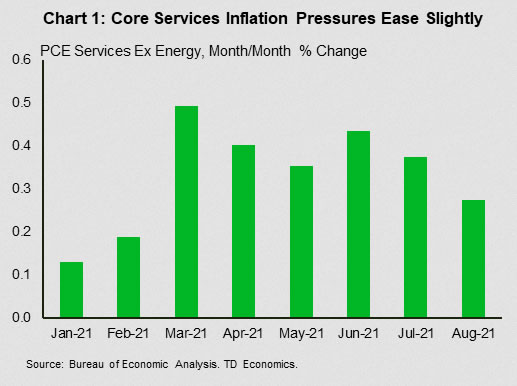
The August inflation data confirms this is occurring. The core PCE deflator – the Fed’s preferred inflation metric – was released on Friday and showed that core services inflation continued to ease from the hotter readings seen in the spring (Chart 1). Inflation is typically cited in year-on-year growth rates, and core inflation remained quite hot at 3.6% in August. We expect that while core inflation to remain high in the coming months due to base effects, it will moderate in 2022 (see our latest forecast).
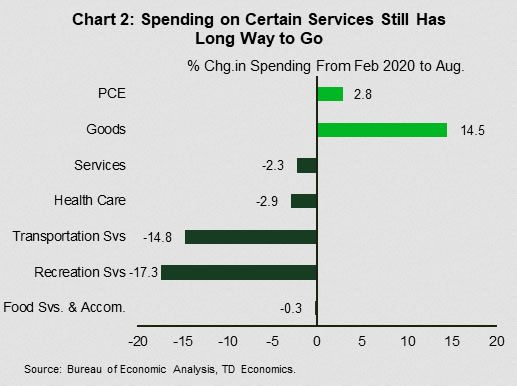
The release also provided some reassurance on the resilience of consumer spending. Growth in services spending cooled from the early days of re-opening. This is to be expected as more areas return to “normal”, spending growth returns to a more trend-like pace. That said, part of the slowing was due to consumer caution on the delta-variant, with spending at close-contact activities like restaurants, bars, and live entertainment falling in August. But, other areas are picking up, such as spending related to education and transportation. We expect the slowdown due to delta to prove temporary, and that there is plenty of pent-up demand in these depressed services sectors to drive above-trend growth in consumer spending in the fourth quarter (Chart 2).
Canada - From Downside to Upside Surprises
This was a week light on data, heavy on financial market developments. A risk-off tone dominated, with the S&P/TSX following its global peers lower on the week (down 2.1% on the week as of 10 AM). The WTI crude oil benchmark hovered near US$75 on mounting global energy and natural gas supply concerns. For Canada, this price strength is supportive for exports and income, though it is likely to contribute to higher consumer price inflation (see Special Feature below).
Turning to economic data, a dose of caution on the economy was warranted following the surprise second quarter contraction. But the past few weeks have offered signs that activity may be evolving decently in the third quarter, in line with our expectations. On this note, July's industry-level GDP release was the key highlight. Canada's economy contracted by 0.1% in July, a far better outturn than the -0.4% preliminary estimate for the month.
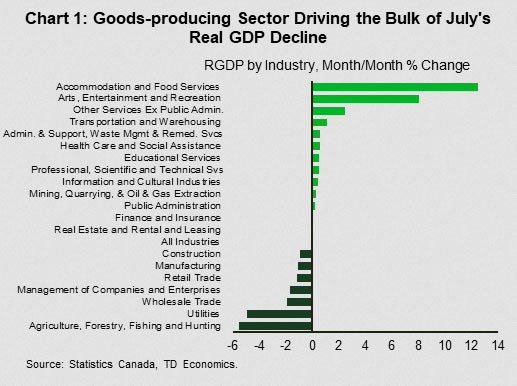
Chart 1 shows shows Canada's real GDP growth by industry for the month of July. Declines were more centered in the goods-producing sector. Agriculture, forestry, and fishing saw the largest decline, at -5.5%, followed by utilities at -4.9%. Wholesale trade, management of companies, retail trade, manufacturing, and construction also saw declines on the month. The remaining industries saw expansions, with real GDP in the accommodation and food services top the chart at +12.5% and arts/entertainment/recreation following at +8.1%.
Despite the contraction, the report contained some silver linings, including an expansion in 13 of the 20 industries (Chart 1). In fact, underlying demand appears resilient, with idiosyncratic and supply-side impediments in the goods sector driving a sizeable portion of the decline. Case in point, the agriculture, forestry, and finishing industry saw a 5.5% decline on the month. Crop production in Western Canada is facing major setbacks on the back of severe drought conditions. Forestry output was also curtailed by wildfires in British Columbia and Ontario. Meanwhile, demand in the utilities industry, down 4.9% in July, was limited by milder weather trends in Central Canada. The manufacturing industry saw a 1.1% contraction on the month, but it is difficult to disentangle the roles of demand and supply in July. It is fair to say, however, that global supply chain disruptions have disproportionately disrupted this industry in recent months. The cooling in the housing market was another theme that contributed to July's decline. Output in the construction industry declined 0.9% due to weak residential activity. Still, residential construction remains elevated relative to pre-pandemic levels. In contrast to the goods sector, the service sector showed signs of life. The reopening-led recovery in close-contact industries accelerated, with the accommodation and food services industry witnessing a 12.5% increase, joined by an 8.1% expansion in the arts and recreation industry. Elsewhere, the professional, scientific, and technical services – a consistently strong performer in the past year – expanded by an additional 0.5% in July. Another silver lining in July's report is the healthy, 0.7% expansion projected for August.
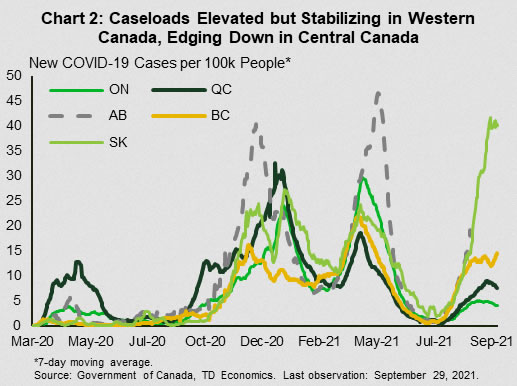
On a separate note, and though still early days, health indicators are offering some respite to concerns relating to Canada's fourth wave. Alberta and Saskatchewan remain at a greater risk, but vaccinations in these regions have started to pick up. At the same time, caseloads and ICUs are slowly edging down in Canada's largest province (Chart 2). High frequency indicators, including TD Spend data and mobility data, have displayed continued strength in September. All told, while we're certainly not out of the woods yet, the trajectory is looking better for Canada during the second half of the year.
Special Feature – Global Energy Supply Squeeze Taking the Spotlight
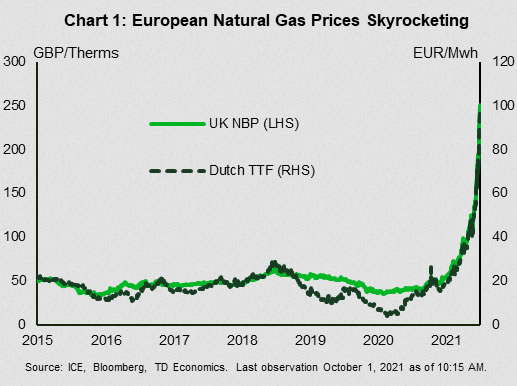
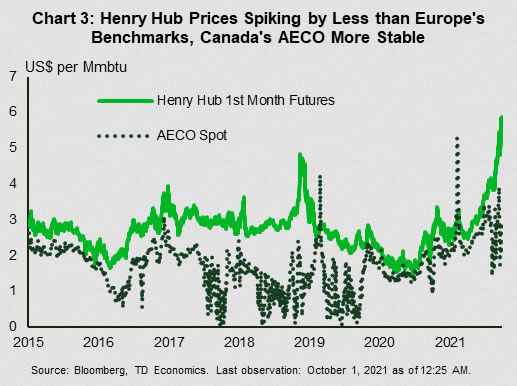
Add global natural gas shortages to the long list of supply chain disruptions impeding the global economic recovery and sparking inflationary concerns. The strong uptrend in natural gas prices has become more amplified in recent weeks, with the Northern Hemisphere faced with impending shortages as it approaches the winter heating season. Indeed, European benchmark natural gas prices are up more than 400% this year – and have risen more by around 90% in the past month alone (Chart 1). In Asia, spot LNG spot prices have also surged. And more recently, North American natural gas prices have joined the party, with Henry Hub futures reaching their highest levels since 2014 before pairing some of their gains. Spillovers are being felt across the energy complex. Despite a bearish U.S. inventory report, WTI oil prices are still hovering near US$75 on speculation that oil to gas switching would further tighten crude markets. Elsewhere, other substitutes (coal) and commodities relying on natural gas feedstock and heavy electricity usage (fertilizers, aluminum) are witnessing output reductions and surging prices.
The Economic Impacts are Already Being Felt
The winter heating season still hasn't started, but this turn of events is already creating implications for inflation and economic growth across Europe and Asia. Case in point, China's official manufacturing PMI slid into contractionary territory this week (to 49.6 from 50.1). In China, power rationing has been implemented across several provinces for industrial and residential users. Meanwhile in Europe, several small UK utility providers, caught off guard by the price increases, have failed. Power prices are rising across several countries, adding further upward pressure to already-high consumer price inflation. Indeed, early estimates suggest that Eurozone inflation increased to 3.4% (y/y) in September, the highest since 2008. Some European governments are already intervening to cap electricity rates and/or provide financial support to offset rising costs to consumers. There are mounting concerns that should this tightness continue it could also impact more vulnerable emerging market economies. Further, the impacts on factory output in China and Europe are flaming concerns around already constrained global supply chains.
Several Drivers Tightening European and Asian Natural Gas Markets
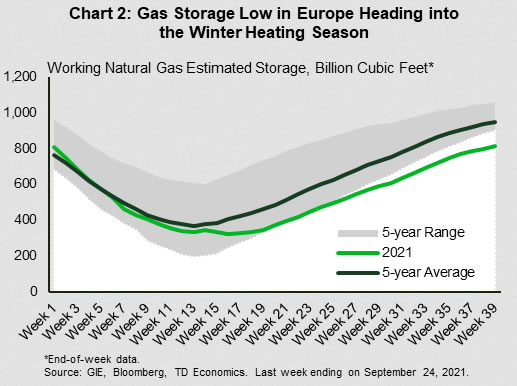
Shortages and supply chain disruptions have become more commonplace in the post-pandemic world. In the case of natural gas and power, a confluence of drivers – almost too many to list - have colluded at the wrong time to tighten markets. Like other areas of the global economy, demand appetite in some regions has rebounded strongly and faster than expected. On the supply side, the summer injection season in Europe is ending on a disappointing note, leaving inventories notably low (Chart 2). For one, flows from Norway and Russia to Europe dropped through the summer. Idiosyncratic events, including a fire at a UK-France connector, played a short-term role. Importantly, constraints to procure natural gas were seen elsewhere. Global LNG markets have been witnessing elevated demand and competition from the more longstanding buyers. At the same time, China has been cementing its position as an increasingly important player in the market while it tries to wean itself off coal-generated electricity. Brazil also contributed to the rise in global LNG demand, with drought conditions limiting its ability to produce hydroelectric power.
North American Markets Are Well Supplied, but Still Feeling the Pinch
Against this tightening global backdrop, North American economies have started to feel the pinch. The recent spike in Henry Hub benchmark prices is a notable departure following years of lackluster performance. However, while some ripple effects are being felt through disrupted global supply chains and the small exposure of North American markets to LNG exports, North American economies are partly shielded by still-plentiful domestic natural gas production capacity. In Canada, AECO prices have risen this year, but by less than Henry Hub futures (Chart 3), with inventories closer to the five-year average, lesser exposure to the global LNG market, and lesser weather-driven production disruptions. Inventories in the U.S. are running below the five-year average. Recent storms impacted production in the Gulf of Mexico. But production is gradually recovering. LNG export capacity in the U.S. (around 11% of production) is limited by infrastructure, capping the ability of producers to direct more output towards the currently more lucrative external markets for the time being, and thereby partly cushioning the spillover effects.
"The Cure to High Prices is High Prices" Still Applies, but it Could Take Time
With global markets tight, the near-term outlook for natural gas prices will be at the mercy of weather. And all told, some volatility into Q4 would not be entirely surprising for the entire energy complex globally.
Europe is more susceptible to continued elevated prices through the autumn and winter given its notably low inventories and the lack of immediate alternative supplies. And, competition from other buyers will likely keep prices elevated. Indeed, China has recently indicated it will secure fuel sources regardless of the cost. Some areas of potential respite to Europe include an increase in Norwegian and Russian gas flows. Milder weather in the fall/winter would also be supportive. In North America, weather will also be critical in determining the trajectory of prices, and colder than expected spells could still result in near-term volatility given the lower than average inventory. But stripping away from short-term movements, domestic production capacity is still ample and should be able to respond to price spikes. Indeed, Henry Hub Natural gas futures are not signaling any lasting significant shortages, with prices projected to moderate from current levels and settle in the US$3-US$4.5 per Mmbtu range after next winter. In its latest Short-Term Energy Outlook, the Energy Information Administration (EIA) has forecasted a 2.7 billion cubic feet per day increase in production next year, with domestic consumption projected to remain flat due to higher prices.
The case for a more bullish oil market outlook in the fourth quarter has turned more compelling, especially as some OPEC+ members face difficulty in quickly ramping up production. But prices are still likely to moderate as U.S. production fully recovers from the late-summer hurricane impacts. Medium-term, with plentiful OPEC+ spare capacity and rebounding U.S. production, sustained rallies beyond current levels appear unlikely.
Forward Guidance: September Jobs Reports to Show More Gains
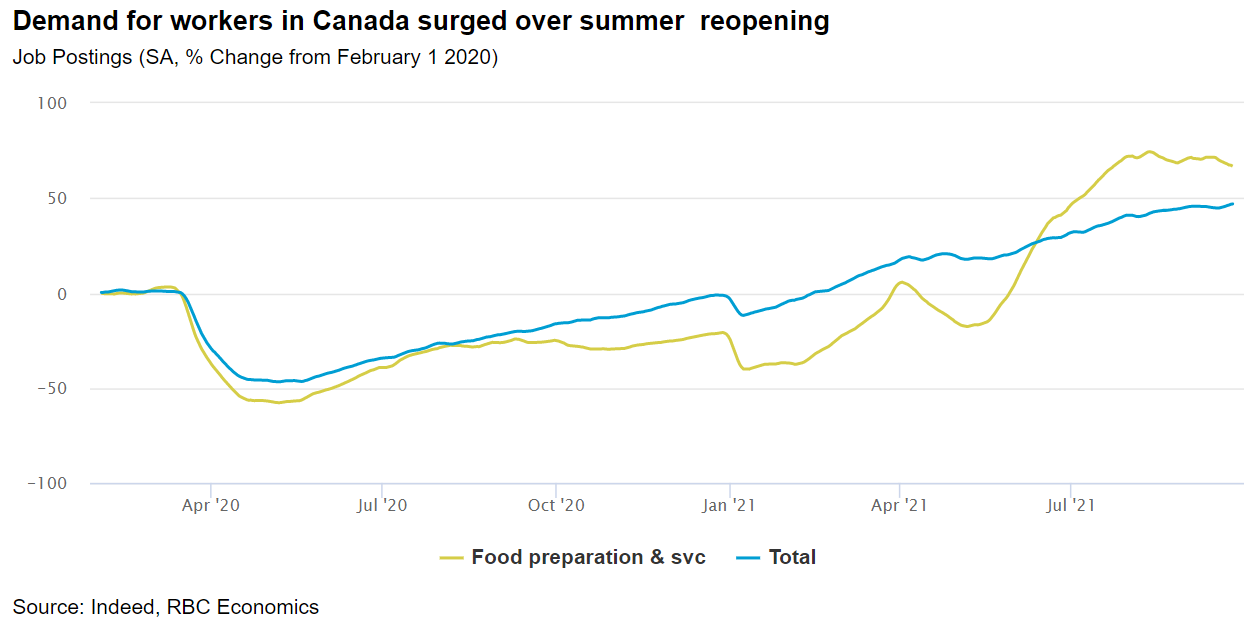
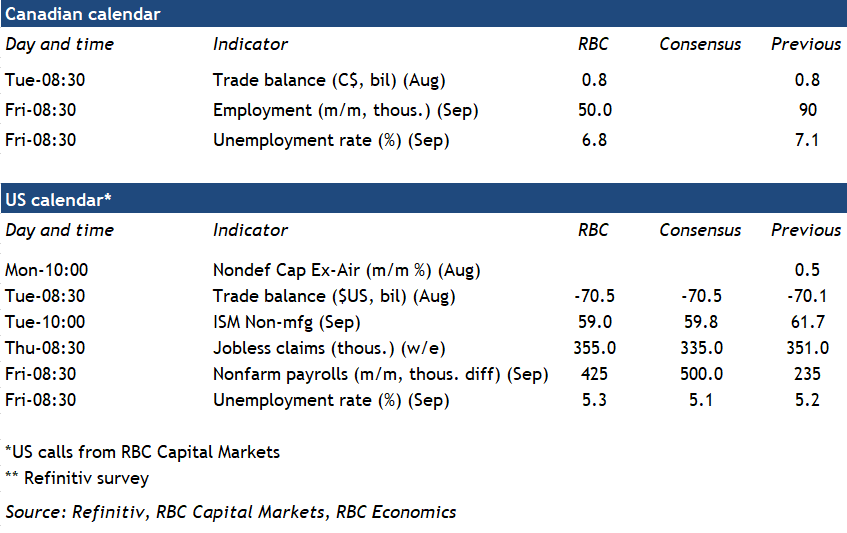
Jobs will be on the radar next week as labour market reports for Canada and the US are released. We expect a 50,000 increase in headline employment in Canada and a 425,000 increase in the US. The spread of the delta variant likely limited the recovery of the hardest-hit travel and hospitality sectors—which still account for the bulk of the employment shortfall versus pre-pandemic levels in both countries. While our own tracking of card transactions showed spending may have plateaued in Canada in September, it has yet to decline substantially, despite rising virus concerns. And job postings are still increasing, even as the number of unemployed workers has continued to fall.
We expect that September job gain in Canada would still leave a sizeable (~100,000) shortfall in jobs versus pre-pandemic levels. And while job vacancies are high, the concern now will be matching those unemployed workers to new positions, particularly as expanded income support programs begin to wind down. Signs of substantial pressure to lift wages has yet to emerge, but will if widespread reports of labour shortages persist.
Week ahead data watch:
- We expect Canadian employment rose 50,000, with the unemployment rate edging down to 6.8% from 7.1% in August.
- US employment is expected to increase 425,000, although we look for the unemployment rate to tick up to 5.3% from 5.2% on higher labour force participation.
- We're anticipating lower trade volumes in Canada in August, led by a drop in motor vehicle production as the global semi-conductor shortage continues to squeeze operations. Exports and imports are both expected to decline about 3%, leaving the balance little changed at around $0.8 billion.
Week Ahead – Central Banks Face Inflation Dilemma
A challenging period for the markets
Nerves are starting to creep into the markets which will make the final months of the year very interesting. The list of downside risks for the economy and markets is growing all the time, something investors have been relatively comfortable with but it seems something is pushing them too far.
Over the years, many have questioned whether central banks have been a backstop for the markets, ensuring that investors continue to buy dips and sell-offs don’t turn into anything more serious during troubling times. Which makes their current situation all the more challenging.
For more than a decade, central banks haven’t been able to generate enough inflation to hit their targets, often not even close, which has allowed them to be patient as their economies get back to full strength. With inflation in many countries now running above target and policymakers seemingly less confident in how temporary it is, the theory may be put to the test as the stimulus is withdrawn and rates start rising.
Country
US
Risks to US economic recovery are growing as inflation pressures intensify, an energy crisis abroad might push oil prices to levels that threaten growth, and the battle in Washington DC over the debt will likely go down to the wire when the last cent is almost exhausted around October 18th.
Congress was able to pass a stopgap bill that avoided a government shutdown, at least till early December. It is clear that getting anything done amongst Democrats, both conservative and progressive will be difficult going forward.
Investors will remain on central bank watch as pricing pressures don’t seem like they will be easing anytime soon. If some of the dovish Fed members turn hawkish, that could allow the bond market selloff to continue.
On Monday, Fed’s Bullard speaks at the World Strategic Forum. Thursday will have an appearance by Fed’s Williams at the Business Cycle Dynamics in Open Economies conference.
Friday’s nonfarm payroll report is expected to be strong, with 500,000 Americans finding employment. September included the expiration of pandemic unemployment benefits, but the delta variant impact to the short-term outlook made some employers refrain from hiring. A November Fed taper announcement is widely expected, with robust employment reports likely accelerating the pace of tapering.
EU
The German election was won narrowly by the SPD, as expected, but coalition talks will take some time. The most likely result is the traffic light coalition with the Greens and Free Democrats but a grand coalition can’t be ruled out.
PMIs and retail sales early next week are the standout data points but ultimately, focus will be on the central bank ahead of the meeting in a few weeks. Others are looking to remove stimulus, even raise rates, and we are seeing some inflation in the region. The fate or the PEPP program in March and what, if anything, will replace it is what traders want to know.
UK
A little light on the data side next week, with the PMIs on Tuesday and Wednesday the only releases, of note.
Key for the UK at the moment is interest rate expectations with the market’s pricing in three by the end of next year despite the country facing an energy crisis this winter, fuel crisis currently, Brexit-related challenges, the end of the furlough and universal credit top-up schemes and a national insurance hike in March.
Not the ideal environment to be tightening unless, of course, policymakers aren’t being entirely honest in their assessment of the stickiness of inflation. The pound has been under pressure even as hike expectations rise, not what you would expect in that scenario and a worrying signal.
Emerging Markets
Russia
The economic calendar is a little thin next week, with inflation data on Wednesday the standout, as well as the services PMI on Tuesday.
South Africa
Next week is looking very quiet, with PMI data on Tuesday the only notable release.
Turkey
The lira came under more pressure this week after the decision by the CBRT last week to cut interest rates despite the recent rise in inflation destroyed the new Governors credibility. With that in mind, the inflation data on Monday could be big, with the CPI seen rising again to 19.7%. The central bank may now prefer to focus on core inflation but the headline number is impossible to ignore, especially when the central bank is seemingly yielding to political pressure. The currency could come under further pressure.
Asia Pacific
China
China is on holiday all week until Friday and thus there are no significant data releases this week.
Although the Evergrande story has ebbed from headlines, it has not gone away despite some recent asset sale announcements and partial payments to retail investors, Evergrande has missed two foreign currency coupon payments. Any deterioration or signs of a government bailout will be reflected through their HK listed equities and will drive directional volatility on the HKEX with the Mainland closed.
China’s energy shortages are grabbing the headlines with the government instructing state energy companies to secure supplies at any cost. That will keep energy prices supported, but any signs that the situation is worsening will again lead to selling on the HKEX.
India
All attention will be focused on the RBI rate decision on Friday where the central bank may be running out of wriggle room to keep rates lower than inflation. They are likely to hold rates this week, however.
Pressure has resumed on the Indian Rupee which has been boosted in recent times by international flows into India’s hot IPO market, money shifting from China equities and lower than usual selling from oil importers, Those flows appear to be ebbing and the aggressive rally in oil prices could see further selling of INR.
Australia & New Zealand
The Australian and New Zealand Dollars continue to bounce around on daily shifts in international risk sentiment, rather than domestic developments. Both the RBA and RBNZ have policy decisions this week. Of the two, the RBNZ is more significant as the RBNZ may well raise rates this month, having postponed a rate hike because of Covid-19 previously.
The NZD/USD remains acutely vulnerable to the delta-variant jumping the fence around Auckland and into the wider community. Both currencies are a proxy for US Fed tapering nerves and China concerns, and thus, look quite vulnerable to more downside.
Japan
The selection of a new Prime Minister by the LDP has passed without incident. The new Prime Minister has promised to open the fiscal taps as predicted but otherwise, there are no big-bang policy decisions to move local markets.
Japan equities are being buffeted by a fall in US equities and will maintain a high correlation to Wall Street this week. Having been boosted previously by fiscal stimulus hopes, Japan equities are among the more vulnerable in Asia to a material pullback if speculative confidence wanes.
Key Economic Events
Saturday, Oct. 2
- Russia Foreign Minister Sergei Lavrov speaks at a conference.
Sunday, Oct. 3
- The 77th IATA Annual General Meeting and World Air Transport Summit begins
- UK Conservative Party conference begins
Monday, Oct. 4
- Golden Week Holiday: Mainland Chinese markets closed till Thursday
- OPEC+ meets to discuss November output
- UK’s Chancellor of the Exchequer Sunak speaks at the Tory Party Conference.
- Fed’s Bullard speaks at the World Strategic Forum – International Economic Forum of the Americas.
- BOE’s Ramsden chairs a session at the Money Macro & Finance Society Policy Conference.
- European Parliament plenary starts in Strasbourg, France
- Eurogroup finance ministers meet in Luxembourg.
Economic Data/Events:
- US factory orders, durable goods
- Spain unemployment
- Turkey CPI, PPI
- Switzerland CPI, retail sales
Tuesday, Oct. 5
- BOJ’s Governor Kuroda speaks at the TCFD Summit 2021.
- OECD 2021 Ministerial Council Meeting starts
- EU Economic and Financial Affairs Council meets in Luxembourg.
- G-20 trade ministers meeting in Sorrento, Italy.
- Norges Bank’s Olsen delivers a speech at the central bank’s regional network.
Economic Data/Events:
- US Trade and ISM Services data
- Australia Rate decision: RBA to keep cash rate target at 0.10%
- Japan CPI
- Thailand CPI
- Australia Trade
- Eurozone PPI
- France Industrial production
- Mexico international reserves
- Singapore retail sales
- Eurozone Services PMI
- UK Services PMI
- South Africa PMI
- South Africa monetary policy review
- Turkey effective exchange rate
Wednesday, Oct. 6
- EU summit in Slovenia to discuss future membership of six Balkan States.
- Fed’s George speaks at Kansas City Fed’s annual Banking and the Economy: A Forum for Women in Banking.
- UK Prime Minister Johnson speaks at the Tory party conference.
Economic Data/Events:
- US ADP employment change
- New Zealand Rate Decision: Expected to increase Official cash rate 25 basis points to 0.50%
- Poland Rate Decision: To keep base rate at 0.10%
- Russia CPI
- Eurozone retail sales
- Germany factory orders
- Spain industrial production
- Sweden monthly GDP indicator
- EIA Crude Oil Inventory Report
Thursday, Oct. 7
- BOJ’s Governor Kuroda speaks at the branch managers meeting.
- PBOC’s Governor Yi Gang speaks at the BIS virtual conference on big tech regulation.
- Federal Reserve Bank of Cleveland and ECB joint annual conference ‘Inflation: Drivers and Dynamics’
- New York Fed President Williams speaks at Business Cycle Dynamics in Open Economies conference.
- Bank of Canada’s Governor Macklem speaks on global financial architecture.
- ECB Chief Economist Lane speaks at a Central Bank of Ireland webinar.
- B20 final summit begins in Rome.
Economic Data/Events:
- US initial jobless claims, consumer credit
- Mexico CPI:
- Russia CPI:
- Chile copper exports, trade
- China Forex Reserves
- Switzerland Forex reserves
- France Trade Data:
- Germany industrial production
- Turkey cash budget balance
- South Africa gross and net reserves, electricity production and consumption
- Russia gold and forex reserves
Friday, Oct. 8
Economic Data/Events:
- US Sept Change in Nonfarm Payrolls: 500Ke v 235K prior, unemployment rate, wholesale inventories
- India Rate decision: Expected to keep Reverse Repo Rate at 4.00%
- Czech Republic General Election
- BOE Quarterly Bulletin
- Hungary CPI
- Trade: Germany, Taiwan
- Norway GDP
- Argentina industrial production
- Canada unemployment
- China Caixin services PMI
- Japan household spending
Sovereign Rating Updates:
- Ukraine (Moody’s)
A Choppy End to the Week
A rocky start to trading on the final day of the week and first of the new quarter, but things have taken a more positive turn with Europe erasing most of its losses and Wall Street opening a little higher.
There's clearly still plenty of nerves in the markets at the moment, which is perfectly understandable under the circumstances. There's an enormous amount of uncertainty as we move into the end of the year and central banks removing stimulus, even raising rates, in the midst of that doesn't inspire confidence.
Policymakers can dress it up however they want, but if they push ahead with tightening monetary policy at a time when growth is slowing and headwinds are growing stronger, they'll be undermining their own message and it will start to fall on deaf ears.
Nowhere is this more evident than the UK, which is facing a more severe energy crisis than most, an end to its furlough scheme and universal credit top-up, and a bizarre fuel crisis due to driver shortages and panic buying akin to the ridiculous toilet roll saga last year. That's just to name a few. And yet markets are pricing in three rates hikes by the end of next year while the pound is tumbling.
If the markets are correct, this is not the action of a central bank that thinks inflation is transitory, nor does it bode well for the economy going into the end of the year. An economy that remains below its pre-pandemic peak with unemployment still well above and likely to rise in the coming months. It just doesn't add up.
Investors have relied on central banks to be effective backstops for such a long time now. Low inflation has allowed them to be extremely patient in exiting emergency stimulus programs and tightening monetary policy.
But they don't have that luxury now and supply-side issues are creating unwelcome price pressures and it's not clear how much of that will stick. For the UK, it's being exacerbated by the proximity of the pandemic to Brexit, which is why we're seeing the pound behaving the way it is.
It feels like investors will have to cross their fingers and hope the next six months is kind to them. A warm winter would be a welcome start. Inflation pressures easing early next year would give central banks a little more wiggle room. And of course, Covid, with the winter in the northern hemisphere potentially bringing surges in the northern hemisphere. I'm not particularly optimistic.
Mixed US data
The US data we've had around the open has been a mixed bag. Inflation was broadly in line with expectations, with the monthly figures showing pressure is easing. Spending was above expectations but followed a downward revision to the July number.
The manufacturing PMIs were also a little mixed, with the headline numbers beating expectations but the employment sub-index not rebounding as well as anticipated. The prices paid were also a little higher.
Oil choppy ahead of OPEC+ meeting
It's been quite a choppy week in the oil markets, with progress having stalled just as Brent closed in on $80. A combination of profit-taking, higher inventory data and broader risk aversion has taken the heat out of the rally for now, but the outlook remains bullish. It pulled back to $76.50 before quickly finding support.
The energy crisis has made crude even more attractive and encouraged talk of $90, maybe even $100 oil. The natural gas shortage has seen prices soar - hitting levels equivalent to $190 a barrel of oil - and alternative sources are riding the wave higher. With the Chinese government ordering state-owned energy companies to secure winter supplies at any cost, the competition has just become fierce.
All of this makes the OPEC+ meeting next week all the more interesting. The group now has a decision on its hands. Does it maintain increases at 400,000 barrels per day, each month, or ramp them up and stop prices rising to unsustainable levels, further squeezing the global recovery. I think they'll refrain from drastic action next week, although various scenarios will be discussed.
Gold back in favour?
Gold prices roared back on Thursday, moving back above $1,750 as the dollar and US yields eased a little. We may be seeing gold enjoy some safe-haven flows as the outlook becomes increasingly more uncertain. The yellow metal has been overlooked at times, with the dollar instead performing well and putting downward pressure on gold.
It will be interesting to see if it can maintain these gains if risk aversion continues in the coming weeks. Many obstacles remain to the upside which will make any ascent very challenging. The first of these is $1,760 where it ran into resistance yesterday, followed by $1,780.
Bitcoin soars after breaking $45,000
Bitcoin has surged on Friday, breaking above $45,000 and accelerating higher. After looking primed for correction for so long before finally breaking lower, the cryptocurrency showed remarkable resilience to hold $40,000 - perhaps in the hope of a helping hand from a certain outspoken entrepreneur - and it's now reaping the rewards.
It had experienced a lot of resistance around $45,000 after it had been key support for most of August and early September. A break back above here was clearly a big moment and was immediately the catalyst for a surge towards $47,000. Comments from Fed Chair Jerome Powell on having no intention of banning cryptos has been attributed to the move but I think there's probably more to it than that.
The battle is not won yet though, with it running into resistance today around the 61.8% retracement of the September highs to lows. A move above here and $50,000 is suddenly looking very vulnerable.
Weekly Focus – Risk Sentiment on the Back Foot
Market sentiment turned into risk-off mode this week. Equity markets declined, credit spreads widened and the VIX volatility index jumped on the back of hawkish comments from the Federal Reserve, a rising inflation outlook, combined with uncertainty whether an increase in the US debt ceiling could be passed in Congress. The broad based risk-off mood and spike in market volatility also weighed heavily on risk-, commodity- and USD-rate sensitive currencies and EUR/USD fell below the 1.16 level. However, rather than seeing the traditional flight-to-quality in a risk-off environment, global yields continued to rise. 10Y US treasuries have broken through 1.5% with the yield curve steeping, while 10Y German government bond yields tested the -20bp-level. While rising yields in itself, from current levels, are not necessarily bad for equities, the speed of the change combined with the turning macro momentum, central banks slowly shifting gear, and jitters in the Chinese financial markets currently create a toxic cocktail for markets.
The mounting energy crisis in Europe also contributed to souring risk sentiment. While market focus in recent weeks primarily centred on rising gas and electricity prices, focus this week shifted to the oil market. Brent crude briefly rose above USD 80/bbl, the highest level in almost three years, and inflation expectations also moved higher after German inflation surged to 4.1%, the highest since 1993. Despite the rising market concerns about 'stagflation', Fed chair Powell, ECB President Lagarde, Bank of Japan Governor Kuroda and Bank of England Governor Bailey all basically repeated that the current high inflation rates will be temporary at a virtual panel debate. That said, global central banks have started the (cautious) process towards a post-corona policy normalisation, with Fed and Bank of England taking the lead. Markets increasingly believe that ECB will eventually follow suit with a first rate hike now priced in for Q2 2023.
Germany's election left the country in unchartered territory, with a possible change in government. As the largest party in the Bundestag, the Social Democrats' (SPD) candidate Olaf Scholz has the best chances to succeed Angela Merkel, but his fortunes will depend on the coalition negotiations. 'Traffic light' (60% probability) and 'Jamaica' (40% probability) coalitions are the most likely in our view, but difficult and lengthy coalition negotiations could drag well into 2022 (read more in German Politics Monitor - Let the game of thrones begin!, 27 September). The market reaction on the election result was muted, also because a pure left-wing coalition of the SPD, Greens and the Left, which held the biggest potential for a fiscal regime shift, failed to gain a majority.
Next week's key release will be the September US jobs report on Friday, which will be important with respect to whether the Fed already starts tapering in November. After the weak August report, focus will be on whether employment growth accelerated after higher benefits expired or whether more deeper running issues (i.e. supply problems or slowing demand?) are holding back jobs growth. While markets have quickly moved on to other issues, we will also keep an eye on China's ongoing property crisis (see Research China - 'No 'Lehman moment' but financial stress is not over, 29 September 2021). Finally, Reserve Bank of New Zealand will meet early Wednesday morning, with markets pricing in a 80% probability of a 25% rate hike, after corona restrictions have been loosened.
Sunset Market Commentary
Markets
The final quarter of 2021 kicked off with a beating for equities. European stocks gapped more than 1.5% lower at the open. It was largely a catch-up move with the US where equities fainted in the final trading hour amid all-or-nothing discussions about Biden’s infrastructure and social spending plans. The ongoing and even escalating energy crunch hurts investor mood as well and turns into an every man for himself situation. China ordered its state-owned companies to secure supplies “at all costs”. European gas futures spiked to a record high of $100/Mwh this morning before easing to 93.9 currently. Sentiment nevertheless improved throughout the session with the EuroStoxx50 erasing all previous losses. In a similar move, the Bund rallied in the wake of yesterday evening’s UST late-session sprint. Unlike stock markets, however, German yields didn’t recover and stuck to their losses throughout the day. European inflation surprised to the upside by hitting the fastest pace since 2008 (3.4% vs 3.3% expected, up from 3%) but after seeing (a.o.) consensus-beating German inflation yesterday, markets simply shrugged at the data today. The German yield curve currently bull flattens with yields down 1.2 bps (2y) to 4 bps (10y, forfeiting -0.20% again but holding the narrow upward trend channel). US yields mostly whipsawed around opening levels today. Yields are little changed with only the 5y and 10y tenor losing 2 and 1 bp(s) respectively.
After testing strong yet important resistance around 94.74, the (trade-weighted) dollar’s momentum faded. It could contain the damage yesterday but today’s losses are somewhat bigger. DXY retreats from an intraday high of 94.39 to 94.04 currently. A first ST support is situated around 93.73. USD/JPY extends a sharp decline yesterday to 111.08 currently. This relates to a rather stable EUR/JPY. EUR/USD is trying to fight its way back above 1.16. At 1.1603 the pair is testing the Nov 2020 correction low that since Wednesday turned from support into resistance. The common currency is losing against the pound however. A poor attempt this morning to extend EUR/GBP’s very short stay north of 0.86 failed miserably. EUR/GBP is changing hands at 0.855. Sterling is well bid overall though, gaining against every G10 major except the NOK. A stronger-than-expected final manufacturing PMI (57.1 vs 56.3) may have helped.
News Headlines
Polish inflation unexpectedly accelerated further in September, rising by 0.6% M/M to 5.8% Y/Y (from 5.5% Y/Y) and further exceeding the upper bound (3.5%) of the tolerance band around the 2.5% NBP inflation target. The Y/Y-outcome is a fresh 20-yr high and adds to pressure on the central bank to abandon its zero interest rate policy. Yesterday’s September Minutes showed renewed minority calls to start a tightening cycle, which were rebuffed by the majority centering around governor Glapinski. The latter always vowed unchanged rates until the end of his reign (early 2022). The Polish manufacturing PMI slowed from 56 to 53.4 in September, the lowest reading since February. Details showed that Polish manufacturers were constrained by severe shortages and rising input prices. Client demand growth has softened and Polish manufacturers hinted at the possibility of the sector heading towards a period of dreaded stagflation. The Polish zloty extended yesterday’s post-FOMC Minutes with markets again starting to discount the possibility of a rate hike at the November meeting, when new growth and inflation forecasts are available. EUR/PLN drops in two days from 4.65 to 4.58.
Hungarian deputy governor Virag said that the size of the September rate hike (+15 bps) is indicative in terms of the decisions to be taken in coming months. The tightening cycle will continue as long as the inflation outlook justifies it. Virag calls it a long road and we’re far from the end. Asked about recent risk-related HUF-weakness, he said that MNB is more interested in more permanent trends rather than short term volatility. A weaker currency risks neutralizing part of the central bank’s tightening efforts. EUR/HUF follows this week’s intraweek dynamics of EUR/PLN, currently trading near 358 after staying a brief period north of 360 earlier this week.
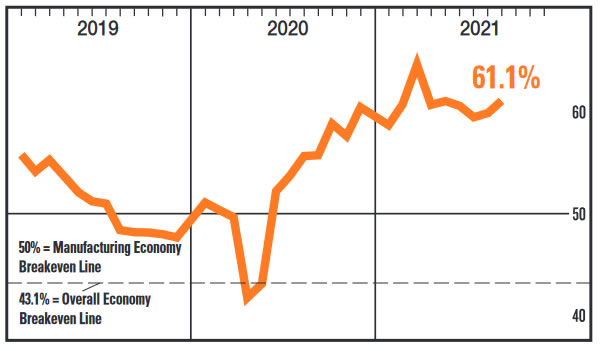
US ISM manufacturing rose to 61.1, corresponds to 5.1% annualized GDP growth
US ISM Manufacturing PMI rose from 59.9 to 61.1 in September, above expectation of 59.9. Looking at some details, new orders was unchanged at 66.7. Production dropped from 60.0 to 59.4. Employment rose from 49.0 to 50.2. Supplier deliveries rose from 69.5 to 73.4. Prices rose form 79.4 to 81.2.
ISM said: "The past relationship between the Manufacturing PMI® and the overall economy indicates that the Manufacturing PMI® for September (61.1 percent) corresponds to a 5.1-percent increase in real gross domestic product (GDP) on an annualized basis."