

Sample Category Title
Elliott Wave View: Further Strength In US Dollar Index
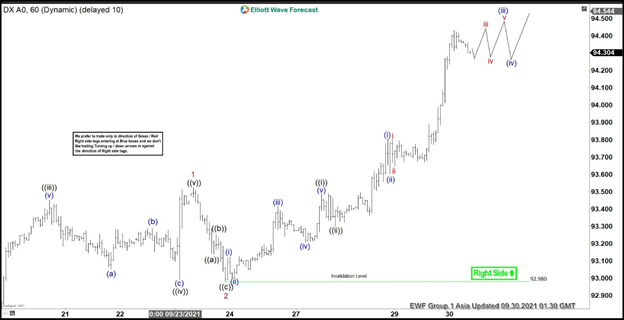
Short Term view in US Dollar Index (DXY) suggests the rally from Sept 3, 2021 low is unfolding as a 5 waves impulse Elliott Wave structure. Up from Sept 3, wave ((i)) ended at 92.8, dips in wave ((ii)) ended at 92.32. Index resumes higher in wave ((iii)) to 93.45, pullback in wave ((iv)) ended at 93. The Dollar Index then completed wave ((v)) at 93.52 which should also end wave 1 in higher degree. Pullback in wave 2 ended at 92.98 with internal subdivision as a zigzag. Down from wave 1, wave ((a)) ended at 93.14, wave ((b)) ended at 93.25, and wave ((c)) ended at 92.98.
Index has resumed higher in wave 3. Up from wave 2, wave (1) ended at 93.12 and pullback in wave (2) ended at 93. Index resumes higher in wave (iii) towards 93.42, and pullback in wave (iv) ended at 93.2. Final leg higher wave (v) of ((i)) ended at 93.49. Pullback in wave ((ii)) has also ended at 93.3 and Index has resumed higher again. Up from wave ((ii)), wave (i) ended at 93.8 and pullback in wave (ii) ended at 93.6. Near term, as far as September 23 pivot low at 93 remains intact, expect pullback to find support in 3, 7, or 11 swing for further upside. Potential target higher is 100% – 161.8% fibonacci extension from September 3 low towards 94.56 – 95.55.
DXY (Dollar Index) 60 minutes Elliott Wave chart
USD/JPY Daily Outlook
Daily Pivots: (S1) 111.44; (P) 111.75; (R1) 112.28; More...
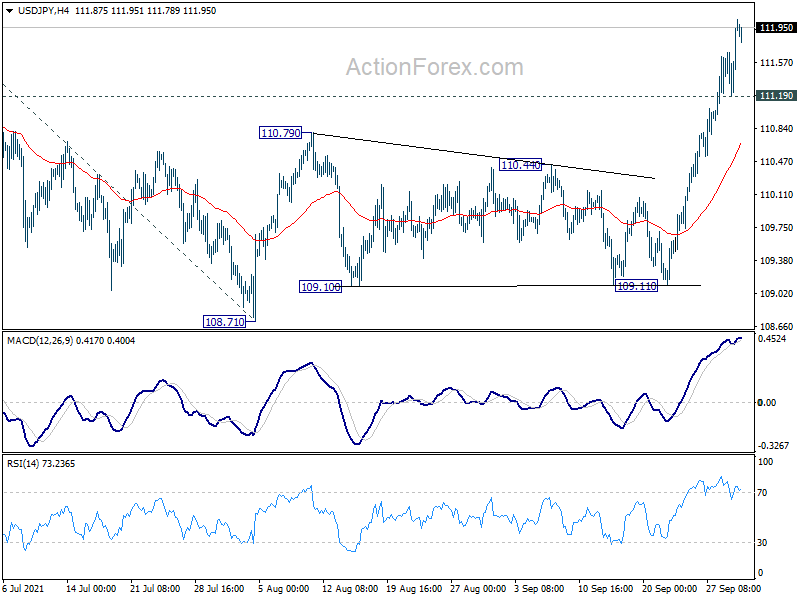
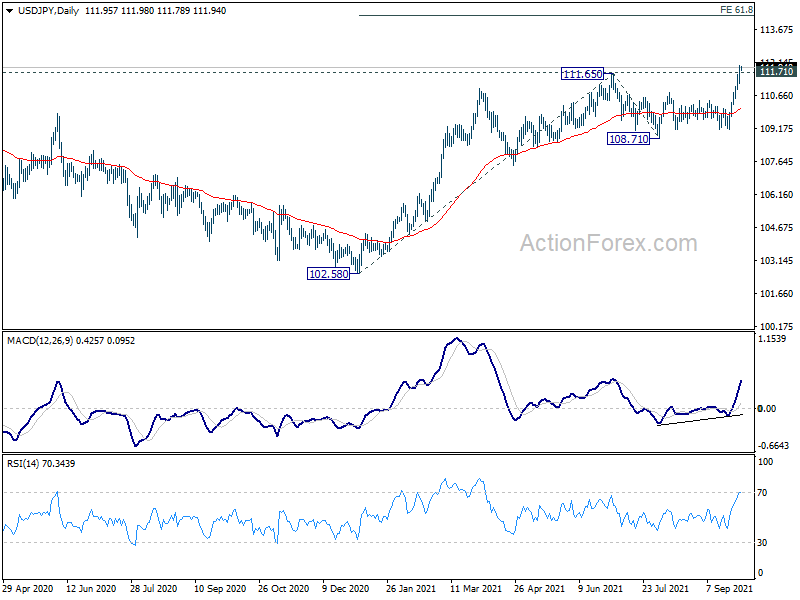
USD/JPY's rally is still in progress and reaches as high as 112.04 so far. The break of 111.71 medium term structural resistance is seen as a sign of long term bullish reversal. Intraday bias stays on the upside. Next target is 61.8% projection of 102.58 to 111.65 from 108.71 at 114.31. On the downside, below 111.19 minor support will turn bias neutral and bring retreat first, before staging another rally.
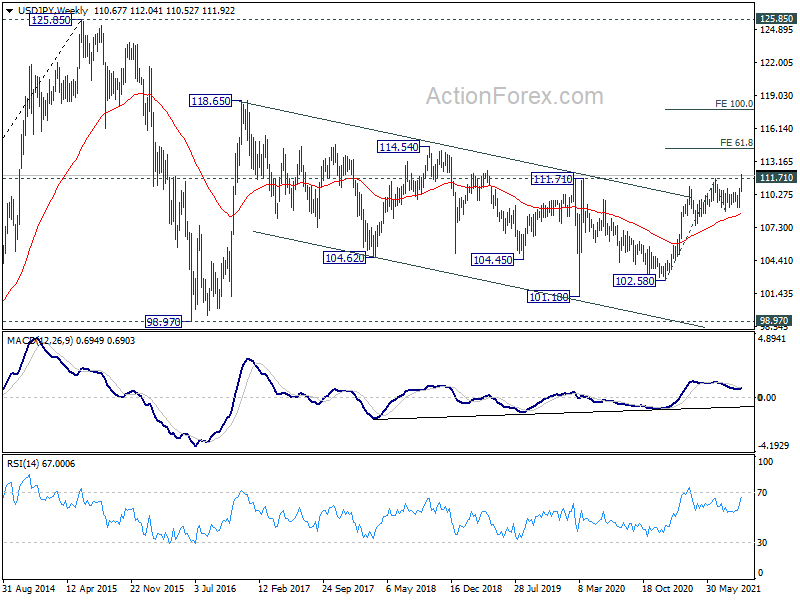
In the bigger picture, break of 111.71 resistance suggests that the whole corrective decline from 118.65 (2016 high) has completed at 101.18 (2020 low) already. Medium term bullishness is also affirmed as USD/JPY stays well above 55 week EMA (now at 108.60). Sustained trading above 111.71 will affirm this bullish case. Rise from 101.18 could then be resuming whole rally from 98.97 (2016 low) through 118.65. This will now be the preferred case as long as 108.71 support holds.
Dollar Breaking Key Resistance Levels as Yields Hold Firm
Dollar retreats mildly in Asian session but remains the strongest one over the week. The rally in treasury yields appear to be taking a breather. But 10-year yield is holding firm above 1.54 handle, while 30-year yield is also above 2.0 handle. Canadian is following as the second strongest, and then Aussie. On the other hand, New Zealand Dollar is the worst performing, followed by Sterling and then Yen. As month end is approaching, traders might start to hold their bets for now until next week.
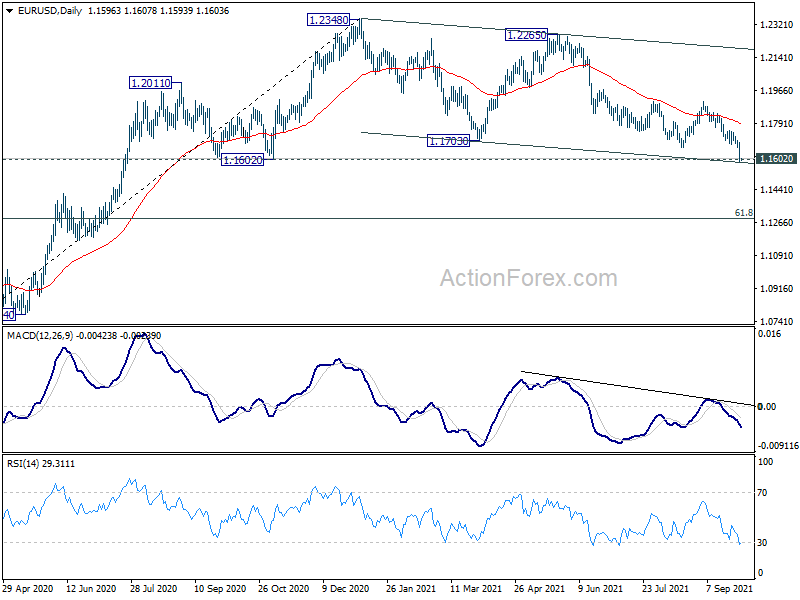
Technically, EUR/USD breached 1.1602 key medium term support level. GBP/USD also broke 1.3482 key medium term resistance turned support too. At the same time, USD/JPY also broke 111.71 key medium term structural resistance. Now, focus will be also whether Dollar could sustain above these level to confirm a medium to long term reversal.
In Asia, at the time of writing, Nikkei is down -0.14%. Hong Kong HSI is down -0.86%. China Shanghai SSE is up 0.37%. Singapore Strait Times is up 0.47%. Japan 10-year JGB yield is up 0.0036 at 0.073. Overnight, DOW rose 0.26%. S&P 500 rose 0.16%. NASDAQ dropped -0.24%. 10-year yield rose 0.007 to 1.541.
Fed Daly: Appropriate to start tapering by later this year
San Francisco Fed President Mary Daly said, "by the end of the year, if things continue as I expect them to with the economy, then I would expect us to hit that 'substantial further progress' goal, threshold, by later this year and it would be appropriate to start dialing back" asset purchases.
Daly also noted that Fed has set a different, higher bar for rate hike. "If we should get there in the time frame of next year that would be a tremendous win for the economy," she said, but "I don't expect that to be the case."
ECB Lagarde: Higher energy prices to go out in first part of 22
In an online seminar hosted by ECB yesterday, President Christine Lagarde noted that "how long how those bottlenecks will take to be resolved" is one of the question marks. She expected the impact of higher energy prices to "go out in the first part of '22". Also, "the last of the uncertainties that we have to account for...is potential new waves of a pandemic that would be vaccine-resistant,"
In the same occasion, BoE Governor Andrew Bailey said, "I expect us to be back to the pre-pandemic level in the early part of next year, possibly a month or two later than we thought we would be at the start of August."
Some analysts took a message from September MPC minutes that BOE could raise interest rate in November, while the asset purchase program is still in its final stages. Bailey declined to comment directly. But he noted, "the preferred tool will always be rates because we understand the effect of rates in the monetary policy transmission mechanism. But that's not to pre-judge what we will decide in November,"
BoJ Governor Haruhiko Kuroda maintained said, "whatever fiscal, regulatory or any other policies the new government pursues, the BOJ will continue to maintain extremely accommodative monetary policy in order to achieve its 2% price stability target as soon as possible."
"In coming years, we must achieve our 2% price stability target. That is true. But at this moment, (achieving) economic recovery and faster growth are the most important challenges faced by us," Kuroda said.
Japan industrial production dropped -3.2% mom in Aug, auto production shrank
Japan industrial production dropped -3.2% mom in August, worse than expectation of -0.5% mom. Production in auto dropped -15.2% mom as affected by global semiconductor shortage and factory shutdowns in Southeast Asia. Output of electrical machinery and information and communication electronics equipment also dropped -10.6% mom.
The Ministry of Economy, Trade and Industry downgraded the assessment of industrial production, and said recovery "has paused. Nevertheless, based on a poll of manufacturers, production is expected to rise 0.2% mom in September and then 6.8% mom in October.
Also released, retail sales dropped -3.2% yoy in August, versus expectation of -1.3% yoy. That's the first decline in six months.
China Caixin PMI manufacturing rose to 50, pandemic impacts demand, supply and circulation
China Caixin PMI Manufacturing rose from 49.2 to 50.0 in September, above expectation of 49.6. Caixin said new orders returned to growth. Output fell at softer pace. Inflation pressures picked up amid material shortages.
Wang Zhe, Senior Economist at Caixin Insight Group said: "On the one hand, the epidemic continued to impact demand, supply, and circulation in the manufacturing sector. The state of the epidemic overseas and the shortage of shipping capacity also dragged down total demand. Epidemic control measures have clearly impacted the logistics industry."
Also released, the official NBS PMI Manufacturing dropped from 50.1 to 49.6 in September, versus expectation of 50.2. PMI Non-Manufacturing rose from 47.5 to 53.2, above expectation of 50.8.
New Zealand ANZ business confidence rose to -7.2, activity dropped to 18.2
New Zealand ANZ Business Confidence rose to -7.2 in September, up from August's -14.5. Own Activity Outlook dropped to 18.2, down from 20.2. Looking at some details, export intentions dropped from 8.4 to 7.4. Investment intentions dropped from 15.4 to 9.2. Cost expectations dropped from 85.0 to 84.2. Employment intentions dropped from 17.9 to 14.1. Inflation expectations ticked down from 3.06% to 3.02%.
ANZ said: "The Auckland COVID outbreak drags on but businesses so far appear to be keeping their eyes on the prize. Spending has already bounced back quite a lot, particularly outside Auckland, and experience has shown momentum tends to recover quickly. In that context, interest rate increases may well prove more of a challenge. The housing market is vulnerable, with headwinds gathering, and there's no question the housing market and construction more generally have been key drivers of growth over the past 18 months – for what's definitely been a mix of better and worse."
Looking ahead
UK GDP and current account, Swiss KOF economic barometer, Germany CPI flash and unemployment, France consumer spending, and Eurozone unemployment rate will be released in European session. Later in the day, US will release initial jobless claims, Chicago PMI, and Q2 GDP final.
USD/JPY Daily Outlook
Daily Pivots: (S1) 111.44; (P) 111.75; (R1) 112.28; More...
USD/JPY's rally is still in progress and reaches as high as 112.04 so far. The break of 111.71 medium term structural resistance is seen as a sign of long term bullish reversal. Intraday bias stays on the upside. Next target is 61.8% projection of 102.58 to 111.65 from 108.71 at 114.31. On the downside, below 111.19 minor support will turn bias neutral and bring retreat first, before staging another rally.
In the bigger picture, break of 111.71 resistance suggests that the whole corrective decline from 118.65 (2016 high) has completed at 101.18 (2020 low) already. Medium term bullishness is also affirmed as USD/JPY stays well above 55 week EMA (now at 108.60). Sustained trading above 111.71 will affirm this bullish case. Rise from 101.18 could then be resuming whole rally from 98.97 (2016 low) through 118.65. This will now be the preferred case as long as 108.71 support holds.
Economic Indicators Update
| GMT | Ccy | Events | Actual | Forecast | Previous | Revised |
|---|---|---|---|---|---|---|
| 23:50 | JPY | Industrial Production M/M Aug P | -3.20% | -0.50% | -1.50% | |
| 23:50 | JPY | Retail Trade Y/Y Jul | -3.20% | -1.30% | 2.40% | |
| 01:00 | CNY | NBS Manufacturing PMI Sep | 49.6 | 50.2 | 50.1 | |
| 01:00 | CNY | Non-Manufacturing PMI Sep | 53.2 | 50.8 | 47.5 | |
| 01:30 | AUD | Private Sector Credit M/M Aug | 0.60% | 0.50% | 0.70% | |
| 01:45 | CNY | Caixin Manufacturing PMI Sep | 50 | 49.6 | 49.2 | |
| 05:00 | JPY | Housing Starts Y/Y Aug | 9.60% | 9.90% | ||
| 06:00 | GBP | GDP Q/Q Q2 F | 4.80% | 4.80% | ||
| 06:00 | GBP | Current Account (GBP) Q2 | -16.6B | -12.8B | ||
| 06:30 | CHF | Real Retail Sales Y/Y Aug | -2.60% | |||
| 06:45 | EUR | France Consumer Spending M/M Aug | 0.10% | -2.20% | ||
| 07:00 | CHF | KOF Leading Indicator Sep | 110.3 | 113.5 | ||
| 07:55 | EUR | Germany Unemployment Change Sep | -40K | -53K | ||
| 07:55 | EUR | Germany Unemployment Rate Sep | 5.60% | 5.50% | ||
| 08:00 | EUR | Italy Unemployment Aug | 9.20% | 9.30% | ||
| 09:00 | EUR | Eurozone Unemployment Rate Aug | 7.60% | 7.60% | ||
| 12:00 | EUR | Germany CPI M/M Sep P | 0.10% | 0.00% | ||
| 12:00 | EUR | Germany CPI Y/Y Sep P | 3.90% | 3.90% | ||
| 12:30 | USD | Initial Jobless Claims (Sep 24) | 321K | 351K | ||
| 12:30 | USD | GDP Annualized Q2 F | 6.70% | 6.60% | ||
| 12:30 | USD | GDP Price Index Q2 F | 6.10% | 6.20% | ||
| 13:45 | USD | Chicago PMI Sep | 66.7 | 66.8 | ||
| 14:30 | USD | Natural Gas Storage | 86B | 76B |
Market Morning Briefing: Pound Fell Further To 1.34 Today
STOCKS
Equities are mixed. While Dow, Dax, Shanghai, Nifty and Sensex have reversed and bounced well after recent dips, Nikkei continues to fall and looks bearish for a few more sessions before a bounce is seen. Dow can rise to 34500-35000, Dax is bullish while above 15000. Shanghai is bullish while above 3500 and can rise towards 3600-3700 slowly. Nifty and Sensex look bullish within the broad range of 17600-18000 and 59000-60000 respectively.
Dow (34390.72, +90.73, +0.26%) has recovered a bit and while above 34000, there is scope for a rise to 34500-35000 on the upside. We do not negate a possible fall to 34000-33900/500 too and need confirmation to negate such a fall on a rise above 35000.
DAX (15365.27, +116.71, +0.77%) has bounced well and while above 15200, it can rise to test 15500-15600 before again falling back towards 15000-15200 on the downside.
Nikkei (29433.68, -110.61, -0.37%) has fallen further today and could test 29000-28500 before rising again from there in the longer run.
Shanghai (3550.52, +14.22, +0.41%) has moved up slightly. While above 3500, there is scope for a slow rise to 3600 and eventually towards 3700.
Nifty (17711.30, -37.30, -0.21%) mostly traded in a narrow range yesterday. The range of 17600-17800 mentioned yesterday is holding well for now. If Nifty breaks below 17600 then we can see a fall towards 17400-17200-17000 levels, else a slow rise from current levels towards 18000/250 is possible soon.
Sensex (59413.27, -254.33, -0.43%) has risen slowly yesterday. View is to see a steady rise towards the level of 60000 now, but could be faced by interim rejections towards 59000.
COMMODITIES
Crude prices have come off but we need more downside for confirmation of a top. Brent needs to break below 76 and WTI below 74 to indicate downside. Any break above 80 on Brent and 76 on WTI can have scope for a test of 82.50-83 and 78 respectively. Gold can still test 1700 before bouncing from there. Silver has broken below crucial support at 22 and if it does not see an immediate bounce from 21, it can plunge further down. Copper is stuck within the 4.0-4.40 range and can fall towards 4.10/4.00 before rising back.
Brent (77.96) has continued to fall while WTI (74.83) has risen a bit. As mentioned yesterday, a fall below 76 and 74 respectively will confirm that a top is possibly in place and we may look for lower targets in the coming sessions. While below 80 and 76/77, view is bearish for a test of 75-70 on Brent and 72-71 on WTI in the medium term. Any break above 80 on Brent and 76/77 on WTI can take the price higher towards 82.50/83 and 78 respectively.
Gold (1732.20) fell to test 1726 before rising back from there. It needs to break above 1740 and sustain higher to negate a possible fall to the lower end of the 1725-1700 range. Else we continue to look for a test of 1700 before a bounce towards 1760/80 or higher is seen. .
Silver (21.53) has broken below our mentioned support near 22.50-22.0. This is crucial and no immediate support is visible below current levels. We will have to wait for a reversal signal.
Copper (4.2030) has dipped sharply and can test 4.10/00 before bouncing back towards 4.30/40 again. Overall ranged view may continue to hold.
FOREX
Dollar trades sharply higher as it break above our expected resistance at 94. Euro has been dragged lower to 1.16, which can break and fall to 1.15-1.14 as the Dollar seems to be heading towards 95. EURJPY has been dragged down too and can fall to 129.50-129 in the near term. Pound and Aussie look bearish. USDCNY is stable within 6.48-6.45/44. USDINR has scope to rise to 74.50.
Dollar Index (94.2650) tested 94.432 yesterday and has just come off a bit. This has been contrary to our expected resistance near 93.80-94.00 to hold. While the index trades above 94, there is scope for a rise towards 95 on the upside.
Euro (1.1607) has tested 1.1589 and has come down as per our expectation of a fall. Failure to hold above 1.16 can drag down Euro further towards 1.15-1.14 as Dollar Index heads higher towards 95. (Get our Euro monthly report for October’21 here: https://kshitij.com/eurusd-forecast-payment-details/oct-21 )
EURJPY (129.80) has been pulled down by a weaker Euro as resistance near 130.50 has also held well. A fall to 129.50-129 looks likely soon.
Dollar-Yen (111.83) had already showed sharp upmove before the Dollar Index broke above 94. The pair has tested 112 and may find difficulty in breaking on the upside just now. We may expect a short corrective fall to 111.50-111 before rising higher. A rise in Dollar Index towards 95 can take USDJPY above 112 soon.
Aussie (0.7204) fell to 0.7170 yesterday before bouncing back slightly from there. Failure to hold the bounce can bring the rate down to 0.71 in the near term. To negate further downside, Aussie has to break above 0.7225-0.7250 and rise higher.
Pound (1.3450) fell further to 1.34 today and can fall further towards 1.3320. Else an immediate bounce from current levels is needed for the Pound to move up towards 1.36. While the US Dollar trades strong, Pound may decline further.
USDCNY (6.4667) looks stable and could range within 6.48-6.45/44 for some more time.
USDINR (74.1525) tested interim resistance at 74.25 but the sharp rise in US Dollar indicates a possible rise to 74.50 on the upside before any rejection sets in. Immediate view is bullish.
INTEREST RATES
The US Treasury yields have dipped slightly. As mentioned yesterday, we see limited upside from here with strong resistances ahead. We expect the yields to remain below these resistances and reverse lower in the coming days. The German yields sustain higher and can move up in the near-term before turning down. The 5Yr and 10Yr GoI are hovering above their key supports which if broken can drag them lower in the coming days and negate the chances of seeing any further rise.
The US 2Yr (0.29%), 5Yr (0.99%), 10Yr (1.51%) and the 30Yr (2.05%) Treasury yields have dipped slightly. 1.6% on the 10Yr and 2.1%-2.2% on the 30Yr are likely to be a cap on the upside for now. As mentioned yesterday, we expect the yields to reverse lower and see a fresh fall either from current levels itself or after an extended rise to test the above mentioned resistances.
The German 2Yr (-0.70), 5Yr (-0.56%), 10Yr (-0.21%) and 30Yr (0.25%) yields remain higher and stable. The outlook is bullish. The 30Yr can rise to 0.3%-0.35% while it sustains above 0.2%. The 10Yr has an immediate resistance at -0.20% and can rise to -0.1% on a break above it. Thereafter a fresh fall is possible.
The Indian 10Yr GoI (6.2056%)has dipped yesterday. But while above 6.2% there is still scope to test 6.25%-6.26% before coming-off again. A strong break below 6.2% from here is needed to negate the above mentioned rise and drag the yield lower to 6.15%-6.10% again.
The 5Yr GoI (5.6471%) has an immediate support at 5.64% which if broken can take the yield lower to 5.6%-5.55% again. While 5.64% holds, a consolidation between 5.64%-5.68%/5.70% can be seen for some time.
China Caixin PMI manufacturing rose to 50, pandemic impacts demand, supply and circulation
China Caixin PMI Manufacturing rose from 49.2 to 50.0 in September, above expectation of 49.6. Caixin said new orders returned to growth. Output fell at softer pace. Inflation pressures picked up amid material shortages.
Wang Zhe, Senior Economist at Caixin Insight Group said: "On the one hand, the epidemic continued to impact demand, supply, and circulation in the manufacturing sector. The state of the epidemic overseas and the shortage of shipping capacity also dragged down total demand. Epidemic control measures have clearly impacted the logistics industry."
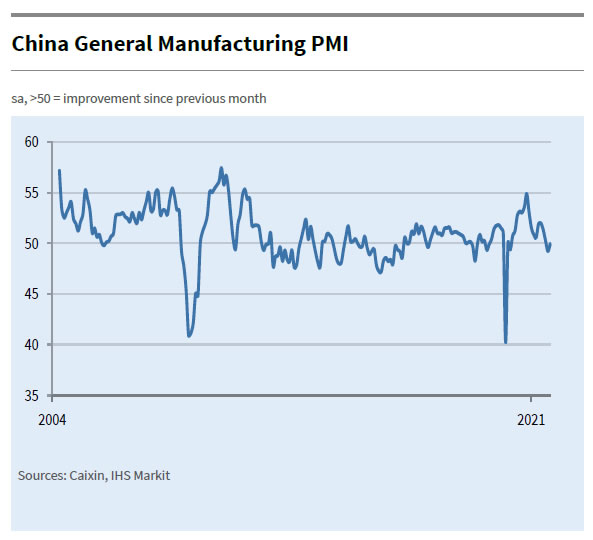
Also released, the official NBS PMI Manufacturing dropped from 50.1 to 49.6 in September, versus expectation of 50.2. PMI Non-Manufacturing rose from 47.5 to 53.2, above expectation of 50.8.
Japan industrial production dropped -3.2% mom in Aug, auto production shrank
Japan industrial production dropped -3.2% mom in August, worse than expectation of -0.5% mom. Production in auto dropped -15.2% mom as affected by global semiconductor shortage and factory shutdowns in Southeast Asia. Output of electrical machinery and information and communication electronics equipment also dropped -10.6% mom.
The Ministry of Economy, Trade and Industry downgraded the assessment of industrial production, and said recovery "has paused. Nevertheless, based on a poll of manufacturers, production is expected to rise 0.2% mom in September and then 6.8% mom in October.
Also released, retail sales dropped -3.2% yoy in August, versus expectation of -1.3% yoy. That's the first decline in six months.
New Zealand ANZ business confidence rose to -7.2, activity dropped to 18.2
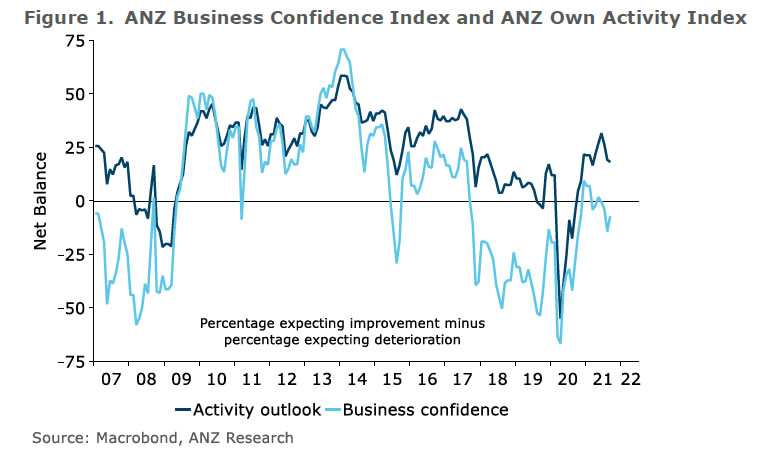
New Zealand ANZ Business Confidence rose to -7.2 in September, up from August's -14.5. Own Activity Outlook dropped to 18.2, down from 20.2. Looking at some details, export intentions dropped from 8.4 to 7.4. Investment intentions dropped from 15.4 to 9.2. Cost expectations dropped from 85.0 to 84.2. Employment intentions dropped from 17.9 to 14.1. Inflation expectations ticked down from 3.06% to 3.02%.
ANZ said: "The Auckland COVID outbreak drags on but businesses so far appear to be keeping their eyes on the prize. Spending has already bounced back quite a lot, particularly outside Auckland, and experience has shown momentum tends to recover quickly. In that context, interest rate increases may well prove more of a challenge. The housing market is vulnerable, with headwinds gathering, and there's no question the housing market and construction more generally have been key drivers of growth over the past 18 months – for what's definitely been a mix of better and worse."
Fed Daly: Appropriate to start tapering by later this year
San Francisco Fed President Mary Daly said, "by the end of the year, if things continue as I expect them to with the economy, then I would expect us to hit that 'substantial further progress' goal, threshold, by later this year and it would be appropriate to start dialing back" asset purchases.
Daly also noted that Fed has set a different, higher bar for rate hike. "If we should get there in the time frame of next year that would be a tremendous win for the economy," she said, but "I don't expect that to be the case."
ECB Lagarde: Higher energy prices to go out in first part of 22
In an online seminar hosted by ECB yesterday, President Christine Lagarde noted that "how long how those bottlenecks will take to be resolved" is one of the question marks. She expected the impact of higher energy prices to "go out in the first part of '22". Also, "the last of the uncertainties that we have to account for...is potential new waves of a pandemic that would be vaccine-resistant."
BoE Governor Andrew Bailey said, "I expect us to be back to the pre-pandemic level in the early part of next year, possibly a month or two later than we thought we would be at the start of August."
Some analysts took a message from September MPC minutes that BOE could raise interest rate in November, while the asset purchase program is still in its final stages. Bailey declined to comment directly. But he noted, "the preferred tool will always be rates because we understand the effect of rates in the monetary policy transmission mechanism. But that's not to pre-judge what we will decide in November,"
BoJ Governor Haruhiko Kuroda maintained said, "whatever fiscal, regulatory or any other policies the new government pursues, the BOJ will continue to maintain extremely accommodative monetary policy in order to achieve its 2% price stability target as soon as possible."
"In coming years, we must achieve our 2% price stability target. That is true. But at this moment, (achieving) economic recovery and faster growth are the most important challenges faced by us," Kuroda said.
Eco Data 9/30/21
[php_everywhere instance="1"]