Sample Category Title
Week Ahead – BoE to Likely Cut in Split Vote – Trade Turmoil Unlikely to End
- Bank of England decision to be the week’s main event.
- ISM services PMI is only other highlight in relatively quiet week.
- Market sentiment might struggle in aftermath of Trump’s August 1 tariffs.
BoE faces tough balancing act
The Bank of England will keep the central bank theme going over the coming week as it’s next in line to set interest rates. Policymakers are headed for a fraught decision amid a dilemma between taming resurgent inflationary pressures and supporting growth in a slowing economy.
The UK’s headline CPI rate climbed to 3.6% year-on-year in June and the core rate also edged up. Aside from higher energy prices, whose effect is likely to be temporary, a bigger concern for the BoE is the substantial rise in food prices, with the British Retail Consortium warning that food inflation could hit 6% by year end.
Yet, Governor Andrew Bailey has been beating the dovish drum lately, as the UK economic outlook has deteriorated following Chancellor Rachel Reeves’ Autumn budget in November. As widely predicted, Reeves’ hike in employers’ national insurance is prompting many businesses to cut back on staff, while job vacancies have plunged to the lowest since 2021.
Earlier in July, Bailey sounded worried about slack opening up in the economy, which would normally be grounds for a rate cut. The drop in GDP in both April and May supports this view. But with the upswing in inflation potentially not over, can the Bank risk lowering rates further?
The most likely outcome is that the BoE will trim rates by 25 basis points, sticking to its ‘gradual and careful’ approach of one reduction per quarter. But the decision will be split, possibly three ways, with some MPC members voting to keep rates on hold, others voting to cut by 25 bps, and one or two members even opting for a 50-bps reduction.
The reaction in the pound will probably be limited in the event of a three-way split as it will be hard to get a clear message on the interest rate outlook. But should the vote turn out to be much tighter, with no MPC member voting for a 50-bps cut and Bailey having the casting vote, the pound could strengthen somewhat on the back of it.
ISM services PMI on tap after Fed
Across the Atlantic, the Fed is also facing an inflation problem but unlike the UK where stagflationary risks are more prominent, the US economy is for the moment humming along quite nicely with few visible scars from the trade war.
It may take several months for the impact of the higher tariffs to fully reflect in the inflation data, while the cooldown in hiring appears to be offset by fewer people entering the workforce, amid President Trump’s migration crackdown. Fed chief Jerome Powell appeared to acknowledge this in his press conference that followed the July FOMC decision.
Although two governors voted to cut rates by 25 bps, the overall tone of the statement and Powell’s commentary was very neutral, suggesting that the Fed is not ruling out a rate increase should higher tariffs and a tighter labour market push inflation higher even as it opens the door to a September cut.
But it’s also possible that the labour market is much weaker than implied by the official data and tariffs may only modestly lift inflation. Investors are therefore keeping a close watch on the more forward-looking data such as the PMIs to gauge what’s happening to both price pressures and employment.
Tuesday’s ISM services PMI for July could sway the US dollar in either direction depending on whether it tips the balance towards a rate cut or a prolonged pause.
Trade uncertainty persists despite deals
But with not much else on the US agenda, traders will also be paying attention to the latest developments in the ongoing trade negotiations between the US and the remaining countries that haven’t signed a deal.
The United States has reached trade deals with most of its major partners such as the UK, EU, Japan and South Korea. But there is no firm agreement with China to extend their trade truce beyond August 12 when the current one expires. More importantly, the White House is still engaged in talks with its closest neighbours, Canada and Mexico, to find a resolution to their trade disputes. Mexico has been granted an extension, Canada has not, and it now faces duties of 35% on its goods.
Tariffs on all other countries have been set at a minimum of 10%, with several countries such as Switzerland and India receiving punitive rates of 39% and 25%, respectively. It’s possible that some countries might still manage to negotiate lower rates, as the new tariffs won’t go into effect until August 7 and there have also been indications that the White House is open to more talks.
But markets are only just starting to realise that the new tariff levels represent a significant increase from the pre-trade war average and the implications of this on domestic inflation in America and on growth prospects around the world could be far more severe than anticipated by most investors. Hence, a fresh tariff-related volatility episode cannot be ruled out.
Next week’s Treasury issuance further risks roiling markets if negative trade headlines knock confidence in the US economy, leading to poor demand at the auctions and pushing up the yields on the 10- and 30-year bonds.
Canada misses out on trade deal, jobs report eyed
One of the toughest negotiations during Trade War II have been between the US and Canada. President Trump has certainly not made things easy for Prime Minister Mark Carney, deciding to impose 35% tariffs on all goods that are not covered by the USMCA agreement.
Doubts about whether Canada will be able to convince Trump to agree to reduced levies have pushed the Canadian dollar to two-month lows against the US dollar.
For the Bank of Canada, the uncertain outlook hasn’t been its only headache as a pickup in underlying inflation has complicated matters for policymakers. However, at its July meeting, Governor Tiff Macklem said that “there are reasons to think that the recent increase in underlying inflation will gradually unwind”, while the announcement statement suggested that a further reduction in interest rates might be needed if the economy were to continue to weaken.
One key indicator of how well the economy is faring will be Friday’s employment report. Canada’s labour market added a solid 83k jobs in June. Another strong print in July would lessen the need for an immediate cut, lending some support to the loonie.
Will the BoJ Summary ease the Yen’s pain?
The yen has also fallen sharply against the US dollar lately, as investors have not been convinced that the US-Japan trade deal will provide much of a boost to the Japanese economy. A year-end rate hike is only about 70% priced in as the Bank of Japan declined to strongly hint at further tightening at its July meeting.
Should next week’s wage growth (Wednesday) and household spending (Friday) data point to faster pay increases and higher consumption in June, the yen could benefit from renewed rate hike bets.
Investors will also be keeping an eye on Friday’s Summary of Opinions of the BoJ’s latest meeting. A more hawkish tone in the summary than that presented by Governor Ueda in his press conference could also bolster the yen.
Elsewhere, trade data out of China might attract some attention on Thursday, while in New Zealand, quarterly employment stats will be watched on Wednesday. But potentially of greater significance for RBNZ rate cut speculation will be the latest inflation expectation numbers due on Thursday from the central bank’s quarterly survey.
US ISM manufacturing contracts further, employment weakness deepens
US ISM Manufacturing PMI slipped further to 48.0 in July, down from 49.0 and missing expectations of 49.6. This marks the fifth straight month of contraction in factory activity.
While production rose slightly from 50.3 to 51.4 and new orders improved from 46.4 to 47.1, both remained in contractionary territory.
Employment was a particular weak spot, with the sub-index dropping from 45.0 to 43.4—its lowest since the start of the year and the sixth consecutive month of contraction.
The share of manufacturing GDP in contraction jumped sharply, with 79% now shrinking in July versus 46% the month prior. A full 31% is deemed to be “strongly contracting,” suggesting growing stress across the sector.
Input costs also eased, with the prices index falling notably from 69.7 to 64.8.
Despite the weak PMI headline, ISM noted the historical correlation still points to modest growth in the broader economy, equating to roughly 1.6% annualized GDP growth. But signs of deeper employment cuts and broadening factory weakness raise concerns about the resilience of the industrial economy in H2.
Sunset Market Commentary
Markets
Dubbed “Liberation Day 2.0”, US president Trump’s adjusted tariffs now the August 1 deadline has lapsed had by far the largest negative impact on equity markets. Asian stocks withstood the long list of unilateral tariffs relatively well but European equities have a much harder time. The EuroStoxx50 slumps >2%, adding to yesterday’s -1.3%. Trump maintained a 10% minimum rate, applicable to countries with a trade deficit with the US (yes, you read that right) while those with a limited trade surplus face 15% (about 40 countries). Countries without a trade agreement or higher surpluses would pay a sometimes significantly higher rate. Switzerland (39%) serves as a case in point. The new rates kick in on August 7 and need yet to be complemented by any sectoral tariffs (pharma, semiconductors, rare metals …). FI and FX markets trade surprisingly resilient. We’re not seeing any safe haven flows to German Bunds, on the contrary: yields rise between 0.7 (bps) to 5.4 (30-yr) bps. US rates eke out up to 2.6 bps. Wednesday’s two dissenters simultaneously hit the wires today, repeating their calls for cuts. Waller said the Fed shouldn’t wait for the labour market to deteriorate while Bowman said slowing growth allows for gradual rate reductions. The USD has a minor upper hand against most G10 peers but its within the margin of error as markets hold the sidelines going into the July Labour market report. EUR/USD hovers around the 1.14 barrier. The trade-weighted dollar index extends this week strong rally to beyond 100. GBP trades in the defensive, allowing EUR/GBP to rebound for a second day straight back to the 0.866 area. The Swiss franc obviously underperforms peers. EUR/CHF jumps north of 0.93.
Enter the payrolls to completely wipe out the pre-labour market picture. July employment was a meagre 73k, falling short of an already low bar of 104k. The previous two months faced a significant cumulative downward revision of 258k, meaning there was barely any employment growth in May (19k) and June (14k). That brings the 3mMA to the lowest since 2010 (35k). A 96k job increase in the services sector (private education & health) compensated an 11k drop in manufacturing and a 12k drop in the government sector. The unemployment rate ticked higher as expected, to 4.2%. That’s still low but it’s despite the participation rate easing to 62.2%. Wages grew largely in line with expectations (0.3% m/m and 3.9%). The market reaction is textbook: front end US yield curves tank up to 21 bps as markets ramp up Fed easing bets again just after the central bank told they won’t just yet. A September cut is priced in for 85% vs 40% pre-payrolls. If future labour market reports confirm the weakening state, we wouldn’t rule out the Fed going big in its opener, similar to last year. Longer maturities drop 8-13 bps too. German yields swap gains for losses in sympathy. The greenback takes a sucker punch, ending in what otherwise have been a stellar week with a downer. EUR/USD shoots up from <1.14 to 1.156 currently. DXY nosedives back towards 99.4 and USD/JPY returns to 149.04. Wall Street opens more than 1% lower but the majority of (futures) losses were already prior to the release. The US manufacturing ISM is still scheduled for release after the wrap-up of this report.
News & Views
The IMF’s executive board approved a $2bn disbursement to Argentina after concluding its first review of the country’s $20bn deal with the Washington-based institution. The approval is seen as a sign of confidence in president Milei and his government since it missed a key mid-June target for building up its net international reserves at the central bank. With the approval, total IMF financing for Argentina adds up to $14bn after an initial and upfront release of an unusually large $12bn chunk. IMF director Georgieva said Milei’s economic program is off to a “strong start” and said that “Exchange rate flexibility should be preserved, while sustained efforts continue to rebuild reserves buffer” in being critical for Argentina to better manage shocks and have durable access to international capital markets.
July and the No Good, Very Bad Jobs Report
Summary
The July employment report was a dud. Nonfarm payrolls rose by 73K in July, coming in short of the consensus forecast of 104K. Employment growth was approximately zero outside the health care and social assistance industries. Revisions to job growth in the previous two months were substantial and shaved 258K off of total employment growth in May and June. In the household survey, the unemployment rate rose from 4.1% to 4.2%, but the rounding masks that the unemployment rate just barely missed reaching a cycle-high of 4.3% (4.248% to be exact). The rise in the unemployment rate came despite another tick lower in the labor force participation rate, the third consecutive monthly decline.
Coming into today's report, our base case forecast was that the FOMC would cut the federal funds rate by 25 bps at its September, October and December meetings, with no additional rate cuts in 2026. Based on today's data, we are inclined to leave that projection unchanged for the time being. Given both the downside risks to the Fed's employment mandate and the upside risks to inflation, we think the Committee will move monetary policy toward a more neutral stance in the coming months to better reflect the two-way risks to the economy.
Clear Signs of Weakness
The "solid" state of the labor market described by the FOMC earlier this week looks more questionable after the July employment report. Nonfarm payrolls rose a weaker-than-expected 73K in July. More jarring, the below-consensus print came with the steepest downward net revision to the prior two months data (-258K) since May 2020. The three-month average of payroll growth was 150K coming into this report, and when incorporating revisions, the pace has lurched lower to just 35K.
Downward revisions to the prior months were broad-based. June's initially reported 74K gain in private sector hiring was shaved down to a scant 3K rise, with notable declines in retail trade and professional & technical services. Similarly, updated information from government agencies led June's solid 73K gain in total government payrolls to be revised down to a much more modest 11K increase. In short, hiring was not as stable as previously thought.
Hiring weakness across industries carried into July. The ongoing federal government hiring freeze pulled total government payrolls into the red in July (-10K), leaving employment down 84K since the start of the year (chart). Outside government, private sector hiring rebounded to a 83K gain, but the details continue to point to a narrow range of industries expanding headcount. Healthcare & social assistance (+73K) continues to be the stalwart of growth, but "white collar" jobs like professional & business services (-14K), information (-2K) and finance continue to struggle (chart). Goods related industries also remain under pressure, as shown by additional declines in wholesale trade (-8K) and manufacturing (-11K). The industry mix is illustrative of cyclically sensitive industries wobbling underneath the weight of stalling demand.
The sharp reduction in immigration this year has made the unemployment rate that much more important in assessing the health of the labor market. Amid tepid demand for workers, slower growth in the labor supply has helped to keep the labor market in balance. In July, the jobless rate ticked back up to 4.2%. That keeps it within the range Fed officials estimate is consistent with the full employment side of their mandate and moving sideways over the past year or so (chart).
However, the increase in July looked a little more troubling underneath the surface. On an unrounded basis, the unemployment rate printed 4.248%, barely avoiding what would have been a cycle-high print of 4.3%. Moreover, the rise came amid a drop in the household measure of employment (-260K) and another decline in the labor force (-38K), not for the benign reason of more individuals looking for work. The labor force participation fell for a third consecutive month, and when smoothing through the household survey's annual population control adjustments, the size of labor force is now unchanged from a year ago (chart). We continue to expect the unemployment rate to move a bit higher before the year is out, but we look for the rise to be limited to only another couple tenths due to the sharp slowing in labor supply growth.
Average hourly earnings rose 0.3% in the month, and the year-ago pace climbed to 3.9%. This brings it a bit more in line with the recent trend in the Employment Cost Index, which shows signs of a leveling off in wage growth this year. Even with the beat, overall compensation growth is more or less consistent with the Fed's inflation goal once accounting for the recent trend in labor productivity, keeping us of the view that the labor market is not a source of significant inflationary pressure at present.
September Rate Cut Remains the Base Case
Coming out of this week's FOMC meeting, Chair Powell generally characterized the labor market as solid and in a good enough position that the Committee could continue to adopt a wait-and-see approach to monetary policy. But, some Committee members, most notably Governors Bowman and Waller, stressed that downside risks to the labor market warranted a rate cut at the July meeting. Those downside risks materialized in today's employment report, with slower nonfarm payroll growth, higher unemployment and generally crummy details under the hood.
Our base case forecast coming into today's report was that the FOMC would cut the federal funds rate by 25 bps at its September, October and December meetings, with no additional rate cuts in 2026. Based on today's data, we are inclined to leave that projection unchanged for the time being. Given both the downside risks to the Fed's employment mandate and the upside risks to inflation, we think the Committee will move monetary policy toward a more neutral stance in the coming months to better reflect the two-way risks to the economy.
That said, we do not think this is the end of the debate over whether to cut rates in September. There is one more employment report between now and the September 17 meeting, and it will be critical to either confirming or dispelling the weakness seen in today's employment data. Furthermore, there are two CPI reports between now and the next FOMC meeting. With higher prices from tariffs still slowly working their way to consumer products, an upside surprise on inflation would not be surprising. If the inflation data are hot, the FOMC will be in the ultimate bind, and the split on the Committee likely will get worse.
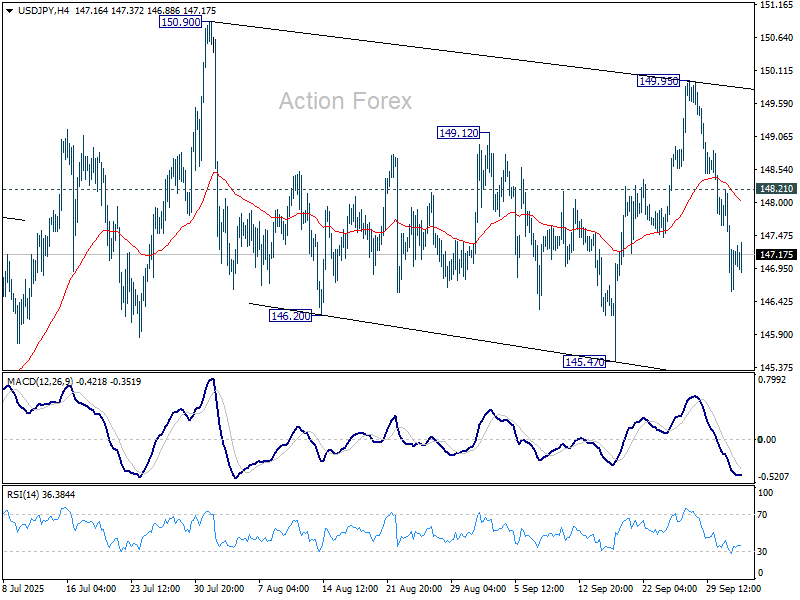
USD/JPY Mid-Day Outlook
Daily Pivots: (S1) 149.29; (P) 150.07; (R1) 151.54; More...
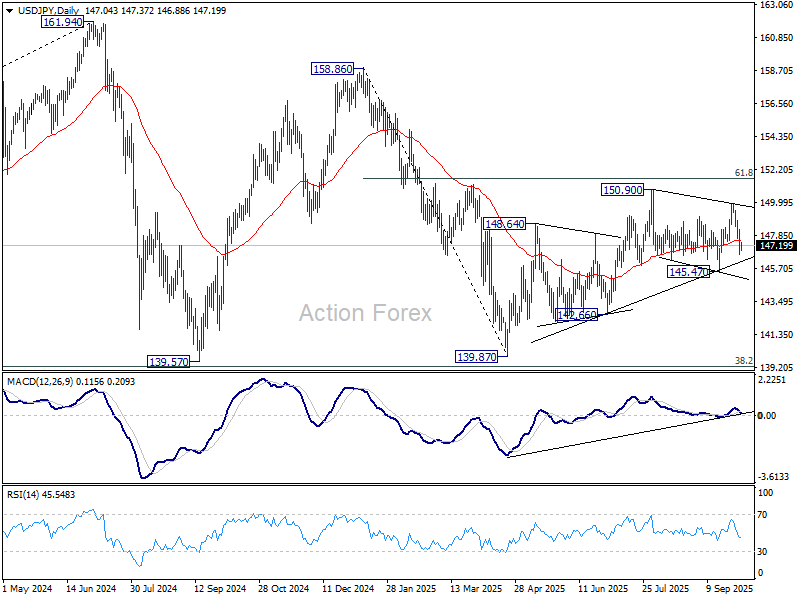
Intraday bias in USD/JPY is turned neutral first with current steep decline. Further rally is still expected as long as 145.84 support holds. Above 150.90 will resume the rise from 139.87 to 100% projection of 139.87 to 148.64 from 142.66 at 151.43. However, firm break of 145.84 will indicate near term reversal and turn outlook bearish.
In the bigger picture, price actions from 161.94 (2024 high) are seen as a corrective pattern to rise from 102.58 (2021 low). Decisive break of 61.8% retracement of 158.86 to 139.87 at 151.22 will argue that it has already completed with three waves at 139.87. Larger up trend might then be ready to resume through 161.94 high. In case the corrective pattern extends with another fall, strong support is expected from 38.2% retracement of 102.58 to 161.94 at 139.26 to bring rebound.
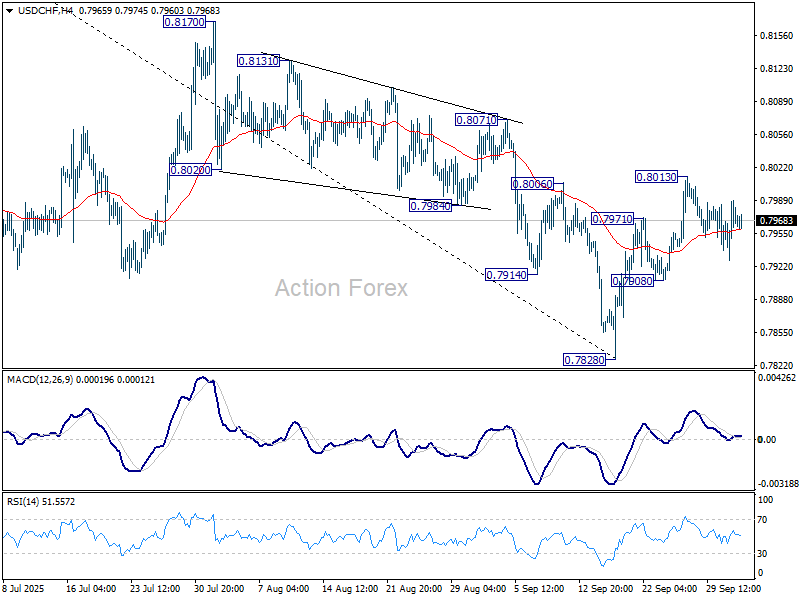
USD/CHF Mid-Day Outlook
Daily Pivots: (S1) 0.8105; (P) 0.8130; (R1) 0.8148; More….
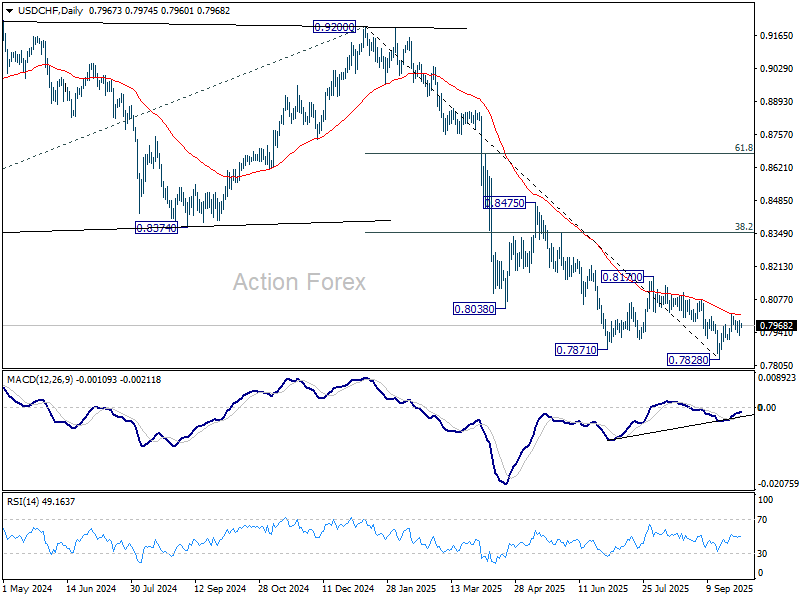
USD/CHF fell sharply after brief surge to 0.8170. Intraday bias is turned neutral first. On the downside, sustained break of 55 4H EMA (now at 0.8043) will argue that rebound from 0.7871 has completed as a three-wave correction. Deeper fall should then be seen back to 0.7871/7910 support zone. Nevertheless, break of 0.8170 will resume the rise to 38.2% retracement of 0.9200 to 0.7871 at 0.8379.
In the bigger picture, long term down trend from 1.0342 (2017 high) is still in progress. Next target is 100% projection of 1.0146 (2022 high) to 0.8332 from 0.9200 at 0.7382. In any case, outlook will stay bearish as long as 0.8475 resistance holds.
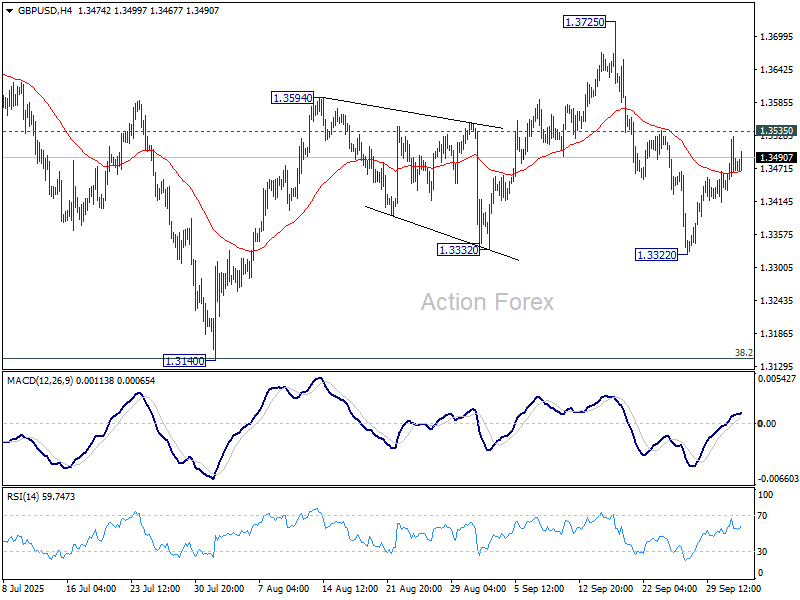
GBP/USD Mid-Day Outlook
Daily Pivots: (S1) 1.3167; (P) 1.3225; (R1) 1.3263; More...
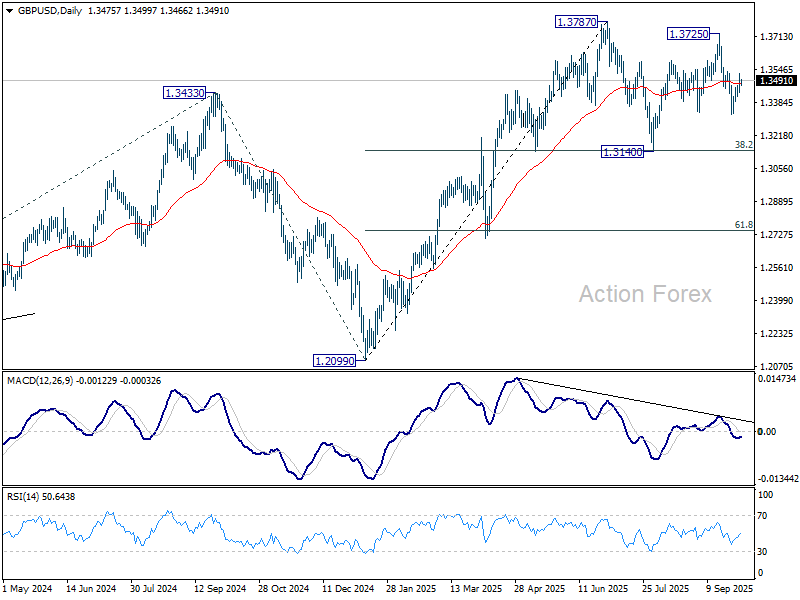
GBP/USD rebounded strongly after hitting 100% projection of 1.3787 to 1.3363 from 1.3587 at 1.3163. Intraday bias is turned neutral first. On the upside, sustained break of 1.3363 resistance turned support will argue that correction from 1.3787 has already completed with three waves down to 1.3140. Further rally should be seen to 1.3587 resistance next. On the downside, firm break of 1.3163 will target 161.8% projection 1.2901 next.
In the bigger picture, up trend from 1.3051 (2022 low) is in progress. Next medium term target is 61.8% projection of 1.0351 to 1.3433 from 1.2099 at 1.4004. Outlook will now stay bullish as long as 55 W EMA (now at 1.3045) holds, even in case of deep pullback.
EUR/USD Mid-Day Outlook
Daily Pivots: (S1) 1.1391; (P) 1.1426; (R1) 1.1449; More...
Intraday bias in EURUSD is turned neutral first with current strong rebound. Immediate focus is now on 1.1555 support turned resistance. Sustained break there will argue that near term corrective pattern from 1.1829 has already completed with three waves down to 1.1390. Further rise should then be seen to 1.1788/1829 resistance zone. On the downside, though, break of 1.1390 will extend the correction to 38.2% retracement of 1.0176 to 1.1829 at 1.1198.
In the bigger picture, rise from 0.9534 long term bottom could be correcting the multi-decade downtrend or the start of a long term up trend. In either case, further rise should be seen to 100% projection of 0.9534 to 1.1274 from 1.0176 at 1.1916. This will remain the favored case as long as 1.1604 support holds.
Dollar Tumbles on Jobs Miss, Fed Dissenters Add Fuel
Dollar fell sharply Friday after a dismal July jobs report cast doubt on the resilience of the labor market. While the headline job growth missed expectations, the bigger blow came from a stunning downward revision to June’s figure. The data raised alarm bells that the U.S. labor market may be losing momentum far quicker than previously thought.
Adding to the pressure was a coordinated release by Fed Governors Waller and Bowman, both of whom dissented at this week’s FOMC meeting in favor of a rate cut. Their remarks, published just before the payrolls release, emphasized the risks of delayed action in the face of labor market weakness. Waller argued for a proactive path, while Bowman called the July cut a necessary step toward neutralizing policy. While perhaps coincidental, the synchronized release raised eyebrows and intensified market concerns.
The combined impact of soft jobs data and dovish Fed messaging sent the Dollar lower across the board. Though the greenback still clings to the top spot among major currencies for the week, its lead is looking fragile. If selling persists into the weekend, Dollar could lose its weekly crown. Loonie holds second place, followed by Yen. On the other end, Euro remains the weakest, trailed by Kiwi and Swiss Franc. Sterling and Aussie are middle-of-the-pack. But with volatility likely to persist, rankings could shift before the week closes.
Meanwhile, equity markets in Europe and US are trading lower, showing a sharper reaction than Asia to US President Donald Trump’s newly announced tariff regime. The latest executive order establishes “reciprocal” duties ranging from 10% to 41%, with a 40% penalty on goods transshipped to dodge tariffs. All unlisted countries face a blanket 10% duty. The new rules will take effect August 7.
Canada is among the hardest hit with a 35% tariff, although items covered under the USMCA are exempt. Prime Minister Mark Carney expressed disappointment and rejected Trump’s justification that tariffs were linked to drug trafficking. Switzerland faces a steep 39% duty despite what its government called “constructive” talks with Washington. The Swiss federal council expressed “regret” and signaled it would evaluate its options while continuing diplomatic engagement.
By contrast, Australia escaped with just a 10% rate. Trade Minister Don Farrell called the outcome “a vindication” of Australia’s calm diplomatic strategy. New Zealand wasn’t as fortunate—its rate was raised to 15%, prompting Trade Minister Todd McClay to warn that exporters may begin to feel meaningful strain at that level.
In Europe, at the time of writing, FTSE is down -0.58%. DAX is down -1.88%. CAC is down -2.15%. UK 10-year yield is down -0.024 at 4.549. Germany 10-year yield is down -0.014 at 2.682. Earlier in Asia, Nikkei fell -0.66%. Hong Kong HSI fell -1.07%. China Shanghai SSE fell -0.37%. Singapore Strait Times fell -0.48%. Japan 10-year JGB yield fell -0.003 to 1.553.
US NFP misses with 73k growth and sharp downward revision
U.S. non-farm payrolls rose just 73k in July, well short of the expected 102k. Unusually large revisions made the picture worse—June’s job growth was slashed from 147k to a mere 14k. Unemployment rate edged up from 4.1% to 4.2% as expected, while average hourly earnings rose 0.3% month-over-month, keeping the annual pace at 3.9%.
While not a disaster, the report showed a clear loss of momentum in hiring, pushing a September rate cut by the Fed back into focus. The sharp downward revision to June data adds weight to concerns that labor market strength is fading more quickly than anticipated.
EUR/USD bounces notably after the release as Dollar is sold off broadly. Immediate focus is now on 1.1555 support turned resistance. Sustained break there will argue that corrective pattern from 1.1829 has completed with three waves down to 1.1390. Further rally would then be seen back to 1.1788/1829 resistance zone.
Fed's Waller and Bowman urge proactive rate cut amid labor market risks
Fed Governors Christopher Waller and Michelle Bowman issued rare public statements today defending their dissenting votes in favor of a rate cut at this week’s FOMC meeting. Both argued that a more proactive approach was needed to support the economy amid slowing growth and labor market softening.
Waller reiterated points he made in a July 17 speech, emphasizing that maintaining the current policy rate risks falling behind the curve. He argued that if tariffs don’t materially worsen inflation, rate reductions should continue at a moderate pace. In contrast, if inflation or employment picks up sharply, the Fed can always pause. “I see no reason we should hold and risk a sudden decline in the labor market,” he stated.
Bowman echoed similar concerns, saying the decision to begin gradually reducing rates was a hedge against further labor market weakness. She stressed that recent inflation increases tied to tariffs are likely transitory, and holding policy too tight could harm the Fed’s employment mandate. “A proactive approach... would avoid an unnecessary erosion in labor market conditions,” she said.
Eurozone CPI steady at 2% in July, reinforces case for ECB pause through rest of 2025
Eurozone inflation held firmer than expected in July, with headline CPI steady at 2.0% yoy, defying expectations for a slight dip to 1.9% yoy. Core CPI was unchanged at 2.3% yoy as forecast. Today’s inflation release reinforces the growing expectation that ECB already completed the easing cycle, as the bar for additional easing is increasingly high.
The underlying components show little sign of disinflation picking up momentum. Non-energy industrial goods inflation rose to 0.8% from 0.5%. While energy inflation remained deeply negative at -2.5%, that decline is slowing. Food inflation ticked up slightly from 3.1% to 3.3%. Services inflation eased only modestly from 3.3% to 3.1%.
Swaps now price in less than 50% chance of another rate cut this year. Comments from officials in recent weeks have leaned cautious, citing inflation stabilization at and waning downside risks tied to the global trade environment. The recent breakthrough in US-EU trade negotiations has also removed a key external headwind.
Besides, major banks are shifting their forecasts in line with this view. Deutsche Bank, Goldman Sachs, and BNP Paribas have all walked back expectations for more cuts in 2025.
European data wrap: PMI points to manufacturing recovery across Europe
China Caixin PMI manufacturing contracts again as export demand falters
China’s Caixin Manufacturing PMI dropped from 50.4 to 49.5 in July, signaling renewed contraction in factory activity and marking the second sub-50 reading in the past three months.
S&P Global’s Jingyi Pan noted that manufacturing production declined for only the second time since October 2023, as firms pulled back operations amid cautious demand outlook heading into H2 2025.
Weaker foreign demand was again a key drag, with export orders remaining sluggish amid global trade tensions. Domestic sales saw some resilience thanks to business development efforts, but overall growth was described as “only fractional.”
EUR/USD Mid-Day Outlook
Daily Pivots: (S1) 1.1391; (P) 1.1426; (R1) 1.1449; More...
Intraday bias in EURUSD is turned neutral first with current strong rebound. Immediate focus is now on 1.1555 support turned resistance. Sustained break there will argue that near term corrective pattern from 1.1829 has already completed with three waves down to 1.1390. Further rise should then be seen to 1.1788/1829 resistance zone. On the downside, though, break of 1.1390 will extend the correction to 38.2% retracement of 1.0176 to 1.1829 at 1.1198.
In the bigger picture, rise from 0.9534 long term bottom could be correcting the multi-decade downtrend or the start of a long term up trend. In either case, further rise should be seen to 100% projection of 0.9534 to 1.1274 from 1.0176 at 1.1916. This will remain the favored case as long as 1.1604 support holds.
Fed’s Waller and Bowman urge proactive rate cut amid labor market risks
Fed Governors Christopher Waller and Michelle Bowman issued rare public statements today defending their dissenting votes in favor of a rate cut at this week’s FOMC meeting. Both argued that a more proactive approach was needed to support the economy amid slowing growth and labor market softening.
Waller reiterated points he made in a July 17 speech, emphasizing that maintaining the current policy rate risks falling behind the curve. He argued that if tariffs don’t materially worsen inflation, rate reductions should continue at a moderate pace. In contrast, if inflation or employment picks up sharply, the Fed can always pause. “I see no reason we should hold and risk a sudden decline in the labor market,” he stated.
Bowman echoed similar concerns, saying the decision to begin gradually reducing rates was a hedge against further labor market weakness. She stressed that recent inflation increases tied to tariffs are likely transitory, and holding policy too tight could harm the Fed’s employment mandate. “A proactive approach... would avoid an unnecessary erosion in labor market conditions,” she said.