Sample Category Title
USD/CHF Mid-Day Outlook
Daily Pivots: (S1) 0.7953; (P) 0.7984; (R1) 0.8026; More…
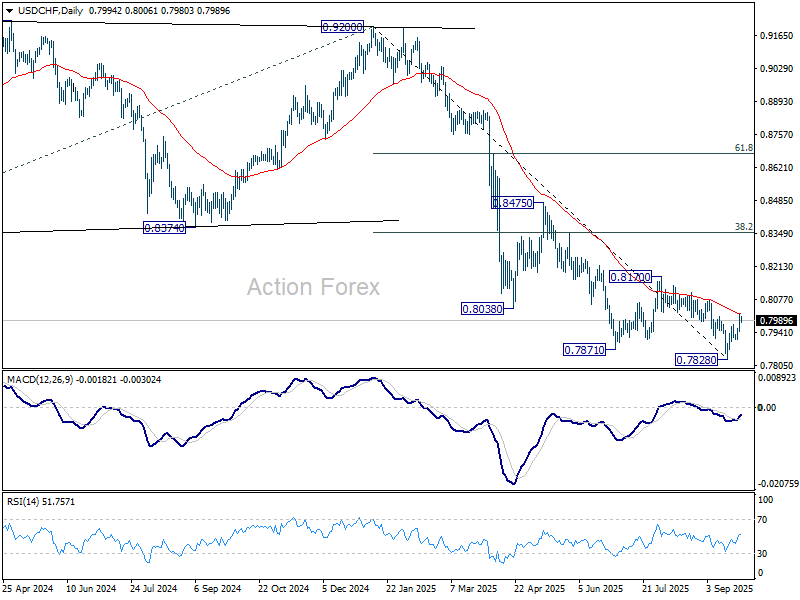
Intraday bias in USD/CHF remains on the upside at this point. Firm break of 0.8006 resistance argue that fall from 0.8170 has completed as a five-waver at 0.7828. USDCHF should then be in larger scale corrective bounce and should target 0.8170 resistance next. For now, risk will stay on the upside as long as 0.7908 support holds, in case of retreat.
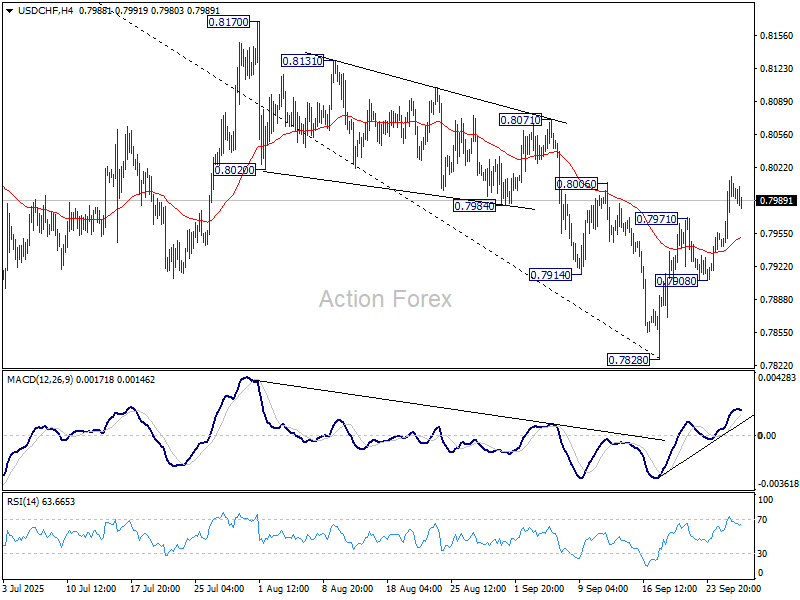
In the bigger picture, long term down trend from 1.0342 (2017 high) is still in progress. Next target is 100% projection of 1.0146 (2022 high) to 0.8332 from 0.9200 at 0.7382. In any case, outlook will stay bearish as long as 0.8332 support turned resistance holds (2023 low).
GBP/USD Mid-Day Outlook
Daily Pivots: (S1) 1.3290; (P) 1.3378; (R1) 1.3433; More...
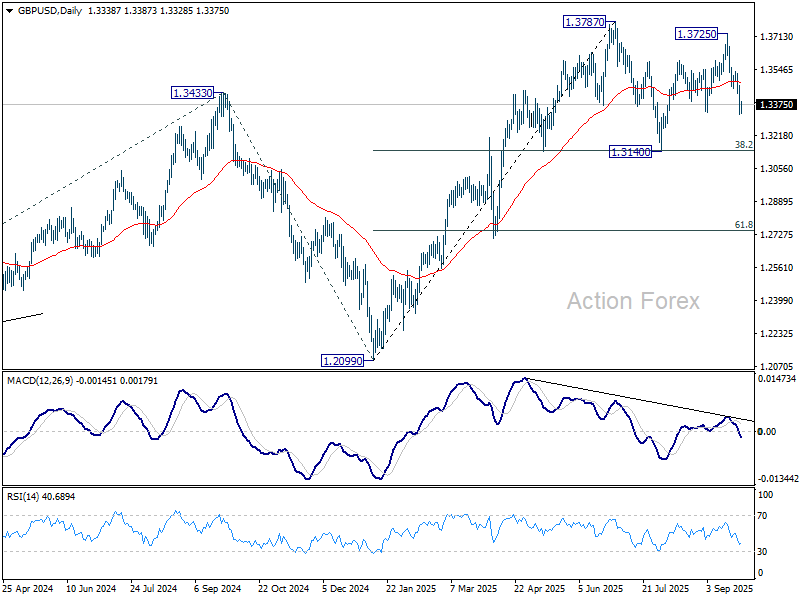
Intraday bias in GBP/USD remains on the downside for the moment. Fall from 1.3725, as the third leg of the corrective pattern from 1.3787, is in progress. Break of 1.3332 support will target 1.3140. On the upside, above 1.3524 support turned resistance will turn intraday bias neutral first. But risk will remain on the downside as long as 1.3535 resistance holds, in case of recovery.
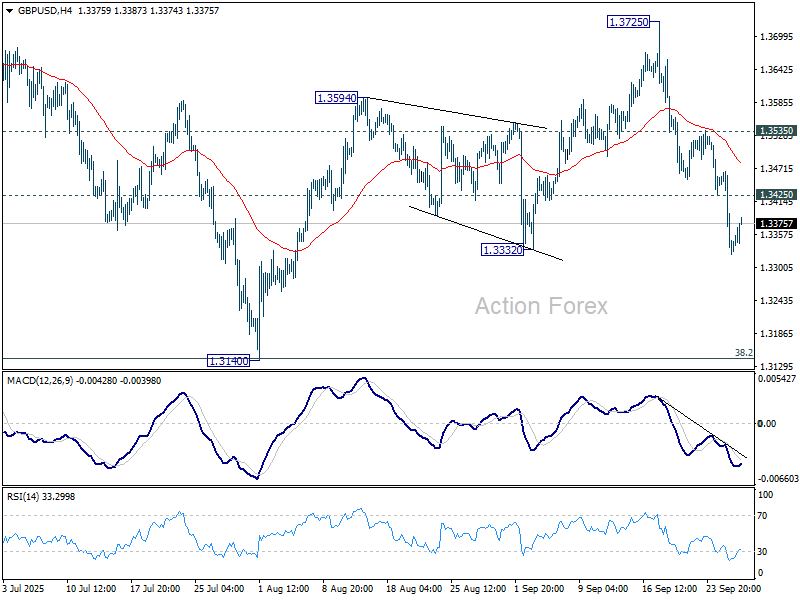
In the bigger picture, rise from 1.3051 (2022 low) is in progress, and would target 61.8% projection of 1.0351 to 1.3433 (2024 high) from 1.2099 (2025 low) at 1.4004. However, with 1.4248 resistance (2021 high) intact, this rally is more likely a corrective move. Sustained break of 55 W EMA (now at 1.3157) will argue that a medium term top has already formed and bring deeper fall back to 1.2099.
Canada’s Economy Rebounds in July
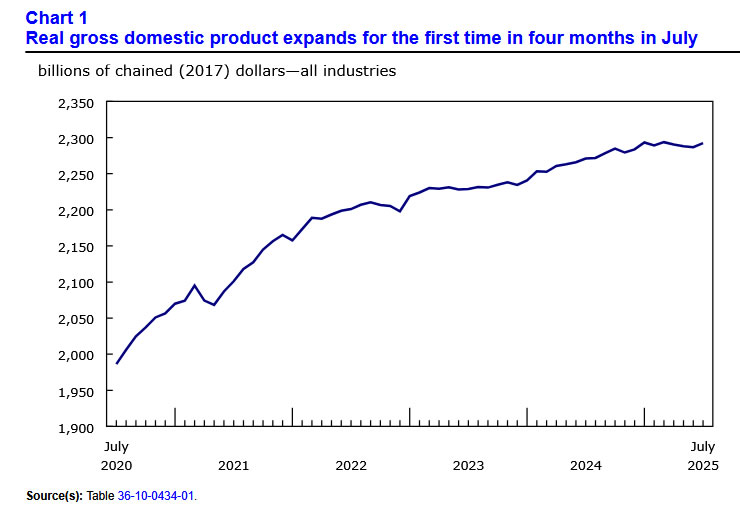
Canadian GDP rose by 0.2% m/m in July, partly reversing three consecutive monthly contractions. The print was a tick hotter than consensus expectations.
Compositionally, 11 of 20 industries registered an increase on the month. Goods industries rebounded by a hefty 0.6% m/m, while the services sector nudged higher by 0.1% m/m.
On the goods side, a 1.4% m/m gain in the mining, oil & gas sector made the biggest contribution to headline growth. A 0.7% m/m increase in the manufacturing sector also provided an assist after falling last month. Elsewhere, the agriculture and construction sectors were up by a softer 0.1% m/m.
On the services side, gains in wholesale trade (0.6% m/m), transportation and warehousing (0.6% m/m) and real estate (0.3% m/m) did most of the heavy lifting. A weaker month for retail trade (-1.0% m/m) and information and cultural services (-0.6% m/m) counterbalanced some of the services side gains.
The advanced guidance for flat growth in August GDP is the result of gains in wholesale and retail trade that are offset by a reversal in the oil & gas, manufacturing, and transportation sectors.
Key Implications
Growth in Canada's tariff-impacted industries contributed most to July's brighter-than expected print. Stabilization across these sectors underpins our view that GDP growth in the third quarter is set to recover modestly after last quarter's trade-driven contraction. Early-tracking suggests sub-1% annualized growth in Q3, which is in line with our expectations, and a touch below the Bank of Canada's (BoC) most recent projections.
The BoC will take this reading in stride, as they continue to weigh the risks around inflation and growth. Looking forward, we maintain our view that the BoC has room to cut rates again in the fourth quarter. The growth backdrop is expected to gradually recover over the next couple quarters, but economic slack will persist. What's more, the outlook continues to face considerable uncertainty, not least as Canada and the U.S. soon enter USMCA renegotiations.
EUR/USD Mid-Day Outlook
Daily Pivots: (S1) 1.1622; (P) 1.1688; (R1) 1.1732; More...
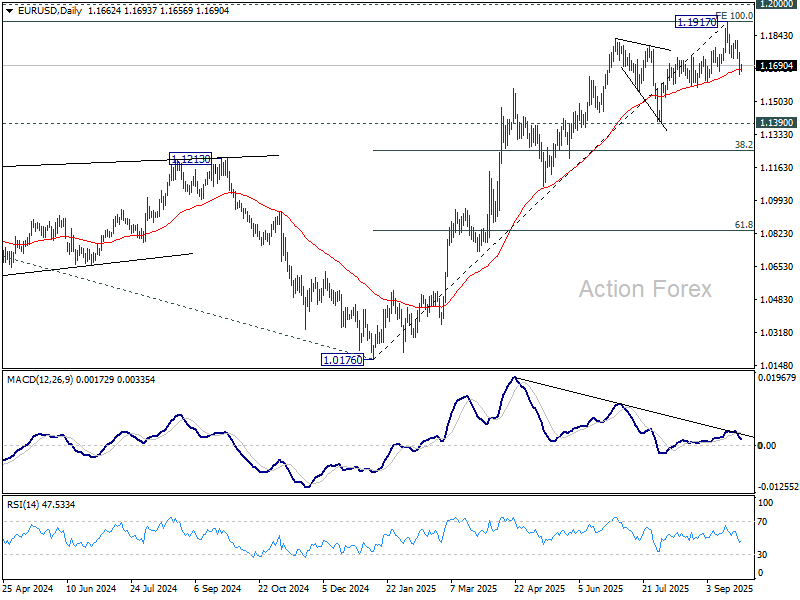
Intraday bias in EUR/USD stays mildly on the downside for the moment. Considering bearish divergence condition in D MACD, sustained break of 55 D EMA (1.1667) will argue that 1.1917 is already a medium term top. Deeper fall should then be seen to 1.1390 support next. On the upside, above 1.1734 support turned resistance will turn intraday bias neutral first. But risk will stay on the downside as long as 1.1819 resistance holds, in case of recovery.
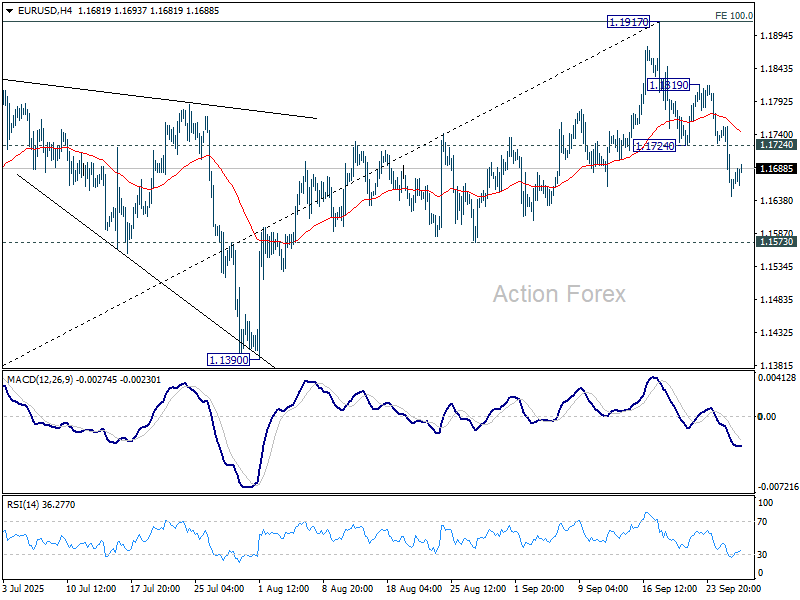
In the bigger picture, rise from 1.0176 (2025 low) is seen as the third leg of the pattern from 0.9534 (2022 low). 100% projection of 0.9534 to 1.1274 from 1.0176 at 1.1916 was already met. For now, further rally will remain in favor as long as 1.1390 support holds, and firm break of 1.2000 psychological level will carry larger bullish implications. However, firm break of 1.1390 will suggest that rise from 1.0176 has already completed and bring deeper fall to 55 W EMA (now at 1.1214).
Dollar Steady After PCE, Euro Finds Support on ECB Survey
The forex markets are relatively steady in early US trading, with most pairs consolidating after a week of sharp moves. The latest batch of US data offered few surprises, leaving traders reluctant to push directional bets ahead of next week’s pivotal employment report.
US PCE inflation for August came in broadly in line with expectations, confirming that disinflation has stalled for now. Meanwhile, spending remained resilient, highlighting the strength of US demand. The combination gives the Fed every reason to proceed cautiously.
That caution, however, does not rule out further easing. Officials have stressed the need to insure against risks to employment, and a weak non-farm payrolls report next week could quickly tilt the balance toward another cut.
For now, the Dollar looks set to digest some of this week’s gains into the weekly close. Positioning remains constructive after strong GDP, claims, and durable goods data earlier in the week, but the lack of fresh catalysts is tempering momentum.
Elsewhere, Euro is holding slightly firmer after the ECB’s consumer survey showed inflation expectations ticking higher. That supports the case for the ECB to remain on hold, barring a steep downturn in growth. Canadian Dollar, by contrast, showed little reaction to stronger-than-expected July GDP as advance data signaled stagnation in August, leaving recovery fragile.
Overall on the week, Dollar leads the performance board, followed by Swiss Franc and Euro. At the bottom, Kiwi lags behind, with Loonie and Yen also weak. Sterling and the Aussie sit mid-pack.
In Europe, at the time of writing, FTSE is up 0.61%. DAX is up 0.77%. CAC is up 0.86%. UK 10-year yield fell -0.022 to 4.737. Germany 10-year yield fell -0.027 to 2.748. Earlier in Asia, Nikkei fell -0.87%. Hong Kong HSI fell -1.35%. China Shanghai SSE fell -0.65%. Singapore Strait Times fell -0.18%. Japan 10-year JGB yield rose 0.01 to 1.659.
US PCE inflation matches forecasts, income and spending beat
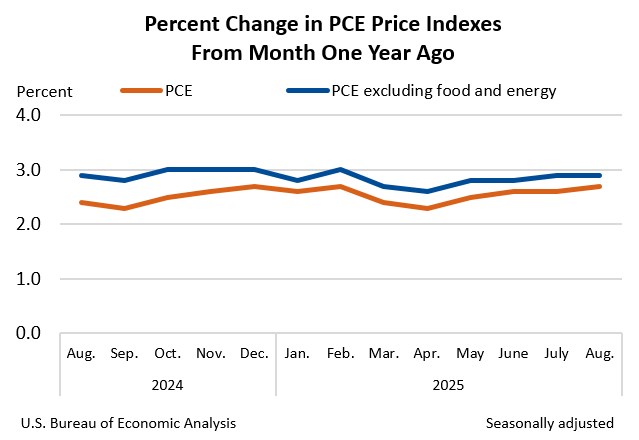
US inflation data for August came in largely as expected. Headline PCE rose 2.7% yoy, slightly up from July’s 2.6%. Core PCE held steady at 2.9% yoy. On the month, headline and core rose 0.3% mom and 0.2% mom, respectively, both in line with consensus.
Beyond inflation, the demand side showed more momentum. Personal income climbed 0.4% mom, above the 0.3% forecast. Personal spending gained 0.6% mom, also beating estimates of 0.5%.
For the Fed, the data reinforces the case for continued but measured easing. Inflation progress remains gradual, while firmer demand signals that the economy is not yet at risk of stalling.
Canada GDP rebounds 0.2% mom in July, first gain in four months
Canada’s GDP expanded 0.2% mom in July, beating expectations of 0.1% and marking the first increase in four months. The rebound was driven primarily by goods-producing industries, which rose 0.6% mom after three straight months of contraction, with every sector in the grouping recording gains.
Services output was more subdued, rising just 0.1% mom as wholesale trade and real estate contributed modestly while retail trade slipped. In total, only 11 of 20 industrial sectors posted growth.
Looking ahead, advance estimates suggest GDP was flat in August, with gains in wholesale and retail offset by declines in resource extraction, manufacturing, and transport.
ECB consumer survey: Inflation expectations edge higher, growth outlook weak
Eurozone households lifted their inflation expectations in August, according to the ECB’s latest survey. Median expectations for the next 12 months rose to 2.8% from 2.6% in July, while five-year expectations climbed from 2.1% to 2.2%, the highest since August 2022. Three-year expectations were steady at 2.5%.
At the same time, the growth outlook remained grim, with respondents predicting output to shrink by -1.2% over the next 12 months. Job worries also inched higher, with unemployment expectations up to 10.7% from 10.6%.
The survey highlights a lingering inflation mindset among households, even as economic prospects stay fragile. For the ECB, the persistence of medium-term price expectations near or above target may limit the scope for further easing if growth continues to stagnate.
Tokyo CPI core stays at 2.5% in September, core-core slows
Tokyo inflation came in softer than expected in September, with core CPI (ex-fresh food) unchanged at 2.5% yoy versus forecasts of 2.8% yoy. The moderation was largely attributed to measures by the metropolitan government, including cuts to childcare fees and water charges, easing some of the burden from rising living costs.
Core-core inflation, stripping out fresh food and energy, slowed sharply from 3.0% yoy to 2.5% yoy, while headline CPI was also steady at 2.5% yoy. Food inflation excluding fresh items cooled to 6.9% yoy from 7.4% yoy, highlighting a broadening slowdown in price pressures.
The weaker data may give the BoJ some breathing room, though markets still price another 25bps hike in the months ahead. Opinion remains divided on whether policymakers act as soon as October or hold off until January.
EUR/USD Mid-Day Outlook
Daily Pivots: (S1) 1.1622; (P) 1.1688; (R1) 1.1732; More...
Intraday bias in EUR/USD stays mildly on the downside for the moment. Considering bearish divergence condition in D MACD, sustained break of 55 D EMA (1.1667) will argue that 1.1917 is already a medium term top. Deeper fall should then be seen to 1.1390 support next. On the upside, above 1.1734 support turned resistance will turn intraday bias neutral first. But risk will stay on the downside as long as 1.1819 resistance holds, in case of recovery.
In the bigger picture, rise from 1.0176 (2025 low) is seen as the third leg of the pattern from 0.9534 (2022 low). 100% projection of 0.9534 to 1.1274 from 1.0176 at 1.1916 was already met. For now, further rally will remain in favor as long as 1.1390 support holds, and firm break of 1.2000 psychological level will carry larger bullish implications. However, firm break of 1.1390 will suggest that rise from 1.0176 has already completed and bring deeper fall to 55 W EMA (now at 1.1214).
Canada GDP rebounds 0.2% mom in July, first gain in four months
Canada’s GDP expanded 0.2% mom in July, beating expectations of 0.1% and marking the first increase in four months. The rebound was driven primarily by goods-producing industries, which rose 0.6% mom after three straight months of contraction, with every sector in the grouping recording gains.
Services output was more subdued, rising just 0.1% mom as wholesale trade and real estate contributed modestly while retail trade slipped. In total, only 11 of 20 industrial sectors posted growth.
Looking ahead, advance estimates suggest GDP was flat in August, with gains in wholesale and retail offset by declines in resource extraction, manufacturing, and transport.
US PCE inflation matches forecasts, income and spending beat
US inflation data for August came in largely as expected. Headline PCE rose 2.7% yoy, slightly up from July’s 2.6%. Core PCE held steady at 2.9% yoy. On the month, headline and core rose 0.3% mom and 0.2% mom, respectively, both in line with consensus.
Beyond inflation, the demand side showed more momentum. Personal income climbed 0.4% mom, above the 0.3% forecast. Personal spending gained 0.6% mom, also beating estimates of 0.5%.
For the Fed, the data reinforces the case for continued but measured easing. Inflation progress remains gradual, while firmer demand signals that the economy is not yet at risk of stalling.
SPX 500: Three-Day Sell-Off Reached 20-Day Moving Average, Tipping Point for Bullish Reversal
Key takeaways
- SPX 500 pullback: Index fell -1.9% over three sessions from its all-time high, testing key support at 6,580/6,560 near its 20-day moving average.
- Bullish setup intact: price remains within its short- and medium-term uptrend, with momentum indicators pointing to easing bearish pressure.
- Sector rotation support: Consumer Discretionary’s outperformance over Consumer Staples signals potential for a bullish reversal in SPX 500.
- Key levels to watch: a rebound above 6,635 could extend gains to 6,670/6,680 and 6,730/6,745; failure below 6,560 risks a deeper slide to 6,530/6,460.
Since hitting the latest fresh all-time high of 6,710 on Monday, 22 September 2025, the US SPX 500 CFD Index (a proxy of the S&P 500 E-mini futures) has dropped for three consecutive sessions and shed -1.9% (high to low) to print an intraday low of 6,580 on Thursday, 25 September 2025.
The recent corrective pullback in the US SPX 500 CFD Index has been attributed to overvaluation concerns in mega-cap technology stocks and a potentially less dovish Fed, where a stronger US Q2 GDP growth reduced the odds of a December Fed rate cut to 58% from 79% a week ago.
Let’s now focus on the latest short-term trajectory (1 to 3 days), relevant key elements, and key levels to watch for the US SPX 500 CFD Index from a technical analysis perspective ahead of today’s key US PCE data (inflation, personal income, and spending) releases.
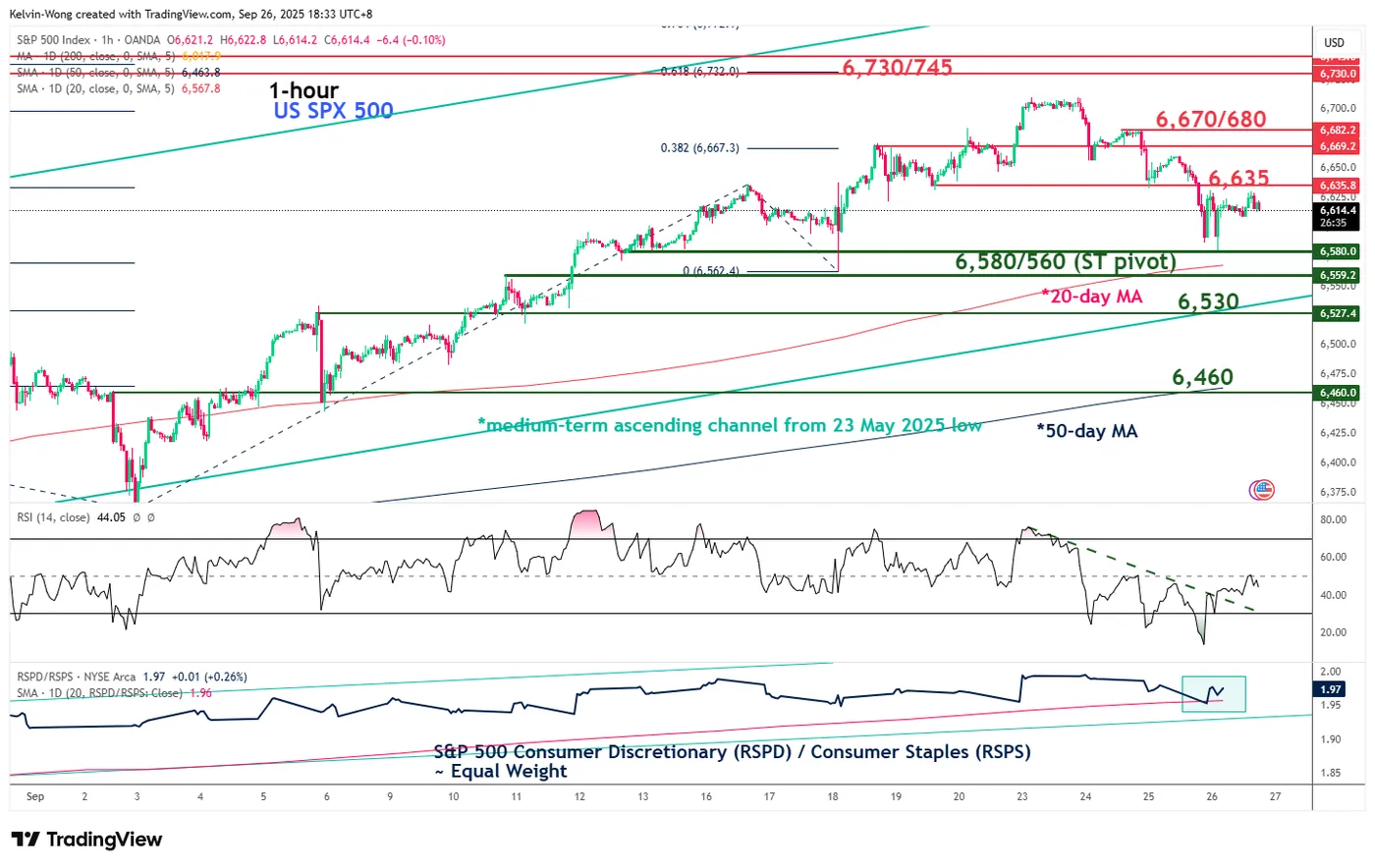
Fig. 1: US SPX 500 CFD Index minor trend as of 26 Sep 2025 (Source: TradingView)
Preferred trend bias (1-3 days)
The three-day sell-off of 1.9% seen in the US SPX 500 Index has not damaged its short-term (minor) and medium-term uptrend phases.
Maintain a bullish bias for a potential near-term recovery above 6,580/6,560 key short-term pivotal support. A clearance above 6,635 is likely to increase the odds of a bullish reversal towards the next intermediate resistances at 6,670/6,680 before the next resistance at 6,730/6,745 (Fibonacci extension cluster).
Key elements
- The current price actions of the US SPX 500 CFD Index are still oscillating above its 20-day, 50-day moving averages and within a medium-term ascending channel in place since 22 May 2025 low.
- The 6,580/6,560 key short-term pivotal support of the US SPX 500 CFD Index confluences closely with the rising 20-day moving average.
- The hourly RSI momentum indicator of the US SPX 500 CFD Index has shaped a bullish breakout above its former descending trendline resistance, which suggests that the recent bearish momentum has eased.
- The relative chart of the cyclical-oriented equal-weighted S&P 500 Consumer Discretionary sector ETF versus the defensive-oriented equal-weighted S&P 500 Consumer Staples sector ETF has rebounded after retesting its 20-day moving average. This development signals continued outperformance in Consumer Discretionary over Consumer Staples, reinforcing the case for a potential bullish reversal in the US SPX 500 CFD Index.
Alternative trend bias (1 to 3 days)
Failure to hold at the 6,580/6,560 key short-term support on the US SPX 500 CFD Index invalidates the bullish reversal scenario for a deeper minor corrective decline sequence to expose the next support at 6,530 (also the lower boundary of the medium-term ascending channel).
A break below 6,530 may trigger a deeper slide towards 6,460 (also the rising 50-day moving average) next.
Canadian Dollar Eyes Canada’s GDP, US PCE Price Index Next
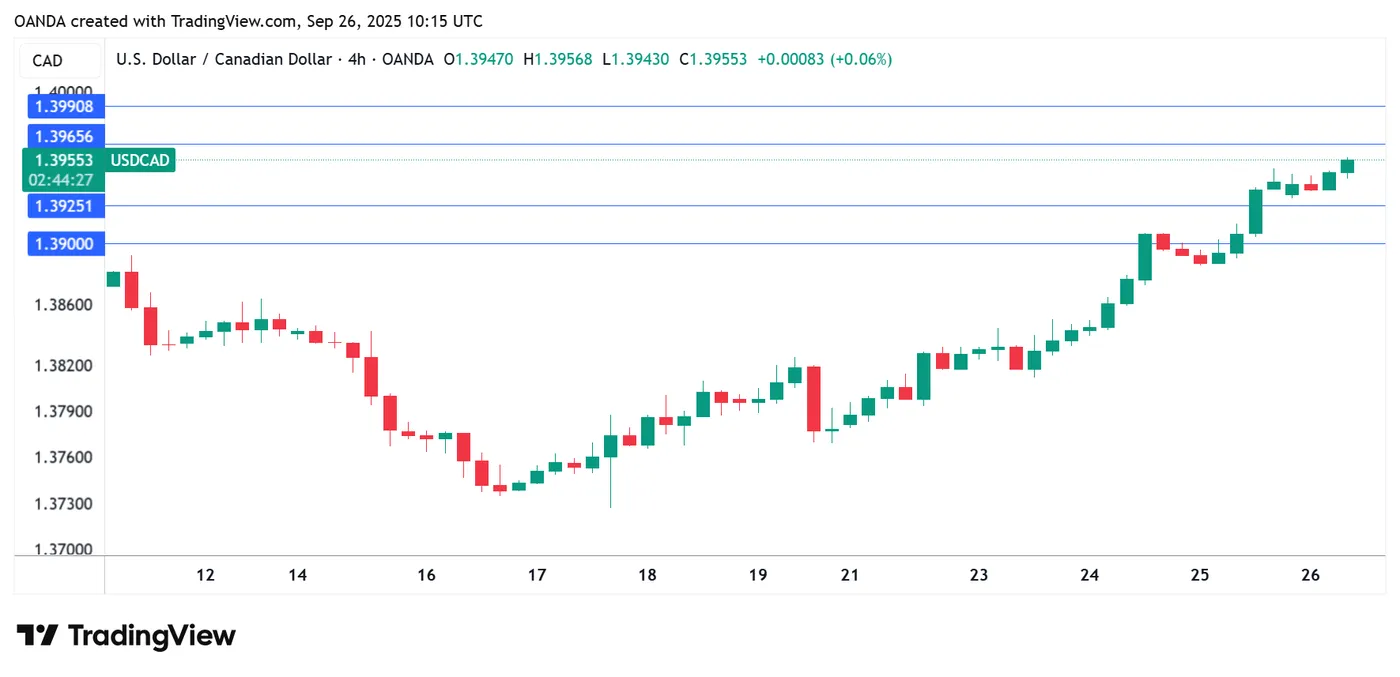
The Canadian dollar is calm on Friday. In the European session, USD/CAD is trading at 1.3947, up 0.05% on the day.
Canada's GDP expected to post 0.1% gain
Canada's economy hasn't looked all that sharp, with three straight monthly declines in GDP. The markets are expecting a slight improvement in July, with a consensus of 0.1% y/y.
The economy has been hurt by the trade war with the United States, with trade talks ongoing but no breaktrhough in sight. US tariffs have been particularly detrimental to the manufacturing sector, which slipped 1.5% y/y in June.
The Bank of Canada lowered rates by a quarter-point earlier this month, bringing the benchmark rate to 2.5%, its lowest level since July 2022. The BoC didn't reveal much in terms of forward guidance at the meeting, as policymakers keep their options open.
Weak economic growth and a slowdown in the labor market support further rate cuts, but sticky inflation is a reason for the BOC to stay on the sidelines. There is a strong likelihood of a December rate cut, although October is also a possibility, especially if inflation moves lower.
The US releases the PCE Price Index, which is the Federal Reserve's preferred inflation indicator. The markets are expecting a small increase in inflation in August, to 2.7% y/y from 2.6% y/y in July and 0.3% from 02%.
With inflation largely under control, the Federal Reserve's priority has shifted to the US labor market. The last two nonfarm payrolls reports showed marginal job growth and missed expectations, raising concerns that the labor market is quickly losing steam. If next week's nonfarm payroll report is soft, it could cement an October rate cut.
USDCAD Technical
- 1.3965 is under pressure in resistance. Above, there is resistance at 1.3990.
- 1.3925 and 1.3900 are providing support
USDCAD 1-Day Chart, September 26, 2025
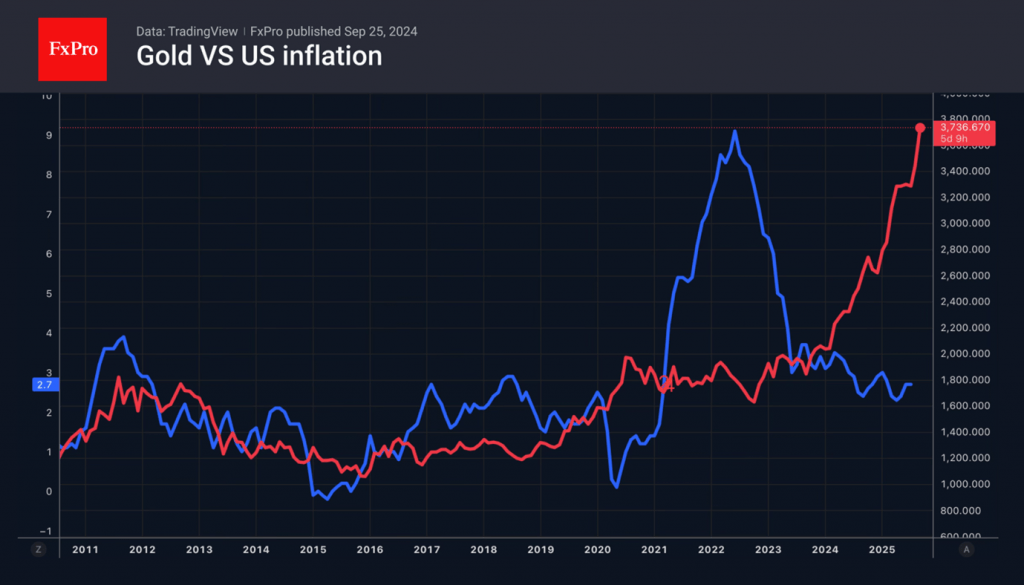
Fed’s Easing Gives Gold a Chance to Repeat Its Best Growth
Gold is trading near record highs, while price pullbacks are attracting new buyers. Two key drivers behind the gold rally are a change in the Fed’s outlook and geopolitics. Jerome Powell emphasises that, given the bilateral risks, the central bank cannot take a risk-free path. Choosing between supporting full employment and inflation control, the Fed now turns its attention to the former.
Gold is considered a hedge against inflation. However, the Fed is the main defender against price acceleration and rising rates. In such conditions, gold often falls. However, when the central bank washes its hands of the matter, gold spreads its wings. This was the case in 1979, when it jumped 140% due to lower rates against a background of high inflation. About the same thing is happening now.
Donald Trump has abandoned the idea of quickly ending the armed conflict in Ukraine. This is leading to a bipolar world, intensifying the processes of de-dollarisation and diversification of gold and foreign exchange reserves, which is adding fuel to the fire of the gold rally.