

Sample Category Title
GBP/JPY Daily Outlook
Daily Pivots: (S1) 198.80; (P) 199.72; (R1) 200.24; More...
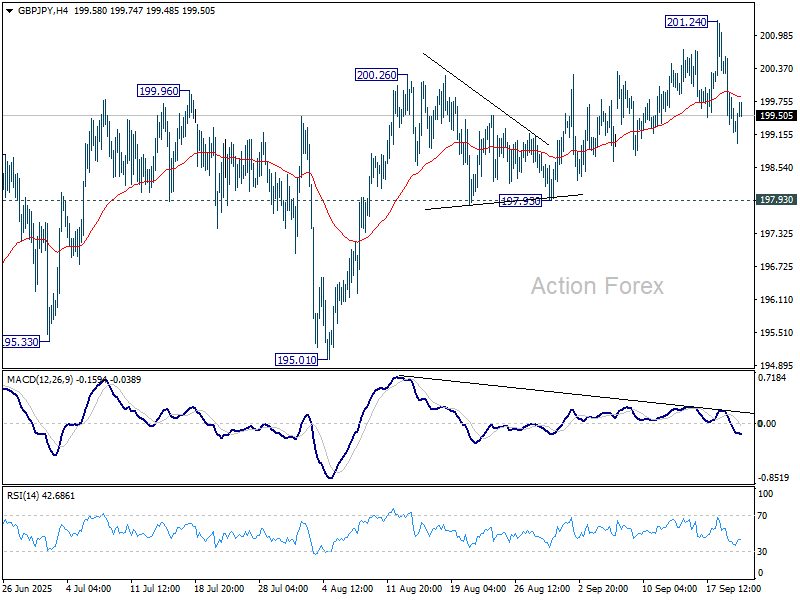
Intraday bias in GBP/JPY remains neutral and more consolidations could be seen first. Further rise is expected as long as 197.93 support holds. Firm break of 201.24 will target 100% projection of 180.00 to 199.79 from 184.35 at 204.14. However, considering bearish divergence condition in both D and 4H MACD, firm break of 197.93 will indicate bearish reversal and bring deeper fall back to 195.01 support first.
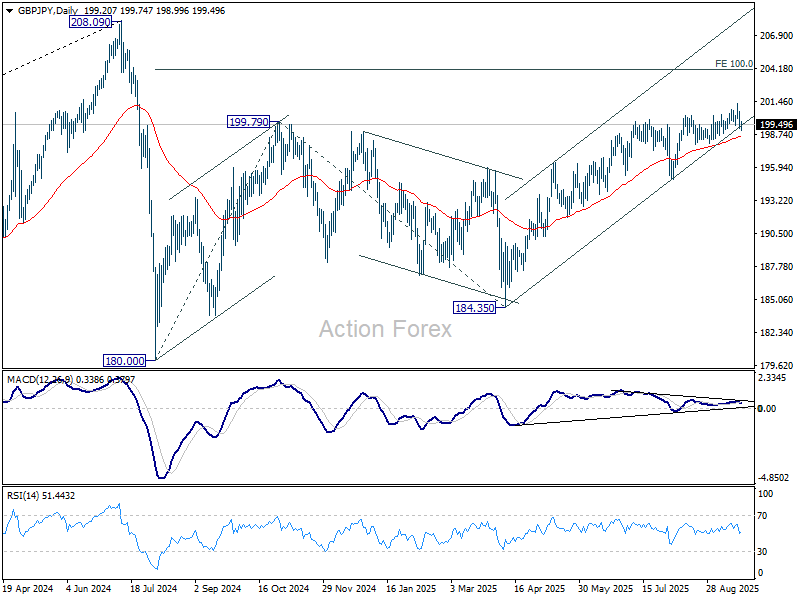
In the bigger picture, price actions from 208.09 (2024 high) are seen as a correction to rally from 123.94 (2020 low). The pattern might still extend with another falling leg. But in that case, strong support should be seen from 38.2% retracement of 123.94 to 208.09 at 175.94 to contain downside. Meanwhile, decisive break of 208.09 will confirm long term up trend resumption.
EUR/JPY Daily Outlook
Daily Pivots: (S1) 173.33; (P) 173.92; (R1) 174.36; More...
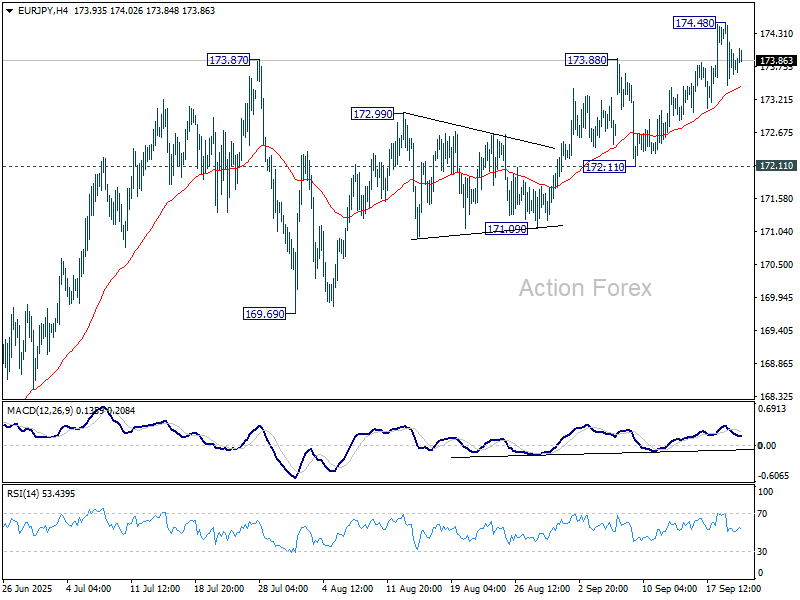
Intraday bias in EUR/JPY remains neutral and more consolidations could be seen below 174.48. But outlook will stay bullish as long as 172.11 support holds. Above 174.48 will target a retest on 175.41 high. However, firm break of 172.11 support will confirm short term topping, and turn bias back to the downside for deeper pullback.
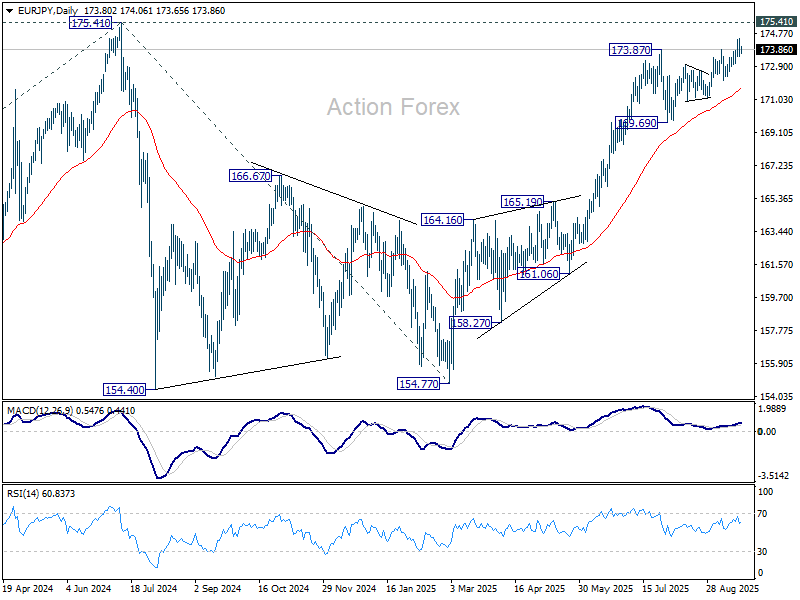
In the bigger picture, current rally from 154.77 is still tentatively seen as resuming the larger up trend. Firm break of 175.41 (2024 high) will confirm and target 61.8% projection of 124.37 (2022 low) to 175.41 from 154.77 (2025 low) at 186.31. However, sustained break of 169.69 support will delay this bullish case, and probably extend the correction from 175.41 with another fall.
EUR/AUD Daily Outlook
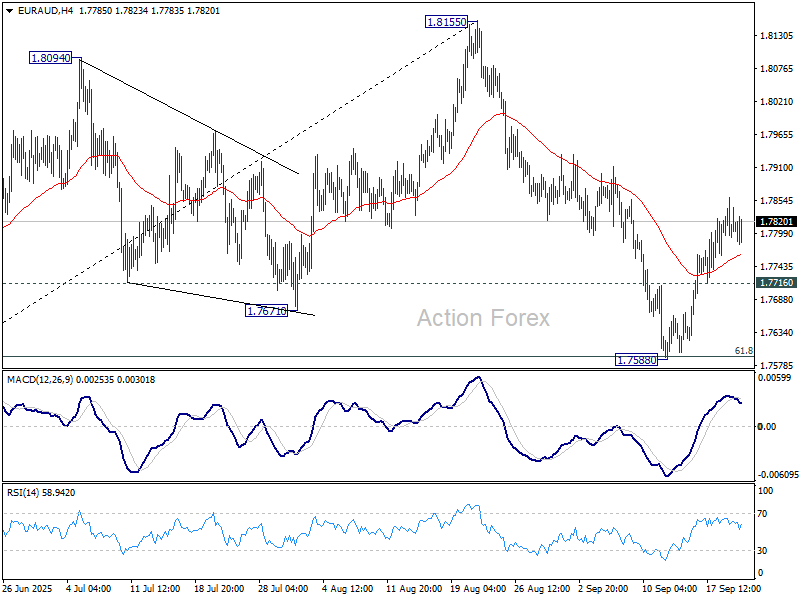
Daily Pivots: (S1) 1.7787; (P) 1.7824; (R1) 1.7853; More...
Intraday bias in EUR/AUD stays mildly on the upside at this point. Pullback from 1.8155 could have completed at 1.7588, after defending 61.8% retracement of 1.7245 to 1.8155 at 1.7593. Further rise would be seen to retest 1.8155. On the downside, however, break of 1.7716 will bring deeper fall to retest 1.7588 instead.
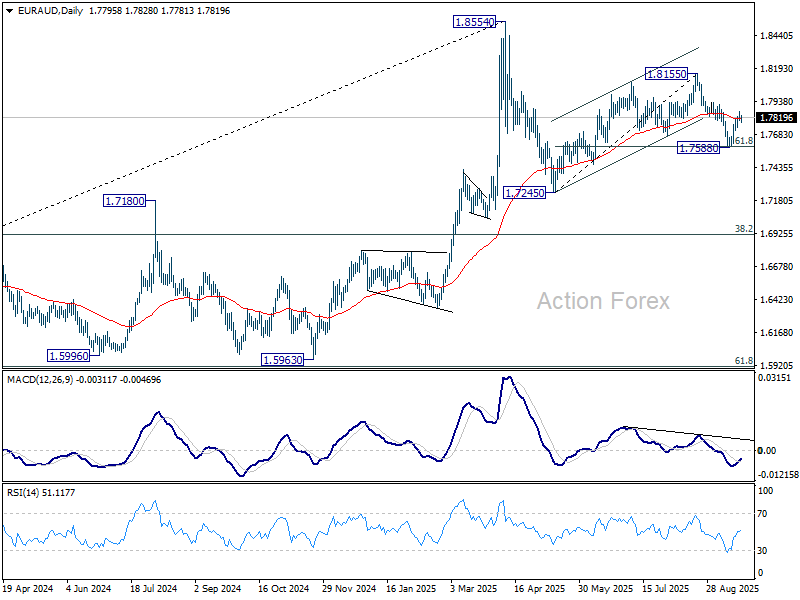
In the bigger picture, price actions from 1.8554 medium term top are seen as a corrective pattern. Deeper fall could be seen as the pattern extends, but downside should be contained by 38.2% retracement of 1.4281 (2022 low) to 1.8554 at 1.6922 to bring rebound. Uptrend from 1.4281 is expected to resume at a later stage.
New Trading Weeks Kicks Off Today With a Series of Central Bank Speeches
Markets
A phone call between US president Trump and his Chinese counterpart Xi Jinping supported the bulls on Friday. The sale of TikTok’s US operations to an American company was the main point but Trump said both made progress on a variety of issues including “Trade, Fentanyl, the need to bring the War between Russia and Ukraine to an end”. The US president added that he would meet Xi in person on the sidelines of the upcoming Asia-Pacific Economic Cooperation summit. The main indices on Wall Street all hit new records. The US dollar extended its post-Fed rebound into a third day. DXY rose to 97.64, EUR/USD drifted gradually but steadily towards the mid 1.17-1.18 area. The dollar’s (for now still) minor comeback comes along with some short-term bottoming out of the 2-year yield. Net daily changes in US rates on Friday varied between 0.8-2.2 bps. German bonds slightly underperformed. Intra-EMU spreads narrowed. France’s 10-yr yield (and therefore spread as well) finished the week the way it started: slightly higher than Italy. The remarkable swap has been years in the making. Italy’s rating upgrade (see below), along with southern peers including Portugal and Spain, are testament to the changing fiscal pecking order. Gilts were the laggards. The long end of the UK curve was particularly vulnerable (30-yr +5.2 bps). August budget deficit figures came in much higher than the Office of Budget Responsibility expected. This independent budget watchdog assesses the government performance against its self-imposed fiscal rules so Friday’s numbers are yet another blow for UK finance minister Reeves going into November’s Autumn Budget. Sterling was among the weaker performers with EUR/GBP closing north of 0.87 for the first time since early August. Cable (GBP/USD) forfeited the 1.35 handle.
The new trading weeks kicks off today with a series of central bank speeches, ranging from Bailey and chief economist Pill in the UK over ECB’s Lane and Nagel in the euro area to several Fed members (NY’s Williams, board member Miran) that are to address the economy and monetary policy. PMI’s are scheduled for release tomorrow along with Fed’s Powell offering his view on the economic outlook. PCE deflators, the Fed’s preferred inflation gauge, are printed on Friday. A slew of central bank meetings are scattered across the week with Hungary and Sweden on tap Tuesday, the Czech Republic Wednesday and Switzerland the day after.
News & Views
Rating agency Fitch raised Italy’s credit rating from BBB to BBB+ with a stable outlook. The upgrade reflects increased confidence in Italy’s fiscal trajectory, a stable political environment, ongoing reform momentum and reduced external imbalances. Fitch expects a continued gradual deficit reduction in 2025-2027, supported by structural improvements on the revenue side and strict expenditure control. They expect a deficit ratio of 3.1% of GDP, below the official 3.3% target. The government’s aim is bring it down to 2.6% in 2027 and under 2% by 2029. The primary surplus is expected to rise from 0.7% of GDP this year to 2.4% in 2029, supported by reform implementation. Fitch forecasts the debt ratio to increase modestly from 135.3% of GDP to 137.5% in 2026, before falling back towards 134% by 2030. One of Italy’s weaker points remains its low growth potential. The rating agency estimates growth of 0.6% this year and an average of 0.8% in 2026-2027. Domestic demand, particularly investment, will be a key driver of short-term growth, offsetting weakness in the external sector. Italian BTP’s have been performing strongly this year with the 10y swapspread narrowing from a YtD top at 130 bps to 83 bps currently and trading more and more in line with semi-core peers.
RBA governor Bullock sounded slightly more hawkish this morning in a testimony to the House of Representatives Standing Committee on Economics. Inflation has fallen substantially since the peak of 7.8% in 2022 and is now within the 2-3% target range. Labour market conditions are close to full employment. Since the August meeting, domestic data have been broadly in line with the Australian central bank’s expectations or if anything slightly stronger. The Board will discuss this and other developments at their meeting next week. Markets expect a stable policy rate (3.6%), but slightly reduced bets on a final rate cut at the November meeting (75% from 95%). Australian bond yields add 3-4 bps across the curve this morning while AUD/USD treads water.
Mixed Sentiment
The week kicks off on a mixed note. Last week’s Federal Reserve (Fed) rate cut gave markets a boost, but news that the Bank of Japan (BoJ) will begin reducing its ETF holdings unsettled global risk sentiment on Friday. The Nikkei came under notable selling pressure, the Stoxx 600 and FTSE 100 traded slightly bearish, but Wall Street shrugged it off: the S&P 500 and Nasdaq both advanced to fresh record highs as the US 2-year yield consolidated just below 3.60% and the 10-year rose to 4.41%.
On the geopolitical front, Trump and Xi reportedly held a constructive call. Details remain scarce, but progress was reported on TikTok, and the two leaders will revisit trade and tariffs in the coming weeks. Meanwhile, Australia, Canada and UK recognized the state of Palestine that could revive geopolitical tensions as the move didn’t please Israel and the US...
On the monetary policy front, the People’s Bank of China (PBoC) left its key rate unchanged at record lows for the fourth consecutive month, aiming to cushion the impact of US tariffs. But Chinese equities opened the week on a muted note, as investors were left wanting more clarity on trade from the Xi-Trump dialogue. By contrast, the Nikkei is better bid thanks to a softer yen, Asian gauges are broadly firmer, while Indian tech stocks face pressure after Trump proposed raising H-1B visa fees to $100,000 up from a few thousand dollars. The steep increase would make hiring foreign talent far more expensive; an analyst at Jefferies estimates this could raise corporate costs by 4–13%, weighing on jobs and growth in the near term, while potentially accelerating AI adoption longer term.
On the goods side, a North American freight index shows shipments have steadily declined this year, falling to their lowest levels since the pandemic. Yet weaker imports haven’t yet fueled consumer price pressures, and US growth likely improved last quarter after a sharp hit in Q1. This Thursday’s US Q2 GDP update is expected to show 3.3% growth with inflation near 2%, while Friday’s core PCE print is also unlikely to suggest building pressures.
Several Fed officials are scheduled to speak this week following last week’s decision to cut rates. They are expected to stress the need to support a weakening labour market as long as inflation remains under control. For now, equity bulls see little to fear: lower rates, an improving earnings outlook, dollar softness boosting overseas revenues and the AI theme remain supportive. Oracle jumped 4% Friday on reports it is in talks with Meta on a ~$20bn cloud deal, while Samsung rose 4% in Korea after winning Nvidia approval to supply high-bandwidth memory chips.
In FX, the dollar is broadly firmer since the FOMC, which proved less dovish than markets hoped. The EURUSD looks toppish, with scope for a retreat toward the 50- and 100-DMA levels. Cable has already slipped below its 100-DMA and is testing 50-DMA support. Dollar strength looks set to keep both pairs under pressure in the near term.
In commodities, gold opened the week higher on renewed Middle East tensions, while silver hit its highest level since 2011. Oil gained as Europe considers tightening sanctions against Russia after fresh airspace violations over NATO countries. European defense and aerospace names remain well bid.
But the standout move was in uranium: the Global X Uranium ETF surged 8% Friday to its highest since 2011 after Trump signed executive orders to quadruple U.S. nuclear power capacity by 2050 and unveiled a cross-Atlantic Technology Prosperity Deal with the UK. The news underscores nuclear’s growing role alongside clean energy, as data-center demand from AI surges. While clean energy ETFs lagged Friday, nuclear’s revival doesn’t necessarily derail the broader green transition — both sources are needed to meet intensifying power needs.
Week ahead: This week brings flash PMIs for a global read on activity, US growth and inflation data, and the Swiss National Bank’s (SNB) policy meeting on Thursday, where rates are expected to remain unchanged.
TikTok Deal Edges Forward With Planned US-China Meeting
In focus today
In the euro area, focus turns to the consumer confidence indicator for September. Confidence has been stuck at a low level for the last four months, which limits growth in private consumption. As the tariff uncertainty has been reduced and inflation returned to the 2% target, we expect gradual improvements in confidence.
Economic and market news
What happened over the weekend
In tech and tariffs, discussions between the US and China on TikTok's US operations appear to have advanced, with White House officials saying China's ByteDance would retain one board seat while Americans hold six. The White House also claims that a deal "signed in the coming days" will put the algorithm in US hands, clashing with Beijing's recent claims that the algorithm will remain in Chinese hands.
Donald Trump and Xi Jinping spoke over the phone on Friday, agreeing to meet in person at the Asia-Pacific Economic Cooperation (APEC) forum starting 31 October in South Korea. While the tone of the call was reportedly positive, and Trump said they had made progress in advancing the TikTok deal, the call yielded little concrete news on the state of tariff discussions. Trump also said he would visit China in early 2026, which could suggest that the trade negotiations will be extended even further beyond the current 10 November deadline. We will discuss the outlook for the trade war, how it is impacting US and Chinese economies and its implications for CNY and USD in a webinar this Thursday.
In the US, President Trump hailed Charlie Kirk as a "martyr for American freedom" at his memorial service on Sunday, using the platform to blame the "radical left" for his murder while vowing to carry on Kirk's conservative legacy. Critics warn Trump's rhetoric risks deepening partisan divides and escalating political tensions.
Furthermore, Trump appointed his former attorney Lindsey Halligan as US Attorney for the Eastern District of Virginia, replacing Erik Siebert. The appointment comes amid Trump's criticism of Attorney General Pam Bondi and calls for more aggressive investigations into political rivals, including James Comey and Letitia James.
In geopolitics, Britain, Canada, Australia, and Portugal formally recognised the State of Palestine on Sunday, in a move intended to promote a two-state solution amidst the ongoing Gaza war. While Palestinian leaders welcomed the decision as a step towards independence, the Israeli PM Netanyahu condemned the move. The recognition is expected to heighten tensions with Israel and its ally, the US, as similar announcements are anticipated during the UN General Assembly this week.
Recent Russian airspace violations in Estonia, Poland, and most recently the Baltic Sea, drew a muted US response. This comes after Pentagon officials in August said that under Trump, the US military would be shifting its attention to other priorities, like defence of the homeland. Analysts warn that US disengagement risks emboldening Russia and straining NATO unity, as European diplomats' express frustration over Trump's inconsistent stance.
In the UK, retail sales data released on Friday surprised to the upside, rising 0.7% y/y in August (cons: 0.6% y/y), despite a downward revision to July's growth to 0.8% y/y.
In China, the PBoC kept the 1Y and 5Y loan prime rates (LPR) unchanged, in line with market expectations. While there is pressure for more stimulus, broad-based rate cuts may not be the preferred tool for China as they are also concerned about fuelling a liquidity-driven equity bubble. We expect more targeted stimulus measures coming soon.
Equities: US equities rose yet again on Friday cementing the strong end to the week, following the FOMC decision on Wednesday, and setting new highs. S&P500 was up 0.5%, with Nasdaq up 0.7% on Friday. Stoxx600 was a touch lower. The tech sector was yet again the driver for the higher equities amid higher US yields as well. Inflation expectations moderated somewhat towards the end of the week, contributing to the cyclical outperformance vs. defensives stocks by almost 1.5% in the final two trading sessions. Overnight, futures are slightly lower.
FI and FX: It is going to be an eventful week with central bank meetings (Sweden - no change, and SNB - no change) as well as key economic data such as the Flash PMIs from Europe and US, US PCE data, inflation data from Japan.
EUR/GBP Daily Outlook
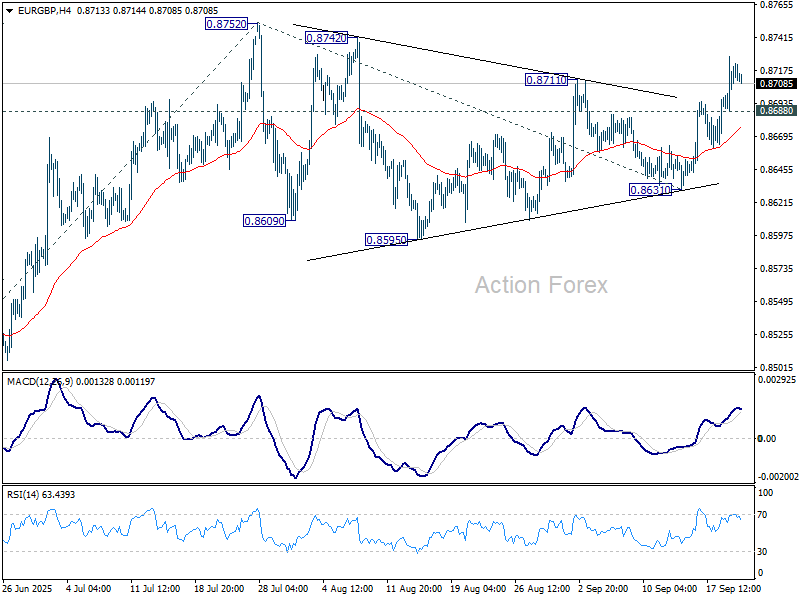
Daily Pivots: (S1) 0.8698; (P) 0.8714; (R1) 0.8737; More...
Intraday bias in EUR/GBP remains on the upside for retesting 0.8752 resistance. Firm break there will resume larger rally to 61.8% projection of 0.8354 to 0.8752 from 0.8631 at 0.8877, which is close to 0.8867 fibonacci level. On the downside, though, below 0.8688 minor support will dampen this view and turn bias neutral first.
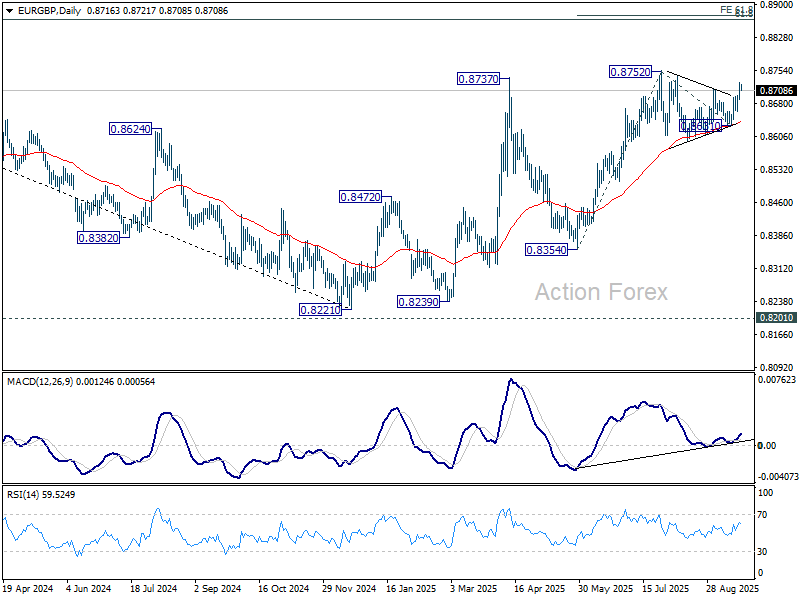
In the bigger picture, the structure from 0.8221 medium term bottom are not impulsive enough to suggest that it's reversing the down trend from 0.9267 (2022 high). But even if it's a correction, further rise could still be seen to 61.8% retracement of 0.9267 to 0.8221 at 0.8867. Nevertheless, sustained trading below 55 W EMA (now at 0.8518) will argue that the pattern has completed and bring retest of 0.8221 low.
Quiet Markets Look to Fed and BoE Commentary
Forex markets started the week on a subdued note, with Asian trading showing little momentum. With no top-tier data scheduled, activity is likely to stay muted until later in the week, leaving traders watching central bank commentary for direction.
Several Fed officials are set to deliver remarks today, their first since last week’s rate cut. Their speeches may shed light on how individual members view inflation risks and labor market resilience after the latest policy move. But collectively, there should be broad alignment around the outlook for two more cuts this year.
The BoE, on the other hand, is a bigger source of uncertainty. Chief Economist Huw Pill will speak today, and his comments could sway expectations ahead of the November meeting, where markets still see the chances of a cut as a coin toss.
Elsewhere, Asian equities diverged. Japan’s Nikkei advanced strongly, building on Wall Street’s rally from Friday, while Hong Kong’s Hang Seng came under pressure. Sentiment in Hong Kong was dampened by Beijing’s reluctance to roll out fresh stimulus despite mounting evidence of domestic fatigue.
In commodities, gold remained range-bound while silver outperformed, breaking higher as traders looked for alternative momentum plays. Cryptocurrencies, by contrast, were under renewed selling pressure, with Bitcoin and Ethereum slipping further in their ongoing consolidations.
On the geopolitical front, U.S. President Donald Trump said progress had been made in negotiations over TikTok’s U.S. operations. The expected deal would see the app’s American assets transferred to domestic ownership under a board with national security credentials. Trump named business leaders Lachlan Murdoch, Larry Ellison, and Michael Dell as potential backers, a move that could give his allies greater influence over a platform central to U.S. political and cultural discourse.
In Asia, at the time of writing, Nikkei is up 1.09%. Hong Kong HSI is down -1.02%. China Shanghai SSE is down -0.09%. Singapore Strait Times is down -0.11%. Japan 10-year JGB yield is up 0.02 at 1.661.
RBA's Bullock: Economy may prove weaker or stronger than forecasts
RBA Governor Michele Bullock told a parliamentary committee today that the central bank expects underlying inflation to moderate toward the midpoint of its 2–3% target range, with forecasts conditioned on the market’s assumption of modest further easing. Recent rate cuts are seen supporting household and business spending, while real income growth should help sustain consumption in the year ahead.
She noted that domestic data since the August meeting have been “broadly in line with expectations, or slightly stronger,” giving the Board some confidence heading into next week’s policy meeting. But Bullock stressed that forecasts remain only estimates, and the outlook is highly uncertain, particularly given the unpredictable global environment.
She highlighted risks on both sides: growth momentum may fade, or it could prove “materially stronger” than anticipated. Bullock warned that "excess demand" in the economy and labour market could persist, particularly that "productivity growth has not picked up and growth in unit labour costs remains high".
PBoC holds fire, China stays patient on stimulus as economy shows strain
The People’s Bank of China left its one-year loan prime rate at 3.0% and the five-year at 3.5% today, extending a steady policy stance for the fourth month running. The unchanged setting came in line with forecasts and follows the central bank’s last 10bps trim in May, part of earlier efforts to shore up growth.
Policymakers opted for patience as the recent strong rally in domestic equities reduced pressure for immediate support, even as official data continue to point to uneven demand and fading momentum in industry and property.
Still, most expect modest easing steps before year-end as Beijing works to lock in its 5% growth target, also as policy focus shifted from deflation management to reflation
Bitcoin risks drop toward 100k correlation with tech stocks breaks
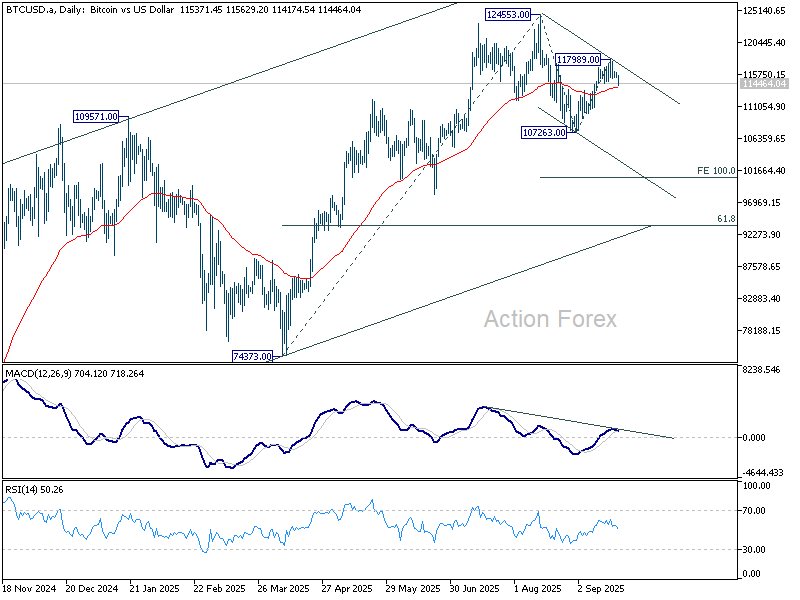
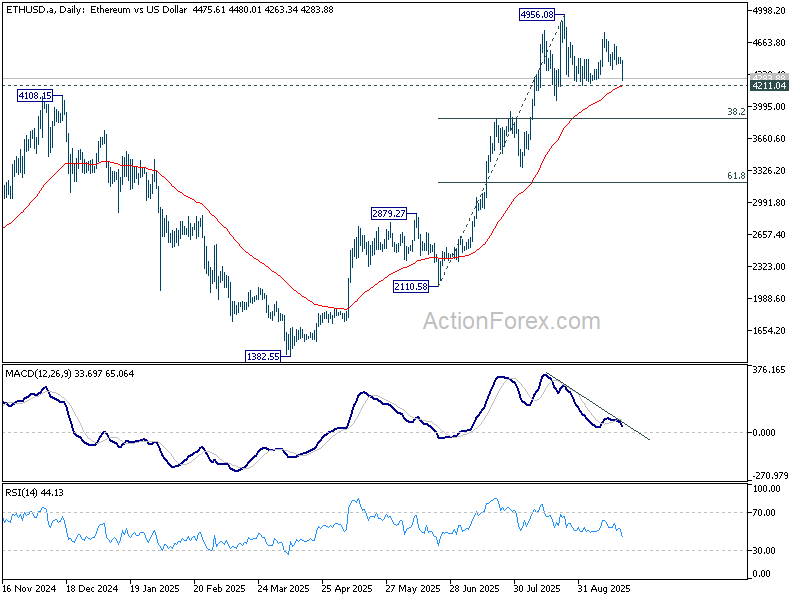
Bitcoin and Ethereum lost ground over the past week as stronger Dollar weighed, breaking their recent correlation with the NASDAQ. While tech stocks surged to fresh records, the two largest cryptocurrencies failed to follow. The price action suggests that the consolidation phase in both Bitcoin and Ethereum, in place since August, is set to extend with another downward leg.
For Bitcoin, sustained break of 55 D EMA (now at 113,835) would confirm that the correction from 124,553 has entered its third leg. That would open the way for a retest of the 107,263 support. Firm break there would target a deeper fall toward 100% projection of 124,553 to 107,263 from 117,989 at 100,699, which is close to 100k psychological level.
Ethereum’s structure looks slightly less fragile, but risks are also tilting lower. The current move from 4,956.08 is seen as correcting only the rise from 2,110.58, not the larger trend from 1,382.55. Still, decisive break of 4,211.04, which aligns closely with 55 D EMA (now at 4,207.58) would signal scope for a deeper correction. The next technical target for Ethereum would be 38.2% retracement of 2,110.58 to 4,956.08 at 3,869.09.
SNB set to hold, Fed officials to shape post-cut outlook
The SNB takes center stage this week, with its policy decision as the only major central bank highlights. Consensus strongly points to no change, with the policy rate remaining at 0.00%. A Bloomberg survey showed only two out of 21 economists anticipate a return to negative rates, reflecting the broad belief that the hurdle for such a move is exceptionally high.
SNB Chair Martin Schlegel has reiterated several times that reintroducing negative rates would require extraordinary circumstances. Even with Switzerland now facing sweeping 39% U.S. tariffs on exports, inflation has remained stable above 0%, providing the Bank room to stay patient. The message is clear: no urgency to deploy policy “mega-bullets” at this stage.
Attention in the U.S. will turn to August PCE inflation due Friday. Both headline and core are projected to hold steady at 2.7% and 2.9%, respectively. Markets are unlikely to be shaken even by a mild upside surprise, as last week’s FOMC meeting signaled two more cuts this year as part of a gradual risk-management strategy.
Fed officials have struck a more confident tone on inflation since tariffs were adjusted away from worst-case scenarios. Minneapolis Fed President Neel Kashkari said last week that while inflation may stay near 3%, it is unlikely to accelerate to 4–5%. That aligns with the Fed’s view that the balance of risks still tilts toward guarding against labor market deterioration.
The focus this week will be less on data surprises and more on Fed officials’ remarks following the latest rate cut. With two more reductions penciled in for 2025, investors will parse comments for insight into how comfortable policymakers are with maintaining a steady easing path. Diverging views within the Committee could start to shape expectations for timing and magnitude.
Europe will also provide important signals through Germany’s Ifo business climate index. Markets are worried that the early recovery momentum in Europe’s largest economy is losing steam, and the survey results will either validate or challenge those concerns. A downside print could weigh on Euro sentiment, especially after last week’s failure of the currency to hold gains versus Dollar.
In Canada, July GDP will be closely watched. Optimism for a rebound in Q3 is high after upbeat retail sales, but the print will be a critical test of whether growth momentum is truly returning. The Loonie’s outperformance last week, despite the BoC’s rate cut, highlights how data surprises can swing sentiment in either direction.
Beyond these highlights, Australia’s monthly CPI, Japan’s Tokyo CPI, and global flash PMI readings round out the calendar.
Here are some highlights for the week:
- Monday: Canada IPPI, RMPI; Eurozone consumer confidence.
- Tuesday: Australia PMIs; Eurozone PMIs; UK PMIs; US PMIs.
- Wednesday: Japan PMIs; Australia monthly CPI; Germany Ifo business climate; US new homes sales.
- Thursday: BoJ minutes, corporate service prices; Germany Gfk consumer climate; SNB rate decision; Eurozone M3 money supply; US Q2 GDP final, jobless claims, durable goods orders, goods trade balance, existing home sales.
- Friday: Japan Tokyo CPI; Canada GDP; US personal income and spending, PCE inflation.
EUR/GBP Daily Outlook
Daily Pivots: (S1) 0.8698; (P) 0.8714; (R1) 0.8737; More...
Intraday bias in EUR/GBP remains on the upside for retesting 0.8752 resistance. Firm break there will resume larger rally to 61.8% projection of 0.8354 to 0.8752 from 0.8631 at 0.8877, which is close to 0.8867 fibonacci level. On the downside, though, below 0.8688 minor support will dampen this view and turn bias neutral first.
In the bigger picture, the structure from 0.8221 medium term bottom are not impulsive enough to suggest that it's reversing the down trend from 0.9267 (2022 high). But even if it's a correction, further rise could still be seen to 61.8% retracement of 0.9267 to 0.8221 at 0.8867. Nevertheless, sustained trading below 55 W EMA (now at 0.8518) will argue that the pattern has completed and bring retest of 0.8221 low.
Bitcoin risks drop toward 100k correlation with tech stocks breaks
Bitcoin and Ethereum lost ground over the past week as stronger Dollar weighed, breaking their recent correlation with the NASDAQ. While tech stocks surged to fresh records, the two largest cryptocurrencies failed to follow. The price action suggests that the consolidation phase in both Bitcoin and Ethereum, in place since August, is set to extend with another downward leg.
For Bitcoin, sustained break of 55 D EMA (now at 113,835) would confirm that the correction from 124,553 has entered its third leg. That would open the way for a retest of the 107,263 support. Firm break there would target a deeper fall toward 100% projection of 124,553 to 107,263 from 117,989 at 100,699, which is close to 100k psychological level.
Ethereum’s structure looks slightly less fragile, but risks are also tilting lower. The current move from 4,956.08 is seen as correcting only the rise from 2,110.58, not the larger trend from 1,382.55. Still, decisive break of 4,211.04, which aligns closely with 55 D EMA (now at 4,207.58) would signal scope for a deeper correction. The next technical target for Ethereum would be 38.2% retracement of 2,110.58 to 4,956.08 at 3,869.09.
PBoC holds fire, China stays patient on stimulus as economy shows strain
The People’s Bank of China left its one-year loan prime rate at 3.0% and the five-year at 3.5% today, extending a steady policy stance for the fourth month running. The unchanged setting came in line with forecasts and follows the central bank’s last 10bps trim in May, part of earlier efforts to shore up growth.
Policymakers opted for patience as the recent strong rally in domestic equities reduced pressure for immediate support, even as official data continue to point to uneven demand and fading momentum in industry and property.
Still, most expect modest easing steps before year-end as Beijing works to lock in its 5% growth target, also as policy focus shifted from deflation management to reflation