




Canada’s GDP grows 0.3% mom in Apr, matches expectations

    Canada’s GDP grew 0.3% mom in April, matched expectations. Both goods-producing (+0.3%) and services-producing (+0.3%) industries contributed to the growth with 15 of 20 sectors increasing in the month.

    Advance information indicates that real GDP rose 0.1% mom in May. Increases in manufacturing, real estate and rental and leasing and finance and insurance were partially offset by decreases in retail trade and wholesale trade.

    Full Canada GDP release here.

    US PCE core inflation slows to 2.6% as expected in May

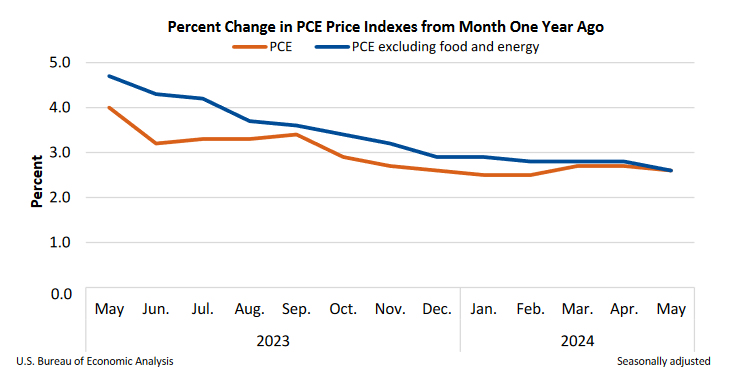
      In May, US PCE price index was flat mom, matched expectations. PCE core price index (excluding food and energy) rose 0.1% mom. Both matched expectations. Prices for goods fell -0.4% mom while prices for services rose 0.2% mom. Food prices rose 0.1% mom while energy prices fell -2.1% mom.

      From the same month one year ago, headline PCE price index slowed from 2.7% yoy to 2.6% yoy. PCE core price index slowed from 2.8% yoy to 2.6% yoy. Both matched expectations. Goods prices were down -0.1% yoy while services prices were up 3.9% yoy. Food prices were up 1.2% mom and energy prices were up 4.8% yoy.

      Also, personal income rose 0.5% mom or USD 114.1B, above expectation of 0.4% mom. Personal spending rose 0.2% mom or USD 47.8B, below expectation of 0.3% mom.
      Full US Personal Income and Outlays release here.

      ECB’s Villeroy: Confidence grows in inflation forecasts as data surprises diminish

        ECB Governing Council member François Villeroy de Galhau expressed increased confidence in the inflation forecast today, noting that the frequency of data surprises has diminished.

        “As data surprises are now smaller and revisions to the current assessment more minor compared to two years ago, we are gaining more confidence in the forecast and more scope to disregard smaller bumps in the disinflation process,” he said.

        ECB projects inflation to remain above its 2% target for the rest of this year. However, it anticipates that inflation will start easing next year and reach the 2% target by the end of 2025.


        Fed’s Barkin: Economy not ready for rate cuts despite expectations

          Richmond Fed President Thomas Barkin highlighted the divergence between expectations and reality of US monetary in a speech today. He noted, “Most anticipated we would be cutting rates by now, either because we returned inflation to target, or perhaps because the economy took a turn for the worse. Yet, in contrast to the European Central Bank, that has not yet been the case.”

          Barkin elaborated on the unique challenges facing the US economy, emphasizing that monetary policy operates with “long and variable lags.” He suggested that these lags might be longer than expected due to factors such as labor hoarding, excess savings, delayed exposure to interest rate hikes, and newfound pricing power among businesses.

          Furthermore, Barkin raised the possibility that the Fed’s rate hikes might not be constraining the economy as much as anticipated. He pointed to the concept of r-star, the neutral real rate of interest, suggesting it might have shifted to a higher level. “It is too soon to tell, but there’s one way to find out: Proceed deliberately while keeping a close eye on the real economy. And that’s what I am doing,” Barkin stated.

          Full speech of Fed’s Barkin here.

          Swiss KOF rises slightly to 102.7, gradual recovery continues

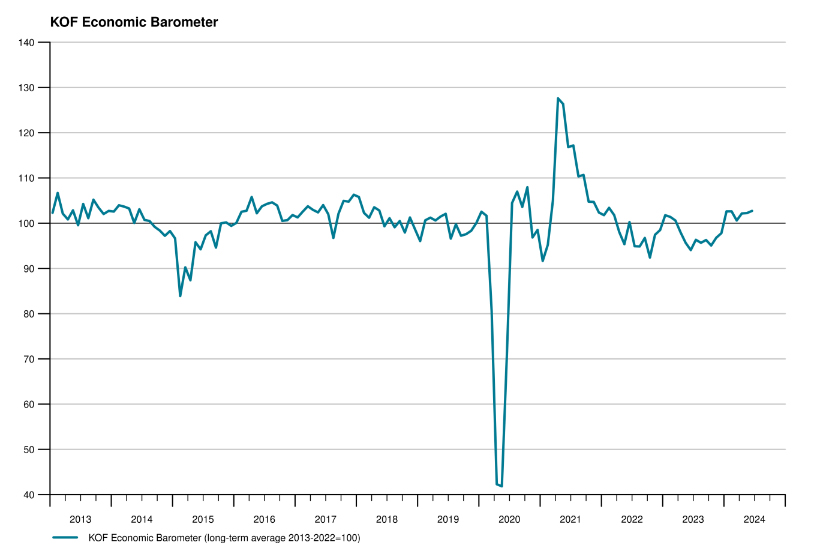
            Swiss KOF Economic Barometer rose from 102.2 to 102.7 in June, surpassing expectations of 100.5. According to KOF, the Swiss economy is projected to “continue to recover little by little over the coming months.”

            This increase is largely driven by a more favorable outlook for foreign demand. Additionally, the hospitality industry is expected to see stronger benefits. The indicators for manufacturing, construction, and private consumption remained virtually unchanged in June. However, the outlook for financial and insurance services, along with other service sectors, has slightly dimmed.

            Full Swiss KOF release here.

            Tokyo CPI surpasses expectations, Japan’s industrial output rebounds

              Japan’s Tokyo CPI core (excluding food) rose to 2.1% yoy in June, beating expectations of 2.0% yoy and up from May’s 1.9% yoy. CPI core-core (excluding food and energy) increased from 1.7% yoy to 1.8% yoy. Headline CPI also ticked up from 2.2% to 2.3% year-on-year. Monthly figures showed Tokyo’s CPI core rose by 0.4% mom, core-core by 0.3% mom, and headline CPI by 0.3% mom.

              In addition, Japan’s industrial production saw a significant boost in May, rising 2.8% mom, surpassing the forecasted 2.0%. Of the 15 industrial sectors covered, 13 reported higher output while only two experienced declines.

              A Ministry of Economy, Trade and Industry official noted, “The private sector’s sentiment toward output is improving as auto production started to pick up.” Despite this, the ministry maintained its previous assessment that industrial production “showed weakness while fluctuating indecisively.” According to a poll of manufacturers, output is expected to decrease by -4.8% in June but increase by 3.6% in July.

              Fed’s Bowman cites multiple risks to inflation, rules out rate cuts for now

                In a speech overnight, Fed Governor Michelle Bowman reiterated that Fed is “still not yet at the point where it is appropriate to lower the policy rate.” She emphasized that several upside risks to inflation persist, making it premature to consider rate cuts.

                Bowman highlighted several concerns impacting inflation. She noted that further improvements on the supply side are unlikely, and geopolitical developments could disrupt global supply chains, adding to inflationary pressures. Additionally, loosening in financial conditions might increase demand, potentially stalling disinflation progress. Furthermore, increased immigration and continued labor market tightness could lead to persistently high core services inflation.

                Bowman stressed that monetary policy is “not on a preset course.” She remains willing to raise interest rates if incoming data suggest that progress on inflation has stalled or reversed.

                Full speech of Fed’s Bowman here.

                Fed’s Bostic sees potential for rate cut in Q4

                  In an essay, Atlanta Fed President Raphael Bostic anticipates that gradual slowdown in the labor market and overall economic activity will lead to inflation decreasing to the target level of 2% by 2025, or slightly later.

                  Bostic mentioned that instead of maintaining the federal funds rate until the inflation target is achieved, he would prefer to start reducing the policy rate once there is clear evidence that inflation is on a definitive path towards the 2% objective.

                  Taking all factors into account, Bostic stated, “I continue to believe conditions will likely call for a cut in the federal funds rate in the fourth quarter of this year.”

                  However, he emphasized flexibility, indicating that he is “not locked into any particular policy path” and that adjustments will be based on evolving data and economic conditions.

                  Bostic acknowledged the possibility of varying scenarios, including more cuts, no cuts, or even a rate increase, depending on how the situation develops. “I will let the data and conditions on the ground be my guide,” highlighting the importance of data-driven decision-making in monetary policy.

                  Full essay of Fed’s Bostic here.

                  US initial jobless claims falls to 233k, vs exp 230k

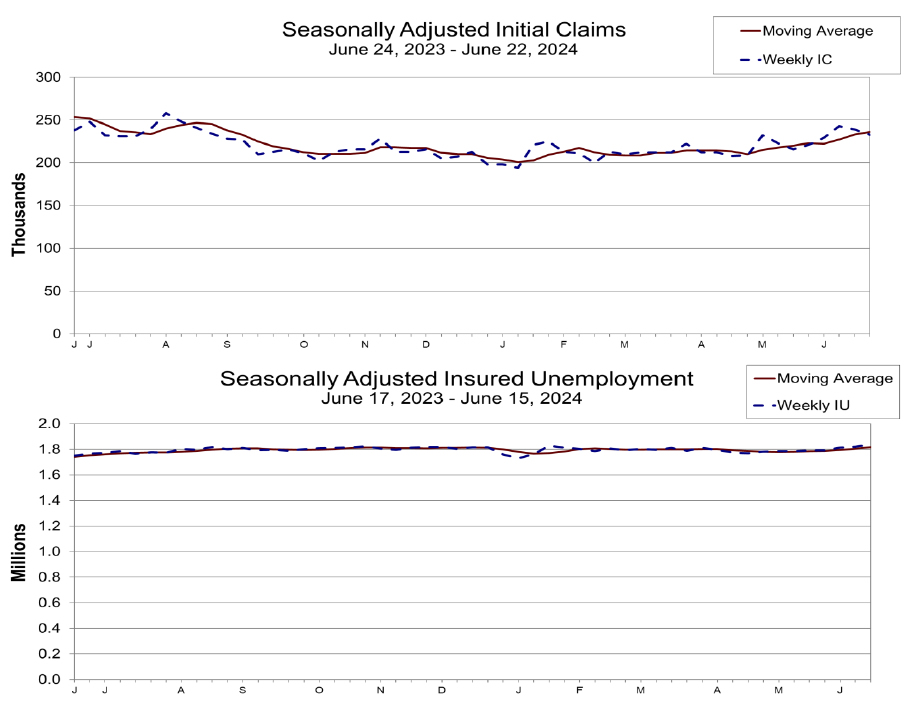
                    US initial jobless claims fell -6k to 233k in the week ending June 22, slightly above expectation of 230k. Four-week moving average of initial claims rose 3k to 236k.

                    Continuing claims rose 18k to 1839k in the week ending June 15, highest since November 27, 2021. Four-week moving average of continuing claims rose 12k to 1816k, highest since December 4, 2021.

                    Full US jobless claims release here.

                    US durable goods orders rise 0.1% mom, ex-transport orders down -0.1% mom

                      US durable goods orders rose 0.1% mom to USD 283.1B in May, above expectation of -0.1% mom. Ex-transport orders fell -0.1% mom to 187.7B, below expectation of 0.1% mom. Ex-defense orders fell -0.2% mom to USD 266.1B. Transportation equipment rose 0.6% mom to USD 95.4B.

                      Full US durable goods orders release here.

                      RBA’s Hauser cautions against policy decisions based on single data point

                        In an event today, RBA Deputy Governor Andrew Hauser emphasized the need for comprehensive analysis before making policy decisions, stating, “it would be a bad mistake to set policy on the basis of one number and we don’t intend to do that.”

                        This comment comes in the wake of Australia’s May CPI release earlier this week, which showed an unexpected acceleration to 4%, leading money markets to price in a 50-50 chance of another 25bps rate hike in August.

                        Hauser highlighted the importance of considering the broader economic context, noting that the monthly consumer price indicator provides only partial information.

                        He stressed, “there’s a whole series of data coming out between now and when we meet in August.”


                        ECB’s Kazimir anticipates single additional rate cut in 2024

                          ECB Governing Council member Peter Kazimir suggested today that “we could expect one more interest-rate cut this year.” He underscored his continued concern over the “significant risk of rising inflation,” driven primarily by wage growth.

                          Kazimir reiterated his opposition to an interest-rate adjustment at upcoming July meeting. Instead, he advocated for policymakers to wait until the next round of quarterly economic projections before making any decisions.

                          “It’s appropriate to wait for the September forecast,” Kazimir stated. “Those are the right moments to make the correct decisions.”

                          Eurozone economic sentiment falls slightly to 95.9, EU ticks down to 96.4

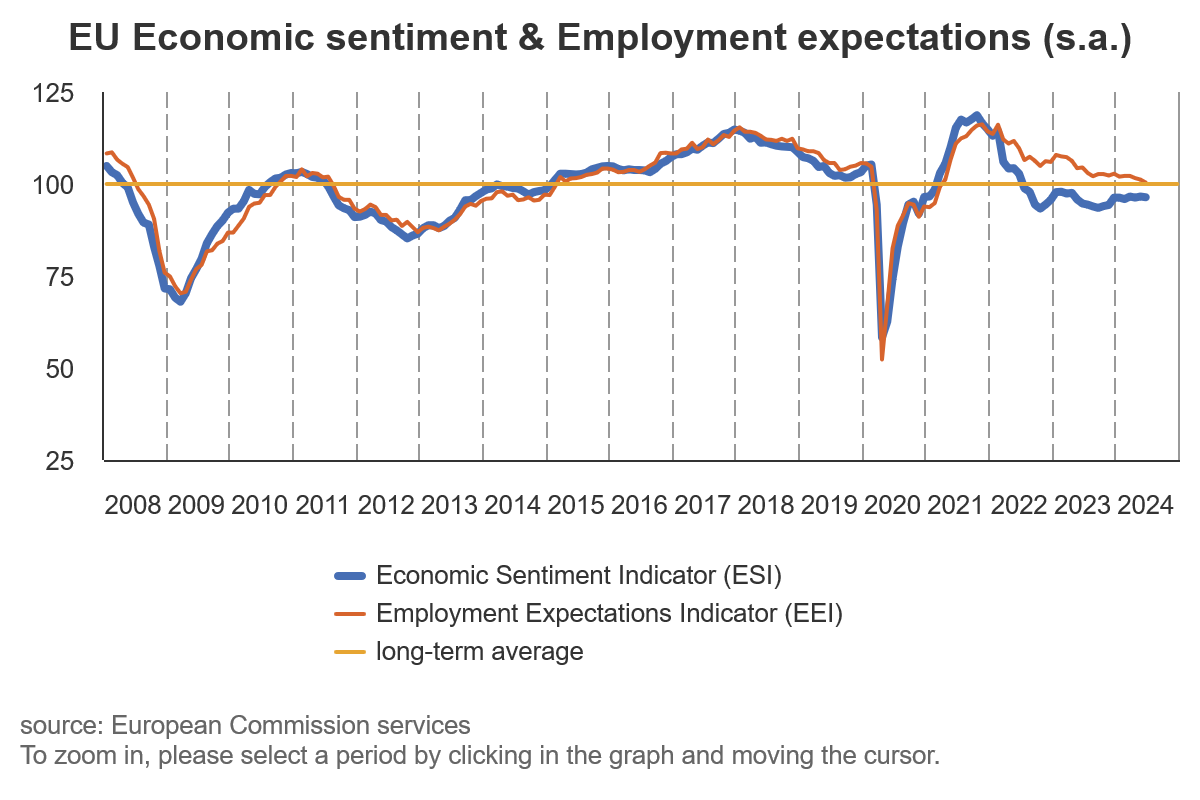
                            Eurozone Economic Sentiment Indicator ticked down from 96.1 to 95.9 in June. Employment Expectation Indicator fell from 101.3 to 99.7. Economic Uncertainty Indicator fell from 18.5 to 18.0.

                            Eurozone industry confidence fell from -9.9 to -10.1. Services confidence fell from 6.8 to 6.5. Consumer confidence improved slightly from -14.3 to -14.0. Retail trade confidence fell from -6.8 to -7.8. Construction confidence fell from -6.2 to -7.0.

                            EU ESI fell from 96.6 to 96.4. EEI fell from 101.2 to 100.4. EUI fell from 17.9 to 17.3. For the largest EU economies, the ESI improved markedly for Spain (+1.1) and more moderately for the Netherlands (+0.5), while it deteriorated for France (-0.7) and Italy (-0.7). The ESI remained broadly stable for Germany (-0.2) and Poland (-0.1).

                            Full Eurozone ESI release here.

                            NZ ANZ business confidence falls to 6.1, inflation pressure eases further

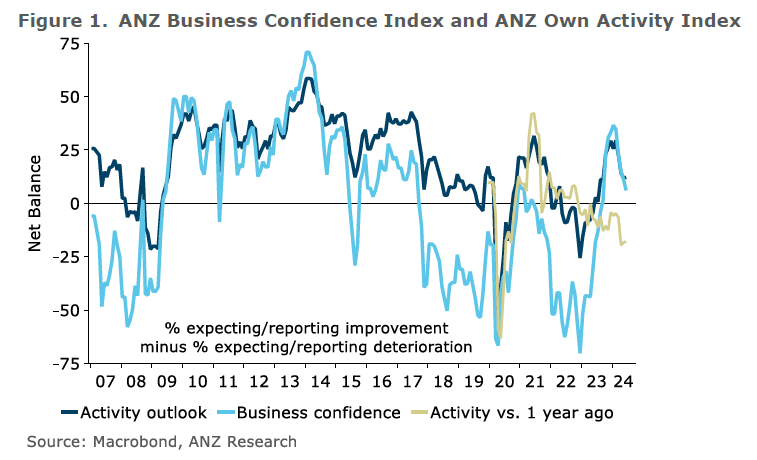
                              New Zealand ANZ Business Confidence fell from 11.2 to 6.1 in June. Despite this decrease in overall confidence, there was a slight improvement in the own activity outlook, from 11.8 to 12.2.

                              Cost expectations decreased from 72.6 to 69.2, while pricing intentions dropped significantly from 41.6 to 35.3, signaling easing price pressure in the business environment. Furthermore, inflation expectations continued their steady descent, moving from 3.59% to 3.46%.

                              ANZ noted that “the economy is clearly weak, as the RBNZ intended.” More importantly, there appears to be “renewed meaningful progress on bringing inflation pressures down.” This fosters optimism that RBNZ might be able to lower the Official Cash Rate considerably earlier than the currently projected August next year.

                              Full NZ ANZ business confidence release here.

                              ECB’s Panetta: Must manage risks beyond baseline scenarios

                                Speaking today, ECB Governing Council member Fabio Panetta noted that the current macroeconomic conditions support “normalization of the monetary stance.” He added that ECB initiated this process recently and, under the “baseline scenario,” intends to continue it “gradually and smoothly.”

                                However, Panetta cautioned that the inflation and growth projections represent only one of many possible outcomes. He stressed that monetary policy must also manage “risks and tail scenarios,” not just baseline forecasts. The prevailing political and geopolitical risks, he said, necessitate “awareness, flexibility, and state-contingent action plans.”

                                Panetta’s comments come just days before French voters head to the polls for the first round of parliamentary elections. He highlighted the potential economic implications of political turnover, explaining that it inherently brings policy uncertainty. This uncertainty affects households and investors as they try to predict how new governments will handle critical economic and political decisions.


                                ECB’s Rehn considers two more rate cuts this year as reasonable

                                  In an interview today, ECB Governing Council member Olli Rehn indicated that market data suggests the likelihood of two additional rate cuts, bringing the rate to 3.25% by the end of the year. He also noted that the terminal rate for this easing cycle is expected to fall between 2.25% and 2.50%. Rehn described these projections as “reasonable expectations.”

                                  Despite recent economic data overshooting expectations, Rehn affirmed that “disinflationary process is going on,” although it may be bumpy. He added that ECB would maintain its course and “continue rate cuts” to ensure this process remains on track.

                                  Rehn further elaborated that current interest rates are still in “restrictive territory,” underscoring ECB’s work to ensuring that the “disinflationary process will continue.” He stressed that the central bank’s primary goal is to control inflation, but also highlighted its broader responsibilities.

                                  “Without compromising our primary objective,” Rehn said, “we also have a responsibility to support full employment, sustainable development, and balanced growth.”


                                  German Gfk consumer sentiment fells to -21.8, interruption of uptrend

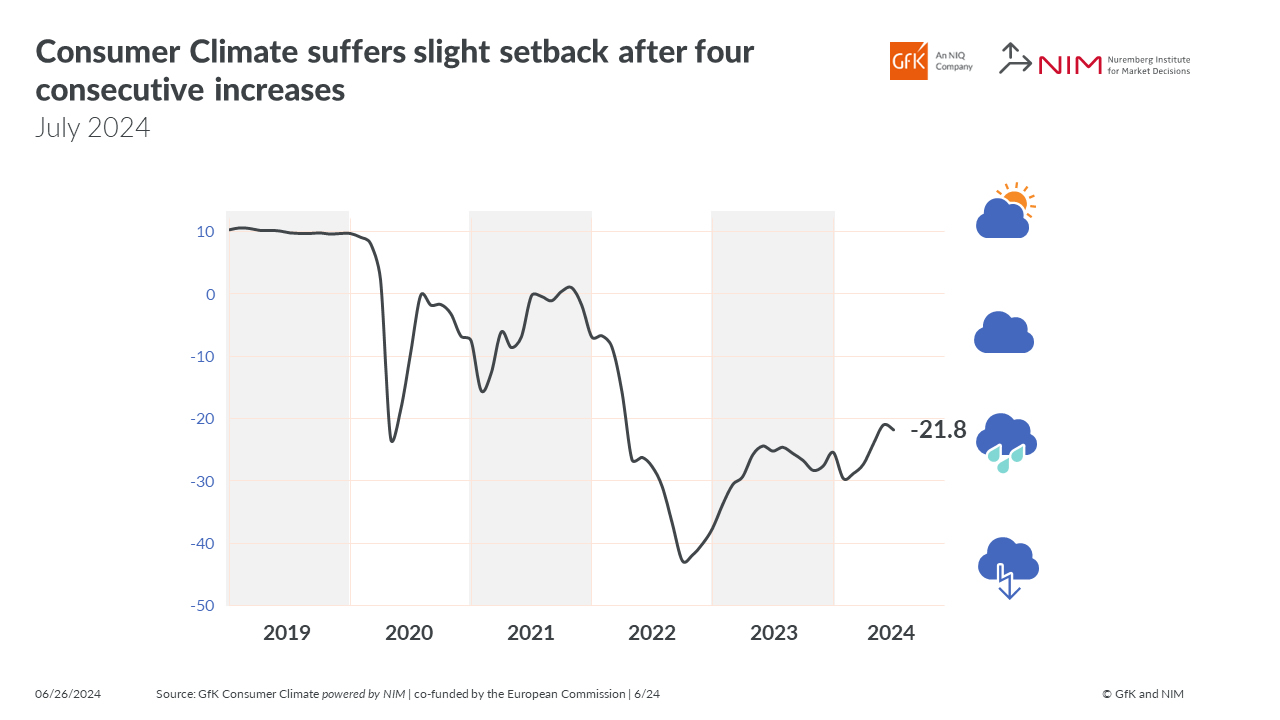
                                    Germany’s Gfk Consumer Sentiment for July fell from -21.0 to -21.8, below expectation of -20.0. In June, economic expectations fell from 9.8 to 2.5. Income expectations fell from 12.5 to 8.2. Willingness to buy fell from -12.3 to -13.0. Willingness to save jumped again from 5.0 to 8.2.

                                    “The interruption of the recent upward trend in consumer sentiment shows that the road out of the sluggish consumption will be difficult and there can always be setbacks,” explains Rolf Buerkl, consumer expert at NIM.

                                    Full German Gfk consumer sentiment release here.

                                    Speculation of RBA August hike drives AUD/NZD higher

                                      Australian Dollar surges broadly today following reacceleration in monthly inflation data, sparking speculation that RBA might need to raise interest rates again. The inflation uptick places significant pressure on RBA to not only refrain from cutting rates anytime soon but potentially consider further rate hikes.

                                      RBA’s upcoming meeting in August is now seen as being “live,” although a decision is not yet certain. The critical factor remains Q2 CPI report due on July 31, which will provide further clarity on the inflation outlook, will heavily influence RBA’s policy decision.

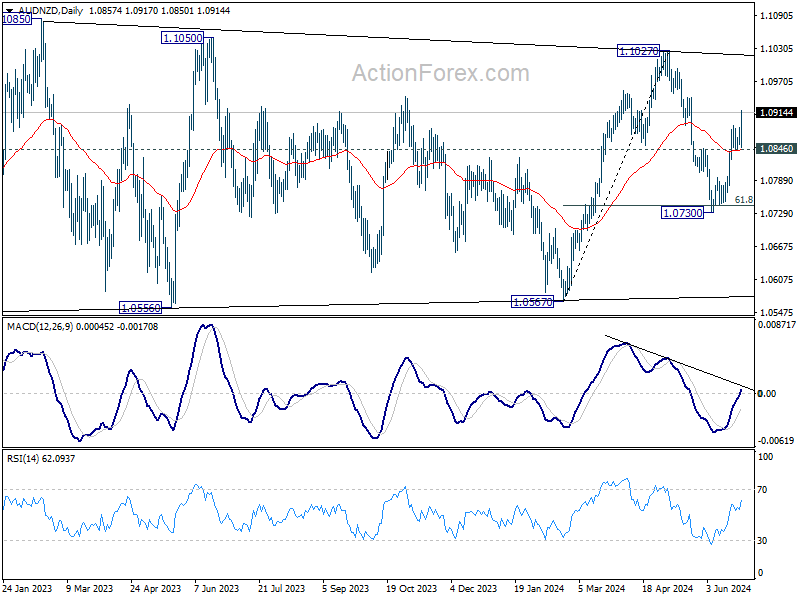
                                      Strength of Aussie is particularly noticeable against Kiwi. AUD/NZD’s rally from 1.0730 resumed and hits as high as 1.0917 so far. The development solidifies that case that pull back from 1.1027 has completed at 1.0730, after hitting 61.8% retracement of 1.0567 to 1.1027.

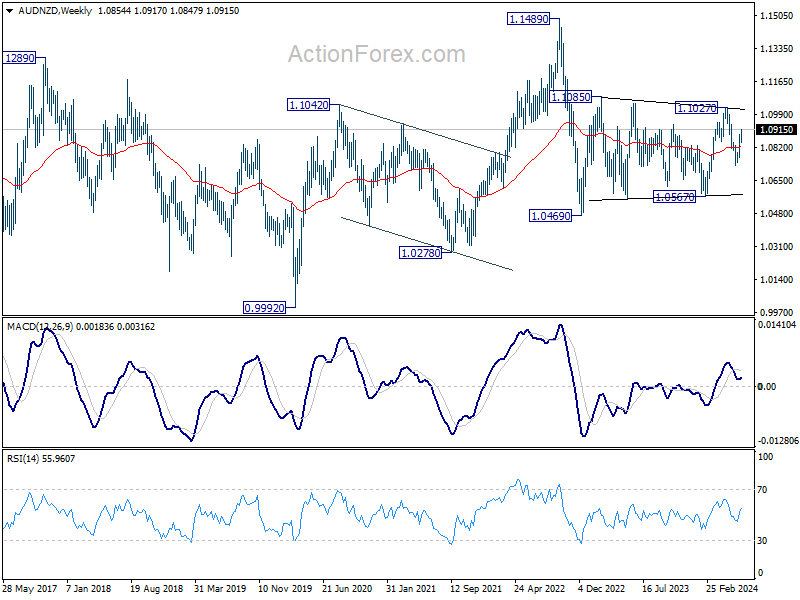
                                      Further rise is expected as long as 1.0846 support holds. Next target is the key resistance zone of 1.1027/1085. Decisive break there will resume whole medium term rebound from 1.0469 (2022 low). However, for this bullish scenario to unfold, RBA would need to actually implement additional tightening, rather then just keeping the option open..

                                      Australia CPI jumps to 4%, trimmed mean rises to 4.4%

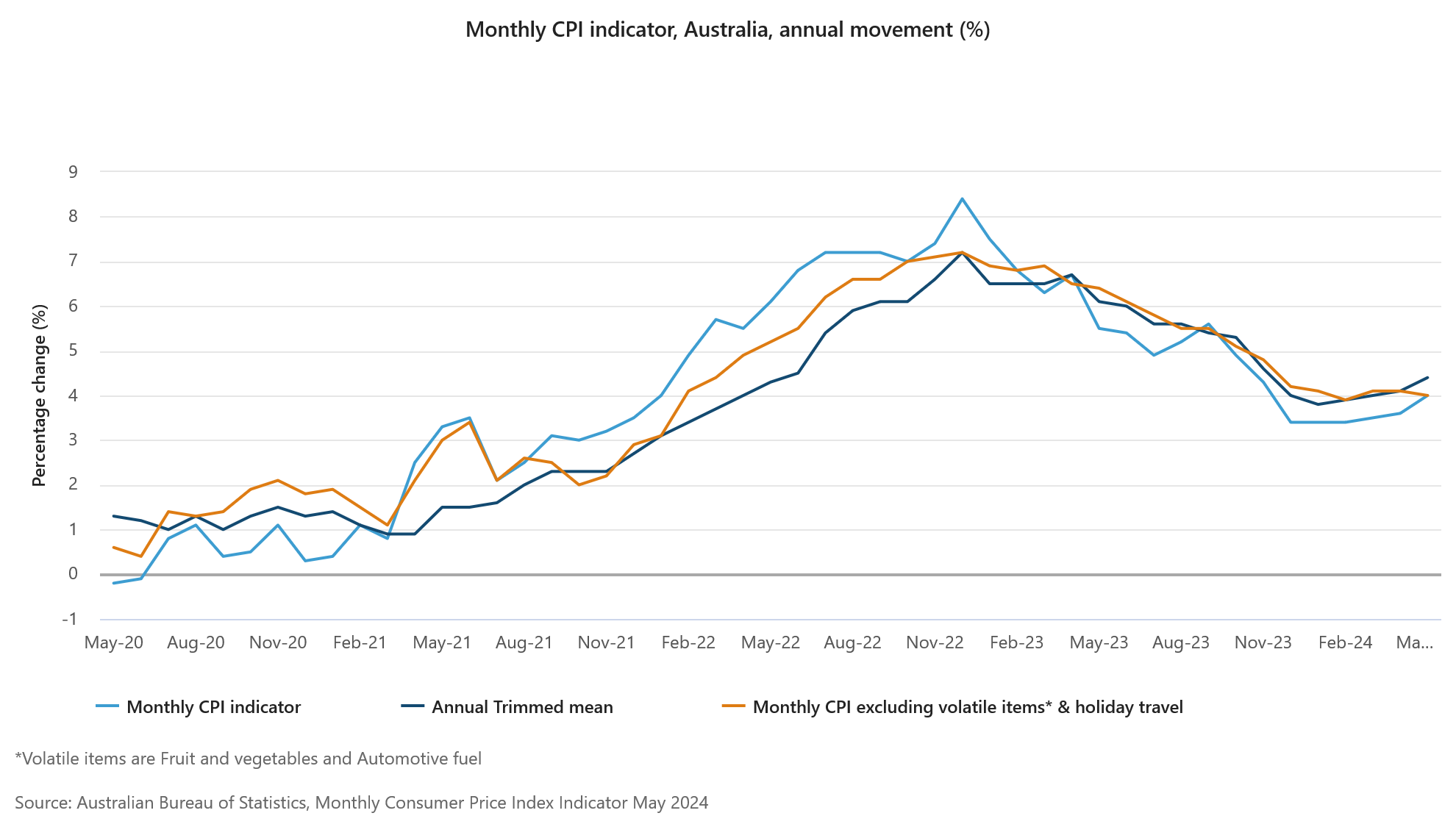
                                        Australia’s monthly CPI accelerated from 3.6% yoy to 4.0% yoy in May, well above expectation of a fall to 3.5% yoy. The last time it was higher was last November, when it was sitting at 4.3%.

                                        CPI excluding volatile items and holiday travel ticked down from 4.1% yoy to 4.0% yoy. Annual Trimmed Mean CPI, on the other hand, surged from 4.1% yoy to 4.4% yoy.

                                        The most significant contributors to the annual rise to May were Housing (+5.2%), Food and non-alcoholic beverages (+3.3%), Transport (+4.9%), and Alcohol and tobacco (+6.7%).

                                        Full Australia monthly CPI release here.

                                        RBA’s Kent stresses vigilance amid mixed data and uncertainty over neutral rate

                                          RBA Assistant Governor Christopher Kent, in a speech today, emphasized that recent economic data have been “mixed,” reinforcing the need for RBA to “remain vigilant to upside risks to inflation.” Kent reiterated that, regarding the path of interest rates, RBA is “not ruling anything in or out.”

                                          Kent noted that the recent median estimate among market economists suggested that the cash rate was around 1 percentage point above the nominal neutral rate. This indicates that current monetary policy is restrictive.

                                          However, he acknowledged the significant uncertainty surrounding estimates of the neutral rate, making it unclear how restrictive monetary policy truly is.

                                          Additionally, Kent mentioned that RBA’s own models suggest that the neutral rate has increased since the pandemic, aligning with trends observed in other economies.

                                          Full speech of RBA’s Kent here.