

Live Comments
Fed’s Paulson Explains What Would Force Another Rate Hike
Federal Reserve Bank of Philadelphia President Anna Paulson made clear that another rate hike remains on the table, but only if incoming data show inflation is failing to resume its downward path. In remarks on Tuesday, Paulson welcomed recent progress, saying "the recent improvement in some inflation data is welcome," but quickly cautioned that "it is only one step." She reiterated her support for last week's decision to leave the federal funds target range unchanged at 3.50-3.75%, while stressing that future policy will remain firmly data dependent.
Rather than offering guidance on the Fed's next move, Paulson emphasized the conditional framework increasingly adopted under Chair Kevin Warsh. "I am committed to keeping an open mind as I assess the evidence and determine the appropriate path for policy," she said. While noting that current policy is already restraining economic activity, she explained what would change her outlook: "If policy is appropriately calibrated, I would expect to see growing signs that inflation is coming down." However, "if instead underlying inflation remains stubbornly elevated, the passage of time without progress would itself signal that more restrictive policy is needed."
Paulson also distinguished between temporary supply shocks and persistent underlying inflation. She argued that the brief easing in Middle East tensions showed energy-related price spikes can prove transitory and therefore should not automatically drive monetary policy. Instead, her focus remains on underlying inflation, which she estimated at 2.4% to 2.8%, describing it as "what I am most focused on" because it has remained elevated for an extended period.
Key Takeaways
- Philadelphia Fed President Anna Paulson supported last week’s decision to keep rates unchanged at 3.50–3.75%, but stressed that one better inflation reading is not enough to declare progress secure.
- Her key condition for another hike is persistent underlying inflation without further improvement. As she put it, “the passage of time without progress would itself signal that more restrictive policy is needed.”
- Paulson estimates underlying inflation at around 2.4%–2.8% and said this is the area she is “most focused on,” rather than temporary swings in headline inflation.
- She argued that energy shocks linked to the Middle East can be temporary and should generally be looked through when setting policy.
- Her stance is cautiously hawkish: current policy may be sufficiently restrictive, but only if inflation continues to move lower.
- The remarks fit the post-Warsh communication framework, with officials emphasizing conditions for action rather than offering forward guidance on the next meeting.
Government vs BoJ? Japan’s Kiuchi Offers Softer View on Inflation Risks
Japan's Economy Minister Minoru Kiuchi struck a more measured tone on inflation than the Bank of Japan, suggesting the recent surge in energy prices has yet to generate broad-based consumer price pressures. Speaking at a press conference on Tuesday, Kiuchi said the pass-through from the Middle East conflict has so far remained limited, noting that "the overall consumer price index rose 1.7% year-on-year in June, showing only moderate rises." His remarks contrasted with the BoJ's warning last week that inflation risks could overshoot its 2% target.
Kiuchi acknowledged that inflationary pressures could build in the months ahead, saying policymakers "do need to be vigilant to the possibility that costs could be gradually passed onto food and other consumer goods from summer through autumn." Still, he emphasized that households should be better placed to absorb higher prices, forecasting average real wages to rise by nearly 1% in the current fiscal year while pointing to government fuel subsidies as an important buffer against higher living costs.
While avoiding direct criticism of the BoJ, Kiuchi's comments appeared to temper market expectations for a more aggressive policy response. He said he hoped the central bank would "continue to guide appropriate policy to stably and sustainably achieve its 2% inflation target," language consistent with his long-standing preference for accommodative monetary settings. The remarks suggest the government remains more comfortable with a gradual approach to policy normalization even after the BoJ raised interest rates to 1% in June.
Key Takeaways
- Japan's Economy Minister Minoru Kiuchi offered a more measured assessment of inflation than the BoJ, saying June's 1.7% CPI increase still represented only "moderate" price rises.
- While acknowledging that higher energy costs could gradually feed into food and consumer goods prices, Kiuchi stressed that cost pass-through from the Middle East conflict has so far remained limited.
- Kiuchi expects real wages to rise by nearly 1% this fiscal year and highlighted government fuel subsidies as an important buffer against higher living costs.
- His remarks contrasted with the BoJ's stronger warning last week that inflation could overshoot its 2% target, suggesting the government sees less urgency for further monetary tightening.
- Although Kiuchi reiterated support for the BoJ achieving its inflation target, his comments reinforced the government's preference for a gradual and cautious normalization of monetary policy.
US ISM Manufacturing Hits Three-Year High, Employment Returns to Growth
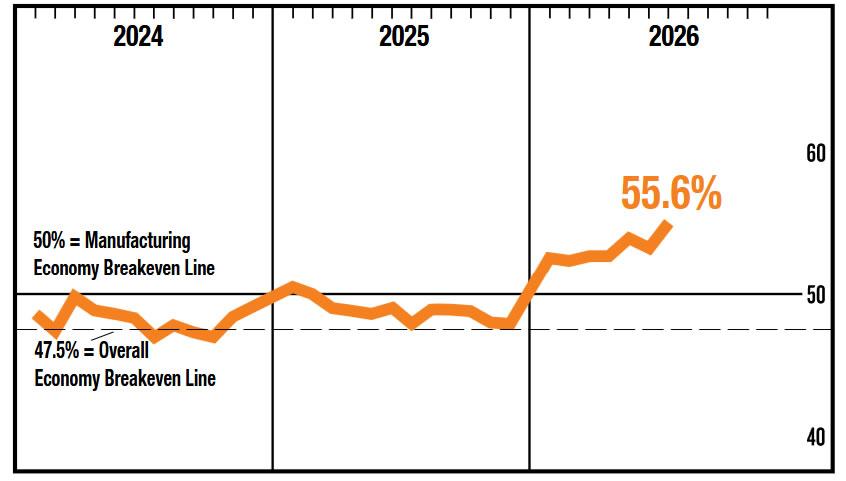
US manufacturing gathered further momentum in July, with the ISM Manufacturing PMI rising to 55.6 from 53.3, its highest reading since May 2022 and well above market expectations. According to ISM, the latest reading is historically consistent with annualized real GDP growth of around 2.8%, reinforcing signs that the US economy entered the third quarter on a solid footing despite elevated interest rates and geopolitical uncertainty.
The improvement was broad-based, led by a sharp acceleration in production. The Production Index jumped 6.3 points to 58.5, its highest level in almost five years, extending expansion to a ninth consecutive month. The labor market also showed renewed strength, with the Employment Index climbing to 52.8 from 49.7, returning to expansion territory for the first time in 33 months and reaching its highest level since August 2022. Together with stronger new orders and export demand, the survey points to improving manufacturing activity rather than a temporary rebound.
Inflation pressures, however, remained an important feature of the report. Although the Prices Index eased to 71.1 from 73.0, it remained firmly elevated. ISM said price increases continued to be driven by higher steel and aluminum costs, tariffs on imported goods and rising petroleum-based product prices linked to the Middle East conflict. Just over half of respondents reported paying higher prices in July, down from June but still indicative of widespread cost pressures across the manufacturing sector.
The report strengthens the case that the US economy remains resilient while inflation risks have yet to disappear. For the Federal Reserve, the combination of stronger production, expanding employment and still-elevated input prices leaves the door open to another rate hike should inflation remain stubborn.
Economic Data
| Indicator | Actual | Expected | Previous |
|---|---|---|---|
| ISM Manufacturing PMI | 55.6 | 54.0 | 53.3 |
| S&P Global Manufacturing PMI | 53.9 | 53.8 | 53.8 |
| Production | 58.5 | — | 52.2 |
| New Orders | 56.7 | — | 56.0 |
| Employment | 52.8 | — | 49.7 |
| Prices Paid | 71.1 | 70.0 | 73.0 |
| New Export Orders | 53.0 | — | 48.5 |
| Backlog of Orders | 55.0 | — | 50.5 |
Key Takeaways
- ISM Manufacturing PMI jumped from 53.3 to 55.6, the highest reading since May 2022, pointing to a further acceleration in US factory activity.
- ISM estimates the July PMI is historically consistent with 2.8% annualized real GDP growth, suggesting manufacturing continues to support overall economic expansion.
- Production surged from 52.2 to 58.5, its highest level in nearly five years, while the Employment Index returned to expansion at 52.8, its first expansionary reading in 33 months.
- Demand remained healthy, with New Orders rising to 56.7, New Export Orders returning to expansion at 53.0, and Backlog of Orders climbing to 55.0, indicating factories continue to receive more work than they can immediately process.
- Inflation pressures eased only modestly. Prices Paid fell from 73.0 to 71.1 but remained elevated, with respondents continuing to cite tariffs, higher steel and aluminum prices, and Middle East-related energy costs as key drivers.
- Overall, the report portrays an economy with strong manufacturing momentum and persistent inflationary pressures, giving the Fed greater flexibility to tighten policy if upcoming inflation data fail to improve.