Sun, Apr 12, 2026 12:19 GMT
More

    Sample Category Title

    AUD/USD & NZD/USD Gain Pace, Bulls Are Back?

    FXOpen

    AUD/USD started a decent increase above the 0.6150 and 0.6200 levels. NZD/USD is also rising and might aim for more gains above 0.5850.

    Important Takeaways for AUD USD and NZD USD Analysis Today

    • The Aussie Dollar rebounded after forming a base above the 0.6000 level against the US Dollar.
    • There is a connecting bullish trend line forming with support at 0.6260 on the hourly chart of AUD/USD at FXOpen.
    • NZD/USD is consolidating gains above the 0.5765 zone.
    • There is a key bullish trend line forming with support at 0.5825 on the hourly chart of NZD/USD at FXOpen.

    AUD/USD Technical Analysis

    On the hourly chart of AUD/USD at FXOpen, the pair started a fresh increase from the 0.5940 support. The Aussie Dollar was able to clear the 0.6065 resistance to move into a positive zone against the US Dollar.

    There was a close above the 0.6200 resistance and the 50-hour simple moving average. Finally, the pair tested the 0.6315 zone. A high was formed near 0.6314 and the pair recently started a consolidation phase.

    There was a move below the 0.6300 level. The pair remained above the 23.6% Fib retracement level of the upward move from the 0.5913 swing low to the 0.6314 high.

    On the downside, initial support is near the 0.6260 level. There is also a connecting bullish trend line forming with support at 0.6260. The next major support is near the 0.6220 zone. If there is a downside break below the 0.6220 support, the pair could extend its decline toward the 0.6205 level.

    Any more losses might signal a move toward 0.6065 and the 61.8% Fib retracement level of the upward move from the 0.5913 swing low to the 0.6314 high.

    On the upside, the AUD/USD chart indicates that the pair is now facing resistance near 0.6315. The first major resistance might be 0.6340. An upside break above the 0.6340 resistance might send the pair further higher.

    The next major resistance is near the 0.6385 level. Any more gains could clear the path for a move toward the 0.6450 resistance zone.

    NZD/USD Technical Analysis

    On the hourly chart of NZD/USD on FXOpen, the pair started a steady increase from the 0.5515 zone. The New Zealand Dollar broke the 0.5670 resistance to start the recent increase against the US Dollar.

    The pair settled above 0.5765 and the 50-hour simple moving average. It tested the 0.5850 zone and is currently consolidating gains. The pair corrected lower below the 0.5840 level. However, the bulls are active above the 0.5825 level.

    The NZD/USD chart suggests that the RSI is stable above 50. On the upside, the pair might struggle near 0.5850. The next major resistance is near the 0.5880 level.

    A clear move above the 0.5880 level might even push the pair toward the 0.5920 level. Any more gains might clear the path for a move toward the 0.6000 resistance zone in the coming days.

    On the downside, immediate support is near the 0.5825 level. There is also a key bullish trend line forming with support at 0.5825. The first key support is near the 0.5765 level. The next major support is near the 0.5670 level and the 50% Fib retracement level of the upward move from the 0.5485 swing low to the 0.5853 high.

    If there is a downside break below the 0.5670 support, the pair might slide toward the 0.5570 support. Any more losses could lead NZD/USD in a bearish zone to 0.5515.

    Trade over 50 forex markets 24 hours a day with FXOpen. Take advantage of low commissions, deep liquidity, and spreads from 0.0 pips. Open your FXOpen account now or learn more about trading forex with FXOpen.

    This article represents the opinion of the Companies operating under the FXOpen brand only. It is not to be construed as an offer, solicitation, or recommendation with respect to products and services provided by the Companies operating under the FXOpen brand, nor is it to be considered financial advice.

    Dollar Latest Victim of Trump’s Improvised Trade Strategy

    Markets

    The US dollar was last week’s latest victim of Trump’s improvised trade strategy. EUR/USD closed the week at 1.1355, up from 1.0882 at the start of the week and taking out the 1.1214/74/76 resistance zone in the process. From a technical point of view, we target full retracement to the 2023-top at 1.2349 in the medium term. US recession risks are growing with the left side of the “dollar smile” numbed by a general loss in confidence in the US (government), its hawkish trade policy and its deteriorating public finances. The US yield curve bear steepened last week with weekly changed ranging from +30.8 bps (2-yr) to +50.2 bps (20-yr). The US 30-yr yield tested the psychological 5% mark. The risk of an uncontrolled sell-off at the long end of the curve remains, even as it didn’t materialize last Friday in the wake of the April Michigan consumer confidence survey. It showed both short-term (1-yr) and long term (5-10-yr) inflation expectations extending their recent steep climb. The 1-yr gauge rose from 5% to 6.7% (vs 5.2% expected). It’s the highest level since 1981, easily surpassing the post-Covid peak of 5.4% (March 2022). The long-term measure rose to 4.4% from 4.1% (vs 4.3% expected & highest since 1991). Boston Fed Collins in an interview with the Financial Times stressed that the Fed would absolutely be prepared to help stabilize financial markets if conditions become disorderly. Overall liquidity concerns prompted the Fed for example into action in March 2020. There’s a difference between providing liquidity and interest rate management though, as pointed out by Minneapolis Fed Kashkari over the weekend. He emphasized that the Fed’s job is to keep inflation under control. All the central bank can do is keep inflation expectations under control while investors in the US and around the world are trying to determine what is the new normal in America. “The Fed has zero ability to affect that destination”. He ruled out interest-rate cuts as an insurance policy against an economic slowdown.

    More good cop, bad cop this weekend. Late on Friday, US President Trump gave a tariff reprieve to a range of electronics from 125% on China and from the 10% flat rate around the rest of the world. It’s temporary though with Trump on Sunday stressing that the government is taking a look at semiconductors and the whole electronics supply chain. This sectoral action can be expected later this week. It makes us err on the side of caution when it comes to interpreting this morning’s Asian risk relief. At the moment, we stick to our sell-on-upticks approach for US assets (Treasuries, stocks, dollar). Today’s eco calendar is thin with NY Fed (1-yr) inflation expectations and a speech by Fed Waller on the economic outlook being the wildcards.

    News & Views

    EU finance ministers on Saturday discussed and were open to the idea of a joint fund that would buy and own defence equipment. The so-called European Defence Mechanism (EDM) would be an intergovernmental fund with paid-in capital that borrows on capital markets, with its members also including non-EU countries. The latter is considered important because it allows for the involvement of defence (and nuclear) powerhouse UK as well as Norway and Canada. The EDM would be one way to address fiscal sustainability concerns for countries with already high debts that are now facing huge spending investments. Some countries including France, Germany and Belgium said the EU should first look at existing instruments such as the EIB and the ReArm Europe plan. Other officials agreed that the latter should be approved ASAP but suggested that spending beyond that should be developed more along the lines of the EDM.

    UK property website Rightmove said asking prices in the survey period between March 9 and April 5 rose 1.4% month over month (1.3% y/y) in a bigger-than-usual rise for the time of the year. The average asking price hit a new record (£377 182) as a result. Rightmove attributed the uptick to an increased choice bringing more buyers to an already resilient market. But buyers had also been rushing to complete purchases before the end of March, when a temporarily reduced purchase tax would fade out. Rightmove said the impact of the US’ trade policies was not clear yet but it could boost the market if it led the BoE to cut rates faster. Mortgage rates, however, are typically linked to longer-dated yields and those shot up dramatically right after the end of the survey period. The 30-year gilt yield hit the highest level since 1998 by end last week.

    Futures Hint at Positive Start But

    The new week starts on relief that the US will exempt electronics – most of which are made in China – from headline tariffs. Futures are hinting at strong gains across the US and European indices. Hon Hai – a major Apple supplier jump opened in Asia but is giving back gains since then as Donald Trump said Sunday that the tech sector won’t be exempt from tariffs, they will be in a different tariff bucket. Prepare for another week of hectic headlines, uncertainty and high volatility – and thinning holiday volumes into the Easter break won’t help in terms of volatility.

    Earnings

    Friday’s bank earnings were encouraging. JPM, Morgan Stanley and Wells Fargo announced earnings exceeding estimates, but their CEOs sounded very much concerned about the tariff uncertainty, with Jamie Dimon warning of "considerable turbulence" due to tariffs, inflation, and high deficits, suggesting a recession is increasingly likely. The stock still jumped 4% on Friday but Wells Fargo slid after earnings.

    In bonds, the selloff across US treasuries accelerated on Friday despite a better appetite for stocks. The US 10-year yield hit the 4.60% mark. Many doubt if China has a role in last week’s rapid selloff in US treasuries of last week as the Chinese are one of the biggest holders of US debt and they could sell their holdings as part of retaliation. But Japan – another major holder of US debt – said earlier this week that they wouldn’t dump their US treasury holdings. In all cases, a Federal Reserve (Fed) official soothed nerves reminding that the Fed could intervene if necessary. As such, the 10-year yield looks more stable this morning. Gold extends gains above the $3220 on rising bets that the US treasuries are losing their safe haven status thanks to the US hectic and harmful policies. The US dollar remains under a decent selling pressure. The euro, yen and franc amass flows. The EURUSD approached the 1.15 mark last Friday and the euro will likely remain in demand despite a broadly expected rate cut from the European Central Bank (ECB) this Thursday. If nothing, the strong euro and lower energy prices give the ECB a comfortable maneuver margin to ease financial conditions. The Japanese yen extends gains against a broadly smashed US dollar. The USDJPY tested the 142 last week, it’s just a matter of time before the pair tests the 140 psychological level. The USDCHF shortly slipped below the 0.81 mark on Friday under the horrified eyes of the Swiss National Bank (SNB) that doesn’t want the franc to strengthen so much when Swiss companies are subject to a 10% rise of their products in the US market! The consensus among analysts is that the SNB wouldn’t go negative on rates this year. But the strong franc tilts the balance in favour of that option as the rising trade uncertainties will unlikely let the franc take a breather anytime soon.
    This week

    Besides the ECB meeting, investors will have their hands full with a wave of key data and earnings: more results from US big banks, inflation figures from Europe, the UK and Canada, the Bank of Canada’s rate decision, and earnings from TSMC and Netflix. US retail sales and business inventories will also be in focus — all unfolding under the shadow of escalating trade tensions.

    Every data point will be dissected through the lens of the growing trade war. While earnings will move stocks, it's the forecasts that truly matter now. A potential jump in US retail sales may not signal confidence, but rather reflect consumers front-loading purchases before tariffs bite.

    AUD/USD Daily Report

    Daily Pivots: (S1) 0.6216; (P) 0.6258; (R1) 0.6335; More...

    Intraday bias in AUD/USD stays on the upside as rebound from 0.5913 short term bottom is still in progress. Sustained break of 38.2% retracement of 0.6941 to 0.5913 at 0.6316 will pave the way to 61.8% retracement at 0.6548, even still as a correction. On the downside, below 0.6180 minor support will turn intraday bias neutral again first.

    In the bigger picture, fall from 0.6941 (2024 high) is seen as part of the down trend from 0.8006 (2021 high). Next medium term target is 61.8% projection of 0.8006 to 0.6169 from 0.6941 at 0.5806. However, sustained trading above 55 W EMA (now at 0.6441) will argue that a medium term bottom was already formed, and set up further rebound to 0.6941 resistance instead.

    USD/CAD Daily Outlook

    Daily Pivots: (S1) 1.3800; (P) 1.3900; (R1) 1.3961; More...

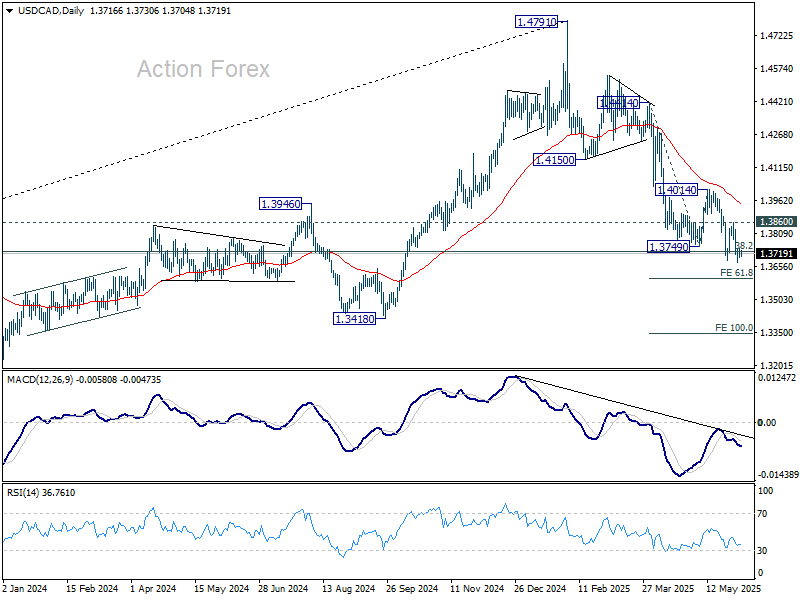
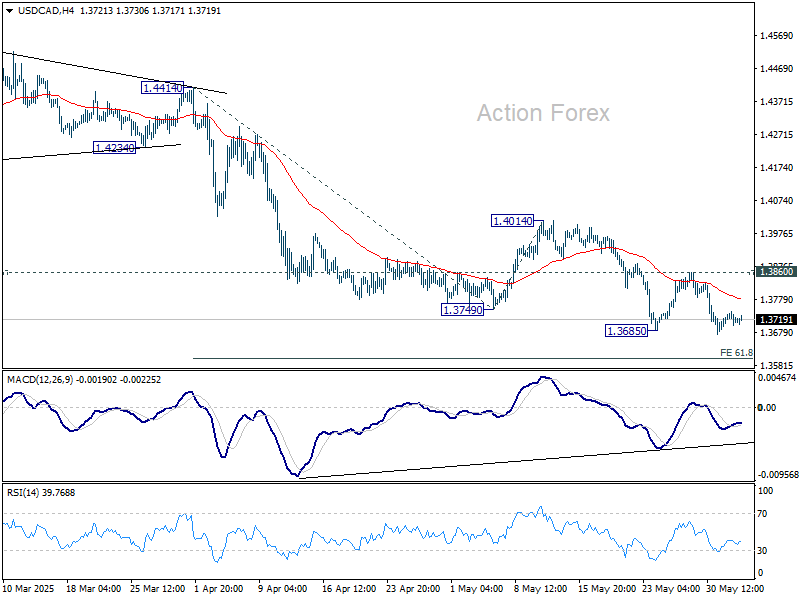
    Intraday bias in USD/CAD remains on the downside for the moment. Fall from 1.4791 should target 100% projection of 1.4791 to 1.4150 from 1.4414 at 1.3773. On the upside, break of 1.4150 support turned resistance is needed to indicate short term bottoming. Otherwise, outlook will stay bearish in case of recovery.

    In the bigger picture, the break of 1.3976 resistance turned support (2022 high) and 55 W EMA (now at 1.3983) indicates that a medium term top is already in place at 1.4791. Fall from there would either be a correction to rise from 1.2005, or trend reversal. In either case, firm break of 38.2% retracement of 1.2005 (2021 low) to 1.4791 at 1.3727 will pave the way back to 61.8% retracement at 1.3069.

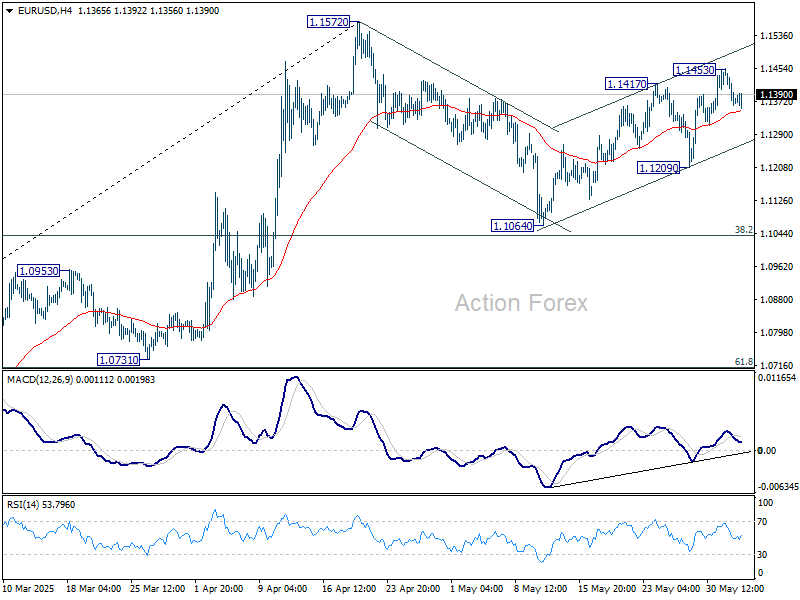
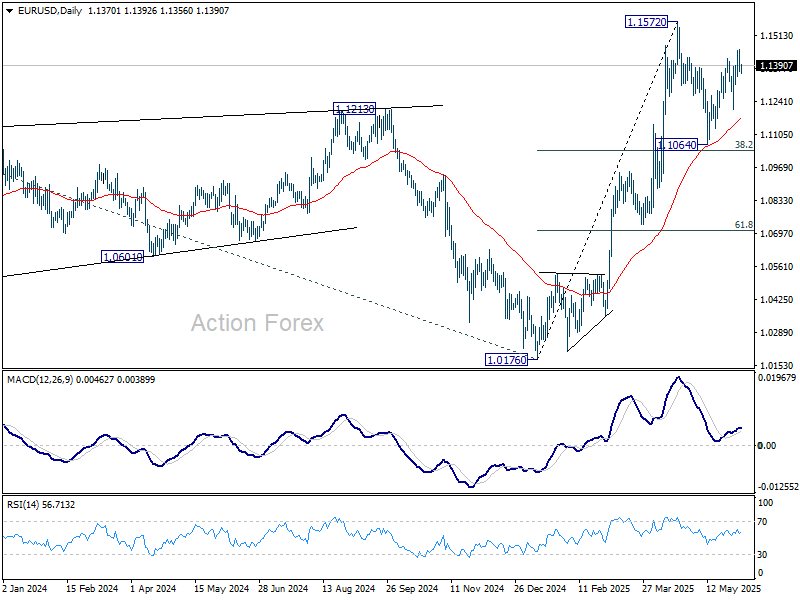
    EUR/USD Daily Outlook

    Daily Pivots: (S1) 1.1207; (P) 1.1340; (R1) 1.1494; More...

    Intraday bias in EUR/USD remains on the upside at this point. Current rally should target 161.8% projection of 1.0358 to 1.0953 from 1.0731 at 1.1694. On the downside, below 1.1245 minor support will turn intraday bias neutral and bring consolidations. But downside should be contained above 1.0912 support to bring another rise.

    In the bigger picture, rise from 0.9534 long term bottom could be correcting the multi-decade downtrend or the start of a long term up trend. In either case, further rise should be seen to 100% projection of 0.9534 to 1.1274 from 1.0176 at 1.1916. This will now remain the favored case as long as 55 W EMA (now at 1.0725) holds.

    GBP/USD Daily Outlook

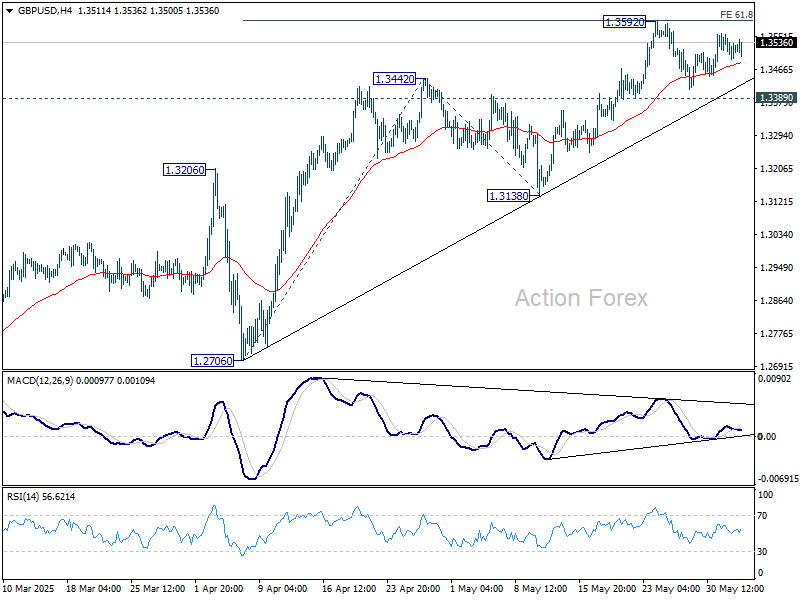
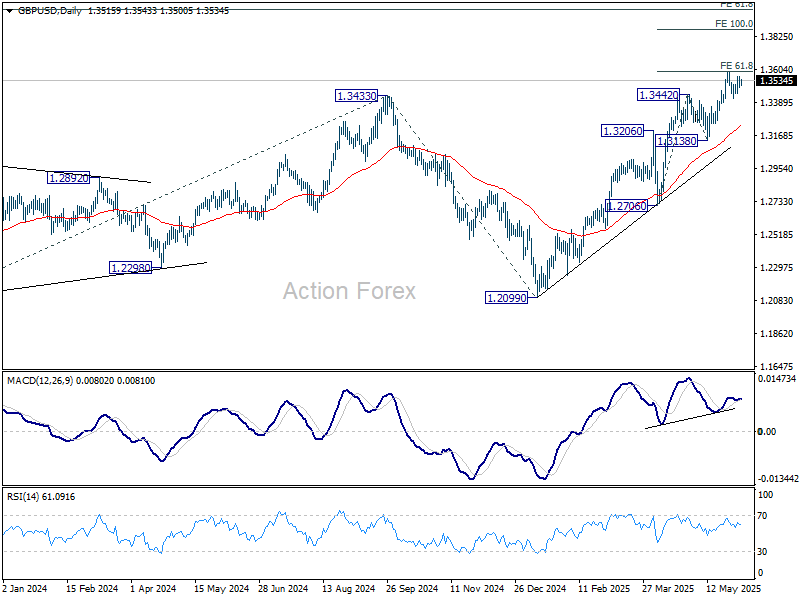
    Daily Pivots: (S1) 1.2987; (P) 1.3067; (R1) 1.3168; More...

    Intraday bias in GBP/USD remains on the upside for 1.3206 resistance. Firm break there will resume the rally from 1.2099 to retest 1.3433 high. On the downside, below 1.2981 minor support will turn intraday bias neutral again first. But overall near term outlook will stay bullish as long as 1.2706 support holds.

    In the bigger picture, price actions from 1.3433 are seen as a corrective pattern to the up trend from 1.3051 (2022 low). Rise from 1.2099 could be the second leg. Overall, GBP/USD should target 1.4248 key resistance (2021 high) on break of 1.3433 at a later stage.

    USD/CHF Daily Outlook

    Daily Pivots: (S1) 0.8079; (P) 0.8173; (R1) 0.8246; More

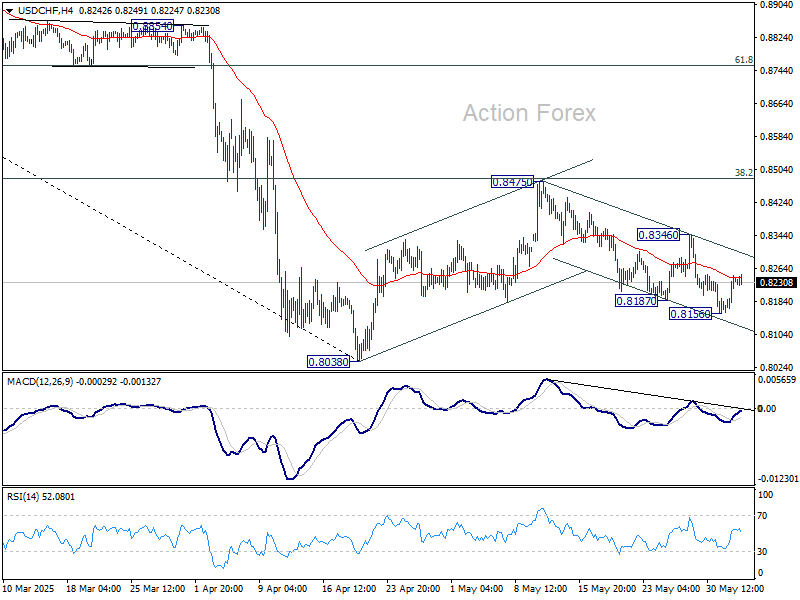
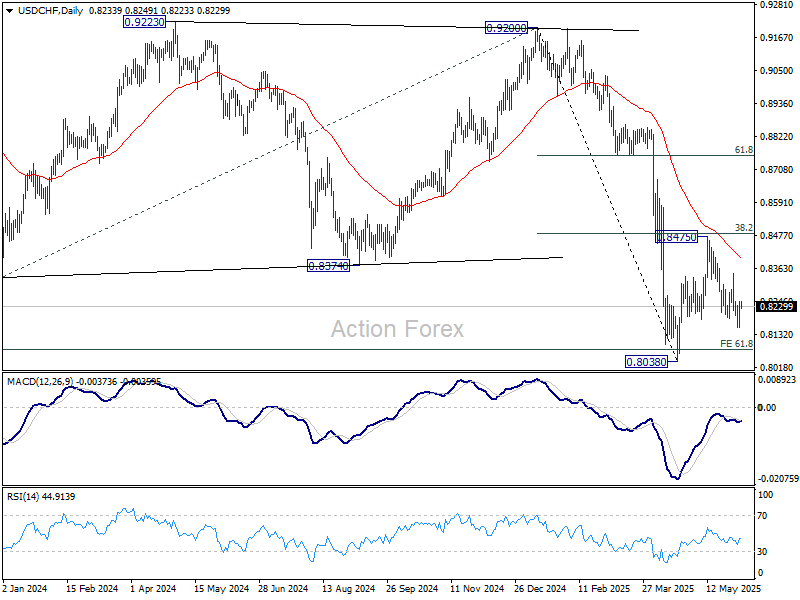
    Intraday bias in USD/CHF stays on the downside at this point. Current down trend should target 200% projection of 0.9196 to 0.8757 from 0.8854 at 0.7976 next. On the upside, above 0.8256 minor resistance will turn intraday bias neutral and bring consolidations first, before staging another fall.

    In the bigger picture, the break of 0.8332 (2023 low) confirms resumption of long term down trend from 1.0342 (2017 high). Next target is 61.8% projection of 1.0146 (2022 high) to 0.8332 from 0.9196 at 0.8075. Firm break there will target 100% projection at 0.7382.
    Markets Eye “Tariff Turmoil”

    In focus this week

    Markets are anxiously assessing US President Trump's next moves in the ongoing "Tariff Turmoil". At the time of writing, most countries face a 10% duty on most exports and a 25% tariff on cars, steel, aluminium as well as most goods from Canada and Mexico. Meanwhile China faces a 145% tariff, and we expect China to take even stronger measures than the already 125% tariff on US exports to boost domestic demand, potentially lowering the policy rate in the week after easter, but refrain from delivering a devaluation. In total this represents a substantial tightening of fiscal policy in the US - heightening recession risks. US retail sales data on Wednesday will be watched closely as an indicator of a potential slowdown in the economy.

    In the euro area, we receive the final March inflation data on Wednesday. We expect the data to confirm the flash release, leading to no market reaction as focus has shifted from inflation towards growth concerns and the trade war.

    On Thursday, the ECB is set to cut policy rates by 25bp to 2.25% in line with market pricing. We expect the statement to repeat "monetary policy is becoming meaningfully less restrictive" and Lagarde to highlight downside risks to growth while abstaining from giving any clear guidance on future rate decisions.

    Economic and market news

    What happened overnight

    In the global trade war, US President Trump stated he would be announcing the tariff on semiconductors over the next week. He also remarked, "You have to show a certain flexibility. Nobody should be so rigid", while also launching a national security trade probe into the semiconductor sector. Meanwhile Chinese President Xi has embarked on his first foreign visit this year to Vietnam, Malaysia and Cambodia. Xi has previously called for greater cooperation with these countries to promote an "equal and orderly multi-polar world".

    What happened over the weekend

    In the global trade war, the Trump Administration excluded phones, chipmaking equipment and certain computers from the reciprocal tariffs, offering a brief moment of relief to the US tech sector. However, US commerce secretary Howard Lutnick has since cautioned that although these products are exempt from reciprocal tariffs, they are not excluded from the semiconductor tariffs anticipated before May this year.

    In the US, the University of Michigan's preliminary consumer sentiment survey for April showed a significant decline in consumer sentiment while inflation expectations increased markedly, akin to the release in March. Sentiment declined to 50.8 from 57.0 (cons: 54.5), Current Conditions declined to 56.5 from 63.8 (cons: 61.5) and Expectations declined to 47.2 from 52.6 (cons: 50.8). 1Y inflation expectations increased to 6.7% from 5.0% (cons: 5.2) while ling-term inflation expectations increased to 4.4% from 4.1% (cons: 4.3).

    The March PPI data showed a decline in Final Demand to 2.7% y/y from 3.2% y/y. This contrasts consensus estimates, which had anticipated a modest increase to 3.3%, likely due to expectations of producers preparing for tariffs increasing producer costs.

    In Sweden, the final inflation data for March released in line with expectations, matching the flash estimates. The CPI was recorded at 0.5% y/y and CPIF came in at 2.3% y/y. Food inflation accelerated, while inflation in clothing and footwear, transport, housing and utilities declined. Overall, annual inflation readings have remained below the Riksbank's 2% target for 8 consecutive months.

    Equities: Equities were generally higher on Friday, with US stocks outperforming Europe as investors rejoiced on tariff exceptions on tech. Exactly what tech products that will be exempted is not clear, but Trump will give more details today. As such, Apple was the standout on Friday. S&P 500 added 1.8% and thereby locking in an average annual equity return in one week - 8%. European equities have been more still, with Stoxx 600 unchanged both on Friday and for the week, though futures point sharply higher when markets open. It should also be noted that Europe is still outperforming US on YTD horizon. The rally appears to linger today, with European futures in catch-up and US futures another 1% higher.

    FI&FX: EUR/USD slipped below 1.13 in early trading Friday as Trump's tariff exemptions on China tempered US recession concerns, providing initial support for the broad USD. With risks of a confidence crisis in USD assets still lingering and several typical market correlations breaking down, the main focus remains on whether easing tariff headlines will be sufficient to stabilise the ongoing sell-off in the USD and Treasuries, as lost credibility may prove difficult to restore. The divergence between US and European rates has been striking during last week's trading sessions. 10Y Bund yields ended the week close to unchanged at 2.55% while 10Y UST rose more than 50bp to just below 4.50% during Friday's session. NOK and SEK remain challenged with the global investment environment taking centre stage.

    USD/JPY Daily Outlook

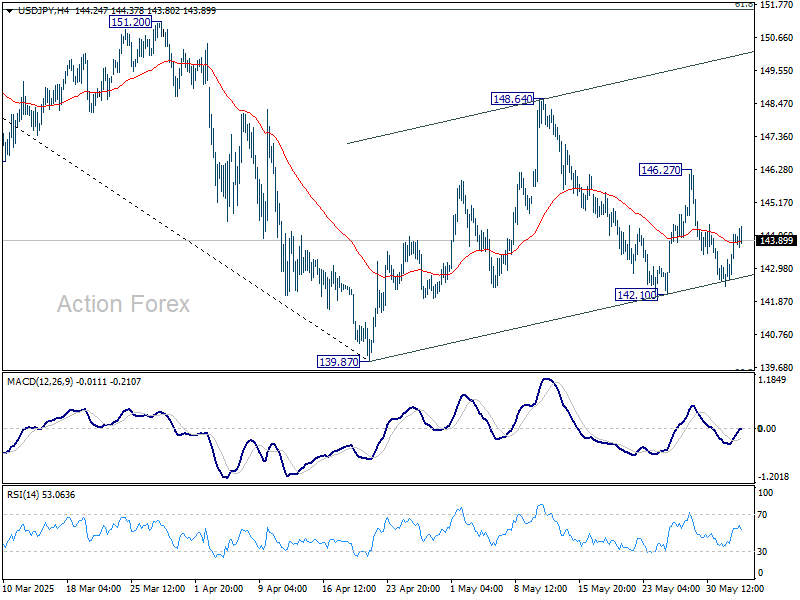
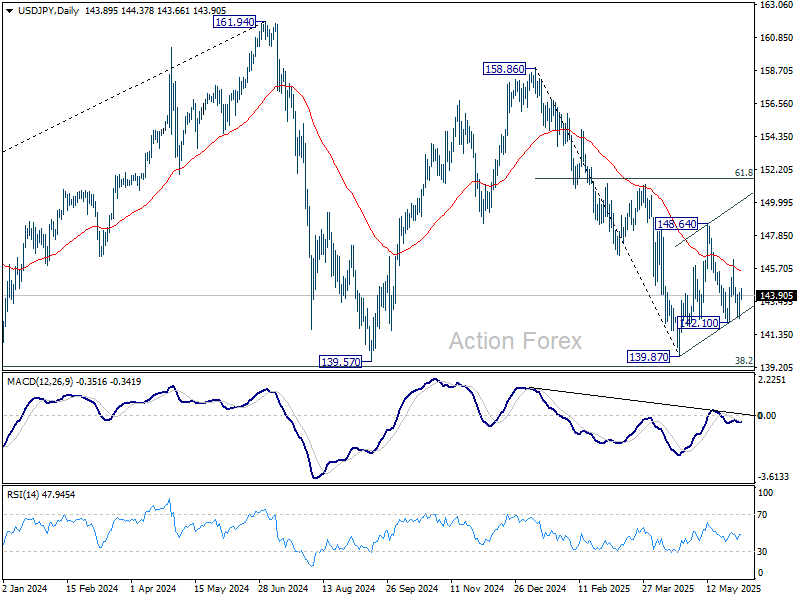
    Daily Pivots: (S1) 142.16; (P) 143.44; (R1) 144.81; More...

    Intraday bias in USD/JPY remains on the downside for the moment. Current fall from 158.86 is in progress to 139.57 support. On the upside, above 144.18 minor resistance will turn intraday bias neutral first. But outlook will stay bearish as long as 151.20 resistance holds, in case of recovery.
    In the bigger picture, price actions from 161.94 are seen as a corrective pattern to rise from 102.58 (2021 low), with fall from 158.86 as the third leg. Strong support should be seen from 38.2% retracement of 102.58 to 161.94 at 139.26 to bring rebound. However, sustained break of 139.26 would open up deeper medium term decline to 61.8% retracement at 125.25.