Sample Category Title
US: Consumer Spending Cools in April Amid Elevated Uncertainty
Consumer spending decelerated in April despite a modest acceleration in income growth. Personal income advanced by 0.8% month-over-month (m/m), well ahead of consensus expectations for a 0.3% m/m gain. This strength, however, did not filter through to spending, which cooled to a gain of 0.2% on the month. As a result, the personal savings rate rose to 4.9% - it's highest level in a year.
On an inflation-adjusted basis, spending grew by a modest 0.1% m/m after a particularly strong performance in March. A decline in goods spending (-0.2% m/m) primarily drove this trend, as March's outsized vehicles sales volumes moderated slightly in April. Services spending growth also softened, but remained stable at 0.3% m/m.
Inflationary pressures changed little in April, with core PCE matching the 0.1% m/m gain seen in March. In annual terms, core PCE fell to 2.5% - its lowest level in four years
Key Implications
Consumer spending came off the burner in April as the implementation of reciprocal tariffs weighed on consumer confidence and began to bring an end to the front-loading behavior we had seen in March. Moving forward, we expect consumer spending to grow at a modest pace of 1.8% in the second quarter as the economy continues to adapt to a higher cost environment.
On the price front, we saw the Federal Reserve's preferred inflation metric - core PCE - continue to ease in April. However, moving forward it is likely that the tariff policies in effect will begin to influence consumer prices. We expect that barring an alteration in tariff composition, core PCE will rise above 3% by the second half of this year. The federal court rulings this week against the bulk of the administration's tariffs, while subsequently stayed pending appeal proceedings, adds an additional layer of uncertainty that is likely to prevail over businesses, the labor market, and by extension consumer spending in the months ahead.
EUR/USD Mid-Day Outlook
Daily Pivots: (S1) 1.1258; (P) 1.1322; (R1) 1.1432; More...
Intraday bias in EUR/USD remains neutral at this point. On the upside, break of 1.1417 resistance will revive the case that correction from 1.1572 has completed at 1.1064. Retest of 1.1572 should then be seen next. Nevertheless, break of 1.1209 will extend the corrective pattern and target 1.1064 support and possibly below.
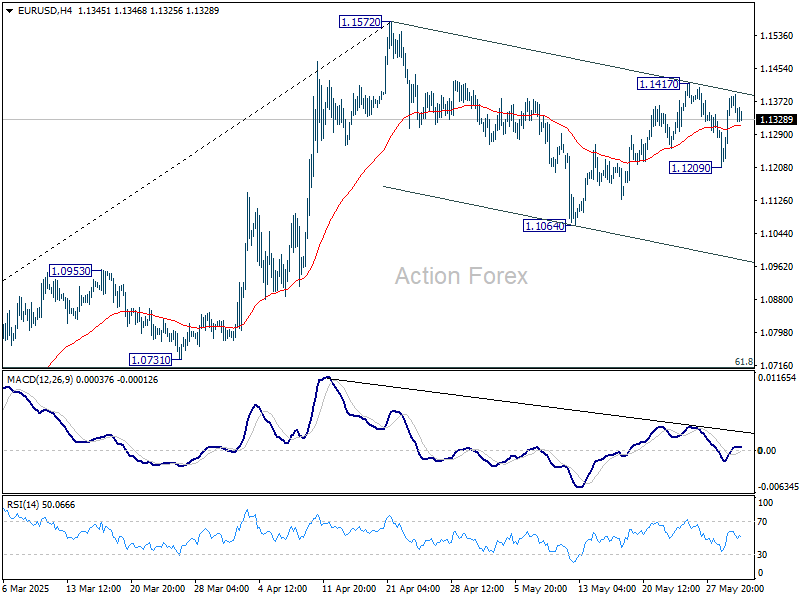
In the bigger picture, rise from 0.9534 long term bottom could be correcting the multi-decade downtrend or the start of a long term up trend. In either case, further rise should be seen to 100% projection of 0.9534 to 1.1274 from 1.0176 at 1.1916. This will remain the favored case as long as 55 W EMA (now at 1.0858) holds.
GBP/USD Mid-Day Outlook
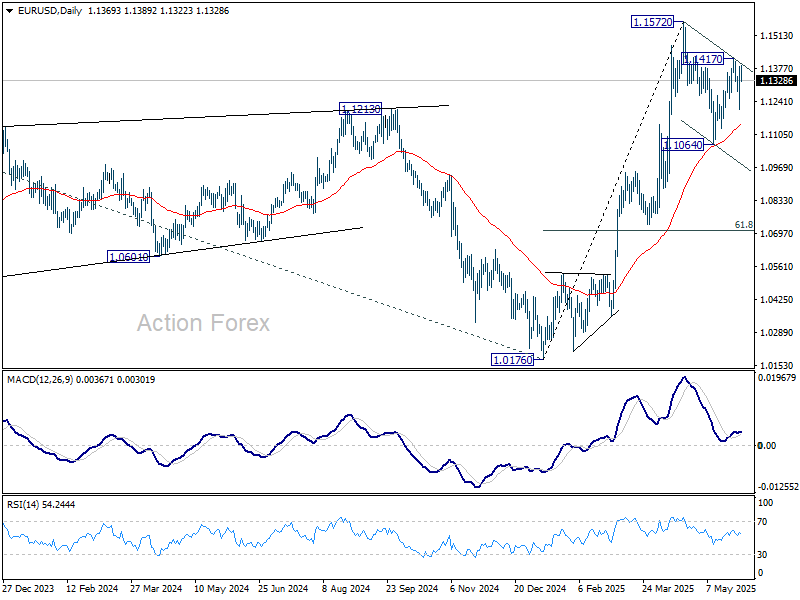
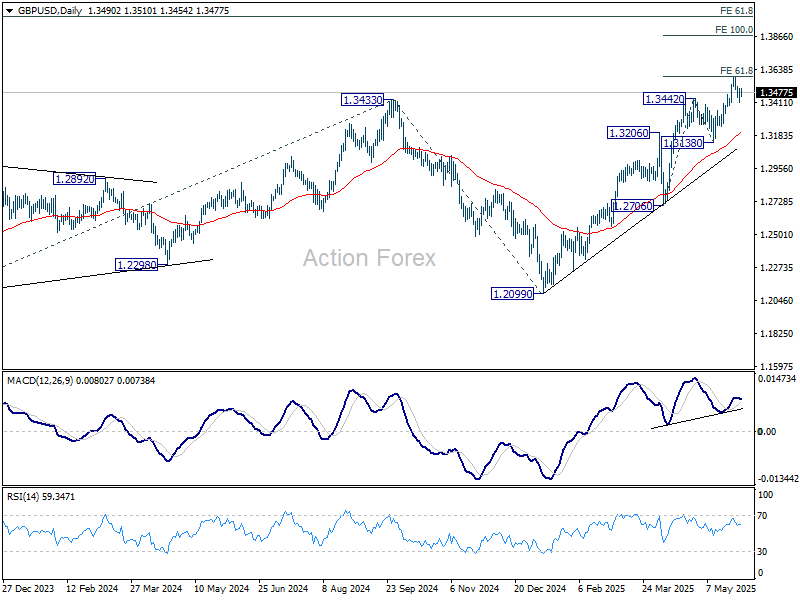
Daily Pivots: (S1) 1.3437; (P) 1.3472; (R1) 1.3529; More...
Range trading continues in GBP/USD and intraday bias remains neutral. With 1.3389 support intact, further rally is expected. On the upside, firm break of 1.3592 will resume larger rally for 100% projection of 1.2706 to 1.3442 from 1.3138 at 1.3874. However, decisive break of 1.3389 will confirm short term topping, and turn bias back to the downside for 1.3138 support instead.
In the bigger picture, up trend from 1.3051 (2022 low) is in progress. Next medium term target is 61.8% projection of 1.0351 to 1.3433 from 1.2099 at 1.4004. Outlook will now stay bullish as long as 55 W EMA (now at 1.2870) holds, even in case of deep pullback.
USD/JPY Mid-Day Outlook
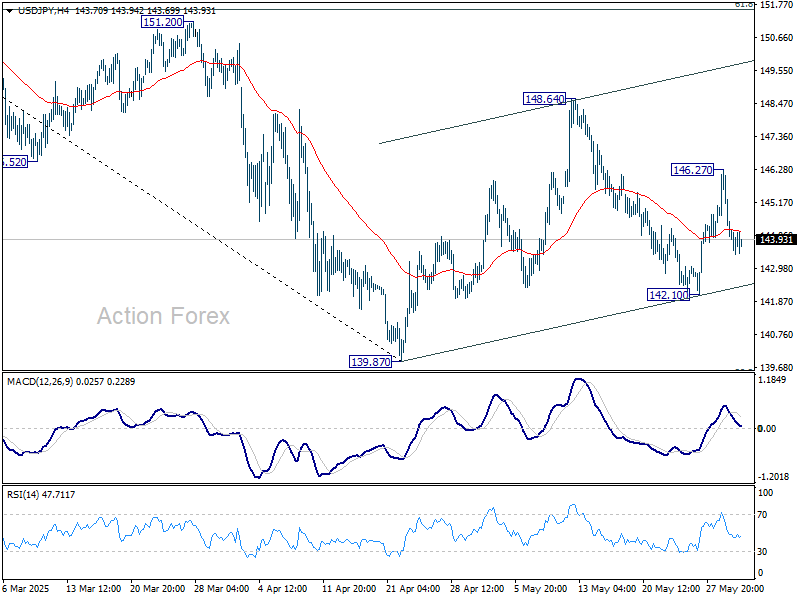
Daily Pivots: (S1) 143.34; (P) 144.81; (R1) 145.66; More...
Intraday bias in USD/JPY stays neutral at this point. On the upside, above 146.27 will target 148.64 resistance first. Firm break there will resume the rebound from 139.87. Nevertheless, break of 142.10 will bring deeper fall back to 139.87 low.
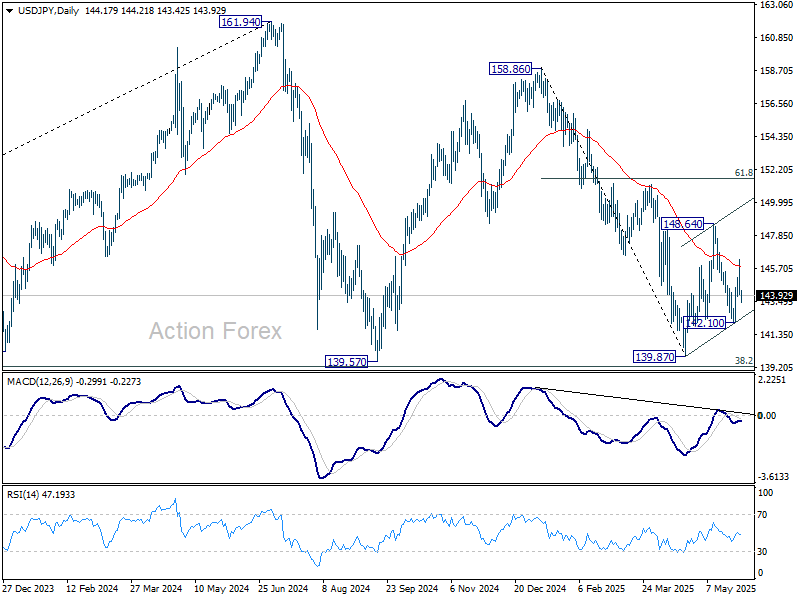
In the bigger picture, price actions from 161.94 are seen as a corrective pattern to rise from 102.58 (2021 low), with fall from 158.86 as the third leg. Strong support should be seen from 38.2% retracement of 102.58 to 161.94 at 139.26 to bring rebound. However, sustained break of 139.26 would open up deeper medium term decline to 61.8% retracement at 125.25.
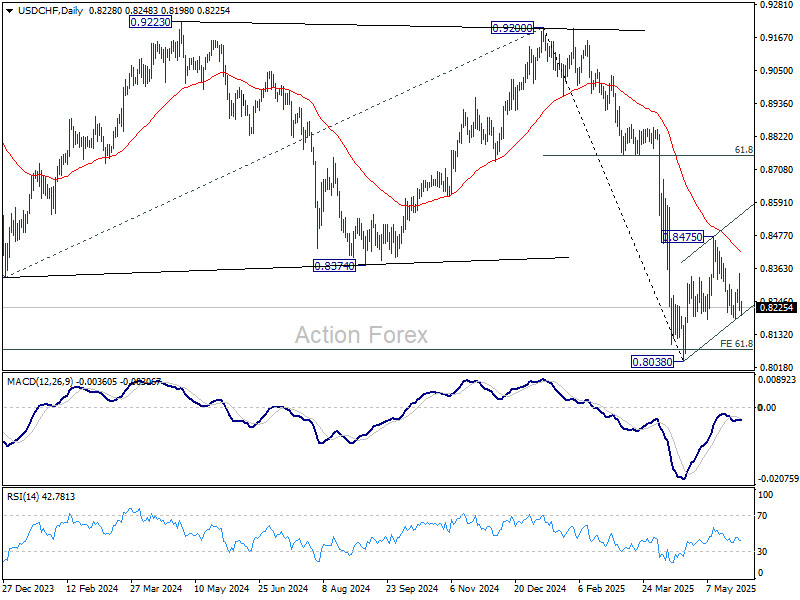
USD/CHF Mid-Day Outlook
Daily Pivots: (S1) 0.8182; (P) 0.8265; (R1) 0.8312; More….
Range trading continues in USD/CHF and intraday bias stays neutral. On the downside, break of 0.8187 will resume the fall from 0.8475 to retest 0.8038 low. On the upside, above 0.8346 will bring stronger rise to 0.8475. Firm break there will extend the corrective pattern from 0.8038 with another rising leg.
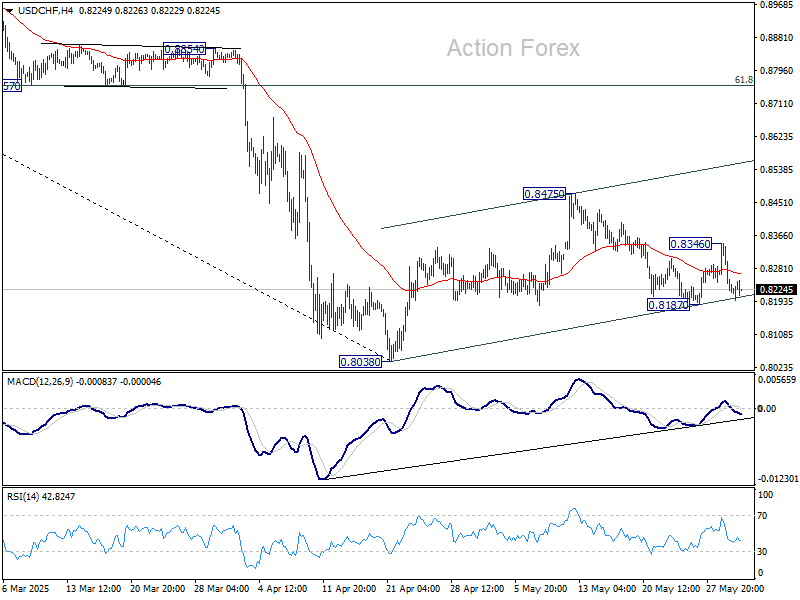
In the bigger picture, long term down trend from 1.0342 (2017 high) is still in progress and met 61.8% projection of 1.0146 (2022 high) to 0.8332 from 0.9200 at 0.8079 already. In any case, outlook will stay bearish as long as 55 W EMA (now at 0.8713) holds. Sustained break of 0.8079 will target 100% projection at 0.7382.
Trade Rhetoric Sours Sentiment Again as US-China Tensions Resurface
Market sentiment took another bearish turn today following renewed rhetoric from US President Donald Trump, who accused China of having "totally violated" its preliminary trade agreement with the U.S. The comments, delivered via social media, were echoed by Trade Representative Jamieson Greer in a CNBC interview, where he expressed concern over China's delayed compliance. Greer emphasized that while the US had fulfilled its commitments under the temporary trade deal, China was "slow rolling" its response—raising fears that tensions between the two economic powers may be re-escalating.
These remarks followed comments from Treasury Secretary Scott Bessent just a day earlier, who admitted that US-China trade talks were “a bit stalled,” though he hinted at possible high-level engagement in the coming weeks. However, the combined messaging from senior officials now points to growing frustration in Washington, increasing the risk of a renewed tariff cycle. That's something the markets are highly sensitive to, especially with ongoing legal uncertainty surrounding the court-blocked reciprocal tariffs and their pending appeal.
On the macro front, the US April core PCE price index ticked down to 2.5% year-on-year, reaffirming that disinflation is progressing, albeit slowly. With inflation trending lower but global uncertainty mounting, Fed is widely expected to hold rates steady in the near term. Fed funds futures currently price in a 95% chance of a hold at the June FOMC meeting and a 73% chance of another hold in July. The soft inflation reading does little to shift the central bank’s cautious stance, especially as trade risks remain firmly in focus.
In the currency markets, Dollar is heading into the final house of the trading week as the strongest performer, followed by Swiss Franc and Euro. On the weaker end, Aussie struggles at the bottom, trailed by Yen and Loonie. Kiwi and Sterling are holding in the middle. However, with sentiment remaining fragile and trade headlines still in play, positioning could shift quickly before the weekly close.
In Europe, at the time of writing, FTSE is up 0.55%. DAX is up 0.72%. CAC is up 0.09%. UK 10-year yield is up 0.21 at 4.672. Germany 10-year yield is up 0.019 at 2.529. Earlier in Asia, Nikkei fell -1.22%. Hong Kong HSI fell -1.20%. China Shanghai SSE fell -0.47%. Singapore Strait Times fell -0.57%. Japan 10-year JGB yield fell -0.015 to 1.505.
US core PCE inflation cools to 2.5%, income surges
US headline PCE price index rose 0.1% mom in April, in line with expectations, while annual inflation slipped from 2.3% yoy to 2.1% yoy, below the consensus of 2.2%.
Core PCE, Fed’s preferred inflation gauge, also rose 0.1% mom and slowed from 2.6% yoy to 2.5% yoy, matching expectations. The data supports the view that disinflation remains intact, though the pace of moderation remains modest.
At the same time, personal income data surprised to the upside, jumping 0.8% mom or USD 210.1B, well above the expected 0.3% mom. Personal spending rose a more modest 0.2% mom, matching forecasts.
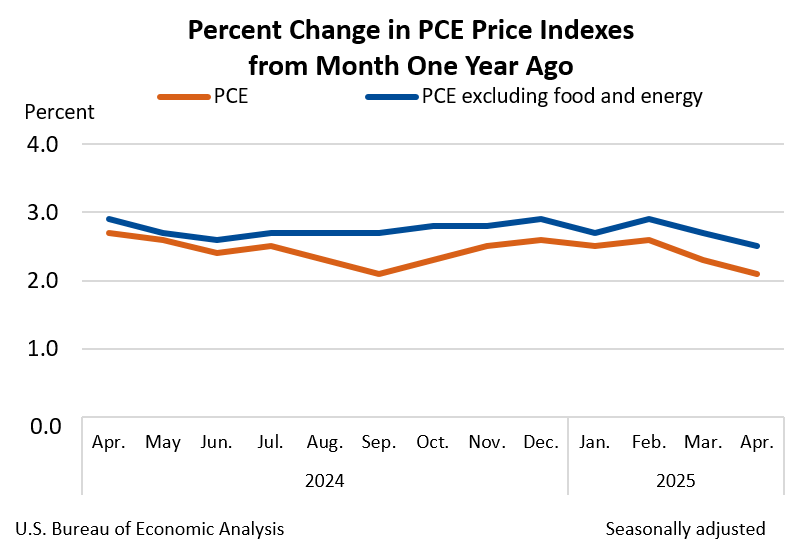
Canada GDP expands 0.1% mom in March, another 0.1% mom in April
Canada’s GDP grew by 0.1% mom in March, in line with market expectations. Strength in goods-producing industries continued to support overall output. The sector expanded by 0.2%, marking its second lead contribution in the past three months.
Services-producing industries also edged higher by 0.1%. In total, 9 out of 20 sectors posted growth.
Looking ahead, preliminary data from Statistics Canada suggests another 0.1% increase in real GDP for April.
ECB’s Panetta signals diminished room for further rate cuts
Italian ECB Governing Council member Fabio Panetta said today that while the central bank has made meaningful progress in easing monetary policy, bringing the deposit rate down from 4% to 2.25%, "the room for further rate cuts has naturally diminished".
"However, the economic outlook remains weak, and trade tensions could lead to a deterioration," he added. "It will be essential to maintain a pragmatic and flexible approach, considering liquidity conditions and the signals coming from financial and credit markets."
Panetta also highlighted the high-stakes nature of ongoing trade talks between the EU and the US, warning that even tensions are likely to have a “significant impact” on the region’s economy.
BoE’s Taylor: Global headwinds justify lower monetary policy path
BoE MPC member Alan Taylor reinforced his dovish position in an interview with the Financial Times, highlighting growing downside risks to the UK economy from global developments.
Taylor, who alongside Swati Dhingra voted for a larger 50bps rate cut in May, argued that monetary policy should be on a “lower policy path” given the accumulating headwinds.
He specifically pointed to impact of Trump’s tariffs on imports would “be building up over the rest of this year in terms of trade diversion and drag on growth”.
While UK inflation unexpectedly jumped to 3.5% in April, Taylor downplayed the significance of the rise, attributing it to "one-time tax and administered price changes."
Swiss KOF rises to 98.5, but growth outlook remains subdued
Switzerland’s KOF Economic Barometer edged up to 98.5 in May from 97.1, marking a modest improvement in economic sentiment. While the uptick is a positive signal, the barometer remains below its long-term average, suggesting that the broader outlook for the Swiss economy "remains subdued".
According to the KOF, the manufacturing sector showed notable strength, contributing to the overall improvement. However, indicators tied to foreign demand and private consumption remain under pressure, highlighting the ongoing drag from weak external conditions and cautious domestic spending.
Japan's industrial production falls -0.9% mom in April, but May rebound expected
Japan's industrial production fell by -0.9% mom in April, a milder decline than the expected -1.4%. The Ministry of Economy, Trade and Industry maintained its view that production "fluctuates indecisively," reflecting ongoing uncertainty, particularly around global trade developments.
While the ministry said the impact of US tariffs was limited in April, some firms have voiced concern about the manufacturing outlook as policy risks persist.
The breakdown of the data shows a mixed picture: six of 15 industrial sectors saw declines, including production machinery, fabricated metals, and transport equipment excluding motor vehicles. However, eight sectors recorded gains, with electronic parts and business-oriented machinery showing notable strength.
Manufacturers surveyed expect a sharp 9.0% rebound in May, followed by a -3.4% dip in June.
Also released, Japan's retail sales grew by a stronger-than-expected 3.3% yoy in April, outpacing the consensus of 2.9% yoy. Meanwhile, the unemployment rate remained steady at 2.5%.
Tokyo core inflation accelerates to 3.6%, driven by food and services costs
Tokyo's core CPI (excluding fresh food) accelerated to 3.6% yoy in May, up from 3.4% yoy and above market expectations of 3.5% yoy, marking the fastest pace since January 2023. This marks the third consecutive year that core inflation has exceeded the Bank of Japan’s 2% target.
While headline CPI ticked down slightly from 3.5% yoy to 3.4% yoy, the underlying core-core measure (excluding food and energy) also edged up fro 2.0% yoy to 2.1% yoy, suggesting broad-based inflation persistence.
The surge in non-fresh food prices, up 6.9% yoy, remains a dominant driver—highlighted by a staggering 93.2% yoy jump in rice prices.
Another notable development is the uptick in services inflation, which climbed to 2.2% yoy from 2.0% yoy , indicating that businesses are beginning to pass on higher labor costs.
Australia retail sales down -0.1% mom in April, weighed by weak clothing demand
Australia’s retail sales turnover unexpectedly declined by -0.1% mom in April, missing expectations for a 0.3% mom rise. On an annual basis, sales were up 3.8% compared to April 2024/
The Australian Bureau of Statistics noted that the decline was driven primarily by reduced spending on clothing. The weakness was partly offset by a rebound in Queensland, where businesses recovered from disruptions caused by ex-Tropical Cyclone Alfred in March.
RBNZ's Silk: Data to guide timing and need for further cuts
RBNZ Assistant Governor Karen Silk said that interest rates are currently within the estimated neutral band of 2.5% to 3.5%.
She noted that the full impact of previous easing has yet to filter through the economy, making any future adjustments highly dependent on incoming data.
The OCR track indicates "whatever we do is going to be data-dependent, and then we will be looking to the data to help us to decide when or if we cut further from here," she added.
USD/CHF Mid-Day Outlook
Daily Pivots: (S1) 0.8182; (P) 0.8265; (R1) 0.8312; More….
Range trading continues in USD/CHF and intraday bias stays neutral. On the downside, break of 0.8187 will resume the fall from 0.8475 to retest 0.8038 low. On the upside, above 0.8346 will bring stronger rise to 0.8475. Firm break there will extend the corrective pattern from 0.8038 with another rising leg.
In the bigger picture, long term down trend from 1.0342 (2017 high) is still in progress and met 61.8% projection of 1.0146 (2022 high) to 0.8332 from 0.9200 at 0.8079 already. In any case, outlook will stay bearish as long as 55 W EMA (now at 0.8713) holds. Sustained break of 0.8079 will target 100% projection at 0.7382.
Canada GDP expands 0.1% mom in March, another 0.1% mom in April
Canada’s GDP grew by 0.1% mom in March, in line with market expectations. Strength in goods-producing industries continued to support overall output. The sector expanded by 0.2%, marking its second lead contribution in the past three months.
Services-producing industries also edged higher by 0.1%. In total, 9 out of 20 sectors posted growth.
Looking ahead, preliminary data from Statistics Canada suggests another 0.1% increase in real GDP for April.
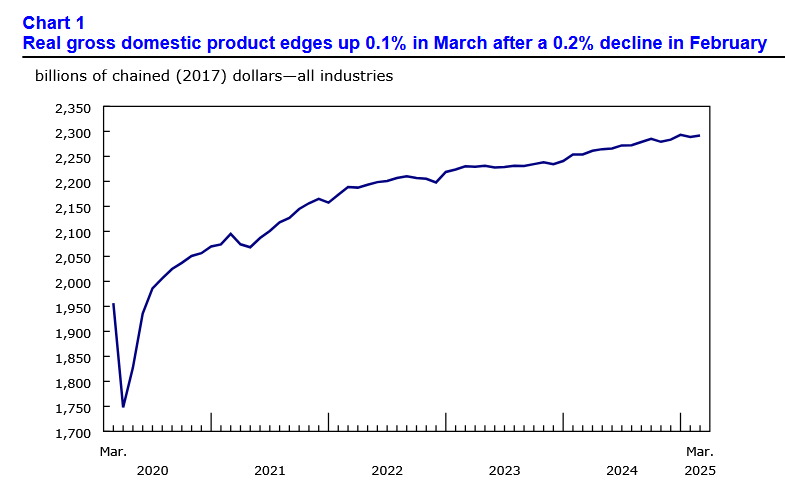
US core PCE inflation cools to 2.5%, income surges
US headline PCE price index rose 0.1% mom in April, in line with expectations, while annual inflation slipped from 2.3% yoy to 2.1% yoy, below the consensus of 2.2%.
Core PCE, Fed’s preferred inflation gauge, also rose 0.1% mom and slowed from 2.6% yoy to 2.5% yoy, matching expectations. The data supports the view that disinflation remains intact, though the pace of moderation remains modest.
At the same time, personal income data surprised to the upside, jumping 0.8% mom or USD 210.1B, well above the expected 0.3% mom. Personal spending rose a more modest 0.2% mom, matching forecasts.
Australian Dollar Dips on Soft Retail Sales, US Court Reinstates Tariffs
The Australian dollar is in negative territory on Friday. In the European session, AUD/USD is trading at 0.6415, down 0.42% on the day.
Australian retail sales show unexpected decline
Australia's retail sales contracted in April by 0.1% m/m, missing the market estimate of 0.3%, which was also the March reading. This was the first decline since December, weighed by declines in clothing and department store spending. Annually, retail sales rose 3.8%, compared to 4.3% in March.
The weak retail sales report points to a nervous Austrlian consumer and will support the case for further rate cuts. The Reserve Bank of Australia lowered rates by a quarter-point to 3.85% last week, only the second rate cut this year. The markets expect the Reserve Bank to be more aggressive and have priced in a cut of at least 75 basis points before the end of the year, which would lower the cash rate to around 3%.
Consumer spending and confidence remain weak and further rate cuts would boost consumption. However, US President Trump's zig-zag tariff policy has created huge uncertainty, making it difficult for the RBA to chart a rate path.
The US has imposed 10% tariffs on Australian products but even more concerning is the US-China trade war. The two countries agreed earlier this month to dramatically lower the tariff rates on each other but the agreement is only for 90 days. China is Australia's largest trading partner and a downturn in China's economy would damage Australia's export-reliant economy.
Federal court reinstates Trump's tariffs
The tariffs are winding their way through the US courts. A trade court panel ruled this week that most of Trump's tariffs were illegal but on Thursday, an appeals court granted the Trump administration a temporary pause, which keeps the tariffs in effect. The legal fight over the tariffs could go all the way to the Supreme Court and is causing even more uncertainty in the financial markets.
AUD/USD Technical
- AUD/USD has pushed below support at 0.6434 and is testing 0.6421. Next, there is support at 0.6402
- There is resistance at 0.6453 and 0.6466
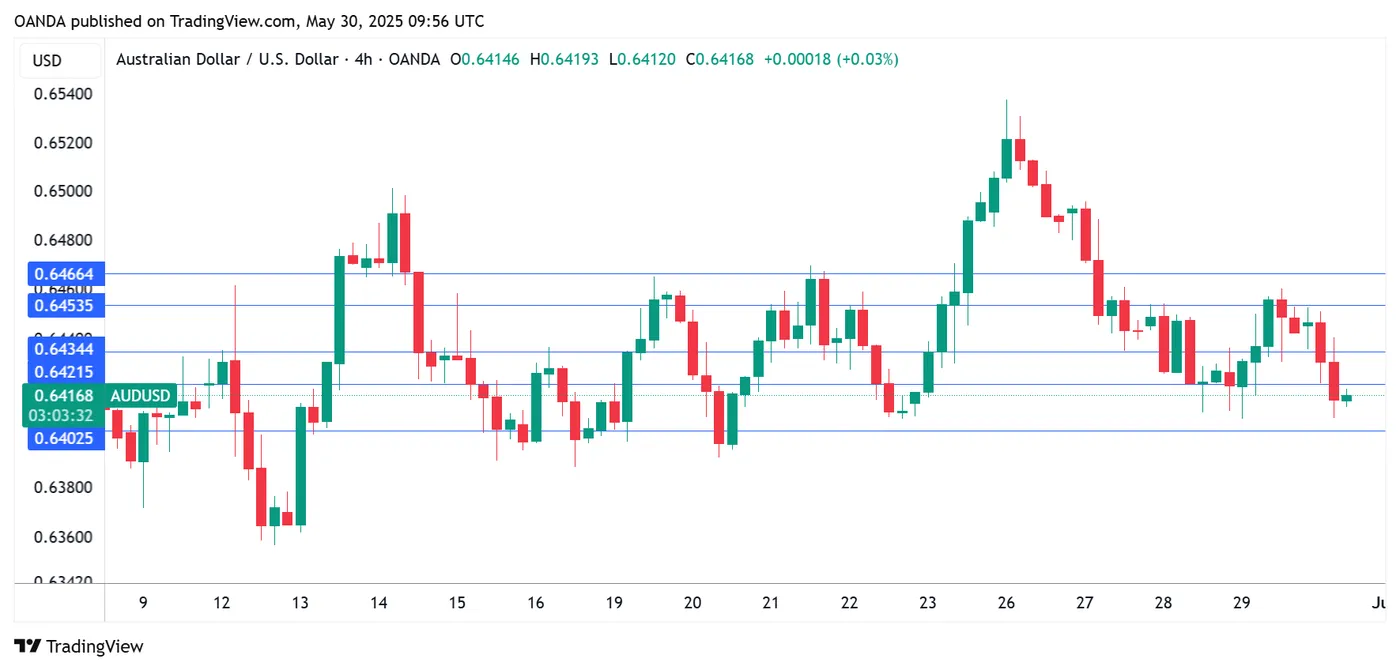
AUDUSD 4-Hour Chart, May 30, 2025
AUDJPY Finds Intraday Sellers at Equal Legs Area
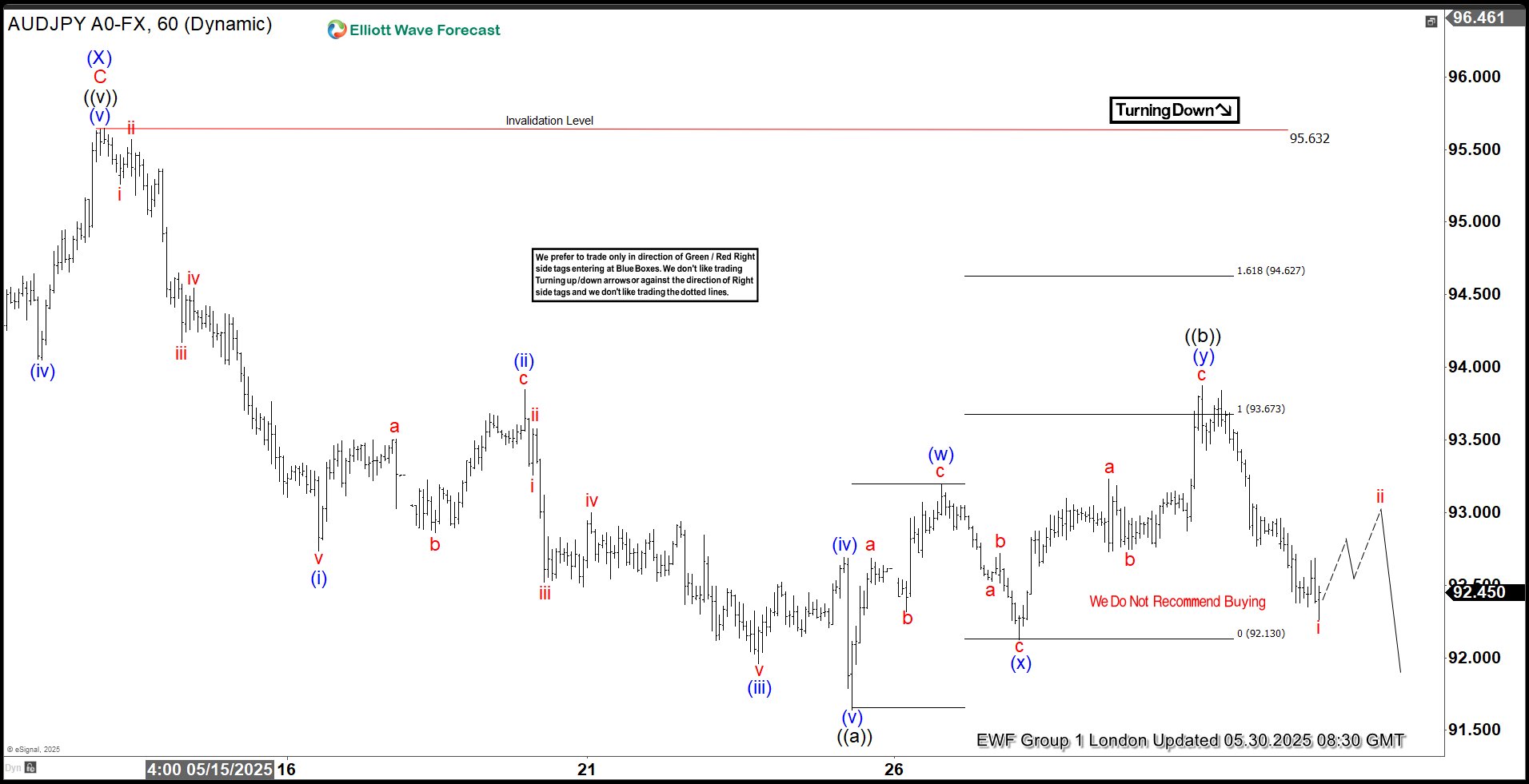
Hello fellow traders. In this technical article we’re going to look at the Elliott Wave charts of AUDJPY forex pair published in members area of the website. The pair has recently given us a 3 waves bounce that completed precisely at the equal legs area as we expected. In the following text, we’ll explain the Elliott Wave analysis and present target areas.
AUDJPY Elliott Wave 1 Hour Chart 05.28.2025
EURUSD is currently forming a three-wave pullback against the95.63 peak, unfolding as a Zig Zag pattern — (a)-(b)-(c). Our members are aware that we get the potential reversal area by measuring the Equal Legs zone, (a)-(b) . This zone comes at 93.65-94.61 area. We expect sellers to emerge within this region and anticipate a continuation of the decline toward new lows ideally.
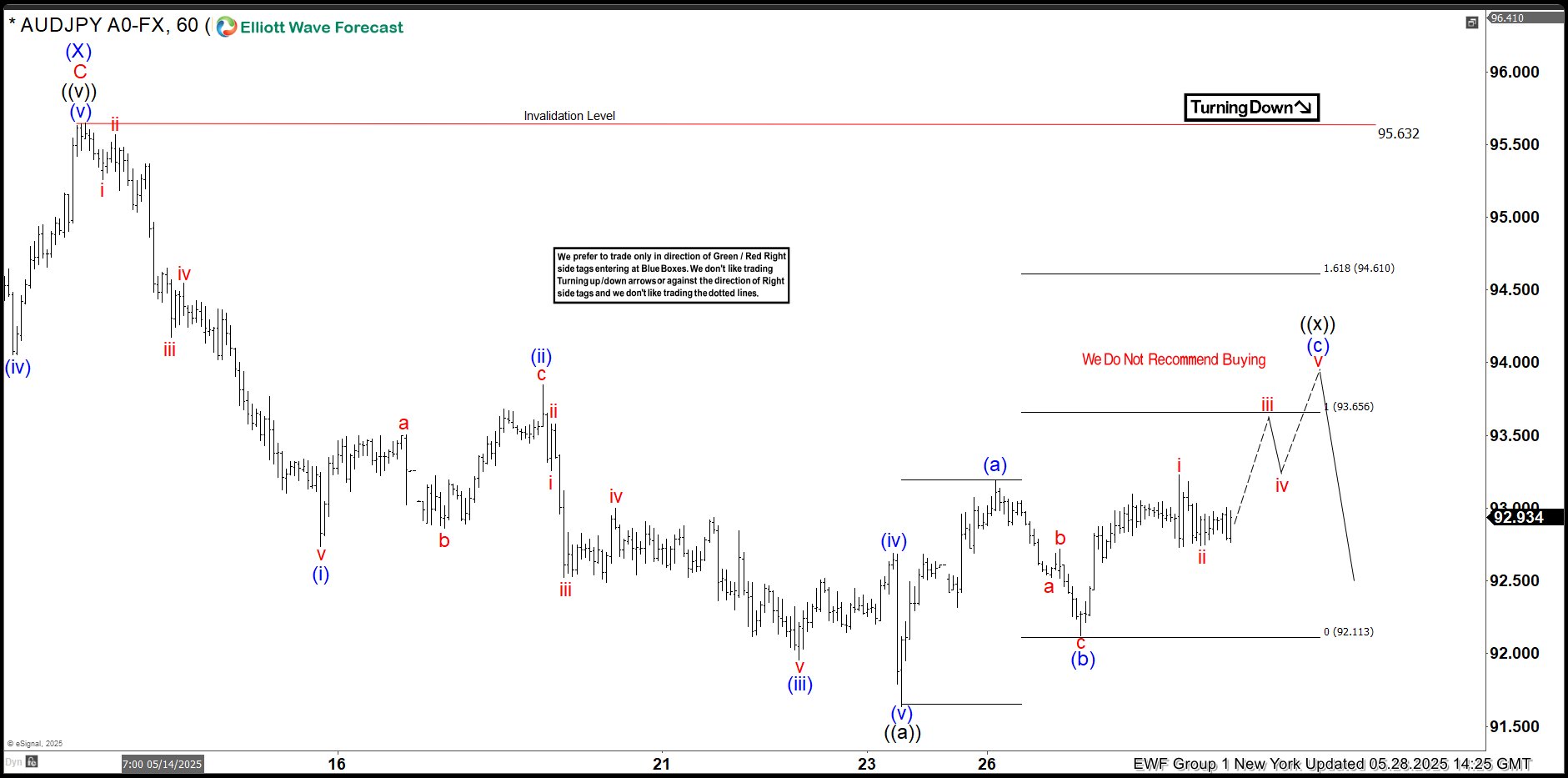
AUDJPY Elliott Wave 1 Hour Chart 05.28.2025
The pair found sellers as expected in the Equal Legs area and has delivered a decent decline so far. We would now like to see a break below the May 23rd low to confirm that the next leg lower is in place. In that case, further downside extension would be expected, ideally targeting the 89.86 area.