Sample Category Title
Yen Softens on Weak Japan PMIs Disappoints, Markets Tread Water Elsewhere
Yen weakened broadly in a relatively quiet Asian session, dragged down by disappointing PMI data. The worrying sign is that both manufacturing and services sectors are now in contraction, pointing to growing signs of weakness in Japan’s economy. Despite expectations that BoJ will raise interest rates further this year, supported by strong wage growth, today's data raises fresh doubts about the timing and viability of the central bank’s tightening path.
The weakening economic backdrop also arrives at a delicate time for Japan, with the specter of new US tariffs looming. Downside risks from a global trade war could weigh on Japan’s export-dependent economy. Rising input costs and shaky external demand may ultimately delay further rate normalization.
Adding to the uncertainty, confusion over the shape and scope of US President Donald Trump’s “Liberation Day” tariffs continues to swirl. A report from the Wall Street Journal over the weekend suggested the White House is set to "narrow" its approach. The current thinking appears to be a scaled-back plan that will still include reciprocal tariffs but may delay industry-specific measures. This may align with Trump’s previous remark that there would be “flexibility”.
Until the April 2 announcement materializes, traders are likely to remain in a wait-and-see mindset, with many choosing to reduce exposure amid headline risk. Market movements in this environment may be temporary and driven more by short-term positioning than conviction. The broader direction for currencies and equities may not be defined until the full scope of the tariffs and their retaliations are well-understood.
For now, Canadian and Australian Dollars are leading the day, together with Euro. Yen and Kiwi are lagging, with Swiss Franc also on the weaker side. Dollar and Sterling are positioning in the middle.
Technically, AUD/CAD's rebound from 0.8853 (Jan low) is so far seen as a corrective move based on its structure. Break of 0.8951 support will argue that the correction has completed. Fall from 0.9375 would then be ready to resume through 0.8853 to 61.8% projection of 0.9375 to 0.8853 from 0.9128 at 0.8805 next.
In Asia, at the time of writing, Nikkei is down -0.01%. Hong Kong HSI is down -0.21%. China Shanghai SSE is down -0.49%. Singapore Strait Times is up 0.17%. Japan 10-year JGB yield is up 0.027 at 1.544.
BoJ’s Ueda reaffirms commitment to rate hikes despite market and financial pressures
BoJ Governor Kazuo Ueda told parliament today that the central bank remains committed to raise interest rate if underlying inflation is deemed to be approaching its 2% target.
He emphasized that BoJ’s objectives remain squarely focused on price stability, and that its approach to policy "would not be disturbed by considerations for the BoJ's finances."
Ueda’s remarks come as concerns mount over the BoJ’s balance sheet in light of interest rate hikes and volatility in equity markets.
BoJ estimated in December that if short-term borrowing costs were to rise to 2%, it could incur losses of up to JPY 2 trillion.
Additionally, Ueda noted that a 1000-point drop in the Nikkei 225 index would translate into a valuation loss of about JPY 1.8 trillion in its ETF holding.
While these figures highlight the scale of financial risks, Ueda’s insistence on prioritizing price stability signals that BoJ is prepared to weather market volatility in pursuit of its monetary policy mandate.
Japan PMI composite falls to 48.5, business confidence sinks to lowest since 2020
Japan’s private sector saw a sharp loss in momentum at the end of Q1, with PMI Composite falling from 52.0 to 48.5, marking the first contraction in five months. PMI Manufacturing dropped from 49.0 to 48.3, its lowest in a year and ninth consecutive month in contraction. More concerning was the steep decline in PMI services, which fell from 53.7 to 49.5 — the weakest reading since mid-2024.
According to Annabel Fiddes of S&P Global, the downturn was driven by a "fresh fall in service sector activity" and an accelerated decline in manufacturing. Firms pointed to "strong inflationary pressure had dampened sales", with clients showing increasing hesitation to place orders.
The broader picture is one of growing pessimism. Japanese firms cited a host of structural and cyclical challenges — from persistent inflation and labor shortages to an aging population and deepening global trade uncertainty. As a result, business confidence for future activity fell to its lowest level since August 2020.
Australia's PMI manufacturing jumps to 52.6, services rises to 51.2
Australia’s PMI Manufacturing surged to 52.6 from 50.4—marking a 29-month high—while PMI Services ticked up to 51.2 from 50.8. PMI Composite , which combines both sectors, rose to a 7-month high at 51.3.
Jingyi Pan of S&P Global Market Intelligence highlighted that the output growth was not only the strongest in seven months but also "broad-based" across both manufacturing and services. Despite a decline in export orders due to weather disruptions and weak global conditions, domestic demand rebounded impressively, pushing new orders to their highest growth rate in nearly three years.
However, the report also highlighted a notable dip in business confidence. Suppressed price increases may have helped support near-term demand. But "tariff uncertainty may continue to cast a shadow on output growth in the year ahead".
Markets Eye Data Avalanche to Close Q1
The final week of Q1 will be marked by a flood of high-impact economic data from around the world, covering everything from PMIs to inflation and consumer sentiment. The central narrative across many regions will be the lingering uncertainty and fallout from the escalating tariff war, particularly between the US and its trading partners.
In the US, the spotlight remains squarely on how the trade war is affecting consumers and businesses. Consumer confidence will be critical, following a sharp deterioration since the beginning of the year due to tariff anxiety. Even more important will be whether this shift in sentiment is already impacting spending. Business PMIs, especially in the services sector, will be examined for hiring trends, while manufacturers may reveal pricing pressures and cost concerns as they brace for more tariffs.
Europe’s attention will be on whether recent optimism over Germany and the EU’s fiscal expansion is filtering into economic activity. Although the spending plan is still in its early stages, it could lift sentiment—particularly in manufacturing PMI data. Additionally, Germany’s Ifo business climate and GfK consumer confidence surveys will be closely watched for signs of a sustainable rebound.
The UK will deliver CPI and retail sales, two key indicators that could influence BoE's policy path. However, barring a significant downside surprise in inflation, BoE is unlikely to deviate from its slow-and-steady approach — one cut per quarter.
In Japan, BoJ’s Summary of Opinions will offer critical insights into policymakers’ sentiment following last week’s rate hold. The focus will be on how optimistic they are about wage growth after strong Shunto results, as well as their assessment of risks posed by global trade tensions and spillovers into financial markets. The tone will be key in gauging how close BoJ is to delivering another rate hike.
Canada’s GDP print, while important, is likely too early to fully capture tariff effects. Australia’s monthly CPI will offer clues on the inflation trend, though not as complete as the quarterly update. RBA has made clear that February’s cut was not the start of an easing cycle, so it would take notable downside surprise to revive bets on more cuts in the near term.
Here are some highlights for the week:
- Monday: Australia PMIs; Japan PMIs; Eurozone PMIs; UK PMIs; US PMIs.
- Tuesday: BoJ minutes; Germany Ifo business climate;US house price index, consumer confidence, new home sales.
- Wednesday: Japan corporate service prices; Australia monthly CPI; UK CPI; Swiss UBS economic expectations; US durable goods orders.
- Thursday: Eurozone M3 money supply; US Q4 GDP final, jobless claims, goods trade balance, pending home sales.
- Friday: Japan Tokyo CPI, BoJ summary of opinions; Germany Gfk consumer sentiment, unemployment; UK Q4 GDP final, goods trade balance, retail sales; Swiss KOF economic barometer; Canada GDP; US personal income and spending, PCE inflation
USD/JPY Daily Outlook
Daily Pivots: (S1) 148.71; (P) 149.19; (R1) 149.79; More...
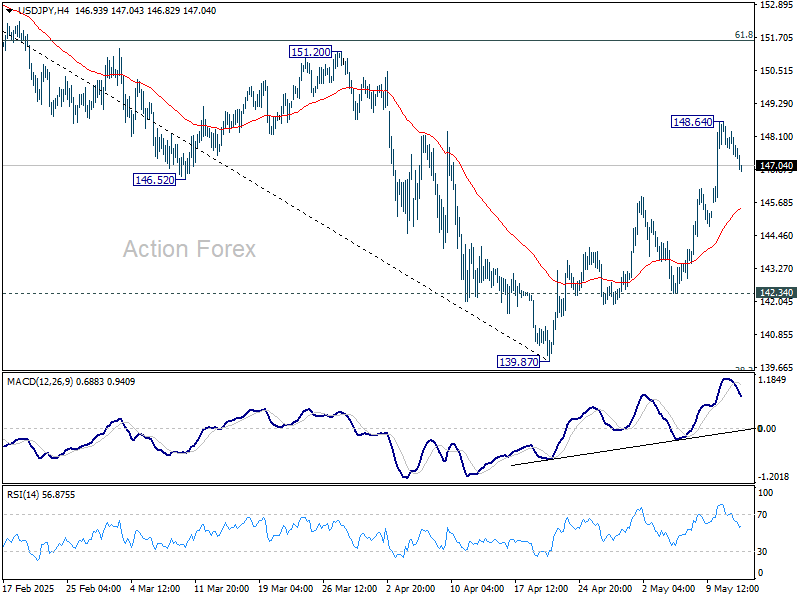
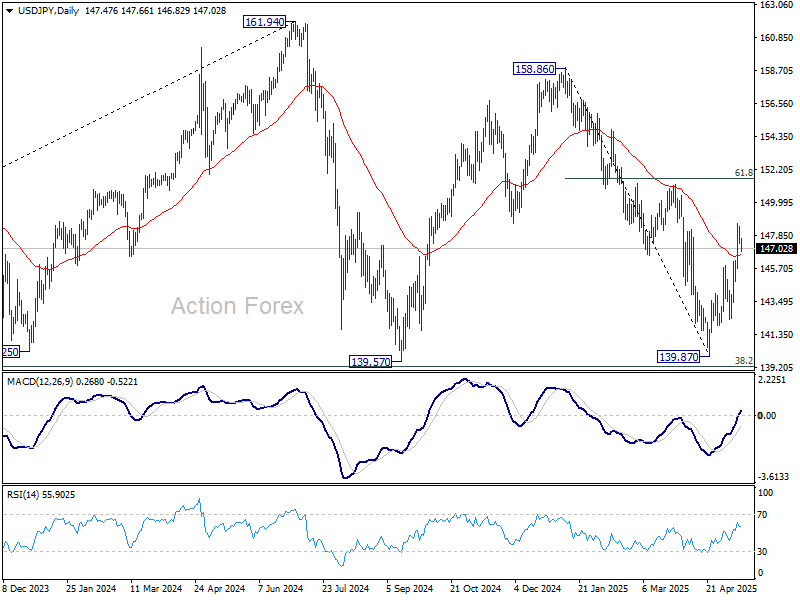
USD/JPY rises slightly today but overall outlook is unchanged. Intraday bias stays neutral first. Recovery from 146.52 is seen as a corrective move. In case of stronger rise, upside should be limited by 150.92 support turned resistance. On the downside, break of 148.17 support will bring retest of 146.52 first. Sustained trading below 61.8% retracement of 139.57 to 158.86 at 146.32 will resume the fall from 158.86 to 139.57 support.
In the bigger picture, price actions from 161.94 are seen as a corrective pattern to rise from 102.58 (2021 low), with fall from 158.86 as the third leg. Strong support should be seen from 38.2% retracement of 102.58 to 161.94 at 139.26 to bring rebound. However, sustained break of 139.26 would open up deeper medium term decline to 61.8% retracement at 125.25.
BoJ’s Ueda reaffirms commitment to rate hikes despite market and financial pressures
BoJ Governor Kazuo Ueda told parliament today that the central bank remains committed to raise interest rate if underlying inflation is deemed to be approaching its 2% target.
He emphasized that BoJ’s objectives remain squarely focused on price stability, and that its approach to policy "would not be disturbed by considerations for the BoJ's finances."
Ueda’s remarks come as concerns mount over the BoJ’s balance sheet in light of interest rate hikes and volatility in equity markets.
BoJ estimated in December that if short-term borrowing costs were to rise to 2%, it could incur losses of up to JPY 2 trillion.
Additionally, Ueda noted that a 1000-point drop in the Nikkei 225 index would translate into a valuation loss of about JPY 1.8 trillion in its ETF holding.
While these figures highlight the scale of financial risks, Ueda’s insistence on prioritizing price stability signals that BoJ is prepared to weather market volatility in pursuit of its monetary policy mandate.
EUR/USD Pulls Back—Limited Room for Further Decline
Key Highlights
- EUR/USD started a downside correction from the 1.0950 resistance zone.
- It traded below a key bullish trend line with support at 1.0880 on the 4-hour chart.
- GBP/USD started a minor downside correction from the 1.3000 resistance.
- The US Manufacturing PMI could drop to 51.9 from 52.7 in March 2025 (Preliminary).
EUR/USD Technical Analysis
The Euro struggled to continue higher above 1.0950 against the US Dollar. EUR/USD started a downside correction below the 1.0900 level.
Looking at the 4-hour chart, the pair traded below a key bullish trend line with support at 1.0880. There was a move below the 1.0880 support, but the pair is still well above the 100 simple moving average (red, 4-hour) and the 200 simple moving average (green, 4-hour).
The pair tested the 1.0800 zone and started a consolidation. On the upside, the pair is facing resistance near the 1.0840 level. The next major resistance is near the 1.0860 level.
The main resistance is now forming near the 1.0895 zone. A close above the 1.0895 level could set the tone for another increase. In the stated case, the pair could even clear the 1.0920 resistance.
On the downside, immediate support sits near the 1.0795 level. The next key support sits near the 1.0765 level. Any more losses could send the pair toward the 1.0750 level.
Looking at GBP/USD, the pair started a short-term downside correction after the bulls failed to clear the 1.3000 resistance zone.
Upcoming Economic Events:
- Euro Zone Manufacturing PMI for March 2025 (Preliminary) – Forecast 48.0, versus 47.6 previous.
- Euro Zone Services PMI for March 2025 (Preliminary) – Forecast 51.0, versus 50.6 previous.
- US Manufacturing PMI for March 2025 (Preliminary) – Forecast 51.9, versus 52.7 previous.
- US Services PMI for March 2025 (Preliminary) – Forecast 51.2, versus 51.0 previous.
Japan PMI composite falls to 48.5, business confidence sinks to lowest since 2020
Japan’s private sector saw a sharp loss in momentum at the end of Q1, with PMI Composite falling from 52.0 to 48.5, marking the first contraction in five months. PMI Manufacturing dropped from 49.0 to 48.3, its lowest in a year and ninth consecutive month in contraction. More concerning was the steep decline in PMI services, which fell from 53.7 to 49.5 — the weakest reading since mid-2024.
According to Annabel Fiddes of S&P Global, the downturn was driven by a "fresh fall in service sector activity" and an accelerated decline in manufacturing. Firms pointed to "strong inflationary pressure had dampened sales", with clients showing increasing hesitation to place orders.
The broader picture is one of growing pessimism. Japanese firms cited a host of structural and cyclical challenges — from persistent inflation and labor shortages to an aging population and deepening global trade uncertainty. As a result, business confidence for future activity fell to its lowest level since August 2020.
Australia’s PMI manufacturing jumps to 52.6, services rises to 51.2
Australia’s PMI Manufacturing surged to 52.6 from 50.4—marking a 29-month high—while PMI Services ticked up to 51.2 from 50.8. PMI Composite , which combines both sectors, rose to a 7-month high at 51.3.
Jingyi Pan of S&P Global Market Intelligence highlighted that the output growth was not only the strongest in seven months but also "broad-based" across both manufacturing and services. Despite a decline in export orders due to weather disruptions and weak global conditions, domestic demand rebounded impressively, pushing new orders to their highest growth rate in nearly three years.
However, the report also highlighted a notable dip in business confidence. Suppressed price increases may have helped support near-term demand. But "tariff uncertainty may continue to cast a shadow on output growth in the year ahead".
USDCHF Wave Analysis
USDCHF: ⬆️ Buy
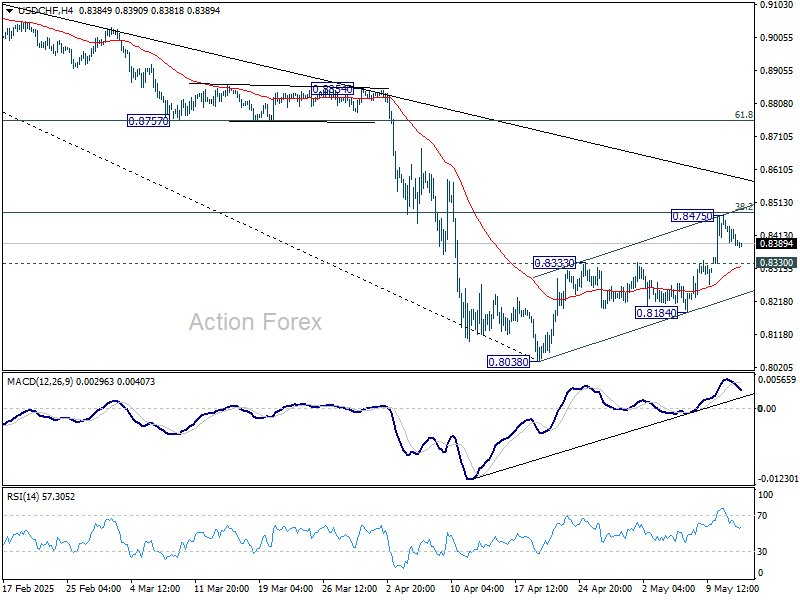
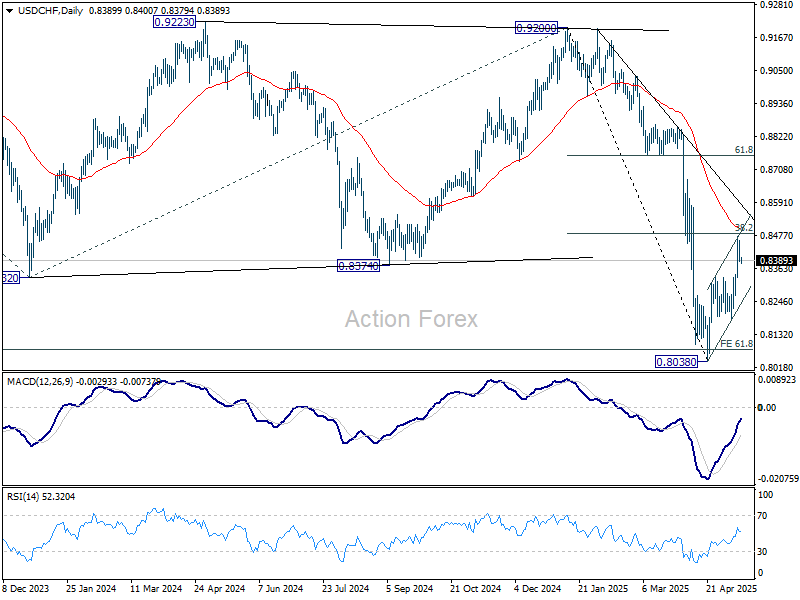
- USDCHF reversed from support level 0,8750
- Likely to fall to support level 208.00
USDCHF currency pair recently reversed from the pivotal support level 0,8750 (former strong support from December and the start of March) standing close to the 50% Fibonacci correction of the upward impulse from September.
The upward reversal from the support level 0,8750 created the daily Japanese candlesticks reversal pattern Morning Star.
USDCHF can be expected to rise to the next resistance level 0.8850 (top of the previous minor correction ii).
Silver Wave Analysis
Silver: ⬇️ Sell
- Silver reversed from resistance level 34.00
- Likely to fall to support level 32.00
Silver recently reversed down from the key resistance level 34.00 (which stopped the previous intermediate impose wave (3) at the end of October) standing close to the upper weekly Bollinger Band.
The downward reversal from the resistance level 34.00 stopped the previous impulse wave 3 of the higher order impulse wave (5) from the end of 2024.
Given the strength of the resistance level 34.00 and the overbought weekly Stochastic, USDCHF can be expected to fall to the next support level 32.00.
Global Trends Hit Pause, Consolidations to Follow Until Trump’s Liberation Day
The dominant trends that shaped Q1 in global markets appear to have run their course, with most major assets entering consolidation phase last week.
US stocks staged a mild recovery from steep selloff since mid-February, but upside momentum was notably weak. Meanwhile, Dollar, which had been under pressure throughout March, appeared to find a near-term bottom. Resilience of hard economic data in the US somewhat offset persistent concerns over trade disruptions.
In Europe, Euro and German DAX also lost steam. Optimism over Germany’s historic EUR 500B infrastructure and defense spending plan helped fuel a strong rally earlier in the month, but now traders are starting to price in political and implementation challenges ahead.
In Asia, sentiment toward China has been broadly positive in recent weeks, driven by policy support and hope for a consumer-led recovery. However, the rally in Hong Kong stocks, in particular, appears stretched.
Even Gold, after a powerful run to record highs, is struggling to overcome a key medium-term resistance zone.
What ties these developments together is a growing sense of caution ahead of the highly anticipated reciprocal tariffs set to be unveiled on April 2.
Market participants remain wary, especially after US President Donald Trump described the date as America’s “liberation day.” His mixed messaging on potential “flexibility” in applying the tariffs — while simultaneously rejecting carveouts — only adds to the confusion and uncertainty.
In this environment, broad-based risk appetite is likely to stay subdued. While tariff concerns may cap further upside in stocks and restrain Dollar’s rebound, traders are unlikely to make aggressive moves until more clarity emerges in early April.
For the week, Swiss Franc led the performance chart, followed by Canadian Dollar and the Greenback. Aussie was the weakest, followed by Euro and Yen, while Kiwi and Sterling ended in the middle of the pack.
Fed Sparks Brief Moves, Markets Consolidate Ahead of April Tariff Showdown
US stock markets saw a brief bounce following Fed's decision to keep interest rates unchanged and maintain the median outlook for two rate cuts later this year. However, the optimism quickly faded, with major indexes settling back into their near-term ranges. Investors seemed to digest the Fed’s stance as largely expected, and without any significant surprises to break the prevailing sentiment stalemate.
The updated Summary of Economic Projections (SEP) hinted at some cautious acknowledgment of the economic toll from trade war. GDP forecasts were revised lower across the board, particularly for 2025 at 1.7%, but remained anchored around Fed’s longer-run estimate of 1.8% growth by 2026 and 2027. On the inflation front, core PCE was nudged higher to 2.8% for this year, up from the previous 2.5%. But projections for 2026 and 2027 held steady at 2.2% and 2.0% respectively.
Overall, the projections suggest that while tariffs may impact near-term economy activity, Fed sees no long-term deviation from trend growth. Also, Fed expects the inflationary pressure from tariffs to be "transitory", fading after the initial pass-through period.
Still, the assumption remains a fragile one. With President Donald Trump’s sweeping reciprocal and sectoral tariff plans due for rollout on April 2, markets are bracing for more clarity—or chaos. The lack of concrete detail on implementation leaves room for policy whiplash, adding to the uncertainty businesses and consumers are already grappling with.
For now, Fed fund futures imply an 88% chance of a rate cut in June, followed by around 70% odds of another cut in September. Still, those odds remain sensitive to upcoming inflation readings, consumer sentiment, and of course, any fresh headlines out of Washington on trade.
Technically, DOW gyrated higher last week after forming a short term bottom at 40661.77 earlier in the month. The structure of the recovery so far suggests that it's merely a corrective bounce. Further decline is expected as long as 55 D EMA (now at 43027.95) holds. Fall from 45054.36 is seen as corrective the whole up trend from 28660.94. On resumption, DOW should target 38.2% retracement of 28660.94 to 45054.36 at 38792.07.
Similarly, NASDAQ turned sideway after forming a short term bottom at 17238.23. While stronger recovery cannot be ruled out, risk will stay on the downside as long as 55 D EMA (now at 18753.98) holds. Fall from 20204.58 is seen as a correction to the ups trend from 10088.82. Break of 17238.23 will target 38.2% retracement of 10088.82 to 20204.58 at 16340.36.
Dollar Index should have formed a short term bottom at 103.19 and turned into consolidations already. Further recovery might be seen in the near term. But there would be strong resistance between 55 W EMA (105.21) and 55 D EMA (now at 105.91) to limit upside. Break of 103.19 will resume the fall from 110.17 to 99.57/100.15 support zone.
Euro and DAX Enter Consolidation as Focus Shifts to German Coalition Talks
Both Euro and German DAX may have peaked in the near term, as the initial optimism surrounding Germany’s sweeping fiscal expansion plan begins to fade. The EUR 500 B infrastructure and defense package, along with reforms to the long-standing debt brake rule, passed the Bundestag earlier in the week and was approved by the Bundesrat on Friday. With the legislative hurdles cleared, investor attention is now turning to the political process of implementing the plan.
Chancellor-in-waiting Friedrich Merz is aiming to finalize a coalition with SPD by Easter, but the path forward is far from certain. Migration policy remains a key stumbling block. At the same time, Merz is already facing internal criticism from parts of his CDU/CSU bloc for what some see as an overly generous fiscal shift. These political frictions would be the uncertainty that could weigh on both sentiment and market performance in the coming weeks.
Even in the absence of external risks like US tariffs, the timeline for tangible economic impact from the spending package remains distant. A regular budget for 2025 may not be passed until mid-year, meaning it could be months before new investments begin to support growth.
A consolidation phase may now set in for German equities and Euro, lasting at least until Merz completes the coalition negotiations.
Technically, while DAX still has some room to climb, considering bearish divergence condition in D MACD, upside will likely be limited by 161.8% projection of 14630.21 to 18892.92 from 17024.82 at 23921.87, or in short 24k mark. Break of 22226.34 support will suggest that a correction has started to digest the rally from 17024.82.
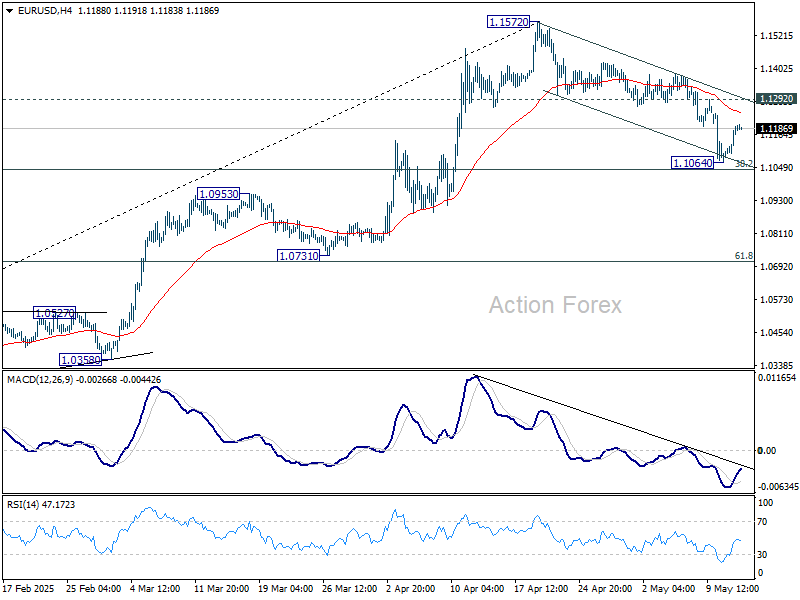
EUR/USD should have completed a short term top at 1.0953 after last week's pull back. Deeper fall might be seen to 38.2% retracement of 1.0358 to 1.0953 at 1.0726. But strong rebound is expected from there to set the range for a near term corrective pattern.
China Optimism and HSI Rally Nears Exhaustion, Aussie at Risk
After weeks of bullish sentiment toward China, markets in Asia may be poised for a meaningful correction. Much of the recent optimism was driven by Beijing’s ambitious "special action plan" to stimulate domestic consumption and the buzz surrounding AI startup DeepSeek. However, as attention shifts from announcements to implementation, investors are turning cautious on whether these initiatives will yield the hoped-for near-term growth.
In particular, the rally in Hong Kong stocks appears increasingly stretched. HSI had made a strong push higher since January, but it's now facing a tough hurdle at the psychologically significant 25,000 mark. That level also aligns closely 100% projection of 16964.28 to 23241.74 from 18671.49 at 24948.95. Combined with bearish divergence in daily MACD, there's a rising risk that profit-taking could be triggered on any failure to break this resistance zone.
Firm break of 23198.13 support would be a key signal that the rally has topped for the near term, opening the door for deeper pullback toward the 55 D EMA (now at 22302.72) or even below.
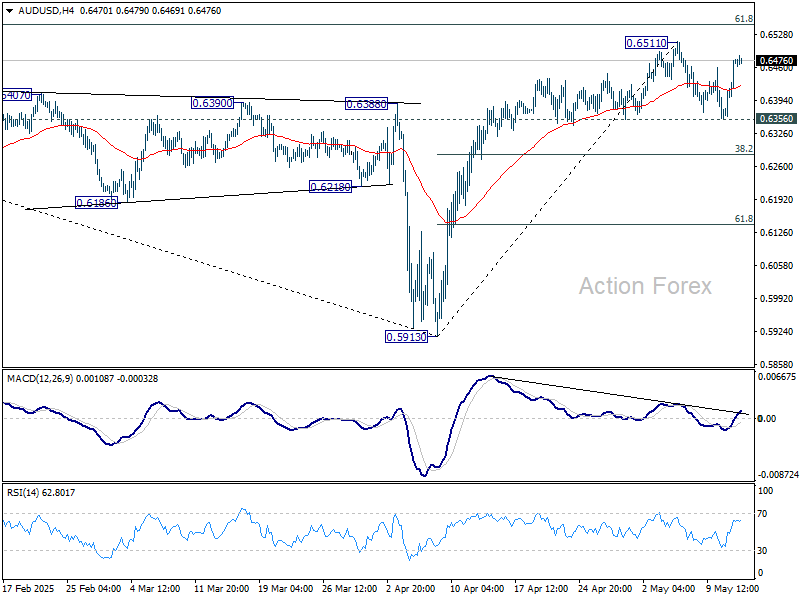
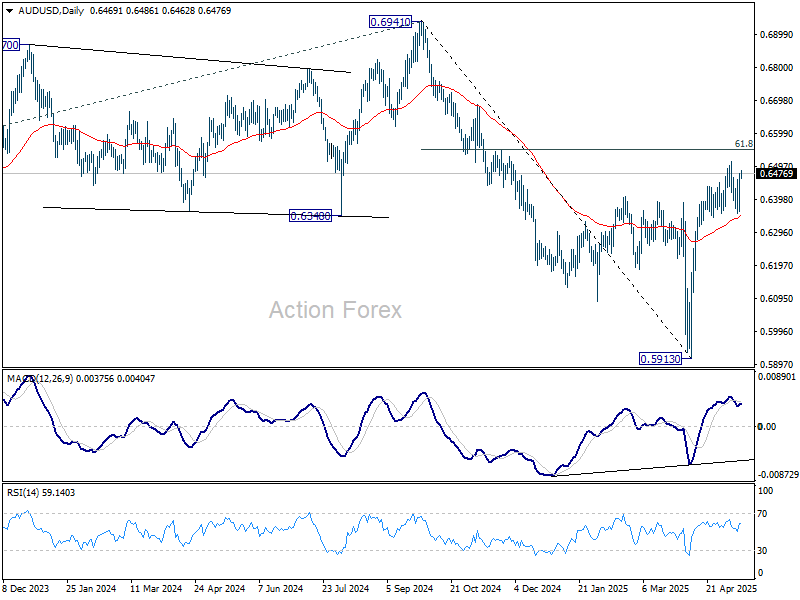
Australian Dollar is especially vulnerable in this bearish scenario, given its strong trade ties with China. Sustained break of near term trend line support (now at 0.6251) will argue that consolidation pattern from 0.6087 has already completed. Further break of 0.6186 support will solidify bearish case and suggest that fall from 0.6941 is ready to resume.
Gold Correction Looms With Rejection by Key Resistance Zone
Gold’s impressive record run may have reached a near-term peak as it ran into a confluence of critical resistance zone. The levels include 61.8% projection of 2584.24 to 2956.09 from 2832.41 at 3062.21, and more importantly, medium-term rising channel resistance.
Sustained break of 55 4H EMA (now at 2993.64) should confirm this view and bring deeper pull back to 2956.09 resistance turned support or a bit lower. But strong support should be seen from 55 D EMA (now at 2862.52) to contain downside, and bring rebound,, at least on first attempt.
USD/CAD Weekly Outlook
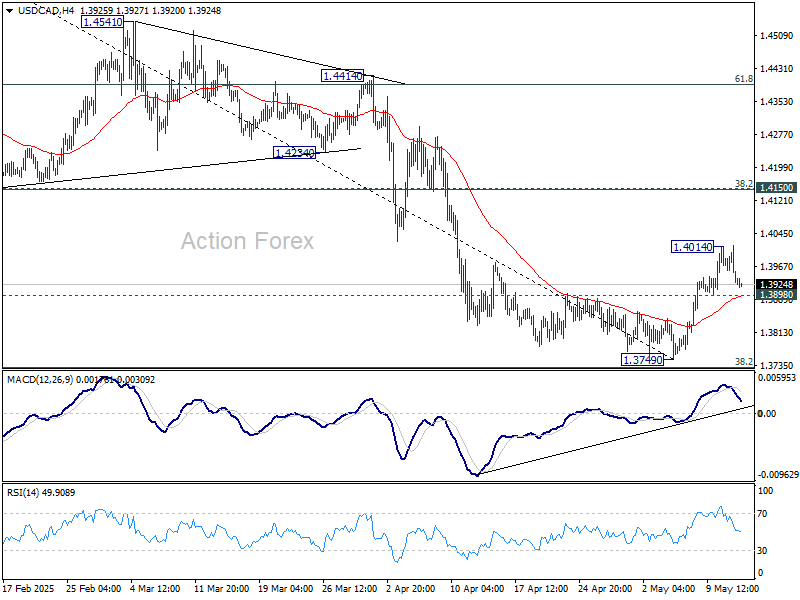
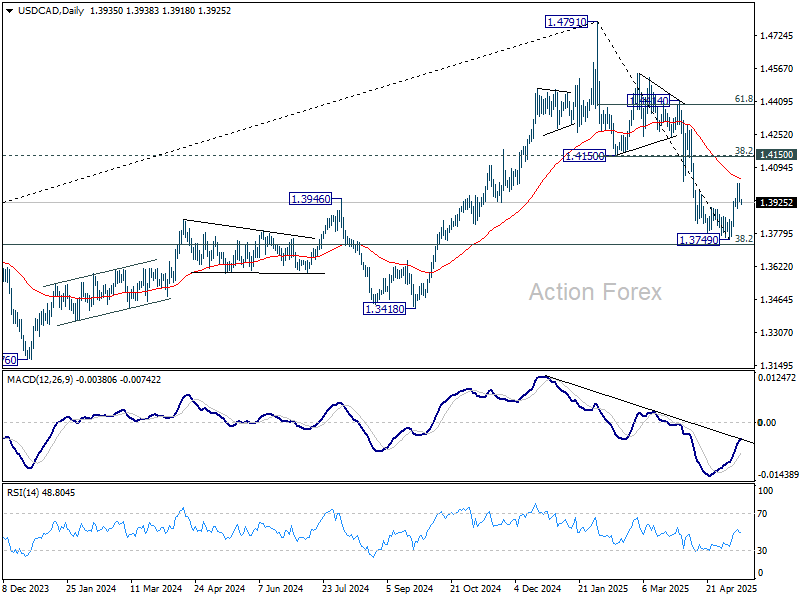
Range trading continued in USD/CAD last week and outlook is unchanged. Initial bias remains neutral this week first. Overall, price actions from 1.4791 are seen as a corrective pattern. On the upside, break of 1.4541 will extend the second leg from 1.4150 to retest 1.4791 high. On the downside, break of 1.4238 will argue that the third leg has already started through 1.4150 support.
In the bigger picture, long term up trend is tentatively seen as resuming with prior breach of 1.4667/89 key resistance zone (2020/2015 highs). Next target is 100% projection of 1.2401 to 1.3976 from 1.3418 at 1.4993. This will remain the favored case as long as 1.3976 resistance turned support holds (2022 high), even in case of deep pullback.
In the longer term picture, up trend from 0.9506 (2007 low) is in progress and possibly resuming. Next target is 61.8% projections of 0.9406 to 1.4689 from 1.2005 at 1.5270. While rejection by 1.4689 will delay the bullish case, further rally will remain in favor as long as 55 M EMA (1.3463) holds.
EUR/USD Weekly Outlook
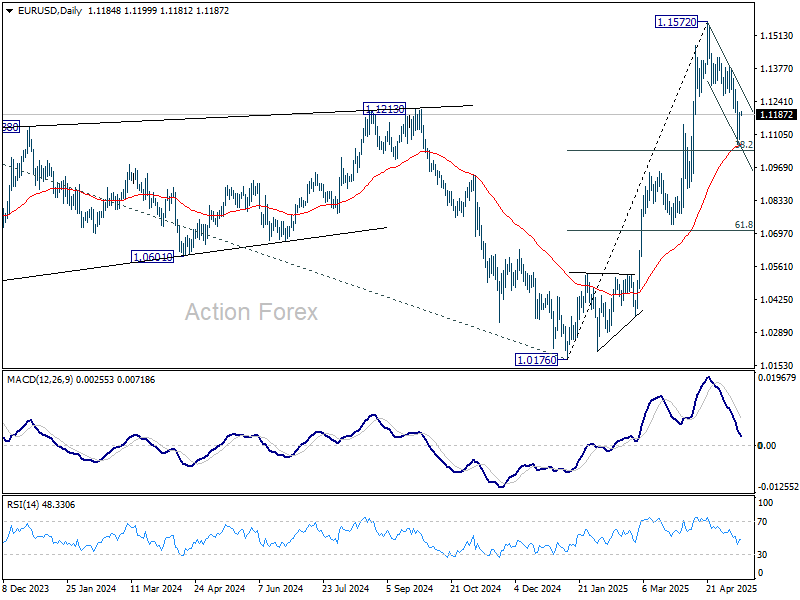
EUR/USD reversed after edging higher to 1.0953 last week and a short term top should be formed. Initial bias is mildly on the downside this week for 38.2% retracement of 1.0358 to 1.0953 at 1.0726. Strong support should be seen there to bring rebound. On the upside, break of 1.0953 will resume the rally from 1.0176 towards 1.1274 key resistance.
In the bigger picture, prior strong break of 55 W EMA (now at 1.0675) suggests that fall from 1.1274 (2024 high) has completed as a three wave correction to 1.0176. Rise from 0.9534 is still intact, and might be ready to resume. Decisive break of 1.1274 will target 100% projection of 0.9534 to 1.1274 from 1.0176 at 1.1916. Also, that will send EUR/USD through a multi-decade channel resistance will carries larger bullish implication. This will now be the favored case as long as 1.0531 resistance turned support holds.
In the long term picture, the case of long term bullish reversal is building up. Sustained break of falling channel resistance (now at around 1.1400) will argue that the down trend from 1.6039 (2008 high) has completed at 0.9534. A medium term up trend should then follow even as a corrective move. Nevertheless, rejection by the channel resistance will keep outlook bearish.