

Sample Category Title
RBA Maintains Key Interest Rates Steady At 1.50%, Expects Stronger Economic Growth In 2018
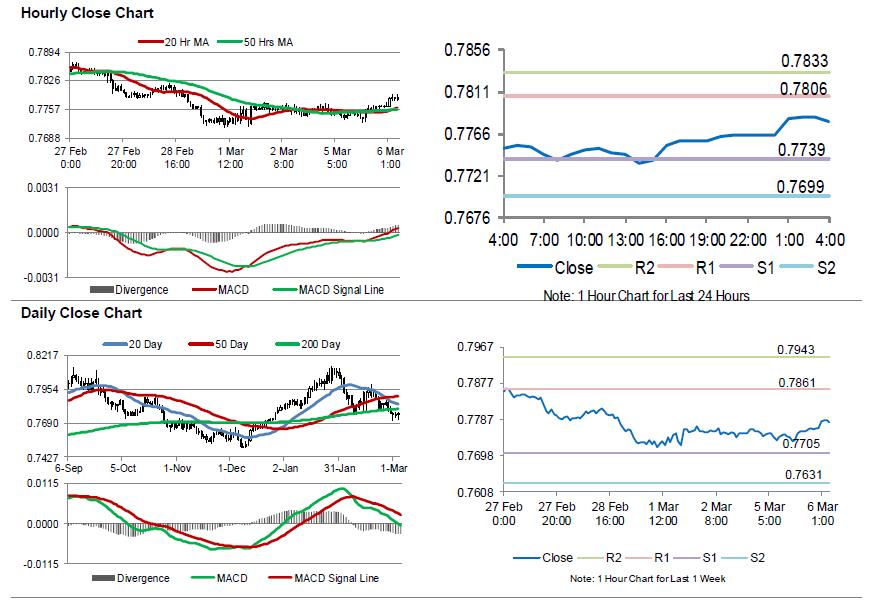
For the 24 hours to 23:00 GMT, the AUD rose 0.26% against the USD and closed at 0.7765.
LME Copper prices declined 0.5% or $33.0/MT to $6850.0/MT. Aluminium prices declined 0.4% or $9.0/MT to $2135.0/MT.
In the Asian session, at GMT0400, the pair is trading at 0.7779, with the AUD trading 0.18% higher against the USD from yesterday’s close.
The RBA, in a widely expected move, decided to keep the official cash rate on hold at 1.50%, on the backdrop of weak wage growth and stubbornly low inflation. In a post-meeting statement, the central bank stated that it now expects the Australian economy to grow faster in 2018 than last year, while inflation is forecasted to remain low for some time.
On the macro front, Australia’s seasonally adjusted retail sales rebounded less-than-expected by 0.1% MoM in January, compared to a drop of 0.5% in the previous month, while markets were expecting retail sales to advance 0.4%.
The pair is expected to find support at 0.7739, and a fall through could take it to the next support level of 0.7699. The pair is expected to find its first resistance at 0.7806, and a rise through could take it to the next resistance level of 0.7833.
Going forward, a speech by the RBA Governor, Philip Lowe, due overnight, would be eyed by traders. Additionally, Australia’s 4Q GDP figures as well as AiG performance of construction index for February, will keep investors on their toes.
The currency pair is trading above its 20 Hr and 50 Hr moving averages.
Eurozone’s Services Sector Activity Revised Lower In February, While Germany’s Services Sector Growth Confirmed At A 3-Month Low In...
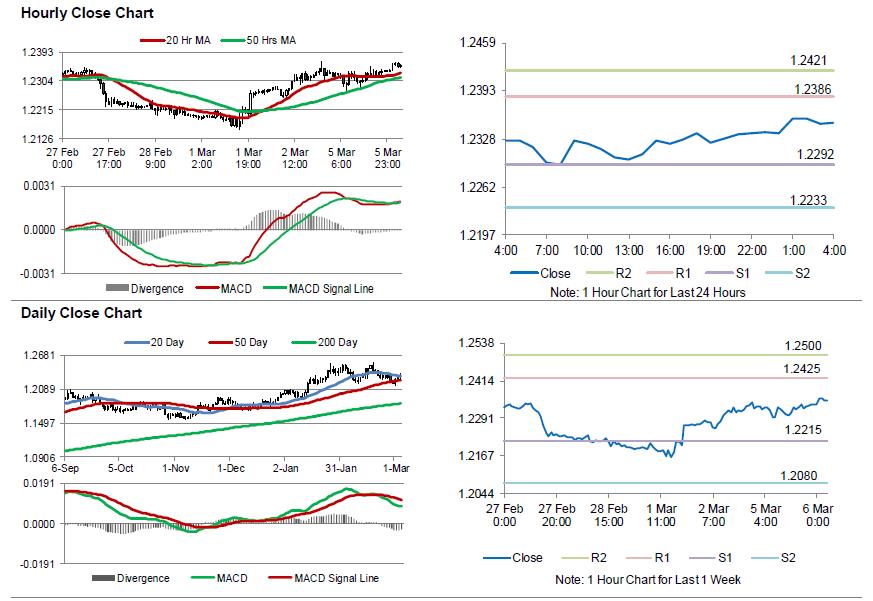
For the 24 hours to 23:00 GMT, the EUR rose 0.15% against the USD and closed at 1.2337, after Germany's Social Democrats decisively voted to form a grand coalition with Angela Merkel's conservatives, thereby ending a prolonged period of political uncertainty in the Euro-bloc's largest economy.
In economic news, the Euro-zone's final Markit services PMI dropped more than initially estimated to a level of 56.2 in February, while the preliminary print had indicated a fall to a level of 56.7. In the prior month, the PMI had registered a reading of 58.0. Additionally, the region's seasonally adjusted retail sales eased 0.1% on a monthly basis in January, meeting market expectations and declining for the second straight month. Retail sales had registered a revised drop of 1.0% in the prior month.
In other economic news, the region's Sentix investor confidence index fell more-than-anticipated to a level of 24.0 in March, as political uncertainty in German and Italy weighed on investors' morale. In the prior month, the index had registered a level of 31.9, while market participants had envisaged for a fall to a level of 30.9.
Separately, activity in Germany's services sector eased to a 3-month low level of 55.3 in February, confirming the flash estimate. In the prior month, the PMI had registered a reading of 57.3.
Macroeconomic data released in the US showed that the ISM non-manufacturing PMI declined less-than-expected to a level of 59.5 in February, after recording a 12-year high level of 59.9 in the previous month, while markets had expected for a drop to a level of 59.0.
On the contrary, the nation's final Markit services PMI climbed to a 6-month high level of 55.9 in February, meeting the preliminary print. The PMI had registered a level of 53.3 in the prior month.
In the Asian session, at GMT0400, the pair is trading at 1.2350, with the EUR trading 0.11% higher against the USD from yesterday's close.
The pair is expected to find support at 1.2292, and a fall through could take it to the next support level of 1.2233. The pair is expected to find its first resistance at 1.2386, and a rise through could take it to the next resistance level of 1.2421.
Moving ahead, investors would direct their attention to Germany's Markit construction PMI for February, scheduled to release in a few hours. Further, the US factory orders as well as final durable goods orders for January, due to release later today, will be on investors' radar.
The currency pair is trading above its 20 Hr and 50 Hr moving averages.
Britain’s Services Sector Activity Jumped To Its Highest Level In 4 Months In February
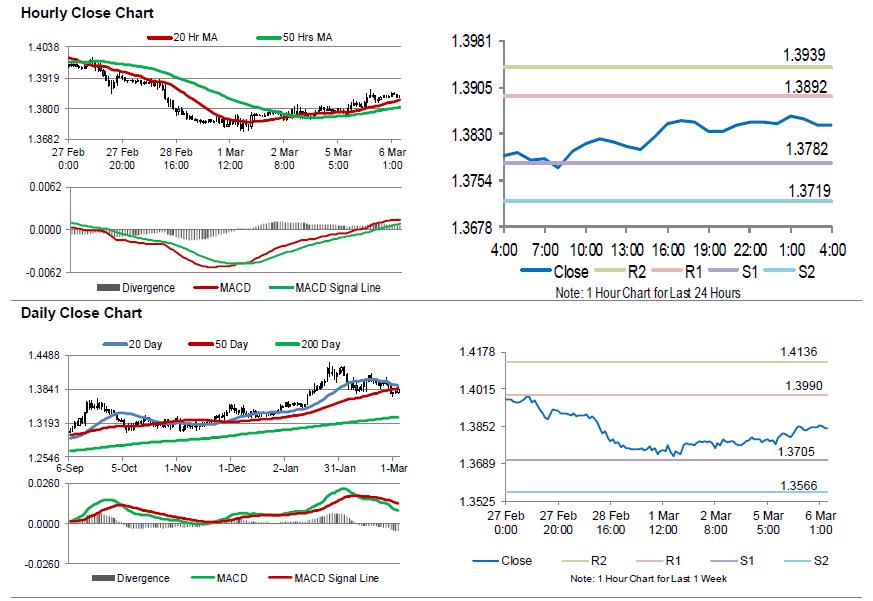
For the 24 hours to 23:00 GMT, the GBP rose 0.46% against the USD and closed at 1.3849, after latest data indicated that UK's services sector activity surged to a 4-month high level in February.
UK's Markit services PMI climbed more-than-estimated to a level of 54.5 in February, expanding at its fastest pace since October 2017 and indicating that the sector regained momentum. The PMI had registered a reading of 53.0 in the previous month, while markets were anticipating for a rise to a level of 53.3.
In the Asian session, at GMT0400, the pair is trading at 1.3844, with the GBP trading slightly lower against the USD from yesterday's close.
Overnight data revealed that UK's BRC retail sales across all sectors advanced 0.6% on an annual basis in February, beating market expectations for a gain of 0.5%. In the prior month, retail sales across all sectors had registered a similar rise.
The pair is expected to find support at 1.3782, and a fall through could take it to the next support level of 1.3719. The pair is expected to find its first resistance at 1.3892, and a rise through could take it to the next resistance level of 1.3939.
The currency pair is showing convergence with its 20 Hr moving average and trading above its 50 Hr moving average.
Japanese Yen Trading On A Weaker Footing This Morning
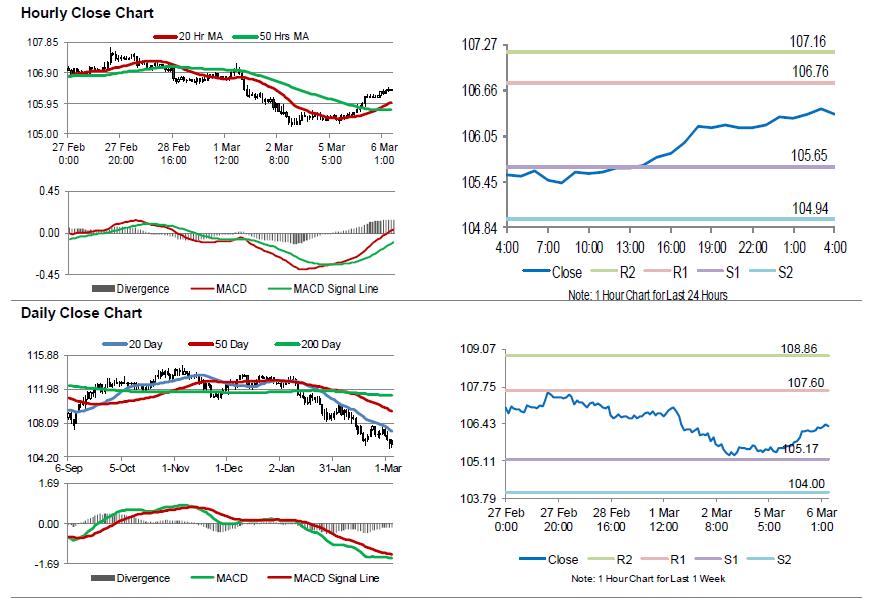
For the 24 hours to 23:00 GMT, the USD rose 0.73% against the JPY and closed at 106.20.
In the Asian session, at GMT0400, the pair is trading at 106.35, with the USD trading 0.14% higher against the JPY from yesterday’s close.
The pair is expected to find support at 105.65, and a fall through could take it to the next support level of 104.94. The pair is expected to find its first resistance at 106.76, and a rise through could take it to the next resistance level of 107.16.
Looking ahead, market participants would keep a close watch on Japan’s flash leading economic and coincident indices for January, set to release tomorrow.
The currency pair is trading above its 20 Hr and 50 Hr moving averages.
Swiss Franc Trading Higher, Ahead Of Swiss Inflation Data
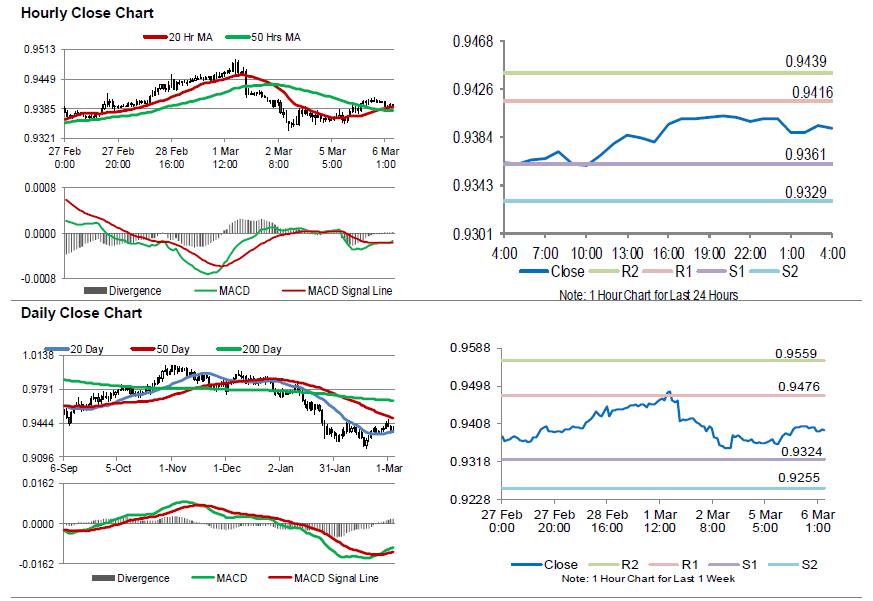
For the 24 hours to 23:00 GMT, the USD rose 0.38% against the CHF and closed at 0.9400.
On the data front, Switzerland’s total sight deposits remained steady at a level of CHF576.0 billion in the week ended 02 March.
In the Asian session, at GMT0400, the pair is trading at 0.9392, with the USD trading 0.09% lower against the CHF from yesterday’s close.
The pair is expected to find support at 0.9361, and a fall through could take it to the next support level of 0.9329. The pair is expected to find its first resistance at 0.9416, and a rise through could take it to the next resistance level of 0.9439.
Ahead in the day, traders would eye Switzerland’s inflation figures for February, slated to release in a few hours.
The currency pair is showing convergence with its 20 Hr moving average and trading above its 50 Hr moving average.
Loonie Trading A Tad Lower In The Morning Session
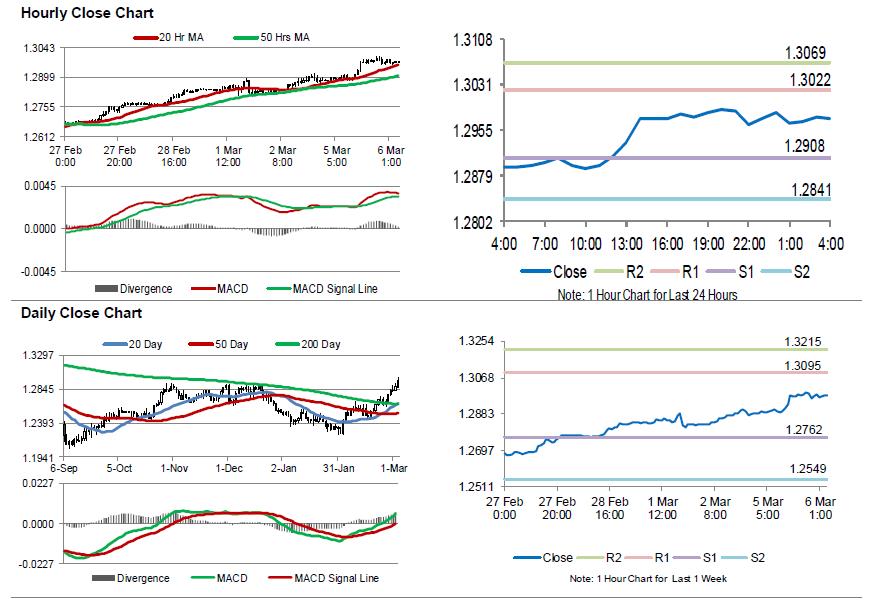
For the 24 hours to 23:00 GMT, the USD rose 0.58% against the CAD and closed at 1.2974.
In the Asian session, at GMT0400, the pair is trading at 1.2976, with the USD trading slightly higher against the CAD from yesterday's close.
The pair is expected to find support at 1.2908, and a fall through could take it to the next support level of 1.2841. The pair is expected to find its first resistance at 1.3022, and a rise through could take it to the next resistance level of 1.3069.
Later today, the release of Canada's Ivey PMI for February, will be on closely monitored by market participants.
The currency pair is trading above its 20 Hr and 50 Hr moving averages.
USD/JPY Daily Outlook
Daily Pivots: (S1) 105.61; (P) 105.92; (R1) 106.50; More...
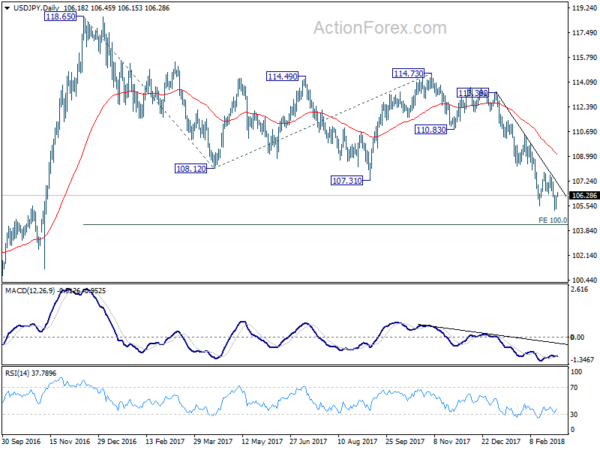
Breaching of 106.37 minor resistance suggest temporary bottoming at 105.24. Intraday bias in USD/JPY is turned neutral again for consolidation. But after all, near term outlook will remain bearish as long as 107.67 resistance holds. Larger decline from 118.65 is expected to continue. Below 105.24 will target 100% projection of 118.65 to 108.12 from 114.73 at 104.20 next. Firm break there will pave the way to 98.97 key support level and below. However, break of 107.67 will indicate short term bottoming, on bullish convergence condition in 4 hour MACD. In such case, stronger rebound would be seen back to 55 day EMA (now at 109.05) first.
In the bigger picture, current development argues that the corrective pattern from 118.65 is extending. The solid break of 61.8% retracement of 98.97 to 118.65 at 106.48 now suggests that the pattern from 125.85 high is possibly extending. Deeper fall could be seen through 98.97 key support (2016 low). This bearish case will now be favored as long as 110.47 resistance holds.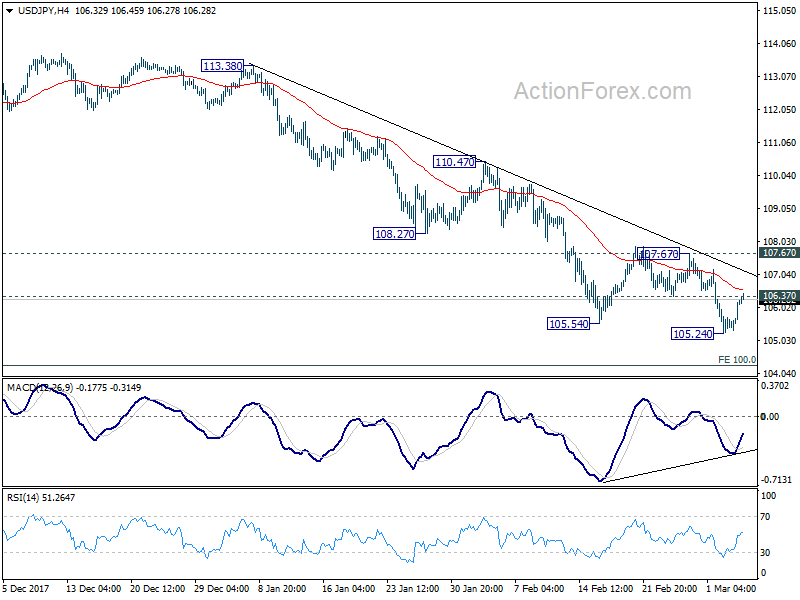

Trump Said He Won’t Back Down on Tariffs, But Markets Bet He Will
Market sentiments improved as some considered US President Donald Trump's threat of trade war is merely a "political show". And pressures from the Republicans and business executives will eventually force him to back down. DOW closed up 336.7 pts or 1.37% at 24874.76. S&P 500 also rebounded 29.69 pts or 1.10% to close at 2720.94. Mild strength was seen in treasury yield with 10 year yield at 2.881, up 0.024. In Asia, Nikkei is trading up 2.1% at the time of writing. In the currency markets, Yen trades broadly lower today but Canadian Dollar remains the weakest one for the week. Aussie trades higher today after RBA stands pat and sounds less concerned with wage growth.
While Trump said he won't back down on imposing steel and aluminum tariff, he is facing increase opposition from his own party. House Speaker Republican Paul Ryan is leading the way. His spokesperson said Ryan is "urging the White House to not advance with this plan. The new tax reform law has boosted the economy and we certainly don't want to jeopardize those gains."
House Ways and Means Chairman Kevin Brady also warned that "blanket tariffs that also sweep up fairly traded steel and aluminium, especially with trading partners like Canada and Mexico". He suggested that Canada and Mexico should be excluded from the tariff. This is the opposite of Trump's rhetoric of "tariffs on Steel and Aluminum will only come off if new & fair NAFTA agreement is signed."
Separately, it's reported that White House economic adviser Gary Cohn is arranging a meeting on Thursday with business executives to halt the imposition of the steel and aluminum tariffs. Representatives of breweries, beverage-can manufacturers, automakers, and oil industry will attend. Trump is also expected to attend too.
RBA: Rate of wage growth troughed
Aussie trades mildly higher after RBA kept the cash rate unchanged at 1.50% as widely expected. The statement is almost likely a carbon copy of the prior one. Nonetheless, RBA sounded more optimistic on wage growth as it said that "the rate of wage growth appears to have troughed". Regarding the economy, Australian economy is expected to grow fast in 2018 than in 2018. Regarding inflation RBA maintained that "the central forecast is for CPI inflation to be a bit above 2 per cent in 2018." The statement concluded by maintaining "holding the stance of monetary policy unchanged at this meeting would be consistent with sustainable growth in the economy and achieving the inflation target over time."
More on RBA: RBA Left Cash Rate Unchanged At 1.5% As Property Markets Cooled
Released earlier in Australia retail sales rose 0.1% mom in January, below expectation of 0.4% mom. Current account deficit widened to AUD -14.0b in Q4.
Looking ahead
Swiss CPI will be a main focus in European session. Eurozone will release retail PMI too. US will release factory orders while Canada will release Ivey PMI later in the day.
USD/JPY Daily Outlook
Daily Pivots: (S1) 105.61; (P) 105.92; (R1) 106.50; More...
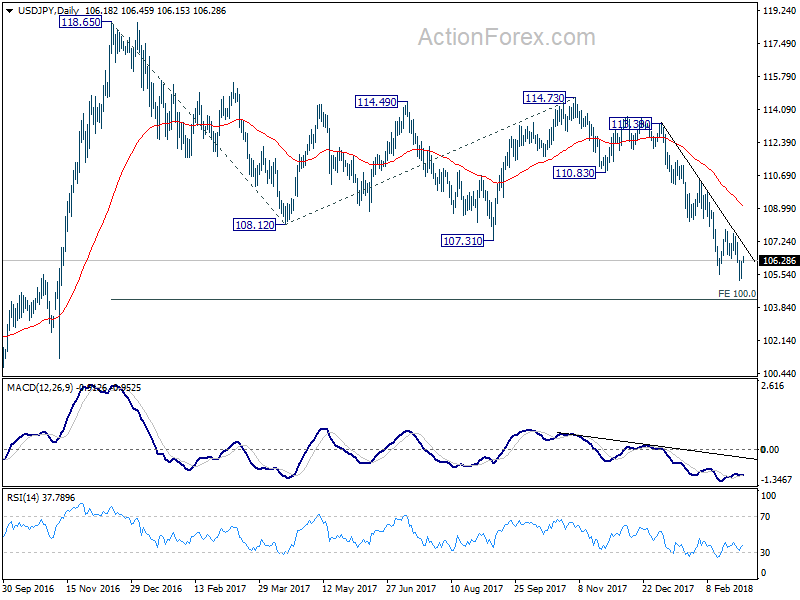
Breaching of 106.37 minor resistance suggest temporary bottoming at 105.24. Intraday bias in USD/JPY is turned neutral again for consolidation. But after all, near term outlook will remain bearish as long as 107.67 resistance holds. Larger decline from 118.65 is expected to continue. Below 105.24 will target 100% projection of 118.65 to 108.12 from 114.73 at 104.20 next. Firm break there will pave the way to 98.97 key support level and below. However, break of 107.67 will indicate short term bottoming, on bullish convergence condition in 4 hour MACD. In such case, stronger rebound would be seen back to 55 day EMA (now at 109.05) first.
In the bigger picture, current development argues that the corrective pattern from 118.65 is extending. The solid break of 61.8% retracement of 98.97 to 118.65 at 106.48 now suggests that the pattern from 125.85 high is possibly extending. Deeper fall could be seen through 98.97 key support (2016 low). This bearish case will now be favored as long as 110.47 resistance holds.
 Economic Indicators Update
| GMT | Ccy | Events | Actual | Forecast | Previous | Revised |
|---|---|---|---|---|---|---|
| 0:01 | GBP | BRC Retail Sales Monitor Y/Y Feb | 0.60% | 0.50% | 0.60% | |
| 0:30 | AUD | Current Account Balance (AUD) Q4 | -14.0B | -12.3B | -9.1B | -11.0B |
| 0:30 | AUD | Retail Sales M/M Jan | 0.10% | 0.40% | -0.50% | |
| 3:30 | AUD | RBA Rate Decision | 1.50% | 1.50% | 1.50% | |
| 8:15 | CHF | CPI M/M Feb | 0.30% | -0.10% | ||
| 8:15 | CHF | CPI Y/Y Feb | 0.60% | 0.70% | ||
| 9:10 | EUR | Eurozone Retail PMI Feb | 50.8 | |||
| 15:00 | USD | Factory Orders Jan | -1.30% | 1.70% | ||
| 15:00 | CAD | Ivey PMI Feb | 56.3 | 55.2 |
RBA Left Cash Rate Unchanged At 1.5% As Property Markets Cooled
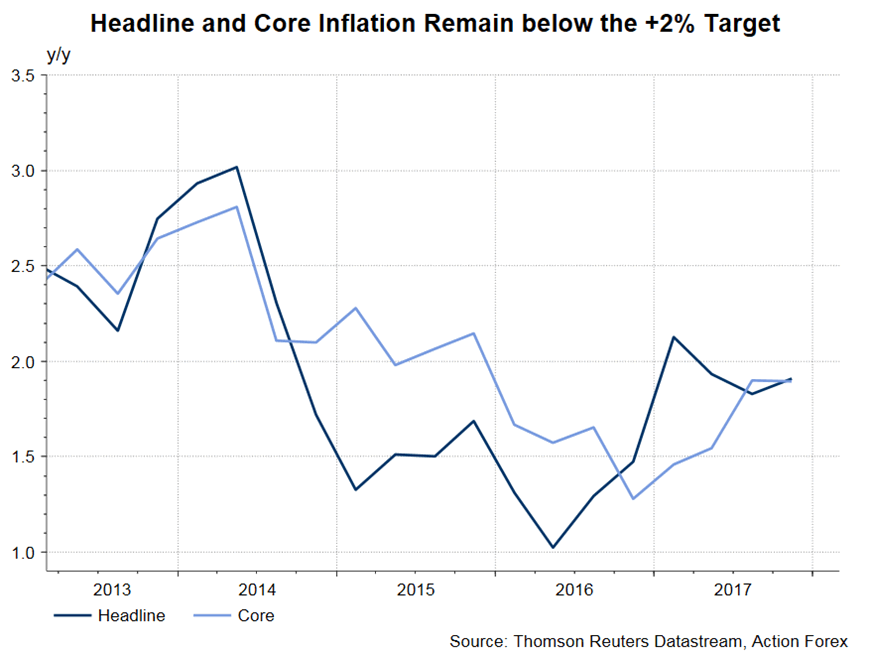
As widely anticipated, RBA left the policy rate unchanged at 1.5% in March. A cooling property market signals that further rate hike is less urgent. On top of the central bank’s agenda has returned to boosting inflation and employment. In 2017, Australia’s CPI averaged at 1.9% while the unemployment rate picked up to 5.5% in January from 5.4% in October 2017. Meanwhile, wage growth remained low while US looming imposition of trade tariffs on metals might affect Aussie economy which relies heavily on exports of raw materials.
As suggested in the accompanying statement, RBA indicated that inflation is “likely to remain low for some time reflecting low growth in labour costs and strong competition in retailing. A gradual pick-up in inflation is, however, expected as the economy strengthens. The central forecast is for inflation to be a bit above 2% in 2018”.
The central bank remained confident over the employment situation. It acknowledged that “employment has been rising in all states and has been accompanied by a significant rise in labour force participation”. Going forward, growth on the job market should remain “solid” with “a further gradual reduction in the unemployment rate expected”. Same as many other advanced economies, wage growth has remained a concern. RBA was aware of the soft wage growth and expected it would “continue for a while yet, although the stronger economy should see some lift in wage growth over time”. It added that “the rate of wage growth appears to have troughed and there are reports that some employers are finding it more difficult to hire workers with the necessary skills”.
The housing market is less a concern as “the housing markets in Sydney and Melbourne have slowed”. Policymakers added that the macro-prudential policies “have been helpful in containing the build-up of risk in household balance sheets, although the level of household debt remains high”.
The language on the exchange rate was unchanged from the previous month. with AUDUSD modestly lower during the inter-meeting period, policymakers should be less worried about the tightening effect of a strong Aussie on the economy.
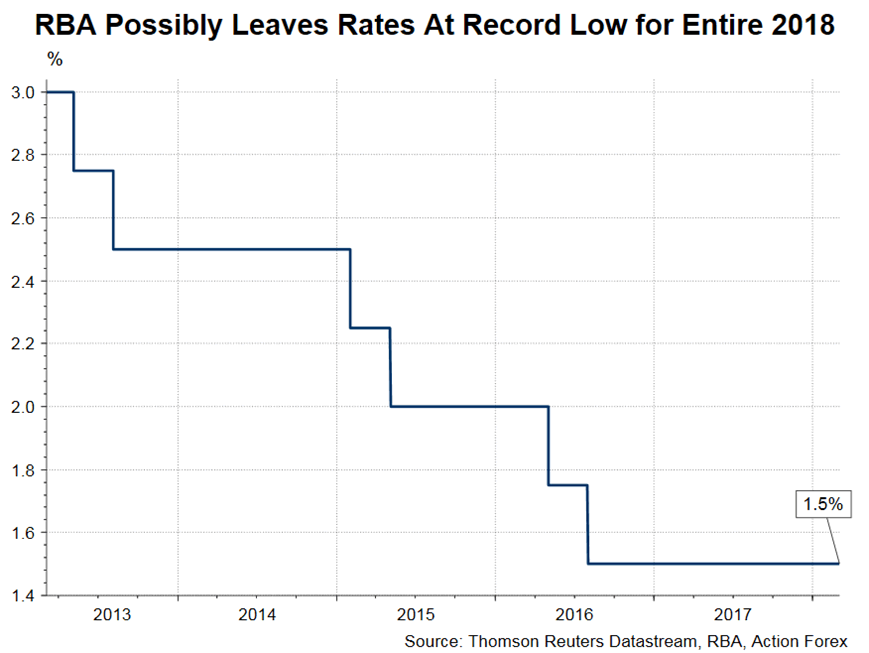
On the monetary policy outlook, the central bank reiterated the stance that the current accommodative policy should be appropriate to support economic growth. The market has priced in no chance of a rate hike for the rest of the year.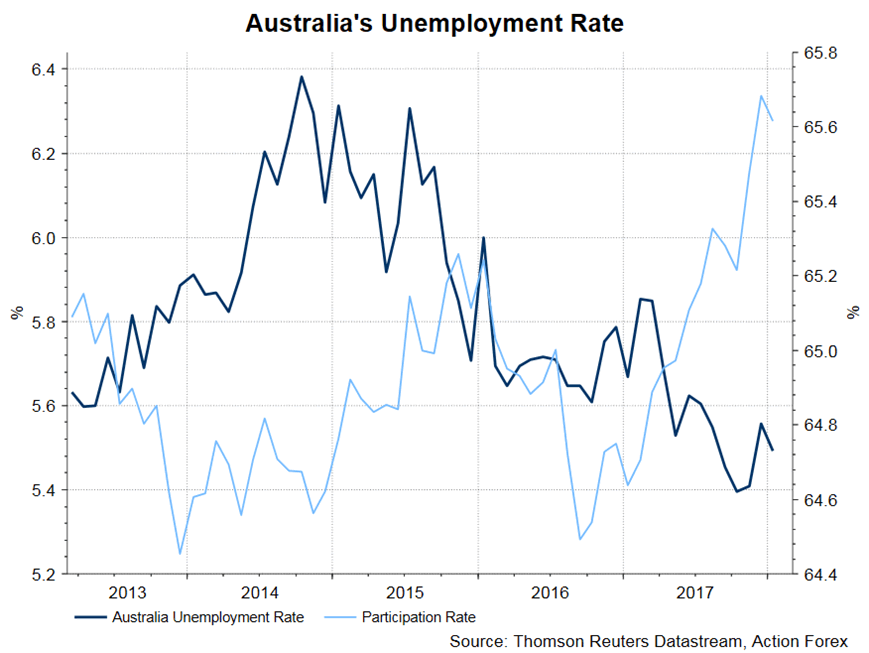
Yen lower as markets betting trade tariff could be halted
Yen broadly lower in Asian as markets stablized. Nikkei is up 2.1%. Dow closed up 1.37%.
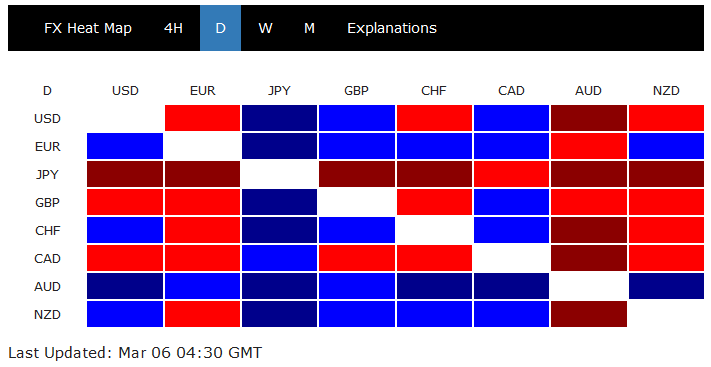 Trump is facing strong opposition from Republicans on steel and aluminum tariffs, and threat of trade wars.
House Speaker Republican Paul Ryan's spokesperson: Ryan is "urging the White House to not advance with this plan. The new tax reform law has boosted the economy and we certainly don't want to jeopardize those gains."
House Ways and Means Chairman Kevin Brady also warned that "blanket tariffs that also sweep up fairly traded steel and aluminium, especially with trading partners like Canada and Mexico".
Separately, White House economic adviser Gary Cohn is arranging a meeting on Thursday with business executives to halt the tariff.