Sample Category Title
Crypto Market Blues: A Week of Decline
Market Picture
The cryptocurrency market has decreased by more than 11% over the past seven days. The primary impact for bearish investors occurred over the weekend and on Monday following the imposition of US tariffs against Canada, Mexico, and China. Despite an initial rally, the market continued its decline, reaching a value of 3.15 trillion, which represents a dip below the previous cyclical low.
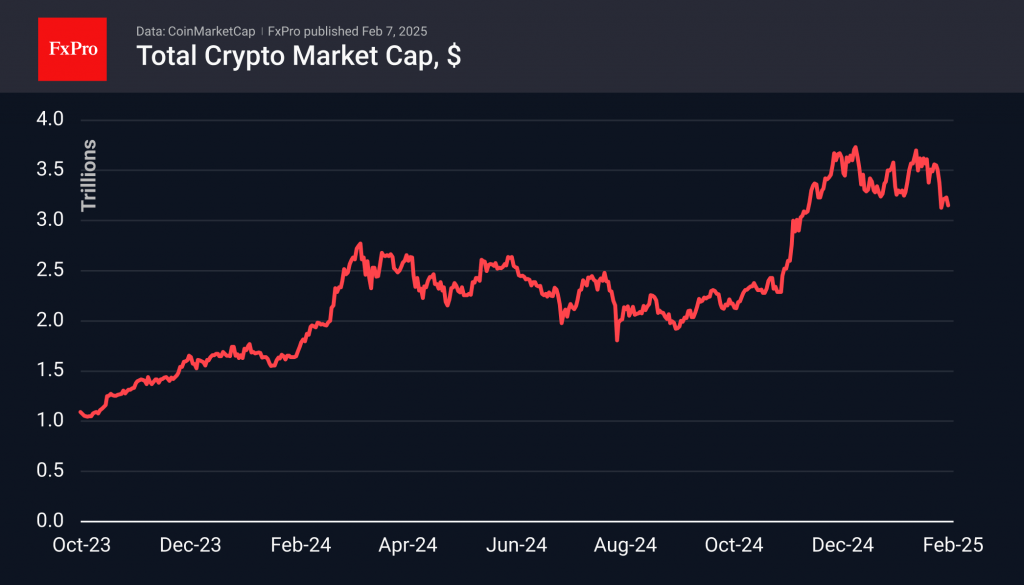
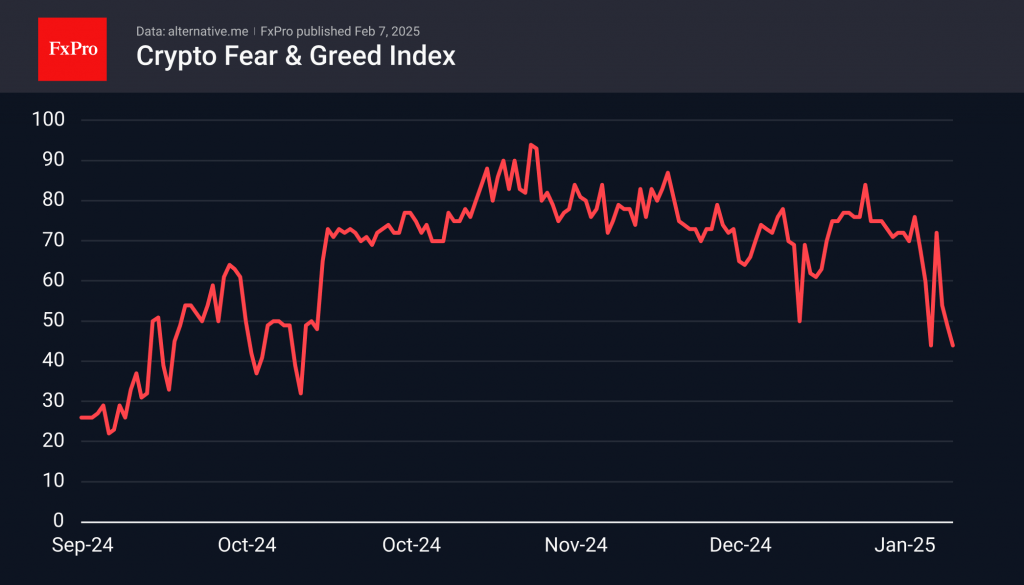
A similar pattern was observed in March of last year when the market experienced a prolonged and somewhat alarming sideways slump. The crypto market sentiment indices accurately reflected this mood, demonstrating a shift back into fear territory by the end of the week.
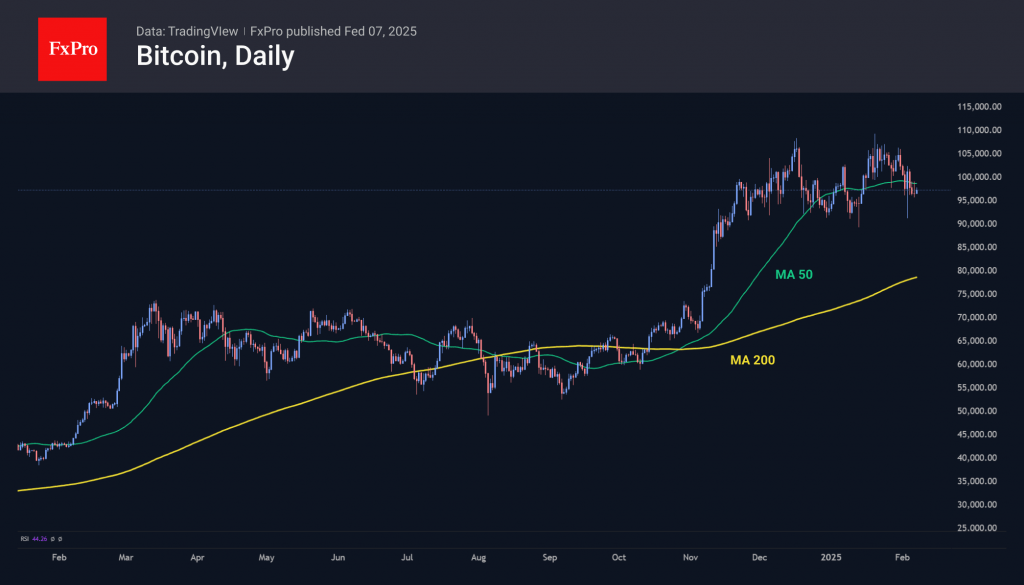
Current conditions are relatively favourable for bitcoin. Although the leading cryptocurrency has also declined, it has done so at a slower rate compared to the overall market, losing slightly more than 6% over the seven-day period. Bitcoin’s price has fallen below $97K and is now trading beneath its 50-day moving average. Consolidation below this level indicates a potential disruption of the uptrend, with a pullback to the 200-day moving average, near $80K, considered a possible target.
News Background
Arthur Hayes forecasts that Bitcoin will return to the $70K-$75K range. The Former BitMEX head said the driver of the decline would be the realisation that the current US president’s policies are virtually the same as those of his predecessors. He believes the creation of a US Special Bitcoin Reserve (SBR) could be a “net negative” for the industry as digital gold becomes a “political weapon. “
Ethereum’s share of the total crypto market capitalisation has fallen to its lowest level in four years. JPMorgan said ETH will continue to face “intense competition” from Solana and Layer 2 (L2) solutions with lower fees and higher performance.
If Ethereum holds $2500, it could “bounce to $4000 or even $6000,” predicts tech analyst Ali Martinez. If the $2500 level is breached, the next target will be $1700. Martinez noted that capital continues to flow from Bitcoin and Ethereum into stablecoins.
According to a JPMorgan survey of 4,200 of the bank’s global clients, 71% of institutional investors do not plan to trade cryptocurrencies in 2025.
USDCHF: Inverse Head-And-Shoulders Pattern
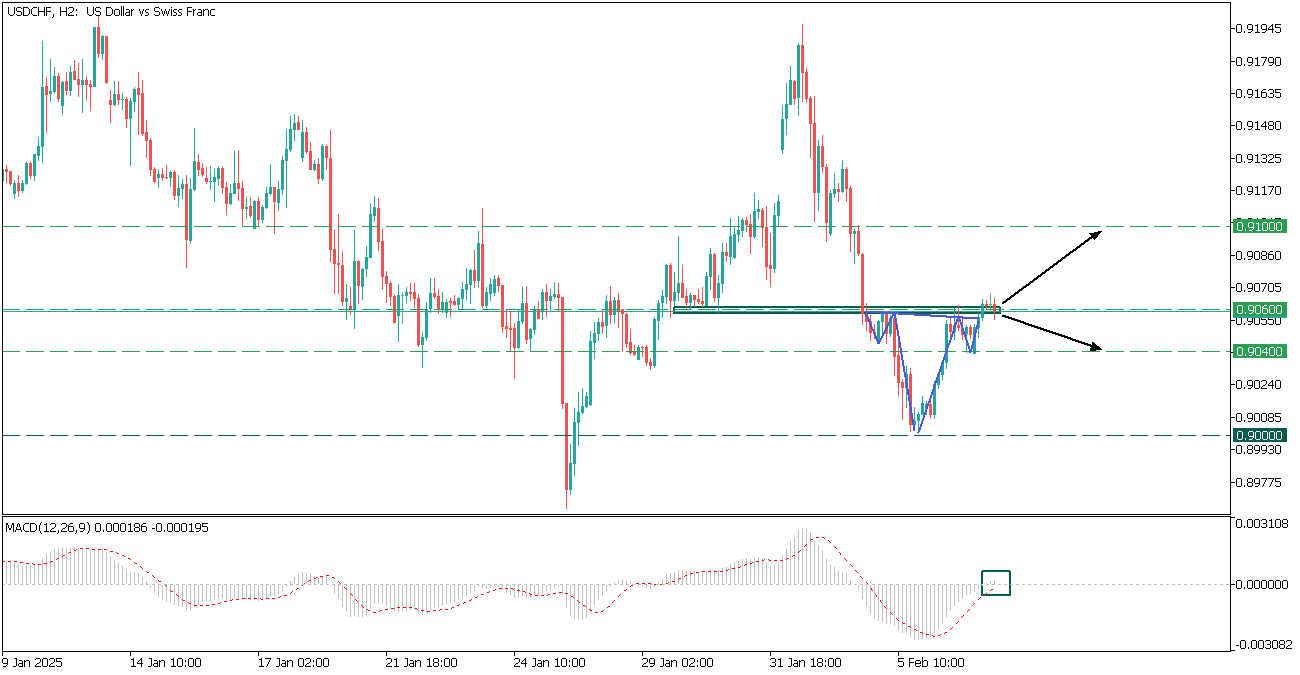
USDCHF, H2
USDCHF is recovering after a decline and formed a head-and-shoulders pattern.
- The MACD histogram crosses the 0-line upwards, however the 0.9060 resistance area is strong, giving a mixed sentiment for the asset.
- If the price breaks above the 0.9060 resistance, it may propel the asset to 0.9100.
However, if the retest fails. It may trigger a decline toward the 0.9040.
USD/JPY Looks for a Rebound
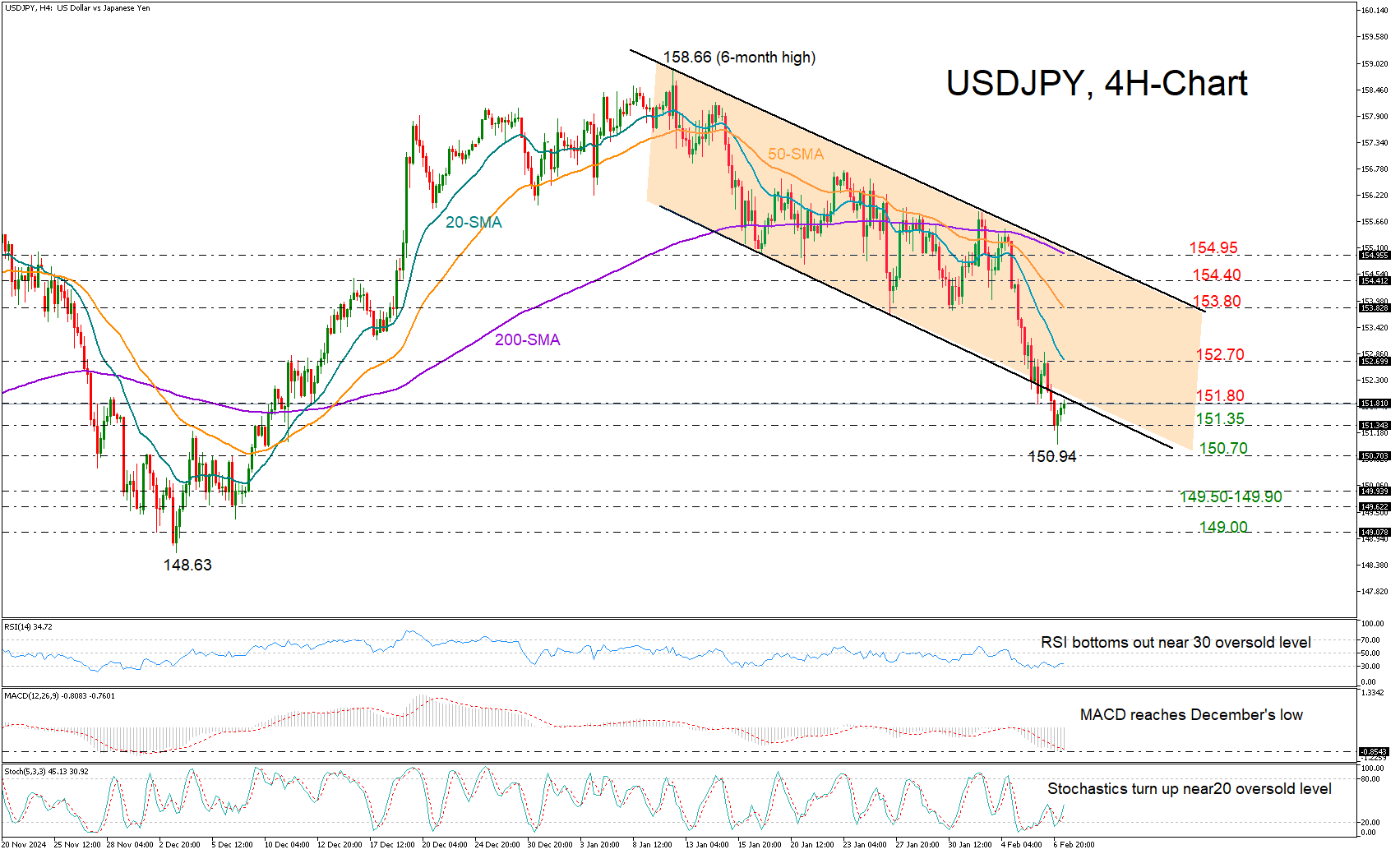
- USD/JPY bulls show some signs of life near a two-month low.
- Oversold signals present; key resistance at 151.80.
USDJPY is showing tentative signs of life after its recent freefall took a halt at 150.94 – the lowest since December – though upside pressures remain subdued, with the price currently struggling to cross above 151.80.
The falling exponential moving averages (EMAs) are endorsing the negative trajectory in the market, but oversold signals coming from the RSI and the stochastic oscillator suggest the decline has gone too far and a recovery or a consolidation phase could be underway.
If the bulls claim the 151.80 region, where the lower band of the broken bearish channel is placed, they could set their sights on the 20-period EMA at 152.70. A move higher could pave the way towards the 50-day EMA near 153.80, while the 154.40 region could be another obstacle before the channel’s upper band and the 200-period EMA at 154.95 come under examination.
In the bearish scenario that the pair closes below the 151.35 floor, the 150.70 barrier taken from December could provide some relief. If selling interest intensifies, traders might watch for a sharp drop to 149.50-149.90 and then down to 149.00.
Summing up, USDJPY is maintaining a bearish short-term outlook but oversold conditions hint that a rebound could be in play if 151.80 is conquered.
Crude Oil Price Hits New 2025 Low
As shown on the XBR/USD chart, the price of Brent crude oil dropped to $73.92 yesterday:
→ this marks a new low for 2025;
→ the decline since 15 January exceeds 9%.
Bearish sentiment is being driven by Trump's policies. According to Reuters, the Brent crude price is falling due to:
→ US President Donald Trump’s renewed trade war with China;
→ threats of tariff hikes for other countries;
→ high oil inventory levels in the US;
→ Trump’s promise yesterday to increase US oil production.
Additionally, the US Treasury Department announced yesterday that it was imposing new sanctions on several individuals and tankers involved in delivering millions of barrels of Iranian crude oil to China each year, adding to the volatility of Brent crude prices.
Could the Brent crude price continue to fall?
From a technical analysis perspective of the XBR/USD chart, we can see that the price has dropped to a key support level around $75 per barrel. At this level, bulls had the upper hand, managing to break a major resistance line at the end of 2024. It is possible that bulls remain strong in this price range, and the long lower wick on the candlestick—marked with a blue arrow—supports this idea.
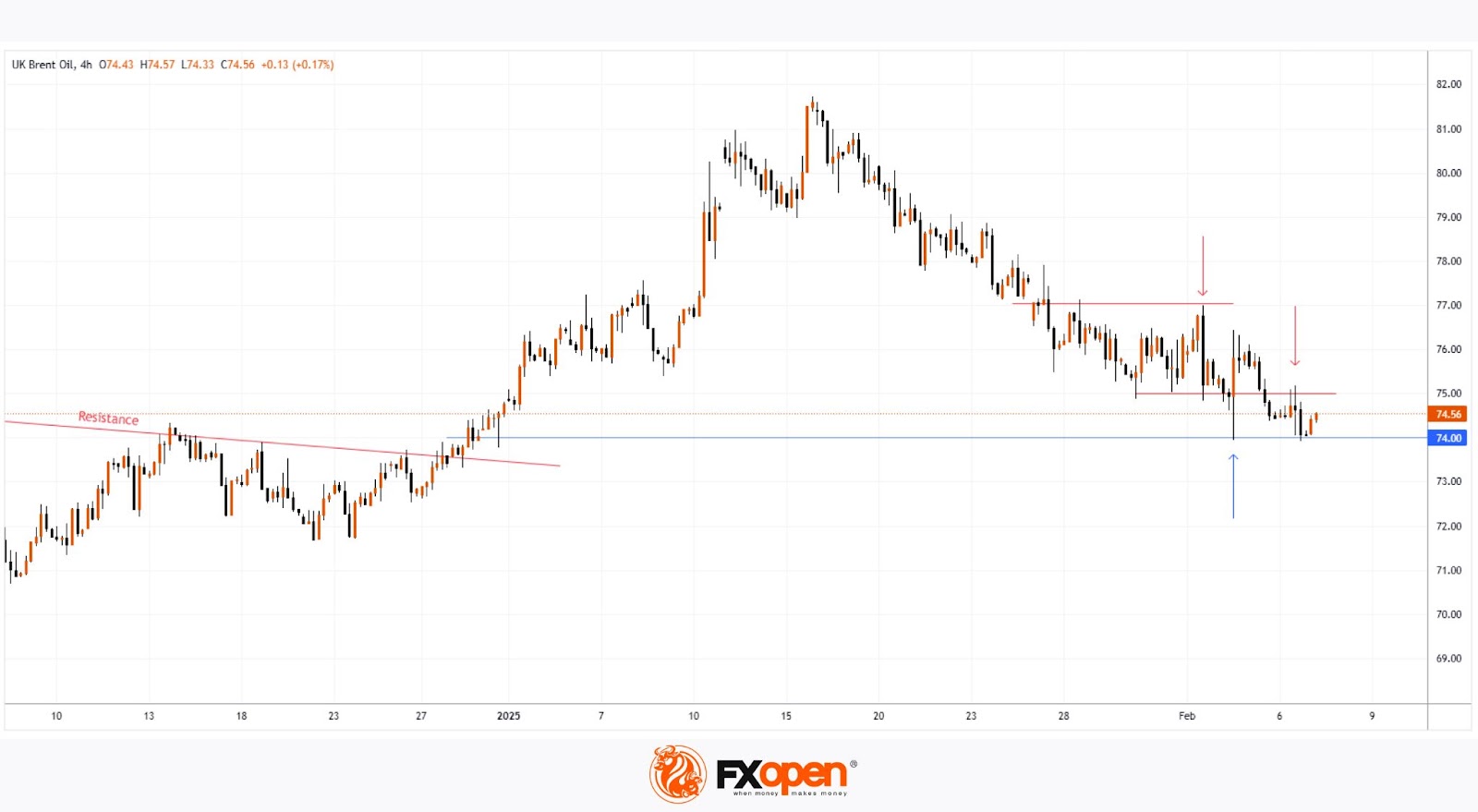
On the other hand, bears appear to be gradually gaining control at increasingly lower levels (as indicated by the red arrows):
→ the $77 level acted as resistance when Brent crude prices moved in February;
→ the $75 level has now shifted from support to resistance.
Given these factors, it is reasonable to assume that supply and demand forces may balance each other out at current levels, leading to signs of consolidation in the Brent crude price chart.
Start trading commodity CFDs with tight spreads. Open your trading account now or learn more about trading commodity CFDs with FXOpen.
This article represents the opinion of the Companies operating under the FXOpen brand only. It is not to be construed as an offer, solicitation, or recommendation with respect to products and services provided by the Companies operating under the FXOpen brand, nor is it to be considered financial advice.
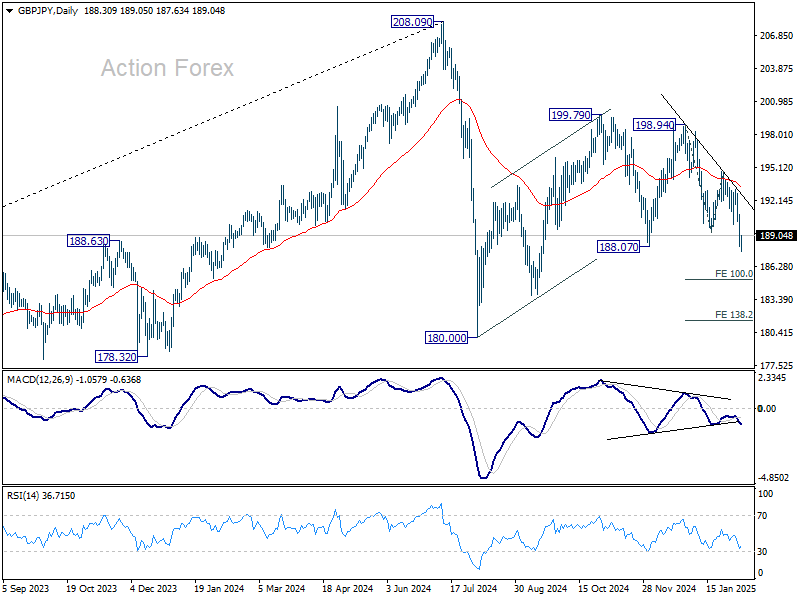
GBP/JPY Daily Outlook
Daily Pivots: (S1) 187.28; (P) 189.13; (R1) 190.18; More...
Intraday bias in GBP/JPY remains on the downside for the moment. Corrective pattern from 180.00 might have completed already. Deeper fall would be seen to 100% projection of 198.94 to 189.31 from 194.73 at 185.10. For now, risk will stay on the downside as long as 194.73 resistance holds, in case of recovery.
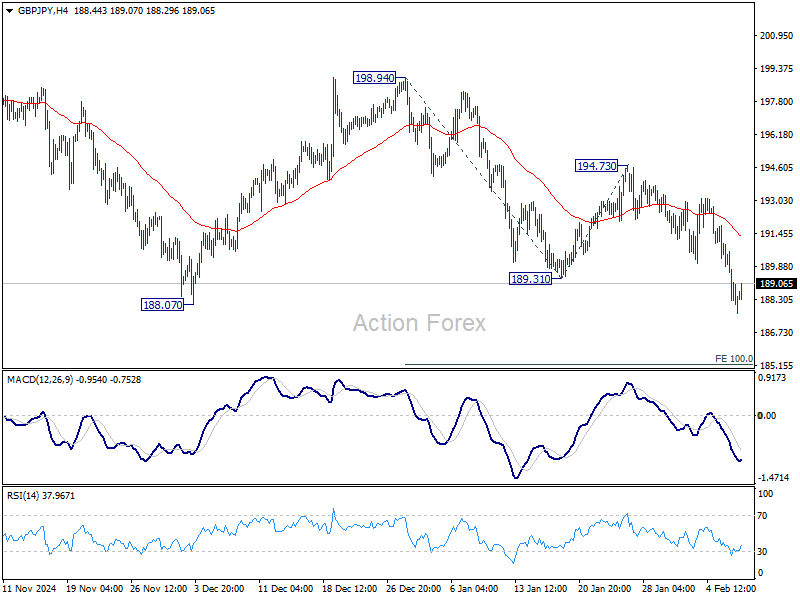
In the bigger picture, price actions from 208.09 are seen as a correction to whole rally from 123.94 (2020 low). The range of consolidation should be set between 38.2% retracement of 123.94 to 208.09 at 175.94 and 208.09. However, decisive break of 175.94 will argue that deeper correction is underway.
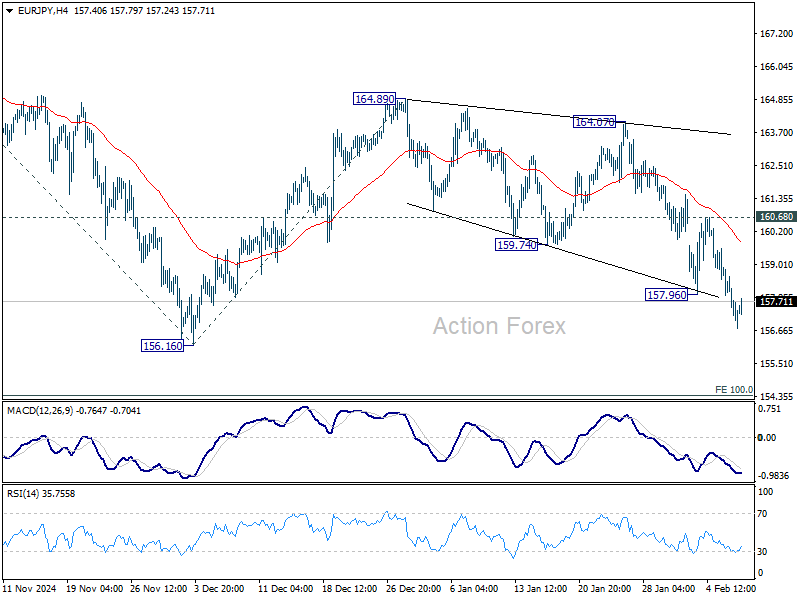
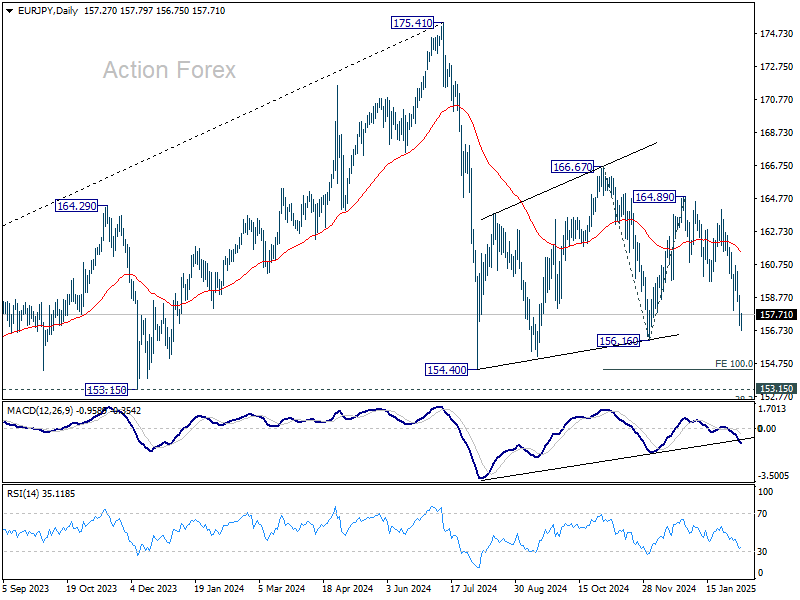
EUR/JPY Daily Outlook
Daily Pivots: (S1) 156.59; (P) 157.72; (R1) 158.41; More...
EUR/JPY's fall resumed by breaking through 157.96 and intraday bias is back on the downside for 156.16 support. Firm break there would argue that corrective pattern from 154.40 has completed at 166.67. Deeper fall would be seen to 100% projection of 166.7 to 156.16 from 164.89 at 154.38. For now, risk will stay on the downside as long as 160.68 resistance holds, in case of recovery.
In the bigger picture, price actions from 175.41 are seen as correction to rally from 114.42 (2020 low). The range of consolidation should have been set between 38.2% retracement of 114.42 to 175.41 at 152.11 and 175.41 high. However, decisive break of 152.11 would argue that deeper correction is underway.
EUR/GBP Daily Outlook
Daily Pivots: (S1) 0.8317; (P) 0.8348; (R1) 0.8381; More...
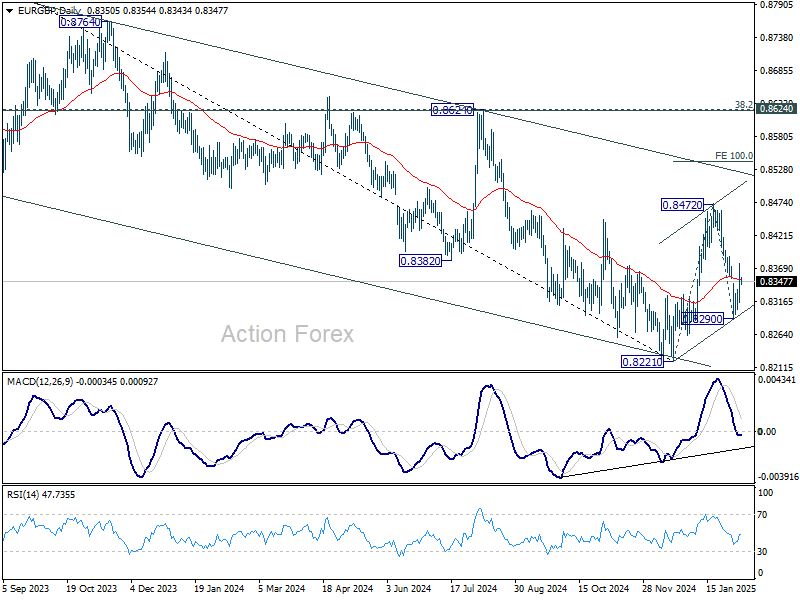
Intraday bias in EUR/GBP remains mildly on the upside for the moment. Rebound from 0.8290 would extend to 0.8472 resistance. Firm break there will resume the rebound from 0.8221. On the downside, break of 0.8290 will target a retest on 0.8221 low.
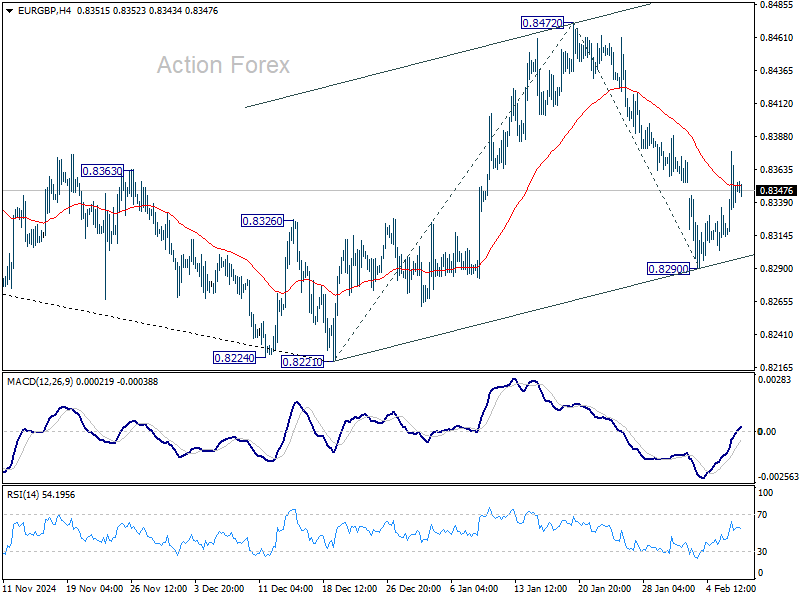
In the bigger picture, a medium term bottom should be in place at 0.8221, just ahead of 0.8201 key support (2022 low). Sustained trading above 55 W EMA (now at 0.8442) will pave the way to 0.8624 cluster zone (38.2% retracement of 0.9267 to 0.8221 at 0.8621), even just as a correction to the down trend from 0.9267 (2022 high). But still, medium term outlook will be neutral at best as long as 0.8621/4 holds.
EUR/AUD Daily Outlook
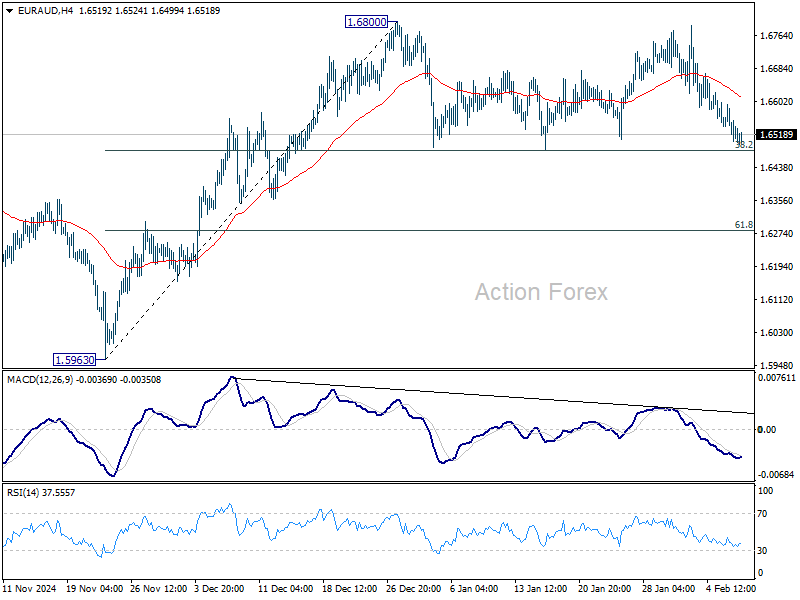
Daily Pivots: (S1) 1.6487; (P) 1.6542; (R1) 1.6578; More...
Intraday bias in EUR/AUD stays neutral for the moment, as consolidation from 1.6800 is still extending. Strong support is expected from 38.2% retracement of 1.5963 to 1.6800 at 1.6480 to contain downside. On the upside, firm break of 1.6800 will resume the rally from 1.5963. However, sustained break of 1.6480 will bring deeper correction 61.8% retracement at 1.6283 instead.
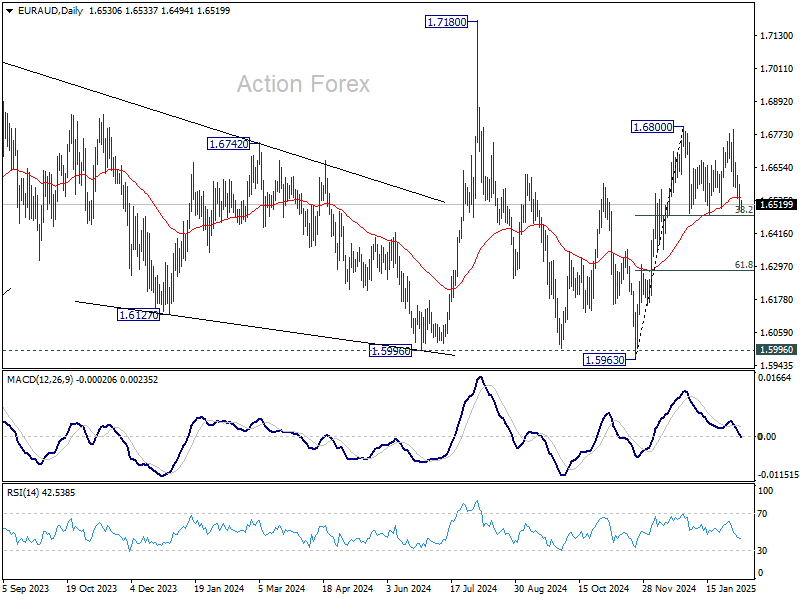
In the bigger picture, EUR/AUD is holding on to 1.5996 key support (2024 low) despite brief breach. Larger up trend from 1.4281 (2022 low) is still in favor to resume through 1.7180 at a later stage. Nevertheless, sustained break of 1.5996 will indicate that such up trend has completed and deeper decline would be seen.
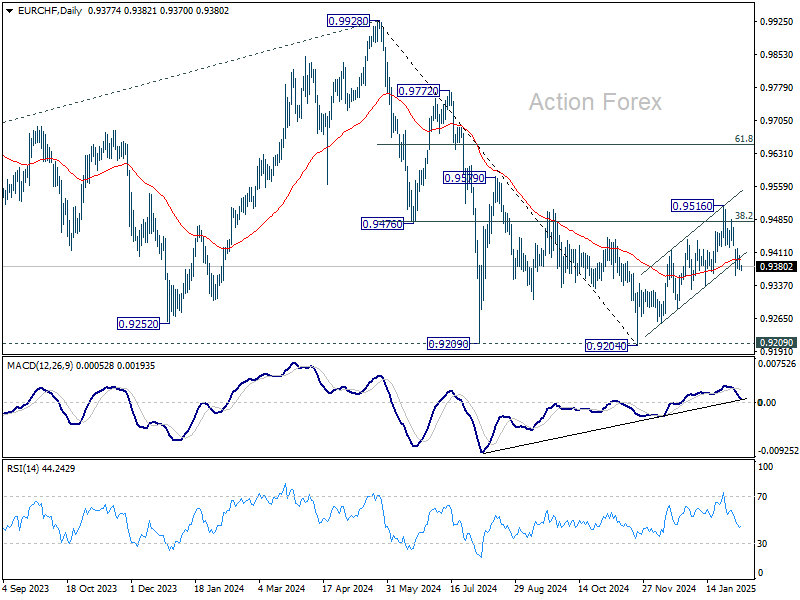
EUR/CHF Daily Outlook
Daily Pivots: (S1) 0.9375; (P) 0.9389; (R1) 0.9412; More....
Intraday bias in EUR/CHF stays neutral as consolidations continue above 0.9359. Risk will stay on the downside as long as 0.9516 resistance holds. Corrective rebound from 0.9204 might have completed at 0.9516 already. Firm break of 0.9336 support will solidify this bearish case and target a retest on 0.9204 low.
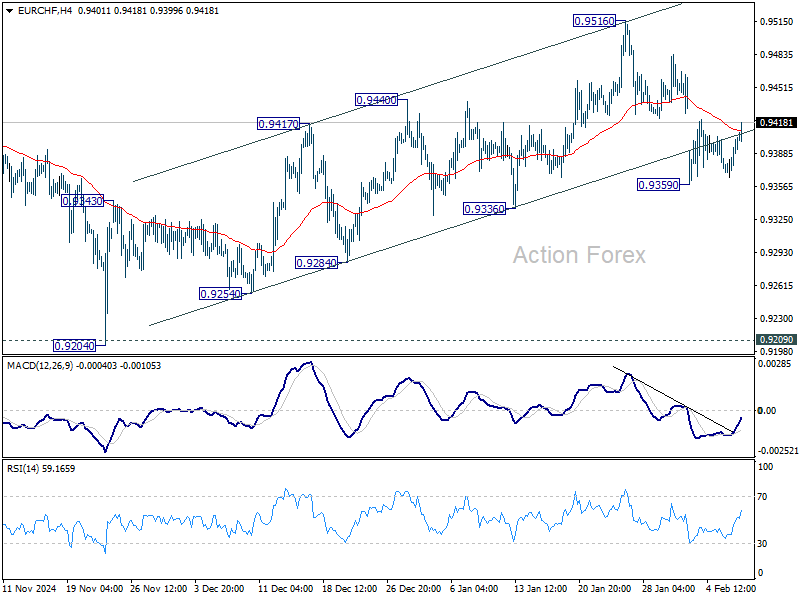
In the bigger picture, current development argues that rebound from 0.9204 has completed as a corrective move after failing to sustain above 38.2% retracement of 0.9928 to 0.9204 at 0.9481. Firm break of 0.9204/9 support zone will confirm larger down trend resumption.
USD/CAD Daily Outlook
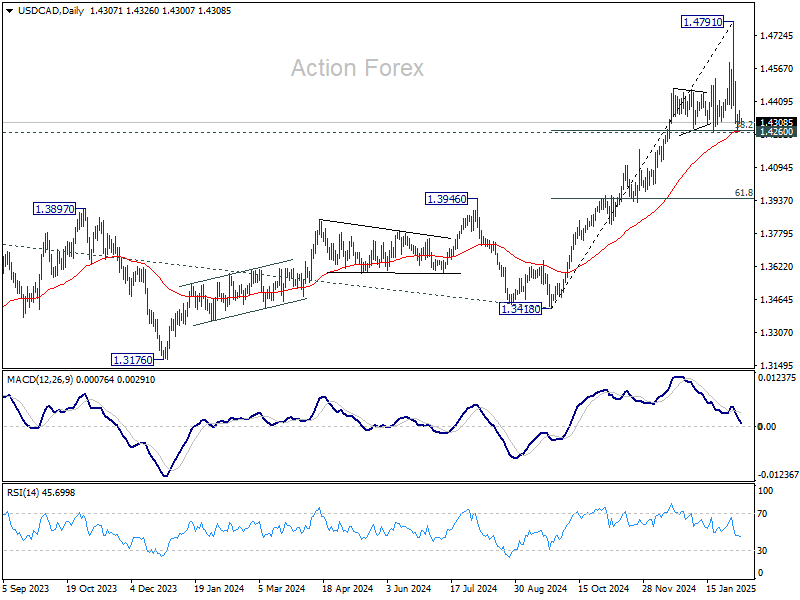
Daily Pivots: (S1) 1.4282; (P) 1.4324; (R1) 1.4348; More...
Intraday bias in USD/CAD stays neutral at this point. Downside of the consolidation from 1.4791 should be contained by 1.4260 cluster support (38.2% retracement of 1.3418 to 1.4791 at 1.4267), which is also close to 55 D EMA (now at 1.4264). On the upside, above 1.4501 minor resistance will turn bias back to the upside for stronger rebound. Larger up trend is expected to resume through 1.4791 at a later stage. However, firm break of 1.4260 will indicate that deeper correction is underway.
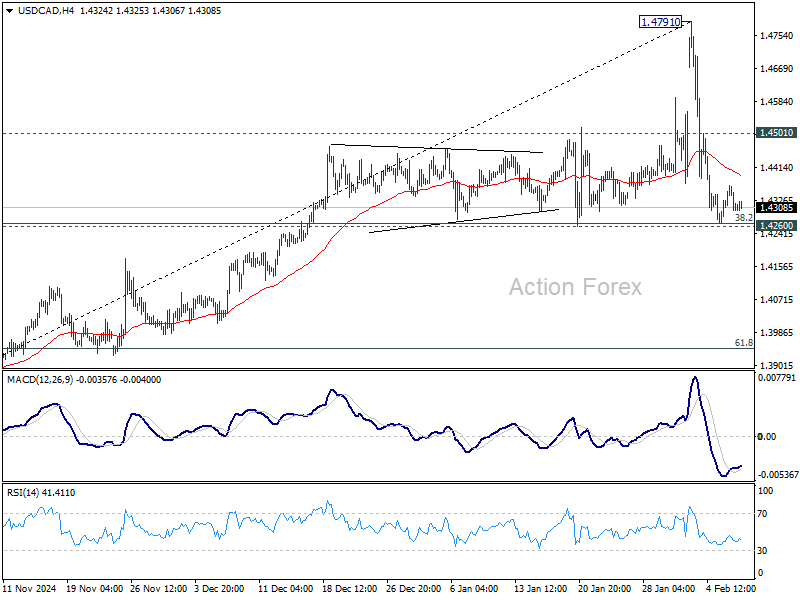
In the bigger picture, the break of 1.4667/89 key resistance zone (2020/2015 highs) confirms long term uptrend resumption. Next target is 100% projection of 1.2401 to 1.3976 from 1.3418 at 1.4993. Medium term outlook will remain bullish as long as 1.3976 resistance turned holds (2022 high), even in case of deep pullback.