Tue, Feb 17, 2026 09:32 GMT
More

    Sample Category Title

    AUD/USD Weekly Outlook

    ActionForex

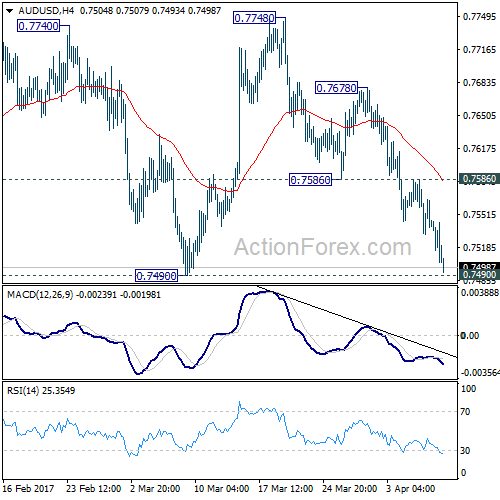
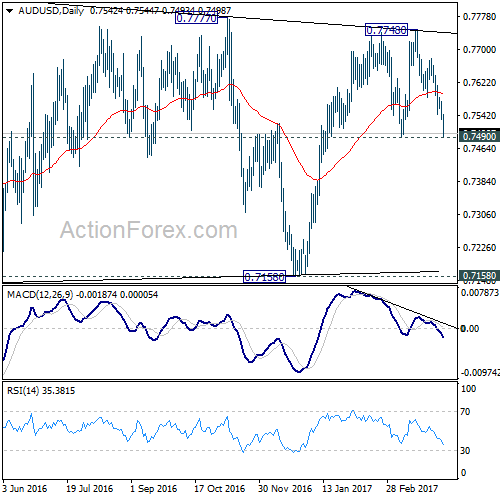
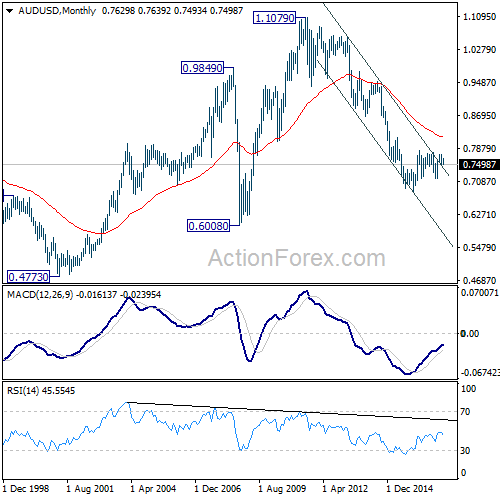
    AUD/USD stayed in tight range below 0.7695 last week and outlook is unchanged. Initial bias remains neutral this week first. Further rise cannot be ruled out yet. But lost of upside momentum is seen in bearish divergence condition in 4 hours MACD. We'd expect strong resistance from 0.7777/7833 resistance zone to limit upside and bring near term reversal. On the downside, break of 0.7510 minor support will indicate that rise from 0.7158 has completed already and turn bias back to the downside for this key near term support level.

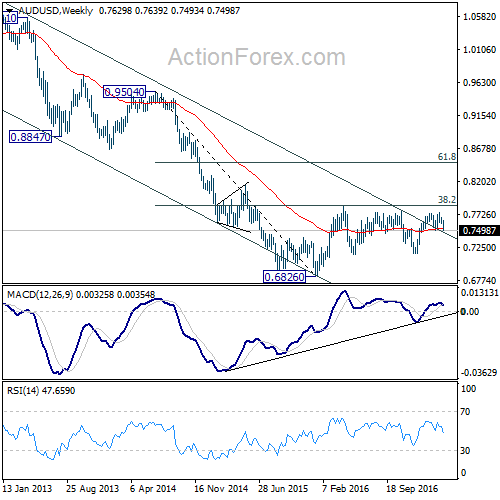
    In the bigger picture, we're still treating price actions from 0.6826 low as a correction. And, as long as 38.2% retracement of 0.9504 to 0.6826 at 0.7849 holds, long term down trend from 1.1079 is expected to resume sooner or later. Break of 0.6826 low will target 0.6008 key support level. However, firm break of 0.7849 will indicate that rise from 0.6826 is developing into a medium term rebound, rather than a sideway pattern. In such case, stronger rise should be seek to 55 month EMA (now at 0.8205) and above.

    In the longer term picture, while the down trend from 1.1079 might extend lower, we're not anticipating a break of 0.6008 (2008 low) yet. We'll look for bottoming above there to reverse the medium term trend.
    AUD/USD 4 Hours Chart

    AUD/USD Daily Chart

    AUD/USD Weekly Chart

    AUD/USD Monthly Chart

    Subscribe to our daily and mid-day newsletter to get this report delivered to your mail box

    USD/CAD Weekly Outlook

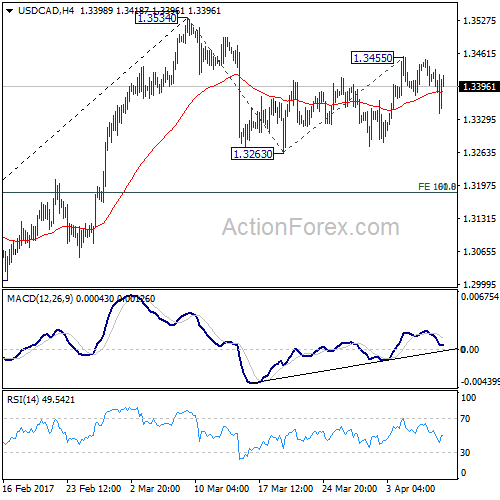
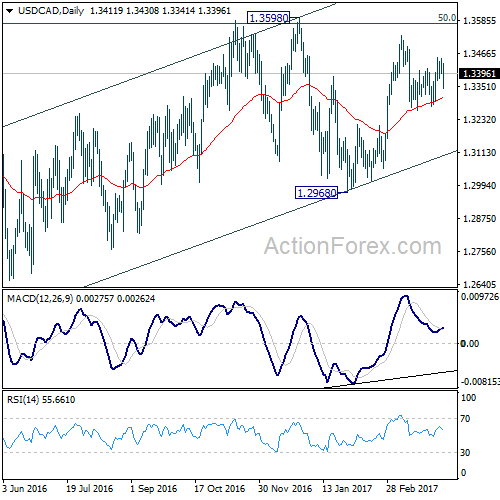
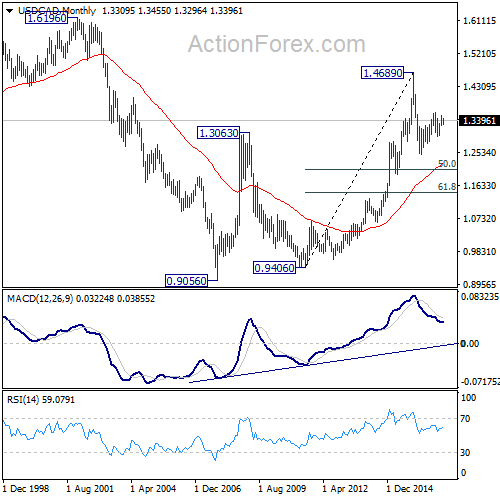
    USD/CAD's recovery last week mixed up the near term outlook. Initial bias remains neutral this week first. On the upside, break of 1.3387 resistance will confirm that fall from 1.3598 has completed at 1.2968. And more importantly, rise from 1.2460 is still in progress. In that case, intraday bias will be turned back to the upside for 1.3598 and above. On the downside, below 1.2968 will revive the case that rise from 1.2460 is completed and turn outlook bearish for this low. Overall, choppy rise from 1.2460 is still seen as a corrective move.

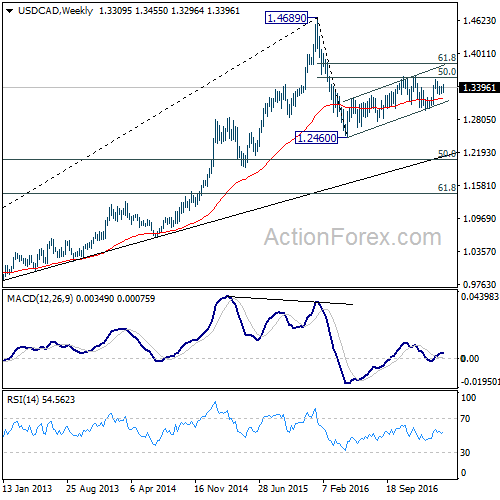
    In the bigger picture, price actions from 1.4689 medium term top are seen as a correction pattern. The first leg has completed at 1.2460. The second leg could be completed at 1.3598 and fall from there is tentatively seen as the third leg. Break of 1.2460 will target 50% retracement of 0.9460 to 1.4689 at 1.2075 before completing the correction. In case of another rise, we'd look for reversal signal above 61.8% retracement of 1.4689 to 1.2460 at 1.3838.

    In the longer term picture, rise from 0.9056 (2007 low) is viewed as a long term up trend. It's taking a breath after hitting 1.4689. But such rise expected to resume later to test 1.6196 down the road.
    USD/CAD 4 Hours Chart

    USD/CAD Daily Chart

    USD/CAD Weekly Chart

    USD/CAD Monthly Chart

    Subscribe to our daily and mid-day newsletter to get this report delivered to your mail box

    GBP/JPY Weekly Outlook

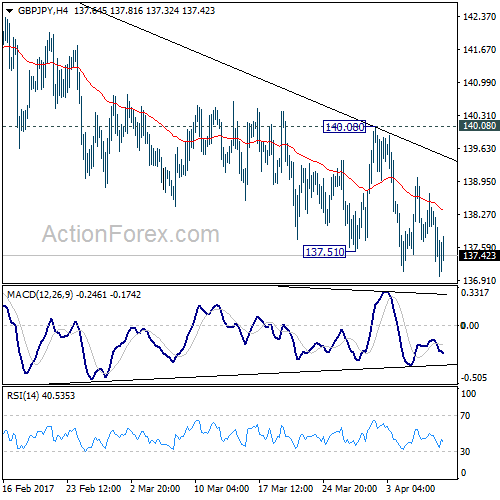
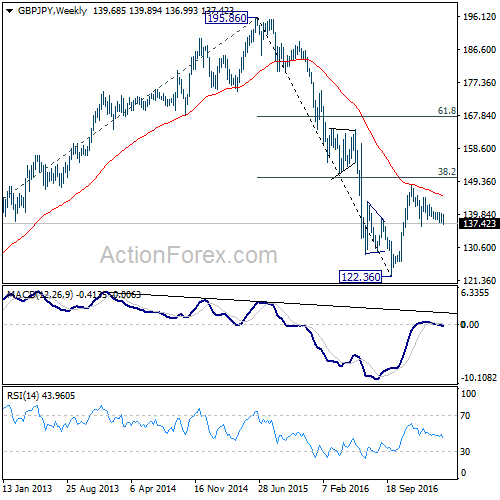
    GBP/JPY dipped to 138.53 last week but recovered since then. Initial bias is mildly on the upside this week for 144.77 resistance. Overall, price actions for 148.42 are seen as developing into a corrective pattern. Above 144.77 will target 148.42 high. On the downside, below 139.79 minor support will turn bias back to the downside and extend the fall fro 144.77 through 138.53.

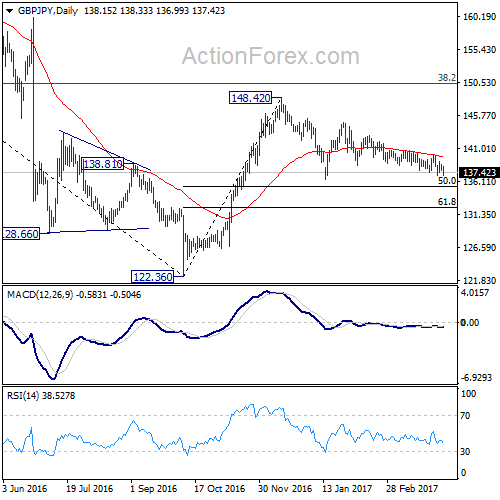
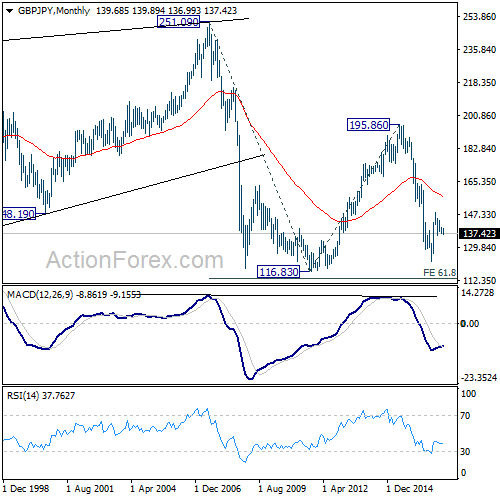
    In the bigger picture, price actions from 122.36 medium term bottom are still seen as a corrective pattern. Main focus is on 38.2% retracement of 195.86 to 122.36 at 150.42. Rejection from there will turn the cross into medium term sideway pattern with a test on 122.36 low next. Though, sustained break of 150.42 will extend the rebound towards 61.8% retracement at 167.78.

    In the longer term picture, while price actions from 122.36 would develop into a medium term correction, fall from 195.86 is still seen as resuming the down trend from 251.09 (2007 high). Hence, after the correction from 122.36 completes we'd expect another fall through 116.83 low.
    GBP/JPY 4 Hours Chart

    GBP/JPY Daily Chart

    GBP/JPY Weekly Chart

    GBP/JPY Monthly Chart

    Subscribe to our daily and mid-day newsletter to get this report delivered to your mail box

    EUR/JPY Weekly Outlook

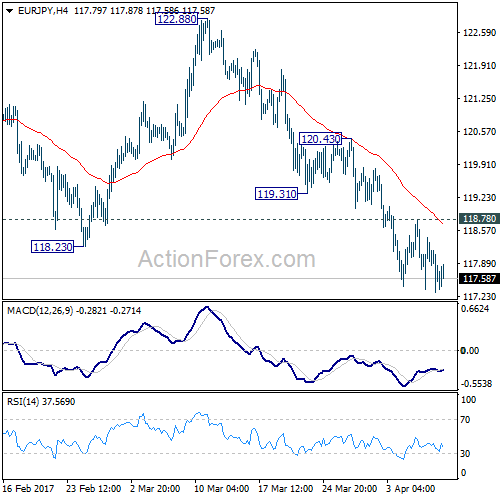
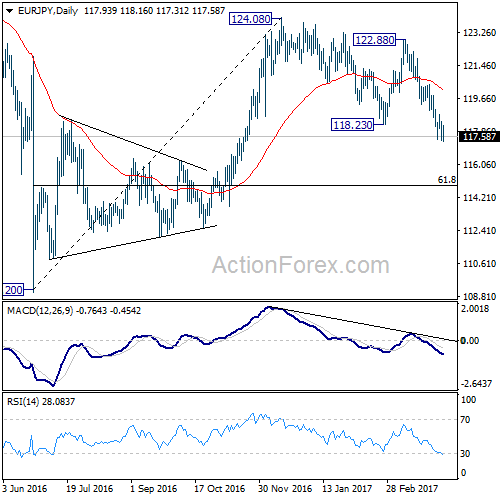
    EUR/JPY dipped sharply to 119.32 last week but recovered since then. However, the recovery was weak and limited 121.32. Initial bias is turned neutral this week first. No change in the view that choppy price actions from 124.08 is a corrective pattern. In case of another fall, downside should be contained by 118.45 cluster support (38.2% retracement of 109.20 to 124.08 at 118.39) and bring rebound. Above 121.32 will turn bias to the upside or 123.30 resistance. Break of 123.30 will likely extend the whole medium term rise from 109.20 through 124.08 high.

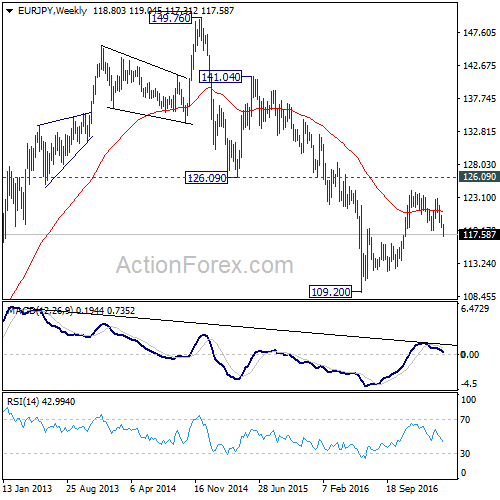
    In the bigger picture, price actions from 109.20 medium term bottom are seen as part of a medium term corrective pattern from 149.76. There is prospect of another rise towards 126.09 key resistance level before completion. But even in that case, we'd expect strong resistance between 126.09 and 141.04 to limit upside, at least on first attempt. Nonetheless, decisive break of 118.45 cluster support (38.2% retracement of 109.20 to 124.08 at 118.39) will argue that rise from 109.20 is completed and turn outlook bearish for 61.8% retracement at 114.88 and below.

    In the long term picture, current medium term decline from 149.76 is seen as part of a long term sideway pattern from 88.96. Decisive break of 126.09 will indicate that such decline is completed and EUR/JPY has started another medium term rally already.

    EUR/JPY 4 Hours Chart

    EUR/JPY Daily Chart

    EUR/JPY Weekly Chart

    EUR/JPY Monthly Chart

    Subscribe to our daily and mid-day newsletter to get this report delivered to your mail box

    EUR/GBP Weekly Outlook

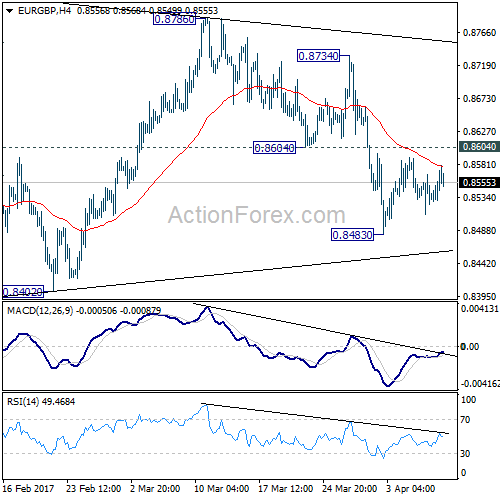
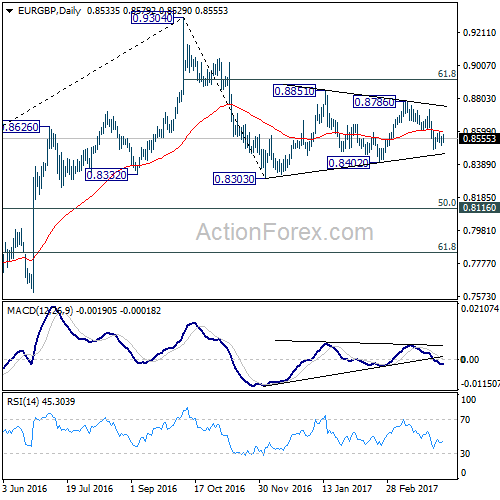
    EUR/GBP stayed in range of 0.8469/8643 last week and outlook is unchanged. Initial bias remains neutral this week first. Fall from 0.8551 is seen as the third leg of the corrective pattern from 0.9304. Break of 0.8469 support will turn bias to the downside for 0.8303 low. Break will target 0.8116 key cluster support level. On the upside, however, break of 0.8643 resistance will now dampen this bearish case and turn bias to the upside for 0.8851 resistance instead.

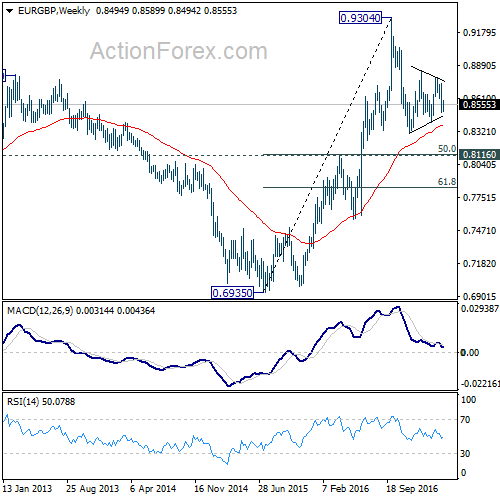
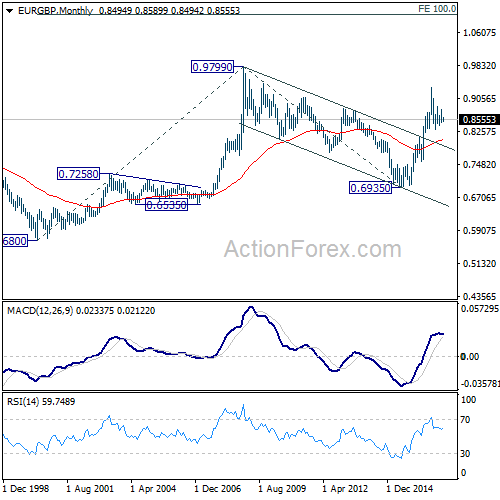
    In the bigger picture, price actions from 0.9304 are viewed as a medium term corrective pattern. Deeper fall cannot be ruled out yet. But we'd expect strong support from 0.8116 cluster support (50% retracement of 0.6935 to 0.9304 at 0.8120) to contain downside. Overall, the corrective pattern would take some time to complete before long term up trend resumes at a later stage. Break of 0.9304 will pave the way to 0.9799 (2008 high).

    In the long term picture, firstly, price action from 0.9799 is seen as a long term corrective pattern and should have completed at 0.6935. Secondly, rise from 0.6935 is likely resuming up trend from 0.5680 (2000 low). Thirdly, this is supported by the impulsive structure of the rise from 0.6935 to 0.9304. Hence, after the consolidation from 0.9304 completes, we'd expect another medium term up trend to target 0.9799 high and above.
    EUR/GBP 4 Hours Chart

    EUR/GBP Daily Chart

    EUR/GBP Weekly Chart

    EUR/GBP Monthly Chart

    Subscribe to our daily and mid-day newsletter to get this report delivered to your mail box

    EUR/AUD Weekly Outlook

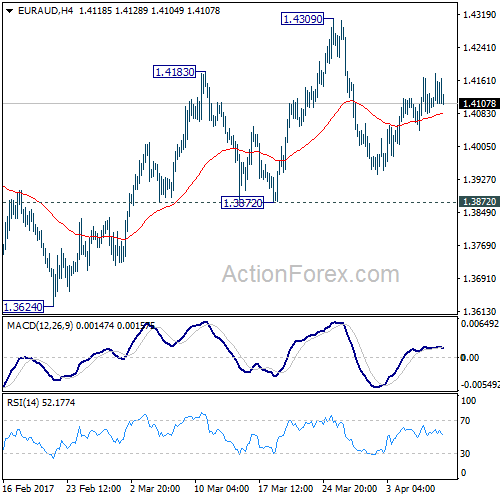
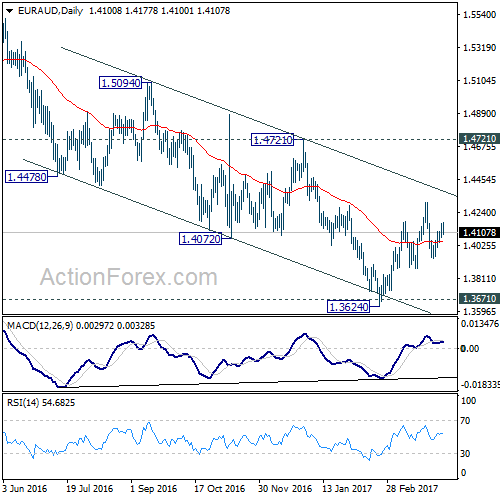
    EUR/AUD's medium term decline from 1.6587 extended last week and reached as low as 1.3838. Intraday bias remains on the downside this week and deeper fall should be seen to 1.3671 key support level. At this point, we'd still expect strong support around 1.3671 to bring rebound. On the upside, break of 1.4038 resistance will indicate short term bottoming and turn focus back to 1.4289 resistance.

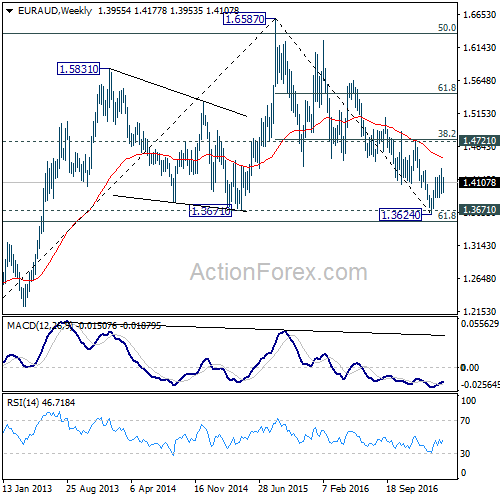
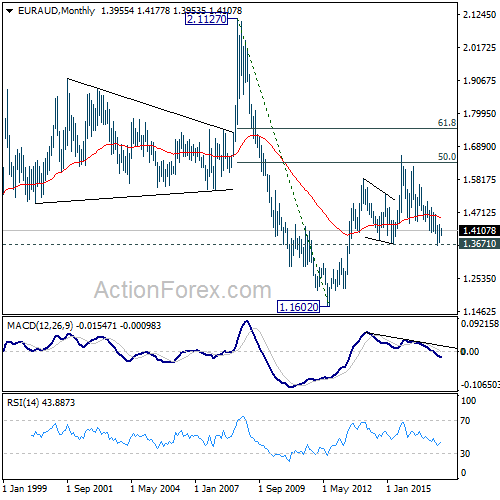
    In the bigger picture, price actions from 1.6587 medium term top are viewed as a corrective pattern. Deeper fall could be seen but, we'd expect strong support above 1.3671 to contain downside and bring rebound. Up trend from 1.1602 should not be finished and will resume later. Break of 1.4721 resistance will indicate completion of such correction and outlook bullish for retesting 1.6587 high. However, sustained break of 1.3671 will invalidate our bullish view and would turn focus back to 1.1602 long term bottom.

    In the longer term picture, the rise from 1.1602 long term bottom isn't over yet. We'll keep monitoring the development but there is prospect of extending the rise to 61.8% retracement of 2.1127 to 1.1602 at 1.7488 and above. However, break of 1.3671 should confirm trend reversal and target 1.1602 long term bottom again.
    Subscribe to our daily and mid-day newsletter to get this report delivered to your mail box

    EUR/CHF Weekly Outlook

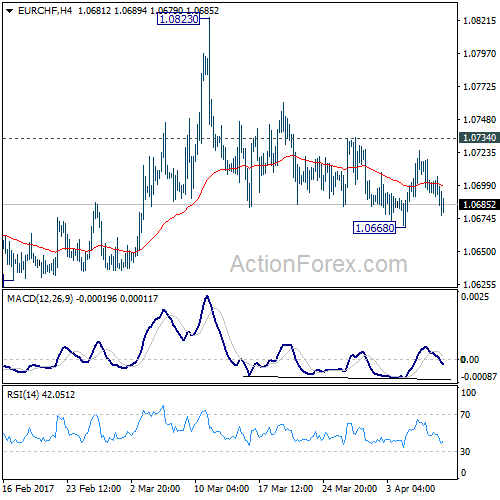
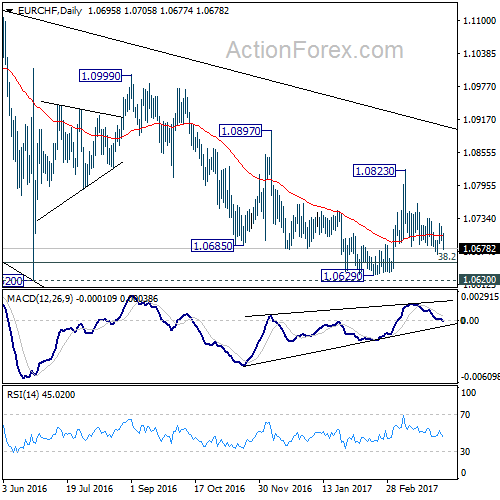
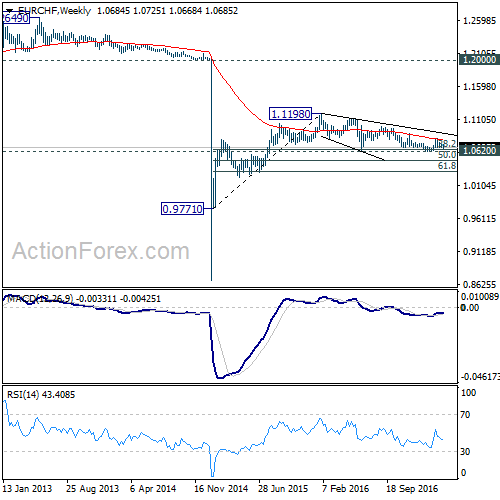
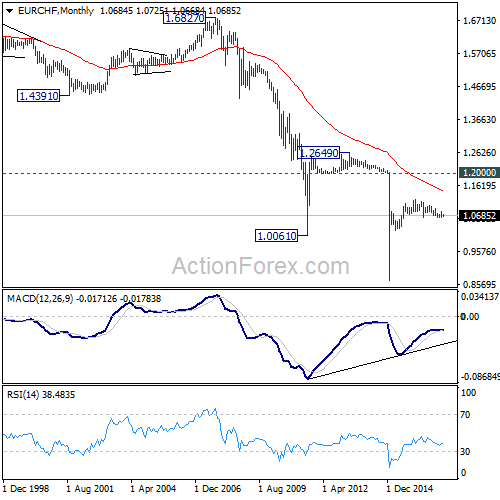
    EUR/CHF edged lower to 1.0631 last week but lost momentum again ahead of 1.0620 support and recovered. Initial bias remains neutral this week first. Near term outlook stays mildly bearish as long as 1.0706 minor resistance holds. Break of 1.0620 key support level will extend the larger decline from 1.1198 to 1.0485 fibonacci level. However, considering bullish convergence condition in 4 hour MACD, break of 1.0706 minor resistance will raise the chance of medium term reversal. In that case, focus will be turned back to 1.0749 and then 1.0897 key resistance.

    In the bigger picture, the decline from 1.1198 is seen as a corrective move. Such correction is still in progress. Sustained trading below 38.2% retracement of 0.9771 to 1.1198 at 1.0653 will target 50% retracement at 1.0485. On the upside, break of 1.0897 resistance is needed to confirm completion of such fall. Otherwise, outlook will stay bearish.

    EUR/CHF 4 Hours Chart

    EUR/CHF Daily Chart

    EUR/CHF Weekly Chart

    EUR/CHF Monthly Chart

    Subscribe to our daily and mid-day newsletter to get this report delivered to your mail box

    Yellen’s Testimonies, Riksbank Policy Meeting, Key Data in Focus

    Next week's market movers

    • In the US, Fed Chair Yellen will testify before Congress, twice. We expect her to retain an upbeat tone overall, in line with her recent appearances.
    • In Sweden, we expect the Riksbank to take the sidelines and to shift to a slightly more optimistic bias in the statement accompanying the decision.
    • We also get key data from China, the UK, the US and Sweden.

    On Monday, we have a quiet day, with no major events or indicators due to be released.

    On Tuesday, during the Asian morning, we get China's CPI and PPI data for January. The forecast is for both the CPI and the PPI rates to have risen. This would be the 13th consecutive increase in the PPI rate. The forecasts are supported by the nation's Caixin manufacturing PMI for the month, which showed that inflationary pressures remained sharp, with both input costs and output charges increasing at a pace rarely seen throughout the past five years. With regards to the PBoC, the Bank has been tightening its policy in recent weeks in order to halt some of the depreciation pressure on the yuan. As such, we think that accelerating inflation could allow the Bank to tighten its policy further in the foreseeable future if needed. What's more, the persistent rise in the PPI rate is likely to be welcomed by foreign central banks struggling to hit their inflation targets, such as the ECB and BoJ. Considering that falling Chinese producer prices between 2012 and 2016 may have held down imported inflation in the Eurozone and Japan, the turnaround in that dynamic may actually boost imported inflation in those nations and thereby, support their overall inflation prints.

    In the US, the main event will be Fed Chair Yellen's semi-annual testimony on monetary policy before the Senate Banking Committee of Congress. She will present the same testimony before the House of Representatives on Wednesday. Although the testimony will be the same on both occasions, we expect market participants to pay extra attention to the Q&A sessions. In particular they may be on the lookout for any fresh hints regarding her view on the economy, and whether she is likely to vote in favor of a rate hike in the upcoming policy meetings. The Fed Chair was relatively upbeat in her latest speech, indicating that the US is near maximum employment and that inflation is moving toward the Fed's goal. She also said that the timing of the next rate hike will depend on the economy over the coming months. Given that since then, US data have been generally solid if one overlooks the dissapointing wage growth print in January, we do not see a material reason for Yellen to deviate from her previously optimistic stance.

    From the UK, we get inflation data for January. The consensus is for both the headline and the core CPI rates to have risen further. The forecasts are supported by the nation's services PMI for the month, which indicated that inflationary pressures in the sector remained intense, with output charges rising at the same pace as in December, the fastest in 68 months. Nevertheless, we do not expect such an increase in these rates to materially affect the BoE's neutral policy stance, at least in the short-term.

    On Wednesday, market participants are likely to turn their gaze to Sweden, where the Riksbank will announce its policy decision. The last time the officials met, they extended the duration of their QE program and maintained a rather sanguine tone in the meeting statement, indicating that the outlook for economic activity in Sweden and abroad has improved somewhat. More importantly, three out of the six Board members entered reservations against extending QE purchases, a move which leads us to conclude that the bar for any further easing is quite high. Bearing this in mind, and that since that gathering the nation's CPI and CPIF rates for December both surged to reach highs last seen in 2011 and 2012 respectively, we see a very low likelihood for the Bank to take action at this meeting. What's more, the minutes of the latest meeting showed that even the members who voted in favor of extending QE were quite upbeat on the state of the economy. All these factors suggest to us that the tone of the statement accompanying the decision may be even more confident than last time.

    In the UK, employment data for December are due out. Both the unemployment rate and the average weekly earnings rates are forecast to have held steady. We share the view for an unchanged unemployment rate, though we see upside risks for the earnings forecast. We base our reasoning on the services PMI for December, which indicated that employment rose at the same pace as in November, the fastest in 7 months. It also showed that labor costs for service providers rose further. Solid employment data are likely to be another confirmation that the UK economy continues to be unaffected by Brexit uncertainties, at least so far.

    As we already noted, in the US, Fed Chair Yellen will testify before lawmakers again, this time before the House Committee on Financial Services.

    With regards to the US economic indicators, we get inflation and retail sales data, all for January. Kicking off with the inflation figures, the headline CPI rate is expected to have risen further, while the core rate is forecast to have held steady. Despite a potential rise in the headline rate, the fact that the core rate remains flat suggests that the progress in headline inflation is mainly due to movements in the prices of volatile items and is thus transitory. What's more, the core PCE price index rate remained flat in December, further confirming that underlying inflationary pressures are not accelerating.

    Turning to retail sales, the headline figure is expected to have slowed, while no forecast is available for the core number. Consumer sentiment indicators, such as the Conference Board index and the U of M index were mixed in the month, with the former declining and the latter rising. Nonetheless, the fact that average hourly earnings for the month slowed down by more than expected supports somewhat the forecast for a slowdown in sales.

    Overall, we do not think that such CPI and retail sales prints will materially affect investors' expectations with regards to the timing of the next Fed rate hike. We maintain the view that for now, the most likely timing for such action is the June meeting, a view that is slightly more optimistic than current market pricing. At the time of writing, investors expect the next rate hike to come in late August according to the Fed funds futures, which is much closer to the September meeting than the June gathering. What's more, we think that as we draw closer to the rest of the FOMC meetings this year, another theme that could attract market attention is the size of the Fed's balance sheet. In particular, we expect investors to focus on whether the Bank will continue to reinvest the assets it purchased under its QE operations. Committee members such as Chicago Fed President Charles Evans recently said that the Bank is in no hurry to halt reinvestment, and that they will discuss this after a few more rate hikes. Nonetheless, we do not think that market participants will wait until the Fed actually debates this in order to begin speculating on this prospect.

    On Thursday, the economic agenda is relatively empty, with no major events and only second-tier indicators due to be released.

    On Friday, we get the UK retail sales for January. Without a forecast available, we expect sales to have rebounded following a sharp decline in December. This view is supported by the nation's consumer sentiment indicators, such as the TR/IPSOS and the Gfk indices, both of which showed increased optimism in the month. However, the fact that the BRC (British Retail Consortium) sales monitor unexpectedly fell, suggests to us that any potential rebound in retail sales is likely to be modest.

    From Sweden, we get the CPI data for January, though we do not have a forecast yet. Considering the notable surge in both the CPI and the CPIF rates in December, which were boosted by temporary factors such as rising airfare prices, we see the case for the rates to have stayed unchanged with risks skewed to the downside. Our view is supported by the fact that SEK surged in the aftermath of the US election and continued to strengthen throughout January, particularly against the euro. This may begin to exert downward pressure on imported prices in the future, thereby being a drag on overall inflation.

    Weekly Economic and Financial Commentary


    U.S. Review

    Light Data Week as We Wait for Fed Policy Clarity

    • The economic data were on the lighter side this week. JOLTS, import prices and the trade balance were key pieces of new information and continued to support a positive assessment of the domestic economy.
    • We updated our economic outlook for the medium term; we see growth of 1.7 percent in Q1, 2.2 percent for 2017 as a whole and 2.4 percent in 2018. There is considerable uncertainty regarding fiscal policy outcomes, but we doubt they will meaningfully play out in the economy before next year.

    Economy on Solid Ground, Outlook Is Up in the Air

    Our outlook for 2017 remains on track as a relatively light data calendar offered no red flags on the domestic economy. We released our updated forecast this week, in which we left our 2017 outlook largely unchanged. We do not anticipate fiscal policy changes, whatever they turn out to be, to materialize in the economy until 2018 at the earliest. We recognize the considerable uncertainty around our forecast, and published a report outlining the assumptions on which our current outlook was formulated, titled Fiscal Policy & Our Economic Outlook, available on our website. We will update our thinking as more clear policy actions come to light.

    The economic calendar was sparse this week. The Job Openings and Labor Turnover Survey (JOLTS) continued to show healthy labor market dynamics in December, international trade figures highlighted strong domestic demand to end 2016 and import prices edged higher in January as the drag from low oil prices continued to abate.

    Job openings essentially held steady to end the year while hires increased slightly, according to the December JOLTS (top chart). The report reiterated that the U.S. labor market is on solid footing. Hiring, openings and layoffs in December were essentially unchanged from the previous month, though there were fewer quits. A rise in quits suggests rising wages may follow as workers tend to switch jobs at a higher pay rate. Fewer quits in December may have played a role in the disappointing wage growth recorded in the January jobs report. Still, the labor market is well suited for job switchers in 2017. At the same time, the tight labor market is encouraging employers to hold on to their employees. Layoffs are becoming less frequent, as evidenced by low levels of new applications for unemployment insurance. Jobless claims unexpectedly dropped last week to its lowest point since mid-November. Post-election optimism may have also played a role in the recent drop in layoffs. Regardless, the current state of the job market bodes well for personal consumption and income this year as companies offer better pay and incentives to attract and retain workers.

    International trade is a major variable. We did not include changes to trade policy in our outlook, as we need to wait and see how the administration chooses to approach policy. We did push up our forecast for U.S. import growth due to strong growth in domestic demand, which made net exports a slightly larger drag on overall GDP growth. International trade figures out this week support that notion. Strong import and export growth in December highlighted both domestic demand and improving global economic conditions, particularly given that exports surged despite the strong dollar headwind. Firming global demand is but one more encouraging signal for the U.S. factory sector that has accumulated in recent months.

    Import prices jumped 0.4 percent in January and 3.7 percent over the year as fuel prices firmed. Excluding fuels, import prices were down 0.2 percent in January and flat over the year (bottom chart). The stronger dollar continued to benefit U.S. purchasers of products from overseas. We expect this to continue as the dollar rises further this year.

    U.S. Outlook

    Retail Sales • Wednesday

    On the back of steady labor market conditions and gradually increasing income growth, headline retail sales posted its ninth straight positive monthly reading in December. Headline retail sales were boosted by a surge in vehicle and online sales in December, while restaurant and department store sales, among others, languished during the month. Core retail sales, which feed directly into the real GDP calculation, eked out a modest monthly reading dragging down the quarterly average, which is consistent with the softer real consumer spending figure in Q4. Consumer outlays remain behind the unsustainable post-election jump in sentiment. In January, weak manufacturer unit auto sales and a dip in average retail gasoline prices should pull down the headline nominal retail sales reading. That said, the underlying trend remains positive and we expect real consumer spending to increase 2.7 percent in 2017 and 2018.

    Previous: 0.6% Wells Fargo: 0.1% Consensus: 0.1% (Month-over-Month)

    Industrial Production • Wednesday

    Following a weak November reading, industrial production rose 0.8 percent in December largely reflecting a weather-related bounce in utility output. Much of the surge in utilities is expected to be reversed in January due to a swing in temperature from a slightly cooler December (measured in the monthly deviation in heating degree days) to an unusually mild January, which reduced demand for heating energy. The pullback in heating demand will also likely constrain consumer spending on energy services. At 56, the ISM manufacturing index in January climbed to its highest level since November 2014, marking the fifth-straight month in expansion territory. Regional purchasing manager indexes were also positive in January. That said, some of the gain will likely be dampened by a calendar quirk as manufacturing hours worked, which are factored into the early output estimate, are typically understated when the 15th payday falls after the survey week.

    Previous: 0.8% Wells Fargo: 0.1% Consensus: 0.0% (Month-over-Month)

    Housing Starts • Thursday

    Thanks to an outsized surge in the volatile multifamily component, housing starts ended 2016 on a solid note, rising to a 1.226 millionunit pace in December from an upwardly revised 1.102 million-unit rate in November. Although the strong reading is welcome, the level of starts is a bit exaggerated, especially due to seasonal factors and weather distortions. Permits, which are less volatile on a monthly basis, were also weak, but the entire drop was concentrated in multifamily. With the level of permits running a bit behind starts, any payback from December's strong reading will likely be muted. The NAHB/Wells Fargo Housing Market Index remained at an elevated level in January, suggesting some upside risk to overall starts. Although builder sentiment is typically seen as a forward-looking indicator for starts, the 11-year high in December and still-elevated reading in January seems to be somewhat unbridled and could also reflect some election euphoria.

    Previous: 1,226K Wells Fargo:1,209K Consensus: 1,230K

    Global Review

    Update on NAFTA Trading Partners

    • The Mexican peso has depreciated sharply versus the U.S. dollar since Election Day, which has contributed to the sharp rise in Mexican CPI inflation in the past two months. The Bank of Mexico hiked its main policy rate by 50 bps this week in an attempt to keep inflationary expectations in check.
    • In Canada, the stabilization in oil prices has caused the trade account to swing back into a small surplus after two years of red ink. Employment growth has been strong in recent months, but the Bank of Canada continues to maintain a cautious approach to policymaking.

    Update on NAFTA Trading Partners

    The Mexican peso has been one of the worst performing currencies vis-à-vis the U.S. dollar over the past year or so. Not only did the peso get caught in the downdraft that affected most emerging market currencies versus the greenback last year, but uncertainties related to the Trump administration's future policies toward Mexico have weighed on the peso in the past three months. Between Election Day and Inauguration Day the peso plunged more than 15 percent against the dollar. Although the Mexican currency has recouped some of its losses in the past two weeks, it remains about 10 percent below its level on Election Day.

    Data released this week showed that the overall CPI inflation rate shot up to 4.7 percent in January, the highest year-over-year rate in four years (top chart). Although some of the surge in inflation reflects the recent increase in the governmentally controlled price of gasoline, the sharp decline in the value of the peso is directly contributing to the inflationary impulse in the Mexican economy.

    Therefore, it came as little surprise that the Bank of Mexico raised its main policy rate by 50 bps on Thursday in an effort to keep inflationary expectations in check. The central bank has hiked its main policy rate by 325 bps since December 2015 (see chart on front page). In our view, the combination of policy tightening, higher inflation, and uncertainty related to the future of NAFTA will produce a mild recession in Mexico this year, despite some acceleration in global economic activity.

    As noted above, the Mexican peso has regained some of its footing after falling to an all-time low against the U.S. dollar in mid-January. Our currency strategy team looks for the peso to remain on the defensive—they acknowledge it could sustain further near-term losses—but look for it to regain its footing further out as policy uncertainty starts to dissipate.

    Moving north of the border, Canada is starting to incur small trade surpluses again after two continuous years of red ink in its trade accounts (middle chart). Yes, the black ink in the past two months is nowhere near the surpluses that were registered in the middle years of the last decade when commodity prices were sky high. But it appears that bleeding has largely come to an end now that oil prices have stabilized.

    There was more good news for Canada this week in the form of the employment report, which showed non-farm payrolls rising by 48K in January. Not only was the outturn much stronger than expected, but it follows on the heels of the 54K jobs that were created in December. Canadian employment figures can be notoriously volatile on a monthly basis, but the trend is clearly up (bottom chart). The unemployment rate, which edged up to 7.2 percent at the beginning of 2016, has trended lower to 6.8 percent presently.

    That said, the Bank of Canada (BoC) is maintaining a cautious approach to policymaking citing "significant slack in the labour market." In our view, the BoC will remain on hold through most of 2017. In the context of modest Fed tightening this year, our currency strategy team looks for some depreciation of the Canadian dollar versus the greenback in the near term.

    Global Outlook

    Germany ZEW • Tuesday

    After the weak number on German industrial production for December reported this week, Germany is going to release the ZEW current situation and expectations index for February on Tuesday. It will be interesting to see how this week's release of the lowerthan- expected industrial production index changes current expectations on the conditions of the German economy. January's ZEW current situation index reading was very strong, at 77.3, up from a 63.5 print in December, but this measure can come down fast if analysts believe the economy was weaker than they thought.

    Meanwhile, the expectations component of the ZEW survey was also higher in January. While this expectations component looks forward rather than backwards, it may not be as affected as the current situation index. However, we believe that the importance of the industrial sector in Germany is such that a lower ZEW reading is probably in the cards for next week.

    Previous: 16.6 Consensus (Expectations Index): 15.0

    Eurozone Industrial Production • Tuesday

    The Eurozone industrial production index for December is on the docket for next week and our expectation, and the market's expectation, is that it is going to be weak as indicated by the weak reading of the German industrial production index released this week.

    At the same time, the Eurozone is expected to release the ZEW survey expectations index for February, an index that has also been slowly increasing over the past five months, to reach 23.2 in January from 18.1 reading in December. Meanwhile, construction activity in December is on the docket for Friday. This index has been weakening on a year-over-year basis since mid-2016 to close November at 0.0 percent, year over year. However, after a very weak September reading, down 0.8 percent, the index posted two consecutive increases of 0.4 percent in October and November.

    Previous: 1.5% Consensus: -1.5% (Month-over-Month)

    Brazil Economic Activity • Thursday

    Brazil will release its monthly economic activity index on Thursday to end a year to forget, a year that marks the first time in recorded Brazilian economic history when the economy managed to decline for two consecutive years. We may say that this is the Brazilian version of a "black swan," an event that is almost unthinkable, but that has finally come to fruition.

    But, what has made this recession even more damaging for Brazil has been the political impeachment of the elected president Dilma Rousseff in mid-2016 as well as the discoveries of several corruption/fraud schemes that went on for a long time and negatively affected the reputation of Brazilian companies and politicians all across the political spectrum. Furthermore, the corruption/fraud accusations have also tainted politicians all across Latin America, with implications that could linger for a long time.

    Previous: 0.2% (Month-over-Month)

    Point of View

    Interest Rate Watch

    Financial Markets Under Policy Uncertainty

    Our outlook for inflation, interest rates and the dollar is composed under the cloud of uncertainty that is current public policy in Washington. Meanwhile, private sector actors act in anticipation of policy moves. Recently, stronger employment and ISM manufacturing data signal economic improvement.

    Our outlook is for stronger economic growth in 2017 relative to 2016. In particular, we suspect business investment will be a key factor in the turnaround from 2016. In part, this stronger business spending will likely reflect higher energy prices and an easing of regulatory policy in general and financial regulation in particular, as financial institutions will likely find fewer barriers to lending to businesses, households and home builders. With stronger demand and given the limited ability of supply to respond in the short-run, we anticipate an upward bias to inflation in 2017 and 2018 (top graph). With stronger economic growth and higher inflation, the outlook is for slightly higher interest rates (middle graph). We anticipate that the Fed will raise the funds rate twice in 2017 and that nominal yields will increase to compensate for the higher rate of inflation. The extent of any increase in interest rates will be moderated by the extent of capital inflows into the U.S. For some time now, the American economy has benefitted from both direct (commercial real estate) and financial flows (purchases of U.S. Treasury, corporate and agency debt).

    Easier fiscal policy via tax cuts and more defense/infrastructure spending as well as tighter monetary policy via the Fed raising the funds rate will give rise to an increase in the value of the dollar (bottom graph). Market Interactions in the Outlook Moving forward, the outlook reflects the interaction in the markets for goods, credit and foreign exchange. Given the high level of uncertainty in policy in all of these areas, we remain vigilant in our recognition that changes in one area will make a difference in all areas of the real economy and financial assets. These market interactions are often glossed over by many commentators when they focus on one area alone, but these interactions form the basis for thoughtful decision making in the macro economy.

    Credit Market Insights

    Fewer Credit Card Swipes

    Credit data, released by the Federal Reserve earlier this week, showed that consumers did not use their credit cards as much during the December holiday season. Consumer credit increased by a slowerthan- expected $14.2 billion, missing expectations for a $20 billion gain. For the year, consumer credit was up 6.4 percent— the slowest pace since 2013. It is also worth noting that the Fed's consumer credit report does not include debt secured by real estate.

    Most of the credit growth in recent years has been nonrevolving, which includes education and auto loans. However, the pace of growth has started to slow as auto loan standards have tightened and tuition increases slowed. Meanwhile, revolving credit, which is mostly credit cards, remains below its pre-recession peak, rising 2.9 percent year over year in December, down from the 14.4 percent pace in November. It appears as though consumers remain cautious and are being selective with their credit.

    Nonetheless, household spending continues to be a driving force behind economic growth. With consumer confidence at a cycle-high, a strengthening labor market and a pickup in wage growth, we expect real personal consumption to increase 2.7 percent in 2017 and 2018. Consumers could also see some help from the proposed income tax decreases, which could provide a further boost to spending in 2018.

    Topic of the Week

    Fiscal Policy and Our Economic Outlook

    With the release of our February Monthly Economic Outlook, we have incorporated a set of fiscal policy assumptions based on what we think is the most likely outcome based on policy proposals from President Trump and senior congressional leaders. While we recognize the challenges of forecasting policy in the current environment, we believe these assumptions provide the most realistic baseline scenario that we will tweak in the months ahead as new developments unfold.

    The fiscal policy assumptions in our outlook include: an increase in defense spending, the repeal of the Affordable Care Act (ACA) and related taxes, individual income tax cuts and corporate tax cuts. At this time, we do not see a path for additional infrastructure spending, although some tax breaks for infrastructure projects are expected. Combined, these assumptions lead to our estimate of a federal budget deficit of $650 billion for federal fiscal year 2017 and $950 billion for fiscal year 2018. On net, we downwardly revised our 2017 real GDP growth forecast by 0.1 percentage point, but we have adjusted our 2018 real GDP growth forecast upward by 0.2 percentage points.

    Our 2018 forecast includes a boost to both real consumer spending and real business fixed investment, but some of this boost to domestic demand is offset by greater import growth. Should policymakers decide to make offsetting cuts to government spending to finance tax cuts, the net effect on the deficit and, by extension, GDP growth in the near term would be much smaller.

    In short, we continue to expect a wide range of possible policy outcomes but have settled on the changes to the ACA, along with cuts to individual and corporate taxes without the major tax "reforms" sought by the Ryan blueprint. We will continue to monitor and report fiscal policy development and should proposed legislation deviate from our baseline assumptions, we will revise our forecast accordingly. For further reading, see our report, Fiscal Policy & Our Economic Outlook, which is available on our website.

    The Weekly Bottom Line

    HIGHLIGHTS OF THE WEEK

    United States

    • After last week's start-of-month data dump and the prior week's executive order deluge, this week has been fairly quiet for U.S. investors.
    • International trade data was the only top-tier release, highlighting an improvement in the trade deficit and suggesting some upward revision to fourth quarter GDP. Also constructive was the sustained decline in initial jobless claims, which beat expectations and fell to 234k last week.
    • Rather than the data, the markets were more interested in what was being said by policymakers about the U.S. economy, cheering the mere mention of what was touted by the president as a 'phenomenal' tax plan. Plenty of Fed-speak also kept market participants looking for clues for the next Fed hike, but one is unlikely until at least mid-year.

    Canada

    • Employment and housing starts data for January suggest a carryover of the positive momentum from the end of last year into the start of 2017.
    • Census data released this week confirms that population growth has and will likely continue to support the housing markets in Vancouver and Toronto. Indeed, more supply is needed to help alleviate demand pressures, and we expect that these markets will continue to experience strong housing starts despite a potential for some transitory softening in the existing home market this year.
    • None of the news this week is likely to change our own or the Bank of Canada's view on the Canadian economy. Material economic slack is apparent in the Canadian economy, and its gradual absorption should ensure that the Bank of Canada keeps monetary policy highly accommodative through 2018.

    UNITED STATES - QUIET DATA CALENDAR A WELCOME CHANGE

    After last week's start-of-month data dump and the prior week's executive order deluge, this week has been fairly quiet for U.S. investors. Markets remained fairly upbeat, on continuing hopes of corporate tax reform and relatively positive earnings, with all three major indices setting records once again on Friday morning (Chart 1). The U.S. dollar also got a modest boost, with the DXY index 1.1% higher on the week, at the time of writing.

    International trade data for December was the sole toptier U.S. release leaving participants with little to chew on by way of economic data. The trade deficit narrowed to $44.3 billion from $45.7 billion in the prior month (Chart 2), beating economists' expectations for a more modest pullback (to $45.0 billion). Exports bounced back after two months of contraction, while imports followed suit, in line with an acceleration in economic growth at home. This was relatively good news, pointing to a modestly smaller drag from net trade on fourth quarter GDP, but did little in the way of moving the needle.

    The second-tier data was somewhat more inspiring. For one, initial jobless claims fell substantially, going against market expectations for a modest increase. The headline number fell to 234k for the week ending February 4th while the 4-week moving average declined to 244k, the lowest level since 1973. The job openings and labor turnover survey for December also painted a picture of an increasingly tight labor market, with job openings hovering around the 5.5 million mark, while the quits rate slipped only slightly to 2.0%, but remained near the cycle-high level of 2.2%.

    Globally, economic data was more mixed. German industrial production hit the brakes in December, down 3% m/m. However, factory orders rebounded, up 5.2% on the month, providing some comfort that industrial production will bounce back in January. Less encouraging was the softer reading of the composite purchasing managers' index in China which fell to 52.2 in January. While this still represents growth, it signals a slower pace at the beginning of the year. Similarly, Australian retail sales also disappointed, falling by 0.1% in the important December shopping month.

    Still, data these days often tends to play second fiddle, with policy discussion about the U.S. economy taking center stage, particularly how any of these may impact the outlook for monetary and fiscal policy. President Trump suggested recently that he will within the next two weeks announce a 'phenomenal' tax plan with markets already cheering the mere mention of this initiative (see Chart 1 again).

    In the follow-up to the Fed's meeting last week, the Fed's speaking circuit was out in full force. Philadelphia Fed President Harker kicked things off, alluding to a rate increase as early as March. However, his hawkish views were offset by the Minneapolis Fed President Kashkari, who cited the slow improvement in core inflation and limited cost pressures stemming from the labor market as reasons to remain patient. Evans (Chicago) and Bullard (St. Louis) also reiterated the dovish stance later on in the week, both citing concerns around the lack of inflationary pressures. Overall, none of this changes our take on the Fed's next move, with our baseline view seeing the Fed raise rates twice this year, with the first coming around the mid-year mark.

    CANADA - JANUARY DATA CONFIRMS SOLID START TO 2017

    The data flow this week painted a fairly optimistic picture of the Canadian economy at the start of 2017. In particular, employment and housing starts data for January suggested a carryover of the positive momentum from the end of last year.

    This morning's jobs report was good enough to stir foreign exchange traders into action, causing the CADUSD to appreciate about 0.5% to a firm $0.765 moments after the report's release. The headline of the January employment report was constructive - 48.3k jobs mainly private sector jobs created, pushing the unemployment rate down to 6.8% despite an uptick in the labour force participation rate to 65.9%. However, the underlying details of the release were less rosy. Two-thirds of jobs created were part-time, dampening hours and wage growth. Moreover, January marks the second consecutive month of decline in hours worked, and the first month since last July in which average hourly wages failed to increase. We've written before about the implications of the trend toward part-time employment for the Canadian economy, particularly that it will likely continue to exert downward pressure on earnings and hours worked.

    On the housing side, starts in Canada remained near the 200k annualized pace in January, just above our projections of trend household formation. The strength in housing starts continues to be focused in large census metropolitan areas (CMAs), such as Toronto, Vancouver and Montreal. The need for housing in these areas was confirmed by the first snapshot from the 2016 Census that revealed these CMAs experienced a significant increase in population since 2011. In fact, these three cities accounted for a fifth of Canada's total increase in CMA population since 2011 in absolute terms, while Edmonton and Calgary had the largest percentage increase in population. Moreover, both Vancouver and Toronto recorded the largest increase in population density, adding more than 50 people per km2 since 2011. All of this is further evidence that fundamentals have and will likely continue to support the housing markets in both of these cities. More supply is needed to help alleviate demand pressures, and we expect that these markets will continue to experience strong housing starts despite a potential for some transitory softening in the existing home market this year.

    Although backward-looking, the December trade data revealed that Canada's nominal trade balance in goods remained in surplus with the rest of the world for the second consecutive month. While largely owing to an improvement in the trade surplus in goods with the U.S., it's important to note that Canada has a substantial trade deficit in services with its largest trading partner that results in the U.S. having an overall trade surplus with Canada. This is one reason why we don't expect that Canada will become a primary target of any protectionist measures that the new U.S. administration may implement. Having said that, Canada may be hurt indirectly from the fallout that any measures may have on nations important to Canadian aggregate demand.

    None of the news this week is likely to change our own or the Bank of Canada's view on the Canadian economy. Weakness in hours worked and average hourly wage growth are signs of material economic slack apparent in the Canadian economy. The absorption of this slack should continue to be a very gradual process, ensuring that the Bank of Canada keeps monetary policy highly accommodative through 2018.