Sample Category Title
EUR/CHF Daily Outlook
Daily Pivots: (S1) 0.9312; (P) 0.9346; (R1) 0.9366; More....
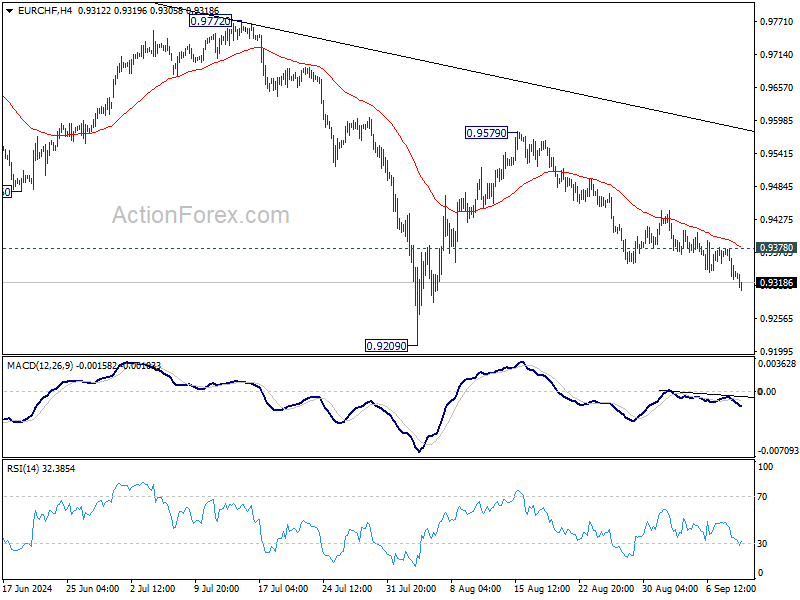
EUR/CHF's fall from 0.9579 extends lower today. Intraday bias remains on the downside for retesting 0.9029 low. Firm break there will resume larger down trend. On the upside, above 0.9378 minor resistance will turn intraday bias neutral first.
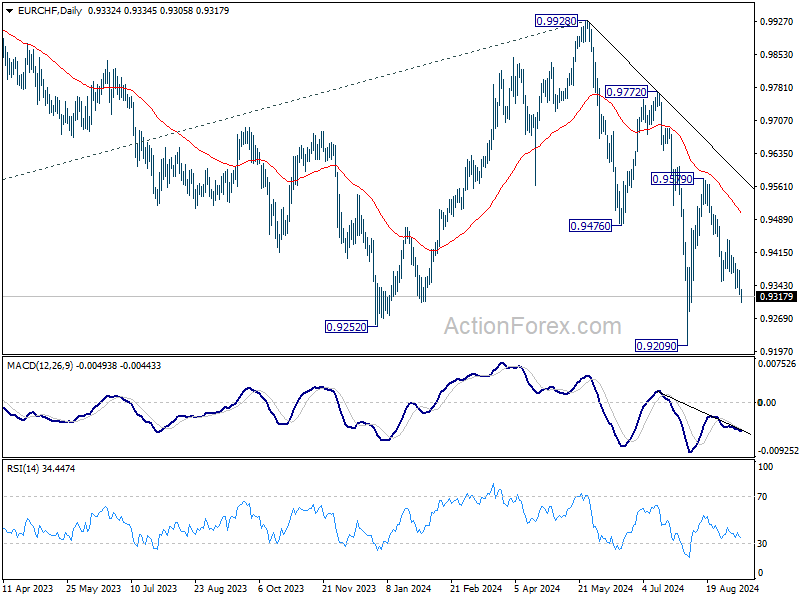
In the bigger picture, medium term corrective pattern from 0.9407 (2022 low) might have completed with three waves to 0.9928. Decisive break of 0.9252 (2023 low) will confirm long term down trend resumption. Next target will be 61.8% projection of 1.1149 to 0.9407 from 0.9928 at 0.8851. For now, outlook will stay bearish as long as 0.9928 resistance holds, even in case of strong rebound.
Japanese Yen Taking a Leap This Morning
Markets
Momentum changed yesterday from the US opening as core bonds steamed ahead. The move was triggered by another sudden drop in oil prices. Brent crude prices opened around $72/b, but a break below the recent lows ($70.6 area) accelerated the downleg with an intraday low near $68.5/b. Commodity prices like oil or iron ore keep sending alarms on the global state of the economy. Investors pile up on central bank easing bets, especially in the US, and recession wagers. Bull steepening is the obvious outcome. A very strong $58bn 3-yr Note auction added to the curve move. The auction stopped a significant 1.7 bps below the WI yield with a very aggressive indirect bid and a rising overall auction bid cover (2.66). US yields dropped 3.8 bps (30-yr) to 7.4 bps (2-yr) yesterday. From a technical point of view, the US 2-yr yield arrived at the 2023 low of 3.55%. However, in the current market setting we don’t expect that to play a role. With Fed entering a new phase in its monetary policy cycle, the bottom for the front end of the curve will be defined in first instance by the (market) view on neutral rates (3% area). The US 10-yr yield lost the final support in the 3.66%/3.78%-zone and is now on its way back to the 2023 low of 3.25% which coincides with 38% retracement on the race from 0.31% to 5.02% between 2020 and 2023. US Treasuries continued to outperform German Bunds with German yields ending 2.6 bps (30-yr) to 4.1 bps (5-yr) lower. That makes sense given the approaching ECB meeting and the fact that the Lagarde & co have way less space to make policy less restrictive compared to the Fed. On top, the European inflation outlook doesn’t support the case for rapid or large rate cuts. The dollar’s technical comeback immediately ran into first resistance. Lower oil prices and the loss of interest rate support obviously aren’t helping. The US presidential debate might have added to the move this morning. We argued before that Trump momentum went hand-in-hand with by default USD-momentum as it implied an aggressive trade policy in the disadvantage of the likes of EMU, China,… . Democratic Nominee Harris’ strong performance the debate triggered some reverse action. EUR/USD rebounds towards 1.1044 this morning.
The August US CPI report grabs most attention today. Consensus expects 0.2% M/M price growth for both headline and core inflation resulting in a Y/Y headline CPI drop from 2.9% to 2.5% and a stabilization at 3.2% for the core gauge. We don’t think that inflation data even in case of an upward surprise will be able to alter ruling market momentum. Especially should risk sentiment sour further. A negative surprise will even add to 50 bps rate cuts bets going into next week’s FOMC meeting, our preferred scenario.
News & Views
The Japanese yen is taking a leap this morning. USD/JPY slips towards the 141 lever with a test of the December 2023 low (140.25) increasingly probably. JPY strength dominates the G10 FX landscape following comments from Bank of Japan board member Nakagawa. Having gained a dovish reputation over the years, Nakagawa this time struck a different tone. She said that policy normalization would continue if the outlook for the economy and inflation materializes, echoing comments made by other BoJ members including governor Ueda. Risk number one for Nakagawa is the upside one to inflation with chances that wage growth will deviate from the BoJ scenario due to a tight labour market. Especially her comments about the “extremely low” real rates gained a lot of market attention. They suggest Nakagawa believes there is room for several rate hikes. The central bank meets September 20 but a third hike already then is unlikely after the unexpected July one.
US households’ real, inflation-adjusted, incomes rose in 2023 for the first time since 2019, the Census Bureau’s annual report unveiled yesterday. Household income rose throughout the income distribution with median incomes increasing some 4% to $86 610. The rise reflected a sharp drop in inflation, which eased from an annual 8% in 2022 to 4.1% last year. Despite the increase, median incomes remain some $600 below the pre-pandemic levels. Census also reported that the country’s main gauge of the poverty rate (adjusted for government support including food assistance and tax credits) rose to 12.9%, up from 12.4% in 2022. The official poverty rate dropped to 11.1%, 0.6 ppts above the record low seen in 2019.
Graphs
GE 10y yield
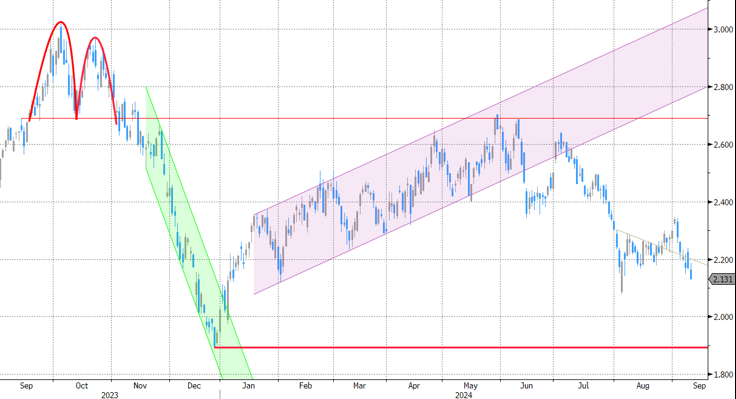
The ECB cut policy rates by 25 bps in June. Stubborn inflation (core, services) make follow-up moves less evident. Markets nevertheless price in two to three more cuts for 2024 as disappointing US and unconvincing EMU activity data rolled in, dragging the long end of the curve down. The move accelerated during the early August market meltdown.
US 10y yield
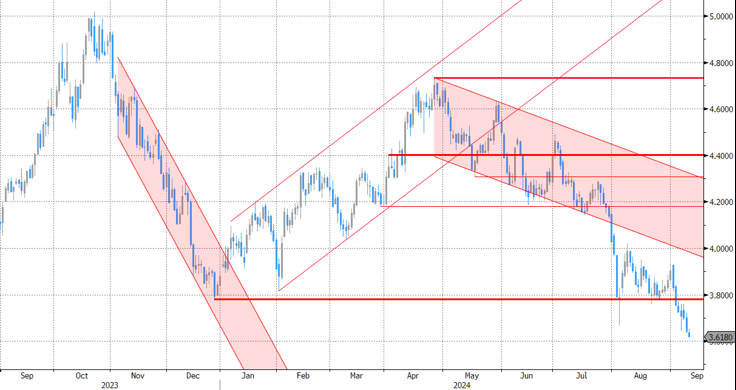
The Fed in its July meeting paved the way for a first cut in September. It turned attentive to risks to the both sides of its dual mandate as the economy is moving to a better in to balance. The pivot weakened the technical picture in US yields. A string of weak eco data and a risk-off market climate pushed and kept the 10-yr sub 4%. We think we could be up to three 50 bps rate cuts this year.
EUR/USD
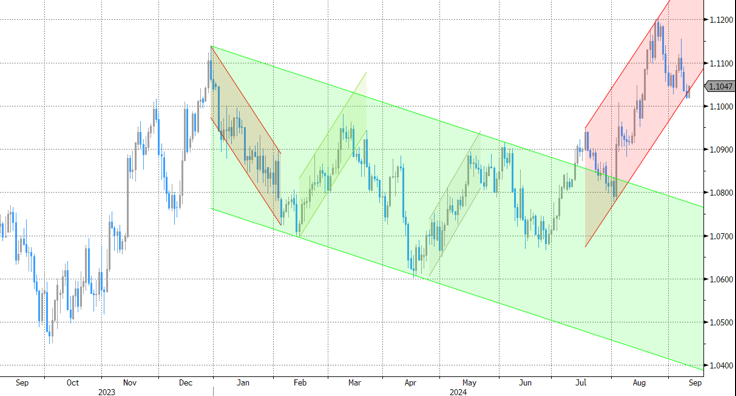
EUR/USD moved above the 1.09 resistance area as the dollar lost interest rate support at stealth pace. US recession risks and bets on fast and large rate cuts trumped traditional safe haven flows into USD. EUR/USD 1.1276 (2023 top) serves as next technical references.
EUR/GBP
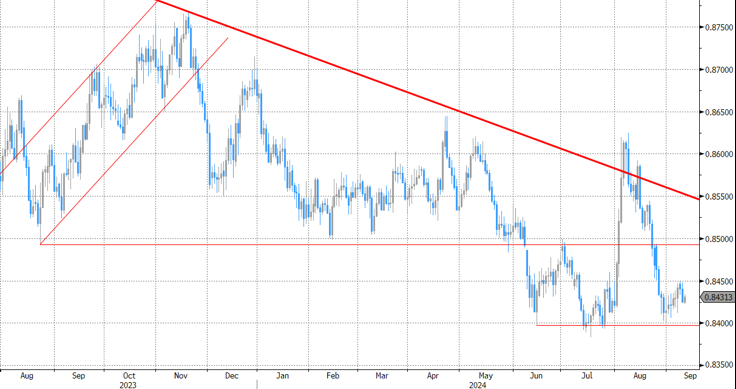
The BoE delivered a hawkish cut in August. Policy restrictiveness will be further unwound gradually on a pace determined by a broad range of data. The strategy similar to the ECB’s balances out EUR/GBP in a monetary perspective. Recent better UK activity data and a cautious assessment of BoE’s Bailey at Jackson Hole are pushing EUR/GBP lower in the 0.84/0.086 range.
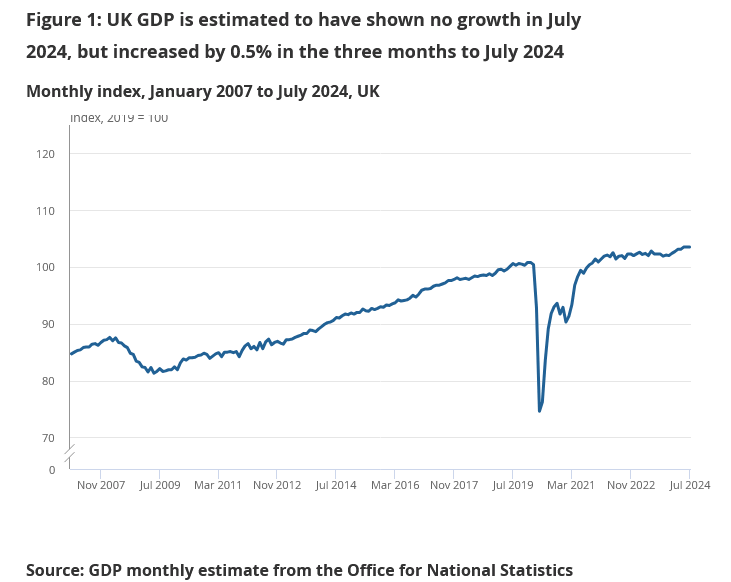
UK GDP stagnates in Jul with sharp production contraction
The UK economy showed no growth in July, marking a disappointing performance after also stagnating in June. The flat 0.0% mom reading fell short of expectations for 0.2% increase.
Breaking down the numbers, services sector—typically a key driver of UK growth—rose just 0.1% mom in July. Meanwhile, production sector saw a sharp contraction, declining by -0.8% mom. Construction activity also fell by -0.4% mom.
In the three months to July, UK GDP managed to post 0.5% growth compared to the previous three-month period ending in April, largely supported by the services sector, which grew by 0.6%. Construction performed relatively well, with a 1.2% expansion, marking its first positive three-month growth since September 2023. However, production remained weak, contracting by -0.1% over the same period.
Brent Slips Below $70pb – Focus on US CPI
The barrel of US crude tumbled almost 4% to nearly $65pb level, as Brent crude slipped below the $70pb mark after OPEC – which is normally optimistic - lowered its demand forecast for the second time in two months. The API data also showed that the US oil inventories fell by another 2.79 mio barrels last week. As such, US crude has now hit the oversold market conditions, and the rapid selloff suggests that a minor correction would be healthy at the current levels. But the short-term outlook remains comfortably bearish, as the demand worries outweigh the supply side of the story. The price supportive factors like the geopolitical tensions, OPEC’s decision to delay the end of the production restrictions and a hurricane in the Gulf of Mexico go totally unheard. Little need to say that the energy sector had a rough session, yesterday.
Elsewhere, the debate between Trump and Harris went quite well for Harris, which saw her victory odds climbed to 55, and the latter sent Bitcoin 2.50% lower.
Big banks and big tech
Yesterday’s news suggested that US regulators would scale back the increase in capital requirements from 19% to 9%. But news were eclipsed by a conference where the big bank heads gave weak revenue prospects and gloomy outlook. JP Morgan’s CEO said that the $90bn estimate for its net interest income ‘is not very reasonable’ for next year. BoFA said that results for its investment banking will be lower than the Wall Street expectations. Goldman Sach’s CEO said that the bank’s trading revenue will likely drop 10% in the current quarter and Ally Financial warned that ‘credit challenges have intensified’ due to increasing auto loan delinquencies as borrowers faced higher borrowing costs. As a result, JP Morgan saw its share price drop more than 5%, and Invesco’s KBW bank ETF fell 1.83%.
Elsewhere, the European top court told Apple to pay Ireland €13bn in unpaid taxes - putting an end to an eight-year dispute, and Google lost its chance to overturn a €2.4bn fine for abusing its market dominance of its shopping comparison service. Google’s Alphabet didn’t really react to the news – its stock price gained 0.31%, while Apple lost 0.36%, but most of it was probably due to the unimpressive product reveal and insufficient AI promises that the company gave the day before. On the brighter side, Taiwan’s exports rose to a new record of $43.6bn in August thanks to the growing demand for AI chips – and the country’s finance ministry said that the exports should continue to rise steadily in the H2 thanks to robust AI demand. Nvidia advanced some 1.5% yesterday, but TSM gave no reaction to the news. To me, it looked like the continuation of the AI fatigue story.
Overall, the S&P500 still gained 0.45% yesterday, Nasdaq 100 jumped 0.90%, while the Dow Jones index closed with losses due to the bank selloff. The US 2-year yield plunged to 3.56% on rising worries regarding the economic strength and the US dollar gave back most of its advance since Monday. The USDJPY fell to the lowest levels since January as a Bank of Japan (BoJ) member said that the central bank will continue to adjust its degree of easing. Because the expectation is that the BoJ will likely wait until December or January to announce another rate hike, there is room for hawkish readjustment, but the 140 level will likely act as a decent support in the absence of a concrete action.
All eyes on US CPI
Today, all eyes are on the US CPI data. Adobe’s Digital price index printed the biggest drop on record in August for online grocery prices. According to their calculation, the online food prices fell 3.7% in August from a month earlier. Food consumption stands for about 8.6% for of the official inflation measure and is left outside of the core measure, but the decent drop fits the slowing economy and slowing inflation narrative. Combined with the falling oil prices, I would say that the direction for consumer prices looks somewhat clear. In numbers, core inflation - that excludes food and energy prices - is expected to have steadied near the 3.2% level but headline inflation which includes food and energy is expected to have eased from 2.9% to 2.5%. If that’s the case, we will see the headline inflation drop significantly below the 3% level for the first time since last summer. That would be another reason for the Federal Reserve (Fed) to stop worrying about inflation and to worry more about the weakening jobs market. Would that justify a 50bp cut instead of a 25bp cut in September? Hardly. Because announcing a 50bp cut in September would suggest that the Fed accepts to have fallen behind the curve, and they probably want to avoid that.
All Eyes on US CPI Today
In focus today
In the US, the August CPI is due, where we forecast headline inflation to ease to 0.1% m/m SA (2.5% y/y), while core inflation is expected to remain steady at 0.2% m/m SA (3.2% y/y). We foresee a gradual moderation in housing and non-housing services inflation following a modest rebound in July, and do not expect a CPI report in line with our forecast to materially change the pricing of Fed cuts.
In the UK, monthly GBP figures will be released, and the Bank of England will be aware of potential inflation risks from strong domestic demand.
In Sweden, Riksbank's Breman speaks about the history of the Swedish economy and the current situation at 17.45 CET at a small-town business community. We do not expect her to send any monetary policy signals on this occasion.
Economic and market news
What happened overnight
In the US, Kalama Harris and Trump had their first presidential debate, where Harris delivered a convincing performance against Trump. While Trump focused on attacking the alleged shortcomings of the current administration, Harris delivered a more forward-looking vision. While Trump's messages lacked clarity on his planned initiatives and key topics such as immigration, Harris stood out especially on her strong views regarding abortion, rule of law and foreign policy towards wars in Ukraine and Gaza. The overall tone on Trump's comments was gloomy and threatening while Harris appeared more optimistic about the future. Leading up to the debate, prediction markets saw odds of both candidates essentially tied (50.5% to 49.5% in favour of Harris) but after the debate Harris is now seen as the clearer favourite (55% to 45%). This was the only presidential debate scheduled for the fall, although Harris' campaign has already called for another one in October.
In Japan, Bank of Japan (BoJ) policymaker Junko Nakagawa stated that the central bank will proceed with its rate hikes if inflation aligns with forecasts, indicating that last month's market turmoil has not altered their plans. This follows comments from policy board member Hajime Takata, who last week emphasized the need to stay on course with rate hikes while treading carefully to avoid volatile markets harming businesses.
What happened yesterday
In the US, The NFIB Small Business Survey fell to 91.2 in August, erasing July's gain of 93.7, driven by concerns over inflation, labour shortages, and weaker sales expectations. Fed Governor Barr, the central bank's regulatory chief, announced a revised "Basel III Endgame" plan, which will now impose a 9% increase in capital requirements for the largest lenders, instead of the 19% rise initially proposed last summer.
In the UK, the July/August labour market report was mixed. Wage growth was lower than expected at 4.0% (cons: 4.1%), while last month's figure was revised up. The less volatile wage measure ex-bonus came in as expected at 5.1%. Similarly, the unemployment rate was also in line with expectations, down to 4.1% from 4.2%, but likely due to noise from the month prior. Employment growth increased in July, while payrolls in August were weaker than expected at -59k. Given the poor data quality of the LFS labour market data, the report should be taken with a pinch of salt as other indicators suggest a loosening labour market. Overall, wage growth remains elevated which is a concern for the Bank of England, keeping the central bank more cautious in this cutting cycle. We expect a cut in November, with pauses in September and December.
In Norway, headline inflation for August came in lower than expected at 2.6% y/y (cons: 2.7% y/y), while core inflation matched expectations at 3.2% y/y. Disregarding the effect of regulated kindergarten max prices, the core reading was 3.5% y/y - higher than expected but still below Norges Bank's 3.6%-projection. The main surprise in core inflation, excluding the kindergarten factor, came from imported inflation, which increased from 1.4% to 2.0%. The rest of the surprise seems to mainly stem from rent, which rose from 4.2% to 4.5%.
In Sweden, July activity data came in weaker than expected, with the GDP indicator at -0.8% m/m SA. However, this should be taken with a grain of salt, as the indicator has been highly erratic. While other data indicate a dip in production, consumption, which makes up some 50% of GDP, surged. Albeit, it must be noted that this is summer data, making the seasonal adjustment a bit uncertain.
On the commodities front, oil prices continued to decline, dropping below USD 70/bbl in yesterday's session amid concerns of oversupply. At the same time, OPEC lowered its global oil demand growth forecast for 2024 and 2025, citing sluggish economic growth, especially in China.
Equities: Global equities were higher yesterday, lifted by the US, tech, and cyclical growth sectors. Conversely, value and defensive groups did not just underperform; they were outright lower. Energy sectors took the hardest hit, with the price of Brent crude oil dropping below 70 dollars per barrel. Banks in both Europe and the US also saw declines, partly due to falling yields and regulatory changes (a Federal Reserve official on Tuesday announced revisions to a set of U.S. banking regulations that would roughly halve the extra capital the largest institutions need). In the US yesterday, the Dow closed down by 0.2%, the S&P 500 was up by 0.5%, the Nasdaq increased by 0.8%, and the Russell 2000 decreased slightly by 0.02%. Asian markets are lower this morning, and the same goes for European and US futures.
FI: Concerns of over-supply of oil sent yields lower driven by the break-evens. The 10y German bund ended 3bp lower at 2.13%. The decline in oil prices has led to a significant repricing of ECB expectations and while the 2024 ECB market pricing has been steady around the 60-65bp, markets continue to add to the 2025 segment and is now pricing 122bp of rate cuts from the ECB, which is a full 25bp rate cut more than just one week ago. Inflation markets are pricing the average HICP ex tobacco at 1.64% through 2025, which is below our expectations.
FX: In a two-split session risk and commodity sensitive currencies ended yesterday as the clear underperformers with notably EUR/NOK rebounding sharply during the US hours. The rally in fixed income benefitted the JPY and despite the USD staying firm USD/JPY still moved back to multi-month lows just above 142.
USD/CAD Daily Outlook
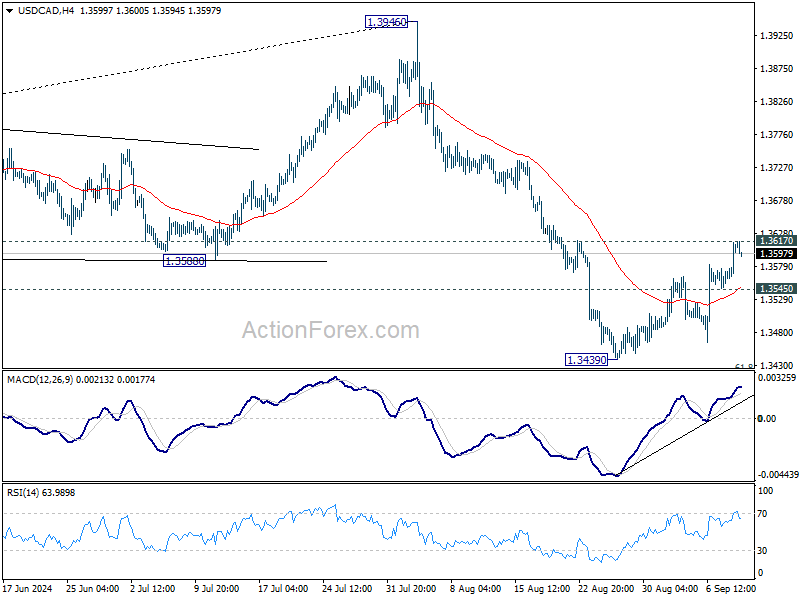
Daily Pivots: (S1) 1.3570; (P) 1.3593; (R1) 1.3633; More...
USD/CAD's recovery is still limited by 1.3617 resistance and intraday bias remains neutral. Further decline will remain in favor as long as 1.3617 resistance holds. On the downside, below 1.3545 minor support will bring retest of 1.3439 low first. However, firm break of 1.3617 will turn bias back to the upside for stronger rebound instead.
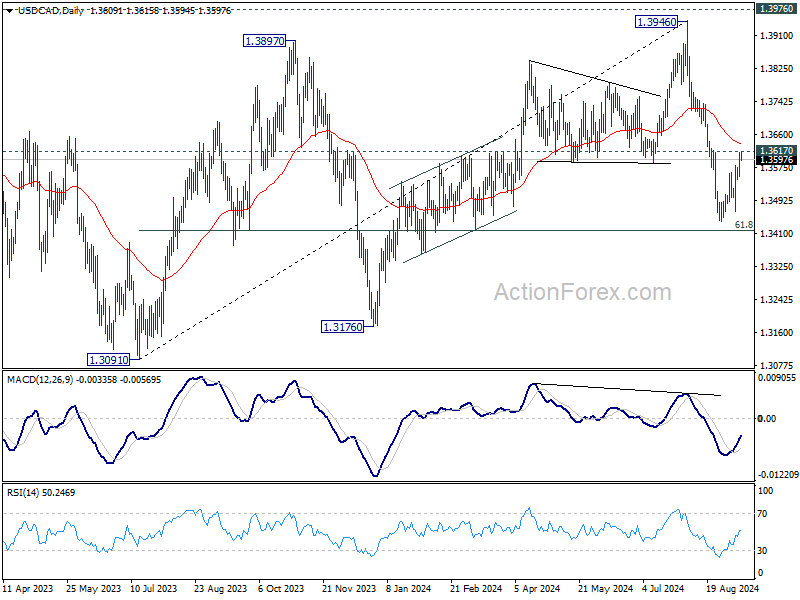
In the bigger picture, current development suggests that corrective pattern from 1.3976 (2022 high) is extending with another falling leg. While deeper decline could be seen, strong support should emerge above 1.2947 resistance turned support to bring rebound. Rise from 1.2005 (2021 low) is still in favor to resume at a later stage.
AUD/USD Daily Report
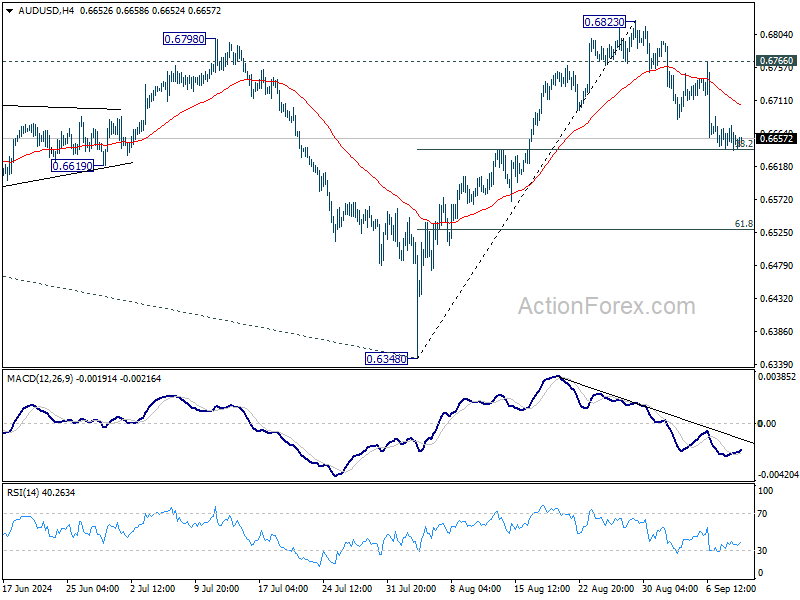
Daily Pivots: (S1) 0.6637; (P) 0.6657; (R1) 0.6673; More...
Intraday bias in AUD/USD remains on the downside for the moment. Decisive break of 38.2% retracement of 0.6348 to 0.6823 at 0.6642 will target 61.8% retracement at 0.6529. On the upside, though, above 0.6766 resistance will bring retest of 0.6823 instead.
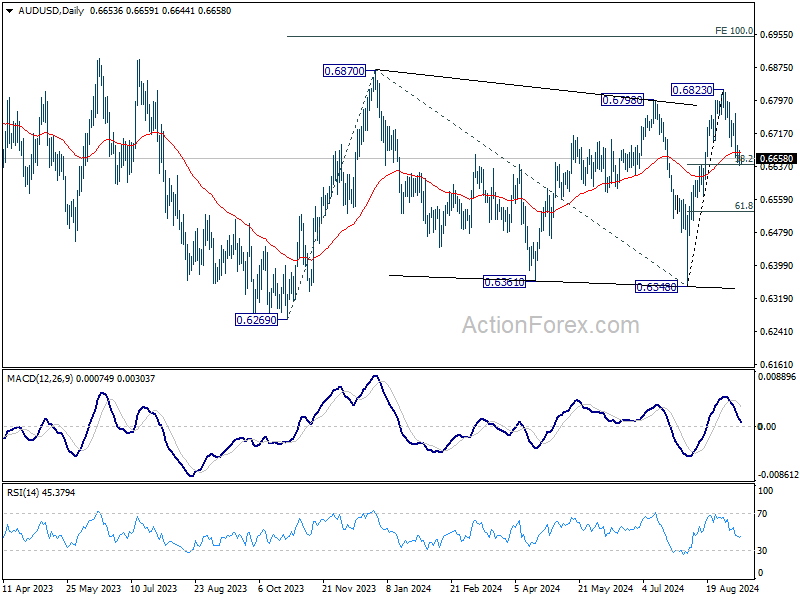
In the bigger picture, overall, price actions from 0.6169 (2022 low) are seen as a medium term corrective pattern, with rise from 0.6269 as the third leg. Firm break of 0.6798/6870 resistance zone will target 0.7156 resistance. In case of another fall, strong support should be seen from 0.6169/6361 to bring rebound.
EUR/USD Daily Outlook
Daily Pivots: (S1) 1.1006; (P) 1.1028; (R1) 1.1041; More....
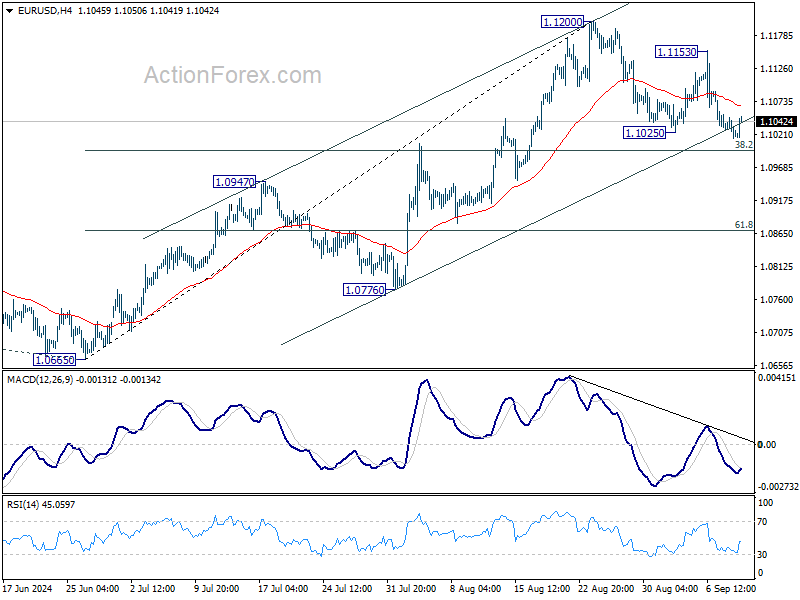
Outlook is EUR/USD is unchanged. While consolidation from 1.1200 could extend lower, downside should be contained by 38.2% retracement of 1.0665 to 1.1200 at 1.0996 to bring rebound. Break of 1.1200 will resume larger rise towards 1.1274 high. However, sustained break of 1.0996 will indicate reversal and turn bias to the downside.
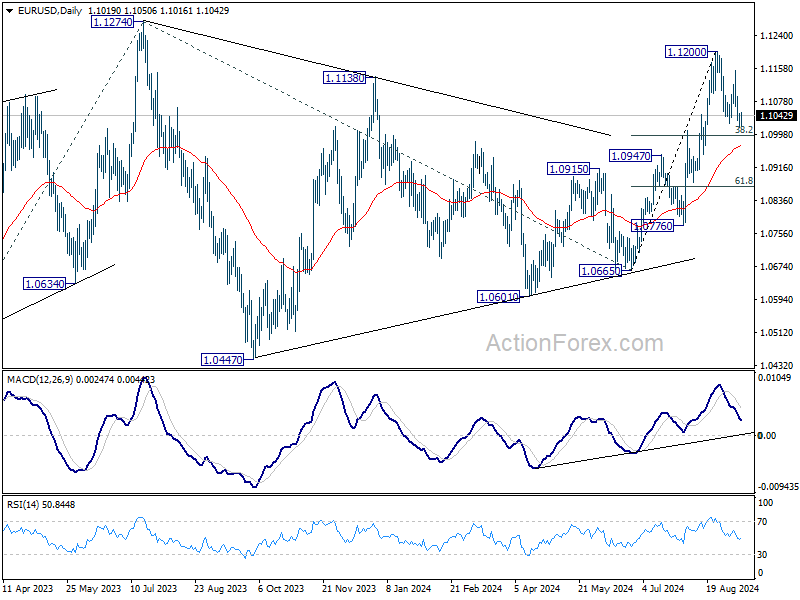
In the bigger picture, prior break of 1.1138 resistance indicates that corrective pattern from 1.1274 might have completed at 1.0665 already. Decisive break of 1.1274 (2023 high) will confirm whole up trend from 0.9534 (2022 low). Next target will be 61.8% projection of 0.9534 to 1.1274 from 1.0665 at 1.1740. This will now be the favored case as long as 1.0947 resistance turned support holds.
GBP/USD Daily Outlook
Daily Pivots: (S1) 1.3051; (P) 1.3079; (R1) 1.3109; More...
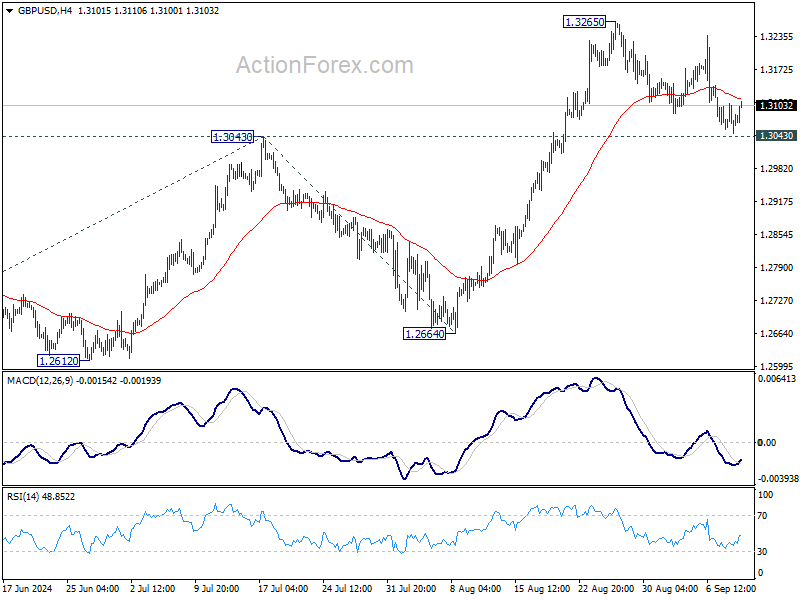
Intraday bias in GBP/USD remains neutral as range trading continues below 1.3265. Further rise is expected with 1.3043 resistance turned support intact. On the upside, firm break of 1.3265 will resume larger up trend to 100% projection of 1.2298 to 1.3043 from 1.2664 at 1.3409. However, firm break of 1.3043 will turn bias back to the downside for deeper pullback.
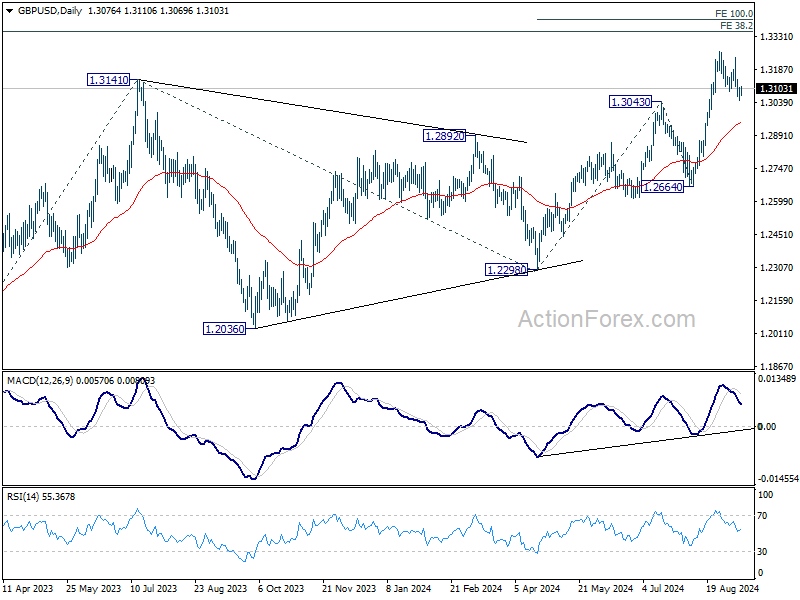
In the bigger picture, up trend from 1.0351 (2022 low) is in progress. Next target is 38.2% projection of 1.0351 to 1.3141 from 1.2298 at 1.3364. For now, outlook will stay bullish as long as 1.2664 support holds, even in case of deep pullback.
USD/CHF Daily Outlook
Daily Pivots: (S1) 0.8450; (P) 0.8476; (R1) 0.8495; More…
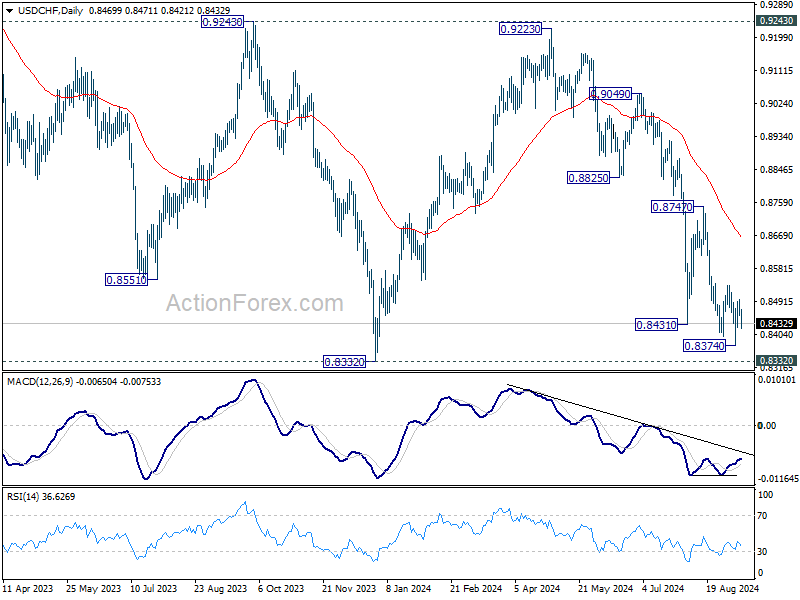
Range trading continues in USD/CHF and intraday bias remains neutral. With 0.8356 resistance intact, further decline is expected. On the downside, break of 0.8374 will resume the fall from 0.9223 to retest 0.8332 low. Decisive break there will indicate larger down trend resumption. However, considering bullish convergence condition in 4H MACD, break of 0.8536 resistance will now confirm short term bottoming, and turn bias back to the upside for 0.8747 resistance.
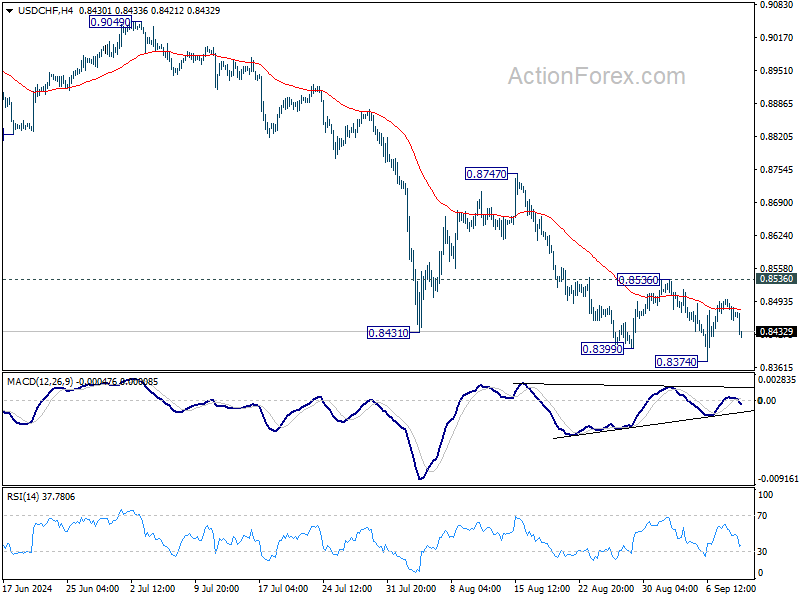
In the bigger picture, price actions from 0.8332 (2023 low) are currently seen as a medium term corrective pattern, with fall from 0.9223 as the second leg. Strong support could be seen from 0.8332 to bring rebound. Yet, overall outlook will continue to stay bearish as long as 0.9243 resistance holds. Firm break of 0.8332, however, will resume larger down trend from 1.0146 (2022 high).