

Sample Category Title
BoC stands pat, Macklem says still too early for rate cuts
BoC keeps overnight rate unchanged at 5.00% as widely expected. In the prepared remarks for the press conference, Governor Tiff Macklem emphasized that it remains "still too early" for the central bank to contemplate reduction in the policy interest rate.
Governor Macklem recognized that recent inflation figures indicate that the monetary policy is "working largely as expected". However, he also cautioned that the journey towards the inflation target is poised to be "gradual and uneven," with "upside risks to inflation" still in play. The Governing Council is looking for "further and sustained easing in core inflation" before considering any shifts in policy direction.
On the economic growth front, Macklem observed that Canada's performance has been "somewhat stronger than projected," albeit still "weak and below potential." The labor market's gradual easing and expectations for inflation to hover around 3% into mid-year—before a potential decrease in the latter half—were highlighted as key factors in the economic outlook. Additionally, Macklem pointed out that gasoline prices and shelter cost pressures are expected to introduce volatility to inflation rates in the upcoming months.
Full BoC statement and Macklem's remarks.
(BOC) Bank of Canada maintains policy rate, continues quantitative tightening
The Bank of Canada today held its target for the overnight rate at 5%, with the Bank Rate at 5¼% and the deposit rate at 5%. The Bank is continuing its policy of quantitative tightening.
Global economic growth slowed in the fourth quarter. US GDP growth also slowed but remained surprisingly robust and broad-based, with solid contributions from consumption and exports. Euro area economic growth was flat at the end of the year after contracting in the third quarter. Inflation in the United States and the euro area continued to ease. Bond yields have increased since January while corporate credit spreads have narrowed. Equity markets have risen sharply. Global oil prices are slightly higher than what was assumed in the January Monetary Policy Report (MPR).
In Canada, the economy grew in the fourth quarter by more than expected, although the pace remained weak and below potential. Real GDP expanded by 1% after contracting 0.5% in the third quarter. Consumption was up a modest 1%, and final domestic demand contracted with a large decline in business investment. A strong increase in exports boosted growth. Employment continues to grow more slowly than the population, and there are now some signs that wage pressures may be easing. Overall, the data point to an economy in modest excess supply.
CPI inflation eased to 2.9% in January, as goods price inflation moderated further. Shelter price inflation remains elevated and is the biggest contributor to inflation. Underlying inflationary pressures persist: year-over-year and three-month measures of core inflation are in the 3% to 3.5% range, and the share of CPI components growing above 3% declined but is still above the historical average. The Bank continues to expect inflation to remain close to 3% during the first half of this year before gradually easing.
Governing Council decided to hold the policy rate at 5% and to continue to normalize the Bank's balance sheet. The Council is still concerned about risks to the outlook for inflation, particularly the persistence in underlying inflation. Governing Council wants to see further and sustained easing in core inflation and continues to focus on the balance between demand and supply in the economy, inflation expectations, wage growth, and corporate pricing behaviour. The Bank remains resolute in its commitment to restoring price stability for Canadians.
Information note
The next scheduled date for announcing the overnight rate target is April 10, 2024. The Bank will publish its next full outlook for the economy and inflation, including risks to the projection, in the MPR at the same time.
USD/JPY Mid-Day Outlook
Daily Pivots: (S1) 149.66; (P) 150.11; (R1) 150.51; More...
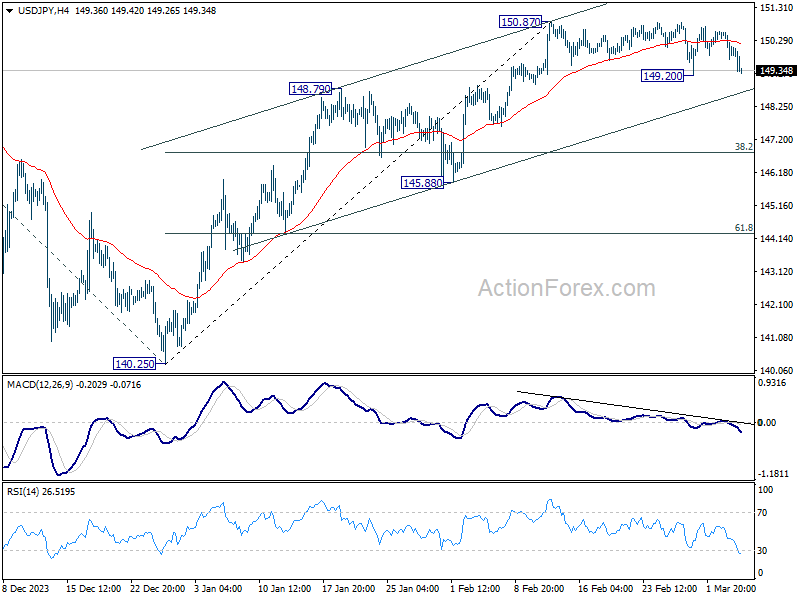
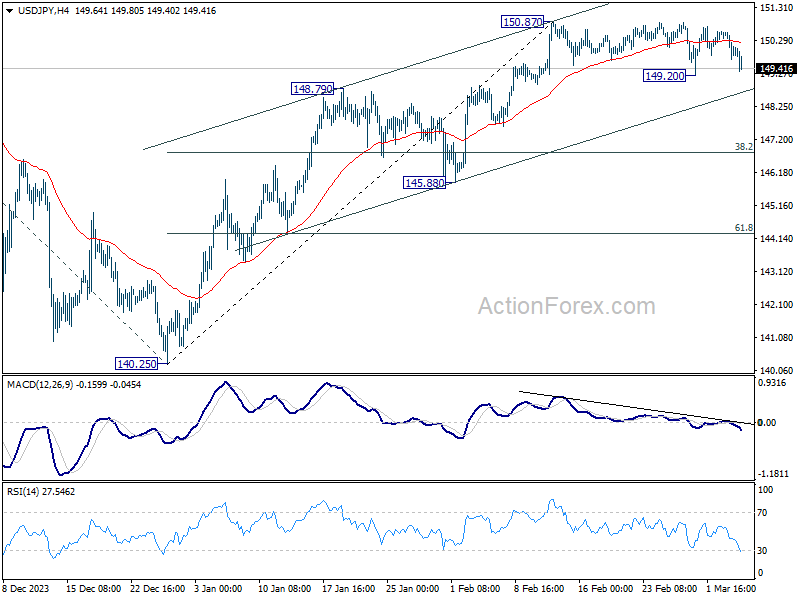
Immediate focus is now on 149.20 support in USD/JPY. Firm break there will suggest that price actions from 150.87 are correcting whole rally from 140.25 at least, with prospect of reversing the whole move. Intraday bias will be back to the downside for channel support (now at 148.69), and then 38.2% retracement of 140.25 to 150.87 at 146.81. Nevertheless, strong bounce from current level will maintain near term bullishness. Break of 150.87 will target 151.89/93 key resistance zone.
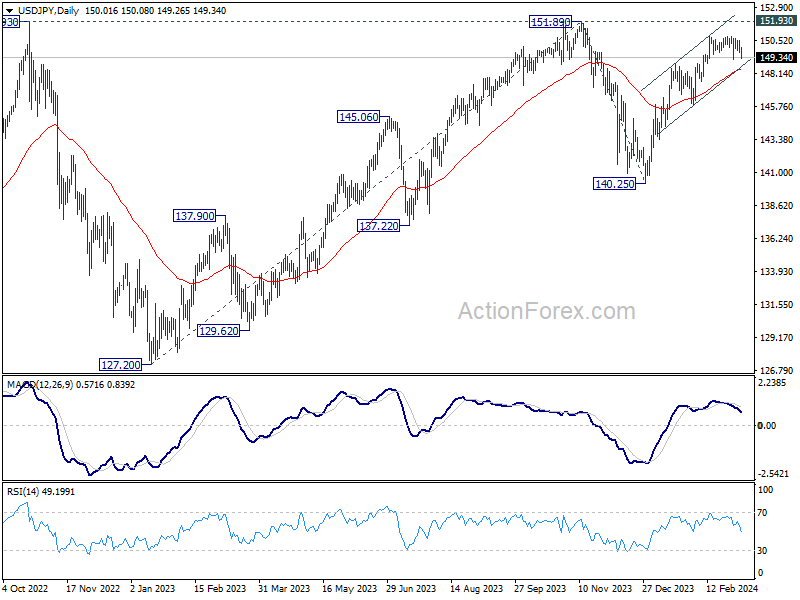
In the bigger picture, rise from 140.25 is seen as resuming the trend from 127.20 (2023 low). Decisive break of 151.89/.93 resistance zone will confirm this bullish case and target 61.8% projection of 127.20 to 151.89 from 140.25 at 155.50. However, break of 148.79 resistance turned support will delay this bullish case, and extend the corrective pattern from 151.89 with another falling leg.
USD/CHF Mid-Day Outlook
Daily Pivots: (S1) 0.8817; (P) 0.8843; (R1) 0.8860; More....
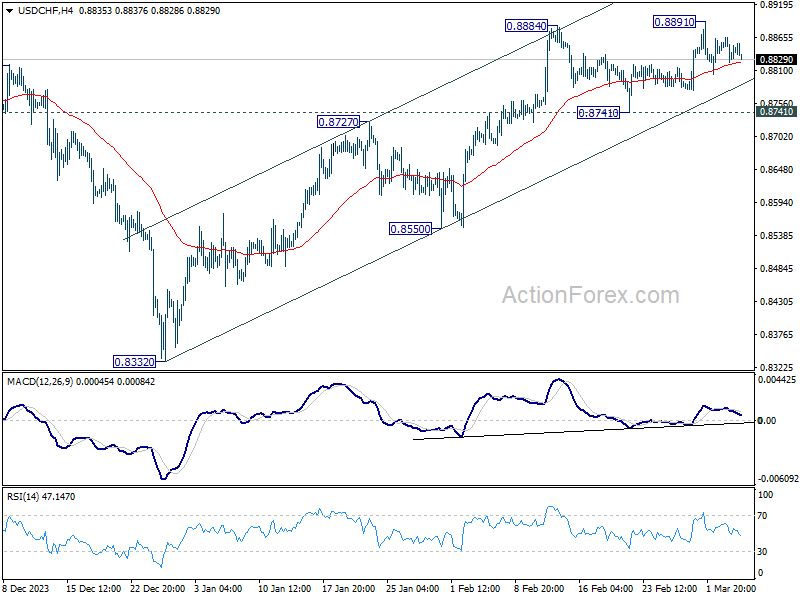
USD/CHF is still bounded in range below 0.8891 and intraday bias stays neutral. Further rally remains in favor as long as 0.8741 support holds. Break of 0.8891 will resume the whole rebound from 0.8332 towards 0.9243 key resistance. Nevertheless, break of 0.8741 support will turn bias back to the downside for deeper pullback.
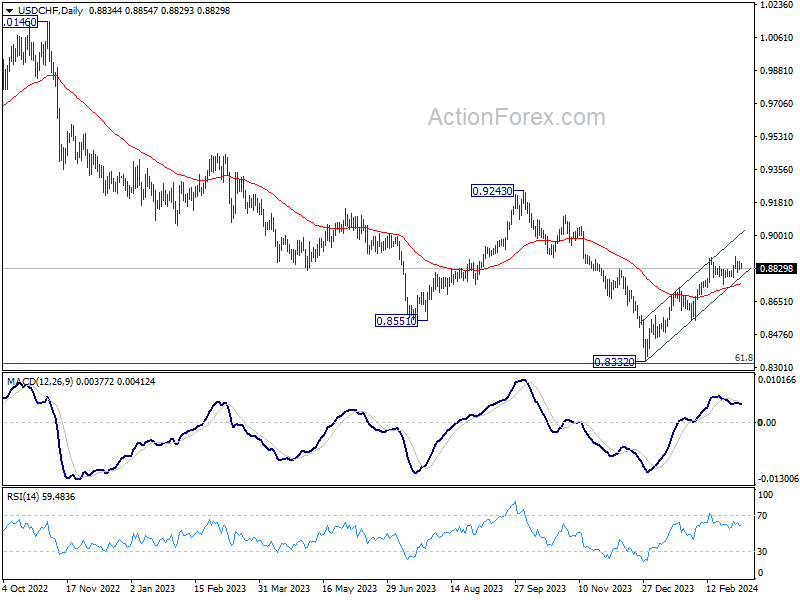
In the bigger picture, a medium term bottom should be formed at 0.8332, on bullish convergence condition in W MACD, just ahead of 0.8317 long term fibonacci support. It's still early to decide if the larger down trend from 1.0146 (2022 high) is reversing. But further rise should be seen to 0.9243 resistance even as a correction.
GBP/USD Mid-Day Outlook
Daily Pivots: (S1) 1.2672; (P) 1.2704; (R1) 1.2736; More...
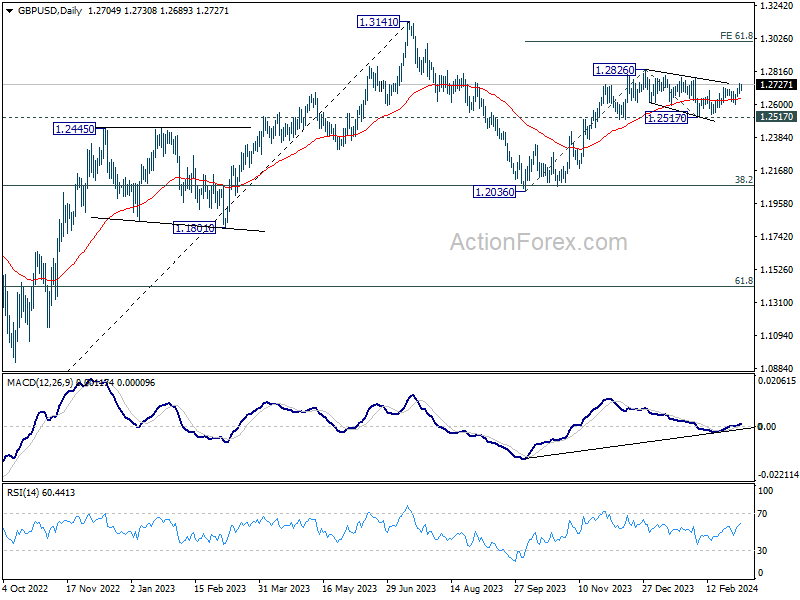
Intraday bias in GBP/USD remains on the upside at this point. Further rally would be seen to 1.2826 resistance first. Firm break there will resume whole rally from 1.2036, and target 61.8% projection of 1.2036 to 1.2826 from 1.2517 at 1.3005 next. For now, further rise will remain in favor as long as 1.2599 support holds, in case of retreat.
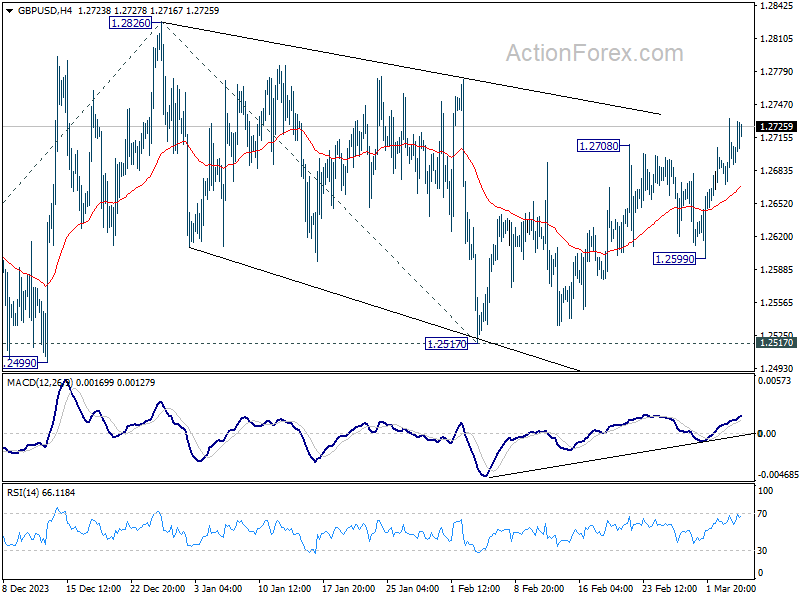
In the bigger picture, price actions from 1.3141 medium term top are seen as a corrective pattern to up trend from 1.0351 (2022 low). Rise from 1.2036 is seen as the second leg, which could be still in progress. But upside should be limited by 1.3141 to bring the third leg of the pattern. Meanwhile, break of 1.2517 support will argue that the third leg has already started for 38.2% retracement of 1.0351 (2022 low) to 1.3141 at 1.2075 again.
EUR/USD Mid-Day Outlook
Daily Pivots: (S1) 1.0840; (P) 1.0858; (R1) 1.0875; More...
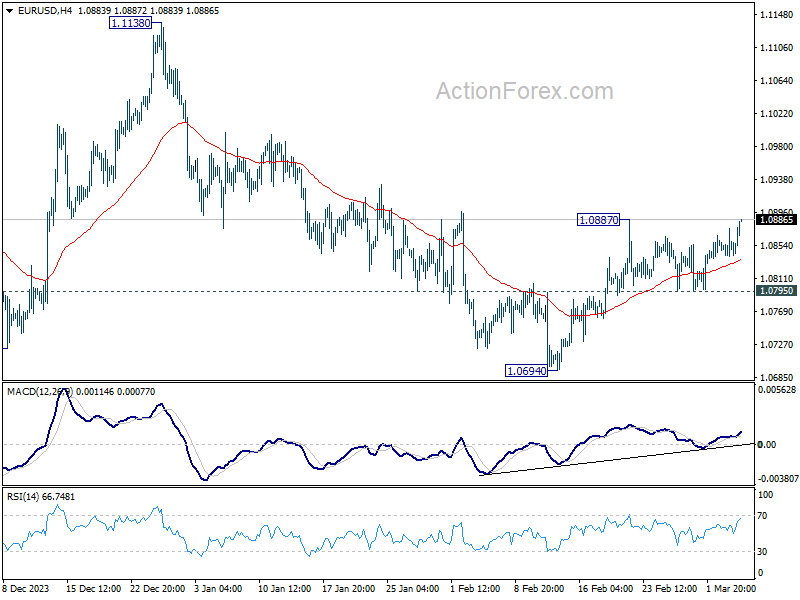
Immediate focus is now on 1.0887 resistance in EUR/USD with today's rally. Firm break there will resume whole rise from 1.0694. Also, sustained trading above 55 D EMA (now at 1.0831) will affirm the case that fall from 1.1138 has completed. In this case, intraday bias will be back on the upside for retesting 1.1138 high. Nevertheless, on the downside, break of 1.0795 minor support will turn bias back to the downside for retesting 1.0694 support.
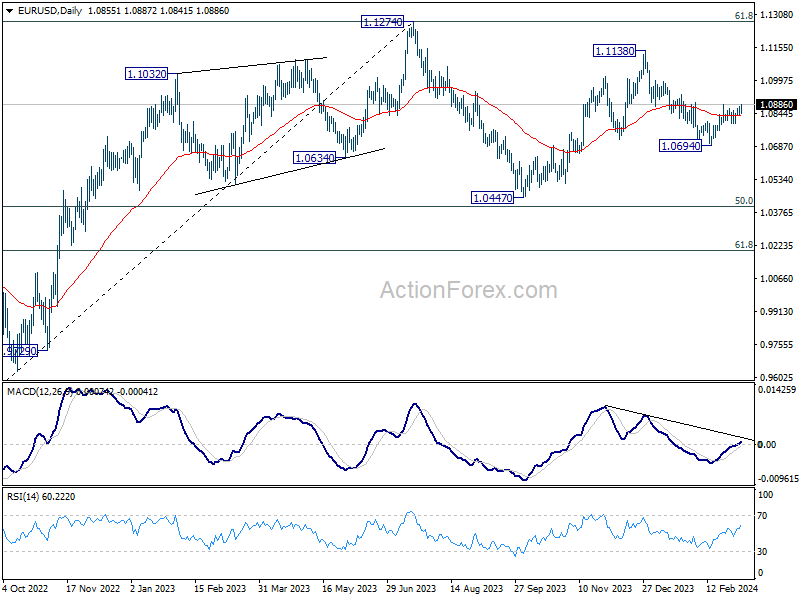
In the bigger picture, price actions from 1.1274 are viewed as a corrective pattern to rise from 0.9534 (2022 low). Rise from 1.0447 is seen as the second leg. While further rally could cannot be ruled out, upside should be limited by 1.1274 to bring the third leg of the pattern. Meanwhile, sustained break of 1.0694 support will argue that the third leg has already started for 1.0447 and possibly below.
Dollar and Yields Downturn Continues, Fed Chair Powell Offers No Respite
Dollar is trading broadly lower as markets enter into US session, with minimal backing from Fed Chair Jerome Powell's prepared remarks for his Congressional testimony. Instead, the currency's weakest is accentuated by extended drop in treasury yields and slightly disappointing ADP private job data. Amidst this backdrop, Swiss Franc emerges as the only currency performing worse than the greenback, with Canadian Dollar also lagging but drawing attention ahead of BoC's impending rate decision.
Japanese Yen staged a robust rebound earlier today but has since faced challenges in overcoming near-term resistance against its primary counterparts. Yen also finds itself overshadowed by Australian and New Zealand Dollar's strong comeback. Euro and Sterling are also gaining ground against Dollar, Canadian Dollar, and Swiss Franc, though they face difficulties when pitted against other currencies.
Technically, immediate focus is now on 149.20 in USD/JPY with today's steep decline. Firm break there will argue that price actions from 150.87 are at least developing into a correction to whole rise from 140.25. There is also prospect of reversing whole rise too. But in either case, that would lead to deeper decline to 38.2% retracement of 140.25 to 150.87 at 146.81.
In Europe, at the time of writing, FTSE is up 0.32%. DAX is up 0.05%. CAC is up 0.16%. UK 19-year yield is up 0.006 at 4.112. Germany 10-year yield is up 0.017 at 2.339. Earlier in Asia, Nikkei fell -0.02%. Hong Kong HSI rose 1.70%. China Shanghai SSE fell -0.26%. Singapore Strait Times rose 0.93%. Japan 10-year JGB yield rose 0.0100 to 0.718.
Fed Powell stands firm: No rate cuts without greater confidence
In his semiannual Congressional testimony, Fed Chair Jerome Powell's prepared remarks highlighted the necessity for Fed to await "greater confidence" in inflation's sustainable movement towards 2 % target before considering any reduction in policy rates.
Powell acknowledged the policy rate is "likely at its peak" for the current cycle, and it's appropriate for "dialing back policy restraint at some point this year." However, he also stressed the "uncertain" economic outlook and noted that the path to 2% inflation is "not assured,"
The Fed Chair warned of the consequences of prematurely or excessively loosening policy, noting that such actions could jeopardize the progress made in inflation control, possibly necessitating "even tighter policy" in the future. Conversely, delaying or minimizing the reduction of policy restraint risks harming economic activity and employment.
US ADP employment rises 140k in Feb, gains remain solid
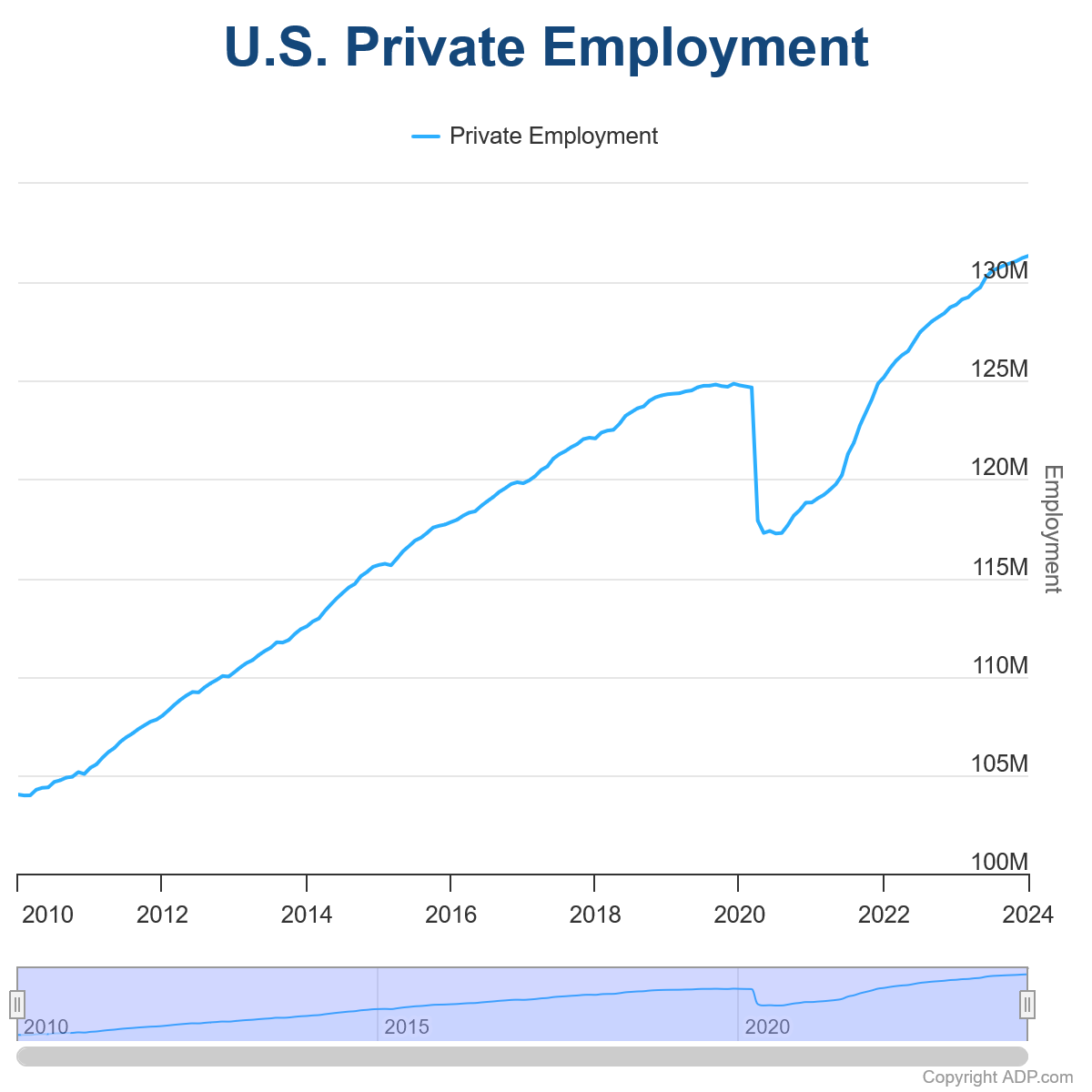
US ADP private employment rose 140k in February, below expectation of 140k. By sector, goods-producing jobs rose 30k while service-providing jobs rose 110k. By establishment size, small companies added 13k jobs, medium companies added 69k, large companies added 61k.
Annual pay for job-stayers rose 5.1% yoy, lowest since August 2021. Annual pay for job-changers rose 7.6% yoy, faster than the prior month for the first time since November 2022.
"Job gains remain solid. Pay gains are trending lower but are still above inflation," said Nela Richardson, chief economist, ADP. "In short, the labor market is dynamic, but doesn't tip the scales in terms of a Fed rate decision this year."
Eurozone retail sales rises 0.1% mom in Jan, EU up 0.3% mom
Eurozone retail sales volume rose 0.1% mom in January, matched expectations. The volume of retail trade increased for food, drinks, tobacco by 1.0%, decreased for non-food products (except automotive fuel) by -0.2%, increased for automotive fuel in specialised stores by 1.7%.
EU retail sales rose 0.3% mom. Among Member States for which data are available, the highest monthly increases in the total retail trade volume were recorded in Luxembourg (+7.6%), Romania (+3.8%) and Cyprus (+1.5%). The largest decreases were observed in Estonia (-2.6%), Slovakia (-1.0%) and Latvia (-0.8%).
IfW slashes 2024 German growth forecast to 0.1% due to multiple challenges
Kiel Institute for the World Economy significantly downgraded its growth expectations for German economy, projecting a mere 0.1% increase in 2024, a sharp downward revision from its previous forecast of 0.9%. Slight improvement is anticipated in 2025, with growth expected to accelerate to 1.2%. On the inflation front, decline to 2.3% is projected for this year, down from 5.9% in 2023, with further reduction anticipated to 1.7% in 2025. Unemployment rate is expected to marginally decrease from 5.8% in 2024 to 5.6% in 2025.
Moritz Schularick, President of the Kiel Institute, pointed to a "whole range of factors" currently dampening sentiment and economic performance in Germany. These include global economic slowdown impacting exports, ECB's restrictive monetary policy expected to extend into the next year, and German government's austerity measures, which Schularick believes are being implemented at an inopportune time, fostering additional pessimism.
Stefan Kooths, Head of Economic Research at the Kiel Institute, added that despite gradual recovery expected over the year, the overall economic dynamism in Germany remains subdued. He underscored the emergence of signs indicating that structural issues are mainly to blame for the economic slowdown, with private investment falling short, partly due to the significant uncertainty provoked by current economic policies.
RBNZ's Conway: OCR to stay restrictive for some time into the future
RBNZ Chief Economist Paul Conway, speaking at a webinar today, noted that emphasizing the contractionary nature of current interest rates is effectively "tapping the brakes" on the economy to moderate its pace of growth and address inflationary pressures.
Conway expressed optimism about the recent declines in core inflation and business inflation expectations. However, he also highlighted ongoing concerns regarding elevated household inflation expectations, which pose a potential risk to the inflation outlook.
Looking forward, Conway underscored the necessity for OCR to maintain a restrictive level "for some time into the future" to get headline inflation, currently at 4.7%, back into the 1-3% target band.
An interesting consideration Conway raised was the impact of Fed's policy moves on New Zealand's monetary policy trajectory. He suggested that if Fed were to initiate rate cuts towards the end of the year, and RBNZ did not follow suit, the resulting appreciation in NZD could alleviate inflationary pressures in New Zealand. This scenario might prompt RBNZ to reassess its rate cut timeline, leading to earlier-than-anticipated adjustments depending on the broader economic implications.
Australia's GDP up 0.2% qoq in Q4, continuing consistent slowdown
Australia GDP grew 0.2% qoq in Q4, slightly below expectation of 0.3% qoq. On an annual basis, the economy expanded by 1.5% yoy.
The data indicates deceleration in economic momentum as the year progressed, with Katherine Keenan, the head of national accounts at ABS, noting a consistent slowdown across each quarter of 2023.
The main pillars supporting GDP growth were identified as government spending and private business investment. Government final consumption expenditure saw 0.6% qoq increase , while private business investment grew 0.7% qoq.
The significant contribution of net trade, which added 0.6 percentage points to the overall GDP growth, was largely attributed to a -3.4% qoq decrease in import.
EUR/USD Mid-Day Outlook
Daily Pivots: (S1) 1.0840; (P) 1.0858; (R1) 1.0875; More...
Immediate focus is now on 1.0887 resistance in EUR/USD with today's rally. Firm break there will resume whole rise from 1.0694. Also, sustained trading above 55 D EMA (now at 1.0831) will affirm the case that fall from 1.1138 has completed. In this case, intraday bias will be back on the upside for retesting 1.1138 high. Nevertheless, on the downside, break of 1.0795 minor support will turn bias back to the downside for retesting 1.0694 support.
In the bigger picture, price actions from 1.1274 are viewed as a corrective pattern to rise from 0.9534 (2022 low). Rise from 1.0447 is seen as the second leg. While further rally could cannot be ruled out, upside should be limited by 1.1274 to bring the third leg of the pattern. Meanwhile, sustained break of 1.0694 support will argue that the third leg has already started for 1.0447 and possibly below.
Economic Indicators Update
| GMT | Ccy | Events | Actual | Forecast | Previous | Revised |
|---|---|---|---|---|---|---|
| 00:30 | AUD | GDP Q/Q Q4 | 0.20% | 0.30% | 0.20% | 0.30% |
| 07:00 | EUR | Germany Trade Balance (EUR) Jan | 27.5B | 21.0B | 22.2B | 22.4B |
| 09:30 | GBP | Construction PMI Feb | 49.7 | 49.2 | 48.8 | |
| 10:00 | EUR | Eurozone Retail Sales M/M Jan | 0.10% | 0.10% | -1.10% | -0.60% |
| 13:15 | USD | ADP Employment Change Feb | 140K | 150K | 107K | |
| 13:30 | CAD | Labor Productivity Q/Q Q4 | 0.40% | -0.10% | -0.80% | |
| 14:45 | CAD | BoC Interest Rate Decision | 5.00% | 5.00% | ||
| 15:00 | USD | Fed's Chair Powell testifies | ||||
| 15:00 | USD | Wholesale Inventories Jan F | -0.10% | -0.10% | ||
| 15:00 | CAD | Ivey PMI Feb | 54.4 | |||
| 15:30 | USD | Crude Oil Inventories | 2.4M | 4.2M | ||
| 19:00 | USD | Fed's Beige Book |
Fed Powell stands firm: No rate cuts without greater confidence
In his semiannual Congressional testimony, Fed Chair Jerome Powell's prepared remarks highlighted the necessity for Fed to await "greater confidence" in inflation's sustainable movement towards 2 % target before considering any reduction in policy rates.
Powell acknowledged the policy rate is "likely at its peak" for the current cycle, and it's appropriate for "dialing back policy restraint at some point this year." However, he also stressed the "uncertain" economic outlook and noted that the path to 2% inflation is "not assured,"
The Fed Chair warned of the consequences of prematurely or excessively loosening policy, noting that such actions could jeopardize the progress made in inflation control, possibly necessitating "even tighter policy" in the future. Conversely, delaying or minimizing the reduction of policy restraint risks harming economic activity and employment.
US ADP employment rises 140k in Feb, gains remain solid
US ADP private employment rose 140k in February, below expectation of 140k. By sector, goods-producing jobs rose 30k while service-providing jobs rose 110k. By establishment size, small companies added 13k jobs, medium companies added 69k, large companies added 61k.
Annual pay for job-stayers rose 5.1% yoy, lowest since August 2021. Annual pay for job-changers rose 7.6% yoy, faster than the prior month for the first time since November 2022.
"Job gains remain solid. Pay gains are trending lower but are still above inflation," said Nela Richardson, chief economist, ADP. "In short, the labor market is dynamic, but doesn't tip the scales in terms of a Fed rate decision this year."
Bitcoin Spooked by Highs, Ethereum Still Climbing
Market picture
The cryptocurrency market is building capitalisation towards the 24-hour level, but it’s a relatively modest +0.6% to $2.51 trillion. That’s close to, but still below Tuesday’s highs.
Bitcoin briefly topped $69K on Tuesday, setting a new all-time high, but has since corrected by more than 15%.
The size, speed and nature of the decline indicate a desire for “weak hands” to exit Bitcoin. At its lowest point, the price fell below $59K due to large orders that the market was unable to quickly digest. Excluding this spike, we can assume that the price fell to $62K – last week’s consolidation area – wiping out all the recent gains.
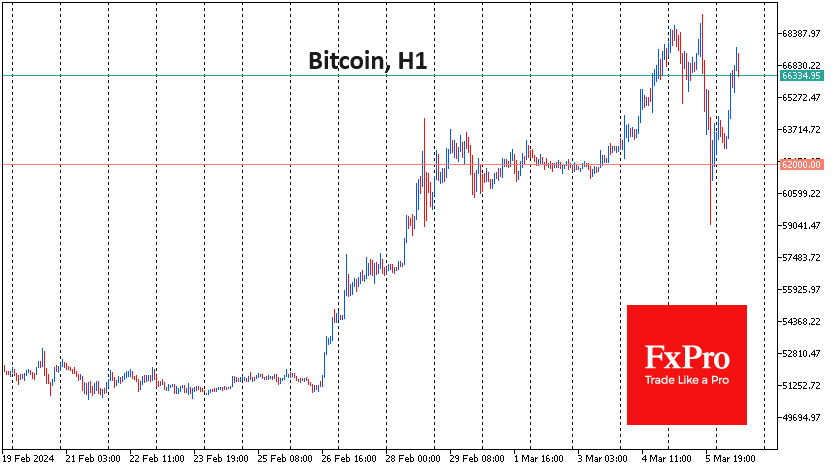
We saw these 15% corrections for a long time after the first update of the highs in the last cycle in 2020. It’s worth bracing for up to several weeks of consolidation in the 15-20% range.
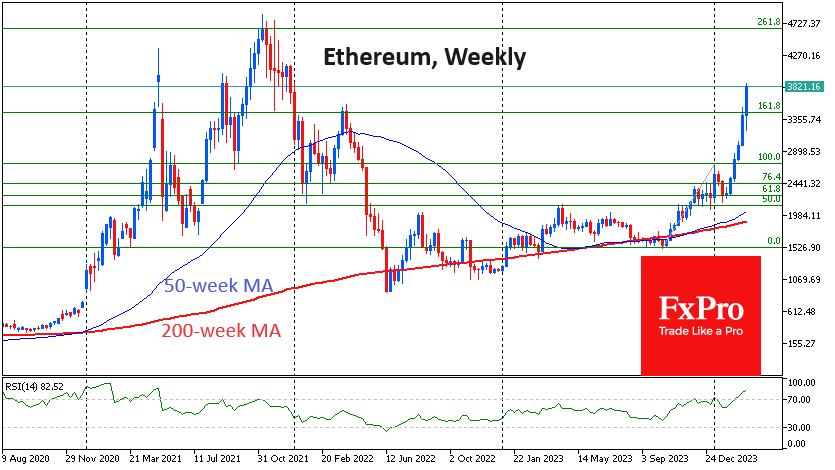
Many altcoins have pulled back significantly from recent highs, looking back at BTC. But not Ethereum, which hit new highs since January 2022 at $3865 on Wednesday morning. The second most important cryptocurrency very quickly crossed the key $3500 threshold (161.8% of the year-end rally and local April 2022 high). According to the Fibonacci model, the next upside target is the 261.8% level, which is just above $4600 and close to historical highs.
News background
Ethereum’s cumulative stakes have surpassed $117 billion. Ethereum validators have blocked more than 31.5 million ETH in stakes, according to The Block. The total ETH supply is around 120 million coins with a capitalisation of ~$450 billion, so around 26% of the asset issuance is involved in securing the network.
The SEC has delayed a decision on BlackRock and Fidelity’s spot Ethereum ETFs. The commission will continue to gather comments from the public. Experts are divided on when the regulator will make a positive decision on Ethereum ETFs.
Over the past 90 days, investors have invested the equivalent of 133,000 BTC in various regulated bitcoin products. Their total assets under management (AuM) rose to 1 million BTC, according to ByteTree. Outflows from gold and bond-based ETFs accompanied the trend.
Michael van de Poppe, founder of MN Trading, pointed out that this is the first time in history that a new ATN has been reached before rather than after a halving.
The upcoming halving in April will reduce the daily mining of new bitcoins from 900 BTC to 450 BTC, which will affect trading strategies, market cycles and mining, according to Glassnode. Historically, halves have preceded bullish rallies. Heavy buying of spot bitcoin ETFs could add to the increased demand.
Deutsche Börse has launched an institutional-focused regulated platform for spot trading, settlement and custody of cryptocurrency assets, Deutsche Börse Digital Exchange (DBDX). Settlement and custody services will be provided by Crypto Finance (Deutschland), a BaFin-licensed subsidiary.