Sample Category Title
USD/CAD Analysis: Canadian Dollar Strengthens after Bank of Canada Decision
The Bank of Canada has decided to keep interest rates at 5.0% for the fifth time in a row, it announced yesterday, as it continues to look for clearer signs that inflation is moving closer to the bank's 2% target before considering rate cuts.
According to Bank of Canada Governor Tiff Macklem:
→ the Bank is concerned that underlying inflationary pressures remain.
→ It is too early to ease restrictive policies. There is a clear consensus within the Board of Governors that the time has not come (for rate cuts).
→ We are now in a difficult phase of the monetary cycle.
These hawkish statements contributed to the Canadian dollar strengthening against other currencies, in particular against the US dollar.
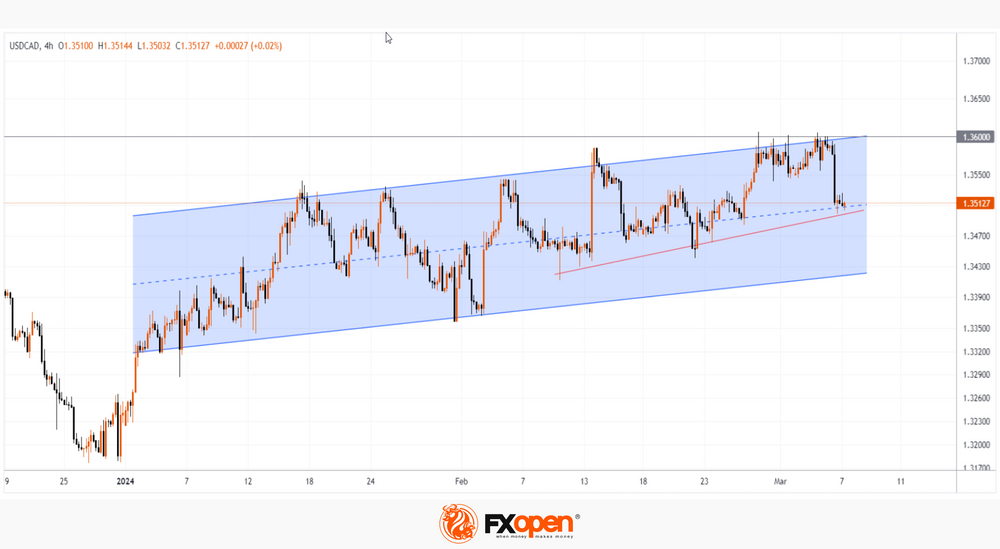
Technical analysis of the USD/CAD chart today shows that:
→ for most of 2024, the price moves within the channel shown in blue;
→ yesterday’s news lowered the price from its upper limit to the median;
→ the psychological level of 1.36 retained its role as resistance, although the bulls repeatedly tried to overcome it.
If the bears maintain the initiative, the price of USD/CAD may fall below:
→ breaking through the median line of the channel;
→ breaking through the local trend line (shown by the orange line);
→ attempting to break through the psychological level of 1.35.
In this scenario, the most obvious target for bears may be the lower boundary of the channel, with news about inflation and interest rates remaining the main drivers in the USD/CAD market. Today, by the way, at 16:15 GMT+3, the decision on interest rates from the ECB will become known — be prepared for surges in volatility.
Trade over 50 forex markets 24 hours a day with FXOpen. Take advantage of low commissions, deep liquidity, and spreads from 0.0 pips. Open your FXOpen account now or learn more about trading forex with FXOpen.
This article represents the opinion of the Companies operating under the FXOpen brand only. It is not to be construed as an offer, solicitation, or recommendation with respect to products and services provided by the Companies operating under the FXOpen brand, nor is it to be considered financial advice.
Japanese Wage Data and BoJ Comments Suggest Policy Change Coming Ever Closer
Markets
Fed’s Powell’s semi-annual appearance before the Financial Services Committee of the House of Representative didn’t bring more specifics on the start of the Fed easing cycle s. The Fed Chair noticed considerable progress toward reaching the 2% goal and the Fed is likely to begin dialing back policy restraint at some point this year, but the MPC needs greater confidence that inflation is moving sustainably to the target. During the hearing, considerations on monetary policy were soon overshadowed by the debate on easing the proposals with respect to capital rules for banks. Earlier in the session, ADP job growth and JOLTS job openings were close to expectations. The US yield curve inverted further with the 2-y easing 0.4 bps while the 30-y declined 5.2 bps. Moves in German Bunds again were very limited with yields changing less than 1 bp across the curve. US equities found their composure after Tuesday’s setback (S&P +0.51%). The decline in the US-EMU interest rate differential finally pushed EUR/USD for a test of the 1.09+area (close 1.0899). USD weakness pushed USD/JPY below the 150 barrier. This morning, the move is extended on yen strength as higher than expected Japanese wage data and BoJ comments suggest a policy change is coming ever closer (USD/JPY 148.1). UK Fin Min Hunt announced in the Spring budget some modest tax cuts (including a 2% reduction in the National insurance tax). However, they were not seen as changing the picture for BoE policy in any profound way. Sterling lost marginally against the euro, holding within well-known territory (close 0.8561).
Asian equities trade mixed this morning with China and Japan (stronger yen) underperforming. The dollar remains in the defensive. Later today, markets look out for the ECB meeting, including the Staff’s economic forecast. Especially 2024 growth and headline inflation are expected to be downwardly revised. ECB Lagarde at the press conference will face questions whether this opens the door for ‘earlier’ rate cuts. However, we expect the ECB Chair to avoid any guidance on timing, as the bank looks for more clarity on the outcome of wage negotiations and their impact on core inflation. We don’t expect today’s meeting to be a game-changer for markets. The topside in EMU yields might be capped for now. A further rise in EUR/USD probably will come from USD softness rather than euro strength. EUR/USD 1.0917 (50% retr Dec/Feb decline) is under test. 62% retracement comes in at 1.0969.
News & Views
The Bank of Canada yesterday unsurprisingly kept the policy rate steady at 5%. Economic growth in Q4 was stronger than expected in the January Monetary Policy Report but stayed below potential. The BoC sees signs the labour market is easing, modest hiring and slower wage growth. The data point to an economy in modest supply. Still, inflation’s slow and uneven progress towards the 2% target remains a reason for caution. CPI eased to 2.9% in January but underlying pressures remain a concern. The BoC’s measures of core inflation remain above 3% Y/Y and on a three-month basis and the share of CPI components rising 3%% stays above the historical average. Internal discussions since January shifted from whether the policy rate is restrictive enough to how long it needs to stay at the current level. Before considering to lower the rate, the MPC first wants a further deceleration in core inflation in the coming months. USD/CAD slid yesterday but that was mainly a US dollar move rather than CAD strength. The pair tested but stayed just north of 1.35. Canadian swap yields changed between +1.9 bps (2-y) to -1.2 bps (30-y).
Poland’s central bank left policy rates unchanged as well at 5.75%. New staff forecasts, which assume stable NBP interest rates, show annual CPI at 3.5% (mid-point of the projected range) in 2024, 3.6% in 2025 and 2.9% in 2026. GDP over the same period is seen at 3.5%, 4.2% and 3.2%. Despite inflation is seen falling in coming months to levels consistent with the target, the NBP is particularly worried about the higher core inflation. In addition, the NBP cites substantial uncertainty around the CPI forecast, related to the shielding measures on energy and food prices. They assume a continuation in their current form, creating asymmetric inflation risks (skewed to the upside). Prime minister Tusk on Tuesday already said the cabinet is working on amended protection measures that will probably raise power prices after the current cap ends in June. Given that the NBP also sees medium term demand pressure in the economy coming from wage growth, it stuck to the status quo. The Polish zloty yesterday briefly touched the multi-year highs against the euro below EUR/PLN 4.30. That barrier remains under test this morning.
Keeping Up With the Central Banks
Federal Reserve (Fed) Chair Jerome Powell’s testimony before Congress went smoothly yesterday. He said that the Fed will certainly cut the interest rates this year and that he’s not necessarily looking for inflation to hit the 2% target to start cutting rates. The US 2-year yield eased but remains above the levels that were in play before the Fed’s December dot plot plotted the idea of a 75bp cut plan, and the US 10-year yield fell below 4.10%. News that Steven Mnuchin, the former Treasury Secretary of Trump times, has led a $1 billion cash injection into New York Community Bancorp also soothed investors’ nerves yesterday. The bank rebounded more than 7.5% and the other banks learned, from Powell yesterday, that officials will review their plans to raise banks capital. That’s as good as it gets. And oh, the ADP print came in slightly lower-than-expected and job openings fell, though less-than-expected. Activity on Fed funds futures still gives around 70% chance for the first rate cut in June in the aftermath of Powell’s first day of testimony.
The US dollar index fell sharply below the 50-DMA in the aftermath of a relatively dovish speech from Powell. The index tested a major Fibonacci support, the 38.2% retracement on the ytd rebound. Below this level (103), the dollar index will sink into the medium-term bearish consolidation zone. Gold on the other hand rose to a fresh record and traded at $2161 per ounce on the back of lower yields. But if lower yields are why gold is up, the upside potential should be limited by better appetite in riskier assets that have juicier returns.
But one thing is sure, the broadly softer US dollar will help other central bankers to better cope with inflation at their regions and be able to cut their rates on their turn.
The Bank of Canada (BoC) left its rate unchanged at 5% at yesterday’ decision and the European Central Bank (ECB) will announce its latest policy verdict today. The European policymakers will leave rates unchanged but will revise their economic projections. There is a lot of confusion and uncertainty regarding when Europeans could eventually start cutting their rates as many among them came to push back on expectations of a too-early rate cut in Europe – and they were right given that the doves tend to get well ahead of themselves with the slightest smell of lower rates.
The ECB is expected to revise its inflation forecast down and hint that inflation in the euro area could reach the 2% target sooner than in the December projection. If that’s the case, if the Europeans look confident that inflation is trending lower toward their 2% target, there is nothing to prevent them from cutting rates: the economic outlook is soft, growth is stagnating, a sufficiently soft inflation is the only missing thing.
The broad-based dollar depreciation sent the EURUSD above the 1.09 yesterday. A hint of a June rate cut from the ECB could quickly cast shadow on the euro bulls’ excitement to push this rally to 1.10 level. While both central banks are expected to start cutting rates in June, the Fed is expected to cut by around 80bp while the ECB is seen cutting its own rates by 90bp. And the Fed’s Neel Kashkari went a step further and said that the Fed could cut rates two times, or just one time this year. That’s rational given that the US economy performs well, and definitely better than the Eurozone economies thanks to ample fiscal support. But whatever is the reason, the ECB could cut more if inflation is not a problem. All this to say that, the ECB decision could reverse the euro appetite before the EURUSD makes a sustainable attempt above the 50% retracement on ytd decline.
Elsewhere, the UK’s Budget Day went smoothly. The British voters were made happy with tax cuts and other soothing news on alcohol and fuel duty in the expense of some public services but hey… the 10-year gilt yield remained steady near 4% and Cable could benefit from weaker dollar to drill above the top of the ytd negative trend.
In Japan, the USDJPY fell steeply below 149 as the Japanese wage growth accelerated at the fastest pace since June and the latter fueled speculation that the Bank of Japan (BoJ) could hike its rates already at this month’s meeting. Knowing how cautious the BoJ is with its interest rate policy and inflation, we will unlikely see a concrete action at the March 18-19 meeting, but maybe in the first half. Traders don’t take a big risk shorting USDJPY near 150 as the potential of a rise above this level is limited by direct intervention threat. The only possible way is the downside. We just don’t know when the real slide will begin.
All Eyes on the ECB
In focus today
The Governing Council of the ECB is meeting today. Besides the regular rate announcement, we will also get updated staff projections. The new projections are likely to show inflation for 2025 revised down to 2%. Whereas neither the revised projections nor Lagarde are likely to close the door to a rate cut at any specific meeting, we continue to view June as the key meeting for a first rate cut. We thus expect an unchanged deposit facility rate at 4%. Read more in our ECB Preview - Policy normalisation in sight, 1 March.
We also receive data on German factory orders for January which will give a hint of where the industrial production figures scheduled for tomorrow are heading.
In Sweden, the SNDO releases the February borrowing requirement which it forecast to be a SEK52.2bn surplus. At 13.00 CET, Riksbank vice governor Martin Flodén will speak at an event in Stockholm hosted by Danske Bank Markets.
In the US, FOMC chairman Powell speaks in Congress again, this time in the Senate. In his speech yesterday, Powell gave no new signals, and we still expect Fed to initiate its rate cutting cycle in May.
Economic and market news
What happened overnight
In China, imports and exports for January and February rose far more than expected, signalling what may be the beginning of a turn towards greener pastures ahead for global trade. Exports rose 7.1% y/y for the period whereas imports rose 3.5% y/y. A Reuters poll showed consensus expectations amongst economists had stood at 1.9% y/y and 1.5% y/y respectively.
What happened yesterday
In the US, Nikki Haley withdrew from the republican presidential primaries. Albeit winning the state of Vermont she lost heavily overall to former president Donald Trump, whose road to the republican nomination seems to now just be a formality.
The ADP numbers for February came in line with expectations, as they showed an increase of 140k jobs whereas 150k was the consensus. On Friday we get non-farm payroll numbers for February where we expect 180k jobs created, and seasonally adjusted wage growth of 0.2% m/m.
The JOLTS numbers for January were also in line with expectations showing 8.86m job openings whereas consensus expectations according to a Reuters poll were 8.9m. December numbers were revised down from 9m to 8.89m thus indicating a virtually unchanged number since last month.
In the euro area, retail sales for January grew by 0.1% m/m (consensus 0.2% m/m) thus underlining how consumer spending remains weak. The cautiousness of consumers has also been reflected in recent weak consumer confidence numbers. We believe consumer confidence will pick up this year, which combined with a historically low unemployment should lead to higher spending.
In the U.K., Chancellor of the Exchequer Jeremy Hunt delivered the spring budget. As expected, he confirmed both a lowering of National Insurance by 2pp, as well as freezing both the fuel and alcohol duties.
Geopolitics: As the self-imposed 10 March deadline for Israel to launch an attack into Rafah looms closer, ceasefire talks with Hamas seem deadlocked. If no ceasefire is achieved and Israel launches an invasion into the southern city, it marks another escalation of the conflict, also raising the risk of more severe retaliation by Iran-backed militants in the region.
Equities: Global equities were higher yesterday in a reversal of the moves we saw Tuesday. Macro data was benign without being impressive and like on Tuesday not the driver of equities. One thing that has changed in the last two weeks is the direction of yields with both the short and long end ticking lower. This would normally fuel the appetite for growth stocks, but it has not done so recently as for the moment lower yields are just a positive for both banks and energy and hence a big part of the value space. Another winner in the benign macro, lower yields environment are small caps, and they outperformed large caps again yesterday. In US yesterday, Dow +0.2%, S&P 500 +0.5%, Nasdaq +0.6% and Russell 2000 +0.7%. Asian markets are mostly lower this morning, with Japanese stocks leading the declines for a change. US futures are lower this morning while futures in Europe are more mixed.
FI: US Treasury yields decline as Federal Reserve Chairman Powell "sticks to the script" as he stated that rate cuts will come this year, but the Federal Reserve is on hold for now. Hence, there was no new information in the statement from Powell and this was taken positively by the market.
FX: EUR/USD creeped higher yesterday amid Powell's testimony and trades just above the 1.09-mark ahead of ECB, which we expect will not rock the boat in terms of new policy signals. Meanwhile, monetary policy speculations continue to pull JPY crosses lower with USD/JPY now around 148.50. BOC sent USD/CAD almost a full figure lower to 1.35 and has hovered just above overnight. A recovery day for Scandies yesterday in slight risk on, which broughT EUR/NOK to around 11.43 and EUR/SEK closer to our1M 11.20 target.
GBP/JPY Daily Outlook
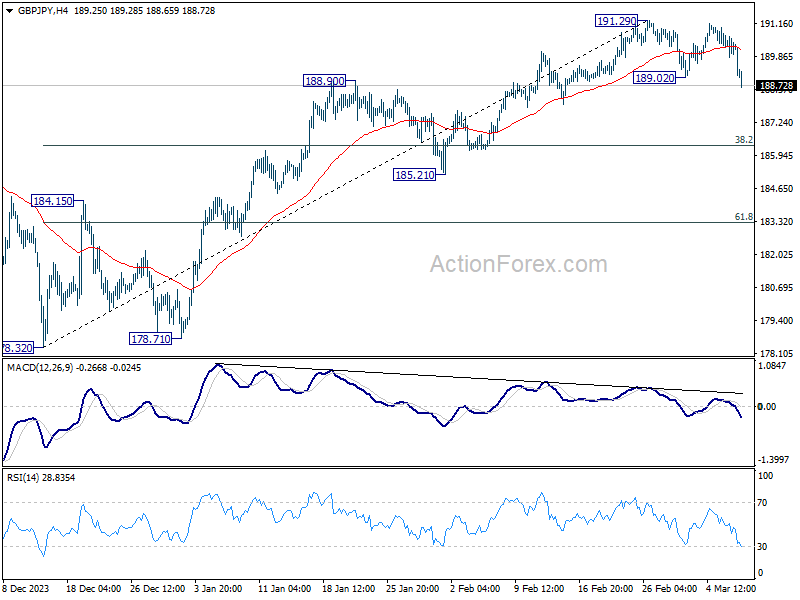
Daily Pivots: (S1) 189.82; (P) 190.26; (R1) 190.67; More.....
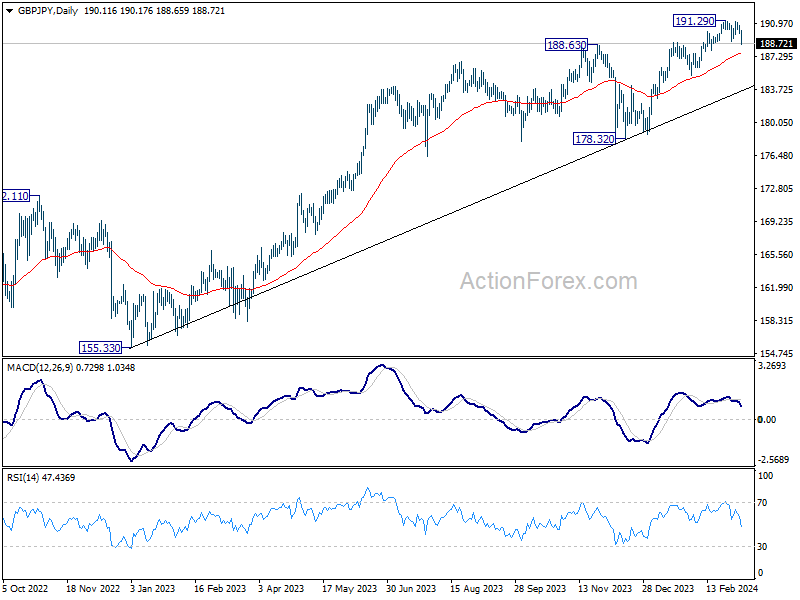
Intraday bias in GBP/JPY is back on the downside with break of 189.02 support. Price actions from 191.29 are seen as a correction to rise from 178.32 for now. Deeper fall would be seen to 38.2% retracement of 178.32 to 191.29 at 186.33. Sustained break there will raise the chance of larger reversal and target 61.8% retracement at 183.27. Risk will now stay on the downside as long as 191.29 resistance holds, in case of recovery.
In the bigger picture, up trend from 123.94 (2020 low) is in progress. Medium term outlook will stay bullish as long as 178.32 support holds. Next target is 195.86 long term resistance (2015 high).
EUR/JPY Daily Outlook
Daily Pivots: (S1) 162.38; (P) 162.67; (R1) 163.14; More...
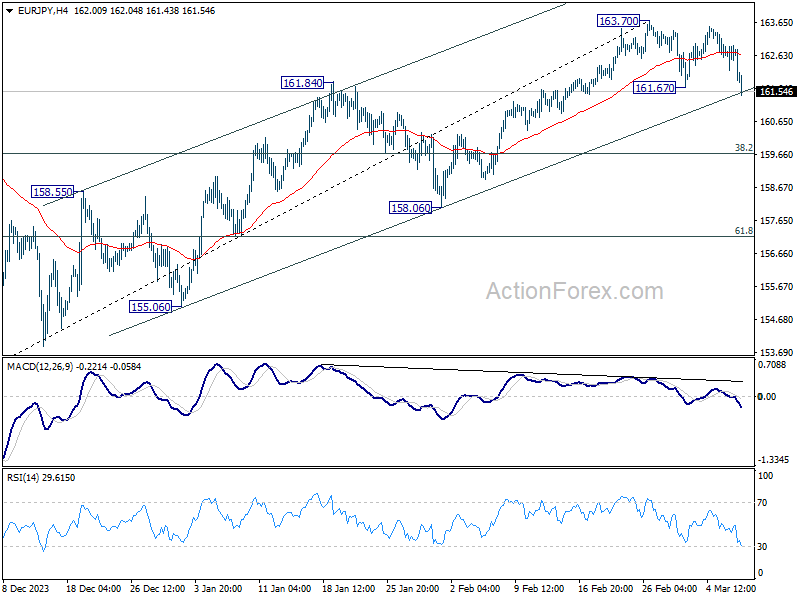
Intraday bias in EUR/JPY is back on the downside with break of 161.67 support. Price actions from 163.70 could be a correction to the rally from 153.15, or reversing the whole move. In either case, deeper fall would be seen to 38.2% retracement of 153.15 to 163.70 at 159.66. Sustained break of 159.66 will affirm the latter case and target 61.8% retracement at 157.18. For now, risk will stay on the downside as long as 163.70 resistance holds, in case of recovery.
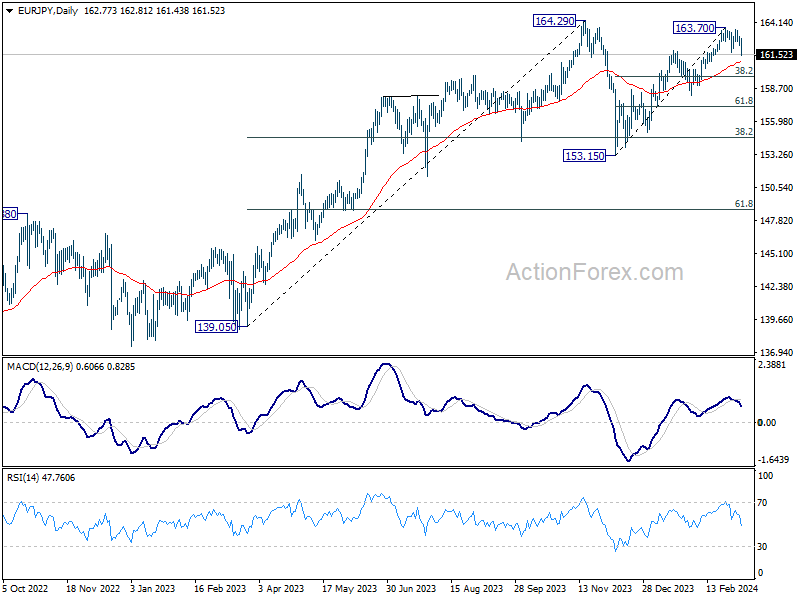
In the bigger picture, price actions from 164.29 medium term top are seen as a correction to rise from 139.05 which could still be extending. As long as 148.38 resistance turned support holds (2022 high), larger up trend from 114.42 (2020 low) is expected to resume through 164.29 at a later stage. Next target would be 169.96 (2008 high).
EUR/GBP Daily Outlook
Daily Pivots: (S1) 0.8546; (P) 0.8555; (R1) 0.8568; More...
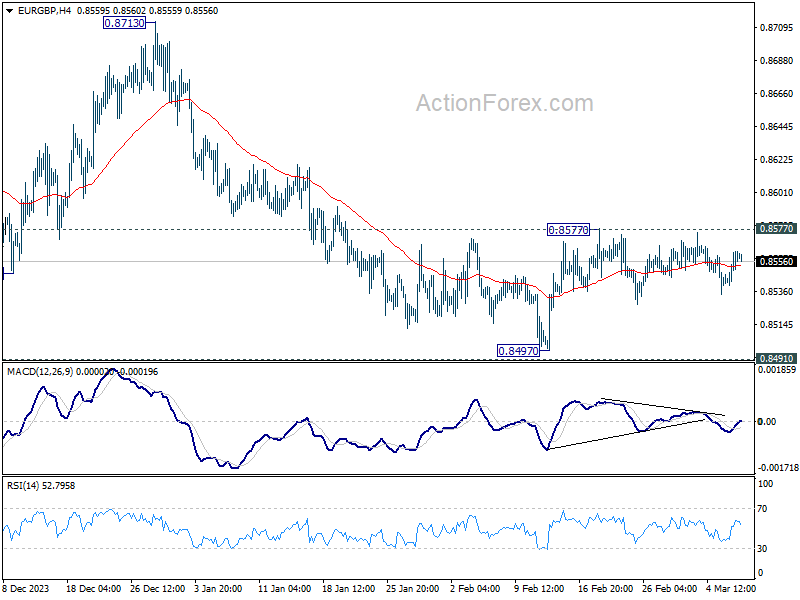
Intraday bias in EUR/GBP remains neutral for the moment. Considering bullish convergence condition in D MACD, decisive break of 0.8577 and 55 D EMA (now at 0.8572) will argue that fall from 0.8764 has completed. Intraday bias will be back on the upside for rebound towards 0.8713 resistance. Nevertheless, firm break of 0.8491/7 support zone will confirm larger down trend resumption.
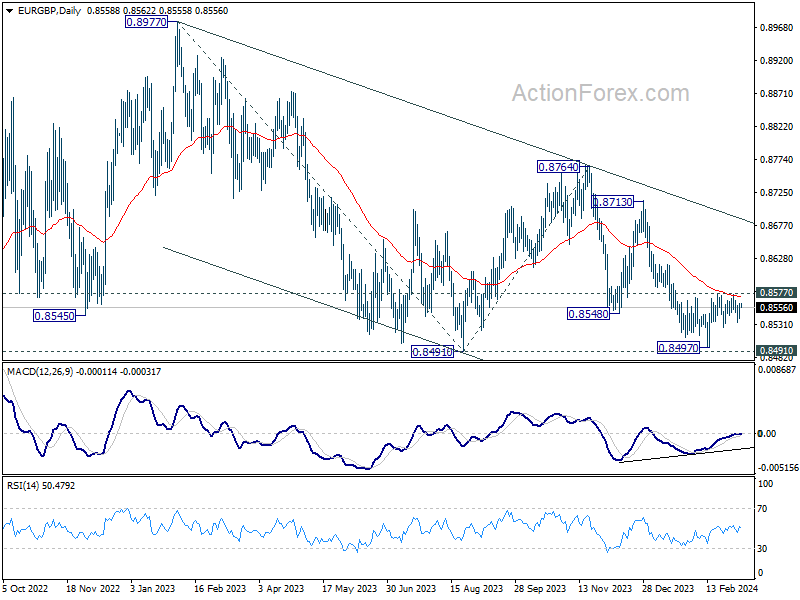
In the bigger picture, fall from 0.8764 is seen as another leg in the whole down trend from 0.9267 (2022 high). Outlook will stay bearish as long as 0.8713 resistance holds. Break of 0.8491 will target 61.8% projection of 0.8977 to 0.8491 from 0.8764 at 0.8464.
EUR/AUD Daily Outlook
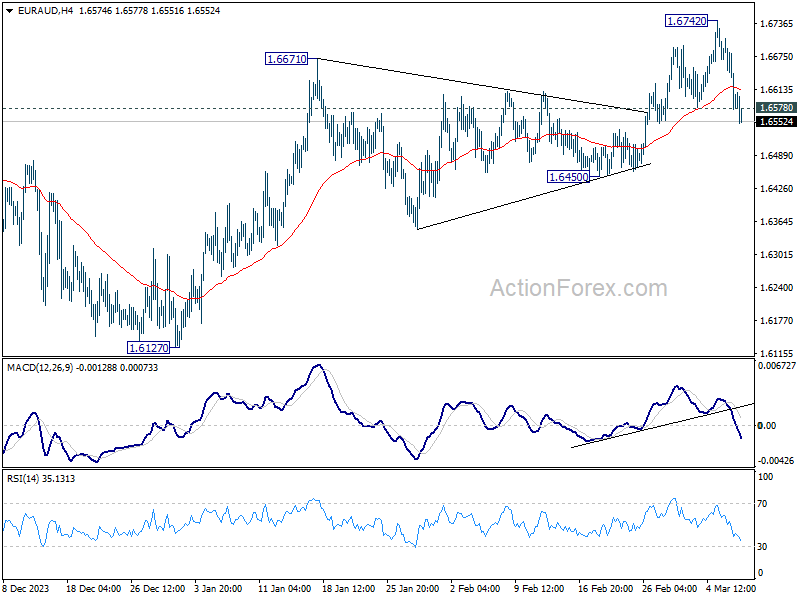
Daily Pivots: (S1) 1.6551; (P) 1.6630; (R1) 1.6683; More...
EUR/AUD's deeper decline from 1.6742 and break of 1.6578 minor support mixes up the near term outlook. Intraday bias is back on the downside for 1.6450 support first. Decisive break there will argue that whole rebound from 1.6127 has completed with three waves up to 1.6742, and turn near term outlook bearish. On the upside, though, break of 1.6742 will resume this rebound.
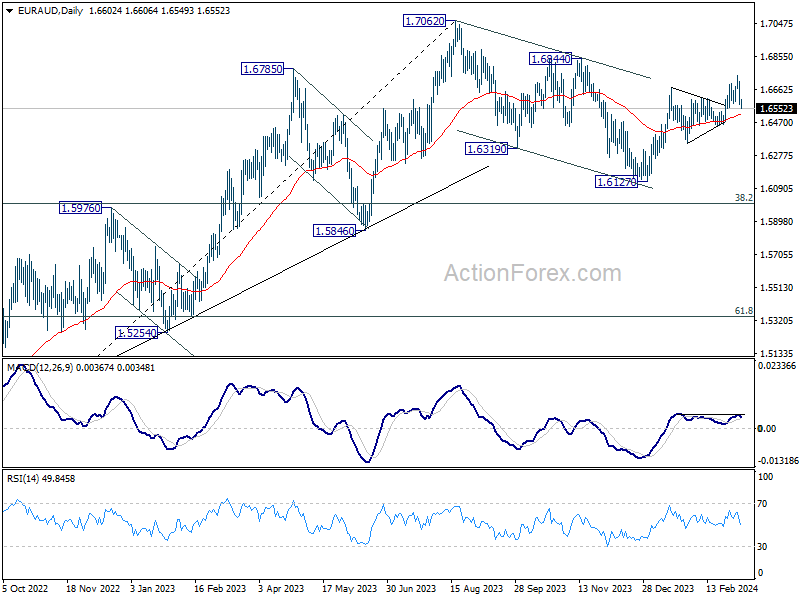
In the bigger picture, fall from 1.7062 medium term top is seen as a correction to the up trend from 1.4281 (2022 low). Break of 1.6844 resistance will argue that this up trend is ready to resume through 1.7062 high. In case of another fall, strong support should be seen around 1.5846 and 38.2% retracement of 1.4281 to 1.7062 at 1.6000 to bring rebound.
EUR/CHF Daily Outlook
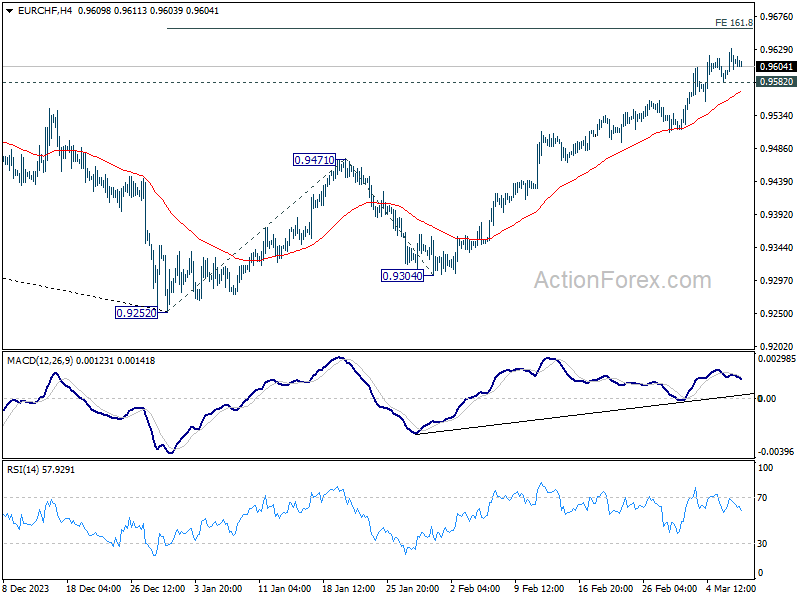
Daily Pivots: (S1) 0.9591; (P) 0.9611; (R1) 0.9634; More...
Intraday bias in EUR/CHF stays on the upside despite diminishing upside momentum. Rise from 0.9252 is in progress for 161.8% projection of 0.9252 to 0.9471 from 0.9304 at 0.9658 next. On the downside, below 0.9582 minor support will turn intraday bias neutral and bring consolidations first, before staging another rise.
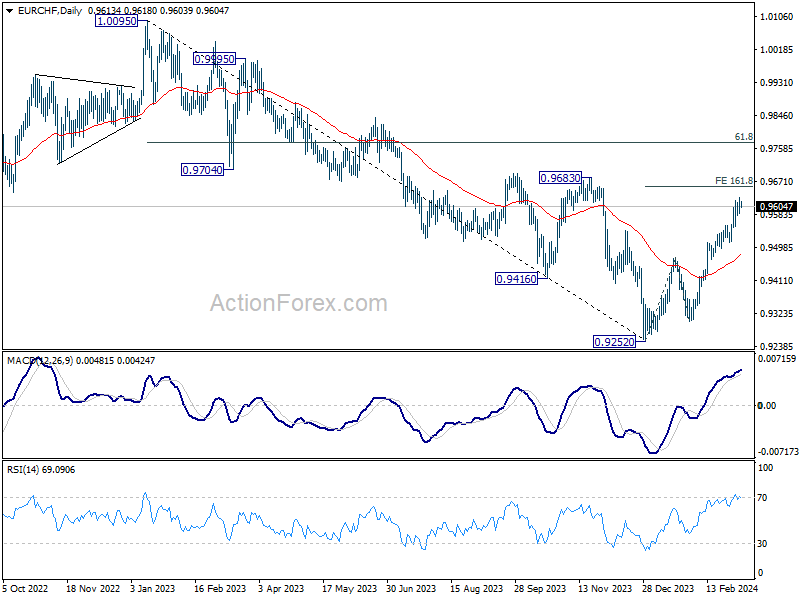
In the bigger picture, as long as 0.9683 resistance holds, rebound from 0.9252 are seen as a corrective move only. Larger down trend is expected to resume through 0.9252 after the correction completes. However, firm break of 0.9683 and sustained trading above 55 W EMA (now at 0.9622) will argue that 0.9252 is already a medium term bottom. Stronger rise would then be seen 61.8% retracement of 1.0095 to 0.9252 at 0.9773 and above.
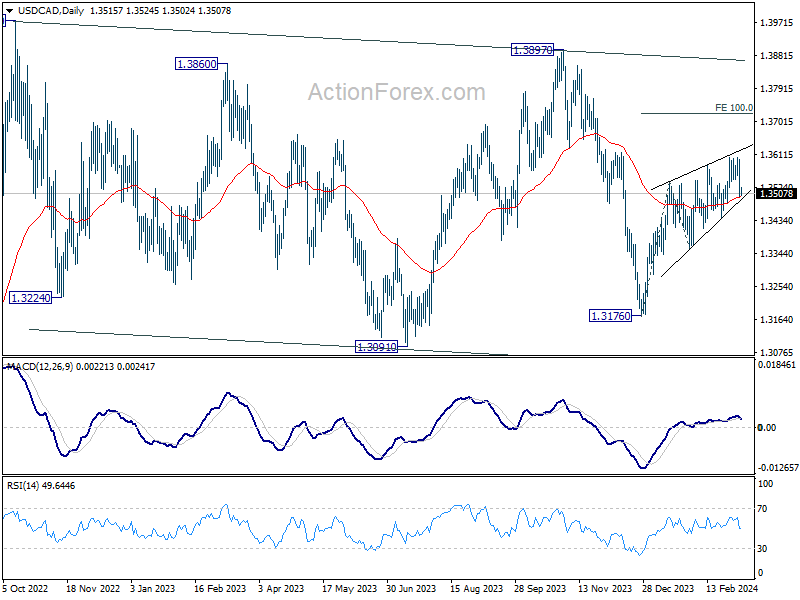
USD/CAD Daily Outlook
Daily Pivots: (S1) 1.3475; (P) 1.3538; (R1) 1.3577; More...
Intraday bias in USD/CAD remains neutral and outlook is unchanged. Further rally is expected as long as 1.3439 support holds. Break of 1.3605 will resume the rise from 1.3176 and target 100% projection of 1.3176 to 1.3540 from 1.3357 at 1.3721 next. However, firm break of 1.3439 will argue that rebound from 1.3176 has completed, and bring deeper fall to 1.3357 support next.
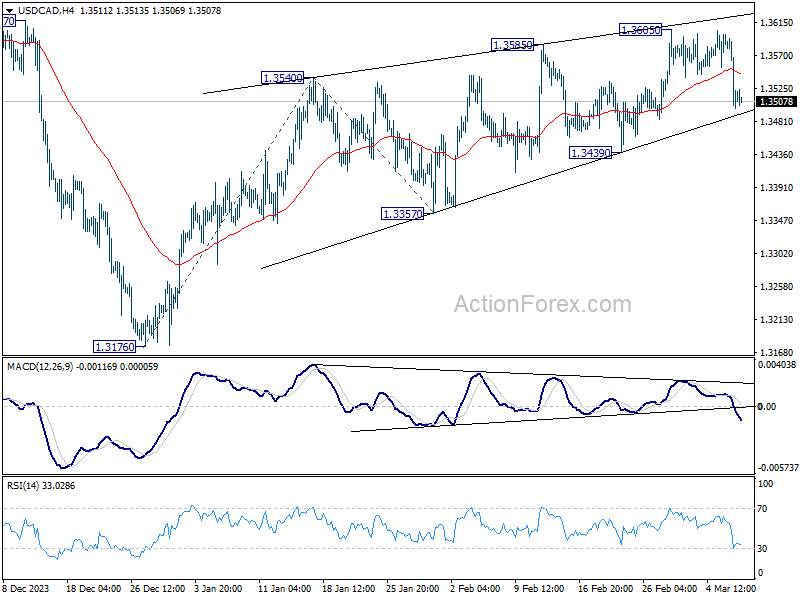
In the bigger picture, price actions from 1.3976 (2022 high) are viewed as a corrective pattern only. In case of another fall, strong support should emerge above 1.2947 resistance turned support to bring rebound. Overall, larger up trend from 1.2005 (2021 low) is still expected to resume through 1.3976 at a later stage.