

Sample Category Title
Weekly Focus – Markets Calming on Peace Hopes
Another week with volatility induced by the Iran war seems to be ending with oil prices lower, equity prices higher and reduced expectations of interest rate hikes. Reports of progress towards a degree of peace and a potential reopening for traffic through the Strait of Hormuz is largely behind the relative optimism. A key step was the 10-day ceasefire agreed on Thursday between Israel and Lebanon, as an end to the fight there is a key Iranian demand. However, all agreements so far are temporary and appear fragile. For example, Iran and the US seem to have very different views on what will happen with Iranian nuclear resources and with shipping conditions through the Strait of Hormuz, and Hezbollah does not seem convinced about the ceasefire in Lebanon. Hence, there is a clear risk that sentiment could worsen significantly again in coming weeks.
As oil prices have declined, so have expectations of higher inflation and interest rates. We have tweaked our expectation for the ECB, so we now expect a 25bp rate cut in June and another one in July, rather than in April and June. This is based both on the decline in the oil price and on what we see as a slight shift in the signals from the ECB governing board members. In particular, news reports this week said that the board has more or less ruled out an April rate hike.
The short-term interest rate outlook is very dependent on the preferences and analysis of the policy decision makers, as the decision on whether to respond to the oil supply shock is not a clear-cut one. We expect that there will be a response because of the fear that inflation expectations will become engrained, with the 2022 inflation still very much being top of mind. However, there is also a good case to be made that the central bank should not move, as higher energy prices will dampen the economy and that higher interest rates will make that problem worse. That is also why we expect that if rates are hiked, they will be cut again during 2027.
March data has in general shown no or only a modest response to the Iran war in economic activity and non-energy prices. This week we got data for China, where Q1 GDP growth surprised to the upside at 5.0% y/y and house prices declined at a slower rate than previously. However, retail sales are growing at only 1.7% y/y, so the weakness in domestic demand remains.
Next week, we will start to get data for April, most importantly the flash PMIs for most major economies on Thursday. Especially in Europe, we expect to see a sharp decline in manufacturing due to higher energy prices, and the price components could give some important clues about whether energy costs are filtering through to other prices. Note that PMIs can be more difficult to interpret in times of high volatility though. For example, longer delivery times increase the headline index, so also keep an eye on the output subcomponent.
In general, even if energy prices continue to decline over the coming months, we still expect to see a negative effect on economic growth for 2026 in most major economies.
Brent Oil Price Falls 10% as Iran Opens Hormuz Strait
Crude oil prices were sharply down on Friday on announcement from Iranian government that the Strait of Hormuz was open for all commercial vessels.
Brent crude price fell around 10% immediately after the announcement in early US session, hitting the lowest in five weeks, in the biggest daily drop since March 23.
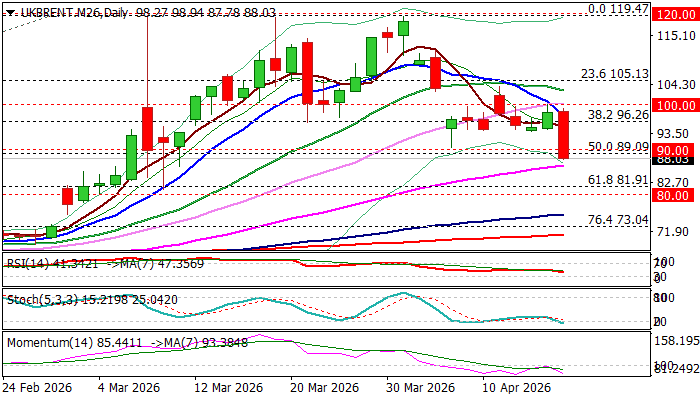
Fresh drop in oil prices further weakened near-term structure, following surge through ascending and thickening daily cloud, accompanied with formation of daily Tenkan/Kijun-sen bear-cross and strengthening negative momentum.
Bears also broke psychological $90 level and dented important Fibo support at $89.09 (50% retracement of $58.70/$119.47 rally) with weekly close below these levels to confirm bearish signal.
The latest news further boosted hopes for potential end of the war that put fire in entire region of the Middle East and sent shockwaves through the world.
Brent crude contract is on track for the second consecutive massive weekly loss that also to improved sentiment.
Immediate target lays at $86.54 (55DMA), followed by $81.91 (Fibo 61.8%) and $80.00 (psychological).
Broken cloud base ($89.61) and $90 (psychological) revert to resistances.
Res: 89.09; 90.00; 93.32; 94.30
Sup: 86.54; 83.16; 81.91; 80.00
EURUSD Hits Pre-War Levels, on Track for Further Gains on Growing Risk Appetite
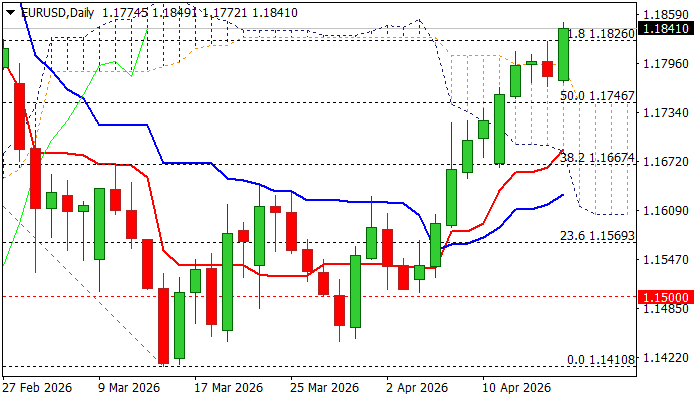
The Euro jumped to two-month high on Friday, as bulls regained traction after eight-day rally paused for narrow consolidation in past two sessions.
Further drop of the dollar continued to fuel risk appetite and provided fresh support to the single currency, which recovered all losses caused by the war in the Middle East in past almost two months.
Fresh strength cracked important Fibo resistance at 1.1826 (61.8% of 1.2082/1.1410 descend) and look for confirmation of bullish signal on weekly close above this level.
The pair is on track for the third consecutive weekly gain, with strong acceleration higher, seen in past two weeks.
Daily studies remain in firm bullish configuration, with the structure being boosted by break above thickening daily Ichimoku cloud that contributes to bullish near-term outlook.
However, strongly overbought Stochastic and north-heading RSI approaching the boundary of overbought territory, send initial signal that bulls may start to face headwinds.
In the current circumstances, consolidation or limited pullback (ideally to find footstep above 1.1750 zone) should provide better levels to re-enter bullish market for 1.1900+ extension.
Keep an eye on developments on the ground over the weekend that would have an impact on Monday’s opening.
Res: 1.1875; 1.1900; 1.1924; 1.2000
Sup: 1.1826; 1.1770; 1.1746; 1.1700
Sunset Market Commentary
Markets
So much for the initial cautious trading session going into a weekend that centers around a second round of US-Iranian talks. Axios during European afternoon trading cited sources in reporting that both countries are negotiating a cash-for-uranium deal, releasing $20bn in frozen Iranian funds in return for giving up its stockpile of enriched uranium. Iran’s nuclear program has been one of the thorny issues in the ongoing talks and the Axios report suggests the warring parties are at least trying to iron out their differences rather than digging in. A second critical topic is, of course, the Strait of Hormuz. Shortly after the Axios report, Iran’s foreign minister Araghchi declared the passage “completely open” for all commercial vessels with the important nuances that it is “on the coordinated route as already announced by Ports and Maritime Organisation of the Islamic Rep. of Iran” – which at some point might bring up the under international maritime law illegal Tehran tollbooth matter – and “for the remaining period of ceasefire”. A workaround for the former could be found in the 1936 Montreux Convention that deals with the Turkish straits and there have been rumours of backchannel diplomacy massaging parties to add another two weeks to the truce. Arab and European leaders yesterday told Bloomberg that a deal could take up to six months though, offering markets a reality check. But optimism is now back in full swing.
Brent oil falls almost 10% towards and even below the $90 barrier. Dutch natural gas (TTF future) loses 8% to trade back at the (higher) €38/MWh opening level following the first US/Israeli strikes that landed on Iranian soil. The EuroStoxx50 is rallying 2%+, reclaiming the 6k mark for the first time since the conflict erupted. US indices open more than a percent higher. European swap yields tumble 5 (30-yr) to 10 bps (2-yr). ECB tightening bets drop sharply. April is all but priced out (7%) and there are no longer two full rate hikes priced in for the year (43 bps compared to 55 bps just prior to the Axios-Araghchi combo). The 10-yr swap tries to hold on the 3% barrier. US Treasury yields ease 6.8-8.5 bps across the curve, the belly outperforming the wings. Gold jumps to a post-war high of $4880, as does silver at $81.2. The US dollar’s search for a near-term bottom (amid stabilizing oil prices) is in vain. The greenback takes a one-two punch, lifting EUR/USD to the highest level since mid-February around 1.185. The trade-weighted DXY loses the 98 barrier (97.64) with room, technically, for a further correction to 97 and 96.
News & Views
The International Air Transport Association’s assessment of potential jet fuel shortages is sobering. They estimate to start seeing some cancellations in Europe by the end of May for lack of jet fuel. This is already happening in parts of Asia. “Along with doing everything possible to secure alternative supply lines, it’s important that authorities have well-communicated and well-coordinated plans in place in case rationing becomes necessary, including for slot relief,” said Willie Walsh, IATA's Director General. EC spokesperson Itkonen also today said that the EU will be preparing to launch possible coordinated action as regards jet fuels. So far, the market is managing the tightness without shortage but issues may arise in the near future.
Czech National Bank board member Kubicek believes that a rate hike is currently more likely to be the central bank’s next move, but it’s not necessary to expect it right away. Kubicek was already contemplating a rate hike ahead of the Iran war because of the massive growth in loan and mortgages. Now he takes a tightening of financial conditions and downside economic risks into stride and balances it against the risks of second round inflation effects. He doesn’t think that the current 3.5% policy rate is too restrictive. Strong growth, increasing real wages and sticky core inflation (2.9% Y/Y) all warrant such stance.
Brent Oil Breaks Below $90 as Hormuz Reopens, Eyes $80 Next
Brent crude has broken below the $90 mark, confirming a decisive shift in market sentiment as geopolitical risks ease. The move follows a sharp selloff triggered by news that the Strait of Hormuz has been declared fully open for commercial shipping during the ceasefire period. The development removes one of the most critical supply risks and accelerates the unwind of the war premium that had supported oil prices in recent weeks.
The catalyst came after Iranian Foreign Minister Abbas Araghchi announced that passage through Hormuz is “completely open,” aligning with broader de-escalation efforts in the region. The response from Donald Trump further reinforced the shift, with the US leader signaling that negotiations are close to completion and suggesting that “most of the points are already negotiated.” Markets have interpreted this as a strong indication that a deal—at least in principle—is within reach.
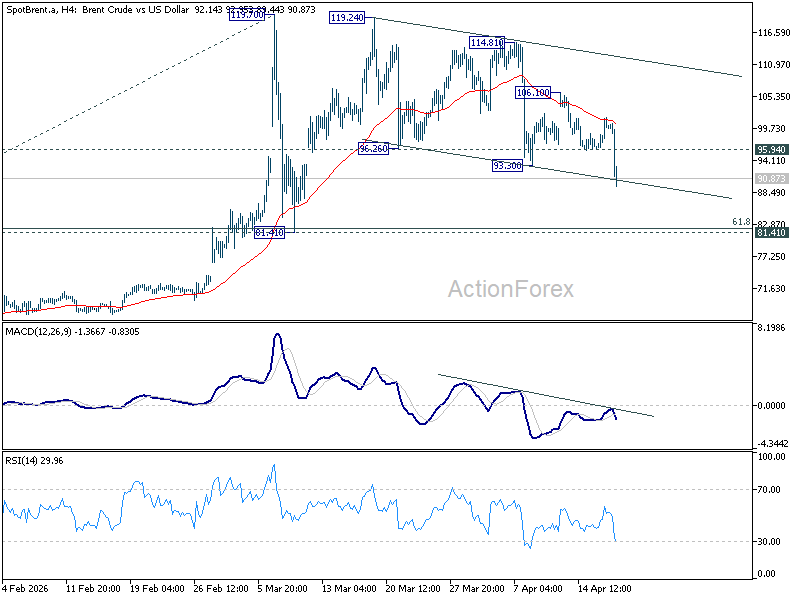
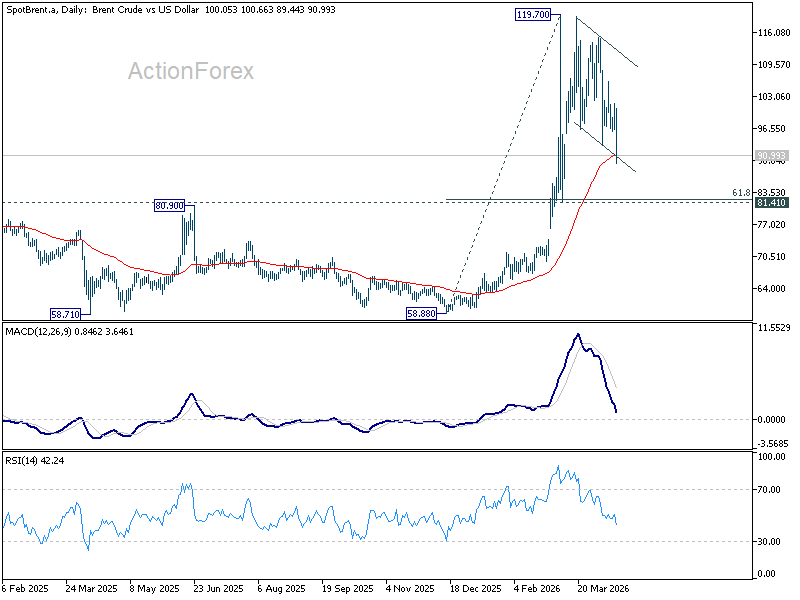
Technically, the rejection at the 4H EMA (now at 100.72) was clearly a near term bearish sign. The focus now is on whether Brent crude's fall would extend through the near term falling channel floor, and close the week below 55 D EMA (now at around 90.85).
If so, that would very well set up further fall towards next key cluster support level at 81.41 (61.8% retracement of 58.88 to 119.70 at 82.11) early next week. In any case, further decline will now remain in favor as long as 95.94 support turned resistance holds.
USD/JPY Mid-Day Outlook
Daily Pivots: (S1) 158.48; (P) 158.90; (R1) 159.56; More...
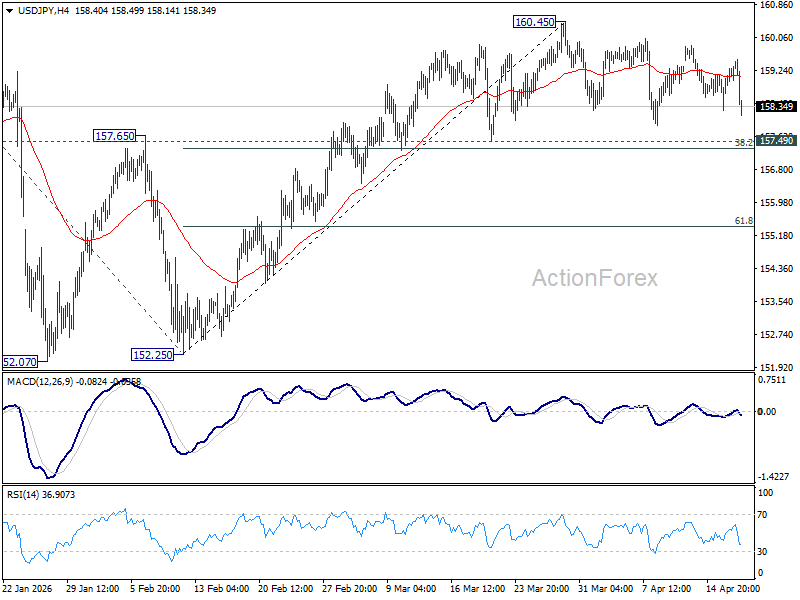
USD/JPY's sideway consolidation from 160.45 continues and intraday bias stays neutral. Outlook will stay bullish as long as 157.49 cluster support (38.2% retracement of 152.25 to 160.45 at 157.31) holds. On the upside break of 160.45 will target a retest on 161.94 high. However, firm break of 157.31/49 will bring deeper fall back to 61.8% retracement at 155.38 next.
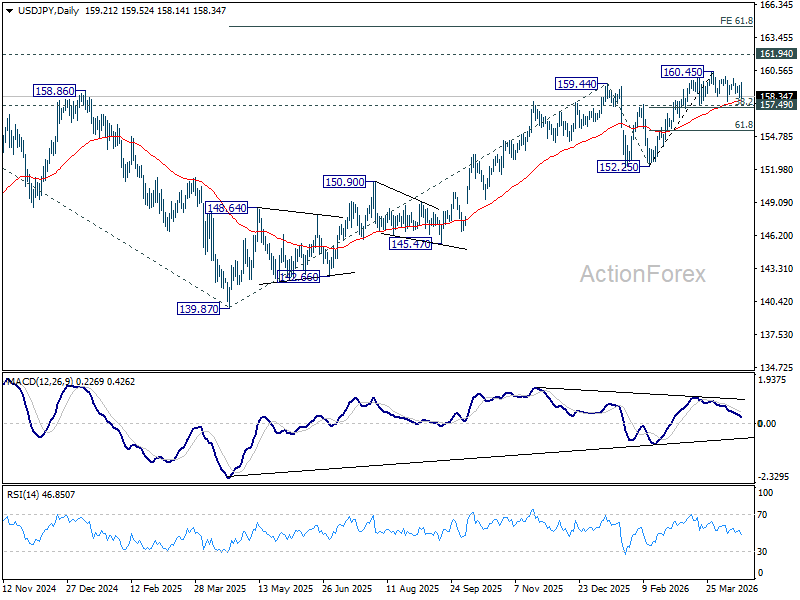
In the bigger picture, outlook is unchanged that corrective pattern from 161.94 (2024 high) should have completed with three waves at 139.87. Larger up trend from 102.58 (2021 low) could be ready to resume through 161.94. This will remain the favored case as long as 55 W EMA (now at 155.24) holds. Firm break of 161.94 will pave the way to 61.8% projection of 102.58 to 161.94 from 139.87 at 176.75.
USD/CHF Mid-Day Outlook
Daily Pivots: (S1) 0.7808; (P) 0.7827; (R1) 0.7857; More….
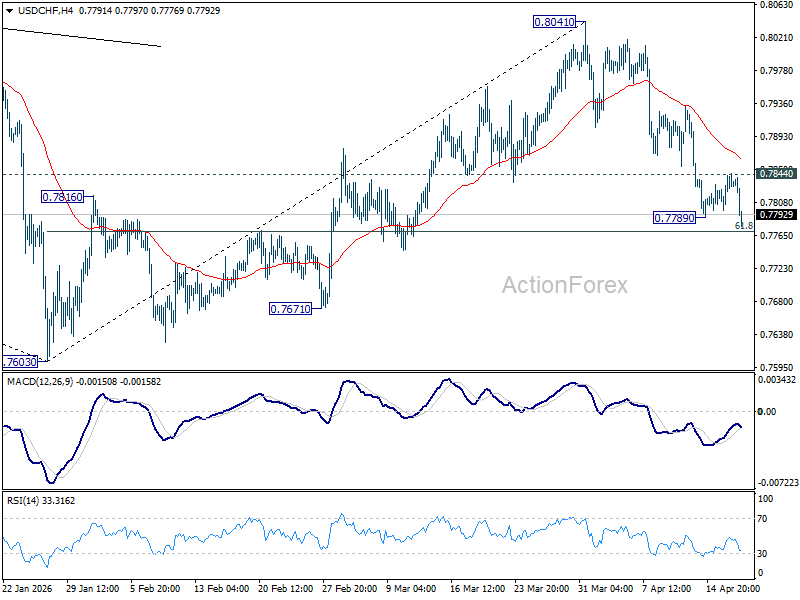
USD/CHF's fall from 0.8041 resumed after brief consolidations and intraday bias is back on the downside. Sustained break of 61.8% retracement of 0.7603 to 0.8041 at 0.7770 will pave the way to retest 0.7603 low. On the upside, above 0.7844 minor resistance will turn intraday bias neutral again first.
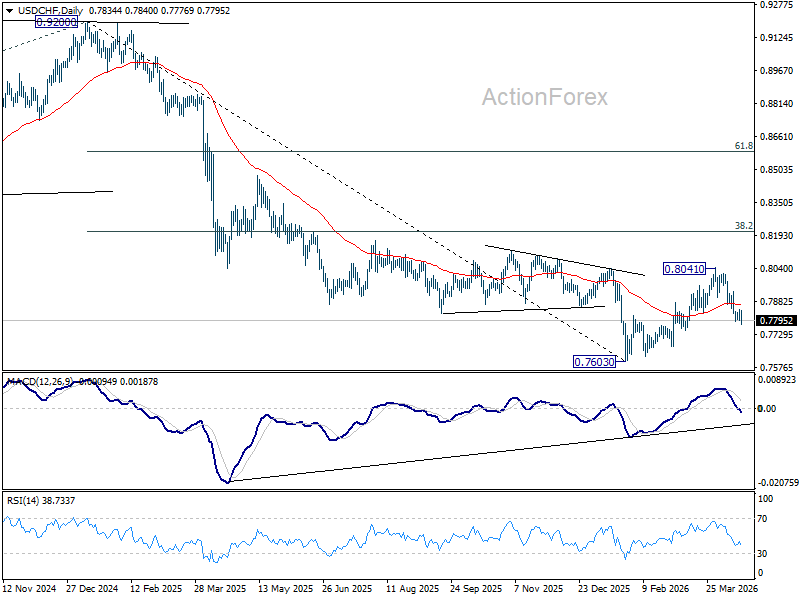
In the bigger picture, rebound from 0.7603 medium term bottom is seen as correcting the fall from 0.9200 only. Rejection by 55 W EMA (now at 0.8071) will affirm this bearish case, and setup down trend resumption to 100% projection of 1.0146 (2022 high) to 0.8332 from 0.9200 at 0.7382 at a later stage. Though, sustained break of 55 W EMA will suggest that it's probably correcting the larger scale down trend from 1.0146 (2022 high).
GBP/USD Mid-Day Outlook
Daily Pivots: (S1) 1.3498; (P) 1.3547; (R1) 1.3576; More...
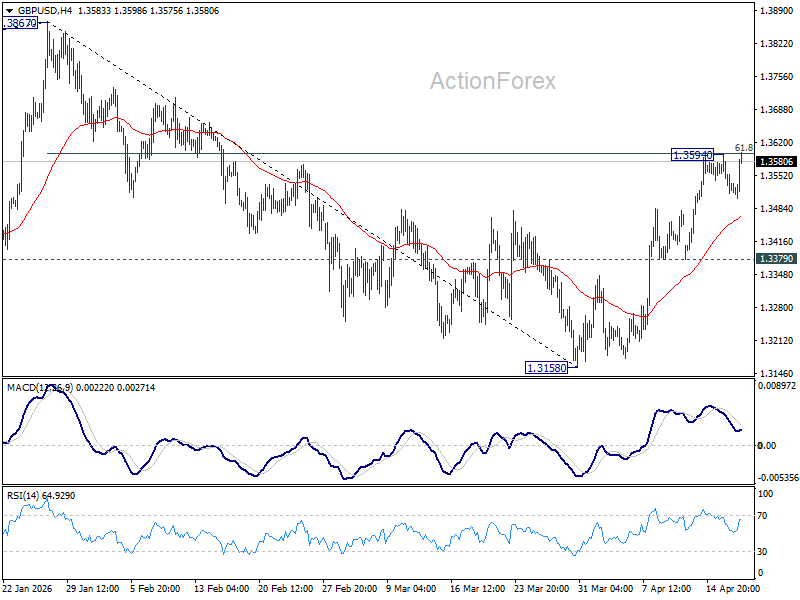
Intraday bias in GBP/USD stays neutral first and more consolidations could still be seen below 1.3594. Further rally is expected as long as 1.3379 support holds. On the upside, firm break of 61.8% retracement of 1.3867 to 1.3158 at 1.3596 will extend the rise from 1.3158 to retest 1.3867 high.
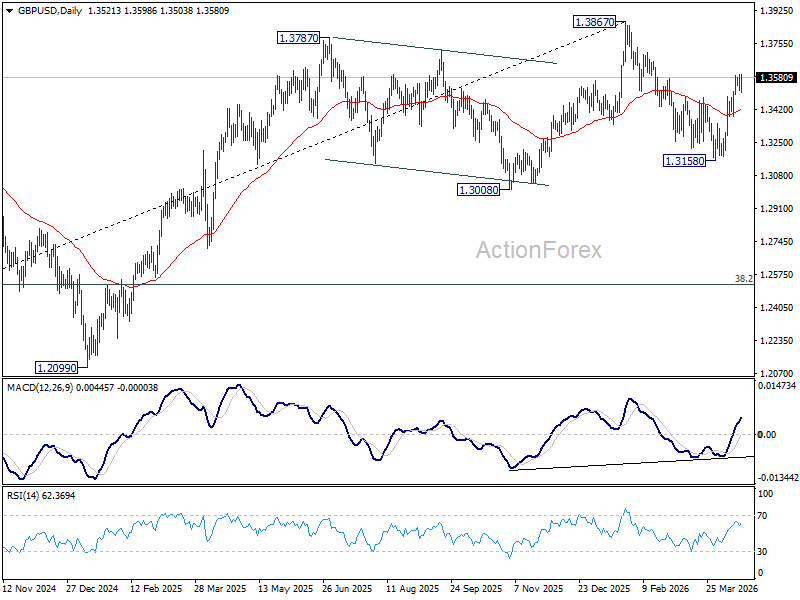
In the bigger picture, current development suggests that price actions from 1.3867 are merely a corrective pattern within the broader up trend from 1.0351 (2022 low). With 1.3008 support intact, medium term bullishness is maintained and break of 1.3867 is back in favor for a later stage, towards 1.4248 key resistance (2021 high).
EUR/USD Mid-Day Outlook
Daily Pivots: (S1) 1.1758; (P) 1.1792; (R1) 1.1817; More….
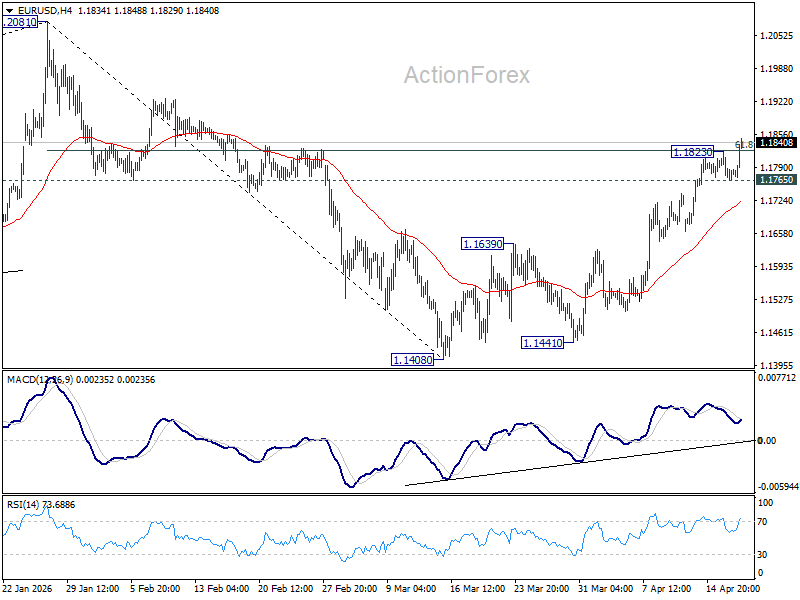
EUR/USD's rally resumed after brief consolidations and intraday bias is back on the upside. Sustained trading above 61.8% retracement of 1.2081 to 1.1408 at 1.1824 will extend the rally from 1.1408 to retest 1.2081 high. On the downside, below 1.1765 minor support will turn intraday bias neutral again first.
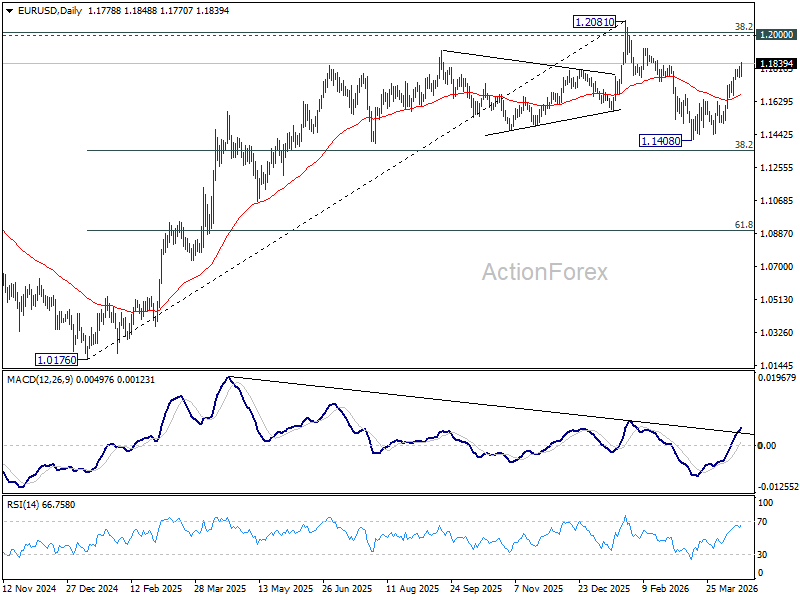
In the bigger picture, the strong support from 38.2% retracement of 1.0176 to 1.2081 at 1.1353 suggests that the pullback from 1.2081 is more likely a corrective move. Strong support was also found in 55 W EMA (now at 1.1513). Focus is back on 1.2 key cluster resistance level. Decisive break there will carry long term bullish implications. Nevertheless, break of 1.1408 support will revive the case of medium term bearish trend reversal.
Markets Aggressively Price US-Iran Deal as Hormuz Reopens, Oil and Dollar Fall
Dollar tumbles again in early US session as oil prices dive on fresh geopolitical progress. A sharp selloff has pushed WTI back toward the mid-$80s and Brent into the low-$90s. The move reflects increasingly aggressive positioning ahead of the second round of US-Iran talks, with markets no longer waiting for confirmation but actively pricing a breakthrough.
The trigger was a key development out of Tehran. Iranian Foreign Minister Abbas Araghchi announced that the Strait of Hormuz is “completely open” for commercial shipping "in line with ceasfire in Lebanon. The move removes one of the most critical risk points in global energy supply and is being interpreted as a clear step toward de-escalation.
With key logistical risks easing, traders are leaning more confidently into a de-escalation scenario. The sequence is becoming clearer: open shipping lanes, sustained ceasefire, then formalized negotiations. In that context, the collapse in oil prices is not just a reaction—it is a forward-looking repricing of a normalization outcome.
At the same time, expectations for the talks have become more realistic—and more achievable. Rather than aiming for a full peace deal, both sides are now expected to settle for an interim memorandum or framework agreement. That shift lowers the threshold for success, increasing the likelihood that negotiations deliver a market-friendly outcome.
Meanwhile, Yen is also under broad-based pressure, but for very different reasons. Markets are expressing clear dissatisfaction with the lack of guidance from BoJ Governor Kazuo Ueda. Despite having a high-profile platform following IMF meetings, Ueda refrained from signaling any imminent policy shift this month, instead reiterating a data-dependent stance.
His comments—that inflation could rise with oil but fall if growth slows, and that decisions will be made “meeting by meeting”—were seen as overly open-ended. Markets had expected at least some forward guidance, especially given the BoJ’s past pattern of subtly preparing markets ahead of policy changes. The absence of such signaling is now being interpreted as inertia.
Still, it would be premature to fully rule out policy action. The BoJ has a history of surprising markets, and the current silence does not preclude a rate hike at upcoming meetings. But for now, the lack of direction is weighing on Yen, pushing it alongside Dollar at the bottom of the weekly performance table.
In contrast, pro-cyclical currencies remain firmly in control. Aussie continues to lead gains, supported by both global risk sentiment and domestic strength, followed by Loonie and Kiwi. Euro and Swiss Franc are holding mid-pack, reflecting a more neutral positioning.
In Europe, at the time of writing, FTSE is down -0.05%. DAX is up 0.72%. CAC is up 0.57%. UK 10-year yield is down -0.184 at 4.653. Germany 10-year yield is down -0.068 at 2.965. Earlier in Asia, Nikkei fell -1.75%. Hong Kong HSI fell -0.89%. China Shanghai SSE fell -0.10%. Singapore Strait Times fell -0.20%. Japan 10-year JGB yield rose 0.015 to 2.420.
BoE's Breeden Says Risks Often Underestimated Before Crises
BoE’s Sarah Breeden warns that while the financial system is more resilient, risks from leverage and complexity are re-emerging and could trigger instability. Read more.
EU Exports to US Drop 26.4% YoY in February, Down 16.1% to China
EU exports dropped sharply in February, with shipments to the US and China falling significantly, signaling weakening global demand. Read more.
EUR/USD Mid-Day Outlook
Daily Pivots: (S1) 1.1758; (P) 1.1792; (R1) 1.1817; More….
EUR/USD's rally resumed after brief consolidations and intraday bias is back on the upside. Sustained trading above 61.8% retracement of 1.2081 to 1.1408 at 1.1824 will extend the rally from 1.1408 to retest 1.2081 high. On the downside, below 1.1765 minor support will turn intraday bias neutral again first.
In the bigger picture, the strong support from 38.2% retracement of 1.0176 to 1.2081 at 1.1353 suggests that the pullback from 1.2081 is more likely a corrective move. Strong support was also found in 55 W EMA (now at 1.1513). Focus is back on 1.2 key cluster resistance level. Decisive break there will carry long term bullish implications. Nevertheless, break of 1.1408 support will revive the case of medium term bearish trend reversal.