Sample Category Title
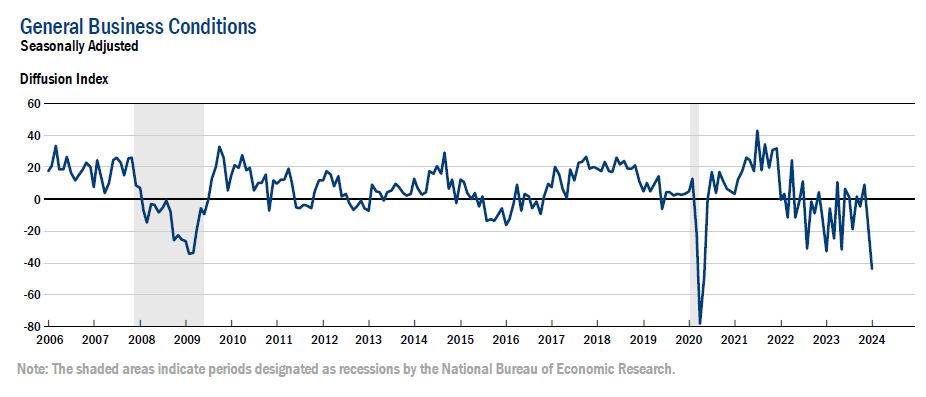
US Empire State manufacturing dives to -43.7, lowest since May 2020
US Empire State Manufacturing general business conditions index fell sharply from -14.5 to -43.7 in January, hitting the lowest level since May 2020. Looking at some details, new orders fell from -11.3 to -49.4. Shipments fell from -6.4 to -31.3. Prices paid rose from 16.7 to 23.2. Prices received fell from 11.5 to 9.5.
Richard Deitz, Economic Research Advisor at the New York Fed said, "this outsized drop suggests January was a difficult month for New York manufacturers, with employment and hours worked also contracting."
Canada’s CPI rises to 3.4% in Nov on gasoline base-year effect
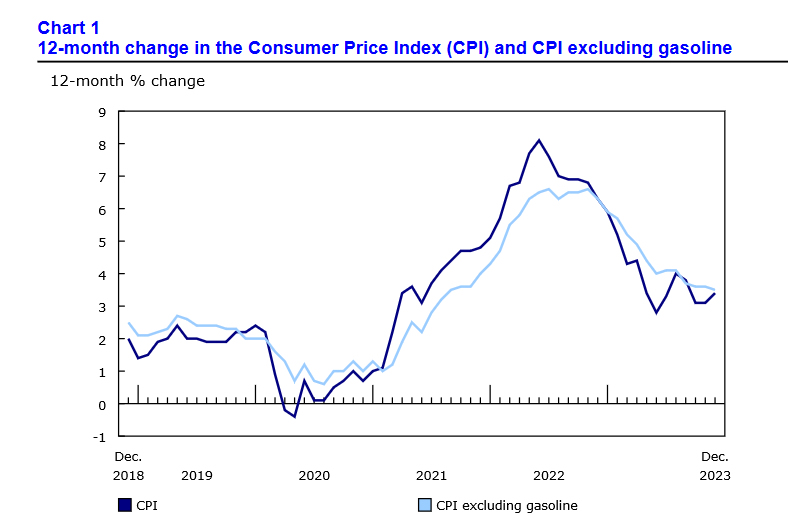
Canada's CPI accelerated from 3.1% yoy to 3.4% yoy in November, above expectation of 3.3% yoy. The acceleration was largely due to base-year effect on gasoline prices. Excluding gasoline, CPI slowed slightly from 3.6% yoy to 3.5% yoy. On a monthly basis, CPI was down -0.3% mom, matched expected.
CPI median, which represents the middle point of price changes, remained steady at 3.6% yoy, exceeding the forecast of 3.4%. CPI trimmed, which excludes certain extreme price movements, rose from 3.5% yoy to 3.7%, also surpassing the expected 3.5%. Meanwhile, CPI Common, which is often viewed as the BoC's preferred measure of core inflation due to its stability, remained unchanged at 3.9% yoy, again higher than the anticipated 3.8%.
USDCAD Breaks Above Downtrend Line
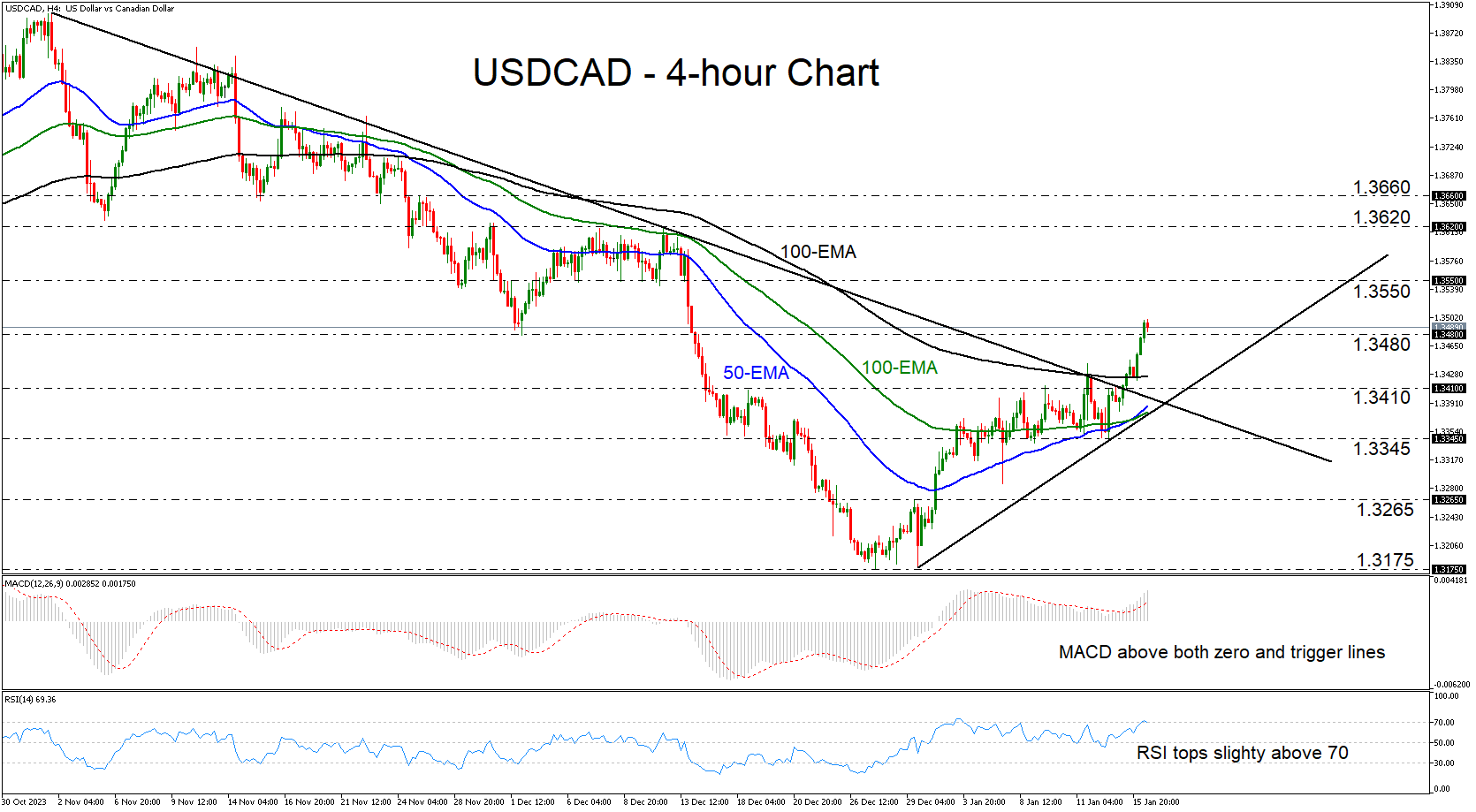
- USDCAD surges after breaking a downtrend line
- MACD and RSI detect positive momentum
- A dip below 1.3345 is needed to turn the picture bearish again
USDCAD traded sharply higher today, after it broke above the downtrend line drawn from the high of November 1. The pair is currently respecting a new shorter-term upside support line taken from the low of December 29 and has just poked its nose above the 1.3480 zone, marked by the inside swing low of December 4.
The MACD lies above both its zero and trigger lines, while the RSI stands near 70. Both these short-term oscillators detect positive momentum, but the latter has ticked down, suggesting that there may be a corrective pullback in the works before the next leg north.
If the bulls are willing to jump back into the action soon, then the pair may travel towards the 1.3550 territory, which offered support between December 5 and 13. A break higher could carry more bullish implications, perhaps paving the way towards the highs of July 16 and December 12, at around 1.3620.
On the downside, a dip below 1.3345 may be needed to cancel the positive short-term picture. Such a move would take the pair below all three of the plotted moving averages and below both the aforementioned trendlines. The bears may then get encouraged to dive towards the 1.3265 zone, the break of which could see scope for additional declines towards the 1.3175 area, which offered support on December 27 and 29.
To sum up, the short-term picture of USDCAD looks positive as the pair is trading above a prior downtrend line. The move that could darken the outlook may be a dip below Friday’s low of 1.3345.
Canadian Dollar Lower Ahead of CPI Data
- Canada’s inflation rate expected to rise to 3.4%
- Inflation expectations for businesses ease
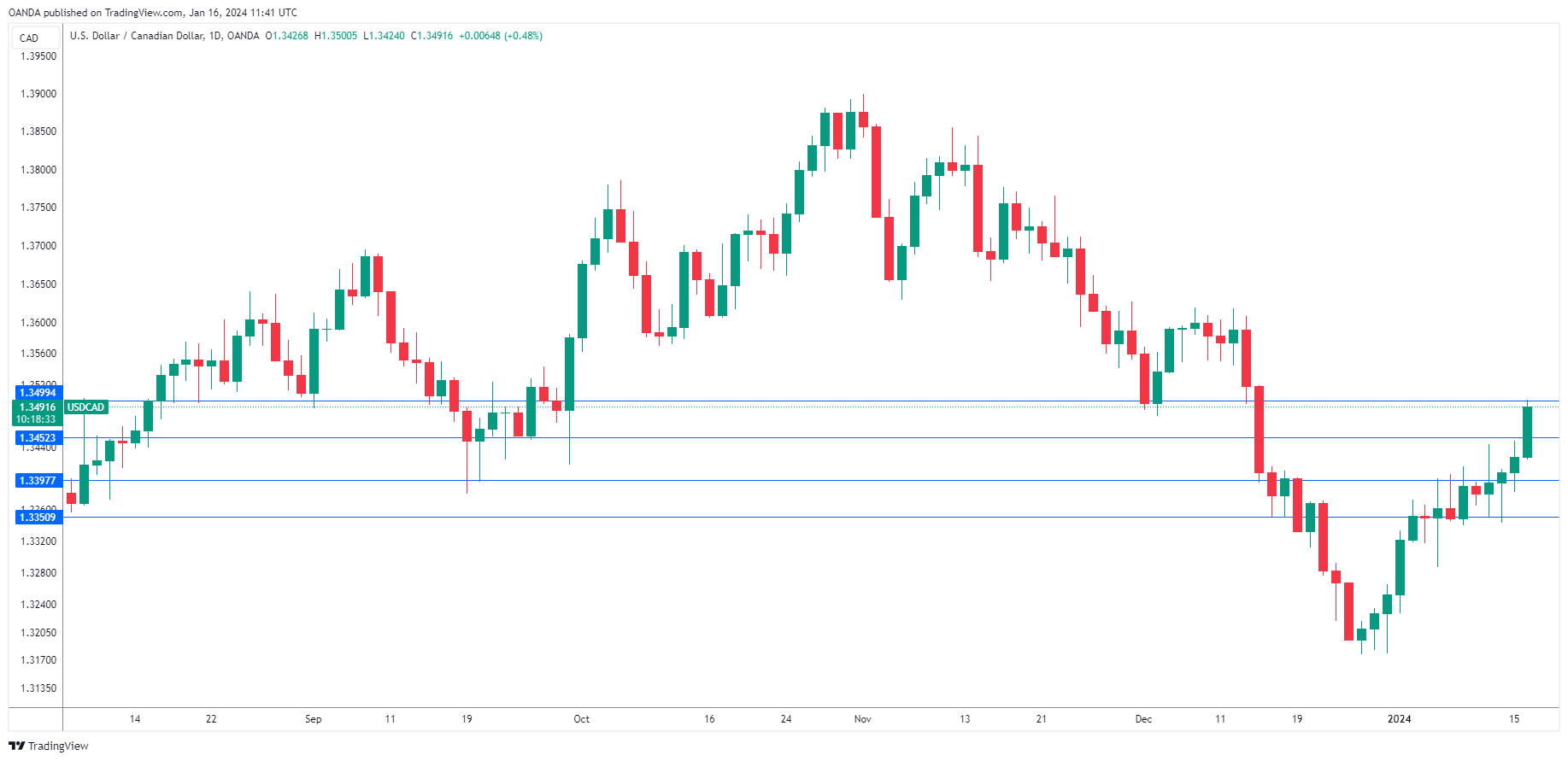
The US dollar has posted gains against all of the major currencies on Tuesday. In the European session, USD/CAD is trading at 1.3494, up 0.50%.
January hasn’t been kind to the Canadian dollar, which is down 1.8% this month against the greenback and is trading at one-month lows.
Canada’s inflation expected to rise
Canada releases December CPI later today, which is expected to rise to 3.4% y/y, up from 3.1% in November. Interestingly, the US inflation report for December rose to 3.4%, up from 3.1% a month earlier. The upward spike in US inflation was driven by gasoline prices, which fell at a slower pace in December than in November. This could repeat itself in the Canadian release.
Inflation expectations are closely watched as expectations of higher inflation can translate into actual inflation following suit and moving higher. The Bank of Canada’s Business Outlook Survey, released on Monday, indicated that many firms expect prices to fall, due to weaker demand and stronger competition.
For the Bank of Canada, an easing of inflation expectations should be an encouraging sign ahead of next week’s rate decision. The BoC has kept rates on hold at 5.0% since June and the rate-tightening cycle looks to be over. The burning question is when the central bank will start to cut rates. The BoC hasn’t signalled a change in policy and is likely to hold off on any rate cuts before core inflation, currently around 3.5%, is closer to the 2% target. This could mean that the BoC maintains rates until the second half of the year.
The week got off to a good start as Canada’s manufacturing sales rebounded in November with a 1.2% gain. This followed a 2.9% decline in October and edged above the market estimate of 1.1%.
USD/CAD Technical
- USD/CAD tested resistance at 1.3452 earlier. Above, there is resistance at 1.3499
- There is support at 1.3397 and 1.3350
German’s ZEW rises to 15.2 on rate cut expectations
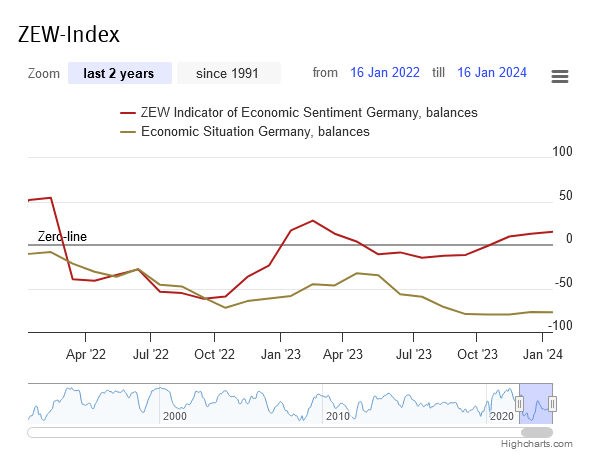
Germany's ZEW Economic Sentiment rose from 12.8 to 15.2 in January, above expectation of 12.7. Current Situation index fell slightly from -77.1 to -77.3, below expectation of -77.0.
Eurozone ZEW Economic Sentiment fell from 23.0 to 22.7, above expectation of 21.9. Current Situation index rose 3.4 points to -59.3.
ZEW President Achim Wambach noted that "Economic expectations for Germany have improved again," attributing this positivity partly to expectations that ECB will cut interest rate in the first half of the year. This expectation is shared by "more than half of the respondents "
Furthermore, Wambach highlighted that there are even more pronounced shifts in US interest rate expectations. He stated, "More than two-thirds of the respondents predict interest rate cuts by the US Federal Reserve in the next six months."
Wambach also pointed out that the recent rise in inflation in Germany and Eurozone in December does not seem to have influenced the monetary policy expectations of the respondents.
Pound Enters Correction Phase
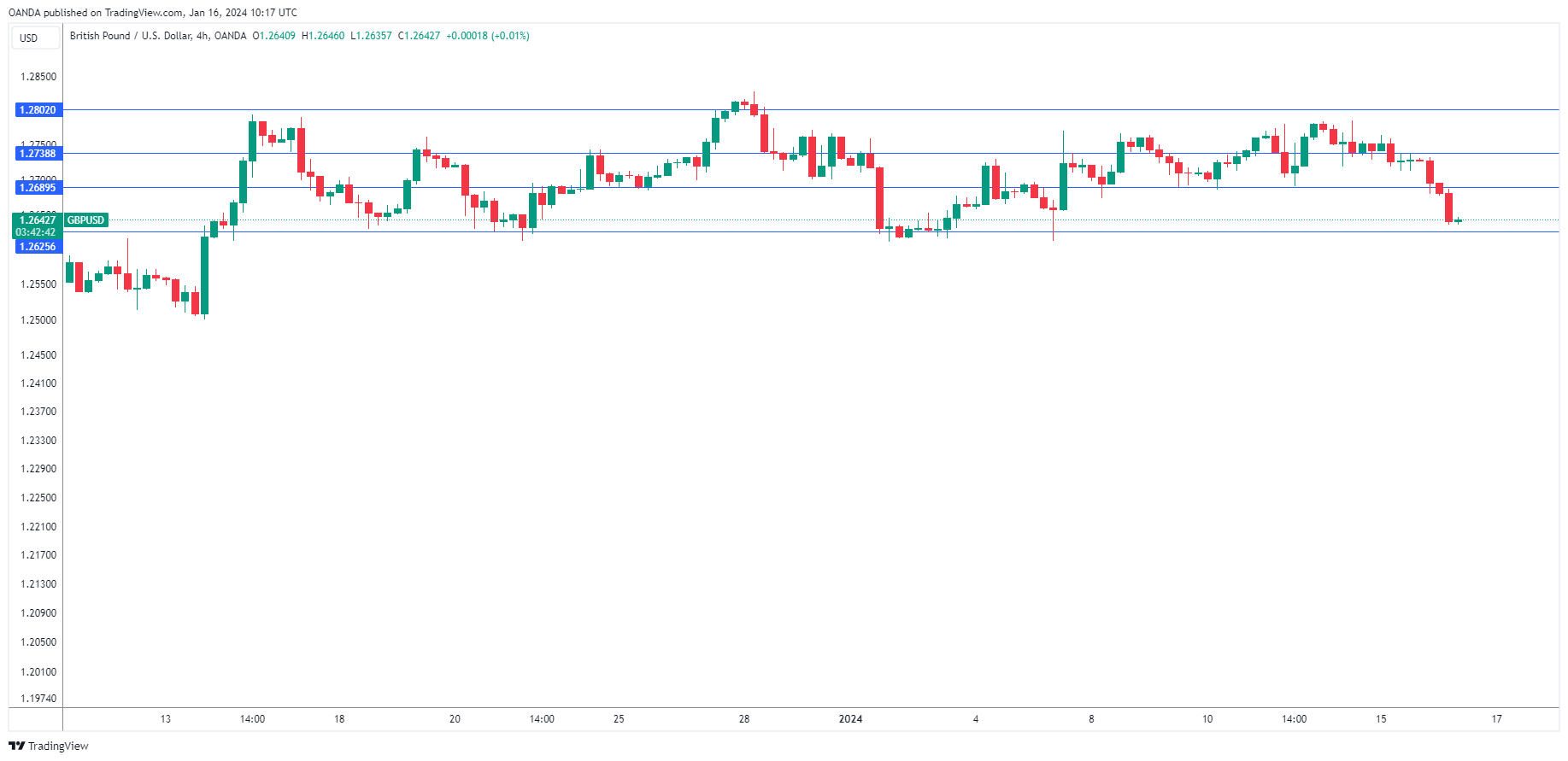
The British Pound has lost around 0.5% against the Dollar since the start of the day on Tuesday, falling to 1.2660. Markets have eased expectations for aggressive US interest rate cuts. In addition, UK employment data was released that provided new evidence of a slowdown.
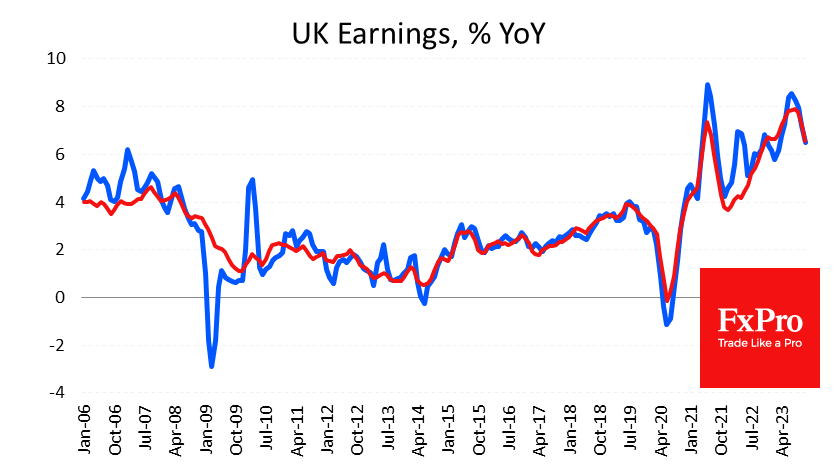
The fresh report for the three months to November showed that wages grew by 6.5% year-on-year, the lowest since March last year. This is weaker than the 6.8% expected and a marked slowdown from 7.2% in the previous month.
At the same time, jobless claims rose by 11.7K in November to 1.571M, the highest level since May last year.
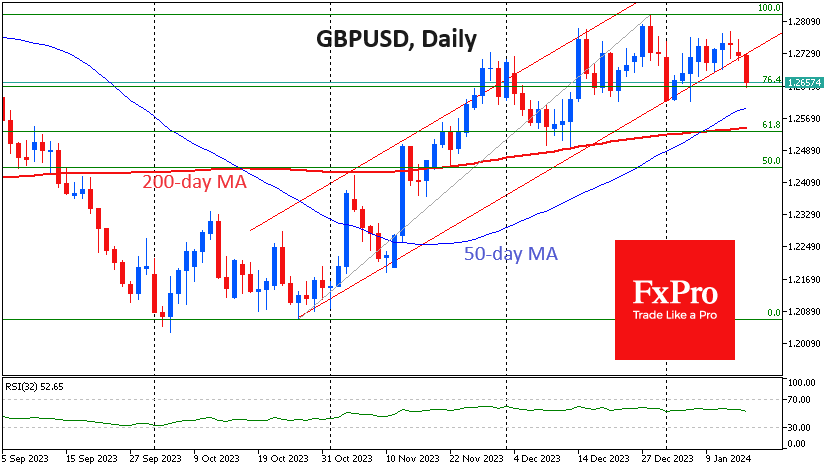
The GBPUSD fell to its lowest level since 5 January, its third consecutive session of losses. This decline formally breaks the uptrend seen from the lows at the start of the year. The move lower raises the question of a broader uptrend from the late October lows.
A break below 1.2610 would confirm the break of this trend. The initial decline may prove to be a technical correction after the gains of the last three months and could take the pound back to 1.2640, where the 200-day moving average and the 61.8% level of the rally.
British Pound Slips as Wage Growth Slides
- UK wages ease to 6.5%
- GBP/USD falls
- UK to release inflation on Wednesday
The British pound is sharply lower on Tuesday after a solid UK employment report. In the European session, GBP/USD is trading at 1.2641, down 0.68%.
UK wage growth falls sharply
The UK employment report indicated that the labour market remains solid while wage growth is falling rapidly. The unemployment rate was unchanged at 4.2% and the economy added 73,000 jobs in the three months to November, following 55,000 in the previous release and above the market estimate of 50,000.
The key segment of the employment release was wage growth. Average earnings including bonuses in the three months to November eased to 6.5%, down from 7.2% a month earlier and 8.5% four months ago. The steady fall in wages supports the case for the Bank of England to cut rates in the next few months and the British pound has responded with sharp losses. Wage growth is a key contributor to inflation and the BoE has been concerned that high wage growth could lead to a wage-price spiral. The drop in wage growth won’t put the BoE completely at ease, as wage growth remains high, but the downward trend is an encouraging sign in the battle against inflation.
The wage growth data didn’t affect market expectations for a rate cut, which remain high. Investors have virtually fully priced in a quarter-point cut by May with four or five additional cuts expected by the end of the year. The BoE has pushed back against these expectations with Governor Bailey sticking to the ‘higher for longer’ stance, in which the BoE would maintain rates in restrictive territory in order to push inflation lower. The BoE has maintained the cash rate at 5.25% three straight times and meets next on February 1.
The UK release the December inflation report on Wednesday. After a sharp drop in November (4.6% to 3.9%), inflation is expected to tick lower to 3.8%. Core CPI is projected to slow to 4.9%, down from 5.1% in November.
GBP/USD Technical
- GBP/USD is testing support at 1.2689. Below, there is support at 1.2625
- There is resistance at 1.2738 and 1.2802
EUR/USD: Euro Loses Ground, Key Supports Under Increased Pressure
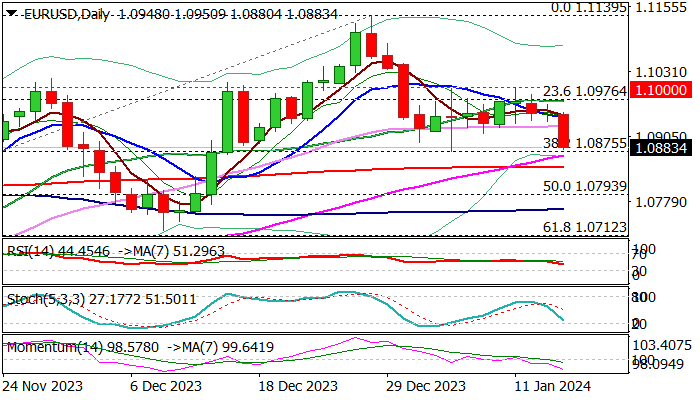
The Euro accelerated lower in Europe, shifting near term focus to the downside after a double failure at psychological 1.10 barrier.
Fresh bears pressure pivotal Fibo support at 1.0875 (38.2% retracement of 1.0448/1.1139, reinforced by rising 55DMA), with firm break here to signal an end of extended consolidation, completion of a double-top (1.10) and further weaken near-term structure for extension towards next key supports at 1.0845/43 (200DMA / top of rising daily Ichimoku cloud).
Strong bearish momentum on daily chart adds to negative outlook, though moving averages are in mixed setup and warn of prolonged sideways mode if key supports resist.
Res: 1.0910; 1.0947; 1.0965; 1.1000.
Sup: 1.0875; 1.0845; 1.0793; 1.0765.
AUDUSD Slips to 1-month Low
- AUDUSD posts a new negative wave
- RSI looks oversold
- 50- and 200-period SMAs ready for bearish cross
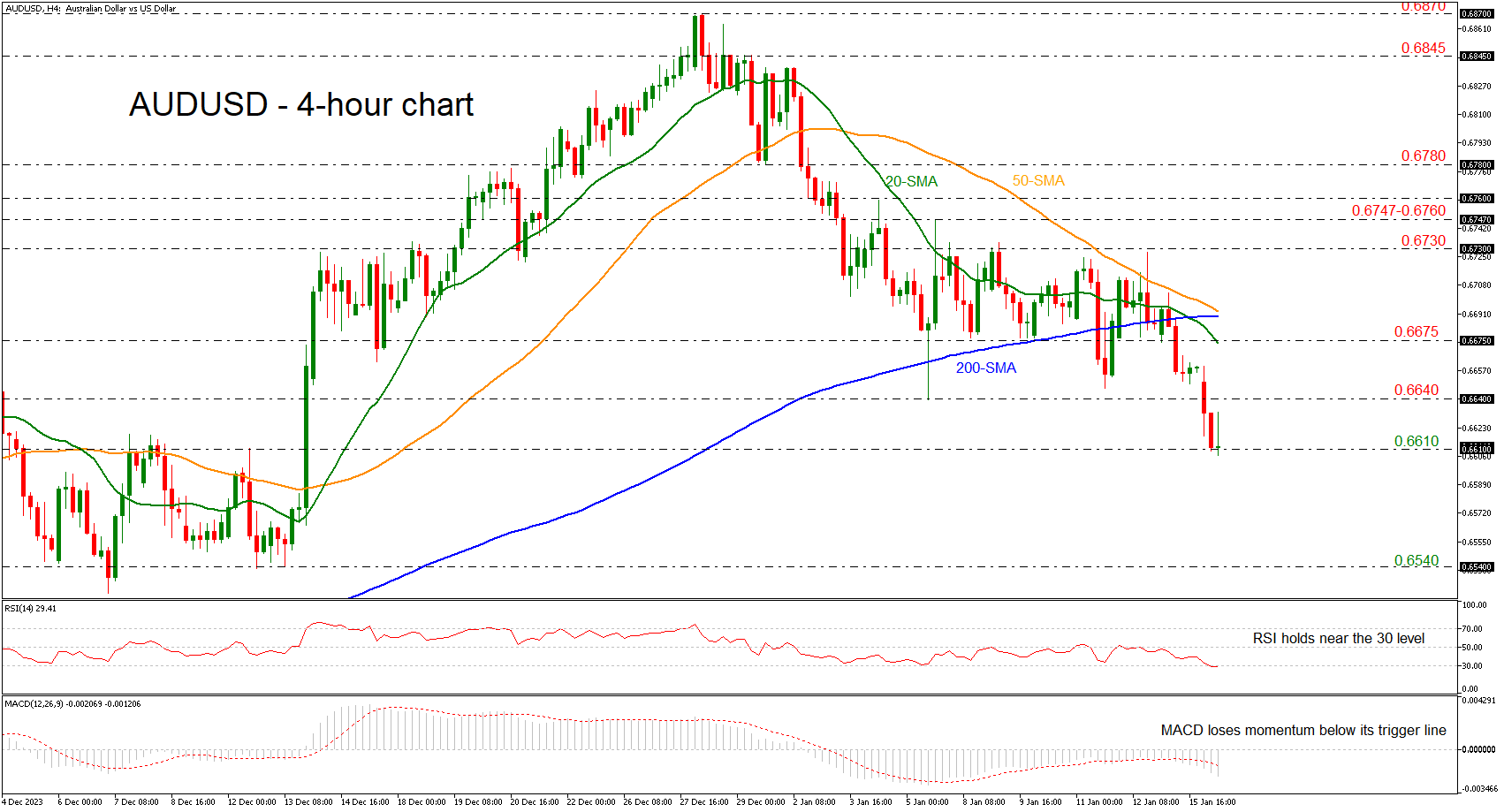
AUDUSD is plunging towards a fresh one-month low of 0.6606 today, confirming the negative structure that started from 0.6870.
Technically, the short-term risk is leaning to the downside. The MACD oscillator is extending its negative momentum beneath its trigger line in the bearish territory; however, the RSI is holding beneath the 30 level but is ticking marginally up, suggesting that the latest spike in the price is overdone.
Given the current negative momentum, the question now is whether the pair will stay resilient above the 0.6610 key region. A clear step below it would press the price towards the 0.6540 support, registered on December 13.
In this case, traders will wait for a close above the 0.6640 resistance and, more importantly, beyond the 0.6675 barricade which overlaps with the 20-period simple moving average (SMA), and the 50- and the 200-period SMAs around 0.6690 to upgrade this outlook. Then, the next battle could occur somewhere around the 0.6730 hurdle.
To sum up, the latest bearish spike in AUDUSD has not excited traders. An extension below 0.6610 would confirm the current negative structure. Note that a bearish cross between the 50- and 200-period SMAs is expected in the next few 4-hour sessions.
GBPUSD Slides But Remains Stuck in Rangebound Pattern
- GBPUSD experiences losses in the past couple of sessions
- But its short-term sideways structure holds
- Momentum indicators turn slightly negative
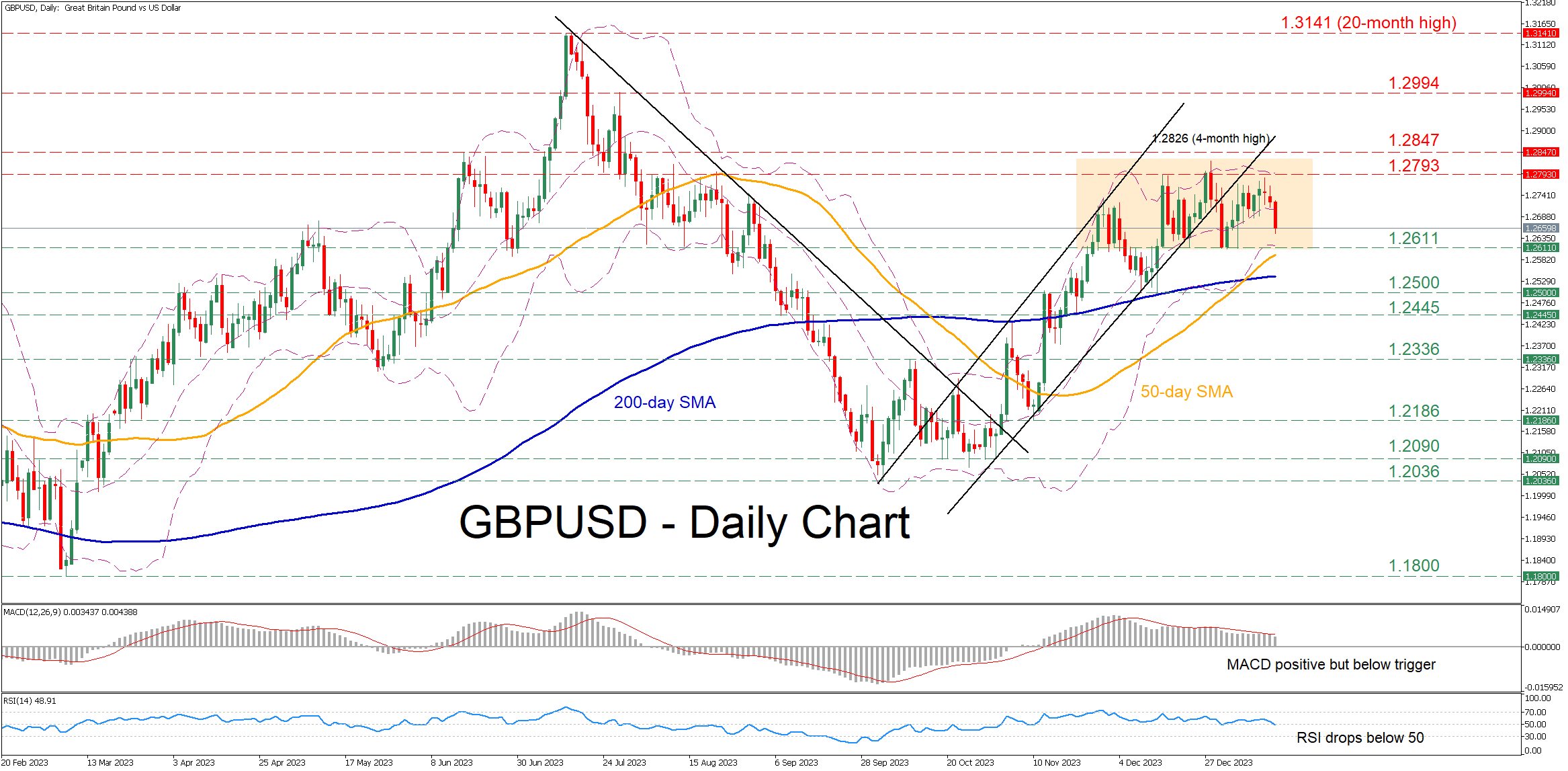
GBPUSD had been trending higher within an upward sloping channel, posting a fresh four-month peak of 1.2826 in late December. Nevertheless, the rally seems to have taken a breather, with the price trading without a clear direction since the beginning of the year.
Given that the short-term oscillators are providing cautiously negative signals, the bears could attempt to push the price below 1.2611, which is the lower end of the recent range. Piercing through that floor, the price may test the December bottom of 1.2500. A violation of that hurdle could pave the way for 1.2445, a region that provided both support and resistance throughout 2023.
Alternatively, if the pair storms back higher, the December resistance of 1.2793 could prove to be the first barricade for buyers to overcome. Breaching that area, the price might test the four-month peak of 1.2826 before it faces the June 2023 high of 1.2847. Further upside attempts could then stall at the July resistance of 1.2994.
In brief, GBPUSD remains a prisoner within its tight range, appearing unable to adopt strong directional impetus. However, negative pressures seem to be intensifying as the RSI has fallen below 50 for the first time since early November.