

Sample Category Title
Markets Weekly Outlook – PMI and PCE in the Spotlight as US Dollar Remains Sensitive to US Labor Data
Week in review - Fed Delivers Cut but Keeps Markets in Check
A busy week that was still dominated by the highly anticipated Federal Reserve Meeting. I have to say, hats off to Fed Chair Powell who kept markets in check whether you think he is right or wrong in his decision. Believe me there is support in both camps.
Fed Chair Powell in particular has been under pressure from the political sphere while labor data and mixed economic signals put the Fed Chair in the firing line. The Fed board itself faced a key decision as markets have turned extremely dovish in expectations ahead of the meeting.
The message from the Fed balanced market expectations while not giving too much away and pushing back to some degree at least, the questions of Fed independence.
So how did the markets perform?
The S&P 500 and the Nasdaq stock indexes are on track to have their third consecutive week of gains. This positive trend was fueled by the Federal Reserve's first interest rate cut of 2025 and hints that more relaxed monetary policies could be on the way. A renewed sense of optimism around stocks related to artificial intelligence (AI) also contributed to the market's rise.
However, the US stock market was a bit unsteady earlier in the day. Investors were still trying to understand the Fed's future plans and were paying close attention to comments made by Stephen Miran, the newest Fed governor and a White House economic adviser, who spoke on CNBC on Friday morning.
Also on Friday, US President Donald Trump and Chinese President Xi Jinping spoke on the phone, and afterward, Trump announced that they had made progress on a deal for TikTok. He also said that the two leaders had agreed to a meeting in person next month in South Korea.
So far in September, the three main US stock indexes—the Dow Jones Industrial Average, the S&P 500, and the Nasdaq Composite—are all performing well. This is unusual because September has historically been a difficult month for the US stock market. Data shows that since the year 2000, the S&P 500 has, on average, lost 1.4% of its value during this month.
How has the US Dollar Reacted?
The US Dollar has been resilient since the decision and not surprising considering that what the Fed delivered was more hawkish than expected.
However, the Fed met expectations by announcing its first rate cut of the year and indicating there would be two more cuts. This caused the dollar to immediately drop by about 0.5% against other currencies.
But within half an hour, the dollar had regained all of its lost value as US government bond yields started to rise again. This quick reversal was likely due to how traders were positioned in the market, rather than a change in how they viewed the Fed's announcement. It was a "trader's market"—meaning it was influenced more by short-term trading behaviors than by long-term economic signals.
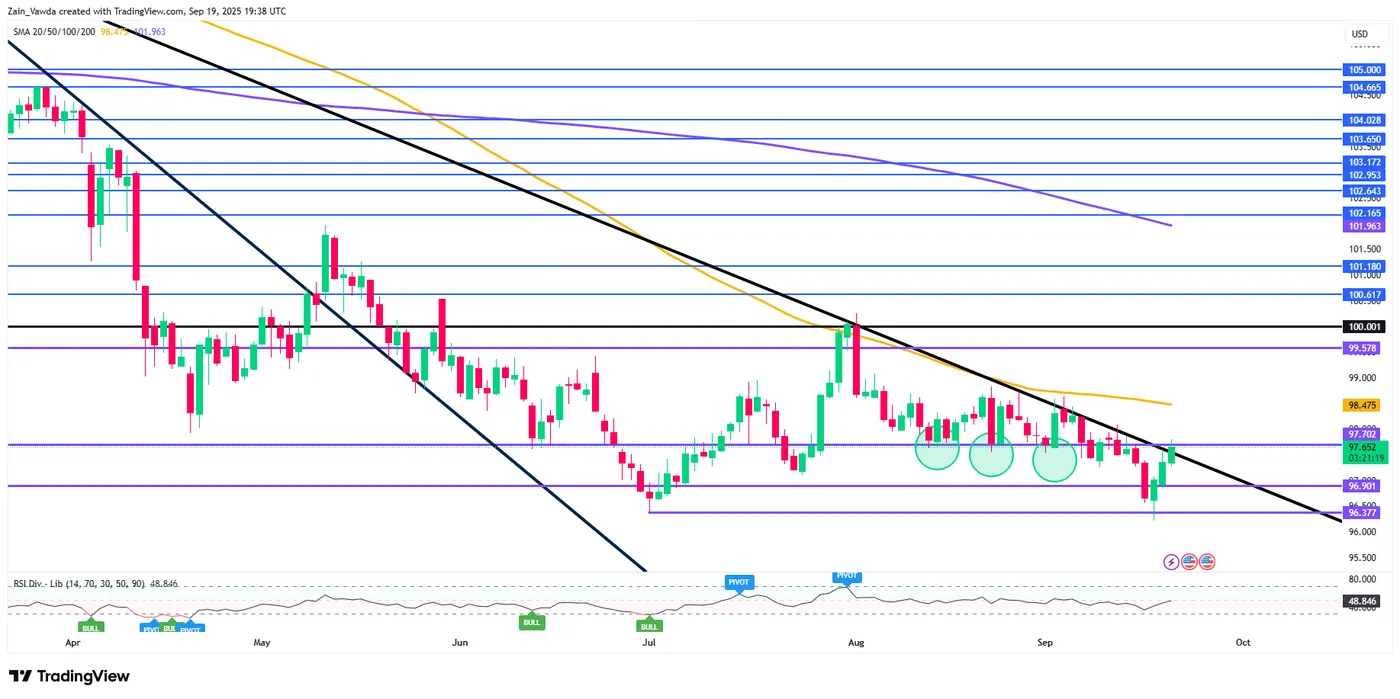
The US Dollar index (DXY) is ending the week with 3 successive days in the green.
US Dollar Index Daily Chart, September 19, 2025
Source: TradingView.Com (click to enlarge)
Despite this rebound, the long-term outlook for the dollar doesn't seem very positive. The Fed has officially stated that the risk to its two main goals—stable prices and maximum employment—is now more focused on a weaker job market. With the expectation of two more rate cuts this year, bringing the policy rate down to 3.00-3.25%, the dollar could weaken. When the immediate market excitement dies down, the dollar is likely to fall back toward its lowest levels of the year and will become very sensitive to upcoming US job market data.
The Week Ahead - Global PMIs and US PCE
Next week is a busy one with Flash PMI survey data will provide a key focus for the markets in the coming week, though Friday's release of the US core PCE price index will also be eagerly awaited.
Other releases of note include revised US GDP numbers, consumer confidence data for the US and Europe, plus US, home sales, durable goods orders and inventories.
Asia Pacific Markets - Tokyo CPI
High impact data will be a bit sparse from Asia next week with the biggest data release being from Japan.
Tokyo CPI data will be released after the BoJ held rates steady but with a hawkish shift on Friday. Two officials on the central bank's board unexpectedly voted against the majority, showing a more "hawkish" view—meaning they are more concerned about inflation and are in favor of raising interest rates.
The market was also caught off guard by the central bank's announcement that it would begin selling its holdings of exchange-traded funds (ETFs) and Japanese real estate investment trusts (J-REITs). This move is a strong sign that the Bank of Japan (BoJ) is serious about gradually returning its monetary policy to normal.
Based on these signals, I believe that an interest rate hike is a probability in October.
Global PMI and US PCE Data in Focus
Over the next week, several officials from the Federal Reserve (the Fed) will be speaking publicly. This is an important opportunity to hear their individual views on the economy after the Fed recently decided to resume cutting interest rates. They'll likely provide more details on how they see the risks to the economy, especially after signaling that their main forecast is for two more rate cuts this year and one in the next.
The most important data release will be the core personal consumer expenditure (PCE) deflator on Friday. This is the inflation measure the Fed prefers to use.
While the core consumer price index (CPI) rose a bit more than expected last month, the core PCE is likely to show a more modest increase. This is because it gives less weight to housing costs and includes different data like airline fares and healthcare costs. If the core PCE comes in as expected, it would give the Fed a clear signal to move forward with more rate cuts in October and December.
Additionally, new housing market data will be released. With more homes available for sale but still weak demand from buyers, there are growing concerns that home prices could start to fall.
Looking at the Euro Area and based on recent data, business activity in August, measured by PMIs (Purchasing Managers' Indexes), was very positive, primarily because of a significant increase in manufacturing.
However, a separate survey from the European Commission suggests that this boost might be a one-time event, as future expectations for the manufacturing sector weren't particularly strong.
For September, this creates a question for economists: Will the positive mood from the summer continue, or was August's good performance just a brief exception? We think the latter is very possible, especially given that the economy is currently growing at a slow pace.
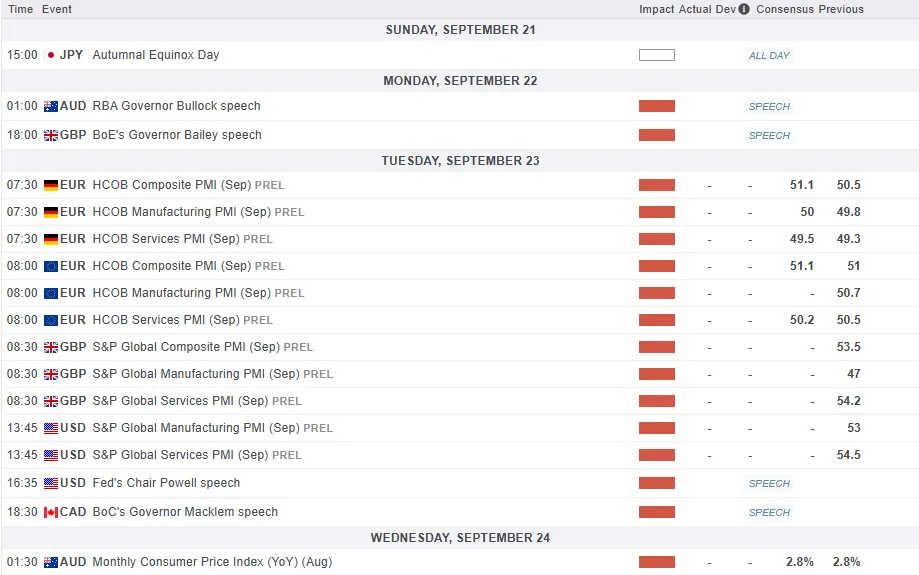
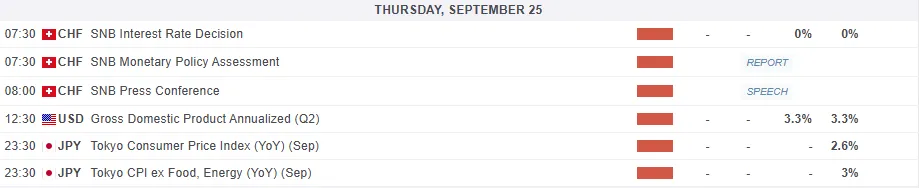
For all market-moving economic releases and events, see the MarketPulse Economic Calendar. (click to enlarge)
Chart of the Week - Gold (XAU/USD)
This week's Chart of the week is Gold.
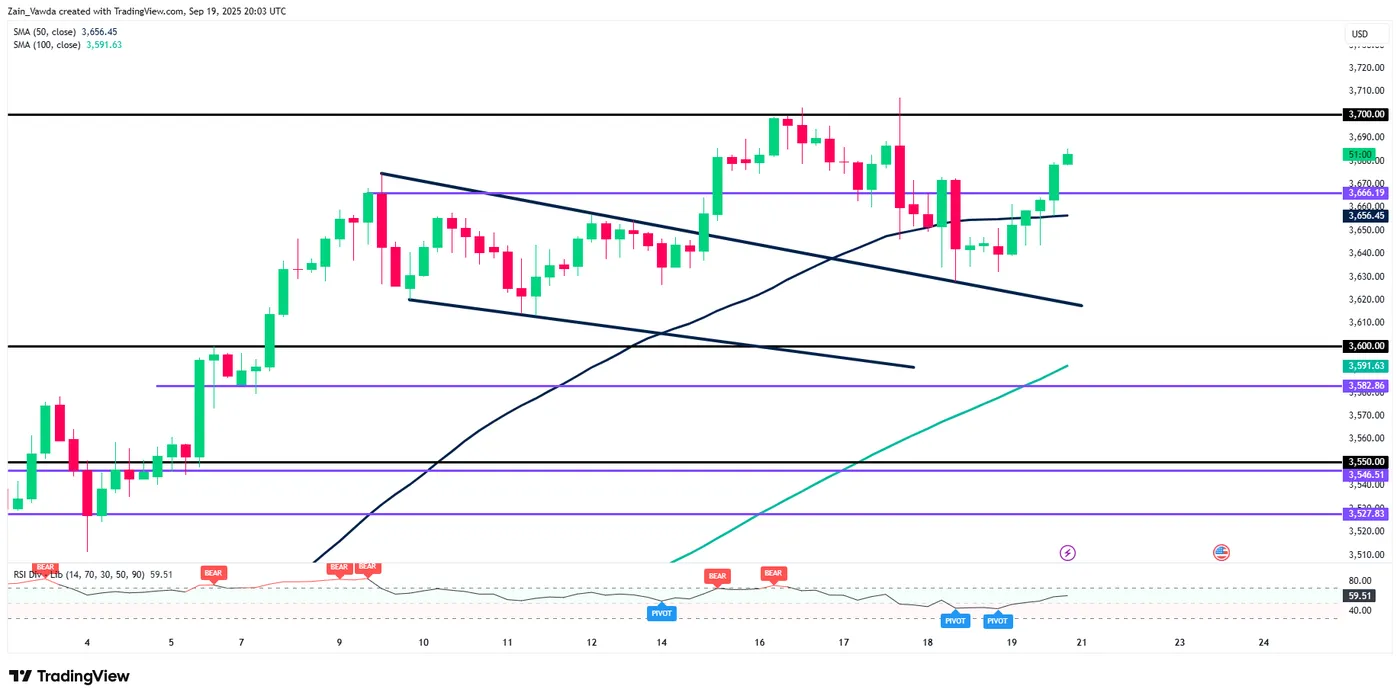
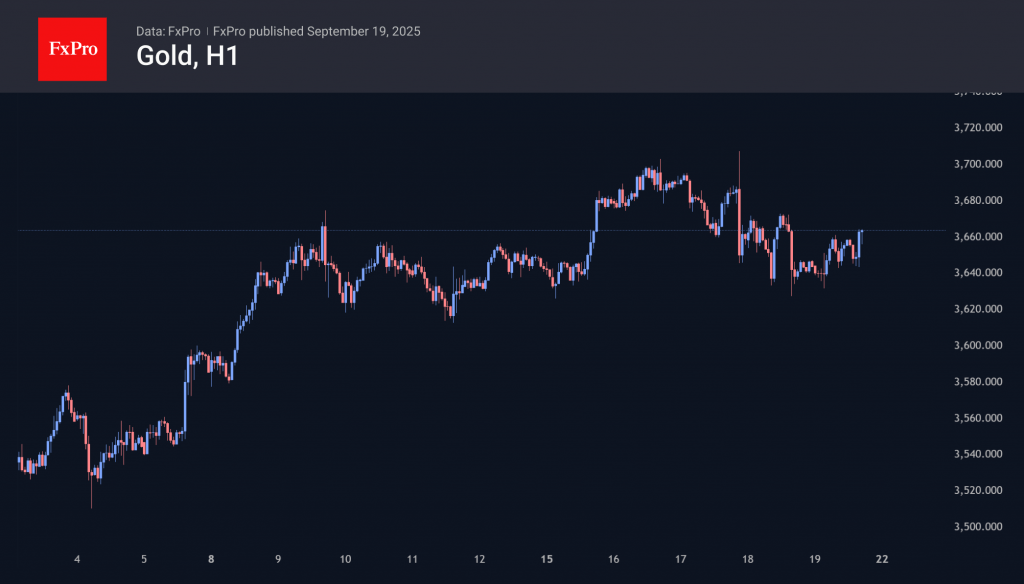
From a technical standpoint, Gold pulled back after the FOMC meeting and retested the bull flag pattern breakout from Monday.
A bullish move since leaves gold on course for another week of gains above 1%. Gold is trading just shy of the $3700/oz handle.
A weekly close above this level seems unlikely this late in the day which leaves Gold in a precarious position heading into the new week.
Looking at the four-hour timeframe, Gold has recorded a change in structure but could be in for a short-term pullback before continuing higher.
Gold has seen its price target updated by many institutions as a combination of potential US Fed rate cuts, along with continued central bank buying and ETF inflows are likely to keep Gold supported.
That of course does not rule out small price retracements in the interim and that could come into play at some stage next week if profit taking does occur.
If the US Dollar index retreats next week that could be another factor which could influence the trajectory of Gold prices, so keep an eye on that.
Immediate support rests at 3666 before the 3656 and 3627 handles come into focus.
Looking at the upside and immediate resistance rests at 3700 before all-time highs at 3707 comes into focus.
Gold Four-Hour Chart Chart - September 19, 2025
Source:TradingView.Com (click to enlarge)
Trade Safe.
The Weekly Bottom Line: Powell’s ‘Risk Management’ Cut
Canadian Highlights
- Despite rate cuts from the Bank of Canada and the U.S. Federal Reserve, bond yields rebounded post-Fed press conference, leaving Canadian yields and equities flat for the week.
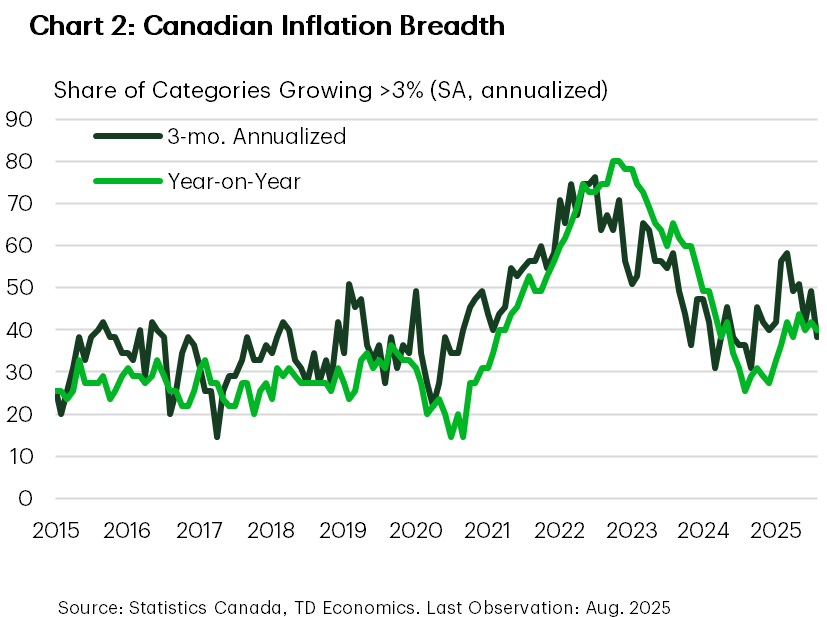
- Core inflation metrics remain elevated on a year-on-year basis, but more recent trends show significant slowing, with fewer CPI categories rising rapidly and both goods and services inflation cooling markedly.
- The upcoming federal budget will be crucial for economic direction and future Bank of Canada rate decisions.
U.S. Highlights
- The Fed resumed rate cuts at this week’s FOMC meeting, lowering the policy rate by 25 basis points to 4.00%-4.25%.
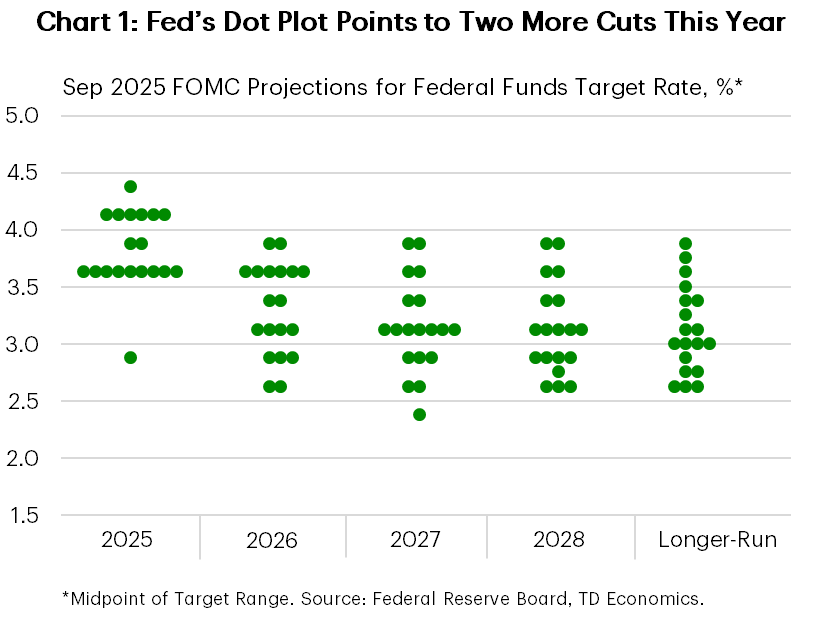
- The Fed’s “dot” plot pointed to two more cuts by the end of this year, but it also showed one member who expects a lot more easing.
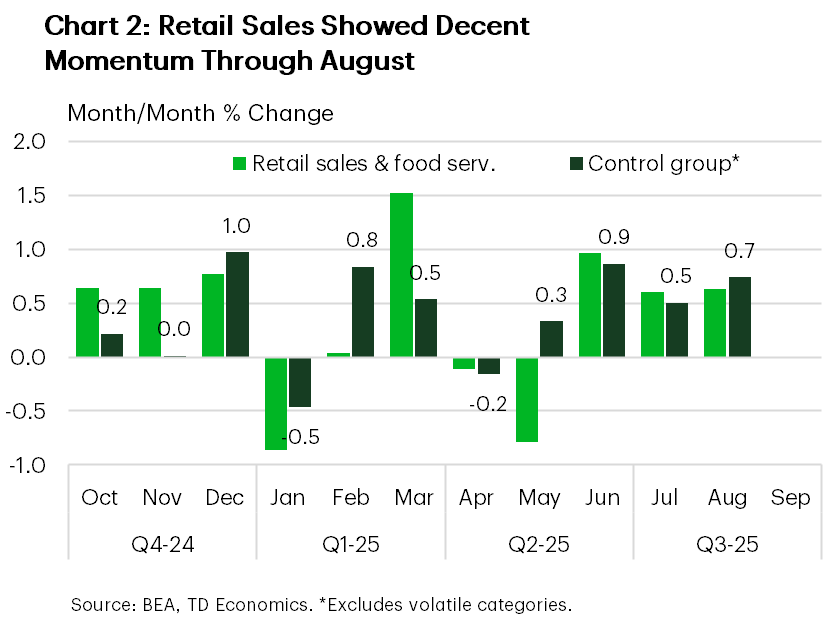
- Retail sales came in better than expected in August, rising 0.6% on the month. Sales in the control group, which strip out volatile categories, rose an even better 0.7%.
Canada – A Cool-Down and a Cut
It was a busy week with updates on inflation and retail sales, along with rate cuts from the Bank of Canada and the U.S. Federal Reserve Bank. Despite the Fed’s rate cut, U.S. bond yields popped, taking global yields with them. For Canada, this now leaves the 10-year bond yield basically unchanged from the start of the week, and the TSX hovering near its record high. For all the ructions in the market, the economic details showcase why we maintain our view that the Bank of Canada was right to cut at this meeting, and that another cut in October is the right way to go.
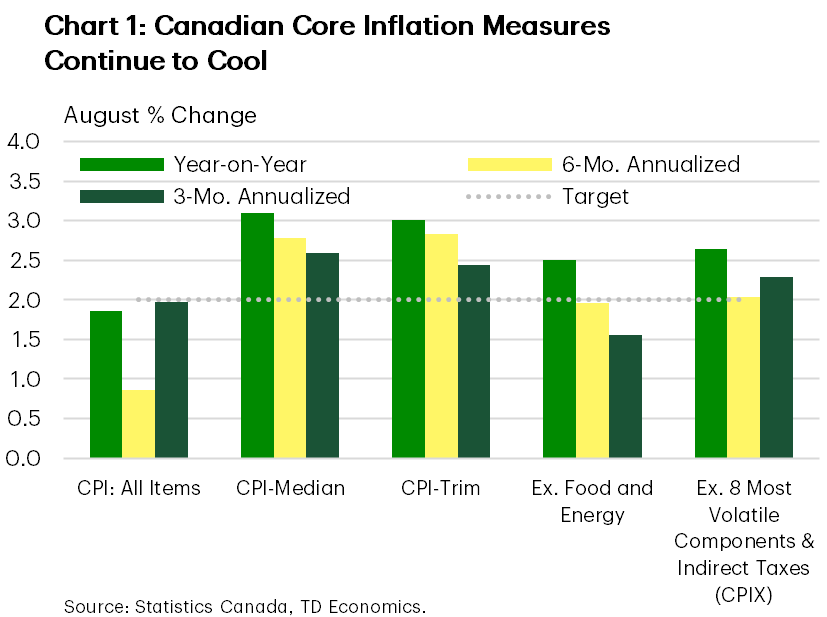
The story starts with inflation. Eliminating the consumer carbon tax has dragged down top line inflation since April, so all eyes have been laser focused on core measures. From that lens things sure seem ugly, with the Bank’s preferred measures still reading around 3.0% year-on-year (y/y), and the old exclusion measures CPI ex-food and energy and CPIX at 2.4% and 2.6% y/y, respectively. But these measures mask what’s been going on in recent months, instead reflecting the spring’s run-up in prices. On a three-month basis (Chart 1) inflation across all core measures has slowed precipitously in the past two months. Moreover, the breadth of inflation has sunk with it. The share of CPI categories rising at more than 3% (annualized) over the past three months has fallen to roughly 38%, sharply lower from the 58% share registered in the spring (Chart 2).
Previously strong prints in core goods prices have faded and it’s now running at 1.2% (3-mo. annualized), and services prices too have cooled to 1.5% (3-mo. annualized). We expect soft momentum in these key categories to continue as domestic demand struggles to gain traction in the wake of the trade shock. This week’s retail data for July bolstered that view. Although the data remain volatile, growth is petering out, and we now expect nominal retail spending in Q3 to register a below-trend 1.6% annualized gain.
Weaker business prospects are expected to push the unemployment rate higher heading into 2026, with restrained population growth limiting the degree of weakness in the labour market. The soft demand backdrop, coupled with the federal government’s removal of most retaliatory tariffs are tempering worries about a possible resurgence of inflation in the back half of 2025.
The wildcard in all of this is what is to come from the Federal government’s budget. We learned this week that it will be released on November 4th, but continue to await details. Five projects have been called out for the Projects of National Significance list, along with planned spending on Build Canada Homes, tariff mitigation measures for affected industries and re-skilling for affected workers. In the coming weeks we will be keenly watching for any news on the structure of proposed savings measures and for signs on the timing of planned (but not yet announced) investment outlays. The scale and timing of the cuts and investments could materially affect the trajectory of the economy and the BoC’s calculus on where the policy rate should be heading into 2026.
U.S. – Powell’s ‘Risk Management’ Cut
The Federal Reserve resumed its easing cycle after a nine-month pause, cutting the policy rate by 25 basis points at this week’s FOMC meeting. The move was widely anticipated, and while bond yields initially dipped, they ultimately rose as markets digested the broader implications. Equities, however, rallied, with the S&P 500 climbing another 1% on the week at time of writing.
The FOMC statement signaled a shift in emphasis from the ‘price stability’ mandate toward ‘full employment’, noting that “downside risks to employment have risen”. This echoed Fed Chair Powell’s remarks at Jackson Hole last month and set the tone for what he later described as a “risk management cut”. In essence, while inflation remains elevated, the Fed deemed it prudent to begin easing the policy rate to help guard against further labor market deterioration.
The decision was accompanied by the latest Summary of Economic Projections (SEP), which offered a mixed picture. Unemployment rate forecasts were largely unchanged, while growth projections for 2025 and 2026 were nudged up 20 basis points (bps) to 1.6% and 1.8%, respectively. Core inflation expectations for next year were also bumped up by 20 bps to 2.6%, with this measure now projected to return to target only by 2028 – which would mark seven consecutive years above the Fed’s 2% goal. The median forecast now calls for three cuts by year-end (including this week’s) up from two, and is in tune with our expectations. But one member projected the equivalent of three jumbo 50 bps cuts total (Chart 1). Stephen Miran, President Trump’s newly appointed Fed governor, is likely the one projecting more aggressive cuts as he was the lone dissent at this week’s meeting, favoring a larger 50 bps cut.
Economic data released this week did little to bolster the case for continued easing. Initial jobless claims fell back last week, following a surge in the week prior. And while housing remained a soft spot, with homebuilding pulling back in August, consumption-related data came in better than anticipated. August retail sales and food services rose 0.6% on the month, matching July’s gain. Sales in the ‘control group’ – which strip out volatile components – rose a solid 0.7%, building on gains in the prior two months (Chart 2). While tariffs are still expected to chip away at spending power and weigh on consumption, this recent data suggests consumers may still have some gas in the tank.
The bottom line is that while the Fed has resumed rate cuts to guard against further labor market weakness, its “risk management” approach means future moves will remain highly data dependent. The Fed will continue to have a hard time balancing the risks with respect to its dual mandate. But ultimately, we believe that the tariff impact on inflation will be temporary, and we expect the central bank to continue to cuts rates to support the economy (see our latest Quarterly Economic Forecast here).
Weekly Economic & Financial Commentary: From Bipolar to Tripolar?
Summary
United States: The Balance of Risks Has Shifted
- The steadiness in consumer spending has helped prevent widespread layoffs, but rising tariff-related costs have limited firms’ ability to expand payrolls or undertake major capital investments. These crosscurrents have curtailed job creation and kept inflation elevated. The FOMC responded this week by cutting its policy rate 25 bps, signaling that a deteriorating jobs market has overshadowed concerns about stubborn inflation.
- Next week: New Home Sales (Tue.), Durable Goods (Thu.), Personal Income and Spending (Fri.)
International: Central Bank Bonanza: Cuts, Holds and Surprises
- Central banks were in the spotlight this week—not only the Federal Reserve, but also counterparts across advanced and emerging markets. Rate cuts came from central banks in Canada, Norway and Indonesia, while the U.K., Japan and Brazil held rates steady—and there were plenty of surprises along the way.
- Next week: Eurozone PMIs (Tue.), Riksbank Policy Rate (Tue.), Banxico Policy Rate (Thu.)
Interest Rate Watch: A "Risk Management" Cut
- The FOMC cut the fed funds rate by 25 bps to 4.00%-4.25%, citing rising risks to employment despite persistent inflation, with most members signaling further easing ahead. Chair Powell emphasized a cautious, data-dependent approach, suggesting additional rate reductions are still likely but not guaranteed.
Credit Market Insights: Cautious Households Moderate Credit Card Spending
- Credit card spending growth has moderated as households faced scant income gains in 2024, with most increases concentrated among top earners. Lower credit uptake, combined with reduced discretionary outlays and rising delinquencies, reflects mounting financial pressure on consumers.
Topic of the Week: From Bipolar to Tripolar?
- We explore how global trade fragmentation could evolve beyond a U.S.-China split into a three-bloc system including the EU. Such a tripolar world would impose far greater costs on global growth.
Forward Guidance: Early Indicators Point to Canada’s Growth Rebounding in July
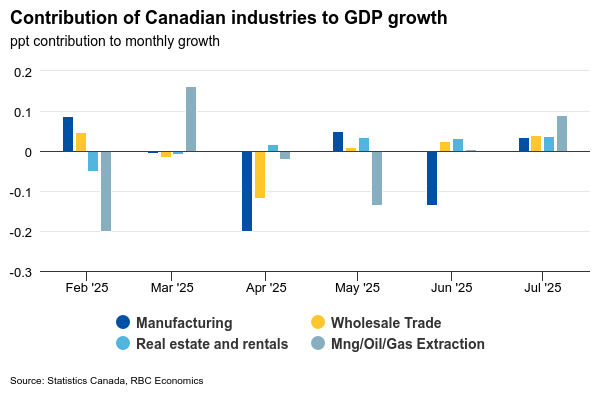
Canada’s gross domestic product for July on Thursday will take center stage as early readings suggest the contraction in Q2 growth was not likely repeated in Q3.
We expect GDP to post a 0.2% increase in July, modestly surpassing Statistics Canada's preliminary estimate of a 0.1% rise. This would mark a welcome rebound following three consecutive months of declines.
Canadian export and manufacturing sale volumes rose in July by 0.7% and 1.6%, respectively, after declining sharply in Q2. Early data is pointing to another increase in oil production in Alberta as activity continues to recover from wildfire-related disruptions in May.
Wholesale volumes rose for a third straight month in July—up 0.8% from June and 3% from a year ago—and home resales rose almost 4%. Retail sales softened to partially retrace a jump in June but the August advance estimate pointed to a 1% rebound. Overall, service sector production appears to have advanced slightly faster than in the previous month in July.
Employment declined sharply in July (-41,000), but hours worked fell less (-0.2%) and are still tracking above their Q2 averages through August. This aligns with our expectations for modest GDP growth in Q3.
It is highly likely that Bank of Canada policymakers expect that additional interest rate cuts will be needed after reducing the overnight rate for the first time since March in September. But, further reductions are also more contingent than usual on more softness in economic data.
Our tracking for GDP growth in early Q3 is not significantly different than the BoC’s, but its decision to cut again (or not) in October will depend heavily on early October trade and labour market data, as well as the results from the BoC’s Business Outlook Survey.
Week ahead data watch:
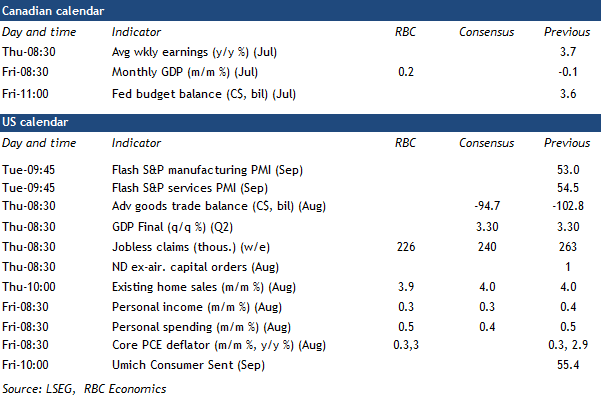
U.S. personal spending likely edged up by another 0.5%, following a similar pace in July and consistent with the +0.6% gain in August retail sales. Unit auto sales inched lower during that month, offsetting some of the price-related increases at the pump.
We expect U.S. personal income to rise by 0.3%, slightly slower than the pace in July, largely aligning with the stagnant wage growth reported in the earlier nonfarm payroll report.
Summary 9/22 – 9/26
Monday, Sep 22, 2025
| GMT | Ccy | Events | Consensus | Previous |
|---|---|---|---|---|
| 01:00 | CNY | 1-Y Loan Prime Rate | 3.00% | 3.00% |
| 01:00 | CNY | 5-Y Loan Prime Rate | 3.50% | 3.50% |
| 12:30 | CAD | Raw Material Price Index Aug | 0.90% | 0.30% |
| 12:30 | CAD | Industrial Product Price M/M Aug | 1.20% | 0.70% |
| 14:00 | EUR | Eurozone Consumer Confidence Sep P | -15 | -16 |
| 23:00 | AUD | Manufacturing PMI Sep P | 53 | |
| 23:00 | AUD | Services PMI Sep P | 55.8 |
| GMT | Ccy | Events | |
|---|---|---|---|
| 01:00 | CNY | 1-Y Loan Prime Rate | |
| Forecast: 3.00% | Previous: 3.00% | ||
| 01:00 | CNY | 5-Y Loan Prime Rate | |
| Forecast: 3.50% | Previous: 3.50% | ||
| 12:30 | CAD | Raw Material Price Index Aug | |
| Forecast: 0.90% | Previous: 0.30% | ||
| 12:30 | CAD | Industrial Product Price M/M Aug | |
| Forecast: 1.20% | Previous: 0.70% | ||
| 14:00 | EUR | Eurozone Consumer Confidence Sep P | |
| Forecast: -15 | Previous: -16 | ||
| 23:00 | AUD | Manufacturing PMI Sep P | |
| Forecast: | Previous: 53 | ||
| 23:00 | AUD | Services PMI Sep P | |
| Forecast: | Previous: 55.8 | ||
Tuesday, Sep 23, 2025
| GMT | Ccy | Events | Consensus | Previous |
|---|---|---|---|---|
| 07:15 | EUR | France Manufacturing PMI Sep P | 50.5 | 50.4 |
| 07:15 | EUR | France Services PMI Sep P | 49.7 | 49.8 |
| 07:30 | EUR | Germany Manufacturing PMI Sep P | 50.1 | 49.8 |
| 07:30 | EUR | Germany Services PMI Sep P | 49.5 | 49.3 |
| 08:00 | EUR | Eurozone Manufacturing PMI Sep P | 50.8 | 50.7 |
| 08:00 | EUR | Eurozone Services PMI Sep P | 50.2 | 50.5 |
| 08:30 | GBP | Manufacturing PMI Sep P | 47.2 | 47 |
| 08:30 | GBP | Services PMI Sep P | 53.6 | 54.2 |
| 12:30 | CAD | New Housing Price Index M/M Aug | 0.00% | -0.10% |
| 12:30 | USD | Current Account (USD) Q2 | -270B | -450.2B |
| 13:45 | USD | Manufacturing PMI Sep P | 51.6 | 53 |
| 13:45 | USD | Services PMI Sep P | 53 | 54.5 |
| GMT | Ccy | Events | |
|---|---|---|---|
| 07:15 | EUR | France Manufacturing PMI Sep P | |
| Forecast: 50.5 | Previous: 50.4 | ||
| 07:15 | EUR | France Services PMI Sep P | |
| Forecast: 49.7 | Previous: 49.8 | ||
| 07:30 | EUR | Germany Manufacturing PMI Sep P | |
| Forecast: 50.1 | Previous: 49.8 | ||
| 07:30 | EUR | Germany Services PMI Sep P | |
| Forecast: 49.5 | Previous: 49.3 | ||
| 08:00 | EUR | Eurozone Manufacturing PMI Sep P | |
| Forecast: 50.8 | Previous: 50.7 | ||
| 08:00 | EUR | Eurozone Services PMI Sep P | |
| Forecast: 50.2 | Previous: 50.5 | ||
| 08:30 | GBP | Manufacturing PMI Sep P | |
| Forecast: 47.2 | Previous: 47 | ||
| 08:30 | GBP | Services PMI Sep P | |
| Forecast: 53.6 | Previous: 54.2 | ||
| 12:30 | CAD | New Housing Price Index M/M Aug | |
| Forecast: 0.00% | Previous: -0.10% | ||
| 12:30 | USD | Current Account (USD) Q2 | |
| Forecast: -270B | Previous: -450.2B | ||
| 13:45 | USD | Manufacturing PMI Sep P | |
| Forecast: 51.6 | Previous: 53 | ||
| 13:45 | USD | Services PMI Sep P | |
| Forecast: 53 | Previous: 54.5 | ||
Wednesday, Sep 24, 2025
| GMT | Ccy | Events | Consensus | Previous |
|---|---|---|---|---|
| 00:30 | JPY | Manufacturing PMI Sep P | 50.2 | 49.7 |
| 00:30 | JPY | Services PMI Sep P | 53.1 | |
| 01:30 | AUD | Monthly CPI Y/Y Aug | 2.80% | 2.80% |
| 08:00 | CHF | UBS Economic Expectations Sep | -53.8 | |
| 08:00 | EUR | Germany IFO Business Climate Sep | 89.5 | 89 |
| 08:00 | EUR | Germany IFO Current Assessment Sep | 86.6 | 86.4 |
| 08:00 | EUR | Germany IFO Expectations Sep | 92 | 91.6 |
| 14:00 | USD | New Homeles M/M Aug | 650K | 652K |
| 14:30 | USD | Crude Oil Inventories (Sep 19) | -9.3M | |
| 23:50 | JPY | BoJ Minutes | ||
| 23:50 | JPY | Corporate Service Price Index Y/Y Aug | 2.90% | 2.90% |
| GMT | Ccy | Events | |
|---|---|---|---|
| 00:30 | JPY | Manufacturing PMI Sep P | |
| Forecast: 50.2 | Previous: 49.7 | ||
| 00:30 | JPY | Services PMI Sep P | |
| Forecast: | Previous: 53.1 | ||
| 01:30 | AUD | Monthly CPI Y/Y Aug | |
| Forecast: 2.80% | Previous: 2.80% | ||
| 08:00 | CHF | UBS Economic Expectations Sep | |
| Forecast: | Previous: -53.8 | ||
| 08:00 | EUR | Germany IFO Business Climate Sep | |
| Forecast: 89.5 | Previous: 89 | ||
| 08:00 | EUR | Germany IFO Current Assessment Sep | |
| Forecast: 86.6 | Previous: 86.4 | ||
| 08:00 | EUR | Germany IFO Expectations Sep | |
| Forecast: 92 | Previous: 91.6 | ||
| 14:00 | USD | New Homeles M/M Aug | |
| Forecast: 650K | Previous: 652K | ||
| 14:30 | USD | Crude Oil Inventories (Sep 19) | |
| Forecast: | Previous: -9.3M | ||
| 23:50 | JPY | BoJ Minutes | |
| Forecast: | Previous: | ||
| 23:50 | JPY | Corporate Service Price Index Y/Y Aug | |
| Forecast: 2.90% | Previous: 2.90% | ||
Thursday, Sep 25, 2025
| GMT | Ccy | Events | Consensus | Previous |
|---|---|---|---|---|
| 06:00 | EUR | Germany GfK Consumer Confidence Oct | -23.3 | -23.6 |
| 07:30 | CHF | SNB Interest Rate Decision | 0.00% | 0.00% |
| 08:00 | CHF | SNB Press Conference | ||
| 08:00 | EUR | Eurozone M3 Money Supply Y/Y Aug | 3.40% | 3.40% |
| 12:30 | USD | Initial Jobless Claims (Sep 19) | 240K | 231K |
| 12:30 | USD | GDP Annualized Q2 F | 3.30% | 3.30% |
| 12:30 | USD | GDP Price Index Q2 F | 2% | 2% |
| 12:30 | USD | Goods Trade Balance (USD) Aug P | -95.2B | -103.9B |
| 12:30 | USD | Wholele Inventories Aug P | 0.10% | 0.10% |
| 12:30 | USD | Durable Goods Orders Aug | -0.50% | -2.80% |
| 12:30 | USD | Durable Goods Orders ex Transport Aug | -0.10% | 1.00% |
| 14:00 | USD | Existing Home Sales Aug | 3.98M | 4.01M |
| 14:30 | USD | Natural Gas Storage (Sep 19) | 90B | |
| 23:30 | JPY | Tokyo CPI Y/Y Sep | 2.60% | |
| 23:30 | JPY | Tokyo CPI Core Y/Y Sep | 2.80% | 2.50% |
| 23:30 | JPY | Tokyo CPI Core-Core Y/Y Sep | 3% |
| GMT | Ccy | Events | |
|---|---|---|---|
| 06:00 | EUR | Germany GfK Consumer Confidence Oct | |
| Forecast: -23.3 | Previous: -23.6 | ||
| 07:30 | CHF | SNB Interest Rate Decision | |
| Forecast: 0.00% | Previous: 0.00% | ||
| 08:00 | CHF | SNB Press Conference | |
| Forecast: | Previous: | ||
| 08:00 | EUR | Eurozone M3 Money Supply Y/Y Aug | |
| Forecast: 3.40% | Previous: 3.40% | ||
| 12:30 | USD | Initial Jobless Claims (Sep 19) | |
| Forecast: 240K | Previous: 231K | ||
| 12:30 | USD | GDP Annualized Q2 F | |
| Forecast: 3.30% | Previous: 3.30% | ||
| 12:30 | USD | GDP Price Index Q2 F | |
| Forecast: 2% | Previous: 2% | ||
| 12:30 | USD | Goods Trade Balance (USD) Aug P | |
| Forecast: -95.2B | Previous: -103.9B | ||
| 12:30 | USD | Wholele Inventories Aug P | |
| Forecast: 0.10% | Previous: 0.10% | ||
| 12:30 | USD | Durable Goods Orders Aug | |
| Forecast: -0.50% | Previous: -2.80% | ||
| 12:30 | USD | Durable Goods Orders ex Transport Aug | |
| Forecast: -0.10% | Previous: 1.00% | ||
| 14:00 | USD | Existing Home Sales Aug | |
| Forecast: 3.98M | Previous: 4.01M | ||
| 14:30 | USD | Natural Gas Storage (Sep 19) | |
| Forecast: | Previous: 90B | ||
| 23:30 | JPY | Tokyo CPI Y/Y Sep | |
| Forecast: | Previous: 2.60% | ||
| 23:30 | JPY | Tokyo CPI Core Y/Y Sep | |
| Forecast: 2.80% | Previous: 2.50% | ||
| 23:30 | JPY | Tokyo CPI Core-Core Y/Y Sep | |
| Forecast: | Previous: 3% | ||
Friday, Sep 26, 2025
| GMT | Ccy | Events | Consensus | Previous |
|---|---|---|---|---|
| 12:30 | CAD | GDP M/M Jul | 0.10% | -0.10% |
| 12:30 | USD | Personal Income M/M Aug | 0.30% | 0.40% |
| 12:30 | USD | Personal Spending Aug | 0.50% | 0.50% |
| 12:30 | USD | PCE Price Index M/M Aug | 0.30% | 0.20% |
| 12:30 | USD | PCE Price Index Y/Y Aug | 2.70% | 2.70% |
| 12:30 | USD | Core PCE Price Index M/M Aug | 0.20% | 0.30% |
| 12:30 | USD | Core PCE Price Index Y/Y Aug | 2.90% | 2.90% |
| 14:00 | USD | UoM Consumer Sentiment Sep F | 55.4 | 55.4 |
| 14:00 | USD | UoM 1-Yr Inflation Expectations Sep F | 4.80% | 4.80% |
| GMT | Ccy | Events | |
|---|---|---|---|
| 12:30 | CAD | GDP M/M Jul | |
| Forecast: 0.10% | Previous: -0.10% | ||
| 12:30 | USD | Personal Income M/M Aug | |
| Forecast: 0.30% | Previous: 0.40% | ||
| 12:30 | USD | Personal Spending Aug | |
| Forecast: 0.50% | Previous: 0.50% | ||
| 12:30 | USD | PCE Price Index M/M Aug | |
| Forecast: 0.30% | Previous: 0.20% | ||
| 12:30 | USD | PCE Price Index Y/Y Aug | |
| Forecast: 2.70% | Previous: 2.70% | ||
| 12:30 | USD | Core PCE Price Index M/M Aug | |
| Forecast: 0.20% | Previous: 0.30% | ||
| 12:30 | USD | Core PCE Price Index Y/Y Aug | |
| Forecast: 2.90% | Previous: 2.90% | ||
| 14:00 | USD | UoM Consumer Sentiment Sep F | |
| Forecast: 55.4 | Previous: 55.4 | ||
| 14:00 | USD | UoM 1-Yr Inflation Expectations Sep F | |
| Forecast: 4.80% | Previous: 4.80% | ||
Gold: Sell-the-Fact pattern still in play
Gold hit three dozen record highs in 2025 and exceeded $3700 per ounce for the first time in history. The precious metal surpassed its inflation-adjusted record set in 1980 and has risen by more than 40% since the beginning of January. This has rarely happened, even during times of global economic crisis and pandemic. Only in 1979, against the backdrop of turmoil in the energy markets and stagflation in the US, was the increase greater than +140%.
Central banks continue to buy bullion as part of the process of de-dollarisation and diversification of gold and foreign exchange reserves. ETF stocks have grown by 43% since the beginning of the year. In terms of value, they have reached a record high. Precious metals are benefiting from a favourable background of falling Treasury yields and a weakening US dollar due to the Fed’s renewed cycle of monetary expansion.
At the same time, however, we note that following the Fed’s decision, the dollar began to rise, and gold began to fall, closing the week near its starting level of $3,650, in contrast to new record highs for stock indices. Markets are temporarily selling gold and buying dollars to buy US stocks.
If this is not the beginning of a new wave of dollar strengthening against fundamental factors, then gold may return to growth in the coming weeks after some shakeout. At the same time, in the short term, the balance of risks is still on the downside. This is not least due to new hopes for a settlement of tariff disputes with China and India, which gold has always offset with declines.
Post-FOMC US Dollar Surge Shifts Global Markets – DXY Outlook
A theme that had been building throughout this entire year was how a compromised Federal Reserve independence, combined with a more isolationist US policy (and de-globalization), would send the US dollar into shambles.
In fact, this theme has been a favorite for Market enthusiasts, particularly as a compromised US dollar would participate in a rewiring of all financial flows.
Since COVID, a spectacular rise in the USD supply has ramped up inflationary pressures, which got exacerbated by ever-higher government spending, hurting confidence in Fiat currencies.
Particularly after the surprising dovish shift from FED speakers, initiated by Trump-appointed Governor Waller and Bowman, Market participants were afraid of a US central bank that would be pressured by the Trump administration and influenced in its activity, further hurting the Greenback.
This turn accelerated even more after Powell's recent appearance at the Jackson Hole Symposium, which is known for providing market-shambling speeches from central bankers.
It was argued that the speech wasn't as dovish as interpreted, but metals flying higher decided otherwise.
Now, the tides have calmed: the Wednesday press conference, combined with a not-so-dovish 25 bps cut, has proven early dovish speak to be justified, and the US dollar, which had seen catastrophic days leading to the September meeting, is now making a sharp comeback.
Let's examine multi-timeframe comprehensive charts of the Dollar Index (DXY) to see how this change may affect US dollar flows in the long run.
A re-upload of how US dollar movement influences metals
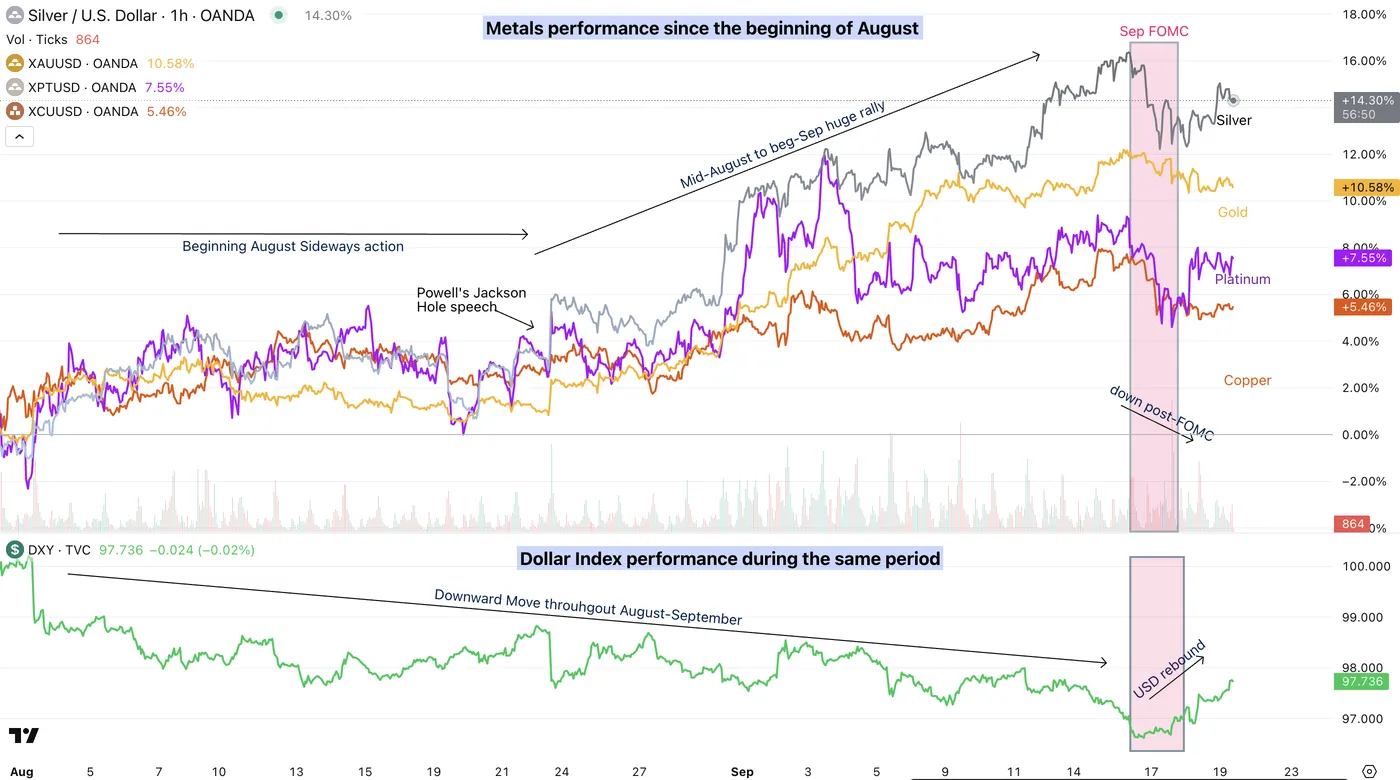
Dollar Index and Metals comparative Performance since beginning August, September 19, 2025 – Source: TradingView
This chart was uploaded on a piece published yesterday on metals (referenced just above) and is very pertinent to how USD ups-and-downs have a huge influence on trajectories for all asset classes, and particularly commodities.
A Dollar Index (DXY) multi-timeframe comprehensive analysis
Dollar Index daily chart
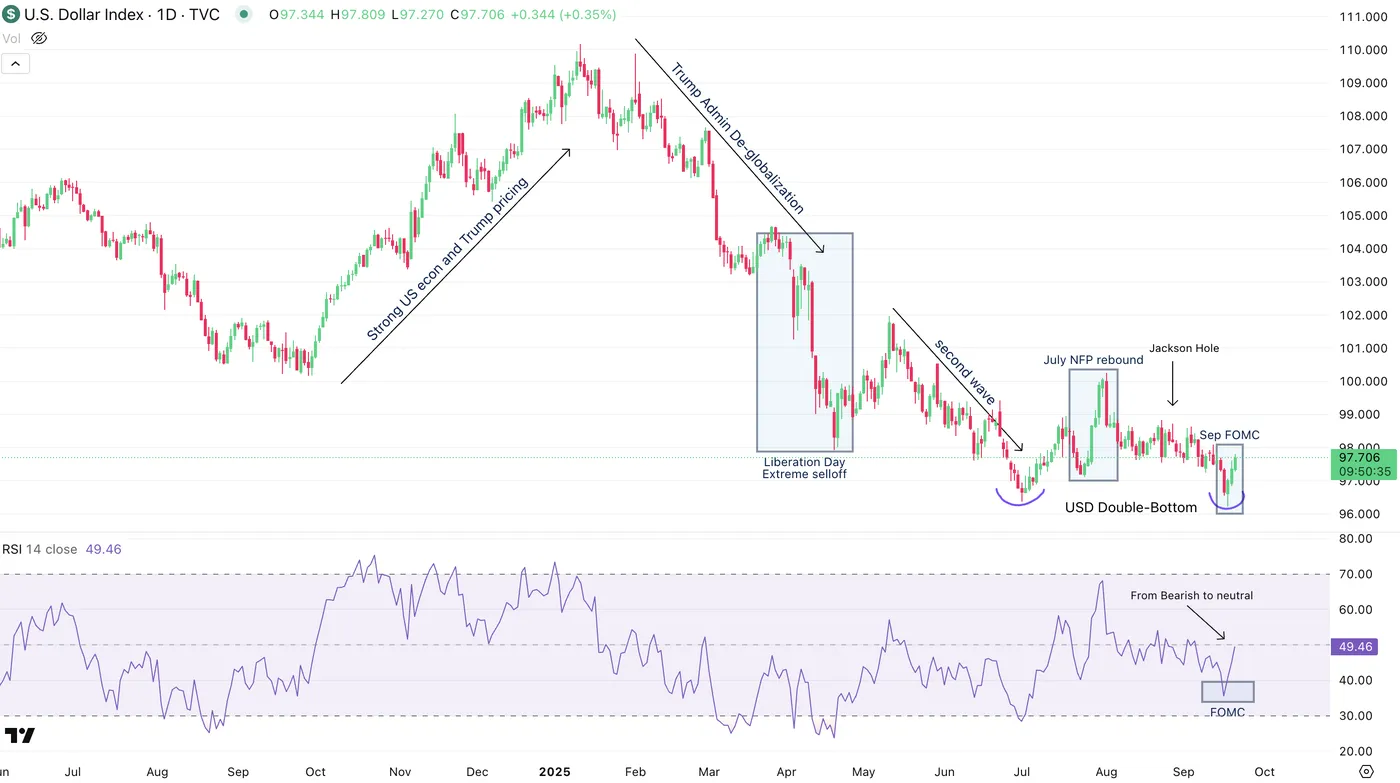
Dollar Index Daily Chart, September 19, 2025 – Source: TradingView
This Daily picture overlook retraces back to how volatile FX and US Dollar flows have been since September 2024.
Between immense buying flows at the end of 2024, followed by a n-shape downard reversal for the USD throughout 2025, volatility-enthusiasts got exactly what they needed.
You may observe the different themes and dynamics directly on the chart, but one thing to observe is how the most-recent fast-paced fall right ahead of Wednesday's FOMC meeting has been met with a consequent huge rally, with buying flows seeing continuation in today's session.
We'll see more details on this on the short-timeframes, but a clear double bottom has taken shape – The rest will be to see how this will influence markets looking forward.
Dollar Index 8H chart and levels
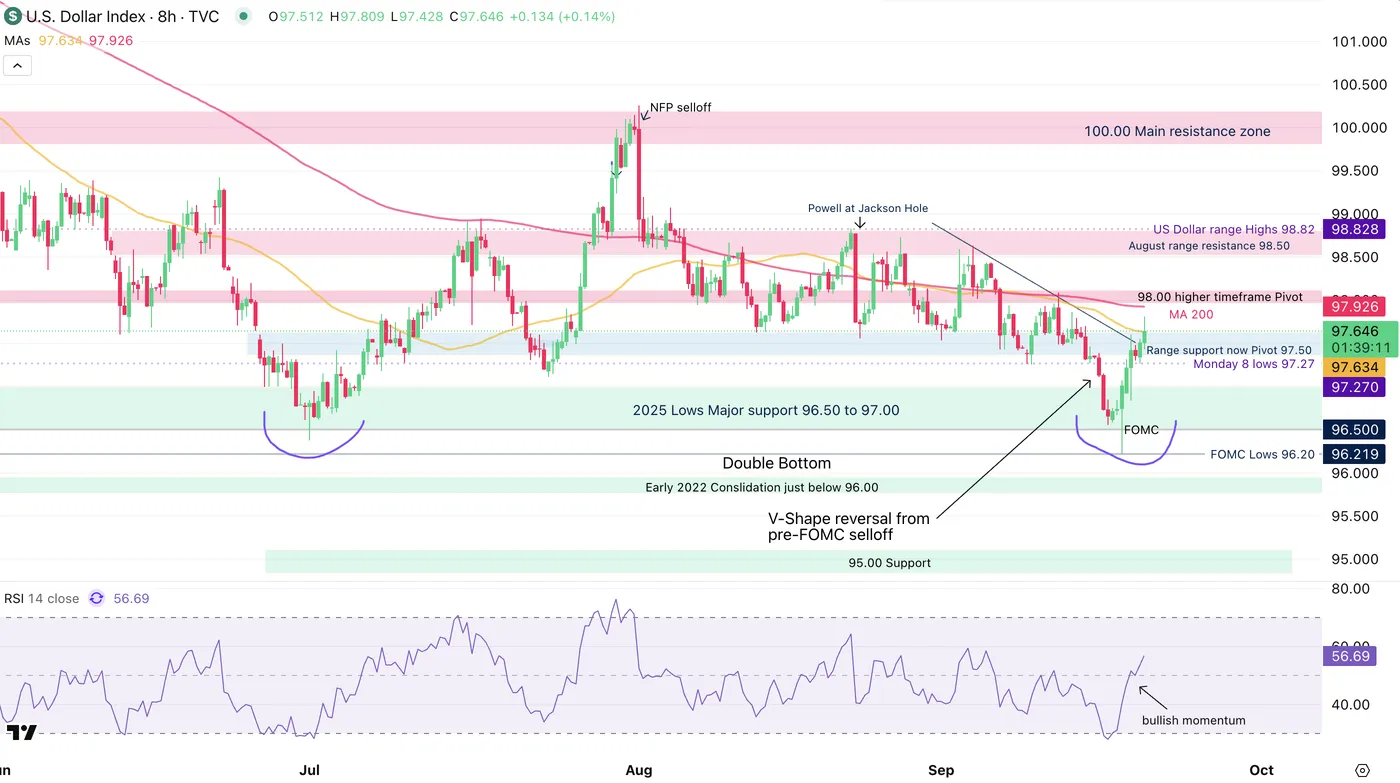
Dollar Index 8H Chart, September 19, 2025 – Source: TradingView
Looking closer, we spot how sharp the rebound has been after a huge pre-FOMC descent which surprised Participants.
Such hedging can occur, particularly ahead of such market-changing events, but the pace and shape of it was one of panic.
The immediate reaction to the dot plot created new 2025 lows, but looking further, an inability of sellers to close below the June lows, supplemented by a switch in the dollar fundamentals has created another environment for a rebound.
Nonetheless, the buying is currently stalling at the 200-period Moving Average just above the lows of the August range, acting as momentum pivot.
Moving above the MA would further amplify the upward reversal.
A rejection here, supplemented by a close below the pivot zone (97.25) would send the dollar to another wave of correction.
Levels to watch for the Dollar Index:
Support Levels:
- 97.25 to 97.60 current pivot, low of August range
- Major support at the 2025 lows 96.50 to 97.00
- 2025 lows 96.20
Resistance Levels:
- MA 200, immediate resistance 97.90
- 98.00 August Mid-Range, acting as resistance
- 98.50 to 98.80 Resistance Zone
- 100.00 Main resistance zone
Dollar Index 1H chart
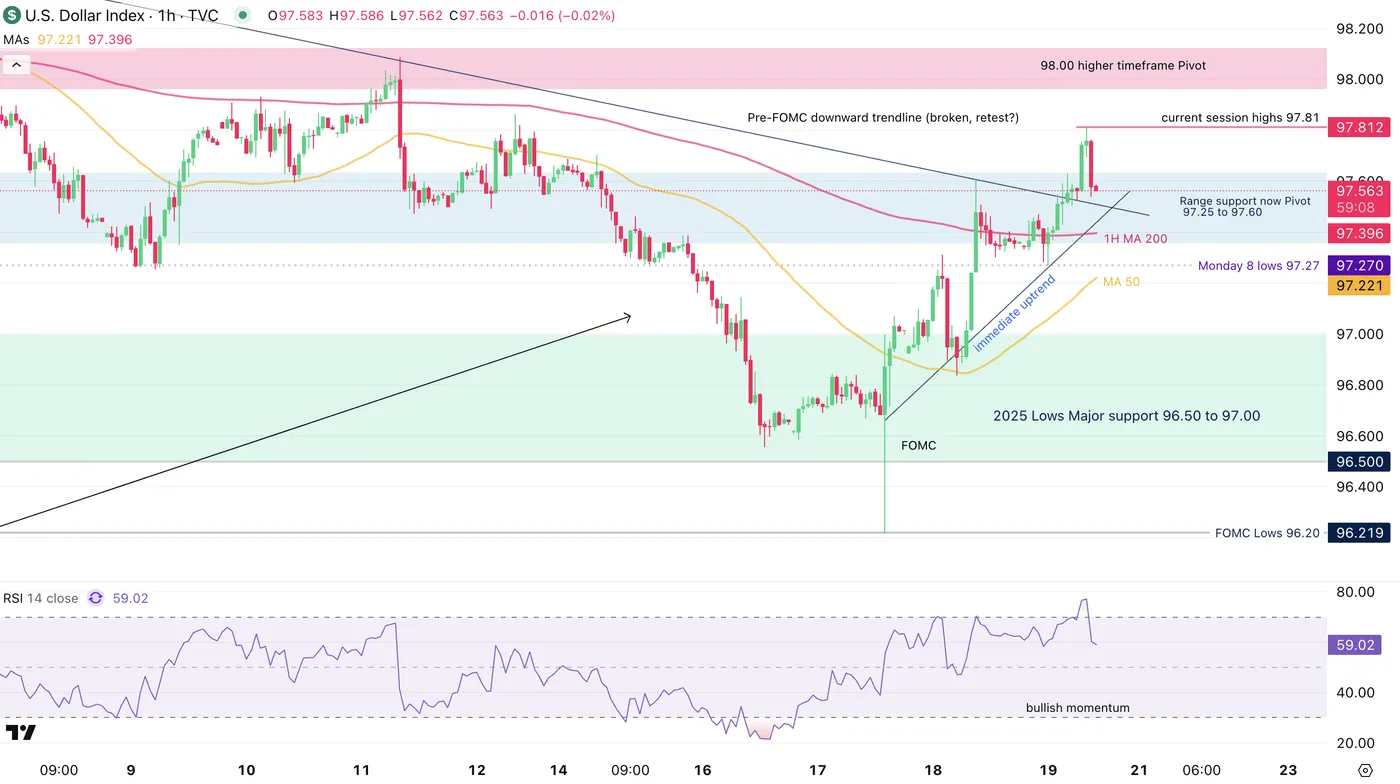
Dollar Index 1H Chart, September 19, 2025 – Source: TradingView
Looking closer to the 1H timeframe, we see how far and fast the reversal in the Dollar went, bringing the index back above its pivot zone and just above the Pre-FOMC downward trendline.
Buyers will need to hold the retest of that trendline to maintain the path above (located right within the pivot) as overbought conditions put a short-term top to the move.
Now, the rest will be to monitor if sellers to enter here again, invalidating this theme, but momentum doesn't look that way too much – Always keep an open-eye in case a reversal back down happens from here.
Safe Trades!
Where to Next, EUR/USD? Policy Gap Between ECB and Fed
- Fed cuts rate to 4.00–4.25% because of labor market situation in US
- Interest rate cuts in the Eurozone are in question due to inflation being under control
- Negative divergence has appeared on EURUSD, which can be a sign of correction ahead
FED Policy
The United States Federal Reserve has decided to cut interest rates by 25 basis points, bringing the main rate to the 4.00-4.25% range. This is the first change after a nine-month pause in the cycle, and the decision itself is precautionary. The Fed, guided by a "risk management" approach, did not react to a specific economic shock but acted prudently amid increasing uncertainty.
A new element of communication was the growing attention paid to the labor market situation – despite relatively stable inflation and unemployment, a slowdown in the pace of employment and limited recruitment activity are visible, which may indicate the market's susceptibility to deterioration.
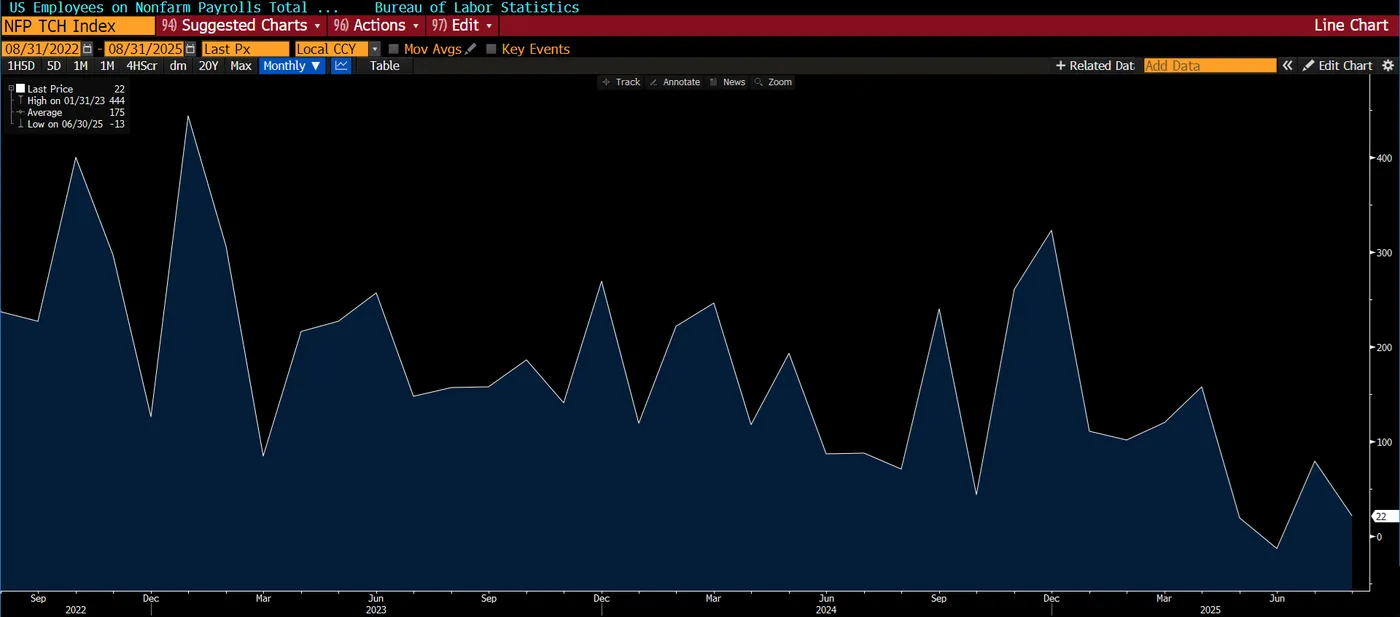
Non Farm Payrolls (in thousands), source: Bloomberg
ECB Policy
Meanwhile, in Europe, during the Eurogroup meeting in Copenhagen, members of the European Central Bank's Governing Council, Madis Muller and Mario Centeno, presented the ECB's monetary policy stance. The current policy remains moderately accommodative, and interest rates – including the deposit rate at 2% – have not changed in recent months. President Christine Lagarde emphasized that the ECB is at an opportune moment to achieve its 2% inflation target.
Madis Muller noted that inflation is currently "more or less on target," and the current level of rates supports economic growth, which in the coming quarters will be more dependent on domestic demand. Mario Centeno, in turn, pointed out the current risks to growth and inflation, which he believes are trending downwards. He did not rule out a future interest rate cut, although he currently sees no urgent need for it. The ECB forecasts inflation at 1.9% in 2027 and GDP growth of 1.3%. Structural challenges, such as higher tariffs from the US, weak industrial demand, and a growing propensity to save, limit the potential for economic recovery in the euro area.
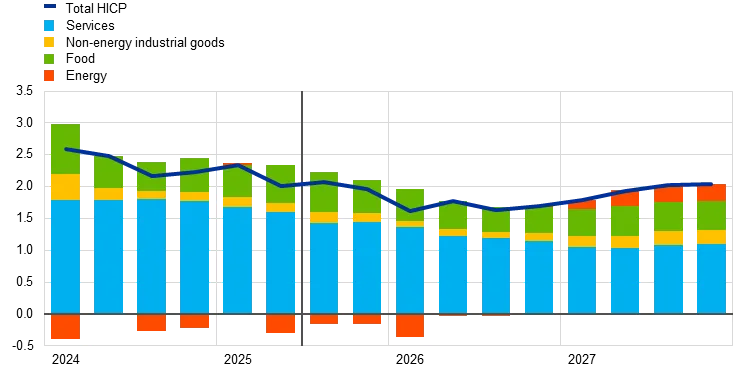
HICP ECB Projections, source: European Central Bank
EUR/USD
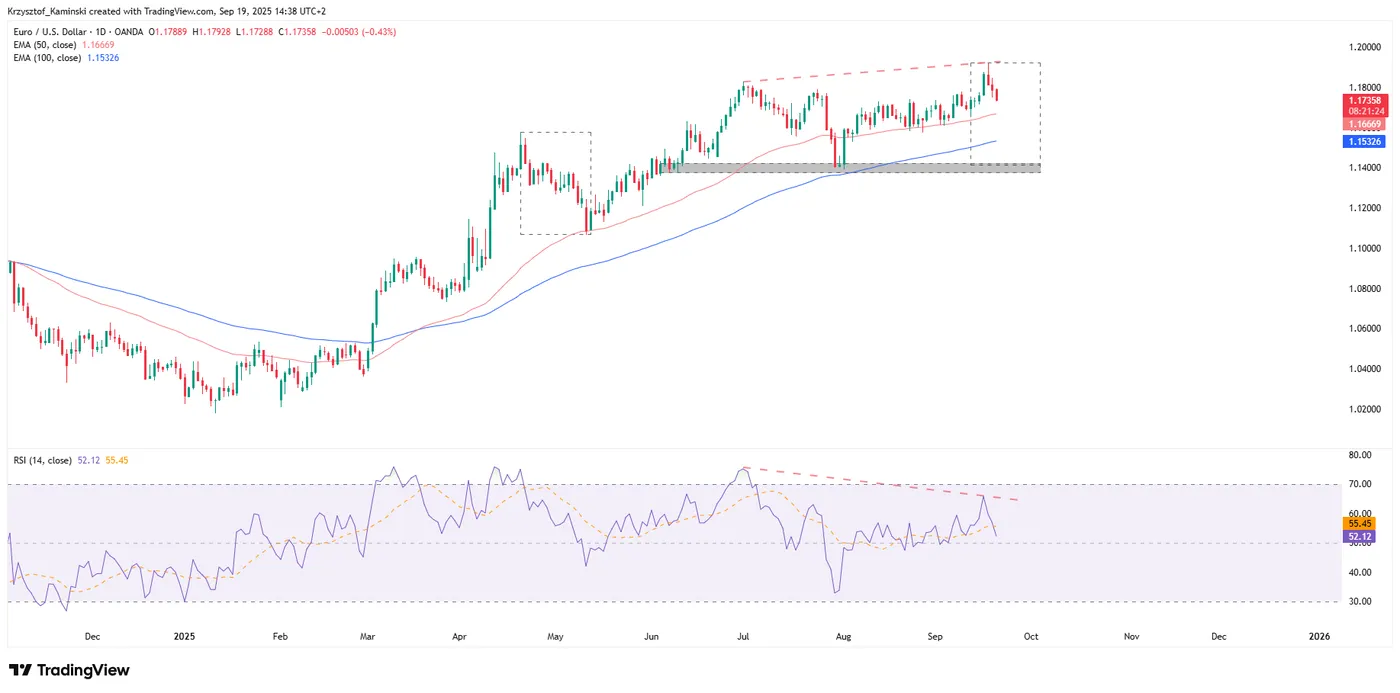
EURUSD, daily timeframe, source: TradingView
In the foreign exchange market, the EURUSD pair has been in an upward trend since mid-January, when the exchange rate rose from 1.0178 to 1.1918, representing an almost 17% increase. Despite this, technical analysis indicates the possibility of a correction – a negative divergence has formed between the price and the RSI indicator. In the region of 1.14, there is important technical support – both horizontal and resulting from previous corrections within the trend.
A decline to this level could be merely a natural correction within a broad upward trend. Potential doubts about further US rate cuts could accelerate such a descent without disturbing the long-term upward structure. In turn, maintaining the current monetary policy in the euro area may strengthen the common currency's fundamentals against the dollar in the medium term.
Week Ahead – Fedspeak and US Data to Set the Tone in Markets
- Dovish Fedspeak and soft PCE data may dent the dollar’s recovery.
- US-China negotiations continue, as yuan’s appreciation lingers.
- Eurozone PMIs could cement the ECB pause; SNB might threaten with negative rates.
- Yen is bid after hawkish BoJ, but LDP contest might clip its wings.
- Aussie on the backfoot; next week’s data may offer a reprieve.
Post-FOMC period
An eventful week is coming to an end, with markets digesting the numerous central bank meetings, predominantly the Fed’s decision. The much-discussed 25bps rate cut was announced, with the US dollar being close to recording another negative week despite the post-FOMC meeting rally. Fed Chair Powell tried to dampen rate cut expectations by referring to Wednesday’s cut as a risk management move, but the dot plot told a different story.
Several investment houses are forecasting consecutive rate cuts in the remaining two Fed meetings of 2025. A plethora of Fed speakers will be on wires next week, with the focus being on Fed members Waller and Bowman and their likely remarks about failing to support the 50bps cut sought by newcomer Miran. Notably, US President Trump is also expected to chip in, most likely expressing his fury at Powell.
While dovish Fedspeak will most likely dominate the week, markets will also be monitoring incoming data and trade negotiations. The preliminary PMI manufacturing and services surveys on Tuesday could set the tone for the week, but barring a surprise at Thursday’s final Q2 GDP print, investors will be mostly interested in the durable goods report – often seen as a leading growth indicator – and Friday’s PCE report. Should the Fed’s favourite inflation metric accelerate, questions about the realistic chances of a back-to-back rate cut may arise.
The dollar is craving another small boost. Euro/dollar is hovering around 1.1770 at the time of writing, bouncing lower after posting a new four-year high at 1.1918, and dollar/yen continues to range-trade. That said, dovish Fedspeak and potentially soft data releases next week might hinder dollar’s ability to record a meaningful rally. On the flip side, stronger PCE data could offer some relief to the ailing dollar, damaging risk appetite.
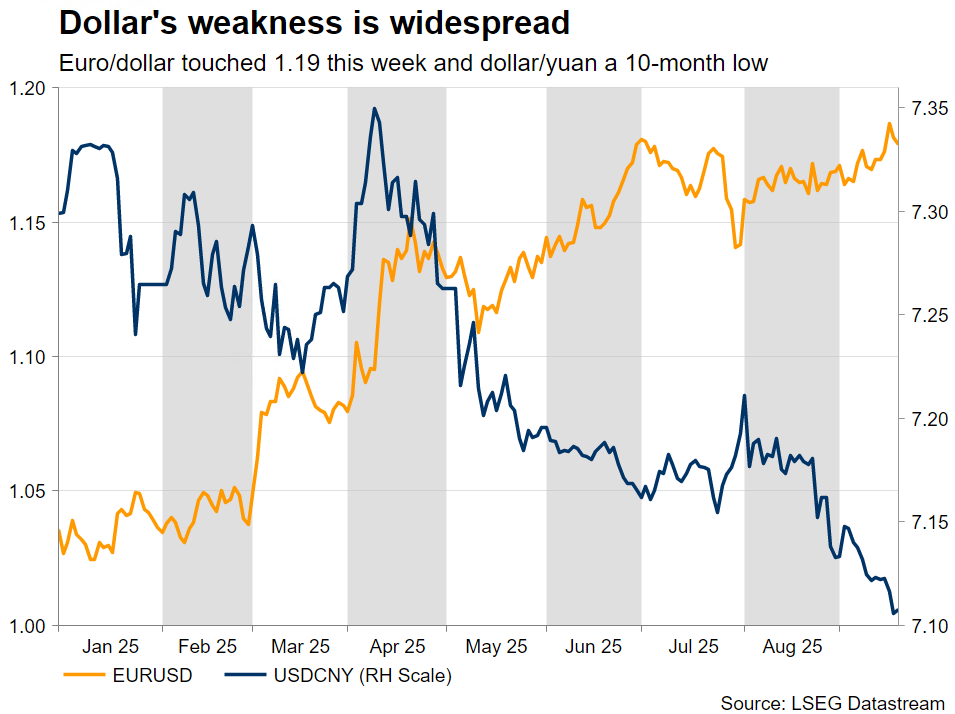
Will China react to yuan’s appreciation as its economy remains fragile?
Meanwhile, the latest round of US-China negotiations resulted in the Tiktok agreement, meeting Trump’s demands. A Trump-Xi call later today is set to confirm the progress made, but could also address the Ukraine-Russia conflict. China stands by Russia at this stage, but Xi is mostly focused on addressing domestic challenges. Another set of measures to boost services consumption was announced this week.
Notably, despite pressure from the Fed rate cut and the appreciating yuan, the PBoC kept its seven-day repo rate unchanged at 1.40%. Consequently, there is a strong probability of a similar decision on Monday about the one- and five-year LPRs. That said, while the housing sector is probably in need of an LPR cut, the PBoC might want to evaluate the economic boost of the upcoming Golden Week before adjusting rates.
Will Eurozone PMIs justify the current ECB strategy?
The upbeat tone at the recent ECB meeting cemented expectations of a policy pause, with Tuesday’s OECD interim projections most likely confirming the anticipated growth acceleration. However, like for the Fed, data matter. On Tuesday, the pivotal preliminary PMI services and manufacturing surveys will be published, with investors paying extra attention to the German and French prints. In the case of the former, economists are expecting modest improvement in both indicators, despite the manufacturing one remaining in contraction. Coupled with a potentially stronger IFO survey print, one could argue that Germany might be gradually turning the corner. That same cannot be said for France though, where PMIs could weaken further due to the political turmoil.
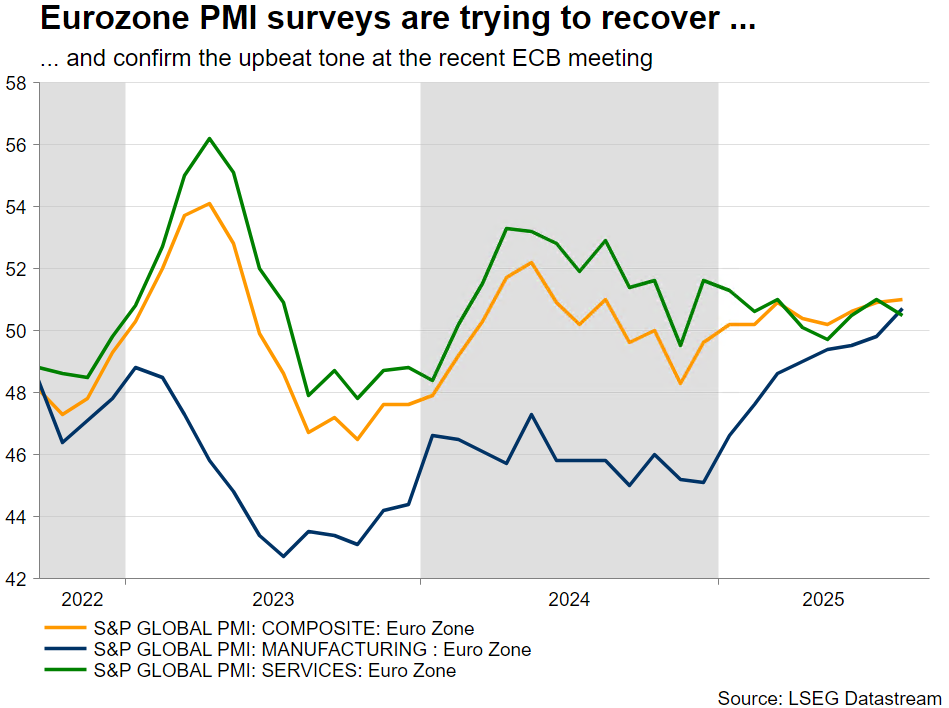
What does all this mean for the euro? Strong data might benefit the euro, but the current rally in euro/dollar is mostly US-driven. Market concerns about Trump’s governing style, the various judicial cases, the attempted power grab at the Fed, and the lingering trend for de-dollarization boost the euro. A continuation of this trend should keep the euro supported, but a correction could be on the cards, with 1.1703 being the primary support level.
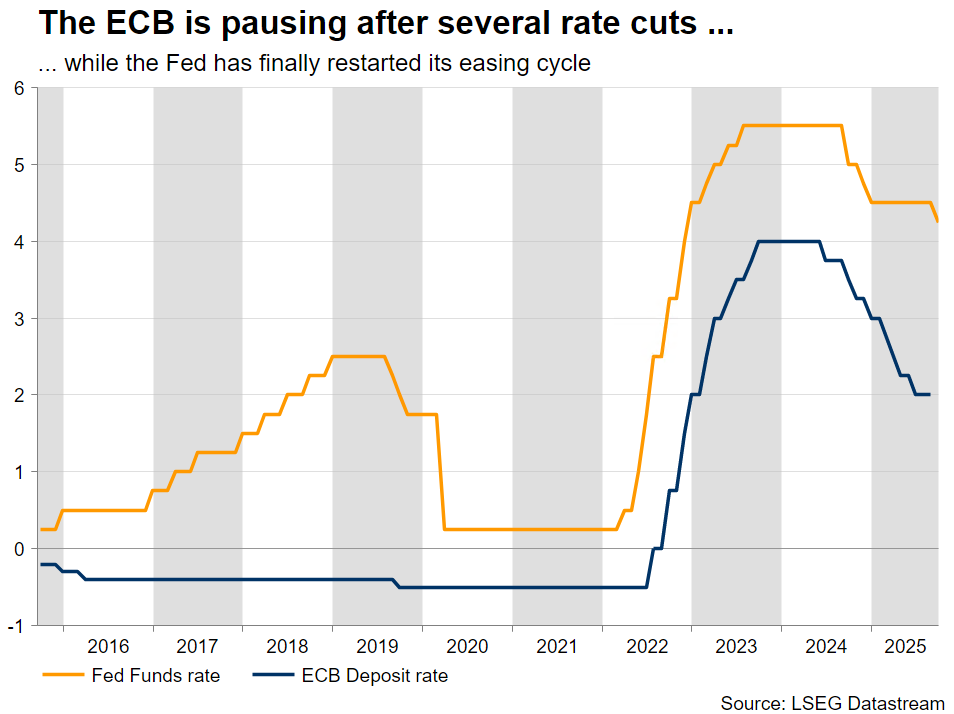
Pound’s early August rally against the Euro is gradually evaporating
Following the uneventful BoE meeting, which kept the door open to further accommodation, the focus shifts to economic data, with investors also preparing for the next Labour government crisis. Tuesday’s preliminary PMIs will offer the next piece in the growth jigsaw, though inflation remains the MPC’s main headache.
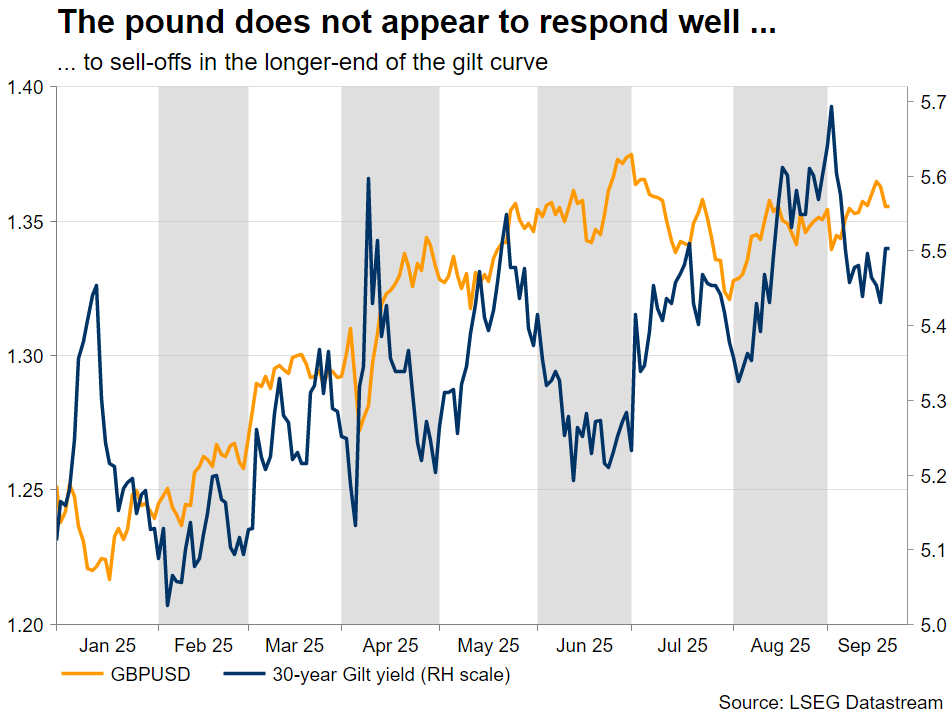
Meanwhile, there is a plethora of BoE speakers this week, potentially aiming to stir market expectations towards a November rate cut, since Thursday’s meeting involved only a statement. Any indication that the MPC is closer to a rate cut than currently perceived may put another dent in the pound’s recent rally against the dollar.
Yen stuck between BoJ and political developments
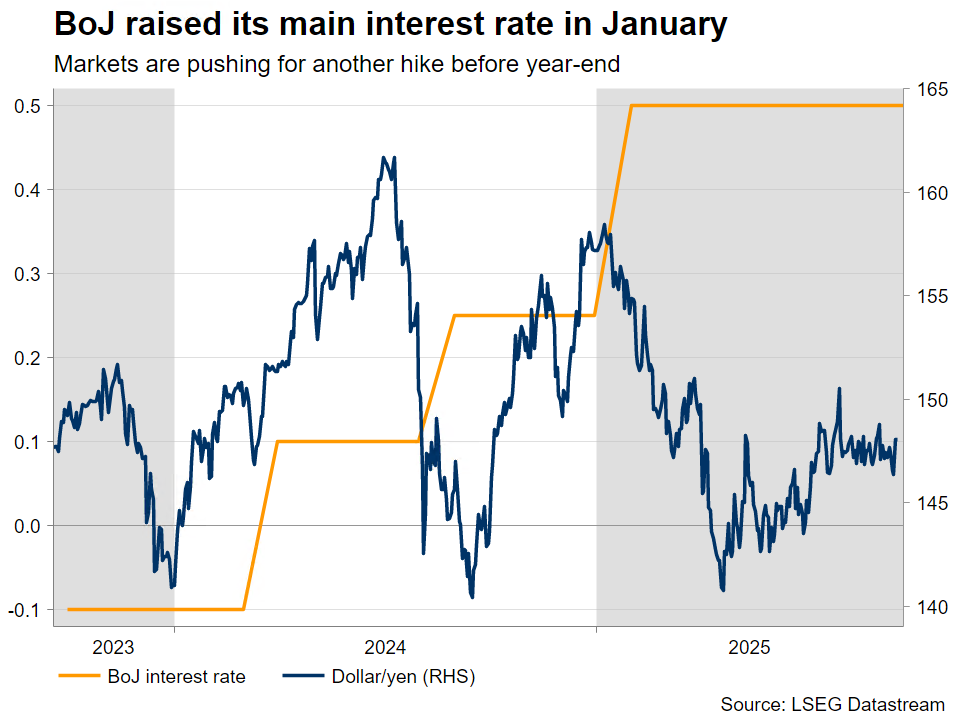
Similarly, the yen continues to dance to the tune of politics. The October 4 LDP leadership contest is hotting up with five candidates already in the starting line. They will gradually present their strategies, with investors focusing on their fiscal policy stance and their outlook on the BoJ, with most candidates unlikely to openly support Governor Ueda’s effort to normalize policy.
The BoJ kept rates unchanged earlier today, and is preparing for the final two meetings of 2025. Ueda et al remain confident about the inflation outlook, partly due to the final US-Japan trade agreement, with next Friday’s Tokyo CPI report in focus. The yen has reacted positively to two hawkish dissidents at today’s meeting, but further hawkish signals are necessary to support a dollar/yen bearish breakout from the prevailing range.
SNB to refrain from pushing rates to negative territory this time around
Unlike other central banks, the SNB has already pushed its policy rate to 0%. With consumer price inflation hovering just above zero, producer price inflation edging further into negative territory, the economy evidently slowing down, and the Swiss franc recording an impressive 13% rally against the dollar, the SNB is understandably pondering negative rates for the first time since mid-2022.
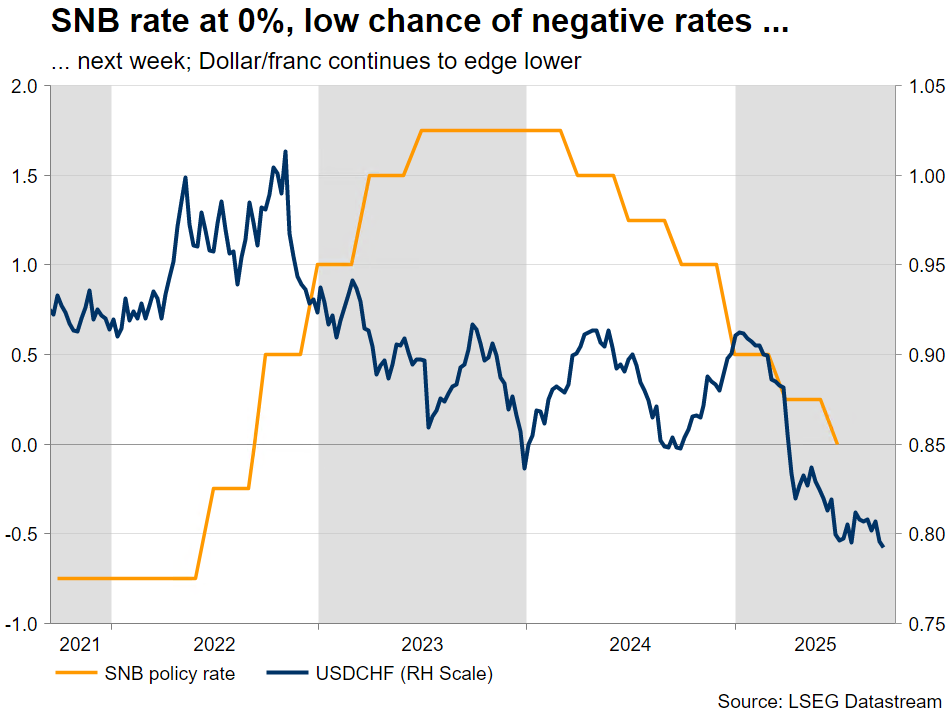
With the franc’s strength being mostly a product of the dollar’s broader weakness and of the search for a safe haven, a rate cut would serve as a signal of the SNB’s determination to achieve its price target. Therefore, while no rate cut is expected on Thursday, SNB President Schlegel is set to keep the door wide open for another rate cut, indirectly threatening a replay of the 2014-2022 period. Only time will tell if markets see this as an empty threat and continue to push dollar/franc lower.
Aussie might catch a bid
Finally, the antipodeans are losing ground this week against the dollar. With China still struggling to meaningfully restart its domestic economy, the Australian economy remains fragile. Growth in the second quarter of 2025 was encouraging, the labour market is not showing serious cracks and monthly inflation indicators are holding up following the mixed Q2 prints. Should next Tuesday’s preliminary PMIs and Wednesday’s CPI report post upside surprises, then chances of a September 30 rate cut might be dented, boosting the aussie.
Weekly Focus – Central Banks on a Relatively Steady Course
The September round of central bank meetings is nearing its end with perhaps a surprising sense of stability in financial markets. Despite the blurry outlook, mixed data signals and political pressure in the US, the rate decisions did not cause major volatility in broader financial conditions. That said, US bond yields have edged higher towards the end of the week, and broad USD has recovered despite the policy rate cut from the Fed.
The Fed's 25bp rate cut was backed by almost unanimous support from the FOMC voters. Only Stephen Miran, whose nomination the Senate confirmed at the last minute on Monday, voted for a larger 50bp move. In addition, the dot plot revealed that one non-voter would have preferred to maintain rates unchanged through the rest of the year.
The rate projections revealed greater dispersion in views towards the final two meetings of the year. 9 out of 19 participants predicted only one more rate cut before year-end, or none at all. The exact same number of participants favoured cutting rates at both of the two remaining meetings. Powell emphasized that the rate cut was motivated by a shift in the balance of risks towards weaker labour markets, rather than deterioration of the baseline outlook. In fact, median forecasts for both growth and inflation were revised up for 2026.
We made no changes to our previous call and still forecast only one additional cut this year at the December meeting, followed by three more cuts in 2026. Our forecast profile is aligned with the more hawkish camp of Fed participants, and above market pricing for the rest of the year, read more from our Fed review - Slim margins, 17 September.
Norges Bank delivered a mixed package, as it cut the policy rate by 25bp in line with our call, but paired the cut with hawkish forward guidance. We expect NB to stay on hold for the rest of the year and deliver four more cuts in 2026, see Reading the Markets Norway - A hawkish 25bp cut; enter DEC25-DEC26 flattener, 18 September. Both Bank of England and Bank of Japan kept rates unchanged, as widely expected, but the latter decision came with a hawkish tilt. BoJ announced a gradual reduction of its ETF and REIT holdings, and two members dissented in favour of a hike, which is now almost fully priced in by January.
Next week, the string of rate decisions concludes with Riksbank and the Swiss National Bank, both of which we expect to keep rates unchanged. Riksbank will likely signal an easing bias for coming months, and we forecast one more 25bp rate cut in November.
Focus will increasingly turn back towards macro data, which remains divided. US retail sales surprised positively in August (control group +0.7% m/m SA), as especially online sales held up ahead of expected tariff-driven price hikes. On the other hand, growth disappointed in China across both retail sales and industrial production. Even so, we expect China's Loan Prime Rates to remain unchanged on Monday, as the 1-week reverse repo rate (which is used to signal policy changes) has remained unchanged since May.
The most interesting data release of the week will be the September flash PMIs, which are due for release on Tuesday for euro area, the UK and the US. We expect to see gradual continuing improvement in the manufacturing indices whilst services activity growth has likely softened modestly from August.