Sample Category Title
Silver Price Hits 14-Year High
As shown on the XAG/USD chart, today the price of silver has climbed above $43.60 per ounce for the first time since 2011.
This may reflect expectations that the recent Federal Reserve interest rate cut will provide a boost to the global economy, where demand for silver is strengthening due to the growth of sectors such as solar energy, electric vehicles, and electronics. In addition, XAG/USD gains further support from gold, which today set a new record high above $3,720.
Technical Analysis of the XAG/USD Chart
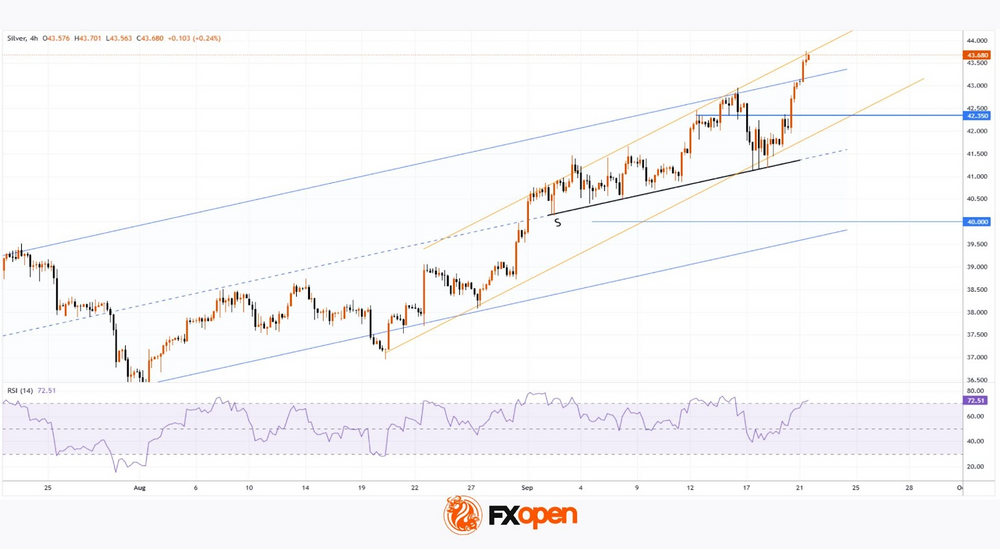
When analysing XAG/USD price movements earlier this month, we:
→ drew an ascending blue channel;
→ noted that silver had encountered a resistance block;
→ suggested a possible corrective scenario towards the psychological $40 level.
Since then, the black line (S) has:
→ proved itself as a strong support level, preventing a decline towards $40;
→ provided enough local pivot points to update the slope of the blue channel.
As of today, silver has broken above the upper boundary of this channel (highlighting strong demand). At the same time:
→ the RSI indicator is in overbought territory;
→ the price is positioned at the upper boundary of a steeper short-term uptrend, plotted from fluctuations over the past month (shown in orange).
Thus, we could assume that XAG/USD is currently vulnerable to a correction following a nearly 10% rally since the beginning of the month, as buyers are likely tempted to take profits.
Should a pullback occur in the near term, silver may find support:
→ around $42.35 – a level that has repeatedly switched roles between resistance and support;
→ at the lower boundary of the orange channel.
Looking further ahead, we may well witness fresh records for both silver and gold before year-end – particularly if the news flow continues to fuel trader expectations of additional Fed rate cuts and inflation concerns persist.
Start trading commodity CFDs with tight spreads. Open your trading account now or learn more about trading commodity CFDs with FXOpen.
This article represents the opinion of the Companies operating under the FXOpen brand only. It is not to be construed as an offer, solicitation, or recommendation with respect to products and services provided by the Companies operating under the FXOpen brand, nor is it to be considered financial advice.
Crypto Market Frightened by Calm
Market Overview
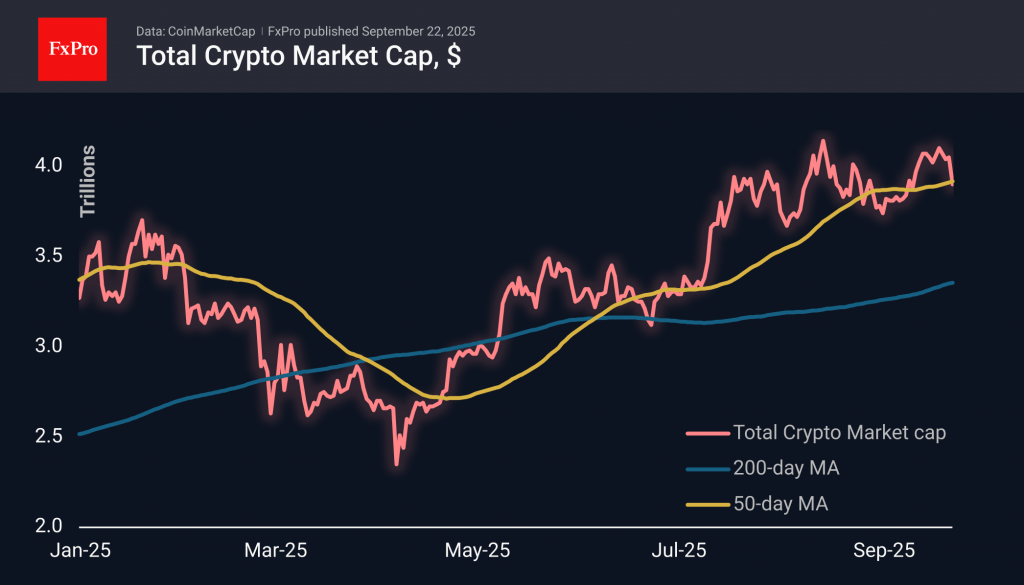
The crypto market capitalisation plummeted below $3.9 trillion on Monday morning, which is 4% lower than the previous day. Among the top altcoins, Bitcoin is losing less than others, while SushiSwap (-13%) and Dogecoin (-11%) lead the list of outsiders. This contrasts with gold hitting new highs and silver surging since the morning, indicating investors’ appetite for safe-haven assets after a period of low volatility.
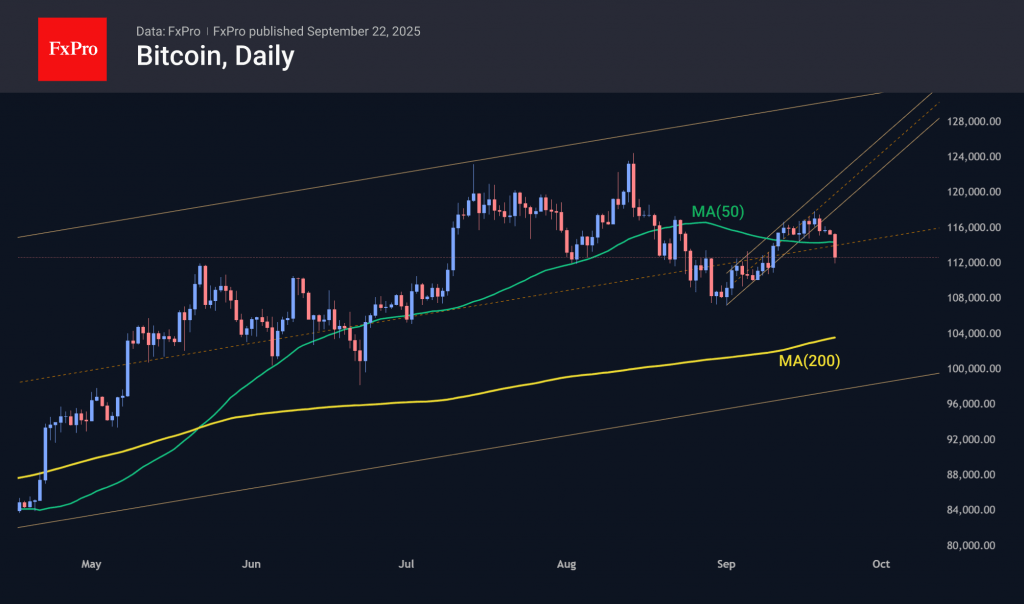
On Monday, Bitcoin broke through support near $115K, which bears had been trying to push through since 13 September. In recent days, there have been several signals of a shift to a downward trend in the first cryptocurrency. BTCUSD fell out of the upward channel that had been in place since early September, dropped below horizontal support and fell sharply below the 50-day moving average. This combination of negative signals suggests a further decline is likely unless there is a fundamental change in financial market sentiment.
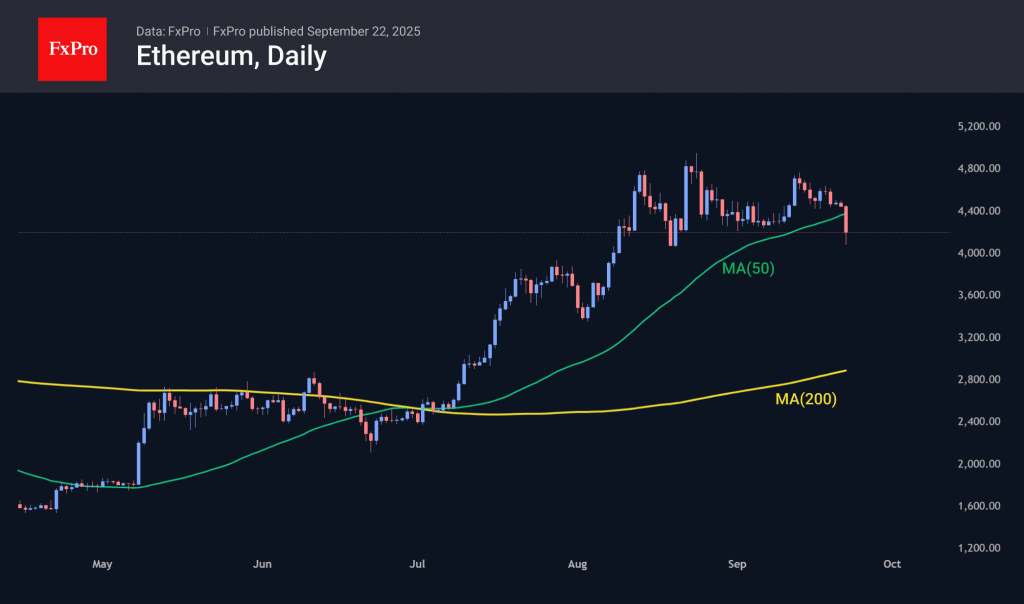
By the start of active trading in Europe, Ethereum had fallen to $4,000, starting the day at $4,500. The price broke through the 50-day moving average for the first time since early July — an alarming technical warning, as the second-largest cryptocurrency fairly accurately reflects signals from the intersection with this curve.
News Background
According to SoSoValue, net weekly inflows into spot BTC ETFs fell to $886.7 million, remaining quite impressive. Cumulative inflows since the approval of Bitcoin ETFs in January 2024 have increased to $57.72 billion.
Inflows into spot Ethereum ETFs in the US fell to $556.9 million, bringing cumulative inflows since July 2024 to $13.92 billion.
According to Glassnode, the share of the first cryptocurrency held by hodlers for more than seven years reached a record 14.3 million BTC, up 3% since the beginning of the year and reflecting growing confidence in Bitcoin’s prospects.
According to a survey by the MEXC crypto exchange, the share of investors using cryptocurrencies to hedge against inflation rose from 29% to 46% in the second quarter. Macroeconomic instability, weakening national currencies, and inflationary pressures are forcing people worldwide to look for alternative ways to preserve the value of their savings.
ETH developers said the Fusaka hard fork will be launched on the Ethereum mainnet on 3 December after a series of deployments on the Holesky, Sepolia, and Hoodi testnets. A key improvement will be the introduction of the PeerDAS protocol, which could double the network’s throughput.
RBA’s Bullock Says Inflation Under Control, Aussie Steady
The Australian dollar is coming off its best week since July, with gains of close to 1%. In Monday's European session, AUD/USD is trading at 0.6589, down 0.07% on the day.
Bullock says inflation in good place but China a concern
RBA Governor Bullock testified before a parliamentary committee on Monday. Bullock said that inflation was in a "very good position" as higher interest rates had curbed demand. Still, she warned that there inflation risks remained on "both sides".
Bullock was less positive about the geopolitical environment, warning that the significant change in the global trading system which had created massive uncertainty. The Reserve Bank was particularly concerned about the impact of US tariffs on China, Australia's largest trading partner.
Bullock warned that the financial markets had not priced in the risks of the tariffs, which could affect financial stability if the the domstic economy was significantly affected by the tariffs.
The RBA is expected to hold the cash rate at 3.6% at next week's meeting, after lowering rates by a quarter-point in August. The markets have priced in a 10% likelihood of a rate cut at the upcoming meeting, with an 86% likelihood of a cut in November.
Investors eye Fedspeak
There are no US economic releases today but investors will be keeping a close eye on Fedspeak, with five FOMC members scheduled to deliver public remarks. New Fed Governor MIran, who voted for a 50-bp cut at the September 17 meeting, is expected to give a detailed explanation of his view in today's speech.
At last week's meeting, the Fed signaled that more rate cuts were coming and the markets have priced in an October cut at 90%, according to CME's FedWatch. The Fed appears to have shifted to a more dovish stance after maintaining rates since December 2024 until lowering rates last week.
AUD/USD Technical
- AUDUSD tested support at 0.6589 and 0.6580 earlier. Next, there is support at 0.6567
- There is resistance at 0.6602 and 0.6611
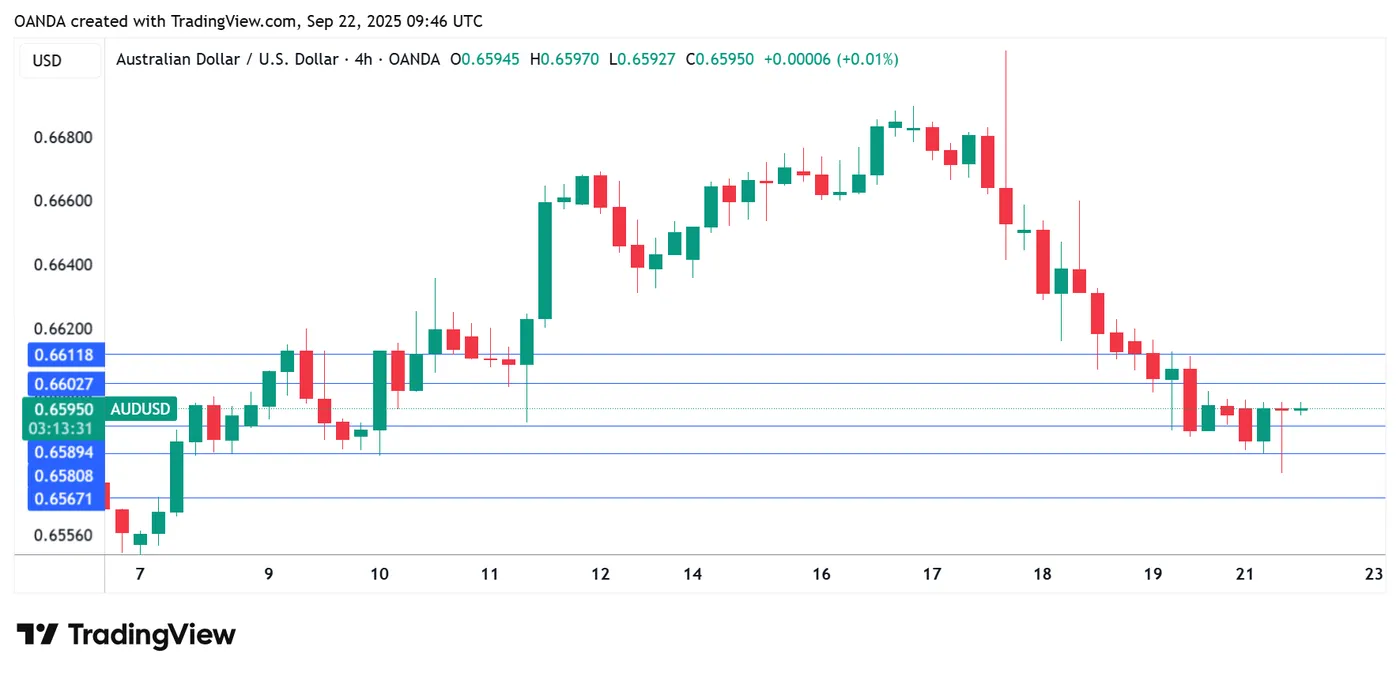
AUDUSD 4-Hour Chart, September 21, 2025
USD/JPY Soars as Yen Weakens on BoJ Policy Concerns
The USD/JPY pair climbed to 148.31 on Monday, extending its gains from the previous week as the US dollar strengthened across the board. The yen faced additional pressure from heightened anticipation around upcoming comments from Federal Reserve officials and the release of critical US inflation data.
Last week, the Federal Reserve delivered a widely expected 25-basis-point cut – its first since December. The central bank's projections indicated two further reductions before the end of the year.
This contrasts sharply with the Bank of Japan's (BoJ) stance. Last Friday, the BoJ held its key rate at 0.5% per annum for a fifth consecutive meeting, a decision that was squarely in line with market forecasts. In its accompanying statement, the central bank described a moderate economic recovery but pointed to persistent weak spots and warned of risks stemming from global trade policy.
In a more significant step, the regulator unanimously approved plans to begin selling ETFs and J-REITs from its vast portfolio. This detail is particularly noteworthy and can be interpreted as a cautious signal that the bank is preparing to wind down its long-standing asset purchase program.
This week, investor focus will shift to the latest PMI data and inflation figures for Tokyo, alongside the release of the minutes from the BoJ's July meeting. These documents may provide crucial insights into the timing and nature of the regulator's next policy steps.
Technical Analysis: USD/JPY
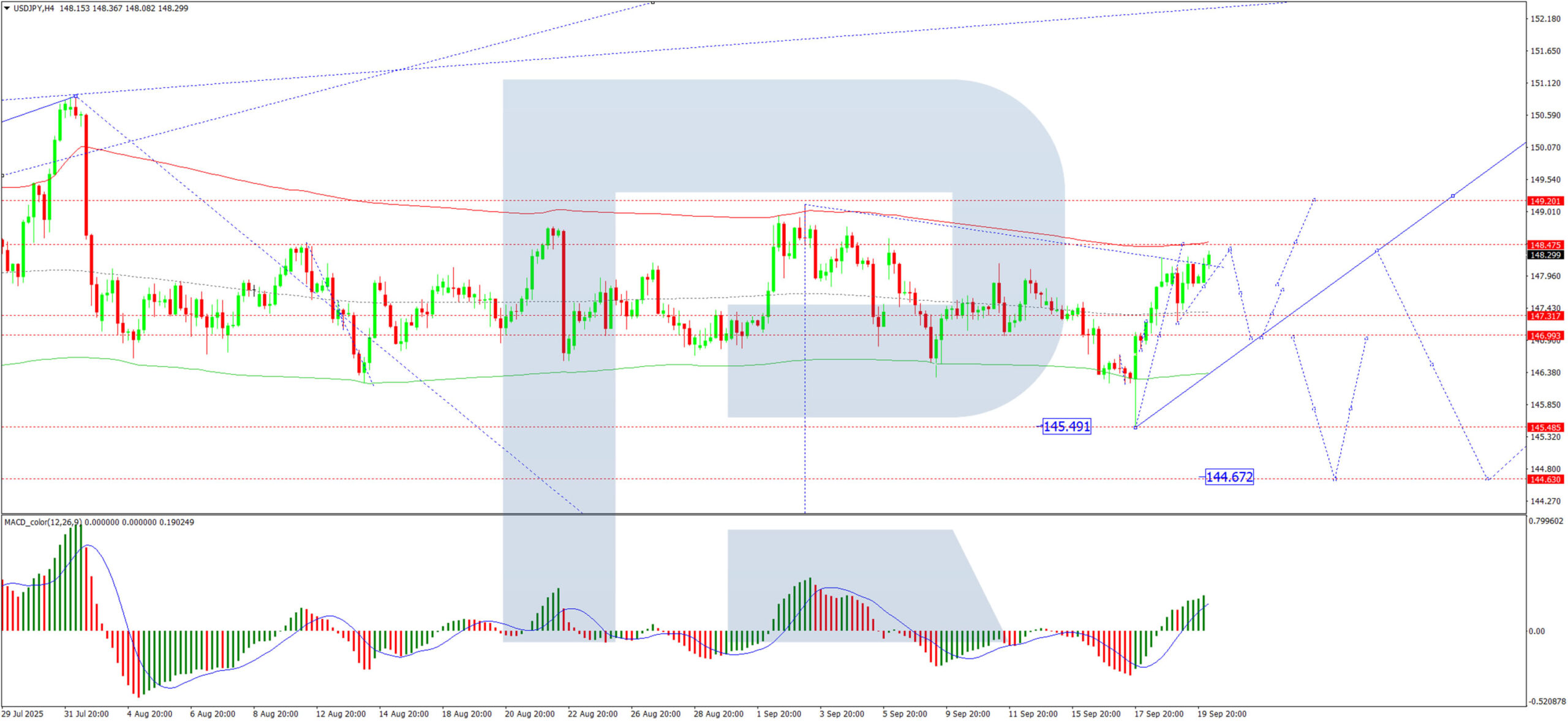
H4 Chart:
On the H4 chart, USD/JPY found solid support at the 147.20 level and is now developing a fresh upward move targeting 148.88. We expect this target to be tested today. Following this, a corrective pullback towards 147.20 is likely. Following this correction, we anticipate another upward move aiming for the 150.00 psychological level. This outlook is technically confirmed by the MACD indicator, whose signal line is positioned above zero and pointing sharply upwards.
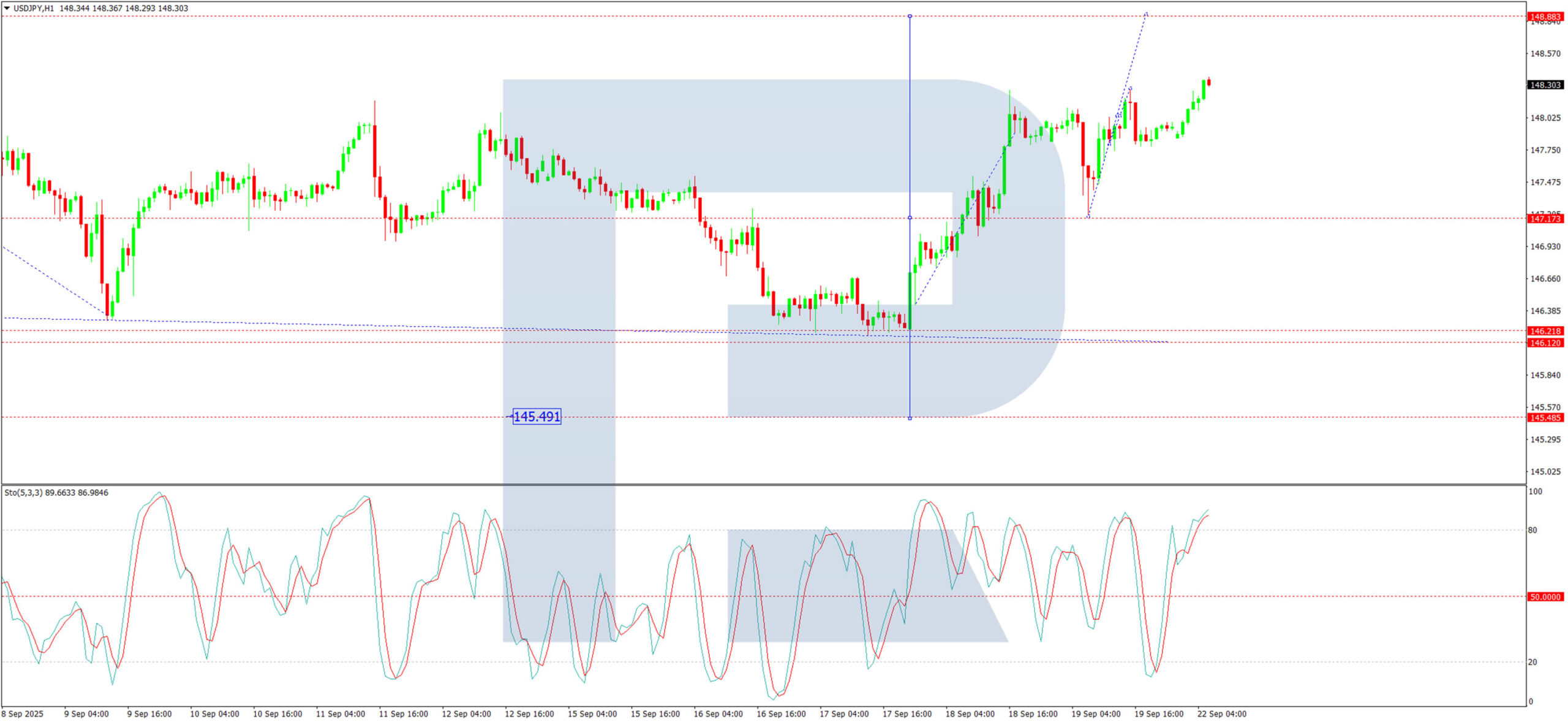
H1 Chart:
The H1 chart shows the pair completed an upward move to 148.23, followed by a correction to 147.20. The current momentum is building for a further advance towards 148.88. Upon reaching this level, a corrective pullback towards 147.20 is possible. The broader upward trajectory is then expected to resume, with a minimum target of 150.00. This scenario is supported by the Stochastic oscillator, with its signal line currently above 50 and rising firmly towards the 80 level.
Conclusion
The yen remains under significant pressure, caught between a resilient US dollar and the Bank of Japan's cautious, gradual approach to policy normalisation. The path of least resistance for USD/JPY remains higher, contingent on this week's key data releases reinforcing the current fundamental and technical picture.
Gold (XAU/USD): Short-Term Bullish Acceleration Intact Towards New All-Time Highs Above US$3,660 Key Support
The price actions of Gold (XAU/USD have shaped the expected bullish move and printed a fresh all-time intraday high of US$3,707 on Wednesday, 17 September, during the onset of the release of the FOMC’s monetary policy outcome and latest summary of economic dot plot projections.
OAU-PRS-236-MarketPulse-variant2-Square
Thereafter, the precious yellow metal staged a minor corrective decline of 2.2% to hit an intraday low of US$3,628 on Thursday, 18 September 2025, in line with a rebound in the US dollar ex-post FOMC.
The minor corrective decline of the Gold (XAU/USD) managed to stage right above the US$3,600 key short-term pivotal support as highlighted in our prior report. It staged a bullish reversal and continued to rally.
In today’s Asia session, 22 September 2025, Gold recorded an intraday gain of 0.9% to print another intraday fresh record high of US$3,720 (just shy of the predefined resistance of US$3,725 highlighted in our previous report).
Let’s now examine its latest short-term trajectory (1 to 3 days), key elements, and price levels for Gold (XAU/USD) from a technical analysis perspective.
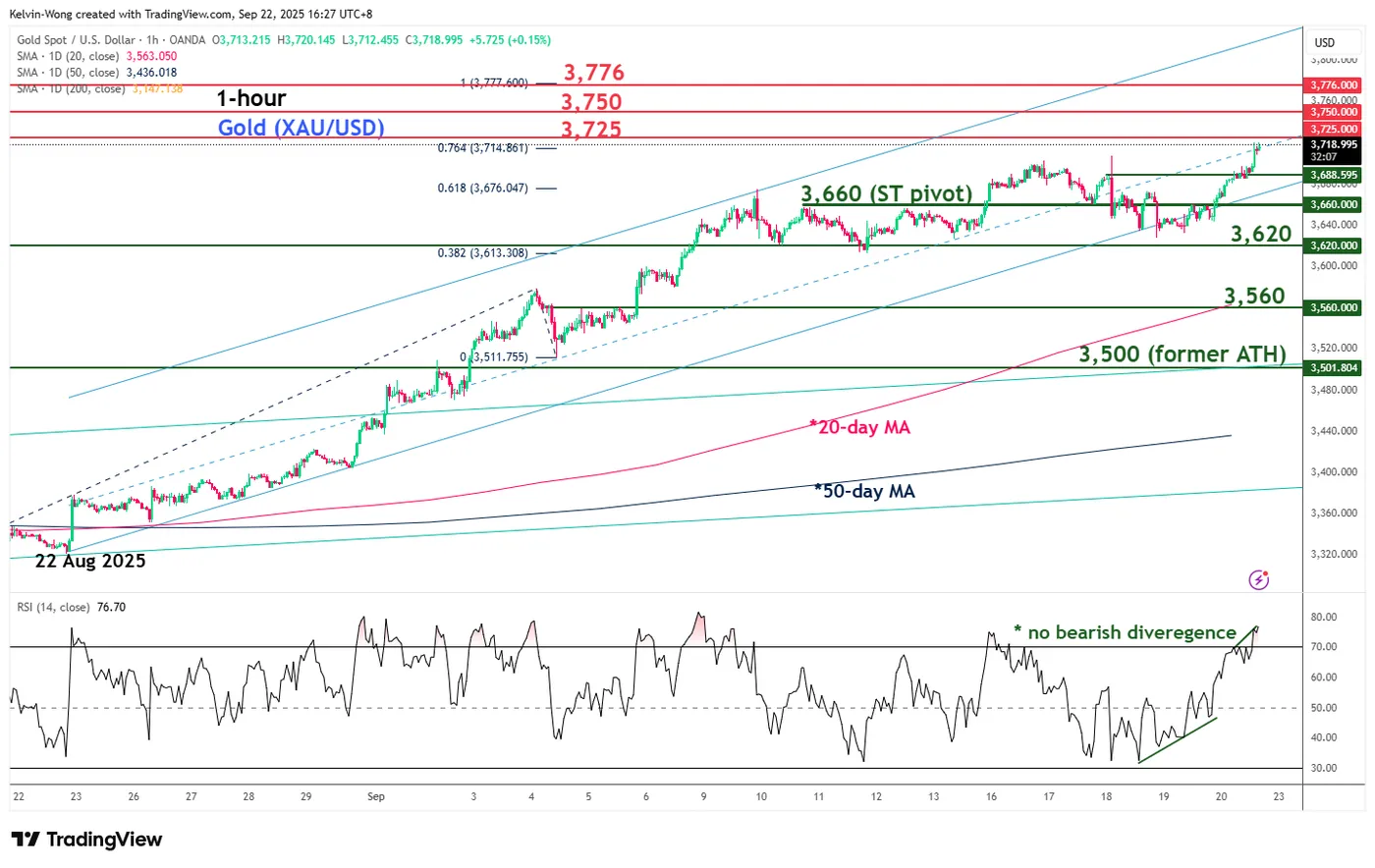
Fig. 1: Gold (XAU/USD) minor trend as of 22 September 2025 (Source: TradingView)
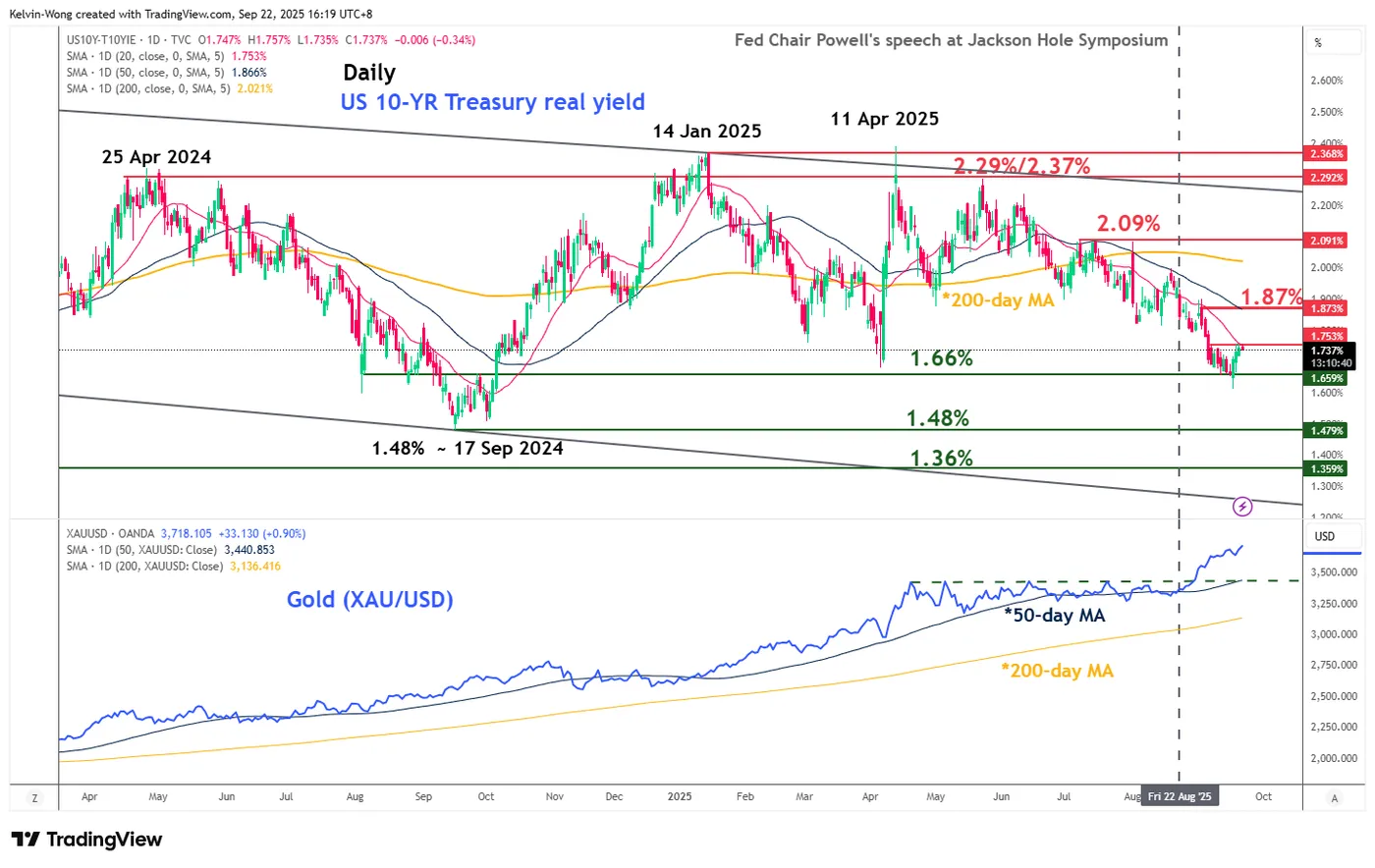
Fig. 2: 10-year US Treasury real yield with Gold (XAU/USD) major trend as of 22 September 2025 (Source: TradingView)
Preferred trend bias (1-3 days)
Maintain bullish bias with a tightened key short-term pivotal support at US$3,660 for Gold (XAU/USD) for a potential bullish acceleration for the next intermediate resistances to come in at US$3,750 and US$3,776 (Fibonacci extension cluster) (see Fig. 1).
Key elements
- The 10-year US Treasury real yield (excluding 10-year breakeven inflation rate) medium-term downtrend remains intact despite a bounce seen from a key near-term support at 1.66% on last Wednesday, 17 September 2025, as it remained below its 20-day moving and 50-day moving averages that are acting as key intermediate resistances at 1.75% and 1.87% respectively (see Fig. 2).
- Based on intermarket analysis, a cap on any further rebound in the 10-year US Treasury real yield reduces the opportunity costs of holding Gold (XAU/USD) as it is a non-income-bearing asset, in turn, creating a further positive feedback loop back into the price actions of Gold (XAU/USD) (see Fig. 2).
- The recent 2.2% minor corrective pull-back in Gold (XAU/USD) has managed to stall right at the lower boundary of a minor ascending channel from the 22 August 2025 low, now acting as a key short-term support at around US$3,660 (see Fig. 1).
- The hourly RSI momentum indicator of Gold (XAU/USD) has reached its overbought zone (above the 70 level) but has not flashed out any bearish divergence condition. These observations suggest short-term bullish momentum remains intact (see Fig. 1).
Alternative trend bias (1 to 3 days)
A break below the US$3,660 key short-term support on Gold (XAU/USD) invalidates the bullish acceleration scenario to expose the next intermediate support at US$3,620.
Failure to hold above US$3,620 opens the scope for a deeper minor corrective decline sequence towards US$3,560 (also the 20-day moving average).
A Terrible Start to the Week for Cryptocurrency Market
This morning (without any clear catalyst) the cryptocurrency market has shown an extremely worrying dynamic – primarily affecting altcoins. Within just a few hours, the following declines were recorded (approximate figures):
→ BTC/USD: down 2.5%;
→ ETH/USD: на 7%;
→ DOGE/USD: на 10%.
It is possible that market participants were readjusting their positions after the weekend, assessing the impact of recent central bank decisions, including the Federal Reserve’s interest rate cut. At the same time, the excessive use of leverage – a common feature of crypto markets – may have triggered cascading long liquidations. Will the decline continue?
Technical Analysis of the BTC/USD Chart
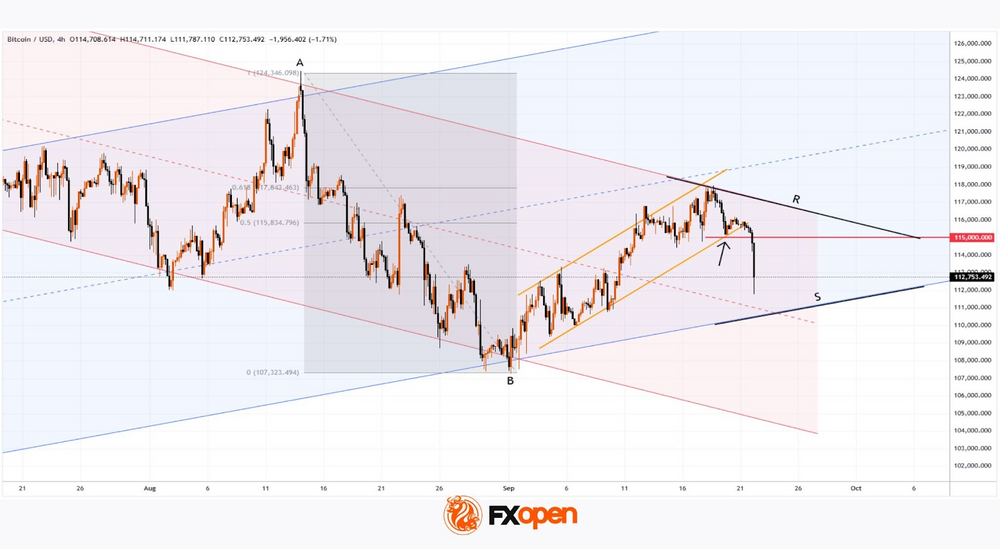
On 11 September, while analysing Bitcoin’s chart, we updated the long-term blue channel and suggested that:
→ Bitcoin’s price remains in a corrective phase (highlighted by the red channel) within the broader global uptrend, with a bull flag pattern forming;
→ bulls are still dominant, though their momentum could be weakening.
Against this backdrop, today’s decline appears to be the result of insufficient bullish momentum to break through the upper boundary of the flag and resume growth within the blue channel.
Resistance was provided by the 0.5–0.618 Fibonacci zone, plotted from the bearish impulse A→B.
What followed was a weak rebound (a dead cat bounce pattern) from the lower boundary of the September upward trajectory (as indicated by the arrow), confirming the fading strength of buyers. Further declines accompanied by expanding bearish candles and higher volumes are a textbook sign of imbalance in favour of sellers.
Therefore, we have grounds to conclude that:
→ bears have forcefully asserted control over the psychological $115k level;
→ bulls are retreating towards the lower boundary of the long-term ascending channel.
Given the above, we could assume that over the next 1–3 weeks the BTC/USD rate may consolidate within a broad zone, forming an S-R triangle.
FXOpen offers the world's most popular cryptocurrency CFDs*, including Bitcoin and Ethereum. Floating spreads, 1:2 leverage — at your service. Open your trading account now or learn more about crypto CFD trading with FXOpen.
*Important: At FXOpen UK, Cryptocurrency trading via CFDs is only available to our Professional clients. They are not available for trading by Retail clients. To find out more information about how this may affect you, please get in touch with our team.
This article represents the opinion of the Companies operating under the FXOpen brand only. It is not to be construed as an offer, solicitation, or recommendation with respect to products and services provided by the Companies operating under the FXOpen brand, nor is it to be considered financial advice.
AUD/USD and NZD/USD Trims Gains, Will Bears Take Full Control?
AUD/USD failed to stay in a positive zone and declined below 0.6650. NZD/USD is also moving lower and might extend losses below 0.5845.
Important Takeaways for AUD/USD and NZD/USD Analysis Today
- The Aussie Dollar started a fresh decline from well above 0.6680 against the US Dollar.
- There is a connecting bearish trend line forming with resistance at 0.6610 on the hourly chart of AUD/USD at FXOpen.
- NZD/USD declined steadily from 0.6000 and traded below 0.5900.
- There was a break above a connecting bearish trend line with resistance at 0.5860 on the hourly chart of NZD/USD at FXOpen.
AUD/USD Technical Analysis
On the hourly chart of AUD/USD at FXOpen, the pair struggled to clear 0.6700. The Aussie Dollar started a fresh decline below 0.6650 against the US Dollar.
The pair even settled below 0.6620 and the 50-hour simple moving average. There was a clear move below 0.6600. A low was formed at 0.6581 and the pair is now consolidating losses below the 23.6% Fib retracement level of the downward move from the 0.6706 swing high to the 0.6581 low.
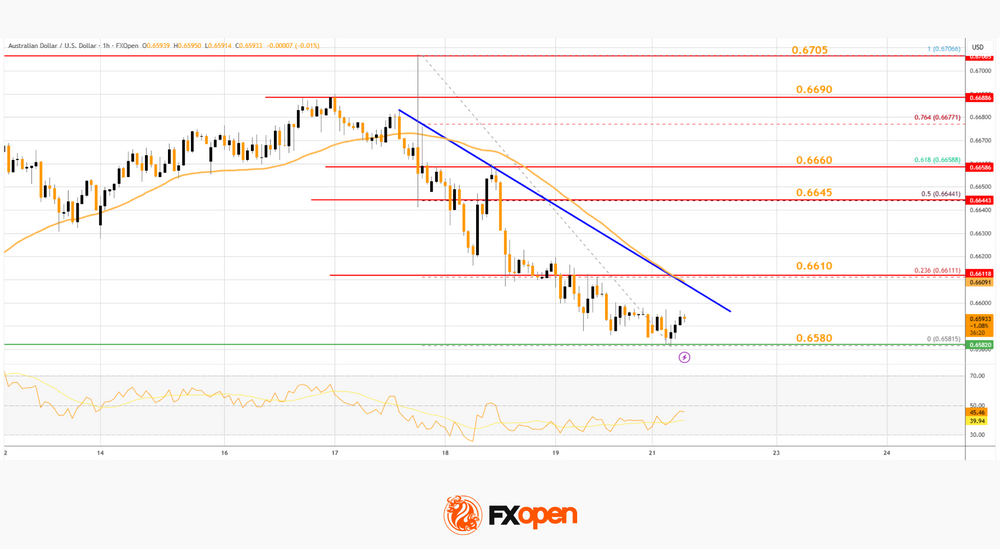
On the upside, immediate resistance is near a connecting bearish trend line at 0.6610 and the 50-hour simple moving average. The next major hurdle for the bulls could be near 0.6645 and the 50% Fib retracement.
The main selling point could be 0.6660, above which the price could rise toward 0.6690. Any more gains might send the pair toward 0.6700. A close above 0.6700 could start another steady increase in the near term. In the stated case, the next key resistance on the AUD/USD chart could be 0.6750.
On the downside, initial support is near 0.6580. The next area of interest might be 0.6550. If there is a downside break below 0.6550, the pair could extend its decline. The next target for the bears might be 0.6500. Any more losses might send the pair toward 0.6420.
NZD/USD Technical Analysis
On the hourly chart of NZD/USD on FXOpen, the pair also followed a similar pattern and declined from the 0.6000 zone. The New Zealand Dollar moved down and traded below 0.5950 against the US Dollar.
The pair settled below 0.5920 and the 50-hour simple moving average. Finally, it tested 0.5845 and is currently consolidating losses. There was a minor increase above a connecting bearish trend line with resistance at 0.5860.
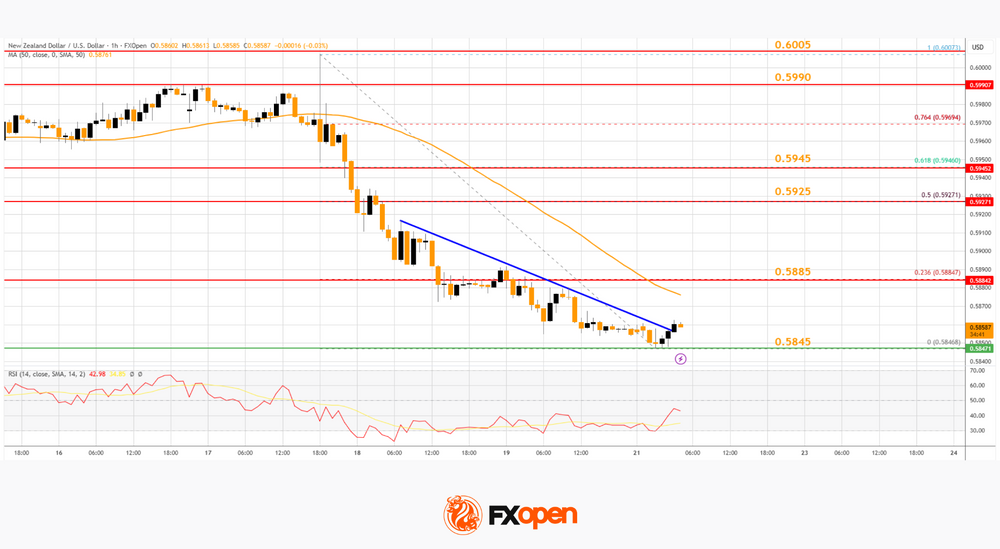
If the pair recovers, it could face hurdles near the 23.6% Fib retracement level of the downward move from the 0.6007 swing high to the 0.5846 low at 0.5885 and the 50-hour simple moving average.
The next major barrier is at 0.5925 since it coincides with the 50% Fib retracement. If there is a move above 0.5925, the pair could rise toward 0.5945. Any more gains might open the doors for a move toward 0.5990 in the coming days.
On the downside, immediate support on the NZD/USD chart is near the 0.5845 level. The next major stop for the bears might be 0.5800. If there is a downside break below 0.5800, the pair could extend its decline toward 0.5750. The main target for the bears could be 0.5720.
Trade over 50 forex markets 24 hours a day with FXOpen. Take advantage of low commissions, deep liquidity, and spreads from 0.0 pips. Open your FXOpen account now or learn more about trading forex with FXOpen.
This article represents the opinion of the Companies operating under the FXOpen brand only. It is not to be construed as an offer, solicitation, or recommendation with respect to products and services provided by the Companies operating under the FXOpen brand, nor is it to be considered financial advice.
EUR/USD Daily Outlook
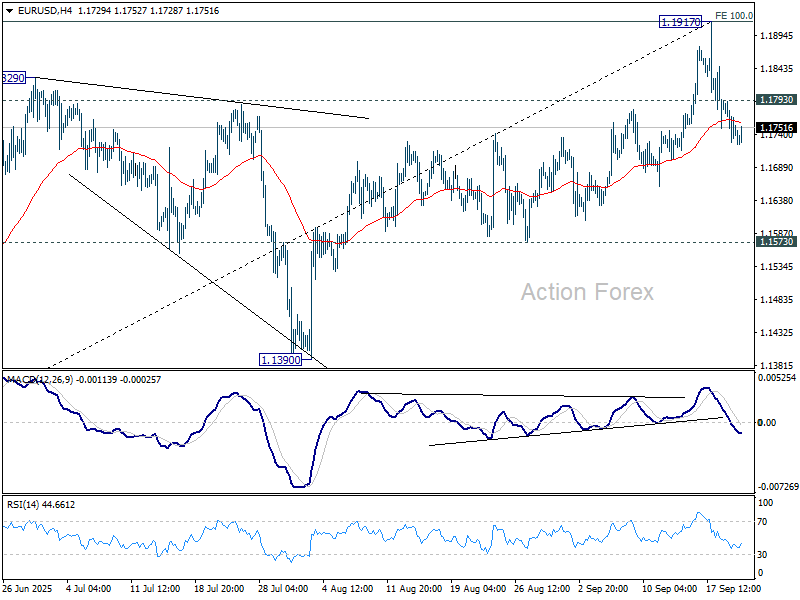
Daily Pivots: (S1) 1.1718; (P) 1.1756; (R1) 1.1782; More...
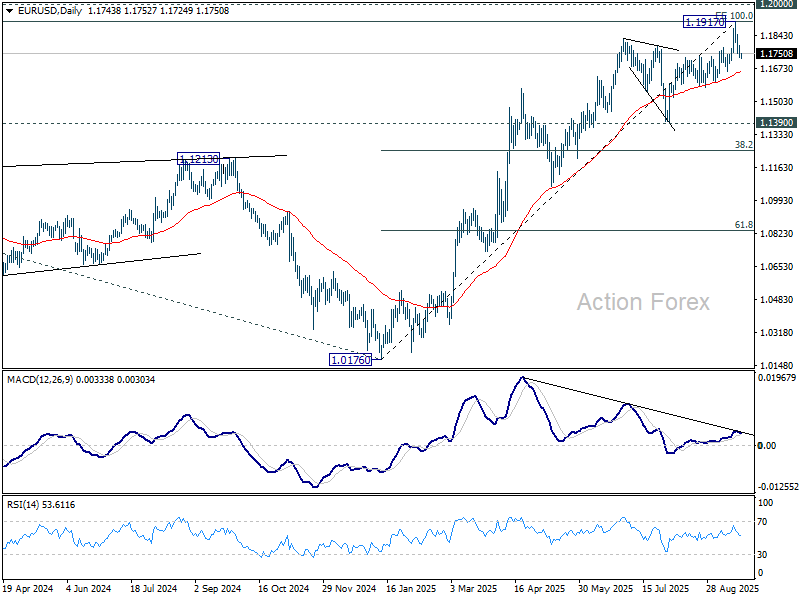
Intraday bias in EUR/USD stays on the downside for the moment. Fall from 1.1917 short term top should continued to 55 D EMA (now at 1.1657). Considering bearish divergence condition in D EMA, sustained break of 55 D EMA will argue that 1.1917 is already a medium term top. Deeper fall should then be seen to 1.1390 support next. On the upside, though, above 1.1793 minor resistance will retain near term bullishness and bring retest of 1.1917 high instead.
In the bigger picture, rise from 1.0176 (2025 low) is seen as the third leg of the pattern from 0.9534 (2022 low). 100% projection of 0.9534 to 1.1274 from 1.0176 at 1.1916 was already met. For now, further rally will remain in favor as long as 1.1390 support holds, and firm break of 1.2000 psychological level will carry larger bullish implications. However, firm break of 1.1390 will suggest that rise from 1.0176 has already completed and bring deeper fall to 55 W EMA (now at 1.1214).
USD/JPY Daily Outlook
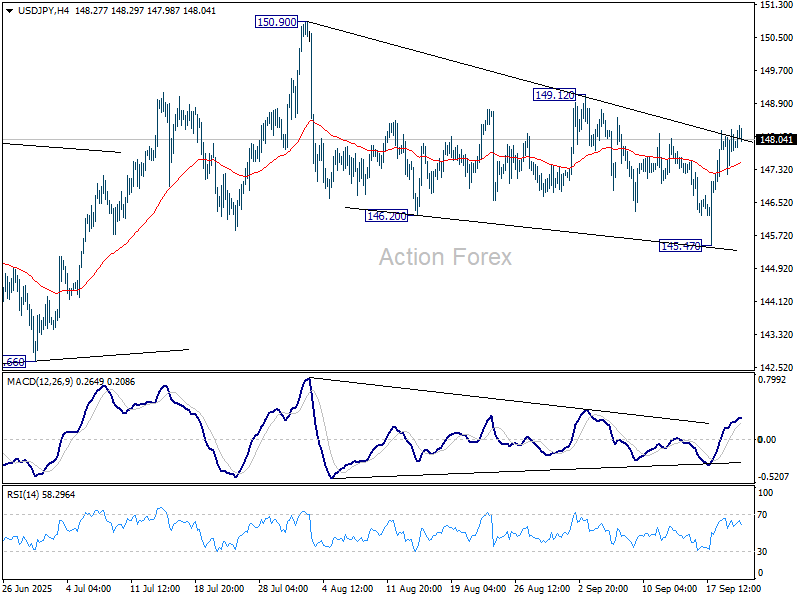
Daily Pivots: (S1) 147.35; (P) 147.82; (R1) 148.43; More...
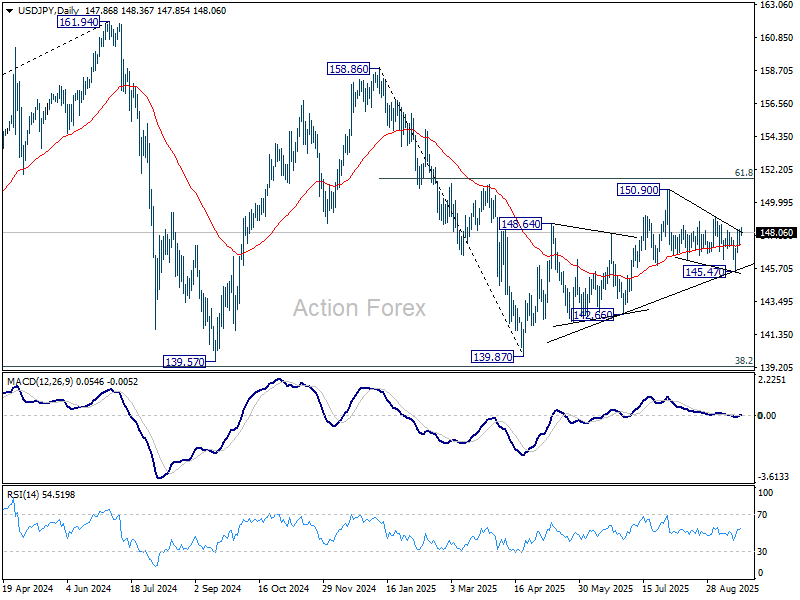
Intraday bias in USD/JPY stays neutral at this point. Current development suggests that rise from 139.87 might still be in progress. On the upside, break of 149.12 will bring stronger rally to retest 150.90 high. However, break of 145.47 will resume the fall from 150.90 instead.
In the bigger picture, price actions from 161.94 (2024 high) are seen as a corrective pattern to rise from 102.58 (2021 low). Decisive break of 61.8% retracement of 158.86 to 139.87 at 151.22 will argue that it has already completed with three waves at 139.87. Larger up trend might then be ready to resume through 161.94 high. In case the corrective pattern extends with another fall, strong support is expected from 38.2% retracement of 102.58 to 161.94 at 139.26 to bring rebound.
GBP/USD Daily Outlook
Daily Pivots: (S1) 1.3436; (P) 1.3498; (R1) 1.3533; More...
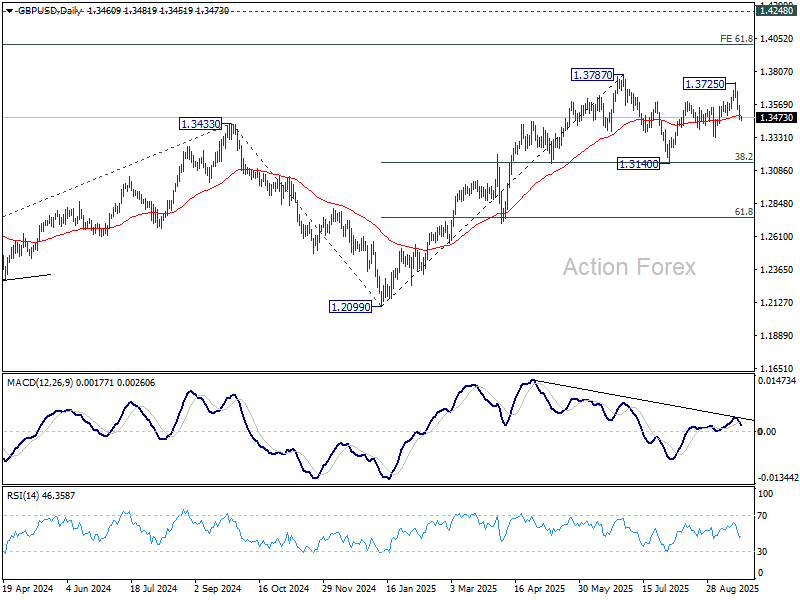
Intraday bias in GBP/USD stays on the downside for the moment. Fall from 1.3725 is seen as the third leg of the corrective pattern from 1.3787 high. Further fall should be seen to 1.3332 support first. Break there will bring deeper fall to 1.3140. On the upside, though, above 1.3561 minor resistance will turn intraday bias neutral.
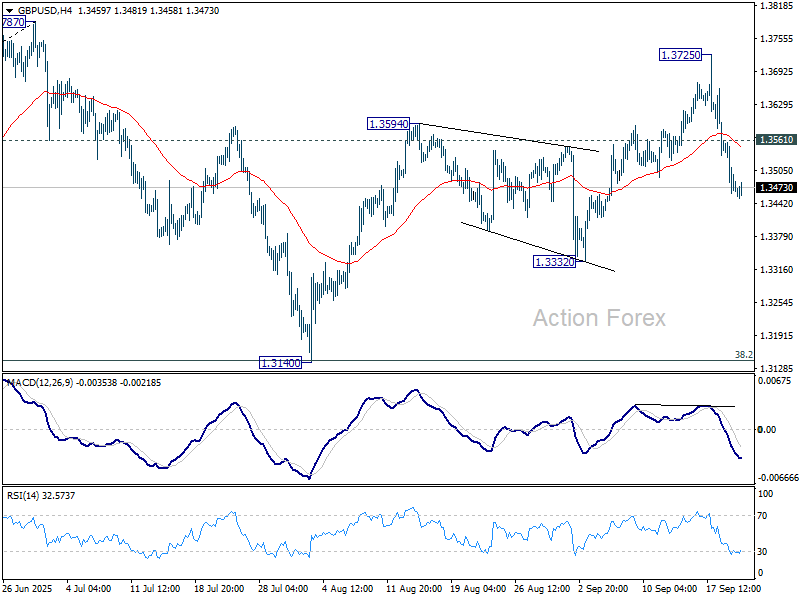
In the bigger picture, rise from 1.3051 (2022 low) is in progress, and would target 61.8% projection of 1.0351 to 1.3433 (2024 high) from 1.2099 (2025 low) at 1.4004. However, with 1.4248 resistance (2021 high) intact, this rally is more likely a corrective move. Sustained break of 55 W EMA (now at 1.3157) will argue that a medium term top has already formed and bring deeper fall back to 1.2099.