Sample Category Title
USDCHF Wave Analysis
USDCHF: ⬆️ Buy
- USDCHF reversed from support zone
- Likely to rise to resistance level 0.8000
USDCHF recently reversed up from the support zone located between the pivotal support level 0.7865 (which stopped the sharp downtrend in June), lower daily Bollinger Band and the support trendline of the daily down channel from July.
The upward reversal from this support zone will mostl likely form the daily Japanese candlesticks reversal pattern Morning Star – if the price closes today near the current levels.
Given the strength of the support level 0.7865 and the oversold daily Stochastic, USDCHF can be expected to rise to the next round resistance level 0,8000 (former support from August).

NZDUSD Weakens Sharply After FOMC, Losing 2% in Two Days
The Kiwi’s slide has been one that hasn't been seen in a while, with NZDUSD dropping 2% in just two sessions.
The pair had initially climbed ahead of the FOMC, driven by dovish concerns around the Fed and sudden Dollar-hedging that briefly pressured the DXY (sending the US Dollar down, hence the pair shooting upwards).
However, Powell’s balanced tone quickly flipped that narrative, erasing the priced-in dovishness observed in the SEP, dot plot, and FOMC statement.
“You can think of this, in a way, as a risk management cut,” Powell noted, striking a cautious stance around future cuts that steadied the USD.
There are still 25 bps of cuts priced at each of the two meetings left in 2025.
Strong US Jobless Claims (231k vs 240K exp) this morning reinforced that shift, further fueling a V-shaped reversal in the greenback.
Coupled with New Zealand’s atrocious GDP miss (-0.9% vs -0.3% q/q), the Kiwi was left in dismay, driving the pair sharply lower.
The current move is reflecting the repricing of more cuts for the RBNZ as the data has been very volatile for New Zealand throughout the year.
Expectations for a rate cut at the RBNZ upcoming meeting were at 82% last week and a 25 bps cut is now fully priced, with some extra premium in case of a larger 50 bps.
The NZ OCR is at 3% and the upcoming meeting will be happening on October 8th.
Let's have a look at NZDUSD through a multi-timeframe outlook to see where this takes the major pair.
A parenthesis on the DXY chart: Look at its V-Shape reversal since yesterday!
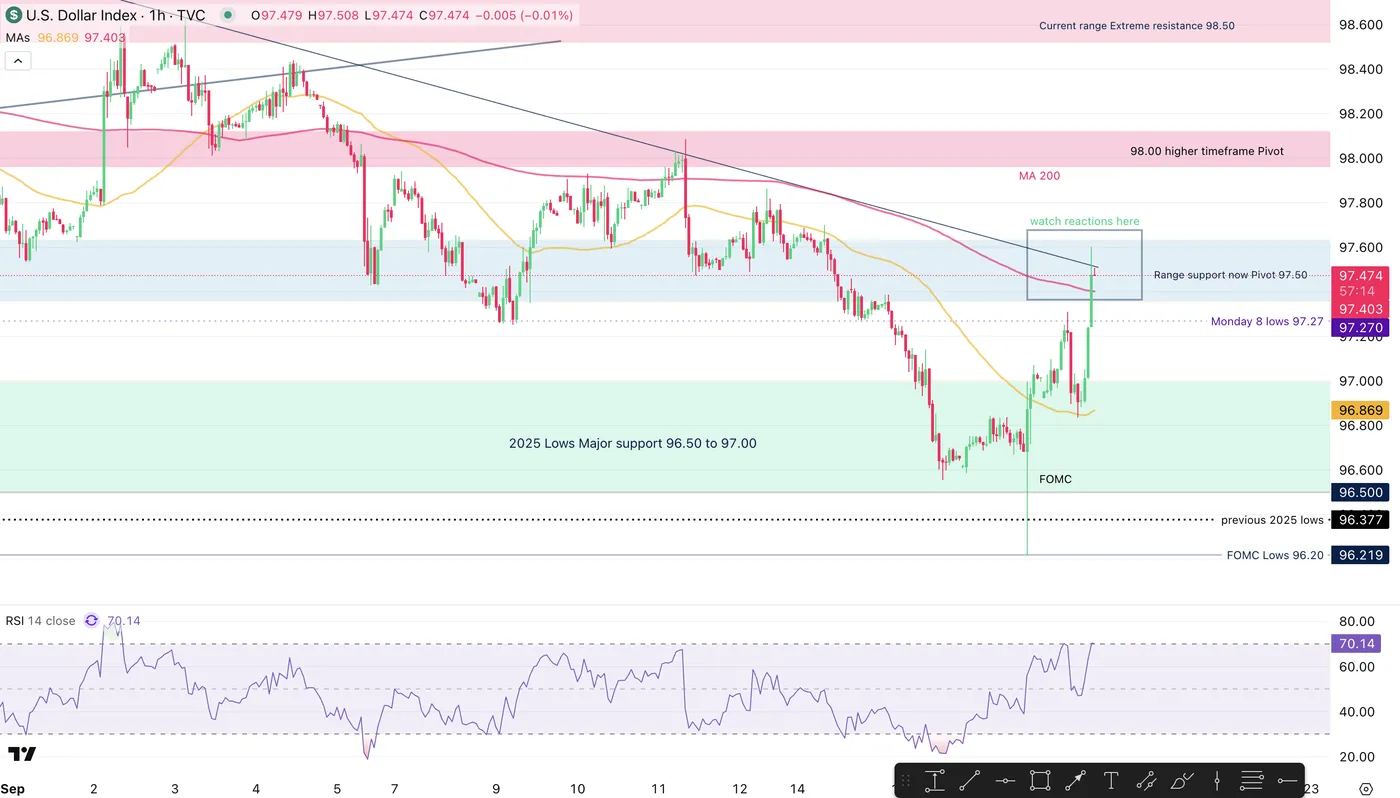
DXY 1H Chart, September 18, 2025 – Source: TradingView
NZDUSD 8H Chart
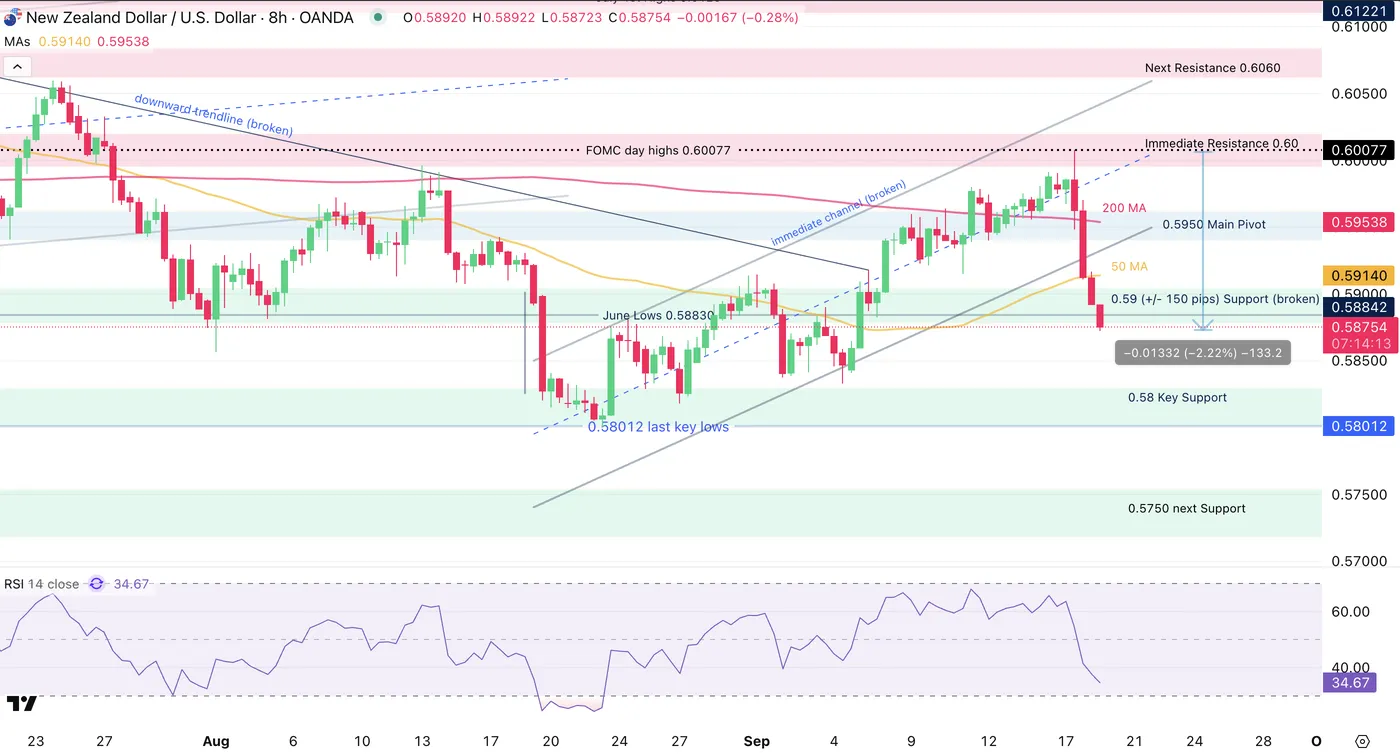
NZDUSD 8H Chart, September 18, 2025 – Source: TradingView
The downward shaping RSI right ahead of the FOMC was well located: Prices reached the 0.60 resistance before getting slammed lower as the Powell press-conference started.
RSI has shot down lower catching up with the ongoing move – The selling is showing no pity to the bulls, with prices consolidating slightly at the 0.59 Support which got swiftly broken.
Some immediate but small scale mean-reversion is stopping the descent, but the price action is brutal.
NZDUSD 2H Chart
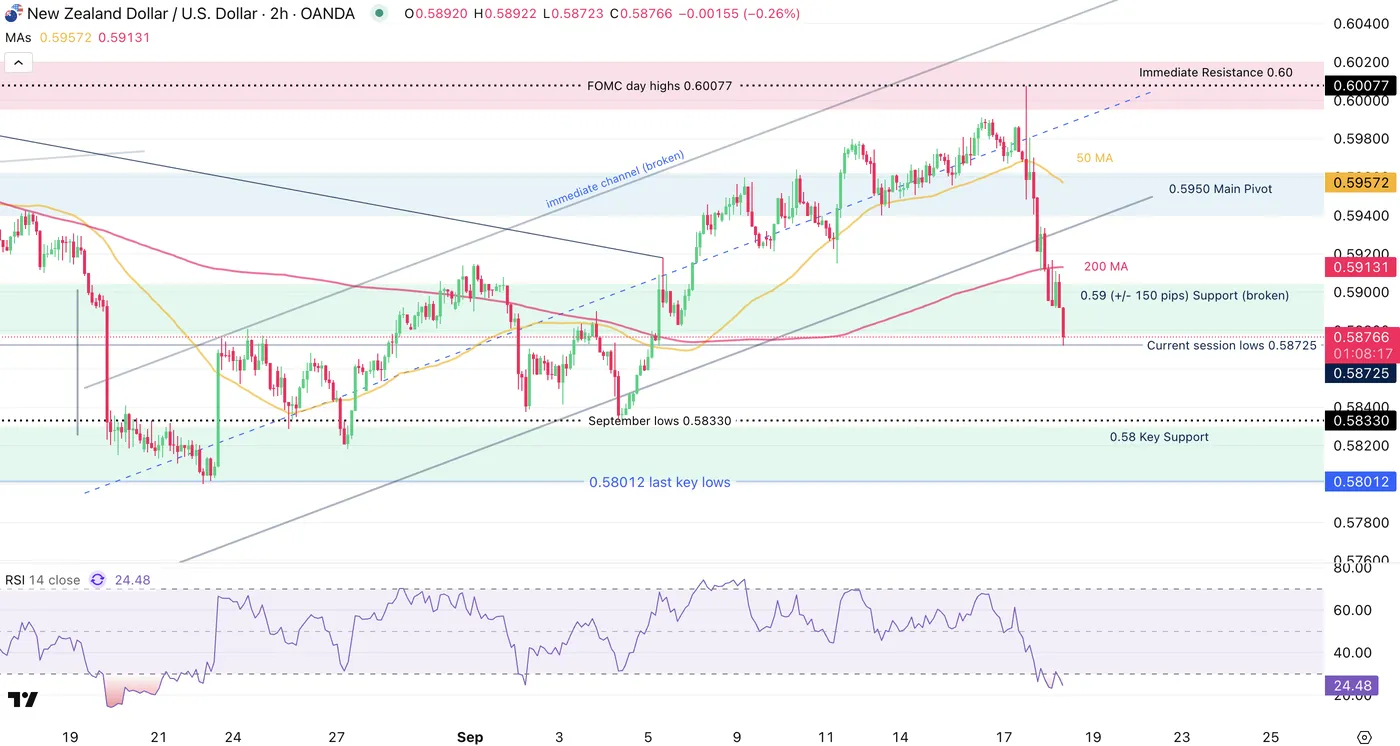
NZDUSD 2H Chart, September 18, 2025 – Source: TradingView
At its extreme, the ongoing move downwards is of about 1350 pips or 2.25% in the pair from peak to trough.
Particularly after very slow FX trading, such data officially reinstores volatility for the end of this year.
Get ready to see more volatile data and price swings for NZDUSD and other pairs looking forward.
Levels to watch for in NZDUSD trading:
Resistance Levels
- Immediate Resistance 0.60
- 0.5950 Main Pivot now Resistance
- 200-period MA 0.59150
Support Levels
- 0.59 (+/- 150 pips) Support (broken)
- Current session lows 0.58725
- September lows 0.58330
- 0.58 Key Support
Watch for further volatile swings looking forward and stay in touch with the latest data as every central banks will be looking at the news for their decision-making.
The Dollar index is reaching an interesting level and NZDUSD is taking a breather, stay locked in for upcoming action.
Safe Trades!
EUR/USD Technical: Euro Bullish Trend Intact Despite 1.2% Sell-Off After FOMC
The euro has continued to rally against the greenback from the 1 August 2025 low of 1.1392 and broke above its recent 52-week high of 1.1830 printed on 1 July 2025, within its medium-term uptrend phase in place since 13 January 2025
The EUR/USD hit a 4-year high of 1.1919 on Wednesday, 17 September, at the onset of the FOMC announcement of a 25 basis points (bps) interest rate cut to bring down the Fed funds rate to 4.00%-4.25%, and the release of the latest summary of economic projections (dot plot) that indicates two more projected interest rate cuts of 25 bps each before 2025 ends.
Post FOMC sell-off due to a less “dovish” Fed Chair Powell’s press conference
Thereafter, the EUR/USD erased all its early intraday gains and closed lower by -0.5% at the end of Wednesday, 17 September 2025, US session due to a less “dovish” Fed Chair Powell’s press conference.
Powell described the latest policy move as a “risk management” cut, emphasising that the Fed will remain data-dependent and proceed “meeting by meeting.” This stance reduced expectations of a deeper, new cycle of monetary policy easing.
The EUR/USD extended its decline in today’s Asia session, hitting a low of 1.1780, a drop of 1.2% from yesterday’s post-FOMC high of 1.1919.
The Fed funds futures market is still implying three interest rate cuts in 2026
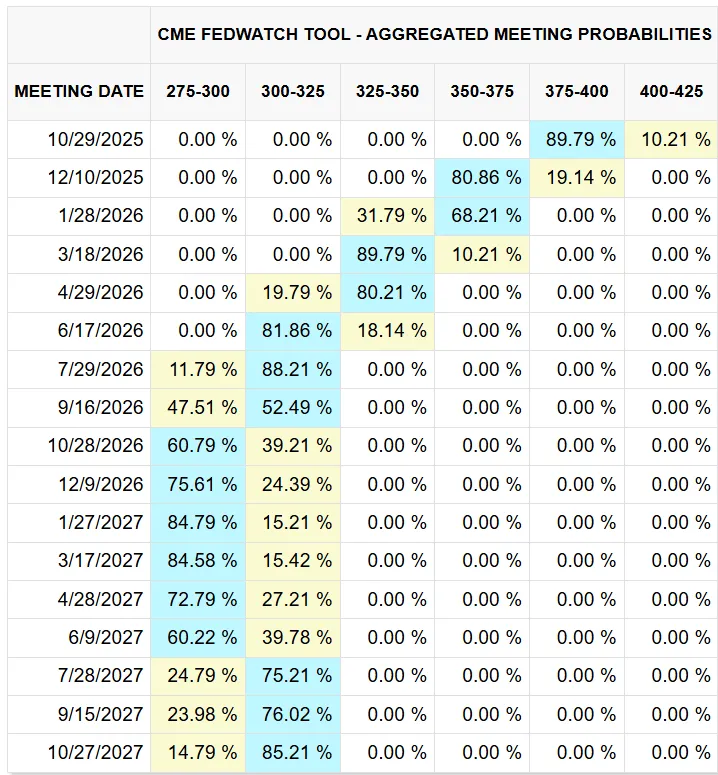
Fig. 1: Aggregated FOMC meeting probabilities on Fed funds rate as of 18 Sep 2025 (Source: CME FedWatch tool)
Despite Fed Chair Powell’s “meeting by meeting” rhetoric and the latest updated dot plot projections that show only a 25-bps cut in 2026, market participants in the Fed funds futures market are still expecting at least three interest rate cuts of 25 bps each in 2025 to bring the Fed funds rate to 2.75%-3.00% in 2026, according to the latest data from the CME FedWatch tool (see Fig. 1).
A continuation of dovish expectations implied by the Fed funds futures market is likely to cap the strength of the US dollar, in turn, creating a positive feedback loop back into the EUR/USD.
Let’s now examine the latest short-term (1 to 3 days) trajectory and key technical levels to watch on the EUR/USD.
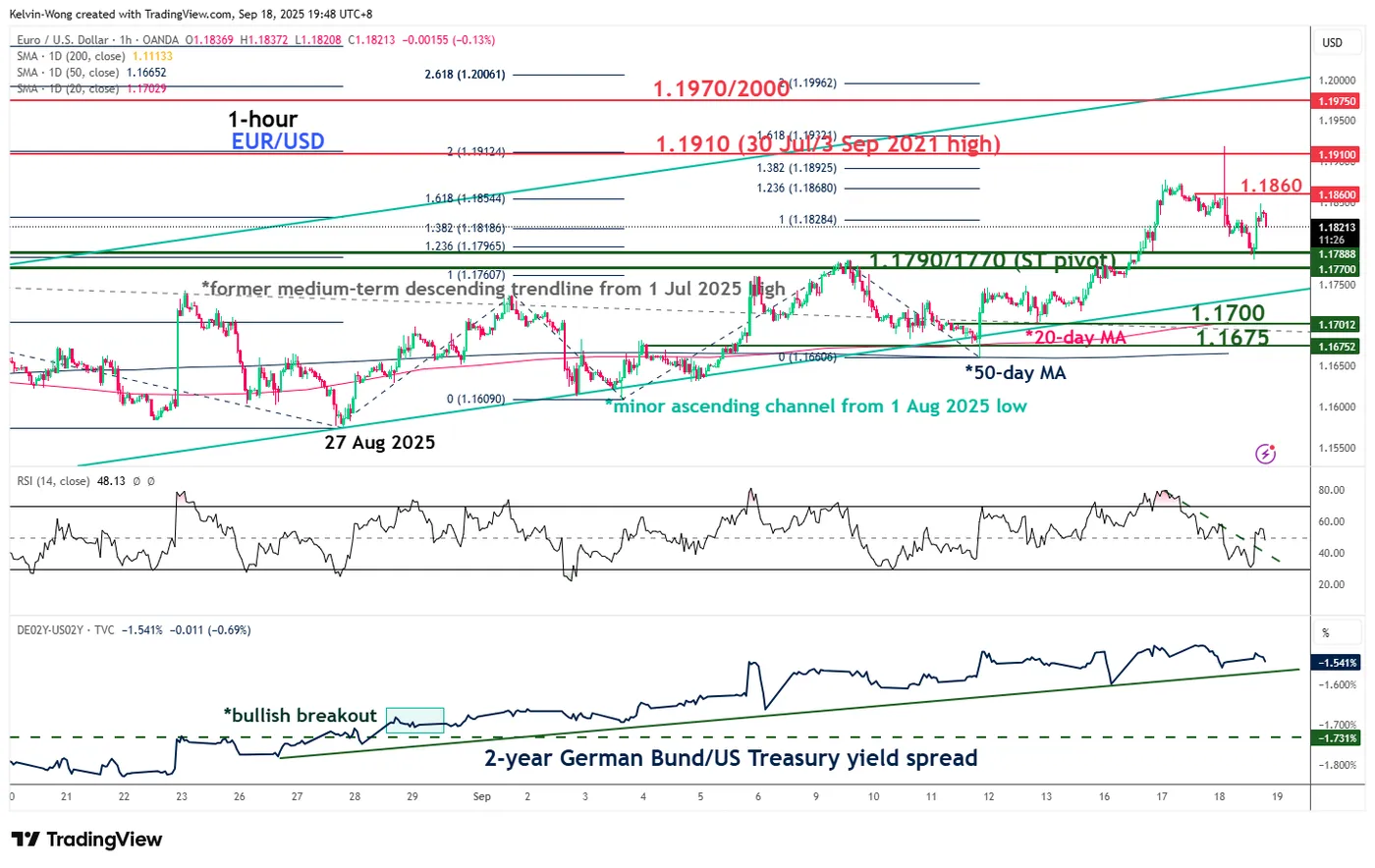
Fig. 2: EUR/USD minor trend as of 18 Sep 2025 (Source: TradingView)
Preferred trend bias (1-3 days)
The current decline of 1.2% seen in the EUR/USD from its post-FOMC high of 1.1919 is likely a minor corrective decline within its ongoing minor uptrend phase in place since the 1 August 2025 low of 1.1392.
Bullish bias on the EUR/USD above 1.1790/1.1770 key short-term pivotal support, and a break above 1.1860 sees a retest on 1.1910 before the next intermediate resistance comes in at 1.1970/1.2000 (Fibonacci extension and the upper boundary of the minor ascending channel) (see Fig. 2).
Key elements
- The EUR/USD has shaped an hourly bullish reversal candlestick at the 1.1790/1.1770 key short-term support.
- The hourly RSI momentum indicator has staged a bullish breakout from its parallel descending resistance after it hit its oversold level in today’s Asian session. These observations indicate a short-term bullish momentum revival for the EUR/USD.
- The yield spread between the 2-year German Bund and the US Treasury note has continued to trend higher (narrowing) from -1.63% on 16 September to -1.54% at the time of writing.
- This development indicates a relative decline in the yield attractiveness of the 2-year US Treasury versus its German counterpart, which in turn exerts downside pressure on the US dollar against the euro.
Alternative trend bias (1 to 3 days)
A break below the 1.1770 key short-term support invalidates the bullish scenario on the EUR/USD to see a deeper minor corrective decline to expose the next intermediate supports at 1.1700 (also the 20-day moving average) and 1.1675 (also the 50-day moving average).
Sunset Market Commentary
Markets
After the Fed decision yesterday it was up to the Bank of England (BoE) to assess whether the balance between inflation and growth/health of the labour market allows to continue policy easing. Contrary to the Fed, this wasn’t the case. The focus in this balancing exercise during summer turned again to overweight inflation risks. BoE currently assess that it still has some squeezing out to do on existing or even emerging persistent inflationary pressures, to sustainably return inflation to the 2% target. With this in mind, the BoE today decided (7-2 majority) to keep the policy rate unchanged at 4%. The committee still expects inflation to sightly rise in September from the 3.8% Y/Y August level, before returning to 2% thereafter. Still, the committee remains alert on the risk that the temporary uptick in inflation could put additional pressure on wages and price setting. Risks to inflation remain tilted to the upside. This only allows for a gradual and careful approach with respect to further withdrawal of policy restraint. In this respect, the BoE is not on a preset course. Aside from decision on the policy rate, the BoE also decided to slow its stock of bond purchases to £70 bln over the next 12 months (was £100 bln this year). In executing this process the bank will sell fewer long maturity gilts than Gilts at other maturities (40% ST, 40% MT and 20% LT). The BoE decision both on the policy rate and on QT were broadly as expected. Gilt yields today are rising between 0.5 bp (2-y) and +6.5bps (30-y), a move in line with Euro/German bond markets. Markets still see only about a 35 % chance of a BoE rate cut before the end of the year, with a next 25 bps stop not fully discounted before April next year. EUR/GBP is stuck in a tight range in the upper half of the 0.86 big figure (0.868).
Global markets, including US Treasuries, had to navigate yesterday’s Fed communication, which basically showed a high degree of fog/dispersion of views as the FOMC resumed reducing policy restriction yesterday in precautionary move to balance the risk of a further weakening in the labour market. In this respect, US jobless claims today provided a first (admittedly very mince, fragmented) reality check on markets’ sensitively to labour market data. Weekly claims declining from 264k to 231k (vs 240k expected) was enough for (short-term) yields to reverse an early decline of about 3 bps. US yields currently add 3-5 bps across the curve. The German yield curve bear steepens with the 2-y yield little changed while the 30-y adds 7 bps. Similarly, the dollar reversed a tentative intraday loss. DXY currently trades 97.45 (from 96.92). EUR/USD aborted an attempt to regain/hold north of 1.18 (currently 1.176). Despite an indecisive picture on Fed policy/global monetary conditions post yesterday’s FOMC decision, equities again were better bid with the EuroStoxx 50 adding 1.25% and the S&P 500 opening at a new record (+0.4%).
News & Views
The Norwegian central bank lowered its policy rate by 25 bps to 4% this morning. The moves caught some by surprise after (core) CPI, amongst others, last week came in to the upside of expectations. The Norges Bank indeed noted that inflation may remain elevated for a little longer than projected in June with only little spare capacity in the economy. The central bank had considered to keep the rate unchanged but eventually opted for a rate cut, stressing that the job of bringing inflation back to target has not been completed, but a cautious easing of monetary policy will pave the way for returning inflation to target without restraining the economy more than needed. “Cautious” in the Norwegian case means one more rate cut per year in the coming three years, according to the new forecast. The policy rate should be around 3-3.25% at the end of the policy horizon in 2028. The Norwegian krone whipsawed in the wake of the decision but EUR/NOK eventually trades virtually unchanged around the 11.59 opening levels.
Growth in New Zealand missed the -0.3% q/q expectation by a huge margin. The -0.9% contraction in Q2 fully wiped out the advance made in Q1. The economy is now 0.6% smaller than the same period in 2024. Growth in services stalled while the goods (-2.3%) and primary (-0.7%) industry sectors declined. The soft print spurred bets for a bumper rate cut by the New Zealand central bank (RBNZ). Markets attach a 33% chance for a 50 bps move in October. That would mean the RBNZ hit its end of year policy rate target (2.5%) made in August one meeting ahead. NZ swap yields tanked 12 bps at the front. The kiwi dollar fell to NZD/USD 0.59.
USD/JPY Mid-Day Outlook
Daily Pivots: (S1) 145.98; (P) 146.51; (R1) 147.54; More...
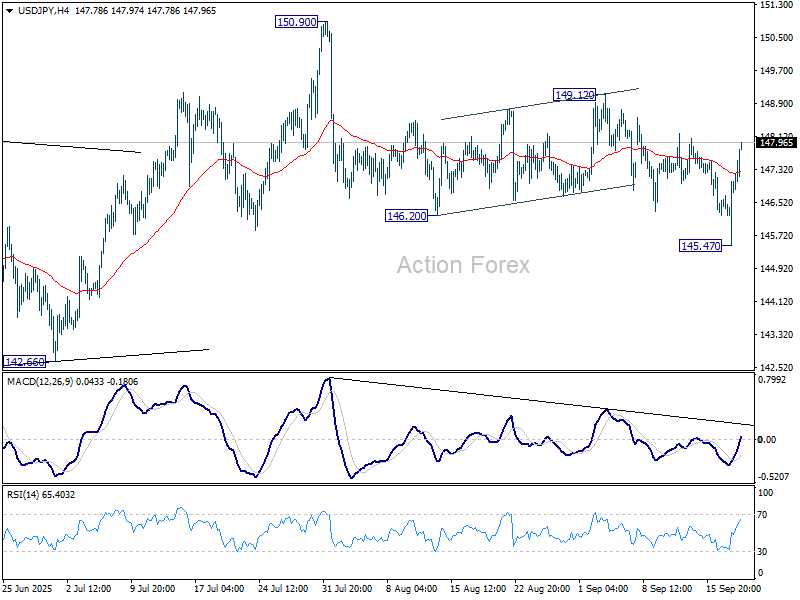
Intraday bias in USD/JPY stays neutral first. On the upside, break of 149.12 resistance will suggest that pullback from 150.90 has completed as a correction, and rise from 139.87 is still in progress. Further rise should then be seen back to retest 150.90 next. On the downside, below 145.47 will resume the fall to 142.66 support next.
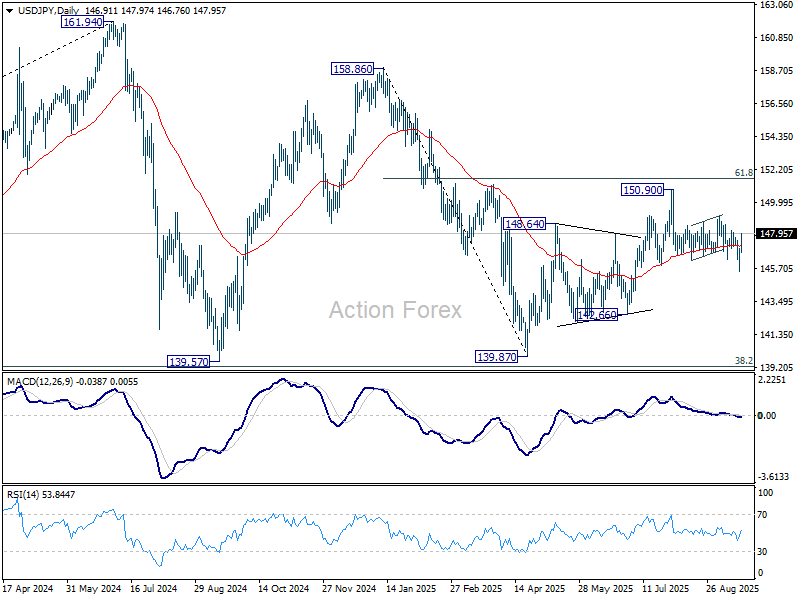
In the bigger picture, price actions from 161.94 (2024 high) are seen as a corrective pattern to rise from 102.58 (2021 low). Decisive break of 61.8% retracement of 158.86 to 139.87 at 151.22 will argue that it has already completed with three waves at 139.87. Larger up trend might then be ready to resume through 161.94 high. In case the corrective pattern extends with another fall, strong support is expected from 38.2% retracement of 102.58 to 161.94 at 139.26 to bring rebound.
USD/CHF Mid-Day Outlook
Daily Pivots: (S1) 0.7847; (P) 0.7871; (R1) 0.7912; More….
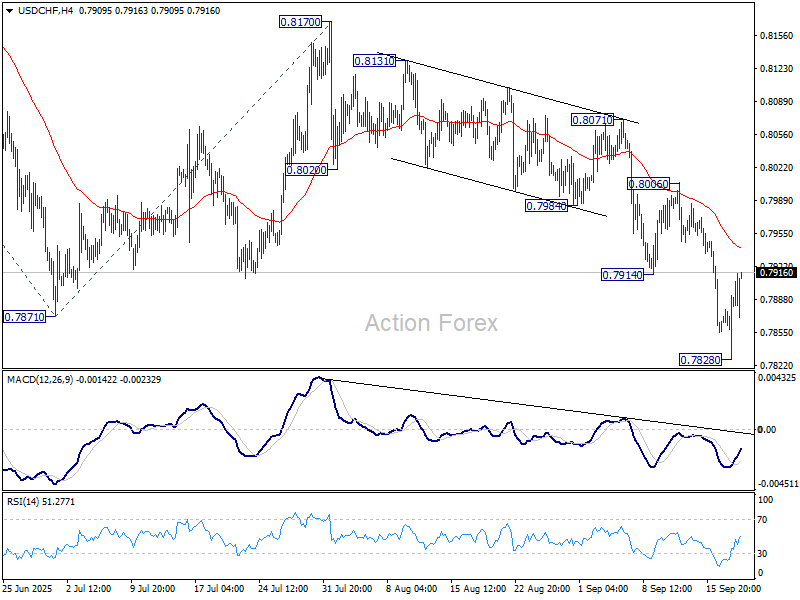
Intraday bias in USD/CHF stays neutral for the moment. Some consolidations would be seen above 0.7828 temporary low. But upside should be limited below 0.8006 resistance to bring another fall. On the downside, break of 0.7828 will resume larger down trend to 61.8% projection of 0.8475 to 0.7871 from 0.8170 at 0.7797. Firm break there will pave the way to 100% projection at 0.7566.
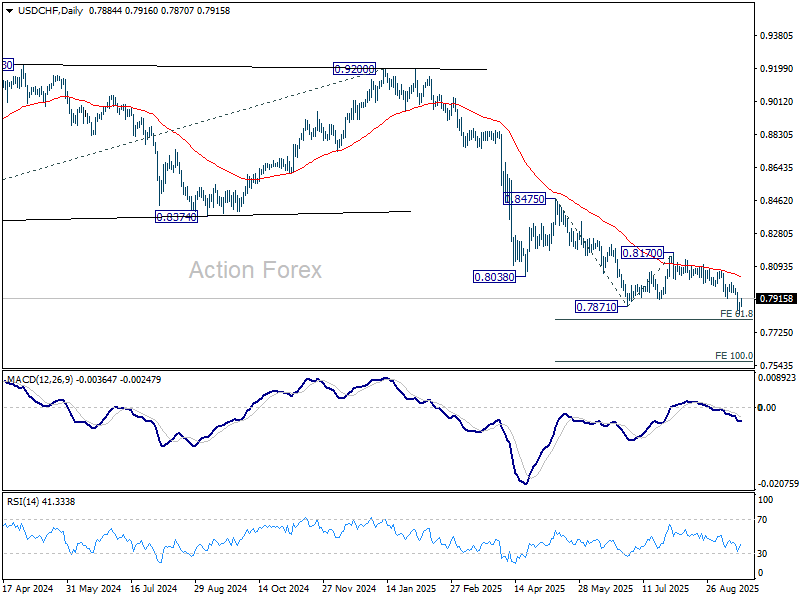
In the bigger picture, long term down trend from 1.0342 (2017 high) is still in progress. Next target is 100% projection of 1.0146 (2022 high) to 0.8332 from 0.9200 at 0.7382. In any case, outlook will stay bearish as long as 0.8332 support turned resistance holds.
EUR/USD Mid-Day Outlook
Daily Pivots: (S1) 1.1774; (P) 1.1847; (R1) 1.1885; More...
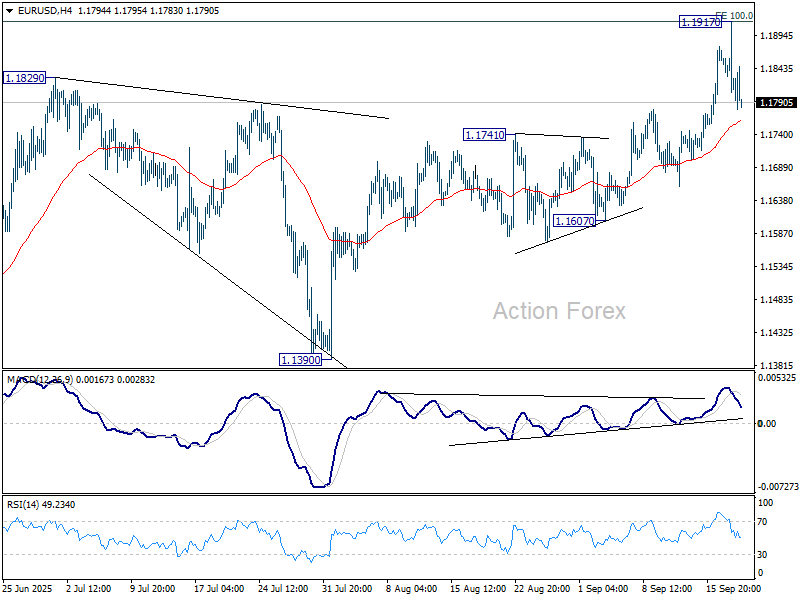
Intraday bias in EUR/USD remains neutral and more consolidations would be seen below 1.1917. Further rise is expected as long as 1.1741 resistance turned support holds. Above 1.1917 will resume larger up trend to 1.2 psychological level. However, firm break of 1.1741 should confirm short term topping, and turn bias back to the downside for 1.1607 support.
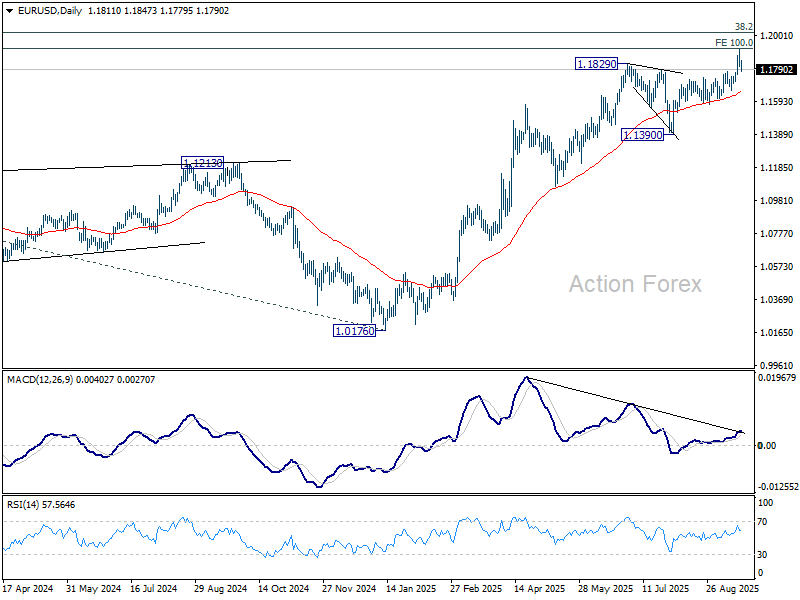
In the bigger picture, rise from 0.9534 (2022 low) long term bottom could be correcting the multi-decade downtrend or the start of a long term up trend. In either case, further rise should be seen to 100% projection of 0.9534 to 1.1274 from 1.0176 at 1.1916. Sustained break of 1.2 psychological level will carry larger bullish implications. Next target is 138.2% projection at 1.2581. This will remain the favored case as long as 55 W EMA (now at 1.1215) holds.
Bank of England Review – Near Term Rate Cuts Remain an Option
- The Bank of England (BoE) kept the Bank Rate at 4.00% as widely expected.
- The vote split was 7-2 in favour of hold, also as expected.
- The BoE did not tweak the guidance more hawkish and thus further cuts remain on the table.
- QT was tapered from an annual pace of GBP100bn. to GBP70bn.
- The market reacted by trading Gilt yields a bit lower and EUR/GBP a bit higher, but the move later faded.
The Bank of England (BoE) kept the Bank rate at 4.00% as widely expected. The vote split was 7-2 in (keep vs. cut) with Professor Allan Taylor (who favoured a 50bp cut in August) and Swati Dhingra (notorious dove) dissenting.
The overall guidance remained unchanged, with the BoE reiterating that "a gradual and careful approach to the further withdrawal of monetary policy restraint remains appropriate". Removing this would likely have dampened expectations for near-term rate cuts further.
The annual QT decision has been a contentious issue, given the fragile Gilt market and the government's growing fiscal challenges, where interest payments are weighing still heavier on the fiscal space. The decision aligned with expectations set the annual pace of GBP70bn, backed by 7of 9 committee members, with one member arguing for a higher pace and one member for lower one.
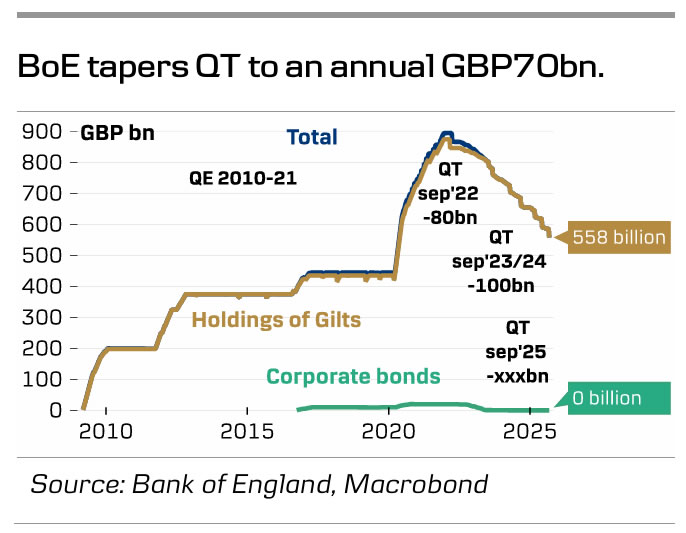
BoE call. We continue to expect the BoE to deliver the next cut in the Bank Rate in November, followed by another cut in February, bringing the Bank Rate to 3.50%. However, we acknowledge that a November cut is highly dependent on more disinflationary signs in the September CPI data.
Market reaction. Gilt yields traded a couple of basis points lower and EUR/GBP a bit higher on the announcement, likely due to the absence of more hawkish guidance from the BoE. However, the initial reaction was short-lived. We expect EUR/GBP to move higher towards 0.89 on a 6-12-month horizon on a weakening of the UK growth outlook and a positive correlation to a USD-negative environment.
GBP/USD Mid-Day Outlook
Daily Pivots: (S1) 1.3588; (P) 1.3657; (R1) 1.3694; More...
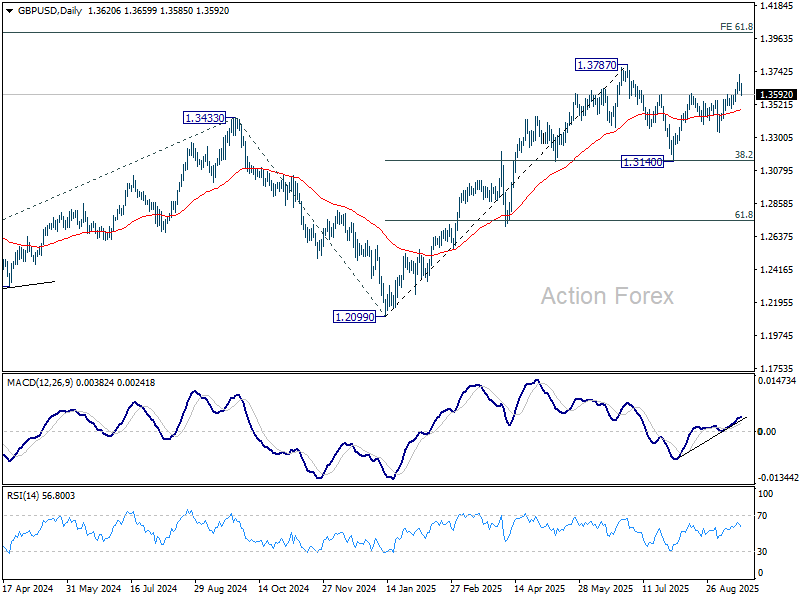
Intraday bias in GBP/USD remains neutral and more consolidations could be seen below 1.3725. Further rise is expected as long as 55 D EMA (now at 1.3488) holds. Above 1.3725 will bring retest of 1.3787 high first. Decisive break there will resume larger up trend to 1.4004 projection level. However, sustained break of 55 D EMA will indicate that corrective pattern from 1.3787 is extending with another falling leg, and bring deeper fall to 1.3332 support and below.
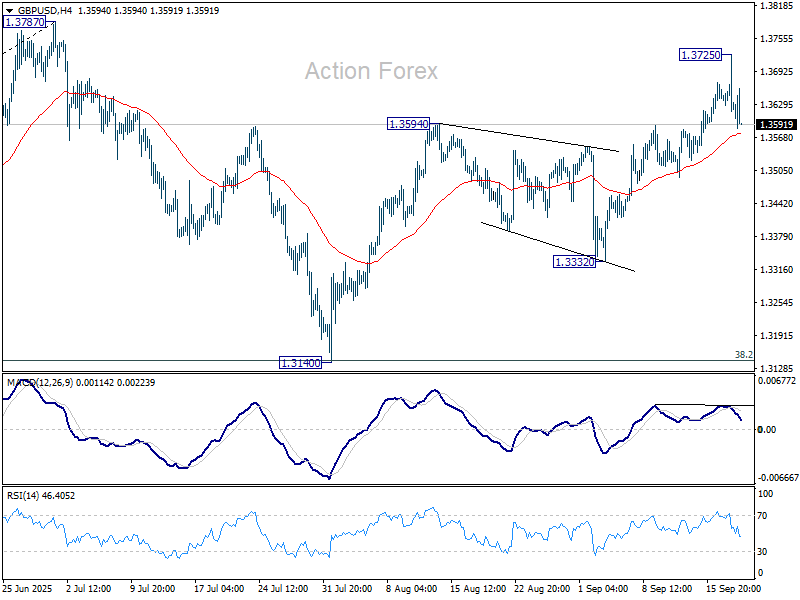
In the bigger picture, up trend from 1.3051 (2022 low) is in progress. Next medium term target is 61.8% projection of 1.0351 to 1.3433 from 1.2099 at 1.4004. Outlook will now stay bullish as long as 55 W EMA (now at 1.3151) holds, even in case of deep pullback.