Sample Category Title
EUR/AUD Daily Outlook
Daily Pivots: (S1) 1.8041; (P) 1.8099; (R1) 1.8136; More...
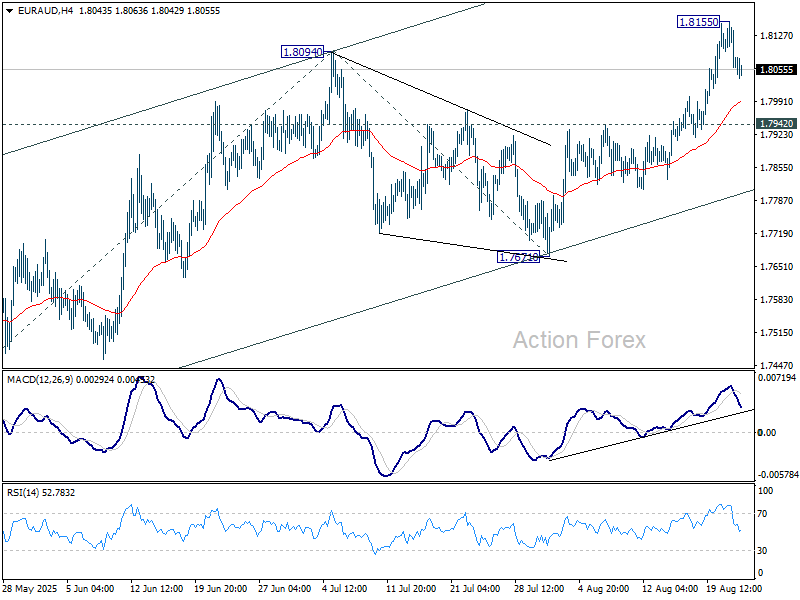
Intraday bias in EUR/AUD is turned neutral first with current retreat. Further rally is expected as long as 1.7942 support holds. Above 18155 will target 61.8% projection of 1.7245 to 1.8094 from 1.7671 at 1.8196. Sustained break there will extend the rally from 1.7245 to 100% projection at 1.8520, which is close to 1.8554 high. However, break of 1.7942 will bring deeper fall back to 1.7671 support instead.
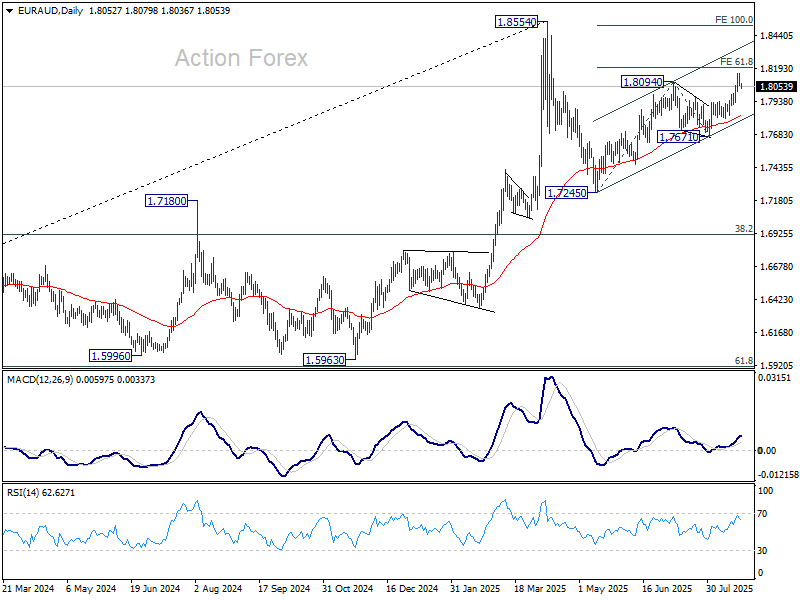
In the bigger picture, price actions from 1.8554 medium term top are seen as a corrective pattern. Such pattern could extend further with another falling leg. But even in that case, downside should be contained by 38.2% retracement of 1.4281 (2022 low) to 1.8554 at 1.6922 to bring rebound. Uptrend from 1.4281 is expected to resume at a later stage.
EUR/CHF Daily Outlook
Daily Pivots: (S1) 0.9365; (P) 0.9380; (R1) 0.9402; More....
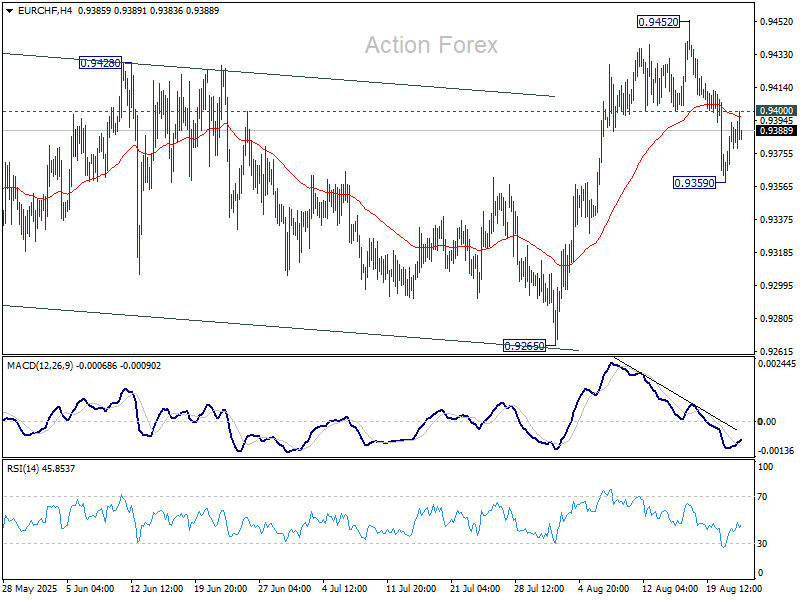
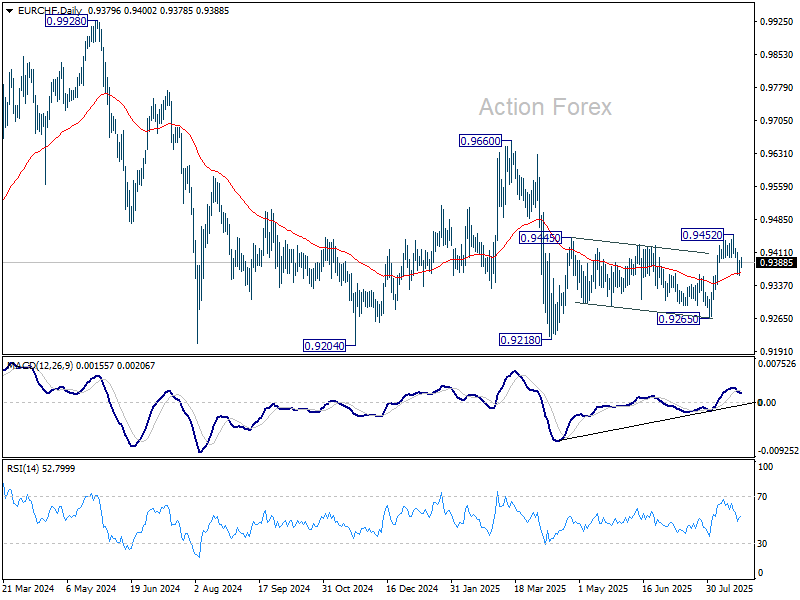
Intraday bias in EUR/CHF is turned neutral first with current recovery. On the downside, sustained trading below 55 D EMA (now at 0.9366) will the rebound from 0.9218 has completed, and target 0.9265 support for confirmation. Nevertheless, break of 0.9400 support turned resistance will bring retest of 0.9452 resistance.
In the bigger picture, the down trend from 0.9204 (2018 high) might still be in progress considering that EUR/CHF is staying well inside the long term falling channel. However, with bullish convergence condition in W MACD, downside potential should be limited in case of another fall. Instead, firm break of 0.9660 resistance will be an important sign of medium term bullish trend reversal.
USD/CAD Daily Outlook
Daily Pivots: (S1) 1.3882; (P) 1.3897; (R1) 1.3926; More...
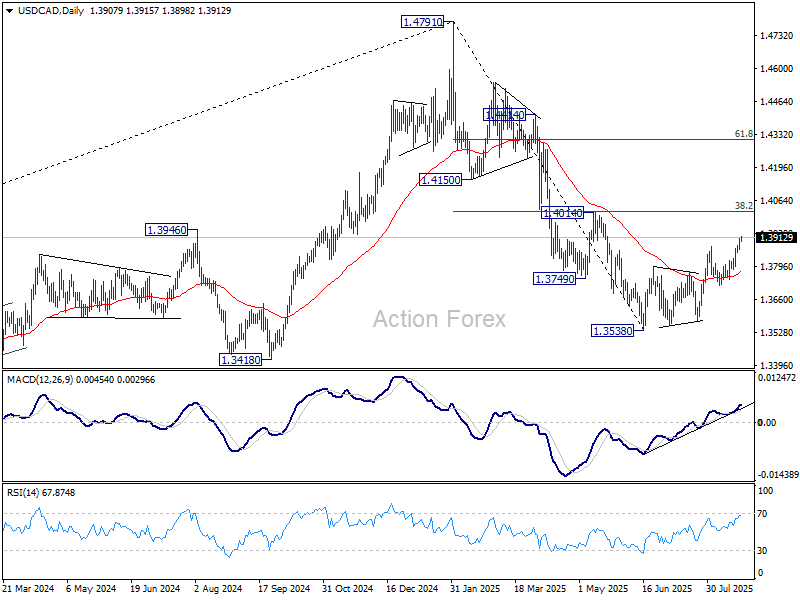
USD/CAD's rally continues today and intraday bias remains on the upside. Corrective rebound from 1.3538 should now target 1.4014 cluster resistance (38.2% retracement of 1.4791 to 1.3538 at 1.4017). Strong resistance should be seen there to complete the corrective bounce. On the downside, below 1.3872 minor support will turn intraday bias neutral again first.
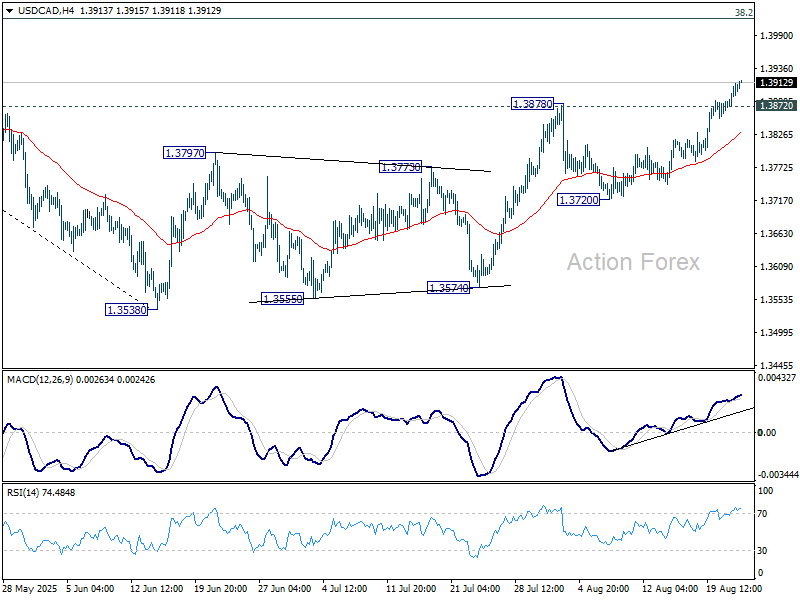
In the bigger picture, price actions from 1.4791 medium term top could either be a correction to rise from 1.2005 (2021 low), or trend reversal. In either case, further decline is expected as long as 1.4014 resistance holds. Next target is 61.8% retracement of 1.2005 (2021 low) to 1.4791 at 1.3069.
AUD/USD Daily Report
Daily Pivots: (S1) 0.6412; (P) 0.6424; (R1) 0.6434; More...
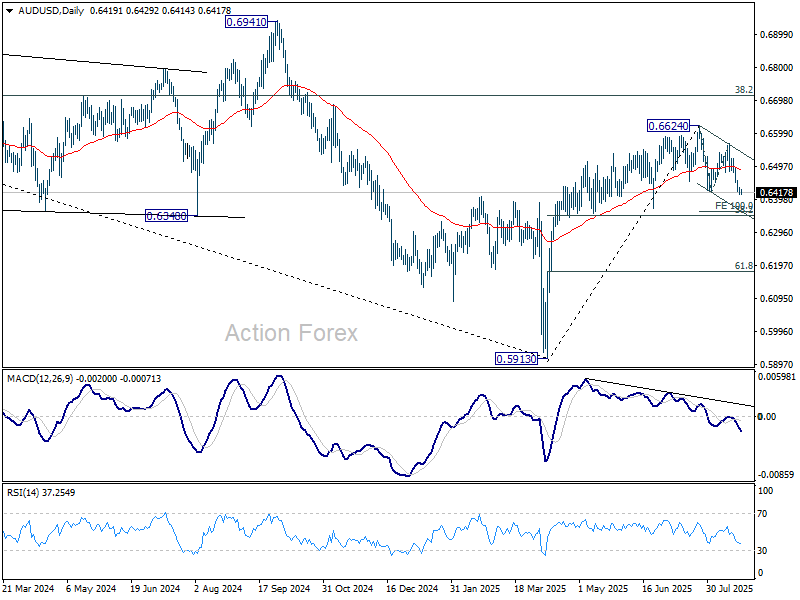
Intraday bias in AUD/USD remains on the downside at this point. Firm break of 0.6418 support will resume the whole corrective fall form 0.6624. Next target is 38.2% retracement of 0.5913 to 0.6624 at 0.6352. On the upside, above 0.6456 minor resistance will turn intraday bias neutral again first.
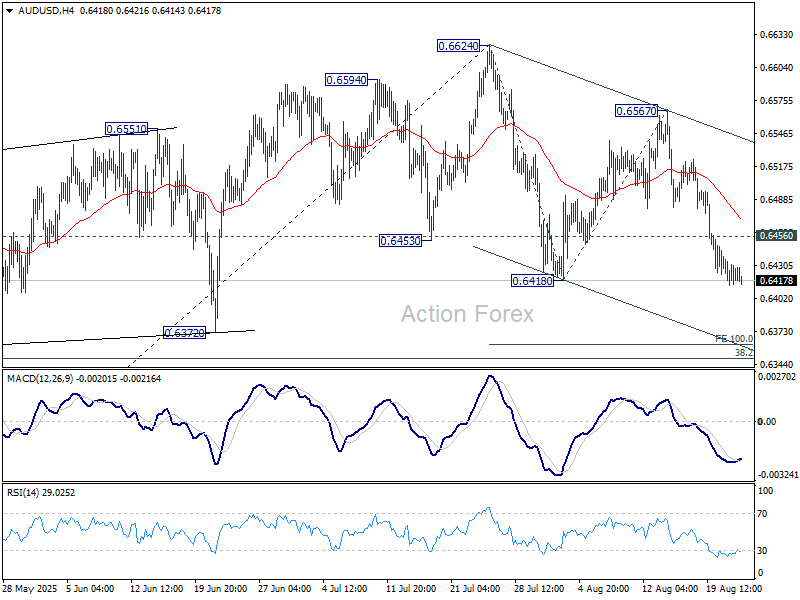
In the bigger picture, there is no clear sign that down trend from 0.8006 (2021 high) has completed. Rebound from 0.5913 is seen as a corrective move. While stronger rally cannot be ruled out, outlook will remain bearish as long as 38.2% retracement of 0.8006 to 0.5913 at 0.6713 holds. Nevertheless, considering bullish convergence condition in W MACD, even in case of another fall through 0.5913, downside should be contained above 0.5506 (2020 low).
GBP/USD Daily Outlook
Daily Pivots: (S1) 1.3384; (P) 1.3434; (R1) 1.3462; More...
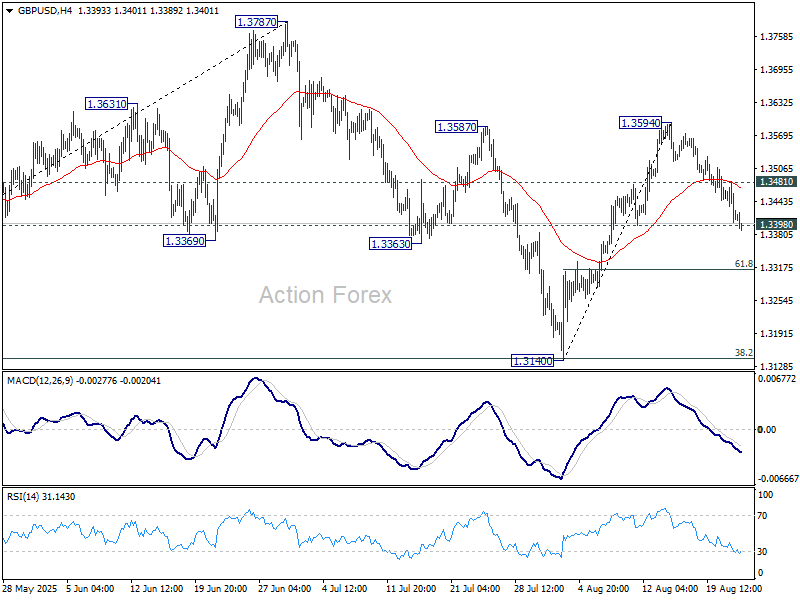
GBP/USD's breach of 1.3398 support suggests that rebound from 1.3140 might have completed at 1.3594 already. Intraday bias is back on the downside, for 61.8% retracement of 1.3140 to 1.3594 at 1.3313. Firm break there will bring retest of 1.3140 low. On the upside, above 1.3481 minor resistance will bring retest of 1.3594 first. Overall, corrective pattern from 1.3787 is extending.
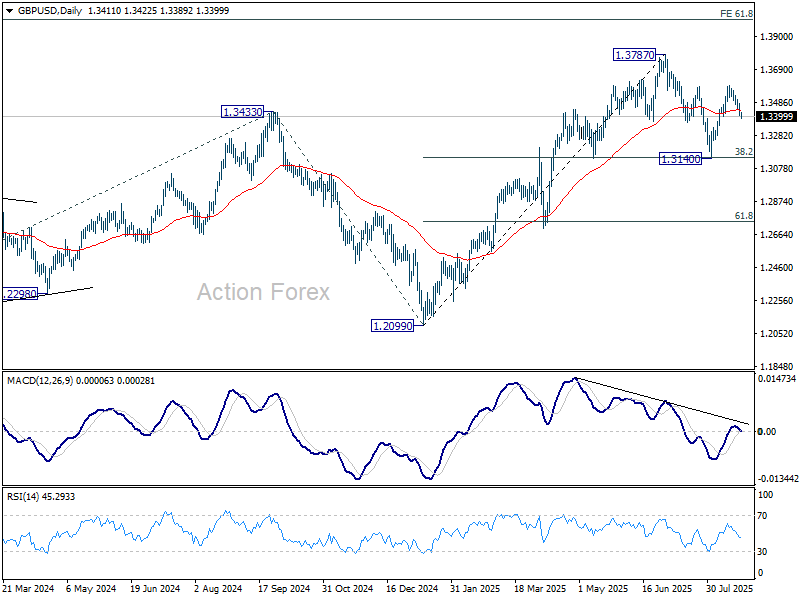
In the bigger picture, up trend from 1.3051 (2022 low) is in progress. Next medium term target is 61.8% projection of 1.0351 to 1.3433 from 1.2099 at 1.4004. Outlook will now stay bullish as long as 55 W EMA (now at 1.3090) holds, even in case of deep pullback.
USD/CHF Daily Outlook
Daily Pivots: (S1) 0.8050; (P) 0.8071; (R1) 0.8109; More….
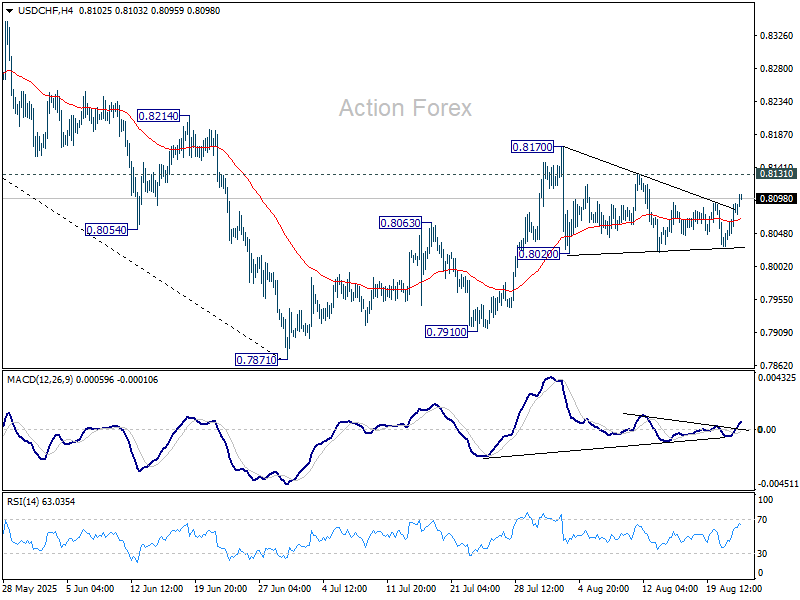
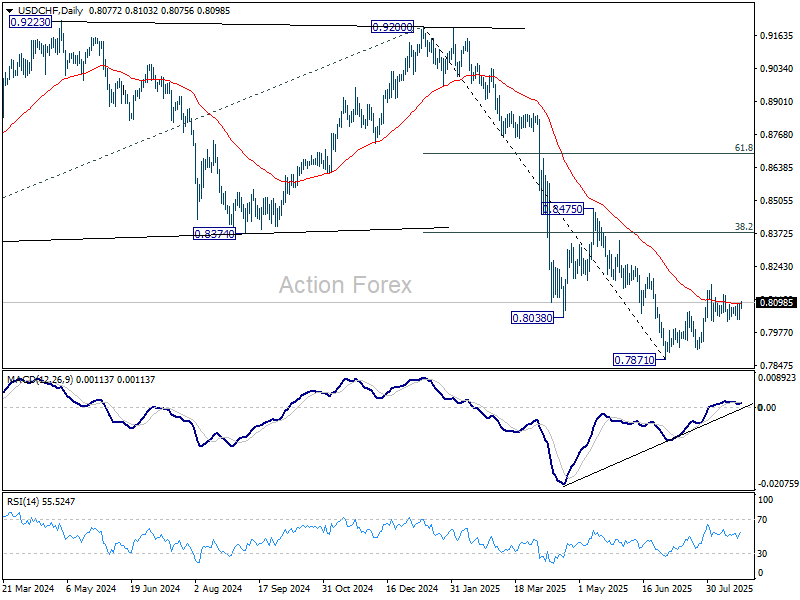
USD/CHF is still kept in range despite today's rebound. Intraday bias stays neutral. On the upside, firm break of 0.8131 resistance will argue that consolidation from 0.8170 has already completed. Bias will be back on the upside. Further break of 0.8170 will resume the rise from 0.7871 towards 38.2% retracement of 0.9200 to 0.7871 at 0.8379. On the downside, break of 0.8020 support will bring retest of 0.7871 support.
In the bigger picture, long term down trend from 1.0342 (2017 high) is still in progress. Next target is 100% projection of 1.0146 (2022 high) to 0.8332 from 0.9200 at 0.7382. In any case, outlook will stay bearish as long as 0.8475 resistance holds.
EUR/USD Drifting Below 1.16 Big Figure
Markets
With markets counting down to Jackson Hole, US data yesterday didn’t provide much need for Fed Chair Powell to commit to any aggressive further policy easing already at this stage. US jobless claims and the Philly Fed Business outlook were a bit softer than expected but that was more than counterbalanced by a big beat in the US August PMI. With the composite measure PMI at 55.4, US business activity grew at the fastest pace this year and suggests strong Q3 growth (S&P global sees it consistent with 2.5% annualized growth). Solid growth was seen both for services activity (55.4) and manufacturing (53.3, 39 month high), also resulting in strong job creation. The report mentions tariffs as a key driver of further costs increases, both for the services and the manufacturing sector. The report concludes that “combined with the upturn in business activity and hiring, the rise in prices signaled by the survey puts the PMI data more into rate hiking, rather than cutting, territory according to the historical relationship between these economic indicators and FOMC policy changes”. The US yield curve bear flattened with yields adding between 4.6 bps (2-y) and 2.2 bps (30-y). Also Fed’s Goolsbee in a Bloomberg interview at least showed some concerns on the recent up-tick in services inflation. After a less impressive (but still decent) EMU PMI, German yields added 3-4 bps across the curve. EUR/USD initially however in the mid 1.16 area, but the dollar finally took the lead after the PMI’s (EUR/USD close 1.1606, DXY 98.62). The strong PMI report didn’t help US equities with major indices again easing 0.35/0.50%. Oil trended higher (Brent $67.6/b).
Asian equities are trade mixed this morning. The dollar extends yesterday rebound with EUR/USD drifting below the 1.16 big figure as markets are looking for more specific guidance on Fed policy from Powell’s Jackson Hole speech (4pm CET). The WSJ suggests that the core of Powells speech might be the Fed Chair commenting the conclusions of the 5-year review of the Fed policy framework. The previous review was mainly focused on issues related to policy efficacy in a context of (too) low inflation and near zero policy rates. Amongst others, that review included an approach allowing a temporary overshoot of the 2% target. As such, changes/a reversal in the longer-term policy framework shouldn’t have too much impact on day-to-day policy. Still, a return to more balanced 2% inflation targeting contains somewhat of a more hawkish message. If the Fed Chair touches on short-term policy, we also expect him to hold to a guarded, data-dependent approach. In such a scenario, markets might turn more cautious on the chances for a September Fed rate cut. (currently 70 % discounted). It could support the recent USD rebound. EUR/USD might correct somewhat further south in the EUR/USD 1.18/1.14 trading range. It’s too early to draw any conclusions on the established USD downtrend yet.
News & Views
National Japanese inflation numbers for July printed broadly in line with expectations. Both headline and core CPI (ex fresh food) rose by 0.1% M/M with both annual readings slowing from 3.3% Y/Y to 3.1% Y/Y. Stripping out energy as well, inflation held steady at 3.4% Y/Y. Services inflation also matched June’s pace at 1.5% Y/Y. Sticky Japanese inflation above the BoJ’s 2% inflation target suggest that the central bank might be lured into continuing its normalization (hiking) cycle at the October 30 policy meeting, when new quarterly projections will be released. Japanese money markets currently see a 50/50 chance of that happening.
Market research firm GfK’s UK consumer confidence indicator rose from -19 in July to -17 in August, its best outcome since December. Especially household sentiment over personal finances improved (both last 12 months as next 12 months) with the Bank of England’s latest rate cut contributing to the improving mood. GfK commented that there’s no sense yet that consumer confidence is about to break out into fresher, more optimistic territory. It’s more wait-and-see with rising inflation and potential tax increases in the autumn budget being downside risks in the (near) future....
All Eyes on Powell
Selling pressure across most major US and European indices continued yesterday. Tensions between Russia and Ukraine persist with mutual attacks, while hawkish risks to the market’s recent dovish Federal Reserve (Fed) narrative persist. Weekly jobless claims and the Philadelphia Fed survey were broadly consistent with concerns over a slowing labour market and lingering price pressures. The Fed minutes earlier this week showed that members remain more concerned about inflation risks than about labour market softening. Although the meeting took place just before the latest volatility around the August employment report, several policymakers reiterated a cautious stance toward immediate rate cuts. The doves are no longer certain that the Fed will cut rates in September. Market pricing now implies around a 75% probability of a 25bp cut, down from near certainty last week when some even considered 50bp cuts.
Inflation vs Jobs: a fine balance. The three-month average job gains in the US dropped from around 150K to just 35K, raising concerns that cracks are emerging in the US labour market following the August jobs report. The story has shifted from “the US job market remains resilient despite trade and AI risks” to “the Fed may be falling behind.” On inflation, CPI data suggested consumer prices remain contained, but PPI reflected tariff-driven cost pressures. US retail earnings added nuance: consumers are shifting toward discount stores and smaller-ticket purchases. While overall demand appears intact, Walmart noted tariff-related pricing effects, restocking with higher-priced goods — a trend that could soon filter into CPI.
This leaves the Fed balancing competing priorities. On one side, the administration — including President Trump — has been pushing for lower rates to cushion the jobs impact of trade tensions. On the other, policymakers remain wary of stoking inflation amid tariff pass-throughs. In theory, inflation should take precedence, yet cracks in the jobs data complicate the picture.
That’s why attention now turns to Powell’s speech at Jackson Hole. While he may stick to a “data dependent” message, the venue has historically hosted major policy shifts. Markets are alert to any surprise, and there is a greater chance that we will see a hawkish surprise than the contrary.
A cautiously hawkish tone from Powell could further unwind the market’s extra-dovish positioning. That could mean a rebound in US 2-year yields, pressure on the S&P 500, a stalling of the small-cap rally, and renewed strength in the US dollar. Rising global yields — notably in long-maturity JGBs — add to the risk of a broader selloff if Powell strikes a firmer line.
For now, USDJPY is stable, the dollar has firmed ahead of Powell’s remarks, and EURUSD has slipped below its 50-day moving average. The pair looks heavy after this week’s decline. Meanwhile, euro area manufacturing PMI printed above 50 for the first time in more than three years, driven by new orders — possibly reflecting easing trade uncertainty and tariff clarity. Progress in US–EU trade discussions and the expected boost from military spending also brighten Europe’s growth outlook. That said, stronger activity could complicate the European Central Bank’s (ECB) ability to justify further cuts. For now, the ECB is likely to sit out September, and possibly drop the idea of another cut, if tariff impacts prove less severe than feared.
The Stoxx 600 has erased tariff-led losses and is advancing toward new highs, making it a favoured vehicle for investors diversifying away from US tech. But the euro, which has gained on military spending narratives and broad dollar weakness, may be nearing a peak if US dollar demand revives this fall on a hawkish Fed turn. Powell’s speech at Jackson Hole will be decisive — and markets will be listening closely.
Markets Eye Powell’s Speech in the Afternoon
In focus today
The Fed's Jackson Hole Symposium continues today and tomorrow. Today's highlight will be Fed Chair Powell's speech. Last year, Powell provided strong guidance that rate cuts were set to begin soon. This time, markets are again expecting the Fed to cut rates in September, but the direction of travel is arguably less clear, not least given the two-sided tariff risks and Trump's attempts to influence the decision-making.
In the euro area, focus turns to the negotiated wage growth indicator released by the ECB. Declining wage growth is the biggest downside risk to our call for the ECB holding rates steady for the rest of the year. The negotiated wages indicator will show how the collective bargaining part of wages fared in Q2.
The Swedish labour market statistics for July, including Statistics Sweden's official estimate of the unemployment rate, will be released today. We expect the unemployment rate to print at 8.6%, up from 8.3% in June. The weekly labour market statistics have been weak for a while and especially so in July. The stubbornly weak Swedish labour market remains one of the Riksbank's cyclical concerns and today's figure is at least of some importance for the Board.
Economic and market news
What happened overnight
In Japan, core inflation slowed modestly in July to 3.1% y/y (cons: 3.0%) from 3.3% in June. Inflation continues to be above the Bank of Japan's 2% target, although primarily driven by rising food prices and new energy subsidies. Excluding food, alcoholic beverages and energy, inflation remained steady at 1.6% y/y.
What happened yesterday
In the trade war, the EU and US have now formally made a trade deal. The deal is very similar to what has been communicated previously, with a 15% tariff rate for the vast majority of EU exports, applying across most sectors, including cars, semiconductors and pharmaceuticals. Zero-for-zero tariffs on a number of strategic products, including all aircraft and component parts, certain chemicals, certain generics, semiconductor equipment, certain agricultural products, natural resources and critical raw materials. Additionally, EU companies are to invest USD 600bn in strategic sectors in the US through 2028 and to buy USD 750bn in energy products.
In the US, flash PMIs for August came in stronger than expected. Manufacturing rose to 53.3 (cons: 49.7) from 49.8 and services fell to 55.4 (cons: 54.2) from 55.7. The increase in manufacturing was due to higher new orders, employment, and output index. The output index is at the highest level in more than three years. Hence, the details are very strong.
In the euro area, August PMIs were also a positive surprise with the composite measure rising to 51.1. (cons: 50.6) from 50.9 due to a rise in manufacturing while services declined. This is a milestone for the euro area manufacturing sector as it recorded growth for the first time in more than three years with the PMI rising above the 50-mark to 50.5 (cons: 49.5) from 49.8. The rise was due to a rise in new orders and output. While services PMI declined to 50.7 (cons: 50.8) from 51.0, it is still a strong report overall.
We expect the ECB to have concluded its cutting cycle and leave the deposit rate unchanged at 2% while markets are still pricing a risk of a final cut from the ECB in the coming six months. With today's stronger data, the risk of a final "insurance cut" has declined. A continued weakening of the services sector in the coming months is the main risk factor for a final ECB rate cut in our view.
Consumer sentiment declined unexpectedly in August to -15.5 from -14.7 (cons: -14.7). Consumers are likely reacting negatively to higher food prices as food inflation has increased by one percentage point since January, even though food is only a minor part of private consumption. The weak confidence should dampen growth in private consumption despite a strong labour market and rising real incomes.
In Denmark, consumer sentiment continued to decline to -17.2 from -15.7. This development is driven by a worsening view of both the private and nationwide economies. Inflationary fears continue to plague consumers as food prices, in particular, have continued to increase over the summer. At the same time the Danish stock market has experienced multiple large downturns, which are not improving sentiment either.
In Norway, Q2 mainland GDP growth came in significantly stronger than expected at +0.6% q/q (cons: 0.3%). Looking at the details, the surprise was mostly driven by mainland exports at +4.2% q/q which is probably a one-off. Private consumption grew 0.2%, residential investments were the biggest domestic surprise climbing 4.0% and private investments up 2.2% after a drop in Q1. All in all, a stronger report than we had expected, but weaker than headlines suggest.
Norges Bank published the Expectations Survey for Q3. Both inflation expectations and wage expectations were slightly below the Expectations Survey for Q2 and below Norges Bank's projections in its June Monetary Policy Report. Overall, a report clearly to the soft side - especially given the GDP surprise in the morning.
In the UK, stronger than expected PMIs added to a hawkish data streak. Composite increased to 53.0 (cons: 51.6), based on much stronger-than-expected services PMI of 53.6 (cons: 51.8), while manufacturing PMI went lower to 47.3 (cons: 48.3). The case for an unchanged Bank of England rate decision in November has strengthened, although we have a lot of incoming data before then.
Equities: Equities took another small step lower yesterday, with Europe outperforming the US, volatility ticking up (VIX higher), and Tech lagging. At first glance, the picture resembled yet another day of rotation into defensives, but that would be an over-simplification. Yesterday's session was not just a sector rotation story. Macro data were abundant, and on balance they surprised to the stronger side. Hence, this should all else equal have led to cyclical outperformance. but energy and commodities led the outperformance. Across assets, yields moved higher, the dollar gained, gold eased, and oil rose - altogether resembling elements of a stagflationary rotation. Some growth indicators were soft, while price components came in firm. Hence, the inflationary/stagflationary trend somewhat justifiable but then again US small caps outperformed, with the Russell 2000 closing higher, underlining the unusual aggregation of market moves.
In the US yesterday, Dow -0.3%, S&P 500 -0.4%, Nasdaq -0.3% and Russell 2000 +0.2%.
This morning paints a similar picture: Asia trading is mixed, and both European and US futures are essentially flat - markets sitting in wait-and-see mode ahead of Jackson Hole and Chair Powell's speech later today.
FI and FX: Rates moved higher across regions as PMI data for US, UK and the euro area came in stronger than expected. EUR/USD slipped to the 1.16 mark, while EUR/GBP continued trading within a narrow range near 0.865. Yesterday's upside surprise in Norwegian GDP figures for Q2 added significant upward pressure on NOK swap rates, while EUR/NOK dropped 1% to 11.8. The PMI data added upward pressure on oil prices with Brent trading 1.75% higher at USD67.7/bbl. this morning.
USD/JPY Daily Outlook
Daily Pivots: (S1) 147.62; (P) 148.01; (R1) 148.78; More...
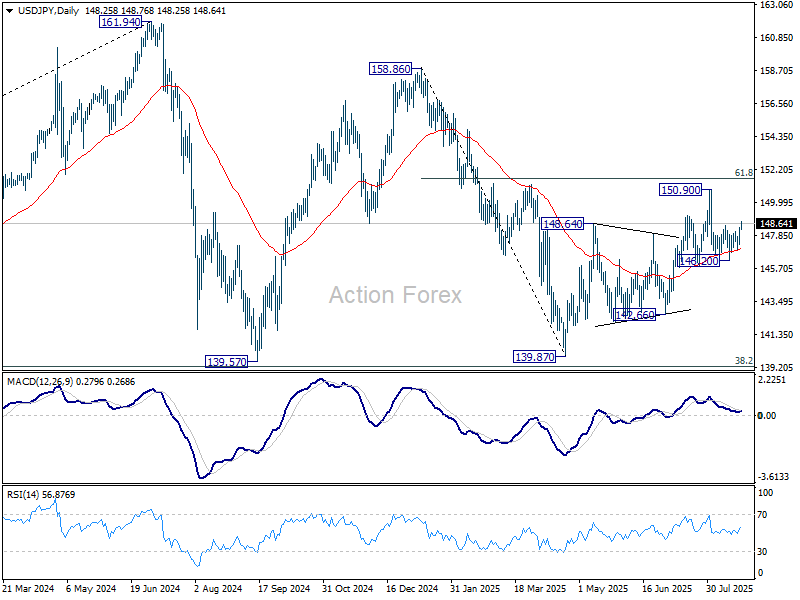
USD/JPY's break of 148.51 resistance suggests that correction from 150.90 has already completed at 146.20. Larger rebound from 139.87 should still be in progress. Intraday bias is back on the upside for 150.90 first. Firm break there will target 151.22 fibonacci level next.
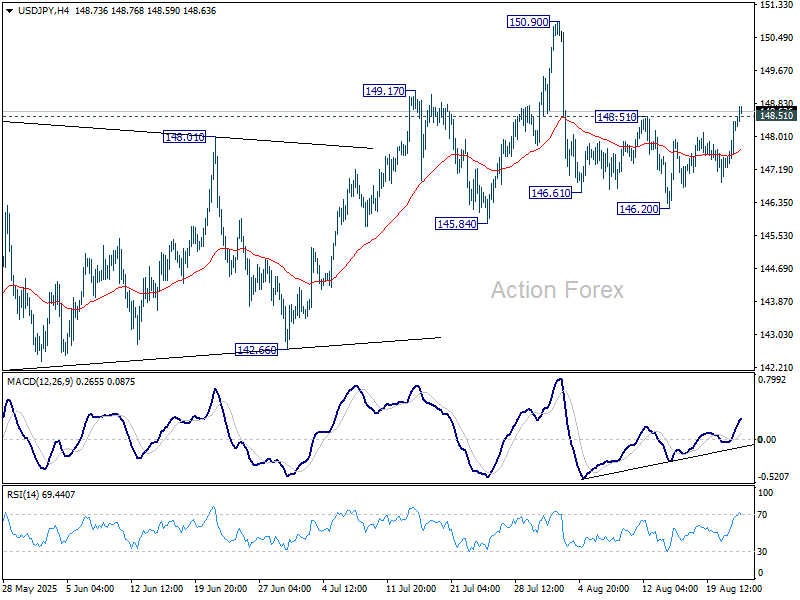
In the bigger picture, price actions from 161.94 (2024 high) are seen as a corrective pattern to rise from 102.58 (2021 low). Decisive break of 61.8% retracement of 158.86 to 139.87 at 151.22 will argue that it has already completed with three waves at 139.87. Larger up trend might then be ready to resume through 161.94 high. In case the corrective pattern extends with another fall, strong support is expected from 38.2% retracement of 102.58 to 161.94 at 139.26 to bring rebound.