Sample Category Title
UK GDP Grows 0.1% MoM in May as Services Offset Weak Production and Construction
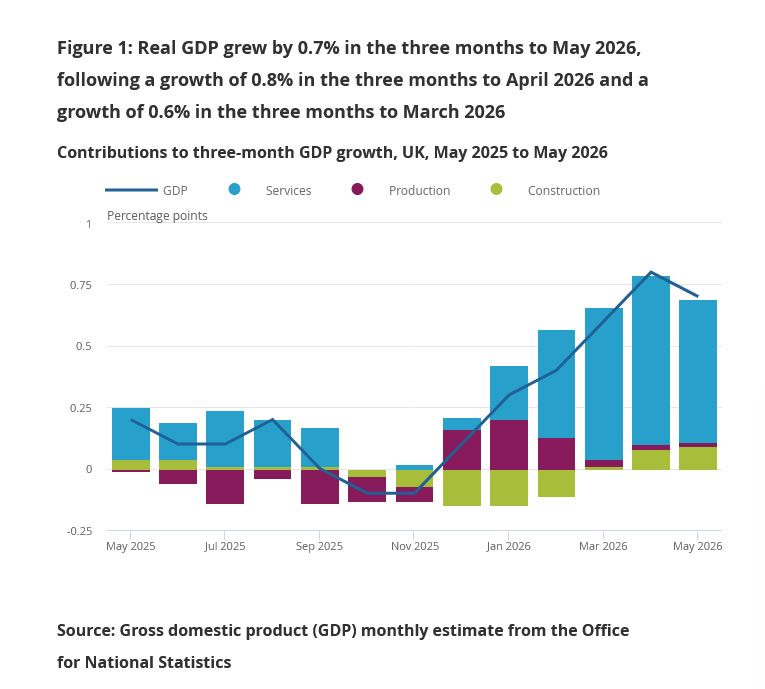
The UK economy returned to modest growth in May, with GDP rising 0.1% month-on-month after a -0.1% contraction in April, slightly exceeding expectations for a flat reading. The data suggest the economy regained some momentum after a soft start to the second quarter, although the recovery remains uneven beneath the headline. Growth was driven almost entirely by the services sector, while both production and construction continued to weigh on overall activity.
Services output rose 0.3% mom in May, reversing April's modest decline, with seven of the fourteen subsectors expanding during the month. The sector continues to provide the principal source of support for the economy, highlighting the resilience of consumer-facing and business services despite a backdrop of elevated interest rates and global uncertainty.
In contrast, production fell -0.5% mom, led by a sharp -4.6% decline in mining and quarrying alongside weakness in utilities and waste management. Manufacturing provided a rare bright spot, edging up 0.1% and preventing an even steeper decline in industrial output. Construction activity also weakened, falling -0.8% mom after a revised 0.1% decline in April, suggesting higher borrowing costs continue to restrain investment and building activity.
The broader trend nevertheless remains constructive. Over the three months to May, GDP expanded 0.7%, following growth of 0.8% in the previous three-month period. Services remained the primary growth engine with a 0.7% increase, while construction posted a solid 1.6% rise despite recent monthly weakness. Production also managed a modest 0.1% gain over the period.
Taken together, the figures point to an economy that continues to grow, albeit at a moderate pace and with an increasingly uneven sectoral mix. The resilience of services is helping offset ongoing weakness in more cyclical industries, suggesting the UK expansion remains intact but far from broad-based.
Economic Data
| Indicator | Actual | Expected | Previous |
|---|---|---|---|
| GDP (May MoM) | 0.1% | 0.0% | -0.1% |
| Services Output (MoM) | 0.3% | — | -0.1% |
| Production Output (MoM) | -0.5% | — | 0.2% |
| Manufacturing Output (MoM) | 0.1% | — | 0.0% |
| Construction Output (MoM) | -0.8% | — | -0.1% |
| GDP (3M/3M) | 0.7% | — | 0.8% |
| Services Output (3M/3M) | 0.7% | — | 0.9% |
| Production Output (3M/3M) | 0.1% | — | 0.1% |
| Construction Output (3M/3M) | 1.6% | — | 1.3% |
Key Takeaways
- UK GDP returned to growth in May, rising 0.1% mom after April's 0.1% contraction, modestly beating expectations.
- The recovery was entirely service-led, with services output rising 0.3%, while production and construction both contracted.
- Production fell -0.5%, largely due to sharp declines in mining & quarrying (-4.6%) and utilities. Manufacturing edged up just 0.1%.
- Construction declined -0.8%, marking a second consecutive monthly fall and pointing to continued weakness in investment-related activity.
- Despite softer monthly readings in production and construction, the broader trend remains positive, with GDP expanding 0.7% over the three months to May.
- The data suggest the UK economy continues to grow at a modest pace, but the expansion remains narrowly driven by services rather than broad-based across sectors.
EUR/GBP and GBP/CHF Channel Breakouts as Burnham’s Cabinet Choice Signals Fiscal Discipline
Sterling extended its rally after reports that incoming Prime Minister Andy Burnham has decided on a fiscally conservative Chancellor. The Pound outperformed broadly, with the strongest gains seen against the Euro and Swiss Franc as both EUR/GBP and GBP/CHF broke out of established technical channels, suggesting investors are beginning to price a more durable revaluation of UK assets rather than merely covering short positions.
The catalyst was a Financial Times report, later corroborated by Reuters, that Burnham has settled on Home Secretary Shabana Mahmood as Chancellor of the Exchequer, with one source describing the appointment as "nailed down." Formal cabinet appointments are expected on Monday when Burnham succeeds Keir Starmer as Prime Minister. Although Mahmood has built her political profile primarily on domestic issues rather than economic policymaking, markets appear to be focusing less on her experience than on what her appointment signals about Burnham's governing philosophy.
Until recently, investors had worried that Burnham, whose political roots lie in Labour's soft-left tradition and mayoral politics, might pursue a looser fiscal agenda once in office. Those concerns had supported a modest political risk premium in Sterling during the leadership contest. The Makerfield by-election largely removed uncertainty over who would become Prime Minister, but it did not resolve uncertainty over how the new government would govern.
The expected choice of Mahmood appears to answer that question. Compared with Ed Miliband, who had long been viewed as the frontrunner for Chancellor and whose association with expansive industrial and net-zero policies had unsettled parts of the business community, Mahmood is regarded as representing a more centrist and fiscally disciplined approach. Investors are therefore interpreting the appointment as an early indication that fiscal credibility will remain a cornerstone of the new government.
That distinction matters because currency markets generally respond more to expected fiscal settings than political personalities. Expectations of tighter control over public finances improve confidence in the outlook for government borrowing, gilt issuance and longer-term debt sustainability. In that sense, the Chancellor announcement would represent a more concrete market signal than Burnham's leadership victory itself.
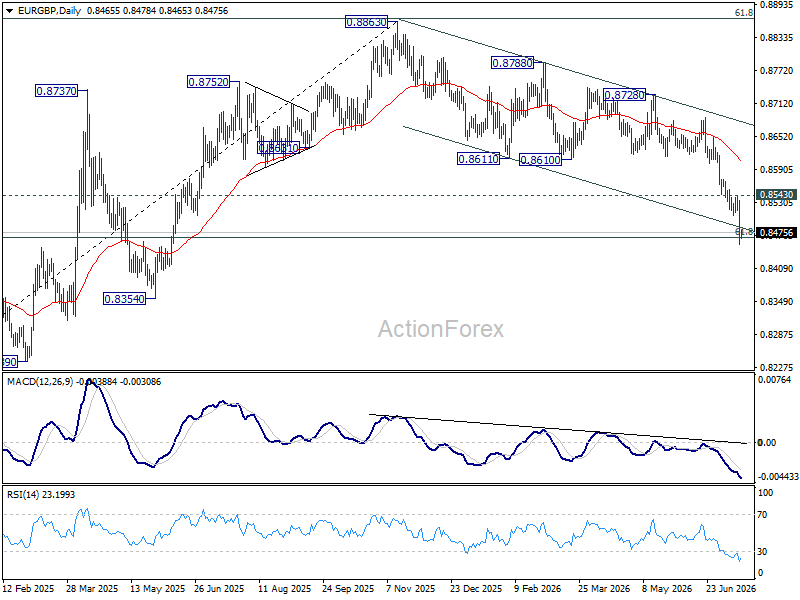
The technical picture reinforces that fundamental shift. EUR/GBP resumed its decline from 0.8863 and broke below its near-term falling channel, indicating that downside momentum is accelerating. The cross is now testing the key 61.8% retracement of 0.8221 (2024 low) to 0.8863 (2025 high) at 0.8466. A sustained break there would strengthen the case for a medium-term move back toward the 2024 low at 0.8221.On the upside, above 0.8543 resistance will bring consolidations first. But recovery should be limited below 0.8610 support turned resistance to bring another fall.
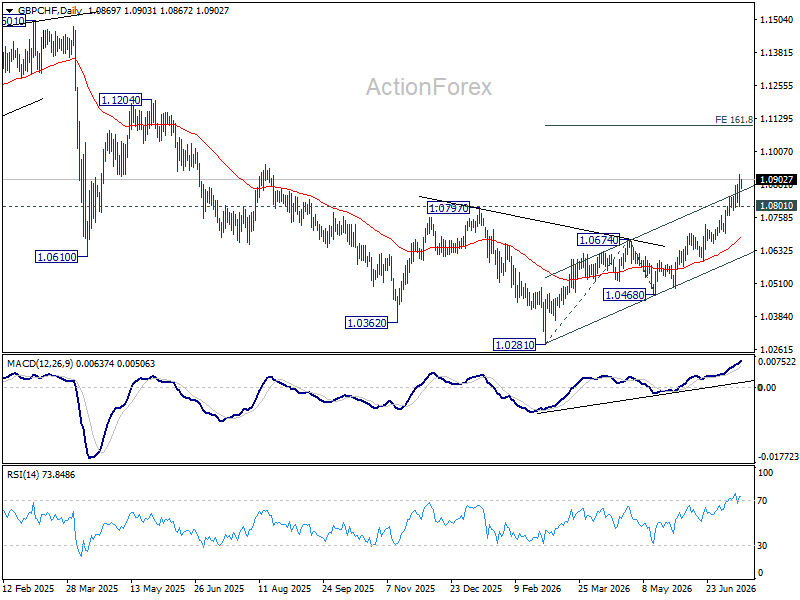
GBP/CHF is delivering a similarly constructive signal. The cross has broken above the upper boundary of its rising channel, suggesting that the uptrend is entering a stronger acceleration phase. The next objective lies at 161.8% projection of 1.0281 to 1.0674 from 1.0468 at 1.1104. On the downside, below 1.0801 support will bring consolidations first. But pullback should be contained above 1.0674 resistance turned support to bring another rise.
Together, the technical breakouts across both crosses suggest Sterling's rally is evolving from a simple unwinding of political uncertainty into a broader repricing of UK fiscal credibility that could extend through the third quarter as Burnham's cabinet and policy agenda become clearer.
WTI Crude Oil Meets a Tough Barrier—Can Bulls Hold on?
Key Highlights
- WTI Crude Oil started a fresh rally above $76 and $78.
- A key bullish trend line is forming with support at $72.80 on the 4-hour chart of XTI/USD.
- Gold could attempt a recovery if it surpasses the $4,120 resistance.
- EUR/USD seems to be consolidating above the 1.1350 support.
WTI Crude Oil Price Technical Analysis
WTI Crude Oil prices started a steady increase above $75 against the US Dollar. The price cleared key hurdles near $76 and $78 to enter a positive zone.
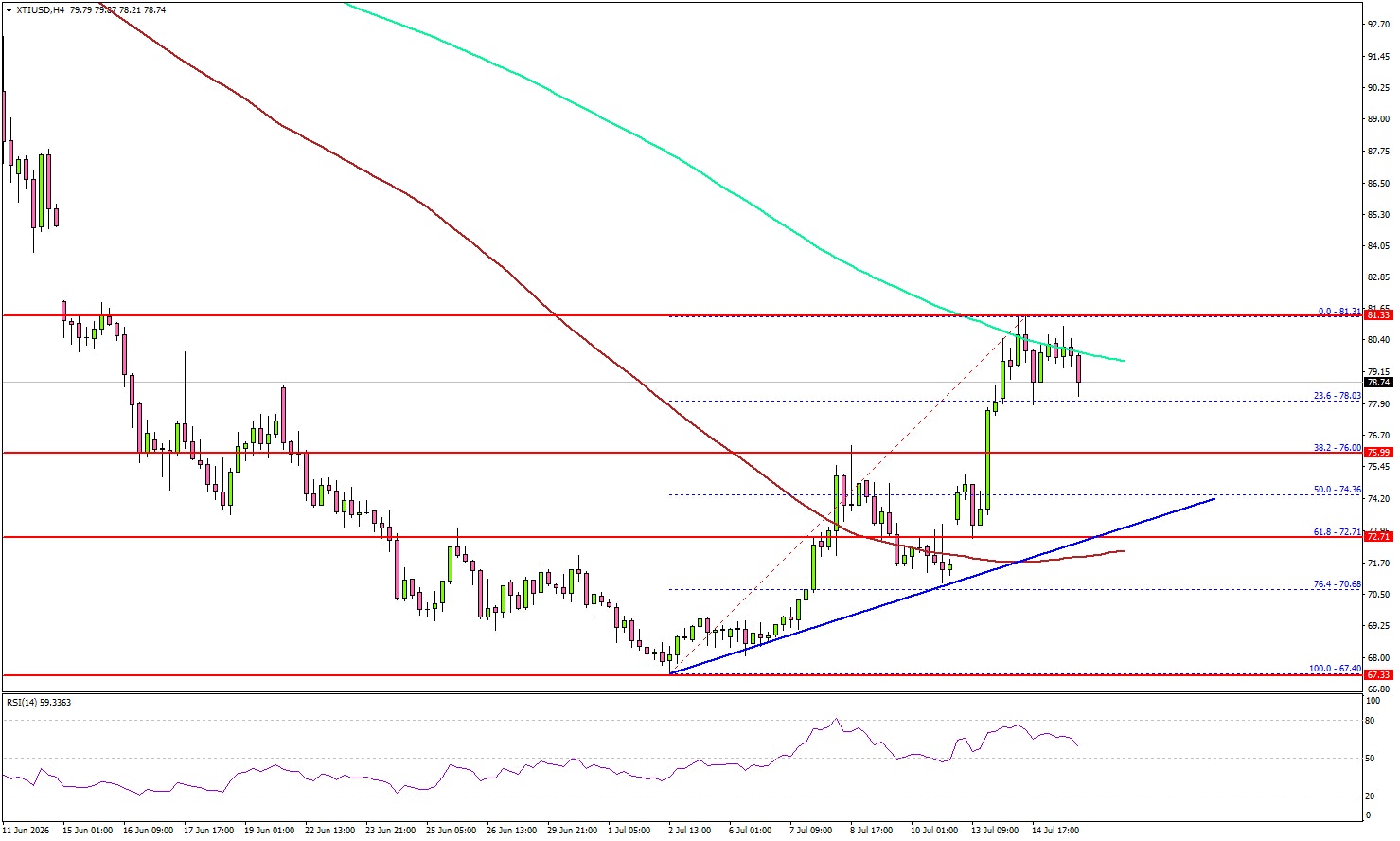
Looking at the 4-hour chart of XTI/USD, the price settled above $76.50 and the 100 simple moving average (red, 4-hour). However, the bears seem to be active near the $81.40 zone and the 200 simple moving average (green, 4-hour).
On the downside, the first major support could be near the $76.50 zone. The next support might be $74.50 or the 50% Fibonacci retracement level of the upward move from the $67.40 swing low to the $81.31 high.
The main support could be near a bullish trend line at $72.80 and the 100 simple moving average (red, 4-hour), below which the price could dive and test $70. A daily close below $70 could open the doors for a larger decline. In the stated case, the bears might aim for a drop toward $65.
On the upside, the price could face resistance at $81.50. The next resistance might be $84.00. The first key hurdle for the bulls could be $85.00. A close above $85.00 might send Oil prices toward $88.00.
Looking at Gold, the price might attempt a recovery wave, but it must settle above $4,120 to continue higher.
Economic Releases to Watch Today
- US Initial Jobless Claims - Forecast 217K, versus 215K previous.
- US Retail Sales March 2026 (MoM) – Forecast +0.2%, versus +0.9% previous.
Fed Beige Book: Economy Expands as Price Growth Slows Across Districts
The Federal Reserve's latest Beige Book painted a picture of an economy that continues to expand while inflation pressures become less widespread, broadly reinforcing the recent message from softer CPI and PPI reports. Economic activity increased at a "slight to moderate pace" in eleven of the twelve Federal Reserve Districts, with contacts generally expecting growth to continue in the months ahead despite elevated uncertainty surrounding fuel costs. Consumer spending edged higher, although several Districts reported that rising fuel prices were weighing on discretionary purchases as households increasingly traded down to cheaper alternatives.
Labor market conditions also remained broadly stable. Employment increased on balance, with five Districts reporting modest to solid hiring gains compared with just one in the previous survey. Wage growth was described as "modest to moderate," while skilled workers continued to be difficult to find in areas such as manufacturing, construction and technical trades. Manufacturers reported modest to moderate production growth, supported by strong demand from data centers, machinery and defense industries, although supply chain disruptions became somewhat more common.
The inflation picture was more encouraging. The Beige Book noted that prices increased at a moderate pace overall, but importantly, "price growth was the same or slower in all Districts" compared with the previous reporting period. Businesses continued to cite higher energy, transportation and raw material costs linked to the Middle East conflict and tariffs, yet several contacts also reported that selling prices were rising more slowly than input costs, squeezing profit margins. While some Districts still expect inflation to remain elevated, others anticipate further moderation as fuel prices ease.
Together with this week's CPI and PPI reports, the Beige Book suggests inflation pressures had continued to cool through late June, although the renewed surge in oil prices means that assessment could face an early test in the months ahead.
Silver (XAG/USD) Elliott Wave Structure Downside Bias Holds While Under $63
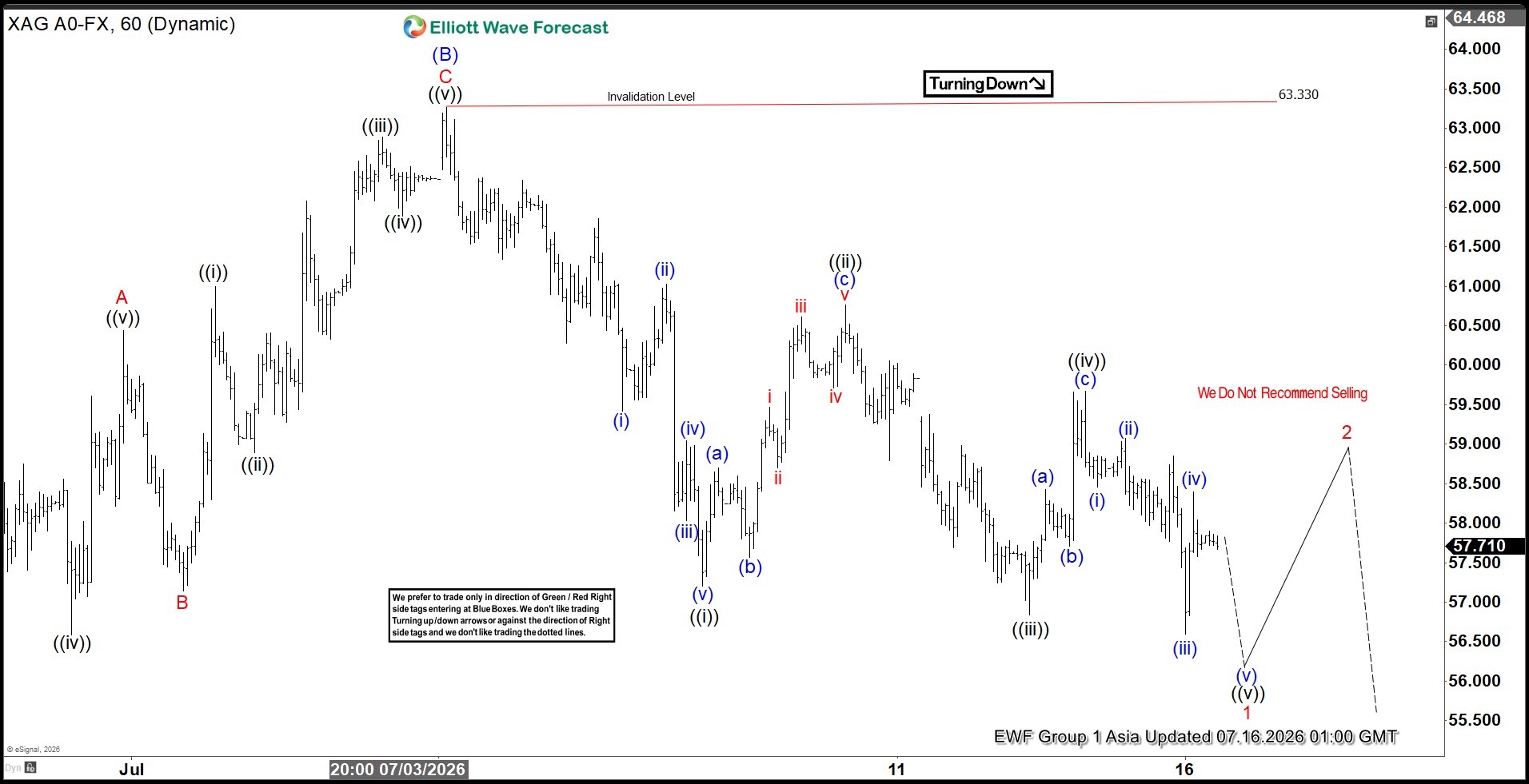
Since forming the all‑time high at $121.6 on January 29, 2026, Silver (XAG/USD) has entered a pronounced correction. The decline has unfolded with a clear Elliott Wave structure, and the ideal extreme target remains the 100% Fibonacci extension at $38.8. Whether this level will ultimately be reached is uncertain, but the broader corrective sequence continues to suggest further downside potential. Short term, the rally to $63.29 marked the completion of wave (B), as illustrated in the one‑hour chart. From that point, the market resumed lower in wave (C), which is progressing with internal subdivision into five waves.
Down from wave (B), wave ((i)) ended at $57.19. A corrective rally in wave ((ii)) terminated at $60.76. The subsequent decline in wave ((iii)) reached $56.84. The rally in wave ((iv)) concluded at $59.67. The structure indicates that wave ((v)) is now approaching completion, which should also finalize the higher degree wave 1 of (C). Once this initial leg is complete, the metal is expected to rally in wave 2, correcting the cycle from the July 6, 2026 high. This correction should unfold in either three or seven swings before the broader decline resumes. In the near term, as long as the pivot at $63.3 remains intact, rallies are expected to fail in corrective sequences. This reinforces the bearish outlook and opens the path for further downside extension.
Silver (XAGUSD) 60-Minute Elliott Wave Chart
XAGUSD Elliott Wave Video:
https://www.youtube.com/watch?v=KiiIU4Zqux8
Eco Data 7/16/26
| GMT | Ccy | Events | Act | Cons | Prev | Rev |
|---|---|---|---|---|---|---|
| 01:00 | AUD | Consumer Inflation Expectations Jul | 4.70% | 5.50% | ||
| 06:00 | GBP | GDP M/M May | 0.10% | 0.00% | -0.10% | |
| 06:00 | GBP | Goods Trade Balance (GBP) May | -18.7B | -23.1B | -26.0B | |
| 09:00 | EUR | Eurozone Trade Balance (EUR) May | -5.0B | 2.8B | -1.3B | 0.8B |
| 12:15 | CAD | Housing Starts Y/Y Jun | 239K | 256K | 261K | 253K |
| 12:30 | USD | Initial Jobless Claims (Jul 10) | 208K | 218K | 215K | 216K |
| 12:30 | USD | Philadelphia Fed Manufacturing Survey Jul | 41.4 | 12.7 | 10.3 | |
| 12:30 | USD | Retail Sales M/M Jun | 0.20% | 0.20% | 0.90% | 1.00% |
| 12:30 | USD | Retail Sales ex Autos M/M Jun | -0.20% | 0.00% | 0.80% | 1.00% |
| 14:00 | USD | Business Inventories May | 0.30% | 0.30% | 0.50% | 0.60% |
| 14:00 | USD | NAHB Housing Market Index Jul | 34 | 35 | 35 | 36 |
| 14:30 | USD | Natural Gas Storage (Jul 10) | 41B | 45B | 61B |
| 01:00 | AUD |
| Consumer Inflation Expectations Jul | |
| Actual | 4.70% |
| Consensus | |
| Previous | 5.50% |
| 06:00 | GBP |
| GDP M/M May | |
| Actual | 0.10% |
| Consensus | 0.00% |
| Previous | -0.10% |
| 06:00 | GBP |
| Goods Trade Balance (GBP) May | |
| Actual | -18.7B |
| Consensus | -23.1B |
| Previous | -26.0B |
| 09:00 | EUR |
| Eurozone Trade Balance (EUR) May | |
| Actual | -5.0B |
| Consensus | 2.8B |
| Previous | -1.3B |
| Revised | 0.8B |
| 12:15 | CAD |
| Housing Starts Y/Y Jun | |
| Actual | 239K |
| Consensus | 256K |
| Previous | 261K |
| Revised | 253K |
| 12:30 | USD |
| Initial Jobless Claims (Jul 10) | |
| Actual | 208K |
| Consensus | 218K |
| Previous | 215K |
| Revised | 216K |
| 12:30 | USD |
| Philadelphia Fed Manufacturing Survey Jul | |
| Actual | 41.4 |
| Consensus | 12.7 |
| Previous | 10.3 |
| 12:30 | USD |
| Retail Sales M/M Jun | |
| Actual | 0.20% |
| Consensus | 0.20% |
| Previous | 0.90% |
| Revised | 1.00% |
| 12:30 | USD |
| Retail Sales ex Autos M/M Jun | |
| Actual | -0.20% |
| Consensus | 0.00% |
| Previous | 0.80% |
| Revised | 1.00% |
| 14:00 | USD |
| Business Inventories May | |
| Actual | 0.30% |
| Consensus | 0.30% |
| Previous | 0.50% |
| Revised | 0.60% |
| 14:00 | USD |
| NAHB Housing Market Index Jul | |
| Actual | 34 |
| Consensus | 35 |
| Previous | 35 |
| Revised | 36 |
| 14:30 | USD |
| Natural Gas Storage (Jul 10) | |
| Actual | 41B |
| Consensus | 45B |
| Previous | 61B |
AUDUSD Wave Analysis
AUDUSD: ⬆️ Buy
– AUDUSD broke resistance level 0.6960
– Likely to rise to resistance level 0.7050
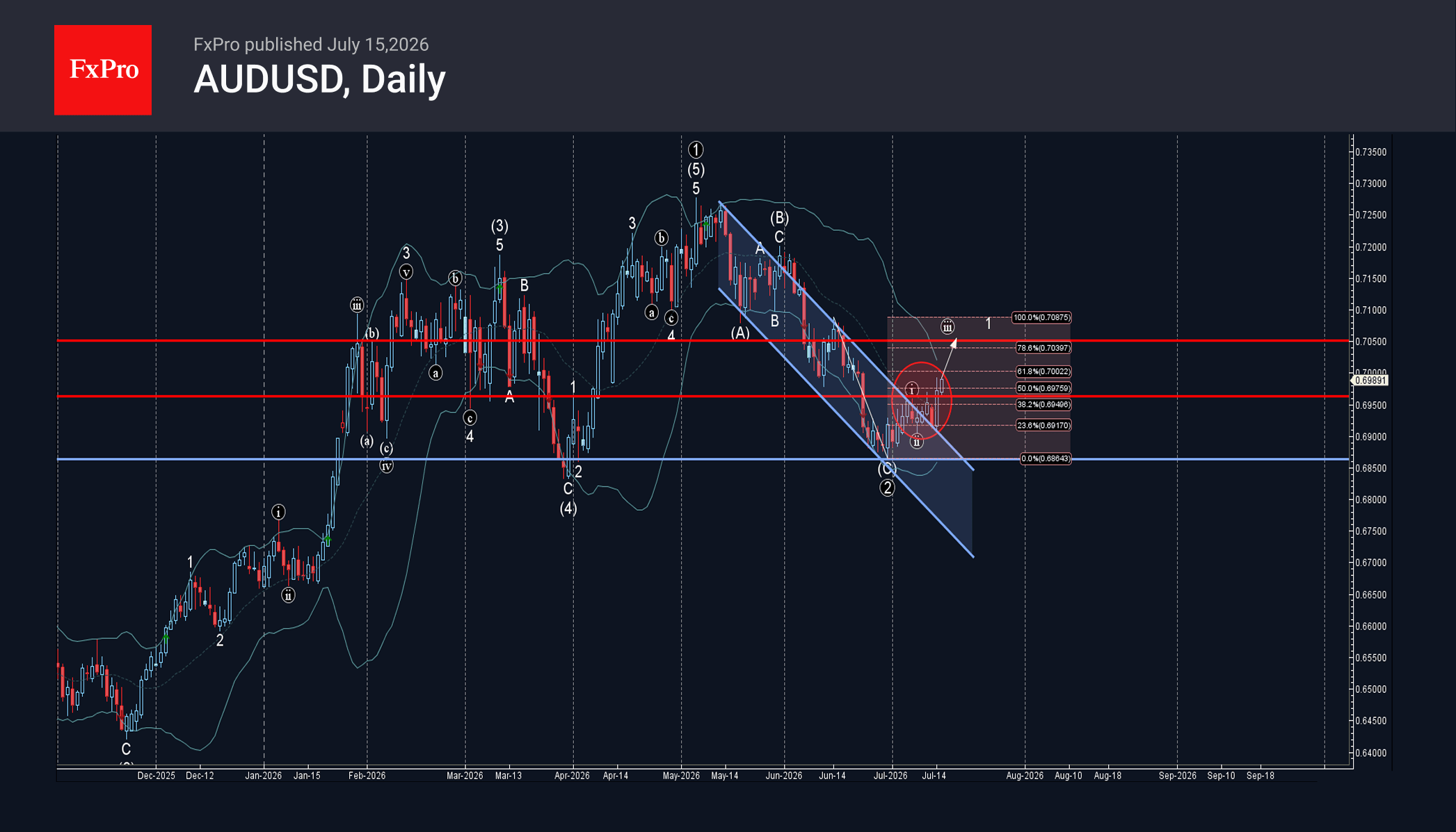
AUDUSD currency pair recently broke resistance level 0.6960 (which stopped earlier minor impulse wave i) interesting with the 50% Fibonacci correction of the downward impulse from June.
The breakout of the resistance level 0.6960 continues the active short-term impulse wave 1 of the impulse sequence (1) from June.
AUDUSD cryptocurrency can be expected to rise to the next resistance level 0.7050, forecast price for the completion of the active impulse wave 3.
Dow Jones Wave Analysis
Dow Jones: ⬆️ Buy
– Dow Jones reversed from support zone
– Likely to rise to resistance level 53500.00
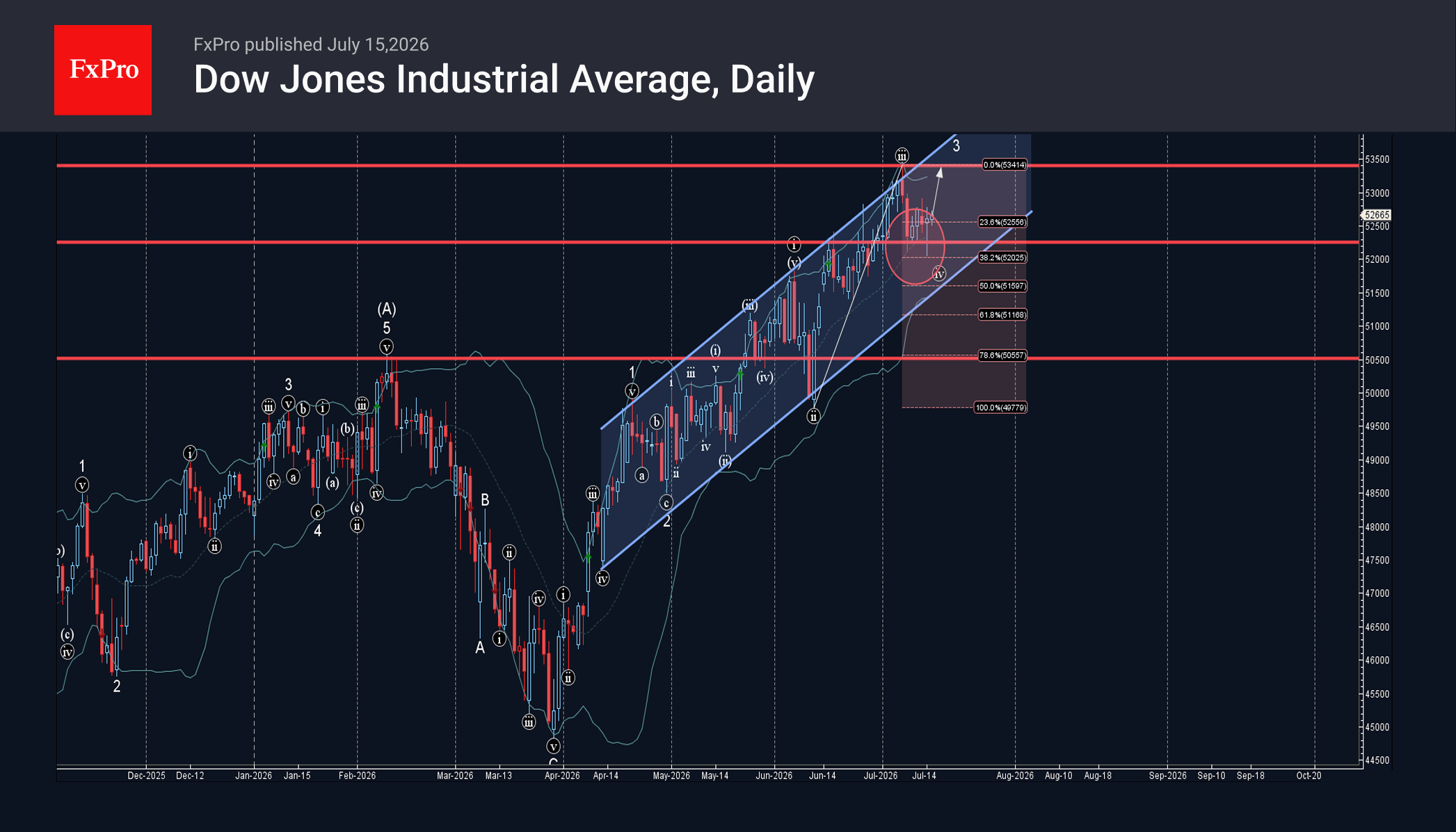
Dow Jones Industrial Average index recently reversed up once again from the support zone between the key support level 52250.00 (former resistance from June), 20-day moving average and the 38.2% Fibonacci correction of the upward impulse from June.
The upward reversal from this support zone created the daily Japanese candlesticks reversal pattern Hammer, which stopped earlier wave iv.
Given the clear daily uptrend, Dow Jones Industrial Average index can be expected to rise to the next resistance level 53500.00 (top of the previous impulse wave iii).
Bank of Canada Holds Rates Unchanged, Points to a Modest Rebound in Activity
- The Bank of Canada (BoC) held its policy rate at 2.25%, in line with market expectations. The opening statement noted that "Canada’s economy is showing signs of improvement".
- The Bank pointed to a modest rebound in activity following the weak start to the year saying that labour market conditions "have remained soft, reflecting ongoing economic slack", while stronger exports, solid consumer spending, and a pickup in business investment are expected to lift second-quarter GDP growth to a "solid" 2.5% quarter-on-quarter (annualized).
- The updated Monetary Policy Report characterized Canada’s growth outlook as “broadly unchanged”. It revised down the near-term growth outlook due to the weak first quarter but expects activity to strengthen through the second half of 2026. Looking further ahead, the Bank projects that "excess capacity to be gradually absorbed", supported by exports, government and consumer spending and a recovery in business investment. At the same time, the MPR continued to emphasize elevated uncertainty surrounding the outlook.
- The Bank also noted that the near-term inflation remains elevated due to earlier increases in energy prices and judges that "higher gasoline prices adds roughly 1.4 percentage points (ppts) to inflation in the second quarter of 2026". In its outlook the Bank assumes some war-related costs pressures are passed through to consumers. These effects have a "peak impact of about 0.4 [ppts] on consumer price index inflation in the first quarter of 2027". The Bank expects CPI to "ease gradually in the coming months, returning to around 2% in early 2027". There continues to be limited evidence of broad-based pass-through into other prices, core inflation remains close to the 2% target, and "longer-term inflation expectations remain well anchored".
- Finally, Governing Council reiterated that monetary policy remains well positioned to respond should the outlook materially change. While downside risks from ongoing U.S. trade uncertainty remain, the Bank continues to stand ready to "adjust monetary policy as needed".
Key Implications
- There were no surprises in today’s decision - the Bank of Canada's message remains one of patience. Compared with June, the Bank struck a modestly more optimistic tone on the economy. Economic activity has improved modestly following a weak first quarter, labour market conditions have been soft, and inflation pressures outside of energy remain well contained.
- If the repeated closures and reopenings of the Strait of Hormuz were not having such real economic consequences, they would rival the FIFA World Cup for drama. The latest blockade has pushed oil prices roughly 10% higher, placing some upside risk to the BoC’s oil price assumption underpinning their forecast. With the economy still operating below capacity, and core inflation remaining close to target, we continue to expect the Bank of Canada to remain on hold through the balance of the year.
ECB Preview: ECB on Hold, but Not for Long
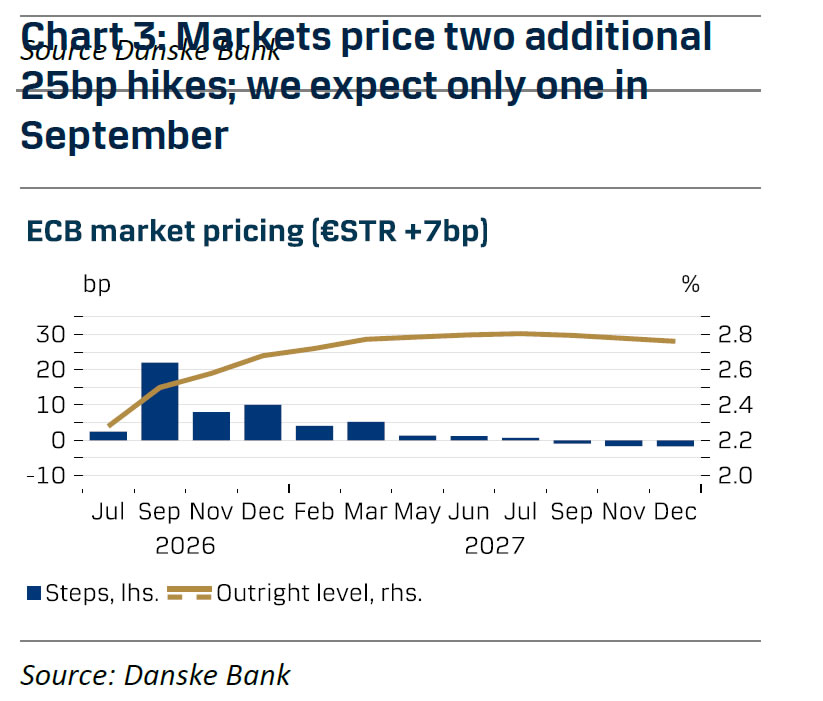
- We expect the ECB to keep policy rates unchanged, with the deposit rate at 2.25%, on Thursday 23 July, in line with consensus and market pricing.
- We expect Lagarde to keep full optionality on the future policy rate path, leaving the door open to a September hike, but without pre-committing.
- We expect a final 25bp hike in September, bringing the deposit rate to 2.50%.
We expect the ECB to leave policy rates unchanged at the July meeting, in line with market pricing and consensus. Since the June meeting, inflation has surprised to the downside, including beyond energy, and near-term oil futures have declined even after the recent end to the ceasefire between the US and Iran. These developments, combined with broadly anchored medium-term inflation expectations, give the ECB the option to wait for new staff projections at the September meeting before potentially hiking policy rates again.
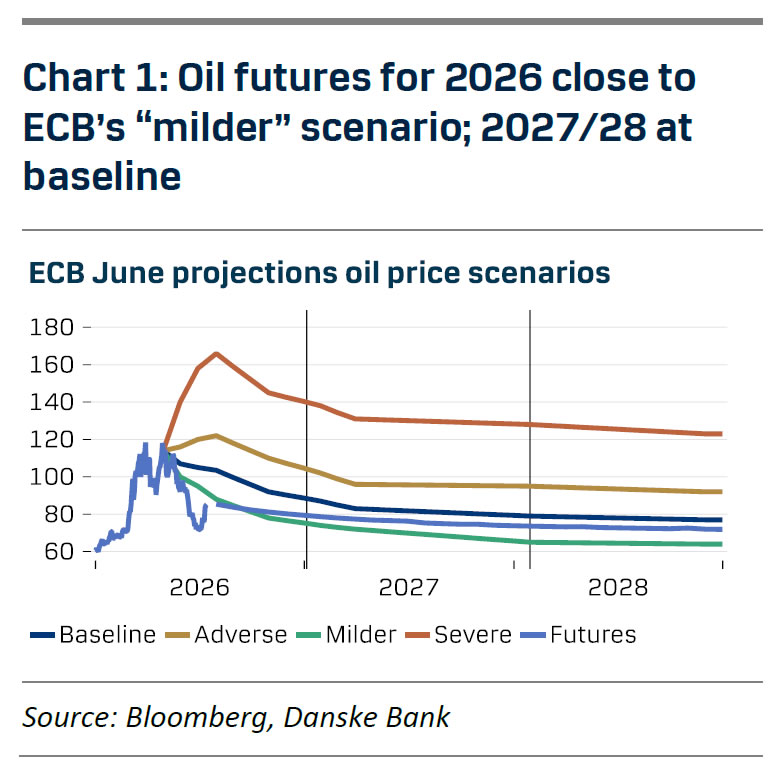
Focus during the meeting will be on signals about the future rate path. We will be particularly attentive to the risk assessment of the inflation and growth outlook. The ECB views inflation risks as tilted to the upside and growth risks as tilted to the downside, but Lagarde stated on 1 July that they are now "probably more balanced". Yet, given the recent escalation of the war in Iran and the lack of new staff projections, we do not expect the risk assessment to be changed.
We expect Lagarde to keep full optionality on the future policy rate path, leaving the door open to a September hike, but without pre-committing. At the Sintra conference, she reiterated that the ECB has set aside forward guidance and instead provides "framework guidance" on its reaction function. With markets currently pricing in 22bp worth of ECB hikes at the September meeting, and given the high uncertainty around the future path of energy prices, we do not believe the ECB has an incentive to rock the boat.
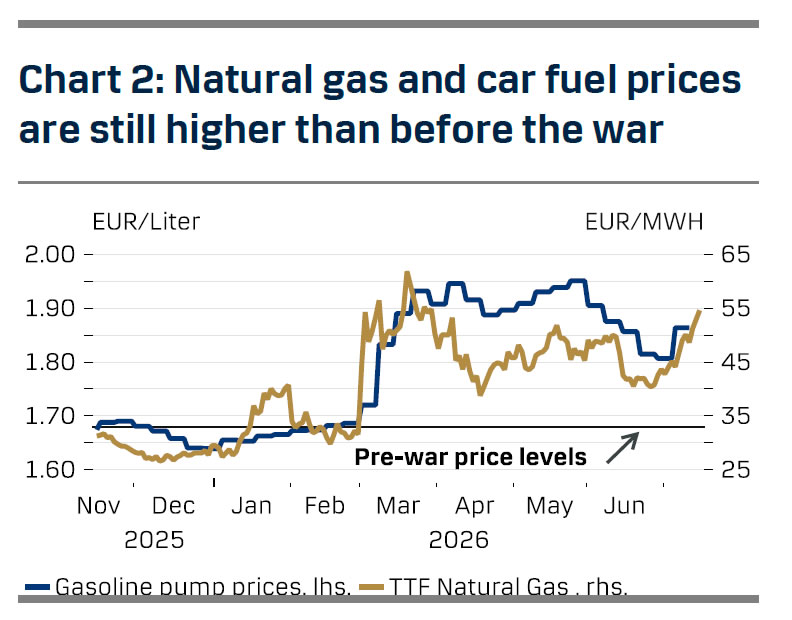
Our baseline remains that the ECB will deliver a final 25bp hike at the September meeting. The bias in the GC remains hawkish, even as it is slightly more balanced now compared to June. While crude oil futures have declined the prices of refined oil products and natural gas remain above pre-war levels, by 10% for gasoline and 170% for natural gas, respectively. Consumer inflation expectations also remain elevated, and markets are pricing inflation to average 3.25% y/y for the rest of 2026 and 2.65% y/y in 2027. Having said that, growth has been weaker than expected in Q2, and the June inflation print was soft, with no signs yet of indirect effects from the energy shock. At the same time, there are no signs of second-round effects, and the labour market is weakening, so we do not expect more than one additional hike and we then see the ECB cutting the deposit rate back to 2.00% next year.