

Sample Category Title
Sunset Market Commentary
Markets
The flash EMU May PMI’s disappointed. After hovering just north of the 50 level that separates growth from contraction in the first four months of the year, it unexpectedly dropped from 50.4 to 49.5. As the HCOB chief economist indicated: US tariffs are not to blame. It is domestic oriented services dropping from 50.1 to 48.9. Manufacturing production (51.5) rose for the third month in a row. Germany (composite 48.6 from 50.1) joined France in contraction territory (48). S&P indicates that the rest of the euro area continues to register growth, but the pace slows. S&P sees the May reading as in line with 0.1% Q/Q EMU Q2 growth, compared to 0.3% in Q1. Orders for services still declined further. New orders in manufacturing stabilized. Despite the pause in the implementation of tariffs, business confidence also declined further after the drop in April. Services confidence dropped to lowest level since September 2022. Inflation indicators mostly slowed, but the picture wasn’t unequivocal. Services input prices still rose sharply, but the rise selling prices eased. Manufacturing input costs declined as did selling prices. With higher services inflation mainly due to high wage growth, this remains mixed input for the ECB. Even so, markets see current mix as justifying the ECB to proceed with a next ‘pre-emptive’ 25 bps rate cut in June (95% discounted). Short-term Germany yields stay lower in a daily perspective (2-y -4.5 bps), but long term yields turned back north with the 30-y again adding 2.5 bps. Investors in LT bonds globally are still keeping a close eye at the developments in the US. In this respect, the US House (narrowly) approved President Trump’s tax Bill, which will now go to the Senate. Even as amendments are likely, the outcome will sharply further raise US deficits and the path of government debt. LT US yields again jumped higher after the approval. The 30-y touched 5.15%, but the pressure gradually eased somewhat. US yields currently are changing between -4.0 bps (2-y) and +2.0 bps (30-y). Fed Waller kept the door open Fed rate cuts in H2 if the tariffs on US trading partners would settle around 10%. A higher level could complicate the Fed assessment. At the time of finishing this report, the US PMI’s surprise sharply to the upside (composite 52.3 from 50.2), helping to put an intraday bottom yields.
Yesterday evening, US fiscal uncertainty and a poor US 20-y auction already triggered a correction in US equities. This spilled over to Asia an Europa. EMU PMI’s didn’t help European markets negative guidance from the US. The EuroStoxx 50 currently cedes about 1.0%. US futures reversed initial further losses after the approval of the tax bill. The S&P opens little changed. On FX markets, the dollar shows a mixed picture. The US currency eased further against the likes of the yen, but gradually found a bottom, supported by the US PMI’s (USD/JPY 143.8). Poor EMU PMI’s pushed EUR/USD back below 1.13, but the damage stays modest for now. Sterling slightly outperforms the euro (EUR/GBP 0.8420). UK PMI’s were not impressive, but better than EMU. (composite 49.4, from 48.5, services back at 50.2). Even so, the UK 30-y yield adding another 6 bps (5.55-60 area 6%) remains another warning sign.
News & Views
The Turkish central bank (CBRT) kept its EoY inflation forecasts unchanged for 2025 and 2026 in its second (out of four in total) inflation reports this year. The respective 24% and 12% projections are on the optimistic side given that actual CPI was 38% in April with the disinflationary process showing signs of stalling in recent months. CBRT governor Karahan cited easing commodity prices and domestic activity to keep forecasts stable. Annual average oil prices were lowered by 14% and 18% for 2025 and 2026 respectively compared to the Q1 inflation report while growth was revised down. But he did warn for upside risks. The arrest of president Erdogan’s political rival in March wreaked havoc on Turkish markets, including on the local currency. While Karahan expects the inflationary impact of to be temporary, they remain on the lookout for pass-through effects. Either way, by keeping the inflation forecasts well above the 5% target and coupled with Karahan’s pledge to do “whatever is needed” to tame price pressures, the central bank signals any future rate cuts would only be gradually. The CBRT started easing late last year but changed course after the March shocker. The de facto policy rate currently stands at 49%.
The oil price rally yesterday following CNN reports of Israel preparing an attack on Iranian nuclear facilities was very short-lived. It reversed course already during the day and extends losses today. The latter followed a Bloomberg report suggesting OPEC+ is readying another jumbo (+411k barrels) output hike in July. That would be the third such move in a row and another strong deviation from the much more gradual return of output OPEC had agreed on initially. Brent oil drops to $63.75.
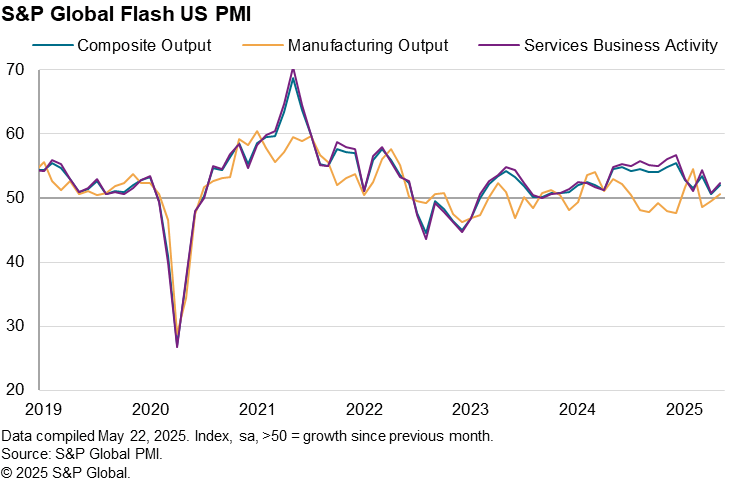
US PMI composite rebounds to 52.1, inflation surge, supply chain delays and inventory build
US economy saw a notable rebound in private sector activity in May, with both PMI Manufacturing and Services rising to 52.3, lifting the Composite reading to a solid 52.1.
According to S&P Global, this improvement marks a turnaround from April’s slump and is largely attributed to improved sentiment following the temporary suspension of higher tariffs.
Chief Economist Chris Williamson highlighted that the rebound appears partly driven by companies and their customers attempting to "front-run" orders ahead of potential new tariff shocks after the current 90-day truce expires in July.
This preemptive behavior has led to the largest accumulation of input inventories" in the survey’s 18-year history, alongside a surge in "supply chain delays", now the worst since the pandemic-era disruptions of 2022.
Most concerning for policymakers is the sharp rise in prices. The report flagged that the overall increase in prices charged for goods and services was the steepest since August 2022, signaling "consumer price inflation moving sharply higher."
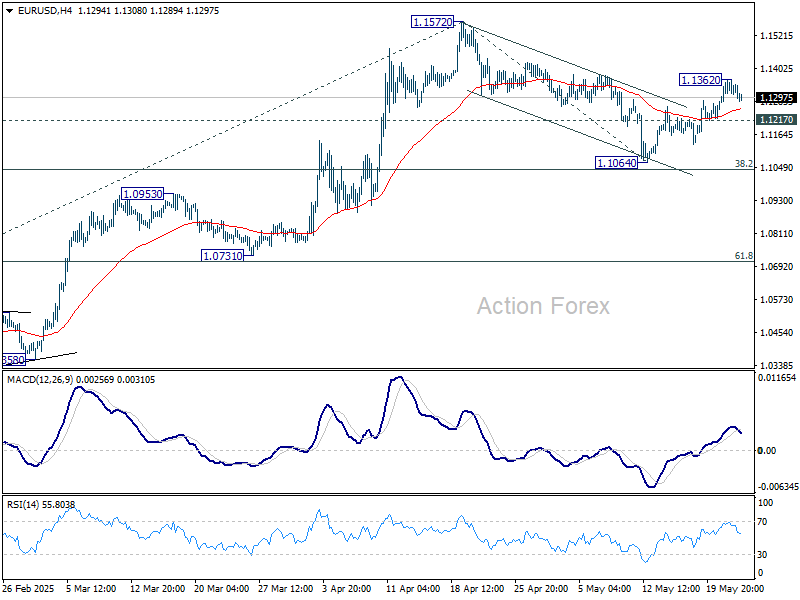
EUR/USD Mid-Day Outlook
Daily Pivots: (S1) 1.1286; (P) 1.1324; (R1) 1.1369; More...
Intraday bias in EUR/USD is turned neutral first with current retreat. But further rise is expected as long as 1.1216 support holds. Correction from 1.1572 could have completed at 1.1064 already. Above 1.1362 will bring retest of 1.1572 first. Firm break there will resume larger up trend. Next near term target will be 61.8% projection of 1.0176 to 1.1572 from 1.1064 at 1.1927. However, break of 1.1217 will turn bias back to the downside for 1.1064 support instead.
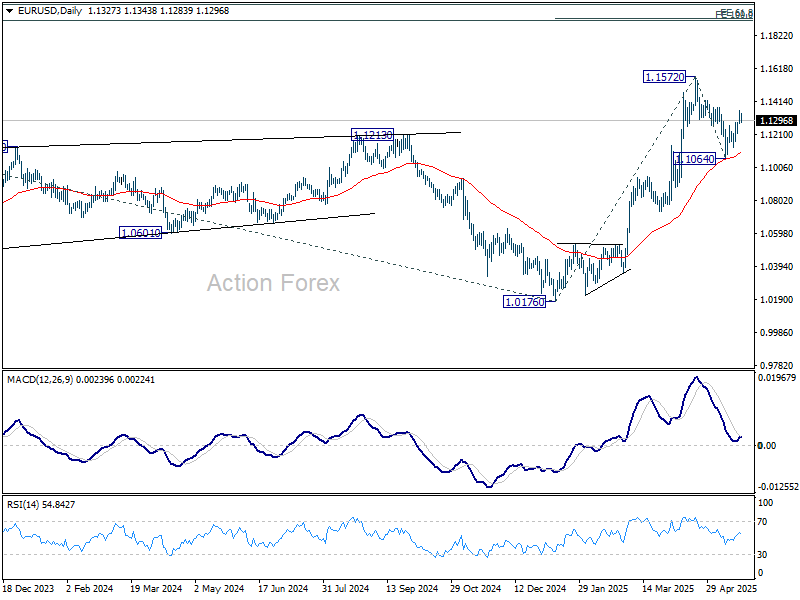
In the bigger picture, rise from 0.9534 long term bottom could be correcting the multi-decade downtrend or the start of a long term up trend. In either case, further rise should be seen to 100% projection of 0.9534 to 1.1274 from 1.0176 at 1.1916. This will now remain the favored case as long as 55 W EMA (now at 1.0818) holds.
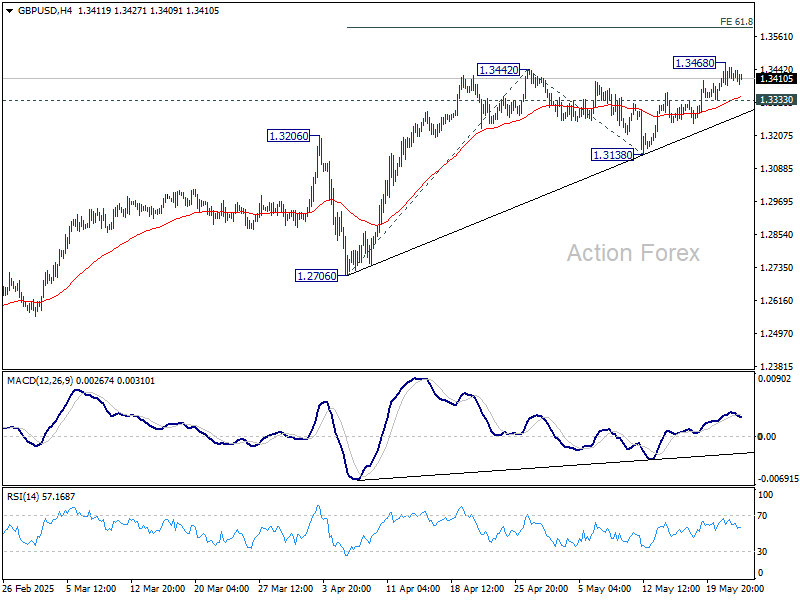
GBP/USD Mid-Day Outlook
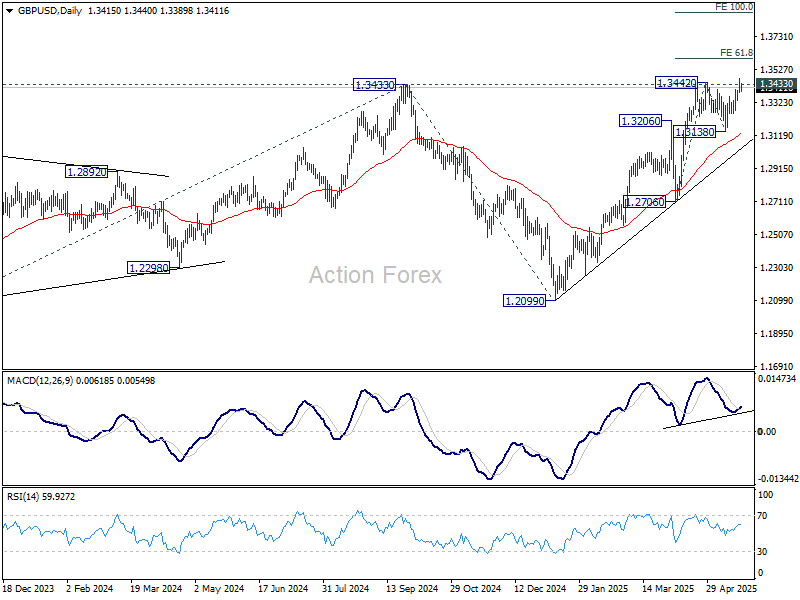
Daily Pivots: (S1) 1.3371; (P) 1.3420; (R1) 1.3469; More...
Intraday bias in GBP/USD is turned neutral first with current retreat. Further rally is expected as long as 1.333 support holds. Above 1.3468 will extend larger up trend to 61.8% projection of 1.2706 to 1.3442 from 1.3138 at 1.3593, and then 100% projection at 1.1.3874. However, break of 1.3333 will turn bias back to the downside for 1.3138 support instead.
In the bigger picture, up trend from 1.3051 (2022 low) is still in progress. Decisive break of 1.3433 (2024 high) will confirm resumption. Next medium term target is 61.8% projection of 1.0351 to 1.3433 from 1.2099 at 1.4004. Nevertheless, sustained trading below 55 D EMA (now at 1.3124) will delay the bullish case and bring more consolidations first.
USD/JPY Mid-Day Outlook
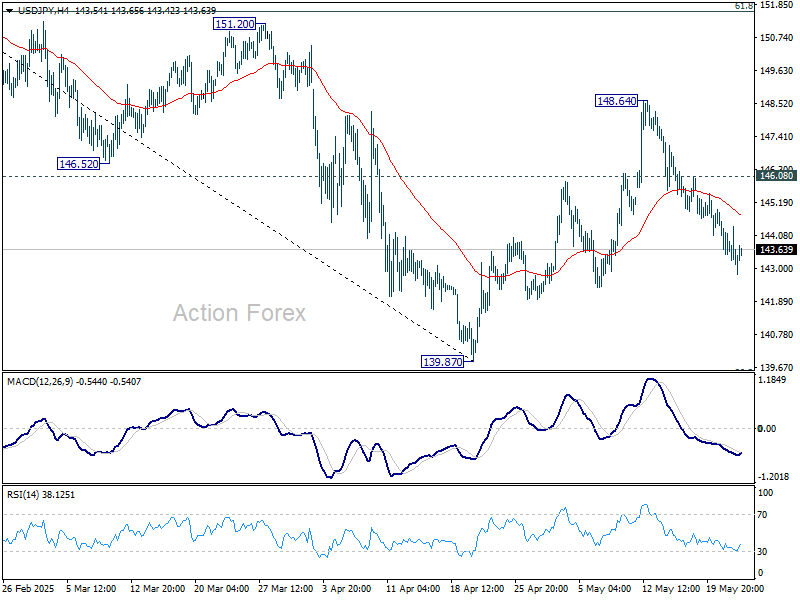
Daily Pivots: (S1) 143.09; (P) 143.86; (R1) 144.43; More...
USD/JPY's fall from 148.64 is still in progress and intraday bias stays on the downside. Rebound from 139.87 could have completed as a correction to 148.64 already. Deeper fall would be seen back to retest this support. For now, risk will stay on the downside as long as 146.08 minor resistance holds, in case of recovery.
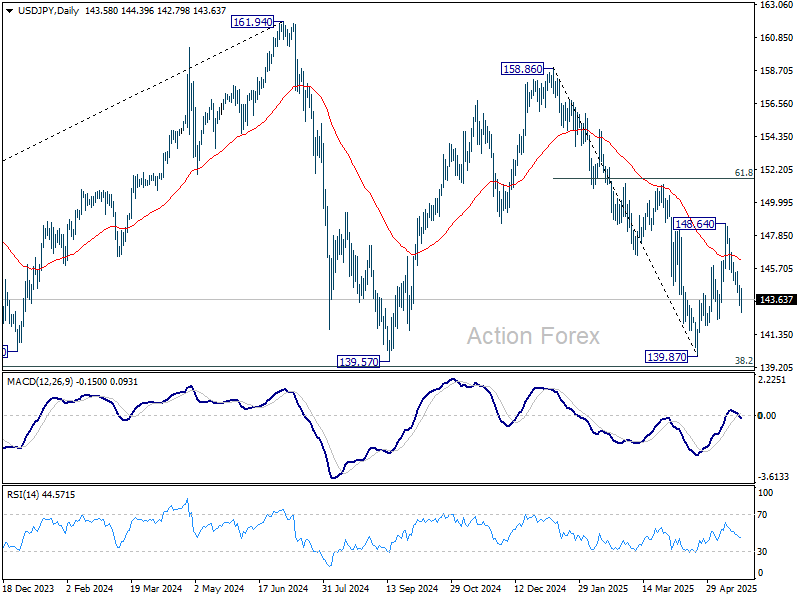
In the bigger picture, price actions from 161.94 are seen as a corrective pattern to rise from 102.58 (2021 low), with fall from 158.86 as the third leg. Strong support should be seen from 38.2% retracement of 102.58 to 161.94 at 139.26 to bring rebound. However, sustained break of 139.26 would open up deeper medium term decline to 61.8% retracement at 125.25.
USD/CHF Mid-Day Outlook
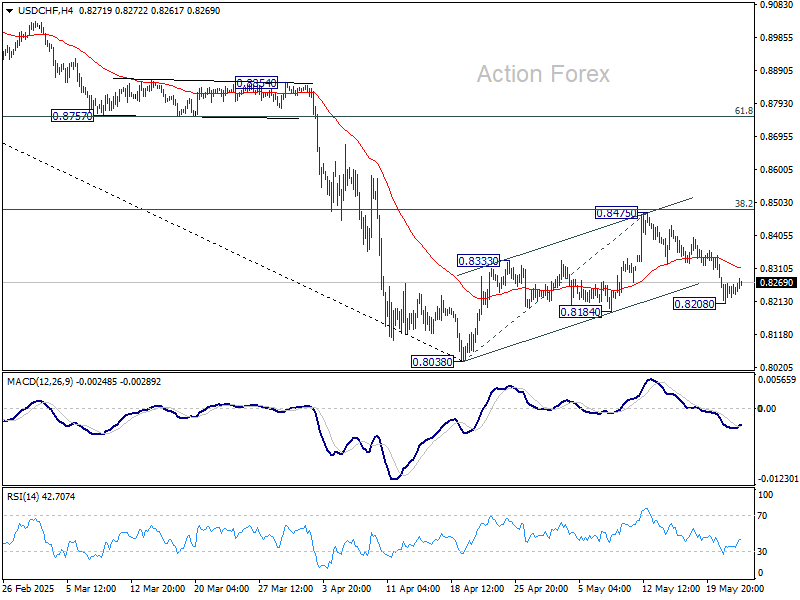
Daily Pivots: (S1) 0.8211; (P) 0.8251; (R1) 0.8251; More….
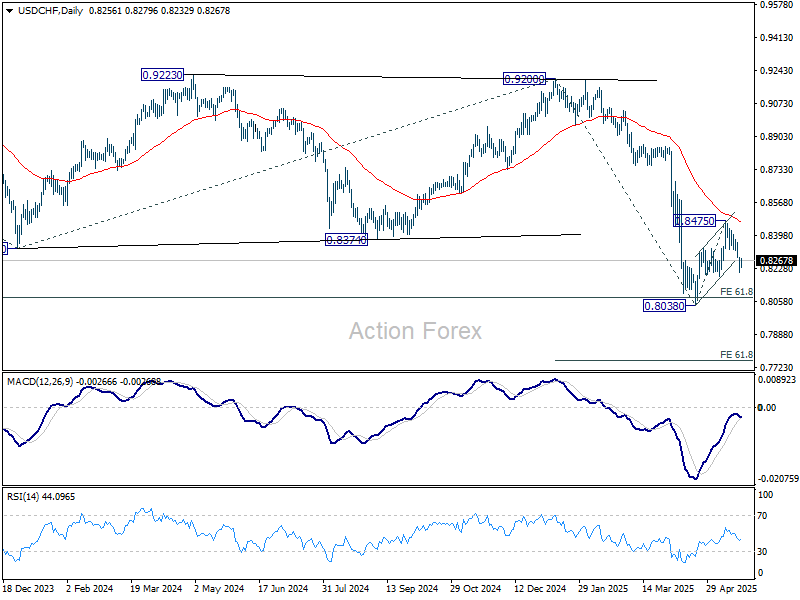
Intraday bias in USD/CHF is turned neutral first with current recovery. But risk will remain on the downside as long as 0.8475 resistance holds. Corrective rebound from 0.8038 should have completed already. Below 0.8208 will bring retest of 0.8038 first. Firm break there will resume larger down trend to 61.8% projection of 0.9200 to 0.8038 from 0.8475 at 0.7757 next.
In the bigger picture, long term down trend from 1.0342 (2017 high) is still in progress and met 61.8% projection of 1.0146 (2022 high) to 0.8332 from 0.9200 at 0.8079 already. In any case, outlook will stay bearish as long as 55 W EMA (now at 0.8765) holds. Sustained break of 0.8079 will target 100% projection at 0.7382.
Dollar Recovers as Markets Stabilize, Euro Pressured by PMI and Dovish ECB Accounts
Dollar staged a broad recovery today as financial markets found some footing following a volatile stretch dominated by US deficit concerns. US futures are trading flat, while 10-year Treasury yield has pared back modestly from recent highs, signaling a pause in the bond selloff. The calmer tone helped the greenback regain some traction.
Support for Dollar came even after a narrow passage of a sweeping tax and spending bill in the US House of Representatives. The legislation, central to President Donald Trump's policy agenda, introduces a range of tax breaks, most notably on tips and car loans, while substantially boosting military and border enforcement budgets. The Congressional Budget Office estimates the bill would add approximately USD 3.8 Trillion to debt over the next decade.
In Europe, Euro came under some pressure following disappointing PMI data. The services sector unexpectedly slipped back into contraction territory in May, highlighting the fragility of the region’s recovery. The PMI Composite also dipped below 50, reinforcing the view that growth momentum is stalling again after a weak start to the year.
Adding to Euro’s woes, ECB’s latest meeting accounts revealed internal discussions over a more aggressive 50 basis point rate cut in April, although the final decision was a unanimous 25 basis point reduction. While the accounts reflect growing confidence in disinflation trends, they also underscore a heightened sense of caution about weakening growth and the evolving global trade environment.
Overall in the currency markets, Yen stands out as the strongest performer today so far, followed by Dollar, and then Sterling. Kiwi leads the losers, followed by Euro and Aussie. Loonie and Swiss Franc are positioning in the middle. Overall, today’s market tone isn't clearly risk-on.
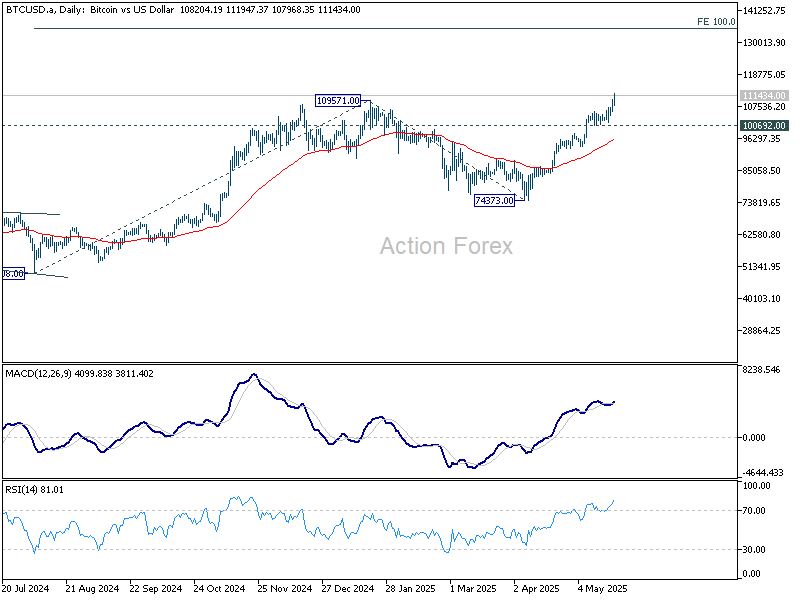
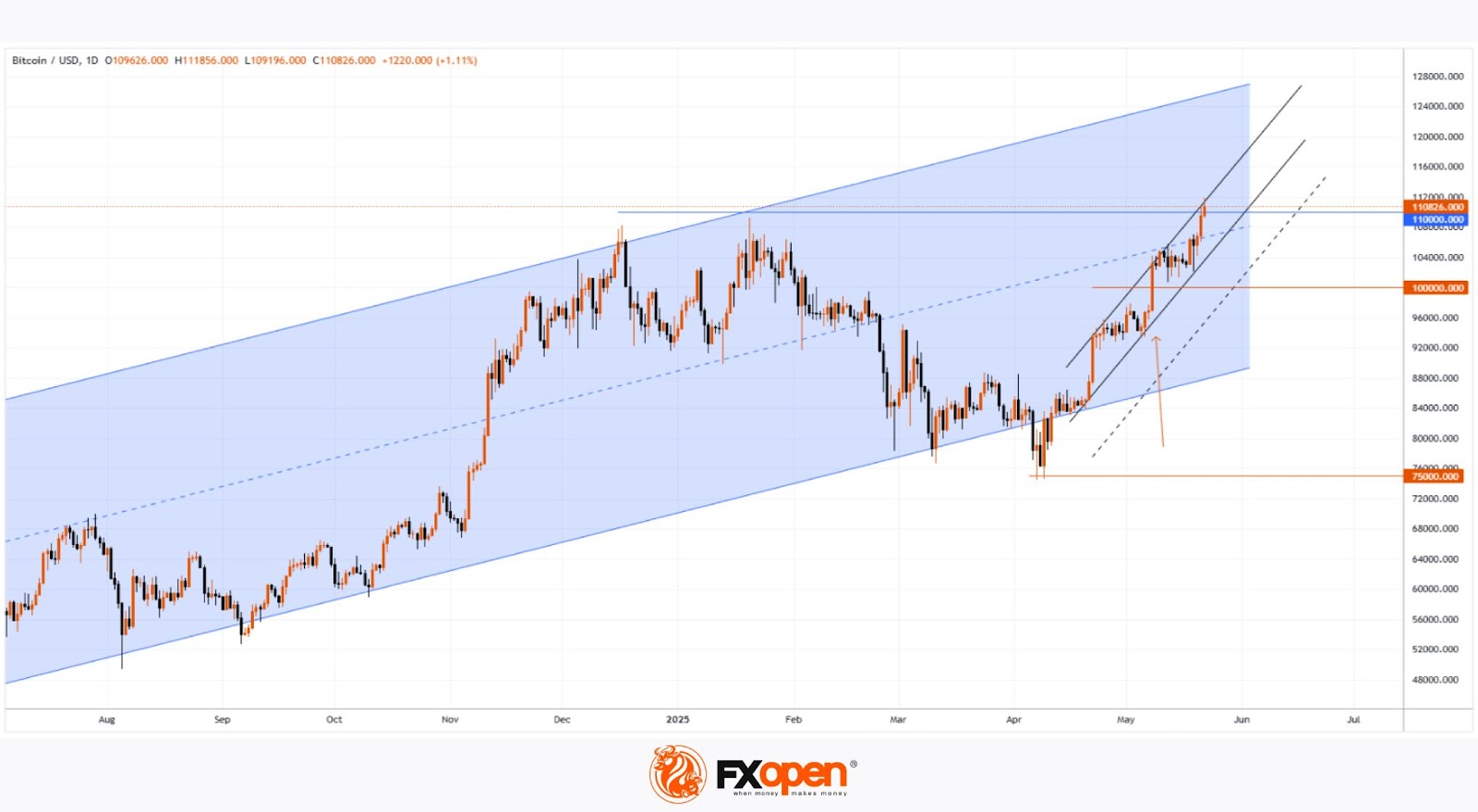
Technically, Bitcoin finally surged to new record high above 110000 this week. Upside momentum remains strong as seen in D MACD. Current up trend could now be targeting 100% projection of 49008 to 109571 from 73473 at 134936 next. For now, outlook will remain bullish as long as 100692 support holds, in case of retreat.
In Europe, at the time of writing, FTSE is down -0.77%. DAX is down -0.08%. CAC is down -1.05%. UK 10-year yield is up 0.008 at 4.769. Germany 10-year yield is down -0.002 at 2.652. Earlier in Asia, Nikkei fell -0.84%. Hong Kong HSI fell -1.19%. China SSE fell -0.22%. Singapore Strait Times fell -0.06%. Japan 10-year JGB yield rose 0.041 to 1.562.
US initial jobless claims fall to 227k vs exp 230k
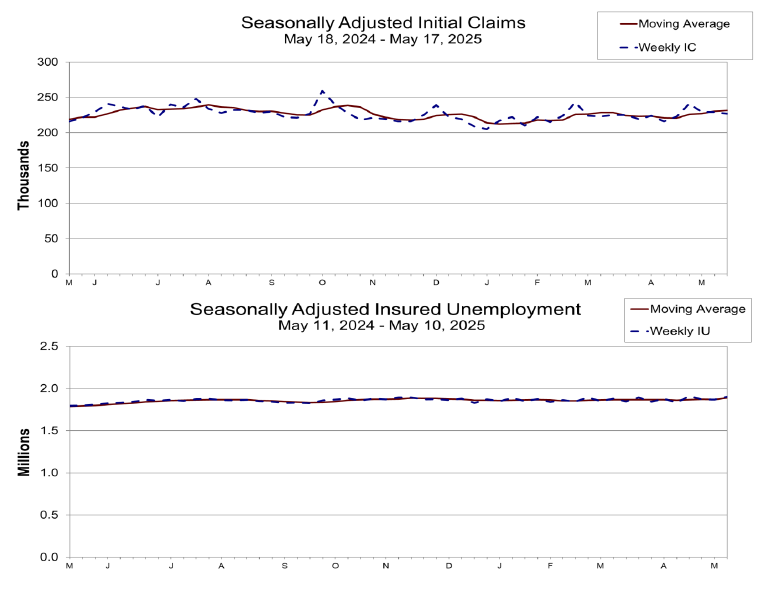
US initial jobless claims fell -2k to 227k in the week ending May 17, below expectation of 230k. Four-week moving average of initial claims rose 1k to 232k.
Continuing claims rose 36k to 1903k in the week ending May 10. Four-week moving average of continuing claims rose 18k to 1888k, highest since November 2021.
UK PMI composite ticks up to 49.4, price pressures ease from April spike
UK PMI Services rose modestly from 49.0 to 50.2, while Manufacturing PMI edged lower from 45.4 to 45.1. As a result, the Composite PMI ticked up from 48.5 to 49.4, still below the 50-mark that separates expansion from contraction.
According to S&P Global’s Chris Williamson, business confidence has improved since April, helped in part by easing trade tensions. However, output across the private sector shrank for a second consecutive month, suggesting that the UK economy may be slipping into contraction for Q2.
On a more encouraging note, inflationary pressures appear to have cooled significantly from April’s spike. This moderation in price growth, combined with lackluster output and emerging job losses, strengthens the case for further monetary easing by BoE in the coming months.
ECB accounts: Some members see April rate cut as frontloading a June move
ECB’s April 16–17 meeting accounts revealed unanimous support for the 25 basis point rate cut, the inflation shock was “nearly over”. The cut was not only as a response to improving inflation outlook but also as insurance against mounting downside risks to growth, driven by escalating global trade tensions.
Several members specifically cited recent developments around tariffs as rationale for acting sooner rather than later. In their view, a cut at the April meeting could be seen as "frontloading a possible cut at the June meeting", helping to anchor sentiment amid elevated market volatility.
Some members noted that the tariff-driven uncertainty did not appear to be translating into inflationary pressure, partly due to Euro’s appreciation role as a "safe-haven currency". Instead, tariff-related headwinds were increasingly viewed as disinflationary, especially as growth prospects weakened and financial conditions tightened.
A minority on the Council even argued for a more aggressive 50 bps cut, citing a deterioration in the balance of risks since March. These members emphasized that "even in the event of a relatively mild trade conflict, uncertainty was already discouraging consumption and investment.
Eurozone PMI composite falls to 49.5, services falter, manufacturing holds tentatively
Eurozone’s private sector returned to contraction in May, with PMI Composite falling from 50.4 to 49.5, a six-month low. The drag came from the services sector, where the PMI dropped from 50.1 to 48.9, its weakest reading in 16 months. While the manufacturing index rose modestly from 49.0 to 49.4, marking a 33-month high, it remained in contractionary territory.
According to HCOB Chief Economist Cyrus de la Rubia, the region’s economy “cannot seem to find its footing,” as growth signals remain elusive and sentiment subdued.
The modest improvement in manufacturing may reflect front-loaded activity as firms seek to get ahead of US tariffs, rather than underlying demand strength. However, the downturn in services, typically more domestically oriented and less exposed to global trade, raises concern about internal demand softness.
For the ECB, the numbers are "likely to leave it with mixed feelings". While service sector inflation appears to be moderating, input costs — likely driven by wages — are ticking higher again. Manufacturing purchase prices, by contrast, continue to fall.
German Ifo rises to 87.5, economy stabilizing with uncertainty eased
Germany’s Ifo Business Climate Index rose to 87.5 in May, up from 86.9 in April, offering cautious optimism that the economy may be stabilizing.
The improvement was driven by a notable rise in the Expectations Index, which climbed from 87.4 to 89.9, a sign that firms are growing more confident about future conditions. However, the Current Situation Index dipped slightly from 86.4 to 86.1.
The Ifo Institute noted that "sentiment among German companies has improved" and that the recent surge in uncertainty has begun to ease.
BoJ's Noguchi: Must tread carefully with step-by-step policy normalization
BoJ board member Asahi Noguchi emphasized the importance of a "measured, step-by-step" pace in raising interest rates, stressing the need to carefully assess the economic impact of each hike before proceeding further.
Noguchi also addressed the upcoming interim review of BoJ’s bond tapering strategy, indicating that he sees no need for any major adjustments to the current plan, which runs through March 2026.
He noted that the central bank should approach its long-term reduction in the balance sheet with flexibility, taking the time needed to ensure stability while maintaining the capacity to respond to "sudden market swings".
Any emergency increase in bond purchases, he noted, would be strictly conditional and "only be implemented during times of severe market disruption."
Japan’s PMI composite falls to 49.8, private sector contracts again
Japan’s private sector activity fell back into contraction in May, with PMI Composite declining from 51.2 to 49.8. Manufacturing output edged higher from 48.7 to 49.0, but remained below the neutral 50 mark. The services sector, however, lost more momentum, with its PMI falling from 52.4 to 50.8.
The decline in composite output reflects weakening domestic and external demand, as new business volumes fell for the first time in nearly a year.
S&P Global’s Annabel Fiddes noted that elevated uncertainty around trade policy and foreign demand weighed heavily on business confidence, which sank to its second-lowest level since the pandemic's onset.
RBA’s Hauser: Post-tariff China outlook positive but incomplete
In a speech focused on his recent visit to China following the sweeping tariff shifts of “Liberation Day”, RBA Deputy Governor Andrew Hauser noted there was a sense of "strong hand" in managing the economic fallout from US-imposed tariffs. Additionally, Australian firms operating in China perceived "opportunities amidst the risks", as trade patterns began to shift.
However, Hauser was quick to stress that this view was inherently limited, anchored to a moment in time and shaped by a single national perspective.
Hauser laid out four key caveats. First, global tariff settings remain fluid, and data on their real-world economic effects is just beginning to emerge. Second, the assessments he heard may prove overly optimistic, domestic stimulus in China may underperform, and public tolerance for economic pain may be lower than expected.
Third, indirect “general equilibrium” effects could emerge, including the possibility of intensified competition from Chinese firms offloading excess supply originally intended for US markets. While sectoral overlap with Australia is limited, it is a concern shared across the Asia-Pacific region.
Finally, Hauser acknowledged the broader strategic uncertainties at play—factors beyond economics that could shape Australia's position.
Australia’s PMI Composite slips to 50.6; firms cite election drag on demand
Australia’s private sector showed signs of slowing in May, with PMI Composite falling from 51.0 to a 3-month low of 50.6. Manufacturing index held steady at 51.7. But services weakened from 51.0 to 50.5, its lowest level in six months.
According to S&P Global’s Andrew Harker, the sluggishness may be tied in part to election-related uncertainty, which "contributed to slower growth of new orders". Still, firms remained cautiously optimistic, continuing to hire at a "solid pace". With the political noise expected to ease, attention will turn to whether demand picks up in the months ahead.
USD/CHF Mid-Day Outlook
Daily Pivots: (S1) 0.8211; (P) 0.8251; (R1) 0.8251; More….
Intraday bias in USD/CHF is turned neutral first with current recovery. But risk will remain on the downside as long as 0.8475 resistance holds. Corrective rebound from 0.8038 should have completed already. Below 0.8208 will bring retest of 0.8038 first. Firm break there will resume larger down trend to 61.8% projection of 0.9200 to 0.8038 from 0.8475 at 0.7757 next.
In the bigger picture, long term down trend from 1.0342 (2017 high) is still in progress and met 61.8% projection of 1.0146 (2022 high) to 0.8332 from 0.9200 at 0.8079 already. In any case, outlook will stay bearish as long as 55 W EMA (now at 0.8765) holds. Sustained break of 0.8079 will target 100% projection at 0.7382.
US Tax Bill, Eurozone PMI & S&P 500 Technicals
European Session Recap
European markets began the day on the back foot as market participants digested a proposed tax-cut bill that threatened to enlarge the US deficit.
Opposition to President Trump’s tax plans and the growing deficit is impacting the bond market, with Treasury prices dropping on Wednesday and dragging down other U.S. assets. The concern is that the tax bill could add trillions to the already large budget deficit in the coming years, especially as global interest in U.S. assets declines.
European Data Mixed as German Ifo beats but PMI disappoints
European data released this morning revealed a mixed picture. In Germany business sentiment has improved which is a positive sign in light of sentiment data out of the US last week.
German businesses are cautiously optimistic despite US tariff concerns. They’re focusing on potential positives from the new German government rather than trade uncertainties. The Ifo index rose to 87.3 in May from 86.9 in April. While the current situation rating dipped slightly, future expectations jumped to 88.9, the highest in a year.
On the flip side, the HCOB Eurozone Composite PMI dropped to 49.5 in May 2025, down from 50.4 in April, signaling the first decline in private sector activity this year. Both services (48.9) and factory activity (49.4) saw declines, though factory contraction was the smallest in nearly three years.
New orders fell as US-EU tariff risks and earlier stockpiling reduced demand. Despite this, job creation stayed steady due to existing order backlogs. Manufacturing costs decreased, but service costs rose sharply. Business confidence also hit its lowest point in 19 months.
The data has raised concerns that the Eurozone economy could be entering stagflation territory once more.
This has weighed on the Euro this morning as it trades around 0.3% lower to the greenback. The data has also kept the DAX on the backfoot as it remains below the 24000 handle.
Oil prices faced pressure this morning on rumors that OPEC + are discussing another 411k bpd output hike in July. This adds to market concerns around demand and could weigh Oil prices down moving forward.
The US Open
Heading into the US open and market participants may be cautious following Wednesday performance. All three major Wall Street indexes saw their biggest single-day drop in about 4 weeks as concerns around US debt continue to pile up.
In premarket trade today, Most big tech and growth stocks edged up in premarket trading, with Alphabet (Google's parent company) leading with a 1.3% gain.
Cryptocurrency-related stocks surged as Bitcoin hit a record high. Coinbase rose 2.5%, MicroStrategy gained 1.4%, and crypto miner MARA Holdings jumped 4%.
Snowflake soared 10.2% after the cloud company raised its product revenue forecast for 2026.
Given the US tax bill has passed the house sentiment may improve slightly ahead of US data. However, the concerns around the tax bill were largely down to a widening budget deficit and those still remain in play which could keep sentiment and thus risk assets in check.
Economic data releases
Looking ahead, the US session finally brings a bit of data today with S&P PMI, existing home sales and weekly jobless claims data all scheduled for release.
Along with this we have at least two Federal Reserve officials including New York Fed President John Williams slated to speak later in the day.
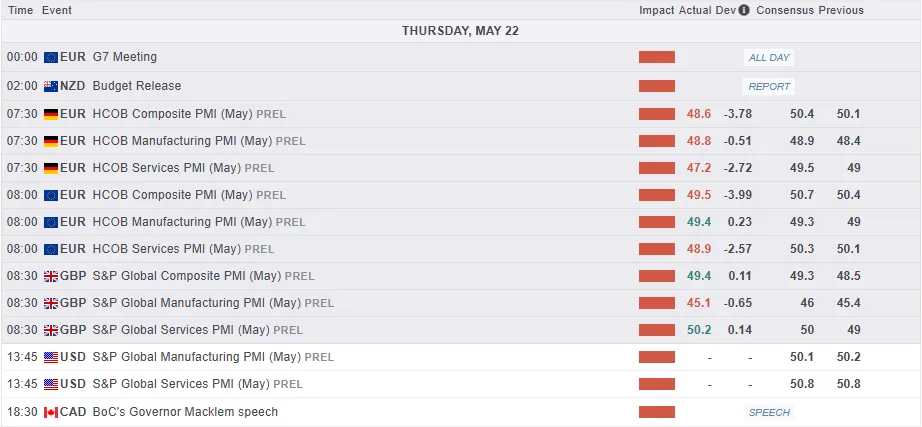
For all market-moving economic releases and events, see the MarketPulse Economic Calendar. (click to enlarge)
Chart of the day - S&P 500
From a technical standpoint, the S&P 500 is approaching a key confluence level.
Having posted its biggest single day drop in a month yesterday, a key confluence area rests just below the 5800 handle.
The levels between 5800-5736 plays host to the 20, 100 and 200-day MAs which could all be a source of support for the index. If this level holds, the probability of a fresh high is likely to improve.
On the daily timeframe, bulls remain firmly in control with a daily candle close below the 5580 swing low needed to invalidate the bullish structure.
Immediate support rests at 5800 before 5785 and 5736 come into focus.
If a move to the upside materializes, 5883 will be the first area to monitor before the 5910 and 5962 levels come into focus.
Source: TradingView.com (click to enlarge)
US initial jobless claims fall to 227k vs exp 230k
US initial jobless claims fell -2k to 227k in the week ending May 17, below expectation of 230k. Four-week moving average of initial claims rose 1k to 232k.
Continuing claims rose 36k to 1903k in the week ending May 10. Four-week moving average of continuing claims rose 18k to 1888k, highest since November 2021.
ECB accounts: Some members see April rate cut as frontloading a June move
ECB’s April 16–17 meeting accounts revealed unanimous support for the 25 basis point rate cut, the inflation shock was “nearly over”. The cut was not only as a response to improving inflation outlook but also as insurance against mounting downside risks to growth, driven by escalating global trade tensions.
Several members specifically cited recent developments around tariffs as rationale for acting sooner rather than later. In their view, a cut at the April meeting could be seen as "frontloading a possible cut at the June meeting", helping to anchor sentiment amid elevated market volatility.
Some members noted that the tariff-driven uncertainty did not appear to be translating into inflationary pressure, partly due to Euro’s appreciation role as a "safe-haven currency". Instead, tariff-related headwinds were increasingly viewed as disinflationary, especially as growth prospects weakened and financial conditions tightened.
A minority on the Council even argued for a more aggressive 50 bps cut, citing a deterioration in the balance of risks since March. These members emphasized that "even in the event of a relatively mild trade conflict, uncertainty was already discouraging consumption and investment.