Sample Category Title
GBP/JPY Daily Outlook
Daily Pivots: (S1) 140.43; (P) 141.14; (R1) 142.03; More...
Intraday bias in GBP/JPY is turned neutral with a temporary low formed at 140.23. Some consolidations would be seen but deeper decline remains in favor as long as 143.48 minor resistance holds. Below 140.23 will extend the down trend from 156.59 to 139.29/47 key support level. We'll pay attention to bottoming signal around there.
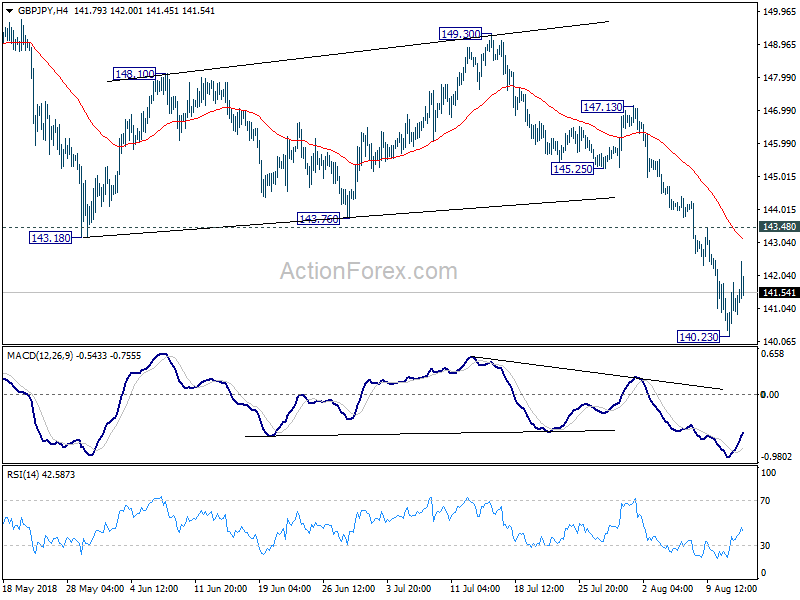
In the bigger picture, at this point decline from 156.59 is still seen as a corrective move. But the current downside accelerate makes this view shaky. Focus will be on 139.29 cluster support (50% retracement of 122.36 to 156.59 at 139.47). Strong rebound from there will re-affirm the bullish case that rise from 122.36 is still to extend through 156.59 high. However, sustained break of 139.29/47 should confirm medium term reversal. GBP/JPY would then target a retest on 122.26 (2016 low).

EUR/GBP Daily Outlook
Daily Pivots: (S1) 0.8918; (P) 0.8933; (R1) 0.8952; More...
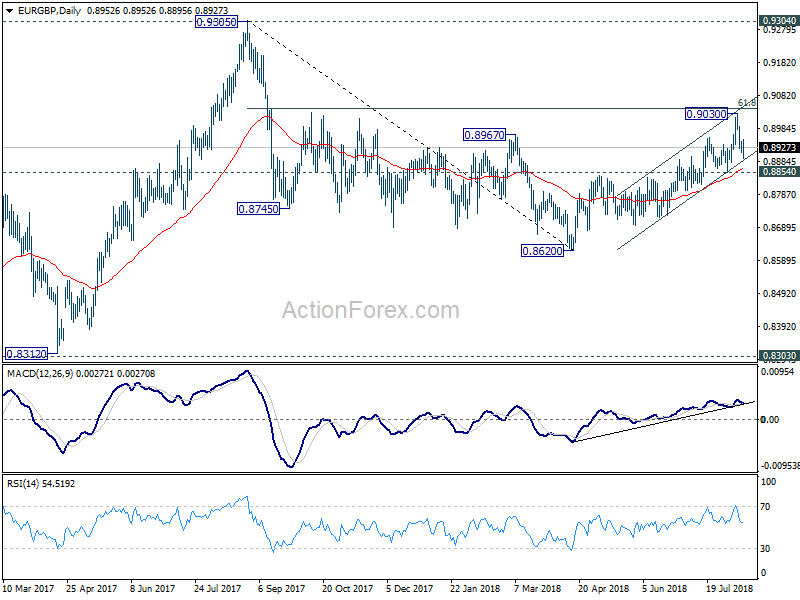
No change in EUR/GBP's outlook as it's staying in corrective trading from 0.9030. While deeper pull back cannot be ruled out, we'd expect downside to be contained by 0.8854 support to bring another rally. Firm break of 61.8% retracement of 0.9305 to 0.8620 at 0.9043 will pave the way to retest 0.9305 key resistance. However, sustained break of 0.8854 will indicate near term reversal and turn outlook bearish.
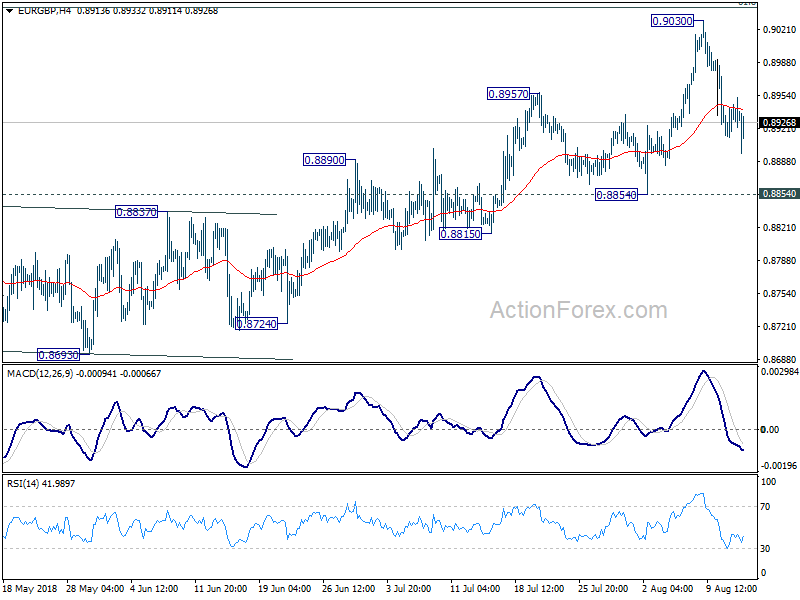
In the bigger picture, EUR/GBP is staying in long term range pattern from 0.9304 (2016 high). The corrective structure of the fall from 0.9305 to 0.8620 is raising the chance that rise from 0.8312 to 0.9305 is an impulsive move. But we're not too confident on it yet. In any case, we'd stay cautious on strong resistance from 0.9304/5 to limit upside in case of further rally. Meanwhile, if there is another medium term decline, strong support will likely be seen from 0.8303 to contain downside.
UK Foreign Minister Hunt: Risk of no-deal Brexit has been increasing recently
UK Foreign Minister Jeremy Hunt told reports in Helsinki that the risk of no-deal Brexit has been "increasing recently". But he emphasized that it's not what anyone wants and I hope very much that we'll find a way to avoid that". He urged that "everyone needs to prepare for the possibility of a chaotic no-deal Brexit". He also called for "a change in approach by the European Commission".
Hunt is on a three-day European tour. He will meet Foreign Ministers of Finland, Latvia, Denmark and the Netherlands. In a quote released by the Foreign Office, Hunt said "we want to safeguard our operational capacity as we leave the EU, and so we have put forward precise, credible proposals that ensure our ability to act is maintained." And, "we are now at the point where the EU also faces strategic choices: with the option to move the negotiations forward and achieve a deal that works in our mutual interests. My simple message is that we need to take that opportunity."
Pound Finds Support As UK Unemployment Rate Declines, Australian Wage Growth In Focus
Here are the latest developments in global markets:
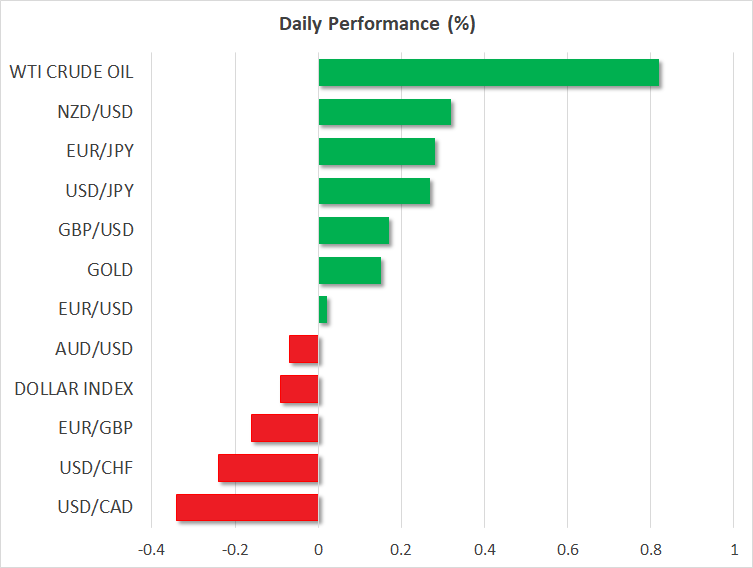
FOREX: The US dollar index, which measures the dollar’s strength against six major currencies, declined by 0.13%, while dollar/yen inched up by 0.23%, trading near the 111.00 psychological level. Euro/dollar started the day in the green but quickly dropped its gains and is down by 0.07% on the day despite an unexpected upward revision in Eurozone Q2 GDP growth estimates. Pound/dollar managed to rebound after the UK’s unemployment rate surprisingly fell to 4.0%, while analysts anticipated the rate to stand flat at 4.2% in June. However, wage growth readings (including bonuses) accompanying the employment numbers came in slightly lower than expected at 2.4% y/y in the three months to June, constraining the pound’s recovery. Pound/dollar was last at 1.2775 (+0.07%), trading around near 13-month lows. Of note, Brexit negotiations will resume on Thursday. The lira rebounded today after hitting a record low of 7.21 per dollar on Monday as the Turkish central bank took some steps to enhance liquidity. However, the Turkish president’s trade threats against the US (see below) are likely to continue exerting pressure on the currency. Meanwhile, aussie/dollar is set to post the fourth consecutive red day (-0.10%), approaching again the 18-month low of 0.7247, whereas kiwi/dollar is paring some losses from previous days, adding 0.27% to its daily performance. Dollar/loonie fell by 0.35% to slip below the 1.3100 handle.
STOCKS: European equities traded higher on Tuesday, as worries over the US-Turkish political turmoil took the back seat for now after the Turkish central bank announced some measures that appear to ease worries to an extent. The pan-European STOXX 600 and the blue-chip Euro STOXX 50 were up by 0.29% and 0.43% respectively at 1030 GMT despite financial stocks remaining in the red. The German DAX 30 advanced by 0.23%, while the French CAC 40 climbed by 0.21%. The Italian FTSE MIB rose by 0.25%, while UK’s FTSE 100 was down by 0.08%. In the meantime, futures tracking major Wall Street indices were in the green, pointing to a positive open.
COMMODITIES: Oil prices headed higher today on news Saudi Arabia had cut production in July. Nevertheless, OPEC’s lower demand projections for 2019 on the back of worries that rising trade uncertainties could weigh on economic growth kept investors somewhat cautious. WTI crude oil climbed by 0.98% to $67.86 per barrel, while London-based Brent advanced by 1.0% to $73.34 per barrel. Gold prices moved higher by 0.14% to $1,194/ounce, rebounding from the fresh 20-month low of $1,191.35 posted on Monday.
Day ahead: US-Turkish relations to remain in focus; Australian wage growth and Westpac economic sentiment eyed
Although the risk-off sentiment linked with the Turkish story seemed to soften a bit on Tuesday, investors will continue to monitor developments around the US-Turkish standoff as a top national security aide to the US President said on Monday that negotiations will not take place between the countries until Turkey frees the detained American pastor. On Tuesday, the Turkish President, Tayyip Erdoğan, threatened to ban electronic products from the US to punish Washington for the lira’s meltdown. This is a signal that the dispute could hold for longer and therefore the euro could find it hard to recover in the following days amid worries that the lira’s meltdown could have negative implications for the European banking sector.
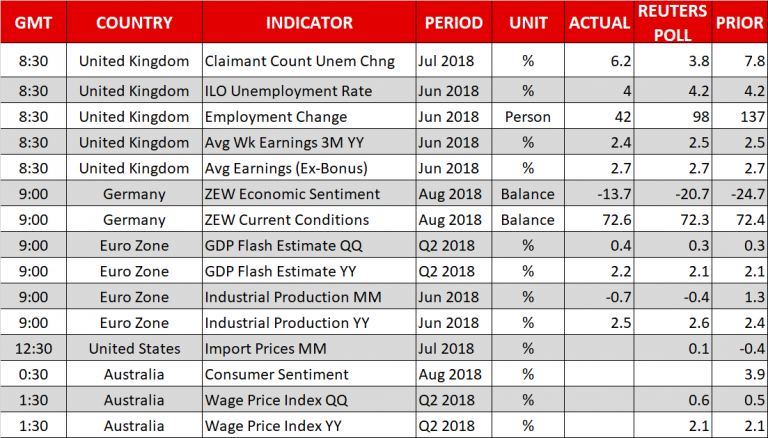
Turning to the economic calendar, US import and export prices will provide a piece of evidence on inflationary pressures later in the day at 1230 GMT, with analysts projecting the former to rebound by 0.1% in July on a monthly basis after posting a decline of 0.4% in June, while the latter is expected to slow down from 0.3% m/m to 0.2%.
Following the above US data, the focus will turn to Australia early on Wednesday, where the Bureau of Statistics is scheduled to publish wage growth figures for the second quarter at 0130 GMT, a key factor behind the RBA’s accommodative monetary policy. While the central bank is eagerly awaiting for subdued wage growth to pick up steam before it decides to remove some stimulus, the data are expected to show that earnings have expanded at 2.1% y/y, the same as in the previous quarter. On a quarterly basis, though, the measure is forecast to rise slightly faster than in the March quarter, posting a growth of 0.6% compared to 0.5% seen previously. Should the numbers beat expectations, turning RBA policymakers more confident on the economy’s outlook, the aussie could recover losses made in the past few days and vice versa. Additionally, Westpac’s consumer sentiment index for the month of August delivered prior the wage numbers at 0030 GMT could also move the aussie.
Meanwhile in oil markets, the American Petroleum Institute (API) will publish its weekly report on US crude oil inventories at 2030 GMT, with scope to add some volatility to crude prices.
NZDUSD Trading In A Bearish Cycle
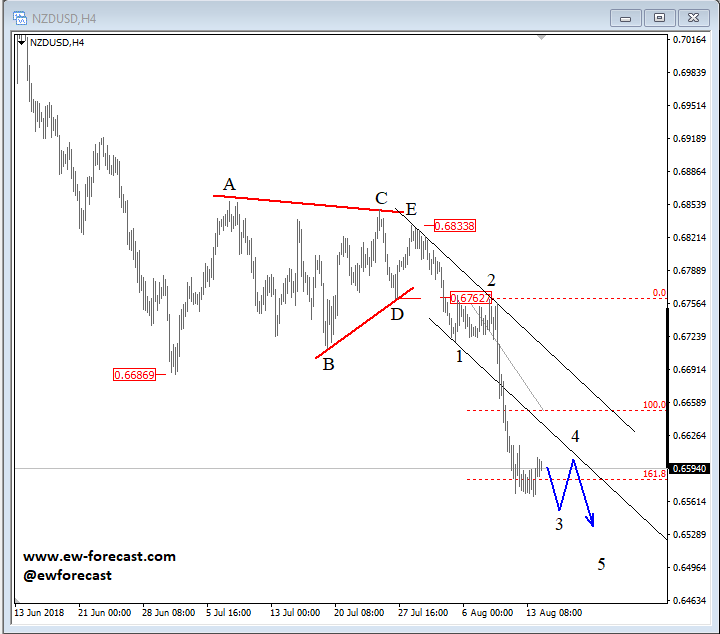
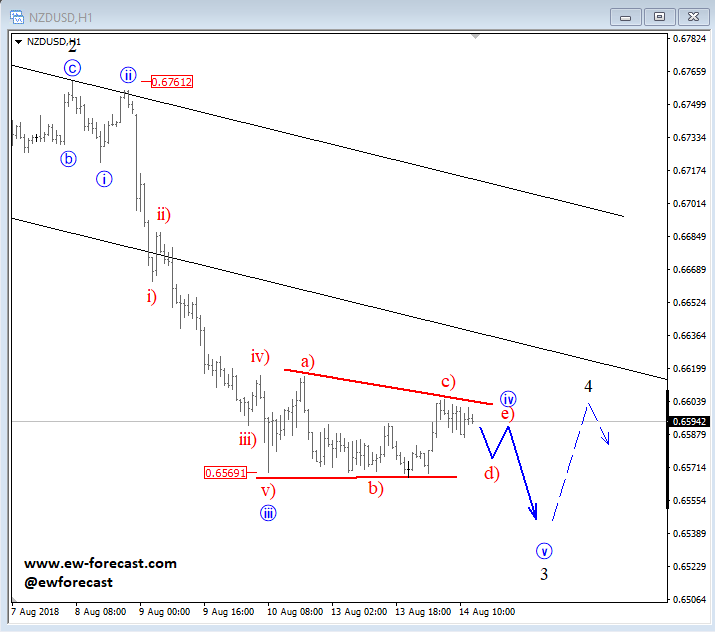
NZDUSD is trading lower, unfolding a new five-wave drop out of a triangle correction located at 0.6834 level. We are observing wave 3 that is now trading below the lower Elliott wave channel line and at Fibonacci projection target of 161.8. Some support can be found here, and a new temporary three-wave rally can follow, which can later look for resistance around the 0.6600 area.
NZDUSD, 4h
Now taking a closer look at the intra-day chart of NZDUSD, where we see a nice five-wave bearish development from the highs.
Higher degree wave 3 unfolded three minor legs, and is now unraveling a choppy and slow price movement within wave iv which looks to be a triangle. A triangle is a five-legged correction that moves into the direction of the trend and also unfolds prior to the final wave. That said, once wave iv correction fully shows up,a new drop towards wave v of 3 may follow.
NZDUSD, 1h
Into US session: AUD weakest, CAD strongest; Nikkei rebounded strongly on Yen’s pull back
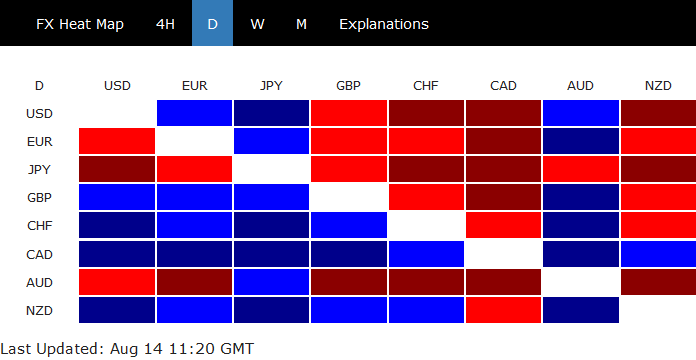
Entering US session, Australian Dollar is trading as the weakest one for today as weighed down by a batch of weaker than expected economic data from China. While European equities opened generally higher, it should be noted that Asian indices ended in red, except for Nikkei. Yen follows as the second weakest one, digesting the steep rally since late last week. On the other hand, Canadian Dollar is the strongest one, followed by Swiss Franc and New Zealand Dollar.
A number of important economic data are released during the European session. But they provide little inspirations to the forex markets. UK employment data are mixed. While unemployment dropped to lowest since 1975, the positive effect is offset by slowdown in wage growth. German ZEW economic sentiment beat markets expectations but still point to less favorable environment ahead. Eurozone industrial production. also contracted more than expected. So, Euro and Sterling are only give a very brief and weak lift.
In other markets, Gold hit as low as 1192.40 as medium term down trend resumed. And it's now consolidation at around 1195. WTI crude oil recovers and is pressing 68 handle. But there is no sign of regaining 70 yet. DAX is trading up 0.16% at the time of writing, CAC up 0.14%, but FTSE is down -0.08%. Earlier in Asia, Hong Kong HSI closed down -0.66%, China Shanghai SSE dropped 0.18%. Singapore Strait Times dropped -0.08%.
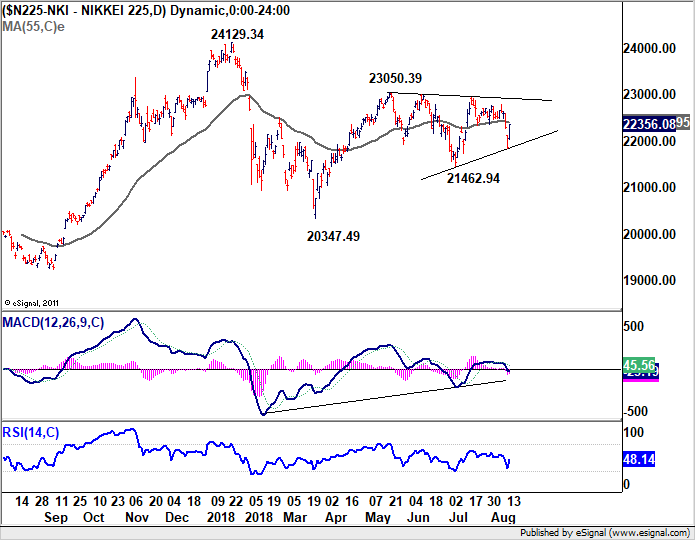
However, Nikkei staged a strong and impressive rebound. It closed up 498.65 pts or 2.28%. The development re-affirmed near term bullish outlook and the last week's selloff just delay an upside breakout. Price actions from 23050.39 should be forming just a consolidation pattern. And rise fro 20347.49 should resume later when such consolidation completes. The index should target a test on 24129.34 high at least.
USDJPY – Sees Further Recovery Higher
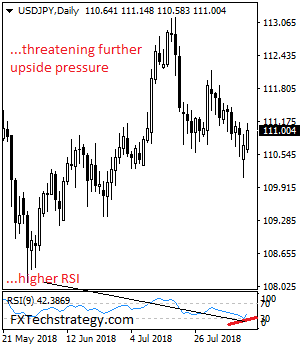
USDJPY - The pair looks to extend further recovery higher as more strength is likely. On the downside, support lies at the 110.50 level where a break if seen will aim at the 110.00 level. A cut through here will turn focus to the 109.50 level and possibly lower towards the 109.00 level. On the upside, resistance resides at the 111.50 level. Further out, we envisage a possible move towards the 112.00 level. Further out, resistance resides at the 112.50 level with a turn above here aiming at the 113.00 level. On the whole, USDJPY faces further recovery pressure
Phew! Turkey Bashing Takes A Break For Now
Tuesday August 14: Five things the markets are talking about
Tuesday sees a tentative reprieve for global equities in the wake of Turkey’s induced turmoil and the forex market has managed to stabilize a tad, aided by reports this morning that the Turkish Finance Ministry has scheduled an investor call for Thursday, Aug 16.
The ‘big’ dollar has managed to slip from its 15-month highs against G10 currency pairs as U.S Treasury prices ease as a degree of calm returns to Turkish markets – USD/TRY is down -4.75% at $6.5622.
Nevertheless, a sizable rate increase by the Central Bank of the Republic of Turkey (CBRT) followed by drastic measures to reduce the fiscal deficit still appears to be the most viable option to re-anchor the lira and pull the country’s economy from the brink. Currently, fixed income dealers are pricing in a +10% rate hike by the CBRT to stem the lira’s depreciation.
Is it economic suicide or attack? President Erdogan knows what needs to be done, but will he allow it? The U.S. has nothing further to negotiate until the detained American pastor is freed.
Elsewhere, crude oil has pared some of its recent losses, while gold finds a bid on a weaker dollar and BTC is again under pressure dropping below $6,000.
On tap: U.S retail sales data appears stateside tomorrow, followed by housing data on Thursday. In Brussels Thursday, Brexit talks between the E.U and the U.K resume.
1. Stocks mixed results on bargain hunting
In Japan, the Nikkei posted its biggest gain in five month after the Turkish lira pared some of yesterday’s losses. Export-driven firms benefited from a pause in the safe-haven yen’s (¥111.01) strengthening. The Nikkei share average surged +2.3%, while the broader Topix rallied +1.6%.
Note: Japanese trading volumes remain thin as many domestic investors are on holiday.
Down-under, Aussie shares closed firmer, supported by the financial and material sectors. The S&P/ASX 200 index rose +0.8% at the close of trade. The benchmark slipped -0.4% on Monday. In S. Korea, both the Kospi stock index and the won gained overnight, supported by recovering confidence after the Turkish turmoil. The Kospi closed up +0.47%.
In Hong Kong and China, stocks fell for a third consecutive session overnight, after data showed further signs of cooling in China’s economy and as trade war worries lingered. In Hong Kong, the Hang Seng index fell -0.7%, while the China Enterprises Index lost -0.2%. In China, the blue-chip CSI300 index fell -0.5%, while the Shanghai Composite Index closed down -0.2%.
Note: Overnight, China July data missed market expectations amid trade frictions – industrial production y/y, +6.0% vs. +6.3%e and retail sales y/y, +8.8% vs. +9.1%e.
In Europe, regional bourses have opened higher across the board as concerns over geopolitical issues, as well as improved outlook over Turkey is helping to support risk sentiment.
U.S stocks are set to open in the ‘black’ (+0.3%).
Indices: Stoxx50 +0.4% at 3,246, FTSE +0.1% at 7,655, DAX +0.5% at 12,415, CAC-40 +0.4% at 5,432; IBEX-35 +0.2% at 9,550, FTSE MIB +0.4% at 21,047, SMI +0.4% at 9,0.42, S&P 500 Futures +0.3%
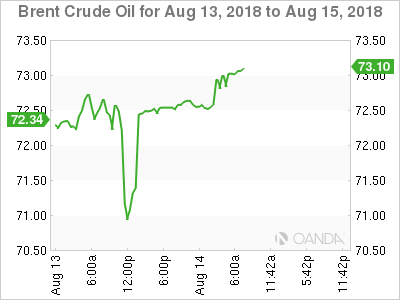
2. Oil edges up on Saudi output cut and Iran sanctions, gold higher
Crude oil prices are better bid this morning after Saudi Arabia said it had cut production in July. However, market concerns over a slowdown in global economic growth is capping prices for now.
Brent crude oil is up +50c at +$73.11 a barrel, while U.S light crude has gained +55c to +$67.75.
Saudi Arabia has told OPEC that it had reduced crude output by -200Kbpd to +10.29M bpd in July.
Note: Saudi Arabia is OPEC’s biggest producer and the only major exporter that can easily adjust output to balance global supply. A self-imposed cut in product would suggest that Saudi’s are keen to avoid a repeat of a global glut that has depressed prices over the past few years.
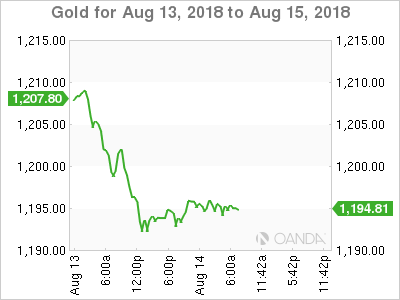
Ahead of the U.S open, gold prices are better bid, edging away from yesterday’s 18-month low print (+$1,191.25). Support is coming from a weaker U.S dollar and a break below some key psychological levels has triggered some technical buying interest. Spot gold is up +0.2% at +$1,195.51 an ounce. U.S gold futures are up +0.3% at +$1,202.50 per ounce.
3. Italian bond yields fall from two-month highs
Italian bond yields have pared some of yesterday’s sharp rise on reassuring comments from the government and as fears about contagion from Turkey has eased for now.
PM Conte and his top ministers discussed the 2019 budget yesterday – investors have been concerned that the government’s high-spending plans would lead to a further deterioration in Italy’s finances. However, the Italian government have agreed to preserve the “stability of state finances and lower public debt.”
Italy’s 10-year BTP yield has fallen – 7 bps to +3.03%, off two-month highs of +3.109% set yesterday, with its 5-year note yield down -6 bps at +2.32%.
Elsewhere, the yield on U.S 10-year Treasuries have backed up +2 bps to +2.89%, the largest gain in a week. In Germany, the 10-year Bund yield has gained +2 bps to +0.33%, the first advance in a week, while in the U.K, 10-year Gilt yield has also climbed +2 bps to +1.277%, the largest surge in almost a fortnight.
4. Indian rupee hits new all time low
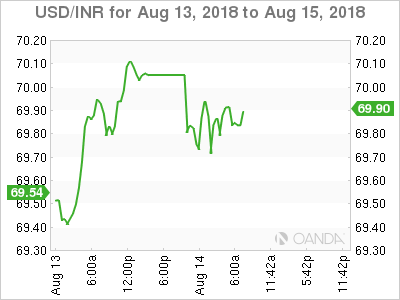
Emerging-market currencies remain under pressure despite today’s TRY reprieve that Turkey’s Finance Ministry has scheduled an investor call for Thursday, Aug 16. Overnight, INR fell to new record low of $70.08 outright, retaining its position as one of Asia’s worst performing currencies this year. It’s believed that the Reserve Bank of India (RBI) has been trying to defend the $70 level by selling USD.
Note: The rupee has fallen -9.5% in 2018. Among other major emerging markets, only BRL, RUB and ZAR currencies have weakened more.
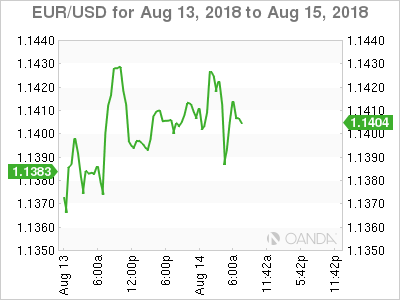
EUR (€1.1401) is trading above yesterday’s intraday low (€1.1367) after German Q2 GDP data suggested that the slowdown in Q1 was temporary. The single unit still faces resistance from Italian discussions on their 2019 budget. Italy Deputy PM Di Maio believes that Italy is not at risk of financial market attack.
GBP (£1.2783) saw its best levels of the session erode (£1.2809) despite its ILO Unemployment falling to its lowest level since 1975.
And cryptocurrencies are stung by ETF Delay – Bitcoin and ethereum continue to fall as reports from earlier this month that the application of a Bitcoin exchange traded fund has been postponed is keeping global institutional money on the sidelines. Bitcoin is down-3.6% to around +$6,035.
5. Eurozone avoids Q2 Slowdown, supported by German growth
Data this morning shows that Germany’s economic growth accelerated in Q2, guaranteeing the eurozone as a whole avoided a slowdown. Nevertheless, expect global trade tensions to cloud the outlook for businesses.
The Federal statistics office reported Germany’s GDP grew at a quarterly rate of +0.5%, or +1.8% in annualized terms. It also raised its Q1 growth estimate to an annualized +1.5% from +1.2% growth reported in May.
And because of Germany’s expansion, the agency has also raised its growth estimate for the eurozone as a whole to +1.5% in annualized terms from +1.4% reported in late July.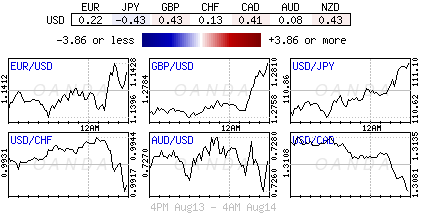
European Data Suggests That Slowdown In Q1 Was Temporary
Notes/Observations
- Upcoming Turkey investor call (Thursday) helps to calm emerging markets; President Erdogan remained deficient in believing his country was under an economic attack
- German Q2 GDP data mixed but hints that momentum was regaining its posture
- German Aug ZEW Survey improved
- Euro Zone Q2 GDP revised higher in its 2nd reading
- No revision to July CPI data for Germany, France and Spain
Asia:
- China July data misses market expectations amid trade frictions and deleveraging e?orts; Industrial Production Y/Y: 6.0% v 6.3%e; Retail Sales Y/Y: 8.8% v 9.1%e
- China July Surveyed Jobless Rate 5.1% v 4.8% prior with seasonal factors attributed for the increase
Europe:
- Italy govt official: any speculation of Fin Min Tria possibly resigning is baseless; Tria is Italy's only ECB interlocutor
- Italy League Party official Borghi (budget committee): the Euro system cannot be at the mercy of the market without an ECB shield
- Conservative Brexiteers said to publish their own blueprint. MP Jacob Rees-Mogg said to be planning to challenge UK PM May by publishing their own blueprint for a hard Brexit. The paper is due to be published next month and was expected to have the backing of between 60-80 MP’s
Americas:
- Argentina Central Bank raises key 7-day LELIQ rate to by 500bps to 45.00%
Economic Data:
- (FR) France Q2 ILO Unemployment Rate: 9.1% v 9.2%e; Mainland Unemployment Rate: 8.7% v 8.9%e; Change in Mainland Unemployment: -48K v +85K prior
- (DE) Germany Q2 Preliminary GDP Q/Q: 0.5% v 0.4%e; Y/Y: 2.0% v 2.1%e; GDP NSA Y/Y: 2.3% v 2.5%e
- (DE) Germany Jun Final CPI M/M: 0.3% v 0.3%e; Y/Y: 2.0% v 2.0%e
- (DE) Germany Jun Final CPI EU Harmonized M/M: 0.4% v 0.4%e; Y/Y: 2.1% v 2.1%e
- (DK) Denmark Q2 GDP Indicator Q/Q0.3% v 0.3% prior
- (FI) Finland July CPI M/M: -0.1% v +0.2% prior; Y/Y: 1.4% v 1.2% prior
- (FI) Finland Jun GDP Indicator WDA Y/Y: 3.0% v 3.5% prior
- (FI) Finland Jun Final Retail Sales Volume Y/Y: -0.3% v -0.3% prelim
- (RO) Romania Q2 Advance GDP Q/Q: 1.4% v 1.5%e v 0.1% prior; Y/Y:
4.1% v 4.0%e - (IN) India July Wholesale Prices (WPI) Y/Y: 5.1% v 5.2%e (pace slowed for the 1st time since March)
- (FR) France July Final CPI M/M: -0.1% v -0.1%e; Y/Y: 2.3% v 2.3%e
- (FR) France July Final CPI EU Harmonized M/M: -0.1% v -0.1%e; Y/Y: 2.6% v 2.6%e , CPI Ex-Tobacco Index: 102.96 v 102.97e
- (ES) Spain July Final CPI M/M: -0.7% v -0.7%e; Y/Y: 2.2% v 2.2%e
- (ES) Spain July Final CPI EU Harmonized M/M: -1.2% v -1.2%e; Y/Y: 2.3% v 2.3%e
- (ES) Spain July CPI Core M/M: -0.8% v +0.1% prior; Y/Y: 0.9% v 1.1%e
- (CZ) Czech Q2 Advance GDP Q/Q: 0.5% v 0.8%e; Y/Y: 2.3% v 2.7%e
- (HU) Hungary Q2 Preliminary GDP Q/Q: 0.9% v 0.8%e; Y/Y: 4.6% v 4.1%e
- (CH) Swiss July Producer & Import Prices M/M: 0.1% v 0.2% prior; Y/Y: 3.6% v 3.5% prior
- (NL) Netherlands Q2 Preliminary GDP Q/Q: 0.7% v 0.6%e; Y/Y: 2.9% v 2.6%e
- (NL) Netherlands Jun Trade Balance: €4.8B v €4.7B prior
- (PL) Poland Q2 Preliminary GDP Q/Q: 0.9% v 1.0%e; Y/Y: 5.2% v 5.1%e
- (PL) Poland July Final CPI M/M: -0.2% v -0.1% prelim; Y/Y: 2.0% v 2.0% prelim
- (UK) Jun Average Weekly Earnings 3M/Y: 2.4% v 2.5%e; Weekly Earnings (ex Bonus) 3M/Y: 2.7% v 2.7%e
- (UK) July Jobless Claims Change: +6.2K v +9.0K prior; Claimant Count Rate: 2.5% v 2.5% prior
- (UK) Jun ILO Unemployment Rate: 4.0% v 4.2%e; Employment Change 3M/3M: +42K v +93Ke
- (PT) Portugal Q2 Preliminary GDP Q/Q: 0.5% v 0.3%e; Y/Y: 2.3% v 2.1% prior
- (DE) Germany Aug ZEW Current Situation: 72.6 v 72.1e; Expectations Survey: -13.7 v -21.3e
- (EU) Euro Zone Q2 Preliminary GDP (2nd reading) Q/Q: 0.4% v 0.3%e; Y/Y: 2.2% v 2.1%e
- (EU) Euro Zone Jun Industrial Production M/M: -0.7% v -0.4%e; Y/Y: 2.5% v 2.4%e
- (EU) Euro Zone Aug ZEW Expectations Survey: -11.1 v -18.7 prior
Fixed Income Issuance:
- (ES) Spain Debt Agency (Tesoro) sold total €B vs. €4.0-5.0B indicated range in 6-month and 12-month Bills
- (IN) India sold total INR180B vs. INR180B indicated in 3-month, 6-month and 12-month bills
SPEAKERS/FIXED INCOME/FX/COMMODITIES/ERRATUM
Equities
- Indices [Stoxx50 +0.4% at 3,246, FTSE +0.1% at 7,655, DAX +0.5% at 12,415, CAC-40 +0.4% at 5,432; IBEX-35 +0.2% at 9,550, FTSE MIB +0.4% at 21,047, SMI +0.4% at 9,0.42, S&P 500 Futures +0.3%]
- Market Focal Points/Key Themes: European indices open higher across the board and largely remained positive as the session wore on; concerns over geopolitical issues, as well as improved outlook over Turkey, help support risk sentiment; Portugal and UK indices underperforming; Esure confirms receipt of unsolicited takeover offer from Bain; earnings newsflow dominated by German companies; financials and automobile sectors among best performers; upcoming earnings expected in the US session include Home Depot, Advance Autoparts and Tapestry
Equities
- Consumer discretionary: Brunel BRNL.NL -5.0% (results), KSB KSB.DE -3.7% (results), Rockwool International ROCKA.DK +2.6% (Prelim results), Straumann STMN.CH +4.2% (results)
- Energy: RWE RWE.DE +1.8% (results), Saipem SPM.IT +2.8% (analyst action)
- Financials: Esure ESUR.UK +4.0% (takeover offer, results), Flow Traders FLOW.NL -3.7% (analayst action)
- Healthcare: Curetis CURE.NL -5.3% (results)
- Industrials: Geberit GEBN.CH -2.1% (results)
- Materials: Antofagasta ANTO.UK -5.0% (results), K+S SDF.DE -2.6% (results)
- Technology: Siltronic WAF.DE -3.8% (analyst action)
- Telecom: TKH Group TK.NL +4.4% (results)
Speakers
- Italy PM Conte and top ministers (Di Maio, Salvini and Tria) held conference call on Monday to continue discussion on 2019 budget; said to reiterate need to reduce debt load. Also examined the macroeconomic situation
- German ZEW Economists stated that recent trade agreement between US and EU had lifted investor sentiment significantly but growth outlook for German economy had deteriorated nonetheless
- Turkey President Erdogan reiterated that the country was under an explicit economic attack, taking all technical measures needed. Have to maintain a strong political stance as our character was not one of flop-flopping. Economy was being used as a weapon against Turkey. To stand firm against the USD and FX rates and had begun converting FX to TRY currency (Liras)
- Turkey State-owned utility Botas said to have fixed the TRY currency (Lira) exchange rate at 6.5 for power plants
- India Economic Affairs Sec Garg: Not concerned about decline in INR currency (Rupee) at this time; move related to external factors
- India Central Bank (RBI) again suspected of FX currency intervention to support INR currency (Rupee), helped to move Rupee off record lows (**Note: USD/INR trade at 70.12 for a fresh record low in
Currencies
- FX markets stabilized a bit on Tuesday aided by reports that the Turkey Finance Ministry scheduled an investor call for Thursday, Aug 16th. Also aiding the situation was reports that White House: NSA Bolton met with Turkey Ambassador today to discuss the detention of Pastor Brunson. Some of the luster of safe-haven plays from last week saw a bit of reversal in today’s session. USD/TRY was lower by over 5% with the pair testing below 6.44 after hitting a record high above 7.20 on Monday. Turkey President Erdogan remain defiant in hid believe that Turkey was under an economic attack and assailed the US for its sanctions.
- EUR/USD held above the 1.14 handle for the most part of the session after German Q2 GDP data suggested that the slowdown in Q1 was temporary. Headwinds for the Euro remains the Italian discussions on 2019 budget as the 10-year Italian BTP yield remained above the 3% level. The 1.15 level will provide stiff resistance for the Euro in the short-run. The pair was just under 1.14 ahead of the NY morning
- GBP/USD saw its best levels of the session erode despite its ILO Unemployment falling to its lowest level since 1975. Pair holding under the 1.28 level.
Fixed Income
- Bund Futures trades at 163.24 down 24 ticks as Indices rebound following a rebound in the Turkish Lira and other emerging currencies.
- A move above today's high targets 163.63 then a push for 164. Continued retracement targets 162.69 initially.
- Gilt futures trades at 123.26 down 26 ticks continuing to pull back from the recent highs with initial support at 123.12, while a higher sees 123.63 then 124.00.
- Tuesday 's liquidity report showed Monday's excess liquidity rose from €1.908T to €1.889T. Use of the marginal lending facility rose from €30M to €31M.
- Corporate issuance saw the week start with three issuers raising $14.3B.
Looking Ahead
- (PT) Bank of Portugal Reports July ECB financing to Portuguese Banks
- (UR) Ukraine Q2 Preliminary GDP Q/Q: No est v 0.9% prior; Y/Y: 3.2%e v 3.1% prior
- 05.30 (UK) Weekly John Lewis LFL sales data
- 05:30 (ZA) South Africa Jun Total Mining Production M/M: No est v 5.0% prior; Y/Y: No est v -2.6% prior; Gold Production Y/Y: No est v -16.2% prior; Platinum Production Y/Y: No est v 9.6% prior
- 05:30 (EU) ECB allotment in 7-Day Main Refinancing Tender (MRO)
- 05:30 (HU) Hungary Debt Agency (AKK) to sell in 3-month Bills
- 05:30 (ZA) South Africa to sell combined ZAR2.4B in 2023, 2035 and 2048 bonds
- 06:00 (US) July NFIB Small Business Optimism: 106.8e v 107.2 prior
- 06:00 (IE) Ireland Jun Property Prices M/M: No est v 0.6% prior; Y/Y: No est v 12.4% prior
- 06:00 (PT) Portugal Q2 Labour Costs Y/Y: No est v -1.5% prior
- 06:00 (TR) Turkey to sell Bonds (2 tranches)
- 06:45 (US) Daily Libor Fixing
- 07:45 (US) Weekly Goldman Economist Chain Store Sales
- 08:00 (BR) Brazil Jun IBGE Services Sector Volume Y/Y: -0.4%e v -3.8% prior
- 08:00 (IS) Iceland July Unemployment Rate: No est v 2.1% prior
- 08:00 (RU) Russia announces weekly OFZ bond auction (held on Wed)
- 08:05 (UK) Baltic Dry Bulk Index
- 08:30 (US) July Import Price Index M/M: 0.0%e v -0.4% prior; Y/Y: 4.5%e v 4.3% prior; Import Price Index ex Petroleum M/M: +0.1%e v -0.3% prior
- 08:30 (US) July Export Price Index M/M: 0.2%e v 0.3% prior; Y/Y: No est v 5.3% prior
- 08:30 (CA) Canada July Teranet/National Bank HPI M/M: No est v 0.9% prior; Y/Y: No est v 2.9% prior, HPI Index: No est v 223.82 prior
- 08:55 (US) Weekly Redbook Sales
- 09:00 (EU) Weekly ECB Forex Reserves
- 09:00 (BE) Belgium Jun Trade Balance: No est v -€0.5B prior
- 11:00 (US) NY Fed Q2 Household Debt & Credit report:
- 11:00 (CO) Colombia Jun Industrial Production Y/Y: 2.0%e v 2.9% prior
- 11:00 (CO) Colombia Jun Retail Sales Y/Y: 4.6%e v 5.9% prior
- 11:00 (CO) Colombia Jun Trade Balance: -$0.8Be v -$0.6B prior; Total Imports: $4.4Be v $4.5B prior
- 11:30 (US) Treasury to sell 4-Week and 52-Week Bills
- 16:30 (US) Weekly API Oil Inventories
Impacts of Turkish Turmoil on Eurozone Limited. Yet, Market Sentiment is Contagious
Selloff in Turkish lira and euro has stabilized but the worst is not yet over. As we mentioned in the previous report, the ultimate reason for lira’s slide is President Recep Tayyip Erdogan's failed economic and monetary policy. The Turkish central bank TCMB, since his re-election as the President, has refrained from raising interest rates despite elevated inflation. The new policy announced on Monday was nothing new. It is in line with recent monetary policy that focuses on injecting liquidity to the market by cutting reserve requirement ratios (RRR). Undeniably, US President Donald Trump’s latest sanctions have exacerbated the situation by putting the problems facing Turkey under the spotlight.
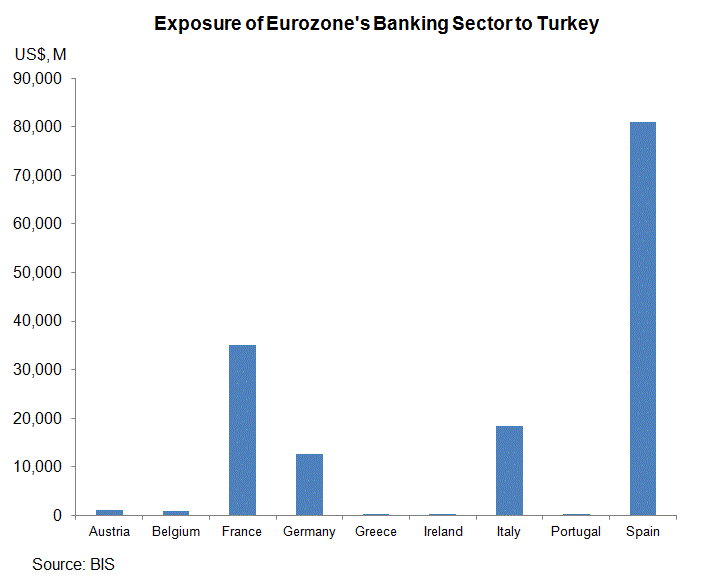
Euro’s weakness late last week was driven by a Financial Times report suggesting that ECB has become concerned about the exposure of some of Eurozone’s banks to Turkey, in particular BBVA, UniCredit and BNP Paribas. The news has sparked concerns over contagion of Turkey’s problems to other European countries, especially those in the perphery. Some have gone so far to suggest that European sovereign debt crisis in 2009/10 can return. Turkish central bank (TCMB).
We illustrate below that, the turmoil of Turkey so far has limited impacts, in terms of economy and financial system, on the Eurozone. While some peripheral economies are having closer ties to Turkey, Eurozone as a whole has limited exposure. However, evolution of the Turkish crisis should be monitored closely as market sentiment, not necessarily rational, can diminish abruptly and can spread from Turkey to other emerging markets very rapidly.
TCMB's stimulus measures to rescue TRY
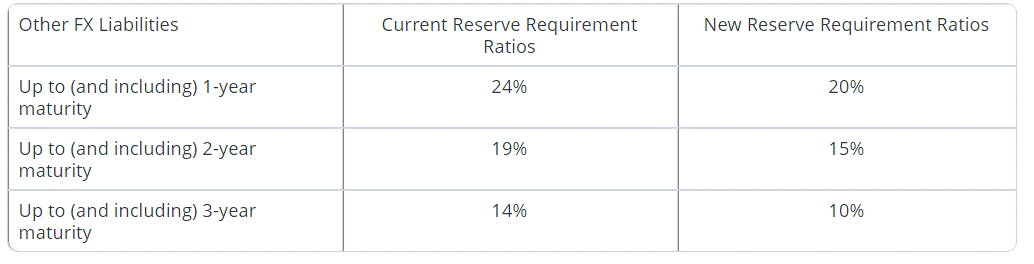
Turkish central bank announced new stimulus measures to rescue the slump in lira. It cut the reserve requirement ratios (RRR) by -250 bps for all maturity brackets and RRR for non-core FX liabilities by -400 bps or up to 3-year maturities. The maximum average maintenance facility for FX liabilities has been raised to 8%. In addition to USD, euro can be used for the maintenance against Turkish lira reserves under the reserve options mechanism. Meanwhile, approximately 10B lira, US$6B, and US$3B equivalent of gold liquidity will be provided to the financial system. We expect these measures could only provide a mild relief to the market. Indeed, injecting liquidity to the market would aggravate the soaring inflation, further constraining consumption and sustaining the economy in downward spiral.
Source: Turkish Central Bank
Turkey takes up only 3% of Eurozone exports
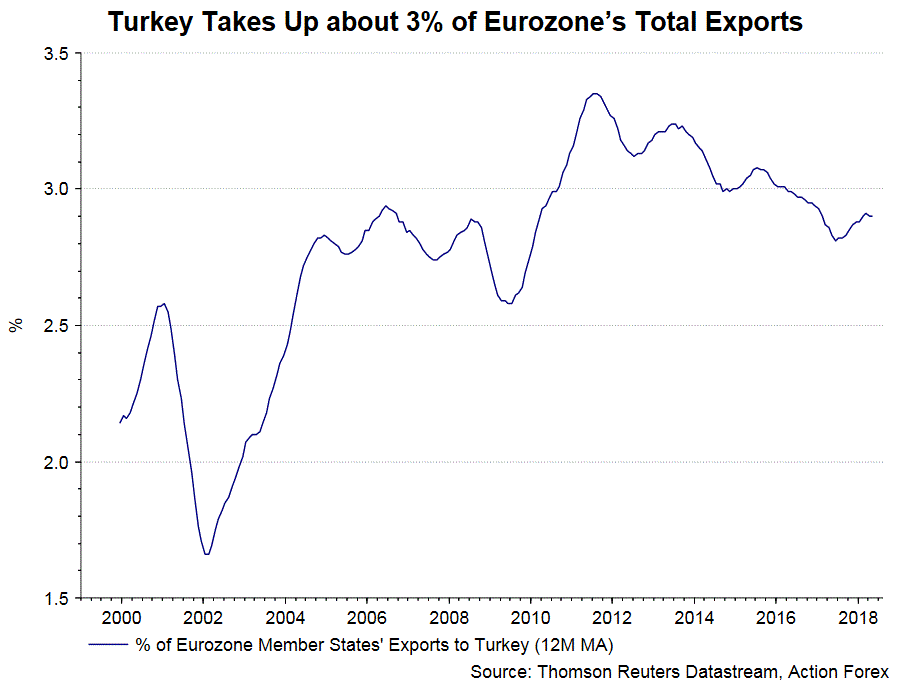
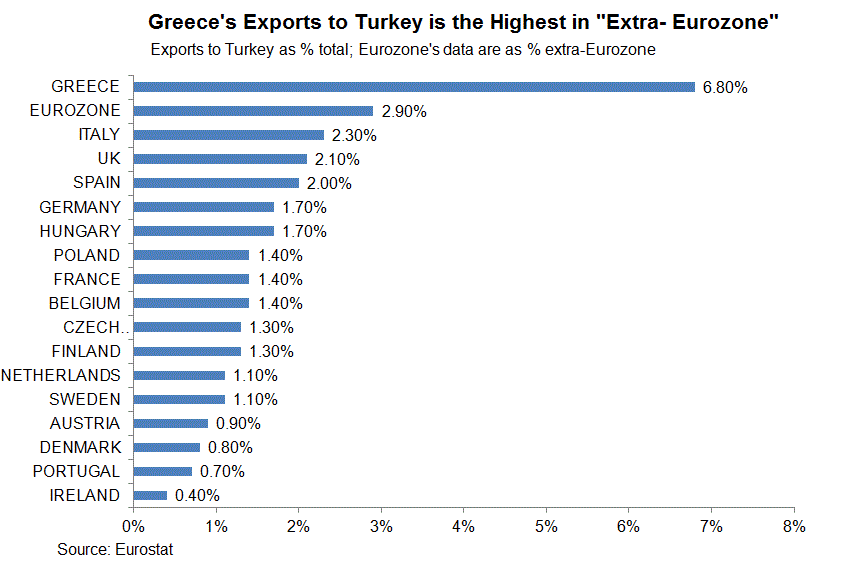
Considering the importance of Turkey to the Eurozone economically and financially, we believe that economic impact is limited while financial impact might be higher. Eurostat’s data shows that Turkey takes up about 3% of Eurozone’s total exports. Greece’s exposure is the highest among the member states.
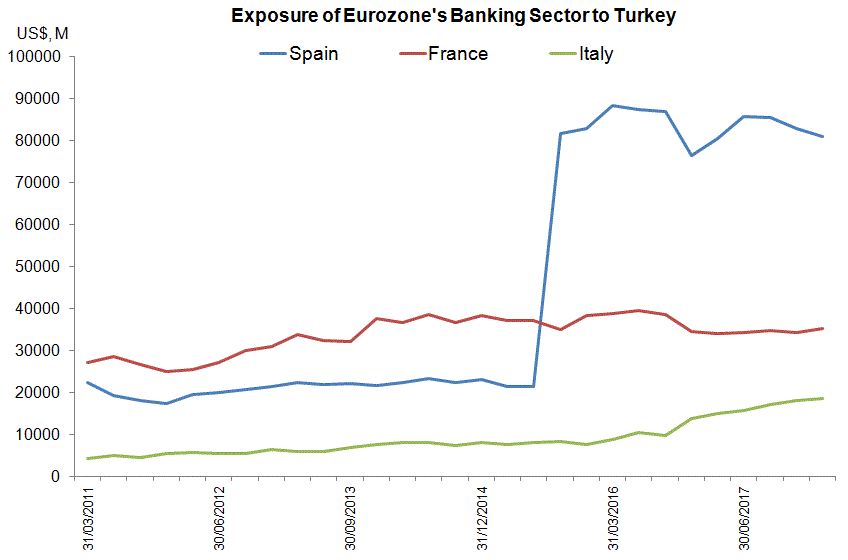
Spain has most banking exposure, but just around 2.5% of aggregate balance sheet
In terms of the banking system, BIS data (https://stats.bis.org/statx/srs/table/b4?c=TR) shows that financial institutions in Spain have the most significant exposure to Turkey. This is followed by France and Italy. Note that the figures in the chart below refer to the ownership of subsidiary banks in Turkey, rather than direct loan exposure. As such, the potential loss of these financial institutions (in case of default) should be lower than the figures suggested. Spain’s exposure to Turkey is equivalent to around 2.5% of the Spanish banking sector’s aggregate balance sheet.