

Sample Category Title
Japanese Yen Dips Despite Soft US Durables, Japan Retail Sales ahead
The Japanese yen has posted losses session in the Wednesday session, continuing the trend seen on Tuesday. In the North American trade, USD/JPY is trading at 110.43 up 0.36% on the day. On the release front, U.S durable goods pointed to contraction. There was more bad news from the housing front, as Pending Home Sales came in at -0.5%, marking a second straight decline. This missed the estimate of a 0.4% gain. Later in the day, Japan releases Retail Sales, which is expected to drop to 1.3%. On Thursday, the U.S will publish Final GDP for the first quarter and unemployment claims.
U.S durable goods reports in May were a disappointment. Core durable goods orders declined 0.3%, well of the estimate of 0.5% and a 4-month low. Durable goods orders declined for a second straight month, with a reading of -0.6%. Still, this was better than the forecast of -0.9%. Despite the soft May numbers, the data for April was revised upwards, so business spending on equipment is expected to show moderate growth in the second quarter. However, the escalating trade war between the U.S and its trading partners could dampen business spending and send the U.S dollar downwards.
As the second quarter draws to a close, the U.S economy continues to perform well. Economic growth has been strong and the labor market is close to capacity. However, the trade war between the U.S and its major partners could be the dark cloud on the horizon. The Federal Reserve now plans to raise rates four times in 2018 (up from three), but a global trade war could force the Fed to revise its forecast back to three hikes. On Tuesday, Atlanta Fed bank president Raphael Bostic said that if the trade war intensified, he would vote against a fourth rate hike, due to downside risks to the economy. Fed Chair Jerome Powell sounded pessimistic about the economic effects of trade tensions at an ECB forum earlier in June, and if other Fed members express concerns, a fourth rate hike could be delayed until 2019.
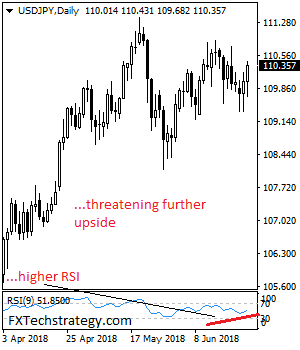
USDJPY: Threatening Further Bull Pressure
USDJPY: The pair looks to recover further higher leaving risk of more strength on the cards. On the downside, support lies at the 110.00 level where a break if seen will aim at the 109.50 level. A cut through here will turn focus to the 10.00 level and possibly lower towards the 108.50 level. On the upside, resistance resides at the 110.50 level. Further out, we envisage a possible move towards the 111.00 level. Further out, resistance resides at the 111.50 level with a turn above here aiming at the 112.00 level. On the whole, USDJPY faces further downside pressure near term.
Sunset Market Commentary
Markets:
Global core bonds managed to eke out gains today with US Treasuries outperforming German Bunds. The main move occurred around the start of European trading as US equity futures hit an air pocket. US stock markets recently showed quite some resilience during the verbal trade war, but show more signs of vulnerability. It comes at a strange moment with President Trump for example backing down on his warning to curb Chinese investments in the US tech sector. The downleg in equity futures occurred in lockstep with new selling pressure in emerging market currencies like ZAR, BRL and (initially) TRY. So the upleg in core bonds was nevertheless safe haven related. US equity futures showed an intraday recovery and main European indices are in the green, but core bonds didn’t really return to opening levels. They hanged on to gains even if also higher oil prices and the US Treasury’s end-of-month refinancing operation are on the other side of the balance. Mixed US durable goods orders even pushed US Treasuries again to the intraday high. The German yield curve bull flattens at the time of writing with yields 0.3 bps (2-yr) to 3.8 bps (30-yr) lower. The US yield curve shifts in similar fashion with yields declining by 2.1 bps (2-yr) and 3.5 bps (30-yr). On intra-EMU bond markets, 10-yr yield spreads vs Germany narrowed up to 4 bps.
EUR-USD. Trading in major FX cross rates like EUR/USD and USD/JPY was again mostly technical in nature. The euro rebound that developed at the end of last week and early this week has stalled. Early in the session, risk sentiment remained cautious. Remarkably, the dollar remained better bid even as US equity futures underperformed European equities. EUR/USD drifted lower in the 1.16 big figure. Later in the session, sentiment on global equities (including US ones) improved as the Trump administration announced it prefers to use a less aggressive procedure to make its assessment on Chinese/foreign investments. Equities rebounded, but the better risk sentiment didn’t change the USD positive sentiment. US eco data (trade balance, inventors and durable goods orders) confirm expectations for good Q2 US growth. In a daily perspective, the dollar gained against the euro (EUR/USD 1.1600 area) and the yen (USD/JPY 110.35 area). So, the dollar retains the benefit of the doubt whatever the ST developments in the trade war. (ST) interest rate differentials between the US and Germany narrowed further, but at least today , it had little (negative) impact on the dollar.
GBP. EUR/GBP held north of the 0.88 big big figure today. The pair hovered in a tight range in the 0.8803/0.8827 area, but hovered near the recent top even as EUR/USD lost substantial ground. It suggests underlying sterling softness. Markets doubt the chances for an August rate hike. CBI June retail data were OK, but as usual didn’t help sterling much. EUR/GBP trades currently in the 0.8815/20 area. Cable dropped to the 1.3150 area, admittedly mostly on broad USD strength.
News Headlines:
The Czech National Bank raised its policy rate from 0.75% to 1%. The bank board mainly pointed to inflationary risks stemming from the weaker-than-expected koruna, faster-than-expected domestic inflation and stronger inflationary pressures from abroad. CNB governor Rusnok added though that the future pace of Czech rate hikes is hard to predict, reversing the Czech koruna’s initial gains.
The US Commerce Department said orders for non-defense capital goods excluding aircraft, a closely watched proxy for business spending plans, slipped 0.2% last month (vs +0.5% M/M forecast). Data for April was revised to show the so-called core capital goods orders surging 2.3% instead of the previously reported 1.0% rise. The US’s trade deficit unexpectedly narrowed from -$67.3bn in April to -$64.8bn in May. (Reuters)
Two auto groups blast Trump’s auto tariffs
The Association of Global Automakers issued a statement titled "International Automakers Are Not A National Security Threat" today in objection to Trump's intention to impose tariffs on import cars. The group warned that "these tariffs will harm today's U.S. auto industry, which is comprised of fourteen auto manufacturers, all of which are global and 10 of which are international automakers." And, "each of these companies employ American workers to produce cars in the United States, and tariffs will substantially increase prices for consumers."
Further it criticized that "there is no national security justification for taxing imports of vehicles and parts or discriminating between global companies headquartered here or in allied countries." The group noted that "every U.S. production facility in the industry could be made available in a national emergency, and the 130,000 Americans who work directly for international automakers are no less patriotic or willing to serve their country in a time of crisis than any other American."
Finally, it warned that "if this investigation leads to tariffs, retaliation against U.S. exports is inevitable." And, "substantial tariffs against major US auto exports have in fact already been announced, placing American auto workers on the front lines of this trade conflict."
Another group Alliance of Automobile Manufacturers also object to the tariff. It said in a statement that "tariffs are not the right approach" to achieve a level playing field. And, it urge reduction in trade barriers across the board and achieve "fairness" through "facilitating rather than inhibiting trade." And, economic security of the auto industry and country would be strengthened through modernizing NAFTA and concluding a U.S.-EU Trade Pact.
The statement also listed the bad effects of auto tariffs. There will be USD 45B in additional tax for consumers. a 25% tariffs would result in 1.5% decline in production and cause USD 195k works to lose jobs over 1-3 years or possibly longer. Job losses could surge further to 624k on retaliation by other countries. Auto sales will fall 1-2m units. It will cancel out tax reform benefits, reduce auto exports and harm other vital sectors of the economy. Besides, it will cede US leadership on future vehicle technologies.
GBPAUD Slips Below 40-Day SMA; Could Weaken Further in Short-Term
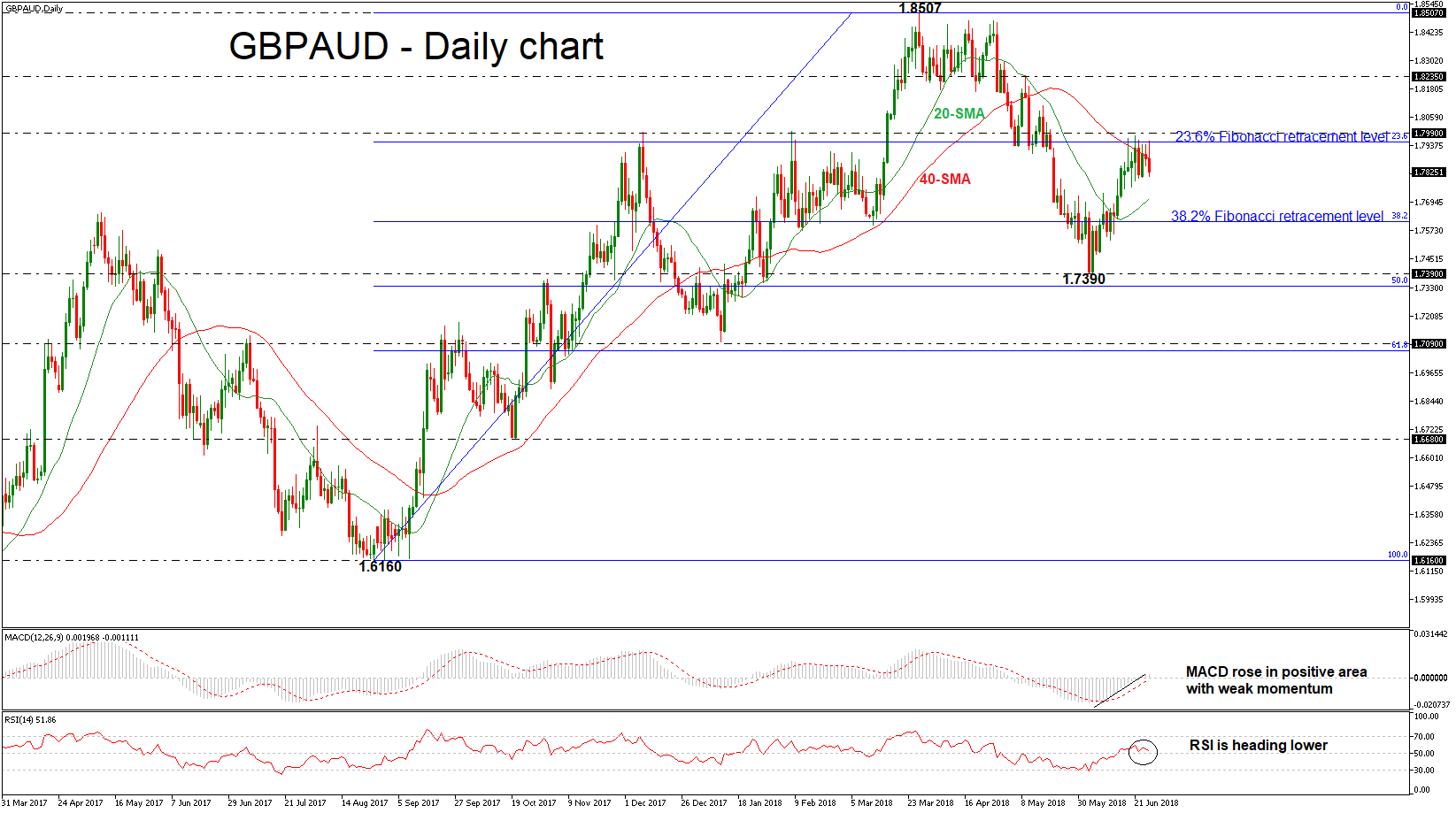
GBPAUD has touched several times the 23.6% Fibonacci retracement level of the upleg from 1.6160 to 1.8507, around 1.7953 over the previous six days. However, the 40-day simple moving average (SMA) also acted as resistance, hence the upside momentum appears to have run out of steam as prices have been attempting and failing to close above the line in the past sessions.
The neutral to bearish bias in the near term is also supported by the RSI, which has been hovering slightly above the 50 level but is still failing to cross into negative territory. The MACD oscillator stands above the zero line with weak momentum.
Should the pair manage to strengthen its positive momentum, the next resistance could come around the 23.6% Fibonacci of 1.7653. A break above this area would shift the bias to a more bullish one and open the way towards the 1.8235 high, taken from the peak on May 8.
However, if prices are unable to break the aforementioned obstacles to the upside the risk would shift back to the downside until the 20-day SMA near 1.7700 at the time of writing, with the level once again coming into focus. A drop below the moving average would signal a bearish movement. The next key support to watch lower down is the 38.2% Fibonacci of 1.7612.
In the medium term, the bullish outlook remains intact, with the 20-day SMA pointing upwards. However, should prices decline towards the mentioned SMA, this would risk shifting the medium-term picture to a more neutral one.
USD/JPY Mid-Day Outlook
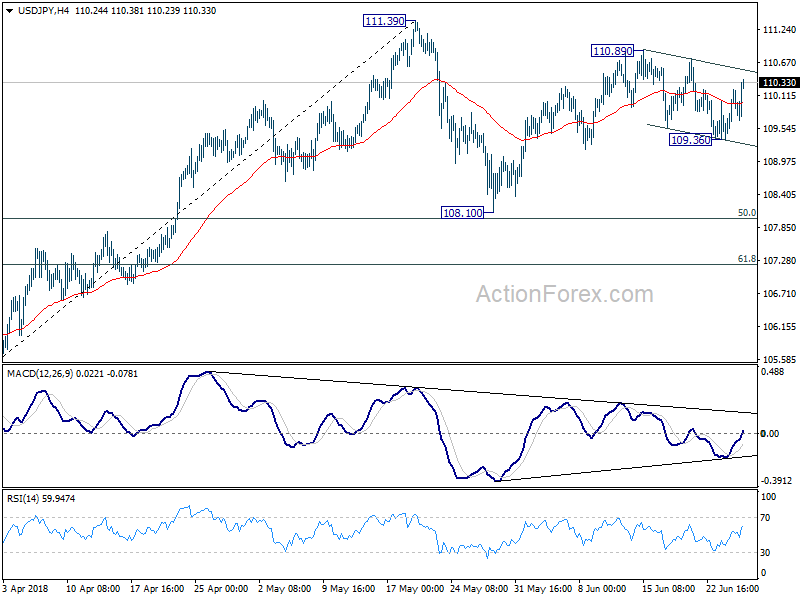
Daily Pivots: (S1) 109.39; (P) 109.74; (R1) 110.11; More...
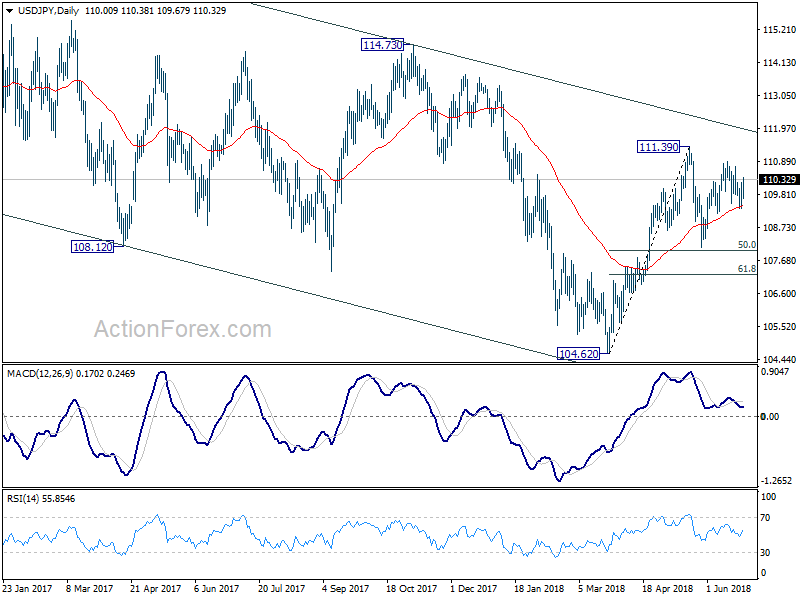
USD/JPY rebounds strongly today but stays inside range of 109.36/110.39. Intraday bias remains neutral first. On the upside, break of 110.89 will resume the rise from 108.10 and target 111.39. Firm break there will resume the rally from 104.62 and target 114.73 key resistance. On the downside, below 109.36 will resume the fall from 110.89. In that case, as price actions from 111.39 are seen as a corrective pattern, we'd expect strong support from 61.8% retracement of 104.62 to 111.39 at 107.20 to contain downside and bring rebound.
In the bigger picture, at this point, we're slightly favoring the case that corrective decline from 118.65 (2016 high) has completed with three waves down to 104.62. Above 111.39 will affirm this view and target 114.73 for confirmation. However, it should be noted that USD/JPY is bounded in medium term falling channel from 118.65 (2016 high). Sustained break of 61.8% retracement of 104.62 to 111.39 at 107.20 will likely resume the fall from 118.65 through 104.62 low.
USD/CHF Mid-Day Outlook
Daily Pivots: (S1) 0.9868; (P) 0.9896; (R1) 0.9933; More...
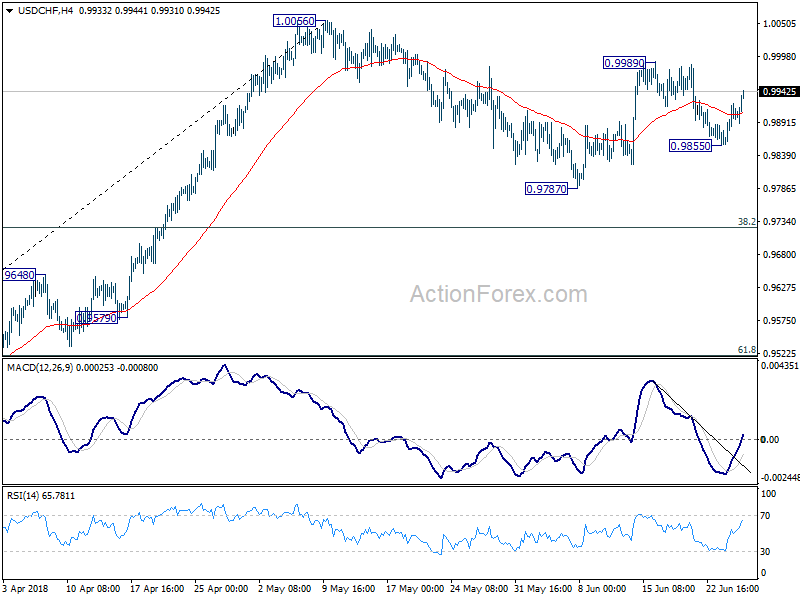
USD/CHF rebounds strongly today but stays below 0.9989 minor resistance. Intraday bias remains neutral first. On the upside, above 0.9989 will resume the rebound from 0.9787 and target 1.0056 high. Break will resume whole rally from 0.9186. On the downside, below 0.9855 will likely resume the correction from 1.0056 through 0.9787 support. But downside should be contained by 38.2% retracement of 0.9186 to 1.0056 at 0.9724 to bring rebound.
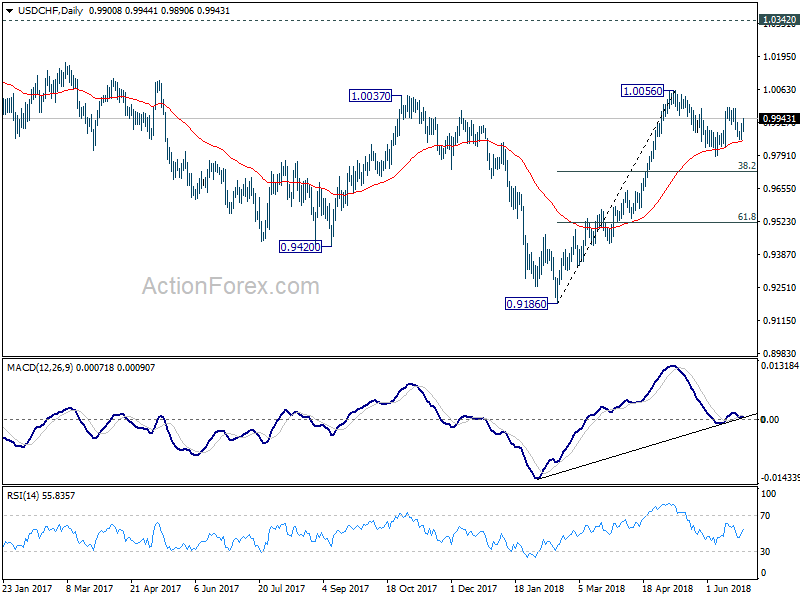
In the bigger picture, medium term decline from 1.0342 has completed with three waves down to 0.9186. Rise from there is currently viewed as a leg inside the long term range pattern. Hence, while further rally would be seen, we'd be cautious on strong resistance from 1.0342 to limit upside. For now, further rise is expected as long as 38.2% retracement of 0.9186 to 1.0056 at 0.9724 holds. However, sustained break of 0.9724 will dampen this bullish view and would at least bring deeper fall to 61.8% retracement at 0.9518.
GBP/USD Mid-Day Outlook
Daily Pivots: (S1) 1.3176; (P) 1.3240; (R1) 1.3287; More...
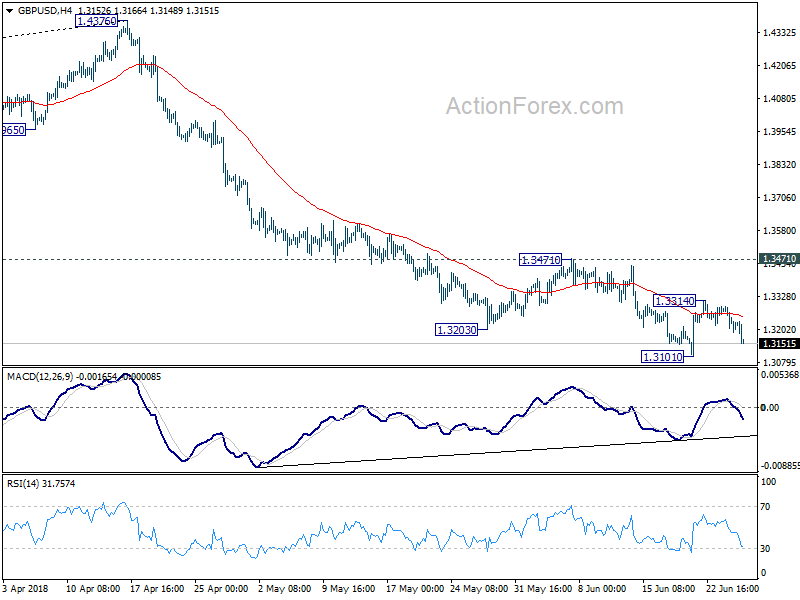
GBP/USD dips notably today but stays above 1.3101 temporary low. Intraday bias remains neutral first. Above 1.3314 will bring another recovery. But we'd expect strong resistance from 1.3471 to limit upside to bring decline resumption. On the downside, break of 1.3101 will resume fall from 1.4376 and target 61.8% retracement of 1.1946 to 1.4376 at 1.2875 next.
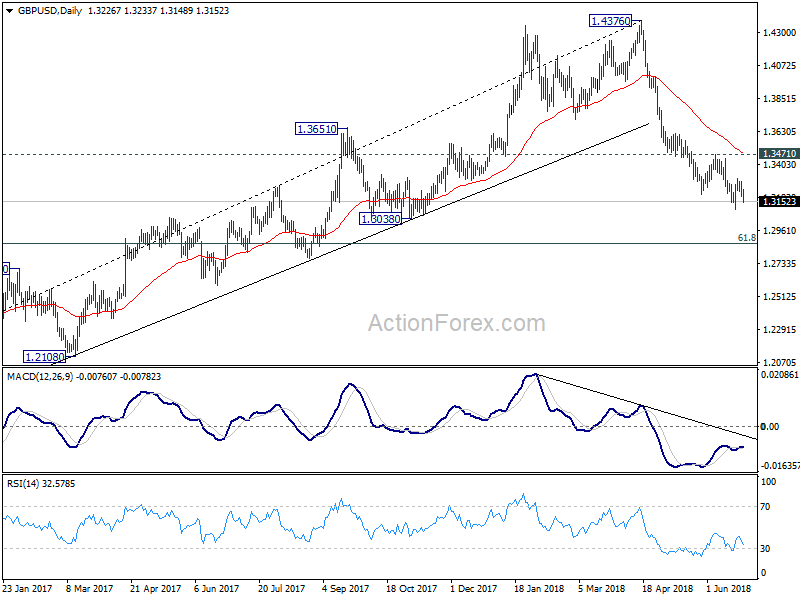
In the bigger picture, current development suggests that whole medium term rebound from 1.1936 (2016 low) has completed at 1.4376 already, with trend line broken firmly, on bearish divergence condition in daily MACD, after rejection from 55 month EMA (now at 1.4177). 61.8% retracement of 1.1936 (2016 low) to 1.4376 at 1.2874 is the next target. We'll pay attention to the reaction from there to asses the chance of long term down trend resumption. For now, outlook will stay bearish as long as 1.3471 resistance holds, even in case of strong rebound.
EUR/USD Mid-Day Outlook
Daily Pivots: (S1) 1.1616; (P) 1.1668 (R1) 1.1702; More.....
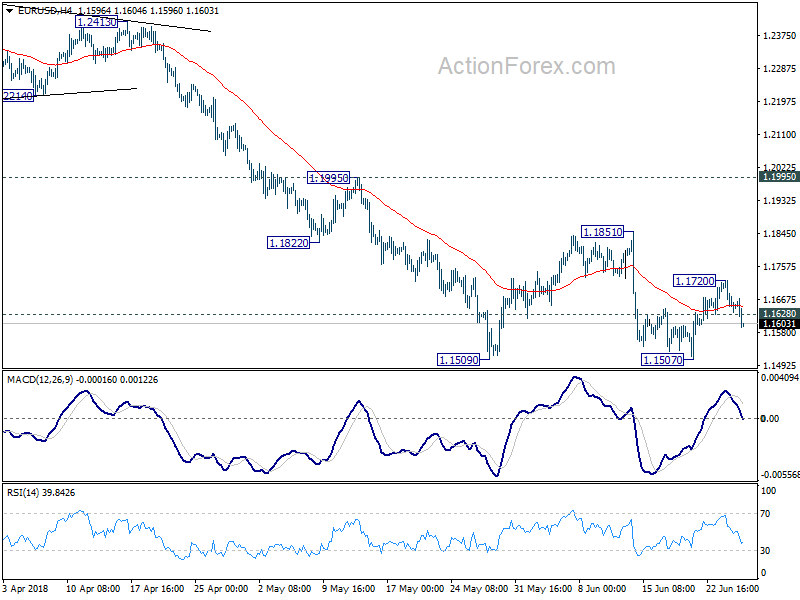
EUR/USD's break of 1.1628 minor support suggests that rebound from 1.1507 has completed at 1.1720 already. Intraday bias is turned back to the downside for 1.1507 first. Break will resume whole fall from 1.2555 through 50% retracement of 1.0339 to 1.2555 at 1.1447 to 61.8% retracement at 1.1186. On the upside, above 1.1720 will bring another recovery. But still, upside should be limited by 1.1851 resistance to bring fall resumption eventually.
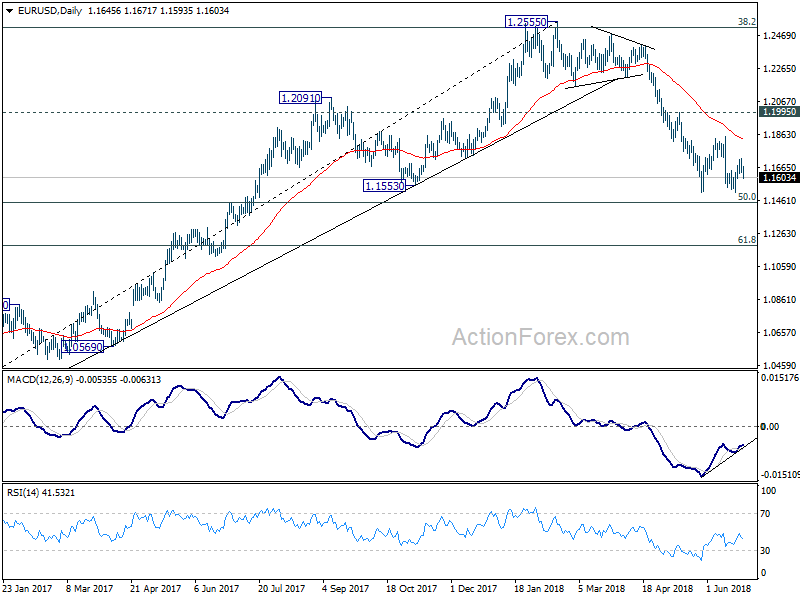
In the bigger picture, current development suggests that EUR/USD was rejected by 38.2% retracement of 1.6039 (2008 high) to 1.0339 (2017 low) at 1.2516. And, a medium term top was formed at 1.2555 already. Decline from there should extend further to 61.8% retracement of 1.0339 to 1.2555 at 1.1186 and below. For now, even in case of rebound, we won't consider the fall from 1.2555 as finished as long as 1.1995 resistance holds.
Dollar and Stocks Cheer as Trump Backs Down on Chinese Investments
Dollar ignores mixed economic data and surges broadly, except versus Canadian in early US session. Sentiments are generally lifted by news that Trump is backing down again on his tough stance on curbing Chinese investments, after backfires from businesses and Republicans. The mixed messages from White Houses are also re-aligned as the measures will not single out China as the target. DOW futures dropped to as low as 24079 earlier today but is now flat. There is room for rebound in US stocks today, in particular in NASDAQ.
In the currency markets, New Zealand Dollar remains the weakest one for today and for the week. Markets will look into RBNZ statement in the upcoming Asian session. And there is risk of RBNZ sounding more cautious on the economic outlook. Sterling follows as the second weakest for today. But Australian Dollar is the second weakest for the week. Canadian Dollar is supported by rally in WTI oil, which breaks above 71 handle. But it's actually not much stronger than Dollar as USD/CAD is staying in very tight range.
Technically, EUR/USD's break of 1.1628 minor support suggests that rebound from 1.1507 has completed. Deeper fall should now be seen back to 1.1507/9. Break will resume larger decline. Rebounds in USD/CHF and USD/JPY also turn focus back to 0.9989 and 110.89 minor resistance.
On the data front, US headline durable goods orders dropped -0.6% in May versus expectation of -0.9%. Ex-transport orders dropped -0.3% versus expectation of 0.5% rise. Trade deficit narrowed to USD -64.8B in May. Wholesale inventories rose 0.5% mom in May. Eurozone M3 rose 4.0% yoy in May.
Trump backs down on tough Chinese investment curb, revert to CFIUS
The markets are responding positive to news that Trump is backing away from the rumored harsh measure on curbing Chinese investments in US technology companies. Instead, his administration will revert to existing laws, with an upgrade. Trump himself told reports that "it's not just Chinese". Treasury Secretary Steven Mnuchin also said that "we are not singling out China, but we will protect technology transfer to China as we will to other important areas." Mnuchin also pledged that "we will have the necessary tools to protect investments, whether it's China or anybody else."
The administration will relay on the newly strengthened Committee on Foreign Investment in the United States (CFIUS) to deal with the issue. The legislation to be used is called the Foreign Investment Risk Review Modernization Act. Trump said the upgraded CFIUS "will enhance our ability to protect the United States from new and evolving threats posed by foreign investment while also sustaining the strong, open investment environment to which our country is committed and which benefits our economy and our people." And, "I have concluded that such legislation will provide additional tools to combat the predatory investment practices that threaten our critical technology leadership, national security, and future economic prosperity."
Trump originally considered invoking executive authority to impose and much tougher crackdown on Chinese investments. And there have been conflicting messages from White House trade adviser Peter Navarro and Mnuchin. But such an idea appeared to have drawn severe complaints from US businesses and Republicans, on the potential economic fallout.
BoE Carney warns of financial stability risks originating beyond the UK shores
The Bank of England published the latest Financial Stability Report today. In the opening remarks of the press conference, BoE Governor Mark Carney warned that "events of the past few months are a reminder that many of the most important risks to financial stability in the United Kingdom originate beyond our shores."
The risks include "recent tightening in global financial conditions" that could be a "'precursor to a much more substantial snapback in world interest rates". There could be "more challenging bank, corporate and sovereign funding conditions." Besides, "Rising protectionist sentiment could sap some of the current strength of the global economy and reduce the size of sustainable external imbalances." In addition, "the complete set of mitigants to the risks of a cliff-edge Brexit also rely on the efforts of EU authorities". Lastly, "cyber risks to UK financial services could originate from anywhere on the planet."
UK Hammond to China: We're a firm supporter of trade liberalization and your long-term trusted partner
UK Chancellor of Exchequer Philip Hammond wrote in an article in China's financial magazine Caixin, saying the the globalized UK is China's long term partner. Hammond is visiting Beijing this week and he pledges to "convey a message to the outside world - as a firm supporter of trade liberalization and a free market, the United Kingdom is China's long-term trusted partner."
Also, he wrote "Britain is committed to promoting free and open trade, and as Britain and its European cooperation partners form a new relationship, we will deepen our relations with other regions around the world." And, there was "enormous development space" with cooperation with Chinese financial services businesses. Hammond also hailed that UK is an "ideal cooperation partner" to the Belt and Road initiative, and they would likely to " grasp the unlimited opportunities" and "take a lead in its financing work."
ECB: Impacts of exchange rate on inflation are spread out over several quarters
ECB published an article today titled Monitoring the exchange rate pass-through to inflation. There it noted that exchange rate developments can play an "important role" in shaping the HICP inflation outlook, through "both direct and indirect channels". The impacts are "spread out over several quarters". And, the effect could be difficult to detect if it is "offset by a confluence of other factors". Among the components, "energy and food, non-energy industrial goods" are most sensitive to exchange rate movements.
As the background, Euro appreciated by about 8% in nominal effective terms and by about 10% against the US dollar, between April 2017 and May 2018. The impact of past euro exchange rate appreciation has been clearly visible in import price developments. The report pointed to import prices for non-food consumer goods, which dropped to 2.0% in April 2018, down from 1.3% in 2017. Over the same period, extra-euro area import price inflation for industry (excluding energy and construction), which also affect prices earlier in the domestic production chain, decreased from 3.1% to ‑1.7%.
Producer price inflation, on the other hand, has remained resilient to downward pressure from the exchange rate appreciation. PPI for intermediate goods declined only moderately during the period. PPI of non-food consumer goods increased from 0.2% in April 2017 to 0.5% in April 2018.
Indirectly, euro exchange range can affect domestic price pressure through company profits, "albeit with a somewhat ambiguous overall sign." The
non-energy industrial goods inflation does not provide a clear sign for significant effects of the exchange rate appreciation.
New Zealand business confidence deteriorated, trade surplus widened
New Zealand ANZ Business Confidence deteriorated again in June and dropped to -39.0, down from -27.2. The Own Activity index also dropped from 14 to 9. ANZ noted in the release that the GDP growth growth indicator remained expansionary but "the economy may continue gently losing steam over coming months, despite the support coming from fiscal stimulus and high commodity prices." And, "tailwinds in the form of fiscal stimulus and strong terms of trade will see the economy continue to grow at about par. However, cost, credit and capacity headwinds have strengthened, and firms have noticed."
New Zealand trade surplus widened to NZD 294m in May, beat expectation of NZD 100m. Goods exports rose 10% to NZD 5.4B, hitting a new high for total exports in a May month, and the second largest for any month. Goods imports rose 5.7% to 5.1B, also a new high for total imports in a May month.
New Zealand Dollar selloff extends ahead of RBNZ
New Zealand Dollar is under broad based selling pressure today as markets await RBNZ rate decision. RBNZ will keep the OCR unchanged at 1.75%, no doubt. It will also reiterate the neutral stance to "keep the OCR at this expansionary level for a considerable period of time" too. The main question is how RBNZ Governor Adrian Orr view the balance of risks. On the one hand, there will be stimulus from the government's expansive fiscal policy. But on the other hand, there is threat of global trade war and slow down in China, it's major trading partner.
EUR/USD Mid-Day Outlook
Daily Pivots: (S1) 1.1616; (P) 1.1668 (R1) 1.1702; More.....
EUR/USD's break of 1.1628 minor support suggests that rebound from 1.1507 has completed at 1.1720 already. Intraday bias is turned back to the downside for 1.1507 first. Break will resume whole fall from 1.2555 through 50% retracement of 1.0339 to 1.2555 at 1.1447 to 61.8% retracement at 1.1186. On the upside, above 1.1720 will bring another recovery. But still, upside should be limited by 1.1851 resistance to bring fall resumption eventually.
In the bigger picture, current development suggests that EUR/USD was rejected by 38.2% retracement of 1.6039 (2008 high) to 1.0339 (2017 low) at 1.2516. And, a medium term top was formed at 1.2555 already. Decline from there should extend further to 61.8% retracement of 1.0339 to 1.2555 at 1.1186 and below. For now, even in case of rebound, we won't consider the fall from 1.2555 as finished as long as 1.1995 resistance holds.
Economic Indicators Update
| GMT | Ccy | Events | Actual | Forecast | Previous | Revised |
|---|---|---|---|---|---|---|
| 22:45 | NZD | Trade Balance May | 294M | 100M | 263M | 193M |
| 01:00 | NZD | ANZ Business Confidence Jun | -39 | -27.2 | ||
| 08:00 | EUR | Eurozone M3 Money Supply Y/Y May | 4.00% | 3.80% | 3.90% | 3.80% |
| 12:30 | USD | Wholesale Inventories M/M May P | 0.50% | 0.20% | 0.10% | |
| 12:30 | USD | Advance Goods Trade Balance May | -64.8B | -68.9B | -67.3B | |
| 12:30 | USD | Durable Goods Orders May P | -0.60% | -0.90% | -1.60% | |
| 12:30 | USD | Durables Ex Transportation May P | -0.30% | 0.50% | 0.90% | |
| 14:00 | USD | Pending Home Sales M/M May | 1.10% | -1.30% | ||
| 14:30 | USD | Crude Oil Inventories | -5.9M | |||
| 21:00 | NZD | RBNZ Rate Decision | 1.75% | 1.75% |