Sample Category Title
EUR/USD Mid-Day Outlook
Daily Pivots: (S1) 1.1558; (P) 1.1592 (R1) 1.1642; More.....
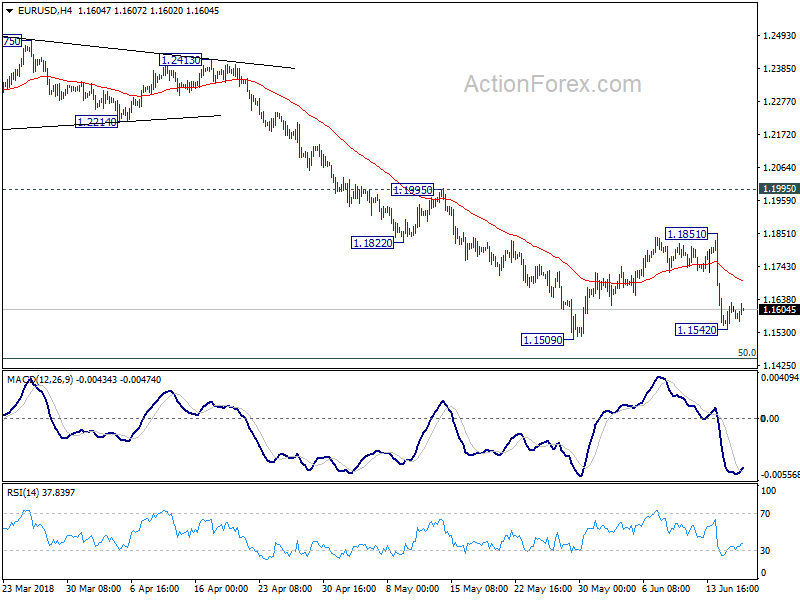
A temporary low is in place at 1.1542 in EUR/USD with 4 hour MACD crossed above signal line. Intraday bias is turned neutral first. Upside of recovery should be limited below 1.1851 resistance to bring fall resumption. Break of 1.1509 will resume larger decline from 1.2555 through 50% retracement of 1.0339 to 1.2555 at 1.1447 to 61.8% retracement at 1.1186.
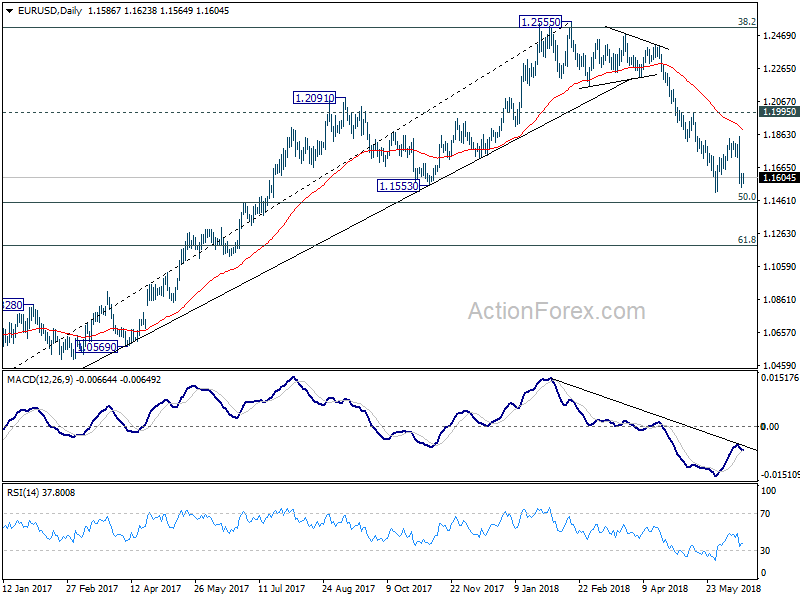
In the bigger picture, current development suggests that EUR/USD was rejected by 38.2% retracement of 1.6039 (2008 high) to 1.0339 (2017 low) at 1.2516. And, a medium term top was formed at 1.2555 already. Decline from there should extend further to 61.8% retracement of 1.0339 to 1.2555 at 1.1186 and below. For now, even in case of rebound, we won't consider the fall from 1.2555 as finished as long as 1.1995 resistance holds.
USD/JPY Mid-Day Outlook
Daily Pivots: (S1) 110.40; (P) 110.65; (R1) 110.92; More...
With 109.91 minor support, further rise is still in favor for 111.39 resistance. Break there will resume larger rebound from 104.62 and target 114.73 resistance. On the downside, though, break of 109.91 will turn bias to the downside and bring another fall towards 108.10 to extend the corrective pattern from 111.39.
In the bigger picture, at this point, we're slightly favoring the case that corrective decline from 118.65 (2016 high) has completed with three waves down to 104.62. Above 111.39 will affirm this view and target 114.73 for confirmation. However, it should be noted that USD/JPY is bounded in medium term falling channel from 118.65 (2016 high). Sustained break of 61.8% retracement of 104.62 to 111.39 at 107.20 will likely resume the fall from 118.65 through 104.62 low.
GBP/USD Mid-Day Outlook
Daily Pivots: (S1) 1.3230; (P) 1.3264; (R1) 1.3317; More...
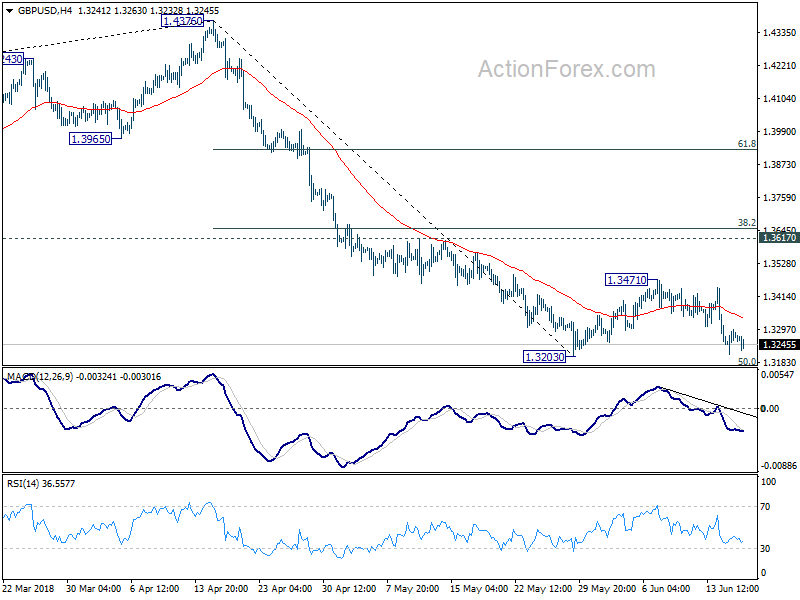
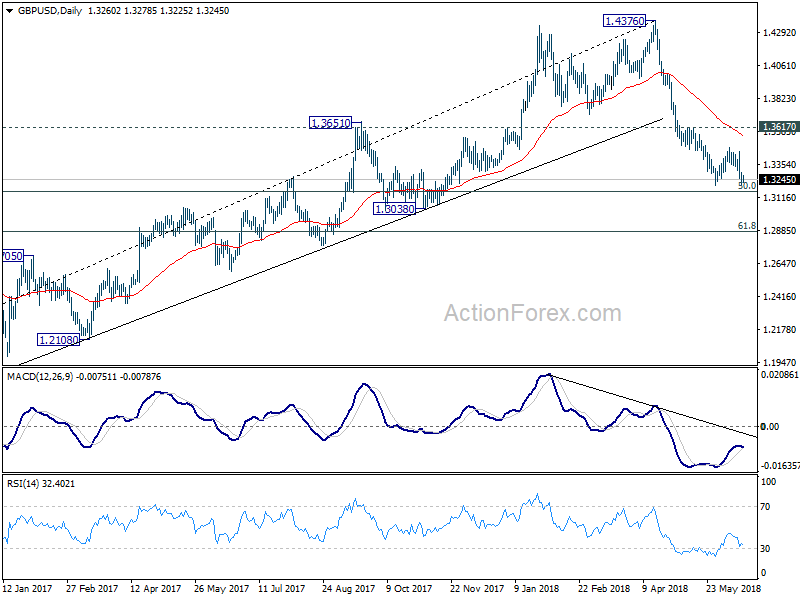
GBP/USD's fall from 1.3471 is still in progress and intraday bias remains on the downside for 1.3203. Break will resume whole decline from 1.4376 and target 50% retracement of 1.1946 to 1.4376 at 1.3161 first, and 61.8% retracement at 1.2875 next. And, for now, outlook remains bearish as long as 1.3471 resistance holds, in case of recovery.
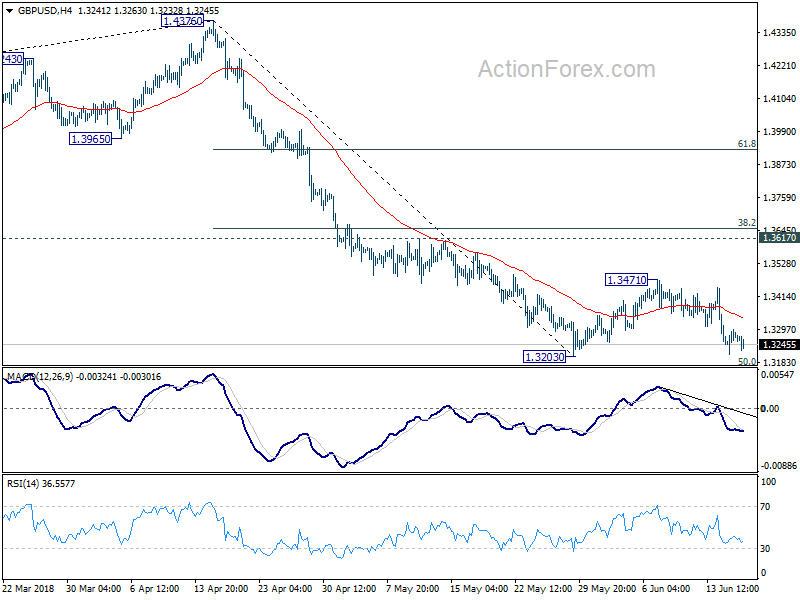
In the bigger picture, current development suggests that whole medium term rebound from 1.1936 (2016 low) has completed at 1.4376 already, with trend line broken firmly, on bearish divergence condition in daily MACD, after rejection from 55 month EMA (now at 1.4182). 61.8% retracement of 1.1936 (2016 low) to 1.4376 at 1.2874 is the next target. We'll pay attention to the reaction from there to asses the chance of long term down trend resumption. For now, outlook will stay bearish as long as 1.3617 resistance holds, even in case of strong rebound.
USD/CHF Mid-Day Outlook
Daily Pivots: (S1) 0.9951; (P) 0.9970; (R1) 0.9995; More...
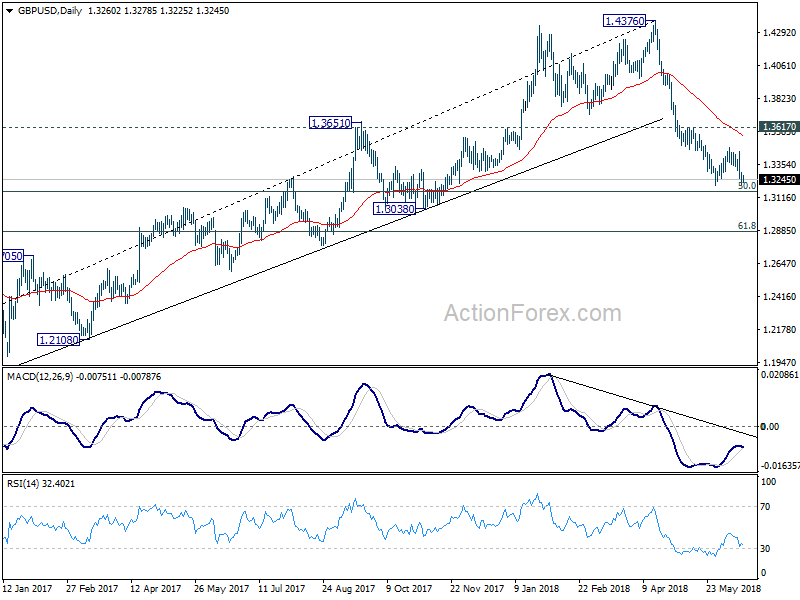
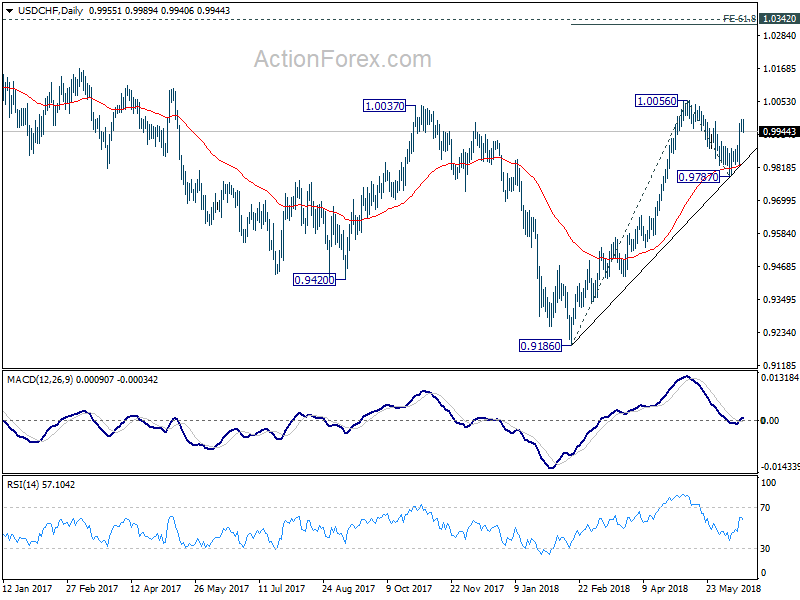
A temporary top is in place at 0.9989 with 4 hour MACD crossed below signal line. Intraday bias in USD/CHF is turned neutral first. Further rise is expected as long as 0.9894 minor support holds. The corrective fall from 1.0056 should have completed at 0.9787. Above 0.9989 will bring retest of 1.0056 first. Break will resume the rise from 0.9186 and target 61.8% projection of 0.9186 to 1.0056 from 0.9787 at 1.0325, which is close to 1.0342 key resistance. However, break of 0.9894 will likely extend the correction, possibly through 0.9787 before completion.
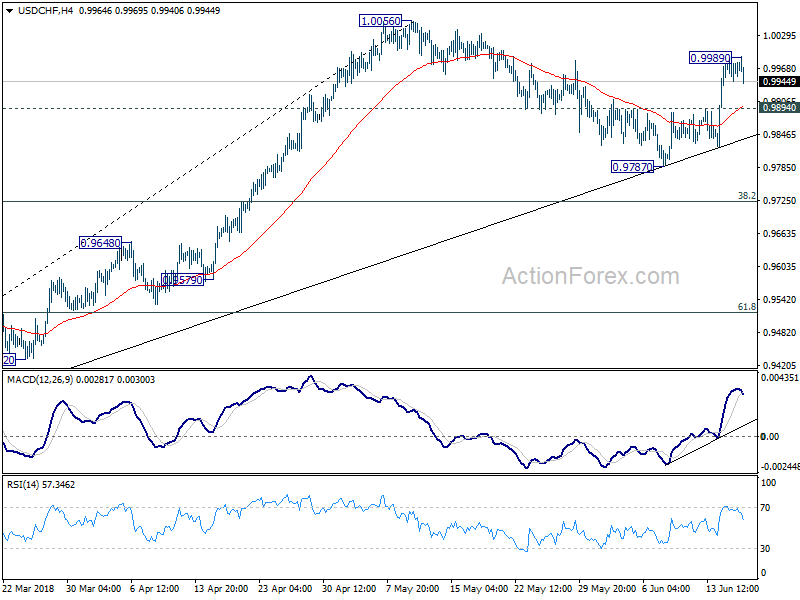
In the bigger picture, medium term decline from 1.0342 has completed with three waves down to 0.9186. Rise from there is currently viewed as a leg inside the long term range pattern. Hence, while further rally would be seen, we'd be cautious on strong resistance from 1.0342 to limit upside. For now, further rise is expected as long as 38.2% retracement of 0.9186 to 1.0056 at 0.9724 holds. However, sustained break of 0.9724 will dampen this bullish view and would at least bring deeper fall to 61.8% retracement at 0.9518.
Swiss Franc and Yen Firmer on Mild Risk Aversion
Swiss Franc and Yen are trading as the strongest ones for today on mild risk aversion. A wave of buying is seen in Euro entering into US session. But for now, Euro is trading up against Dollar, Sterling and Aussie for the day only. Some attributes today's weakness in the stock markets to US-China trade war. But it should be noted that FTSE is down only -0.36% at the time of writing. The -1.55% fall in DAX and -1.39% fall in CAC are more due to a retreat after ECB inspired rally. US futures also point to slightly lower open but it seems DOW could hold on to 25000 handle.
Regarding the US-China trade tariffs, we'd like to point out that on July 6, they will impose 25% tariffs on around USD 34B imports from each other. The USD 50B and combined USD 100B figures reported in many places are plainly wrong. There would be tariffs on a second set of products, totaling USD 16B on each side. If implemented, the tariffs will be on USD 100B of products in total, two-sides added. But the second list is not finalized. The US will have to take it through public hearing. And there is no implementation date yet.
Technically, Euro seems to have gone through the worst for post ECB selling as it recovers. As long as 1.1509 in EUR/USD and 127.69 in EUR/JPY holds, there is room for more recovery. Focus could turn back to Sterling ahead of BoE rate decision. As EUR/GBP looks set to have another take on 0.8844 resistance, GBP/USD could be dragged to test on key near term support at 1.3203.
Bundesbank: Projection paints a picture of an ongoing economic boom
In the Bundesbank's June Monthly Report published today, it noted "all in all, the projection paints a picture of an ongoing economic boom, in which increasing supply-side bottlenecks are reflected in strong wage growth and in higher domestic inflation." It projected German GDP growth to slow to 2.0% in 2018, 1.9% in 2019 and then 1.6% in 2020. HICP inflation is projected to be rather steady, at 1.8% in 2018, 1.7% in 2019 and 1.8% in 2018.
But Bundesbank also warned that "risks outweigh opportunities". President Jens Weidmann noted that "uncertainties regarding the prospects for the German economy are considerably greater than they were." And, downside risks relating to the external environment outweigh the effects resulting from the probably more expansionary fiscal policy in Germany.
In particular, exports and commercial investment are likely to see weaker growth. employment growth is dampened by growing lack of skilled workers. And that tens to "brake" the rise in household disposable incomes.
Abe's advisor Kawai: Alliance with US changed to a transactional one under Trump
Katsuyuki Kawai, a ruling Liberal Democratic Party (LDP) lawmaker who advises Prime Minister Shinzo Abe on foreign affairs, raised his "personal" concern over the change in US foreign policy under Trump. He said in a Reuters interview that the alliance between Japan and the US has "changed from one based on shared values to a transactional alliance." And, "this is the reality now". He also pointed to the Kim-Trump submit and said it "will serve as a trigger for the Japanese people to begin to realize that it is risky to leave Japan's destiny to another country."
An unnamed Japanese government source also said "trade is more worrisome," and "it's getting worse … There is no reliable (U.S.) cabinet level person who can say 'No' to unreasonable proposals."
The Nikkei business newspaper also criticized in a weekend analysis that "Mr. Trump mixes up economics and security with the mind-set of a real estate deal is a big cause for concern".
South and North Korea to form combined team in Asia Games
South Korean President Moon Jae-in's officials took another solid step in creating peace in the peninsula. South Korean Culture, Sports and Tourism Ministry's chief delegate Jeon Choong-ryul held a successful meeting with his North Korean counterpart Won Kil U.
They agreed to hold a joint basketball match in Pyongyang on July 4. More than that, they agreed to form some combined teams at Asian Games in Indonesia in August. They also agreed to march together at the Asian Games as a sign of unity. This is a repeat of what they did in the Winter Olympics in South Korea back in February.
Stopping war games could weaken US rationale to ask South Korea to pay more
The Yonhap news agency reported that South Korea and the US would announce suspension of large scale joint military exercises this week, amid the negotiations with North Korea on denuclearization. A "snapback" clause, though, would be included if North Korea fails to deliver its promises.
Yonhap also reported that suspension of the exercises could "weaken Washington's rationale for an increase in Seoul's share of the cost for the upkeep of 28,500 U.S. troops in the country." And the US has been demanding the South to pay more. There will be a fourth round of so-called burden sharing costs negotiations in Seoul later this month.
Meanwhile, Trump also made clear it's his request to stop the "war games" as they are "very expensive".
NZIER: Growth and NZD expectations lowered
The NZ Institute of Economic Research downgraded growth forecast for the New Zealand economy. Weaker exports "drive much of this downward revision in near term". But from 2019 onwards, "expectations of weaker growth in investment explain the softer growth outlook". Though, NZIER noted that expectations for growth remain reasonably healthy through to 2021.
Real GDP growth is projected to be 2.8% in 2017/18, 2.9% in 2018/19, 3.2% in 2019/20 and 2.9% in 2020/21. That compares to March survey result of 2.9% in 2017.19, 3.1% in 2018/19, 3.3% in 2019/20 and 2.9% in 2020.21. .
NZD expectations were also revised lower. NZIER pointed to Fed's rate hike in the coming year. Meanwhile, RBNZ is expected to keep OCR on hold "until at least the middle of next year". And, "this should reduce the yield attractiveness of the NZD, and hence weigh on the currency.
New Zealand Dollar TWI is projected to average at 75.5 in 2017/18, 72.6 in 2018/19, 72.3 in 2019/20 and 72.0 in 2020/21. That compares to March survey result of 75.2 in 2017/18, 73.1 in 2018/19, 73.1 in 2019/20 and 72.8 in 2020/21.
NZIER also noted that RBNZ's May MPS indicates that "interest rates were just as likely to go down as up." Nonetheless " the central bank's forecasts indicate the OCR is likely to increase, although not till later in 2019. Consensus Forecasts for interest rates have been revised slightly lower from 2019."
USD/CHF Mid-Day Outlook
Daily Pivots: (S1) 0.9951; (P) 0.9970; (R1) 0.9995; More...
A temporary top is in place at 0.9989 with 4 hour MACD crossed below signal line. Intraday bias in USD/CHF is turned neutral first. Further rise is expected as long as 0.9894 minor support holds. The corrective fall from 1.0056 should have completed at 0.9787. Above 0.9989 will bring retest of 1.0056 first. Break will resume the rise from 0.9186 and target 61.8% projection of 0.9186 to 1.0056 from 0.9787 at 1.0325, which is close to 1.0342 key resistance. However, break of 0.9894 will likely extend the correction, possibly through 0.9787 before completion.
In the bigger picture, medium term decline from 1.0342 has completed with three waves down to 0.9186. Rise from there is currently viewed as a leg inside the long term range pattern. Hence, while further rally would be seen, we'd be cautious on strong resistance from 1.0342 to limit upside. For now, further rise is expected as long as 38.2% retracement of 0.9186 to 1.0056 at 0.9724 holds. However, sustained break of 0.9724 will dampen this bullish view and would at least bring deeper fall to 61.8% retracement at 0.9518.
Economic Indicators Update
| GMT | Ccy | Events | Actual | Forecast | Previous | Revised |
|---|---|---|---|---|---|---|
| 23:01 | GBP | Rightmove House Prices M/M Jun | 0.40% | 0.80% | ||
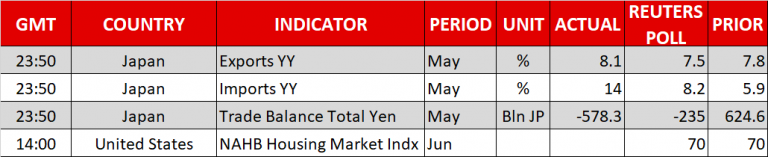
| 23:50 | JPY | Trade Balance (JPY) May | -0.30T | 0.14T | 0.55T | 0.45T |
| 14:00 | USD | NAHB Housing Market Index Jun | 70 | 70 |
UK Economic Recap – Jobs, Inflation, Retail sales
Last week's economic data from the UK covered a wide range of aspects crucial for the Bank of England as it meets this week. Overall, economic data continued to point a mixed picture offering no clarity for officials as they decide on interest rates this week.
UK Inflation steady at 2.4%
Inflation data released last week showed that consumer prices were stable at 2.4% on the year ending May 2018. This was the same pace of increase registered in the month before. Most of the gains in inflation came from higher oil prices. The 2.4% inflation rate was incidentally the lowest inflation rate since March 2017.
On a month over month basis, consumer prices were seen rising 0.4% in May which matched the median estimates. Core consumer prices that exclude the volatile food and energy prices were seen rising at a pace of 2.1% on the year.
In comparison, the data showed that the increase in headline inflation came on account of higher fuel prices. The increase in fuel prices led to higher transportation costs as prices of air fares and ferry prices increased as a result.
Offsetting the higher fuel prices was the fact that there were price declines in other sectors such as computer games.
Based on the inflation data, some analysts noted that in the backdrop of a weakening economy, the August rate hike was likely questionable.
Output inflation was also seen rising with prices picking up for the first time since November 2017. On an annualized basis, output price inflation was seen rising 2.9% and rising from 2.5% the month before.
Prices registered a steady increase of 0.4% which beat estimates of a 0.3% increase. Input price inflation was seen rising 9.2% in the year ending May which was higher than the 5.6% increase registered the month before. Economists forecast that input price inflation would rise 7.6%.
Retail sales rises on warm weather
In another economic report released this week, which covers the health of consumer spending, data showed that retail sales in the UK had picked up, largely on account of the warm weather and the Royal wedding.
Retail sales on a volume basis including auto fuels were seen rising 1.3% on a month over month basis. This came amid April's revised retail sales report that showed a 1.8% increase. The data marked a second consecutive month of increase in retail sales as the data beat estimates of a 0.5% increase.
Excluding auto fuel, retail sales increased 1.3% on the month which was slightly slower than the 1.4% increase seen previously. Economists had expected to see the core retail sales rising just 0.3% on a month over month basis.
Sales at food stores increased 1.1% while non-food store sales grew 0.7%.
The three months ending May saw retail sales rising 0.9%.
Retailers said that the sustained warm weather along with the Royal wedding celebrations had encouraged consumers to spend on food and household stores during the month.
The data comes amid real wages seen increasing modestly as the UK's inflation rate was seen being stable. On the whole, retail sales growth was seen advancing 3.9% in May compared to the same period the year before. This beat estimates that predicted a 2.4% increase.
UK's unemployment rate stays lows
The labor market data released last week showed that the unemployment rate was steady at 4.2%. This marked the lowest unemployment rate in the UK since 1975. The UK was seen having 1.4 million unemployed which was seen to be 38,000 fewer compared to the November 2017 through December 2018 period.
Wage growth was seen rising 2.5% including bonuses while excluding bonuses, wage growth increased 2.8%. With the UK's inflation rate seen at 2.4%, real wages were seen rising just 0.1%
South and North Korea to form combined team in Asia Games
South Korean President Moon Jae-in's officials took another solid step in creating peace in the peninsula. South Korean Culture, Sports and Tourism Ministry's chief delegate Jeon Choong-ryul held a successful meeting with his North Korean counterpart Won Kil U.
They agreed to hold a joint basketball match in Pyongyang on July 4. More than that, they agreed to form some combined teams at Asian Games in Indonesia in August. They also agreed to march together at the Asian Games as a sign of unity. This is a repeat of what they did in the Winter Olympics in South Korea back in February.
Trade Fears Keep Market Bears Around
Here are the latest developments in global markets:
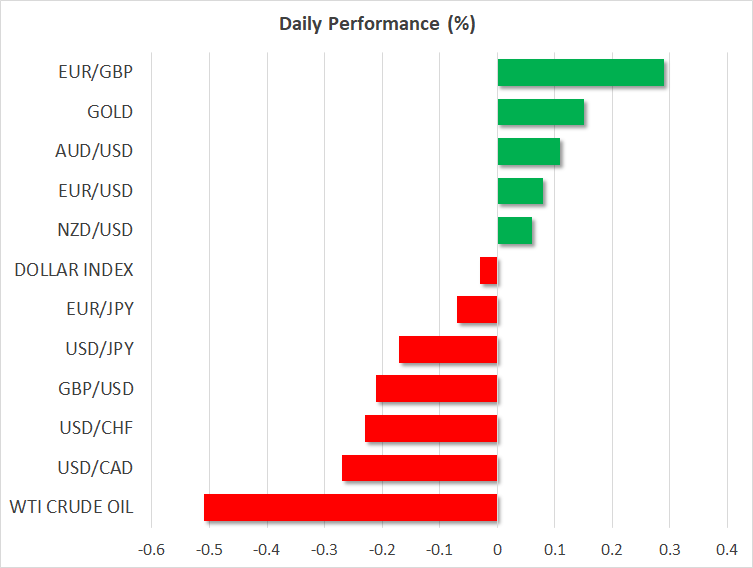
FOREX: A trade war between the US and China, which could harm global trade, got nasty on Friday when China decided to apply a 25% tariff on several US imports (taking effect on July 6) as a response to an extra 25% tariff imposed by Washington on Chinese imports on the same day. Investors turned more cautious thereafter, pushing dollar/yen down to 110.45 (-0.19%) on Monday, while the dollar index which gauges the dollar’s strength against six major currencies stood flat at 94.78 as the euro and the pound remained on the back foot. Euro/dollar was unable to recover after the ECB announced the end of its asset purchase program this year but said that interest rates will remain steady until well into 2019. German political developments were also a concern on Monday, with the German Chancellor, Angela Merkel, facing opposition from her coalition partners, the CSU, over migration ahead of the EU summit this month. Euro/dollar was testing the 1.1600 level (+0.04%). Pound/dollar slipped to 1.3245 (-0.30%), a few days before the Bank of England starts its policy meeting, where policymakers are expected to stand pat on rates. Brexit developments, though, are still holding the largest share of uncertainty as the withdrawal bill has returned to the House of Lords today for a vote, with pro-EU peers expected to reject amendments approved by the House of Commons last week. Euro/pound climbed to 0.8765 (+0.34%) In antipodean currencies, aussie/dollar and kiwi dollar were marginally up at 0.7447 (+0.09%) and 0.6951 (+0.03%) respectively. Dollar/loonie was weaker at 1.3162 (-0.27%) and dollar/swiss franc was lower at 0.9958 (-0.17%) ahead of the SNB rate decision on Thursday.
STOCKS: The risk-off sentiment attributed to trade fears continued to pressure European equities, with the pan-European STOXX 600 and the blue-chip Euro STOXX 50 losing 0.97% and 1.07% respectively at 1150 GMT. The German DAX 30 was down by 1.36%, the French CAC 40 was lower by 1.19%, while the Italian FTSE MIB was falling by 0.69%. Spain’s IBEX 35 retreated by 1.02%, whereas the UK’s FTSE 100 managed to post smoother losses, fell by 0.34% as gains in telecommunications capped steeper downside corrections. Asian stocks closed in bearish territory and futures tracking US stock indices were in the red as well, pointing to a negative open. Markets in China and Hong Kong are shut for a public holiday.
COMMODITIES: Oil prices were mixed early in the European afternoon as traders were weighing a potential increase in supply from Saudi Arabia and Russia, which markets now believe will be smaller than initially expected. The prospect of demand shortages due to the tariff war between the US and China also weighed on prices. Note that China fought back US import tariffs announced on Friday, targeting US export products, including crude oil. Rising tensions in the Libyan oil ports, where rival factions are in a dispute over the control of the Ras Lanuf oil port and ES Sider, provided some support to the market after an oil tank was set on fire. WTI crude was last seen at $64.79/barrel (-0.42%) and Brent at $74.11 (+0.91%). In precious metals, gold remained on the upside on Monday after a sharp fall on Friday, trading at $1,279/ounce (+0.04%).
Day Ahead: Light economic releases ahead of numerous speeches
The calendar will be light of data later on Monday, turning the attention to the rest of the week as the SNB and BOE will announce their interest rate decisions. Also, on Friday OPEC and Russia will have a discussion on whether to relax the oil output cap.
The only notable release today is the US National Association Home Business (NAHB) housing market index for June, which is expected to remain unchanged at 70 at 1400 GMT.
On the political front, German Chancellor Angela Merkel’s Bavarian allies, the Christin Social Union, will decide later today whether to restrict migrants that have already registered in another EU state from entering Germany. Such a move would be against Merkel’s open-door policy and would put the coalition at risk.
In terms of public appearances, retiring Federal Reserve Bank of New York President William Dudley will be participating in a discussion at 1300 GMT. Incoming Federal Reserve Bank of New York President John Williams will be giving a speech at 2000 GMT. Out of Canada, the Bank of Canada Deputy Governor Lynn Patterson will participate at Investment Industry Association of Canada and Institute of International Finance. Investors will also have a close eye on ECB President Mario Draghi’s speech at the ECB Forum on Central Banking in Sintra, Portugal at 1900 GMT.
Overnight at 0130 GMT, the Reserve Bank of Australia (RBA) will release the minutes of June’s Monetary Policy Meeting that left interest rates steady at 1.5%, while earlier in the neighboring country, in New Zealand, the Westpac Banking Corporation will publish Q2 figures on consumer sentiment.
DAX Slides As Trump Slaps Tariffs On China
The DAX index has started the week with sharp losses, continuing the downward trend seen on Friday. Currently, the DAX is at 12,834, down 1.35% on the day. On the release front, there are no German or eurozone indicators. The highlight of the day is the opening of the ECB Forum, which kicks off with a speech from ECB President Mario Draghi. On Tuesday, Draghi will participate in a panel discussion. As well, the eurozone releases current account, with the surplus expected to drop to EUR 30.3 billion.
It's been a roller-coaster ride for the DAX, which soared on Thursday, but quickly reversed directions. Investor risk appetite has waned, after U.S President Trump imposed further tariffs on some $50 billion of Chinese products. China has promised to retaliate against U.S imports, as trade ties between the world's two largest economies continue to deteriorate. With the U.S recently slapping tariffs on the E.U and the NAFTA talks in pause mode, it is no wonder that investor anxiety has risen. If the trade war between the U.S and its partners continues to escalate, traders can expect global equities to continue to lose ground.
The DAX jumped 1.6% on Thursday, but has since given up most of these gains. The markets jumped after the ECB policy meeting, when the ECB said that it had no intention of raising interest rates prior to the second half of 2019. The ECB pledged to taper its bond-purchase program to EUR 15 billion/mth, in October, down from the current pace of EUR 30 billion/mth. The program will wind up at the end of the year. However, investors detected a ‘dovish flavor' to the announcement, as the ECB added that interest rates would remain steady “at least through the summer of 2019”, giving policymakers plenty of wiggle-room to delay any rate hikes. The markets were anticipating a rate hike shortly after the end of the bond-purchase program, so this announcement was a disappointment. ECB head Mario Draghi sounded dovish in his press conference, saying that the eurozone economy was facing “increasing uncertainty”. Draghi was likely referring to the G-7 meeting which ended in disarray as well as the election of a euro-sceptic government in Italy. The ECB also lowered its growth forecast for the eurozone to 2.1%, down from 2.4% earlier this year.
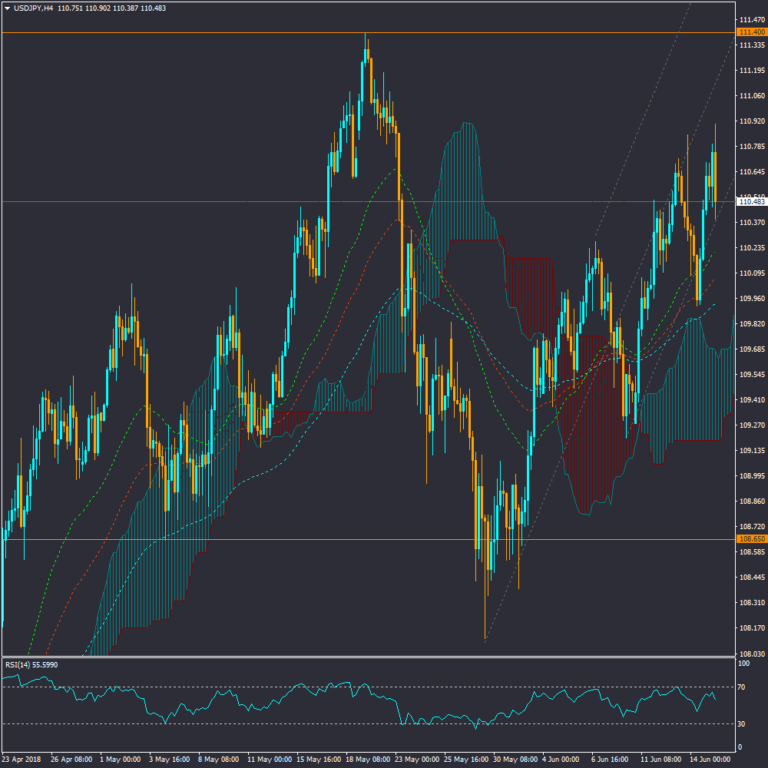
USDJPY, In The Short Term, More Price Correction Is Expected Whilst On A Mid-Term Basis A Bullish Trend Will...
The BOJ kept interest rates steady at the Friday meeting. In reaction to the statement by the Bank of Japan’s Monetary Policy Council, the demand of the Japanese yen increased, displaying a correction in the USDJPY chart.
In the short term, more price correction is expected whilst on a mid-term basis a bullish trend will prevail.
Support levels: 109.2 & 108.11
Resistance levels: 111.40, 112 & 113.48