Sample Category Title
CADJPY Wave Analysis
- CADJPY broke support zone
- Likely to fall to support level 104.00
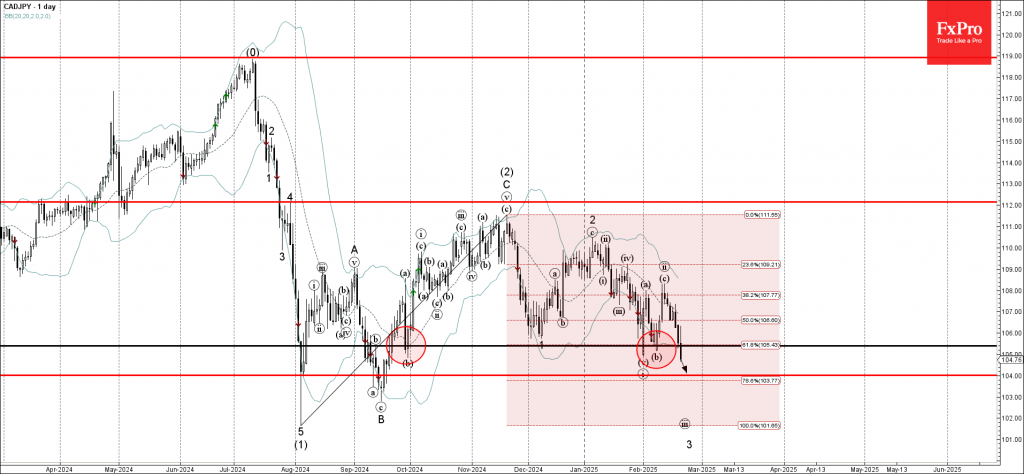
CADJPY currency pair recently broke the support zone between the key support level 105.40 (which has been reversing the price from September) and the 61.8% Fibonacci correction of wave (2) from August.
The breakout of this support zone should accelerate the active impulse wave 3 of the intermediate impulse wave (3) from November.
Given the strong daily downtrend and the bullish yen sentiment seen today, CADJPY currency pair can be expected to fall to the next support level 104.00.
GBPCHF Wave Analysis
- GBPCHF reversed from resistance zone
- Likely to fall to support level 1.1300
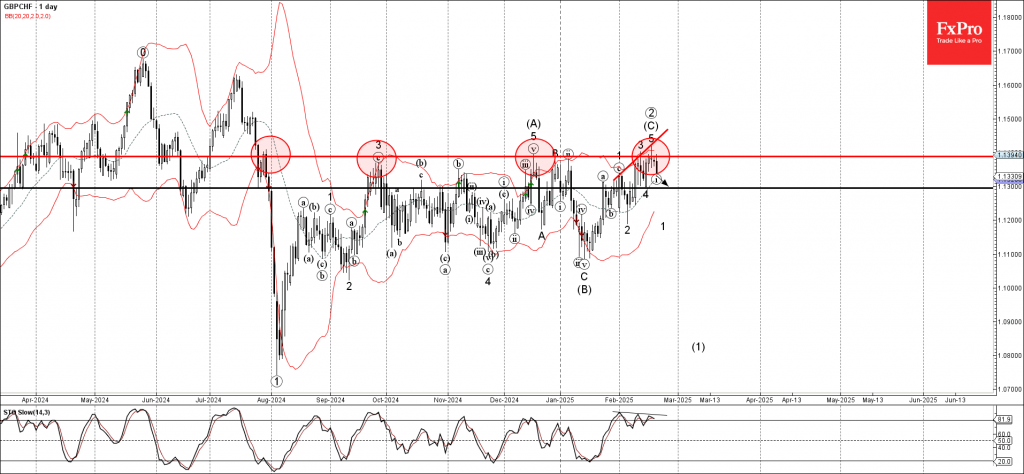
GBPCHF currency pair recently reversed down from the resistance zone between the multi-month resistance level 1.1385 (which has been reversing the price from July) and the upper daily Bollinger Band.
The downward reversal from this resistance zone stopped impulse wave 5 of the intermediate upward impulse sequence (C) from January.
Given the strength of the resistance level 1.1385 and the triple bearish divergence on the daily Stochastic, GBPCHF currency pair can be expected to fall to the next support level 1.1300 (low of the previous minor correction 4).
Risk Aversion Returns as US Tariff Fears Resurface, Dollar Recovers Late
Geopolitical developments dominated global headlines last week, particularly surrounding peace negotiations over Russia’s invasion of Ukraine and evolving US-Ukraine relations. While US President Donald Trump’s tariffs took a backseat, concerns over their impact on consumer spending and economic growth resurfaced by the end of the week, triggering renewed risk aversion.
Markets lacked clear direction for most of the week, with major assets struggling to gain momentum in either direction. However, risk sentiment soured late in the week as fresh worries emerged over the potential inflationary effects of tariffs, particularly on US consumers. This shift in tone could set the market narrative for the near term.
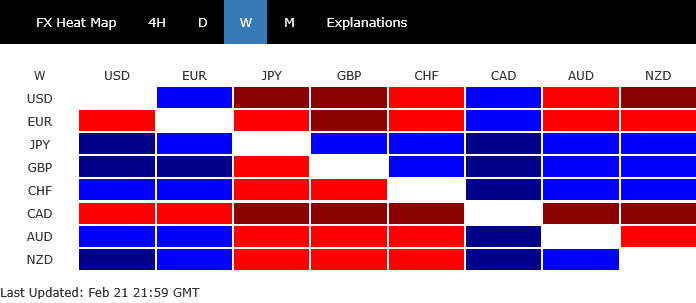
Against this backdrop, Dollar initially struggled but recovered some ground by the week’s close, finishing as the third worst performer overall. The late-week risk-off mood helped Dollar stabilize, with Dollar Index showing potential for a rebound off key Fibonacci support if risk aversion deepens further.
Euro finished as the second weakest currency, partly weighed down by disappointing PMI data. Hopes for a political boost from German election over the weekend could be short-lived, as renewed US tariff threats may quickly drag Euro lower again. The worst performer was Canadian Dollar, which faced additional pressure from concerns over trade and slowing economy.
In contrast, Yen emerged as the strongest currency, benefiting from increasing speculation of an earlier-than-expected BoJ rate hike. Divergence in yields also provided support, as Japan’s JGB yields rose while US Treasury yields declined.
Sterling and the Swiss Franc were the second and third strongest, respectively, as both benefited from uncertainty surrounding Euro. Australian and New Zealand Dollars ended mixed, weighed down by the late-week risk aversion. However, Kiwi ended up with a slight upper hand over Aussie.
Stocks Slide as Consumer Confidence Plunges, Dollar Index Holds Key Support
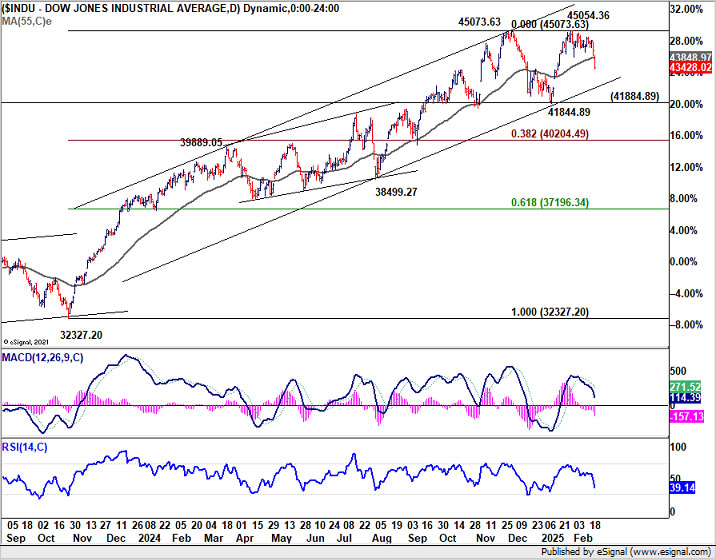
US stocks ended the week notably lower as earlier resilience turned into steep selloff on Friday. S&P 500, which had set a new record high, ended the week with -1.7% loss, while DOW and NASDAQ both fell -2.5%. DOW’s -700-point drop on Friday marked its worst trading day of the year, catching many investors off guard and raising concerns over broader market sentiment.
At the heart of the selloff was the unexpected deterioration in consumer sentiment. The University of Michigan Consumer Sentiment Index for February was finalized at 64.7, significantly below January’s 71.7 and the preliminary reading of 67.8. This was the lowest level since November 2023, signaling growing unease among US households about economic conditions.
Adding to market anxiety, inflation expectations surged. Households now expect inflation over the next year to rise to 4.3%, the highest since November 2023, up from 3.3% last month. Over the next five years, inflation expectations climbed to 3.5%, the highest level since 1995, compared to 3.2% in January.
Some analysts attribute the drop in sentiment to uncertainty over US President Donald Trump’s policies, particularly the potential for inflationary effects from new tariffs. The University of Michigan noted that the deterioration in sentiment was led by the -19% drop in buying conditions for durable goods, as consumers fear tariff-driven price hikes. Additionally, expectations for personal finances and the short-run economic outlook fell by nearly -10%.
However, there are differing views on the inflationary impact of tariffs. Some analysts argue that Trump’s tariff threats are more of a strategic negotiation tool aimed at broader geopolitical objectives, such as pressuring Canada and Mexico on fentanyl issues. If these concerns fade, inflation expectations could retreat, allowing consumer confidence to rebound.
Technically, DOW's steep decline and strong break of 55 D EMA (now at 43848.97) is clearly a near term bearish sign. However, current fall from 45054.36 are seen as the third leg of the corrective pattern from 45073.63 only. Hence, while deeper fall could be seen to medium term rising channel support (now at around 42530) or below, strong support should emerge around 41884.89 to complete the pattern and bring up trend resumption.
However, decisive break of 41844.89 will complete a double top reversal pattern (45073.63, 45054.36). DOW would then be at least in correction to the up trend form 32327.20. That would open up deeper correction to 38.2% retracement of 32327.20 to 45054.36 at 40204.49, or even further to 38499.27 support. But then, this is far from being the base scenario at this point.
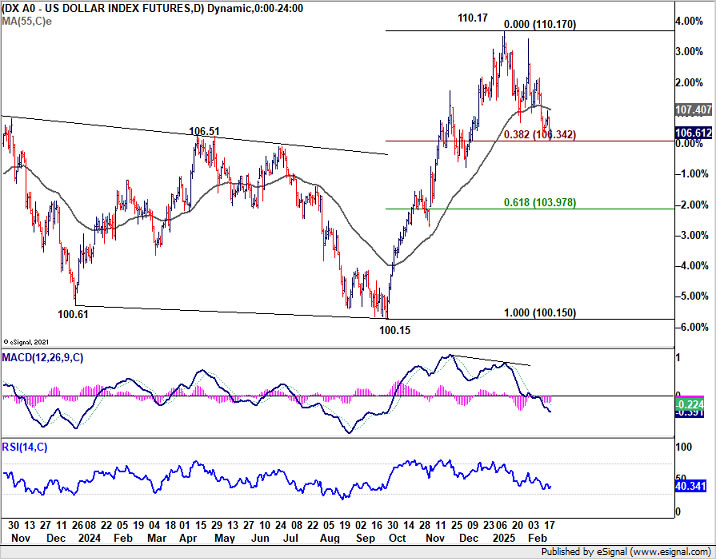
For now, Dollar Index is still sitting above 38.2% retracement of 100.15 to 110.17 at 106.34. Near term risk aversion could help Dollar Index defend this support level, with prospect of a bounce from there. Firm break of 55 D EMA (now at 107.40) should bring stronger rally back towards 110.17 high. However, Decisive break below the 106.34 support would deepen the decline to 61.8% retracement at 103.98, even still as a correction.
Yen Ends Week Strong as BoJ Might Hike Rates Again Sooner
Yen ended last week as the best-performing currency, thanks to robust inflation data and hawkish remarks from BoJ officials. The rally briefly paused midweek after BoJ Governor Kazuo Ueda signaled readiness to intervene in the bond market, causing Japan’s 10-year JGB yield to retreat from its 15-year high. However, this setback proved temporary, as Yen quickly regained strength amid rising risk aversion and falling US Treasury yields.
According to the latest Reuters poll, 65% of economists (38 out of 58) expect BoJ to raise rates from 0.50% to 0.75% in July or September. Among the 39 analysts who gave a specific month, 59% (23 respondents) chose July, while 15% (six analysts) expected a June hike. The remaining 10 analysts were evenly split between April and September.
However, stronger-than-anticipated inflation could give BoJ further cause to pull the timetable forward. Last week's data already showed core CPI surging more than expected to 3.2% in January, marking the fastest pace in 19 months. If consumer price pressures remain elevated, markets speculate that policymakers might prefer to act sooner rather than wait for the second half.
The April 30 - May 1 policy meeting could stand out as an appropriate window for BoJ to act. By then, BoJ will have access to Shunto wage negotiation results and an updated economic outlook, providing the necessary justification for an earlier rate hike.
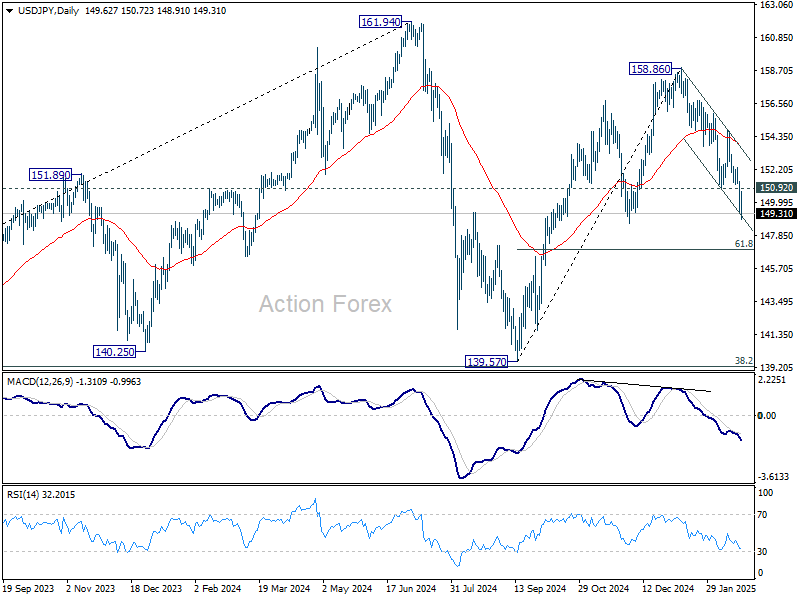
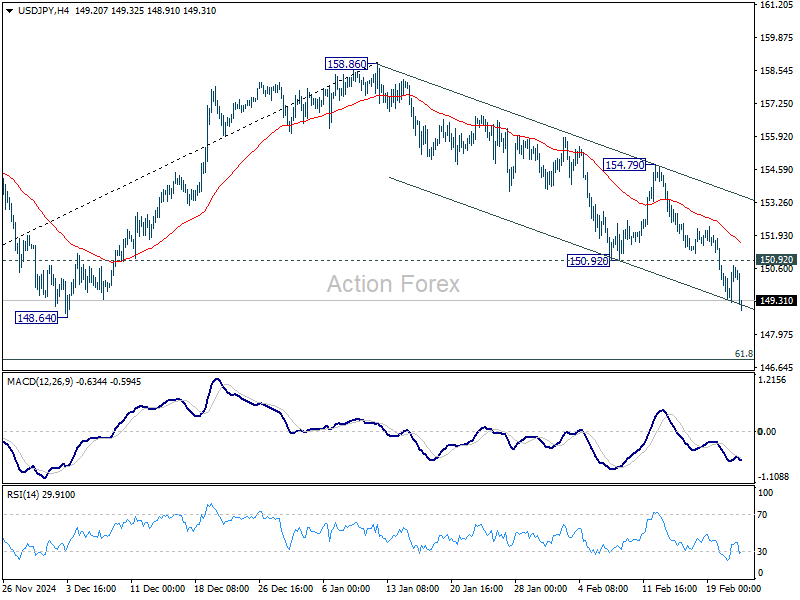
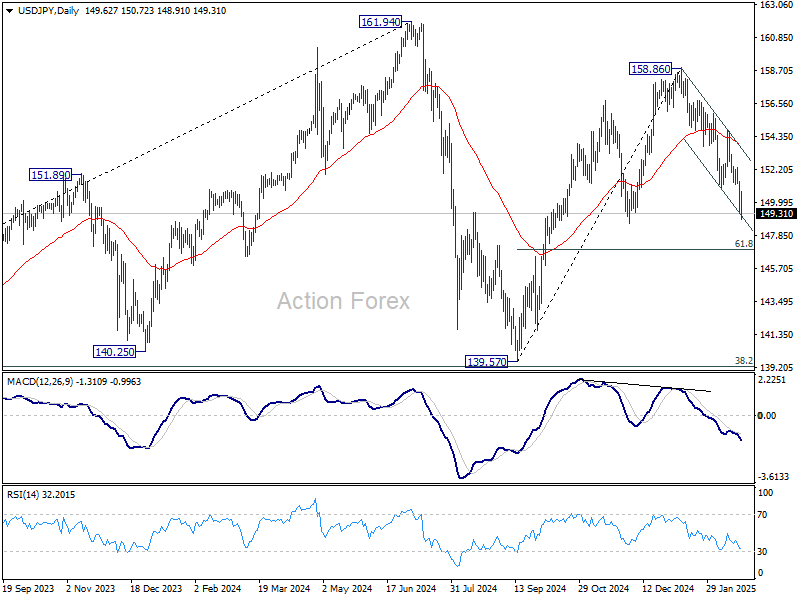
USD/JPY's extended decline last week suggests that rebound from 139.57 has already completed with three waves up to 158.86. Fall from 158.86 is now seen as the third leg of the pattern from 161.94.
Deeper fall is expected as long as 150.92 support turned resistance holds, to 61.8% retracement of 139.57 to 158.86 at 146.32. Firm break there will pave the way back to 139.57. Meanwhile, break of 150.92 will delay the bearish case and bring some consolidations first.
Any extended USD/JPY weakness should limit Dollar’s rebound. However, this alone shouldn't be enough to push DXY below key fibonacci support at 106.34 mentioned above.
AUD/NZD Reverses after RBA and RBNZ Rate Cuts
Both RBA and RBNZ delivered rate cuts last week, with RBA lowering its cash rate by 25bps to 4.10% and RBNZ cutting by 50bps to 3.75%, in line with expectations.
RBA maintained a cautious tone, with Governor Michele Bullock emphasizing "patience" before considering another cut. The accompanying statement warned against easing "too much too soon," highlighting concerns that disinflation progress could stall and inflation could settle above the midpoint of the target range if policy is loosened aggressively.
Australian economic data also reinforced RBA’s cautious stance, with strong job growth and elevated wage pressures supporting a measured pace of policy easing.
Meanwhile, RBNZ delivered a more defined path for easing, with Governor Adrian Orr clearly ruling out further 50bps cuts barring an economic shock. Instead, the central bank has outlined two additional 25bps cuts in the first half of the year.
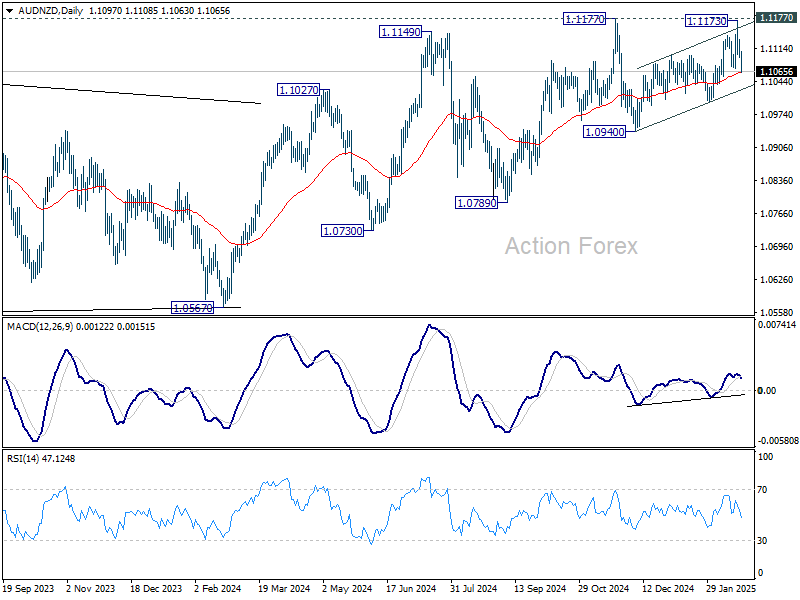
In the currency markets, AUD/NZD saw a sharp decline, falling back toward its 55 D EMA (now at 1.1063). The key driver of this move is likely the perception that RBNZ is nearing the end of its rate-cutting cycle, while RBA has only just begun easing, leaving room for further reductions if economic conditions weaken.
With the OCR at 3.75% already close to the neutral band, there is limited downside for RBNZ, while RBA at 4.10% has more room to cut rates. This policy divergence, particularly if Australia's economy slows further due to trade tensions between US and China, could keep downward pressure on AUD/NZD in the near term.
Technically, sustained trading below 55 D EMA should confirm rejection by 1.1177 resistance. Fall from 1.1173 would be seen as the third leg of the corrective pattern from 1.1177. Further break of near term channel support (now at 1.1029) would pave the way back to 1.0940 support next.
EUR/USD Weekly Outlook
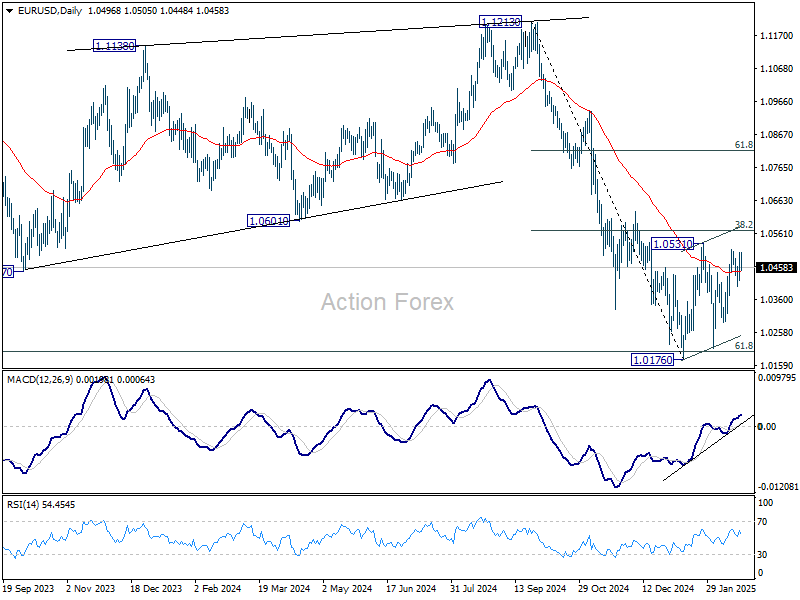
Range trading continued in EUR/USD last week and outlook is unchanged. Initial bias remains neutral this week first. Price actions from 1.0176 are seen as a corrective pattern only. IN case of further rise, upside should be limited by 38.2% retracement of 1.1213 to 1.0176 at 1.0572. On the downside, break of 1.0400 support will turn bias back to the downside for 1.0176/0210 support zone. However, decisive break of 1.0572 will raise the chance of reversal, and target 61.8% retracement at 1.0817.

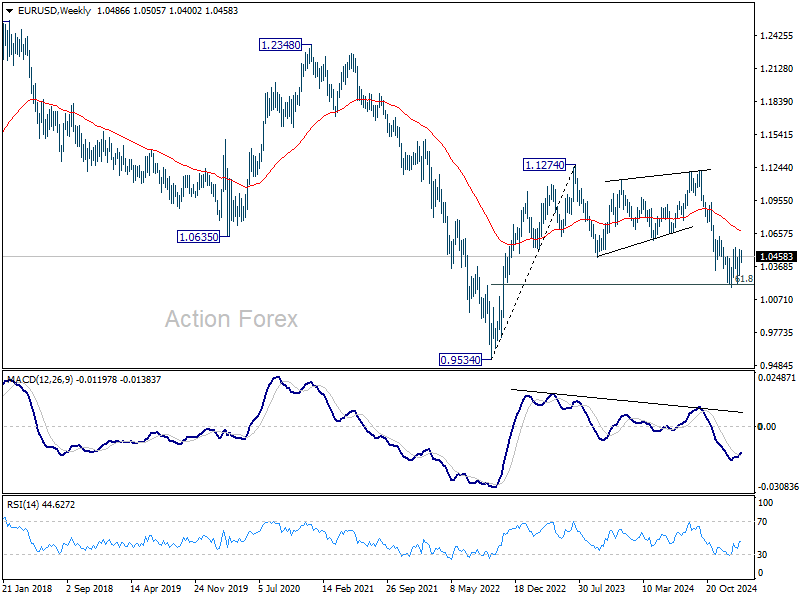
In the bigger picture, focus stays on on 61.8 retracement of 0.9534 (2022 low) to 1.1274 (2024 high) at 1.0199. Sustained break there will solidify the case of medium term bearish trend reversal, and pave the way back to 0.9534. However, strong rebound from 1.0199 will argue that price actions from 1.1274 are merely a corrective pattern, and has already completed.
In the long term picture, down trend from 1.6039 remains in force with EUR/USD staying well inside falling channel, and upside of rebound capped by 55 M EMA (now at 1.0929). Consolidation from 0.9534 could extend further and another rising leg might be seem. But as long as 1.1274 resistance holds, eventual downside breakout would be mildly in favor.

EUR/USD Weekly Outlook
Range trading continued in EUR/USD last week and outlook is unchanged. Initial bias remains neutral this week first. Price actions from 1.0176 are seen as a corrective pattern only. IN case of further rise, upside should be limited by 38.2% retracement of 1.1213 to 1.0176 at 1.0572. On the downside, break of 1.0400 support will turn bias back to the downside for 1.0176/0210 support zone. However, decisive break of 1.0572 will raise the chance of reversal, and target 61.8% retracement at 1.0817.
In the bigger picture, focus stays on on 61.8 retracement of 0.9534 (2022 low) to 1.1274 (2024 high) at 1.0199. Sustained break there will solidify the case of medium term bearish trend reversal, and pave the way back to 0.9534. However, strong rebound from 1.0199 will argue that price actions from 1.1274 are merely a corrective pattern, and has already completed.
In the long term picture, down trend from 1.6039 remains in force with EUR/USD staying well inside falling channel, and upside of rebound capped by 55 M EMA (now at 1.0929). Consolidation from 0.9534 could extend further and another rising leg might be seem. But as long as 1.1274 resistance holds, eventual downside breakout would be mildly in favor.
USD/JPY Weekly Outlook
USD/JPY's fall from 158.86 resumed by breaking through 150.29 support last week. The development suggests that whole rally from 139.57 has completed with three waves up to 158.86. Fall from there is now seen as the third leg of the pattern from 161.94 high. Initial bias stays on the downside this week for 61.8% retracement of 139.57 to 158.86 at 146.32 next. On the upside, above 150.97 resistance will turn intraday bias neutral and bring consolidations first, before staging another decline.
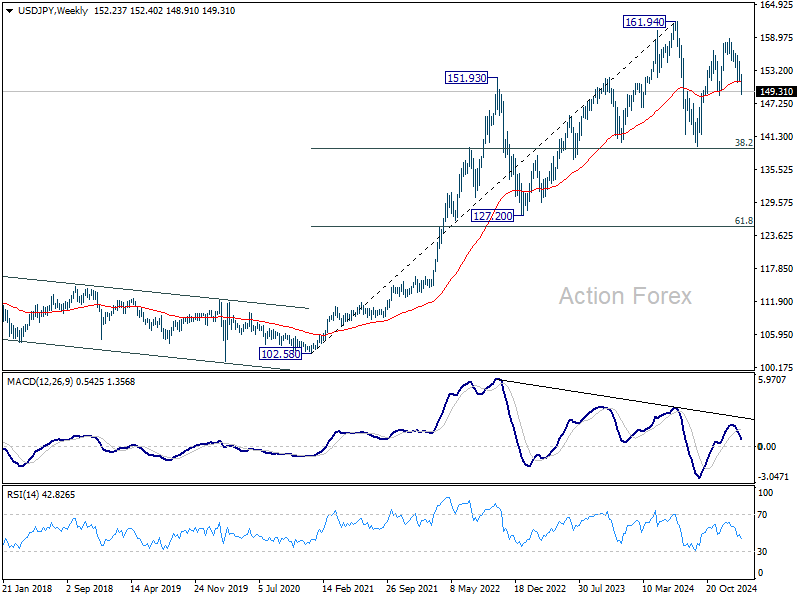
In the bigger picture, price actions from 161.94 are seen as a corrective pattern to rise from 102.58 (2021 low). In case of another fall, strong support should be seen from 38.2% retracement of 102.58 to 161.94 at 139.26 to bring rebound. However, sustained break of 139.26 would open up deeper medium term decline to 61.8% retracement at 125.25.
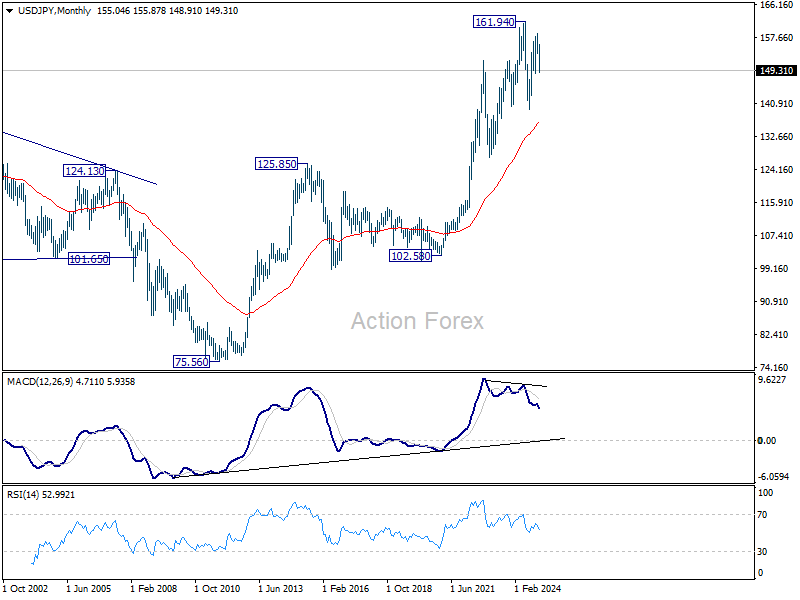
In the long term picture, it's still early to conclude that up trend from 75.56 (2011 low) has completed. A medium term corrective phase should have commenced, with risk of deep correction towards 55 M EMA (now at 136.50).
GBP/USD Weekly Outlook
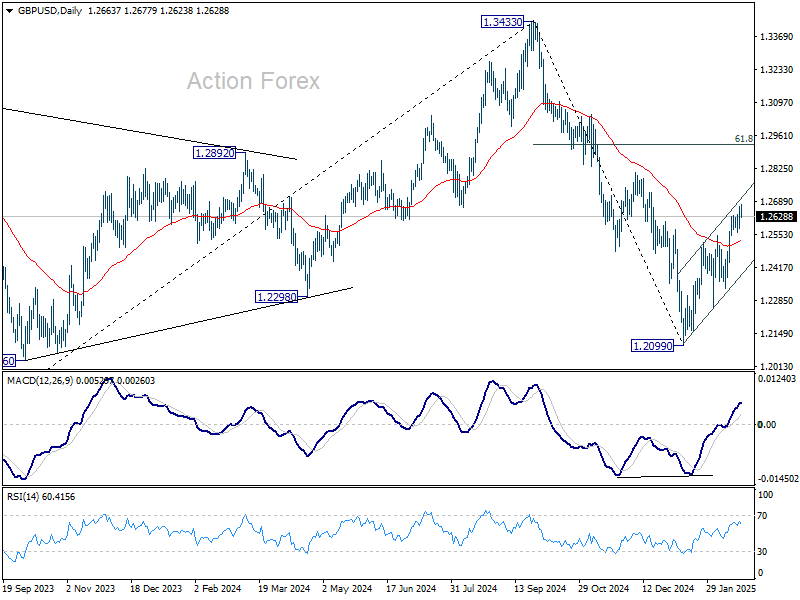
GBP/USD's extended rally last week suggests that stronger rise is underway even still as a correction to fall from 1.3433. Initial bias stays on the upside this week for 1.2810 resistance first. Firm break there will target 61.8% retracement of 1.3433 to 1.2099 at 1.2923 next. On the downside, below 1.2562 minor support will turn intraday bias neutral again first. But another rise will remain in favor as long as 1.2331 support holds, in case of retreat.
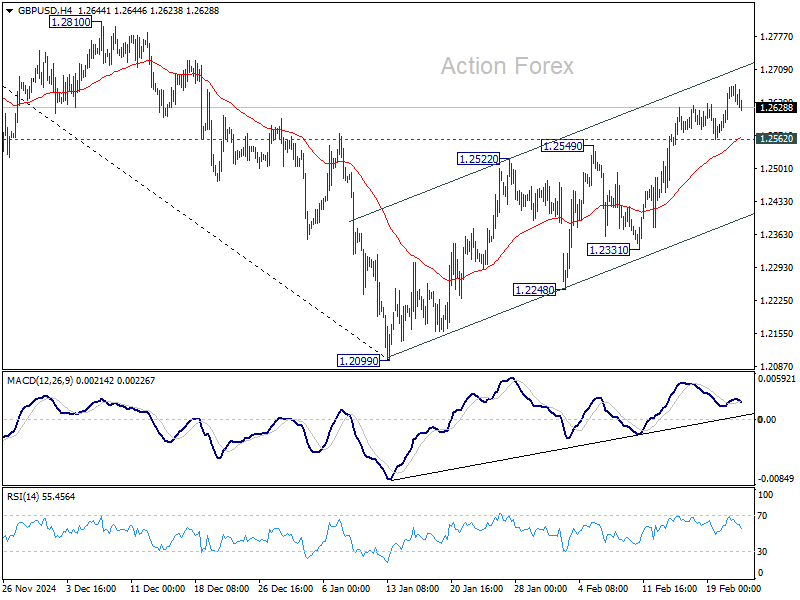
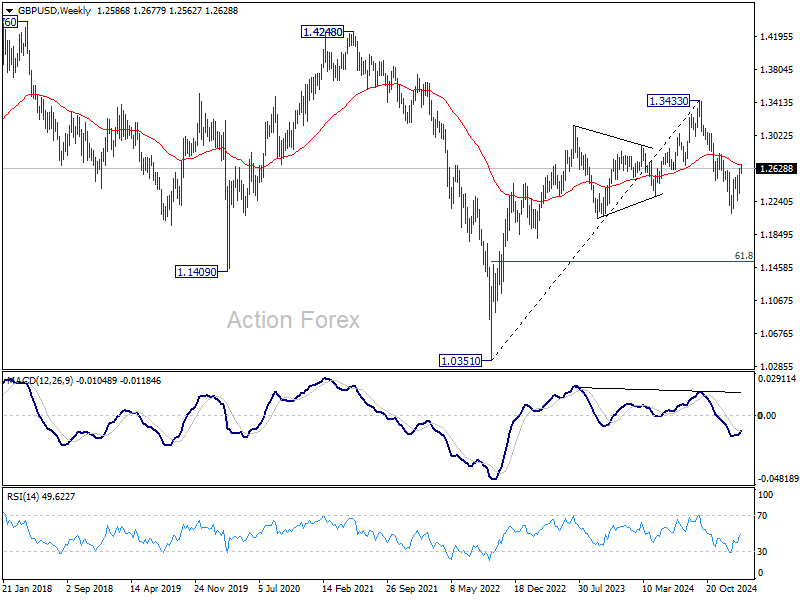
In the bigger picture, rise from 1.0351 (2022 low) should have already completed at 1.3433 (2024 high), and the trend has reversed. Further fall is now expected as long as 1.2810 resistance holds. Deeper decline should be seen to 61.8% retracement of 1.0351 to 1.3433 at 1.1528, even as a corrective move. However, firm break of 1.2810 will dampen this bearish view and bring retest of 1.3433 high instead.
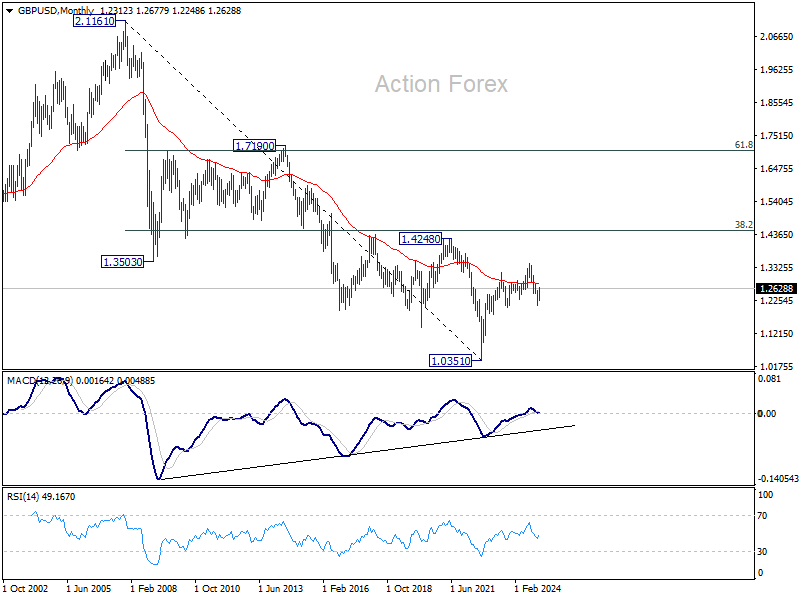
In the long term picture, price actions from 1.0351 (2022 low) are seen as a corrective pattern to the long term down trend from 2.1161 (2007 high) only. Outlook will be neutral at best as long as 1.4248 structural resistance holds, even in case of strong rebound.
USD/CHF Weekly Outlook
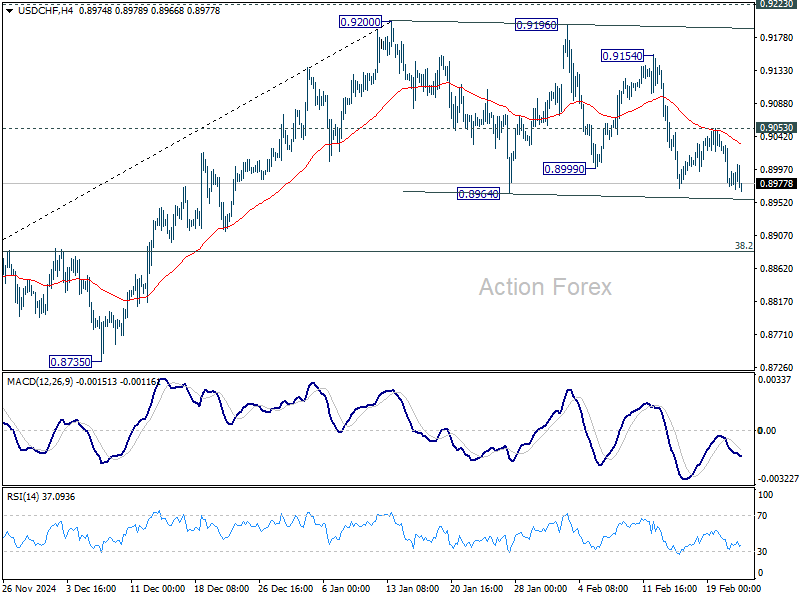
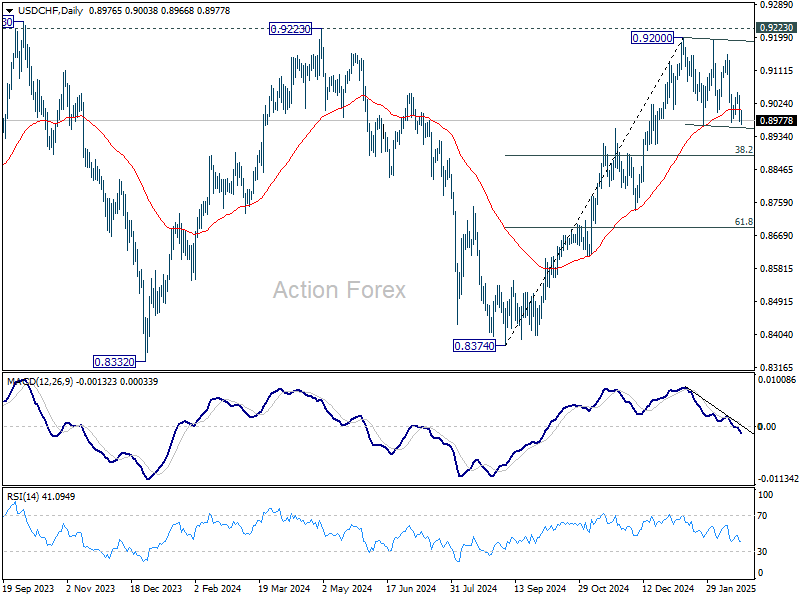
USD/CHF gyrated lower last week as corrective pattern from 0.9200 extended. While deeper decline cannot be ruled out, larger rally is still expected to continue as long as 38.2% retracement of 0.8374 to 0.9200 at 0.8884 holds. On the upside, above 0.9053 will bring retest of 0.9200 resistance. However, sustained break of 0.8884 will indicate bearish reversal, and target 61.8% retracement at 0.8690 instead.
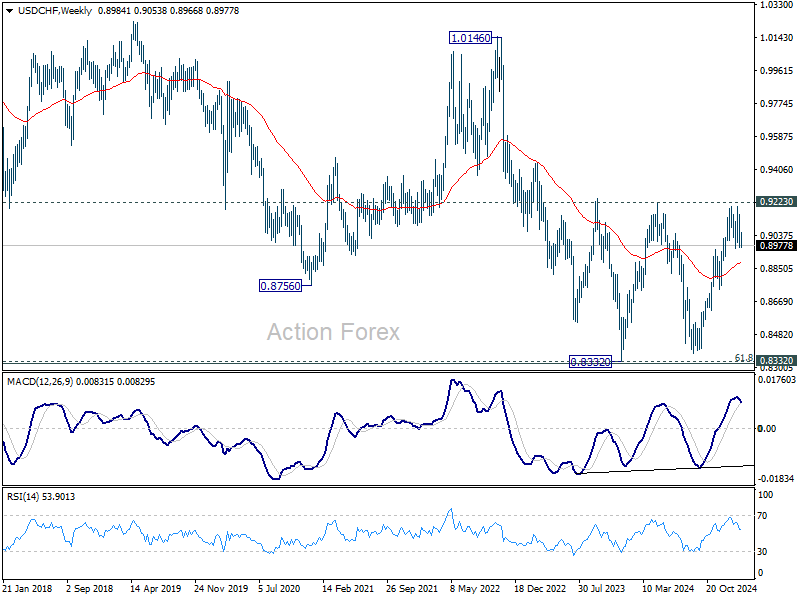
In the bigger picture, decisive break of 0.9223 resistance will argue that whole down trend from 1.0342 (2017 high) has completed with three waves down to 0.8332 (2023 low). Outlook will be turned bullish for 1.0146 resistance next. Nevertheless, rejection by 0.9223 will retain medium term bearishness for another decline through 0.8332 at a later stage.
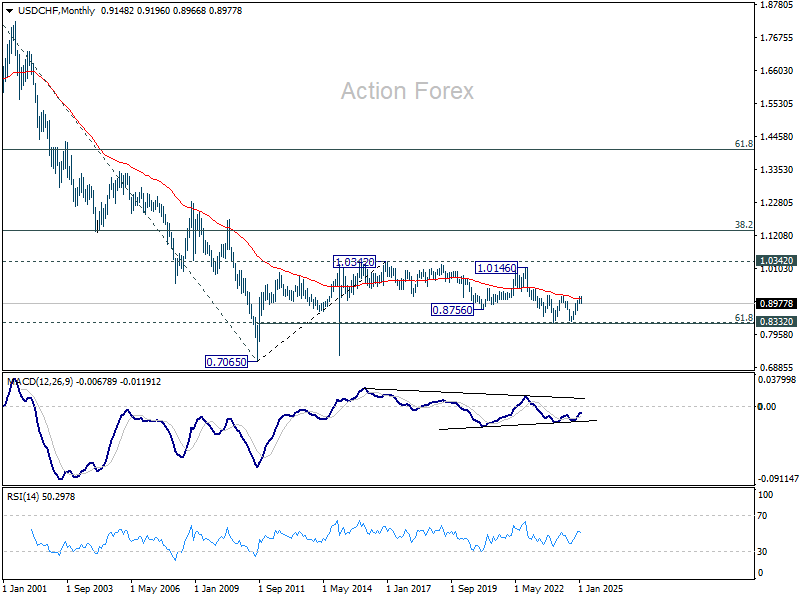
In the long term picture, price action from 0.7065 (2011 low ) are seen as a corrective pattern to the multi-decade down trend from 1.8305 (2000 high). Fall from 1.0342 (2016 high) is seen as the second leg. Sustained break of 55 M EMA (now at 0.9131) will indicate that the third leg has already started. However, rejection by 55 M EMA again, followed by break of 61.8% retracement of 0.7065 to 1.0342 at 0.8317, will pave the way back to 0.7065.
AUD/USD Weekly Report
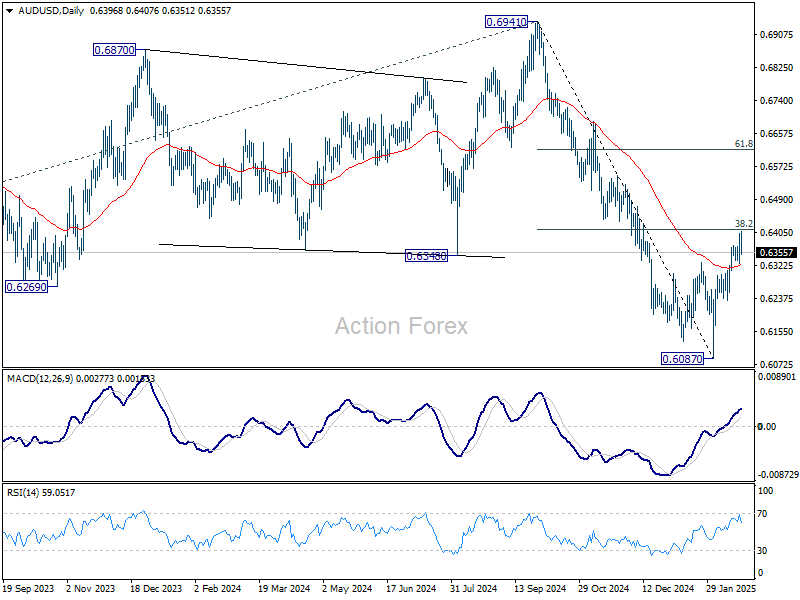
AUD/USD's rebound from 0.6087 extended higher last week but lost momentum again just ahead of 38.2% retracement of 0.6941 to 0.6087 at 0.6413. Initial bias is turned neutral this week first. On the downside, firm break of 0.6327 will suggest that the corrective rebound has completed, and bring deeper fall to retest this low. Nevertheless, sustained break of 0.6413 will pave the way back to 61.8% retracement at 0.6615, even still as a correction.
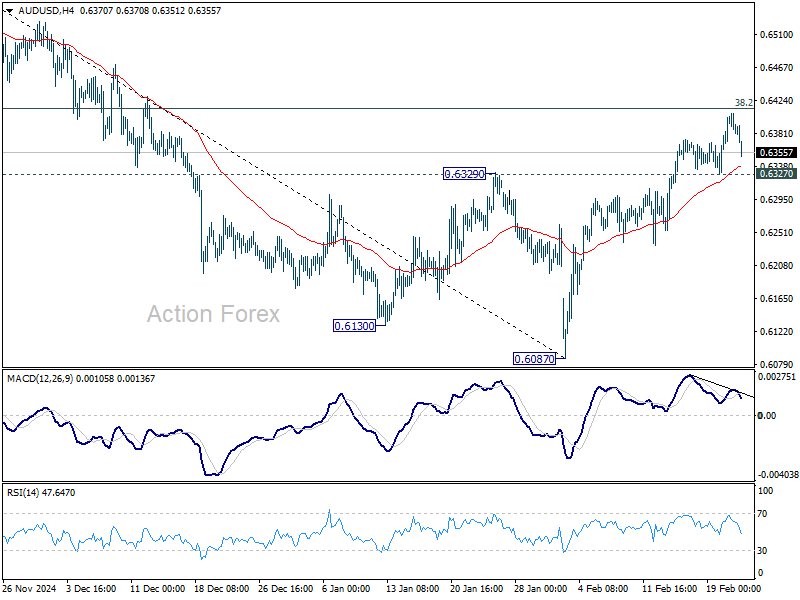
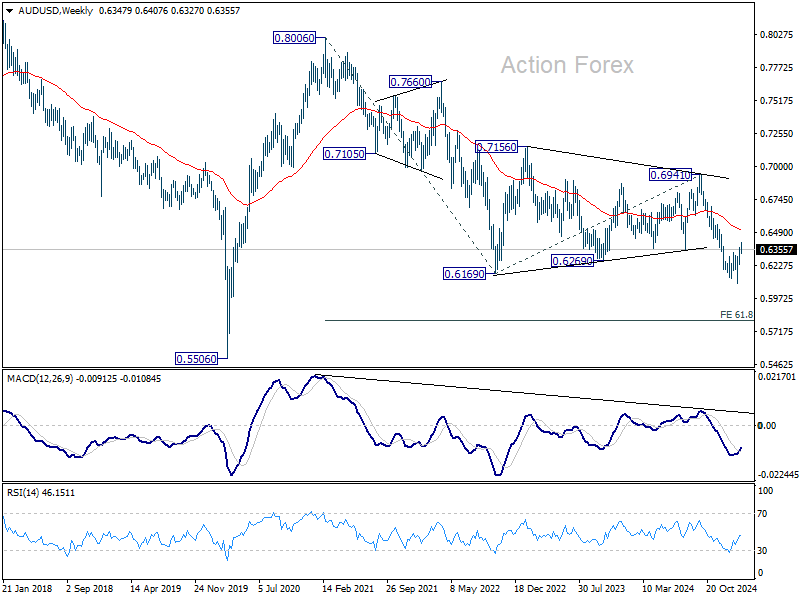
In the bigger picture, fall from 0.6941 (2024 high) is seen as part of the down trend from 0.8006 (2021 high). Next medium term target is 61.8% projection of 0.8006 to 0.6169 from 0.6941 at 0.5806. In any case, outlook will stay bearish as long as 55 W EMA (now at 0.6505) holds.
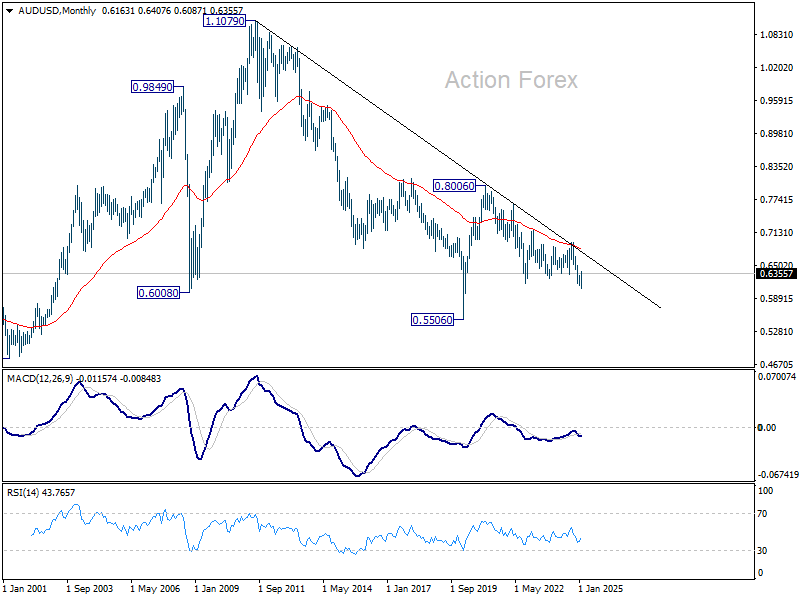
In the long term picture, prior rejection by 55 M EMA (now at 0.6823) is taken as a bearish signal. But for now, fall from 0.8006 is still seen as the second leg of the corrective pattern from 0.5506 long term bottom (2020 low). Hence, in case of deeper fall, strong support should emerge above 0.5506 to contain downside to bring reversal. However, this view is subject to adjustment if current decline accelerates further.
USD/CAD Weekly Outlook
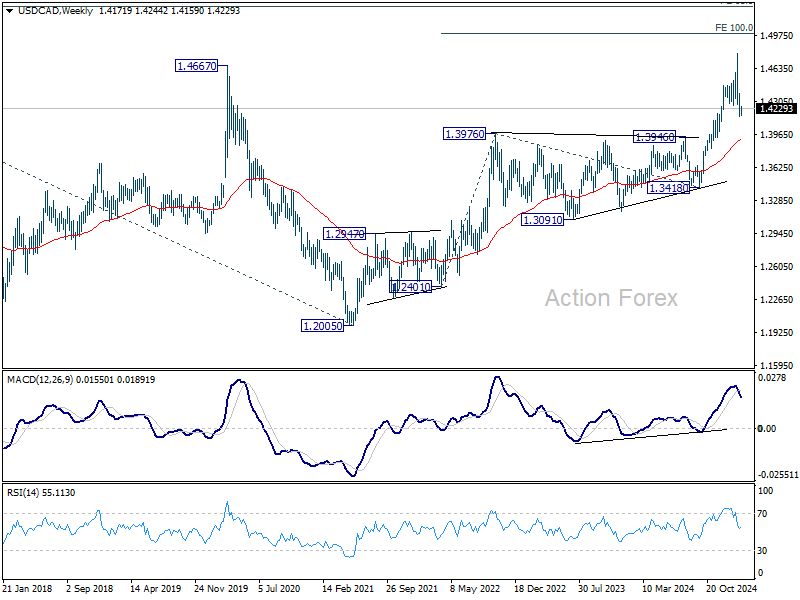
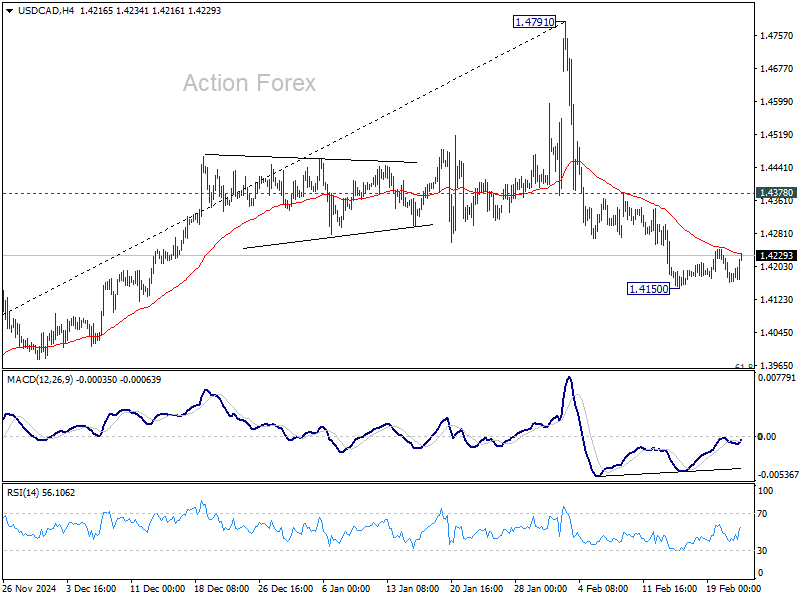
USD/CAD turned into sideway consolidations last week and outlook is unchanged. Initial bias remains neutral this week first and further fall is expected with 1.4378 resistance intact. Decline from 1.4791 is seen as a correction to rally from 1.3418. Break of 1.4150 will target 1.3946 cluster support (61.8% retracement of 1.3418 to 1.4791 at 1.3942).
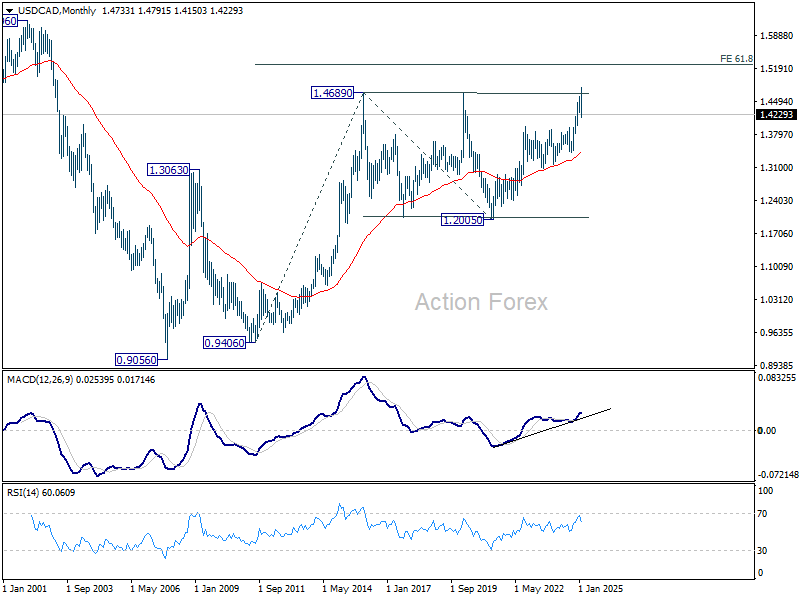
In the bigger picture, long term up trend is tentatively seen as resuming with prior breach of 1.4667/89 key resistance zone (2020/2015 highs). Next target is 100% projection of 1.2401 to 1.3976 from 1.3418 at 1.4993. This will remain the favored case as long as 1.3976 resistance turned support holds (2022 high), even in case of deep pullback.
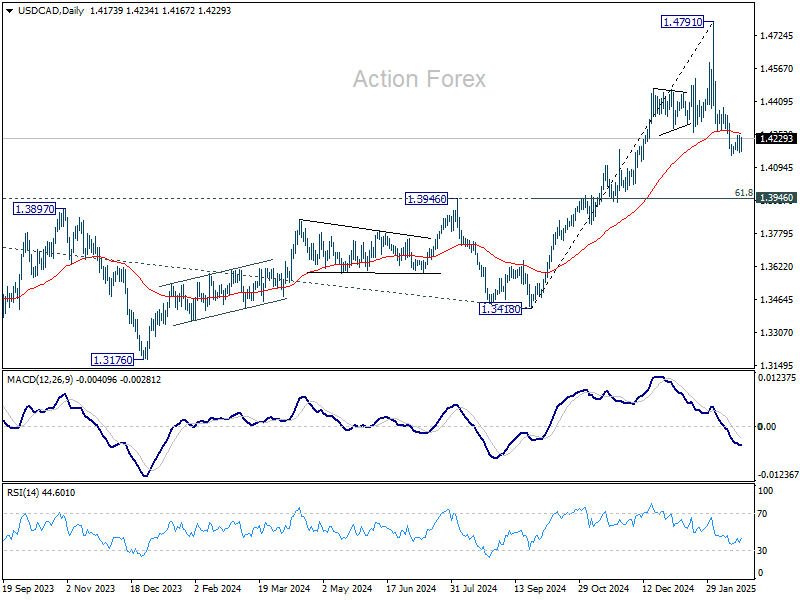
In the longer term picture, up trend from 0.9506 (2007 low) is in progress and possibly resuming. Next target is 61.8% projections of 0.9406 to 1.4689 from 1.2005 at 1.5270. While rejection by 1.4689 will delay the bullish case, further rally will remain in favor as long as 55 M EMA (1.3420) holds.