

Sample Category Title
GBP/JPY Daily Outlook
Daily Pivots: (S1) 147.35; (P) 148.31; (R1) 149.65; More...
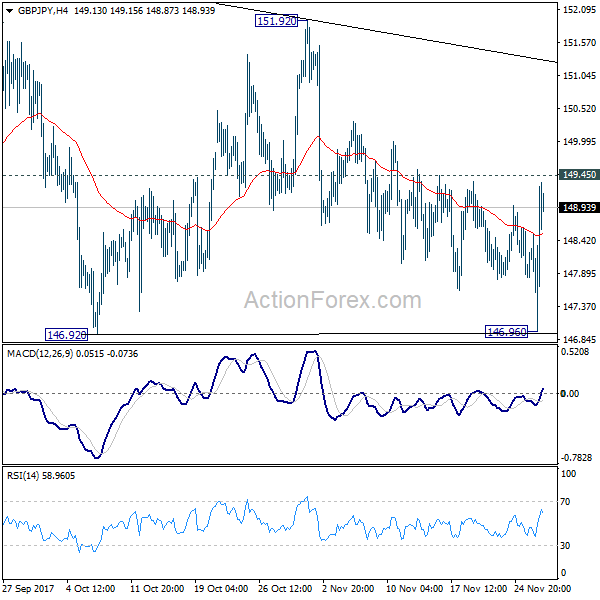
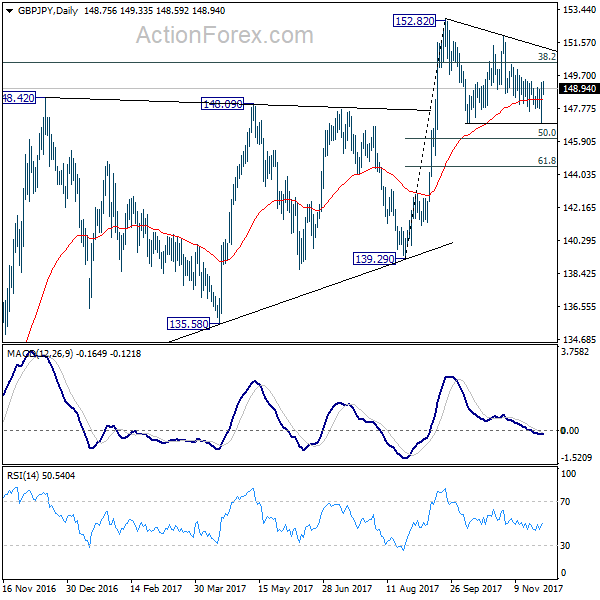
Outlook in GBP/JPY is unchanged that price actions from 152.82 are forming a corrective pattern. On the upside, above 149.45 will turn bias to the upside for 151.92 resistance first. Break there will likely resume rise from 139.29 through 152.82 high. On the downside, below 146.96 will bring deeper fall. But now, we'd expect downside to be contained by 50% retracement of 139.29 to 152.82 at 146.05 to bring up trend resumption eventually.
In the bigger picture, medium term rebound from 122.36 is still expected to resume after corrective pull back from 152.82 completes. Firm break of 38.2% retracement of 196.85 to 122.36 at 150.43 will carry long term bullish implications. In that case, GBP/JPY could target 61.8% retracement at 167.78. However, break of 139.29 will indicate rejection from 150.43 key fibonacci level. And the three wave corrective structure of rebound from 122.36 will argue that larger down trend is resuming for a new low below 122.26.
US Stocks Surged to Records as Tax Plan Moved Another Step, Sterling Boosted by Reports of Brexit Bill
US equities staged a strong rally overnight. Investors were happy that another step was taken with the Republican's tax plan. Senate version was approved by the Budget Committee, paving the way for a floor vote on Thursday. Also, Fed chair nominee Jerome Powell commented that current banking regulations are "tough enough". And there could even be some easing also lifted sentiments. DOW closed up 255.93 pts or 1.09% at 23826.71. S&P 500 gained 25.62 pts or 0.98% at 2627.04. NASDAQ also rose 33.84 pts or 0.49% to 6912.36. All three indices closed at record highs. Dollar rebounded broadly but was overwhelmed by Sterling. The Pound was given a strong boost on reports that UK and EU have agreed on the divorce bill.
Fed Powell: Banking regulations tough enough already
Fed Chair nominee Jerome Powell's confirmation hearing brought little new to the markets. Basically, Powell indicated that "the case for raising interest rates at our next meeting is coming together." He didn't sound too concerned with slow inflation in the US and expected inflation to rise as the economy nears full employment. Regarding banking regulations, Powell indicated they are "tough enough" for now. And he expressed the intention to "consider appropriate ways to ease regulatory burdens while preserving core reforms".
Minneapolis Fed President Neel Kashkari sounded cautious again in his speech yesterday. He said that "because inflation is low, I am seeing no reason to tap the brakes on the economy." He added that "my perspective is, let's allow the job market to continue to strengthen, allow more Americans to go back to work, allow wages to strengthen, and then, if we start to see inflation creep back up to our 2-percent target, we can tap the brakes then." Kashkari dissented both of Fed's hikes this year. His comments suggested that he's going to dissent again in December.
Sterling jumped as UK and EU agreed on divorce bill
Sterling rebounds broadly and stays firm on multiple reports that an agreement was reached between UK and EU on the divorce bill, clearing an important hurdle to move on to trade talks. The Daily Telegraph reported that EU's request for EUR 60b was agreed in principle. There would be further detailed interpretations and the final amount could range between EUR 45b and EUR 55b. The Financial Times reported that EU liabilities could sum up to EUR 100b but net payments over the decades could add up to half the amount. UK's Brexit Ministry just said that there were "intensive talks" and both sides were finding ways to "build on recent momentum". European Commission declined to comment. But the news raised hope that there would finally be "sufficient progress" made before EU summit on December 14/15 to move on to trade negotiations.
BoC Poloz named housing as big risks
Bank of Canada Governor Stephen Poloz said that "our financial system continues to be resilient, and is being bolstered by stronger growth and job creation". But he also emphasized the need to "continue to watch financial vulnerabilities closely." The central bank pointed out, in the latest financial system review, risks of historic levels of household debts. And, more than 80% of the debts is on mortgages and home equities credit lines. Poloz warned that "these vulnerabilities continue to be elevated and it will take a long time for them to return to more sustainable levels."
RBNZ to unwind home loan restrictions
RBNZ indicates today that it would to unwind some restrictions on home loans. The loan-to-value ratio restrictions could be modestly eased starting January 1 next year. Governor Grant Spencer said that "over the past six months, pressures in the housing market have continued to moderate due to the tightening of LVR restrictions in October 2016." And, "the market has been coming off really since mid-last year and so we have been considering it particularly as Auckland was flattening out and indeed going negative." Also, "housing market policies announced by the government are also expected to have a dampening effect on the housing market."
North Korea close to striking anywhere in US mainland
North Korea launched an intercontinental ballistic missile which flew for 53 minutes over 960km and reached an altitude of more than 4000km. US Secretary of Defense James Mattis said that it's the highest reaching missile ever. And it's believed that North Korea is now close to being able to strike anywhere in the mainland US. South Korea President Moon Jae-in called for dialogue and urged to "prevent a situation where North Korea threatens us with its nuclear arsenal based on misjudgment or the US. considers a preemptive strike." The news was shrugged off by the markets though.
On the data front
Japan retail sales rose 0.8% yoy in October. UK BRC shop price dropped -0.1% yoy in November. Germany CPI will be the main feature in European session. Eurozone will release confidence indicators and French GDP. UK will release mortgage approvals and M4. Swiss will release UBS consumption indicators. Later in the day, US will release Q2 GDP revisions, pending home sales and Fed's Beige Book. Fed Chair Janet Yellen will also have her last Congressional testimony.
GBP/JPY Daily Outlook
Daily Pivots: (S1) 147.35; (P) 148.31; (R1) 149.65; More...
Outlook in GBP/JPY is unchanged that price actions from 152.82 are forming a corrective pattern. On the upside, above 149.45 will turn bias to the upside for 151.92 resistance first. Break there will likely resume rise from 139.29 through 152.82 high. On the downside, below 146.96 will bring deeper fall. But now, we'd expect downside to be contained by 50% retracement of 139.29 to 152.82 at 146.05 to bring up trend resumption eventually.
In the bigger picture, medium term rebound from 122.36 is still expected to resume after corrective pull back from 152.82 completes. Firm break of 38.2% retracement of 196.85 to 122.36 at 150.43 will carry long term bullish implications. In that case, GBP/JPY could target 61.8% retracement at 167.78. However, break of 139.29 will indicate rejection from 150.43 key fibonacci level. And the three wave corrective structure of rebound from 122.36 will argue that larger down trend is resuming for a new low below 122.26.
Economic Indicators Update
| GMT | Ccy | Events | Actual | Forecast | Previous | Revised |
|---|---|---|---|---|---|---|
| 23:50 | JPY | Retail Trade Y/Y Oct | 0.80% | 0.00% | 2.20% | |
| 00:01 | GBP | BRC Shop Price Index Y/Y Nov | -0.10% | -0.10% | ||
| 07:00 | CHF | UBS Consumption Indicator Oct | 1.56 | |||
| 07:45 | EUR | French GDP Q/Q Q3 P | 0.50% | 0.50% | ||
| 09:30 | GBP | Mortgage Approvals Oct | 65K | 66K | ||
| 09:30 | GBP | M4 Money Supply M/M Oct | 0.30% | -0.20% | ||
| 10:00 | EUR | Eurozone Business Climate Indicator Nov | 1.51 | 1.44 | ||
| 10:00 | EUR | Eurozone Economic Confidence Nov | 114.6 | 114 | ||
| 10:00 | EUR | Eurozone Industrial Confidence Nov | 8.6 | 7.9 | ||
| 10:00 | EUR | Eurozone Services Confidence Nov | 16.7 | 16.2 | ||
| 10:00 | EUR | Eurozone Consumer Confidence Nov F | 0.1 | 0.1 | ||
| 13:00 | EUR | German CPI M/M Nov P | 0.30% | 0.00% | ||
| 13:00 | EUR | German CPI Y/Y Nov P | 1.70% | 1.60% | ||
| 13:30 | USD | GDP Annualized Q/Q Q3 S | 3.20% | 3.00% | ||
| 13:30 | USD | GDP Price Index Q3 S | 2.20% | 2.20% | ||
| 15:00 | USD | Pending Home Sales M/M Oct | 1.20% | 0.00% | ||
| 15:30 | USD | Crude Oil Inventories | -1.9M | |||
| 19:00 | USD | Federal Reserve Beige Book |
Indecision Candle At AUD/NZD Daily Support
With Monday's AUD/USD and yesterday's USD/CAD setups playing out nicely, I wanted to speak about the AUD/NZD short setup that we had previously featured. A level that didn't hold and the setup was blown out of the water by a fundamental news spike.
Take a look at the chart below in comparison to September's blog. The zone broke to the upside pretty convincingly, but as you can now see, price is back retesting it again from the other side.
AUD/NZD Daily:
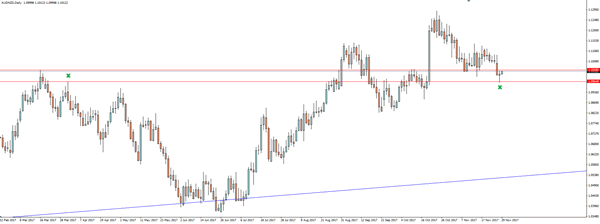
It's not just the level that's interesting, but it's the price action inside it. The last daily candle that's low touches the bottom of the marked zone is a pretty juicy indecision candle. The fact that it's inside the support zone and the bottom touched the exact bottom gives it more stead in my opinion.
Now zoom into an intraday chart and take a look at the price action on for example the 15 minute chart such as below.
AUD/NZD 15 Minute:
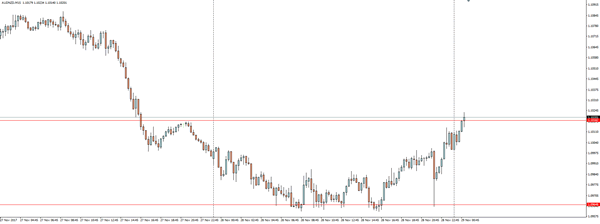
You can really see the buyers coming in at the bottom of the zone with that huge wick late in the trading session.
Let's see if it can break and hold back above it now. Remember that for now, it's just a daily indecision candle rather than a reversal.
Won Heck of a Story Unfolding in Asia FX
After a relatively uninspiring Asia session yesterday, equity markets returned to recent form overnight after the Senate Budget Committees stamped their approval on the Senates tax plan.
Also Financial's hit a high note during Jerome Powell's testimony to the Senate Banking Committee when his comments regarding "easing regulatory burdens while preserving core reforms." put a huge smile on Wall Street Bankers faces and an even broader one on their shareholders.
Initially, the dollar moved higher lifted by higher US yields after Senate Budget Committee signed off the bill to move to the Senate floor for a final vote. But with Powell towing the current Fed's dovish narrative of gradual rate hikes in his earlier Senate confirmation the dollar edge dulled quickly against most G-10, but USDJPY remained buoyant on improving risk sentiment.
The festivities were briefly interrupted after the US Pentagon confirmed that an NK missile launch was "probable," made around 13:30 EST. But unlike the previous North Korea missile tests, investors haven't sounded any alarm bells and in fact, quickly faded the initial knee-jerk.
The British Pound
Sterling is being lashed around on the latest Brexit headlines. The Pound ripped higher after a deal over the soi-disant 'Brexit bill' which includes a purported EUR60bn financial settlement according to sources on both sides was agreed on balance. This headline is fantastically positive news for the beleaguered pound which was sold early in the day after Bank of England governor Mark Carney's depressing warning of potential Brexit fallout. While Carney candid talks my hold true, the financial settlement should pave the way to possible breakthrough in negotiations in December overcoming investors biggest fears, a hard Brexit
The New Zealand Dollar
The Kiwi moved higher in early trade on an unexpected decision from the RBNZ to ease its LVR restrictions. The move proved to be short-lived and was quickly sold given the tacitly backed stronger USD dollar narrative this morning
The Euro
The Euro failed to break convincingly higher on Monday or Tuesday, and that alone would have caused traders to unwind some overextend long EUR positioning. But the single currency got caught up in headline wash after Brixit positive news caused EURGBP to crater, and then Ireland's deputy PM Frances Fitzgerald is reported facing calls to resign over a controversy involving a police whistleblower. Mind you, the Irish edition of EU political risk should be inconsequential to the Euro as have all the other politically inspired moves. But last nights sell-off is as much about Traders getting nervous about the crowded trade mentality in less than ideal liquidity conditions and cutting quickly when the trade set up goes sideways.
The Japanese Yen
Its been a real chop feast this week as the market digests noise about BoJ normalisation, US Tax Reform, month-end rebalancing and of course, the North Korea threat. It makes for difficult trading conditions, however, buying the USDJPY dip still looks attractive on the positive risk outcome from US tax reform.
The Australian Dollar
In listless trade, the Aussie dollar is slightly lower as the currency remains range bound amidst the market's competing priorities.
Indeed all the talk about China destabilising markets into year end is not helping sentiment as the Aussie would be the go-to G-10 hedge against China market fallout.
The Chinese Yuan before the Fix
Month end and year end USD demands are creeping into the picture keeping a floor under the USDCNH. Not much early action despite the moves other regional pairs so I suspect the latest equity market bobble and bond market sell-off is too fresh in traders minds to take on more Yuan risk.
Energy Market
Oil traders remain incredibly jittery ahead of Thursday's OPEC meeting. And while we can never be sure what's evolving behind closed doors, market whispers suggest Saudi Arabia and Russia are not yet fully coordinated which indicates the balance of risks remain skewed lower.
The Korean Won
The market woke up when London walked in eager to buy Asia FX. The move was briefly interrupted by news that North Korea has tested another missile.But the KRW reaction is very very telling as USDKRW NDF barley moved from 1082.70 to 1084.50 before USD offers returned as geopolitically risk desensitised investors view little chance of escalation and are using these opportunities to add risk.
On the broader KRW rally that began in earnest in London, some were attributing the move to Yonhap News Agency reports that China has eased the ban on group tour packages bound for South Korea which was put in place after the deployment of the THAAD missile system. But the move has more to do with the grand exit of long USD geopolitical risk hedges ahead of Thursday BoK interest rate decision
Traders will be on the edge of their seat awaiting the BoK rate hike and more specifically what tone the governor will take. There's a high chance for dovish interest hike expressed during the press conference to slow down the pace of the Won appreciation.
The Malaysian Ringgit
The Market continues to express its bullish Asia FX views through the Ringgit which rallied yesterday in tandem with regional peers.
The Yellen-Esq dulcet dovish tones from incoming Fed Chair Jerome Powell portend well for the Ringgit. And while the USD, more so USDJPY, could bounce higher on a favourable tax reform improving global risk sentiment, the bounce in global equity markets should play favourably in the region and offset higher USDJPY
The Indian Rupee
A strong showing for the Rupee yesterday bolstered by investment inflow.The dovish Fed rhetoric play's well for the Ruppe and looks very favourable after breaking through 64.50 level. Sentiment remains a guardedly optimistic on the Rupee in conjunction with other Asain pairs. However, given the Rupee susceptibility to rising oil prices, suspect traders will be less inclined to push USDINR lower until after OPEC clears the airwaves.
Bank of Canada Sees Elevated Risks, But Things are Moving in the Right Direction
The Bank of Canada released the latest edition of its biannual Financial System Review this morning, laying out an updated view of the main risks facing Canada's financial system. Household indebtedness and housing market imbalances once again took center stage. However, robust economic growth and tightened mortgage rules are seen as factors that should mitigate these vulnerabilities over time. The vulnerability of the Canadian financial system to cyber-attacks was also highlighted as a risk.
On the topic of household indebtedness, the Bank noted that credit growth continues to outpace income growth, largely due to mortgage and HELOC activity. Encouragingly, the share of mortgage originations going to highly-indebted, high-ratio borrowers has declined notably, likely due to mortgage stress test rules implemented last year. However, there are signs that risks may have shifted towards low-ratio borrowers. They account for about 9 in 10 new mortgages in Toronto and Vancouver, with the share of both borrowers that are highly indebted and those with amortizations of more than 25 years trending up, pointing to heightened risk.
The newest mortgage underwriting guidelines from OSFI are meant to address this risk, but the Bank of Canada sees uncertainty around the effectiveness, noting that around 17% of outstanding uninsured mortgages are held by credit unions that are not regulated by OSFI and therefore not subject to the new guidelines. As such, there remains the possibility that high risk borrower activity shifts away from the more heavily regulated areas of the financial system. However, the extent of migration may be limited by the relatively smaller lending capacity available. On balance, the new guidelines are seen as broadly supportive of overall credit quality, although the large stock of outstanding debt means it will take some time for the overall vulnerability to be reduced.
On a related note, the Bank highlighted the vulnerability stemming from imbalances in Canadian housing markets. The report notes that as Toronto has undergone an adjustment over the summer months, home price growth elsewhere has remained steady, with healthy growth in Vancouver and nascent signs of a recovery in Alberta. This has served to reduce the differences in regional home price growth. Policy measures, including changes to underwriting standards are expected to continue to reduce demand and thus price growth, particularly in the high growth markets of Toronto and Vancouver. The Bank also noted that some localized measures, such as foreign buyer taxes in specific regions may have only a limited impact, and may be pushing demand to other cities.
Cyber threats have always been a risk to the financial system, but the growing interconnectedness of the system means that the impacts can be more significant, with a successful attack against one institution potentially spreading more widely. The Bank is working with financial institutions to increase resiliency and put recovery plans in place.
Other vulnerabilities discussed include brokered deposits at monoline lenders, with the experience at Home Capital Group earlier this year demonstrating the risk of rapid funding withdrawal. Risk taking, in a general sense, is being incentivized by low interest rates and low market volatility, leading to the use of higher leverage and rising risk profiles among investors. Finally, high corporate indebtedness was noted – corporate debt relative to GDP is at historic highs, although firms appear to have adequate cash buffers at present.
Key Implications
Canada's financial system may be facing a number of key vulnerabilities, but the Bank of Canada sees things moving in the right direction. For both high household indebtedness and housing market imbalances, changes to underwriting standards and rising interest rates are having, or are expected to have, the desired effect. The report noted that past changes to standards for borrowers with low down payments had something of a balloon-squeezing impact, pushing some risk into high down payment lending, but this should be at least partially mitigated by expanded mortgage stress-testing requirements in the new year.
More fundamentally, rising borrowing costs, which impact all sectors of the market, should work to slow activity. The Bank noted that five-year fixed mortgage rates are up 70 basis points since June, bringing them in line with levels seen five years ago. At the same time an improved economic backdrop, including robust employment growth, is seen as also working to reduce vulnerabilities through time.
In light of the sizeable stock of debt outstanding, it will be some time before these factors work their way through the market, with these vulnerabilities not going away any time soon. However, the Bank sees things as moving in the right direction – towards reduced financial sector risk – a scenario consistent with continued gradual tightening of monetary policy in 2018.
BoC Says Financial System Risks Still Elevated But Sees Signs of Improvement
Our Take:
Thanks to a growing economy and changes in housing regulation, the Bank of Canada sounded a bit more sanguine on risks facing the financial system. Today's semi-annual Financial System Review noted that key vulnerabilities related to household debt and housing market imbalances remain elevated, but in contrast to prior reports, haven't necessarily increased over the last six months.
The bank has emphasized that the economy will be more sensitive to higher interest rates than in the past due to elevated household debt levels. Today's report provided little new insight on that interaction, so it's tough to draw implications for monetary policy. But we think it's worth remembering what Governor Poloz said around the time of the June FSR: with the economic backdrop having improved, monetary policy and financial stability goals are less at odds with one another. Higher interest rates will both keep the economy from overheating and help address key vulnerabilities. So while the bank will likely raise rates more gradually than they otherwise would, household indebtedness isn't necessarily an impediment to tightening monetary policy.
Cable Has a Catalyst
Separate reports suggested UK PM Theresa May's government is close to a breakthrough on negotiations around the Brexit bill. Cable jumped on the headlines and was the top performer on the day while the euro lagged. Japanese retail sales are due up next. 2nd EURUSD trade has been issued. Tomorrow marks Janet Yellen's final testimony to Congress' joint economic committee. The video for Premium subscribers is posted below, highlighting the existing and future trades.
It was a lively day of trading that included heavy newsflow. The pound suffered early and cable was down more than a cent when a Telegraph report said a deal was largely done that would put the exit bill at 45-55B euros. Cable jumped more than 120 pips then fell back down when a government spokesman denied it. A second report, this time from the FT, added more detail, indicating the deal could be part of a broader deal on the Ireland border and EU citizen's rights. That sent cable near 1.3400 from as low as 1.3220 on the day.
More importantly, it's a fresh catalyst for cable. If confirmed, it's a sign that negotiations are bearing fruit and progressing towards some sort of a deal. At this point, nearly any kind of resolution or progress is good for sterling.
Across the Atlantic, the US dollar was buoyed by economic data as consumer confidence rose to the best level since 2000 and the Richmond Fed hit an all-time high. New home sales also beat expectations, but trade and inventory reports led to downgrades of Q4 growth estimates.
The tax plan also made progress but once again that buoyed stock markets while leaving the US dollar behind. The S&P 500 surged 26 points to a record 2627.
In geopolitical news, North Korea tested a missile but the dip was merely a buying opportunity in USD/JPY and stock markets.
Amidst all that, Fed chair nominee Powell was grilled in his confirmation hearing but most of the time was eaten up trying to score political points on the tax plan. On monetary policy, he did his best Yellen impression and said gradual rate hikes was the best path forward. At the same time, he struck a few dovish notes by warning on low wage inflation and some signs of slack.
Looking ahead, we will continue to monitor the North Korea fallout but also watch for retail sales from Japan at 2350 GMT. The consensus is for a +0.2% m/m rise after a 0.8% m/m jump in Sept. Comments from the BOJ's Nakaso are also due at 0700 GMT.
Canadian Dollar Lower After Strong US Consumer Confidence
The Canadian dollar depreciated on Tuesday with the US dollar gaining on confident consumers and improving housing prices in the United States. Canadian producer prices rose 1.0 percent in October thanks to auto prices being sensitive to a currency fluctuations. Raw materials rose 3.8 percent as energy prices keep rising. Despite the rise in inflation indicators the loonie could not gain a foothold against the USD. The Bank of Canada (BoC) presented its Financial System Review and Governor Poloz held a press conference to discuss the findings of the economic assessment.
In the last review six months ago the central bank had struck notes of concerns regarding high levels of household debt and rising house prices. Now with two rate hikes between them and new regulation in place to avoid a housing bubble the BoC was seen as optimistic, but gone were the hawkish undertones of the summer. The Canadian central bank remains concerned with household debt as it exposes borrowers to higher rates but that could be offset by a strong jobs component with growing wages. Poloz said that the risks were unchanged, but the policy changes in housing finance are a step in the right direction. The BoC is not expected to make another adjustment to the Canadian benchmark rate until 2018 as there are improvements in the indicators, but the jury is still out on the price fo crude and the fate of NAFTA.
Trade relations between the US and Canada just got thornier after the latter just initiated a WTO case against the US for the duties it imposed on Canadian lumber. This follows the NAFTA challenge issued in early November. The renegotiation of the 23 year old trade agreement have not gone to plan and in some best case scenarios the deal would be close to being wrapped up before the end of the year. The reality is that the negotiating teams are far apart, specially the US Trade representatives who are pushing an America First agenda that leaves little room to compromise.
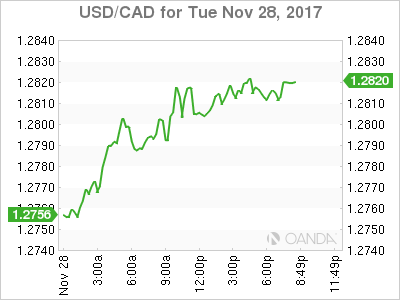
The USD/CAD gained 0.36 percent on Tuesday. The currency pair is trading at 1.2815 after Fed Chair nominee went before the US Senate to testify. He remains a hawk in the style of Janet Yellen and talking about the December rate hike. The rise of consumer confidence as reported by the Conference Board is now at a 17 year high, which bodes well for tomorrow's release of the second estimate of third quarter gross domestic product (GDP) data. The Bank of Canada (BoC) Financial System Review and the word form Governor Poloz could not offset the strong US data and the loonie depreciated.
The Bank of Canada (BoC) hiked twice in 2017, but that only put the Canadian benchmark rate back to 1 percent where it was when Governor Poloz cut the rate twice to boost the economy ahead of the fall of oil prices. The loonie will face more pressure as the Fed continues its monetary policy tightening pace, while the BoC will be more cautious as it monitors rising household debt.
Job numbers will be released in Canada on Friday, December 1. Statistics Canada will publish the monthly GDP figures as well as the employment report both at 8:30 am EST. GDP is expected to have shrunk by 0.1 percent and there is some anxiety on the job front as the first ADP job report for Canada showed a loss of 5,700 in October. The US GDP for the third quarter is expected to have improved between the first and second estimates, and if the Canadian economy continues to show signs of cooling it will put more pressure not the CAD ahead of the December monetary policy meetings of both central banks.
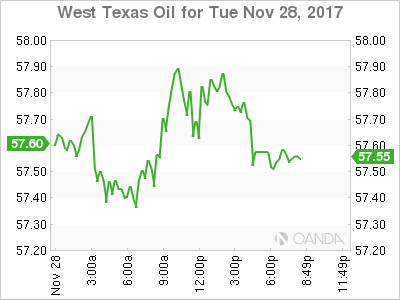
Oil prices recovered some ground in the last 24 hours. West Texas Intermediate is trading at $57.73 awaiting the news to come out of the Organization of the Petroleum Exporting Countries (OPEC) meeting in Vienna. The price of oil has already priced in an extension as multiple comments from OPEC and non-OPEC members have pointed to increasing the deadline past March 2018. The main remaining issue is how long will the agreement be extended by. The consensus at this point is for a 9 month extension with a meeting at the six month mark to review.
Earlier today a committee made up by OPEC and non-OPEC members recommended the extension until the end of 2018, with the option of a review in June. Comments from energy Ministers have been supportive, but the duration of the deal is still up for debate in the next couple of days.
US production has increased and with the Keystone pipeline restarted operations, but still at reduced capacity. Disruptions in North America due to weather and forest fires has kept production lower than otherwise expected with the OPEC doing the heavy lifting on price stability. The market will be watching for developments in Vienna as the floor of energy pricing has been put in place by the OPEC production cut, and once it reaches its end crude prices will be vulnerable if global demand for energy has not recovered at the same rate as production.
Market events to watch this week:
Wednesday, November 29
- All Day All OPEC Meetings
- 8:30am USD Prelim GDP q/q
- 10:30am USD Crude Oil Inventories
- 7:00pm NZD ANZ Business Confidence
- 7:30pm AUD Private Capital Expenditure q/q
Thursday, November 30
- 8:30am USD Unemployment Claims
Friday, December 1
- 4:30am GBP Manufacturing PMI
- 8:30am CAD Employment Change
- 8:30am CAD GDP m/m
- 10:00am USD ISM Manufacturing PMI
*All times EDT
Gold Ticks Higher, Markets Digesting Powell Testimony
Gold has posted slight gains on the Tuesday session. In North American trade, the spot price for an ounce of gold is $1295.91, up 0.12% on the day. In the US, CB Consumer Confidence jumped to 129.5, crushing the estimate of 123.9 points. In Washington, Fed Chair Designate Jerome Powell testified at his confirmation hearing before the Senate Banking Committee.
The markets were listening closely, as Jerome Powell testified before a senate committee. Powell said that he favored tailoring regulations for small banks, leaving the toughest regulations for the big players. Powell was cautious and diplomatic during the hearing, saying that the case is building for a December rate hike, and refused to express an opinion on the Trump tax bill. He will replace Janet Yellen in February, and is widely expected to continue Yellen's monetary stance of small, gradual rate hikes.
Powell inherits an economy that is in excellent shape, but persistently low inflation remains a nagging problem. Fed policymakers have differing views on what to do about inflation, with some members proposing that the Fed drop its 2 percent target, in favor of a "gradually rising path" for prices. The Fed remains confounded by low inflation and wage growth, despite a labor market that is at full capacity. Still, the Fed will likely pull the rate trigger next month, and could raise rates up to 3 more times in 2018 if the economy continues to expand at its current pace.
Pound Slips as Carney Spooks Markets
The British pound has posted considerable losses in the Tuesday session. In North American trade, GBP/USD is trading at 1.3223, down 0.66% on the day. On the release front, the Bank of England published the results of its bank stress tests and the semi-annual Financial Stability report. In the US, CB Consumer Confidence jumped to 129.5, crushing the estimate of 123.9 points. In Washington, Fed Chair Designate Jerome Powell is testifying at his confirmation hearing before the Senate Banking Committee.
There was positive news from the banking sector on Tuesday, as all seven major UK banks passed the BoE's stress tests. This is a reliable indication that the banking sector is in decent shape, despite nagging concerns about the toll that Brexit could take the British economy. Still, investors were quick to seize on negative comments from BoE Governor Mark Carney, who warned that in the case of a "disorderly" Brexit, the financial sector would face "some quite material economic costs". Carney's warning has sent the pound lower on Wednesday. Prime Minister May is expected to improve on its offer for its Brexit divorce bill, which could smooth some feathers in Brussels. Until now, the Europeans had demanded EUR 60 billion, while the UK had countered with EUR 20 billion. Another headache for May is the issue of the border between Northern Ireland and Ireland and its status after Brexit. The DUP party, which is propping up May in parliament, does not want a hard border between Ireland and Northern Ireland. However, if Britain does not remain in a customs union with the EU after Brexit, the result would likely be a hard border, given that there would be different regulatory schemes in Ireland and Northern Ireland.
All eyes are on the Federal Reserve on Tuesday, as Jerome Powell is testifying before the Senate Banking Committee. Investors will be listening closely, as Powell faces questions from lawmakers about his plans as head of the powerful central bank. Powell is widely expected to maintain Janet Yellen's cautious monetary stance, which has been marked by small, incremental rate hikes. Powell inherits an economy that is in excellent shape, but persistently low inflation remains a nagging problem. Fed policymakers have differing views on what to do about inflation, with some members proposing that the Fed drop its 2 percent target, in favor of a "gradually rising path" for prices. The Fed remains confounded by low inflation and wage growth, despite a labor market that is at full capacity. Still, the Fed will likely pull the rate trigger next month, and could raise rates up to 3 more times in 2018 if the economy continues to expand at its current pace.